EP1496111B1 - Varianten der 3-Phosphoglyceratdehydrogenase mit reduzierter Hemmung durch L-Serin und dafür codierende Gene - Google Patents
Varianten der 3-Phosphoglyceratdehydrogenase mit reduzierter Hemmung durch L-Serin und dafür codierende Gene Download PDFInfo
- Publication number
- EP1496111B1 EP1496111B1 EP04015524A EP04015524A EP1496111B1 EP 1496111 B1 EP1496111 B1 EP 1496111B1 EP 04015524 A EP04015524 A EP 04015524A EP 04015524 A EP04015524 A EP 04015524A EP 1496111 B1 EP1496111 B1 EP 1496111B1
- Authority
- EP
- European Patent Office
- Prior art keywords
- pgd
- amino acids
- serine
- sera
- escherichia coli
- Prior art date
- Legal status (The legal status is an assumption and is not a legal conclusion. Google has not performed a legal analysis and makes no representation as to the accuracy of the status listed.)
- Expired - Lifetime
Links
Classifications
-
- C—CHEMISTRY; METALLURGY
- C12—BIOCHEMISTRY; BEER; SPIRITS; WINE; VINEGAR; MICROBIOLOGY; ENZYMOLOGY; MUTATION OR GENETIC ENGINEERING
- C12N—MICROORGANISMS OR ENZYMES; COMPOSITIONS THEREOF; PROPAGATING, PRESERVING, OR MAINTAINING MICROORGANISMS; MUTATION OR GENETIC ENGINEERING; CULTURE MEDIA
- C12N9/00—Enzymes; Proenzymes; Compositions thereof; Processes for preparing, activating, inhibiting, separating or purifying enzymes
- C12N9/0004—Oxidoreductases (1.)
- C12N9/0006—Oxidoreductases (1.) acting on CH-OH groups as donors (1.1)
-
- C—CHEMISTRY; METALLURGY
- C12—BIOCHEMISTRY; BEER; SPIRITS; WINE; VINEGAR; MICROBIOLOGY; ENZYMOLOGY; MUTATION OR GENETIC ENGINEERING
- C12P—FERMENTATION OR ENZYME-USING PROCESSES TO SYNTHESISE A DESIRED CHEMICAL COMPOUND OR COMPOSITION OR TO SEPARATE OPTICAL ISOMERS FROM A RACEMIC MIXTURE
- C12P13/00—Preparation of nitrogen-containing organic compounds
- C12P13/04—Alpha- or beta- amino acids
-
- C—CHEMISTRY; METALLURGY
- C12—BIOCHEMISTRY; BEER; SPIRITS; WINE; VINEGAR; MICROBIOLOGY; ENZYMOLOGY; MUTATION OR GENETIC ENGINEERING
- C12P—FERMENTATION OR ENZYME-USING PROCESSES TO SYNTHESISE A DESIRED CHEMICAL COMPOUND OR COMPOSITION OR TO SEPARATE OPTICAL ISOMERS FROM A RACEMIC MIXTURE
- C12P13/00—Preparation of nitrogen-containing organic compounds
- C12P13/04—Alpha- or beta- amino acids
- C12P13/06—Alanine; Leucine; Isoleucine; Serine; Homoserine
-
- C—CHEMISTRY; METALLURGY
- C12—BIOCHEMISTRY; BEER; SPIRITS; WINE; VINEGAR; MICROBIOLOGY; ENZYMOLOGY; MUTATION OR GENETIC ENGINEERING
- C12Y—ENZYMES
- C12Y101/00—Oxidoreductases acting on the CH-OH group of donors (1.1)
- C12Y101/01—Oxidoreductases acting on the CH-OH group of donors (1.1) with NAD+ or NADP+ as acceptor (1.1.1)
- C12Y101/01095—Phosphoglycerate dehydrogenase (1.1.1.95)
Definitions
- the phosphoglycerate family of amino acids is defined as being amino acids involved in their biosynthesis derived from the 3-phosphoglyceric acid.
- the natural pathway of metabolism leads initially through the intermediates 3-Phospohydroxypyruvat and 3-phospho-L-serine to L-serine.
- L-serine can also be converted to glycine or via O-acetyl-serine to L-cysteine.
- L-tryptophan belongs to this group, as it is also derived in the biosynthesis of L-serine.
- unnatural amino acids which are prepared by the method described in US 2002/0039767 A1, attributable to the phosphoglycerate family.
- compounds derived from C1 metabolism also show a dependence on the biosynthesis of the amino acids of the phosphoglycerate family. This is due to the fact that in the conversion of L-serine to glycine tetrahydrofolate acts as C1- Nemakzeptor and the loading tetrahydrofolate as a central methyl group donor in C1 metabolism in many biosyntheses (eg L-methionine, nucleotides, pantothenic acid, etc.) involved is.
- compounds derived from the C1 metabolism are thus preferably compounds whose biosynthesis depends on C1 group transfer via tetrahydrofolic acid.
- the initial step in the biosynthesis of amino acids of the phosphoglycerate family is the oxidation of D-3-phosphoglyceric acid to 3-phosphohydroxypyruvate and is catalyzed by the enzyme 3-phosphoglycerate dehydrogenase (PGD) [EC 1.1.1.95].
- PGD 3-phosphoglycerate dehydrogenase
- PGD enzymes are known from a variety of organisms (eg Rattus norvegicus, Arabidopsis thaliana, Escherichia coli, Bacillus subtilis). The better characterized microbial members are subject to feedback inhibition by L-serine.
- the microbial PGD enzymes in the N-terminal part are very similar to each other, whereas the C-terminal portion has little similarity. Especially in this C-terminal part, the regulatory domain responsible for serine inhibition is located (Peters-Wendisch et al., 2002, Appl. Microbiol. Biotechnol. 60: 437-441).
- PGD The best characterized PGD is that of Escherichia coli.
- the enzyme has been extensively biochemically studied (Dubrow & Pizer, 1977, J. Biol. Chem. 252, 1527-1538) and is subject to allosteric feedback inhibition by L-serine with an inhibitor constant K i of 5 ⁇ M.
- EP0620853A has described variants of Escherichia coli PGD with reduced susceptibility to serine inhibition, which is a modification in the C-terminal 25% of the wild-type PGD (ie amino acids 307-410), preferably a modification in the region of the last 50 residues (ie, amino acids 361-410).
- the mutants described were obtained by linker mutagenesis, i. obtained by simple use of existing restriction sites in the E. coli serA gene and subsequent insertion of oligonucleotide linkers of a length of 8-14 base pairs.
- linker mutagenesis is usually problematic because the incorporation or deletion of several residues greatly alters the structure of the protein and thus adversely affects the overall activity or stability of the protein. In fact, most of the mutants described in EP0620853A show barely detectable activity.
- the object of the present invention was to provide variants of the PGD of Escherichia coli, which have a reduced susceptibility to serine inhibition in comparison to wild-type Escherichia coli PGD.
- the object is achieved by a PGD according to claim 1.
- a PGD according to the invention may additionally have the mutation D at position 349 if the amino acid I is located at position 372.
- the invention further relates to a DNA sequence coding for the PGD according to the invention according to claim 1.
- This serA allele differs from the gene of Escherichia coli PGD (serA gene, SEQ ID NO: 1) in that the codon 372 for a natural amino acid coded with the exception of threonine.
- the enzymatic activity of the gene product corresponds to more than 10% of the activity of the wild-type gene product.
- PGD variants of the invention can be generated by standard molecular biology techniques. For this purpose, mutations are introduced into the serA gene coding for the PGD at the corresponding codons. Appropriate methods for introducing mutations at specific positions within a DNA fragment are known.
- the starting material for the mutagenesis is preferably the DNA of the E. coli serA gene.
- the serA gene to be mutated can be chromosomally or extrachromosomally encoded.
- the serA gene is amplified by polymerase chain reaction and cloned into a vector.
- any method can be used which allows to determine the activity of the enzyme in the presence of L-serine.
- the determination of PGD activity can be based on the method described by McKrickick and Pizer (1980, J. Bacteriol 141: 235-245).
- the enzyme activity is measured by the reverse reaction in an approach containing phosphohydroxypyruvate and NADH / H + .
- the reaction is started by enzyme addition and monitored by the decrease in absorbance at 340 nm, which is caused by oxidation of NADH / H + in a spectrophotometer.
- the inhibition of PGD activity is tested in the presence of various concentrations of L-serine in the reaction mixture.
- the catalytic activity of the various PGD variants is determined in the presence and absence of L-serine and used to determine the inhibitor constant K i .
- the K i describes that inhibitor concentration in which the activity is only 50% of the activity determined in the absence of the inhibitor.
- PGD enzymes of the present invention because of their feedback resistance, can be used to produce amino acids of the phosphoglycerate family or of compounds derived from the metabolism of Cl.
- the serA alleles according to the invention are expressed in a host strain.
- a serA allele can be carried out under the control of the own promoter which is localized in front of the serA gene or by using other suitable promoter systems which are known to the person skilled in the art.
- the corresponding allele may be in one or more copies on the chromosome of the host organism.
- the strategies for integrating genes into the chromosome are state of the art.
- the serA allele to be expressed is cloned into a vector, preferably a plasmid.
- the invention therefore also relates to a vector, characterized in that it contains a serA allele according to the invention under the functional control of a promoter.
- the serA alleles it is possible to use vectors which already contain genetic elements (eg constitutive or regulatable promoters, terminators) which allow either a sustained or a controlled, inducible expression of the gene encoding the PGD.
- genetic elements eg constitutive or regulatable promoters, terminators
- other regulatory elements such as ribosomal binding sites and termination sequences as well as sequences coding for selective marker and / or reporter genes.
- selection markers facilitates the identification of transformants. Suitable selection markers are genes which are resistant to z. As ampicillin, tetracycline, chloramphenicol, kanamycin or other antibiotics.
- the plasmid vector should preferably contain an origin of replication.
- plasmid vectors such as the E. coli vectors pACYC184, pUC18, pQE-70, pBR322, pSC101 and their derivatives.
- Suitable inducible promoters are, for example, the lac, tac, trc, lambda PL, ara or tet promoter or sequences derived therefrom.
- Such vectors allow for the direct production of microorganism strains according to the invention with high production efficiency from any strain of microorganism, since such a plasmid also causes the abolishment of other restrictions of the metabolic pathway in a microorganism.
- the serA allele-containing plasmids of the present invention are introduced into microorganisms and selected for example by antibiotic resistance to plasmid-carrying clones.
- the invention thus also relates to processes for the preparation of a microorganism strain according to the invention, characterized in that a vector according to the invention is introduced into a microorganism strain.
- all organisms which have the biosynthetic pathway for amino acids of the phosphoglycerate family, are accessible to recombinant processes and can be cultivated by fermentation are suitable as host organisms for vectors according to the invention.
- Such microorganisms may be fungi, yeasts or bacteria.
- bacteria of the phylogenetic group of Eubacteria are used.
- the invention thus further relates to a microorganism strain which is suitable for the fermentative production of amino acids of the phosphoglycerate family or their derivatives or of compounds derived from the C1 metabolism, characterized in that it has a PGD according to the invention.
- Another object of the invention is the production of amino acids of the phosphoglycerate family or of compounds derived from the C1 metabolism, by culturing a microorganism strain according to the invention.
- the microorganism strain according to the invention is cultured, for example, in a fermenter in a nutrient medium containing a suitable carbon source, and a suitable energy source, as well as other additives.
- the substances formed during the fermentation such as, for example, L-phosphoserine, L-serine, O-acetyl-L-serine, L-cysteine, glycine, L-tryptophan, 1,2,4-triazol-2-yl-L-alanine, L-methionine or pantothenic acid can then be purified.
- the serA gene from Escherichia coli strain W3110 was amplified by the polymerase chain reaction.
- the oligonucleotides were used as specific primers and
- the resulting DNA fragment was digested with the restriction enzymes NdeI and HindIII and the 5 'overhangs filled in with Klenow enzyme. Subsequently, the DNA fragment was purified by means of agarose gel electrophoresis and isolated by the GeneClean method (GeneClean Kit BI0101 POBox 2284 La Jolla, California, 92038-2284). The cloning of the serA fragment thus obtained was carried out in the expression vector pQE-70 (Qiagen, Hilden, D). For this, the vector was first cut with SphI and BamHI and the 3'-overhang was digested with Klenow enzyme or the 5'-overhang filled in with Klenow enzyme.
- the vector fragment was purified and ligated with the serA fragment.
- the resulting vector is called pFL209.
- the bacterial strain Escherichia coli JM109 / pFL209 was deposited with the DSMZ (German Collection for Microorganisms and Cell Cultures GmbH, D-38142 Braunschweig) under the number DSM 15628 in accordance with the Budapest Treaty.
- the cells were then harvested by centrifugation, washed and resuspended in 2 ml of buffer (100 mM K-phosphate pH 7.0, 10 mM MgCl 2 , 1 mM dithiothreitol). Cell disruption was performed using a French Press (Spectronic Instruments, Inc., Rochester, NY, USA) at a pressure of 18,000 psi. The crude extracts were clarified by centrifugation at 30,000 g and PGD activity was determined by the test of McKrickick and Pizer (1980, J. Bacteriol 141: 235-245). The following tables show the PGD activity of different mutants, as well as the corresponding inhibitor constants K i .
Landscapes
- Chemical & Material Sciences (AREA)
- Organic Chemistry (AREA)
- Life Sciences & Earth Sciences (AREA)
- Engineering & Computer Science (AREA)
- Zoology (AREA)
- Wood Science & Technology (AREA)
- Health & Medical Sciences (AREA)
- Genetics & Genomics (AREA)
- Bioinformatics & Cheminformatics (AREA)
- General Health & Medical Sciences (AREA)
- Biochemistry (AREA)
- General Engineering & Computer Science (AREA)
- Microbiology (AREA)
- Biotechnology (AREA)
- General Chemical & Material Sciences (AREA)
- Chemical Kinetics & Catalysis (AREA)
- Medicinal Chemistry (AREA)
- Molecular Biology (AREA)
- Biomedical Technology (AREA)
- Micro-Organisms Or Cultivation Processes Thereof (AREA)
- Enzymes And Modification Thereof (AREA)
- Preparation Of Compounds By Using Micro-Organisms (AREA)
- Measuring Or Testing Involving Enzymes Or Micro-Organisms (AREA)
Description
- Die Erfindung betrifft Varianten der 3-Phospoglyceratdehydrogenase mit reduzierter Hemmung durch L-Serin und dafür codierende Gene.
- Die Herstellung der zwanzig natürlichen, proteinogenen Aminosäuren wird heutzutage vorwiegend durch Fermentation von Mikroorganismen bewerkstelligt. Dabei wird ausgenützt, dass Mikroorganismen über entsprechende Biosynthesewege zur Synthese der natürlichen Aminosäuren verfügen.
- Solche Biosynthesewege unterliegen jedoch in Wildtyp-Stämmen einer strengen Kontrolle, die gewährleistet, dass die Aminosäuren nur zum Eigenbedarf der Zelle hergestellt werden. Ein wichtiger Kontrollmechanismus in vielen Biosynthesen ist beispielsweise das Phänomen der Feedback-Hemmung (oder Endprodukt-Hemmung). Dabei wird meist dasjenige Enzym eines Biosyntheseweges, das die einleitende enzymatische Reaktion dieses Biosynthesewegs katalysiert, durch das Endprodukt des Biosyntheseweges gehemmt. Die Hemmung findet meist durch eine allosterische Bindung des Endproduktes an das Enzym statt und bewirkt eine Konformationsänderung in einen inaktiven Zustand. So wird sichergestellt, dass bei einer Anhäufung des Endproduktes in der Zelle die weitere Synthese durch Hemmung des einleitenden Schrittes unterbunden wird.
- Eine effiziente industrielle Produktion von Stoffwechselprodukten (wie z.B. Aminosäuren) ist deshalb nur möglich, wenn die Restriktionen durch Feedbackhemmung eines Stoffwechselweges aufgehoben werden können und damit Mikroorganismen verfügbar gemacht werden, die im Gegensatz zu Wildtyp-Organismen eine drastisch gesteigerte Produktionsleistung für die Herstellung des gewünschten Stoffwechselprodukts aufweisen.
- Die Phosphoglycerat-Familie von Aminosäuren ist dadurch definiert, dass es sich um Aminosäuren handelt, die in ihrer Biosynthese von der 3-Phosphoglycerinsäure abgeleitet werden. Der natürliche Pfad des Stoffwechsels führt dabei zunächst über die Zwischenstufen 3-Phospohydroxypyruvat und 3-Phospho-L-serin zu L-Serin. L-Serin kann weiterhin zu Glycin bzw. über O-Acetyl-Serin zu L-Cystein umgesetzt werden. Auch L-Tryptophan ist zu dieser Gruppe zu zählen, da es sich ebenfalls in der Biosynthese von L-Serin ableitet. Ebenso sind unnatürliche Aminosäuren, die nach dem in US 2002/0039767 A1 beschrieben Verfahren hergestellt werden, der Phosphoglycerat-Familie zuzuordnen.
- Verbindungen, die sich aus dem C1-Stoffwechsel ableiten, zeigen ebenfalls eine Abhängigkeit von der Biosynthese der Aminosäuren der Phosphoglycerat-Familie. Dies beruht auf der Tatsache, dass bei der Konversion von L-Serin zu Glycin Tetrahydrofolat als C1-Gruppenakzeptor fungiert und das beladende Tetrahydrofolat als zentraler Methylgruppendonor im C1-Stoffwechsel an vielen Biosynthesen (z.B. L-Methionin, Nukleotide, Pantothensäure, etc.) beteiligt ist. Erfindungsgemäß sind Verbindungen, die sich aus dem C1-Stoffwechsel ableiten somit vorzugsweise Verbindungen, die in ihrer Biosynthese von einer C1-Gruppenübertragung über Tetrahydrofolsäure abhängen.
- Der einleitende Schritt der Biosynthese von Aminosäuren der Phosphoglycerat-Familie ist die Oxidation der D-3-Phosphoglycerinsäure zu 3-Phosphohydroxypyruvat und wird durch das Enzym 3-Phosphoglyceratdehydrogenase (PGD) [EC 1.1.1.95] katalysiert. Als Akzeptor für die bei der Reaktion entstehenden Reduktionsäquivalente dient NAD+, das zu NADH/H+ umgesetzt wird.
- PGD-Enzyme sind aus verschiedensten Organismen bekannt (z.B. Rattus norvegicus, Arabidopsis thaliana, Escherichia coli, Bacillus subtilis). Dabei unterliegen die besser charakterisierten mikrobiellen Vertreter einer Feedback-Hemmung durch L-Serin.
- Auf der Ebene der Aminosäuresequenz sind die mikrobiellen PGD-Enzyme im N-terminalen Teil (Aminosäure 1-340 der E. coli Sequenz) untereinander sehr ähnlich, wogegen der C-terminale Anteil nur geringe Ähnlichkeiten aufweist. Gerade in diesem C-terminalen Teil ist die regulatorische Domäne lokalisiert, die für die Serin-Hemmung verantwortlich ist (Peters-Wendisch et al., 2002, Appl. Microbiol. Biotechnol. 60:437-441).
- Die am besten charakterisierte PGD ist diejenige aus Escherichia coli. Das Enzym wurde eingehend biochemisch untersucht (Dubrow & Pizer, 1977, J. Biol. Chem. 252, 1527-1538) und unterliegt einer allosterischen Feedback-Hemmung durch L-Serin mit einer Inhibitorkonstante Ki von 5 µM.
- Diese Feedback-Hemmung steht einer effizienten Produktion von Aminosäuren der Phosphoglycerat-Familie im Wege und war deshalb bereits Ziel molekularbiologischer Ansätze.
- So wurden in der Schrift EP0620853A Varianten der Escherichia coli PGD mit verringerter Empfindlichkeit gegen Hemmung durch Serin beschrieben, die eine Modifikation in den C-terminalen 25% der Wildtyp-PGD, (d.h. Aminosäuren 307-410), bevorzugt eine Modifikation im Bereich der letzten 50 Reste (d.h. Aminosäuren 361-410) aufweisen. Die beschriebenen Mutanten wurden durch Linker-Mutagenese, d.h. durch einfache Nutzung von vorhandenen Restriktionsschnittstellen im E. coli serA-Gen und anschließendes Einsetzen von Oligonukleotid-Linkern einer Länge von 8-14 Basenpaaren erhalten.
- Solche Linker-Mutagenesen sind jedoch meist problematisch, da durch den Einbau bzw. die Deletion von mehreren Resten die Struktur des Proteins sehr stark verändert wird und so die Gesamtaktivität oder Stabilität des Proteins negativ beeinflusst wird. Tatsächlich zeigen die meisten in EP0620853A beschriebenen Mutanten eine kaum nachweisbare Aktivität.
- Auch in coryneformen Mikroorganismen wurden Mutagenesen am serA-Gen vorgenommen, die das Ziel einer Verringerung der Empfindlichkeit der PGD gegen Hemmung durch Serin erfüllen:
- Peters-Wendisch et al. (2002, Appl. Microbiol. Biotechnol. 60:437-441) beschreiben C-terminale Deletionen der PGD von Corynebacterium glutamicum. Auch hier führen die Deletionen zu teilweise starken Einbußen an Enzymaktivität.
- Die Anmeldung EP0943687A2 beschreibt einen Austausch des Glutaminsäure-Restes an Position 325 der PGD von Brevibacterium flavum. Dieser Rest liegt im Bezug zur Escherichia coli PGD in einem Alignment mit dem Algorithmus GAP des Programms GCG (GCG Wisconsin Package, Genetics Computer Group (GLG) Madison, Wisconsin) bereits in dem variablen C-terminalen Teil des Proteins und korreliert mit dem Asparaginrest 364 des Escherichia coli Proteins. Da diese Modifikation in dem variablen C-terminalen Teil der PGD liegen, sind keine Rückschlüsse auf das Escherichia coli Protein möglich.
- Aufgabe der vorliegenden Erfindung war es, Varianten der PGD von Escherichia coli zur Verfügung zu stellen, die eine im Vergleich zur Escherichia coli-Wildtyp-PGD verringerte Empfindlichkeit gegen eine Hemmung durch Serin aufweisen.
- Die Aufgabe wird gelöst durch eine PGD gemäß Anspruch 1.
- Eine erfindungsgemäße PGD kann zusätzlich die Mutation D an Position 349 aufweisen wenn sich an Position 372 die Aminosäure I befindet.
- Die Erfindung betrifft ferner eine DNS-Sequenz codierend für die erfindungsgemäße PGD gemäß Anspruch 1. Dieses serA-Allel unterscheidet sich vom Gen der Escherichia coli PGD (serA-Gen, SEQ ID NO: 1) dadurch, dass das Codon 372 für eine natürliche Aminosäure mit Ausnahme von Threonin codiert.
- Vorzugsweise entspricht die enzymatische Aktivität des Genprodukts mehr als 10 % der Aktivität des Wildtyp Genprodukts.
- Erfindungsgemäße PGD-Varianten können mit Standardtechniken der Molekularbiologie erzeugt werden. Dazu werden an den entsprechenden Codons Mutationen in das für die PGD codierende serA-Gen eingebracht. Entsprechende Methoden zur Einführung von Mutationen an spezifischen Positionen innerhalb eines DNS-Fragmentes sind bekannt.
- Als Ausgangsmaterial für die Mutagenese dient vorzugsweise die DNS des E. coli serA-Gens. Das zu mutierende serA-Gen kann chromosomal oder extrachromosomal codiert sein. Bevorzugt wird das serA-Gen jedoch durch Polymerase-Ketten-Reaktion amplifiziert und in einen Vektor kloniert. Durch Anwendung der vorgenannten Mutagenese-Methoden werden ein oder mehrere Nukleotide der DNS-Sequenz so verändert, dass die codierte PGD einen Aminosäureaustausch an Position 349 oder 372 aufweist, wobei Position 1 das Startmethionin aus SEQ ID NO: 1 ist.
- Diese Mutationen bewirken, dass die codierte PGD eine verminderte Empfindlichkeit gegen Hemmung durch L-Serin (=Feedback-Resistenz) besitzt. Dabei ist besonders vorteilhaft, dass die erfindungsgemäßen PGD-Varianten in Abwesenheit von L-Serin im Vergleich zur Wildtyp-PGD eine Aktivität von mehr als 10 %, vorzugsweise eine unveränderte Aktivität, aufweist.
- Zur Bestimmung des Ausmaßes der Feedback-Resistenz einer erfindungsgemäßen PGD-Variante kann jede Methode benützt werden, die es erlaubt, die Aktivität des Enzyms in Anwesenheit von L-Serin zu bestimmen. Beispielsweise kann die Bestimmung der PGD-Aktivität in Anlehnung an die von McKitrick und Pizer (1980, J.Bacteriol. 141:235-245) beschriebene Methode erfolgen. Die Enzymaktivität wird anhand der Rückreaktion in einem Ansatz, der Phosphohydroxypyruvat und NADH/H+ enthält, gemessen. Die Reaktion wird durch Enzymzugabe gestartet und über die Abnahme der Extinktion bei 340 nm, die durch Oxidation des NADH/H+ hervorgerufen wird, in einem Spektralphotometer verfolgt. Die Hemmung der PGD-Aktivität wird in Anwesenheit verschiedener Konzentrationen von L-Serin im Reaktionsansatz getestet. Die katalytische Aktivität der verschiedenen PGD-Varianten wird in An- und Abwesenheit von L-Serin bestimmt und daraus die Inhibitorkonstante Ki ermittelt. Der Ki beschreibt diejenige Inhibitorkonzentration, bei welcher die Aktivität nur noch 50 % der Aktivität beträgt, die in Abwesenheit des Inhibitors bestimmt wurde.
- Erfindungsgemäße PGD-Enzyme können aufgrund ihrer Feedback-Resistenz zur Herstellung von Aminosäuren der Phosphoglycerat-Familie oder von Verbindungen, die sich aus dem Cl-Stoffwechsel ableiten, verwendet werden. Hierfür werden die erfindungsgemäßen serA-Allele in einem Wirtsstamm exprimiert.
- Die Expression eines erfindungsgemäßen serA-Allels kann unter Kontrolle des eigenen, vor dem serA-Gen lokalisierten Promotors oder durch Verwendung anderer geeigneter Promotorsysteme, die dem Fachmann bekannt sind, erfolgen. Dabei kann sich das entsprechende Allel beispielsweise unter der Kontrolle eines solchen Promotors entweder in einer oder in mehreren Kopien auf dem Chromosom des Wirtsorganismus befinden. Die Strategien zur Integration von Genen in das Chromosom sind Stand der Technik. Bevorzugt wird das zu exprimierende serA-Allel jedoch in einen Vektor kloniert, vorzugsweise ein Plasmid.
- Die Erfindung betrifft daher auch einen Vektor, dadurch gekennzeichnet, dass er ein erfindungsgemäßes serA-Allel unter funktioneller Kontrolle eines Promotors enthält.
- Zur Klonierung der erfindungsgemäßen serA-Allele können Vektoren verwendet werden, die bereits genetische Elemente (z.B. konstitutive oder regulierbare Promotoren, Terminatoren) enthalten, die entweder eine andauernde oder eine kontrollierte, induzierbare Expression des für die PGD codierenden Gens ermöglichen. Außerdem befinden sich auf einem Expressionsvektor vorzugsweise andere regulatorische Elemente wie ribosomale Bindungsstellen und Terminationssequenzen sowie Sequenzen, die für selektive Marker und/oder Reporter-Gene codieren. Die Expression derartiger Selektionsmarker erleichtert die Identifizierung von Transformanten. Als Selektionsmarker geeignet sind Gene, die für eine Resistenz gegenüber z. B. Ampicillin, Tetracyclin, Chloramphenicol, Kanamycin oder anderen Antibiotika codieren. Wenn das erfindungsgemäße serA-Allel extrachromosomal repliziert werden soll, sollte der Plasmidvektor vorzugsweise einen Ursprungspunkt der Replikation enthalten. Besonders bevorzugt sind Plasmidvektoren wie beispielsweise die E. coli-Vektoren pACYC184, pUC18, pQE-70, pBR322, pSC101 und ihre Derivate. Als induzierbare Promotoren eignen sich beispielsweise der lac-, tac-, trc-, lambda PL, ara- oder tet-Promotor oder davon abgeleitete Sequenzen.
- Des weiteren sind Plasmidvektoren besonders bevorzugt, die bereits ein Gen/Allel enthalten, dessen Einsatz ebenfalls zu einer Überproduktion von Aminosäuren der Phosphoglycerat-Familie bzw. von Verbindungen, die sich aus dem C1-Stoffwechsel ableiten, führt, wie beispielsweise für die Produktion von:
- L-Serin (z.B. serB-, serC-, Exportcarrier-Gen wie beschreiben in DE10044831A1)
- N-Acetyl-Serin, O-Acetyl-Serin, Cystin, Cystein oder Cysteinderivaten (z.B. cysE-Allele wie beschrieben in WO97/15673, Efflux-Gene wie beschrieben in EP0885962A1, cysB-Gen wie beschrieben in DE19949579C1, yfiK-Gen wie beschrieben in DE 10232930A)
- L-Tryptophan (z.B. trpE-Allele wie beschrieben in EP0662143A)
- Pantothensäure (z.B. wie beschrieben in WO02061108)
- Solche Vektoren ermöglichen die direkte Herstellung von erfindungsgemäßen Mikroorganismenstämmen mit hoher Produktionsleistung aus einem beliebigen Mikroorganismenstamm, da ein solches Plasmid auch die Aufhebung von anderen Restriktionen des Stoffwechselweges in einem Mikroorganismus bewirkt.
- Durch eine gängige Transformationsmethode (z.B. Elektroporation) werden die erfindungsgemäßen serA-Allel-haltigen Plasmide in Mikroorganismen eingebracht und beispielsweise mittels Antibiotika-Resistenz auf plasmid-tragende Klone selektiert.
- Die Erfindung betrifft somit auch Verfahren zur Herstellung eines erfindungsgemäßen Mikroorganismenstammes, dadurch gekennzeichnet, dass in einen Mikroorganismenstamm ein erfindungsgemäßer Vektor eingebracht wird.
- Es ist auch möglich Vektoren mit einem erfindungsgemäßen serA-Allel in Mikroorganismen einzubringen, die beispielsweise einzelne oder mehrere der oben genannten Gene/Allele bereits chromosomal exprimieren und bereits eine Überproduktion eines Stoffwechselprodukts aufweisen. In solchen Fällen kann durch das Einbringen eines erfindungsgemäßen serA-Allels die Produktionsleistung nochmals gesteigert werden.
- Generell sind als Wirtsorganismus für erfindungsgemäße Vektoren alle Organismen geeignet, die den Biosyntheseweg für Aminosäuren der Phosphoglycerat-Familie aufweisen, rekombinanten Verfahren zugänglich sind und durch Fermentation kultivierbar sind. Solche Mikroorganismen können Pilze, Hefen oder Bakterien sein. Bevorzugt kommen Bakterien der phylogenetischen Gruppe der Eubacteria zum Einsatz. Besonders bevorzugt sind Mikroorganismen der Familie Enterobacteriaceae und insbesondere der Art Escherichia coli.
- Die Erfindung betrifft somit ferner einen Mikroorganismenstamm, der zur fermentativen Herstellung von Aminosäuren der Phosphoglycerat-Familie oder deren Derivaten bzw. von Verbindungen, die sich aus dem C1 Stoffwechsel ableiten, geeignet ist, dadurch gekennzeichnet, dass er eine erfindungsgemäße PGD besitzt.
- Ein weiterer Gegenstand der Erfindung ist die Herstellung von Aminosäuren der Phosphoglycerat-Familie bzw. von Verbindungen, die sich aus dem C1-Stoffwechsel ableiten, durch Kultivierung eines erfindungsgemäßen Mikroorganismenstammes.
- Dazu wird der erfindungsgemäße Mikroorganismenstamm beispielsweise in einem Fermenter in einem Nährmedium kultiviert, das eine geeignete Kohlenstoff-, und eine geeignete Energiequelle, sowie andere Zusatzstoffe enthält.
- Die während der Fermentation gebildeten Substanzen wie beispielsweise L-Phosphoserin, L-Serin, O-Acetyl-L-Serin, L-Cystein, Glycin, L-Tryptophan, 1,2,4-Triazol-2-yl-L-alanin, L-Methionin oder Pantothensäure können anschließend aufgereinigt werden.
- Die folgenden Beispiele dienen der weiteren Erläuterung der Erfindung. Sämtliche eingesetzten molekularbiologischen Verfahren, wie Polymerase-Kettenreaktion, Isolierung und Reinigung von DNS, Modifikation von DNS durch Restriktionsenzyme, Klenow-Fragment und Ligase, Transformation etc. wurden in der dem Fachmann bekannten, in der Literatur beschriebenen oder von den jeweiligen Herstellern empfohlenen Art und Weise durchgeführt.
- Das serA-Gen aus Escherichia coli Stamm W3110 (American Type Culture Collection, ATCC27325) wurde mit Hilfe der Polymerase-Ketten-Reaktion amplifiziert. Als spezifische Primer dienten die Oligonukleotideund


- Das resultierende DNS-Fragment wurde mit den Restriktionsenzymen NdeI und HindIII verdaut und die 5'-Überhänge mit Klenow-Enzym aufgefüllt. Anschließend wurde das DNS-Fragment mit Hilfe einer Agarose-Gelelektrophorese gereinigt und mit der GeneClean-Methode isoliert (GeneClean Kit BI0101 P.O.Box 2284 La Jolla, California, 92038-2284). Die Klonierung des so erhaltenen serA-Fragments erfolgte in den Expressionsvektor pQE-70 (Qiagen, Hilden, D). Hierfür wurde der Vektor zunächst mit SphI und BamHI geschnitten und der 3'-Überhang mit Klenow-Enzym abgedaut bzw. der 5'-Überhang mit Klenow-Enzym aufgefüllt. Anschließend wurde das Vektorfragment gereinigt und mit dem serA-Fragment ligiert. Der resultierende Vektor trägt die Bezeichnung pFL209. Nach der Verifizierung des Konstrukts durch Sequenzierung wurde der Escherichia coli Stamm JM109 (Stratagene, Amsterdam, NL) transformiert und entsprechende Transformanten mit Ampicillin selektiert. Der Bakterienstamm Escherichia coli JM109 / pFL209 wurde bei der DSMZ (Deutsche Sammlung für Mikroorganismen und Zellkulturen GmbH, D-38142 Braunschweig) unter der Nummer DSM 15628 gemäß Budapester Vertrag hinterlegt.
- Die ortsspezifische Mutagenese an den Codons 349 und 372 des serA-Gens wurde mittels einer inversen Polymerase-Ketten-Reaktion durchgeführt. Als Matrize diente der in Beispiel 1 beschriebene Vektor pFL209. Für die Mutagenese des Codons 349 wurden die Primer
serA40-mut (SEQ ID NO: 5) - 5'-GAA AAC CGT CCG NNN GTG CTA ACT GCG-3' N= G,A,T oder C und
- 5'-GTG GAT GTG CAT CAG ACG-3'
- Das erhaltene PCR-Produkt wurde durch Ligation zirkularisiert und in den E. coli-Stamm JM109 transformiert. Durch Sequenzierung wurde schließlich die Mutation an Codon 349 bestimmt und die Korrektheit der übrigen Sequenz überprüft.
Für die Mutagenese des Codons 372 wurde prinzipiell gleich verfahren, jedoch wurden die Primer
serA20-mut2 (SEQ ID NO: 7) - 5'-CAA TAT CTG CAA NNN TCC GCC CAG ATG GG-3' N= G,A,T oder C und
- 5'-CGC GGC GAT GTT GAC GCC-3'
- Zur Bestimmung von PGD-Enzymaktivitäten und des Einflusses von L-Serin auf die Aktivität wurden 100 ml LB-Medium (10 g/l Trypton, 5 g/l Hefeextrakt, 10 g/l NaCl), das zusätzlich 100 mg/l Ampicillin enthielt, mit einer 2 ml Übernachtkultur der Stämme mit den plasmidcodierten serA-Allelen beimpft und bei 30 °C und 150 rpm in einem Schüttler inkubiert. Bei einer optischen Dichte von 1,0 wurde die serA-Expression durch Zugabe von 0,4 mM Isopropyl-β-thiogalaktosid induziert und die Kultur für weitere 3 Stunden inkubiert. Die Zellen wurden anschließend durch Zentrifugation geerntet, gewaschen und in 2 ml Puffer (100 mM K-Phosphat pH 7,0; 10 mM MgCl2; 1 mM Dithiothreitol) resuspendiert. Der Zellaufschluss erfolgte mittels einer French Press (Spectronic Instruments, Inc., Rochester, NY, USA) bei einem Druck von 18 000 psi. Die Rohextrakte wurden durch Zentrifugation bei 30 000 g geklärt und die PGD-Aktivität mit dem Test von McKitrick und Pizer (1980, J.Bacteriol. 141:235-245) bestimmt.
Die folgenden Tabellen zeigen die PGD-Aktivität verschiedener Mutanten, sowie die entsprechenden Inhibitorkonstanten Ki.Tabelle 1: Mutationen an Codon 349 Allel Mutation Aktivität [units/mg] Ki [mM] serA Wildtyp 0,05 < 0,1 serA40 G349D 0,05 25 Tabelle 2: Mutationen an Codon 372 Allel Mutation Aktivität [units/mg] Ki [mM] serA Wildtyp 0,05 < 0,1 serA20 T372I 0,05 40 serA21 T372D 0,05 120 serA211 T372Y 0,05 35 serA219 T372G 0,05 8 serA220 T372S 0,05 1 serA223 T372E 0,05 150 serA229 T372R 0,05 120 serA234 T372K 0,05 110 serA206 T372P 0,05 120 serA208 T372H 0,05 80 serA210 T372W 0,04 60 serA212 T372F 0,05 60 serA214 T372A 0,04 10 serA218 T372N 0,05 100 serA221 T372Q 0,05 100 serA222 T372V 0,05 40 serA226 T372L 0,04 40 serA228 T372M 0,03 60 serA231 T372C 0,02 3 - Eine Kombination von Mutationen des Codons 349 bzw. 372 sollte zeigen, ob die Austausche einen synergistischen Effekt auf die Feedback-Resistenz haben. Hierfür wurde eine singuläre HindII Restriktionsschnittstelle zwischen den beiden Mutationsorten benützt. So wurde durch HindII-HindIII-Restriktion des Vektors mit dem serA20-Allel ein 183 bp-Fragment isoliert das dem 3'-Ende des serA-Gens entspricht und die Mutation an Codon 372 beinhaltet. Dieses Fragment wurde in einen ebenfalls HindII-BamHI-verdauten Vektor mit dem serA40-Allel kloniert und so ein Klon erhalten der eine Doppelmutante darstellt. Die folgende Tabelle zeigt die zugehörigen Enzymdaten.
Tabelle 3: Mutationen an Codon 349 und 372 Allel Mutation Aktivität [units/mg] Ki [mM] serA Wildtyp 0,05 <0,1 serA2040 G349D, T372I 0,05 120 -
- <110> Consortium fuer elektrochemische Industrie GmbH
- <120> Varianten der 3-Phosphoglyceratdehydrogenase mit reduzierter Hemmung durch L-Serin und dafuer codierende Gene
- <130> serA-Mutanten
- <140>
<141> - <160> 8
- <170> PatentIn Ver. 2.0
- <210> 1
<211> 1233
<212> DNA
<213> Escherichia coli - <220>
<221> CDS
<222> (1)..(1230) - <400> 1



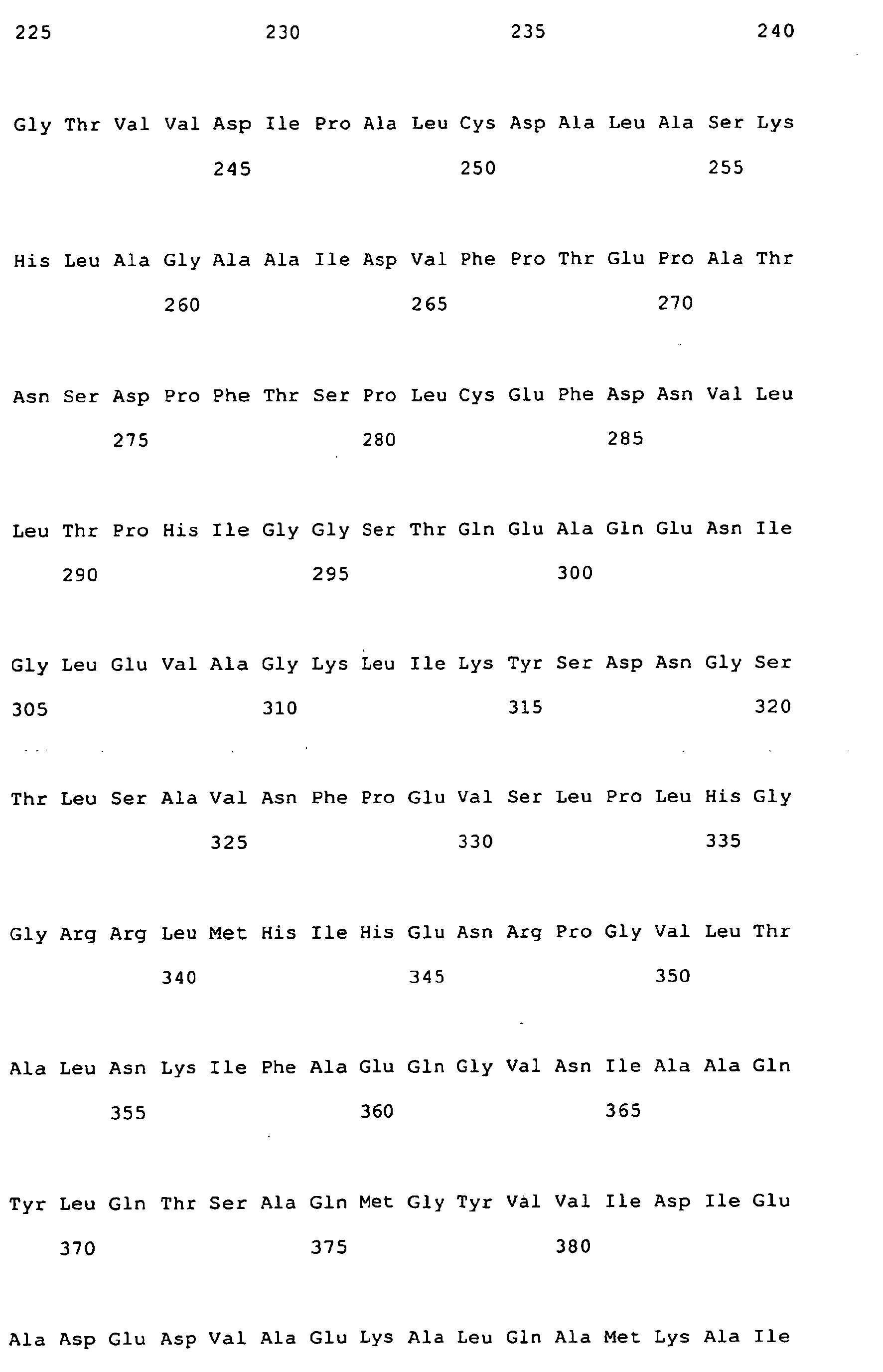
- <210> 2
<211> 410
<212> PRT
<213> Escherichia coli - <400> 2



- <210> 3
<211> 30
<212> DNA
<213> Artificial Sequence - <220>
<223> Primer for PCR - <400> 3
- gaattccata tggcaaaggt atcgctggag 30
- <210> 4
<211> 30
<212> DNA
<213> Artificial Sequence - <220>
<223> Primer for PCR - <400> 4
- agaaagcttt tattagtaca gcagacgggc 30
- <210> 5
<211> 27
<212> DNA
<213> Artificial Sequence - <220>
<223> Primer for PCR - <400> 5
- gaaaaccgtc cgnnngtgct aactgcg 27
- <210> 6
<211> 18
<212> DNA
<213> Artificial Sequence - <220>
<223> Primer for PCR - <400> 6
- gtggatgtgc atcagacg 18
- <210> 7
<211> 29
<212> DNA
<213> Artificial Sequence - <220>
<223> Primer for PCR - <400> 7
- caatatctgc aannntccgc ccagatggg 29
- <210> 8
<211> 18
<212> DNA
<213> Artificial Sequence - <220>
<223> Primer for PCR - <400> 8
- cgcggcgatg ttgacgcc 18
Claims (9)
- 3-Phospoglyceratdehydrogenase (PGD) aufweisend eine im Vergleich zu einer Escherichia coli-Wildtyp-PGD verringerte Empfindlichkeit gegen eine Hemmung durch Serin mit einer Aminosäuresequenz, die der Escherichia coli-Wildtyp-PGD (SEQ ID NO: 2) bis auf die Position 372 entspricht, dadurch gekennzeichnet dass sich an Position 372 eine Aminosäure ausgewählt aus der Gruppe I, D, Y, G, S, E, R, K, P, H, W, F, A, N, Q, V, L, M, C befindet.
- 3-Phospoglyceratdehydrogenase (PGD) aufweisend eine im Vergleich zu einer Escherichia coli-Wildtyp-PGD verringerte Empfindlichkeit gegen eine Hemmung durch Serin mit einer Aminosäuresequenz, die der Escherichia coli-Wildtyp-PGD (SEQ ID NO: 2) bis auf die die Positionen 349 und 372 entspricht, dadurch gekennzeichnet dass sich an Position 349 die Aminosäure D und an Position 372 die Aminosäure I befindet.
- serA-Allel codierend für eine PGD gemäß Anspruch 1 dadurch gekennzeichnet, dass sie sich vom Gen der Escherichia coli PGD (serA-Gen, SEQ ID NO: 1) dadurch unterscheidet, dass das Codon 372 für eine natürliche Aminosäure mit Ausnahme von Threonin codiert.
- serA-Allel gemäß Anspruch 3 dadurch gekennzeichnet, dass die enzymatische Aktivität des Genprodukts soweit erhalten bleibt, dass sie mehr als 10 % der Aktivität des Wildtyp Genprodukts entspricht.
- Vektor, dadurch gekennzeichnet, dass er ein serA-Allel gemäß Anspruch 3 oder 4 unter funktioneller Kontrolle eines Promotors enthält.
- Verfahren zur Herstellung eines Mikroorganismenstammes, dadurch gekennzeichnet, dass in einen Mikroorganismenstamm ein Vektor gemäß Anspruch 5 eingebracht wird.
- Mikroorganismenstamm, der zur fermentativen Herstellung von Aminosäuren der Phosphoglycerat-Familie oder deren Derivaten bzw. von Verbindungen, die sich aus dem C1 Stoffwechsel ableiten, geeignet ist, dadurch gekennzeichnet, dass er eine PGD gemäß Anspruch 1 oder 2 besitzt.
- Verfahren zur Herstellung von Aminosäuren der Phosphoglycerat-Familie bzw. von Verbindungen, die sich aus dem C1 Stoffwechsel ableiten, durch Kultivierung eines Mikroorganismenstammes gemäß Anspruch 7.
- Verwendung einer PGD gemäß Anspruch 1 oder 2 zur Herstellung von Aminosäuren der Phosphoglycerat-Familie oder von Verbindungen, die sich aus dem C1-Stoffwechsel ableiten.
Priority Applications (2)
| Application Number | Priority Date | Filing Date | Title |
|---|---|---|---|
| EP07102448A EP1813669B1 (de) | 2003-07-10 | 2004-07-01 | Varianten der 3-Phosphoglyceratdehydrogenase mit reduzierter Hemmung durch L-Serin und dafür codierende Gene |
| EP08152747A EP1950287B1 (de) | 2003-07-10 | 2004-07-01 | Varianten der 3-Phosphoglyceratdehydrogenase mit reduzierter Hemmung durch L-Serin und dafür codierende Gene |
Applications Claiming Priority (2)
| Application Number | Priority Date | Filing Date | Title |
|---|---|---|---|
| DE10331291A DE10331291A1 (de) | 2003-07-10 | 2003-07-10 | Varianten der 3-Phosphoglyceratdehydrogenase mit reduzierter Hemmung durch L-Serin und dafür codierende Gene |
| DE10331291 | 2003-07-10 |
Related Child Applications (1)
| Application Number | Title | Priority Date | Filing Date |
|---|---|---|---|
| EP07102448A Division EP1813669B1 (de) | 2003-07-10 | 2004-07-01 | Varianten der 3-Phosphoglyceratdehydrogenase mit reduzierter Hemmung durch L-Serin und dafür codierende Gene |
Publications (3)
| Publication Number | Publication Date |
|---|---|
| EP1496111A2 EP1496111A2 (de) | 2005-01-12 |
| EP1496111A3 EP1496111A3 (de) | 2005-03-09 |
| EP1496111B1 true EP1496111B1 (de) | 2007-05-02 |
Family
ID=33441709
Family Applications (3)
| Application Number | Title | Priority Date | Filing Date |
|---|---|---|---|
| EP04015524A Expired - Lifetime EP1496111B1 (de) | 2003-07-10 | 2004-07-01 | Varianten der 3-Phosphoglyceratdehydrogenase mit reduzierter Hemmung durch L-Serin und dafür codierende Gene |
| EP08152747A Expired - Lifetime EP1950287B1 (de) | 2003-07-10 | 2004-07-01 | Varianten der 3-Phosphoglyceratdehydrogenase mit reduzierter Hemmung durch L-Serin und dafür codierende Gene |
| EP07102448A Expired - Lifetime EP1813669B1 (de) | 2003-07-10 | 2004-07-01 | Varianten der 3-Phosphoglyceratdehydrogenase mit reduzierter Hemmung durch L-Serin und dafür codierende Gene |
Family Applications After (2)
| Application Number | Title | Priority Date | Filing Date |
|---|---|---|---|
| EP08152747A Expired - Lifetime EP1950287B1 (de) | 2003-07-10 | 2004-07-01 | Varianten der 3-Phosphoglyceratdehydrogenase mit reduzierter Hemmung durch L-Serin und dafür codierende Gene |
| EP07102448A Expired - Lifetime EP1813669B1 (de) | 2003-07-10 | 2004-07-01 | Varianten der 3-Phosphoglyceratdehydrogenase mit reduzierter Hemmung durch L-Serin und dafür codierende Gene |
Country Status (7)
| Country | Link |
|---|---|
| US (1) | US7582460B2 (de) |
| EP (3) | EP1496111B1 (de) |
| JP (1) | JP4695855B2 (de) |
| CN (1) | CN100526457C (de) |
| AT (3) | ATE431847T1 (de) |
| DE (4) | DE10331291A1 (de) |
| ES (2) | ES2283906T3 (de) |
Cited By (3)
| Publication number | Priority date | Publication date | Assignee | Title |
|---|---|---|---|---|
| DE102013209274A1 (de) | 2013-05-17 | 2014-11-20 | Wacker Chemie Ag | Mikroorganismus und Verfahren zur fermentativen Überproduktion von Gamma-Glutamylcystein und Derivaten dieses Dipeptids |
| WO2021259491A1 (de) | 2020-06-26 | 2021-12-30 | Wacker Chemie Ag | Verbesserte cystein produzierende stämme |
| WO2023165684A1 (de) | 2022-03-01 | 2023-09-07 | Wacker Chemie Ag | Verbesserte cystein produzierende stämme |
Families Citing this family (19)
| Publication number | Priority date | Publication date | Assignee | Title |
|---|---|---|---|---|
| EP2019868A2 (de) | 2006-05-24 | 2009-02-04 | Evonik Degussa GmbH | Verfahren zur herstellung von l-methionin |
| US8383372B2 (en) * | 2008-03-06 | 2013-02-26 | Ajinomoto Co., Inc. | L-cysteine producing bacterium and a method for producing L-cysteine |
| JP5332237B2 (ja) * | 2008-03-06 | 2013-11-06 | 味の素株式会社 | L−システイン生産菌及びl−システインの製造法 |
| EP2379730B1 (de) * | 2008-12-31 | 2015-07-22 | Metabolic Explorer | Verfahren zur herstellung von diolen |
| ES2646165T3 (es) | 2009-11-30 | 2017-12-12 | Ajinomoto Co., Inc. | Bacteria que produce L-cisteína y procedimiento para la producción de L-cisteína |
| JP5803927B2 (ja) | 2010-09-14 | 2015-11-04 | 味の素株式会社 | 含硫アミノ酸生産菌及び含硫アミノ酸の製造法 |
| JP2014087259A (ja) | 2011-02-22 | 2014-05-15 | Ajinomoto Co Inc | L−システイン生産菌及びl−システインの製造法 |
| JP6020443B2 (ja) | 2011-04-01 | 2016-11-02 | 味の素株式会社 | L−システインの製造法 |
| US9234223B2 (en) | 2011-04-01 | 2016-01-12 | Ajinomoto Co., Inc. | Method for producing L-cysteine |
| JP2014131487A (ja) | 2011-04-18 | 2014-07-17 | Ajinomoto Co Inc | L−システインの製造法 |
| DE102011075656A1 (de) | 2011-05-11 | 2012-03-29 | Wacker Chemie Ag | Verfahren zur fermentativen Produktion von L-Cystin |
| DE102011078481A1 (de) | 2011-06-30 | 2013-01-03 | Wacker Chemie Ag | Verfahren zur fermentativen Produktion von natürlichem L-Cystein |
| CN102433312A (zh) * | 2011-11-30 | 2012-05-02 | 天津科技大学 | 一种d-3-磷酸甘油酸脱氢酶及其编码基因及构建方法 |
| DE102012208359A1 (de) * | 2012-05-18 | 2013-11-21 | Wacker Chemie Ag | Verfahren zur fermentativen Produktion von L-Cystein und Derivaten dieser Aminosäure |
| DE102012216527A1 (de) | 2012-09-17 | 2014-03-20 | Wacker Chemie Ag | Verfahren zur fermentativen Produktion von L-Cystein und Derivaten dieser Aminosäure |
| CN103436504A (zh) * | 2013-09-02 | 2013-12-11 | 江南大学 | 抗l-丝氨酸反馈抑制的谷氨酸棒杆菌syps-062的构建方法及应用 |
| JP7620698B2 (ja) | 2021-07-05 | 2025-01-23 | ワッカー ケミー アクチエンゲゼルシャフト | スルフィン酸をスルホン酸に酵素的に酸化する方法 |
| CN116376857A (zh) * | 2023-04-19 | 2023-07-04 | 中国科学院天津工业生物技术研究所 | 一种酶活性和热稳定性提高的3-磷酸甘油酸脱氢酶突变体 |
| CN120796214B (zh) * | 2025-07-18 | 2026-05-01 | 合肥和晨生物科技有限公司 | 磷酸甘油酸脱氢酶突变体、工程菌及其生产l-丝氨酸的应用 |
Family Cites Families (11)
| Publication number | Priority date | Publication date | Assignee | Title |
|---|---|---|---|---|
| TW313589B (de) * | 1991-12-12 | 1997-08-21 | Wacker Chemie Gmbh | |
| DE4232468A1 (de) * | 1992-09-28 | 1994-03-31 | Consortium Elektrochem Ind | Mikroorganismen für die Produktion von Tryptophan und Verfahren zu ihrer Herstellung |
| DE19539952A1 (de) | 1995-10-26 | 1997-04-30 | Consortium Elektrochem Ind | Verfahren zur Herstellung von O-Acetylserin, L-Cystein und L-Cystein-verwandten Produkten |
| DE19726083A1 (de) | 1997-06-19 | 1998-12-24 | Consortium Elektrochem Ind | Mikroorganismen und Verfahren zur fermentativen Herstellung von L-Cystein, L-Cystin, N-Acetyl-Serin oder Thiazolidinderivaten |
| JP3997631B2 (ja) | 1998-01-12 | 2007-10-24 | 味の素株式会社 | 発酵法によるl−セリンの製造法 |
| JP4066543B2 (ja) * | 1998-01-12 | 2008-03-26 | 味の素株式会社 | 発酵法によるl−セリンの製造法 |
| DE19949579C1 (de) | 1999-10-14 | 2000-11-16 | Consortium Elektrochem Ind | Verfahren zur fermentativen Herstellung von L-Cystein oder L-Cystein-Derivaten |
| DE10044831A1 (de) | 2000-03-01 | 2002-04-04 | Forschungszentrum Juelich Gmbh | Verbessertes Verfahren zur mikrobiellen Herstellung von L-Serin sowie ein dazu geeigneter genetisch veränderter Mikroorganismus |
| DE10046934A1 (de) | 2000-09-21 | 2002-04-18 | Consortium Elektrochem Ind | Verfahren zur fermentativen Herstellung von nicht-proteinogenen L-Aminosäuren |
| CZ20031886A3 (cs) | 2001-01-19 | 2003-10-15 | Basf Aktiengesellschaft | Způsob přípravy pantothenátu ve vyšším výtěžku a mikroorganizmy používané při tomto způsobu |
| DE10232930A1 (de) | 2002-07-19 | 2004-02-05 | Consortium für elektrochemische Industrie GmbH | Verfahren zur fermentativen Herstellung von Aminosäuren und Aminosäure-Derivaten der Phosphoglycerat-Familie |
-
2003
- 2003-07-10 DE DE10331291A patent/DE10331291A1/de not_active Withdrawn
-
2004
- 2004-07-01 DE DE502004003661T patent/DE502004003661D1/de not_active Expired - Lifetime
- 2004-07-01 EP EP04015524A patent/EP1496111B1/de not_active Expired - Lifetime
- 2004-07-01 DE DE502004009513T patent/DE502004009513D1/de not_active Expired - Lifetime
- 2004-07-01 AT AT07102448T patent/ATE431847T1/de active
- 2004-07-01 ES ES04015524T patent/ES2283906T3/es not_active Expired - Lifetime
- 2004-07-01 EP EP08152747A patent/EP1950287B1/de not_active Expired - Lifetime
- 2004-07-01 EP EP07102448A patent/EP1813669B1/de not_active Expired - Lifetime
- 2004-07-01 AT AT08152747T patent/ATE440946T1/de active
- 2004-07-01 AT AT04015524T patent/ATE361361T1/de active
- 2004-07-01 DE DE502004009985T patent/DE502004009985D1/de not_active Expired - Lifetime
- 2004-07-01 ES ES07102448T patent/ES2325603T3/es not_active Expired - Lifetime
- 2004-07-08 US US10/886,858 patent/US7582460B2/en not_active Expired - Lifetime
- 2004-07-09 CN CNB2004100635275A patent/CN100526457C/zh not_active Expired - Lifetime
- 2004-07-12 JP JP2004205113A patent/JP4695855B2/ja not_active Expired - Lifetime
Non-Patent Citations (1)
| Title |
|---|
| None * |
Cited By (4)
| Publication number | Priority date | Publication date | Assignee | Title |
|---|---|---|---|---|
| DE102013209274A1 (de) | 2013-05-17 | 2014-11-20 | Wacker Chemie Ag | Mikroorganismus und Verfahren zur fermentativen Überproduktion von Gamma-Glutamylcystein und Derivaten dieses Dipeptids |
| EP2808394A1 (de) | 2013-05-17 | 2014-12-03 | Wacker Chemie AG | Mikroorganismus und Verfahren zur fermentativen Überproduktion von Gamma-Glutamylcystein und Derivaten dieses Dipeptids |
| WO2021259491A1 (de) | 2020-06-26 | 2021-12-30 | Wacker Chemie Ag | Verbesserte cystein produzierende stämme |
| WO2023165684A1 (de) | 2022-03-01 | 2023-09-07 | Wacker Chemie Ag | Verbesserte cystein produzierende stämme |
Also Published As
| Publication number | Publication date |
|---|---|
| ATE440946T1 (de) | 2009-09-15 |
| CN100526457C (zh) | 2009-08-12 |
| ES2283906T3 (es) | 2007-11-01 |
| US20050009162A1 (en) | 2005-01-13 |
| EP1950287A3 (de) | 2008-08-13 |
| US7582460B2 (en) | 2009-09-01 |
| ATE431847T1 (de) | 2009-06-15 |
| JP4695855B2 (ja) | 2011-06-08 |
| EP1950287A2 (de) | 2008-07-30 |
| DE502004009513D1 (de) | 2009-07-02 |
| EP1950287B1 (de) | 2009-08-26 |
| EP1813669B1 (de) | 2009-05-20 |
| DE502004003661D1 (de) | 2007-06-14 |
| EP1496111A2 (de) | 2005-01-12 |
| ATE361361T1 (de) | 2007-05-15 |
| JP2005040134A (ja) | 2005-02-17 |
| ES2325603T3 (es) | 2009-09-09 |
| EP1813669A1 (de) | 2007-08-01 |
| EP1496111A3 (de) | 2005-03-09 |
| DE502004009985D1 (de) | 2009-10-08 |
| CN1609208A (zh) | 2005-04-27 |
| DE10331291A1 (de) | 2005-02-17 |
Similar Documents
| Publication | Publication Date | Title |
|---|---|---|
| EP1813669B1 (de) | Varianten der 3-Phosphoglyceratdehydrogenase mit reduzierter Hemmung durch L-Serin und dafür codierende Gene | |
| EP1382684B1 (de) | Verfahren zur fermentativen Herstellung von Aminosäuren und Aminosäure-Derivaten der Phosphoglycerat-Familie | |
| DE60025976T2 (de) | DNA die für eine mutierte Isopropylmalatsynthase kodiert, Microorganismus, das L-Leucin produziert, und Verfahren zur Herstellung von L-Leucin | |
| EP1220940B2 (de) | Verfahren zur fermentativen herstellung von l-cystein oder l-cystein-derivaten | |
| EP0885962B1 (de) | Mikroorganismen und Verfahren zur fermentativen Herstellung von L-Cystein, L-Cystin, N-Acetyl-Serin oder Thiazolindinderivaten | |
| DE102004001674B4 (de) | Verfahren zur Herstellung von L-Lysin unter Einsatz von Methanol verwertenden Bakterien | |
| EP2411502B1 (de) | Verfahren zur herstellung grosser mengen glycolsäure durch fermentation | |
| CA2262813A1 (en) | Novel strains of escherichia coli, methods of preparing the same and use thereof in fermentation processes for l-threonine production | |
| EP1445310B1 (de) | Verfahren zur fermentativen Herstellung von L-Methionin | |
| DE19539952A1 (de) | Verfahren zur Herstellung von O-Acetylserin, L-Cystein und L-Cystein-verwandten Produkten | |
| EP0387527A1 (de) | Verfahren zur fermentativen Herstellung von L-Lysin | |
| DE19907567A1 (de) | Verfahren zur mikrobiellen Herstellung von L-Valin | |
| EP1570066B1 (de) | Feedback-resistente homoserin-transsuccinylasen mit modifiziertem c-terminus | |
| DE60210184T2 (de) | L-Cystein herstellendes Bakterium und Verfahren zur Herstellung von L-Cystein | |
| EP1783230B1 (de) | Feedback-resistente Homoserin-Transsuccinylasen | |
| WO2015132213A1 (de) | Verfahren zur herstellung von endständigen aminocarbonsäuren und aminoaldehyden mittels eines rekombinaten mikroorganismus | |
| EP1924694B1 (de) | Verfahren zur produktion von aminosäuren mit mikroorganismen | |
| DE10220234B4 (de) | Verfahren sowie Mikroorganismen zur mikrobiellen Herstellung von Pyruvat aus Kohlenhydraten sowie Alkoholen | |
| KR101755349B1 (ko) | L-쓰레오닌 생산능을 가지는 미생물 및 그를 이용하여 l-쓰레오닌을 생산하는 방법 | |
| WO2004007705A1 (de) | Nukleotidsequenzen codierend für deregulierte phosphoglycerat-dehydrogenasen coryneformer bakterien sowie verfahren zur herstellung von l-serin | |
| DE10101501A1 (de) | Verfahren zur fermentativen Herstellung von Pantothensäure |
Legal Events
| Date | Code | Title | Description |
|---|---|---|---|
| PUAI | Public reference made under article 153(3) epc to a published international application that has entered the european phase |
Free format text: ORIGINAL CODE: 0009012 |
|
| 17P | Request for examination filed |
Effective date: 20040701 |
|
| AK | Designated contracting states |
Kind code of ref document: A2 Designated state(s): AT BE BG CH CY CZ DE DK EE ES FI FR GB GR HU IE IT LI LU MC NL PL PT RO SE SI SK TR |
|
| AX | Request for extension of the european patent |
Extension state: AL HR LT LV MK |
|
| PUAL | Search report despatched |
Free format text: ORIGINAL CODE: 0009013 |
|
| RTI1 | Title (correction) |
Free format text: VARIANTS OF 3-PHOSPHOGLYCERATE DEHYDROGENASE WITH REDUCED INHIBITION BY L-SERINE AND GENES ENCODING THE SAME |
|
| AK | Designated contracting states |
Kind code of ref document: A3 Designated state(s): AT BE BG CH CY CZ DE DK EE ES FI FR GB GR HU IE IT LI LU MC NL PL PT RO SE SI SK TR |
|
| AX | Request for extension of the european patent |
Extension state: AL HR LT LV MK |
|
| 17Q | First examination report despatched |
Effective date: 20050221 |
|
| AKX | Designation fees paid |
Designated state(s): AT BE BG CH CY CZ DE DK EE ES FI FR GB GR HU IE IT LI LU MC NL PL PT RO SE SI SK TR |
|
| GRAP | Despatch of communication of intention to grant a patent |
Free format text: ORIGINAL CODE: EPIDOSNIGR1 |
|
| RTI1 | Title (correction) |
Free format text: VARIANTS OF 3-PHOSPHOGLYCERATE DEHYDROGENASE WITH REDUCED INHIBITION BY L-SERINE AND GENES ENCODING THE SAME. |
|
| GRAS | Grant fee paid |
Free format text: ORIGINAL CODE: EPIDOSNIGR3 |
|
| GRAA | (expected) grant |
Free format text: ORIGINAL CODE: 0009210 |
|
| AK | Designated contracting states |
Kind code of ref document: B1 Designated state(s): AT BE BG CH CY CZ DE DK EE ES FI FR GB GR HU IE IT LI LU MC NL PL PT RO SE SI SK TR |
|
| PG25 | Lapsed in a contracting state [announced via postgrant information from national office to epo] |
Ref country code: FI Free format text: LAPSE BECAUSE OF FAILURE TO SUBMIT A TRANSLATION OF THE DESCRIPTION OR TO PAY THE FEE WITHIN THE PRESCRIBED TIME-LIMIT Effective date: 20070502 |
|
| REG | Reference to a national code |
Ref country code: GB Ref legal event code: FG4D Free format text: NOT ENGLISH |
|
| RAP2 | Party data changed (patent owner data changed or rights of a patent transferred) |
Owner name: WACKER CHEMIE AG |
|
| REG | Reference to a national code |
Ref country code: CH Ref legal event code: EP |
|
| REG | Reference to a national code |
Ref country code: IE Ref legal event code: FG4D Free format text: LANGUAGE OF EP DOCUMENT: GERMAN |
|
| REF | Corresponds to: |
Ref document number: 502004003661 Country of ref document: DE Date of ref document: 20070614 Kind code of ref document: P |
|
| NLT2 | Nl: modifications (of names), taken from the european patent patent bulletin |
Owner name: WACKER CHEMIE AG Effective date: 20070516 |
|
| GBT | Gb: translation of ep patent filed (gb section 77(6)(a)/1977) |
Effective date: 20070613 |
|
| PG25 | Lapsed in a contracting state [announced via postgrant information from national office to epo] |
Ref country code: SE Free format text: LAPSE BECAUSE OF FAILURE TO SUBMIT A TRANSLATION OF THE DESCRIPTION OR TO PAY THE FEE WITHIN THE PRESCRIBED TIME-LIMIT Effective date: 20070802 |
|
| ET | Fr: translation filed | ||
| REG | Reference to a national code |
Ref country code: ES Ref legal event code: FG2A Ref document number: 2283906 Country of ref document: ES Kind code of ref document: T3 |
|
| PG25 | Lapsed in a contracting state [announced via postgrant information from national office to epo] |
Ref country code: PL Free format text: LAPSE BECAUSE OF FAILURE TO SUBMIT A TRANSLATION OF THE DESCRIPTION OR TO PAY THE FEE WITHIN THE PRESCRIBED TIME-LIMIT Effective date: 20070502 |
|
| REG | Reference to a national code |
Ref country code: IE Ref legal event code: FD4D |
|
| BERE | Be: lapsed |
Owner name: CONSORTIUM FUR ELEKTROCHEMISCHE INDUSTRIE G.M.B.H. Effective date: 20070731 |
|
| PG25 | Lapsed in a contracting state [announced via postgrant information from national office to epo] |
Ref country code: IE Free format text: LAPSE BECAUSE OF FAILURE TO SUBMIT A TRANSLATION OF THE DESCRIPTION OR TO PAY THE FEE WITHIN THE PRESCRIBED TIME-LIMIT Effective date: 20070502 Ref country code: CZ Free format text: LAPSE BECAUSE OF FAILURE TO SUBMIT A TRANSLATION OF THE DESCRIPTION OR TO PAY THE FEE WITHIN THE PRESCRIBED TIME-LIMIT Effective date: 20070502 Ref country code: DK Free format text: LAPSE BECAUSE OF FAILURE TO SUBMIT A TRANSLATION OF THE DESCRIPTION OR TO PAY THE FEE WITHIN THE PRESCRIBED TIME-LIMIT Effective date: 20070502 Ref country code: BG Free format text: LAPSE BECAUSE OF FAILURE TO SUBMIT A TRANSLATION OF THE DESCRIPTION OR TO PAY THE FEE WITHIN THE PRESCRIBED TIME-LIMIT Effective date: 20070802 Ref country code: SI Free format text: LAPSE BECAUSE OF FAILURE TO SUBMIT A TRANSLATION OF THE DESCRIPTION OR TO PAY THE FEE WITHIN THE PRESCRIBED TIME-LIMIT Effective date: 20070502 Ref country code: PT Free format text: LAPSE BECAUSE OF FAILURE TO SUBMIT A TRANSLATION OF THE DESCRIPTION OR TO PAY THE FEE WITHIN THE PRESCRIBED TIME-LIMIT Effective date: 20071002 |
|
| PLBE | No opposition filed within time limit |
Free format text: ORIGINAL CODE: 0009261 |
|
| STAA | Information on the status of an ep patent application or granted ep patent |
Free format text: STATUS: NO OPPOSITION FILED WITHIN TIME LIMIT |
|
| 26N | No opposition filed |
Effective date: 20080205 |
|
| PG25 | Lapsed in a contracting state [announced via postgrant information from national office to epo] |
Ref country code: GR Free format text: LAPSE BECAUSE OF FAILURE TO SUBMIT A TRANSLATION OF THE DESCRIPTION OR TO PAY THE FEE WITHIN THE PRESCRIBED TIME-LIMIT Effective date: 20070803 Ref country code: MC Free format text: LAPSE BECAUSE OF NON-PAYMENT OF DUE FEES Effective date: 20070731 |
|
| PG25 | Lapsed in a contracting state [announced via postgrant information from national office to epo] |
Ref country code: RO Free format text: LAPSE BECAUSE OF FAILURE TO SUBMIT A TRANSLATION OF THE DESCRIPTION OR TO PAY THE FEE WITHIN THE PRESCRIBED TIME-LIMIT Effective date: 20070502 |
|
| PG25 | Lapsed in a contracting state [announced via postgrant information from national office to epo] |
Ref country code: BE Free format text: LAPSE BECAUSE OF NON-PAYMENT OF DUE FEES Effective date: 20070731 |
|
| PG25 | Lapsed in a contracting state [announced via postgrant information from national office to epo] |
Ref country code: EE Free format text: LAPSE BECAUSE OF FAILURE TO SUBMIT A TRANSLATION OF THE DESCRIPTION OR TO PAY THE FEE WITHIN THE PRESCRIBED TIME-LIMIT Effective date: 20070502 |
|
| PG25 | Lapsed in a contracting state [announced via postgrant information from national office to epo] |
Ref country code: CY Free format text: LAPSE BECAUSE OF FAILURE TO SUBMIT A TRANSLATION OF THE DESCRIPTION OR TO PAY THE FEE WITHIN THE PRESCRIBED TIME-LIMIT Effective date: 20070502 |
|
| PG25 | Lapsed in a contracting state [announced via postgrant information from national office to epo] |
Ref country code: LU Free format text: LAPSE BECAUSE OF NON-PAYMENT OF DUE FEES Effective date: 20070701 |
|
| PG25 | Lapsed in a contracting state [announced via postgrant information from national office to epo] |
Ref country code: HU Free format text: LAPSE BECAUSE OF FAILURE TO SUBMIT A TRANSLATION OF THE DESCRIPTION OR TO PAY THE FEE WITHIN THE PRESCRIBED TIME-LIMIT Effective date: 20071103 Ref country code: TR Free format text: LAPSE BECAUSE OF FAILURE TO SUBMIT A TRANSLATION OF THE DESCRIPTION OR TO PAY THE FEE WITHIN THE PRESCRIBED TIME-LIMIT Effective date: 20070502 |
|
| PGFP | Annual fee paid to national office [announced via postgrant information from national office to epo] |
Ref country code: SK Payment date: 20140630 Year of fee payment: 11 |
|
| PGFP | Annual fee paid to national office [announced via postgrant information from national office to epo] |
Ref country code: NL Payment date: 20140721 Year of fee payment: 11 Ref country code: CH Payment date: 20140721 Year of fee payment: 11 |
|
| PGFP | Annual fee paid to national office [announced via postgrant information from national office to epo] |
Ref country code: ES Payment date: 20140728 Year of fee payment: 11 |
|
| PGFP | Annual fee paid to national office [announced via postgrant information from national office to epo] |
Ref country code: IT Payment date: 20140724 Year of fee payment: 11 |
|
| REG | Reference to a national code |
Ref country code: FR Ref legal event code: PLFP Year of fee payment: 12 |
|
| REG | Reference to a national code |
Ref country code: CH Ref legal event code: PL |
|
| REG | Reference to a national code |
Ref country code: SK Ref legal event code: MM4A Ref document number: E 3015 Country of ref document: SK Effective date: 20150701 |
|
| REG | Reference to a national code |
Ref country code: NL Ref legal event code: MM Effective date: 20150801 |
|
| PG25 | Lapsed in a contracting state [announced via postgrant information from national office to epo] |
Ref country code: SK Free format text: LAPSE BECAUSE OF NON-PAYMENT OF DUE FEES Effective date: 20150701 Ref country code: CH Free format text: LAPSE BECAUSE OF NON-PAYMENT OF DUE FEES Effective date: 20150731 Ref country code: IT Free format text: LAPSE BECAUSE OF NON-PAYMENT OF DUE FEES Effective date: 20150701 Ref country code: LI Free format text: LAPSE BECAUSE OF NON-PAYMENT OF DUE FEES Effective date: 20150731 |
|
| PG25 | Lapsed in a contracting state [announced via postgrant information from national office to epo] |
Ref country code: NL Free format text: LAPSE BECAUSE OF NON-PAYMENT OF DUE FEES Effective date: 20150801 |
|
| REG | Reference to a national code |
Ref country code: FR Ref legal event code: PLFP Year of fee payment: 13 |
|
| REG | Reference to a national code |
Ref country code: ES Ref legal event code: FD2A Effective date: 20160831 |
|
| PG25 | Lapsed in a contracting state [announced via postgrant information from national office to epo] |
Ref country code: ES Free format text: LAPSE BECAUSE OF NON-PAYMENT OF DUE FEES Effective date: 20150702 |
|
| REG | Reference to a national code |
Ref country code: FR Ref legal event code: PLFP Year of fee payment: 14 |
|
| REG | Reference to a national code |
Ref country code: FR Ref legal event code: PLFP Year of fee payment: 15 |
|
| PGFP | Annual fee paid to national office [announced via postgrant information from national office to epo] |
Ref country code: AT Payment date: 20190722 Year of fee payment: 16 |
|
| REG | Reference to a national code |
Ref country code: AT Ref legal event code: MM01 Ref document number: 361361 Country of ref document: AT Kind code of ref document: T Effective date: 20200701 |
|
| PG25 | Lapsed in a contracting state [announced via postgrant information from national office to epo] |
Ref country code: AT Free format text: LAPSE BECAUSE OF NON-PAYMENT OF DUE FEES Effective date: 20200701 |
|
| P01 | Opt-out of the competence of the unified patent court (upc) registered |
Effective date: 20230502 |
|
| PGFP | Annual fee paid to national office [announced via postgrant information from national office to epo] |
Ref country code: GB Payment date: 20230719 Year of fee payment: 20 |
|
| PGFP | Annual fee paid to national office [announced via postgrant information from national office to epo] |
Ref country code: FR Payment date: 20230725 Year of fee payment: 20 Ref country code: DE Payment date: 20230719 Year of fee payment: 20 |
|
| REG | Reference to a national code |
Ref country code: DE Ref legal event code: R071 Ref document number: 502004003661 Country of ref document: DE |
|
| PG25 | Lapsed in a contracting state [announced via postgrant information from national office to epo] |
Ref country code: GB Free format text: LAPSE BECAUSE OF EXPIRATION OF PROTECTION Effective date: 20240630 |
|
| REG | Reference to a national code |
Ref country code: GB Ref legal event code: PE20 Expiry date: 20240630 |
|
| PG25 | Lapsed in a contracting state [announced via postgrant information from national office to epo] |
Ref country code: GB Free format text: LAPSE BECAUSE OF EXPIRATION OF PROTECTION Effective date: 20240630 |
|
| REG | Reference to a national code |
Ref country code: DE Ref legal event code: R081 Ref document number: 502004003661 Country of ref document: DE Owner name: WACKER CHEMIE AG, DE Free format text: FORMER OWNER: WACKER CHEMIE AG, 81737 MUENCHEN, DE |