EP1498497A2 - Verfahren zur Nukleinsäureanalyse unter Verwendung von Masenspektroskopie - Google Patents
Verfahren zur Nukleinsäureanalyse unter Verwendung von Masenspektroskopie Download PDFInfo
- Publication number
- EP1498497A2 EP1498497A2 EP04077319A EP04077319A EP1498497A2 EP 1498497 A2 EP1498497 A2 EP 1498497A2 EP 04077319 A EP04077319 A EP 04077319A EP 04077319 A EP04077319 A EP 04077319A EP 1498497 A2 EP1498497 A2 EP 1498497A2
- Authority
- EP
- European Patent Office
- Prior art keywords
- nucleic acid
- acid molecule
- mass
- sugar
- oligonucleotides
- Prior art date
- Legal status (The legal status is an assumption and is not a legal conclusion. Google has not performed a legal analysis and makes no representation as to the accuracy of the status listed.)
- Withdrawn
Links
- 150000007523 nucleic acids Chemical class 0.000 title claims abstract description 160
- 108020004707 nucleic acids Proteins 0.000 title claims abstract description 152
- 102000039446 nucleic acids Human genes 0.000 title claims abstract description 152
- 238000000034 method Methods 0.000 title claims abstract description 71
- 238000004949 mass spectrometry Methods 0.000 title claims abstract description 23
- 238000004458 analytical method Methods 0.000 title abstract description 29
- 230000035772 mutation Effects 0.000 claims abstract description 22
- 238000000816 matrix-assisted laser desorption--ionisation Methods 0.000 claims description 15
- 239000003153 chemical reaction reagent Substances 0.000 claims description 10
- 239000002253 acid Substances 0.000 claims description 8
- 238000002360 preparation method Methods 0.000 claims description 8
- 238000003752 polymerase chain reaction Methods 0.000 claims description 7
- 230000002255 enzymatic effect Effects 0.000 claims description 5
- 208000026350 Inborn Genetic disease Diseases 0.000 claims description 3
- 238000012217 deletion Methods 0.000 claims description 3
- 230000037430 deletion Effects 0.000 claims description 3
- 208000016361 genetic disease Diseases 0.000 claims description 3
- 238000003780 insertion Methods 0.000 claims description 3
- 230000037431 insertion Effects 0.000 claims description 3
- RYYWUUFWQRZTIU-UHFFFAOYSA-K thiophosphate Chemical compound [O-]P([O-])([O-])=S RYYWUUFWQRZTIU-UHFFFAOYSA-K 0.000 abstract description 94
- 239000002168 alkylating agent Substances 0.000 abstract description 47
- 229940100198 alkylating agent Drugs 0.000 abstract description 47
- JRPHGDYSKGJTKZ-UHFFFAOYSA-K selenophosphate Chemical compound [O-]P([O-])([O-])=[Se] JRPHGDYSKGJTKZ-UHFFFAOYSA-K 0.000 abstract description 27
- 229910019142 PO4 Inorganic materials 0.000 abstract description 25
- NBIIXXVUZAFLBC-UHFFFAOYSA-K phosphate Chemical compound [O-]P([O-])([O-])=O NBIIXXVUZAFLBC-UHFFFAOYSA-K 0.000 abstract description 25
- 239000010452 phosphate Substances 0.000 abstract description 25
- 238000001712 DNA sequencing Methods 0.000 abstract description 6
- 230000014509 gene expression Effects 0.000 abstract description 6
- 108091034117 Oligonucleotide Proteins 0.000 description 157
- JLCPHMBAVCMARE-UHFFFAOYSA-N [3-[[3-[[3-[[3-[[3-[[3-[[3-[[3-[[3-[[3-[[3-[[5-(2-amino-6-oxo-1H-purin-9-yl)-3-[[3-[[3-[[3-[[3-[[3-[[5-(2-amino-6-oxo-1H-purin-9-yl)-3-[[5-(2-amino-6-oxo-1H-purin-9-yl)-3-hydroxyoxolan-2-yl]methoxy-hydroxyphosphoryl]oxyoxolan-2-yl]methoxy-hydroxyphosphoryl]oxy-5-(5-methyl-2,4-dioxopyrimidin-1-yl)oxolan-2-yl]methoxy-hydroxyphosphoryl]oxy-5-(6-aminopurin-9-yl)oxolan-2-yl]methoxy-hydroxyphosphoryl]oxy-5-(6-aminopurin-9-yl)oxolan-2-yl]methoxy-hydroxyphosphoryl]oxy-5-(6-aminopurin-9-yl)oxolan-2-yl]methoxy-hydroxyphosphoryl]oxy-5-(6-aminopurin-9-yl)oxolan-2-yl]methoxy-hydroxyphosphoryl]oxyoxolan-2-yl]methoxy-hydroxyphosphoryl]oxy-5-(5-methyl-2,4-dioxopyrimidin-1-yl)oxolan-2-yl]methoxy-hydroxyphosphoryl]oxy-5-(4-amino-2-oxopyrimidin-1-yl)oxolan-2-yl]methoxy-hydroxyphosphoryl]oxy-5-(5-methyl-2,4-dioxopyrimidin-1-yl)oxolan-2-yl]methoxy-hydroxyphosphoryl]oxy-5-(5-methyl-2,4-dioxopyrimidin-1-yl)oxolan-2-yl]methoxy-hydroxyphosphoryl]oxy-5-(6-aminopurin-9-yl)oxolan-2-yl]methoxy-hydroxyphosphoryl]oxy-5-(6-aminopurin-9-yl)oxolan-2-yl]methoxy-hydroxyphosphoryl]oxy-5-(4-amino-2-oxopyrimidin-1-yl)oxolan-2-yl]methoxy-hydroxyphosphoryl]oxy-5-(4-amino-2-oxopyrimidin-1-yl)oxolan-2-yl]methoxy-hydroxyphosphoryl]oxy-5-(4-amino-2-oxopyrimidin-1-yl)oxolan-2-yl]methoxy-hydroxyphosphoryl]oxy-5-(6-aminopurin-9-yl)oxolan-2-yl]methoxy-hydroxyphosphoryl]oxy-5-(4-amino-2-oxopyrimidin-1-yl)oxolan-2-yl]methyl [5-(6-aminopurin-9-yl)-2-(hydroxymethyl)oxolan-3-yl] hydrogen phosphate Polymers Cc1cn(C2CC(OP(O)(=O)OCC3OC(CC3OP(O)(=O)OCC3OC(CC3O)n3cnc4c3nc(N)[nH]c4=O)n3cnc4c3nc(N)[nH]c4=O)C(COP(O)(=O)OC3CC(OC3COP(O)(=O)OC3CC(OC3COP(O)(=O)OC3CC(OC3COP(O)(=O)OC3CC(OC3COP(O)(=O)OC3CC(OC3COP(O)(=O)OC3CC(OC3COP(O)(=O)OC3CC(OC3COP(O)(=O)OC3CC(OC3COP(O)(=O)OC3CC(OC3COP(O)(=O)OC3CC(OC3COP(O)(=O)OC3CC(OC3COP(O)(=O)OC3CC(OC3COP(O)(=O)OC3CC(OC3COP(O)(=O)OC3CC(OC3COP(O)(=O)OC3CC(OC3COP(O)(=O)OC3CC(OC3COP(O)(=O)OC3CC(OC3CO)n3cnc4c(N)ncnc34)n3ccc(N)nc3=O)n3cnc4c(N)ncnc34)n3ccc(N)nc3=O)n3ccc(N)nc3=O)n3ccc(N)nc3=O)n3cnc4c(N)ncnc34)n3cnc4c(N)ncnc34)n3cc(C)c(=O)[nH]c3=O)n3cc(C)c(=O)[nH]c3=O)n3ccc(N)nc3=O)n3cc(C)c(=O)[nH]c3=O)n3cnc4c3nc(N)[nH]c4=O)n3cnc4c(N)ncnc34)n3cnc4c(N)ncnc34)n3cnc4c(N)ncnc34)n3cnc4c(N)ncnc34)O2)c(=O)[nH]c1=O JLCPHMBAVCMARE-UHFFFAOYSA-N 0.000 description 97
- 238000005804 alkylation reaction Methods 0.000 description 97
- 230000029936 alkylation Effects 0.000 description 90
- 108020004414 DNA Proteins 0.000 description 56
- 239000000047 product Substances 0.000 description 44
- ZMXDDKWLCZADIW-UHFFFAOYSA-N N,N-Dimethylformamide Chemical compound CN(C)C=O ZMXDDKWLCZADIW-UHFFFAOYSA-N 0.000 description 40
- 238000006243 chemical reaction Methods 0.000 description 38
- 150000002500 ions Chemical class 0.000 description 32
- 239000011159 matrix material Substances 0.000 description 32
- 239000000203 mixture Substances 0.000 description 26
- HVTICUPFWKNHNG-UHFFFAOYSA-N iodoethane Chemical compound CCI HVTICUPFWKNHNG-UHFFFAOYSA-N 0.000 description 24
- 238000012163 sequencing technique Methods 0.000 description 23
- 239000000499 gel Substances 0.000 description 19
- 125000001931 aliphatic group Chemical group 0.000 description 18
- 238000001906 matrix-assisted laser desorption--ionisation mass spectrometry Methods 0.000 description 18
- 239000002773 nucleotide Substances 0.000 description 17
- 238000010438 heat treatment Methods 0.000 description 16
- INQOMBQAUSQDDS-UHFFFAOYSA-N iodomethane Chemical compound IC INQOMBQAUSQDDS-UHFFFAOYSA-N 0.000 description 16
- 239000000463 material Substances 0.000 description 16
- PCMORTLOPMLEFB-ONEGZZNKSA-N sinapic acid Chemical compound COC1=CC(\C=C\C(O)=O)=CC(OC)=C1O PCMORTLOPMLEFB-ONEGZZNKSA-N 0.000 description 16
- PCMORTLOPMLEFB-UHFFFAOYSA-N sinapinic acid Natural products COC1=CC(C=CC(O)=O)=CC(OC)=C1O PCMORTLOPMLEFB-UHFFFAOYSA-N 0.000 description 16
- 125000003277 amino group Chemical group 0.000 description 15
- 239000007983 Tris buffer Substances 0.000 description 14
- 125000002924 primary amino group Chemical group [H]N([H])* 0.000 description 14
- 235000011178 triphosphate Nutrition 0.000 description 14
- 239000001226 triphosphate Substances 0.000 description 14
- LENZDBCJOHFCAS-UHFFFAOYSA-N tris Chemical compound OCC(N)(CO)CO LENZDBCJOHFCAS-UHFFFAOYSA-N 0.000 description 14
- WEVYAHXRMPXWCK-UHFFFAOYSA-N Acetonitrile Chemical compound CC#N WEVYAHXRMPXWCK-UHFFFAOYSA-N 0.000 description 12
- XSQUKJJJFZCRTK-UHFFFAOYSA-N Urea Chemical compound NC(N)=O XSQUKJJJFZCRTK-UHFFFAOYSA-N 0.000 description 12
- 125000000217 alkyl group Chemical group 0.000 description 11
- 210000004027 cell Anatomy 0.000 description 11
- 238000001514 detection method Methods 0.000 description 11
- 239000012634 fragment Substances 0.000 description 11
- -1 DNA Chemical class 0.000 description 10
- IQFYYKKMVGJFEH-XLPZGREQSA-N Thymidine Chemical compound O=C1NC(=O)C(C)=CN1[C@@H]1O[C@H](CO)[C@@H](O)C1 IQFYYKKMVGJFEH-XLPZGREQSA-N 0.000 description 10
- 239000000074 antisense oligonucleotide Substances 0.000 description 10
- 238000012230 antisense oligonucleotides Methods 0.000 description 10
- 150000001875 compounds Chemical class 0.000 description 10
- 239000007789 gas Substances 0.000 description 10
- 239000000017 hydrogel Substances 0.000 description 10
- 239000012071 phase Substances 0.000 description 10
- 108090000623 proteins and genes Proteins 0.000 description 10
- 125000001453 quaternary ammonium group Chemical group 0.000 description 10
- QTBSBXVTEAMEQO-UHFFFAOYSA-N Acetic acid Chemical compound CC(O)=O QTBSBXVTEAMEQO-UHFFFAOYSA-N 0.000 description 9
- HRPVXLWXLXDGHG-UHFFFAOYSA-N Acrylamide Chemical compound NC(=O)C=C HRPVXLWXLXDGHG-UHFFFAOYSA-N 0.000 description 9
- 230000008901 benefit Effects 0.000 description 9
- 238000003776 cleavage reaction Methods 0.000 description 9
- 230000006870 function Effects 0.000 description 9
- 125000003835 nucleoside group Chemical group 0.000 description 9
- 230000007017 scission Effects 0.000 description 9
- 239000000243 solution Substances 0.000 description 9
- 108010008286 DNA nucleotidylexotransferase Proteins 0.000 description 8
- 102100029764 DNA-directed DNA/RNA polymerase mu Human genes 0.000 description 8
- 239000000872 buffer Chemical class 0.000 description 8
- 230000000295 complement effect Effects 0.000 description 8
- 238000005342 ion exchange Methods 0.000 description 8
- 150000003839 salts Chemical class 0.000 description 8
- 239000007858 starting material Substances 0.000 description 8
- 239000000126 substance Substances 0.000 description 8
- 108091032973 (ribonucleotides)n+m Proteins 0.000 description 7
- LFQSCWFLJHTTHZ-UHFFFAOYSA-N Ethanol Chemical compound CCO LFQSCWFLJHTTHZ-UHFFFAOYSA-N 0.000 description 7
- 230000000692 anti-sense effect Effects 0.000 description 7
- 230000015572 biosynthetic process Effects 0.000 description 7
- 238000003795 desorption Methods 0.000 description 7
- 125000002887 hydroxy group Chemical group [H]O* 0.000 description 7
- 230000001965 increasing effect Effects 0.000 description 7
- 125000002467 phosphate group Chemical group [H]OP(=O)(O[H])O[*] 0.000 description 7
- XIROXSOOOAZHLL-UHFFFAOYSA-N 2',3',4'-Trihydroxyacetophenone Chemical compound CC(=O)C1=CC=C(O)C(O)=C1O XIROXSOOOAZHLL-UHFFFAOYSA-N 0.000 description 6
- 102000004190 Enzymes Human genes 0.000 description 6
- 108090000790 Enzymes Proteins 0.000 description 6
- 108091028043 Nucleic acid sequence Proteins 0.000 description 6
- OIRDTQYFTABQOQ-KQYNXXCUSA-N adenosine Chemical compound C1=NC=2C(N)=NC=NC=2N1[C@@H]1O[C@H](CO)[C@@H](O)[C@H]1O OIRDTQYFTABQOQ-KQYNXXCUSA-N 0.000 description 6
- 239000004202 carbamide Substances 0.000 description 6
- 230000007423 decrease Effects 0.000 description 6
- 230000003247 decreasing effect Effects 0.000 description 6
- 229920000642 polymer Polymers 0.000 description 6
- 239000002243 precursor Substances 0.000 description 6
- 238000005070 sampling Methods 0.000 description 6
- XLEYFDVVXLMULC-UHFFFAOYSA-N 2',4',6'-trihydroxyacetophenone Chemical compound CC(=O)C1=C(O)C=C(O)C=C1O XLEYFDVVXLMULC-UHFFFAOYSA-N 0.000 description 5
- QGZKDVFQNNGYKY-UHFFFAOYSA-O Ammonium Chemical compound [NH4+] QGZKDVFQNNGYKY-UHFFFAOYSA-O 0.000 description 5
- 108020000948 Antisense Oligonucleotides Proteins 0.000 description 5
- DWRXFEITVBNRMK-UHFFFAOYSA-N Beta-D-1-Arabinofuranosylthymine Natural products O=C1NC(=O)C(C)=CN1C1C(O)C(O)C(CO)O1 DWRXFEITVBNRMK-UHFFFAOYSA-N 0.000 description 5
- 108010014303 DNA-directed DNA polymerase Proteins 0.000 description 5
- 102000016928 DNA-directed DNA polymerase Human genes 0.000 description 5
- 108010021757 Polynucleotide 5'-Hydroxyl-Kinase Proteins 0.000 description 5
- 102000008422 Polynucleotide 5'-hydroxyl-kinase Human genes 0.000 description 5
- 230000002152 alkylating effect Effects 0.000 description 5
- 239000012491 analyte Substances 0.000 description 5
- IQFYYKKMVGJFEH-UHFFFAOYSA-N beta-L-thymidine Natural products O=C1NC(=O)C(C)=CN1C1OC(CO)C(O)C1 IQFYYKKMVGJFEH-UHFFFAOYSA-N 0.000 description 5
- 238000001502 gel electrophoresis Methods 0.000 description 5
- 125000003729 nucleotide group Chemical group 0.000 description 5
- 230000008569 process Effects 0.000 description 5
- 238000000746 purification Methods 0.000 description 5
- 239000002904 solvent Substances 0.000 description 5
- 239000000758 substrate Substances 0.000 description 5
- 229940104230 thymidine Drugs 0.000 description 5
- GETQZCLCWQTVFV-UHFFFAOYSA-N trimethylamine Chemical compound CN(C)C GETQZCLCWQTVFV-UHFFFAOYSA-N 0.000 description 5
- XLYOFNOQVPJJNP-UHFFFAOYSA-N water Substances O XLYOFNOQVPJJNP-UHFFFAOYSA-N 0.000 description 5
- YKBGVTZYEHREMT-KVQBGUIXSA-N 2'-deoxyguanosine Chemical compound C1=NC=2C(=O)NC(N)=NC=2N1[C@H]1C[C@H](O)[C@@H](CO)O1 YKBGVTZYEHREMT-KVQBGUIXSA-N 0.000 description 4
- CKTSBUTUHBMZGZ-SHYZEUOFSA-N 2'‐deoxycytidine Chemical compound O=C1N=C(N)C=CN1[C@@H]1O[C@H](CO)[C@@H](O)C1 CKTSBUTUHBMZGZ-SHYZEUOFSA-N 0.000 description 4
- KDCGOANMDULRCW-UHFFFAOYSA-N 7H-purine Chemical compound N1=CNC2=NC=NC2=C1 KDCGOANMDULRCW-UHFFFAOYSA-N 0.000 description 4
- 108010017826 DNA Polymerase I Proteins 0.000 description 4
- 102000004594 DNA Polymerase I Human genes 0.000 description 4
- CKTSBUTUHBMZGZ-UHFFFAOYSA-N Deoxycytidine Natural products O=C1N=C(N)C=CN1C1OC(CO)C(O)C1 CKTSBUTUHBMZGZ-UHFFFAOYSA-N 0.000 description 4
- 241000725303 Human immunodeficiency virus Species 0.000 description 4
- 238000013459 approach Methods 0.000 description 4
- 125000003118 aryl group Chemical group 0.000 description 4
- 125000004429 atom Chemical group 0.000 description 4
- 239000011324 bead Substances 0.000 description 4
- GZUXJHMPEANEGY-UHFFFAOYSA-N bromomethane Chemical compound BrC GZUXJHMPEANEGY-UHFFFAOYSA-N 0.000 description 4
- 239000006227 byproduct Substances 0.000 description 4
- OPTASPLRGRRNAP-UHFFFAOYSA-N cytosine Chemical compound NC=1C=CNC(=O)N=1 OPTASPLRGRRNAP-UHFFFAOYSA-N 0.000 description 4
- SUYVUBYJARFZHO-RRKCRQDMSA-N dATP Chemical compound C1=NC=2C(N)=NC=NC=2N1[C@H]1C[C@H](O)[C@@H](COP(O)(=O)OP(O)(=O)OP(O)(O)=O)O1 SUYVUBYJARFZHO-RRKCRQDMSA-N 0.000 description 4
- SUYVUBYJARFZHO-UHFFFAOYSA-N dATP Natural products C1=NC=2C(N)=NC=NC=2N1C1CC(O)C(COP(O)(=O)OP(O)(=O)OP(O)(O)=O)O1 SUYVUBYJARFZHO-UHFFFAOYSA-N 0.000 description 4
- NGPGDYLVALNKEG-OLXYHTOASA-N diammonium L-tartrate Chemical compound [NH4+].[NH4+].[O-]C(=O)[C@H](O)[C@@H](O)C([O-])=O NGPGDYLVALNKEG-OLXYHTOASA-N 0.000 description 4
- 239000005546 dideoxynucleotide Substances 0.000 description 4
- UYTPUPDQBNUYGX-UHFFFAOYSA-N guanine Chemical compound O=C1NC(N)=NC2=C1N=CN2 UYTPUPDQBNUYGX-UHFFFAOYSA-N 0.000 description 4
- 125000004051 hexyl group Chemical group [H]C([H])([H])C([H])([H])C([H])([H])C([H])([H])C([H])([H])C([H])([H])* 0.000 description 4
- 238000010348 incorporation Methods 0.000 description 4
- 238000002372 labelling Methods 0.000 description 4
- 238000001840 matrix-assisted laser desorption--ionisation time-of-flight mass spectrometry Methods 0.000 description 4
- 125000002496 methyl group Chemical group [H]C([H])([H])* 0.000 description 4
- PVWOIHVRPOBWPI-UHFFFAOYSA-N n-propyl iodide Chemical compound CCCI PVWOIHVRPOBWPI-UHFFFAOYSA-N 0.000 description 4
- 230000007935 neutral effect Effects 0.000 description 4
- 150000008300 phosphoramidites Chemical class 0.000 description 4
- 102000004169 proteins and genes Human genes 0.000 description 4
- 238000007480 sanger sequencing Methods 0.000 description 4
- 229910052711 selenium Inorganic materials 0.000 description 4
- 238000001228 spectrum Methods 0.000 description 4
- 238000003786 synthesis reaction Methods 0.000 description 4
- 238000012546 transfer Methods 0.000 description 4
- QGZKDVFQNNGYKY-UHFFFAOYSA-N Ammonia Chemical compound N QGZKDVFQNNGYKY-UHFFFAOYSA-N 0.000 description 3
- 108091034057 RNA (poly(A)) Proteins 0.000 description 3
- 108010090804 Streptavidin Proteins 0.000 description 3
- 239000007984 Tris EDTA buffer Substances 0.000 description 3
- ARLKCWCREKRROD-POYBYMJQSA-N [[(2s,5r)-5-(4-amino-2-oxopyrimidin-1-yl)oxolan-2-yl]methoxy-hydroxyphosphoryl] phosphono hydrogen phosphate Chemical compound O=C1N=C(N)C=CN1[C@@H]1O[C@H](COP(O)(=O)OP(O)(=O)OP(O)(O)=O)CC1 ARLKCWCREKRROD-POYBYMJQSA-N 0.000 description 3
- 150000007513 acids Chemical class 0.000 description 3
- 230000001419 dependent effect Effects 0.000 description 3
- 238000006073 displacement reaction Methods 0.000 description 3
- 230000000694 effects Effects 0.000 description 3
- 150000002148 esters Chemical class 0.000 description 3
- 230000006203 ethylation Effects 0.000 description 3
- 238000006200 ethylation reaction Methods 0.000 description 3
- 238000000752 ionisation method Methods 0.000 description 3
- 239000007788 liquid Substances 0.000 description 3
- 125000000956 methoxy group Chemical group [H]C([H])([H])O* 0.000 description 3
- 239000011541 reaction mixture Substances 0.000 description 3
- 230000002441 reversible effect Effects 0.000 description 3
- JRPHGDYSKGJTKZ-UHFFFAOYSA-N selenophosphoric acid Chemical group OP(O)([SeH])=O JRPHGDYSKGJTKZ-UHFFFAOYSA-N 0.000 description 3
- 239000011734 sodium Substances 0.000 description 3
- 229910052708 sodium Inorganic materials 0.000 description 3
- YBJHBAHKTGYVGT-ZKWXMUAHSA-N (+)-Biotin Chemical compound N1C(=O)N[C@@H]2[C@H](CCCCC(=O)O)SC[C@@H]21 YBJHBAHKTGYVGT-ZKWXMUAHSA-N 0.000 description 2
- CYNYIHKIEHGYOZ-UHFFFAOYSA-N 1-bromopropane Chemical compound CCCBr CYNYIHKIEHGYOZ-UHFFFAOYSA-N 0.000 description 2
- QKNYBSVHEMOAJP-UHFFFAOYSA-N 2-amino-2-(hydroxymethyl)propane-1,3-diol;hydron;chloride Chemical compound Cl.OCC(N)(CO)CO QKNYBSVHEMOAJP-UHFFFAOYSA-N 0.000 description 2
- 208000024893 Acute lymphoblastic leukemia Diseases 0.000 description 2
- 208000014697 Acute lymphocytic leukaemia Diseases 0.000 description 2
- 229930024421 Adenine Natural products 0.000 description 2
- GFFGJBXGBJISGV-UHFFFAOYSA-N Adenine Chemical compound NC1=NC=NC2=C1N=CN2 GFFGJBXGBJISGV-UHFFFAOYSA-N 0.000 description 2
- 208000010833 Chronic myeloid leukaemia Diseases 0.000 description 2
- 201000003883 Cystic fibrosis Diseases 0.000 description 2
- 102000053602 DNA Human genes 0.000 description 2
- 241000588724 Escherichia coli Species 0.000 description 2
- DGAQECJNVWCQMB-PUAWFVPOSA-M Ilexoside XXIX Chemical compound C[C@@H]1CC[C@@]2(CC[C@@]3(C(=CC[C@H]4[C@]3(CC[C@@H]5[C@@]4(CC[C@@H](C5(C)C)OS(=O)(=O)[O-])C)C)[C@@H]2[C@]1(C)O)C)C(=O)O[C@H]6[C@@H]([C@H]([C@@H]([C@H](O6)CO)O)O)O.[Na+] DGAQECJNVWCQMB-PUAWFVPOSA-M 0.000 description 2
- 108091026898 Leader sequence (mRNA) Proteins 0.000 description 2
- TWRXJAOTZQYOKJ-UHFFFAOYSA-L Magnesium chloride Chemical compound [Mg+2].[Cl-].[Cl-] TWRXJAOTZQYOKJ-UHFFFAOYSA-L 0.000 description 2
- 229920003171 Poly (ethylene oxide) Polymers 0.000 description 2
- JUJWROOIHBZHMG-UHFFFAOYSA-N Pyridine Chemical compound C1=CC=NC=C1 JUJWROOIHBZHMG-UHFFFAOYSA-N 0.000 description 2
- VYPSYNLAJGMNEJ-UHFFFAOYSA-N Silicium dioxide Chemical compound O=[Si]=O VYPSYNLAJGMNEJ-UHFFFAOYSA-N 0.000 description 2
- DRTQHJPVMGBUCF-XVFCMESISA-N Uridine Chemical compound O[C@@H]1[C@H](O)[C@@H](CO)O[C@H]1N1C(=O)NC(=O)C=C1 DRTQHJPVMGBUCF-XVFCMESISA-N 0.000 description 2
- 230000001133 acceleration Effects 0.000 description 2
- 230000002378 acidificating effect Effects 0.000 description 2
- 229960000643 adenine Drugs 0.000 description 2
- 125000003342 alkenyl group Chemical group 0.000 description 2
- 150000001347 alkyl bromides Chemical class 0.000 description 2
- 150000003863 ammonium salts Chemical class 0.000 description 2
- 238000003556 assay Methods 0.000 description 2
- 230000036760 body temperature Effects 0.000 description 2
- 238000009835 boiling Methods 0.000 description 2
- RDHPKYGYEGBMSE-UHFFFAOYSA-N bromoethane Chemical compound CCBr RDHPKYGYEGBMSE-UHFFFAOYSA-N 0.000 description 2
- 239000006172 buffering agent Substances 0.000 description 2
- DQXBYHZEEUGOBF-UHFFFAOYSA-N but-3-enoic acid;ethene Chemical compound C=C.OC(=O)CC=C DQXBYHZEEUGOBF-UHFFFAOYSA-N 0.000 description 2
- 125000001369 canonical nucleoside group Chemical group 0.000 description 2
- 230000015556 catabolic process Effects 0.000 description 2
- 239000003184 complementary RNA Substances 0.000 description 2
- 230000002153 concerted effect Effects 0.000 description 2
- 239000013078 crystal Substances 0.000 description 2
- 229940104302 cytosine Drugs 0.000 description 2
- URGJWIFLBWJRMF-JGVFFNPUSA-N ddTTP Chemical compound O=C1NC(=O)C(C)=CN1[C@@H]1O[C@H](COP(O)(=O)OP(O)(=O)OP(O)(O)=O)CC1 URGJWIFLBWJRMF-JGVFFNPUSA-N 0.000 description 2
- 238000006731 degradation reaction Methods 0.000 description 2
- 238000010790 dilution Methods 0.000 description 2
- 239000012895 dilution Substances 0.000 description 2
- 239000003814 drug Substances 0.000 description 2
- 238000001035 drying Methods 0.000 description 2
- 239000005038 ethylene vinyl acetate Substances 0.000 description 2
- 238000002474 experimental method Methods 0.000 description 2
- 238000010265 fast atom bombardment Methods 0.000 description 2
- 239000007943 implant Substances 0.000 description 2
- 238000001802 infusion Methods 0.000 description 2
- 230000003993 interaction Effects 0.000 description 2
- 238000001819 mass spectrum Methods 0.000 description 2
- 238000001869 matrix assisted laser desorption--ionisation mass spectrum Methods 0.000 description 2
- 239000002609 medium Substances 0.000 description 2
- 108020004999 messenger RNA Proteins 0.000 description 2
- 229940102396 methyl bromide Drugs 0.000 description 2
- 230000011987 methylation Effects 0.000 description 2
- 238000007069 methylation reaction Methods 0.000 description 2
- 230000004048 modification Effects 0.000 description 2
- 238000012986 modification Methods 0.000 description 2
- 125000001624 naphthyl group Chemical group 0.000 description 2
- 238000002515 oligonucleotide synthesis Methods 0.000 description 2
- 229910052760 oxygen Inorganic materials 0.000 description 2
- 125000001997 phenyl group Chemical group [H]C1=C([H])C([H])=C(*)C([H])=C1[H] 0.000 description 2
- 125000004437 phosphorous atom Chemical group 0.000 description 2
- 229910052698 phosphorus Inorganic materials 0.000 description 2
- 229920001200 poly(ethylene-vinyl acetate) Polymers 0.000 description 2
- 229920001451 polypropylene glycol Polymers 0.000 description 2
- 230000001737 promoting effect Effects 0.000 description 2
- 230000006207 propylation Effects 0.000 description 2
- 230000035484 reaction time Effects 0.000 description 2
- 230000002829 reductive effect Effects 0.000 description 2
- 230000010076 replication Effects 0.000 description 2
- 230000035945 sensitivity Effects 0.000 description 2
- 238000000926 separation method Methods 0.000 description 2
- 125000006850 spacer group Chemical group 0.000 description 2
- 238000006467 substitution reaction Methods 0.000 description 2
- 230000001629 suppression Effects 0.000 description 2
- 230000001225 therapeutic effect Effects 0.000 description 2
- RWQNBRDOKXIBIV-UHFFFAOYSA-N thymine Chemical compound CC1=CNC(=O)NC1=O RWQNBRDOKXIBIV-UHFFFAOYSA-N 0.000 description 2
- 210000001519 tissue Anatomy 0.000 description 2
- 238000013519 translation Methods 0.000 description 2
- 238000009834 vaporization Methods 0.000 description 2
- 230000008016 vaporization Effects 0.000 description 2
- LFRDGHVRPSURMV-YFKPBYRVSA-N (4s)-4,5-dihydroxypentanal Chemical group OC[C@@H](O)CCC=O LFRDGHVRPSURMV-YFKPBYRVSA-N 0.000 description 1
- YMHXXJJTAGKFBA-UHFFFAOYSA-N 1-bromo-2-chloropropane Chemical compound CC(Cl)CBr YMHXXJJTAGKFBA-UHFFFAOYSA-N 0.000 description 1
- DFMOYZCKOYEADZ-UHFFFAOYSA-N 1-bromo-2-fluoropropane Chemical compound CC(F)CBr DFMOYZCKOYEADZ-UHFFFAOYSA-N 0.000 description 1
- MPPPKRYCTPRNTB-UHFFFAOYSA-N 1-bromobutane Chemical compound CCCCBr MPPPKRYCTPRNTB-UHFFFAOYSA-N 0.000 description 1
- WEFSXBPMNKAUDL-UHFFFAOYSA-N 1-iodopropan-2-one Chemical compound CC(=O)CI WEFSXBPMNKAUDL-UHFFFAOYSA-N 0.000 description 1
- OAKPWEUQDVLTCN-NKWVEPMBSA-N 2',3'-Dideoxyadenosine-5-triphosphate Chemical compound C1=NC=2C(N)=NC=NC=2N1[C@H]1CC[C@@H](CO[P@@](O)(=O)O[P@](O)(=O)OP(O)(O)=O)O1 OAKPWEUQDVLTCN-NKWVEPMBSA-N 0.000 description 1
- OKOARRLHQZNSDP-RRKCRQDMSA-N 2-[(2r,4s,5r)-4-hydroxy-5-(hydroxymethyl)oxolan-2-yl]-6-methyl-3-sulfanylidene-1,2,4-triazin-5-one Chemical compound S=C1NC(=O)C(C)=NN1[C@@H]1O[C@H](CO)[C@@H](O)C1 OKOARRLHQZNSDP-RRKCRQDMSA-N 0.000 description 1
- HHVHGJSEBXCVJM-UHFFFAOYSA-N 2-chloro-1-iodopropane Chemical compound CC(Cl)CI HHVHGJSEBXCVJM-UHFFFAOYSA-N 0.000 description 1
- FQCWFGAALPWVDK-UHFFFAOYSA-N 2-fluoro-1-iodopropane Chemical compound CC(F)CI FQCWFGAALPWVDK-UHFFFAOYSA-N 0.000 description 1
- WEVYNIUIFUYDGI-UHFFFAOYSA-N 3-[6-[4-(trifluoromethoxy)anilino]-4-pyrimidinyl]benzamide Chemical compound NC(=O)C1=CC=CC(C=2N=CN=C(NC=3C=CC(OC(F)(F)F)=CC=3)C=2)=C1 WEVYNIUIFUYDGI-UHFFFAOYSA-N 0.000 description 1
- WGKZCFPJVPNRAV-UHFFFAOYSA-N 3-bromopropanal Chemical compound BrCCC=O WGKZCFPJVPNRAV-UHFFFAOYSA-N 0.000 description 1
- RDAOTCDCHAKJAP-UHFFFAOYSA-N 3-iodopropanal Chemical compound ICCC=O RDAOTCDCHAKJAP-UHFFFAOYSA-N 0.000 description 1
- NKOPQOSBROLOFP-UHFFFAOYSA-N 6-methyl-3-sulfanylidene-2h-1,2,4-triazin-5-one Chemical compound CC1=NNC(=S)NC1=O NKOPQOSBROLOFP-UHFFFAOYSA-N 0.000 description 1
- 108091029792 Alkylated DNA Proteins 0.000 description 1
- 108020004491 Antisense DNA Proteins 0.000 description 1
- 108020005544 Antisense RNA Proteins 0.000 description 1
- 108700024106 Argininosuccinate synthases Proteins 0.000 description 1
- 206010058298 Argininosuccinate synthetase deficiency Diseases 0.000 description 1
- 241000212384 Bifora Species 0.000 description 1
- 108091028690 C-myc mRNA Proteins 0.000 description 1
- 102100025064 Cellular tumor antigen p53 Human genes 0.000 description 1
- 108091033380 Coding strand Proteins 0.000 description 1
- 102000008186 Collagen Human genes 0.000 description 1
- 108010035532 Collagen Proteins 0.000 description 1
- 108020004635 Complementary DNA Proteins 0.000 description 1
- 108020004394 Complementary RNA Proteins 0.000 description 1
- 230000009946 DNA mutation Effects 0.000 description 1
- 230000006820 DNA synthesis Effects 0.000 description 1
- 229920002307 Dextran Polymers 0.000 description 1
- 108010069091 Dystrophin Proteins 0.000 description 1
- KCXVZYZYPLLWCC-UHFFFAOYSA-N EDTA Chemical compound OC(=O)CN(CC(O)=O)CCN(CC(O)=O)CC(O)=O KCXVZYZYPLLWCC-UHFFFAOYSA-N 0.000 description 1
- 206010014561 Emphysema Diseases 0.000 description 1
- 241000160765 Erebia ligea Species 0.000 description 1
- IAYPIBMASNFSPL-UHFFFAOYSA-N Ethylene oxide Chemical compound C1CO1 IAYPIBMASNFSPL-UHFFFAOYSA-N 0.000 description 1
- 229920000219 Ethylene vinyl alcohol Polymers 0.000 description 1
- 108010076282 Factor IX Proteins 0.000 description 1
- 108010054218 Factor VIII Proteins 0.000 description 1
- 102000001690 Factor VIII Human genes 0.000 description 1
- 108091005904 Hemoglobin subunit beta Proteins 0.000 description 1
- 208000031220 Hemophilia Diseases 0.000 description 1
- 208000009292 Hemophilia A Diseases 0.000 description 1
- 108010086541 Human Immunodeficiency Virus gag Gene Products Proteins 0.000 description 1
- 241000700588 Human alphaherpesvirus 1 Species 0.000 description 1
- UFHFLCQGNIYNRP-UHFFFAOYSA-N Hydrogen Chemical compound [H][H] UFHFLCQGNIYNRP-UHFFFAOYSA-N 0.000 description 1
- 206010020575 Hyperammonaemia Diseases 0.000 description 1
- 108020005350 Initiator Codon Proteins 0.000 description 1
- 229930010555 Inosine Natural products 0.000 description 1
- UGQMRVRMYYASKQ-KQYNXXCUSA-N Inosine Chemical compound O[C@@H]1[C@H](O)[C@@H](CO)O[C@H]1N1C2=NC=NC(O)=C2N=C1 UGQMRVRMYYASKQ-KQYNXXCUSA-N 0.000 description 1
- FEMXZDUTFRTWPE-DZSWIPIPSA-N L-erythro-7,8-dihydrobiopterin Chemical compound N1C(N)=NC(=O)C2=C1NCC([C@@H](O)[C@@H](O)C)=N2 FEMXZDUTFRTWPE-DZSWIPIPSA-N 0.000 description 1
- 206010028980 Neoplasm Diseases 0.000 description 1
- 206010067482 No adverse event Diseases 0.000 description 1
- 101710163270 Nuclease Proteins 0.000 description 1
- GNHLYAVEIGFSCI-UHFFFAOYSA-N OP(O)(O)=S.OP(O)(O)=[Se] Chemical compound OP(O)(O)=S.OP(O)(O)=[Se] GNHLYAVEIGFSCI-UHFFFAOYSA-N 0.000 description 1
- 108700020796 Oncogene Proteins 0.000 description 1
- 101710198224 Ornithine carbamoyltransferase, mitochondrial Proteins 0.000 description 1
- 108010069013 Phenylalanine Hydroxylase Proteins 0.000 description 1
- 201000011252 Phenylketonuria Diseases 0.000 description 1
- RVGRUAULSDPKGF-UHFFFAOYSA-N Poloxamer Chemical compound C1CO1.CC1CO1 RVGRUAULSDPKGF-UHFFFAOYSA-N 0.000 description 1
- 229920002732 Polyanhydride Polymers 0.000 description 1
- 229920000954 Polyglycolide Polymers 0.000 description 1
- 229920001710 Polyorthoester Polymers 0.000 description 1
- GOOHAUXETOMSMM-UHFFFAOYSA-N Propylene oxide Chemical compound CC1CO1 GOOHAUXETOMSMM-UHFFFAOYSA-N 0.000 description 1
- 108010087705 Proto-Oncogene Proteins c-myc Proteins 0.000 description 1
- 102000009092 Proto-Oncogene Proteins c-myc Human genes 0.000 description 1
- 241000714474 Rous sarcoma virus Species 0.000 description 1
- 108091081021 Sense strand Proteins 0.000 description 1
- 108010006785 Taq Polymerase Proteins 0.000 description 1
- 208000002903 Thalassemia Diseases 0.000 description 1
- 102000004357 Transferases Human genes 0.000 description 1
- 108090000992 Transferases Proteins 0.000 description 1
- 241000711975 Vesicular stomatitis virus Species 0.000 description 1
- 101710201961 Virion infectivity factor Proteins 0.000 description 1
- 241000700605 Viruses Species 0.000 description 1
- WREGKURFCTUGRC-POYBYMJQSA-N Zalcitabine Chemical compound O=C1N=C(N)C=CN1[C@@H]1O[C@H](CO)CC1 WREGKURFCTUGRC-POYBYMJQSA-N 0.000 description 1
- IOCRYHATDKHWPM-UMURPWKOSA-N [[(2r,3s,5r)-5-(2-amino-6-oxo-3h-purin-9-yl)-3-hydroxyoxolan-2-yl]methoxy-hydroxyphosphinothioyl] phosphono hydrogen phosphate Chemical compound C1=2NC(N)=NC(=O)C=2N=CN1[C@H]1C[C@H](O)[C@@H](COP(O)(=S)OP(O)(=O)OP(O)(O)=O)O1 IOCRYHATDKHWPM-UMURPWKOSA-N 0.000 description 1
- HDRRAMINWIWTNU-NTSWFWBYSA-N [[(2s,5r)-5-(2-amino-6-oxo-3h-purin-9-yl)oxolan-2-yl]methoxy-hydroxyphosphoryl] phosphono hydrogen phosphate Chemical compound C1=2NC(N)=NC(=O)C=2N=CN1[C@H]1CC[C@@H](COP(O)(=O)OP(O)(=O)OP(O)(O)=O)O1 HDRRAMINWIWTNU-NTSWFWBYSA-N 0.000 description 1
- 150000001336 alkenes Chemical class 0.000 description 1
- 150000001351 alkyl iodides Chemical class 0.000 description 1
- 230000003321 amplification Effects 0.000 description 1
- 238000000137 annealing Methods 0.000 description 1
- 239000003816 antisense DNA Substances 0.000 description 1
- QVGXLLKOCUKJST-UHFFFAOYSA-N atomic oxygen Chemical compound [O] QVGXLLKOCUKJST-UHFFFAOYSA-N 0.000 description 1
- DRTQHJPVMGBUCF-PSQAKQOGSA-N beta-L-uridine Natural products O[C@H]1[C@@H](O)[C@H](CO)O[C@@H]1N1C(=O)NC(=O)C=C1 DRTQHJPVMGBUCF-PSQAKQOGSA-N 0.000 description 1
- 239000012148 binding buffer Substances 0.000 description 1
- 229960002685 biotin Drugs 0.000 description 1
- 235000020958 biotin Nutrition 0.000 description 1
- 239000011616 biotin Substances 0.000 description 1
- WXNRYSGJLQFHBR-UHFFFAOYSA-N bis(2,4-dihydroxyphenyl)methanone Chemical compound OC1=CC(O)=CC=C1C(=O)C1=CC=C(O)C=C1O WXNRYSGJLQFHBR-UHFFFAOYSA-N 0.000 description 1
- 230000000903 blocking effect Effects 0.000 description 1
- VQFAIAKCILWQPZ-UHFFFAOYSA-N bromoacetone Chemical compound CC(=O)CBr VQFAIAKCILWQPZ-UHFFFAOYSA-N 0.000 description 1
- 239000000337 buffer salt Substances 0.000 description 1
- KMGBZBJJOKUPIA-UHFFFAOYSA-N butyl iodide Chemical compound CCCCI KMGBZBJJOKUPIA-UHFFFAOYSA-N 0.000 description 1
- 238000010804 cDNA synthesis Methods 0.000 description 1
- 238000004113 cell culture Methods 0.000 description 1
- 239000006143 cell culture medium Substances 0.000 description 1
- 230000003915 cell function Effects 0.000 description 1
- 230000008859 change Effects 0.000 description 1
- 238000002144 chemical decomposition reaction Methods 0.000 description 1
- 229910001914 chlorine tetroxide Inorganic materials 0.000 description 1
- 125000001309 chloro group Chemical group Cl* 0.000 description 1
- 238000000576 coating method Methods 0.000 description 1
- 229920001436 collagen Polymers 0.000 description 1
- 239000002299 complementary DNA Substances 0.000 description 1
- 229920001577 copolymer Polymers 0.000 description 1
- 238000005520 cutting process Methods 0.000 description 1
- 125000004093 cyano group Chemical group *C#N 0.000 description 1
- 230000001351 cycling effect Effects 0.000 description 1
- RGWHQCVHVJXOKC-SHYZEUOFSA-J dCTP(4-) Chemical compound O=C1N=C(N)C=CN1[C@@H]1O[C@H](COP([O-])(=O)OP([O-])(=O)OP([O-])([O-])=O)[C@@H](O)C1 RGWHQCVHVJXOKC-SHYZEUOFSA-J 0.000 description 1
- HAAZLUGHYHWQIW-KVQBGUIXSA-N dGTP Chemical compound C1=NC=2C(=O)NC(N)=NC=2N1[C@H]1C[C@H](O)[C@@H](COP(O)(=O)OP(O)(=O)OP(O)(O)=O)O1 HAAZLUGHYHWQIW-KVQBGUIXSA-N 0.000 description 1
- NHVNXKFIZYSCEB-XLPZGREQSA-N dTTP Chemical compound O=C1NC(=O)C(C)=CN1[C@@H]1O[C@H](COP(O)(=O)OP(O)(=O)OP(O)(O)=O)[C@@H](O)C1 NHVNXKFIZYSCEB-XLPZGREQSA-N 0.000 description 1
- 238000011033 desalting Methods 0.000 description 1
- 238000011161 development Methods 0.000 description 1
- 238000010586 diagram Methods 0.000 description 1
- 150000005690 diesters Chemical class 0.000 description 1
- 230000008034 disappearance Effects 0.000 description 1
- 229940079593 drug Drugs 0.000 description 1
- 239000003937 drug carrier Substances 0.000 description 1
- 230000005684 electric field Effects 0.000 description 1
- 238000010828 elution Methods 0.000 description 1
- 230000002708 enhancing effect Effects 0.000 description 1
- 108010078428 env Gene Products Proteins 0.000 description 1
- 238000012869 ethanol precipitation Methods 0.000 description 1
- 125000001495 ethyl group Chemical group [H]C([H])([H])C([H])([H])* 0.000 description 1
- 239000004715 ethylene vinyl alcohol Substances 0.000 description 1
- 230000005284 excitation Effects 0.000 description 1
- 238000000605 extraction Methods 0.000 description 1
- 229960000301 factor viii Drugs 0.000 description 1
- RZXDTJIXPSCHCI-UHFFFAOYSA-N hexa-1,5-diene-2,5-diol Chemical compound OC(=C)CCC(O)=C RZXDTJIXPSCHCI-UHFFFAOYSA-N 0.000 description 1
- 239000001257 hydrogen Substances 0.000 description 1
- 229910052739 hydrogen Inorganic materials 0.000 description 1
- 230000006872 improvement Effects 0.000 description 1
- 238000001727 in vivo Methods 0.000 description 1
- 230000002401 inhibitory effect Effects 0.000 description 1
- 229960003786 inosine Drugs 0.000 description 1
- 208000032839 leukemia Diseases 0.000 description 1
- 230000000670 limiting effect Effects 0.000 description 1
- 239000002502 liposome Substances 0.000 description 1
- 239000012160 loading buffer Substances 0.000 description 1
- 229910001629 magnesium chloride Inorganic materials 0.000 description 1
- 238000004519 manufacturing process Methods 0.000 description 1
- 230000007246 mechanism Effects 0.000 description 1
- 230000008018 melting Effects 0.000 description 1
- 238000002844 melting Methods 0.000 description 1
- YACKEPLHDIMKIO-UHFFFAOYSA-N methylphosphonic acid Chemical compound CP(O)(O)=O YACKEPLHDIMKIO-UHFFFAOYSA-N 0.000 description 1
- 239000003094 microcapsule Substances 0.000 description 1
- 238000000520 microinjection Methods 0.000 description 1
- 201000006938 muscular dystrophy Diseases 0.000 description 1
- 108700024542 myc Genes Proteins 0.000 description 1
- 229920005615 natural polymer Polymers 0.000 description 1
- 238000006386 neutralization reaction Methods 0.000 description 1
- 238000003199 nucleic acid amplification method Methods 0.000 description 1
- 239000002777 nucleoside Substances 0.000 description 1
- 150000003833 nucleoside derivatives Chemical class 0.000 description 1
- 231100000590 oncogenic Toxicity 0.000 description 1
- 230000002246 oncogenic effect Effects 0.000 description 1
- 229940045681 other alkylating agent in atc Drugs 0.000 description 1
- 239000001301 oxygen Substances 0.000 description 1
- 238000010422 painting Methods 0.000 description 1
- 230000036961 partial effect Effects 0.000 description 1
- 239000002245 particle Substances 0.000 description 1
- 230000035515 penetration Effects 0.000 description 1
- 150000002972 pentoses Chemical group 0.000 description 1
- VLTRZXGMWDSKGL-UHFFFAOYSA-M perchlorate Chemical compound [O-]Cl(=O)(=O)=O VLTRZXGMWDSKGL-UHFFFAOYSA-M 0.000 description 1
- 239000008194 pharmaceutical composition Substances 0.000 description 1
- 210000004214 philadelphia chromosome Anatomy 0.000 description 1
- 150000004713 phosphodiesters Chemical class 0.000 description 1
- PTMHPRAIXMAOOB-UHFFFAOYSA-L phosphoramidate Chemical compound NP([O-])([O-])=O PTMHPRAIXMAOOB-UHFFFAOYSA-L 0.000 description 1
- 239000011574 phosphorus Substances 0.000 description 1
- 108010089520 pol Gene Products Proteins 0.000 description 1
- 229920001983 poloxamer Polymers 0.000 description 1
- 229920000747 poly(lactic acid) Polymers 0.000 description 1
- 229920002401 polyacrylamide Polymers 0.000 description 1
- 239000004633 polyglycolic acid Substances 0.000 description 1
- 239000004626 polylactic acid Substances 0.000 description 1
- 239000011118 polyvinyl acetate Substances 0.000 description 1
- 229920002689 polyvinyl acetate Polymers 0.000 description 1
- 238000001556 precipitation Methods 0.000 description 1
- 108090000765 processed proteins & peptides Proteins 0.000 description 1
- 102000004196 processed proteins & peptides Human genes 0.000 description 1
- 238000012545 processing Methods 0.000 description 1
- 230000000069 prophylactic effect Effects 0.000 description 1
- 125000001436 propyl group Chemical group [H]C([*])([H])C([H])([H])C([H])([H])[H] 0.000 description 1
- 239000003586 protic polar solvent Substances 0.000 description 1
- 230000005588 protonation Effects 0.000 description 1
- UMJSCPRVCHMLSP-UHFFFAOYSA-N pyridine Natural products COC1=CC=CN=C1 UMJSCPRVCHMLSP-UHFFFAOYSA-N 0.000 description 1
- 230000002285 radioactive effect Effects 0.000 description 1
- 102000016914 ras Proteins Human genes 0.000 description 1
- 108010014186 ras Proteins Proteins 0.000 description 1
- 125000006853 reporter group Chemical group 0.000 description 1
- 108091008146 restriction endonucleases Proteins 0.000 description 1
- 238000012552 review Methods 0.000 description 1
- 239000012898 sample dilution Substances 0.000 description 1
- 229920006395 saturated elastomer Polymers 0.000 description 1
- 208000007056 sickle cell anemia Diseases 0.000 description 1
- 239000000377 silicon dioxide Substances 0.000 description 1
- 238000002791 soaking Methods 0.000 description 1
- 239000007790 solid phase Substances 0.000 description 1
- 238000010532 solid phase synthesis reaction Methods 0.000 description 1
- 238000000935 solvent evaporation Methods 0.000 description 1
- 241000894007 species Species 0.000 description 1
- 238000005507 spraying Methods 0.000 description 1
- 125000001424 substituent group Chemical group 0.000 description 1
- 125000000446 sulfanediyl group Chemical group *S* 0.000 description 1
- 239000006228 supernatant Substances 0.000 description 1
- 238000001356 surgical procedure Methods 0.000 description 1
- 229920001059 synthetic polymer Polymers 0.000 description 1
- 230000009885 systemic effect Effects 0.000 description 1
- 239000005451 thionucleotide Substances 0.000 description 1
- WQYSXVGEZYESBR-UHFFFAOYSA-N thiophosphoryl chloride Chemical compound ClP(Cl)(Cl)=S WQYSXVGEZYESBR-UHFFFAOYSA-N 0.000 description 1
- 229940113082 thymine Drugs 0.000 description 1
- 238000001269 time-of-flight mass spectrometry Methods 0.000 description 1
- 238000004448 titration Methods 0.000 description 1
- 238000013518 transcription Methods 0.000 description 1
- 230000035897 transcription Effects 0.000 description 1
- 238000005820 transferase reaction Methods 0.000 description 1
- 230000014616 translation Effects 0.000 description 1
- 230000001960 triggered effect Effects 0.000 description 1
- 239000002753 trypsin inhibitor Substances 0.000 description 1
- 241000712461 unidentified influenza virus Species 0.000 description 1
- 241001430294 unidentified retrovirus Species 0.000 description 1
- DRTQHJPVMGBUCF-UHFFFAOYSA-N uracil arabinoside Natural products OC1C(O)C(CO)OC1N1C(=O)NC(=O)C=C1 DRTQHJPVMGBUCF-UHFFFAOYSA-N 0.000 description 1
- 229940045145 uridine Drugs 0.000 description 1
- 125000000391 vinyl group Chemical group [H]C([*])=C([H])[H] 0.000 description 1
- 229920002554 vinyl polymer Polymers 0.000 description 1
- 230000029812 viral genome replication Effects 0.000 description 1
- 239000002699 waste material Substances 0.000 description 1
- 238000010626 work up procedure Methods 0.000 description 1
- 229960000523 zalcitabine Drugs 0.000 description 1
Images















Classifications
-
- C—CHEMISTRY; METALLURGY
- C07—ORGANIC CHEMISTRY
- C07H—SUGARS; DERIVATIVES THEREOF; NUCLEOSIDES; NUCLEOTIDES; NUCLEIC ACIDS
- C07H21/00—Compounds containing two or more mononucleotide units having separate phosphate or polyphosphate groups linked by saccharide radicals of nucleoside groups, e.g. nucleic acids
-
- C—CHEMISTRY; METALLURGY
- C12—BIOCHEMISTRY; BEER; SPIRITS; WINE; VINEGAR; MICROBIOLOGY; ENZYMOLOGY; MUTATION OR GENETIC ENGINEERING
- C12Q—MEASURING OR TESTING PROCESSES INVOLVING ENZYMES, NUCLEIC ACIDS OR MICROORGANISMS; COMPOSITIONS OR TEST PAPERS THEREFOR; PROCESSES OF PREPARING SUCH COMPOSITIONS; CONDITION-RESPONSIVE CONTROL IN MICROBIOLOGICAL OR ENZYMOLOGICAL PROCESSES
- C12Q1/00—Measuring or testing processes involving enzymes, nucleic acids or microorganisms; Compositions therefor; Processes of preparing such compositions
- C12Q1/68—Measuring or testing processes involving enzymes, nucleic acids or microorganisms; Compositions therefor; Processes of preparing such compositions involving nucleic acids
- C12Q1/6844—Nucleic acid amplification reactions
- C12Q1/6858—Allele-specific amplification
-
- C—CHEMISTRY; METALLURGY
- C12—BIOCHEMISTRY; BEER; SPIRITS; WINE; VINEGAR; MICROBIOLOGY; ENZYMOLOGY; MUTATION OR GENETIC ENGINEERING
- C12Q—MEASURING OR TESTING PROCESSES INVOLVING ENZYMES, NUCLEIC ACIDS OR MICROORGANISMS; COMPOSITIONS OR TEST PAPERS THEREFOR; PROCESSES OF PREPARING SUCH COMPOSITIONS; CONDITION-RESPONSIVE CONTROL IN MICROBIOLOGICAL OR ENZYMOLOGICAL PROCESSES
- C12Q1/00—Measuring or testing processes involving enzymes, nucleic acids or microorganisms; Compositions therefor; Processes of preparing such compositions
- C12Q1/68—Measuring or testing processes involving enzymes, nucleic acids or microorganisms; Compositions therefor; Processes of preparing such compositions involving nucleic acids
- C12Q1/6869—Methods for sequencing
- C12Q1/6872—Methods for sequencing involving mass spectrometry
-
- C—CHEMISTRY; METALLURGY
- C12—BIOCHEMISTRY; BEER; SPIRITS; WINE; VINEGAR; MICROBIOLOGY; ENZYMOLOGY; MUTATION OR GENETIC ENGINEERING
- C12Q—MEASURING OR TESTING PROCESSES INVOLVING ENZYMES, NUCLEIC ACIDS OR MICROORGANISMS; COMPOSITIONS OR TEST PAPERS THEREFOR; PROCESSES OF PREPARING SUCH COMPOSITIONS; CONDITION-RESPONSIVE CONTROL IN MICROBIOLOGICAL OR ENZYMOLOGICAL PROCESSES
- C12Q1/00—Measuring or testing processes involving enzymes, nucleic acids or microorganisms; Compositions therefor; Processes of preparing such compositions
- C12Q1/68—Measuring or testing processes involving enzymes, nucleic acids or microorganisms; Compositions therefor; Processes of preparing such compositions involving nucleic acids
- C12Q1/6869—Methods for sequencing
-
- C—CHEMISTRY; METALLURGY
- C12—BIOCHEMISTRY; BEER; SPIRITS; WINE; VINEGAR; MICROBIOLOGY; ENZYMOLOGY; MUTATION OR GENETIC ENGINEERING
- C12Q—MEASURING OR TESTING PROCESSES INVOLVING ENZYMES, NUCLEIC ACIDS OR MICROORGANISMS; COMPOSITIONS OR TEST PAPERS THEREFOR; PROCESSES OF PREPARING SUCH COMPOSITIONS; CONDITION-RESPONSIVE CONTROL IN MICROBIOLOGICAL OR ENZYMOLOGICAL PROCESSES
- C12Q2600/00—Oligonucleotides characterized by their use
- C12Q2600/156—Polymorphic or mutational markers
Definitions
- the present invention relates to a method of nucleic analysis, particularly to methods of DNA sequencing and detection of mutations.
- MALDI MS matrix assisted laser desorption ionization time-of-flight mass spectrometry
- Chemically synthesized methylphosphonate oligonucleotides which have an uncharged backbone show good definition by MALDI MS 7,8 . They were detected in positive ion mode while for the analysis of negatively charged oligonucleotides negative ion mode detection was preferable.
- nucleic acid particularly DNA
- mass spectroscopy especially when the said nucleic acid has been enzymatically synthesised
- a first aspect of the invention provides a method of analysing a nucleic acid by mass spectrometry comprising the steps of (1) providing a nucleic acid molecule containing no or up to ten negative charges and no or up to ten positive charges; (2) introducing the said nucleic acid molecule into a mass spectrometer; and (3) determining the mass of the said nucleic acid molecule, wherein when the nucleic acid molecule has no negative charges it has greater than 17 sugar-sugar linkages and when the nucleic acid has a charge there are fewer charges than there are sugar-sugar linkages.
- the nucleic acid when it has no negative charges it has >20 sugar-sugar linkages; more preferably > 30 sugar-sugar linkages; and still more preferably >50 sugar-sugar linkages.
- a second aspect of the invention provides a method of analysing a nucleic acid by mass spectrometry comprising the steps of (1) preparing a nucleic acid molecule comprising a negatively charged non-phosphate sugar-sugar linkage; (2) eliminating the charge from all, or up to all but ten, of the sugar-sugar linkages of the said nucleic acid molecule; (3) introducing the said nucleic acid molecule in which the charge has been wholly or partly eliminated as said into a mass spectrometer; and (4) determining the mass of the said nucleic acid molecule.
- determining the mass of the said nucleic acid molecule we include determination of any physical characteristic derivable from the mass or relative mass of the said nucleic acid molecule.
- nucleic acid provided in the first aspect of the invention or prepared in the second aspect of the invention has no or one charge.
- Having more than one charge on the molecule may be useful as it provides a way of increasing the mass range of the mass spectrometer as a mass/charge ratio is analysed.
- Mixed charges (wherein some parts of the molecule have a positive charge and some parts have a negative charge) can be used for selective neutralisation.
- nucleic acid is DNA
- DNA we mean a molecule with a sugar-linkage-sugar backbone wherein the sugar residue comprises a 2'-deoxyribose (and therefore includes a DNA chain terminated with a nucleoside comprising a 2',3'dideoxyribose moiety) and wherein, attached to the sugar residue at the 1 position is a base such as adenine (A), cytosine (C), guanine (G), thymidine (T), inosine (I), uridine (U) and the like.
- the linkage between sugar residues is a phosphate moiety which forms a diester with the said sugar residues.
- nucleic acid and more particularly in the term DNA molecules with non-phosphate linkages.
- a negatively charged non-phosphate sugar-sugar linkage we include a phosphorothioate linkage and a phosphoroselenoate linkage.
- a phosphorothioate linkage is most preferred.
- nucleic acid we also include molecules with non-natural base analogues; molecules in which the 2' and 3' positions of the pentose sugar are independently any of -H, -OH or -NH 2 ; and molecules in which an oxygen attached to the phosphorus atom but not in phosphodiester linkage is replaced by -SH, SeH, -BH 2 , -NH 2 , -PH 3 , -F, -Cl, -CH 3 , -OCH 3 , -CN and -H.
- Such molecules are exemplified in Figure 12. Replacement by -SH and -SeH is particularly preferred.
- nucleic acid molecule has no phosphate sugar-sugar linkages.
- nucleic acid molecule has any of one to ten phosphate sugar-sugar linkages; most preferably one.
- mass spectrometry is matrix-assisted laser desorption ionization time-of-flight mass spectroscopy (MALDI MS) because the ionization conditions for the molecules are less severe than using other forms of mass spectroscopy, such as fast atom bombardment MS (FAB MS).
- MALDI MS matrix-assisted laser desorption ionization time-of-flight mass spectroscopy
- FAB MS fast atom bombardment MS
- the mass is determined in positive ion mode (PIM); similarly, when the nucleic acid is negatively charged, the mass is determined in negative ion mode. Indeed, when the nucleic acid molecule is uncharged no signal is detected in NIM.
- PIM positive ion mode
- nucleic acid molecules as defined in the invention containing from two nucleoside moieties to around 1600 nucleoside moieties can be determined by mass spectroscopy and, as the spectrometers improve, it is envisaged that nucleic acid molecules of the invention of greater molecular mass could be used.
- nucleic acid molecule whose mass is determined has between 2 and 500 nucleoside moieties; preferably between 5 and 300 nucleoside moieties; and more preferably between 10 and 200 nucleoside moieties.
- the mass spectrometer is able to distinguish at least two nucleic acid molecules whose mass differs by the mass of a nucleoside moiety.
- nucleic acid molecules with differing molecular mass are introduced into the mass spectrometer and the mass of at least one of the said molecules is determined.
- the nucleic acid is prepared using an enzymatic chain extension step. It is particularly preferred if a polymerase chain reaction or a chain terminating reagent is used in the preparation of the plurality of nucleic acids.
- a particularly preferred embodiment of the invention further comprises the step of determining a nucleotide sequence or detecting a mutation by comparing the masses or mass differences of the said plurality of nucleic acids molecules.
- nucleic acid molecule containing no or up to ten negative and no or up to ten positive charges, and the preparation of a nucleic acid molecule comprising a negatively charged non-phosphate sugar-sugar linkage, as well as nucleic acid molecules which are suitable for use in the methods, are described in the following aspects of the invention.
- salts are removed from the nucleic acid before introduction into the mass spectrometer.
- NaI is produced in some of the methods described in the third aspect of the invention and it is convenient to remove this salt, and any buffer, from the nucleic acid.
- presence of NH 4 + ions may increase the definition of the MS signal.
- any nucleic acid is not a free hydroxyl.
- it may be alkylated. It may also be phosphorylated (for example using ATP and T4 DNA kinase) to introduce, in some circumstances, a single phosphate (negative charge).
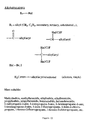
- a third aspect of the invention provides a method of preparing a nucleic acid molecule containing no or up to ten negative charges and no or up to ten positive charges comprising the steps of (1) synthesising a nucleic acid with a phosphorothioate linkage or a phosphoroselenoate linkage between sugar residues, and (2) reacting the said nucleic acid with an alkylating agent so as to eliminate the charge on the said phosphorothioate linkage or said phosphoroselenoate linkage.
- a particular advantage of this method is that uncharged, or substantially uncharged, nucleic acid can be made post-synthetically.
- a further advantage is that uncharged, or substantially uncharged, nucleic acid can be made which is longer than any uncharged nucleic acid that has been (or can be) made by de novo chemical synthesis.
- the nucleic acid is DNA.
- the nucleic acid molecule with a phosphorothioate linkage or with a phosphoroselenoate linkage is synthesised chemically, for example using solid phase phosphoramidite chemistry.
- a review of phosphorothioate-containing oligonucleotides and other nucleic acids is given in Eckstein & Gish 10 . Details of the synthesis and use of phosphorothioate- and phosphoroselenoate-containing oligonucleotides are given in References 10,23,24,25,26,27,28.
- the nucleic acid molecule with a phosphorothioate linkage or with a phosphoroselenoate linkage is synthesised enzymatically.
- an ⁇ S-dNTP or an ⁇ Se-dNTP is incorporated into a growing nucleic acid chain using a polymerase enzyme.
- At least the ⁇ S-dNTPs are readily commercially available for example from United States Biochemical Corporation, 26111 Miles Road, Cleveland, OH 44128, USA.
- Polymerase enzymes are well known in the art of molecular biology and include E . coli DNA polymerase, T4 DNA polymerase and Taq DNA polymerase.
- the Klenow fragment of E . coli DNA polymerase is a preferred enzyme and in this embodiment a nucleic acid template and a primer are used to synthesise the nucleic acid molecule.
- the primer is an oligonucleotide wherein each of the sugar-sugar linkages is either a phosphorothioate or a phosphoroselenoate linkage.
- primers may be modified (preferably at their 5' end) to include a moiety which will aid in purifying the product of primer extension.
- biotin may be incorporated using well known methods and the primer (and any extension product) can be purified by binding to, and subsequent elution from, an immobilised streptavidin protein.
- the primer contains regular phosphate sugar-sugar linkages and the extended product contains only phosphorothioate linkages. Alkylation of such a molecule with, for example, ICH 2 CH 2 OH and subsequent heating to 95°C will lead to the cleavage from the extended molecule of phosphate sugar-sugar linkage containing primer to leave a phosphorothioate-only linked extension product.
- the primer can be synthesised to include at its 5' end an amino group, preferably a secondary, tertiary or quaternary amino group that can be readily protonated to give a positive charge.
- an amino group preferably a secondary, tertiary or quaternary amino group that can be readily protonated to give a positive charge.
- the 5' end of a primer is a free hydroxyl group which can readily be reacted to provide an amino group.
- step (1) of the method of the third aspect of the invention further comprises (a) synthesising said nucleic acid with a taggable group, said taggable group being capable of accepting a positive charge either directly or indirectly either before or after step (2), or (b) synthesising said nucleic acid with a precursor that comprises a positively charged moiety.
- the taggable group accepts the positive charge before step (2).
- the method is used to introduce a single positive charge.
- amino (or ammonium) groups more particularly quaternary ammonium tags, may usefully be added to the nucleic acid that is to be analysed by mass-spectrometry.
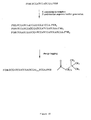
- the amino (or ammonium) group is added to a synthetic oligonucleotide (such as a primer) or to a PCR product either by a 5'-NH 2 link or by attaching a base containing an aliphatic NH 2 group to the 3'end of the DNA, for example by using the enzyme terminal transferase or directly by using a base for termination in a Sanger chain termination protocol which has an aliphatic NH 2 group by which the positively charged group can be added.
- the positively charged group (which is preferably a quaternary ammonium-containing compound) is then attached to the aliphatic -NH 2 group in the nucleic acid.
- the quaternary ammonium-containing compound comprises hydroxysuccinimidyl ester which reacts with aliphatic -NH 2 groups; preferably the compound is trimethyl ammonium hexyryl-N-hydroxysuccinimidyl ester (C5-NHS).
- the taggable group is any suitable group to which a positive charge may be added.
- the taggable group is an aliphatic amino group, preferably a primary amino group.
- the positively charged group may be attached using any suitable method.
- the precursor of the nucleic acid may be any suitable precursor which comprises a positively-charged moiety. It is particularly preferred if the precursor is a dideoxynucleotide comprising a positively charged moiety and that the precursor is introduced into the nucleic acid using a polymerase. Conveniently, the dideoxynucleotide comprising a positively charged moiety is made from a nucleotide precursor that comprises an aliphatic amino group. Suitably, the dideoxynucleotide comprising a positively charged moiety is introduced into the nucleic acid in a Sanger sequencing reaction.
- nucleic acid it is preferred if substantially all of the negative charges of the nucleic acid are removed and a single positive charge remains on the nucleic acid molecule.
- a phosphate sugar-sugar linkage provides the negative charge which is not eliminated upon reaction with the said alkylating agent.
- a phosphate sugar-sugar linkage is readily incorporated into an oligonucleotide which otherwise has phosphorothioate or phosphoroselenoate sugar-sugar linkages using, for example, well known phosphoramidate chemistry.
- each of the sugar-sugar linkages is either a phosphorothioate or a phosphoroselenoate linkage.
- a chain terminating a nucleotide is used in order to terminate the chain.
- Suitable chain terminating reagents include ddNTP, ⁇ S-ddNTP and ⁇ Se-ddNTP.
- the ddNTPs are readily commercially available from the usual suppliers of Sanger sequencing reagents.
- ⁇ SddNTPs are synthesised using the methods described in WO 93/23415 by reacting a 2',3'dideoxynucleoside with a mixture of thiophosphoryl chloride and pyridine at a temperature less than 130°C.
- extension of a primer (which has each sugar-sugar linkage as a phosphorothioate or phosphoroselenoate linkage) using either ⁇ S-dNTP or ⁇ Se-dNTP (or a mixture thereof) in the presence of ⁇ S-ddNTP or ⁇ Se-ddNTP will lead to a plurality of nucleic acid molecules of varying sizes in which all of the sugar-sugar linkages are either a phosphorothioate linkage or a phosphoroselenoate linkage, each of said linkages being capable of reacting with an alkylating agent so as to eliminate the charge on the said linkage.
- a nucleic acid molecule with no charge is produced.
- the chain terminating nucleotide is ddNTP.
- the primer has each sugar-sugar linkage as a phosphorothioate or phosphoroselenoate linkage, and either ⁇ S-dNTP or ⁇ Se-dNTP is used to extend the nucleic acid chain, then incorporation of a ddNTP will yield a nucleic acid molecule wherein the 3'-most sugar-sugar linkage is a phosphate linkage, and all other sugar-sugar linkages are either phosphorothioate or phosphoroselenoate. Alkylation of this molecule so as to eliminate the charge on the phosphorothioate or phosphoroselenoate linkages will yield a molecule which has only a single, negative charge (at the single phosphate group).
- the alkylating agent reacts selectively, but substantially completely, with the phosphorothioate S atom or phosphoroselenoate Se atom.
- the alkylating agent does not react with the bases of nucleic acid or with any free hydroxyl groups of the nucleic acid.
- the alkylating agent is one that reacts substantially completely with the phosphorothioate S atom or phosphoroselenoate Se atom and substantially completely with other reactive groups in the said nucleic acid, for example the bases of the nucleic acid or any free hydroxyl group of the nucleic acid.
- the alkylating agent is substantially incapable of alkylating a phosphate group to form a stable nucleic acid.
- alkylating agent we include R-Hal wherein R is any of a primary, secondary or tertiary alkyl, alkenyl, -CO-alkyl, -CO-aryl, -CH(Hal/Cl/F) alkyl, -CH(Hal/Cl/F)-aryl, -C(Hal/Cl/F)(Hal/Cl/F)alkyl and -C(Hal/Cl/F)aryl and wherein Hal is independently Br or I and (Hal/Cl/F) is independently any of Hal or Cl or F.
- aryl we include phenyl, substituted phenyl, naphthyl and substituted naphthyl groups. Substitutions with an alkyl group or Hal or F or Cl are preferred.
- the alkyl group is -C n H 2n+1 wherein n is 1-20; more preferably n is 1-10; more preferably still n is 1-5.
- the alkenyl group is -C n H 2n-1 wherein n is 2-20; more preferably n is 2-10; more preferably still n is 2-5.
- the alkylating agent is any of methyliodide, methylbromide, ethyliodide, ethylbromide, propyliodide, propylbromide, butyliodide, butylbromide, 1-iodopropane-2-one, 1-iodopropane-3-one, 1-bromopropane-2-one, 1-bromopropane-3-one, 1-iodo-2-fluoropropane, 1-iodo-2-chloro-propane, 1-bromo-2-fluoropropane and 1-bromo-2-chloropropane.
- the alkylating agent is any of methyl iodide, ethyl iodide or propyl iodide, although, of these reagents propyl iodide reacts relatively slowly or is any of methyl bromide, ethyl bromide or propyl bromide.
- Ethyl iodide is most preferred.
- the alkyl bromides react more slowly than the equivalent alkyl iodides but are nevertheless useful.
- the alkyl bromides are less likely to alkylate any free 3'-OH or 5'-OH and this may be advantageous in a PCR and analysis by MALDI.
- alkylating agent is generally unimportant and so, as mentioned above, alkylating agents with primary, secondary and tertiary alkyl chains, or with other substituents, may be used.
- any of the aforementioned compounds also include a proton acceptor group which can be protonated in the gas phase.
- Amino groups are preferred proton acceptor groups and so the alkylating groups of the invention include amino substituted alkyl and aryl groups.
- particularly preferred alkylating agents are ICH 2 CH 2 NH 2 and ICH 2 CH 2 N(CH 3 ) 3 + ClO 4 - .
- the alkylated nucleic acid molecule of this third aspect of the invention is analysed using the first or second aspects of the invention it is highly desirable that the alkylation is substantially complete and to the same extent for each molecule to be analysed.
- substantially all phosphorothioate linkages or substantially all phosphoroselenoate linkages of substantially all of the nucleic acid molecules are so alkylated. It does not matter if other reactive groups of the nucleic acid molecule (such as the bases or hydroxyl groups) so long as that alkylation is substantially complete and to the same extent for each molecule to be analysed.
- substantially complete we mean that for any given molecule that >90% (but more preferably >95%; >99%; or >99.9%) of the sites available for alkylation with a particular alkylating agent (under given reaction conditions) are alkylated.
- substantially all we mean that for any given plurality of molecules >90% (but more preferably >95%; >99% or >99.9%) of the molecules are substantially completely alkylate (under given reaction conditions).
- the extent of alkylation is important so that the masses or mass differences detected reflect differences in the number of nucleoside moieties in a nucleic acid molecule rather than the extent of alkylation.
- nested sets of DNA molecules can be synthesised wherein the sets comprise molecules that differ by a single nucleoside moiety (this, of course, is the principle of the Sanger sequencing method).
- the mass of each (or at least a substantial number) of the plurality of the nucleic acid molecules so generated can be determined according to the first or second aspect of the invention and, because the mass difference expected for each nucleoside moiety (comprising a base A, G, C or T) is known, the sequence of a nucleic acid can be determined.
- the methods of the invention are useful in a quick DNA sequencing method which removes the need for gel electrophoresis of DNA molecules.
- the methods of the first and second aspects of the invention can be used to determine mutations in a DNA sequence.
- the mass of a given nucleic acid sequence can be readily calculated from the known molecular masses of bases, sugar and sugar-sugar linkages. If one or more bases is replaced by another base (as occurs in a mutation), the mass of the said given nucleic acid sequence will change in a predictable way. Thus, as is apparent (and is described in more details in the Examples) mutations can be readily detected.
- the nucleic acid molecule with a given sequence is produced by a polymerase chain reaction.
- the primers used in the PCR may be any of the primers described above (for example containing only phosphorothioate or phosphoroselenoate sugar-sugar linkages, or containing a single or up to ten phosphate linkages, the remaining linkages being phosphorothioate or phosphoroselenoate).
- the primers contain no phosphate linkage.
- the sequence of the primers are designed using well established principles so that the nucleic acid sequence of interest is amplified. Conveniently, ⁇ S-dNTPs or ⁇ Se-dNTPs are used and the resulting DNA molecule has only either phosphorothioate sugar-sugar linkages or phosphoroselenoate sugar-sugar linkages.
- the template DNA for the PCR reaction is derived from a patient, the said patient being a patient in which the presence or absence of a mutation is to be determined.
- a patient being a patient in which the presence or absence of a mutation is to be determined.
- genetic diseases that are caused, at least in part, by well characterised DNA mutations.
- the method of this embodiment of the invention is particularly suited to the identification of the presence or absence of such a causative mutation including a mutation in any of the following genes: the cystic fibrosis transmembrane regulator (CFTR) gene which leads to cystic fibrosis; the Factor VIII or Factor IX genes which leads to haemophilia; ⁇ 1 -antitrypsin gene which leads to emphysema; the phenylalanine hydroxylase gene which leads to phenylketonuria; the ornithine transcarbamylase gene that leads to hyperammonaemia; the argininosuccinate synthetase gene which leads to citrullinaemia; the dystrophin gene which leads to muscular dystrophy; and in the ⁇ -globin gene, some of which lead to sickle cell anaemia and some to thalassaemia.
- CFTR cystic fibrosis transmembrane regulator
- the method is suited not only to point mutations but also to deletions, insertions and other types of mutation. Also, detection of differences in nucleotide sequences is useful in other areas such as DNA I fingerprinting.
- a fourth aspect of the invention provides a method of preparing a nucleic acid molecule containing no or up to ten negative charges comprising the steps of synthesising enzymatically the said nucleic acid using a dNTP uncharged at least at the ⁇ -phosphorus position.
- the nucleic acid is synthesised using a primer and a polymerase.
- the uncharged dNTP is a dNTP shown in Figure 12 wherein R 3 is H and R, is any of BH 2 , CH 3 , OCH 3 , F, -Cl or -H.
- R 2 is as given in Figure 12 but is preferably OH.
- nucleic acid molecules are suitable as primers. It is preferred if the primer is an oligonucleotide wherein each of the sugar-sugar linkages is either uncharged or is capable of having its charge eliminated. Linkages which are capable of having their charge eliminated include a phosphorothioate linkage and a phosphoroselenoate linkage. As in the third aspect of the invention, the primer may be positively charged. The primer may also comprise a phosphate as a sugar-sugar linkage.
- a fifth aspect of the invention provides an uncharged nucleic acid molecule has greater than 17 sugar-sugar linkages.
- the nucleic acid molecule has >20; more preferably >30 and still more preferably >50 sugar-sugar linkages.
- Such molecules are readily synthesised using, for example, the third and fourth aspects of the invention.
- a sixth aspect of the invention provides a nucleic acid molecule with no or up to ten negative charges wherein at least one sugar-sugar linkage comprises an alkylated phosphorothioate moiety or an alkylated phosphoroselenoate moiety.
- Such molecules are readily synthesised using, for example, the third aspect of the invention.
- each of the sugar-sugar linkages is either an alkylated phosphorothioate linkage or an alkylated phosphoroselenoate linkage.
- At least one base of the molecule is alkylated.
- the phosphorothioate linkage or phosphoroselenoate linkage is alkylated with a residue of any of the alkylating agents described in the third aspect of the invention.
- the said alkylated linkage is an alkylated phosphorothioate linkage. It is further preferred if the linkage is alkylated with a methyl, ethyl or propyl residue.
- a seventh aspect of the invention provides an uncharged nucleic acid molecule comprising a phosphoro sugar-sugar linkage wherein in each phosphoro linkage the phosphorous atom is substituted with any one of -BH 2 , -OCH 3 , -F, -Cl, or -H.
- An eighth aspect of the invention provides a nucleic acid molecule containing one to ten phosphate sugar-sugar linkages wherein all other sugar-sugar linkages are uncharged.
- the nucleic acid comprises at least 20 nucleoside residues; more preferably at least 50 nucleoside residues.
- a further aspect of the invention provides a nucleic acid with one or up to ten positive charges wherein the sugar-sugar linkages are uncharged.
- each sugar-sugar linkage is either an alkylated phosphorothioate moiety or an alkylated phosphoroselenoate moiety.
- the nucleic acid has a single positive charge.
- the nucleic acids of this aspect of the invention can be synthesised using a method of the third aspect of the invention.
- a ninth aspect of the invention provides a use of an alkylating agent which reacts selectively, but substantially completely, with a phosphorothioate S atom or a phosphoroselenoate Se atom.
- the alkylating agent is one that reacts substantially completely with the phosphorothioate S atom or phosphoroselenoate Se atom and substantially completely with other reactive groups in the said nucleic acid molecule.
- the alkylating agent is as defined in the third aspect of the invention. It is particularly preferred if the alkylating agent is methyl iodide, ethyl iodide or propyl iodide.
- the use to which the alkylating agent is put is to alkylate a nucleic acid wherein each of the sugar-sugar linkages is either a phosphorothioate or a phosphoroselenoate linkage; or wherein up to ten sugar-sugar linkages is a phosphate linkage and each of the remaining said linkages is either a phosphorothioate or a phosphoroselenoate linkage.
- Tenth, eleventh, twelfth and thirteenth aspects of the invention provide a method of suppressing gene expression in a cell comprising administering to the cell an antisense nucleic acid wherein the antisense nucleic acid is a nucleic acid obtainable by the third and fourth aspects of the invention or a nucleic acid of the fifth, sixth, seventh or eighth aspects of the invention; use of any of the said nucleic acids as an antisense nucleic acid; a said nucleic acid for use in medicine; and a pharmaceutical formulation comprising a said nucleic acid and a pharmaceutically acceptable carrier.
- the nucleic acid is the nucleic acid obtainable by the method of the third aspect of the invention, in particular by synthesising a nucleic acid with a phosphorothioate linkage between sugar residues and reacting the said nucleic acid with an alkylating agent so as to eliminate the charge on the said phosphorothioate linkage.
- Antisense nucleic acids are single-stranded nucleic acid, which can specifically bind to a complementary nucleic acid sequence. By binding to the appropriate target sequence, an RNA-RNA, a DNA-DNA, or RNA-DNA duplex is formed. These nucleic acids are often termed "antisense” because they are complementary to the sense or coding strand of the gene. Recently, formation of a triple helix has proven possible where the oligonucleotide is bound to a DNA duplex. It was found that oligonucleotides could recognise sequences in the major groove of the DNA double helix. A triple helix was formed thereby. Thus, the nucleic acid molecules of the invention may be able to specifically bind double-stranded DNA via recognition of major groove hydrogen binding sites.
- the above oligonucleotides can inhibit the function of the target nucleic acid. This is, for example, a result of blocking the transcription, processing, poly(A) addition, replication, translation, or promoting inhibitory mechanisms of the cells, such as promoting RNA degradations.
- the antisense oligonucleotide of the invention can be used to selectively suppress certain cellular functions. For example, in oncogenic transformed cells, oligonucleotides complementary to the oncogene suppress its expression.
- An antisense oligonucleotide has previously been shown by others to inhibit c-myc protein expression in a human promyelocytic leukaemia cell line, HL60, which over expresses the c-myc proto-oncogene.
- the antisense oligonucleotide used was complementary to regions of the c-myc mRNA.
- a nucleic acid of the present invention with the same base sequence is expected to work in the same way with an advantage of being substantially nuclease resistant and facile to make.
- Antisense oligonucleotides can also be used to inhibit replication and expression of nucleic acid foreign to the host cells.
- the antisense oligonucleotides are prepared as described above and then introduced into cells, for example by microinjection or uptake from the cell culture medium into the cells, or by administration to a patient.
- Antisense oligonucleotides can also be used to inhibit viral replication or expression in cell culture for example, Rous sarcoma virus, vesicular stomatitis virus, herpes simplex virus type 1, simian virus and influenza virus.
- Oligonucleotides complementary to the poly(A) signal are effective; also effective are those targeted at the 5' end of the RNA, particularly the cap and 5' untranslated region, next to the primer binding site and at the primer binding site.
- the cap, 5' untranslated region, and poly(A) signal lie within the sequence repeated at the ends of retrovirus RNA (R region) and the oligonucleotides complementary to these may bind twice to the RNA.
- the antisense oligonucleotide may be any useful antisense oligonucleotide, for example an oligonucleotide complementary to DNA or RNA specifically forming part of a gene for the mutant ras protein, the mutant p53 protein, the BCR-ABL fused mRNA characteristic of the Philadelphia chromosome in chronic myeloid leukaemia (CML) and acute lymphocytic leukaemia (ALL), or an HIV (human immunodeficiency virus) protein, for example the HIV gag, pol , env or sor gene products.
- CML chronic myeloid leukaemia
- ALL acute lymphocytic leukaemia
- HIV human immunodeficiency virus
- the antisense DNA/RNA include the HIV tRNA (Lys) primer binding site, mRNA splice donor or acceptor sites, the poly A region and the initiator codons of the HIV genes mentioned above.
- the antisense nucleic acids (or oligonucleotides) have between 10 and 500 bases, more preferably 15 to 200 bases, most preferably 20 to 100 bases.
- the inherent binding specificity of antisense oligonucleotides characteristic of base pairing is enhanced by limiting the availability of the antisense compound to its intend locus in vivo, permitting lower dosages to be used and minimizing systemic effects.
- oligonucleotides are applied locally to achieve the desired effect.
- the concentration of the oligonucleotides at the desired locus is much higher than if the oligonucleotides were administered systemically, and the therapeutic effect can be achieved using a significantly lower total amount.
- the local high concentration of oligonucleotides enhances penetration of the targeted cells and effectively blocks translation of the target nucleic acid sequences.
- the oligonucleotides can be delivered to the locus by any means appropriate for localized administration of a drug.
- a solution of the oligonucleotides can be injected directly to the site or can be delivered by infusion using an infusion pump.
- the oligonucleotides also can be incorporated into an implantable device which when placed at the desired site, permits the oligonucleotides to be released into the surrounding locus.
- the oligonucleotides are most preferably administered via a hydrogel material.
- the hydrogel is noninflammatory and biodegradable. Many such materials now are known, including those made from natural and synthetic polymers.
- the method exploits a hydrogel which is liquid below body temperature but gels to form a shape-retaining semisolid hydrogel at or near body temperature.
- Preferred hydrogel are polymers of ethylene oxide-propylene oxide repeating units. The properties of the polymer are dependent on the molecular weight of the polymer and the relative percentage of polyethylene oxide and polypropylene oxide in the polymer.
- Preferred hydrogels contain from about 10 to about 80% by weight ethylene oxide and from about 20 to about 90% by weight propylene oxide.
- a particularly preferred hydrogel contains about 70% polyethylene oxide and 30% polypropylene oxide. Hydrogels which can be used are available, for example, from BASF Corp., Parsippany, NJ, under the tradename Pluronic R .
- the hydrogel is cooled to a liquid state and the oligonucleotides are admixed into the liquid to a concentration of about 1 mg oligonucleotide per gram of hydrogel.
- the resulting mixture then is applied onto the surface to be treated, for example by spraying or painting during surgery or using a catheter or endoscopic procedures.
- the polymer warms, it solidifies to form a gel, and the oligonucleotides diffuse out of the gel into the surrounding cells over a period of time defined by the exact composition of the gel.
- the oligonucleotides can be administered by means of other implants that are commercially available or described in the scientific literature, including liposomes, microcapsules and implantable devices.
- implants made of biodegradable materials such as polyanhydrides, polyorthoesters, polylactic acid and polyglycolic acid and copolymers thereof, collagen, and protein polymers, or non-biodegradable materials such as ethylenevinyl acetate (EVAc), polyvinyl acetate, ethylene vinyl alcohol, and derivatives thereof can be used to locally deliver the oligonucleotides.
- biodegradable materials such as polyanhydrides, polyorthoesters, polylactic acid and polyglycolic acid and copolymers thereof, collagen, and protein polymers
- non-biodegradable materials such as ethylenevinyl acetate (EVAc), polyvinyl acetate, ethylene vinyl alcohol, and derivatives thereof can be used to locally deliver the oligonucleotides.
- EVAc
- the oligonucleotides can be incorporated into the material as it is polymerized or solidified, using melt or solvent evaporation techniques, or mechanically mixed with the material.
- the oligonucleotides are mixed into or applied onto coatings for implantable devices such as dextran coated silica beads, stents, or catheters.
- the dose of oligonucleotides is dependent on the size of the oligonucleotides and the purpose for which is it administered. In general, the range is calculated based on the surface area of tissue to be treated.
- the effective dose of oligonucleotide is somewhat dependent on the length and chemical composition of the oligonucleotide but is generally in the range of about 30 to 3000 ⁇ g per square centimetre of tissue surface area.
- the oligonucleotides may be administered to the patient systemically for both therapeutic and prophylactic purposes.
- the oligonucleotides may be administered by any effective method, for example, parenterally (eg intravenously, subcutaneously, intramuscularly) or by oral, nasal or other means which permit the oligonucleotides to access and circulate in the patient's bloodstream.
- Oligonucleotides administered systemically preferably are given in addition to locally administered oligonucleotides, but also have utility in the absence of local administration.
- a dosage in the range of from about 0.1 to about 10 grams per administration to an adult human generally will be effective for this purpose.
- a still further aspect of the invention provides a method of analysing a nucleic acid by mass spectrometry comprising the steps of (1) providing a nucleic acid molecule comprising a positively-charged moiety; (2) introducing the said nucleic acid molecule into a mass spectrometer; and (3) determining the mass of the said nucleic acid.
- the sugar-sugar linkages of the nucleic acid are substantially all phosphate sugar-sugar linkages. As is shown in Example 5, there are advantages to including a positively charged moiety into a nucleic acid whether or not the negative charges of the sugar-sugar linkages are eliminated or not.
- a further aspect of the invention provides a method of preparing a nucleic acid comprising a positively-charged moiety comprising synthesising a nucleic acid with a taggable group, said taggable group being capable of accepting a positive charge either directly or indirectly.
- the sugar-sugar linkages of the nucleic acid are substantially all phosphate sugar-sugar linkages.
- the method is used to introduce a single positive charge.
- amino (or ammonium) groups more particularly quaternary ammonium tags, may usefully be added to the nucleic acid that is to be analysed by mass-spectrometry.
- the amino (or ammonium) group is added to a synthetic oligonucleotide (such as a primer) or to a PCR product either by a 5'-NH 2 link or by attaching a base containing an aliphatic NH 2 group to the 3'end of the DNA, for example by using the enzyme terminal transferase or directly by using a base for termination in a Sanger chain termination protocol which has an aliphatic NH 2 group by which the positively charged group can be added.
- the positively charged group (which is preferably a quaternary ammonium-containing compound) is then attached to the aliphatic -NH 2 group in the nucleic acid.
- the quaternary ammonium-containing compound comprises hydroxysuccinimidyl ester which reacts with aliphatic -NH 2 groups; preferably the compound is trimethyl ammonium hexyryl-N-hydroxysuccinimidyl ester (C5-NHS).
- the taggable group is any suitable group to which a positive charge may be added.
- the taggable group is an aliphatic amino group, preferably a primary amino group.
- the positively charged group may be attached using any suitable method.
- PT phosphorothioate
- MALDI matrix assisted laser desorption ionization
- MALDI MS matrix assisted laser desorption ionization time-of-flight mass spectrometry
- NIM negative ion mode
- PIM positive ion mode
- DMF dimethylformamide
- SA sinapinic acid
- 234-THA 2,3,4-trihydroxyacetophenone
- 246-THA 2,4,6-trihydroxyacetophenone
- Example 1 Alkylation of phosphorothioate linked oligonucleotides and detection by mass-spectrometry
- phosphorothioate deoxyoligonucleotides listed below were synthesized by an in-house oligonucleotide synthesis service by standard phosphoramidite chemistry: HO-CCC, HO-TTT, HO-AAA, HO-GGG, HO-AGCT, HO-TTTTTTTTTT (SEQ ID No 1), HO-TCGATCGATCGA (SEQ ID No 2), M13mp18 forward sequencing primer HO-GTAAAACGACGGCCAGT (SEQ ID No 3). Regular HO-TTTTTTTTTTTT (SEQ ID No 1) was also synthesized.
- Phosphorothioate 5'hexyl-dAGCT was custom synthesized by Oswel DNA Service, University of Edinburgh (Edinburgh EH9 3JJ, UK) using standard phosphoramidite chemistry.
- a hexyl building block (C 6 H 13 ) was coupled to the 5'end also via a PT link.
- Deoxyadenosine 5'- ⁇ -thiotriphosphate (Sp-isomer, dATP- ⁇ -S), deoxycytidine 5'- ⁇ -thiotriphosphate (Sp-isomer, dCTP- ⁇ -S), deoxyguanosine 5'- ⁇ -thiotriphosphate (Sp-isomer, dGTP- ⁇ -S), thymidine 5'- ⁇ -thiotriphosphate (Sp-isomer, dTTP- ⁇ -S) were purchased from Amersham International (Little Chalfont, UK).
- CH 3 I, C 2 H 5 I, C 3 H 7 I, 2,3,4-trihydroxyacetophenone, 2,4,6-trihydroxyacetophenone, sinapinic acid and L-tartaric acid diammonium salt were purchased from Aldrich (Gillingham, UK).
- T4 polynucleotide kinase 5'End-labelling ( 32 P) of PT oligonucleotides was done with T4 polynucleotide kinase according to the protocol of Mundi et al 15 .
- T4 polynucleotide kinase was purchased from New England Biolabs (Bishop's Stortford, UK) and ⁇ - 32 P dATP from Amersham International (Little Chalfont, UK).
- MALDI MS Matrix Assisted Laser Desorption Ionization time-of-flight mass spectrometry
- HO-TTT, HO-CCC, HO-GGG, HO-AAA, and HO-TCGA were alkylated in Tris/DMF and analyzed by MALDI MS using sinapinic acid, 2,3,4-trihydroxyacetophenone and 2,4,6-trihydroxyacetophenone as matrices ( Figure 7). Spectra were recorded in PIM and NIM as described above. Alkylation with CH 3 I was very efficient. Products with masses corresponding to the oligonucleotides with up to six methyl groups were observed which indicates base alkylation.
- alkylating agent after sampling helped drive the backbone alkylation to completion without leading to base alkylation. Due to the small reaction volumes it is probable that some of the alkylating agent is lost during sampling. It was found that the 5'- and 3'-hydroxy groups were susceptible to alkylation by CH 3 I, C 2 H 5 I and to a lesser extent by C 3 H 7 I although these alkylations were not quantitative.
- FIG. 3 shows the time course of the ethylation of PT 5'-hexyl-AGCT, monitored in PIM and NIM in three different matrices (SA, 234-THA and 246-THA).
- SA, 234-THA and 246-THA three different matrices
- the appearance of signals at 1514 Da and 1542 Da (4 and 5 times alkylated starting material) was detected in PIM.
- NIM a signal at 1484 Da (3 times alkylated starting material) was detected in SA and 246-THA matrix.
- FIG. 4 shows the PIM and NIM spectra after completion of the alkylation using SA.
- the 3'-OH was found to be completelyalkylated although often a double peak with masses corresponding to 4x and 5x alkylated starting material was observed in PIM indicating that the 3'-OH alkylation is not quantitative.
- Ethylation products of longer PT oligonucleotides could be detected by MALDI MS.
- HO-T 10 (PT linked) gave a well resolved signal that corresponded to eleven alkylations in PIM using SA as matrix. No corresponding signal was detected in NIM after completion of the alkylation which indicates optimal conditions for alkylation.
- the control alkylation of a regular HO-T 10 in Tris/DMF gave a product that corresponded in mass to the 4 times ethylated starting material this indicates about 40% efficiency of alkylation of regular phosphate groups under these conditions. It could only be detected in NIM.
- PT HO-(TCGA) 3 could be ethylated to completion under the same conditions.
- the signal detected in PIM was very symmetrical, well resolved and corresponded to the starting oligonucleotide ethylated 12 times. During the reaction the decreasing signal of the 10 times ethylated intermediate could be detected in NIM. Products with fewer than 10 alkylations could never be resolved during the alkylation indicating that they are either never abundant enough for detection or that higher alkylation products are more easily detected by MALDI MS due to their homogeneity.
- Salts like NaI, which is a side product of the alkylation reaction, and buffers, were not removed. This might lead to a certain degree of suppression for larger oligonucleotides but could not be observed with the instrument used.
- the resolution/definition is a function of the overall concentration of analyte and therefore a function of the number of ionic positions in an oligonucleotide.
- concentration of oligonucleotide analyte material but, of course, this decreases the detectability.
- analyte to matrix ratios of 1:100 19 very efficient exchange would have to be achieved in order to obtain reasonable signal with longer oligonucleotides (>20 bases).
- a Sanger type approach can be used for sequencing DNA by MALDI because no large "waste" fragments are generated like in a chemical degradation (eg Maxam and Gilbert type) DNA sequencing approach which might obscure a MALDI analysis.
- Purification of extended single strand DNA from proteins, residual trinucleotides and salts can be done by facile precipitation procedures or other purification techniques such as magnetic bead purification are applied 21 .
- oligonucleotides were synthesized by an in house oligonucleotide synthesis service.
- 5'Hexyl phosphorothioate oligonucleotides were custom synthesized by Oswel DNA Service, University of Edinburgh (Edinburgh EH9 3JJ, UK) hexyl-GTAAAACGACGGCCAGT (SEQ ID No 3) (all phosphorothioate links) M13 forward sequencing primer.
- Deoxyadenosine 5'- ⁇ -thiotriphosphate (Sp-isomer), deoxycytidine 5'- ⁇ -thiotriphosphate (Sp-isomer), deoxyguanosine 5'- ⁇ -thiotriphosphate (Sp-isomer), thymidine 5'- ⁇ -thiotriphosphate (Sp-isomer) were purchased from Amersham (Little Chalfont, UK). Dideoxycytidine 5'- ⁇ -thiotriphosphate (1:1 mix of R and S isomers) was used. This was kindly supplied by Amersham International, Little Chalfont, UK and was synthesised by the method described in WO 93/23415. CH 3 I, C 2 H 5 I, C 3 H 7 I were purchased from Aldrich (Gillingham, UK).
- Oligonucleotides smaller than 40 bases were separated on 20 cm x 0.5 mm 15 % acrylamide gels containing 8 M urea. They were run for 1-2 hours at 500 V after an initial run in at 200 V. Larger oligonucleotides were separated on 50 cm x 0.5 mm 6% acrylamide gels containing 8 M urea and are run for 4 h at 2000 V.
- a phosphorothioate 35-mer was generated by extending HO-GTAAAACGACGGCCAGT (SEQ ID No 3) (all phosphorothioate links).
- This primer sequence (2 ⁇ l 1 pmole/ ⁇ l) was annealed to 4 ⁇ l template oligonucleotide (40-mer, ⁇ 200 ng/ ⁇ l) 5'biotin-CAGGCATGCAAGCTTGGCACTGGCCGTCGTTTTAC AACGT (SEQ ID No 4)) with 2,5 ⁇ l TM buffer (100 mM Tris-HCl pH 8, 50 mM MgCl 2 ) and 17 ⁇ l TE buffer (10 mM Tris-HCl, 1 mM EDTA pH 8) at 55°C in 30 min.
- ⁇ -S-dideoxycytidine triphosphate was incorporated roughly 10 times less efficiently as ddCTP but termination is just as specific ( Figure 9: tracks 1-10 regular M13 forward sequencing primer: 1-4 extension with regular nucleotide triphosphates (terminated TCGA), 5-8 extension with ⁇ -S-nucleotide triphosphates (termination TCGA), 9 extension with ⁇ -S-nucleotide triphosphates (termination C), 10 extension with ⁇ -S-nucleotide triphosphates (termination with ⁇ -S-ddCTP); tracks 11-20 phosphorothioate M13 forward sequencing primer: 11-14 extension with regular nucleotide triphosphates (terminated TCGA), 15-18 extension with ⁇ -S-nucleotide triphosphates (termination TCGA), 19 extension with ⁇ -S-nucleotide triphosphates (termination C), 20 extension with ⁇ -S-nucleotide triphosphate
- Example 3 Chain termination protocol for sequencing by MALDI mass spectrometry (example with phosphorothioate DNA, alkylation thereof and removal of primers
- Figure 10 shows a diagrammatic representation of a DNA sequencing reaction using the methods of the invention.
- Example 4 Polymerase chain reaction protocol for analysis by MALDI mass spectrometry (example with phosphorothioate DNA, alkylation thereof, removal of primers)
- Figure 11 shows a diagrammatic representation of a polymerase chain reaction using the methods of the invention.
- Example 5 Charge tagging of DNA for improved analysis by matrix-assisted laser desorption time-of-flight mass spectroscopy
- the efficiency of the detection of a charge tagged DNA was compared to similar oligonucleotides without the charge tag. It is estimated that the combination of charge tagging of an oligonucleotide combined with the alkylation of the backbone results in an increased detectability of oligonucleotides by a factor of 20. It was found that within an equimolar mixtures of differently modified oligonucleotides the charge tagged ones were predominant even when the mass spectrometric conditions are adjusted to optimised conditions for unmodified DNA. In addition the charge tagged and backbone neutralised oligonucleotides tend to suppress other oligonucleotides. Reaction side products in the matrix do not hamper the detectability of the charge tagged and backbone neutralised oligonucleotides.
- a single charge tag can be introduced into a synthetic oligonucleotide or into DNA generated enzymatically either via a terminating group or by enzymatically transferring a chemically reactive group (for example a base containing an aliphatic NH 2 group with terminal transferase).
- Phosphorothioate oligonucleotides were synthesized using standard chemistry by an in-house DNA synthesis service: HO-GTCGACTCTAGAGGATC (SEQ ID No 39) M13 forward PCR primer, HO-GTCGACTCTAGAGGATC (SEQ ID No 39) M13 forward PCR primer (all phosphorothioate links), HO-GAATTCGAGCTCGGTAC (SEQ ID No 40) M13 reverse PCR primer, HO-GAATTCGAGCTCGGTAC (SEQ ID No 40) M13 reverse PCR primer (all phosphorothioate links), NH 2 -TTTTTTTTTTTT (SEQ ID No 41) (all phosphorothioate links), NH 2 -TCGATCGATCGA (SEQ ID No 2) (all phosphorothioate links), H 2 N-TTT (all phosphorothioate links), HO-AGCT (all phosphorothioate links), hexyl-AGCT (all
- 5'Hexyl phosphorotioate oligonucleotides were custom synthesized by Oswel DNA Service, University of Edinburgh (Edinburgh EH9 3JJ, UK) using standard phosphoramidite chemistry in conjunction with a hexyl building block which was linked via a phosphorothioate link: Hexyl-AGCT (all phosphorothioate links), hexyl-GTAAAACGACGGCCAGT (SEQ ID No 3) (all phosphorothioate links) M13 forward sequencing primer.
- Deoxyadenosine 5'- ⁇ -thiotriphosphate (Sp-isomer), deoxycytidine 5'- ⁇ -thiotriphosphate (Sp-isomer), deoxyguanosine 5'- ⁇ -thiotriphosphate (Sp-isomer), thymidine 5'- ⁇ -thiotriphosphate (Sp-isomer) were purchased from Amersham (Little Chalford, UK).
- C 2 H 5 I and matrices 2,2',4,4'-tetrahydroxybenzophenone, 6-aza-2-thiothymine, 2,4,6-trihydroxyacetophenone and 2,3,4-trihydroxyacetophenone were purchased from Aldrich (Gillingham, UK).
- Trimethylammonium hexyryl- N -hydroxysuccinimidyl ester (C5-NHS) was synthesized according to the method of Bartlet-Jones et al , and was a gift of D.C.J. Pappin (Bartlet-Jones, M., Jeffrey, W.A., Hansen, H.F. and Pappin, D.J.C. (1994) Rap . Commun. Mass Spectrom. 8 , 737-742).
- Oligonucleotides were separated on 20 cm x 0.5 mm 15% acrylamide gels containing 8 M urea. They were run for 1-2 hours at 500 V after an initial run in at 200 V. Larger oligonucleotides were separated on 50 cm x 0.5 mm 6% - 10% acrylamide gels containing 8 M urea and are run for 4 h at 2000 V.
- Mass spectrometry analysis (m atrix a ssisted l aser d esorption i onization mass spectrometry (MALDI): 1 ⁇ l of a 1% solutions of matrix in 50% aqueous acetonitrile was spotted onto the target slide and air dried. 0.5 ⁇ l of samples was spotted on to the dried crystals. Dilutions of samples were done with 50% acetonitrile. Volatile components like solvents evaporate upon formation of the matrix. No further effort was made to remove residual buffer salts and salts that were side products of the alkylation reaction. This might lead to some suppression but in most cases no adverse effects were observed.
- MALDI mass spectrometry analysis
- Mass spectra were recorded on a Finnegan MAT LaserMat 2000 time-of-flight mass spectrometer, essentially as described by Mock et al (Mock, K.K., Sutton, C.W. and Cottrell, J.S. Rapid Commun. Mass Spectrom . (1992) 6 , 233).
- C5-NHS C 5 trimethylammonium hexyryl- N -hydroxysuccinimidyl
- the two step synthesis of alkylated phosphorothioate charge tagged DNA was performed as follows. Charge tagging was done first as the alkylating procedure would also take place with an aliphatic amino group. Charge tagging was done as described above. The reaction mixture was removed from ice after 30 minutes. 20 ⁇ l of 90 % DMF was added then 1 ⁇ l of EtI and the tube placed in a waterbath at 55°C for 30 minutes. Another 1 ⁇ l of EtI was added and the reaction mixture kept at 55°C for a further 30 minutes. The solvent and volatile reagents were then evaporated and the product redissolved in 5 ⁇ l of 90% DMF.
- any material can be used as a matrix that sufficiently absorbs at the excitation wavelength and can provide sufficient desorption.
- the twelve oligonucleotides were investigated individually and in mixtures with different concentration ratios. Individually all twelve 4-mers could be detected. Analysis showed that the charge tagging reaction is clean and efficient. The removal of negative charges from the backbone by an alkylation reaction thereafter is also very efficient and clean. The combination of these two reactions is very simple. No side products were observed. Attaching a single positive charge via a charge tag has the advantage that there is no need for a high acidity in the matrix which leads to degradation of DNA.
- 3'NH 2 -ddTTP can also be used as a terminating group in a regular Sanger dideoxy sequencing approach using Klenow for polymerisation. It terminates specifically and efficiently. The combination of charge tagging with backbone alkylation and its benefits are demonstrated.
Landscapes
- Chemical & Material Sciences (AREA)
- Life Sciences & Earth Sciences (AREA)
- Organic Chemistry (AREA)
- Proteomics, Peptides & Aminoacids (AREA)
- Health & Medical Sciences (AREA)
- Engineering & Computer Science (AREA)
- Molecular Biology (AREA)
- Wood Science & Technology (AREA)
- Biochemistry (AREA)
- Zoology (AREA)
- General Health & Medical Sciences (AREA)
- Biotechnology (AREA)
- Physics & Mathematics (AREA)
- Genetics & Genomics (AREA)
- Immunology (AREA)
- Microbiology (AREA)
- Analytical Chemistry (AREA)
- Bioinformatics & Cheminformatics (AREA)
- General Engineering & Computer Science (AREA)
- Biophysics (AREA)
- Chemical Kinetics & Catalysis (AREA)
- Spectroscopy & Molecular Physics (AREA)
- Measuring Or Testing Involving Enzymes Or Micro-Organisms (AREA)
- Other Investigation Or Analysis Of Materials By Electrical Means (AREA)
Applications Claiming Priority (3)
| Application Number | Priority Date | Filing Date | Title |
|---|---|---|---|
| GB9504598 | 1995-03-03 | ||
| GBGB9504598.5A GB9504598D0 (en) | 1995-03-03 | 1995-03-03 | Method of nucleic acid analysis |
| EP96904215A EP0813609B1 (de) | 1995-03-03 | 1996-03-04 | Verfahren zur analyse von nukleinsäuren |
Related Parent Applications (1)
| Application Number | Title | Priority Date | Filing Date |
|---|---|---|---|
| EP96904215A Division EP0813609B1 (de) | 1995-03-03 | 1996-03-04 | Verfahren zur analyse von nukleinsäuren |
Publications (2)
| Publication Number | Publication Date |
|---|---|
| EP1498497A2 true EP1498497A2 (de) | 2005-01-19 |
| EP1498497A3 EP1498497A3 (de) | 2005-03-02 |
Family
ID=10770810
Family Applications (2)
| Application Number | Title | Priority Date | Filing Date |
|---|---|---|---|
| EP96904215A Expired - Lifetime EP0813609B1 (de) | 1995-03-03 | 1996-03-04 | Verfahren zur analyse von nukleinsäuren |
| EP04077319A Withdrawn EP1498497A3 (de) | 1995-03-03 | 1996-03-04 | Verfahren zur Nukleinsäureanalyse unter Verwendung von Masenspektroskopie |
Family Applications Before (1)
| Application Number | Title | Priority Date | Filing Date |
|---|---|---|---|
| EP96904215A Expired - Lifetime EP0813609B1 (de) | 1995-03-03 | 1996-03-04 | Verfahren zur analyse von nukleinsäuren |
Country Status (7)
| Country | Link |
|---|---|
| US (1) | US6268129B1 (de) |
| EP (2) | EP0813609B1 (de) |
| JP (1) | JPH11500924A (de) |
| AT (1) | ATE279533T1 (de) |
| DE (1) | DE69633615T2 (de) |
| GB (1) | GB9504598D0 (de) |
| WO (1) | WO1996027681A1 (de) |
Families Citing this family (55)
| Publication number | Priority date | Publication date | Assignee | Title |
|---|---|---|---|---|
| US5605798A (en) | 1993-01-07 | 1997-02-25 | Sequenom, Inc. | DNA diagnostic based on mass spectrometry |
| US5830655A (en) | 1995-05-22 | 1998-11-03 | Sri International | Oligonucleotide sizing using cleavable primers |
| US6780982B2 (en) | 1996-07-12 | 2004-08-24 | Third Wave Technologies, Inc. | Charge tags and the separation of nucleic acid molecules |
| US5885775A (en) * | 1996-10-04 | 1999-03-23 | Perseptive Biosystems, Inc. | Methods for determining sequences information in polynucleotides using mass spectrometry |
| EP1164203B1 (de) | 1996-11-06 | 2007-10-10 | Sequenom, Inc. | DNA-Diagnostik mittels Massenspektrometrie |
| DE19710166C1 (de) * | 1997-03-12 | 1998-12-10 | Bruker Franzen Analytik Gmbh | Zwei-Schritt-Verfahren der DNA-Amplifikation für MALDI-TOF-Messungen |
| CA2303790A1 (en) * | 1997-09-15 | 1999-03-25 | Brax Group Limited | Characterising nucleic acid by mass spectrometry |
| DK1036202T3 (da) * | 1997-12-05 | 2002-08-12 | Max Planck Gesellschaft | Fremgangsmåde til identifikation af nucleinsyrer ved matriksassisteret laserdesorptions/ionisationsmassespektrometri |
| DE19824280B4 (de) * | 1998-05-29 | 2004-08-19 | Bruker Daltonik Gmbh | Mutationsanalyse mittels Massenspektrometrie |
| US6218118B1 (en) | 1998-07-09 | 2001-04-17 | Agilent Technologies, Inc. | Method and mixture reagents for analyzing the nucleotide sequence of nucleic acids by mass spectrometry |
| US6270976B1 (en) | 1998-09-15 | 2001-08-07 | Brax Group Limited | Characterizing nucleic acid by mass spectrometry |
| US6716634B1 (en) | 2000-05-31 | 2004-04-06 | Agilent Technologies, Inc. | Increasing ionization efficiency in mass spectrometry |
| EP1170379A1 (de) * | 2000-06-30 | 2002-01-09 | Centre National de Genotypage | Erstellung von Proben zur Genotypisierung mittels Massenspektroskopie |
| DE10108453B4 (de) * | 2001-02-22 | 2005-10-20 | Bruker Daltonik Gmbh | Massenspektrometrische Mutationsanalyse mit photolytisch spaltbaren Primern |
| US20040121309A1 (en) | 2002-12-06 | 2004-06-24 | Ecker David J. | Methods for rapid detection and identification of bioagents in blood, bodily fluids, and bodily tissues |
| US7226739B2 (en) | 2001-03-02 | 2007-06-05 | Isis Pharmaceuticals, Inc | Methods for rapid detection and identification of bioagents in epidemiological and forensic investigations |
| US7718354B2 (en) | 2001-03-02 | 2010-05-18 | Ibis Biosciences, Inc. | Methods for rapid identification of pathogens in humans and animals |
| US20030027135A1 (en) | 2001-03-02 | 2003-02-06 | Ecker David J. | Method for rapid detection and identification of bioagents |
| US7666588B2 (en) | 2001-03-02 | 2010-02-23 | Ibis Biosciences, Inc. | Methods for rapid forensic analysis of mitochondrial DNA and characterization of mitochondrial DNA heteroplasmy |
| US20040121314A1 (en) * | 2002-12-06 | 2004-06-24 | Ecker David J. | Methods for rapid detection and identification of bioagents in containers |
| WO2004060278A2 (en) | 2002-12-06 | 2004-07-22 | Isis Pharmaceuticals, Inc. | Methods for rapid identification of pathogens in humans and animals |
| US7217510B2 (en) | 2001-06-26 | 2007-05-15 | Isis Pharmaceuticals, Inc. | Methods for providing bacterial bioagent characterizing information |
| US8073627B2 (en) | 2001-06-26 | 2011-12-06 | Ibis Biosciences, Inc. | System for indentification of pathogens |
| EP1333101B1 (de) | 2002-02-01 | 2007-03-28 | Bruker Daltonik GmbH | Mutationsanalyse Mittels PCR und Massenspektrometrie |
| US8046171B2 (en) | 2003-04-18 | 2011-10-25 | Ibis Biosciences, Inc. | Methods and apparatus for genetic evaluation |
| US8057993B2 (en) | 2003-04-26 | 2011-11-15 | Ibis Biosciences, Inc. | Methods for identification of coronaviruses |
| US7964343B2 (en) | 2003-05-13 | 2011-06-21 | Ibis Biosciences, Inc. | Method for rapid purification of nucleic acids for subsequent analysis by mass spectrometry by solution capture |
| US8158354B2 (en) | 2003-05-13 | 2012-04-17 | Ibis Biosciences, Inc. | Methods for rapid purification of nucleic acids for subsequent analysis by mass spectrometry by solution capture |
| US8242254B2 (en) | 2003-09-11 | 2012-08-14 | Ibis Biosciences, Inc. | Compositions for use in identification of bacteria |
| US8546082B2 (en) | 2003-09-11 | 2013-10-01 | Ibis Biosciences, Inc. | Methods for identification of sepsis-causing bacteria |
| US8097416B2 (en) | 2003-09-11 | 2012-01-17 | Ibis Biosciences, Inc. | Methods for identification of sepsis-causing bacteria |
| US7666592B2 (en) | 2004-02-18 | 2010-02-23 | Ibis Biosciences, Inc. | Methods for concurrent identification and quantification of an unknown bioagent |
| US8119336B2 (en) | 2004-03-03 | 2012-02-21 | Ibis Biosciences, Inc. | Compositions for use in identification of alphaviruses |
| ES2641832T3 (es) | 2004-05-24 | 2017-11-14 | Ibis Biosciences, Inc. | Espectrometría de masas con filtración de iones selectiva por establecimiento de umbrales digitales |
| US20050266411A1 (en) | 2004-05-25 | 2005-12-01 | Hofstadler Steven A | Methods for rapid forensic analysis of mitochondrial DNA |
| US7811753B2 (en) | 2004-07-14 | 2010-10-12 | Ibis Biosciences, Inc. | Methods for repairing degraded DNA |
| WO2006135400A2 (en) | 2004-08-24 | 2006-12-21 | Isis Pharmaceuticals, Inc. | Methods for rapid identification of recombinant organisms |
| US8084207B2 (en) | 2005-03-03 | 2011-12-27 | Ibis Bioscience, Inc. | Compositions for use in identification of papillomavirus |
| US20060205040A1 (en) | 2005-03-03 | 2006-09-14 | Rangarajan Sampath | Compositions for use in identification of adventitious viruses |
| JP2009502137A (ja) | 2005-07-21 | 2009-01-29 | アイシス ファーマシューティカルズ インコーポレイティッド | 核酸変種の迅速な同定および定量のための方法 |
| US9149473B2 (en) | 2006-09-14 | 2015-10-06 | Ibis Biosciences, Inc. | Targeted whole genome amplification method for identification of pathogens |
| US7902345B2 (en) * | 2006-12-05 | 2011-03-08 | Sequenom, Inc. | Detection and quantification of biomolecules using mass spectrometry |
| US8133701B2 (en) * | 2006-12-05 | 2012-03-13 | Sequenom, Inc. | Detection and quantification of biomolecules using mass spectrometry |
| EP2126132B1 (de) | 2007-02-23 | 2013-03-20 | Ibis Biosciences, Inc. | Verfahren für schnelle forensische dna-analyse |
| WO2008151023A2 (en) | 2007-06-01 | 2008-12-11 | Ibis Biosciences, Inc. | Methods and compositions for multiple displacement amplification of nucleic acids |
| WO2009032781A2 (en) | 2007-08-29 | 2009-03-12 | Sequenom, Inc. | Methods and compositions for universal size-specific polymerase chain reaction |
| US20090246762A1 (en) * | 2008-03-31 | 2009-10-01 | Applera Corporation, Applied Biosystems Group | Nucleic acid terminators incorporating a cationic moiety and methods for their use |
| US8148163B2 (en) | 2008-09-16 | 2012-04-03 | Ibis Biosciences, Inc. | Sample processing units, systems, and related methods |
| US8550694B2 (en) | 2008-09-16 | 2013-10-08 | Ibis Biosciences, Inc. | Mixing cartridges, mixing stations, and related kits, systems, and methods |
| WO2010033625A1 (en) | 2008-09-16 | 2010-03-25 | Ibis Biosciences, Inc. | Microplate handling systems and related computer program products and methods |
| EP2396803A4 (de) | 2009-02-12 | 2016-10-26 | Ibis Biosciences Inc | Ionisationssondenanordnungen |
| CA2755615A1 (en) * | 2009-03-18 | 2010-09-23 | Sequenom, Inc. | Use of thermostable endonucleases for generating reporter molecules |
| EP2454000A4 (de) | 2009-07-17 | 2016-08-10 | Ibis Biosciences Inc | Systeme zur identifizierung von biowirkstoffen |
| US8950604B2 (en) | 2009-07-17 | 2015-02-10 | Ibis Biosciences, Inc. | Lift and mount apparatus |
| EP2488656B1 (de) | 2009-10-15 | 2015-06-03 | Ibis Biosciences, Inc. | Mehrfache verschiebungsverstärkung |
Family Cites Families (9)
| Publication number | Priority date | Publication date | Assignee | Title |
|---|---|---|---|---|
| US5003059A (en) * | 1988-06-20 | 1991-03-26 | Genomyx, Inc. | Determining DNA sequences by mass spectrometry |
| FR2636738B1 (fr) | 1988-09-20 | 1992-12-11 | Commissariat Energie Atomique | Procede et installation de sequencage de l'adn |
| JPH06508130A (ja) | 1991-05-23 | 1994-09-14 | テンプル ユニバーシティ−オブ ザ コモンウェルス システム オブ ハイヤー エデュケーション | c−mybプロト−オンコジーンに対するアンチセンスオリゴヌクレオチドによる結腸直腸癌の処置 |
| US5210264A (en) * | 1992-01-10 | 1993-05-11 | Isis Pharmaceuticals, Inc. | S-(2,4-dichlorobenzyl)-β-cyanoethyl phosphorothioate diester |
| AU4236693A (en) | 1992-05-13 | 1993-12-13 | United States Biochemical Corporation | Chemical synthesis of 2',3'-dideoxynucleoside 5'-(alpha-thio) triphosphates |
| US5274566A (en) | 1992-12-04 | 1993-12-28 | United Technologies Corporation | Aligning average axis of hollow workpiece cavity with rotary machine axis |
| DE69433811T2 (de) * | 1993-01-07 | 2005-06-23 | Sequenom, Inc., San Diego | Dns - sequenzierung durch massenspektronomie |
| GB9315847D0 (en) * | 1993-07-30 | 1993-09-15 | Isis Innovation | Tag reagent and assay method |
| EP0765401B1 (de) | 1993-11-17 | 2001-02-21 | Amersham Pharmacia Biotech UK Limited | Verfahren zur massenspektroskopischen sequenzanalyse einer nukleinsäure mittels primerverlängerung |
-
1995
- 1995-03-03 GB GBGB9504598.5A patent/GB9504598D0/en active Pending
-
1996
- 1996-03-04 EP EP96904215A patent/EP0813609B1/de not_active Expired - Lifetime
- 1996-03-04 US US08/894,836 patent/US6268129B1/en not_active Expired - Fee Related
- 1996-03-04 JP JP8526690A patent/JPH11500924A/ja not_active Ceased
- 1996-03-04 WO PCT/GB1996/000476 patent/WO1996027681A1/en not_active Ceased
- 1996-03-04 DE DE69633615T patent/DE69633615T2/de not_active Expired - Fee Related
- 1996-03-04 AT AT96904215T patent/ATE279533T1/de not_active IP Right Cessation
- 1996-03-04 EP EP04077319A patent/EP1498497A3/de not_active Withdrawn
Also Published As
| Publication number | Publication date |
|---|---|
| DE69633615T2 (de) | 2006-02-02 |
| EP0813609B1 (de) | 2004-10-13 |
| DE69633615D1 (de) | 2004-11-18 |
| JPH11500924A (ja) | 1999-01-26 |
| ATE279533T1 (de) | 2004-10-15 |
| US6268129B1 (en) | 2001-07-31 |
| EP1498497A3 (de) | 2005-03-02 |
| GB9504598D0 (en) | 1995-04-26 |
| EP0813609A1 (de) | 1997-12-29 |
| WO1996027681A1 (en) | 1996-09-12 |
Similar Documents
| Publication | Publication Date | Title |
|---|---|---|
| EP0813609B1 (de) | Verfahren zur analyse von nukleinsäuren | |
| CA2220418C (en) | Oligonucleotide sizing using cleavable primers | |
| US8383795B2 (en) | Detection and quantification of biomolecules using mass spectrometry | |
| Limbach | Indirect mass spectrometric methods for characterizing and sequencing oligonucleotides | |
| AU2007352560B2 (en) | Detection and quantification of biomolecules using mass spectrometry | |
| JP4452445B2 (ja) | 移動度改変ヌクレオ塩基ポリマーおよび同一物を使用する方法 | |
| Gut et al. | A procedure for selective DNA alkylation and detection by mass spectrometry | |
| US6500650B1 (en) | Method for identifying polymorphisms | |
| US7667033B2 (en) | Compositions and methods for the use of FMOC derivatives in DNA/RNA synthesis | |
| US6458945B1 (en) | Method for analyzing polynucleotides | |
| WO2009073251A1 (en) | Detection and quantification of biomolecules using mass spectrometry | |
| JP2002510507A (ja) | ハイブリダイゼーション及び不一致識別のための、ピラゾロ[3,4−d]ピリミジン含有オリゴヌクレオチド | |
| JPH11508122A (ja) | 質量分析に基づいたdna診断 | |
| JPH11503611A (ja) | 生体高分子の固相配列決定法 | |
| JP2002535011A (ja) | ゲノムdnaプローブにおけるシトシン−メチル化型の確認法 | |
| CZ85095A3 (en) | Determination method of nucleotide sequence of an oligonucleotide sample | |
| US7033753B1 (en) | Compositions and methods for nonenzymatic ligation of oligonucleotides and detection of genetic polymorphisms | |
| US20110229976A1 (en) | Sequencing of nucleic acid molecules by mass spectrometry | |
| CA2344611C (en) | A method for analyzing polynucleotides | |
| Guy et al. | Incorporation by chemical synthesis and characterization of deoxyribosylformylamine into DNA | |
| Day III | Incision at O6-methylguanine: thymine mispairs in DNA by extracts of human cells | |
| EP4419710B1 (de) | Vorbibliothekszielanreicherung zur nukleinsäuresequenzierung | |
| Frahm et al. | Nucleic Acid analysis by fourier transform ion cyclotron resonance mass spectrometry at the beginning of the twenty-first century | |
| JP2002507883A (ja) | マススペクトロメトリーに基づくdna診断法 |
Legal Events
| Date | Code | Title | Description |
|---|---|---|---|
| PUAI | Public reference made under article 153(3) epc to a published international application that has entered the european phase |
Free format text: ORIGINAL CODE: 0009012 |
|
| PUAL | Search report despatched |
Free format text: ORIGINAL CODE: 0009013 |
|
| 17P | Request for examination filed |
Effective date: 20040826 |
|
| AC | Divisional application: reference to earlier application |
Ref document number: 0813609 Country of ref document: EP Kind code of ref document: P |
|
| AK | Designated contracting states |
Kind code of ref document: A2 Designated state(s): AT BE CH DE DK ES FI FR GB GR IE IT LI LU MC NL PT SE |
|
| AK | Designated contracting states |
Kind code of ref document: A3 Designated state(s): AT BE CH DE DK ES FI FR GB GR IE IT LI LU MC NL PT SE |
|
| AKX | Designation fees paid |
Designated state(s): AT BE CH DE DK ES FI FR GB GR IE IT LI LU MC NL PT SE |
|
| 17Q | First examination report despatched |
Effective date: 20050712 |
|
| GRAP | Despatch of communication of intention to grant a patent |
Free format text: ORIGINAL CODE: EPIDOSNIGR1 |
|
| STAA | Information on the status of an ep patent application or granted ep patent |
Free format text: STATUS: THE APPLICATION IS DEEMED TO BE WITHDRAWN |
|
| 18D | Application deemed to be withdrawn |
Effective date: 20071002 |