EP1500614B1 - Encliquetage de la tige d'articulation par un anneau agrandi - Google Patents
Encliquetage de la tige d'articulation par un anneau agrandi Download PDFInfo
- Publication number
- EP1500614B1 EP1500614B1 EP04405463A EP04405463A EP1500614B1 EP 1500614 B1 EP1500614 B1 EP 1500614B1 EP 04405463 A EP04405463 A EP 04405463A EP 04405463 A EP04405463 A EP 04405463A EP 1500614 B1 EP1500614 B1 EP 1500614B1
- Authority
- EP
- European Patent Office
- Prior art keywords
- belt
- pivot rod
- module
- diameter
- link
- Prior art date
- Legal status (The legal status is an assumption and is not a legal conclusion. Google has not performed a legal analysis and makes no representation as to the accuracy of the status listed.)
- Expired - Lifetime
Links
- 238000003780 insertion Methods 0.000 description 5
- 230000037431 insertion Effects 0.000 description 5
- 238000009434 installation Methods 0.000 description 5
- 230000014759 maintenance of location Effects 0.000 description 3
- 239000004033 plastic Substances 0.000 description 3
- 238000005452 bending Methods 0.000 description 2
- 230000001419 dependent effect Effects 0.000 description 1
- 230000003670 easy-to-clean Effects 0.000 description 1
- 235000013305 food Nutrition 0.000 description 1
- 238000004519 manufacturing process Methods 0.000 description 1
- 238000005007 materials handling Methods 0.000 description 1
- 239000002184 metal Substances 0.000 description 1
- 238000012986 modification Methods 0.000 description 1
- 230000004048 modification Effects 0.000 description 1
- 239000002991 molded plastic Substances 0.000 description 1
- 230000000717 retained effect Effects 0.000 description 1
Images




Classifications
-
- B—PERFORMING OPERATIONS; TRANSPORTING
- B65—CONVEYING; PACKING; STORING; HANDLING THIN OR FILAMENTARY MATERIAL
- B65G—TRANSPORT OR STORAGE DEVICES, e.g. CONVEYORS FOR LOADING OR TIPPING, SHOP CONVEYOR SYSTEMS OR PNEUMATIC TUBE CONVEYORS
- B65G17/00—Conveyors having an endless traction element, e.g. a chain, transmitting movement to a continuous or substantially-continuous load-carrying surface or to a series of individual load-carriers; Endless-chain conveyors in which the chains form the load-carrying surface
- B65G17/06—Conveyors having an endless traction element, e.g. a chain, transmitting movement to a continuous or substantially-continuous load-carrying surface or to a series of individual load-carriers; Endless-chain conveyors in which the chains form the load-carrying surface having a load-carrying surface formed by a series of interconnected, e.g. longitudinal, links, plates, or platforms
- B65G17/08—Conveyors having an endless traction element, e.g. a chain, transmitting movement to a continuous or substantially-continuous load-carrying surface or to a series of individual load-carriers; Endless-chain conveyors in which the chains form the load-carrying surface having a load-carrying surface formed by a series of interconnected, e.g. longitudinal, links, plates, or platforms the surface being formed by the traction element
-
- B—PERFORMING OPERATIONS; TRANSPORTING
- B65—CONVEYING; PACKING; STORING; HANDLING THIN OR FILAMENTARY MATERIAL
- B65G—TRANSPORT OR STORAGE DEVICES, e.g. CONVEYORS FOR LOADING OR TIPPING, SHOP CONVEYOR SYSTEMS OR PNEUMATIC TUBE CONVEYORS
- B65G17/00—Conveyors having an endless traction element, e.g. a chain, transmitting movement to a continuous or substantially-continuous load-carrying surface or to a series of individual load-carriers; Endless-chain conveyors in which the chains form the load-carrying surface
- B65G17/06—Conveyors having an endless traction element, e.g. a chain, transmitting movement to a continuous or substantially-continuous load-carrying surface or to a series of individual load-carriers; Endless-chain conveyors in which the chains form the load-carrying surface having a load-carrying surface formed by a series of interconnected, e.g. longitudinal, links, plates, or platforms
- B65G17/08—Conveyors having an endless traction element, e.g. a chain, transmitting movement to a continuous or substantially-continuous load-carrying surface or to a series of individual load-carriers; Endless-chain conveyors in which the chains form the load-carrying surface having a load-carrying surface formed by a series of interconnected, e.g. longitudinal, links, plates, or platforms the surface being formed by the traction element
- B65G17/086—Conveyors having an endless traction element, e.g. a chain, transmitting movement to a continuous or substantially-continuous load-carrying surface or to a series of individual load-carriers; Endless-chain conveyors in which the chains form the load-carrying surface having a load-carrying surface formed by a series of interconnected, e.g. longitudinal, links, plates, or platforms the surface being formed by the traction element specially adapted to follow a curved path
-
- B—PERFORMING OPERATIONS; TRANSPORTING
- B65—CONVEYING; PACKING; STORING; HANDLING THIN OR FILAMENTARY MATERIAL
- B65G—TRANSPORT OR STORAGE DEVICES, e.g. CONVEYORS FOR LOADING OR TIPPING, SHOP CONVEYOR SYSTEMS OR PNEUMATIC TUBE CONVEYORS
- B65G17/00—Conveyors having an endless traction element, e.g. a chain, transmitting movement to a continuous or substantially-continuous load-carrying surface or to a series of individual load-carriers; Endless-chain conveyors in which the chains form the load-carrying surface
- B65G17/30—Details; Auxiliary devices
- B65G17/38—Chains or like traction elements; Connections between traction elements and load-carriers
- B65G17/40—Chains acting as load-carriers
-
- B—PERFORMING OPERATIONS; TRANSPORTING
- B65—CONVEYING; PACKING; STORING; HANDLING THIN OR FILAMENTARY MATERIAL
- B65G—TRANSPORT OR STORAGE DEVICES, e.g. CONVEYORS FOR LOADING OR TIPPING, SHOP CONVEYOR SYSTEMS OR PNEUMATIC TUBE CONVEYORS
- B65G21/00—Supporting or protective framework or housings for endless load-carriers or traction elements of belt or chain conveyors
- B65G21/16—Supporting or protective framework or housings for endless load-carriers or traction elements of belt or chain conveyors for conveyors having endless load-carriers movable in curved paths
- B65G21/18—Supporting or protective framework or housings for endless load-carriers or traction elements of belt or chain conveyors for conveyors having endless load-carriers movable in curved paths in three-dimensionally curved paths
-
- B—PERFORMING OPERATIONS; TRANSPORTING
- B65—CONVEYING; PACKING; STORING; HANDLING THIN OR FILAMENTARY MATERIAL
- B65G—TRANSPORT OR STORAGE DEVICES, e.g. CONVEYORS FOR LOADING OR TIPPING, SHOP CONVEYOR SYSTEMS OR PNEUMATIC TUBE CONVEYORS
- B65G2207/00—Indexing codes relating to constructional details, configuration and additional features of a handling device, e.g. Conveyors
- B65G2207/12—Chain pin retainers
Definitions
- the present invention relates to a modular belt and a belt module.
- Modular plastic conveyor belts are made up of molded plastic modular links, or belt modules, that can be arranged side by side in rows of selectable width.
- a series of spaced apart link ends extending from each side of the modules include aligned apertures to accommodate a pivot rod.
- the link ends along one end of a row of modules are interconnected with link ends of an adjacent row.
- a pivot rod journaled in the aligned apertures of the side-by-side and end-to-end connected modules forms a hinge between adjacent rows. Rows of belt modules are then connected together to form an endless conveyor belt capable of articulating about a drive sprocket.
- the retention of the pivot rod is an important feature of the modular plastic conveyor belts. Rod retention can be accomplished by enlarging the heads of the pivot rods at both ends but such would not allow for disassembly without destroying the rod head. Headless rods have been used for easier production and belt assembly. These type of rods must be blocked at both ends of the belt during use. In addition headless rods are often difficult to remove for disassembly.
- One approach to rod retention is to have a head at one end of a rod and a headless section at the opposite end.
- the headed rod is furnished with a rod retaining ring disposed on the shaft at a distance from the head portion of the rod.
- the rod is inserted through the pivot holes of the module links, which are all exactly the same diameter.
- the retaining ring is just a little bit larger in diameter than the pivot hole of the outermost link, such that the ring may be forced through the pivot hole of the outermost link end and is able to expand behind the link.
- the rod is kept firmly in position by the retaining ring.
- the system described above has the drawback that it requires tight tolerances of the hole diameter of the outermost link and the retaining ring diameter. In practice, there is a risk that the rod does not retain well enough or is retained tightly and cannot be easily disassembled. In addition, if the retaining ring is a little too large, it may be sheared off when inserted.
- U.S. Patent 5,547,071 discloses a modular belt conform to the preamble of claim 1
- U.S. Patent 5,598,916 discloses a belt module conform to the preamble of claim 6.
- the retaining ring can be made larger in order to increase the size of the shoulder which engages behind the link face.
- the bore of the outermost link needs to be enlarged accordingly in order to allow the larger retaining ring to be moved through the bore. Due to the larger difference between the retaining ring and the rod diameter, the tolerance becomes less critical.
- the bore of the outermost link end is slightly eccentric in such a way that the enlarged shoulder of the retaining ring will be clearly overlapping the link face when assembled. When the belt is under tension the rod will be firmly forced into this retaining position, without losing the ability to transmit the belt pull.
- a modular belt 10 is formed from a plurality of belt modules as will be evident to those of ordinary skill in the art.
- the outermost modules 13, 16 are shown.
- the belt 10 may be formed into varying widths in bricklayed fashion in a direction perpendicular to the direction of belt travel 34.
- Each module 13, 16 has a module body 20 with a first and second plurality of link ends 22, 25 disposed in the middle of the module with respect to the outer edge 12 shown at the top of Figure 1.
- Each link end 22, 25 has opposed side walls 23, 24 defining a first transverse thickness 21.
- the first transverse thickness 21 is connected to the intermediate section 26 of the module body 20 at a first proximal portion 27.
- the transverse thickness extends from the intermediate section 26 in a direction of belt travel to a first distal portion 29.
- the link ends 22, 25 include openings 28, 31 disposed transverse to the direction of belt travel 34.
- the openings 28 and 31 receive the pivot rod 19 when adjacent belt modules 13, 16 are intercalated as shown in the figure.
- the pivot rod 19 is typically round and has a diameter 30 such that the modules 13, 16 are capable of pivoting relative to each other for articulating about a sprocket (not shown).
- the pivot rod 19 has an end portion 46 with a diameter 47 that is greater than the diameter 30 of the pivot rod 19.
- the pivot rod 19 also includes a retaining ring 60 spaced apart longitudinally from the end portion 46.
- the retaining ring 60 has a diameter D R that is larger than the diameter of the pivot rod 19 and may be formed with a chamfered or beveled edge 63.
- Outermost link end 40 of module 16 is disposed toward the edge 12 of belt 10.
- the outermost link end 40 has a recessed portion 43 that is capable of receiving end portion 46 of pivot rod 19.
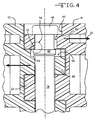
- the pivot rod 19 is installed in the belt 10 in the direction indicated by arrow 49, the end portion 46 is received in the recessed portion 43 and abuts with the portion of the link end surrounding aperture 52 as shown in Fig. 4.
- Link end 40 has an opening 52 with a diameter D 1 that is approximately equal to or slightly smaller than the diameter D R of the ring 60 but is larger than the diameter D 2 of openings 28, 31.
- Belt module 13 also has a specially formed outermost link end 55 having a recessed portion 56 and an opening 31 with a diameter D 2 .
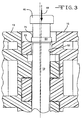
- the central longitudinal axis 65 of aperture 52 is offset from the central longitudinal axis 67 of openings 28, 31 such that upon insertion, the pivot rod 19 is bent as shown in Fig. 3.
- the pivot rod 19 is bent during insertion such that once the ring 60 clears aperture 52, the enlarged shoulder 75 overlaps the link face surrounding aperture 52 as shown in the circled area 76 in Fig. 4.
- the axial misalignment between the apertures 52 and 31 ensures that the ring 60 does not exit from the aligned modules 13 and 16 after installation.
- Figs. 2-4 illustrate the position of the pivot rod 19 and the modules 13 and 16 during various stages of the installation of the pivot rod 19.
- the pivot rod 19 is shown at the maximum insertion point prior to bending the body or shaft of the pivot rod 19.
- the rod 19 has been inserted in the direction of arrow 49 until the beveled edge 63 of the retaining ring 60 engages with the edge of the opening 52 on the left hand side of the figure.
- retaining ring 60 aligns with the opening 52.
- the retaining ring 60 is sized to frictionally engage with the inside walls of opening 52 during insertion. Accordingly, the retaining ring may be roughly equal to or slightly larger in diameter D R than the inside diameter D 1 of opening 52. As shown, the left hand side of the beveled edge 63 clears the opening in Fig. 3 so that the retaining ring 60 may be passed through the opening 52.
- FIG. 5 an alternate embodiment of the modular belt of the present invention is shown.
- the overlapping area 100 located between the outermost link end 103 on the first belt module 104 and the rod retaining ring 106 defines the locking behavior of the snap rod.
- the offset 107 between the pivot rod center axis 109 and the central axis 111 of opening 112 in the outermost link end 103 for the retaining ring 106 is a parameter that affects the locking behavior.
- This offset 107 can be increased by reducing the diameter D 3 of the rod 118 to a diameter D 4 between the head 121 and the retaining ring 106.
- the outermost link end 103 has a recessed portion 122 that receives the head 121.
- the opening 112 in the outermost link end 103 is larger than the openings 127 in the plurality of link ends 130.
- the second belt module 133 also has an outermost link end 136 having a recessed portion 139.
- the recessed portion 139 in the second belt module 133 receives the retaining ring 106 when the first and second belt modules 104, 133 are intercalated and connected by the pivot rod 118.
- the outermost link end 136 on the second belt module 133 has a pivot rod opening 140 with a diameter 143 that is approximately equal to the diameter of the openings 127 in the first belt module 104.
- Fig. 6 the offset 107 is shown from an end view of the intercalated belt modules.
- the pivot rod axis 109 and the central axis 111 of the opening 112 are shown.
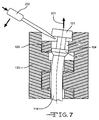
- the pivot rod 118 may be removed by use of a screw driver 200.
- the screw driver 200 may be inserted under the head 121 of the pivot rod 118 to provide leverage for bending the rod 118 to align it with the opening 112 in the outermost link end 103 in the first module 104. Once the retaining ring 106 is aligned with the opening 112 the pivot rod 118 may be removed by sliding it outward in the direction indicated by arrow 203.
- a belt 300 is formed from modules 303 and 306.
- the modules have outer link ends 309, 312.
- Link end 309 on module 306 has extra width to accommodate an internal opening 315 for receiving retaining ring 360 on pivot rod 319.
- Link end 312 on module 303 intercalates adjacent to link end 309 as shown.
- the link end 309 also includes a recessed portion 318 for receiving end portion 346 of pivot rod 319.
- Link end 309 also includes an opening 321 having the same diameter as opening 315. Openings 315 and 321 have a diameter D 1 that is approximately equal to or smaller than the diameter D r of ring 360 which is formed with a chamfered or beveled edge 363. The link end 312 and the link ends disposed toward the middle of the belt have openings with a Diameter D 2 that is smaller than D 1 . The longitudinal axis 325 of openings 315 and 321 is offset from the longitudinal axis 330 of the opening in link end 312 and the openings 350 toward the middle of the belt module.
- the pivot rod 319 has to be bent and once the ring 360 clears the opening 315 it shifts to the left with respect to Fig. 8 such that shoulder 375 engages the link surface around opening 315.
- Fig. 8 may also be provided with a pivot rod 118 (Fig. 5) having different diameters located above and below the retaining ring 106.
- the diameter of the rod between the retaining ring and the head is smaller than the diameter of the rod between the retaining ring and the second end of the rod.
Landscapes
- Engineering & Computer Science (AREA)
- Mechanical Engineering (AREA)
- Chain Conveyers (AREA)
- Clamps And Clips (AREA)
- Hooks, Suction Cups, And Attachment By Adhesive Means (AREA)
- Supports For Pipes And Cables (AREA)
- Supports Or Holders For Household Use (AREA)
- Adornments (AREA)
- Slide Fasteners, Snap Fasteners, And Hook Fasteners (AREA)
- Harvester Elements (AREA)
- Insertion Pins And Rivets (AREA)
Claims (9)
- Une courroie modulaire (10), comprenant :un premier module de courroie (16 ; 104) comportant une première pluralité d'extrémités d'articulation (22 ; 130), chaque extrémité d'articulation (22 ; 130) ayant des parois latérales opposées (23, 24) définissant une première épaisseur transversale (21) reliée à une section intermédiaire (26) au niveau d'une première portion proximale (27) et s'étendant à partir de la section intermédiaire (26) dans un sens de défilement (34) de la courroie jusqu'à une première portion distale (29) aux extrémités d'articulation (22 ; 130), la première pluralité d'extrémités d'articulation (22 ; 130) comportant des premiers orifices (28 ; 127) à travers la première épaisseur transversale (21) entre et par rapport aux parois latérales opposées (23, 24), le premier module de courroie (16 ; 104) ayant une extrémité d'articulation (40 ; 103) la plus à l'extérieur dont les parois latérales opposées définissent une seconde épaisseur transversale reliée à la section intermédiaire (26) au niveau d'une seconde portion proximale et s'étendant à partir de la section intermédiaire (26) dans un sens de défilement (34) de la courroie jusqu'à une seconde portion distale à l'extrémité d'articulation (40 ; 103), l'extrémité d'articulation (40 ; 103) la plus à l'extérieur ayant un second orifice (52 ; 112) à travers la seconde épaisseur transversale entre et par rapport aux parois latérales opposées ;un second module de courroie (13 ; 133) comportant une pluralité d'extrémités d'articulation (25), chaque extrémité d'articulation (25) ayant des parois latérales opposées définissant une première épaisseur transversale reliée à une section intermédiaire au niveau d'une première portion proximale et s'étendant à partir de la section intermédiaire dans un sens de défilement (34) de la courroie jusqu'à une première portion distale aux extrémités d'articulation (25), la première pluralité d'extrémités d'articulation (25) comportant des premiers orifices (31) à travers la première épaisseur transversale entre et par rapport aux parois latérales opposées, le second module de courroie (13 ; 133) ayant une extrémité d'articulation (55 ; 136) la plus à l'extérieur dont les parois latérales opposées définissent une seconde épaisseur transversale reliée à la section intermédiaire au niveau d'une seconde portion proximale et s'étendant à partir de la section intermédiaire dans un sens de défilement (34) de la courroie jusqu'à une seconde portion distale à l'extrémité d'articulation ; etune tige d'articulation (19; 118) comportant un corps de forme allongée présentant un premier diamètre (30; D3), la tige d'articulation (19 ; 118) ayant une première extrémité située à l'opposé d'une seconde extrémité, la tige d'articulation (19 ; 118) ayant un axe longitudinal situé transversalement par rapport au sens de défilement (34) de la courroie, la tige d'articulation (19 ; 118) étant munie d'une tête (46 ; 121) dont le diamètre (47) est supérieur au premier diamètre (30 ; D3) et comportant un anneau de retenue (60 ; 106) situé à distance de la tête (46 ; 121) dans le sens de l'axe longitudinal, la tige d'articulation (19 ; 118) pouvant être disposée à travers les premiers et seconds orifices (31, 28, 52 ; 127, 112) dans les premier et second modules de courroie adjacents (16, 13 ; 104, 133) de telle manière que la tête (46 ; 121) est disposée contre la paroi latérale opposée de l'extrémité d'articulation (40 ; 103) la plus à l'extérieur du premier module (16 ; 104) lorsque les premier et second modules (16, 13 ; 104, 133) sont intercalés,caractérisée en ce que la seconde épaisseur transversale du premier module de courroie (16 ; 104) est inférieure à la première épaisseur transversale du premier module de courroie (16 ; 104), le second orifice (52 ; 112) du premier module de courroie (16 ; 104) a un diamètre intérieur (D1) supérieur à un diamètre intérieur (D2) des premiers orifices (22 ; 127) du premier module de courroie (16 ; 104), le second orifice (52 ; 112) du premier module de courroie (16; 104) présente un axe longitudinal central (65 ; 111) qui est décalé (107) dans le sens de défilement (34) de la courroie par rapport à un axe longitudinal central (67) des premiers orifices (22 ; 130) du premier module de courroie (16 ; 104), et en ce que la seconde épaisseur transversale du second module de courroie (13 ; 133) est inférieure à la première épaisseur transversale du second module de courroie (13 ; 133) de telle sorte qu'une portion évidée (56 ; 139) est formée dans le second module de courroie (13 ; 133), l'anneau de retenue (60 ; 106) étant disposé dans la portion évidée (56 ; 139) du second module (13 ; 133) venant en contact avec l'une des parois latérales de l'extrémité d'articulation (40 ; 103) la plus à l'extérieur du premier module (16 ; 104) lorsque les premier et second modules (16, 13 ; 104, 133) sont intercalés.
- Courroie modulaire selon la revendication 1, dans laquelle l'anneau de retenue (60 ; 106) présente un diamètre (DR) plus grand que le diamètre intérieur (D1) du second orifice (52 ; 112) du premier module de courroie (16 ; 104).
- Courroie modulaire selon la revendication 1 ou 2, dans laquelle les premiers orifices (31) du second module de courroie (13 ; 133) ont un diamètre intérieur (D2) sensiblement égal au diamètre intérieur (D2) des premiers orifices (28 ; 127) du premier module de courroie (16 ; 104).
- Courroie modulaire selon l'une quelconque des revendications 1 à 3, dans laquelle l'anneau de retenue (60 ; 106) présente un bord biseauté (63).
- Courroie modulaire selon l'une quelconque des revendications 1 à 4, dans laquelle la tige d'articulation (19 ; 118) a un second diamètre (D4) situé entre la tête (46 ; 121) et l'anneau de retenue (60 ; 106), le second diamètre (D4) étant inférieur au premier diamètre (30 ; D3) de la tige d'articulation (19 ; 118).
- Module de courroie (306) pour utilisation avec une tige d'articulation (319) comportant un corps de forme allongée, une tête (346) disposée à une première extrémité et un anneau de retenue (360) situé à distance vers une seconde extrémité située à l'opposé de la première extrémité, le module de courroie (306) comprenant :une première pluralité d'extrémités d'articulation (312), chaque extrémité d'articulation (312) ayant des parois latérales opposées définissant une première épaisseur transversale reliée à une section intermédiaire au niveau d'une première portion proximale et s'étendant à partir de la section intermédiaire dans un sens de défilement de la courroie jusqu'à une première portion distale aux extrémités d'articulation (312), la première pluralité d'extrémités d'articulation (312) ayant chacune un premier orifice (350) à travers la première épaisseur transversale entre et par rapport aux parois latérales opposées;une extrémité d'articulation (309) la plus à l'extérieur comportant une paire de parois opposées définissant une première épaisseur transversale reliée à la section intermédiaire au niveau d'un première portion proximale et s'étendant à partir de la section intermédiaire dans un sens de défilement de la courroie jusqu'à une seconde portion distale aux extrémités d'articulation (309), l'épaisseur transversale de l'extrémité d'articulation (309) la plus à l'extérieur étant plus importante que l'épaisseur des premières extrémités d'articulation, l'extrémité d'articulation (309) la plus à l'extérieur comportant une cavité entre un second orifice (315) et un troisième orifice (321), les seconde et troisième orifices (315, 321) étant dimensionnés pour recevoir la tige d'articulation (319),caractérisé en ce que l'extrémité d'articulation (309) la plus à l'extérieur présente une portion évidée (318) destinée à recevoir la tête (346) de la tige d'articulation (319) et en ce que les second et troisième orifices (315, 321) dans l'extrémité d'articulation (309) la plus à l'extérieur ont un diamètre intérieur (D1) supérieur à un diamètre intérieur (D2) du premier orifice (350) de chacune des premières extrémités d'articulation, la tête (346) de la tige d'articulation (319) étant disposée dans la portion évidée (318) et l'anneau de retenue (360) étant disposé dans la cavité située entre les second et troisième orifices (315, 321) lorsque la tige d'articulation (319) est montée dans le module (306).
- Module de courroie (306) selon la revendication 6, dans lequel les second et troisième orifices (315, 321) ont un axe longitudinal central (325) qui est décalé par rapport à un axe longitudinal central (330) du premier orifice (350) de chacune de la première pluralité d'extrémités d'articulation.
- Module de courroie (306) selon la revendication 7, dans lequel l'axe longitudinal central (325) des second et troisième orifices (315, 321) est décalé dans le sens de défilement de la courroie.
- Module de courroie (306) selon l'une quelconque des revendications 6 à 8, dans lequel le corps de la tige d'articulation (319) a un premier diamètre situé entre la tête (346) et l'anneau de retenue (360) et un second diamètre situé entre l'anneau de retenue (360) et la seconde extrémité, le premier diamètre étant plus petit que le second diamètre.
Applications Claiming Priority (4)
| Application Number | Priority Date | Filing Date | Title |
|---|---|---|---|
| US891807 | 1997-07-14 | ||
| US48982403P | 2003-07-24 | 2003-07-24 | |
| US489824P | 2003-07-24 | ||
| US10/891,807 US7108127B2 (en) | 2003-07-24 | 2004-07-15 | Rod retaining snap rod with enlarged retaining ring |
Publications (2)
| Publication Number | Publication Date |
|---|---|
| EP1500614A1 EP1500614A1 (fr) | 2005-01-26 |
| EP1500614B1 true EP1500614B1 (fr) | 2006-06-21 |
Family
ID=33493640
Family Applications (1)
| Application Number | Title | Priority Date | Filing Date |
|---|---|---|---|
| EP04405463A Expired - Lifetime EP1500614B1 (fr) | 2003-07-24 | 2004-07-21 | Encliquetage de la tige d'articulation par un anneau agrandi |
Country Status (6)
| Country | Link |
|---|---|
| US (3) | US7108127B2 (fr) |
| EP (1) | EP1500614B1 (fr) |
| AT (1) | ATE330878T1 (fr) |
| DE (1) | DE602004001296T2 (fr) |
| DK (1) | DK1500614T3 (fr) |
| ES (1) | ES2267027T3 (fr) |
Families Citing this family (27)
| Publication number | Priority date | Publication date | Assignee | Title |
|---|---|---|---|---|
| US7331447B2 (en) * | 2003-07-24 | 2008-02-19 | Habasit Ag | Rod retaining snap rod with enlarged retaining ring |
| US7108127B2 (en) * | 2003-07-24 | 2006-09-19 | Habasit Ag | Rod retaining snap rod with enlarged retaining ring |
| NL1026284C2 (nl) * | 2004-05-27 | 2005-11-30 | Rexnord Flattop Europe Bv | Samenstel voor het scharnierbaar koppelen van delen van een transporteur, alsmede scharnierpen. |
| US7530454B2 (en) * | 2005-11-08 | 2009-05-12 | Ashworth Bros. Inc. | Conveyor belt |
| DE102007019939B3 (de) * | 2007-04-27 | 2008-09-18 | Simonswerk, Gmbh | Türband und Verfahren zur Herstellung eines Türbandes |
| IT1392181B1 (it) * | 2008-12-11 | 2012-02-22 | System Plast S R L | Convogliatore |
| US8113340B1 (en) | 2009-02-03 | 2012-02-14 | Hormel Foods Corporation | Modular conveyer belt |
| US8978881B2 (en) * | 2009-10-29 | 2015-03-17 | Habasit Ag | Pivot rod and method of making thereof |
| DK201000294A (en) * | 2010-04-08 | 2011-10-09 | Ammeraal Beltech Modular As | Restrictor clip |
| CN102319972A (zh) * | 2011-08-10 | 2012-01-18 | 长春轨道客车股份有限公司 | 防止转向架侧梁一系定位座组焊变形的方法 |
| KR101741239B1 (ko) * | 2011-12-06 | 2017-05-29 | 애슈워쓰 브라더스, 인코포레이티드 | 로드 유지 특징부를 갖는 컨베이어 벨트용 링크 |
| US8636141B2 (en) | 2011-12-06 | 2014-01-28 | Ashworth Bros., Inc. | Conveyor belt link with rod retaining feature |
| US8607967B2 (en) | 2011-12-06 | 2013-12-17 | Ashworth Bros., Inc. | Conveyor belt link with rod retaining feature |
| US8720676B2 (en) | 2011-12-06 | 2014-05-13 | Ashworth Bros., Inc. | Conveyor belt link with rod retaining feature |
| CN104039667B (zh) | 2011-12-23 | 2018-08-10 | 德马泰克公司 | 分拣机板条连接装置 |
| ITRM20120430A1 (it) * | 2012-09-07 | 2014-03-08 | System Plast S R L | Sistemi di trasporto con connettori e metodi di uso e realizzazione |
| US9102476B2 (en) | 2012-10-25 | 2015-08-11 | Solus Industrial Innovations, Llc | Conveyor system wear indication devices and methods |
| CN105263828B (zh) | 2012-11-29 | 2017-04-26 | 雷勃电气美国公司 | 侧弯曲输送机和输送带 |
| US9216859B2 (en) * | 2013-05-03 | 2015-12-22 | Habasit Ag | Rod retention system and method |
| US9694979B2 (en) * | 2015-06-18 | 2017-07-04 | Cambridge International Inc. | Plate conveyor belt |
| US10183809B2 (en) * | 2016-05-24 | 2019-01-22 | Habasit Ag | Pin retention for conveyor modules |
| WO2019152339A1 (fr) | 2018-01-30 | 2019-08-08 | Cambridge International, Inc. | Système d'épissage destiné à une bande transporteuse |
| IT201800005862A1 (it) * | 2018-05-30 | 2019-11-30 | Fissaggio di un tampone di presa ad una catena gripper. | |
| US11440735B2 (en) | 2019-10-04 | 2022-09-13 | Cambridge International, Inc. | Flatwire belt conveyor systems and methods |
| CN112919007B (zh) * | 2021-04-09 | 2025-02-18 | 上海采扬塑料制品有限公司 | 一种塑料链板 |
| WO2024059066A1 (fr) | 2022-09-13 | 2024-03-21 | Cambridge International, Inc. | Systèmes et procédés de courroie transporteuse sans soudure |
| WO2025250637A1 (fr) * | 2024-05-30 | 2025-12-04 | Laitram, L.L.C. | Système de fixation pour bande transporteuse |
Family Cites Families (38)
| Publication number | Priority date | Publication date | Assignee | Title |
|---|---|---|---|---|
| US586956A (en) * | 1897-07-27 | And van dyke | ||
| US589956A (en) * | 1897-09-14 | Non-fillable bottle | ||
| US812655A (en) | 1903-07-02 | 1906-02-13 | Adolph Johnson | Roller-chain for conveyers. |
| US2649812A (en) | 1951-04-02 | 1953-08-25 | Howard W Wylie | Conveyer chain |
| US2852129A (en) | 1957-07-15 | 1958-09-16 | Atlas Chain & Mfg Co | Chain linkage |
| US3269526A (en) | 1964-08-28 | 1966-08-30 | Rex Chainbelt Inc | Chain link with improved pin securement |
| US3631965A (en) * | 1969-09-09 | 1972-01-04 | Lev Nikolaevich Koshkin | Conveyor for assembling apertured workpieces adapted to be received one within another |
| US4153152A (en) * | 1977-02-14 | 1979-05-08 | The Laitram Corporation | Bi-directional hinged conveyor belt |
| ZA818197B (en) * | 1980-12-09 | 1982-10-27 | Scapa Porritt Ltd | Edge guard means for a link belt and a link belt embodying such means |
| SE455861B (sv) | 1981-09-30 | 1988-08-15 | Skf Ab | Anordning vid en kedjetransportor |
| DE3241632C2 (de) | 1982-11-11 | 1986-09-25 | Draadindustrie Jonge Poerink B.V., Borne | Aus Kunststoff-Gliedern bestehendes Förderband mit eingeschobenen Querstäben |
| US4858753A (en) | 1987-04-15 | 1989-08-22 | Rexnord Corporation | Conveyor chain assembly |
| US5058732A (en) * | 1988-11-14 | 1991-10-22 | The Laitram Corporation | Apparatus to allow non-destructive removal of pivot rods in modular plastic conveyor belts |
| US5156264A (en) * | 1988-11-14 | 1992-10-20 | The Laitram Corporation | Non-destructive pivot rod retention apparatus for modular plastic conveyor belts |
| US4911681A (en) * | 1989-07-17 | 1990-03-27 | Ashworth Brothers, Inc. | Ceramic conveyor belt connector rod end fixation |
| US5181601A (en) * | 1990-10-09 | 1993-01-26 | Palmaer K V | Plastic conveyor belt with integral sideplate |
| US5105938A (en) | 1991-06-14 | 1992-04-21 | The Laitram Corporation | Pivot rod retention structure in modular conveyor belts |
| US5372248A (en) | 1994-01-18 | 1994-12-13 | The Laitram Corporation | Radius conveyor belt |
| US5662211A (en) * | 1996-02-05 | 1997-09-02 | Rexnord Corporation | Conveyor chain with self retaining hinge pin with internal barbs |
| US5816390A (en) | 1996-02-05 | 1998-10-06 | Stebnicki; James C. | Conveyor pin retention system using offset openings |
| US5678683A (en) | 1996-02-05 | 1997-10-21 | Rexnord Corporation | Conveyor chain with sealed plug hinge pin retention system |
| US5573106A (en) | 1996-02-05 | 1996-11-12 | Rexnord Corporation | Modular conveyor chain including headed hinge pins |
| JP3642629B2 (ja) * | 1996-05-24 | 2005-04-27 | 株式会社小林製作所 | プラスチック製コンベアベルト及びこれを使用したコンベア装置 |
| US5899322A (en) * | 1996-08-22 | 1999-05-04 | Regina-Emerson Company | Retention clip for conveyor belts |
| US5826705A (en) | 1996-11-25 | 1998-10-27 | Omni Manufacturing Co. | Conveyor belt assembly with headed retention shaft |
| US5960937A (en) | 1997-10-27 | 1999-10-05 | Rexnord Corporation | Conveyor with hinge pin retention plug with snap fit |
| JP2951316B1 (ja) | 1998-05-29 | 1999-09-20 | 株式会社椿本チエイン | 合成樹脂製コンベヤチェーン |
| JP3331464B2 (ja) | 1999-03-25 | 2002-10-07 | 山久チヱイン株式会社 | 合成樹脂製コンベアチェーンに於ける連結ピンの抜止め装置 |
| JP3580415B2 (ja) | 2000-04-05 | 2004-10-20 | 株式会社椿本チエイン | チェーン用ローラ及びローラを備えたチェーン |
| US6330941B1 (en) | 2000-05-25 | 2001-12-18 | Habasit Ag | Radius conveyor belt |
| US6516944B2 (en) | 2000-08-21 | 2003-02-11 | Habasit Ag | Module with alternating, offset cross-rib |
| JP3616624B2 (ja) * | 2002-10-03 | 2005-02-02 | 株式会社椿本チエイン | コンベヤチェーン |
| WO2004037685A2 (fr) * | 2002-10-21 | 2004-05-06 | Ulsh Larry P | Courroie de transporteur modulaire avec moyens de capture de chainons uniques |
| US7108127B2 (en) * | 2003-07-24 | 2006-09-19 | Habasit Ag | Rod retaining snap rod with enlarged retaining ring |
| US7073662B2 (en) * | 2004-02-20 | 2006-07-11 | Ashworth Bros., Inc. | Conveyor belt and method of assembly |
| US7080729B2 (en) * | 2004-08-25 | 2006-07-25 | Habasit Ag | Belt module with oblong pivot hole |
| US7168557B2 (en) * | 2004-12-06 | 2007-01-30 | Rexnord Industries, Llc | Side-flexing conveyor chain having members joined by linkages |
| US7255227B2 (en) * | 2005-04-04 | 2007-08-14 | Laitram, L.L.C. | Hinge rod retention in modular conveyor belt edges by means of resilient blocking elements |
-
2004
- 2004-07-15 US US10/891,807 patent/US7108127B2/en not_active Expired - Lifetime
- 2004-07-21 EP EP04405463A patent/EP1500614B1/fr not_active Expired - Lifetime
- 2004-07-21 AT AT04405463T patent/ATE330878T1/de active
- 2004-07-21 ES ES04405463T patent/ES2267027T3/es not_active Expired - Lifetime
- 2004-07-21 DE DE602004001296T patent/DE602004001296T2/de not_active Expired - Lifetime
- 2004-07-21 DK DK04405463T patent/DK1500614T3/da active
-
2006
- 2006-08-04 US US11/499,409 patent/US20060266627A1/en not_active Abandoned
-
2007
- 2007-09-10 US US11/900,056 patent/US7766159B2/en not_active Expired - Lifetime
Also Published As
| Publication number | Publication date |
|---|---|
| DE602004001296D1 (de) | 2006-08-03 |
| US20080000759A1 (en) | 2008-01-03 |
| EP1500614A1 (fr) | 2005-01-26 |
| US7108127B2 (en) | 2006-09-19 |
| DE602004001296T2 (de) | 2006-11-02 |
| US20050016821A1 (en) | 2005-01-27 |
| US7766159B2 (en) | 2010-08-03 |
| ES2267027T3 (es) | 2007-03-01 |
| DK1500614T3 (da) | 2006-10-16 |
| US20060266627A1 (en) | 2006-11-30 |
| ATE330878T1 (de) | 2006-07-15 |
Similar Documents
| Publication | Publication Date | Title |
|---|---|---|
| US20080000759A1 (en) | Rod retaining snap rod with enlarged retaining ring | |
| EP2004524B1 (fr) | Ceinture modulaire avec tiges pivot comportant une bague de retenue agrandie | |
| AU745176B2 (en) | Conveyor with hinge pin retention plug with snap fit | |
| EP0960839A2 (fr) | Chaíne de transport moulée | |
| US6997309B2 (en) | Roller cradle and modular conveying assembly formed therefrom | |
| EP0787663B1 (fr) | Chaíne transporteuse modulaire contenant des pivots têtés | |
| EP2091848B1 (fr) | Convoyeur de bande modulaire avec de la garde latérale sans intervalle | |
| US7360644B1 (en) | Modular belt with rodless hinge | |
| EP1277676B1 (fr) | Panneau latéral pour convoyeurs avec mécanisme de fermeture cliquetant | |
| US5826705A (en) | Conveyor belt assembly with headed retention shaft | |
| US4949838A (en) | Apparatus and methods to allow non-destructive removal of pivot rods in modular plastic conveyor belts | |
| CN101341082A (zh) | 传送带 | |
| EP1473260A1 (fr) | Système transporteur modulaire et modules | |
| CA2475559C (fr) | Tige de blocage a tige de retenue avec anneau de retenue elargi | |
| EP1751038B1 (fr) | Ensemble permettant le couplage par charniere de parties d'un transporteur | |
| EP1654173B1 (fr) | Courroi modulaire de transport avec tige de retenue | |
| WO2023239490A1 (fr) | Courroie transporteuse métallique à points de service | |
| EP0380202A1 (fr) | Dispositif et procédé pour démonter, sans les détériorer, des tiges articulées sur des courroies de transport en matière plastique modulaire |
Legal Events
| Date | Code | Title | Description |
|---|---|---|---|
| PUAI | Public reference made under article 153(3) epc to a published international application that has entered the european phase |
Free format text: ORIGINAL CODE: 0009012 |
|
| AK | Designated contracting states |
Kind code of ref document: A1 Designated state(s): AT BE BG CH CY CZ DE DK EE ES FI FR GB GR HU IE IT LI LU MC NL PL PT RO SE SI SK TR |
|
| AX | Request for extension of the european patent |
Extension state: AL HR LT LV MK |
|
| 17P | Request for examination filed |
Effective date: 20050314 |
|
| AKX | Designation fees paid |
Designated state(s): AT BE BG CH CY CZ DE DK EE ES FI FR GB GR HU IE IT LI LU MC NL PL PT RO SE SI SK TR |
|
| GRAJ | Information related to disapproval of communication of intention to grant by the applicant or resumption of examination proceedings by the epo deleted |
Free format text: ORIGINAL CODE: EPIDOSDIGR1 |
|
| GRAP | Despatch of communication of intention to grant a patent |
Free format text: ORIGINAL CODE: EPIDOSNIGR1 |
|
| GRAS | Grant fee paid |
Free format text: ORIGINAL CODE: EPIDOSNIGR3 |
|
| GRAA | (expected) grant |
Free format text: ORIGINAL CODE: 0009210 |
|
| AK | Designated contracting states |
Kind code of ref document: B1 Designated state(s): AT BE BG CH CY CZ DE DK EE ES FI FR GB GR HU IE IT LI LU MC NL PL PT RO SE SI SK TR |
|
| PG25 | Lapsed in a contracting state [announced via postgrant information from national office to epo] |
Ref country code: LI Free format text: LAPSE BECAUSE OF FAILURE TO SUBMIT A TRANSLATION OF THE DESCRIPTION OR TO PAY THE FEE WITHIN THE PRESCRIBED TIME-LIMIT Effective date: 20060621 Ref country code: FI Free format text: LAPSE BECAUSE OF FAILURE TO SUBMIT A TRANSLATION OF THE DESCRIPTION OR TO PAY THE FEE WITHIN THE PRESCRIBED TIME-LIMIT Effective date: 20060621 Ref country code: PL Free format text: LAPSE BECAUSE OF FAILURE TO SUBMIT A TRANSLATION OF THE DESCRIPTION OR TO PAY THE FEE WITHIN THE PRESCRIBED TIME-LIMIT Effective date: 20060621 Ref country code: CZ Free format text: LAPSE BECAUSE OF FAILURE TO SUBMIT A TRANSLATION OF THE DESCRIPTION OR TO PAY THE FEE WITHIN THE PRESCRIBED TIME-LIMIT Effective date: 20060621 Ref country code: BE Free format text: LAPSE BECAUSE OF FAILURE TO SUBMIT A TRANSLATION OF THE DESCRIPTION OR TO PAY THE FEE WITHIN THE PRESCRIBED TIME-LIMIT Effective date: 20060621 Ref country code: CH Free format text: LAPSE BECAUSE OF FAILURE TO SUBMIT A TRANSLATION OF THE DESCRIPTION OR TO PAY THE FEE WITHIN THE PRESCRIBED TIME-LIMIT Effective date: 20060621 Ref country code: RO Free format text: LAPSE BECAUSE OF FAILURE TO SUBMIT A TRANSLATION OF THE DESCRIPTION OR TO PAY THE FEE WITHIN THE PRESCRIBED TIME-LIMIT Effective date: 20060621 Ref country code: SI Free format text: LAPSE BECAUSE OF FAILURE TO SUBMIT A TRANSLATION OF THE DESCRIPTION OR TO PAY THE FEE WITHIN THE PRESCRIBED TIME-LIMIT Effective date: 20060621 Ref country code: SK Free format text: LAPSE BECAUSE OF FAILURE TO SUBMIT A TRANSLATION OF THE DESCRIPTION OR TO PAY THE FEE WITHIN THE PRESCRIBED TIME-LIMIT Effective date: 20060621 |
|
| REG | Reference to a national code |
Ref country code: GB Ref legal event code: FG4D |
|
| REG | Reference to a national code |
Ref country code: CH Ref legal event code: EP |
|
| PG25 | Lapsed in a contracting state [announced via postgrant information from national office to epo] |
Ref country code: IE Free format text: LAPSE BECAUSE OF NON-PAYMENT OF DUE FEES Effective date: 20060721 |
|
| REG | Reference to a national code |
Ref country code: IE Ref legal event code: FG4D |
|
| PG25 | Lapsed in a contracting state [announced via postgrant information from national office to epo] |
Ref country code: MC Free format text: LAPSE BECAUSE OF NON-PAYMENT OF DUE FEES Effective date: 20060731 |
|
| REF | Corresponds to: |
Ref document number: 602004001296 Country of ref document: DE Date of ref document: 20060803 Kind code of ref document: P |
|
| REG | Reference to a national code |
Ref country code: SE Ref legal event code: TRGR |
|
| REG | Reference to a national code |
Ref country code: DK Ref legal event code: T3 |
|
| PG25 | Lapsed in a contracting state [announced via postgrant information from national office to epo] |
Ref country code: PT Free format text: LAPSE BECAUSE OF FAILURE TO SUBMIT A TRANSLATION OF THE DESCRIPTION OR TO PAY THE FEE WITHIN THE PRESCRIBED TIME-LIMIT Effective date: 20061121 |
|
| REG | Reference to a national code |
Ref country code: CH Ref legal event code: PL |
|
| ET | Fr: translation filed | ||
| REG | Reference to a national code |
Ref country code: ES Ref legal event code: FG2A Ref document number: 2267027 Country of ref document: ES Kind code of ref document: T3 |
|
| PLBE | No opposition filed within time limit |
Free format text: ORIGINAL CODE: 0009261 |
|
| STAA | Information on the status of an ep patent application or granted ep patent |
Free format text: STATUS: NO OPPOSITION FILED WITHIN TIME LIMIT |
|
| 26N | No opposition filed |
Effective date: 20070322 |
|
| PG25 | Lapsed in a contracting state [announced via postgrant information from national office to epo] |
Ref country code: GR Free format text: LAPSE BECAUSE OF FAILURE TO SUBMIT A TRANSLATION OF THE DESCRIPTION OR TO PAY THE FEE WITHIN THE PRESCRIBED TIME-LIMIT Effective date: 20060922 |
|
| PG25 | Lapsed in a contracting state [announced via postgrant information from national office to epo] |
Ref country code: EE Free format text: LAPSE BECAUSE OF FAILURE TO SUBMIT A TRANSLATION OF THE DESCRIPTION OR TO PAY THE FEE WITHIN THE PRESCRIBED TIME-LIMIT Effective date: 20060621 Ref country code: BG Free format text: LAPSE BECAUSE OF FAILURE TO SUBMIT A TRANSLATION OF THE DESCRIPTION OR TO PAY THE FEE WITHIN THE PRESCRIBED TIME-LIMIT Effective date: 20060921 |
|
| PG25 | Lapsed in a contracting state [announced via postgrant information from national office to epo] |
Ref country code: HU Free format text: LAPSE BECAUSE OF FAILURE TO SUBMIT A TRANSLATION OF THE DESCRIPTION OR TO PAY THE FEE WITHIN THE PRESCRIBED TIME-LIMIT Effective date: 20061222 Ref country code: LU Free format text: LAPSE BECAUSE OF NON-PAYMENT OF DUE FEES Effective date: 20060721 Ref country code: TR Free format text: LAPSE BECAUSE OF FAILURE TO SUBMIT A TRANSLATION OF THE DESCRIPTION OR TO PAY THE FEE WITHIN THE PRESCRIBED TIME-LIMIT Effective date: 20060621 |
|
| PG25 | Lapsed in a contracting state [announced via postgrant information from national office to epo] |
Ref country code: CY Free format text: LAPSE BECAUSE OF FAILURE TO SUBMIT A TRANSLATION OF THE DESCRIPTION OR TO PAY THE FEE WITHIN THE PRESCRIBED TIME-LIMIT Effective date: 20060621 |
|
| PGFP | Annual fee paid to national office [announced via postgrant information from national office to epo] |
Ref country code: NL Payment date: 20140710 Year of fee payment: 11 |
|
| PGFP | Annual fee paid to national office [announced via postgrant information from national office to epo] |
Ref country code: ES Payment date: 20140703 Year of fee payment: 11 Ref country code: AT Payment date: 20140729 Year of fee payment: 11 Ref country code: FR Payment date: 20140717 Year of fee payment: 11 Ref country code: SE Payment date: 20140711 Year of fee payment: 11 Ref country code: GB Payment date: 20140716 Year of fee payment: 11 |
|
| PGFP | Annual fee paid to national office [announced via postgrant information from national office to epo] |
Ref country code: IT Payment date: 20140716 Year of fee payment: 11 |
|
| REG | Reference to a national code |
Ref country code: SE Ref legal event code: EUG |
|
| REG | Reference to a national code |
Ref country code: AT Ref legal event code: MM01 Ref document number: 330878 Country of ref document: AT Kind code of ref document: T Effective date: 20150721 |
|
| GBPC | Gb: european patent ceased through non-payment of renewal fee |
Effective date: 20150721 |
|
| REG | Reference to a national code |
Ref country code: NL Ref legal event code: MM Effective date: 20150801 |
|
| PG25 | Lapsed in a contracting state [announced via postgrant information from national office to epo] |
Ref country code: IT Free format text: LAPSE BECAUSE OF NON-PAYMENT OF DUE FEES Effective date: 20150721 Ref country code: GB Free format text: LAPSE BECAUSE OF NON-PAYMENT OF DUE FEES Effective date: 20150721 |
|
| REG | Reference to a national code |
Ref country code: FR Ref legal event code: ST Effective date: 20160331 |
|
| PG25 | Lapsed in a contracting state [announced via postgrant information from national office to epo] |
Ref country code: FR Free format text: LAPSE BECAUSE OF NON-PAYMENT OF DUE FEES Effective date: 20150731 Ref country code: NL Free format text: LAPSE BECAUSE OF NON-PAYMENT OF DUE FEES Effective date: 20150801 Ref country code: AT Free format text: LAPSE BECAUSE OF NON-PAYMENT OF DUE FEES Effective date: 20150721 Ref country code: SE Free format text: LAPSE BECAUSE OF NON-PAYMENT OF DUE FEES Effective date: 20150722 |
|
| REG | Reference to a national code |
Ref country code: ES Ref legal event code: FD2A Effective date: 20160826 |
|
| PG25 | Lapsed in a contracting state [announced via postgrant information from national office to epo] |
Ref country code: ES Free format text: LAPSE BECAUSE OF NON-PAYMENT OF DUE FEES Effective date: 20150722 |
|
| PGFP | Annual fee paid to national office [announced via postgrant information from national office to epo] |
Ref country code: DK Payment date: 20230721 Year of fee payment: 20 Ref country code: DE Payment date: 20230719 Year of fee payment: 20 |
|
| REG | Reference to a national code |
Ref country code: DE Ref legal event code: R071 Ref document number: 602004001296 Country of ref document: DE |
|
| REG | Reference to a national code |
Ref country code: DK Ref legal event code: EUP Expiry date: 20240721 |