EP1501194B1 - Structure d'électrode pour un système d'affichage à particules sèches - Google Patents
Structure d'électrode pour un système d'affichage à particules sèches Download PDFInfo
- Publication number
- EP1501194B1 EP1501194B1 EP03719125A EP03719125A EP1501194B1 EP 1501194 B1 EP1501194 B1 EP 1501194B1 EP 03719125 A EP03719125 A EP 03719125A EP 03719125 A EP03719125 A EP 03719125A EP 1501194 B1 EP1501194 B1 EP 1501194B1
- Authority
- EP
- European Patent Office
- Prior art keywords
- micro
- particles
- image display
- display device
- electrode
- Prior art date
- Legal status (The legal status is an assumption and is not a legal conclusion. Google has not performed a legal analysis and makes no representation as to the accuracy of the status listed.)
- Expired - Lifetime
Links
Images




Classifications
-
- G—PHYSICS
- G02—OPTICS
- G02F—OPTICAL DEVICES OR ARRANGEMENTS FOR THE CONTROL OF LIGHT BY MODIFICATION OF THE OPTICAL PROPERTIES OF THE MEDIA OF THE ELEMENTS INVOLVED THEREIN; NON-LINEAR OPTICS; FREQUENCY-CHANGING OF LIGHT; OPTICAL LOGIC ELEMENTS; OPTICAL ANALOGUE/DIGITAL CONVERTERS
- G02F1/00—Devices or arrangements for the control of the intensity, colour, phase, polarisation or direction of light arriving from an independent light source, e.g. switching, gating or modulating; Non-linear optics
- G02F1/01—Devices or arrangements for the control of the intensity, colour, phase, polarisation or direction of light arriving from an independent light source, e.g. switching, gating or modulating; Non-linear optics for the control of the intensity, phase, polarisation or colour
- G02F1/165—Devices or arrangements for the control of the intensity, colour, phase, polarisation or direction of light arriving from an independent light source, e.g. switching, gating or modulating; Non-linear optics for the control of the intensity, phase, polarisation or colour based on translational movement of particles in a fluid under the influence of an applied field
- G02F1/1675—Constructional details
- G02F1/1676—Electrodes
-
- G—PHYSICS
- G02—OPTICS
- G02F—OPTICAL DEVICES OR ARRANGEMENTS FOR THE CONTROL OF LIGHT BY MODIFICATION OF THE OPTICAL PROPERTIES OF THE MEDIA OF THE ELEMENTS INVOLVED THEREIN; NON-LINEAR OPTICS; FREQUENCY-CHANGING OF LIGHT; OPTICAL LOGIC ELEMENTS; OPTICAL ANALOGUE/DIGITAL CONVERTERS
- G02F1/00—Devices or arrangements for the control of the intensity, colour, phase, polarisation or direction of light arriving from an independent light source, e.g. switching, gating or modulating; Non-linear optics
- G02F1/01—Devices or arrangements for the control of the intensity, colour, phase, polarisation or direction of light arriving from an independent light source, e.g. switching, gating or modulating; Non-linear optics for the control of the intensity, phase, polarisation or colour
- G02F1/165—Devices or arrangements for the control of the intensity, colour, phase, polarisation or direction of light arriving from an independent light source, e.g. switching, gating or modulating; Non-linear optics for the control of the intensity, phase, polarisation or colour based on translational movement of particles in a fluid under the influence of an applied field
- G02F1/1675—Constructional details
- G02F1/16756—Insulating layers
-
- G—PHYSICS
- G02—OPTICS
- G02F—OPTICAL DEVICES OR ARRANGEMENTS FOR THE CONTROL OF LIGHT BY MODIFICATION OF THE OPTICAL PROPERTIES OF THE MEDIA OF THE ELEMENTS INVOLVED THEREIN; NON-LINEAR OPTICS; FREQUENCY-CHANGING OF LIGHT; OPTICAL LOGIC ELEMENTS; OPTICAL ANALOGUE/DIGITAL CONVERTERS
- G02F1/00—Devices or arrangements for the control of the intensity, colour, phase, polarisation or direction of light arriving from an independent light source, e.g. switching, gating or modulating; Non-linear optics
- G02F1/01—Devices or arrangements for the control of the intensity, colour, phase, polarisation or direction of light arriving from an independent light source, e.g. switching, gating or modulating; Non-linear optics for the control of the intensity, phase, polarisation or colour
- G02F1/13—Devices or arrangements for the control of the intensity, colour, phase, polarisation or direction of light arriving from an independent light source, e.g. switching, gating or modulating; Non-linear optics for the control of the intensity, phase, polarisation or colour based on liquid crystals, e.g. single liquid crystal display cells
- G02F1/133—Constructional arrangements; Operation of liquid crystal cells; Circuit arrangements
- G02F1/1333—Constructional arrangements; Manufacturing methods
- G02F1/1337—Surface-induced orientation of the liquid crystal molecules, e.g. by alignment layers
- G02F1/133707—Structures for producing distorted electric fields, e.g. bumps, protrusions, recesses, slits in pixel electrodes
-
- G—PHYSICS
- G02—OPTICS
- G02F—OPTICAL DEVICES OR ARRANGEMENTS FOR THE CONTROL OF LIGHT BY MODIFICATION OF THE OPTICAL PROPERTIES OF THE MEDIA OF THE ELEMENTS INVOLVED THEREIN; NON-LINEAR OPTICS; FREQUENCY-CHANGING OF LIGHT; OPTICAL LOGIC ELEMENTS; OPTICAL ANALOGUE/DIGITAL CONVERTERS
- G02F1/00—Devices or arrangements for the control of the intensity, colour, phase, polarisation or direction of light arriving from an independent light source, e.g. switching, gating or modulating; Non-linear optics
- G02F1/01—Devices or arrangements for the control of the intensity, colour, phase, polarisation or direction of light arriving from an independent light source, e.g. switching, gating or modulating; Non-linear optics for the control of the intensity, phase, polarisation or colour
- G02F1/13—Devices or arrangements for the control of the intensity, colour, phase, polarisation or direction of light arriving from an independent light source, e.g. switching, gating or modulating; Non-linear optics for the control of the intensity, phase, polarisation or colour based on liquid crystals, e.g. single liquid crystal display cells
- G02F1/133—Constructional arrangements; Operation of liquid crystal cells; Circuit arrangements
- G02F1/1333—Constructional arrangements; Manufacturing methods
- G02F1/1343—Electrodes
- G02F1/134309—Electrodes characterised by their geometrical arrangement
- G02F1/134327—Segmented, e.g. alpha numeric display
-
- G—PHYSICS
- G02—OPTICS
- G02F—OPTICAL DEVICES OR ARRANGEMENTS FOR THE CONTROL OF LIGHT BY MODIFICATION OF THE OPTICAL PROPERTIES OF THE MEDIA OF THE ELEMENTS INVOLVED THEREIN; NON-LINEAR OPTICS; FREQUENCY-CHANGING OF LIGHT; OPTICAL LOGIC ELEMENTS; OPTICAL ANALOGUE/DIGITAL CONVERTERS
- G02F1/00—Devices or arrangements for the control of the intensity, colour, phase, polarisation or direction of light arriving from an independent light source, e.g. switching, gating or modulating; Non-linear optics
- G02F1/01—Devices or arrangements for the control of the intensity, colour, phase, polarisation or direction of light arriving from an independent light source, e.g. switching, gating or modulating; Non-linear optics for the control of the intensity, phase, polarisation or colour
- G02F1/13—Devices or arrangements for the control of the intensity, colour, phase, polarisation or direction of light arriving from an independent light source, e.g. switching, gating or modulating; Non-linear optics for the control of the intensity, phase, polarisation or colour based on liquid crystals, e.g. single liquid crystal display cells
- G02F1/133—Constructional arrangements; Operation of liquid crystal cells; Circuit arrangements
- G02F1/1333—Constructional arrangements; Manufacturing methods
- G02F1/1343—Electrodes
- G02F1/13439—Electrodes characterised by their electrical, optical, physical properties; materials therefor; method of making
-
- G—PHYSICS
- G02—OPTICS
- G02F—OPTICAL DEVICES OR ARRANGEMENTS FOR THE CONTROL OF LIGHT BY MODIFICATION OF THE OPTICAL PROPERTIES OF THE MEDIA OF THE ELEMENTS INVOLVED THEREIN; NON-LINEAR OPTICS; FREQUENCY-CHANGING OF LIGHT; OPTICAL LOGIC ELEMENTS; OPTICAL ANALOGUE/DIGITAL CONVERTERS
- G02F1/00—Devices or arrangements for the control of the intensity, colour, phase, polarisation or direction of light arriving from an independent light source, e.g. switching, gating or modulating; Non-linear optics
- G02F1/01—Devices or arrangements for the control of the intensity, colour, phase, polarisation or direction of light arriving from an independent light source, e.g. switching, gating or modulating; Non-linear optics for the control of the intensity, phase, polarisation or colour
- G02F1/165—Devices or arrangements for the control of the intensity, colour, phase, polarisation or direction of light arriving from an independent light source, e.g. switching, gating or modulating; Non-linear optics for the control of the intensity, phase, polarisation or colour based on translational movement of particles in a fluid under the influence of an applied field
- G02F1/166—Devices or arrangements for the control of the intensity, colour, phase, polarisation or direction of light arriving from an independent light source, e.g. switching, gating or modulating; Non-linear optics for the control of the intensity, phase, polarisation or colour based on translational movement of particles in a fluid under the influence of an applied field characterised by the electro-optical or magneto-optical effect
- G02F1/1671—Devices or arrangements for the control of the intensity, colour, phase, polarisation or direction of light arriving from an independent light source, e.g. switching, gating or modulating; Non-linear optics for the control of the intensity, phase, polarisation or colour based on translational movement of particles in a fluid under the influence of an applied field characterised by the electro-optical or magneto-optical effect involving dry toners
-
- G—PHYSICS
- G02—OPTICS
- G02F—OPTICAL DEVICES OR ARRANGEMENTS FOR THE CONTROL OF LIGHT BY MODIFICATION OF THE OPTICAL PROPERTIES OF THE MEDIA OF THE ELEMENTS INVOLVED THEREIN; NON-LINEAR OPTICS; FREQUENCY-CHANGING OF LIGHT; OPTICAL LOGIC ELEMENTS; OPTICAL ANALOGUE/DIGITAL CONVERTERS
- G02F1/00—Devices or arrangements for the control of the intensity, colour, phase, polarisation or direction of light arriving from an independent light source, e.g. switching, gating or modulating; Non-linear optics
- G02F1/01—Devices or arrangements for the control of the intensity, colour, phase, polarisation or direction of light arriving from an independent light source, e.g. switching, gating or modulating; Non-linear optics for the control of the intensity, phase, polarisation or colour
- G02F1/165—Devices or arrangements for the control of the intensity, colour, phase, polarisation or direction of light arriving from an independent light source, e.g. switching, gating or modulating; Non-linear optics for the control of the intensity, phase, polarisation or colour based on translational movement of particles in a fluid under the influence of an applied field
- G02F1/1675—Constructional details
- G02F1/1679—Gaskets; Spacers; Sealing of cells; Filling or closing of cells
- G02F1/1681—Gaskets; Spacers; Sealing of cells; Filling or closing of cells having two or more microcells partitioned by walls, e.g. of microcup type
-
- G—PHYSICS
- G02—OPTICS
- G02F—OPTICAL DEVICES OR ARRANGEMENTS FOR THE CONTROL OF LIGHT BY MODIFICATION OF THE OPTICAL PROPERTIES OF THE MEDIA OF THE ELEMENTS INVOLVED THEREIN; NON-LINEAR OPTICS; FREQUENCY-CHANGING OF LIGHT; OPTICAL LOGIC ELEMENTS; OPTICAL ANALOGUE/DIGITAL CONVERTERS
- G02F1/00—Devices or arrangements for the control of the intensity, colour, phase, polarisation or direction of light arriving from an independent light source, e.g. switching, gating or modulating; Non-linear optics
- G02F1/01—Devices or arrangements for the control of the intensity, colour, phase, polarisation or direction of light arriving from an independent light source, e.g. switching, gating or modulating; Non-linear optics for the control of the intensity, phase, polarisation or colour
- G02F1/165—Devices or arrangements for the control of the intensity, colour, phase, polarisation or direction of light arriving from an independent light source, e.g. switching, gating or modulating; Non-linear optics for the control of the intensity, phase, polarisation or colour based on translational movement of particles in a fluid under the influence of an applied field
- G02F1/1675—Constructional details
- G02F2001/1678—Constructional details characterised by the composition or particle type
-
- G—PHYSICS
- G09—EDUCATION; CRYPTOGRAPHY; DISPLAY; ADVERTISING; SEALS
- G09G—ARRANGEMENTS OR CIRCUITS FOR CONTROL OF INDICATING DEVICES USING STATIC MEANS TO PRESENT VARIABLE INFORMATION
- G09G2300/00—Aspects of the constitution of display devices
- G09G2300/06—Passive matrix structure, i.e. with direct application of both column and row voltages to the light emitting or modulating elements, other than LCD or OLED
-
- G—PHYSICS
- G09—EDUCATION; CRYPTOGRAPHY; DISPLAY; ADVERTISING; SEALS
- G09G—ARRANGEMENTS OR CIRCUITS FOR CONTROL OF INDICATING DEVICES USING STATIC MEANS TO PRESENT VARIABLE INFORMATION
- G09G2310/00—Command of the display device
- G09G2310/02—Addressing, scanning or driving the display screen or processing steps related thereto
- G09G2310/0264—Details of driving circuits
- G09G2310/0275—Details of drivers for data electrodes, other than drivers for liquid crystal, plasma or OLED displays, not related to handling digital grey scale data or to communication of data to the pixels by means of a current
-
- G—PHYSICS
- G09—EDUCATION; CRYPTOGRAPHY; DISPLAY; ADVERTISING; SEALS
- G09G—ARRANGEMENTS OR CIRCUITS FOR CONTROL OF INDICATING DEVICES USING STATIC MEANS TO PRESENT VARIABLE INFORMATION
- G09G2360/00—Aspects of the architecture of display systems
- G09G2360/18—Use of a frame buffer in a display terminal, inclusive of the display panel
-
- G—PHYSICS
- G09—EDUCATION; CRYPTOGRAPHY; DISPLAY; ADVERTISING; SEALS
- G09G—ARRANGEMENTS OR CIRCUITS FOR CONTROL OF INDICATING DEVICES USING STATIC MEANS TO PRESENT VARIABLE INFORMATION
- G09G3/00—Control arrangements or circuits, of interest only in connection with visual indicators other than cathode-ray tubes
- G09G3/20—Control arrangements or circuits, of interest only in connection with visual indicators other than cathode-ray tubes for presentation of an assembly of a number of characters, e.g. a page, by composing the assembly by combination of individual elements arranged in a matrix no fixed position being assigned to or needed to be assigned to the individual characters or partial characters
- G09G3/34—Control arrangements or circuits, of interest only in connection with visual indicators other than cathode-ray tubes for presentation of an assembly of a number of characters, e.g. a page, by composing the assembly by combination of individual elements arranged in a matrix no fixed position being assigned to or needed to be assigned to the individual characters or partial characters by control of light from an independent source
- G09G3/3433—Control arrangements or circuits, of interest only in connection with visual indicators other than cathode-ray tubes for presentation of an assembly of a number of characters, e.g. a page, by composing the assembly by combination of individual elements arranged in a matrix no fixed position being assigned to or needed to be assigned to the individual characters or partial characters by control of light from an independent source using light modulating elements actuated by an electric field and being other than liquid crystal devices and electrochromic devices
- G09G3/344—Control arrangements or circuits, of interest only in connection with visual indicators other than cathode-ray tubes for presentation of an assembly of a number of characters, e.g. a page, by composing the assembly by combination of individual elements arranged in a matrix no fixed position being assigned to or needed to be assigned to the individual characters or partial characters by control of light from an independent source using light modulating elements actuated by an electric field and being other than liquid crystal devices and electrochromic devices based on particles moving in a fluid or in a gas, e.g. electrophoretic devices
Definitions
- the present invention relates to a dry-type particle display device, which comprises an image display panel which can repeatedly display or delete images accompanied by flight and movement of particles utilizing Coulomb's force and so on.
- image display devices substitutable for liquid crystal display (LCD)
- image display devices with the use of technology such as an electrophoresis method, an electro-chromic method, a thermal method, dichroic-particles-rotary method are proposed.
- an image display device comprising an image display panel, in which two or more groups of particles having different colors and different charge characteristics are sealed between two substrates, at least one of two substrates being transparent, and, in which the particles, to which an electrostatic field produced by a pair of electrodes provided on respective substrates is applied, are made to fly and move so as to display an image by means of Coulomb's force.
- Tasks to be solved by the invention including a first embodiment and a second embodiment are as follows. That is, if the image is repeatedly displayed and deleted in the image display device, the particles are moved in parallel to the substrate due to agglutination power and gravity of the particle itself and a rough and dense portion of the particles is generated, so that a defect of the image display and a decrease of the contrast occur. Therefore, an idea is proposed such that a space between the substrates is divided finely by a partition wall so as to form a cell structure and a movement along lateral direction of the particles is inhibited.
- this method utilizing the partition wall there is a drawback such that an effective display area decreases and thus the contrast deteriorates.
- a particle filling operation into the cell becomes complicated when manufacturing the image display device and further a manufacturing cost of the image display device is increased due to the partition wall production.
- An object of the invention including the first embodiment and the second embodiment is to provide an image display device having a rapid response in a dry-type device, a simple and inexpensive construction and an excellent stability, which can inhibit an image deterioration due to a particle agglutination during repeated image display operations and can improve a durability.
- the present invention provides a dry-type particle display device which comprises an image display panel, in which two or more groups of particles having different colors and different charge characteristics are sealed between two substrates, at least one of said two substrates being transparent, and in which the particles, to which an electrostatic field produced by a pair of electrodes provided on respective substrates is applied, are made to move so as to display an image, characterized either in that micro-concave portions and/or micro-convex portions or in that micro-cutout holes are provided on a part of or over the whole of an electrode surface, so that a lateral electric field component is induced on switching.
- micro-concave portions and/or micro-convex portions are provided.
- micro-cutout holes are provided.
- an electric field for flying the particles applied from a pair of electrodes provided respectively on the two substrates arranged in parallel with each other is an even electric field.
- the image display device according to the invention it is possible to introduce a very little uneven electric field partly by the micro-concave portions and/or the micro-convex portions arranged to a surface of the electrode. Since the very little uneven electric field generated by the micro-concave portions and/or the micro-convex portions includes an electric field component along a lateral direction i.e. along a direction parallel to the substrate surface, the particles to be moved in a lateral direction are sucked or cast away aggressively and the particles are fixed. Therefore, it is possible to inhibit an uneven distribution of the particles due to the particle agglutination.
- an influence rate for the particles applied from the uneven electric field obtained by the micro-concave portions and/or the micro-convex portions is determined in relation to an average particle size of the particles. Therefore, it is possible to obtain the uneven electric field having a value larger than a predetermined value by defining a relation between the average particle size and a dimension of the micro-concave portions and/or the micro-convex portions.
- micro-concave portions and/or the micro-convex portions in such a manner that the following formulas are satisfied: w av / d av_max > 2 ; and h av / d av_max > 2 ; wherein w av is the average width defined as a distance from corner to corner across the shape of the projection of the micro-concave portions and/or the micro-convex portions on to the electrode surface , h av is the average absolute value of the depth of the micro-concave portions and/or of the height of the micro-convex portions ; and d av_max is the largest average particle size among the two or more groups of particles.
- the micro-concave portions and/or the micro-convex portions are to be arranged on a display electrode that requires an optical transparent property, it is difficult to increase an ITO transparent electrode used normally as a thin film of several tens nm order from the viewpoint of its process and its optical property.
- a transparent insulation layer is arranged on the electrode and micro-concave portions and/or the micro-convex portions are arranged thereto so as to obtain the same effects.
- an average distance L av between the micro-concave portions and/or the micro-convex portions is arranged to satisfy the formula: L av / d av_max ⁇ 50.
- a gross area of projection shapes of the micro-concave portions and/or the micro-convex portions on the electrode surface is not more than 50 % with respect to an area of the electrode.
- the total area of the micro-concave portions and the micro-convex portions is not less than 0.1 % with respect to the electrode area.
- the particles used in the image display device of the first embodiment of the invention it is preferred to use the particles such that an average particle diameter of the particles is 0.1 to 50 ⁇ m.
- the use the particles are such that a surface charge density of the particles measured by a carrier and in accordance with a blow-off method is not less than 5 ⁇ C/m 2 and not greater than 150 ⁇ C/m 2 in an absolute value.
- the particles are particles such that the maximum surface potential, in the case that the surface of particles is charged by applying a voltage of 8 KV to a Corona discharge device deployed at a distance of 1 mm from the surface, is 300 V or greater at 0.3 second after the Corona discharge.
- a color of the particles is a white or a black.
- a dry particle display device which comprises an image display panel, in which two or more groups of particles having different colours and different charge characteristics are sealed between two substrates, at least one of two substrates being transparent, and, in which the particles, to which an electrostatic field produced by a pair of electrodes provided on respective substrates is applied, are made to move so as to display an image, is characterized in that micro-cutout holes are provided to a part of or an overall of a surface of the electrode.
- an electric field for flying the particles applied from a pair of electrodes provided respectively on the two substrates arranged in parallel with each other is an even electric field.
- the image display device it is possible to introduce a very little uneven electric field partly by the micro-cutout holes arranged to a surface of the electrode. Since the very little uneven electric field generated by the micro-cutout holes includes an electric field component along a lateral direction i.e. along a direction parallel to the substrate surface, the particles to be moved in a lateral direction are sucked or cast away aggressively and the particles are fixed. Therefore, it is possible to inhibit an uneven distribution of the particles due to the particle agglutination.
- an influence rate for the particles applied from the uneven electric field obtained by the micro-cutout holes is determined in relation to an average particle size of the particles. Therefore, it is possible to obtain the uneven electric field having a value larger than a predetermined value by defining a relation between the average particle size of the particles and a dimension of the micro-cutout holes. From this viewpoint, it is preferred to construct the micro-cutout holes in such a manner that the following formula is satisfied: w max / d av_max > 10 ; where w max is the maximum width defined as the maximum distance from corner to corner across the shape of the micro-cutout holes; and d av_max is the largest average particle size among the two or more groups of particles.
- a minimum distance L min between the holes is arranged to satisfy the following formula: L min / d av_max > 50.
- the total area of the micro-cutout holes on the electrode surface is not more than 50% with respect to an area of the electrode.
- the total area of the micro-cutout holes is not less than 0.1% with respect to the electrode area.
- the particles used in the image display device of the second embodiment of the invention it is preferred to use the particles such that an average particle diameter of the particles is 0.1 to 50 ⁇ m.
- the particles are such that a surface charge density of the particles measured by a carrier and in accordance with a blow-off method is not less than 5 ⁇ C/m 2 and not greater than 150 ⁇ C/m 2 in an absolute value.
- the particles are particles in which the maximum surface potential, in the case that the surface of particles is charged by applying a voltage of 8 KV to a Corona discharge device deployed at a distance of 1 mm from the surface, is 300 V or greater at 0.3 second after the Corona discharge.
- a color of the particles is a white or a black.
- Figs. 1a to 1c are schematic views respectively showing first and second embodiments of the image display element of the image display panel used for the image display device according to the invention and its display driving method.
- numeral 1 is a transparent substrate
- numeral 2 is an opposed substrate
- numeral 3 is a display electrode (transparent electrode)
- numeral 4 is an opposed electrode
- numeral 5 is a negatively chargeable particle
- numeral 6 is a positively chargeable particle.
- Fig. 1a shows a state such that the negatively chargeable particles 5 and the positively chargeable particles 6 are arranged between opposed substrates (transparent substrate 1 and opposed substrate 2).
- a voltage is applied in such a manner that a side of the display electrode 3 becomes low potential and a side of the opposed electrode 4 becomes high potential, as shown in Fig. 1b , the positively chargeable particles 6 fly and move to the side of the display electrode 3 and the negatively chargeable particles 5 fly and move to the side of the opposed electrode 4 by means of Coulomb's force.
- a display face viewed from a side of the transparent substrate 1 looks like a color of the positively chargeable particles 6.
- the negatively chargeable particles 5 fly and move to the side of the display electrode 3 and the positively chargeable particles 6 fly and move to the side of the opposed electrode 4 by means of Coulomb's force.
- the display face viewed from the side of the transparent substrate 1 looks like a color of the negatively chargeable particles 5.
- the display states shown in Figs. 1b and 1c are repeatedly changeable only by reversing the potentials of a power source, and thus it is possible to change colors on the display face reversibly by reversing the potentials of the power source as mentioned above.
- the colors of the particles can be arbitrarily selected. For example, when the negatively chargeable particles 5 are white color and the positively chargeable particles 6 are black color, or, when the negatively chargeable particles 5 are black color and the positively chargeable particles 5 are white color, a reversible image display between white color and black color can be performed. In this method, since the particles are once adhered to the electrode by means of an imaging force, a display image can be maintained for a long time after a voltage apply is stopped, thereby showing an excellent memory property.
- the response speed of the image display is extremely fast and the response speed of shorter than 1 msec may be possible.
- it is stable with respect to a temperature variation and can be used in a wide temperature range from a low temperature to a high temperature. Further, it is not affected by an angle of visual field and has a high reflection coefficient. Therefore, it is easily viewable and has low electric power consumption. Furthermore, it has an excellent memory property and thus it is not necessary to use an electric power when the image is to be maintained.
- micro-concave portions, micro-convex portions, or both of the micro-concave portions and the micro-convex portions are provided to a part of or an overall of a surface of the electrode (here, display electrode 3 and opposed electrode 4).
- a shape of the micro-concave portions and/or the micro-convex portions is important.
- the micro-concave portions and/or the micro-convex portions are constructed in such a manner that the following formulas are satisfied: average width/maximum average particle size > 2; and average height/maximum average particle size > 2; where a length across corner of a projection shape of the micro-concave portions and/or the micro-convex portions with respect to an electrode surface is assumed to be the average width, an average absolute value of a depth and/or a height of the micro-concave portions and the micro-convex portions is assumed to be the average height (depth), and a largest average particle size among the two or more groups of particles is assumed to be the maximum average particle size.
- a shape of the micro-concave portions and/or the micro-convex portions provided to the electrode surface may be circle shape, ellipse shape, square shape, rectangle shape, polygon shape, line shape, curve shape, indeterminate shape or a combination thereof.
- a segment display in which an area of one pixel becomes particularly large, it is possible to obtain the same effects by arranging the micro-concave portions and/or the micro-convex portions repeatedly.
- a repeated arrangement use may be made of lattice arrangement, hound's-tooth arrangement, pitch variable arrangement, random arrangement and so on.
- Figs. 2a - 2h are schematic views respectively explaining one embodiment of the micro-concave portions and/or the micro-convex portions provided to the electrode surface.
- micro-concave portions 11 having a circle shape are provided to a surface of an electrode 12 in a lattice arrangement.
- the micro-concave portions 11 having a racetrack shape are provided to the surface of the electrode 12 in a lattice arrangement.
- the micro-concave portions 11 having a circle shape are provided to the surface of the electrode 12 in a hound's-tooth, arrangement.
- Fig. 1 are schematic views respectively explaining one embodiment of the micro-concave portions and/or the micro-convex portions provided to the electrode surface.
- Fig. 2a micro-concave portions 11 having a circle shape are provided to a surface of an electrode 12 in a lattice arrangement.
- the micro-concave portions 11 having a racetrack shape are provided to the surface of the electrode 12 in a lattice arrangement.
- the micro-concave portions 11 having a racetrack shape are provided to the surface of the electrode 12 in a hound's-tooth arrangement.
- micro-convex portions 13 having a circle shape are provided to the surface of the electrode 12 in a lattice arrangement.
- the micro-concave portions 11 having a line slit shape are provided to the surface of the electrode 12 in a parallel arrangement.
- the micro-convex portions 13 having a cone shape are provided to the surface of the electrode 12 in a lattice arrangement.
- the micro-concave portions 11 having a square shape are provided to the surface of the electrode 12 like a waffle.
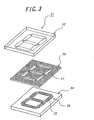
- Fig. 3 is a schematic view showing one embodiment in which the first embodiment of the invention is applied to a segment display device.
- a segment display device 21 is constructed by stacking a transparent substrate 22, a spacer 23 and an opposed substrate 24.
- a transparent electrode (not shown) having a shape corresponding to respective segments of a display pattern is arranged.
- a black spacer having openings 27 corresponding to respective segments of the display pattern.
- Seven segment electrodes 26, to which a plurality of micro-concave portions 25 having a circle shape are provided, are formed to a surface of the opposed substrate 24 at the spacer 23 side respectively.
- wiring lines not shown are arranged so as to connect them to a drive circuit not shown.
- Two or more kinds of the particles having different colors and different charge properties i.e. the positively chargeable particles and the negatively chargeable particles as shown in the above embodiment are filled in respective seven openings 27 of the spacer 23. It should be noted that a thickness of the spacer 23 is controlled to make a distance between the electrodes to a predetermined distance. Operation of the segment display shown in Fig. 3 is the same as that of the image display device mentioned above.
- the segment electrode 26 having the micro-concave portions 25 may be manufactured in such a manner that one surface of aluminum plate having a square shape for example 100 mm x 100 mm and a thickness of 1 mm is etched to form a plurality of micro-concave portions 25 and the etched aluminum plate is cut into respective segment shapes.
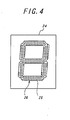
- the opposed substrate 24 ( Fig. 4 ) on which the segment electrode 26 having the micro-convex portions are arranged may be manufactured as follows. At first, as shown in Fig. 5 , the segment electrode 26 corresponding to the display pattern is formed on a glass substrate by means of ITO transparent electrodes. Then, as shown in Fig. 6 , a screen 28 having openings corresponding to the portions, to which the micro-convex portions are formed, is prepared. This screen is overlapped on the glass substrate on which the segment electrode 26 is formed. A paste for forming PDP ribs is adhered to a surface of the segment electrode 26 through the openings. In this manner, the predetermined opposed substrate 24 is manufactured. In this case, a height of the micro-convex portions can be adjusted to a predetermined value by controlling a viscosity of the paste and a dimension of the openings.
- the opposed substrate 24 ( Fig. 4 ) on which the segment electrode 26 having the micro-concave portions are arranged may be manufactured as follows. At first, as shown in Fig. 5 , the segment electrode 26 corresponding to the display pattern is formed on the glass substrate by means of the ITO transparent electrode. Then, a resist film having a thickness of 50 ⁇ m is adhered to an overall surface of the glass substrate. The resist film is exposed by UV through the photo-mask 28 (refer to Fig. 6 ) corresponding to the display pattern and is etched so as to form the micro-concave portions to the segment electrode 26. In this manner, a depth of the micro-concave portions can be adjusted to a predetermined value by controlling a time of the etching operation.
- the second embodiment of the invention is characterized in that micro-cutout holes (explained below) are provided to a part of or an overall of a surface of the electrode (here, display electrode 3 and opposed electrode 4).
- a shape of the micro-cutout holes is important. From this viewpoint, it is preferred that he following formula is satisfied: maximum width / maximum average particle size > 10; where a largest length across corner of a shape of the micro-cutout holes is assumed to be the maximum width and a largest average particle size among the two or more groups of particles is assumed to be the maximum average particle size.
- a shape of the micro-cutout holes provided to the electrode surface may be circle shape, ellipse shape, square shape, rectangle shape, polygon shape, line shape, curve shape, indeterminate shape or a combination thereof.
- a repeated arrangement use may be made of lattice arrangement, hound's-tooth arrangement, pitch variable arrangement, random arrangement and so on.
- Figs. 7a - 7g are schematic views respectively explaining one embodiment pf the micro-cutout holes formed to the electrode surface by cutting.
- micro-cutout holes 31 having a circle shape are provided to a surface of an electrode 32 in a lattice arrangement.
- the micro-cutout holes 31 having an ellipse shape are provided to the surface of the electrode 32 in a lattice arrangement.
- the micro-cutout holes 31 having a circle shape are provided to the surface of the electrode 32 in a hound's-tooth arrangement.
- Fig. 7a - 7g are schematic views respectively explaining one embodiment pf the micro-cutout holes formed to the electrode surface by cutting.
- Fig. 7a micro-cutout holes 31 having a circle shape are provided to a surface of an electrode 32 in a lattice arrangement.
- the micro-cutout holes 31 having an ellipse shape are provided to the surface of the electrode 32 in a lattice arrangement.
- the micro-cutout holes 31 having an ellipse shape are provided to the surface of the electrode 32 in a hound's-tooth arrangement.
- the micro-cutout holes 31 having a sine slit shape are provided to the surface of the electrode 32 in a parallel arrangement.
- the micro-cutout holes 31 having a line slit shape are provided to the surface of the electrode 32 in two alternating directions different with each other by 90°.
- the micro-cutout holes 31 having a curve line shape are provided to the surface of the electrode 32 in a hound's-tooth arrangement.
- Fig. 8 is a schematic view showing one embodiment in which the second embodiment of the invention is applied to a segment display device.
- a segment display device 41 is constructed by stacking a transparent substrate 42, spacer 43 and an opposed substrate 44.
- Seven segment electrodes 46 to which a plurality of micro-cutout holes 45 having a dot shape are provided, are formed to a surface of the transparent substrate 42 at a side of the spacer 43, respectively.
- the spacer 43 use is made of a blue spacer having openings 47 corresponding to respective segments of the display pattern.
- Seven segment electrodes 46, to which a plurality of the micro-cutout holes 45 are provided are formed to a surface of the opposed substrate 44 at a side of the spacer 43 respectively, as is the same as the transparent substrate 42.
- a dimension of respective segments is for example a width of about 1 cm, a length of about 5 cm and a whole height of a letter "8" of about 10 cm.
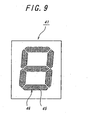
- a shape of the micro-cutout holes 45 is not apparently limited to the above shapes, and as shown in Fig. 9 , the micro cutout holes 45 having a circle shape may be provided to respective segments in a lattice arrangement.
- the substrate at least one substrate must be transparent substrate capable of recognizing the displaying color from outside of the display panel, and a material with large transmission factor of visible light and with excellent heat resistance is preferable.
- the presence of flexibility as the image display device is selected appropriately by the usage, for example, the flexible materials are selected for the usage as an electronic paper and so on, and materials having no flexibility are selected for the usage as display units for portable devices such as cellular phones, PDAs, and notebook personal computers.
- the substrate material examples include polymer sheets such as polyethylene terephthalate, polymer sulfone, polyethylene, or polycarbonate, and inorganic sheets such as glass, quartz or so.
- the thickness of the substrate is preferably 2 to 5000 ⁇ m, more preferably 5 to 1000 ⁇ m. When the thickness is too thin, it becomes difficult to maintain strength and distance uniformity between the substrates, and when the thickness is too thick, vividness and contrast as a display capability degrade, and in particular, flexibility in the case of using for an electron paper deteriorates.
- the particles used in the image display device according to the invention will be explained.
- any of colored particles negatively or positively chargeable having capability of flying and moving by Coulomb's force are employable, spherical particles with light specific gravity are particularly preferable.
- the average particle diameter is preferable to be 0.1 to 50 ⁇ m, particularly to be 1 to 30 ⁇ m.
- charge density of the particles will be so large that an imaging force to an electrode and a substrate becomes too strong; resulting in poor following ability at the inversion of its electric field, although the memory characteristic is favorable.
- the particle diameter exceeds the range, the following ability is favorable, however, the memory characteristic will degrade.
- the method for charging the particles negatively or positively is not particularly limited, a corona discharge method, an electrode injection-charge method, a friction charge method and so on are employable. It is preferable that the absolute value of the difference between the surface charge densities of the particles, which are measured by a blow-off method using carriers, is not less than 5 ⁇ C/m 2 and not larger than 150 ⁇ C/m 2 .
- the absolute value of the surface charge density is less than this range, response speed to the change of an electric field will be late, and the memory property degrades.
- the absolute value of the surface charge density exceeds this range, image force for the electrode or the substrate will be so strong that the memory property will be favorable, but following ability will be poor in the case where the electric field is inverted.
- the blow-off method a mixture of the particles and the carriers are placed into a cylindrical container with nets at both ends, and high-pressure gas is blown from the one end to separate the particles and the carriers, and then only the particles are blown off from the mesh of the net.
- charge amount of reverse blown polarity remains on the carriers with the same charge amount of the particles carried away out of the container.
- TB-200 As a blow-off powder charge amount measuring instrument, TB-200 produced by Toshiba Chemical Co., Ltd. was used. Two kinds of positively chargeable and negatively chargeable resin were employed as the carriers, and charge density per unit area (unit: ⁇ C/m 2 ) was measured in each case. Namely, F963-2535 available from Powder TEC Co., Ltd. was employed as a positive chargeable carrier (the carrier whose opponent is positively charged and itself tends to be negative) and F921-2535 available from Powder TEC Co., Ltd. was employed as negatively chargeable carrier (the carrier whose opponent is negatively charged and itself tends to be positive). The surface charge density of the particles was obtained from the measured charge amount, the average particle diameter and specific gravity of the particles measured separately.
- the specific gravity was measured with the use of a hydrometer produced by Shimadzu Seisakusho Ltd. (brand name: Multi volume Density Meter H1305).
- insulating particles with the volume specific resistance of 1 ⁇ 10 10 ⁇ cm or greater are preferable, and in particular, insulating particles with the volume specific resistance of 1 ⁇ 10 12 ⁇ cm or greater are more preferable. Further, the particles with slow charge attenuation property evaluated by the measuring method below are more preferable.
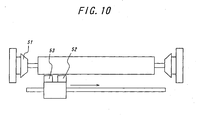
- the foregoing surface potential is measured by means of an instrument (CRT2000 produced by QEA Inc.) as shown in Fig. 10 .
- this instrument both end portions of a roll shaft being held with chuck 51, compact scorotron discharger 52 and surface potential meter 53 are spaced with predetermined interval to form a measurement unit.
- a method of measuring its surface potential is preferably adopted.
- measurement environment should be settled at the temperature of 25 ⁇ 3°C and the humidity of 55 ⁇ 5% RH.
- the particles may be formed by any materials.
- it is formed by resin, charge control agent, coloring agent, inorganic additive and so on, or, by coloring agent and so on only.
- the resin include urethane resin, urea resin, acrylic resin, polyester resin, acryl urethane resin, acryl urethane silicone resin, acryl urethane fluorocarbon polymers, acryl fluorocarbon polymers, silicone resin, acryl silicone resin, epoxy resin, polystyrene resin, styrene acrylic resin, polyolefin resin, butyral resin, vinylidene chloride resin, melamine resin, phenolic resin, fluorocarbon polymers, polycarbonate resin, polysulfon resin, polyether resin, and polyamide resin.
- acryl urethane resin for the purpose of controlling the attaching force with the substrate, acryl urethane resin, acryl silicone resin, acryl fluorocarbon polymers, acryl urethane silicone resin, acryl urethane fluorocarbon polymers, fluorocarbon polymers, silicone resin are particularly preferable. Two kinds or more of these may be mixed and used.
- Examples of the electric charge control agent include, but not particularly specified to, negative charge control agent such as salicylic acid metal complex, metal containing azo dye, oil-soluble dye of metal-containing (containing a metal ion or a metal atom), the fourth grade ammonium salt-based compound, calixarene compound, boron-containing compound (benzyl acid boron complex), and nitroimidazole derivative.
- negative charge control agent such as salicylic acid metal complex, metal containing azo dye, oil-soluble dye of metal-containing (containing a metal ion or a metal atom), the fourth grade ammonium salt-based compound, calixarene compound, boron-containing compound (benzyl acid boron complex), and nitroimidazole derivative.
- Examples of the positive charge control agent include nigrosine dye, triphenylmethane compound, the fourth grade ammonium salt compound, polyamine resin, imidazole derivatives, etc.
- metal oxides such as ultra-minute particles of silica, ultra-minute particles of titanium oxide, ultra-minute particles of alumina, and so on; nitrogen-containing circular compound such as pyridine, and so on, and these derivates or salts; and resins containing various organic pigments, fluorine, chlorine, nitrogen, etc. can be employed as the electric charge control agent.
- coloring agent various kinds of organic or inorganic pigments or dye as will be described below are employable.
- black pigments include carbon black, copper oxide, manganese dioxide, aniline black, and activate carbon.
- yellow pigments include chrome yellow, zinc chromate, cadmium yellow, yellow iron oxide, mineral first yellow, nickel titanium yellow, navel orange yellow, naphthol yellow S, hanzayellow G, hanzayellow 10G, benzidine yellow G, benzidine yellow GR, quinoline yellow lake, permanent yellow NCG, and tartrazinelake.
- orange pigments include red chrome yellow, molybdenum orange, permanent orange GTR, pyrazolone orange, Balkan orange, indusren brilliant orange RK, benzidine orange G, and Indusren brilliant orange GK.
- red pigments examples include red oxide, cadmium red, diachylon, mercury sulfide, cadmium, permanent red 4R, lithol red, pyrazolone red, watching red, calcium salt, lake red D, brilliant carmine 6B, eosin lake, rhodamine lake B, alizarin lake, and brilliant carmine 3B.
- Examples of purple pigments include manganese purple, first violet B, and methyl violet lake.
- Examples of blue pigments include Berlin blue, cobalt blue, alkali blue lake, Victoria blue lake, phthalocyanine blue, metal-free phthalocyanine blue, partially chlorinated phthalocyanine blue, first sky blue, and Indusren blue BC.
- Examples of green pigments include chrome green, chromium oxide, pigment green B, Malachite green lake, and final yellow green G.
- examples of white pigments include zinc white, titanium oxide, antimony white, and zinc sulphide.
- extenders examples include baryta powder, barium carbonate, clay, silica, white carbon, talc, and alumina white. Furthermore, there are Nigrosine, Methylene Blue, rose bengal, quinoline yellow, and ultramarine blue as various dyes such as basic dye, acidic dye, dispersion dye, direct dye, etc. These coloring agents may be used alone or in combination of two or more kinds thereof. Particularly, carbon black is preferable as the black coloring agent, and titanium oxide is preferable as the white coloring agent.
- the manufacturing method of the particles is not specifically restricted, mixing/grinding method or polymerization method for producing toner of electrophotography is, for example, similarly employable. Further the method of coating resin or charge control agent and so on over the surface of powders such as inorganic or organic pigments is also employable.
- the distance between the facing substrates is suitably adjusted in a manner where the particles can move and maintain the contrast of image display; however, it is adjusted usually within 10 to 5000 ⁇ m, preferably within 30 to 500 ⁇ m.
- the volume population of the particle existing in the space between the faced substrates is preferable to be 10 to 90%, more preferable to be 20 to 70%. When the volume population exceeds 80%, it causes some troubles in the particle movement, and when it is less than 10%, contrast tens to be indistinct.
- plural of the foregoing display element are dispose in a matrix form, and images can be displayed.
- one display element makes one pixel.
- three kinds of display elements i.e., one group of display elements each having color plate of R (red), G (green) and B (blue) respectively and each having particles of black composes a set of disposed elements preferably resulting in the reversible image display panel having the sets of the elements.
- the image display device is applicable to the image display unit for mobile equipments such as notebook personal computers, PDAs, cellular phones and so on; to the electric paper for electric book, electric newspaper and so on; to the bulletin boards such as signboards, posters, blackboards and so on; and to the image display unit for electric calculator, home electric application products, auto supplies and so on.
- the explanations are made to the image display device wherein the partition wall is not used, but it is possible to use the partition wall.
- a cell size can be made larger and an area rate of the partition wall with respect to the display area can be made smaller, it is possible to obtain a higher contrast.
- the image display devices according to the examples 1 - 6 were prepared, wherein the micro-concave portions having a shape and an arrangement shown in the following Table 1 with average width W, average height (depth) H and average interval I shown in the following Table 1 were provided to one electrode, and, wherein substrate interval D and maximum average particle size R of the particles were adjusted in the manner shown in the following Table 1.
- the electrodes are arranged on the substrates.
- the image display devices according to the examples 11 - 16 were prepared, wherein the micro-cutout holes having a shape and an arrangement shown in the following Table 2 with average width W and average interval I shown in the following Table 2 were provided to one electrode, and, wherein substrate interval d and maximum average particle size R of the particles were adjusted in the manner shown in the following Table 2.
- the electrodes are arranged on the substrates.
- the first embodiment of the invention it is possible to introduce a very little uneven electric field partly by the micro-concave portions and/or the micro-convex portions arranged to a surface of the electrode. Since the very little uneven electric field generated by the micro-concave portions and/or the micro-convex portions includes an electric field component along a lateral direction i.e. along a direction parallel to the substrate surface, the particles to be moved in a lateral direction are sucked or cast away aggressively and the particles are fixed. Therefore, it is possible to inhibit an uneven distribution of the particles due to the particle agglutination. As a result, it is possible to improve the image quality deterioration during the durable use.
- an electric field for flying the particles applied from a pair of electrodes provided respectively on the two substrates arranged in parallel with each other is an even electric field.
- the image display device it is possible to introduce a very little uneven electric field partly by the micro-cutout holes arranged to a surface of the electrode. Since the very little uneven electric field generated by the micro-cutout holes includes an electric field component along a lateral direction i.e. along a direction parallel to the substrate surface, the particles to be moved in a lateral direction are sucked or cast away aggressively and the particles are fixed. Therefore, it is possible to inhibit an uneven distribution of the particles due to the particle agglutination. As a result, it is possible to improve the image quality deterioration during the durable use.
Landscapes
- Physics & Mathematics (AREA)
- Nonlinear Science (AREA)
- General Physics & Mathematics (AREA)
- Optics & Photonics (AREA)
- Electrochromic Elements, Electrophoresis, Or Variable Reflection Or Absorption Elements (AREA)
- Devices For Indicating Variable Information By Combining Individual Elements (AREA)
Abstract
Claims (10)
- Dispositif d'affichage de type à particules sèches qui comprend un écran d'affichage d'image, dans lequel deux groupes, ou plus, de particules, chaque groupe ayant une couleur différente et une caractéristique de charge différente, sont scellés entre deux substrats (1, 2), au moins un (1) desdits deux substrats étant transparent, et dans lequel les particules (5, 6), auxquelles un champ électrostatique produit par une paire d'électrodes (3, 4) disposées sur les faces des substrats respectifs en face des particules est appliqué, sont mises en mouvement de manière à afficher une image,
caractérisé soit en ce que des parties micro-concaves (11) et/ou des parties micro-convexes (13), soit en ce que des trous micro-découpés (31) sont pourvus sur une partie de, ou sur l'ensemble de la surface de l'électrode, de manière à ce qu'une composante de champ électrique latérale soit induite à la commutation. - Dispositif d'affichage d'image tel que revendiqué dans la revendication 1, dans lequel les portions micro-concaves et/ou les portions micro-convexes sont formées de telle manière que les formules suivantes soient satisfaites :

et
où wav est la largeur moyenne définie comme distance de coin à coin à travers la forme de la projection des portions micro-concaves et/ou des portions micro-convexes sur la surface de l'électrode,
hav est la valeur absolue moyenne de la profondeur des portions micro-concaves et/ou de la hauteur des portions micro-convexes ; et
dav_max est la taille de particule moyenne la plus grande parmi les deux, ou plus, groupes de particules. - Dispositif d'affichage d'image tel que revendiqué dans la revendication 2, dans lequel la pluralité de portions micro-concaves et/ou de portions micro-convexes est arrangée sur la même électrode et une distance moyenne Lav entre les portions est arrangée pour satisfaire la formule :

- Dispositif d'affichage d'image tel que revendiqué dans l'une quelconque des revendications 2 à 3, dans lequel la surface totale des formes de projection des portions micro-concaves et/ou des portions micro-convexes sur la surface de l'électrode est de 0,1 à 50 % par rapport à la surface de l'électrode.
- Dispositif d'affichage d'image tel que revendiqué dans la revendication 1, dans lequel les trous micro-découpés sont formés de telle manière que la formule suivante soit satisfaite :

où wmax est la largeur maximum définie comme distance maximum de coin à coin à travers la forme des trous micro-découpés ; et
dav_max est la taille de particule moyenne la plus grande parmi les deux, ou plus, groupes de particules. - Dispositif d'affichage d'image tel que revendiqué dans la revendication 1 ou la revendication 5, dans lequel la pluralité de trous micro-découpés est pourvue sur la même électrode et où une distance minimum Lmin entre les trous est arrangée pour satisfaire la formule suivante :

- Dispositif d'affichage d'image tel que revendiqué dans l'une quelconque des revendications 1, 5 ou 6, dans lequel la surface totale des trous micro-découpés est de 0,1 à 50 % par rapport à la surface de l'électrode.
- Dispositif d'affichage d'image tel que revendiqué dans l'une quelconque des revendications 1 à 7, dans lequel un diamètre de particule moyen des particules va de 0,1 à 50 µm.
- Dispositif d'affichage d'image tel que revendiqué dans l'une quelconque des revendications 1 à 10, dans lequel les particules sont telles que le potentiel de surface maximum, dans le cas où la surface des particules est chargée en appliquant une tension de 8 KV à un dispositif à décharge Corona déployé à une distance de 1 mm de la surface des particules, est de 300 V ou plus, 0,3 seconde après la décharge Corona.
- Dispositif d'affichage d'image tel que revendiqué dans l'une quelconque des revendications 1 à 9, dans lequel une couleur des particules est blanc ou noir.
Priority Applications (1)
| Application Number | Priority Date | Filing Date | Title |
|---|---|---|---|
| EP10075698A EP2299318A3 (fr) | 2002-04-17 | 2003-04-17 | Paramètres de texture de surface (Ra, Sm) d'un substrat dans un système d'affichage utilisant des particules colorées de type toner sec |
Applications Claiming Priority (15)
| Application Number | Priority Date | Filing Date | Title |
|---|---|---|---|
| JP2002114668 | 2002-04-17 | ||
| JP2002114668 | 2002-04-17 | ||
| JP2002114586 | 2002-04-17 | ||
| JP2002114586 | 2002-04-17 | ||
| JP2002130411 | 2002-05-02 | ||
| JP2002130510 | 2002-05-02 | ||
| JP2002130510 | 2002-05-02 | ||
| JP2002130411 | 2002-05-02 | ||
| JP2002158781 | 2002-05-31 | ||
| JP2002158781 | 2002-05-31 | ||
| JP2002313817A JP4484424B2 (ja) | 2002-04-17 | 2002-10-29 | 画像表示装置 |
| JP2002313817 | 2002-10-29 | ||
| JP2002313955A JP4436600B2 (ja) | 2002-04-17 | 2002-10-29 | 画像表示装置 |
| JP2002313955 | 2002-10-29 | ||
| PCT/JP2003/004924 WO2003088495A1 (fr) | 2002-04-17 | 2003-04-17 | Unite d'affichage d'images |
Related Child Applications (1)
| Application Number | Title | Priority Date | Filing Date |
|---|---|---|---|
| EP10075698.0 Division-Into | 2010-10-01 |
Publications (3)
| Publication Number | Publication Date |
|---|---|
| EP1501194A1 EP1501194A1 (fr) | 2005-01-26 |
| EP1501194A4 EP1501194A4 (fr) | 2008-01-23 |
| EP1501194B1 true EP1501194B1 (fr) | 2012-03-14 |
Family
ID=29255740
Family Applications (2)
| Application Number | Title | Priority Date | Filing Date |
|---|---|---|---|
| EP10075698A Withdrawn EP2299318A3 (fr) | 2002-04-17 | 2003-04-17 | Paramètres de texture de surface (Ra, Sm) d'un substrat dans un système d'affichage utilisant des particules colorées de type toner sec |
| EP03719125A Expired - Lifetime EP1501194B1 (fr) | 2002-04-17 | 2003-04-17 | Structure d'électrode pour un système d'affichage à particules sèches |
Family Applications Before (1)
| Application Number | Title | Priority Date | Filing Date |
|---|---|---|---|
| EP10075698A Withdrawn EP2299318A3 (fr) | 2002-04-17 | 2003-04-17 | Paramètres de texture de surface (Ra, Sm) d'un substrat dans un système d'affichage utilisant des particules colorées de type toner sec |
Country Status (5)
| Country | Link |
|---|---|
| US (1) | US20060209008A1 (fr) |
| EP (2) | EP2299318A3 (fr) |
| CN (1) | CN1653694B (fr) |
| AU (1) | AU2003235217A1 (fr) |
| WO (1) | WO2003088495A1 (fr) |
Families Citing this family (121)
| Publication number | Priority date | Publication date | Assignee | Title |
|---|---|---|---|---|
| US7327511B2 (en) | 2004-03-23 | 2008-02-05 | E Ink Corporation | Light modulators |
| US7411719B2 (en) | 1995-07-20 | 2008-08-12 | E Ink Corporation | Electrophoretic medium and process for the production thereof |
| US7848006B2 (en) | 1995-07-20 | 2010-12-07 | E Ink Corporation | Electrophoretic displays with controlled amounts of pigment |
| US7583251B2 (en) | 1995-07-20 | 2009-09-01 | E Ink Corporation | Dielectrophoretic displays |
| US7999787B2 (en) | 1995-07-20 | 2011-08-16 | E Ink Corporation | Methods for driving electrophoretic displays using dielectrophoretic forces |
| US8040594B2 (en) | 1997-08-28 | 2011-10-18 | E Ink Corporation | Multi-color electrophoretic displays |
| CA2336596A1 (fr) | 1998-07-08 | 2000-01-20 | E Ink Corporation | Procedes permettant d'ameliorer la couleur des dispositifs electrophoretiques microencapsules |
| US8009348B2 (en) | 1999-05-03 | 2011-08-30 | E Ink Corporation | Machine-readable displays |
| US8115729B2 (en) | 1999-05-03 | 2012-02-14 | E Ink Corporation | Electrophoretic display element with filler particles |
| US7119759B2 (en) | 1999-05-03 | 2006-10-10 | E Ink Corporation | Machine-readable displays |
| WO2002073572A2 (fr) | 2001-03-13 | 2002-09-19 | E Ink Corporation | Appareil d'affichage de dessins |
| US7679814B2 (en) | 2001-04-02 | 2010-03-16 | E Ink Corporation | Materials for use in electrophoretic displays |
| US8390918B2 (en) | 2001-04-02 | 2013-03-05 | E Ink Corporation | Electrophoretic displays with controlled amounts of pigment |
| US7535624B2 (en) | 2001-07-09 | 2009-05-19 | E Ink Corporation | Electro-optic display and materials for use therein |
| US6982178B2 (en) * | 2002-06-10 | 2006-01-03 | E Ink Corporation | Components and methods for use in electro-optic displays |
| US8125501B2 (en) | 2001-11-20 | 2012-02-28 | E Ink Corporation | Voltage modulated driver circuits for electro-optic displays |
| US8593396B2 (en) | 2001-11-20 | 2013-11-26 | E Ink Corporation | Methods and apparatus for driving electro-optic displays |
| US7952557B2 (en) | 2001-11-20 | 2011-05-31 | E Ink Corporation | Methods and apparatus for driving electro-optic displays |
| US9530363B2 (en) | 2001-11-20 | 2016-12-27 | E Ink Corporation | Methods and apparatus for driving electro-optic displays |
| US8558783B2 (en) | 2001-11-20 | 2013-10-15 | E Ink Corporation | Electro-optic displays with reduced remnant voltage |
| US7223672B2 (en) | 2002-04-24 | 2007-05-29 | E Ink Corporation | Processes for forming backplanes for electro-optic displays |
| US7583427B2 (en) | 2002-06-10 | 2009-09-01 | E Ink Corporation | Components and methods for use in electro-optic displays |
| US8363299B2 (en) | 2002-06-10 | 2013-01-29 | E Ink Corporation | Electro-optic displays, and processes for the production thereof |
| US7554712B2 (en) | 2005-06-23 | 2009-06-30 | E Ink Corporation | Edge seals for, and processes for assembly of, electro-optic displays |
| US8049947B2 (en) | 2002-06-10 | 2011-11-01 | E Ink Corporation | Components and methods for use in electro-optic displays |
| US7649674B2 (en) | 2002-06-10 | 2010-01-19 | E Ink Corporation | Electro-optic display with edge seal |
| US7843621B2 (en) | 2002-06-10 | 2010-11-30 | E Ink Corporation | Components and testing methods for use in the production of electro-optic displays |
| US20080024482A1 (en) | 2002-06-13 | 2008-01-31 | E Ink Corporation | Methods for driving electro-optic displays |
| EP3056941B1 (fr) | 2002-09-03 | 2019-01-09 | E Ink Corporation | Milieu électro-phorétique |
| US7839564B2 (en) | 2002-09-03 | 2010-11-23 | E Ink Corporation | Components and methods for use in electro-optic displays |
| US20130063333A1 (en) | 2002-10-16 | 2013-03-14 | E Ink Corporation | Electrophoretic displays |
| US7910175B2 (en) | 2003-03-25 | 2011-03-22 | E Ink Corporation | Processes for the production of electrophoretic displays |
| US10726798B2 (en) | 2003-03-31 | 2020-07-28 | E Ink Corporation | Methods for operating electro-optic displays |
| US8174490B2 (en) | 2003-06-30 | 2012-05-08 | E Ink Corporation | Methods for driving electrophoretic displays |
| CN101142510B (zh) | 2003-11-05 | 2010-04-14 | 伊英克公司 | 电光显示器 |
| US7672040B2 (en) | 2003-11-05 | 2010-03-02 | E Ink Corporation | Electro-optic displays, and materials for use therein |
| US7551346B2 (en) | 2003-11-05 | 2009-06-23 | E Ink Corporation | Electro-optic displays, and materials for use therein |
| US8177942B2 (en) | 2003-11-05 | 2012-05-15 | E Ink Corporation | Electro-optic displays, and materials for use therein |
| US20110164301A1 (en) | 2003-11-05 | 2011-07-07 | E Ink Corporation | Electro-optic displays, and materials for use therein |
| US8928562B2 (en) | 2003-11-25 | 2015-01-06 | E Ink Corporation | Electro-optic displays, and methods for driving same |
| JP4790622B2 (ja) | 2003-11-26 | 2011-10-12 | イー インク コーポレイション | 低残留電圧の電気光学ディスプレイ |
| US7206119B2 (en) | 2003-12-31 | 2007-04-17 | E Ink Corporation | Electro-optic displays, and method for driving same |
| US7075703B2 (en) | 2004-01-16 | 2006-07-11 | E Ink Corporation | Process for sealing electro-optic displays |
| US7388572B2 (en) | 2004-02-27 | 2008-06-17 | E Ink Corporation | Backplanes for electro-optic displays |
| US7492339B2 (en) | 2004-03-26 | 2009-02-17 | E Ink Corporation | Methods for driving bistable electro-optic displays |
| US8289250B2 (en) | 2004-03-31 | 2012-10-16 | E Ink Corporation | Methods for driving electro-optic displays |
| EP1739477A4 (fr) * | 2004-04-05 | 2007-06-13 | Bridgestone Corp | Panneau d'affichage d'information |
| US20080136774A1 (en) | 2004-07-27 | 2008-06-12 | E Ink Corporation | Methods for driving electrophoretic displays using dielectrophoretic forces |
| EP1779174A4 (fr) | 2004-07-27 | 2010-05-05 | E Ink Corp | Affichages electro-optiques |
| US11250794B2 (en) | 2004-07-27 | 2022-02-15 | E Ink Corporation | Methods for driving electrophoretic displays using dielectrophoretic forces |
| US7453445B2 (en) | 2004-08-13 | 2008-11-18 | E Ink Corproation | Methods for driving electro-optic displays |
| EP1842093A4 (fr) | 2005-01-26 | 2010-11-24 | E Ink Corp | Ecrans electrophoretiques utilisant des fluides gazeux |
| US20100129752A1 (en) * | 2005-05-30 | 2010-05-27 | Hitachi Chemical Company, Ltd. | Photosensitive resin composition, photosensitive element employing the same, method of forming resist pattern, and process for producing printed wiring board |
| US20080043318A1 (en) | 2005-10-18 | 2008-02-21 | E Ink Corporation | Color electro-optic displays, and processes for the production thereof |
| WO2007048096A2 (fr) | 2005-10-18 | 2007-04-26 | E Ink Corporation | Composants pour dispositifs d'affichage electro-optiques |
| CN103885290B (zh) * | 2005-10-25 | 2017-11-03 | 日立化成株式会社 | 感光性树脂组合物、使用其的感光性元件、抗蚀剂图案的形成方法及印刷电路板的制造方法 |
| TW200745749A (en) * | 2006-02-21 | 2007-12-16 | Hitachi Chemical Co Ltd | Photosensitive resin composition, method for forming resist pattern, method for manufacturing printed wiring board, and method for producing substrate for plasma display panel |
| US7843624B2 (en) | 2006-03-08 | 2010-11-30 | E Ink Corporation | Electro-optic displays, and materials and methods for production thereof |
| US8390301B2 (en) | 2006-03-08 | 2013-03-05 | E Ink Corporation | Electro-optic displays, and materials and methods for production thereof |
| TWI350793B (en) | 2006-03-08 | 2011-10-21 | E Ink Corp | Methods for production of electro-optic displays |
| US8610988B2 (en) | 2006-03-09 | 2013-12-17 | E Ink Corporation | Electro-optic display with edge seal |
| US7952790B2 (en) | 2006-03-22 | 2011-05-31 | E Ink Corporation | Electro-optic media produced using ink jet printing |
| JP4828305B2 (ja) * | 2006-05-30 | 2011-11-30 | 株式会社Sen | 静電式ビーム偏向走査装置及びビーム偏向走査方法 |
| US7903319B2 (en) | 2006-07-11 | 2011-03-08 | E Ink Corporation | Electrophoretic medium and display with improved image stability |
| US8018640B2 (en) | 2006-07-13 | 2011-09-13 | E Ink Corporation | Particles for use in electrophoretic displays |
| US7808696B2 (en) * | 2006-07-31 | 2010-10-05 | Samsung Electronics Co., Ltd. | Electrophoretic display device and fabrication thereof |
| US7492497B2 (en) | 2006-08-02 | 2009-02-17 | E Ink Corporation | Multi-layer light modulator |
| JP2010503895A (ja) | 2006-09-18 | 2010-02-04 | イー インク コーポレイション | カラー電気光学ディスプレイ |
| US7477444B2 (en) | 2006-09-22 | 2009-01-13 | E Ink Corporation & Air Products And Chemical, Inc. | Electro-optic display and materials for use therein |
| US7986450B2 (en) | 2006-09-22 | 2011-07-26 | E Ink Corporation | Electro-optic display and materials for use therein |
| US7649666B2 (en) | 2006-12-07 | 2010-01-19 | E Ink Corporation | Components and methods for use in electro-optic displays |
| US7688497B2 (en) | 2007-01-22 | 2010-03-30 | E Ink Corporation | Multi-layer sheet for use in electro-optic displays |
| KR101256709B1 (ko) | 2007-01-22 | 2013-04-19 | 이 잉크 코포레이션 | 전기-광학 디스플레이에서 사용하기 위한 다층 시트 |
| US7826129B2 (en) | 2007-03-06 | 2010-11-02 | E Ink Corporation | Materials for use in electrophoretic displays |
| WO2008144715A1 (fr) | 2007-05-21 | 2008-11-27 | E Ink Corporation | Procédés de commande d'écrans vidéo électro-optiques |
| US9199441B2 (en) | 2007-06-28 | 2015-12-01 | E Ink Corporation | Processes for the production of electro-optic displays, and color filters for use therein |
| US8034209B2 (en) | 2007-06-29 | 2011-10-11 | E Ink Corporation | Electro-optic displays, and materials and methods for production thereof |
| US8902153B2 (en) | 2007-08-03 | 2014-12-02 | E Ink Corporation | Electro-optic displays, and processes for their production |
| US20090122389A1 (en) | 2007-11-14 | 2009-05-14 | E Ink Corporation | Electro-optic assemblies, and adhesives and binders for use therein |
| JP4952567B2 (ja) * | 2007-12-21 | 2012-06-13 | 富士ゼロックス株式会社 | 画像検索システム、画像検索装置、プログラム |
| JP2011517490A (ja) | 2008-03-21 | 2011-06-09 | イー インク コーポレイション | 電子光学ディスプレイおよびカラーフィルタ |
| CA2720091C (fr) | 2008-04-11 | 2015-10-06 | E Ink Corporation | Procedes permettant d'exciter des affichages electrooptiques |
| WO2009129217A2 (fr) | 2008-04-14 | 2009-10-22 | E Ink Corporation | Procédés d’activation d’affichages électro-optiques |
| TWI484273B (zh) | 2009-02-09 | 2015-05-11 | E Ink Corp | 電泳粒子 |
| US8098418B2 (en) | 2009-03-03 | 2012-01-17 | E. Ink Corporation | Electro-optic displays, and color filters for use therein |
| JP5434382B2 (ja) * | 2009-08-31 | 2014-03-05 | 日本精機株式会社 | 液晶表示素子 |
| US8654436B1 (en) | 2009-10-30 | 2014-02-18 | E Ink Corporation | Particles for use in electrophoretic displays |
| WO2011097228A2 (fr) | 2010-02-02 | 2011-08-11 | E Ink Corporation | Procédé d'excitation de dispositifs d'affichage électro-optiques |
| JP5449617B2 (ja) | 2010-04-02 | 2014-03-19 | イー インク コーポレイション | 電気泳動媒体 |
| CN105654889B (zh) | 2010-04-09 | 2022-01-11 | 伊英克公司 | 用于驱动电光显示器的方法 |
| TWI484275B (zh) | 2010-05-21 | 2015-05-11 | E Ink Corp | 光電顯示器及其驅動方法、微型空腔電泳顯示器 |
| US8797634B2 (en) | 2010-11-30 | 2014-08-05 | E Ink Corporation | Multi-color electrophoretic displays |
| DE102011117129A1 (de) * | 2011-10-28 | 2013-05-02 | Leonhard Kurz Stiftung & Co. Kg | Anzeigeeinrichtung |
| CN105654911B (zh) | 2012-02-01 | 2018-10-02 | 伊英克公司 | 用于驱动电光显示器的方法 |
| JP5935064B2 (ja) | 2012-05-31 | 2016-06-15 | イー インク コーポレイション | 画像表示媒体の駆動装置、画像表示装置、及び駆動プログラム |
| KR101851513B1 (ko) | 2013-07-31 | 2018-04-23 | 이 잉크 코포레이션 | 전기 광학 디스플레이들을 구동하기 위한 방법들 |
| CN107223278B (zh) | 2015-02-04 | 2019-05-28 | 伊英克公司 | 具有降低的剩余电压的电光显示器以及相关的设备和方法 |
| US10803813B2 (en) | 2015-09-16 | 2020-10-13 | E Ink Corporation | Apparatus and methods for driving displays |
| CN113241041B (zh) | 2015-09-16 | 2024-01-05 | 伊英克公司 | 用于驱动显示器的装置和方法 |
| US11657774B2 (en) | 2015-09-16 | 2023-05-23 | E Ink Corporation | Apparatus and methods for driving displays |
| US10795233B2 (en) | 2015-11-18 | 2020-10-06 | E Ink Corporation | Electro-optic displays |
| CN106055016B (zh) * | 2016-07-22 | 2017-11-28 | 清华大学 | 表面电势控制装置及控制方法 |
| US10670926B2 (en) * | 2017-07-25 | 2020-06-02 | Wuhan China Star Optoelectronics Semiconductor Display Technology Co., Ltd. | Spacer particle distribution device |
| US11143930B2 (en) | 2018-06-28 | 2021-10-12 | E Ink Corporation | Driving methods for variable transmission electro-phoretic media |
| JP7584213B2 (ja) * | 2018-10-09 | 2024-11-15 | 恵和株式会社 | 光学シート、バックライトユニット、液晶表示装置及び情報機器 |
| JP7335356B2 (ja) | 2019-05-07 | 2023-08-29 | イー インク コーポレイション | 可変光透過デバイスのための駆動方法 |
| CN112946984A (zh) * | 2019-12-11 | 2021-06-11 | 四川尚视科技有限公司 | 一种用于激光抗光屏幕的ag膜组合物及ag膜的制备方法 |
| GB2593150A (en) | 2020-03-05 | 2021-09-22 | Vlyte Ltd | A light modulator having bonded structures embedded in its viewing area |
| US12105396B2 (en) | 2020-07-22 | 2024-10-01 | E Ink Corporation | Electro-optic device comprising integrated conductive edge seal and a method of production of the same |
| CN118043735A (zh) * | 2021-09-27 | 2024-05-14 | 伊英克公司 | 在开启状态下具有降低的衍射的电泳粒子膜 |
| US12579951B2 (en) * | 2021-11-23 | 2026-03-17 | Beijing Boe Display Technology Co., Ltd. | Electronic paper display device and driving method therefor |
| CN118696269A (zh) | 2022-02-25 | 2024-09-24 | 伊英克公司 | 具有边缘密封部件的电光显示器及其制造方法 |
| PL4476591T3 (pl) | 2022-04-13 | 2025-10-06 | E Ink Corporation | Materiał wyświetlacza zawierający obszary z utworzonym wzorem kapsułkowanych ośrodków elektroforetycznych |
| KR102921133B1 (ko) | 2022-04-27 | 2026-01-30 | 이 잉크 코포레이션 | 세그먼트화된 전극들을 갖는 전기 광학 디스플레이 스택들 및 그 제조 방법들 |
| CN121368743A (zh) | 2023-07-18 | 2026-01-20 | 伊英克公司 | 具有减小的孔径衍射的可切换电泳光调制器 |
| US20250053058A1 (en) | 2023-08-08 | 2025-02-13 | E Ink Corporation | Backplanes for segmented electro-optic displays and methods of manufacturing same |
| US20250116908A1 (en) | 2023-10-06 | 2025-04-10 | E Ink Corporation | Large-area electro-optic light modulator or display |
| WO2025096239A1 (fr) | 2023-10-30 | 2025-05-08 | E Ink Corporation | Affichage électro-optique avec une couche de matériau électro-optique ayant un liant comprenant un polymère avec un groupe ammonium quaternaire et son procédé de fabrication |
| WO2025101330A1 (fr) | 2023-11-08 | 2025-05-15 | E Ink Corporation | Procédé de fabrication photolithographique continue pour produire des microstructures sans soudure utilisées dans les dispositifs d'affichage électro-optiques et les films de modulation de lumière |
| US20250237922A1 (en) | 2024-01-19 | 2025-07-24 | E Ink Corporation | Flexible segmented electro-optic displays and methods of manufacture |
| US20250284171A1 (en) | 2024-03-06 | 2025-09-11 | E Ink Corporation | Electro-optic displays with color filter arrays for reducing visible texture patterns in displayed images |
Family Cites Families (18)
| Publication number | Priority date | Publication date | Assignee | Title |
|---|---|---|---|---|
| US4203106A (en) * | 1977-11-23 | 1980-05-13 | North American Philips Corporation | X-Y addressable electrophoretic display device with control electrode |
| JPH02119625U (fr) * | 1989-03-13 | 1990-09-26 | ||
| EP1095354B1 (fr) * | 1998-07-08 | 2002-11-27 | E Ink Corporation | Procede et dispositif permettant de deceler l'etat d'un afficheur par electrophorese |
| JP3726646B2 (ja) * | 1999-07-21 | 2005-12-14 | 富士ゼロックス株式会社 | 画像表示方法、画像表示装置、及び画像表示媒体 |
| US6337761B1 (en) * | 1999-10-01 | 2002-01-08 | Lucent Technologies Inc. | Electrophoretic display and method of making the same |
| JP2001290179A (ja) * | 2000-01-28 | 2001-10-19 | Minolta Co Ltd | 可逆性画像表示媒体及び可逆性画像表示方法 |
| US6515790B2 (en) * | 2000-01-28 | 2003-02-04 | Minolta Co., Ltd. | Reversible image display medium and image display method |
| US6774879B2 (en) * | 2000-06-09 | 2004-08-10 | Minolta Co., Ltd. | Reversible image display medium |
| JP3468509B2 (ja) * | 2000-08-22 | 2003-11-17 | Necマイクロシステム株式会社 | ページングモード制御方法 |
| JP4061830B2 (ja) * | 2000-08-31 | 2008-03-19 | 富士ゼロックス株式会社 | 画像表示媒体 |
| JP2002072257A (ja) * | 2000-09-05 | 2002-03-12 | Fuji Xerox Co Ltd | 表示素子 |
| US6900789B2 (en) * | 2000-11-16 | 2005-05-31 | Minolta Co., Ltd. | Reversible image display medium |
| JP3685448B2 (ja) * | 2000-11-17 | 2005-08-17 | キヤノン株式会社 | 電気泳動表示装置 |
| US6985132B2 (en) * | 2000-11-29 | 2006-01-10 | Matsushita Electric Industrial Co., Ltd. | Display device and method for manufacturing the same |
| US6700695B2 (en) * | 2001-03-14 | 2004-03-02 | 3M Innovative Properties Company | Microstructured segmented electrode film for electronic displays |
| US7525719B2 (en) * | 2001-09-19 | 2009-04-28 | Bridgestone Corporation | Particles and device for displaying image |
| WO2003069404A1 (fr) * | 2002-02-15 | 2003-08-21 | Bridgestone Corporation | Unite d'affichage d'images |
| JP4518736B2 (ja) * | 2002-04-17 | 2010-08-04 | 株式会社ブリヂストン | 画像表示装置 |
-
2003
- 2003-04-17 WO PCT/JP2003/004924 patent/WO2003088495A1/fr not_active Ceased
- 2003-04-17 CN CN038113082A patent/CN1653694B/zh not_active Expired - Fee Related
- 2003-04-17 US US10/511,626 patent/US20060209008A1/en not_active Abandoned
- 2003-04-17 EP EP10075698A patent/EP2299318A3/fr not_active Withdrawn
- 2003-04-17 AU AU2003235217A patent/AU2003235217A1/en not_active Abandoned
- 2003-04-17 EP EP03719125A patent/EP1501194B1/fr not_active Expired - Lifetime
Also Published As
| Publication number | Publication date |
|---|---|
| CN1653694A (zh) | 2005-08-10 |
| CN1653694B (zh) | 2010-11-24 |
| WO2003088495A1 (fr) | 2003-10-23 |
| EP2299318A2 (fr) | 2011-03-23 |
| US20060209008A1 (en) | 2006-09-21 |
| EP2299318A3 (fr) | 2011-04-06 |
| EP1501194A4 (fr) | 2008-01-23 |
| EP1501194A1 (fr) | 2005-01-26 |
| AU2003235217A1 (en) | 2003-10-27 |
Similar Documents
| Publication | Publication Date | Title |
|---|---|---|
| EP1501194B1 (fr) | Structure d'électrode pour un système d'affichage à particules sèches | |
| US7705823B2 (en) | Image display unit | |
| US20050259068A1 (en) | Image display | |
| EP1462847A1 (fr) | Visualisateur d'images | |
| US20060214906A1 (en) | Image display | |
| US20050285500A1 (en) | Image display device | |
| US7535539B2 (en) | Image display device, method of manufacturing image display panel and image display panel | |
| EP1785767A1 (fr) | Panneau d'affichage d'informations | |
| EP1772769A1 (fr) | Panneau pour affichage d'informations et affichage d'informations | |
| EP2065756A1 (fr) | Particules pour un support d'affichage et panneau d'affichage d'information qui utilise ces particules | |
| US7580179B2 (en) | Method of manufacturing information display device | |
| EP1780590A1 (fr) | Affichage d'informations | |
| US7483201B2 (en) | Particles for display media, information display panel and information display device, utilizing the particles for display media | |
| US7952795B2 (en) | Information display panel and method of manufacturing same | |
| US7532387B2 (en) | Particles for display media and information display panel using the particles | |
| EP1739477A1 (fr) | Panneau d'affichage d'information | |
| EP1785768A1 (fr) | Panneau d'affichage d'information | |
| JP4484424B2 (ja) | 画像表示装置 | |
| JP4436600B2 (ja) | 画像表示装置 | |
| JP2004004479A (ja) | 画像表示装置 | |
| EP1715376A1 (fr) | Affichage d'informations | |
| JP4373068B2 (ja) | 可逆画像表示板および画像表示装置 | |
| JP2004004477A (ja) | 画像表示装置 | |
| JP2003307753A (ja) | 画像表示装置 |
Legal Events
| Date | Code | Title | Description |
|---|---|---|---|
| PUAI | Public reference made under article 153(3) epc to a published international application that has entered the european phase |
Free format text: ORIGINAL CODE: 0009012 |
|
| 17P | Request for examination filed |
Effective date: 20041109 |
|
| AK | Designated contracting states |
Kind code of ref document: A1 Designated state(s): AT BE BG CH CY CZ DE DK EE ES FI FR GB GR HU IE IT LI LU MC NL PT RO SE SI SK TR |
|
| AX | Request for extension of the european patent |
Extension state: AL LT LV MK |
|
| RIN1 | Information on inventor provided before grant (corrected) |
Inventor name: SAKURAI, RYOU Inventor name: TAKAGI, KOJI Inventor name: YAMAZAKI, HIROTAKA Inventor name: HATTORI, REIJI Inventor name: MASUDA, YOSHITOMO Inventor name: KITANO, HAJIME Inventor name: MURATA, KAZUYA Inventor name: IWABUCHI, YOSHINORI Inventor name: NIHEI, NORIO Inventor name: YAKUSHIJI, GAKU |
|
| RIC1 | Information provided on ipc code assigned before grant |
Ipc: G02F 1/167 20060101AFI20070725BHEP |
|
| A4 | Supplementary search report drawn up and despatched |
Effective date: 20080102 |
|
| 17Q | First examination report despatched |
Effective date: 20080409 |
|
| GRAP | Despatch of communication of intention to grant a patent |
Free format text: ORIGINAL CODE: EPIDOSNIGR1 |
|
| RTI1 | Title (correction) |
Free format text: ELECTRODE STRUCTURE FOR A DRY PARTICLE DISPLAY DEVICE |
|
| RIN1 | Information on inventor provided before grant (corrected) |
Inventor name: NIHEI, NORIO Inventor name: TAKAGI, KOJI Inventor name: SAKURAI, RYOU Inventor name: HATTORI, REIJI Inventor name: MASUDA, YOSHITOMO Inventor name: YAKUSHIJI, MANABU Inventor name: IWABUCHI, YOSHINORI Inventor name: KITANO, HAJIME Inventor name: YAMAZAKI, HIROTAKA Inventor name: MURATA, KAZUYA |
|
| GRAS | Grant fee paid |
Free format text: ORIGINAL CODE: EPIDOSNIGR3 |
|
| GRAA | (expected) grant |
Free format text: ORIGINAL CODE: 0009210 |
|
| AK | Designated contracting states |
Kind code of ref document: B1 Designated state(s): DE FR |
|
| RIN1 | Information on inventor provided before grant (corrected) |
Inventor name: MASUDA, YOSHITOMO Inventor name: NIHEI, NORIO Inventor name: YAKUSHIJI, GAKU Inventor name: YAMAZAKI, HIROTAKA Inventor name: IWABUCHI, YOSHINORI Inventor name: MURATA, KAZUYA Inventor name: KITANO, HAJIME Inventor name: SAKURAI, RYOU Inventor name: TAKAGI, KOJI Inventor name: HATTORI, REIJI |
|
| REG | Reference to a national code |
Ref country code: DE Ref legal event code: R096 Ref document number: 60340267 Country of ref document: DE Effective date: 20120510 |
|
| PLBE | No opposition filed within time limit |
Free format text: ORIGINAL CODE: 0009261 |
|
| STAA | Information on the status of an ep patent application or granted ep patent |
Free format text: STATUS: NO OPPOSITION FILED WITHIN TIME LIMIT |
|
| 26N | No opposition filed |
Effective date: 20121217 |
|
| REG | Reference to a national code |
Ref country code: DE Ref legal event code: R097 Ref document number: 60340267 Country of ref document: DE Effective date: 20121217 |
|
| REG | Reference to a national code |
Ref country code: DE Ref legal event code: R082 Ref document number: 60340267 Country of ref document: DE Representative=s name: MARKS & CLERK (LUXEMBOURG) LLP, LU |
|
| REG | Reference to a national code |
Ref country code: FR Ref legal event code: CA Effective date: 20140812 |
|
| REG | Reference to a national code |
Ref country code: DE Ref legal event code: R082 Ref document number: 60340267 Country of ref document: DE Representative=s name: MARKS & CLERK (LUXEMBOURG) LLP, LU Effective date: 20140828 Ref country code: DE Ref legal event code: R081 Ref document number: 60340267 Country of ref document: DE Owner name: BRIDGESTONE CORPORATION, JP Free format text: FORMER OWNER: BRIDGESTONE CORP., TOKIO/TOKYO, JP Effective date: 20140828 Ref country code: DE Ref legal event code: R081 Ref document number: 60340267 Country of ref document: DE Owner name: BRIDGESTONE CORPORATION, JP Free format text: FORMER OWNER: BRIDGESTONE CORP., TOKIO/TOKYO, JP Effective date: 20120320 |
|
| REG | Reference to a national code |
Ref country code: FR Ref legal event code: PLFP Year of fee payment: 13 |
|
| PGFP | Annual fee paid to national office [announced via postgrant information from national office to epo] |
Ref country code: DE Payment date: 20150421 Year of fee payment: 13 |
|
| PGFP | Annual fee paid to national office [announced via postgrant information from national office to epo] |
Ref country code: FR Payment date: 20150421 Year of fee payment: 13 |
|
| REG | Reference to a national code |
Ref country code: DE Ref legal event code: R119 Ref document number: 60340267 Country of ref document: DE |
|
| REG | Reference to a national code |
Ref country code: FR Ref legal event code: ST Effective date: 20161230 |
|
| PG25 | Lapsed in a contracting state [announced via postgrant information from national office to epo] |
Ref country code: FR Free format text: LAPSE BECAUSE OF NON-PAYMENT OF DUE FEES Effective date: 20160502 Ref country code: DE Free format text: LAPSE BECAUSE OF NON-PAYMENT OF DUE FEES Effective date: 20161101 |