EP1503386A2 - Miroir encapsulé pour rayons-X - Google Patents
Miroir encapsulé pour rayons-X Download PDFInfo
- Publication number
- EP1503386A2 EP1503386A2 EP04016846A EP04016846A EP1503386A2 EP 1503386 A2 EP1503386 A2 EP 1503386A2 EP 04016846 A EP04016846 A EP 04016846A EP 04016846 A EP04016846 A EP 04016846A EP 1503386 A2 EP1503386 A2 EP 1503386A2
- Authority
- EP
- European Patent Office
- Prior art keywords
- mirror
- ray
- encapsulation
- ray mirror
- mirror surface
- Prior art date
- Legal status (The legal status is an assumption and is not a legal conclusion. Google has not performed a legal analysis and makes no representation as to the accuracy of the status listed.)
- Granted
Links
Images


Classifications
-
- B—PERFORMING OPERATIONS; TRANSPORTING
- B82—NANOTECHNOLOGY
- B82Y—SPECIFIC USES OR APPLICATIONS OF NANOSTRUCTURES; MEASUREMENT OR ANALYSIS OF NANOSTRUCTURES; MANUFACTURE OR TREATMENT OF NANOSTRUCTURES
- B82Y10/00—Nanotechnology for information processing, storage or transmission, e.g. quantum computing or single electron logic
-
- G—PHYSICS
- G21—NUCLEAR PHYSICS; NUCLEAR ENGINEERING
- G21K—HANDLING OF PARTICLES OR IONISING RADIATION NOT OTHERWISE PROVIDED FOR; IRRADIATION DEVICES; GAMMA RAY OR X-RAY MICROSCOPES
- G21K1/00—Arrangements for handling particles or ionising radiation, e.g. focusing or moderating
- G21K1/06—Arrangements for handling particles or ionising radiation, e.g. focusing or moderating using diffraction, refraction or reflection, e.g. monochromators
- G21K1/062—Devices having a multilayer structure
Definitions
- the invention relates to an X-ray mirror, in particular multilayer mirror, for reflecting X-rays under grazing incidence, with an integral, firmly attached to the X-ray mirror means for Protection of the mirror surface against unwanted surface-altering Influences that affect the mirror effect.
- a generic X-ray mirror is known for example from DE 101 34 267 A1 known.
- X-rays are used in a variety of ways in materials research and the Medical technology used. This is the special Interaction behavior of X-ray radiation exploited with matter to To get information about the irradiated matter. Especially at Diffraction experiments, it is advantageous to X-rays on a to steer small space area of a material sample. These are under used other X-ray mirror.
- Well-known construction methods of X-ray mirrors include single crystal X-ray mirrors and multilayer mirrors, in particular gradient multilayer mirrors (Goebelspiegel). With a Goebelspiegel can simultaneously achieve a reflection and a focus become.
- X-ray mirror also called X-ray reflectors
- the prior art lose after a short period of use, some already after a few months, a significant part of their reflectivity. Eventually, the X-ray mirrors become completely unusable, and an exchange the X-ray mirror is required.
- a disadvantage of this coating layer is mainly a lowering of the Basic reflectivity of the X-ray mirror.
- the materials of the Coating layer and the X-ray mirror be compatible with each other.
- mechanical stresses on, even causing a chipping the coating layer and thus protect the mirror surface can make impossible.
- Object of the present invention is the duration of use of X-ray mirrors, regardless of the materials used X-ray mirror, to extend significantly.
- an X-ray mirror of the beginning solved type solved by the means of protection of the Mirror surface comprises an airtight encapsulation of the mirror surface, wherein the encapsulation is an X-ray transparent entrance and Exit window has.
- the total amount (amount of substance) to chemical substances that interact with the mirror surface can occur, limited. It is therefore preferred according to the invention with which Encapsulation as small a volume as possible just above the To enclose mirror surface. Through a "consumption" of the aging the mirror surface causing substances in the enclosure is the Aging of the mirror surface reduced. Particularly preferred is the interior the encapsulation free from the aging of the mirror surface causing Substances, so that there is not even a "consumption" to reduce the Aging effects needed.
- the encapsulation is in particular an ever new supply of Air oxygen to the surface of the X-ray mirror prevented.
- a Etching the mirror surface by ozone or free oxygen radicals reduced.
- the second, pollution-related aging effect of the mirror surface is to the knowledge of the inventors a crystallite formation on the mirror surface, the leads to a roughening of the mirror surface.
- the crystallites scatter that X-ray light in a more or less random manner, i. E. in all Spaces, and thus reduce the reflectivity of the X-ray mirror in the desired spatial direction, i. in the actual, geometric Failure direction of the X-ray beam.
- the crystallite formation is based on the Findings of the inventors on a deposition of impurities from the Environment of the mirror.
- the encapsulation is an access of Impurities from the environment prevented, and thus a formation and / or growth of the crystallites inhibited.
- the encapsulation can basically be independent of the used Mirror material can be used.
- the encapsulation can over a network layer be attached to the x-ray mirror, wherein the Network layer due to easier plastic deformability Voltage entry in the X-ray mirror prevents or even a Bonding effected.
- the network layer may be part of the encapsulation be understood.
- the encapsulation also leads to a more stable operating behavior of the X-ray mirror.
- the environment of the mirror surface is through the Encapsulation constant, in particular independent of the Environmental pollution (oil, soot, dust in the air), and the Ambient humidity (humidity, also as a function of temperature). This simplifies the reproducibility of measurement conditions.
- X-ray mirror is the entrance window and / or the exit window Beryllium and / or polyimide, in particular Kapton®, and / or Mylar manufactured. These materials do not cause appreciable absorption of X-rays and contaminate the interior of the enclosure also X-ray exposure is not.
- X-ray mirror at the window surface of the entrance window and / or the exit window by a window angle of 90 ° ⁇ 25 °, in particular 90 ° ⁇ 5 °, is inclined against the mirror surface.
- the Aging problems at the X-ray mirrors are intensified by the fact that through the geometry of grazing incidence x-rays in one large volume area immediately above the mirror surface acts. Through the above window geometry meets the X-ray radiation approximately perpendicular to the window surface, leaving only a small one Volume range in the immediate vicinity of the window area under influence of X-radiation stands. Thus, aging phenomena are through Crystallite formation at the windows reduced. In addition, this helps Window geometry to reduce reflection losses at the windows.
- the entrance window and / or the exit window have mechanical support grid.
- the Windows can then with less material use at the same mechanical Stability are made. In particular, prevent the support grid a Denting the windows.
- the airtight enclosure is evacuated. Under evacuated a total gas pressure of 0.2 bar (2 * 10 4 Pa) or less understood. Preferably, the total pressure inside the enclosure is at most 0.1 Pa. Due to the reduced gas pressure, material transport processes in the enclosure are slowed down. Also, the amount of corrosive substances in the enclosure is easily reduced.
- the airtight Encapsulation contains a defined atmosphere, the atmosphere preferably also chemically inert under the action of X-radiation is.
- the setting of the defined atmosphere is typically done by evacuate and then fill the enclosure with a particular gas, or by mounting and closing the encapsulation in a particular gas environment, such as within a protective gas box (Glove box).
- the X-ray mirror according to the invention has Encapsulation no closable openings, but the X-ray mirror is irreversibly associated with the closed enclosure.
- the monatomic noble gases are suitable as atmospheric gases in the enclosure.
- the defined atmosphere improves the reproducibility of X-ray measurements involving the invention X-ray mirror. Through the defined atmosphere is a control over the possible chemical processes in the encapsulation gained, the used according to the invention for a reduction of aging processes becomes.
- the atmosphere is subjected to an overpressure, in particular with an overpressure between 100 mbar and 500 mbar, preferably with an overpressure of about 300 mbar.
- the overpressure makes the penetration of gas molecules from the environment into the encapsulation more difficult (so-called countercurrent diffusion).
- the atmosphere in the enclosure can be kept constant for a longer time easier, especially oxygen-free.
- a total pressure of about 1.3 * 10 5 Pa in the enclosure (corresponding to an overpressure of about 300 mbar in the enclosure in ambient conditions in the environment) is sufficient to maintain an overpressure in the encapsulation from the environment in all weather conditions.
- the atmosphere for X-radiation is substantially transparent. This will be a high Beam intensity of an associated X-ray apparatus and thus high Measurement accuracy allows. An X-ray transparent gas has as well less interactions with X-rays and thereby reduces the responsiveness of the atmosphere. This will be Aging processes are unlikely.
- the atmosphere is oxygen-free.
- the atmosphere is considered to be oxygen free if the mass fraction of oxygen in the atmosphere is less than 10 -5 (10 ppm). A further improvement can be achieved with even lower oxygen mass fractions, in particular less than 10 -8 (0.01 ppm).
- the atmosphere is not only free of oxygen gas (O 2 ), but also of any other oxygen-containing gases, in particular CO, CO 2 and H 2 O.
- Such other oxygen-containing gases can in principle be split by X-radiation and form ozone or free oxygen radicals, which can damage the mirror surface. Due to the low oxygen mass fraction, the damage (etching) of the mirror surface is prevented or at least slowed down.
- the atmosphere is made Nitrogen gas and / or noble gases.
- the atmosphere gases are present been dried in the encapsulation.
- atmospheric gas has 4.8 or 5.0 nitrogen proved. Nitrogen gas and noble gases are particularly inert and therefore do not contribute to the aging processes of the X-ray mirror.
- a particularly preferred embodiment provides that the Encapsulation materials are chosen so that the atmosphere is also under Influence of X-radiation in the presence of encapsulation chemically inert is.
- the atmosphere and encapsulation materials are so matched to each other at the interface of encapsulating material and atmosphere even under the influence of X-rays none chemical reactions that lead to an enrichment of the atmosphere with substances that accelerate the aging of the mirror surface.
- the encapsulating materials include both the structural material of Encapsulation as well as sealing and bonding materials associated with the atmosphere in contact with the encapsulation. Through this continuing education form the aging of the mirror surface is slowed down even more.
- the encapsulating materials so that they do not outgas, especially that these are not release oxidizing molecules.
- the encapsulating materials may be prior to assembly be pre-stored or baked out of the X-ray mirror. Through this Embodiment also becomes the aging of the mirror surface slowed down.
- the Encapsulating materials metal in particular copper-free metal, and / or Include glass and / or ceramic.
- the encapsulation exclusively of metal, in particular copper-free metal, and / or glass and / or ceramics.
- the above materials are due to their chemical and physical stability particularly suitable as encapsulating materials.
- metals in particular light metals such as aluminum due to their less interaction with X-radiation preferred.
- the glass and / or the ceramics are preferably copper-free, as copper as particularly active in crystallite surface contamination Has.
- the thermal Expansion coefficients of the encapsulating materials and the X-ray mirror are matched.
- the thermal expansion coefficients in the directions in the mirror surface plane equal, so that when fluctuating Operating temperatures no thermal stresses in the mirror occur.
- the thermal expansion coefficient so agree that at a typical operating temperature (at 20 ° C), the mirror surface assumes a defined state of stress, in particular a tension-free state. This will be the X-ray mirror operated with well-defined reflection properties.
- An embodiment is advantageous in which the X-ray mirror and the Encapsulation are constructed mechanically stress-free. This defines simple way, the reflection properties of the X-ray mirror.
- a multilayer mirror that leaves Reflectivity by etching the mirror surface quickly after, so that in this type of mirror the aging protection by the encapsulation is particularly desired.
- the invention is also compatible with other types of X-ray mirrors, such as single crystal X-ray mirrors usable.
- single crystal X-ray mirrors can by surface etching the roughness of Mirror surface can be increased, and crystallite deposits can also reduce the reflectivity.
- the extended Encapsulation according to the invention the mirror duration of use.
- the multilayer mirror multilayer materials include Ni / C and / or Ni / B 4 C and / or W / WSi 2 and / or V / C and / or Fe / B 4 C .
- the slash separates the materials of each layer.
- the material combinations are widespread and therefore cost-effective.
- the combination of materials Ni / B 4 C is particularly easily etched away by oxygen radicals or ozone, so that the advantages of the invention are particularly evident here.
- An advantageous embodiment provides that the X-ray mirror for X-rays under grazing incidence with an angle of incidence ⁇ 5 °, in particular ⁇ 3 °, designed for the mirror surface.
- Under grazing Incidence is the volume penetrated by the X-ray radiation close to the mirror surface (and also the of X-ray illuminated mirror surface) is particularly large, so that in this type of x-ray mirror, the aging damage is particularly rapid and could be intense. This is achieved by the invention Encapsulation prevents, and the advantages of the invention are particularly good to the validity.
- the Mirror surface of the X-ray mirror forms part of the encapsulation.
- the encapsulation can exclusively be arranged as an attachment to the reflective mirror surface.
- the Encapsulation advantageously directly surrounds the x-ray mirror, and a Volume for the atmosphere of the encapsulation is only immediately above the mirror surface formed.
- both X-ray mirrors with a (macroscopic almost flat) mirror surface as well as X-ray mirror with several Mirror surfaces be encapsulated.
- an encapsulated X-ray mirror which is characterized in that the encapsulation is connected under clean room conditions with the X-ray mirror.
- An encapsulation with the internal dimensions 2 x 2 x 1 cm 3 would then have enclosed on average only about 0.014 dirt particles.
- skin contacts to the interior of the encapsulation and in particular to the mirror surface are avoided according to the invention.
- the encapsulation is under Inert gas atmosphere associated with the X-ray mirror, in particular wherein the inert gas atmosphere with an atmosphere in the enclosure is identical.
- the protective gas is preferably anhydrous and free of oxygen gas. The protective gas mounting prevents the entry of aging active Substances in the encapsulation.
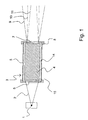
- FIG. 1 shows an X-ray arrangement in a cross-sectional plan view, comprising an X-ray source 1, from which an incident X-ray beam 2 emanates, and an encapsulation 3, which contains an X-ray mirror 4.
- the encapsulation 3 constitutes a housing which surrounds the X-ray mirror 4 completely and on all sides.
- the with housing reinforcements 8 with beryllium windows of an entrance window 6 and an exit window 7 are connected.
- the entire encapsulation is 3 airtight, in particular also waterproof, designed so that a gas or Mass transfer between an interior 14 of the enclosure 3 and the Environment 15 of the encapsulation 3 is excluded.
- the beryllium slices the entrance window 6 and the exit window 7 are X-ray transparent, so that the incident beam 2 unhindered to the X-ray mirror. 4 can reach and precipitating X-rays encapsulation unhindered can leave.
- the precipitating X-rays can vary depending on the type of X-ray mirror 3 a divergent beam 9, a parallel Beam 10 or a convergent beam 11 be.
- FIG. 2 shows the X-ray arrangement of FIG. 1 in a vertical cross-section, that is to say from the side.
- the incident beam 2 emanating from the X-ray source 1 enters the enclosure 3 through the entrance window 6, strikes a mirror surface 16 of the X-ray mirror 4, is reflected there and leaves the enclosure 3 through the exit window as a failing beam 9, 10, 11 7th
- the X-ray mirror 4 rests on the bottom plate 13 and is mounted on this in a manner not shown, such as a mechanical clamping device or by a bond.
- the enclosure 3 accommodates in its interior 14 exclusively a single X-ray mirror 4.
- the interior 14 contains the rest of a defined atmosphere, preferably high purity argon or helium at a gas pressure of about 1.3 * 10 5 Pa.
- the outer dimensions of the encapsulation 3 are based on the size of the enclosed X-ray mirror 4, ie the outer dimensions of the encapsulation 3 are only slightly larger (up to a factor of 2) than the outer dimensions of the X-ray mirror 4, wherein above the mirror surface 16 a distance of a few millimeters (Typically, up to about 12 mm) to the cover plate 12 of the enclosure 3 remains.
- the outer dimensions of the encapsulation 3 are approximately 30 mm in length, 15 mm in width and 15 mm in each case; According to the invention, the outer dimensions of an encapsulated X-ray mirror are each a maximum of 100 mm.
- the encapsulation 3 is firmly connected to the X-ray mirror 4 and protects the mirror surface 16 during assembly of the encapsulated X-ray mirror according to the invention against accidental contact and thus contamination or damage.
- the encapsulation 3 is easy to carry and handle together with the actual X-ray mirror 4, in particular with one hand.
- the encapsulated X-ray mirror according to the invention is a single component for X-ray optics.
- the incident beam of X-rays hits the plane very flat Mirror surface 16, namely in grazing incidence.
- the course of the Beam 2, (and also the beam 9, 10, 11) is almost parallel to Mirror surface 16.
- the sake of clarity is the Incidence angle (and the angle of reflection) in the figures slightly increased shown.
- the levels of the beryllium windows of the windows 6, 7 run perpendicular to the plane of the mirror surface 16. This ensures that the X-ray radiation approximately perpendicular to the windows 6, 7 meets and This can penetrate with only slight reflection losses.
- mirror surface 16 is shown flat in FIG. 2, it can also be profiled, in particular have a paraboloid profile.
- FIG. 3 shows an alternative embodiment of an encapsulated X-ray mirror according to the invention.
- An X-ray mirror 30 has a reflective mirror surface 31.
- An encapsulation 32 which covers a part of the mirror surface 31 like a hood, is fastened to this mirror surface 31. Only this overstretched part of the mirror surface 31 is used for reflection of X-radiation.
- the encapsulation 32 has an entrance window 33 and an exit window 34, each made of beryllium.
- An interior 35 of the enclosure 32 is bounded by the partial walls of the enclosure 32, in particular a cover plate 36 and side walls 37, the windows 33, 34 and the X-ray mirror 30 itself.
- the mirror surface 31 thus forms a boundary of the interior 35 of the enclosure 32 to Interior 35 to be able to include a defined atmosphere.
- the mirror surface of an X-ray mirror is according to the invention permanently enclosing a small volume of a defined atmosphere, to the access of chemical substances during the irradiation of the Limit mirror surface with X-rays. This will become one Mirror degradation causing chemical reactions at the Mirror surface limited, and the life of the so encapsulated X-ray mirror is extended.
Landscapes
- Engineering & Computer Science (AREA)
- Physics & Mathematics (AREA)
- Chemical & Material Sciences (AREA)
- Nanotechnology (AREA)
- Theoretical Computer Science (AREA)
- Crystallography & Structural Chemistry (AREA)
- Mathematical Physics (AREA)
- Spectroscopy & Molecular Physics (AREA)
- General Engineering & Computer Science (AREA)
- High Energy & Nuclear Physics (AREA)
- Exposure Of Semiconductors, Excluding Electron Or Ion Beam Exposure (AREA)
- Analysing Materials By The Use Of Radiation (AREA)
- X-Ray Techniques (AREA)
Applications Claiming Priority (2)
| Application Number | Priority Date | Filing Date | Title |
|---|---|---|---|
| DE10334169 | 2003-07-26 | ||
| DE2003134169 DE10334169A1 (de) | 2003-07-26 | 2003-07-26 | Gekapselter Röntgenspiegel |
Publications (3)
| Publication Number | Publication Date |
|---|---|
| EP1503386A2 true EP1503386A2 (fr) | 2005-02-02 |
| EP1503386A3 EP1503386A3 (fr) | 2009-08-05 |
| EP1503386B1 EP1503386B1 (fr) | 2011-12-28 |
Family
ID=33521419
Family Applications (1)
| Application Number | Title | Priority Date | Filing Date |
|---|---|---|---|
| EP04016846A Expired - Lifetime EP1503386B1 (fr) | 2003-07-26 | 2004-07-16 | Miroir encapsulé pour rayons-X |
Country Status (2)
| Country | Link |
|---|---|
| EP (1) | EP1503386B1 (fr) |
| DE (1) | DE10334169A1 (fr) |
Families Citing this family (3)
| Publication number | Priority date | Publication date | Assignee | Title |
|---|---|---|---|---|
| DE102010034597A1 (de) * | 2010-08-12 | 2012-02-16 | Ifg - Institute For Scientific Instruments Gmbh | Röntgenoptik mit Strahleneintrittsfenster und Strahlenaustrittsfenster |
| DE102012208710B3 (de) | 2012-05-24 | 2013-09-19 | Incoatec Gmbh | Verfahren zur Herstellung einer einkristallinen Röntgenblende und Röntgenanalysegerät mit einkristalliner Röntgenblende |
| US10962491B2 (en) | 2018-09-04 | 2021-03-30 | Sigray, Inc. | System and method for x-ray fluorescence with filtering |
Citations (3)
| Publication number | Priority date | Publication date | Assignee | Title |
|---|---|---|---|---|
| DE4027285A1 (de) | 1990-08-29 | 1992-03-05 | Zeiss Carl Fa | Roentgenmikroskop |
| DE10134267A1 (de) | 2001-07-18 | 2003-02-06 | Geesthacht Gkss Forschung | Einrichtung zur Reflektion von Röntgenstrahlen |
| US6529578B1 (en) | 1999-10-01 | 2003-03-04 | Rigaku Corporation | X-ray condenser and x-ray apparatus |
Family Cites Families (4)
| Publication number | Priority date | Publication date | Assignee | Title |
|---|---|---|---|---|
| JPH01198021A (ja) * | 1988-02-03 | 1989-08-09 | Nec Corp | X線露光装置 |
| US6108397A (en) * | 1997-11-24 | 2000-08-22 | Focused X-Rays, Llc | Collimator for x-ray proximity lithography |
| US6498685B1 (en) * | 1999-01-11 | 2002-12-24 | Kenneth C. Johnson | Maskless, microlens EUV lithography system |
| EP1126477A3 (fr) * | 2000-02-14 | 2003-06-18 | Leica Microsystems Lithography GmbH | Procédé d'examen de structures dans un substrat sémiconducteur |
-
2003
- 2003-07-26 DE DE2003134169 patent/DE10334169A1/de not_active Ceased
-
2004
- 2004-07-16 EP EP04016846A patent/EP1503386B1/fr not_active Expired - Lifetime
Patent Citations (3)
| Publication number | Priority date | Publication date | Assignee | Title |
|---|---|---|---|---|
| DE4027285A1 (de) | 1990-08-29 | 1992-03-05 | Zeiss Carl Fa | Roentgenmikroskop |
| US6529578B1 (en) | 1999-10-01 | 2003-03-04 | Rigaku Corporation | X-ray condenser and x-ray apparatus |
| DE10134267A1 (de) | 2001-07-18 | 2003-02-06 | Geesthacht Gkss Forschung | Einrichtung zur Reflektion von Röntgenstrahlen |
Also Published As
| Publication number | Publication date |
|---|---|
| EP1503386B1 (fr) | 2011-12-28 |
| EP1503386A3 (fr) | 2009-08-05 |
| DE10334169A1 (de) | 2005-02-24 |
Similar Documents
| Publication | Publication Date | Title |
|---|---|---|
| EP1055046B1 (fr) | Profile d'ecartement pour unite de plaques isolantes | |
| DE3027256C2 (fr) | ||
| DE1696066C3 (de) | Wärmereflektierendes Fenster und Verfahren zu seiner Herstellung | |
| EP2300389B1 (fr) | Produit de verre | |
| EP2732255B1 (fr) | Résistance de mesure munie d'un cadre de protection | |
| DE3902596A1 (de) | Verfahren zum herstellen einer vorgespannten oder gebogenen glasscheibe mit rueckseitiger beschichtung, danach hergestellte glasscheibe sowie deren verwendung | |
| EP0646283A1 (fr) | Fenetre de sortie pour faisceau electronique. | |
| DE102018211980A1 (de) | Reflektives optisches Element | |
| EP0853685B1 (fr) | Feuille transparente calorifuge et son procede de production | |
| DE102016224200A1 (de) | Verfahren zum Reparieren von reflektiven optischen Elementen für die EUV-Lithographie | |
| EP3660550A2 (fr) | Matière composite réfléchissante dotée d'un support en aluminium et d'une couche de réflexion en argent | |
| DE10353776B4 (de) | Reflexionsspiegel | |
| EP1503386B1 (fr) | Miroir encapsulé pour rayons-X | |
| DE69709508T2 (de) | Fluoreszenzlampe mit Dünnschichtphotokatalysator und Herstellungsverfahren derselben | |
| WO2021037508A1 (fr) | Élément optique pour réfléchir un rayonnement euv, système de lithographie euv et procédé d'obturation d'un interstice | |
| EP1679291A1 (fr) | Procédé pour la fabrication d une couche à reflection basse | |
| EP3717430B1 (fr) | Procédé de fabrication d'une vitre imprimée et revêtue | |
| EP2198668A1 (fr) | Dispositif pour unité d'irradiation | |
| EP2494577A1 (fr) | Dispositif pour réfléchir des électrons accélérés | |
| DE102017222690A1 (de) | Optisches Element mit einem Wasserstoff-Desorptionsmaterial | |
| EP0834483B1 (fr) | Revêtement multicouche thermiquement isolant pour un substrat transparent | |
| DE102013104212A1 (de) | Vogelschutzglas und Verfahren zum Herstellen eines Vogelschutzglases | |
| DE112018004832T5 (de) | Laminierter film und verfahren zum produzieren von laminiertem film | |
| DE2854213A1 (de) | Verfahren zur herstellung von zu isolierscheiben verarbeitbaren, infrarotreflektierenden fensterscheiben und durch das verfahren hergestellte fensterscheiben sowie isolierscheiben | |
| WO2017202579A1 (fr) | Élément optique et système de lithographique extrême ultraviolet |
Legal Events
| Date | Code | Title | Description |
|---|---|---|---|
| PUAI | Public reference made under article 153(3) epc to a published international application that has entered the european phase |
Free format text: ORIGINAL CODE: 0009012 |
|
| AK | Designated contracting states |
Kind code of ref document: A2 Designated state(s): AT BE BG CH CY CZ DE DK EE ES FI FR GB GR HU IE IT LI LU MC NL PL PT RO SE SI SK TR |
|
| AX | Request for extension of the european patent |
Extension state: AL HR LT LV MK |
|
| PUAL | Search report despatched |
Free format text: ORIGINAL CODE: 0009013 |
|
| AK | Designated contracting states |
Kind code of ref document: A3 Designated state(s): AT BE BG CH CY CZ DE DK EE ES FI FR GB GR HU IE IT LI LU MC NL PL PT RO SE SI SK TR |
|
| AX | Request for extension of the european patent |
Extension state: AL HR LT LV MK |
|
| 17P | Request for examination filed |
Effective date: 20091113 |
|
| AKX | Designation fees paid |
Designated state(s): DE FR NL |
|
| 17Q | First examination report despatched |
Effective date: 20100709 |
|
| GRAP | Despatch of communication of intention to grant a patent |
Free format text: ORIGINAL CODE: EPIDOSNIGR1 |
|
| GRAS | Grant fee paid |
Free format text: ORIGINAL CODE: EPIDOSNIGR3 |
|
| GRAA | (expected) grant |
Free format text: ORIGINAL CODE: 0009210 |
|
| AK | Designated contracting states |
Kind code of ref document: B1 Designated state(s): DE FR NL |
|
| REG | Reference to a national code |
Ref country code: DE Ref legal event code: R096 Ref document number: 502004013181 Country of ref document: DE Effective date: 20120308 |
|
| REG | Reference to a national code |
Ref country code: NL Ref legal event code: T3 |
|
| PLBE | No opposition filed within time limit |
Free format text: ORIGINAL CODE: 0009261 |
|
| STAA | Information on the status of an ep patent application or granted ep patent |
Free format text: STATUS: NO OPPOSITION FILED WITHIN TIME LIMIT |
|
| 26N | No opposition filed |
Effective date: 20121001 |
|
| REG | Reference to a national code |
Ref country code: DE Ref legal event code: R097 Ref document number: 502004013181 Country of ref document: DE Effective date: 20121001 |
|
| REG | Reference to a national code |
Ref country code: FR Ref legal event code: PLFP Year of fee payment: 13 |
|
| REG | Reference to a national code |
Ref country code: FR Ref legal event code: PLFP Year of fee payment: 14 |
|
| REG | Reference to a national code |
Ref country code: FR Ref legal event code: PLFP Year of fee payment: 15 |
|
| PGFP | Annual fee paid to national office [announced via postgrant information from national office to epo] |
Ref country code: NL Payment date: 20230720 Year of fee payment: 20 |
|
| PGFP | Annual fee paid to national office [announced via postgrant information from national office to epo] |
Ref country code: FR Payment date: 20230724 Year of fee payment: 20 Ref country code: DE Payment date: 20230720 Year of fee payment: 20 |
|
| P01 | Opt-out of the competence of the unified patent court (upc) registered |
Effective date: 20231116 |
|
| REG | Reference to a national code |
Ref country code: NL Ref legal event code: MK Effective date: 20240715 |