EP1503979B9 - Prozess zur hydrierung von nicht-aktivierten iminen unter verwendung von ruthenium-komplexen als katalysatoren - Google Patents
Prozess zur hydrierung von nicht-aktivierten iminen unter verwendung von ruthenium-komplexen als katalysatoren Download PDFInfo
- Publication number
- EP1503979B9 EP1503979B9 EP03720057.3A EP03720057A EP1503979B9 EP 1503979 B9 EP1503979 B9 EP 1503979B9 EP 03720057 A EP03720057 A EP 03720057A EP 1503979 B9 EP1503979 B9 EP 1503979B9
- Authority
- EP
- European Patent Office
- Prior art keywords
- optionally substituted
- group
- process according
- ligand
- linear
- Prior art date
- Legal status (The legal status is an assumption and is not a legal conclusion. Google has not performed a legal analysis and makes no representation as to the accuracy of the status listed.)
- Expired - Lifetime
Links
- 238000000034 method Methods 0.000 title claims abstract description 54
- 230000008569 process Effects 0.000 title claims abstract description 46
- 150000002466 imines Chemical class 0.000 title claims abstract description 43
- 239000003054 catalyst Substances 0.000 title description 18
- 150000003303 ruthenium Chemical class 0.000 title description 3
- 239000003446 ligand Substances 0.000 claims abstract description 69
- 238000005984 hydrogenation reaction Methods 0.000 claims abstract description 42
- 125000000217 alkyl group Chemical group 0.000 claims abstract description 32
- 125000003342 alkenyl group Chemical group 0.000 claims abstract description 29
- 150000001412 amines Chemical class 0.000 claims abstract description 29
- VURFVHCLMJOLKN-UHFFFAOYSA-N diphosphane Chemical compound PP VURFVHCLMJOLKN-UHFFFAOYSA-N 0.000 claims abstract description 28
- 150000004985 diamines Chemical class 0.000 claims abstract description 25
- XYFCBTPGUUZFHI-UHFFFAOYSA-N Phosphine Chemical compound P XYFCBTPGUUZFHI-UHFFFAOYSA-N 0.000 claims abstract description 24
- 125000004122 cyclic group Chemical group 0.000 claims abstract description 24
- 238000009876 asymmetric hydrogenation reaction Methods 0.000 claims abstract description 20
- 125000003107 substituted aryl group Chemical group 0.000 claims abstract description 17
- 230000003197 catalytic effect Effects 0.000 claims abstract description 13
- 125000005741 alkyl alkenyl group Chemical group 0.000 claims abstract description 12
- 229910000073 phosphorus hydride Inorganic materials 0.000 claims abstract description 12
- 239000012327 Ruthenium complex Substances 0.000 claims abstract description 11
- 125000004435 hydrogen atom Chemical group [H]* 0.000 claims abstract description 6
- 125000004432 carbon atom Chemical group C* 0.000 claims description 21
- VLKZOEOYAKHREP-UHFFFAOYSA-N n-Hexane Chemical compound CCCCCC VLKZOEOYAKHREP-UHFFFAOYSA-N 0.000 claims description 19
- WYURNTSHIVDZCO-UHFFFAOYSA-N Tetrahydrofuran Chemical compound C1CCOC1 WYURNTSHIVDZCO-UHFFFAOYSA-N 0.000 claims description 16
- 125000003118 aryl group Chemical group 0.000 claims description 16
- 229910052739 hydrogen Inorganic materials 0.000 claims description 16
- YXFVVABEGXRONW-UHFFFAOYSA-N Toluene Chemical compound CC1=CC=CC=C1 YXFVVABEGXRONW-UHFFFAOYSA-N 0.000 claims description 15
- 239000000203 mixture Substances 0.000 claims description 15
- 125000004437 phosphorous atom Chemical group 0.000 claims description 14
- 150000001875 compounds Chemical class 0.000 claims description 13
- 239000001257 hydrogen Substances 0.000 claims description 13
- UHOVQNZJYSORNB-UHFFFAOYSA-N Benzene Chemical compound C1=CC=CC=C1 UHOVQNZJYSORNB-UHFFFAOYSA-N 0.000 claims description 12
- 239000002904 solvent Substances 0.000 claims description 12
- 125000005346 substituted cycloalkyl group Chemical group 0.000 claims description 11
- 125000002947 alkylene group Chemical group 0.000 claims description 9
- 229920006395 saturated elastomer Polymers 0.000 claims description 9
- 125000004429 atom Chemical group 0.000 claims description 8
- YLQBMQCUIZJEEH-UHFFFAOYSA-N tetrahydrofuran Natural products C=1C=COC=1 YLQBMQCUIZJEEH-UHFFFAOYSA-N 0.000 claims description 8
- 150000003003 phosphines Chemical class 0.000 claims description 7
- MUALRAIOVNYAIW-UHFFFAOYSA-N binap Chemical compound C1=CC=CC=C1P(C=1C(=C2C=CC=CC2=CC=1)C=1C2=CC=CC=C2C=CC=1P(C=1C=CC=CC=1)C=1C=CC=CC=1)C1=CC=CC=C1 MUALRAIOVNYAIW-UHFFFAOYSA-N 0.000 claims description 6
- 229910052717 sulfur Inorganic materials 0.000 claims description 6
- UFHFLCQGNIYNRP-UHFFFAOYSA-N Hydrogen Chemical compound [H][H] UFHFLCQGNIYNRP-UHFFFAOYSA-N 0.000 claims description 5
- 125000003545 alkoxy group Chemical group 0.000 claims description 5
- 125000003368 amide group Chemical group 0.000 claims description 5
- 229910052751 metal Inorganic materials 0.000 claims description 5
- 239000002184 metal Substances 0.000 claims description 5
- 125000004423 acyloxy group Chemical group 0.000 claims description 4
- 150000005347 biaryls Chemical group 0.000 claims description 4
- XDTMQSROBMDMFD-UHFFFAOYSA-N Cyclohexane Chemical compound C1CCCCC1 XDTMQSROBMDMFD-UHFFFAOYSA-N 0.000 claims description 3
- 229910052784 alkaline earth metal Inorganic materials 0.000 claims description 3
- 125000000129 anionic group Chemical group 0.000 claims description 3
- 229910052794 bromium Inorganic materials 0.000 claims description 3
- 229910052801 chlorine Inorganic materials 0.000 claims description 3
- 150000004679 hydroxides Chemical class 0.000 claims description 3
- 229910052740 iodine Inorganic materials 0.000 claims description 3
- 125000005647 linker group Chemical group 0.000 claims description 3
- CTQNGGLPUBDAKN-UHFFFAOYSA-N O-Xylene Chemical compound CC1=CC=CC=C1C CTQNGGLPUBDAKN-UHFFFAOYSA-N 0.000 claims description 2
- WHLQQRGHOPIIMQ-UHFFFAOYSA-N [2-(2-diphenylphosphanyl-6-methylphenyl)-3-methylphenyl]-diphenylphosphane Chemical compound CC=1C=CC=C(P(C=2C=CC=CC=2)C=2C=CC=CC=2)C=1C=1C(C)=CC=CC=1P(C=1C=CC=CC=1)C1=CC=CC=C1 WHLQQRGHOPIIMQ-UHFFFAOYSA-N 0.000 claims description 2
- 150000001342 alkaline earth metals Chemical class 0.000 claims description 2
- GKTNLYAAZKKMTQ-UHFFFAOYSA-N n-[bis(dimethylamino)phosphinimyl]-n-methylmethanamine Chemical compound CN(C)P(=N)(N(C)C)N(C)C GKTNLYAAZKKMTQ-UHFFFAOYSA-N 0.000 claims description 2
- 125000004433 nitrogen atom Chemical group N* 0.000 claims description 2
- 150000003138 primary alcohols Chemical class 0.000 claims description 2
- 150000003333 secondary alcohols Chemical class 0.000 claims description 2
- 239000008096 xylene Substances 0.000 claims description 2
- 125000002887 hydroxy group Chemical group [H]O* 0.000 claims 2
- XLYOFNOQVPJJNP-UHFFFAOYSA-N water Chemical compound O XLYOFNOQVPJJNP-UHFFFAOYSA-N 0.000 abstract description 2
- 239000000758 substrate Substances 0.000 description 14
- 238000006243 chemical reaction Methods 0.000 description 11
- RIOQSEWOXXDEQQ-UHFFFAOYSA-N triphenylphosphine Chemical compound C1=CC=CC=C1P(C=1C=CC=CC=1)C1=CC=CC=C1 RIOQSEWOXXDEQQ-UHFFFAOYSA-N 0.000 description 10
- 239000012018 catalyst precursor Substances 0.000 description 9
- -1 iridium binaphane complexes Chemical class 0.000 description 9
- YMWUJEATGCHHMB-UHFFFAOYSA-N Dichloromethane Chemical compound ClCCl YMWUJEATGCHHMB-UHFFFAOYSA-N 0.000 description 8
- 238000009903 catalytic hydrogenation reaction Methods 0.000 description 7
- 230000009467 reduction Effects 0.000 description 7
- IJGRMHOSHXDMSA-UHFFFAOYSA-N Atomic nitrogen Chemical compound N#N IJGRMHOSHXDMSA-UHFFFAOYSA-N 0.000 description 6
- 150000002431 hydrogen Chemical group 0.000 description 6
- 125000004356 hydroxy functional group Chemical group O* 0.000 description 6
- 229910052757 nitrogen Inorganic materials 0.000 description 6
- YAYGSLOSTXKUBW-UHFFFAOYSA-N ruthenium(2+) Chemical compound [Ru+2] YAYGSLOSTXKUBW-UHFFFAOYSA-N 0.000 description 6
- 239000000243 solution Substances 0.000 description 6
- KJTLSVCANCCWHF-UHFFFAOYSA-N Ruthenium Chemical compound [Ru] KJTLSVCANCCWHF-UHFFFAOYSA-N 0.000 description 5
- 150000002576 ketones Chemical class 0.000 description 5
- 238000004519 manufacturing process Methods 0.000 description 5
- 229910052760 oxygen Inorganic materials 0.000 description 5
- 238000002360 preparation method Methods 0.000 description 5
- 125000001424 substituent group Chemical group 0.000 description 5
- UHDGCWIWMRVCDJ-UHFFFAOYSA-N 1-beta-D-Xylofuranosyl-NH-Cytosine Natural products O=C1N=C(N)C=CN1C1C(O)C(O)C(CO)O1 UHDGCWIWMRVCDJ-UHFFFAOYSA-N 0.000 description 4
- 238000005160 1H NMR spectroscopy Methods 0.000 description 4
- PAYRUJLWNCNPSJ-UHFFFAOYSA-N Aniline Chemical compound NC1=CC=CC=C1 PAYRUJLWNCNPSJ-UHFFFAOYSA-N 0.000 description 4
- RTZKZFJDLAIYFH-UHFFFAOYSA-N Diethyl ether Chemical compound CCOCC RTZKZFJDLAIYFH-UHFFFAOYSA-N 0.000 description 4
- 230000000694 effects Effects 0.000 description 4
- 229910052741 iridium Inorganic materials 0.000 description 4
- 125000002524 organometallic group Chemical group 0.000 description 4
- HWTZZLIIDDMPSQ-UHFFFAOYSA-N 6-methyl-n-phenylhept-5-en-2-imine Chemical compound CC(C)=CCCC(C)=NC1=CC=CC=C1 HWTZZLIIDDMPSQ-UHFFFAOYSA-N 0.000 description 3
- ZMANZCXQSJIPKH-UHFFFAOYSA-N Triethylamine Chemical compound CCN(CC)CC ZMANZCXQSJIPKH-UHFFFAOYSA-N 0.000 description 3
- 125000000753 cycloalkyl group Chemical group 0.000 description 3
- 239000007789 gas Substances 0.000 description 3
- 125000005842 heteroatom Chemical group 0.000 description 3
- GKOZUEZYRPOHIO-UHFFFAOYSA-N iridium atom Chemical compound [Ir] GKOZUEZYRPOHIO-UHFFFAOYSA-N 0.000 description 3
- WQKGAJDYBZOFSR-UHFFFAOYSA-N potassium;propan-2-olate Chemical compound [K+].CC(C)[O-] WQKGAJDYBZOFSR-UHFFFAOYSA-N 0.000 description 3
- 239000002243 precursor Substances 0.000 description 3
- 229910052703 rhodium Inorganic materials 0.000 description 3
- 239000010948 rhodium Substances 0.000 description 3
- MHOVAHRLVXNVSD-UHFFFAOYSA-N rhodium atom Chemical compound [Rh] MHOVAHRLVXNVSD-UHFFFAOYSA-N 0.000 description 3
- 229910052707 ruthenium Inorganic materials 0.000 description 3
- WVQBLGZPHOPPFO-LBPRGKRZSA-N (S)-metolachlor Chemical compound CCC1=CC=CC(C)=C1N([C@@H](C)COC)C(=O)CCl WVQBLGZPHOPPFO-LBPRGKRZSA-N 0.000 description 2
- XKRFYHLGVUSROY-UHFFFAOYSA-N Argon Chemical compound [Ar] XKRFYHLGVUSROY-UHFFFAOYSA-N 0.000 description 2
- LFQSCWFLJHTTHZ-UHFFFAOYSA-N Ethanol Chemical compound CCO LFQSCWFLJHTTHZ-UHFFFAOYSA-N 0.000 description 2
- MZRVEZGGRBJDDB-UHFFFAOYSA-N N-Butyllithium Chemical compound [Li]CCCC MZRVEZGGRBJDDB-UHFFFAOYSA-N 0.000 description 2
- 125000000732 arylene group Chemical group 0.000 description 2
- 230000015572 biosynthetic process Effects 0.000 description 2
- 229910052799 carbon Inorganic materials 0.000 description 2
- 238000006555 catalytic reaction Methods 0.000 description 2
- 230000008859 change Effects 0.000 description 2
- HIGHHSNPFSMLCS-UHFFFAOYSA-M chloro(hydrido)ruthenium;triphenylphosphane Chemical compound [RuH]Cl.C1=CC=CC=C1P(C=1C=CC=CC=1)C1=CC=CC=C1.C1=CC=CC=C1P(C=1C=CC=CC=1)C1=CC=CC=C1.C1=CC=CC=C1P(C=1C=CC=CC=1)C1=CC=CC=C1 HIGHHSNPFSMLCS-UHFFFAOYSA-M 0.000 description 2
- 125000005843 halogen group Chemical group 0.000 description 2
- 238000009776 industrial production Methods 0.000 description 2
- 239000007788 liquid Substances 0.000 description 2
- 125000001624 naphthyl group Chemical group 0.000 description 2
- 125000001997 phenyl group Chemical group [H]C1=C([H])C([H])=C(*)C([H])=C1[H] 0.000 description 2
- SCVFZCLFOSHCOH-UHFFFAOYSA-M potassium acetate Chemical compound [K+].CC([O-])=O SCVFZCLFOSHCOH-UHFFFAOYSA-M 0.000 description 2
- 239000011541 reaction mixture Substances 0.000 description 2
- 238000012552 review Methods 0.000 description 2
- URGAHOPLAPQHLN-UHFFFAOYSA-N sodium aluminosilicate Chemical class [Na+].[Al+3].[O-][Si]([O-])=O.[O-][Si]([O-])=O URGAHOPLAPQHLN-UHFFFAOYSA-N 0.000 description 2
- 239000007787 solid Substances 0.000 description 2
- 239000000126 substance Substances 0.000 description 2
- 238000006467 substitution reaction Methods 0.000 description 2
- 238000003786 synthesis reaction Methods 0.000 description 2
- RCKGKFUSTYPZAX-UHFFFAOYSA-N 1-cyclobutyl-n-phenylethanimine Chemical compound C1CCC1C(C)=NC1=CC=CC=C1 RCKGKFUSTYPZAX-UHFFFAOYSA-N 0.000 description 1
- LKNXZMFFOKBUKB-UHFFFAOYSA-N 1-cyclopropyl-n-phenylethanimine Chemical compound C1CC1C(C)=NC1=CC=CC=C1 LKNXZMFFOKBUKB-UHFFFAOYSA-N 0.000 description 1
- 238000001644 13C nuclear magnetic resonance spectroscopy Methods 0.000 description 1
- 125000003903 2-propenyl group Chemical group [H]C([*])([H])C([H])=C([H])[H] 0.000 description 1
- JMAYGWLEUGWVPG-UHFFFAOYSA-N 3,3-dimethyl-n-phenylbutan-2-imine Chemical compound CC(C)(C)C(C)=NC1=CC=CC=C1 JMAYGWLEUGWVPG-UHFFFAOYSA-N 0.000 description 1
- ZZXIKCHNJDYKSS-UHFFFAOYSA-N 3-methyl-n-phenylbutan-2-imine Chemical compound CC(C)C(C)=NC1=CC=CC=C1 ZZXIKCHNJDYKSS-UHFFFAOYSA-N 0.000 description 1
- 239000004215 Carbon black (E152) Substances 0.000 description 1
- ULBXWWGWDPVHAO-UHFFFAOYSA-N Chlorbufam Chemical compound C#CC(C)OC(=O)NC1=CC=CC(Cl)=C1 ULBXWWGWDPVHAO-UHFFFAOYSA-N 0.000 description 1
- DGAQECJNVWCQMB-PUAWFVPOSA-M Ilexoside XXIX Chemical compound C[C@@H]1CC[C@@]2(CC[C@@]3(C(=CC[C@H]4[C@]3(CC[C@@H]5[C@@]4(CC[C@@H](C5(C)C)OS(=O)(=O)[O-])C)C)[C@@H]2[C@]1(C)O)C)C(=O)O[C@H]6[C@@H]([C@H]([C@@H]([C@H](O6)CO)O)O)O.[Na+] DGAQECJNVWCQMB-PUAWFVPOSA-M 0.000 description 1
- XEEYBQQBJWHFJM-UHFFFAOYSA-N Iron Chemical compound [Fe] XEEYBQQBJWHFJM-UHFFFAOYSA-N 0.000 description 1
- JCMWSMSWYQGFFS-UHFFFAOYSA-N P.P.[Ir] Chemical class P.P.[Ir] JCMWSMSWYQGFFS-UHFFFAOYSA-N 0.000 description 1
- NBIIXXVUZAFLBC-UHFFFAOYSA-N Phosphoric acid Chemical compound OP(O)(O)=O NBIIXXVUZAFLBC-UHFFFAOYSA-N 0.000 description 1
- 239000005617 S-Metolachlor Substances 0.000 description 1
- VYPSYNLAJGMNEJ-UHFFFAOYSA-N Silicium dioxide Chemical compound O=[Si]=O VYPSYNLAJGMNEJ-UHFFFAOYSA-N 0.000 description 1
- RTAQQCXQSZGOHL-UHFFFAOYSA-N Titanium Chemical compound [Ti] RTAQQCXQSZGOHL-UHFFFAOYSA-N 0.000 description 1
- 125000003668 acetyloxy group Chemical group [H]C([H])([H])C(=O)O[*] 0.000 description 1
- 230000004913 activation Effects 0.000 description 1
- 150000001335 aliphatic alkanes Chemical class 0.000 description 1
- 125000003277 amino group Chemical group 0.000 description 1
- 125000005428 anthryl group Chemical group [H]C1=C([H])C([H])=C2C([H])=C3C(*)=C([H])C([H])=C([H])C3=C([H])C2=C1[H] 0.000 description 1
- 229910052786 argon Inorganic materials 0.000 description 1
- 239000003849 aromatic solvent Substances 0.000 description 1
- QVGXLLKOCUKJST-UHFFFAOYSA-N atomic oxygen Chemical compound [O] QVGXLLKOCUKJST-UHFFFAOYSA-N 0.000 description 1
- 238000009835 boiling Methods 0.000 description 1
- 125000001246 bromo group Chemical group Br* 0.000 description 1
- 244000309464 bull Species 0.000 description 1
- 125000004369 butenyl group Chemical group C(=CCC)* 0.000 description 1
- 125000002837 carbocyclic group Chemical group 0.000 description 1
- 150000001733 carboxylic acid esters Chemical class 0.000 description 1
- 125000001309 chloro group Chemical group Cl* 0.000 description 1
- AKJFBIZAEPTXIL-UHFFFAOYSA-N chloro(dicyclohexyl)phosphane Chemical compound C1CCCCC1P(Cl)C1CCCCC1 AKJFBIZAEPTXIL-UHFFFAOYSA-N 0.000 description 1
- 238000002425 crystallisation Methods 0.000 description 1
- 230000008025 crystallization Effects 0.000 description 1
- 125000006165 cyclic alkyl group Chemical group 0.000 description 1
- 125000001995 cyclobutyl group Chemical group [H]C1([H])C([H])([H])C([H])(*)C1([H])[H] 0.000 description 1
- 125000000640 cyclooctyl group Chemical group [H]C1([H])C([H])([H])C([H])([H])C([H])([H])C([H])(*)C([H])([H])C([H])([H])C1([H])[H] 0.000 description 1
- 125000001511 cyclopentyl group Chemical group [H]C1([H])C([H])([H])C([H])([H])C([H])(*)C1([H])[H] 0.000 description 1
- 125000001559 cyclopropyl group Chemical group [H]C1([H])C([H])([H])C1([H])* 0.000 description 1
- 230000001419 dependent effect Effects 0.000 description 1
- 239000011903 deuterated solvents Substances 0.000 description 1
- 238000011161 development Methods 0.000 description 1
- 238000010790 dilution Methods 0.000 description 1
- 239000012895 dilution Substances 0.000 description 1
- AASUFOVSZUIILF-UHFFFAOYSA-N diphenylmethanone;sodium Chemical compound [Na].C=1C=CC=CC=1C(=O)C1=CC=CC=C1 AASUFOVSZUIILF-UHFFFAOYSA-N 0.000 description 1
- 238000004821 distillation Methods 0.000 description 1
- 150000002170 ethers Chemical class 0.000 description 1
- 125000001495 ethyl group Chemical group [H]C([H])([H])C([H])([H])* 0.000 description 1
- 238000001704 evaporation Methods 0.000 description 1
- 230000008020 evaporation Effects 0.000 description 1
- 239000011521 glass Substances 0.000 description 1
- 238000004636 glovebox technique Methods 0.000 description 1
- 229910052736 halogen Inorganic materials 0.000 description 1
- 150000002367 halogens Chemical class 0.000 description 1
- 230000002363 herbicidal effect Effects 0.000 description 1
- 239000004009 herbicide Substances 0.000 description 1
- 238000009905 homogeneous catalytic hydrogenation reaction Methods 0.000 description 1
- 229930195733 hydrocarbon Natural products 0.000 description 1
- 150000002430 hydrocarbons Chemical class 0.000 description 1
- 238000006459 hydrosilylation reaction Methods 0.000 description 1
- 238000011065 in-situ storage Methods 0.000 description 1
- 238000002329 infrared spectrum Methods 0.000 description 1
- 125000002346 iodo group Chemical group I* 0.000 description 1
- SXRIPRHXGZHSNU-UHFFFAOYSA-N iridium rhodium Chemical compound [Rh].[Ir] SXRIPRHXGZHSNU-UHFFFAOYSA-N 0.000 description 1
- 125000001449 isopropyl group Chemical group [H]C([H])([H])C([H])(*)C([H])([H])[H] 0.000 description 1
- 238000011068 loading method Methods 0.000 description 1
- 239000000463 material Substances 0.000 description 1
- 230000008018 melting Effects 0.000 description 1
- 238000002844 melting Methods 0.000 description 1
- 125000002496 methyl group Chemical group [H]C([H])([H])* 0.000 description 1
- 238000012986 modification Methods 0.000 description 1
- 230000004048 modification Effects 0.000 description 1
- 239000002808 molecular sieve Substances 0.000 description 1
- WPIFRKFCVFPKIC-UHFFFAOYSA-N n-(6-methylhept-5-en-2-yl)aniline Chemical compound CC(C)=CCCC(C)NC1=CC=CC=C1 WPIFRKFCVFPKIC-UHFFFAOYSA-N 0.000 description 1
- 125000001971 neopentyl group Chemical group [H]C([*])([H])C(C([H])([H])[H])(C([H])([H])[H])C([H])([H])[H] 0.000 description 1
- 238000000655 nuclear magnetic resonance spectrum Methods 0.000 description 1
- 239000001301 oxygen Substances 0.000 description 1
- PARWUHTVGZSQPD-UHFFFAOYSA-N phenylsilane Chemical compound [SiH3]C1=CC=CC=C1 PARWUHTVGZSQPD-UHFFFAOYSA-N 0.000 description 1
- HYQWVHLEZIWIGH-UHFFFAOYSA-N phosphane;ruthenium(2+) Chemical compound P.[Ru+2] HYQWVHLEZIWIGH-UHFFFAOYSA-N 0.000 description 1
- 229920001515 polyalkylene glycol Polymers 0.000 description 1
- 235000011056 potassium acetate Nutrition 0.000 description 1
- LPNYRYFBWFDTMA-UHFFFAOYSA-N potassium tert-butoxide Chemical compound [K+].CC(C)(C)[O-] LPNYRYFBWFDTMA-UHFFFAOYSA-N 0.000 description 1
- 230000003389 potentiating effect Effects 0.000 description 1
- 125000001436 propyl group Chemical group [H]C([*])([H])C([H])([H])C([H])([H])[H] 0.000 description 1
- 238000000425 proton nuclear magnetic resonance spectrum Methods 0.000 description 1
- 239000012429 reaction media Substances 0.000 description 1
- 238000010992 reflux Methods 0.000 description 1
- 150000003283 rhodium Chemical class 0.000 description 1
- JDNQPKBFOBQRBN-UHFFFAOYSA-N ruthenium monohydride Chemical class [RuH] JDNQPKBFOBQRBN-UHFFFAOYSA-N 0.000 description 1
- YBCAZPLXEGKKFM-UHFFFAOYSA-K ruthenium(iii) chloride Chemical compound [Cl-].[Cl-].[Cl-].[Ru+3] YBCAZPLXEGKKFM-UHFFFAOYSA-K 0.000 description 1
- 238000012216 screening Methods 0.000 description 1
- 125000002914 sec-butyl group Chemical group [H]C([H])([H])C([H])([H])C([H])(*)C([H])([H])[H] 0.000 description 1
- 229910052711 selenium Inorganic materials 0.000 description 1
- 239000000741 silica gel Substances 0.000 description 1
- 229910002027 silica gel Inorganic materials 0.000 description 1
- 229910052708 sodium Inorganic materials 0.000 description 1
- 239000001632 sodium acetate Substances 0.000 description 1
- 235000017281 sodium acetate Nutrition 0.000 description 1
- 238000001228 spectrum Methods 0.000 description 1
- 229910001220 stainless steel Inorganic materials 0.000 description 1
- 239000010935 stainless steel Substances 0.000 description 1
- 239000011550 stock solution Substances 0.000 description 1
- 239000000725 suspension Substances 0.000 description 1
- 229910052714 tellurium Inorganic materials 0.000 description 1
- 125000000999 tert-butyl group Chemical group [H]C([H])([H])C(*)(C([H])([H])[H])C([H])([H])[H] 0.000 description 1
- CZDYPVPMEAXLPK-UHFFFAOYSA-N tetramethylsilane Chemical compound C[Si](C)(C)C CZDYPVPMEAXLPK-UHFFFAOYSA-N 0.000 description 1
- 229910052719 titanium Inorganic materials 0.000 description 1
- 239000010936 titanium Substances 0.000 description 1
- 238000009901 transfer hydrogenation reaction Methods 0.000 description 1
- ILWRPSCZWQJDMK-UHFFFAOYSA-N triethylazanium;chloride Chemical compound Cl.CCN(CC)CC ILWRPSCZWQJDMK-UHFFFAOYSA-N 0.000 description 1
- PTMFUWGXPRYYMC-UHFFFAOYSA-N triethylazanium;formate Chemical compound OC=O.CCN(CC)CC PTMFUWGXPRYYMC-UHFFFAOYSA-N 0.000 description 1
- 125000000391 vinyl group Chemical group [H]C([*])=C([H])[H] 0.000 description 1
- 229920002554 vinyl polymer Polymers 0.000 description 1
Classifications
-
- C—CHEMISTRY; METALLURGY
- C07—ORGANIC CHEMISTRY
- C07D—HETEROCYCLIC COMPOUNDS
- C07D453/00—Heterocyclic compounds containing quinuclidine or iso-quinuclidine ring systems, e.g. quinine alkaloids
- C07D453/02—Heterocyclic compounds containing quinuclidine or iso-quinuclidine ring systems, e.g. quinine alkaloids containing not further condensed quinuclidine ring systems
-
- C—CHEMISTRY; METALLURGY
- C07—ORGANIC CHEMISTRY
- C07C—ACYCLIC OR CARBOCYCLIC COMPOUNDS
- C07C209/00—Preparation of compounds containing amino groups bound to a carbon skeleton
- C07C209/44—Preparation of compounds containing amino groups bound to a carbon skeleton by reduction of carboxylic acids or esters thereof in presence of ammonia or amines, or by reduction of nitriles, carboxylic acid amides, imines or imino-ethers
- C07C209/52—Preparation of compounds containing amino groups bound to a carbon skeleton by reduction of carboxylic acids or esters thereof in presence of ammonia or amines, or by reduction of nitriles, carboxylic acid amides, imines or imino-ethers by reduction of imines or imino-ethers
-
- C—CHEMISTRY; METALLURGY
- C07—ORGANIC CHEMISTRY
- C07B—GENERAL METHODS OF ORGANIC CHEMISTRY; APPARATUS THEREFOR
- C07B2200/00—Indexing scheme relating to specific properties of organic compounds
- C07B2200/07—Optical isomers
-
- C—CHEMISTRY; METALLURGY
- C07—ORGANIC CHEMISTRY
- C07C—ACYCLIC OR CARBOCYCLIC COMPOUNDS
- C07C2601/00—Systems containing only non-condensed rings
- C07C2601/02—Systems containing only non-condensed rings with a three-membered ring
-
- C—CHEMISTRY; METALLURGY
- C07—ORGANIC CHEMISTRY
- C07C—ACYCLIC OR CARBOCYCLIC COMPOUNDS
- C07C2601/00—Systems containing only non-condensed rings
- C07C2601/04—Systems containing only non-condensed rings with a four-membered ring
Definitions
- Noyori and coworkers have described an efficient catalyst system generated from the complex Ru( ⁇ 6 -arene)(tosyldiamine)Cl for the asymmetric hydrogenation of imines by transferring hydrogen from triethylammonium formate ( Noyori et al., Acc. Chem. Res. 1997, 30, 97-102 ). This is the first really effective imine reduction system based on ruthenium although other straight hydrogenation systems with much lower activity and selectivity have been reported as reviewed by James ( supra ).
- the present invention relates to a process for the hydrogenation and/or asymmetric hydrogenation of dialkyl, alkylalkenyl or dialkenyl imines of formula II to amines of formula III: wherein
- the present inventors have surprisingly found that unreactive alkyl- and alkenyl-substituted imines, which are notoriously recalcitrant to undergo hydrogenation under milder hydrogenation conditions, may be efficiently hydrogenated, as well as asymmetrically hydrogenated, in the presence of H 2 and Noyori-type ruthenium(II) complexes.
- the present invention relates to a process for the hydrogenation and/or asymmetric hydrogenation of dialkyl, alkylalkenyl or dialkenyl imines of formula II to amines of formula III: wherein
- PR 3 ( VI ) represents a chiral or achiral monodentate phosphine ligand wherein each R, taken separately, is independently selected from the group consisting of optionally substituted linear and branched alkyl and alkenyl containing 1 to 8 carbon atoms, optionally substituted cycloalkyl, optionally substituted aryl, or OR and NR 2 , wherein R is as previously defined; or two R groups bonded to the same P atom are bonded together to form an optionally substituted saturated or aromatic ring having 5 to 8 atoms including the phosphorous atom to which said R groups are bonded.
- R 2 P-Q-PR 2 ( VII ) represents a chiral or achiral bidentate ligand wherein each R, taken separately, is independently selected from the group consisting of optionally substituted linear and branched alkyl and alkenyl containing 1 to 8 carbon atoms, optionally substituted cycloalkyl, optionally substituted aryl, or OR and NR 2 , wherein R is as previously defined; or two R groups bonded to the same P atom are bonded together to form an optionally substituted saturated or aromatic ring having 5 to 8 atoms including the phosphorous atom to which said R groups are bonded;
- Q is selected from the group consisting of optionally substituted linear and cyclic C 2 -C 7 alkylene, optionally substituted metallocenediyl and optionally substituted C 6 -C 22 arylene.
- the diphosphine ligand is chiral and includes atropisomeric bis-tertiary phosphines, in which the two phosphorus atoms are linked by a biaryl backbone.
- Representative members of this class of atropisomeric compounds include BINAP, BIPHEP and BIPHEMP.
- the diphosphine ligand is a chiral or achiral ligand of the formula R 2 P-NR'-Z-NR'-PR 2 ( VIII ): R 2 P-NR'-Z-NR'-PR 2 ( VIII ) wherein each R, taken separately, is independently selected from the group consisting of optionally substituted linear and branched alkyl and alkenyl containing 1 to 8 carbon atoms, optionally substituted cycloalkyl, optionally substituted aryl, or OR and NR 2 , wherein R is as previously defined; or two R groups bonded to the same P atom are bonded together to form an optionally substituted saturated or aromatic ring having 5 to 8 atoms including the phosphorous atom to which said R groups are bonded; each R', taken separately, is independently selected from the group consisting of hydrogen , optionally substituted linear and branched alkyl or alkenyl containing 1 to 8 carbon atoms, optionally substituted cycloalkyl and
- the diamine ligand has the formula NH 2 -Z-NH 2 ( IX ): H 2 N-Z-NH 2 ( IX ) wherein Z is selected from the group consisting of optionally substituted linear and cyclic C 2 -C 7 alkylene, optionally substituted metallocenediyl and optionally substituted C 6 -C 22 arylene.
- rings may be contain from three to twelve atoms, preferably three to ten atoms, having a single ring structure or multiple condensed (fused) ring structure.
- one or more, preferably one or two, more preferably one, of the carbon atoms may be substituted with a heteroatom such as O, S and N.
- a heteroatom such as O, S and N.
- An example of such a ring structure is 1-aza-bicyclo[2.2.2]oct-3-ylidene.
- cycloalkyl or "cyclic alkyl” as used herein refers to cyclic alkyl groups of from three to twelve carbon atoms, preferably from three to eight carbon atoms, having a single cyclic ring or multiple condensed rings.
- Such cycloalkyl groups include, by way of example, single ring structures such as cyclopropyl, cyclobutyl, cyclopentyl, cyclooctyl, and the like, or multiple ring structures such as adamantanyl, and the like.
- one or more, preferably one or two, more preferably one, of the carbon atoms may be substituted with a heteroatom such as O, S and N.
- metallocene group typically having the following structure: wherein M is a metal, for example iron (Fe).
- arylene as used herein includes biaryldiyl groups and refers to a bivalent group comprising one to three, preferably one to two, aryl groups linked together. Examples of arylene groups include, but are not limited to biphenyldiyl and binaphthyldiyl.
- substituents may include one to five, preferably one to three, more preferably one to two, groups independently selected from alkyl, alkoxy, polyalkyleneglycol, carboxylic esters, OH, halo, cycloalkyl, aryl, and halo-substituted-aryl.
- groups that contain 1 or more substituents, it is understood, of course, that such groups do not contain any substitution or substitution patterns which are sterically impractical and/or synthetically non-feasible.
- halo as used herein means halogen and includes chloro, flouro, bromo and iodo.
- the ruthenium catalyst complexes may be prepared, for example, as described by Abdur-Rashid et al. (Organometallics, 2001, 21, 1047 ). Many of the ligands described above are known in the art and, unless specified differently in the Examples, are obtained according to methods known in the art. The ligands that are new can be obtained by modifying known procedures according to the knowledge of a person skilled in the art.
- the catalytic system characterizing the process of the present invention comprises a base.
- Said base can be the substrate itself, if the latter is basic, or any conventional base.
- organic non-coordinating bases such as DBU, NR 3 , phosphazene bases, alkaline or alkaline-earth metal carbonates, carboxylate salts such as sodium or potassium acetate, or alcoholates or hydroxide salts.
- Preferred bases are the alcoholate or hydroxide salts selected from the group consisting of the compounds of formula (R 7 O) 2 M' and R 7 OM", wherein M' is an alkaline-earth metal, M" is an alkaline metal and R 7 is selected from the group consisting of hydrogen and C 1 to C 6 linear and branched alkyl.
- a typical process involves the mixture of the substrate with the ruthenium complex and a base, possibly in the presence of a solvent, and then treating such a mixture with molecular hydrogen at a chosen pressure and temperature.
- the complexes can be added to the reaction medium in a large range of concentrations.
- a substrate to complex (S/com) ratio of 10 5 to 20.
- the substrate to complex ratio will be in the range of 10 to 1 respectively. It goes without saying that the optimum concentration of complex will depend on the nature of the latter and on the pressure of H 2 used during the process.
- Useful quantities of base, added to the reaction mixture, may be comprised in a relatively large range.
- it should be noted that it is also possible to add a small amount of base (e.g. base/com 1 to 3) to achieve high hydrogenation yields.
- the hydrogenation reaction can be carried out in the presence or absence of a solvent.
- a solvent is required or used for practical reasons, then any solvent current in hydrogenation reactions can be used for the purposes of the invention.
- Non-limiting examples include aromatic solvents such as benzene, toluene or xylene, hydrocarbon solvents such as hexane or cyclohexane, ethers such as tetrahydrofuran, or yet primary or secondary alcohols, or mixtures thereof.
- aromatic solvents such as benzene, toluene or xylene
- hydrocarbon solvents such as hexane or cyclohexane
- ethers such as tetrahydrofuran
- primary or secondary alcohols or mixtures thereof.
- a person skilled in the art is well able to select the solvent most convenient in each case to optimize the hydrogenation reaction.
- the reaction can be carried out at a H 2 pressure comprised between 10 5 Pa and 80x10 5 Pa (1 to 80 bars).
- a person skilled in the art is well able to adjust the pressure as a function of the catalyst load and of the dilution of the substrate in the solvent.
- the temperature at which the hydrogenation can be carried out is comprised between 0°C and 100°C, more preferably in the range of between 20°C and 60°C.
- a person skilled in the art is also able to select the preferred temperature as a function of the melting and boiling point of the starting and final products.
- the process of the present invention provides an effective means of preparing a wide range of chiral amines. It is desirable that the enantiomeric enrichment or excess (ee) of the amine ( III ) is at least 50% ee, and more preferably at least 80% ee, or higher. If necessary, any shortfall in ee can be subsequently corrected by crystallization techniques known by persons skilled in the art. It is also important to achieve a high conversion of substrate to product, preferably at least 80% conversion, and more preferably at least 90% conversion.
- NMR spectra were recorded on either a Varian Gemini 300 MHz spectrometer (300 MHz for 1 H, 75 MHz for 13 C and 121.5 for 31 P) or a Varian Unity 400 MHz spectrometer (400 MHz for 1 H and 100 MHz for 13 C). All 31 P spectra were recorded with proton decoupling and 31 P chemical shifts were measured relative to 85% H 3 PO 4 as an external reference. 1 H and 13 C chemical shifts were measured relative to partially deuterated solvent peaks but are reported relative to tetramethylsilane. Infrared spectra were obtained on a Nicolet 550 Magna-IR spectrometer.
- R,R-1,2-Bis(dicyclohexylphosphinamino)cyclohexane (R,R-DCYPPACH): A solution of chlorodicyclohexylphosphine (4.07 g, 17.5 mmol) in toluene (20 ml) was added dropwise to a solution of R,R-1,2-cyclohexyldiamine (1.0 g, 8.75 mmol) and triethylamine (2.0 g, 19.4 mmol) in toluene (20 ml) and the resulting suspension stirred for 6 hours at room temperature.
- RuHCl(R,R-DCYPPACH)(PPh 3 ) Tetrahydrofuran (10 ml) was added to RuHCl(PPh 3 ) 3 (1.50 g, 1.63 mmol) and R,R-DCYPPACH (900 mg, 1.77 mmol) and the mixture refluxed for 4 hours under argon. The mixture was filtered and the brick-red solution used as a stock solution, since the product is an oil at room temperature.
- RuHCl(R,R-DCYPPACH)(R,R-CYDN) Tetrahydrofuran (2 ml) was added to a mixture of RuHCl(R,R-DCYPPACH)(PPh 3 ) (300 mg, 0.34 mmol) and R,R-cyclohexyldiamine (40mg, 0.35 mmol) and the resulting solution stirred for 30 minutes under nitrogen. It was then filtered and the solution used as a stock for the complex, which is a pale yellow oil at room temperature.
- the required substrate was added to a mixture of the catalyst precursor and KO i Pr or KO t Bu in a 250 ml Schlenk flask (benzene or THF was added to dissolve solid imines), which was then cooled to liquid nitrogen temperature.
- the flask was evacuated under vacuum, filled with H 2 gas, closed and allowed to gradually warm to room temperature. The mixture was stirred vigorously until either hydrogenation is complete or no further change in the composition is observed (NMR).
- N-(1,5-dimethyl-4-hexenylidene)aniline A solution of N-(1,5-dimethyl-4-hexenylidene)aniline (2.0 g) in benzene (2 ml) was added under a flow of hydrogen gas to a mixture of RuHCl(R,R-BINAP)(R,R-CYDN) (5 mg) and KO i Pr (5 mg) in a Schlenk flask. The flask was then cooled to liquid nitrogen temperature, filled with H 2 gas, closed and allowed to gradually warm to room temperature. The mixture was vigorously stirred for 24 hours. A 1 H NMR spectrum of the reaction mixture indicated complete conversion of the imine to the amine.
- Hexane (10 ml) was added to the mixture, which was then eluted (hexane) through a short column of silica gel in order to remove the spent catalyst and KO i Pr. Evaporation of the hexane under reduced pressure resulted in spectroscopically pure N-(1,5-dimethyl-4-hexenyl)aniline, as verified by 1 H and 13 C NMR.
- Catalyst Precursor S C Conversion (%) Time (hr) RuHCl(R-BINAP)(R,R-CYDN) 1700 100 ⁇ 48 RuHCl(R-BINAP)(R,R-DPEN) 1700 100 ⁇ 48
- Catalyst Precursor S C Conversion (%) Time (hr) RuHCl(R-BINAP)(R,R-DPEN) 1600 100 ⁇ 30
- Catalyst Precursor S C Conversion (%) Time (hr) RuHCl(R-BINAP)(R,R-CYDN) 600 92 60 RuHCl(R-BINAP)(R,R-DPEN) 600 95 72
- Catalyst Precursor S C Conv. (IV, V %) Time (hr) e.e. RuHCl(binap)(cydn) 200 17,83 24 RuHCl(binap)(dpen) 200 22, 78 24 RuHCl(dppach)(cydn) 500 34,66 4 RuHCl(dppach)(dpen) 500 75,25 4
- Catalyst Precursor S C Conversion (%) Time (hr) RuHCl(R-BINAP)(R,R-DPEN) 250 5 24
Landscapes
- Chemical & Material Sciences (AREA)
- Organic Chemistry (AREA)
- Organic Low-Molecular-Weight Compounds And Preparation Thereof (AREA)
- Catalysts (AREA)
- Nitrogen Condensed Heterocyclic Rings (AREA)
- Low-Molecular Organic Synthesis Reactions Using Catalysts (AREA)
Claims (22)
- Verfahren zur Hydrierung und/oder asymmetrischen Hydrierung von Dialkyl-, Alkylalkenyl- oder Dialkenyliminen der Formel II zu Aminen der Formel III:
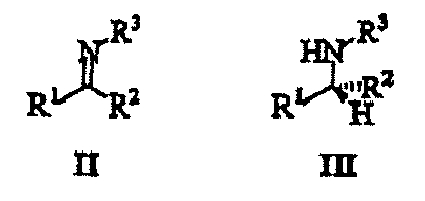 wobei R1 und R2 unabhängig aus der Gruppe ausgewählt sind bestehend aus wahlweise substituiertem cyclischem, linearem und verzweigtem Alkyl und Alkenyl und wobei R1 und R2 ebenfalls miteinander oder mit R3 zur Bildung eines oder mehrerer Ringe verknüpft sein können; undR3 aus der Gruppe ausgewählt ist bestehend aus Wasserstoff, Hydroxy, wahlweise substituiertem cyclischem, linearem und verzweigtem C1- bis C8-Alkyl und -Alkenyl und wahlweise substituiertem Aryl; wobei das Verfahren die Schritte des Reagierens von Iminen der Formel II in Anwesenheit von H2 und einem katalytischen System umfasst, das eine Base und einen Rutheniumkomplex umfasst, der (1) einen Diamin- und (2) einen Diphosphinliganden oder einzählige Phosphinliganden enthält.
 - Verfahren nach Anspruch 1, das der Herstellung von enantiomer angereicherten chiralen Dialkyl-, Alkylalkenyl- oder Dialkenylaminen der Formel III oder des entgegengesetzten Enantiomers davon dient.
- Verfahren nach einem der Ansprüche 1-2, wobei der Rutheniumkomplex die allgemeine Formel RuXY(PR3)2(NH2-Z-NH2) (IV) oder RuXY(R2P-Q-PR2)(NH2-Z-NH2) (V) aufweist, wobei Z und Q chirale oder achirale Verknüpfer darstellen, die zusätzlichen Liganden PR3 und R2P-Q-PR2 jeweils chirale oder achirale einzählige und zweizählige Phosphine darstellen und die Liganden X und Y irgendeinen anionischen Liganden darstellen.
- Verfahren nach Anspruch 3, wobei der Ligand PR3 (VI):

PR3 (VI)
einen chiralen oder achiralen einzähligen Phosphinliganden darstellt, wobei jedes R einzeln genommen unabhängig ausgewählt ist aus der Gruppe bestehend aus wahlweise substituiertem linearem und verzweigtem Alkyl und Alkenyl, das 1 bis 8 Kohlenstoffatome enthält, wahlweise substituiertem Cycloalkyl, wahlweise substituiertem Aryl oder OR und NR2, wobei R wie oben definiert ist; oder zwei R-Gruppen, die an dasselbe P-Atom gebunden sind, zur Bildung eines wahlweise substituierten gesättigten oder aromatischen Rings zusammengebunden sind, der 5 bis 8 Atome, einschließlich des Phosphoratoms, an das die R-Gruppen gebunden sind, aufweist. - Verfahren nach Anspruch 3, wobei der Ligand R2P-Q-PR2 (VII):

R2P-Q-PR2 (VII)
einen chiralen oder achiralen zweizähligen Liganden darstellt, wobei jedes R einzeln genommen unabhängig ausgewählt ist aus der Gruppe bestehend aus wahlweise substituiertem linearem und verzweigtem Alkyl und Alkenyl, das 1 bis 8 Kohlenstoffatome enthält, wahlweise substituiertem Cycloalkyl, wahlweise substituiertem Aryl oder OR und NR2, wobei R wie oben definiert ist; oder zwei R-Gruppen, die an dasselbe P-Atom gebunden sind, zur Bildung eines wahlweise substituierten gesättigten oder aromatischen Rings zusammengebunden sind, der 5 bis 8 Atome, einschließlich des Phosphoratoms, an das die R-Gruppen gebunden sind, aufweist; Q aus der Gruppe ausgewählt ist bestehend aus wahlweise substituiertem linearem und cyclischem C2-C7-Alkylen, wahlweise substituiertem Metallocendiyl und wahlweise substituiertem C6-C22-Arylen. - Verfahren nach Anspruch 5, wobei der Ligand R2P-Q-PR2 (VII) chiral ist und atropisomere bis-tertiäre Phosphine umfasst, wobei die beiden Phosphoratome durch eine Biarylrückgratkette verknüpft sind.
- Verfahren nach Anspruch 6, wobei der Ligand R2P-Q-PR2 (VII) aus der Gruppe ausgewählt ist bestehend aus BINAP, BIPHEP und BIPHEMP.
- Verfahren nach Anspruch 3, wobei das zweizählige Phosphin ein chiraler oder achiraler Ligand der Formel R2P-NR'-Z-NR'-PR2 (VIII) ist:
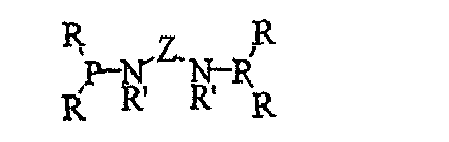
R2P-NR'-Z-NR'-PR2 (VIII)
wobei jedes R einzeln genommen unabhängig ausgewählt ist aus der Gruppe bestehend aus wahlweise substituiertem linearem und verzweigtem Alkyl und Alkenyl, das 1 bis 8 Kohlenstoffatome enthält, wahlweise substituiertem Cycloalkyl, wahlweise substituiertem Aryl oder OR und NR2, wobei R wie oben definiert ist; oder zwei R-Gruppen, die an dasselbe P-Atom gebunden sind, zur Bildung eines wahlweise substituierten gesättigten oder aromatischen Rings zusammengebunden sind, der 5 bis 8 Atome, einschließlich des Phosphoratoms, an das die R-Gruppen gebunden sind, aufweist; jedes R' einzeln genommen unabhängig aus der Gruppe ausgewählt ist bestehend aus Wasserstoff, wahlweise substituiertem linearem und verzweigtem Alkyl oder Alkenyl, das 1 bis 8 Kohlenstoffatome enthält, wahlweise substituiertem Cycloalkyl und wahlweise substituiertem Aryl; und Z aus der Gruppe ausgewählt ist bestehend aus wahlweise substituiertem linearem und cyclischem C2-C7-Alkylen, wahlweise substituiertem Metallocendiyl und wahlweise substituiertem C6-C22-Arylen. - Verfahren nach Anspruch 8, wobei der Ligand R2P-NR'-Z-NR'-PR2 (VIII) aus der Gruppe ausgewählt ist bestehend aus R,R-DPPACH und R, R-DCYPPACH.
- Verfahren nach einem der Ansprüche 1-8, wobei der Diaminligand die Formel NH2-Z-NH2 (IX) aufweist:

H2N-Z-NH2 (IX)
wobei Z aus der Gruppe ausgewählt ist bestehend aus wahlweise substituiertem linearem und cyclischem C2-C7-Alkylen, wahlweise substituiertem Metallocendiyl und wahlweise substituiertem C6-C22-Arylen. - Verfahren nach Anspruch 10, wobei der Diaminligand chiral ist und (1) Verbindungen, in denen mindestens einer der amintragenden Zentren stereogen ist, (2) Verbindungen, in denen beide der amintragenden Zentren stereogen sind und (3) atropisomere bis-tertiäre Diamine umfasst, in denen die beiden Stickstoffatome durch eine Biarylrückgratkette verknüpft sind.
- Verfahren nach Anspruch 10, wobei der Diaminligand NH2-Z-NH2 (IX) aus der Gruppe ausgewählt ist bestehend aus R,R-CYDN und R,R-DPEN.
- Verfahren nach einem der Ansprüche 1-2, wobei das Diamin ein zweizähliger Ligand der Formel D-Z-NHR4 (X) ist, wobei Z aus der Gruppe ausgewählt ist bestehend aus wahlweise substituiertem linearem und cyclischem C2-C7-Alkylen, wahlweise substituiertem Metallocendiyl und wahlweise substituiertem C6-C22-Arylen; D ein Amidogruppendonator ist; und R4 aus der Gruppe ausgewählt ist bestehend aus Wasserstoff, wahlweise substituiertem linearem und verzweigtem Alkyl und Alkenyl, das 1 bis 8 Kohlenstoffatome enthält, wahlweise substituiertem Cycloalkyl und wahlweise substituiertem Aryl.
- Verfahren nach Anspruch 13, wobei D NR5 ist, wobei R5 aus der Gruppe ausgewählt ist bestehend aus S(O)2R6, P(O)(R6)2, C(O)R6, C(O)N(R6)2 und C(S)N(R6)2, wobei R6 einzeln genommen unabhängig aus der Gruppe ausgewählt ist bestehend aus Wasserstoff, wahlweise substituiertem linearem und verzweigtem Alkyl und Alkenyl, das 1 bis 8 Kohlenstoffatome enthält, wahlweise substituiertem Cycloalkyl und wahlweise substituiertem Aryl.
- Verfahren nach Anspruch 13, wobei das Diamin chiral ist und (1) Verbindungen, in denen der amintragende Zenter stereogen ist und (2) Verbindungen umfasst, in denen beide Amidogruppendonatoren (D) tragende und amintragende Zentren stereogen sind.
- Verfahren nach einem der Ansprüche 3-15, wobei die Liganden X und Y aus der Gruppe ausgewählt sind bestehend aus Cl, Br, I, H, Hydroxy, Alkoxy oder Acyloxy.
- Verfahren nach einem der Ansprüche 1 bis 16, wobei die Base ein Alkoholat oder ein Hydroxidsalz ist ausgewählt aus der Gruppe bestehend aus den Verbindungen der Formel (R7O)2M' und R7OM", wobei M' ein Erdalkalimetall, M" ein Alkalimetall ist und R7 für Wasserstoffoder lineares oder verzweigtes C1-bis C6-Alkyl steht.
- Verfahren nach einem der Ansprüche 1 bis 16, wobei die Base eine organische nichtkoordinierende Base ist.
- Verfahren nach Anspruch 18, wobei die Base aus der Gruppe ausgewählt ist bestehend aus DBU, NR3 und Phosphazen.
- Verfahren nach einem der Ansprüche 1 bis 19, wobei die Hydrierung in Abwesenheit eines Lösungsmittels durchgeführt wird.
- Verfahren nach einem der Ansprüche 1 bis 20, wobei die Hydrierungsreaktion in Gegenwart eines Lösungsmittels durchgeführt wird.
- Verfahren nach Anspruch 21, wobei das Lösungsmittel aus der Gruppe ausgewählt ist bestehend aus Benzol, Toluol, Xylol, Hexan, Cyclohexan, Tetrahydrofuran, primären und sekundären Alkoholen und Mischungen davon.
Applications Claiming Priority (3)
| Application Number | Priority Date | Filing Date | Title |
|---|---|---|---|
| US38025602P | 2002-05-15 | 2002-05-15 | |
| US380256P | 2002-05-15 | ||
| PCT/CA2003/000689 WO2003097571A1 (en) | 2002-05-15 | 2003-05-15 | Process for hydrogenating unactivated imines using ruthenium complexes as catalysts |
Publications (3)
| Publication Number | Publication Date |
|---|---|
| EP1503979A1 EP1503979A1 (de) | 2005-02-09 |
| EP1503979B1 EP1503979B1 (de) | 2011-01-26 |
| EP1503979B9 true EP1503979B9 (de) | 2014-10-29 |
Family
ID=29549943
Family Applications (1)
| Application Number | Title | Priority Date | Filing Date |
|---|---|---|---|
| EP03720057.3A Expired - Lifetime EP1503979B9 (de) | 2002-05-15 | 2003-05-15 | Prozess zur hydrierung von nicht-aktivierten iminen unter verwendung von ruthenium-komplexen als katalysatoren |
Country Status (9)
| Country | Link |
|---|---|
| US (1) | US7256311B2 (de) |
| EP (1) | EP1503979B9 (de) |
| JP (1) | JP2005525426A (de) |
| AT (1) | ATE496880T1 (de) |
| AU (1) | AU2003223806B2 (de) |
| CA (1) | CA2489158C (de) |
| DE (1) | DE60335874D1 (de) |
| IL (1) | IL164915A (de) |
| WO (1) | WO2003097571A1 (de) |
Families Citing this family (11)
| Publication number | Priority date | Publication date | Assignee | Title |
|---|---|---|---|---|
| GB0205455D0 (en) | 2002-03-07 | 2002-04-24 | Molecular Sensing Plc | Nucleic acid probes, their synthesis and use |
| WO2004096735A2 (en) | 2003-05-02 | 2004-11-11 | Kamaluddin Abdur-Rashid | Transfer hydrogenation processes and catalysts |
| US7816533B2 (en) * | 2003-12-15 | 2010-10-19 | Kamaluddin Abdur-Rashid | Asymmetric imine hydrogenation processes |
| JP4800213B2 (ja) * | 2004-07-07 | 2011-10-26 | 浜理薬品工業株式会社 | 光学活性フェニルプロピルアミン誘導体の製法 |
| EP2094624A1 (de) * | 2006-12-22 | 2009-09-02 | DSMIP Assets B.V. | Asymmetrische hydrierung prochiraler verbindungen |
| EP2623509A1 (de) * | 2012-02-01 | 2013-08-07 | Kanto Kagaku Kabushiki Kaisha | Verfahren zur Herstellung einer optisch aktiven Aminverbindung durch katalytische asymmetrische Hydrierung mittels eines Ruthenium-diphosphin Komplexes |
| US11498901B2 (en) | 2018-03-02 | 2022-11-15 | Firmenich Sa | Hydrogenation of imines with Ru complexes |
| JP7127808B2 (ja) * | 2018-05-29 | 2022-08-30 | 国立大学法人山口大学 | フルオロアルキル基を含有するイミン類の製造方法 |
| CN109400508B (zh) * | 2018-11-13 | 2020-12-22 | 上海交通大学 | 不对称钯催化氢化z式大位阻亚胺制备大位阻手性胺的方法 |
| JP7645811B2 (ja) * | 2019-08-08 | 2025-03-14 | フイルメニツヒ ソシエテ アノニム | Ru錯体を用いたイミンの水素化 |
| GB202216812D0 (en) | 2022-11-10 | 2022-12-28 | Univ Court Univ St Andrews | Process |
Family Cites Families (5)
| Publication number | Priority date | Publication date | Assignee | Title |
|---|---|---|---|---|
| EP0256982B1 (de) * | 1986-08-04 | 1991-08-28 | Ciba-Geigy Ag | Verfahren zur Herstellung von optisch aktiven sekundären Arylaminen |
| JP2912572B2 (ja) * | 1995-12-06 | 1999-06-28 | 科学技術振興事業団 | 光学活性アミン類の製造方法 |
| JP4004123B2 (ja) * | 1997-12-26 | 2007-11-07 | 独立行政法人科学技術振興機構 | ルテニウム錯体を触媒とするアルコール化合物の製造方法 |
| AU2001270892A1 (en) * | 2000-07-24 | 2002-02-05 | Chirotech Technology Limited | Ruthenium complexes and their use in asymmetric hydrogenation |
| ES2305095T3 (es) * | 2000-09-13 | 2008-11-01 | Firmenich S.A. | Procesos de hidrogenacion catalitica. |
-
2003
- 2003-05-15 AT AT03720057T patent/ATE496880T1/de not_active IP Right Cessation
- 2003-05-15 US US10/513,321 patent/US7256311B2/en not_active Expired - Fee Related
- 2003-05-15 CA CA2489158A patent/CA2489158C/en not_active Expired - Fee Related
- 2003-05-15 DE DE60335874T patent/DE60335874D1/de not_active Expired - Lifetime
- 2003-05-15 JP JP2004505305A patent/JP2005525426A/ja active Pending
- 2003-05-15 EP EP03720057.3A patent/EP1503979B9/de not_active Expired - Lifetime
- 2003-05-15 WO PCT/CA2003/000689 patent/WO2003097571A1/en not_active Ceased
- 2003-05-15 AU AU2003223806A patent/AU2003223806B2/en not_active Ceased
-
2004
- 2004-10-28 IL IL164915A patent/IL164915A/en not_active IP Right Cessation
Also Published As
| Publication number | Publication date |
|---|---|
| AU2003223806A1 (en) | 2003-12-02 |
| IL164915A0 (en) | 2005-12-18 |
| IL164915A (en) | 2010-12-30 |
| US7256311B2 (en) | 2007-08-14 |
| EP1503979B1 (de) | 2011-01-26 |
| CA2489158A1 (en) | 2003-11-27 |
| AU2003223806B2 (en) | 2009-01-08 |
| JP2005525426A (ja) | 2005-08-25 |
| DE60335874D1 (de) | 2011-03-10 |
| EP1503979A1 (de) | 2005-02-09 |
| ATE496880T1 (de) | 2011-02-15 |
| CA2489158C (en) | 2010-08-03 |
| US20050209487A1 (en) | 2005-09-22 |
| WO2003097571A1 (en) | 2003-11-27 |
Similar Documents
| Publication | Publication Date | Title |
|---|---|---|
| EP0918781B1 (de) | Durch übergangsmetallkomplexe mit zyklischen chiralen liganden katalysierte asymmetrische synthese | |
| JP4958374B2 (ja) | 非対称(移動)水素化のための触媒 | |
| JP5207445B2 (ja) | 2−(アミノメチル)ピリジン及びフォスフィンを有するルテニウムの複合体、その調製方法、並びに触媒としての使用 | |
| EP1305278B1 (de) | Rutheniumkomplexe und ihre verwendung zur asymmetrischen hydrierung | |
| EP1503979B1 (de) | Prozess zur hydrierung von nicht-aktivierten iminen unter verwendung von ruthenium-komplexen als katalysatoren | |
| US6486337B2 (en) | Ruthenium-disphosphine complexes and their use as catalysts | |
| US6451727B2 (en) | Catalysts for use in asymmetric synthesis comprising transition metals and chiral amine oxazolinyl ligands | |
| US7291753B2 (en) | Transfer hydrogenation processes and catalysts | |
| US7816533B2 (en) | Asymmetric imine hydrogenation processes | |
| EP1601635B1 (de) | Verfahren zur herstellung von optisch aktivem alkohol in gegenwart von rhodium, einem chiralen ferrocenyldiphosphin und einem optisch aktivem diamin | |
| CN1225095A (zh) | 由含环状手性膦配位体的过渡金属配合物催化的不对称合成 | |
| CN101072786B (zh) | 适于作为不对称转移氢化催化剂的手性化合物 | |
| US20200055037A1 (en) | Transition metal isonitrile catalysts | |
| CN116947580B (zh) | 一种铑催化的蒽的氢化去对称化构建轴手性化合物的方法 | |
| US6020527A (en) | Stereospecific isomerisation of allyl amines using chiral phosphorous ligands | |
| US20100069684A1 (en) | Assymmetric hydrogeneration of prochiral compounds | |
| Ranade | Catalytic diastereoselective hydrogenation of substituted aromatic compounds | |
| Li | Design and Synthesis of Chiral Ligands and Their Applications in Transition Metal-catalyzed Asymmetric Reactions |
Legal Events
| Date | Code | Title | Description |
|---|---|---|---|
| PUAI | Public reference made under article 153(3) epc to a published international application that has entered the european phase |
Free format text: ORIGINAL CODE: 0009012 |
|
| 17P | Request for examination filed |
Effective date: 20041108 |
|
| AK | Designated contracting states |
Kind code of ref document: A1 Designated state(s): AT BE BG CH CY CZ DE DK EE ES FI FR GB GR HU IE IT LI LU MC NL PT RO SE SI SK TR |
|
| AX | Request for extension of the european patent |
Extension state: AL LT LV MK |
|
| DAX | Request for extension of the european patent (deleted) | ||
| 17Q | First examination report despatched |
Effective date: 20100303 |
|
| GRAP | Despatch of communication of intention to grant a patent |
Free format text: ORIGINAL CODE: EPIDOSNIGR1 |
|
| GRAS | Grant fee paid |
Free format text: ORIGINAL CODE: EPIDOSNIGR3 |
|
| GRAA | (expected) grant |
Free format text: ORIGINAL CODE: 0009210 |
|
| AK | Designated contracting states |
Kind code of ref document: B1 Designated state(s): AT BE BG CH CY CZ DE DK EE ES FI FR GB GR HU IE IT LI LU MC NL PT RO SE SI SK TR |
|
| REG | Reference to a national code |
Ref country code: GB Ref legal event code: FG4D |
|
| REG | Reference to a national code |
Ref country code: CH Ref legal event code: EP |
|
| RAP2 | Party data changed (patent owner data changed or rights of a patent transferred) |
Owner name: ABDUR-RASHID, KAMALUDDIN |
|
| REG | Reference to a national code |
Ref country code: IE Ref legal event code: FG4D |
|
| REF | Corresponds to: |
Ref document number: 60335874 Country of ref document: DE Date of ref document: 20110310 Kind code of ref document: P |
|
| REG | Reference to a national code |
Ref country code: DE Ref legal event code: R096 Ref document number: 60335874 Country of ref document: DE Effective date: 20110310 |
|
| REG | Reference to a national code |
Ref country code: NL Ref legal event code: VDEP Effective date: 20110126 |
|
| PG25 | Lapsed in a contracting state [announced via postgrant information from national office to epo] |
Ref country code: ES Free format text: LAPSE BECAUSE OF FAILURE TO SUBMIT A TRANSLATION OF THE DESCRIPTION OR TO PAY THE FEE WITHIN THE PRESCRIBED TIME-LIMIT Effective date: 20110507 Ref country code: GR Free format text: LAPSE BECAUSE OF FAILURE TO SUBMIT A TRANSLATION OF THE DESCRIPTION OR TO PAY THE FEE WITHIN THE PRESCRIBED TIME-LIMIT Effective date: 20110427 Ref country code: SE Free format text: LAPSE BECAUSE OF FAILURE TO SUBMIT A TRANSLATION OF THE DESCRIPTION OR TO PAY THE FEE WITHIN THE PRESCRIBED TIME-LIMIT Effective date: 20110126 Ref country code: PT Free format text: LAPSE BECAUSE OF FAILURE TO SUBMIT A TRANSLATION OF THE DESCRIPTION OR TO PAY THE FEE WITHIN THE PRESCRIBED TIME-LIMIT Effective date: 20110526 |
|
| PG25 | Lapsed in a contracting state [announced via postgrant information from national office to epo] |
Ref country code: BE Free format text: LAPSE BECAUSE OF FAILURE TO SUBMIT A TRANSLATION OF THE DESCRIPTION OR TO PAY THE FEE WITHIN THE PRESCRIBED TIME-LIMIT Effective date: 20110126 Ref country code: CY Free format text: LAPSE BECAUSE OF FAILURE TO SUBMIT A TRANSLATION OF THE DESCRIPTION OR TO PAY THE FEE WITHIN THE PRESCRIBED TIME-LIMIT Effective date: 20110126 Ref country code: FI Free format text: LAPSE BECAUSE OF FAILURE TO SUBMIT A TRANSLATION OF THE DESCRIPTION OR TO PAY THE FEE WITHIN THE PRESCRIBED TIME-LIMIT Effective date: 20110126 Ref country code: AT Free format text: LAPSE BECAUSE OF FAILURE TO SUBMIT A TRANSLATION OF THE DESCRIPTION OR TO PAY THE FEE WITHIN THE PRESCRIBED TIME-LIMIT Effective date: 20110126 Ref country code: SI Free format text: LAPSE BECAUSE OF FAILURE TO SUBMIT A TRANSLATION OF THE DESCRIPTION OR TO PAY THE FEE WITHIN THE PRESCRIBED TIME-LIMIT Effective date: 20110126 Ref country code: BG Free format text: LAPSE BECAUSE OF FAILURE TO SUBMIT A TRANSLATION OF THE DESCRIPTION OR TO PAY THE FEE WITHIN THE PRESCRIBED TIME-LIMIT Effective date: 20110426 Ref country code: NL Free format text: LAPSE BECAUSE OF FAILURE TO SUBMIT A TRANSLATION OF THE DESCRIPTION OR TO PAY THE FEE WITHIN THE PRESCRIBED TIME-LIMIT Effective date: 20110126 |
|
| PG25 | Lapsed in a contracting state [announced via postgrant information from national office to epo] |
Ref country code: EE Free format text: LAPSE BECAUSE OF FAILURE TO SUBMIT A TRANSLATION OF THE DESCRIPTION OR TO PAY THE FEE WITHIN THE PRESCRIBED TIME-LIMIT Effective date: 20110126 Ref country code: DK Free format text: LAPSE BECAUSE OF FAILURE TO SUBMIT A TRANSLATION OF THE DESCRIPTION OR TO PAY THE FEE WITHIN THE PRESCRIBED TIME-LIMIT Effective date: 20110126 |
|
| PG25 | Lapsed in a contracting state [announced via postgrant information from national office to epo] |
Ref country code: RO Free format text: LAPSE BECAUSE OF FAILURE TO SUBMIT A TRANSLATION OF THE DESCRIPTION OR TO PAY THE FEE WITHIN THE PRESCRIBED TIME-LIMIT Effective date: 20110126 Ref country code: SK Free format text: LAPSE BECAUSE OF FAILURE TO SUBMIT A TRANSLATION OF THE DESCRIPTION OR TO PAY THE FEE WITHIN THE PRESCRIBED TIME-LIMIT Effective date: 20110126 Ref country code: CZ Free format text: LAPSE BECAUSE OF FAILURE TO SUBMIT A TRANSLATION OF THE DESCRIPTION OR TO PAY THE FEE WITHIN THE PRESCRIBED TIME-LIMIT Effective date: 20110126 |
|
| PLBE | No opposition filed within time limit |
Free format text: ORIGINAL CODE: 0009261 |
|
| PG25 | Lapsed in a contracting state [announced via postgrant information from national office to epo] |
Ref country code: MC Free format text: LAPSE BECAUSE OF NON-PAYMENT OF DUE FEES Effective date: 20110531 |
|
| REG | Reference to a national code |
Ref country code: CH Ref legal event code: PL |
|
| 26N | No opposition filed |
Effective date: 20111027 |
|
| PG25 | Lapsed in a contracting state [announced via postgrant information from national office to epo] |
Ref country code: CH Free format text: LAPSE BECAUSE OF NON-PAYMENT OF DUE FEES Effective date: 20110531 Ref country code: LI Free format text: LAPSE BECAUSE OF NON-PAYMENT OF DUE FEES Effective date: 20110531 |
|
| REG | Reference to a national code |
Ref country code: DE Ref legal event code: R097 Ref document number: 60335874 Country of ref document: DE Effective date: 20111027 |
|
| REG | Reference to a national code |
Ref country code: IE Ref legal event code: MM4A |
|
| PG25 | Lapsed in a contracting state [announced via postgrant information from national office to epo] |
Ref country code: IE Free format text: LAPSE BECAUSE OF NON-PAYMENT OF DUE FEES Effective date: 20110515 |
|
| PG25 | Lapsed in a contracting state [announced via postgrant information from national office to epo] |
Ref country code: IT Free format text: LAPSE BECAUSE OF FAILURE TO SUBMIT A TRANSLATION OF THE DESCRIPTION OR TO PAY THE FEE WITHIN THE PRESCRIBED TIME-LIMIT Effective date: 20110126 |
|
| PG25 | Lapsed in a contracting state [announced via postgrant information from national office to epo] |
Ref country code: LU Free format text: LAPSE BECAUSE OF NON-PAYMENT OF DUE FEES Effective date: 20110515 |
|
| PG25 | Lapsed in a contracting state [announced via postgrant information from national office to epo] |
Ref country code: TR Free format text: LAPSE BECAUSE OF FAILURE TO SUBMIT A TRANSLATION OF THE DESCRIPTION OR TO PAY THE FEE WITHIN THE PRESCRIBED TIME-LIMIT Effective date: 20110126 |
|
| PG25 | Lapsed in a contracting state [announced via postgrant information from national office to epo] |
Ref country code: HU Free format text: LAPSE BECAUSE OF FAILURE TO SUBMIT A TRANSLATION OF THE DESCRIPTION OR TO PAY THE FEE WITHIN THE PRESCRIBED TIME-LIMIT Effective date: 20110126 |
|
| PGFP | Annual fee paid to national office [announced via postgrant information from national office to epo] |
Ref country code: DE Payment date: 20131120 Year of fee payment: 11 Ref country code: GB Payment date: 20131118 Year of fee payment: 11 |
|
| PGFP | Annual fee paid to national office [announced via postgrant information from national office to epo] |
Ref country code: FR Payment date: 20131129 Year of fee payment: 11 |
|
| PLAA | Information modified related to event that no opposition was filed |
Free format text: ORIGINAL CODE: 0009299DELT |
|
| PLBE | No opposition filed within time limit |
Free format text: ORIGINAL CODE: 0009261 |
|
| STAA | Information on the status of an ep patent application or granted ep patent |
Free format text: STATUS: NO OPPOSITION FILED WITHIN TIME LIMIT |
|
| R26N | No opposition filed (corrected) |
Effective date: 20111027 |
|
| RIN2 | Information on inventor provided after grant (corrected) |
Inventor name: ABDUR-RASHID, KAMALUDDIN Inventor name: MORRIS, ROBERT, H. |
|
| REG | Reference to a national code |
Ref country code: DE Ref legal event code: R119 Ref document number: 60335874 Country of ref document: DE |
|
| GBPC | Gb: european patent ceased through non-payment of renewal fee |
Effective date: 20140515 |
|
| REG | Reference to a national code |
Ref country code: DE Ref legal event code: R119 Ref document number: 60335874 Country of ref document: DE Effective date: 20141202 |
|
| REG | Reference to a national code |
Ref country code: FR Ref legal event code: ST Effective date: 20150130 |
|
| PG25 | Lapsed in a contracting state [announced via postgrant information from national office to epo] |
Ref country code: DE Free format text: LAPSE BECAUSE OF NON-PAYMENT OF DUE FEES Effective date: 20141202 |
|
| PG25 | Lapsed in a contracting state [announced via postgrant information from national office to epo] |
Ref country code: FR Free format text: LAPSE BECAUSE OF NON-PAYMENT OF DUE FEES Effective date: 20140602 Ref country code: GB Free format text: LAPSE BECAUSE OF NON-PAYMENT OF DUE FEES Effective date: 20140515 |