EP1504948A2 - Dispositif de regulation adaptable de la vitesse de vehicules - Google Patents
Dispositif de regulation adaptable de la vitesse de vehicules Download PDFInfo
- Publication number
- EP1504948A2 EP1504948A2 EP04017288A EP04017288A EP1504948A2 EP 1504948 A2 EP1504948 A2 EP 1504948A2 EP 04017288 A EP04017288 A EP 04017288A EP 04017288 A EP04017288 A EP 04017288A EP 1504948 A2 EP1504948 A2 EP 1504948A2
- Authority
- EP
- European Patent Office
- Prior art keywords
- speed
- vehicle
- function
- target object
- follow
- Prior art date
- Legal status (The legal status is an assumption and is not a legal conclusion. Google has not performed a legal analysis and makes no representation as to the accuracy of the status listed.)
- Granted
Links
Images

Classifications
-
- B—PERFORMING OPERATIONS; TRANSPORTING
- B60—VEHICLES IN GENERAL
- B60K—ARRANGEMENT OR MOUNTING OF PROPULSION UNITS OR OF TRANSMISSIONS IN VEHICLES; ARRANGEMENT OR MOUNTING OF PLURAL DIVERSE PRIME-MOVERS IN VEHICLES; AUXILIARY DRIVES FOR VEHICLES; INSTRUMENTATION OR DASHBOARDS FOR VEHICLES; ARRANGEMENTS IN CONNECTION WITH COOLING, AIR INTAKE, GAS EXHAUST OR FUEL SUPPLY OF PROPULSION UNITS IN VEHICLES
- B60K31/00—Vehicle fittings, acting on a single sub-unit only, for automatically controlling vehicle speed, i.e. preventing speed from exceeding an arbitrarily established velocity or maintaining speed at a particular velocity, as selected by the vehicle operator
- B60K31/18—Vehicle fittings, acting on a single sub-unit only, for automatically controlling vehicle speed, i.e. preventing speed from exceeding an arbitrarily established velocity or maintaining speed at a particular velocity, as selected by the vehicle operator including a device to audibly, visibly, or otherwise signal the existence of unusual or unintended speed
- B60K31/185—Vehicle fittings, acting on a single sub-unit only, for automatically controlling vehicle speed, i.e. preventing speed from exceeding an arbitrarily established velocity or maintaining speed at a particular velocity, as selected by the vehicle operator including a device to audibly, visibly, or otherwise signal the existence of unusual or unintended speed connected to the speedometer display, e.g. by sensors or switches responsive to the position of the indicator needle
-
- B—PERFORMING OPERATIONS; TRANSPORTING
- B60—VEHICLES IN GENERAL
- B60K—ARRANGEMENT OR MOUNTING OF PROPULSION UNITS OR OF TRANSMISSIONS IN VEHICLES; ARRANGEMENT OR MOUNTING OF PLURAL DIVERSE PRIME-MOVERS IN VEHICLES; AUXILIARY DRIVES FOR VEHICLES; INSTRUMENTATION OR DASHBOARDS FOR VEHICLES; ARRANGEMENTS IN CONNECTION WITH COOLING, AIR INTAKE, GAS EXHAUST OR FUEL SUPPLY OF PROPULSION UNITS IN VEHICLES
- B60K31/00—Vehicle fittings, acting on a single sub-unit only, for automatically controlling vehicle speed, i.e. preventing speed from exceeding an arbitrarily established velocity or maintaining speed at a particular velocity, as selected by the vehicle operator
- B60K31/0008—Vehicle fittings, acting on a single sub-unit only, for automatically controlling vehicle speed, i.e. preventing speed from exceeding an arbitrarily established velocity or maintaining speed at a particular velocity, as selected by the vehicle operator including means for detecting potential obstacles in vehicle path
-
- B—PERFORMING OPERATIONS; TRANSPORTING
- B60—VEHICLES IN GENERAL
- B60W—CONJOINT CONTROL OF VEHICLE SUB-UNITS OF DIFFERENT TYPE OR DIFFERENT FUNCTION; CONTROL SYSTEMS SPECIALLY ADAPTED FOR HYBRID VEHICLES; ROAD VEHICLE DRIVE CONTROL SYSTEMS FOR PURPOSES NOT RELATED TO THE CONTROL OF A PARTICULAR SUB-UNIT
- B60W2554/00—Input parameters relating to objects
- B60W2554/40—Dynamic objects, e.g. animals, windblown objects
- B60W2554/404—Characteristics
- B60W2554/4041—Position
Definitions
- the invention relates to a device for adapitven speed control for motor vehicles, with a locating system for locating preceding vehicles and a controller for regulating the Speed to a guideline speed or to one Desired distance to a preceding vehicle.
- ACC adaptive cruise control systems
- ACC Adptive Cruise Control
- the known ACC systems a location system, such as a radar sensor on, with the preceding vehicles located and their distances and relative speeds are measured. If one or several slower vehicles in front on their own lane be located, then the immediately preceding vehicle, So the one with the shortest distance, automatically as the target object selected, and the speed of your own vehicle becomes automatically adjusted so that the vehicle ahead in a reasonable safety distance, the nominal distance, is tracked.
- This nominal distance is usually speed-dependent and is z. B. defined over a time gap, d. h., over the temporal Distance in which the two vehicles the same point on the Roadway happen.
- the invention has the features specified in claim 1 features the advantage that extends the functionality of the ACC system and Thus, the comfort for the driver is further increased.
- a follow-up function is provided according to the invention, which causes the target object even when exceeding the recommended speed is automatically pursued.
- the distance control or the regulation on the time gap then automatically continued, if the speed of the own vehicle temporarily or permanently over the past set Richt Agriculture must be increased. If z.
- the driver at higher traffic on a highway Desire to "attach" to a preceding vehicle and each to drive as fast as the front vehicle permitting, it only needs to activate the follow-up function once, and then he no longer needs the attitude or adjustment to take care of a directional speed. Especially advantageous if this is e.g.
- the conventional ACC systems are generally for driving on highways or well-developed country roads and let themselves therefore generally only above a certain minimum speed for example 40 or 50 km / h. It is, however Systems have been proposed, in addition to a so-called LSF (Low Speed Following) function, for example in a traffic jam, a continuation of the distance control in the lower Speed range, up to the speed 0 allows.
- LSF Low Speed Following
- this function e.g. provided that your own Vehicle when approaching a jam end automatically if necessary is braked in the state and then possibly also automatically starts again when the front vehicle starts moving again puts.
- LSF function A major difference between the LSF function and The ACC function is that in the LSF mode also standing Obstacles must be taken into account while in ACC operation, at higher speeds, normally assumed is that there are no stationary obstacles on the road and therefore stand targets that are located by the location system, to be disregarded in the regulation. Because the detection stagnant Obstacles and the discrimination of apparent obstacles such as Manhole covers on the roadway or other irrelevant radar targets with more or less great uncertainties, depending according to the extent of the available location sensors, and since the Misinterpretation of target goals to incorrect reactions and higher Speed may lead to dangerous situations could, are so far only relatively low in LSF operation Straightening speeds allowed.
- the invention offers the advantageous possibility in the cases where the follow-up function is active automatically depending on the respective speed between switch the various modes so that the driver does not need to intervene in the system to change the Operating mode and, in connection with this, an adjustment of the guideline speed to induce.
- the follow-up function can also be used in city traffic be made usable. This gives the driver the advantageous Possibility to engage in a wide range of different traffic situations and speed profiles away from city traffic over highways to highways, to a front vehicle to attach and to pursue this.
- the Guiding speed in the controller automatically by, for example, 5 km / h enlarged so that there is enough scope again, the target object to pursue. This process may then repeat several times, if necessary when the front vehicle continues to accelerate.
- the guideline speed can also be reduced again if the front vehicle slows down again.
- the adaptation of Guideline speed can in each case with a certain time delay or depending on one over a period of time average speed of the front vehicle, so that in discontinuous driving the driver of the front vehicle unnecessary speed fluctuations are avoided.
- the follow-up function automatically be continued, so that now pursues the new target object becomes.
- the following function be deactivated.
- the current guideline speed Retain or return to the original from the driver selected guideline speed to be returned can ever according to embodiments or operating mode, the current guideline speed Retain or return to the original from the driver selected guideline speed to be returned.
- a sufficiently complex location sensor available stands, so that vehicles driving ahead individually based on characteristic Characteristics can be recognized, it is also possible to the once selected target object continued, even at Track changes, track. This is particularly useful when driving in convoy or in cases where a local "pilot" should be pursued. If an image processing system available For example, the selection of the target object to be tracked may be also be done by the driver of this target on a Screen marked.
- the following function according to the invention can be used directly in the hardware or software of an ACC system, but it can also be part of another system that gives the ACC system the each specifies suitable straightening speeds.
- FIG. 1 shows an apparatus for adaptive cruise control for motor vehicles in the form of a simplified block diagram shown.
- the device comprises a location system 10, For example, a built-in front of the vehicle radar sensor, with located ahead of the vehicles and their distances and relative speeds be measured, and a controller 12, the for example, by one or more suitably programmed microprocessors is formed and the known functions of a ACC system executes.
- a location system 10 For example, a built-in front of the vehicle radar sensor, with located ahead of the vehicles and their distances and relative speeds be measured, and a controller 12, the for example, by one or more suitably programmed microprocessors is formed and the known functions of a ACC system executes.
- To operate the system are several buttons 14, 16, 18, 20 and 22, which are usually in a multi-function lever integrated on the steering wheel of the vehicle. These buttons initially have the known from a conventional ACC system Functions.
- actuation of a key 14 causes the current speed of the vehicle stored as a guideline speed and the scheme is based. If then the location system 10 locates a slow vehicle ahead, so does the speed throttled in the context of a distance control. If that front vehicle leaves the lane or above the set guideline speed accelerated, the scheme will be extended to the Recommended speed resumed.
- a key 20 (+) is used for the saved guideline speed gradually increase. Accordingly, with a button 22 (-) the straightening speed can be gradually reduced.
- the driver is the respectively valid Recommended speed (125 km / h in the example shown).
- the display device 24 also has two in the example shown Indicator lights 26 and 28 on which provide additional information to be displayed via the state of the system.
- the illumination of the Indicator light 26 means that a target object from the location system 10th located and in the controller 12 was selected. In these conditions can be activated by the driver, a follow-up function 30, in the controller 12 is implemented. This follow-up function causes the selected Target object regardless of the selected guideline speed is pursued. Deviating from the normal ACC function, will the pursuit of the target object continued even if For this purpose, the previous directional speed must be exceeded.
- the indicator light 28 indicates whether the follower function 30 is active or not.
- a special key may be provided be. In the example shown, however, this function is thereby activates the key 14 (Set / follow) twice in quick succession is pressed.
- FIG. 2 shows a vehicle A which is equipped with the adaptive cruise control system according to FIG. A preceding vehicle B is selected as a target object.
- the follower function 30 is active and, in principle also the conventional proximity control function, causes the speed V A of the vehicle A to be adapted to the speed V B of the front vehicle B.
- Two right-hand-drive vehicles C and D are being overtaken by vehicles A and B.
- the speeds of the vehicles are symbolized by the lengths of the arrows in FIG.
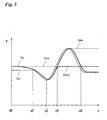
- Figure 3 shows the time evolution of the speed V A of the vehicle A and the speed V B of the vehicle B in a speed / time diagram.
- the vehicle A is traveling with the directional speed V RS selected by the driver via the button 14, which is slightly greater than the speed V B of the vehicle B.
- V A gradually becomes V B reduced.
- the vehicle B must decelerate greatly, for example, because of a further forward, not shown in Figure 2 obstacle.
- the vehicle A also reduces its speed with a small time delay to maintain the distance to the vehicle B.
- the lane in front of the vehicle B is free again, and the vehicle B accelerates beyond its original speed in order to catch up again with the flowing traffic.
- the vehicle B can be returned to the original speed.
- These speed changes are also reproduced by the vehicle A, and its speed is between the times t3 and t4 above the original target speed V RS .
- V RF the maximum of the speed reached by the vehicle A in tracking the vehicle B (or optionally may be slightly larger).
- the vehicle A thus automatically closes for flowing traffic.
- the follow-up function 30 were not active, then the velocity profile of the vehicle A would correspond to the curve V ACC shown in dashed lines in FIG. This would mean that the vehicle A takes much longer to overtake the vehicle C, and the driver of the vehicle C would be hampered because he can not go out to overtake the even slower vehicle D.
- a driving style serving the traffic flow is achieved without the driver having to actively intervene in the event.
- V RF required level
- the vehicle B changes to the right lane after it has passed the vehicle D, this would also mean a target loss, and the vehicle A would continue at the speed V RF .
- the follower function 30 can also be designed such that that the vehicle B remains selected as the target object despite the lane change.
- the speed V A would then be adapted to the speed of the vehicle B, which is particularly advantageous if the driver of the vehicle A intends in turn to change to the right lane after he has overtaken the vehicle D.
- the regulator 12 stores the directional speed V RS originally set with the key 14. By operating the key 18 at any time after t3, the driver can then restore the original target speed V RS .
- the actuation of the key 16 has the effect, even if the follower function 30 is active, that the control is completely suspended and the driver must control the speed himself with the gas pedal.
- the subsequent operation of the button 18 (Resume) then, depending on the embodiment with the result that either the original directional speed V RS or to the tracking directional speed V RF is regulated.
- the keys 20 and 22 should act with active following function 30 expediently to the tracking directional speed V RF .
- the driver can restore the original directional speed V RS also by pressing the button 22.
Landscapes
- Engineering & Computer Science (AREA)
- Chemical & Material Sciences (AREA)
- Combustion & Propulsion (AREA)
- Transportation (AREA)
- Mechanical Engineering (AREA)
- Controls For Constant Speed Travelling (AREA)
- Control Of Velocity Or Acceleration (AREA)
Applications Claiming Priority (2)
| Application Number | Priority Date | Filing Date | Title |
|---|---|---|---|
| DE10336331 | 2003-08-07 | ||
| DE10336331A DE10336331A1 (de) | 2003-08-07 | 2003-08-07 | Vorrichtung zur adaptiven Geschwindigkeitsregelung für Kraftfahrzeuge |
Publications (3)
| Publication Number | Publication Date |
|---|---|
| EP1504948A2 true EP1504948A2 (fr) | 2005-02-09 |
| EP1504948A3 EP1504948A3 (fr) | 2005-04-20 |
| EP1504948B1 EP1504948B1 (fr) | 2008-01-30 |
Family
ID=33547140
Family Applications (1)
| Application Number | Title | Priority Date | Filing Date |
|---|---|---|---|
| EP04017288A Expired - Lifetime EP1504948B1 (fr) | 2003-08-07 | 2004-07-22 | Dispositif de regulation adaptable de la vitesse de vehicules |
Country Status (2)
| Country | Link |
|---|---|
| EP (1) | EP1504948B1 (fr) |
| DE (2) | DE10336331A1 (fr) |
Cited By (4)
| Publication number | Priority date | Publication date | Assignee | Title |
|---|---|---|---|---|
| WO2007124704A1 (fr) * | 2006-05-03 | 2007-11-08 | Adc Automotive Distance Control Systems Gmbh | Procédé de régulation de vitesse d'un véhicule dans une situation de circulationc complexe |
| FR2920384A1 (fr) * | 2007-08-31 | 2009-03-06 | Peugeot Citroen Automobiles Sa | Procede et dispositif de controle du fonctionnement d'un regulateur de vitesse de vehicule automobile |
| US9632507B1 (en) | 2016-01-29 | 2017-04-25 | Meritor Wabco Vehicle Control Systems | System and method for adjusting vehicle platoon distances based on predicted external perturbations |
| CN107933551A (zh) * | 2017-11-27 | 2018-04-20 | 长安大学 | 一种智能车队换道方法 |
Families Citing this family (3)
| Publication number | Priority date | Publication date | Assignee | Title |
|---|---|---|---|---|
| DE102011085585A1 (de) * | 2011-11-02 | 2013-05-02 | Bayerische Motoren Werke Aktiengesellschaft | Abstandsbezogenes elektronisch gesteuertes Fahrgeschwindigkeitsregelsystem für Kraftfahrzeuge |
| DE102017205506A1 (de) | 2017-03-31 | 2018-10-04 | Robert Bosch Gmbh | Verfahren und Vorrichtung zur Abstandsregelung für ein einspuriges Kraftfahrzeug |
| SE547634C2 (en) * | 2023-05-26 | 2025-10-28 | Scania Cv Ab | Following distance based on historic brake events |
Family Cites Families (5)
| Publication number | Priority date | Publication date | Assignee | Title |
|---|---|---|---|---|
| DE4133882A1 (de) * | 1990-10-24 | 1992-04-30 | Volkswagen Ag | Verfahren zum selbsttaetigen nachfuehren eines fahrzeugs auf der spur eines vorausfahrenden fahrzeugs |
| GB9606384D0 (en) * | 1996-03-26 | 1996-06-05 | Jaguar Cars | Cruise control systems |
| DE19627727B4 (de) * | 1996-07-10 | 2012-05-31 | Robert Bosch Gmbh | Verfahren und Vorrichtung zur Steuerung der Geschwindigkeit eines Fahrzeugs |
| JP3183501B2 (ja) * | 1997-07-07 | 2001-07-09 | 本田技研工業株式会社 | 車両用走行制御装置 |
| JP3666338B2 (ja) * | 2000-01-20 | 2005-06-29 | 日産自動車株式会社 | 車両走行制御装置 |
-
2003
- 2003-08-07 DE DE10336331A patent/DE10336331A1/de not_active Withdrawn
-
2004
- 2004-07-22 EP EP04017288A patent/EP1504948B1/fr not_active Expired - Lifetime
- 2004-07-22 DE DE502004006095T patent/DE502004006095D1/de not_active Expired - Lifetime
Cited By (6)
| Publication number | Priority date | Publication date | Assignee | Title |
|---|---|---|---|---|
| WO2007124704A1 (fr) * | 2006-05-03 | 2007-11-08 | Adc Automotive Distance Control Systems Gmbh | Procédé de régulation de vitesse d'un véhicule dans une situation de circulationc complexe |
| US8219299B2 (en) | 2006-05-03 | 2012-07-10 | Adc Automotive Distance Control Systems Gmbh | Method for speed regulation of a motor vehicle in a complex traffic situation |
| FR2920384A1 (fr) * | 2007-08-31 | 2009-03-06 | Peugeot Citroen Automobiles Sa | Procede et dispositif de controle du fonctionnement d'un regulateur de vitesse de vehicule automobile |
| WO2009030845A3 (fr) * | 2007-08-31 | 2009-04-23 | Peugeot Citroen Automobiles Sa | Procédé et dispositif de contrôle du fonctionnement d'un régulateur de vitesse de véhicule automobile |
| US9632507B1 (en) | 2016-01-29 | 2017-04-25 | Meritor Wabco Vehicle Control Systems | System and method for adjusting vehicle platoon distances based on predicted external perturbations |
| CN107933551A (zh) * | 2017-11-27 | 2018-04-20 | 长安大学 | 一种智能车队换道方法 |
Also Published As
| Publication number | Publication date |
|---|---|
| DE10336331A1 (de) | 2005-03-03 |
| DE502004006095D1 (de) | 2008-03-20 |
| EP1504948B1 (fr) | 2008-01-30 |
| EP1504948A3 (fr) | 2005-04-20 |
Similar Documents
| Publication | Publication Date | Title |
|---|---|---|
| EP1381530B1 (fr) | Procede et dispositif assistant une manoeuvre de depassement pour des vehicules automobiles | |
| EP1485283B1 (fr) | Dispositif d'assistance au changement de voie pour vehicules | |
| EP2353957B2 (fr) | Procédé et dispositif destinés à assister un conducteur lors d'une action de dépassement | |
| DE60021341T2 (de) | Abstandsbezogenes Fahrgeschwindigkeitsregelsystem mit Verfahren und Vorrichtung zur Steuerung bei Zielfahrzeugverlust | |
| DE10114470A1 (de) | Spurhalte- und Fahgeschwindigkeitsregeleinrichtung für Kraftfahrzeuge | |
| WO2007045523A1 (fr) | Regulateur de distance et de vitesse a detection d'embouteillage | |
| WO2003047900A1 (fr) | Systeme de suivi automatique d'un vehicule automobile | |
| DE102005045018A1 (de) | Vorrichtung zur Längsführung eines Kraftfahrzeugs | |
| DE102007038059A1 (de) | Verfahren zum Betreiben eines Abstandsregelsystems für Fahrzeuge und Fahrzeug mit einem Abstandsregelsystem zur Durchführung des Verfahrens | |
| DE102022115718A1 (de) | Verfahren und Vorrichtung zum automatisierten Anfahren eines Fahrzeugs an einer Signalisierungseinheit | |
| EP4412881B1 (fr) | Procédé de manoeuvre d'un véhicule sur une route à plusieurs voies tout en tenant compte d'une pente dans une région d'une sortie de la route, système d'assistance au conducteur et véhicule | |
| EP2060466B1 (fr) | Système d'assistance à la conduite embarqué dans un véhicule automobile | |
| DE102017209533A1 (de) | Spurwechselassistenzsystem und Spurwechselassistenzverfahren mit erhöhter Sicherheit für den Fahrer und andere Verkehrsteilnehmer | |
| DE102015003344B4 (de) | Betriebsverfahren für eine Geschwindigkeitsregelanlage eines Kraftfahrzeugs und Kraftfahrzeug | |
| DE102018210650A1 (de) | Längsführendes Fahrerassistenzsystem in einem Kraftfahrzeug | |
| DE10321412B4 (de) | Vorrichtung zur Längsführung eines Kraftfahrzeugs | |
| DE10004525B4 (de) | Verfahren zur Geschwindigkeits- und Abstandsregelung eines Kraftfahrzeuges | |
| EP1575798B1 (fr) | Regulateur de vitesse a plusieurs modes de fonctionnement | |
| DE102018210648A1 (de) | Längsführendes Fahrerassistenzsystem in einem Kraftfahrzeug | |
| EP1504948B1 (fr) | Dispositif de regulation adaptable de la vitesse de vehicules | |
| DE102004047081A1 (de) | Fahrerassistenzsystem mit Bildverarbeitungseinrichtung | |
| DE60018256T2 (de) | Verfahren und Vorrichtung zur Schaffung einer Abstandsfunktion für den Aktivierungsschalter einer adaptiven Geschwindigkeitsregelung | |
| EP1112888B1 (fr) | Régulateur de vitesse avec régulation de la distance entre deux véhicules | |
| DE102020214865A1 (de) | Verfahren und Vorrichtung zur Unterstützung eines Fahrers eines Kraftfahrzeugs bei einem Spurwechselvorgang | |
| EP4608693A1 (fr) | Procédé et dispositif pour l'opération d'une fonction de conduite lors de l'approche d'une unité de signalisation |
Legal Events
| Date | Code | Title | Description |
|---|---|---|---|
| PUAI | Public reference made under article 153(3) epc to a published international application that has entered the european phase |
Free format text: ORIGINAL CODE: 0009012 |
|
| AK | Designated contracting states |
Kind code of ref document: A2 Designated state(s): AT BE BG CH CY CZ DE DK EE ES FI FR GB GR HU IE IT LI LU MC NL PL PT RO SE SI SK TR |
|
| AX | Request for extension of the european patent |
Extension state: AL HR LT LV MK |
|
| PUAL | Search report despatched |
Free format text: ORIGINAL CODE: 0009013 |
|
| AK | Designated contracting states |
Kind code of ref document: A3 Designated state(s): AT BE BG CH CY CZ DE DK EE ES FI FR GB GR HU IE IT LI LU MC NL PL PT RO SE SI SK TR |
|
| AX | Request for extension of the european patent |
Extension state: AL HR LT LV MK |
|
| 17P | Request for examination filed |
Effective date: 20051020 |
|
| AKX | Designation fees paid |
Designated state(s): DE FR GB IT SE |
|
| 17Q | First examination report despatched |
Effective date: 20060111 |
|
| GRAP | Despatch of communication of intention to grant a patent |
Free format text: ORIGINAL CODE: EPIDOSNIGR1 |
|
| GRAS | Grant fee paid |
Free format text: ORIGINAL CODE: EPIDOSNIGR3 |
|
| GRAA | (expected) grant |
Free format text: ORIGINAL CODE: 0009210 |
|
| AK | Designated contracting states |
Kind code of ref document: B1 Designated state(s): DE FR GB IT SE |
|
| REG | Reference to a national code |
Ref country code: GB Ref legal event code: FG4D Free format text: NOT ENGLISH |
|
| REF | Corresponds to: |
Ref document number: 502004006095 Country of ref document: DE Date of ref document: 20080320 Kind code of ref document: P |
|
| REG | Reference to a national code |
Ref country code: SE Ref legal event code: TRGR |
|
| GBT | Gb: translation of ep patent filed (gb section 77(6)(a)/1977) |
Effective date: 20080506 |
|
| ET | Fr: translation filed | ||
| PLBE | No opposition filed within time limit |
Free format text: ORIGINAL CODE: 0009261 |
|
| STAA | Information on the status of an ep patent application or granted ep patent |
Free format text: STATUS: NO OPPOSITION FILED WITHIN TIME LIMIT |
|
| 26N | No opposition filed |
Effective date: 20081031 |
|
| PGFP | Annual fee paid to national office [announced via postgrant information from national office to epo] |
Ref country code: IT Payment date: 20130729 Year of fee payment: 10 |
|
| PG25 | Lapsed in a contracting state [announced via postgrant information from national office to epo] |
Ref country code: IT Free format text: LAPSE BECAUSE OF NON-PAYMENT OF DUE FEES Effective date: 20140722 |
|
| REG | Reference to a national code |
Ref country code: FR Ref legal event code: PLFP Year of fee payment: 12 |
|
| PGFP | Annual fee paid to national office [announced via postgrant information from national office to epo] |
Ref country code: GB Payment date: 20150724 Year of fee payment: 12 |
|
| PGFP | Annual fee paid to national office [announced via postgrant information from national office to epo] |
Ref country code: SE Payment date: 20150724 Year of fee payment: 12 Ref country code: FR Payment date: 20150730 Year of fee payment: 12 |
|
| REG | Reference to a national code |
Ref country code: SE Ref legal event code: EUG |
|
| GBPC | Gb: european patent ceased through non-payment of renewal fee |
Effective date: 20160722 |
|
| PG25 | Lapsed in a contracting state [announced via postgrant information from national office to epo] |
Ref country code: SE Free format text: LAPSE BECAUSE OF NON-PAYMENT OF DUE FEES Effective date: 20160723 Ref country code: FR Free format text: LAPSE BECAUSE OF NON-PAYMENT OF DUE FEES Effective date: 20160801 |
|
| REG | Reference to a national code |
Ref country code: FR Ref legal event code: ST Effective date: 20170331 |
|
| PG25 | Lapsed in a contracting state [announced via postgrant information from national office to epo] |
Ref country code: GB Free format text: LAPSE BECAUSE OF NON-PAYMENT OF DUE FEES Effective date: 20160722 |
|
| PGFP | Annual fee paid to national office [announced via postgrant information from national office to epo] |
Ref country code: DE Payment date: 20190924 Year of fee payment: 16 |
|
| REG | Reference to a national code |
Ref country code: DE Ref legal event code: R119 Ref document number: 502004006095 Country of ref document: DE |
|
| PG25 | Lapsed in a contracting state [announced via postgrant information from national office to epo] |
Ref country code: DE Free format text: LAPSE BECAUSE OF NON-PAYMENT OF DUE FEES Effective date: 20210202 |