EP1505079A2 - Heparin mit mittlerer Molmasse von 10 bis 11,5 kD - Google Patents
Heparin mit mittlerer Molmasse von 10 bis 11,5 kD Download PDFInfo
- Publication number
- EP1505079A2 EP1505079A2 EP04023290A EP04023290A EP1505079A2 EP 1505079 A2 EP1505079 A2 EP 1505079A2 EP 04023290 A EP04023290 A EP 04023290A EP 04023290 A EP04023290 A EP 04023290A EP 1505079 A2 EP1505079 A2 EP 1505079A2
- Authority
- EP
- European Patent Office
- Prior art keywords
- heparin
- molecular weight
- heparins
- activity
- enoxaparin
- Prior art date
- Legal status (The legal status is an assumption and is not a legal conclusion. Google has not performed a legal analysis and makes no representation as to the accuracy of the status listed.)
- Withdrawn
Links
Images



Classifications
-
- C—CHEMISTRY; METALLURGY
- C08—ORGANIC MACROMOLECULAR COMPOUNDS; THEIR PREPARATION OR CHEMICAL WORKING-UP; COMPOSITIONS BASED THEREON
- C08B—POLYSACCHARIDES; DERIVATIVES THEREOF
- C08B37/00—Preparation of polysaccharides not provided for in groups C08B1/00 - C08B35/00; Derivatives thereof
- C08B37/006—Heteroglycans, i.e. polysaccharides having more than one sugar residue in the main chain in either alternating or less regular sequence; Gellans; Succinoglycans; Arabinogalactans; Tragacanth or gum tragacanth or traganth from Astragalus; Gum Karaya from Sterculia urens; Gum Ghatti from Anogeissus latifolia; Derivatives thereof
- C08B37/0063—Glycosaminoglycans or mucopolysaccharides, e.g. keratan sulfate; Derivatives thereof, e.g. fucoidan
- C08B37/0075—Heparin; Heparan sulfate; Derivatives thereof, e.g. heparosan; Purification or extraction methods thereof
- C08B37/0078—Degradation products
-
- A—HUMAN NECESSITIES
- A61—MEDICAL OR VETERINARY SCIENCE; HYGIENE
- A61P—SPECIFIC THERAPEUTIC ACTIVITY OF CHEMICAL COMPOUNDS OR MEDICINAL PREPARATIONS
- A61P7/00—Drugs for disorders of the blood or the extracellular fluid
- A61P7/02—Antithrombotic agents; Anticoagulants; Platelet aggregation inhibitors
Definitions
- the present invention generally relates to a novel medium heparin Molar mass, its preparation and use.
- UHF unfractionated first Heparin
- LMWH low molecular weight heparins
- UFH and LMWH are essentially used for Prophylaxis and therapy of thromboembolic diseases used, wherein NMH has only found increased use for a short time.
- Peri- and postoperative risk of thrombosis from 50 to 60% through the use of this Heparins are reduced to about 15 to 30% (Harenberg, J., Haas, S. and Breddin, K.H., "Prophylaxis of venous thrombosis" in Müller-Berghaus, G. Pötsch (ed.), “Haemostaseology", Springer Verlag, Berlin-Heidelberg, pages 564 - 580, 1998).
- the achieved reduction of peri-and postoperative Thrombosis risk at 15 to 30% indicates that there is a need for further reduction of thrombosis risk exists, which is why research on development improved alternatives.
- hirudin a direct thrombin inhibitor, brought here one some improvement because more extensive protection was achievable.
- use of hirudin is limited to particular problem cases, e.g. a Heparin intolerance, treatment of heparin-induced Thrombocytopenia (HIT), because there is no antidote for hirudin and thus the Danger of uncontrollable bleeding.
- HIT heparin-induced Thrombocytopenia
- NM-heparins despite the diversity of the individual preparations as classified clinically equivalent and summarized in meta-analyzes regularly. However, they surpass UFH in orthopedics or in operative hip replacement only in terms of effectiveness, with regard to the compatibility are none Differences. In the dominant area of general surgery NMH and standard heparin prove to be consistently equivalent. This is true at least with regard to the main criteria thrombosis protection and bleeding tendency to.
- each NM heparin in the clinic contrasts with the Differences in the average molecular weight, the molecular weight spectrum, the percentages of anti-FXa and anti-Flla activity as well as the influence on the APTT, a clotting time that inhibits endogenous thrombin activity (by heparin) signals.
- the list of differences also includes profibrinolytic effect, the release of TFPI (tissue factor pathway inhibitor), influencing the platelet function etc.
- the present object is achieved by a heparin with the characteristics of attached claim 1 solved. Likewise, the present task by the Use of such a heparin according to the appended claim 3.
- the present invention is therefore particularly due to the Fact that with higher effectiveness no compared to the known Heparins increased bleeding tendency occurs, a long-felt need for an improvement of the prophylaxis and therapy of thromboembolytic processes Taken into account.
- the evaluation of the heparin according to the invention was carried out by comparison with Enoxaparin, the leading international NMH. Because NMH is generally considered at least can be regarded as effective and tolerable as UFH, the the comparison between the heparin according to the invention and enoxaparin also be extended to UFH.
- the heparin of the invention was prepared by controlled depolymerization and further worked up by molecular filtering techniques.
- the heparin thus obtained had the following HPLC profile: number average molecular weight 10513 Weight average molecular weight 10819 Z-average 11233 viscosity agent 10819 Z + 1 means 11815 Internal viscosity 0.0000 Peak molecular weight 10236 dispersity 1.029066 Z-average / weight-average 1.038271 Z + 1 agent / weight average 1.092039
- the medium molecular weight heparin of the invention is in this Description also referred to as "HMM", enoxaparin as the representative of Low molecular weight heparins with "NMH” and Liquemin @ as representatives of the unfractionated heparins with "UFH”.
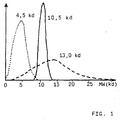
- Heparin UFH and LMWH of the present invention differ markedly from each other, as is apparent from the figure 1.
- Figure 1 which is a GPC elution profile clearly shows the three mentioned heparins, that the UFH an average molecular mass of 13.0 kd at the same time very broad Has molecular weight distribution.
- the NMH has an average molecular weight of 4.5 kd and a much narrower molecular weight distribution.
- the heparin according to the invention however, has an average molecular weight of 10.5 kd, which at the same time the having the narrowest molecular weight distribution of the three different heparins.
- the narrow molecular weight distribution of the heparin according to the invention comes here a special meaning because this is the unique and surprising Pharmacological spectrum of action of heparin of the present invention is due.
- each one UFH and NMH represent, both in terms of anti-Xa activity as well as in terms of anti-IIa activity has a marked increase in activity. This was up no case to be expected. At best, one might have thought that the anti-factor Xa and antithrombin activities of the heparin according to the invention Mid position between UFH and NMH.
- HMM Heparin
- UHF Liquemin®
- NH Enoxaparin
- the anticoagulant activity of plasma samples was determined by determination of Clotting time determined according to APTT (activated partial thrombin time) test (APTT-Micro Diatomaceous Earth, Instrumentation Laboratory), wherein the inhibition of Factor Xa and thrombin activity on an ACL 3000 model (Instrumentation Laboratory) was determined. This investigation is is the determination of a coagulation parameter that is generally used for Determination of anticoagulant effects. There were generally two values determined. If the deviation was more than 3%, the measurement was repeated. The validity was carried out in parallel Controls with reference plasma, the 4th international standard for UHF and the 1st international standard for NMH.
- the plasma was Puffem diluted for heparin determination (Chromogenix) and incubated with human AT (Chromogenix) added. After incubation with factor Xa or thrombin (Chromogenix), the remaining activity was determined by the reaction of the chromogenic substrates S2222 and S2238.
- the total and free TFPI antigen concentrations in the plasma samples were determined by the specific ELISAs "Asserachrom® Free TPFI” and Asserachrom® Total TFPI (Diagnostica Stago). With F (ab ') 2 fragments from a TFPI specific antibody (TT4E2) coated ELISA plates were used for TFPI measurement.
- the monoclonal, Peroxidase-coupled detection antibodies were either for total TFPI specific (2C6) or for free TFPI (H65).
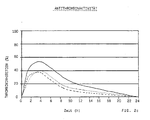
- the heparin according to the invention has the highest activity in The APTT test and the anti-Flla assay shows and is particularly in his anti-FIIa activity from the other two heparins in a surprising manner different. Only the anti-FXa assay shows an expected result.
- the heparin according to the invention takes the heparin according to the invention in about a middle position between Enoxaparin and Liquemin® as an example of NMH and UFH.
- the different anticoagulant potential of the three heparins investigated is evident from the AUC 0-24h data of the APTT test, the anti-FXa and the anti-FIIa assays, which are shown in FIGS. 3a to c respectively for the three heparins investigated are.
- the values result from the action of the respective heparin in the individual tests, ie the prolongation of the clotting time and in each case the inhibition of factor Xa and thrombin. It shows that the three heparins differ not only significantly in their pharmacokinetics, but also in their pharmacodynamics (eg the magnitude of the anti-FXa activity in comparison with the anti-FIIA activity).
- the values shown in FIGS. 3a to 3b do not indicate the mass-specific activity of each individual heparin, since the specific activities of the three heparins differ from each other and 9,000 iu anti-FXa of the heparin according to the invention, Liquemin® and enoxaparin to the individual Test persons had been injected. Therefore, the dose-standardized values for AUC 0-24h were also calculated, ie, the value for AUC 0-24h / mg of each heparin administered. The respective doses administered were 51.5 mg of the heparin according to the invention, 56.5 mg Liquemin® and 90 mg enoxaparin.
- the comparison of the mass-specific AUC values, shown in FIGS. 4a to 4c clearly shows that the heparin according to the invention not only has a higher bioavailability than Liquemin®, but also a substantially higher potential than enoxaparin.
- the superiority of the heparin of the invention over Liquemin® which is more pronounced at the AUC 0-24h value than the c max value, may be beneficial as, conversely, the risk of bleeding could be higher.
- c max can be reduced while maintaining a higher AUC 0-24h value than that of Liquemin®.
- the discrepancy between the c max of enoxaprin and Liquemin® in the anti-Xa and antithrombin assays is also lower than between the AUC 0-24h values.
- the c max value of enaxoperin in the APTT test is even 25% lower than that of Liquemin®.
- the comparison of the pharmacokinetic parameters c max , t1 / 2 invasion [min] and t1 / 2 elimination [min] shows that the heparin according to the invention is comparable neither with UFH nor with LMWH.
- heparin according to the invention differs either distinctly from Liquemin® and enoxaparin (eg, t1 / 2 invasion ) or only from Liquemin® (eg t max ) or only from enoxaparin (eg t1 / 2 elimination ).
- the heparin according to the invention has a t max value which corresponds approximately to that of enoxaparin and differs only slightly from that of Liquemin®. There were no significant differences in the three different assays observed for the three heparins tested.
- t1 / 2 invasion is significantly longer for the heparin of the invention in the APTT assay and the anti-FXa assay than for Liquemin®, but not significantly longer in the anti-Flla assay. In addition, this time is longer than that of enoxaparin in these two assays. However, in the anti-Flla assay, enoxaparin has the largest t1 / 2 invasion value, which is significant. In contrast to other time-related values, the t1 / 2 elimination value of the heparin of the present invention is not significantly different from that of Liquemin®.
- the t1 / 2 elimination value of enoxaparin in the APTT assay and the anti-FXa assay is twice that of the heparin of the invention and Liquemin.
- enoxaparin has the lowest t1 / 2 elimination value.
- the anti-FIIa activity of the heparin according to the invention is therefore eliminated the slowest, which is to be regarded as an advantage over the other two heparins due to the importance of antithrombin activity for anticoagulant activity.
- the total TFPI antigen concentration is found to be 2.0 to 2 after one hour 5 times the initial value and the concentration of the free TFPI antigen to 6.7 to 7.9 times the initial concentration. It can be seen from FIGS. 5a and 5b that the maximum values are found after 1.5 to 2 hours, so that t.sub.max is significantly shorter than in the three assays carried out so far. This demonstrates that heparin-induced TFPI release does not correlate with these traditional coagulation parameters.
- the concentration of free TFPI antigen is the critical parameter for coagulation when it comes to the contribution of TFPI to the activity of heparin
- the AUC 0-24h values for free TFPI antigen concentration should be compared. It can be seen from FIG. 6b that the heparin according to the invention is found to be the most effective.
- the medium molecular weight heparin according to the invention also for Therapy of acute myocardial infarction and unstable angina pectoris as well as Use anticoagulant in extracorporeal circuits.
- the heparin according to the invention was average molecular weight also in animal experiments with a low molecular weight heparin, Enoxaparin, compared. This happened as part of a modified Thrombosis model according to S. Wessler ("rabbit stasis model", “Thrombosis in the presence of vascular stasis ", Am. J. Med., 33: 649, 1959), the experimental Induced thrombosis from the combination of hypercoagulability and Venostasis results.
- Figures 7 and 8 demonstrate the impressive, consistent increase in the "therapeutic index" of the medium molecular weight heparin of the invention compared to LMWH, which is not only due to the increased antithrombotic Efficacy is based, but also particularly on the significant reduction bleeding tendency.
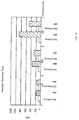
- FIG. 7 again shows a comparison of the antithrombotic activity intravenous administration of the as NMH enoxaprin with the HMM of the present Invention.
- the coagulation value the one Measure of the number and size of the formed blood clot, in which heparin according to the invention significantly lower than enoxaparin.
- saline solution was used as a zero comparison. It also shows that the Coagulation only at elevated dose, in this case at 50 units / kg body weight, is also completely suppressed by enoxaparin.
- Figure 8 shows a comparison of bleeding time to intravenous administration of Enoxaparin, HMM or saline solution as a zero comparison or standard. It appears especially at higher dosages that the heparin according to the invention mean molecular weight compared to Enoxaparin a much greater potential shows that from the animal experiment, the absolute lower bleeding tendency significantly becomes.
- the present invention is compared to the prior art expressly provided better heparin, characterized by a higher therapeutic index, which is on a more favorable ratio based on effect and tolerability.
- a higher therapeutic index which is on a more favorable ratio based on effect and tolerability.
- For the clinic can be a larger Range of Prophylaxis and Therapy Predict:
- the heparin of average molecular weight according to the invention will be metered relatively higher can not be known as the known heparins and thus to one predictable further improvement in the management of thromboembolytic Contribute to diseases.
- heparin characterized, that it has an average molecular weight of 10 to 11.5 kd, in particular an average molecular weight of 10.5 kd.
- Heparin available through controlled Depolymerization of unfractionated heparin with nitrous acid followed by molecular filtration.
- heparin for the production a drug for prophylaxis and therapy thromboembolytic Processes, treatment of acute myocardial infarction, unstable angina pectoris and for coagulation inhibition in extracorporeal circuits.
- the medicament further contains pharmaceutically acceptable fillers and / or adjuvants.
- the medicament is formulated for parenteral administration.
Landscapes
- Chemical & Material Sciences (AREA)
- Health & Medical Sciences (AREA)
- Life Sciences & Earth Sciences (AREA)
- Chemical Kinetics & Catalysis (AREA)
- Medicinal Chemistry (AREA)
- General Health & Medical Sciences (AREA)
- Engineering & Computer Science (AREA)
- Organic Chemistry (AREA)
- Materials Engineering (AREA)
- Molecular Biology (AREA)
- Polymers & Plastics (AREA)
- Biochemistry (AREA)
- Animal Behavior & Ethology (AREA)
- Nuclear Medicine, Radiotherapy & Molecular Imaging (AREA)
- Diabetes (AREA)
- Public Health (AREA)
- Veterinary Medicine (AREA)
- Bioinformatics & Cheminformatics (AREA)
- Pharmacology & Pharmacy (AREA)
- Hematology (AREA)
- General Chemical & Material Sciences (AREA)
- Pharmaceuticals Containing Other Organic And Inorganic Compounds (AREA)
- Polysaccharides And Polysaccharide Derivatives (AREA)
- Medicines That Contain Protein Lipid Enzymes And Other Medicines (AREA)
- Addition Polymer Or Copolymer, Post-Treatments, Or Chemical Modifications (AREA)
Abstract
Description
| UFH | NMH | |
| Molekulargewicht (in d) | 3.000-30.000 | 2000-8.000 |
| mittleres MG (in d) | 13.000 | 5.000 |
| anti-Xa/anti-IIa-Aktivität | 1:1 | 2:1 - 5:1 |
| Neutralisation durch PF 4 | stark | schwach |
| Bindung an Proteine | hoch | niedrig |
| Bindung an Endothelzellen | ja | schwach |
| dosisabhängige Clearance | ja | nein |
| Bioverfügbarkeit (s.c.) | 10-25 % | ∼ 90 % |
| Halbwertszeiten (t½) | 1 h (i.v.) | 2 h (i.v.) |
| 1 - 2 h (s.c.) | 3 - 6 h (s.c.) | |
| Elimination | biophasisch | renal |
| Laborkontrollen | erforderlich | nicht erforderlich |
- Figur 1
- eine Darstellung der Molmassenverteilung des erfindungsgemäßen Heparins (HMM), von Enoxaparin (NMH) und von Liquemin® (UFH) in einem GPC-Elutionsprofil,
- Figur 2a
- eine Darstellung der APTT-Aktivität jeweils des erfindungsgemäßen Heparins (HMM), von Enoxaparin (NMH) und von Liquemin® (UFH),
- Figur 2b
- eine Darstellung des anti-Faktor-Xa-Aktivität der drei Heparine,
- Figur 2c
- eine Darstellung der Antithrombinaktivität der drei Heparine,
- Figur 3a
- eine Darstellung der AUC0-24h-Werte der drei Heparine,
- Figur 3b
- eine Figur 3a entsprechende Darstellung der anti-FXa-Aktivität der drei Heparine,
- Figur 3c
- eine den Figuren 3a und 3b entsprechende Darstellung der anti-FIIA-Aktivität der drei untersuchten Heparine,
- Figuren 4a bis 4c
- eine Darstellung der dosisnormierten Aktivitäten entsprechend den Figuren 3a bis c der drei untersuchten Heparine,
- Figur 5a
- eine zeitabhängige Darstellung der Konzentration an Gesamt TFPI-Antigen jeweils nach Gabe eines Heparins (durchgezogene Linie HMM; gepunktete Linie NMH (Enoxaparin); gestrichelte Linie UFH (Liquemin®)),
- Figur 5b
- eine Darstellung gemäß Figur 5a für das freie TFPI-Antigen,
- Figuren 6a bis 6d
- eine Darstellung der AUC0-24h-Werte für die drei untersuchten Heparine, berechnet aus der Freisetzung von Gesamt-TFPI-Antigen sowie von freiem TFPI-Antigen.
- Figur 7
- Vergleich der antithrombotischen Wirkungen von Enoxaparin und dem erfindungsgemäßen Heparin mittlerer Molmasse im Tierversuch (Kaninchen),
- Figur 8
- Vergleich der Blutungsdauer bei Verabreichung von Enoxaparin bzw. dem erfindungsgemäßen Heparin mittlerer Molmasse im Tiermodell (Kaninchen).
| zahlengemittelte Molmasse | 10.513 |
| Gewichtsgemittelte Molmasse | 10.819 |
| Z-Mittel | 11.233 |
| Viskositätsmittel | 10.819 |
| Z+1-Mittel | 11.815 |
| Innere Viskosität | 0,0000 |
| Peak-Molmasse | 10.236 |
| Dispersity | 1,029066 |
| Z-Mittel/Gewichtsmittel | 1,038271 |
| Z+1-Mittel/Gewichtsmittel | 1,092039 |
| aXa i.E./mg | aIIa i.E./mg | aXa/aIIa-Verhältnis | aIIa/aXa-Verhältnis | |
| HMM | 174,9 | 170,0 | 1,03 | 0,97 |
| Liquemin® (UFH) | 159,0 | 159,0 | 1,00 | 1,00 |
| Enoxaparin (NMH) | 100,0 | 26,3 | 3,80 | 0,26 |
- AUC0-24h[s*h,%Inh.*h oder (ng/ml)*h] = Fläche unter der Kurve
= (area under the curve) - cmax[S, inh.% oder ng/ml] = Aktivitätsmaximum (Verlängerung
der Gerinnungszeit, Inhibierung oder
Konzentration) - tmax[Min.] = Zeit des Aktivitätsmaximums
- t1/2Invasion[min.] = Invasions-Halbwertszeit
- t1/2Elimination[min.] = Eliminations-Halbwertszeit

dadurch gekennzeichnet,
daß es eine mittlere Molmasse von 10 bis 11,5 kd aufweist, insbesondere eine mittlere Molmasse von 10,5 kd.
Depolymerisierung von unfraktioniertem Heparin mit salpetriger Säure und nachfolgender Molekularfiltration.
dadurch gekennzeichnet,
daß das Arzneimittel weiterhin pharmazeutisch verträgliche Füllund/oder Hilfsstoffe enthält.
dadurch gekennzeichnet,
daß das Arzneimittel zur parenteralen Verabreichung formuliert ist.
Claims (1)
- Heparin mit einer mittleren Molmasse von 10 bis 11,5 kd mit einer anti-Xa-Aktivität von 174,8 und einer anti-IIa-Aktivität von 170,0, jeweils bestimmt nach dem 1. internationalen Standard für niedermolekulare Heparine.
Applications Claiming Priority (3)
| Application Number | Priority Date | Filing Date | Title |
|---|---|---|---|
| DE10000602 | 2000-01-10 | ||
| DE10000602 | 2000-01-10 | ||
| EP00990588A EP1252194B1 (de) | 2000-01-10 | 2000-12-22 | Verwendung eines Heparins mit mittlerer Molmasse |
Related Parent Applications (1)
| Application Number | Title | Priority Date | Filing Date |
|---|---|---|---|
| EP00990588A Division EP1252194B1 (de) | 2000-01-10 | 2000-12-22 | Verwendung eines Heparins mit mittlerer Molmasse |
Publications (2)
| Publication Number | Publication Date |
|---|---|
| EP1505079A2 true EP1505079A2 (de) | 2005-02-09 |
| EP1505079A3 EP1505079A3 (de) | 2005-04-13 |
Family
ID=7627036
Family Applications (2)
| Application Number | Title | Priority Date | Filing Date |
|---|---|---|---|
| EP04023290A Withdrawn EP1505079A3 (de) | 2000-01-10 | 2000-12-22 | Heparin mit mittlerer Molmasse von 10 bis 11,5 kD |
| EP00990588A Expired - Lifetime EP1252194B1 (de) | 2000-01-10 | 2000-12-22 | Verwendung eines Heparins mit mittlerer Molmasse |
Family Applications After (1)
| Application Number | Title | Priority Date | Filing Date |
|---|---|---|---|
| EP00990588A Expired - Lifetime EP1252194B1 (de) | 2000-01-10 | 2000-12-22 | Verwendung eines Heparins mit mittlerer Molmasse |
Country Status (9)
| Country | Link |
|---|---|
| US (1) | US7008933B2 (de) |
| EP (2) | EP1505079A3 (de) |
| AT (1) | ATE279929T1 (de) |
| AU (1) | AU2001230019A1 (de) |
| CA (1) | CA2434393C (de) |
| DE (2) | DE50008363D1 (de) |
| ES (1) | ES2231303T3 (de) |
| RU (1) | RU2322245C2 (de) |
| WO (1) | WO2001051525A1 (de) |
Families Citing this family (8)
| Publication number | Priority date | Publication date | Assignee | Title |
|---|---|---|---|---|
| US7575886B2 (en) | 2002-03-11 | 2009-08-18 | Momenta Pharmaceuticals, Inc. | Analysis of sulfated polysaccharides |
| AU2007267561B2 (en) * | 2006-05-25 | 2012-05-17 | Momenta Pharmaceuticals, Inc. | Low molecular weight heparin composition and uses thereof |
| US9139876B1 (en) * | 2007-05-03 | 2015-09-22 | Momenta Pharmacueticals, Inc. | Method of analyzing a preparation of a low molecular weight heparin |
| EP2242494A4 (de) * | 2008-02-20 | 2013-01-02 | Momenta Pharmaceuticals Inc | Verfahren zur herstellung von heparinzusammensetzungen mit geringem molekulargewicht |
| CN102791742B (zh) * | 2010-01-19 | 2014-12-24 | 动量制药公司 | 评价肝素制剂 |
| WO2012115952A1 (en) | 2011-02-21 | 2012-08-30 | Momenta Pharmaceuticals, Inc. | Evaluating heparin preparations |
| EP3348270A1 (de) * | 2017-01-11 | 2018-07-18 | Fytagoras B.V. | Heparin mit mittlerem molekulargewicht |
| EP3581189A1 (de) * | 2018-06-14 | 2019-12-18 | Fytagoras B.V. | Heparin mit mittlerem molekulargewicht zur behandlung und sekundären prävention eines ischämischen schlaganfalls |
Family Cites Families (4)
| Publication number | Priority date | Publication date | Assignee | Title |
|---|---|---|---|---|
| US4687765A (en) * | 1983-07-25 | 1987-08-18 | Choay S.A. | Method and composition for thrombolytic treatment |
| IT1219704B (it) * | 1988-06-03 | 1990-05-24 | Italfarmaco Spa | Sali di glicosaminoglicani,procedimento per la loro preparazione e relative composizioni farmaceutiche |
| FR2723847A1 (fr) * | 1994-08-29 | 1996-03-01 | Debiopharm Sa | Compositions antithrombotiques et non hemorragiques a base d'heparine, procede pour leur preparation et applications therapeutiques. |
| HK1045532A1 (zh) * | 1999-06-30 | 2002-11-29 | Hamilton Civic Hospitals Research Development, Inc. | 抑制与凝结有关凝结因子的肝素成份 |
-
2000
- 2000-12-22 CA CA002434393A patent/CA2434393C/en not_active Expired - Lifetime
- 2000-12-22 DE DE50008363T patent/DE50008363D1/de not_active Expired - Lifetime
- 2000-12-22 WO PCT/DE2000/004674 patent/WO2001051525A1/de not_active Ceased
- 2000-12-22 AT AT00990588T patent/ATE279929T1/de active
- 2000-12-22 DE DE10084241T patent/DE10084241D2/de not_active Expired - Fee Related
- 2000-12-22 EP EP04023290A patent/EP1505079A3/de not_active Withdrawn
- 2000-12-22 AU AU2001230019A patent/AU2001230019A1/en not_active Abandoned
- 2000-12-22 US US10/169,834 patent/US7008933B2/en not_active Expired - Lifetime
- 2000-12-22 ES ES00990588T patent/ES2231303T3/es not_active Expired - Lifetime
- 2000-12-22 RU RU2003123505/15A patent/RU2322245C2/ru not_active Application Discontinuation
- 2000-12-22 EP EP00990588A patent/EP1252194B1/de not_active Expired - Lifetime
Also Published As
| Publication number | Publication date |
|---|---|
| AU2001230019A1 (en) | 2001-07-24 |
| RU2003123505A (ru) | 2005-02-27 |
| WO2001051525A1 (de) | 2001-07-19 |
| EP1505079A3 (de) | 2005-04-13 |
| RU2322245C2 (ru) | 2008-04-20 |
| CA2434393C (en) | 2009-09-15 |
| DE10084241D2 (de) | 2003-02-20 |
| DE50008363D1 (de) | 2004-11-25 |
| CA2434393A1 (en) | 2001-07-19 |
| ATE279929T1 (de) | 2004-11-15 |
| ES2231303T3 (es) | 2005-05-16 |
| US20030134823A1 (en) | 2003-07-17 |
| US7008933B2 (en) | 2006-03-07 |
| EP1252194B1 (de) | 2004-10-20 |
| EP1252194A1 (de) | 2002-10-30 |
Similar Documents
| Publication | Publication Date | Title |
|---|---|---|
| DE68913050T2 (de) | Antithrombotische zusammensetzung. | |
| DE69621528T2 (de) | Anti-inflamatorische agenzien | |
| DE2833898C2 (de) | ||
| DE69120674T2 (de) | Koagulationsassays und reagenzien | |
| AT398976B (de) | Gemische von polysacchariden mit niedrigem molekulargewicht, deren herstellungsverfahren und verwendung | |
| DE3854604T2 (de) | Antientzündungsmittel und zusammensetzungen. | |
| DE69023957T2 (de) | Sulfatierte Polysaccharide, Antikoagulierungs- und Antikomplementärmittel, hergestellt aus Fukanen aus braunen Algen, und Verfahren zu deren Herstellung. | |
| DE69230372T2 (de) | Polyoxypropylen/polyoxyethylen copolymere mit verbesserter biologischer aktivität | |
| DE69923810T2 (de) | Blutstillendes Mittel | |
| DE60125154T2 (de) | Teildesulfatierte glykosaminoglykanderivate mit antiangiogenischer aktivität und ohne antikoagulierender wirkung | |
| DE69925821T2 (de) | Zusammensetzungen enthaltend Heparin mit niedrigem Molekülargewicht | |
| DE69228362T2 (de) | Hochmolekulare, N,O-sulfatierte Heparosane; Verfahren zu deren Herstellung und diese enthaltende Arzneimittel | |
| DE3486341T2 (de) | Derivate von Dextran mit antikoagulierenden und antikomplementären Eigenschaften, ihre Herstellung und ihre biologischen Anwendungen. | |
| DE69016383T2 (de) | Supersulfatierte Heparine. | |
| EP1423436B1 (de) | Verwendung von heparinoid-derivaten zur behandlung und diagnose von mit heparinoiden behandelbaren erkrankungen | |
| DE69220442T2 (de) | Heparinderivate und verfahren zu deren herstellung | |
| DE2944792C3 (de) | Mucopolysaccharidfraktion, Verfahren zu ihrer Herstellung und sie enthaltende Arzneimittel | |
| DE10053053A1 (de) | Pharmazeutische Formulierungen zur Hemmung von entzündlichen Arthritiden | |
| EP1252194B1 (de) | Verwendung eines Heparins mit mittlerer Molmasse | |
| DE3403256C2 (de) | ||
| DE69911633T2 (de) | Pharmazeutische zusammenstellungen die tetrahydroisoquinoleinverbindungen enthalten | |
| DE3875854T2 (de) | Auf ligninsulfonat aufgebautes pharmazeutisches mittel mit einer atithrombose-aktivitaet. | |
| DE3787996T2 (de) | Heparine, frei von E.D.T.A., Fraktionen und Fragmente von Heparin, Verfahren zu deren Herstellung und pharmazeutische Zusammensetzungen, welche diese enthalten. | |
| DE69313826T2 (de) | Sulfatierte polysaccharide, verfahren zu deren herstellung, pharmazeutische zusammensetzung und ihre verwendung | |
| DE19813234A1 (de) | Verfahren zur Herstellung hochsulfatierter Hyaluronsäuren |
Legal Events
| Date | Code | Title | Description |
|---|---|---|---|
| PUAI | Public reference made under article 153(3) epc to a published international application that has entered the european phase |
Free format text: ORIGINAL CODE: 0009012 |
|
| 17P | Request for examination filed |
Effective date: 20040930 |
|
| AC | Divisional application: reference to earlier application |
Ref document number: 1252194 Country of ref document: EP Kind code of ref document: P |
|
| AK | Designated contracting states |
Kind code of ref document: A2 Designated state(s): AT BE CH CY DE DK ES FI FR GB GR IE IT LI LU MC NL PT SE TR |
|
| PUAL | Search report despatched |
Free format text: ORIGINAL CODE: 0009013 |
|
| AK | Designated contracting states |
Kind code of ref document: A3 Designated state(s): AT BE CH CY DE DK ES FI FR GB GR IE IT LI LU MC NL PT SE TR |
|
| AKX | Designation fees paid |
Designated state(s): AT BE CH CY DE DK ES FI FR GB GR IE IT LI LU MC NL PT SE TR |
|
| STAA | Information on the status of an ep patent application or granted ep patent |
Free format text: STATUS: THE APPLICATION HAS BEEN WITHDRAWN |
|
| 18W | Application withdrawn |
Effective date: 20091105 |