EP1508044B1 - Dispositif et procede de transport et de reaction par bouchons entraines par pression - Google Patents
Dispositif et procede de transport et de reaction par bouchons entraines par pression Download PDFInfo
- Publication number
- EP1508044B1 EP1508044B1 EP03783044A EP03783044A EP1508044B1 EP 1508044 B1 EP1508044 B1 EP 1508044B1 EP 03783044 A EP03783044 A EP 03783044A EP 03783044 A EP03783044 A EP 03783044A EP 1508044 B1 EP1508044 B1 EP 1508044B1
- Authority
- EP
- European Patent Office
- Prior art keywords
- plug
- channel
- plugs
- fluid
- fluids
- Prior art date
- Legal status (The legal status is an assumption and is not a legal conclusion. Google has not performed a legal analysis and makes no representation as to the accuracy of the status listed.)
- Expired - Lifetime
Links
- ISQBXPOEJGFEOU-UHFFFAOYSA-N CC(C)CCCCCNC Chemical compound CC(C)CCCCCNC ISQBXPOEJGFEOU-UHFFFAOYSA-N 0.000 description 1
Images



















Classifications
-
- B—PERFORMING OPERATIONS; TRANSPORTING
- B01—PHYSICAL OR CHEMICAL PROCESSES OR APPARATUS IN GENERAL
- B01L—CHEMICAL OR PHYSICAL LABORATORY APPARATUS FOR GENERAL USE
- B01L3/00—Containers or dishes for laboratory use, e.g. laboratory glassware; Droppers
- B01L3/50—Containers for the purpose of retaining a material to be analysed, e.g. test tubes
- B01L3/502—Containers for the purpose of retaining a material to be analysed, e.g. test tubes with fluid transport, e.g. in multi-compartment structures
- B01L3/5027—Containers for the purpose of retaining a material to be analysed, e.g. test tubes with fluid transport, e.g. in multi-compartment structures by integrated microfluidic structures, i.e. dimensions of channels and chambers are such that surface tension forces are important, e.g. lab-on-a-chip
- B01L3/502769—Containers for the purpose of retaining a material to be analysed, e.g. test tubes with fluid transport, e.g. in multi-compartment structures by integrated microfluidic structures, i.e. dimensions of channels and chambers are such that surface tension forces are important, e.g. lab-on-a-chip characterised by multiphase flow arrangements
- B01L3/502784—Containers for the purpose of retaining a material to be analysed, e.g. test tubes with fluid transport, e.g. in multi-compartment structures by integrated microfluidic structures, i.e. dimensions of channels and chambers are such that surface tension forces are important, e.g. lab-on-a-chip characterised by multiphase flow arrangements specially adapted for droplet or plug flow, e.g. digital microfluidics
-
- B—PERFORMING OPERATIONS; TRANSPORTING
- B01—PHYSICAL OR CHEMICAL PROCESSES OR APPARATUS IN GENERAL
- B01F—MIXING, e.g. DISSOLVING, EMULSIFYING OR DISPERSING
- B01F23/00—Mixing according to the phases to be mixed, e.g. dispersing or emulsifying
- B01F23/40—Mixing liquids with liquids; Emulsifying
- B01F23/45—Mixing liquids with liquids; Emulsifying using flow mixing
-
- B—PERFORMING OPERATIONS; TRANSPORTING
- B01—PHYSICAL OR CHEMICAL PROCESSES OR APPARATUS IN GENERAL
- B01F—MIXING, e.g. DISSOLVING, EMULSIFYING OR DISPERSING
- B01F25/00—Flow mixers; Mixers for falling materials, e.g. solid particles
- B01F25/40—Static mixers
- B01F25/42—Static mixers in which the mixing is affected by moving the components jointly in changing directions, e.g. in tubes provided with baffles or obstructions
- B01F25/43—Mixing tubes, e.g. wherein the material is moved in a radial or partly reversed direction
- B01F25/433—Mixing tubes wherein the shape of the tube influences the mixing, e.g. mixing tubes with varying cross-section or provided with inwardly extending profiles
- B01F25/4331—Mixers with bended, curved, coiled, wounded mixing tubes or comprising elements for bending the flow
-
- B—PERFORMING OPERATIONS; TRANSPORTING
- B01—PHYSICAL OR CHEMICAL PROCESSES OR APPARATUS IN GENERAL
- B01F—MIXING, e.g. DISSOLVING, EMULSIFYING OR DISPERSING
- B01F33/00—Other mixers; Mixing plants; Combinations of mixers
- B01F33/30—Micromixers
- B01F33/302—Micromixers the materials to be mixed flowing in the form of droplets
- B01F33/3021—Micromixers the materials to be mixed flowing in the form of droplets the components to be mixed being combined in a single independent droplet, e.g. these droplets being divided by a non-miscible fluid or consisting of independent droplets
-
- B—PERFORMING OPERATIONS; TRANSPORTING
- B01—PHYSICAL OR CHEMICAL PROCESSES OR APPARATUS IN GENERAL
- B01J—CHEMICAL OR PHYSICAL PROCESSES, e.g. CATALYSIS OR COLLOID CHEMISTRY; THEIR RELEVANT APPARATUS
- B01J19/00—Chemical, physical or physico-chemical processes in general; Their relevant apparatus
- B01J19/0046—Sequential or parallel reactions, e.g. for the synthesis of polypeptides or polynucleotides; Apparatus and devices for combinatorial chemistry or for making molecular arrays
-
- B—PERFORMING OPERATIONS; TRANSPORTING
- B01—PHYSICAL OR CHEMICAL PROCESSES OR APPARATUS IN GENERAL
- B01J—CHEMICAL OR PHYSICAL PROCESSES, e.g. CATALYSIS OR COLLOID CHEMISTRY; THEIR RELEVANT APPARATUS
- B01J19/00—Chemical, physical or physico-chemical processes in general; Their relevant apparatus
- B01J19/0093—Microreactors, e.g. miniaturised or microfabricated reactors
-
- B—PERFORMING OPERATIONS; TRANSPORTING
- B01—PHYSICAL OR CHEMICAL PROCESSES OR APPARATUS IN GENERAL
- B01L—CHEMICAL OR PHYSICAL LABORATORY APPARATUS FOR GENERAL USE
- B01L3/00—Containers or dishes for laboratory use, e.g. laboratory glassware; Droppers
- B01L3/50—Containers for the purpose of retaining a material to be analysed, e.g. test tubes
- B01L3/502—Containers for the purpose of retaining a material to be analysed, e.g. test tubes with fluid transport, e.g. in multi-compartment structures
- B01L3/5027—Containers for the purpose of retaining a material to be analysed, e.g. test tubes with fluid transport, e.g. in multi-compartment structures by integrated microfluidic structures, i.e. dimensions of channels and chambers are such that surface tension forces are important, e.g. lab-on-a-chip
- B01L3/502746—Containers for the purpose of retaining a material to be analysed, e.g. test tubes with fluid transport, e.g. in multi-compartment structures by integrated microfluidic structures, i.e. dimensions of channels and chambers are such that surface tension forces are important, e.g. lab-on-a-chip characterised by the means for controlling flow resistance, e.g. flow controllers, baffles or throttle valves
-
- B—PERFORMING OPERATIONS; TRANSPORTING
- B01—PHYSICAL OR CHEMICAL PROCESSES OR APPARATUS IN GENERAL
- B01L—CHEMICAL OR PHYSICAL LABORATORY APPARATUS FOR GENERAL USE
- B01L3/00—Containers or dishes for laboratory use, e.g. laboratory glassware; Droppers
- B01L3/50—Containers for the purpose of retaining a material to be analysed, e.g. test tubes
- B01L3/502—Containers for the purpose of retaining a material to be analysed, e.g. test tubes with fluid transport, e.g. in multi-compartment structures
- B01L3/5027—Containers for the purpose of retaining a material to be analysed, e.g. test tubes with fluid transport, e.g. in multi-compartment structures by integrated microfluidic structures, i.e. dimensions of channels and chambers are such that surface tension forces are important, e.g. lab-on-a-chip
- B01L3/502761—Containers for the purpose of retaining a material to be analysed, e.g. test tubes with fluid transport, e.g. in multi-compartment structures by integrated microfluidic structures, i.e. dimensions of channels and chambers are such that surface tension forces are important, e.g. lab-on-a-chip specially adapted for handling suspended solids or molecules independently from the bulk fluid flow, e.g. for trapping or sorting beads or physically stretching molecules
-
- B—PERFORMING OPERATIONS; TRANSPORTING
- B01—PHYSICAL OR CHEMICAL PROCESSES OR APPARATUS IN GENERAL
- B01L—CHEMICAL OR PHYSICAL LABORATORY APPARATUS FOR GENERAL USE
- B01L7/00—Heating or cooling apparatus; Heat insulating devices
- B01L7/52—Heating or cooling apparatus; Heat insulating devices with provision for submitting samples to a predetermined sequence of different temperatures, e.g. for treating nucleic acid samples
-
- C—CHEMISTRY; METALLURGY
- C12—BIOCHEMISTRY; BEER; SPIRITS; WINE; VINEGAR; MICROBIOLOGY; ENZYMOLOGY; MUTATION OR GENETIC ENGINEERING
- C12P—FERMENTATION OR ENZYME-USING PROCESSES TO SYNTHESISE A DESIRED CHEMICAL COMPOUND OR COMPOSITION OR TO SEPARATE OPTICAL ISOMERS FROM A RACEMIC MIXTURE
- C12P19/00—Preparation of compounds containing saccharide radicals
- C12P19/26—Preparation of nitrogen-containing carbohydrates
- C12P19/28—N-glycosides
- C12P19/30—Nucleotides
- C12P19/34—Polynucleotides, e.g. nucleic acids, oligoribonucleotides
-
- C—CHEMISTRY; METALLURGY
- C12—BIOCHEMISTRY; BEER; SPIRITS; WINE; VINEGAR; MICROBIOLOGY; ENZYMOLOGY; MUTATION OR GENETIC ENGINEERING
- C12Q—MEASURING OR TESTING PROCESSES INVOLVING ENZYMES, NUCLEIC ACIDS OR MICROORGANISMS; COMPOSITIONS OR TEST PAPERS THEREFOR; PROCESSES OF PREPARING SUCH COMPOSITIONS; CONDITION-RESPONSIVE CONTROL IN MICROBIOLOGICAL OR ENZYMOLOGICAL PROCESSES
- C12Q1/00—Measuring or testing processes involving enzymes, nucleic acids or microorganisms; Compositions therefor; Processes of preparing such compositions
- C12Q1/34—Measuring or testing processes involving enzymes, nucleic acids or microorganisms; Compositions therefor; Processes of preparing such compositions involving hydrolase
- C12Q1/44—Measuring or testing processes involving enzymes, nucleic acids or microorganisms; Compositions therefor; Processes of preparing such compositions involving hydrolase involving esterase
-
- G—PHYSICS
- G01—MEASURING; TESTING
- G01N—INVESTIGATING OR ANALYSING MATERIALS BY DETERMINING THEIR CHEMICAL OR PHYSICAL PROPERTIES
- G01N15/00—Investigating characteristics of particles; Investigating permeability, pore-volume or surface-area of porous materials
- G01N15/10—Investigating individual particles
- G01N15/14—Optical investigation techniques, e.g. flow cytometry
- G01N15/1404—Handling flow, e.g. hydrodynamic focusing
-
- G—PHYSICS
- G01—MEASURING; TESTING
- G01N—INVESTIGATING OR ANALYSING MATERIALS BY DETERMINING THEIR CHEMICAL OR PHYSICAL PROPERTIES
- G01N35/00—Automatic analysis not limited to methods or materials provided for in any single one of groups G01N1/00 - G01N33/00; Handling materials therefor
- G01N35/08—Automatic analysis not limited to methods or materials provided for in any single one of groups G01N1/00 - G01N33/00; Handling materials therefor using a stream of discrete samples flowing along a tube system, e.g. flow injection analysis
- G01N35/085—Flow Injection Analysis
-
- B—PERFORMING OPERATIONS; TRANSPORTING
- B01—PHYSICAL OR CHEMICAL PROCESSES OR APPARATUS IN GENERAL
- B01F—MIXING, e.g. DISSOLVING, EMULSIFYING OR DISPERSING
- B01F2101/00—Mixing characterised by the nature of the mixed materials or by the application field
- B01F2101/23—Mixing of laboratory samples e.g. in preparation of analysing or testing properties of materials
-
- B—PERFORMING OPERATIONS; TRANSPORTING
- B01—PHYSICAL OR CHEMICAL PROCESSES OR APPARATUS IN GENERAL
- B01F—MIXING, e.g. DISSOLVING, EMULSIFYING OR DISPERSING
- B01F25/00—Flow mixers; Mixers for falling materials, e.g. solid particles
- B01F25/30—Injector mixers
- B01F25/31—Injector mixers in conduits or tubes through which the main component flows
-
- B—PERFORMING OPERATIONS; TRANSPORTING
- B01—PHYSICAL OR CHEMICAL PROCESSES OR APPARATUS IN GENERAL
- B01J—CHEMICAL OR PHYSICAL PROCESSES, e.g. CATALYSIS OR COLLOID CHEMISTRY; THEIR RELEVANT APPARATUS
- B01J2219/00—Chemical, physical or physico-chemical processes in general; Their relevant apparatus
- B01J2219/00274—Sequential or parallel reactions; Apparatus and devices for combinatorial chemistry or for making arrays; Chemical library technology
- B01J2219/00277—Apparatus
- B01J2219/00279—Features relating to reactor vessels
- B01J2219/00281—Individual reactor vessels
- B01J2219/00286—Reactor vessels with top and bottom openings
-
- B—PERFORMING OPERATIONS; TRANSPORTING
- B01—PHYSICAL OR CHEMICAL PROCESSES OR APPARATUS IN GENERAL
- B01J—CHEMICAL OR PHYSICAL PROCESSES, e.g. CATALYSIS OR COLLOID CHEMISTRY; THEIR RELEVANT APPARATUS
- B01J2219/00—Chemical, physical or physico-chemical processes in general; Their relevant apparatus
- B01J2219/00274—Sequential or parallel reactions; Apparatus and devices for combinatorial chemistry or for making arrays; Chemical library technology
- B01J2219/00277—Apparatus
- B01J2219/0054—Means for coding or tagging the apparatus or the reagents
- B01J2219/00572—Chemical means
- B01J2219/00576—Chemical means fluorophore
-
- B—PERFORMING OPERATIONS; TRANSPORTING
- B01—PHYSICAL OR CHEMICAL PROCESSES OR APPARATUS IN GENERAL
- B01J—CHEMICAL OR PHYSICAL PROCESSES, e.g. CATALYSIS OR COLLOID CHEMISTRY; THEIR RELEVANT APPARATUS
- B01J2219/00—Chemical, physical or physico-chemical processes in general; Their relevant apparatus
- B01J2219/00274—Sequential or parallel reactions; Apparatus and devices for combinatorial chemistry or for making arrays; Chemical library technology
- B01J2219/00583—Features relative to the processes being carried out
- B01J2219/00585—Parallel processes
-
- B—PERFORMING OPERATIONS; TRANSPORTING
- B01—PHYSICAL OR CHEMICAL PROCESSES OR APPARATUS IN GENERAL
- B01J—CHEMICAL OR PHYSICAL PROCESSES, e.g. CATALYSIS OR COLLOID CHEMISTRY; THEIR RELEVANT APPARATUS
- B01J2219/00—Chemical, physical or physico-chemical processes in general; Their relevant apparatus
- B01J2219/00274—Sequential or parallel reactions; Apparatus and devices for combinatorial chemistry or for making arrays; Chemical library technology
- B01J2219/00583—Features relative to the processes being carried out
- B01J2219/0059—Sequential processes
-
- B—PERFORMING OPERATIONS; TRANSPORTING
- B01—PHYSICAL OR CHEMICAL PROCESSES OR APPARATUS IN GENERAL
- B01J—CHEMICAL OR PHYSICAL PROCESSES, e.g. CATALYSIS OR COLLOID CHEMISTRY; THEIR RELEVANT APPARATUS
- B01J2219/00—Chemical, physical or physico-chemical processes in general; Their relevant apparatus
- B01J2219/00274—Sequential or parallel reactions; Apparatus and devices for combinatorial chemistry or for making arrays; Chemical library technology
- B01J2219/00583—Features relative to the processes being carried out
- B01J2219/00599—Solution-phase processes
-
- B—PERFORMING OPERATIONS; TRANSPORTING
- B01—PHYSICAL OR CHEMICAL PROCESSES OR APPARATUS IN GENERAL
- B01J—CHEMICAL OR PHYSICAL PROCESSES, e.g. CATALYSIS OR COLLOID CHEMISTRY; THEIR RELEVANT APPARATUS
- B01J2219/00—Chemical, physical or physico-chemical processes in general; Their relevant apparatus
- B01J2219/00274—Sequential or parallel reactions; Apparatus and devices for combinatorial chemistry or for making arrays; Chemical library technology
- B01J2219/00718—Type of compounds synthesised
- B01J2219/0072—Organic compounds
- B01J2219/00722—Nucleotides
-
- B—PERFORMING OPERATIONS; TRANSPORTING
- B01—PHYSICAL OR CHEMICAL PROCESSES OR APPARATUS IN GENERAL
- B01J—CHEMICAL OR PHYSICAL PROCESSES, e.g. CATALYSIS OR COLLOID CHEMISTRY; THEIR RELEVANT APPARATUS
- B01J2219/00—Chemical, physical or physico-chemical processes in general; Their relevant apparatus
- B01J2219/00274—Sequential or parallel reactions; Apparatus and devices for combinatorial chemistry or for making arrays; Chemical library technology
- B01J2219/00718—Type of compounds synthesised
- B01J2219/0072—Organic compounds
- B01J2219/00725—Peptides
-
- B—PERFORMING OPERATIONS; TRANSPORTING
- B01—PHYSICAL OR CHEMICAL PROCESSES OR APPARATUS IN GENERAL
- B01J—CHEMICAL OR PHYSICAL PROCESSES, e.g. CATALYSIS OR COLLOID CHEMISTRY; THEIR RELEVANT APPARATUS
- B01J2219/00—Chemical, physical or physico-chemical processes in general; Their relevant apparatus
- B01J2219/00274—Sequential or parallel reactions; Apparatus and devices for combinatorial chemistry or for making arrays; Chemical library technology
- B01J2219/00718—Type of compounds synthesised
- B01J2219/0072—Organic compounds
- B01J2219/00736—Non-biologic macromolecules, e.g. polymeric compounds
-
- B—PERFORMING OPERATIONS; TRANSPORTING
- B01—PHYSICAL OR CHEMICAL PROCESSES OR APPARATUS IN GENERAL
- B01J—CHEMICAL OR PHYSICAL PROCESSES, e.g. CATALYSIS OR COLLOID CHEMISTRY; THEIR RELEVANT APPARATUS
- B01J2219/00—Chemical, physical or physico-chemical processes in general; Their relevant apparatus
- B01J2219/00274—Sequential or parallel reactions; Apparatus and devices for combinatorial chemistry or for making arrays; Chemical library technology
- B01J2219/00718—Type of compounds synthesised
- B01J2219/0072—Organic compounds
- B01J2219/0074—Biological products
-
- B—PERFORMING OPERATIONS; TRANSPORTING
- B01—PHYSICAL OR CHEMICAL PROCESSES OR APPARATUS IN GENERAL
- B01J—CHEMICAL OR PHYSICAL PROCESSES, e.g. CATALYSIS OR COLLOID CHEMISTRY; THEIR RELEVANT APPARATUS
- B01J2219/00—Chemical, physical or physico-chemical processes in general; Their relevant apparatus
- B01J2219/00274—Sequential or parallel reactions; Apparatus and devices for combinatorial chemistry or for making arrays; Chemical library technology
- B01J2219/00718—Type of compounds synthesised
- B01J2219/00756—Compositions, e.g. coatings, crystals, formulations
-
- B—PERFORMING OPERATIONS; TRANSPORTING
- B01—PHYSICAL OR CHEMICAL PROCESSES OR APPARATUS IN GENERAL
- B01J—CHEMICAL OR PHYSICAL PROCESSES, e.g. CATALYSIS OR COLLOID CHEMISTRY; THEIR RELEVANT APPARATUS
- B01J2219/00—Chemical, physical or physico-chemical processes in general; Their relevant apparatus
- B01J2219/00781—Aspects relating to microreactors
- B01J2219/00783—Laminate assemblies, i.e. the reactor comprising a stack of plates
-
- B—PERFORMING OPERATIONS; TRANSPORTING
- B01—PHYSICAL OR CHEMICAL PROCESSES OR APPARATUS IN GENERAL
- B01J—CHEMICAL OR PHYSICAL PROCESSES, e.g. CATALYSIS OR COLLOID CHEMISTRY; THEIR RELEVANT APPARATUS
- B01J2219/00—Chemical, physical or physico-chemical processes in general; Their relevant apparatus
- B01J2219/00781—Aspects relating to microreactors
- B01J2219/00819—Materials of construction
- B01J2219/00837—Materials of construction comprising coatings other than catalytically active coatings
-
- B—PERFORMING OPERATIONS; TRANSPORTING
- B01—PHYSICAL OR CHEMICAL PROCESSES OR APPARATUS IN GENERAL
- B01J—CHEMICAL OR PHYSICAL PROCESSES, e.g. CATALYSIS OR COLLOID CHEMISTRY; THEIR RELEVANT APPARATUS
- B01J2219/00—Chemical, physical or physico-chemical processes in general; Their relevant apparatus
- B01J2219/00781—Aspects relating to microreactors
- B01J2219/00851—Additional features
- B01J2219/00858—Aspects relating to the size of the reactor
- B01J2219/0086—Dimensions of the flow channels
-
- B—PERFORMING OPERATIONS; TRANSPORTING
- B01—PHYSICAL OR CHEMICAL PROCESSES OR APPARATUS IN GENERAL
- B01J—CHEMICAL OR PHYSICAL PROCESSES, e.g. CATALYSIS OR COLLOID CHEMISTRY; THEIR RELEVANT APPARATUS
- B01J2219/00—Chemical, physical or physico-chemical processes in general; Their relevant apparatus
- B01J2219/00781—Aspects relating to microreactors
- B01J2219/00851—Additional features
- B01J2219/00867—Microreactors placed in series, on the same or on different supports
-
- B—PERFORMING OPERATIONS; TRANSPORTING
- B01—PHYSICAL OR CHEMICAL PROCESSES OR APPARATUS IN GENERAL
- B01J—CHEMICAL OR PHYSICAL PROCESSES, e.g. CATALYSIS OR COLLOID CHEMISTRY; THEIR RELEVANT APPARATUS
- B01J2219/00—Chemical, physical or physico-chemical processes in general; Their relevant apparatus
- B01J2219/00781—Aspects relating to microreactors
- B01J2219/00851—Additional features
- B01J2219/00869—Microreactors placed in parallel, on the same or on different supports
-
- B—PERFORMING OPERATIONS; TRANSPORTING
- B01—PHYSICAL OR CHEMICAL PROCESSES OR APPARATUS IN GENERAL
- B01J—CHEMICAL OR PHYSICAL PROCESSES, e.g. CATALYSIS OR COLLOID CHEMISTRY; THEIR RELEVANT APPARATUS
- B01J2219/00—Chemical, physical or physico-chemical processes in general; Their relevant apparatus
- B01J2219/00781—Aspects relating to microreactors
- B01J2219/00889—Mixing
-
- B—PERFORMING OPERATIONS; TRANSPORTING
- B01—PHYSICAL OR CHEMICAL PROCESSES OR APPARATUS IN GENERAL
- B01J—CHEMICAL OR PHYSICAL PROCESSES, e.g. CATALYSIS OR COLLOID CHEMISTRY; THEIR RELEVANT APPARATUS
- B01J2219/00—Chemical, physical or physico-chemical processes in general; Their relevant apparatus
- B01J2219/00781—Aspects relating to microreactors
- B01J2219/00891—Feeding or evacuation
-
- B—PERFORMING OPERATIONS; TRANSPORTING
- B01—PHYSICAL OR CHEMICAL PROCESSES OR APPARATUS IN GENERAL
- B01J—CHEMICAL OR PHYSICAL PROCESSES, e.g. CATALYSIS OR COLLOID CHEMISTRY; THEIR RELEVANT APPARATUS
- B01J2219/00—Chemical, physical or physico-chemical processes in general; Their relevant apparatus
- B01J2219/00781—Aspects relating to microreactors
- B01J2219/0095—Control aspects
- B01J2219/00952—Sensing operations
- B01J2219/00968—Type of sensors
- B01J2219/0097—Optical sensors
- B01J2219/00975—Ultraviolet light
-
- B—PERFORMING OPERATIONS; TRANSPORTING
- B01—PHYSICAL OR CHEMICAL PROCESSES OR APPARATUS IN GENERAL
- B01J—CHEMICAL OR PHYSICAL PROCESSES, e.g. CATALYSIS OR COLLOID CHEMISTRY; THEIR RELEVANT APPARATUS
- B01J2219/00—Chemical, physical or physico-chemical processes in general; Their relevant apparatus
- B01J2219/00781—Aspects relating to microreactors
- B01J2219/0095—Control aspects
- B01J2219/00952—Sensing operations
- B01J2219/00968—Type of sensors
- B01J2219/0097—Optical sensors
- B01J2219/00977—Infrared light
-
- B—PERFORMING OPERATIONS; TRANSPORTING
- B01—PHYSICAL OR CHEMICAL PROCESSES OR APPARATUS IN GENERAL
- B01L—CHEMICAL OR PHYSICAL LABORATORY APPARATUS FOR GENERAL USE
- B01L2200/00—Solutions for specific problems relating to chemical or physical laboratory apparatus
- B01L2200/06—Fluid handling related problems
- B01L2200/0647—Handling flowable solids, e.g. microscopic beads, cells, particles
- B01L2200/0668—Trapping microscopic beads
-
- B—PERFORMING OPERATIONS; TRANSPORTING
- B01—PHYSICAL OR CHEMICAL PROCESSES OR APPARATUS IN GENERAL
- B01L—CHEMICAL OR PHYSICAL LABORATORY APPARATUS FOR GENERAL USE
- B01L2200/00—Solutions for specific problems relating to chemical or physical laboratory apparatus
- B01L2200/06—Fluid handling related problems
- B01L2200/0673—Handling of plugs of fluid surrounded by immiscible fluid
-
- B—PERFORMING OPERATIONS; TRANSPORTING
- B01—PHYSICAL OR CHEMICAL PROCESSES OR APPARATUS IN GENERAL
- B01L—CHEMICAL OR PHYSICAL LABORATORY APPARATUS FOR GENERAL USE
- B01L2200/00—Solutions for specific problems relating to chemical or physical laboratory apparatus
- B01L2200/10—Integrating sample preparation and analysis in single entity, e.g. lab-on-a-chip concept
-
- B—PERFORMING OPERATIONS; TRANSPORTING
- B01—PHYSICAL OR CHEMICAL PROCESSES OR APPARATUS IN GENERAL
- B01L—CHEMICAL OR PHYSICAL LABORATORY APPARATUS FOR GENERAL USE
- B01L2300/00—Additional constructional details
- B01L2300/08—Geometry, shape and general structure
- B01L2300/0861—Configuration of multiple channels and/or chambers in a single devices
- B01L2300/0867—Multiple inlets and one sample wells, e.g. mixing, dilution
-
- B—PERFORMING OPERATIONS; TRANSPORTING
- B01—PHYSICAL OR CHEMICAL PROCESSES OR APPARATUS IN GENERAL
- B01L—CHEMICAL OR PHYSICAL LABORATORY APPARATUS FOR GENERAL USE
- B01L2300/00—Additional constructional details
- B01L2300/08—Geometry, shape and general structure
- B01L2300/0861—Configuration of multiple channels and/or chambers in a single devices
- B01L2300/0883—Serpentine channels
-
- B—PERFORMING OPERATIONS; TRANSPORTING
- B01—PHYSICAL OR CHEMICAL PROCESSES OR APPARATUS IN GENERAL
- B01L—CHEMICAL OR PHYSICAL LABORATORY APPARATUS FOR GENERAL USE
- B01L2400/00—Moving or stopping fluids
- B01L2400/04—Moving fluids with specific forces or mechanical means
- B01L2400/0403—Moving fluids with specific forces or mechanical means specific forces
- B01L2400/0415—Moving fluids with specific forces or mechanical means specific forces electrical forces, e.g. electrokinetic
- B01L2400/0424—Dielectrophoretic forces
-
- B—PERFORMING OPERATIONS; TRANSPORTING
- B01—PHYSICAL OR CHEMICAL PROCESSES OR APPARATUS IN GENERAL
- B01L—CHEMICAL OR PHYSICAL LABORATORY APPARATUS FOR GENERAL USE
- B01L2400/00—Moving or stopping fluids
- B01L2400/04—Moving fluids with specific forces or mechanical means
- B01L2400/0403—Moving fluids with specific forces or mechanical means specific forces
- B01L2400/0442—Moving fluids with specific forces or mechanical means specific forces thermal energy, e.g. vaporisation, bubble jet
- B01L2400/0448—Marangoni flow; Thermocapillary effect
-
- B—PERFORMING OPERATIONS; TRANSPORTING
- B01—PHYSICAL OR CHEMICAL PROCESSES OR APPARATUS IN GENERAL
- B01L—CHEMICAL OR PHYSICAL LABORATORY APPARATUS FOR GENERAL USE
- B01L2400/00—Moving or stopping fluids
- B01L2400/04—Moving fluids with specific forces or mechanical means
- B01L2400/0403—Moving fluids with specific forces or mechanical means specific forces
- B01L2400/0454—Moving fluids with specific forces or mechanical means specific forces radiation pressure, optical tweezers
-
- B—PERFORMING OPERATIONS; TRANSPORTING
- B01—PHYSICAL OR CHEMICAL PROCESSES OR APPARATUS IN GENERAL
- B01L—CHEMICAL OR PHYSICAL LABORATORY APPARATUS FOR GENERAL USE
- B01L2400/00—Moving or stopping fluids
- B01L2400/04—Moving fluids with specific forces or mechanical means
- B01L2400/0475—Moving fluids with specific forces or mechanical means specific mechanical means and fluid pressure
- B01L2400/0487—Moving fluids with specific forces or mechanical means specific mechanical means and fluid pressure fluid pressure, pneumatics
-
- B—PERFORMING OPERATIONS; TRANSPORTING
- B82—NANOTECHNOLOGY
- B82Y—SPECIFIC USES OR APPLICATIONS OF NANOSTRUCTURES; MEASUREMENT OR ANALYSIS OF NANOSTRUCTURES; MANUFACTURE OR TREATMENT OF NANOSTRUCTURES
- B82Y30/00—Nanotechnology for materials or surface science, e.g. nanocomposites
-
- G—PHYSICS
- G01—MEASURING; TESTING
- G01N—INVESTIGATING OR ANALYSING MATERIALS BY DETERMINING THEIR CHEMICAL OR PHYSICAL PROPERTIES
- G01N15/00—Investigating characteristics of particles; Investigating permeability, pore-volume or surface-area of porous materials
- G01N15/10—Investigating individual particles
- G01N15/14—Optical investigation techniques, e.g. flow cytometry
- G01N15/1404—Handling flow, e.g. hydrodynamic focusing
- G01N15/1409—Handling samples, e.g. injecting samples
-
- G—PHYSICS
- G01—MEASURING; TESTING
- G01N—INVESTIGATING OR ANALYSING MATERIALS BY DETERMINING THEIR CHEMICAL OR PHYSICAL PROPERTIES
- G01N15/00—Investigating characteristics of particles; Investigating permeability, pore-volume or surface-area of porous materials
- G01N15/10—Investigating individual particles
- G01N15/14—Optical investigation techniques, e.g. flow cytometry
- G01N15/1484—Optical investigation techniques, e.g. flow cytometry microstructural devices
-
- Y—GENERAL TAGGING OF NEW TECHNOLOGICAL DEVELOPMENTS; GENERAL TAGGING OF CROSS-SECTIONAL TECHNOLOGIES SPANNING OVER SEVERAL SECTIONS OF THE IPC; TECHNICAL SUBJECTS COVERED BY FORMER USPC CROSS-REFERENCE ART COLLECTIONS [XRACs] AND DIGESTS
- Y02—TECHNOLOGIES OR APPLICATIONS FOR MITIGATION OR ADAPTATION AGAINST CLIMATE CHANGE
- Y02A—TECHNOLOGIES FOR ADAPTATION TO CLIMATE CHANGE
- Y02A90/00—Technologies having an indirect contribution to adaptation to climate change
- Y02A90/10—Information and communication technologies [ICT] supporting adaptation to climate change, e.g. for weather forecasting or climate simulation
-
- Y—GENERAL TAGGING OF NEW TECHNOLOGICAL DEVELOPMENTS; GENERAL TAGGING OF CROSS-SECTIONAL TECHNOLOGIES SPANNING OVER SEVERAL SECTIONS OF THE IPC; TECHNICAL SUBJECTS COVERED BY FORMER USPC CROSS-REFERENCE ART COLLECTIONS [XRACs] AND DIGESTS
- Y10—TECHNICAL SUBJECTS COVERED BY FORMER USPC
- Y10T—TECHNICAL SUBJECTS COVERED BY FORMER US CLASSIFICATION
- Y10T436/00—Chemistry: analytical and immunological testing
- Y10T436/11—Automated chemical analysis
- Y10T436/117497—Automated chemical analysis with a continuously flowing sample or carrier stream
- Y10T436/118339—Automated chemical analysis with a continuously flowing sample or carrier stream with formation of a segmented stream
-
- Y—GENERAL TAGGING OF NEW TECHNOLOGICAL DEVELOPMENTS; GENERAL TAGGING OF CROSS-SECTIONAL TECHNOLOGIES SPANNING OVER SEVERAL SECTIONS OF THE IPC; TECHNICAL SUBJECTS COVERED BY FORMER USPC CROSS-REFERENCE ART COLLECTIONS [XRACs] AND DIGESTS
- Y10—TECHNICAL SUBJECTS COVERED BY FORMER USPC
- Y10T—TECHNICAL SUBJECTS COVERED BY FORMER US CLASSIFICATION
- Y10T436/00—Chemistry: analytical and immunological testing
- Y10T436/12—Condition responsive control
-
- Y—GENERAL TAGGING OF NEW TECHNOLOGICAL DEVELOPMENTS; GENERAL TAGGING OF CROSS-SECTIONAL TECHNOLOGIES SPANNING OVER SEVERAL SECTIONS OF THE IPC; TECHNICAL SUBJECTS COVERED BY FORMER USPC CROSS-REFERENCE ART COLLECTIONS [XRACs] AND DIGESTS
- Y10—TECHNICAL SUBJECTS COVERED BY FORMER USPC
- Y10T—TECHNICAL SUBJECTS COVERED BY FORMER US CLASSIFICATION
- Y10T436/00—Chemistry: analytical and immunological testing
- Y10T436/25—Chemistry: analytical and immunological testing including sample preparation
- Y10T436/2575—Volumetric liquid transfer
Definitions
- Taylor dispersion broadens and dilutes sample plugs. Some of the sample is frequently left behind the plug as a tail. Overlap of these tails usually leads to cross-contamination of samples in different plugs. Thus, samples are often introduced into the channels individually, separated by buffer washes. On the other hand, interleaving samples with long buffer plugs, or washing the system with buffer between samples, reduces the throughput of the system.
- each plug is substantially similar in size when initially formed in the channel.
- the capillary number of the plug in the channel is low, typically less than 1, preferably ⁇ about 0.2, more preferably ⁇ about 0.1.
- reaction refers to a physical, chemical, biochemical, or biological transformation that involves at least one chemical, e.g ., reactant, reagent, phase, carrier-fluid, or plug-fluid and that generally involves (in the case of chemical, biochemical, and biological transformations) the breaking or formation of one or more bonds such as covalent, noncovalent, van der Waals, hydrogen, or ionic bonds.
- Devices and methods of the invention are also provided for use in traditional areas of microfluidics where, for example, miniaturization and speed are important.
- the devices and methods according to the invention may be used to develop various tools such as those for high-throughput chemical or biophysical measurements, chemical synthesis, particle formation, and protein crystallization. They may also be used in high-throughput screening, combinatorial synthesis, analysis, and diagnostics, either as a self-contained platform, or in combination with existing technologies particularly those that rely on the use of immiscible fluid flows.
- various devices and methods according to the present invention are designed to provide novel and efficient means for high-throughput crystallization of soluble and membrane proteins.
- a system according to the invention will enable unique time control of processes such as the mixing and nucleation steps leading to crystallization.
- a system according to the present invention may also be used to control protein crystallization by controlling not only short time-scale events such as nucleation but also long time-scale events such as crystal growth.
- the devices and methods of the present invention may be used in high-throughput, kinetic, and biophysical measurements spanning the 10 -5 - 10 7 second time regime.
- the various devices and methods according to the present invention require only between about a few nanoliters to about a few microliters of each solution.
- Applications of such devices and methods include studies of enzyme kinetics and RNA folding, and nanoparticle characterization and synthesis, which are discussed in detail below.
- the first and branch channels of the present invention can, each independently, be straight or have one or more bends.
- the angle of a bend, relative to the substrate can be greater than about 10°, preferably greater than about 135°, 180°, 270°, or 360°.
- the substrate also has a detection region along a channel.
- a detection region along a channel.
- Machining methods e.g ., micromachining methods
- film deposition processes such as spin coating and chemical vapor deposition, laser fabrication or photolithographic techniques, or etching methods, which maybe performed either by wet chemical or plasma processes.
- Channels may be molded onto optically transparent silicone rubber or polydimethylsiloxane (PDMS), preferably PDMS. This can be done, for example, by casting the channels from a mold by etching the negative image of these channels into the same type of crystalline silicon wafer used in semiconductor fabrication. The same or similar techniques for patterning semiconductor features can be used to form the pattern of the channels.
- PDMS polydimethylsiloxane
- an uncured PDMS is poured onto the molds placed in the bottom of, for example, a Petri dish. To accelerate curing, the molds are preferably baked. After curing the PDMS, it is removed from on top of the mold and trimmed.
- Holes may be cut into the PDMS using, for example, a tool such as a cork borer or a syringe needle.
- a tool such as a cork borer or a syringe needle.
- the PDMS channels may be placed in a hot bath of HCl if it is desired to render the surface hydrophilic.
- the PDMS channels can then be placed onto a microscope cover slip (or any other suitable flat surface), which can be used to form the base/floor or top of the channels.
- a substrate according to the invention is preferably fabricated from materials such as glass, polymers, silicon microchip, or silicone elastomers.
- the dimensions of the substrate may range, for example, between about 0.3 cm to about 7 cm per side and about 1 micron to about 1 cm in thickness, but other dimensions may be used.
- a substrate can be fabricated with a fluid reservoir or well at the inlet port, which is typically in fluid communication with an inlet channel.
- a reservoir preferably facilitates introduction of fluids into the substrate and into the first channel.
- An inlet port may have an opening such as in the floor of the substrate to permit entry of the sample into the device.
- the inlet port may also contain a connector adapted to receive a suitable piece of tubing, such as Teflon ® tubing, liquid chromatography or HPLC tubing, through which a fluid may be supplied.
- a suitable piece of tubing such as Teflon ® tubing, liquid chromatography or HPLC tubing
- a substrate containing the fabricated flow channels and other components is preferably covered and sealed, preferably with a transparent cover, e.g ., thin glass or quartz, although other clear or opaque cover materials may be used.
- a transparent cover e.g ., thin glass or quartz, although other clear or opaque cover materials may be used.
- Silicon is a preferred substrate material due to well-developed technology permitting its precise and efficient fabrication, but other materials may be used, including polymers such as polytetrafluoroethylenes.
- Analytical devices having channels, valves, and other elements can be designed and fabricated from various substrate materials. When external radiation sources or detectors are employed, the detection region is preferably covered with a clear cover material to allow optical access to the fluid flow.
- FIG. 2A is a schematic diagram contrasting laminar flow transport and plug transport in a channel.
- two aqueous reagents (marked in red and blue) form laminar streams that are separated by a "divider" aqueous stream.
- the three streams enter a channel with flowing oil, at which point plugs form and plug fluids mix.
- plug transport rapid mixing of the plug-fluids typically occurs within the plugs.
- laminar flow transport fluid mixing occurs slowly, and with high dispersion, as shown in the upper figure.
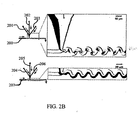
- FIG. 2B shows a photograph and a schematic diagram that depict mixing in water/oil plugs (upper schematic and photograph) and in laminar streams (lower schematic and photograph) comprising only aqueous plug-fluids.
- the oil carrier-fluid in this case
- water is introduced into the corresponding channel 207 in the case of mixing using laminar streams.
- the three aqueous plug-fluids are introduced by inlet ports 201, 202, 203 into the carrier-fluid (and by inlet ports 204,205,206 in the case of laminar streams).
- the middle or second aqueous plug-fluid in the top figure may be plain water, buffer, solvent, or a different plug-fluid.
- the middle aqueous plug-fluid would preferably initially separate the two other aqueous plug-fluids before the aqueous fluids come into contact with the carrier-fluid.
- the intervening aqueous plug-fluid would prevent, delay, or minimize the reaction or mixing of the two outer aqueous plug-fluids before they come in contact with the carrier-fluid.
- the plugs that form in the plug-forming region can continue along an unbranched channel, can split and enter a channel, can merge with plugs from another channel, or can exit the substrate through an exit port. It can be seen in FIG: 2 that, in the absence of an oil, the aqueous plug-fluids flow in laminar streams without significant mixing or with only partial mixing. In contrast, plug-fluids mix substantially or completely in the plugs.
- FIG. 3 shows photographs and schematic diagrams that depict a stream of plugs from an aqueous plug-fluid and an oil (carrier-fluid) in curved channels at flow rates of 0.5 ⁇ L/min (top schematic diagram and photograph) and 1.0 ⁇ L/min (bottom schematic diagram and photograph).
- This scheme allows enhanced mixing of reagents in the elongated plugs flowing along a curved channel with smooth corners or curves.
- the carrier-fluid is introduced into an inlet port 300, 307 of a substrate while the three aqueous plug-fluids are introduced in separate inlet ports 301-306. As in FIG.
- a preferred scheme would be one in which the plug-fluids initially coflow preferably along a short or minimal distance before coming in contact with the carrier-fluid.
- the distance traversed by the coflowing plug-fluids e.g ., aqueous plug-fluids
- the middle or second aqueous plug-fluid may comprise plain water, buffer, solvent, or a plug-fluid, and the middle aqueous plug-fluid preferably initially separates the two other aqueous plug-fluids before the aqueous plug-fluids come into contact with the carrier-fluid which, in this case, is an oil.
- the intervening aqueous plug-fluid would prevent, delay, or minimize the reaction or mixing of the two outer aqueous plug-fluids before they come in contact with the oil (or carrier-fluid).
- perfluorodecaline was used as the carrier-fluid and the plug-fluid was aqueous
- this system can be operated at values of C.n. up to ⁇ 0.1 (at 300 mm s -1 ).
- the value of the C.n. increased above ⁇ 0.2, the formation of plugs became irregular.
- the viscosity of perfluorodecaline is 5.10x10 -3 kg m -3 s -1
- the surface tension at the interface between the plugs and the carrier-fluid was 13x10 -3 N m -1 .
- the length of the plugs can be controlled such that their sizes can range from, for example, about 1 to 4 times a cross-sectional dimension (d, where d is a channel cross-sectional dimension) of a channel using techniques such as varying the ratio of the plug-fluids and carrier-fluids or varying the relative volumetric flow rates of the plug-fluid and carrier-fluid streams. Short plugs tend to form when the flow rate of the aqueous stream is lower than that of a carrier-fluid stream. Long plugs tend to form when the flow rate of the plug-fluid stream is higher than that of the carrier stream.
- the volume of a plug is taken equal to about 2xd 3 , where d is a cross-sectional dimension of a channel.
- the plugs can be formed in channels having cross-sectional areas of, for example, from 20 x 20 to 200 x 200 ⁇ m 2 , which correspond to plug volumes of between about 16 picoliters (pL) to 16 nanoliters (nL).
- the size of channels may be increased to about 500 ⁇ m (corresponding to a volume of about 250 nL) or more.
- the channel size can be reduced to, for example, about 1 ⁇ m (corresponding to a volume of about 1 femtoliter). Larger plugs are particularly useful for certain applications such as protein crystallizations, while the smaller plugs are particularly useful in applications such as ultrafast kinetic measurements.
- plugs conform to the size and shape of the channels while maintaining their respective volumes.
- plugs move from a wider channel to a narrower channel they preferably become longer and thinner, and vice versa.
- Plug-fluids may comprise a solvent and optionally, a reactant.
- Suitable solvents for use in the invention include organic solvents, aqueous solvents, oils, or mixtures of the same or different types of solvents, e.g . methanol and ethanol, or methanol and water.
- the solvents according to the invention include polar and non-polar solvents, including those of intermediate polarity relative to polar and non-polar solvents.
- the solvent may be an aqueous buffer solution, such as ultrapure water (e.g ., 18 M ⁇ resistivity, obtained, for example, by column chromatography), 10 mM Tris HCl, and 1 mM EDTA (TE) buffer, phosphate buffer saline or acetate buffer.
- ultrapure water e.g ., 18 M ⁇ resistivity, obtained, for example, by column chromatography
- 10 mM Tris HCl e.g ., 18 M ⁇ resistivity, obtained, for example, by column chromatography
- 10 mM Tris HCl e.g HCl
- 1 mM EDTA (TE) buffer e.g phosphate buffer saline or acetate buffer.
- Other solvents that are compatible with the reagents may also be used.
- the concentration of reagents in a plug can be varied.
- the reagent concentration may be adjusted to be dilute enough that most of the plugs contain no more than a single molecule or particle, with only a small statistical chance that a plug will contain two or more molecules or particles.
- the reagent concentration in the plug-fluid is adjusted to concentrate enough that the amount of reaction product can be maximized.
- Suitable carrier-fluids include oils, preferably fluorinated oils.
- oils include viscous fluids, such as perfluorodecaline or perfluoroperhydrophenanthrene; nonviscous fluids such as perfluorohexane; and mixtures thereof (which are particularly useful for matching viscosities of the carrier-fluids and plug-fluids).
- fluorinated compounds such as Fluorinert TM liquids (3M, St. Paul, MN) can also be used.
- the carrier-fluid or plug-fluid, or both may contain additives, such as agents that reduce surface tensions (e.g ., surfactants).
- agents that reduce surface tensions e.g ., surfactants
- Other agents that are soluble in a carrier-fluid relative to a plug-fluid can also be used when the presence of a surfactant in the plug fluid is not desirable.
- Surfactants may be used to facilitate the control and optimization of plug size, flow and uniformity.
- surfactants can be used to reduce the shear force needed to extrude or inject plugs into an intersecting channel.
- Surfactants may affect plug volume or periodicity, or the rate or frequency at which plugs break off into an intersecting channel.
- surfactants can be used to control the wetting of the channel walls by fluids.
- at least one of the plug-fluids comprises at least one surfactant.
- Preferred surfactants that may be used include, but are not limited to, surfactants such as those that are compatible with the carrier and plug-fluids.
- exemplary surfactants include Tween TM , Span TM , and fluorinated surfactants (such as Zonyl TM (Dupont, Wilmington DE)).
- fluorinated surfactants such as those with a hydrophilic head group, are preferred when the carrier-fluid is a fluorinated fluid and the plug-fluid is an aqueous solution.
- aqueous plugs are used as microreactors for chemical reactions (including biochemical reactions) or are used to analyze and/or sort biomaterials
- a water soluble surfactant such as SDS may denature or inactivate the contents of the plug.
- the carrier-fluid preferably wets the walls of the channels preferentially over the plugs. If this condition is satisfied, the plug typically does not come in contact with the walls of the channels, and instead remains separated from the walls by a thin layer of the carrier-fluid. Under this condition, the plugs remain stable and do not leave behind any residue as they are transported through the channels.
- the carrier-fluid's preferential wetting of the channel walls over the plug-fluid is achieved preferably by setting the surface tension by, for example, a suitable choice of surfactant.
- the surface tension at a plug fluid/channel wall interface (e.g ., about 38 mN/m surface tension for a water/PDMS interface) is set higher than the surface tension at a plug fluid/carrier-fluid interface ( e.g ., about 13 mN/m for a water/carrier-fluid interface with a surfactant such as 10% 1H,1H,2H,2H-perfluorooctanol in perfluorodecaline as the carrier-fluid).
- a surfactant such as 10% 1H,1H,2H,2H-perfluorooctanol in perfluorodecaline as the carrier-fluid.
- the surface tension at an interface may be measured using what is known as a hanging drop method, although one may also use other methods.
- the surface tension is sufficiently high to avoid destruction of the plugs by shear.
- one or more plugs are detected, analyzed, characterized, or sorted dynamically in a flow stream of microscopic dimensions based on the detection or measurement of a physical or chemical characteristic, marker, property, or tag.
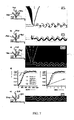
- FIG. 7(c) shows a false-color microphotograph (2 s exposure, individual plugs are invisible) showing time-averaged fluorescence arising from rapid mixing inside plugs of solutions of Fluo-4 (54 ⁇ M) and CaCl 2 (70 ⁇ M) in aqueous sodium morpholine propanesulfonate buffer (20 ⁇ M, pH 7.2); this buffer was also used as the middle aqueous stream.
- FIG. 7(d) shows a plot of the relative normalized intensity ( I ) of fluorescence obtained from images such as shown in (c) as a function of distance (left) traveled by the plugs and of time required to travel that distance (right) at a given flow rate. The total intensity across the width of the channel was measured.
- the plugs are transported along multi-step channels, instead of channels with smooth curves (as opposed to channels with sharp corners).
- An advantage of these multi-step configurations of channels is that they may provide further enhanced mixing of the substances within the plugs.
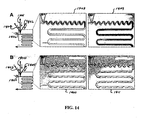
- FIG. 1A shows a schematic of a basic channel design
- FIG. 1B shows a series of periodic variations of the basic channel design
- FIG. 1C shows a series of aperiodic combinations resulting from a sequence of alternating elements taken from a basic design element shown in FIG. 1A and an element from the periodic variation series shown in FIGS. 1B(1)-(4) .
- aperiodic combinations of these periodic variations are preferably used to break the symmetries arising from periodic flows (see FIG. 1C ).
- the relevant parameters are channel width, period, radius of curvature, and sequence of turns based on the direction of the turns.
- Another approach for accelerating mixing relies on rationally-designed chaotic flows on a microfluidic chip using what is known as the baker's transformation. Reorientation of the fluid is critical for achieving rapid mixing using the baker's transformation.
- the baker's transformation leads to an exponential decrease of the striation thickness (the distance over which mixing would have to occur by diffusion) of the two components via a sequence of stretching and folding operations. Typically, every stretch-fold pair reduces the striation thickness by a factor of 2, although this factor may have a different value.
- the striation thickness (ST) can be represented, in an ideal case, by Eqn. (2) below.
- the baker's transformation is preferably implemented by creating channels composed of a sequence of straight regions and sharp turns.
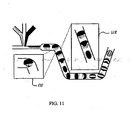
- FIG. 11 shows a schematic diagram of a channel geometry designed to implement and visualize the baker's transformation of plugs flowing through microfluidic channels. Other designs could also be used.
- the angles at the channel bends and the lengths of the straight portions are chosen so as to obtain optimal mixing corresponding to the flow patterns shown. Different lengths of straight paths and different turns may be used depending on the particular application or reaction involved.
- mixing time is expected to be approximately equal to the time it takes to travel 15d, and will decrease linearly with the size of the channel, t mix ⁇ d.
- a method that provides mixing in about 1 ms in 25- ⁇ m channels preferably provides mixing in about 40 ⁇ s in 1- ⁇ m channels. Achieving microsecond mixing times generally requires the use of small channels. High pressures are normally required to drive a flow through small channels.
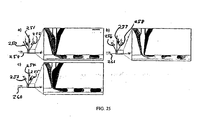
- twirling occurred only at the tip of the forming plug before the tip made contact with the right wall of the microchannel. Also, the amount of twirling in a plug was observed to be related to the amount of the carrier-fluid that flowed past the tip.
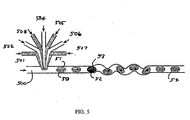
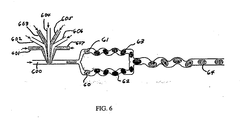
- the results of experiments involving twirling and its effect on mixing show that twirling is one of the most important factors, if not the most important factor, in determining the ideal conditions for mixing occurring within plugs moving through straight channels. By inducing twirling, one may stimulate mixing; by preventing twirling, one may suppress complete mixing. Suppressing mixing may be important in some of the reaction schemes, for example those shown in FIG. 5 and FIG. 6 .
- FIG. 10a is a schematic diagram depicting a three-dimensional confocal visualization of chaotic flows in plugs.
- Plugs are preferably formed from three laminar streams.
- the middle stream 11 preferably contains fluorescent markers.
- the middle stream 11 is injected into the channel system at a low volumetric flow rate.
- the volumetric flow rates of the two side streams 10, 12 are preferably adjusted to position the marker stream in a desired section of the channel.
- a confocal microscope such as a Carl Zeiss LSM 510 is used.
- the location of merging can be controlled in a variety of ways, for example by varying the location of plug-fluid inlet ports, by varying the location of channel junctions (if one of the plug forming fluids is introduced into a secondary channel), varying the size of the plugs, adjusting the speed at which different sets of plugs are transported varying the viscosity or surface tension of plugs having substantially the same size, etc.
- plugs can be merged by controlling the arrival time of the plugs flowing in opposite directions towards a common point, area, or region of the channel so that each pair of plugs arrive at the common point, area, or region of the channel at around the same time to form a single plug.
- the split 125 plugs may undergo merging or further splitting, or they may be directed to other channels, channel branches, area, or region of the substrate where they may undergo one or more reactions or "treatments" such as one or more types of characterizations, measurements, detection, sorting, or analysis.
- aqueous plugs can be split or sorted from an oil carrier fluid by using divergent hydrophilic and hydrophobic channels.
- the channels are rendered hydrophilic or hydrophobic by pretreating a channel or region of a channel such that a channel or channel surface becomes predominantly hydrophilic or hydrophobic.
- substrates with hydrophilic channel surfaces may be fabricated using methods such as rapid prototyping in polydimethylsiloxane.
- the channel surface can be rendered hydrophobic either by silanization or heat treatment.
- electrodes can be fabricated onto a substrate to control the force fields in a micro fabricated device.
- Dielectrophoresis is particularly suitable for moving objects that are electrical conductors.
- the use of AC current is preferred, to prevent permanent alignment of ions.
- Megahertz frequencies are suitable to provide a net alignment, attractive force, and motion over relatively long distances.
- Radiation pressure can also be used in the invention to deflect and move plugs and reagents/products contained therein with focused beams of light such as lasers.
- Flow can also be obtained and controlled by providing a thermal or pressure differential or gradient between one or more channels of a substrate or in a method according to the invention.
- the carrier-fluids used are those having refractive indices that match those of commonly used aqueous solutions at the wavelengths used for observation.
- the plugs preferably contain known concentrations of fluorescein.
- the fluorescence originating from the plugs are measured and then compared with the fluorescence arising from the same solution of fluorescein in the channel in the absence of oil.
- I plug I solution * V water / V water + V oil where V is the volumetric flow rate of the fluid streams. It is expected that smaller plugs with a higher proportion of curved interfaces will show larger deviations from ideal plug behavior, i. e., those smaller plugs will tend to cause greater optical distortion. If necessary, measurements are performed partly to determine the errors associated with refractive index mismatch.
- the devices and methods of the invention can be also used for performing experiments typically done in, for example, a microtiter plate where a few reagents are mixed at many concentrations and then monitored and/or analyzed. This can be done, for example, by forming plugs with variable composition, stopping the flow if needed, and then monitoring the plugs.
- the assays may be positionally encoded, that is, the composition of the plug may be deduced from the position of the plug in the channel.
- the devices and methods of the invention may be used to perform high-throughput screening and assays useful, for example, in diagnostics and drug discovery. In particular, the devices and methods of the invention can be used to perform relatively fast kinetic measurements.
- ⁇ P in units of Pa
- U (m/s) is the velocity of the flow
- ⁇ (kilogram/meter-second, kg m -1 s -1 ) is the viscosity of the fluid
- l (m) is the length of the capillary
- a (m) is the height of the capillary
- b (m) is the width of the capillary.
- microfluidic devices according to the invention which allow chaotic mixing and compartmentalization, are used to overcome this problem.
- a microfluidic system according to the invention is used to handle unstable mixtures.
- a microfluidic system according to the invention is preferably used to control a stochastic reaction between NaClO 2 and NaS 2 O 3 .
- this reaction is preferably used for a highly sensitive amplification process.
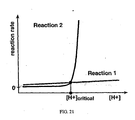
- Autocatalytic reactions show a threshold response, that is, there is a very abrupt temporal change from unreacted mixture to reacted mixture. In the case where time is equal to distance, this abrupt transition over a short distance can be observed using the devices and methods of the invention.
- the time (and distance) is very sensitive to the initial concentration of the catalyst, and thus it should be easy to determine the concentration of the autocatalyst in the sample by noting how far the reaction system traveled before it reacted.
- microscopic beads containing immobilized tissue factor (the cascade initiator) on the surface may be added to one of the streams and transported inside the plugs.
- surfactants may be used to control surface chemistry.
- a method of conducting a reaction within a substrate is provided.
- the reaction is initiated by introducing two or more plug-fluids containing reactants into the substrate of the present invention.
- All of the above synthesis methods of the present invention can be used to form macroscopic quantities of one or more reaction products by running multiple reactions in parallel.
- the devices and methods of the invention allow fast, inexpensive miniaturization of existing crystallization methods and other methods that can be adapted into, for example, novel protein screening and crystallization techniques.
- the crystallization methods according to the invention may be applied to various drugs, materials, small molecules, macromolecules, colloidal and nanoparticles, or any of their combinations. Many relevant protein structures remain undetermined due to their resistance to crystallization. Also, many interesting proteins are only available in microgram quantities. Thus, a screening process must permit the use of small amounts protein for analysis.
- Current crystallization screening technologies generally determine the ideal conditions for protein crystallization on a milligram scale. Devices and methods according to the invention improve current bench-top methodology available to single users, and enables higher throughput automated systems with improved speed, sample economy, and entirely new methods of controlling crystallization.
- Crystal properties such as appearance, size, optical quality, and diffractive properties may be characterized and measured under different conditions.
- a Raxis IIc X-ray detector mounted on a Rigaku RU 200 rotating anode X-ray generator, which is equipped with double focusing mirrors and an MSC cryosystem, may be used for at least some of the characterizations and measurements.
- a synchrotron beam may be useful for characterization of small crystals.
- these devices and methods may be used to build microfluidic systems according to the invention that are compatible with structural studies using x-ray beams.
- Solution pH can be varied by the inclusion of buffering agents; typical pH ranges for biological materials lie anywhere between values of 3 and 10.5 and the concentration of buffer generally lies between 0.01 and 0.25 M.
- buffering agents typical pH ranges for biological materials lie anywhere between values of 3 and 10.5 and the concentration of buffer generally lies between 0.01 and 0.25 M.
- the microfluidics devices described in this document are readily compatible with a broad range of pH values, particularly those suited to biological targets.
- additives that may be used in accordance with the invention: 2-butanol; DMSO; hexanediol; ethanol; methanol; isopropanol; sodium fluoride; potassium fluoride; ammonium fluoride; lithium chloride anhydrous; magnesium chloride hexahydrate; sodium chloride; calcium chloride dihydrate; potassium chloride; ammonium chloride; sodium iodide; potassium iodide; ammonium iodide; sodium thiocyanate; potassium thiocyanate; lithium nitrate; magnesium nitrate hexahydrate; sodium nitrate; potassium nitrate; ammonium nitrate; magnesium formate; sodium formate; potassium formate; ammonium formate; lithium acetate dihydrate; magnesium acetate tetrahydrate; zinc acetate dihydrate; sodium acetate trihydrate; calcium acetate hydrate; potassium acetate; ammonium acetate; lithium sul
- any number of salts or small molecular weight organic compounds can be used as a cryoprotectant, and typical ones include but are not limited to: MPD, PEG-400 (as well as both PEG derivatives and higher molecular-weight PEG compounds), glycerol, sugars (xylitol, sorbitol, erythritol, sucrose, glucose, etc.), ethylene glycol, alcohols (both short- and long chain, both volatile and nonvolatile), LiOAc, LiCl, LiCHO 2 , LiNO 3 , Li 2 SO 4 , Mg(OAc) 2 , NaCl, NaCHO 2 , NaNO 3 , etc.
- materials from which microfluidics devices in accordance with the present invention are fabricated may be compatible with a range of such compounds.
- the flow is preferably stopped once the desired number of plugs are formed.
- the plugs are then preferably allowed to incubate.
- the flow may be continued, rather than stopped.
- the flow is maintained sufficiently slow and the channels are made sufficiently long that plugs spend sufficient time in the channels for crystallization to occur (from tens of minutes to weeks, but may be faster or slower).
- FIG. 16 is a schematic illustration of a microfluidic device according to the invention that illustrates the trapping of plugs.
- plugs were sustained in perfluorodecaline inside a channel for one day, and did not appear to change during that time (a refractive index mismatch between the fluorinated and aqueous phase was introduced to aid in visualization of plugs).
- Vapor diffusion can be performed in two ways.
- the one most often used is called Hanging Drop Technique.
- the drop is placed on a glass coverslip, which is then inverted and used to seal a small reservoir in a Linbro Plate. After a period of several hours to weeks, microscopic crystals may form and continue to grow.
- the other set up is known as Sitting Drop.
- a drop (usually >10uL) is placed in a depression in either a Micro Bridge in a Linbro Plate or a glass plate and again placed in a closed system to equilibrate with a much larger reservoir.
- One usually uses the sitting drop technique if the drop has very low surface tension, making it hard to turn upside down or if the drops need to be larger than 20uL. Also, in some cases, crystals will grow better using one technique or the other.
- control of nucleation is highly desired in an advanced crystallization screen.
- One method that can be used to achieve control of nucleation involves the transfer of nucleating crystals from one concentration to another via dilution. This method, which has been applied in macroscopic systems primarily to vapor diffusion, was intended to allow decoupling of the nucleation and growth phases. This method is difficult to perform using traditional methods of crystallization because nucleation occurs long before the appearance of microcrystals..
- FIG. 19 illustrates a method of separating nucleation and growth using a microfluidic network according to the present invention using proteins as a non-limiting example.
- the left side of FIG. 19 shows plugs that are formed preferably using high concentrations of protein and precipitant.
- the following can be introduced into the various inlets shown: buffer into inlets 191, 196; PEG into inlets 192, 197; precipitant into inlets 193, 198; solvent into inlets 194, 199; and protein into inlets 195, 200.
- Oil flows through the channels 201, 202 from left to right.
- the portions 203, 204, and 205 of the channel correspond to regions where fast nucleation occurs (203), no nucleation occurs (204), and where crystal growth occurs (205).
- Nucleation time can be varied by varying the flow rate along the nucleation channel.
- the nucleus is preferably used as a seed crystal for a larger plug with solution concentrations that correspond to a metastable region.
- Existing data indicate the formation of nuclei within less than about 5 minutes.
- the two methods in accordance with the invention depicted in FIG. 20 can be used to determine the effect of mixing on protein crystallization.
- the various methods for controlling mixing described previously e.g ., slow mixing in straight channels, chaotic mixing in non-straight channels, or mixing in which twirling may or may not occur
- the crystals may be removed from the microfluidic device for structure determination.
- the fragile and gelatinous nature of protein crystals makes crystal collection difficult.
- removing protein crystals from solid surfaces can damage them to the point of uselessness.
- the present invention offers a solution to this problem by nucleating and growing crystals in liquid environments.
- a thin wetting layer of a carrier-fluid covered with a surfactant is used to enable or facilitate the separation of a growing crystal from a solid surface.
- the crystals may be separated from the PDMS layer by using a thin layer of a carrier-fluid.
- the flow within the moving plugs can be used for separation of polymers and particles.
- Plugs can be used for separation by first using flow within a moving plug to establish a distribution of the polymers or particles inside the plug (for example, an excess of the polymer inside the front, back, right or left side of the plug) and then using splitting to separate and isolate the part of the plug containing higher concentration of the polymers or particles. When two polymers or particles are present inside the plug and establish different distributions, splitting can be used to separate the polymers or particles.
- Oils and aqueous solutions were pumped through devices using a kdScientific syringe pump (Model 200) or Harvard Apparatus PhD 2000 pump. Hamilton Company GASTIGHT syringes were used (10-250 ⁇ l) and Hamilton Company 30 gauge Teflon ® needles were used to attach the syringes to the devices. Oils and aqueous solutions were pumped through devices at volumetric flow rates ranging from about 0.10 ⁇ L/min to about 10.0 ⁇ L/min.
- Aqueous solutions were colored using Crayola Original Formula Markers or Ferroin Indicator (0.025 M, Fisher Scientific). Oils that were used included perfluorodecaline (mixture of cis and trans, 95%, Acros Organics), perfluoroperhydrophenanthrene (tech., Alfa-Aesar), or 1H,1H,1H,2H-perfluorooctanol (98%, Alfa-Aesar). The experiments were typically performed using 10:1 1 mixtures of perfluorodecaline and 1H, H,2H,2H-perfluorooctanol.
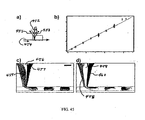
- FIG. 45a shows a schematic of the microfluidic network used to demonstrate that on-chip dilutions can be accomplished by varying the flow rates of the reagents.
- the reagents are introduced through inlets 451, 453 while the dilution buffer is introduced through inlet 452.
- An oil stream flows through channel 454.
- the blue rectangle outlines the field of view for images shown in FIG. 45c )-d).
- FIG. 45b shows a graph quantifying this dilution method by measuring fluorescence of a solution of fluorescein diluted in plugs in the microchannel.
- FIG. 45(c) shows photographs illustrating this dilution method with streams of food dyes 455, 456, 457 having flow rates of 45 nL/s, 10 nL/s, and 10nL/s, respectively.
- FIG. 45(d) shows photographs illustrating this dilution method with streams of food dyes 458, 459, 460 having flow rates of 10 nL/s, 45 nL/s, and 10nL/s, respectively.
- Carrier fluid was flowed at 60 nL/s.
- Aqueous solutions were pumped using 100 ⁇ L Hamilton Gastight syringes (1700 series, TLL) or 50 ⁇ L SGE gastight syringes.
- PFD was pumped using 1mL Hamilton Gastight syringes (1700 series, TLL).
- the syringes were attached to microfluidic devices by means of Hamilton Teflon needles (30 gauge, 1 hub).
- Syringe pumps from Harvard Apparatus PLD 2000 Infusion pumps; specially-ordered bronze bushings were attached to the driving mechanism to stabilize pumping) were used to infuse the aqueous solutions and PFD.
- Microphotographs were taken with a Leica MZ12.5 stereomicroscope and a SPOT Insight Color digital camera (Model #3.2.0, Diagnostic Instruments, Inc.).
- SPOT Advanced software version 3.4.0 for Windows, Diagnostic Instruments, Inc.
- Lighting was provided from a Machine Vision Strobe X-Strobe X1200 (20Hz, 12 ⁇ F, 600V, Perkin Elmer Optoelectronics).
- the shutter of the camera was opened for 1 second and the strobe light was flashed once with the duration of the flash being about 10 ⁇ s.
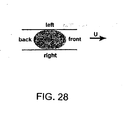
- Image J was used to measure periods and lengths of plugs from microphotographs such as shown in Fig. 27b ). Periods corresponded to the distance from the center of one plug to the center of an adjacent plug, and the length of a plug was the distance from the extreme front to the extreme back of the plug (see FIG. 28 for the definitions of front and back). Measurements were initially made in pixels, but could be converted to absolute measurements by comparing them to a measurement in pixels of the 50 ⁇ m width of the channel.
- microphotographs were converted from RGB to CMYK color mode in Adobe Photoshop 6.0. Using the same program, the yellow color channels of the microphotographs were then isolated and converted to grayscale images, and the intensities of the grayscale images were inverted. The yellow color channel was chosen to reduce the intensity of bright reflections at the extremities of the plugs and at the interface between the plugs and the channel. Following the work done in Photoshop, regions of plugs containing high concentrations of Fe(SCN) x (3-x)+ , complexes appeared white while regions of low concentration appeared black.
- FIG. 29a )-b) shows plots of the sizes of periods and sizes of plugs as a function of total flow velocity ( FIG. 29a )) and water fraction (wf) ( FIG. 29b )).
- Values of capillary number (C.n.) were 0.0014, 0.0036, 0.0072 and 0.011, while values of the Reynolds number (R e ) were 1.24, 3.10, 6.21, and 9.31, each of the C.n. and R e value corresponding to a set of data points with water fractions (wf) 0.20, 0.52, 0.52, and 0.20 (the data points from top to bottom in FIG. 29A )).
- each of these sets of data points corresponds to a particular flow velocity as shown in FIG. 29a ).
- Plugs in FIG. 29b ) travel at about 50 millimeter/second (mm/s). All measurements of length and size are relative to the width of the channels (50 ⁇ m).
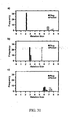
- FIG. 31A-C are plots showing the distribution of periods and lengths of plugs where the water fractions were 0.20, 0.40, and 0.73, respectively.
- FIG. 27b shows microphotographs of plugs of various lengths near the plug-forming region of the microfluidic network for water fractions of from 0.14 up to 1.00.
- FIG. 27c2 is the same as FIG.
- the larger plugs from the bigger channel are able to merge with the smaller plugs from the narrower channel even when they do not arrive at the junction at the same time. This is because lagging larger plugs are able to catch up with the leading smaller plugs once the plugs are in the common channel.
- FIG. 33d illustrates defects (i.e., plugs that fail to undergo merging when they would normally merge under typical or ideal conditions) produced by fluctuations in the relative velocity of the two incoming streams of plugs.
- the oil streams were introduced into inlets 342, 344, while the aqueous streams were introduced into inlets 343, 345.
- the flow rate corresponding to the fluid stream through channel 352 resulting from a 1:1 oil-to-water volumetric ratio was 4.0 mm/s, while that through channel 353 corresponding to the 4:1 oil-to-water volumetric ratio was 6.9 mm/s.
- Each branch channel that formed one of the two branches of the Y-shaped intersection was 50 x 50 ⁇ m 2 while the common channel 354 (the channel to which the two branch channels merge) is 125 x 50 ⁇ m 2 .
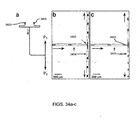
- FIG. 34a shows a schematic diagram of the channel network used in the experiment.
- the oil and water were introduced into inlets 3400 and 3401, respectively.
- the oil-to-water ratio was 4:1 while the flow rate past the junction where the oil and water meet was 4.3 mm/s.
- FIG. 34c is a microphotograph showing the asymmetric splitting of plugs (i.e., the splitting of plugs into plugs of different sizes or lengths) which occurred when P 1 ⁇ P 2 .
- the microphotograph shows that larger plugs (somewhat rectangular in shape) flowed along the channel with the lower pressure P 1 , while smaller plugs (spherical in shape) flowed along the channel with the higher pressure P 2 .
- each of the channel 3405 cross-section measured 50 x 50 ⁇ m 2 .
- the constricted section of the channel 3403 at the junction measured 25 x 50 ⁇ m 2 .
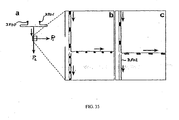
- FIGS. 35b-c The splitting of plugs was investigated using a channel network without a constriction such as the one shown in FIGS. 35b-c .
- the channel network used was similar to that shown in FIG. 34(a) except that here the plugs split and flowed past the junction in two separate channels at a 90°-angle to each other (the plug flow being represented by arrows).
- the oil and aqueous streams (4:1 oil:aqueous stream ratio) were introduced into inlets 3500 and 3501, respectively.
- An oil-only stream flowed through channel 3502. All channels had a cross-section of 50 x 50 ⁇ m 2 .
- the flow rate used was 4.3 mm/s.
- 35a-c which represent top views of a channel network, show that plugs behave differently compared to the plugs in Example 3 when they flow past a junction in the absence of a channel constriction, such as a constriction shown in FIGS. 35b-c .
- FIG. 35c shows, when P 1 ⁇ P 2 , the plugs remained intact after passing through the junction. Further, the plugs traveled along the channel that had the lower pressure (P 1 in FIG. 35c ) while the intervening oil stream split at the junction. The splitting of the oil stream at the junction gives rise to a shorter separation between plugs flowing along the channel with pressure P 1 compared to the separation between plugs in the channel upstream of the branching point or junction.
- FIG. 37 illustrates the design of an experiment involving chemical amplification in microfluidic devices according to the invention that involves an investigation of a stochastic autocatalytic reaction.
- This example illustrates how the devices of the present invention can be used to study the acid-sensitive autocatalytic reaction between NaClO 2 and NaS 2 O 3 .
- a three-channel inlet introduces an aqueous stream through channel 3702, an ester through channel 3701, and an esterase through channel 3703. Oil flowed through channels 3713, 3714. The reaction between ester and esterase yield plugs 3704 that contain a small amount of acid.
- Example 8 Using Chemical Reactions as Highly Sensitive Autoamplifying Detection Elements in Microfluidic Devices
- a sequential amplification using controlled autocatalytic systems is used to amplify samples that contain single molecules of autocatalysts into samples containing a sufficiently high concentration of an autocatalyst such that the amplified autocatalyst can be detected with the naked eye can be detected with the naked eye.
- systems displaying stochastic behavior are expected to display high sensitivity and amplification, various autocatalytic systems can be used in accordance with the invention.
- a microfluidic network as shown in FIG. 38 is preferably used.
- These large plugs are preferably split in accordance with the invention into three different sizes of plugs.
- a three-step photolithography is preferably used in the fabrication of masters for these microfluidic channels.
- FIG. 38 illustrates a method for a multi-stage chemical amplification for single molecule detection using microfluidic devices according to the invention.
- This reaction mixture (contained in plugs 3811) is unstable and decomposes rapidly (shown in red) when small amounts of Co 2+ 3810 are added. Thus, this reaction mixture is preferably mixed quickly and used immediately.
- the reaction mixture is preferably transported through the network in (1 ⁇ m) 3 , (10 ⁇ m) 3 , (100 ⁇ m) 3 size plugs.
- the approximately 1 ⁇ m 3 plugs of the sample to be analyzed form at a junction of two channels (shown in green).
- the merging of plugs containing Co 2+ ions and plugs containing the reaction mixture results in a rapid autocatalytic reaction.
- each Co 2+ ion in a plug can be amplified to about 10 10 Co 2+ ions per plug. The result of amplification is visually detectable.
- the (10 ⁇ m) 3 plugs are preferably merged with larger (100 ⁇ m) 3 plugs in the third channel to give approximately 4 ⁇ 10 -8 mole/L solution of Co 2+ ions.
- Autocatalytic decomposition in the approximately 10 -9 L plugs will produce plugs 3809 with about 2.4 ⁇ 10 10 Co 2+ ions (4 ⁇ 10 -5 mole/L).
- the flow rates in this system are preferably controlled carefully to control the time that plugs spend in each branch.
- the time provided for amplification is preferably long enough to allow amplification to substantially reach completion, but short enough to prevent or minimize slow decomposition.
- Plugs with a size of about (1 ⁇ m) 3 are preferably formed by flowing a sample containing about 3 ⁇ 10 -9 mole/L Co 2+ through channel 3806. This reaction can be used to detect Co 2+ at this, or lower, concentration ( Endo et al., "Kinetic determination of trace cobalt(II) by visual autocatalytic indication," Talanta, 1998, vol. 47, pp. 349-353 ; Endo et al., "Autocatalytic decomposition of cobalt complexes as an indicator system for the determination of trace amounts of cobalt and effectors," Analyst, 1996, vol. 121, pp. 391-394 .).
- Channels are preferably designed to create an optical path through at least ten consecutive 100 ⁇ m plugs. These plugs will provide an approximately 1-mm long optical path, with absorbance of the starting 4 ⁇ 10 -5 mole/L solution of about 0.4. This absorbance can be detected by an on-chip photodetector or with the naked eye. If Co 2+ is present in the sample solution, an autocatalytic cascade will result in the disappearance of the color of the reaction mixture.
- the system may show stochastic behavior, that is, not every Co 2+ ion would give rise to a decomposition cascade.
- the attractive feature of this system is that thousands of tests can be carried out in a matter of seconds, and statistics and averaging can be performed.
- a sequence of controlled autocatalytic amplification reactions leads to a visual detection of single ions.
- a microfluidic chip according to the invention was used to measure millisecond single-turnover kinetics of ribonuclease A (RNase A; EC 3.1.27.5), a well-studied enzyme. Sub-microliter sample consumption makes the microfluidic chip especially attractive for performing such measurements because they require high concentrations of both the enzyme and the substrate, with the enzyme used in large excess.
- RNase A ribonuclease A
- the channels were designed to wind so that rapid chaotic mixing was induced, and were designed to fit within the field of view of the microscope so that the entire reaction profile could be measured in one spatially resolved image.
- Selwyn's test Duggleby, R. G., Enzyme Kinetics and Mechanisms, Pt D; Academic Press: San Diego, 1995, vol. 249, pp. 61-90 ; Selwyn, M. J. Biochim. Biophys. Acta, 1965, vol. 105, pp. 193-195 ) was successfully performed in this system to establish that there were no factors leading to product inhibition or RNase A denaturation.
- the systems and methods of the present invention are preferably used to conduct kinetic measurements of, for example, folding in the time range from tens of microseconds to hundreds of seconds.
- the systems and methods according to the invention allow kinetic measurements using only small amounts of sample so that the folding of hundreds of different RNA mutants can be measured and the effect of mutation on folding established.
- the kinetics of RNA folding is preferably measured by adding Mg 2+ to solutions of previously synthesized unfolded RNA labeled with FRET pairs in different positions.
- the concentrations of Mg 2+ are preferably varied in the 0.04 to 0.4 ⁇ M range by varying the flow rates (see, for example, FIGS. 25a )-c)) to rapidly determine the folding kinetics over a range of conditions.
- the ability to integrate the signal over many seconds using the steady-flow microfluidic devices according to the invention can further improve sensitivity.
- 25a )-c) illustrate the formation of plugs with different concentrations of the aqueous streams.
- the various shadings inside the streams and plugs arise from the use of aqueous solutions of food dyes (red/dark and green/light), which allowed visualization, and water were used as the three streams, the darker shading arising mainly from the red dye color while the lighter shading arising mainly from the green dye color.
- the dark stream is more viscous than the light stream, therefore it moves slower (in mm/s) and occupies a larger fraction of the channel at a given volumetric flow rate (in ⁇ L/min).
- An aqueous solution of 0.80 mM polyphosphates Na(PO 3 ) n was flowed through the central inlet channel 152 at 8 ⁇ L min -1 , and an aqueous solution of 0.96 mM Na 2 S was flowed through the right-most inlet channel 153 at 8 ⁇ L min -1 .
- Nanoparticles were also formed without microfluidics. Solutions of CdCl 2 , polyphosphates, Na 2 S, and 3-mercaptopropionic acid, identical to those used in the microfluidics experiment, were used. 0.5 mL of the solution of CdCl 2 and 3-mercaptopropionic acid, 0.5 mL of polyphosphates solution, and 0.5 mL of Na 2 S solution were combined in a cuvette, and the cuvette was shaken by hand. Immediately after mixing; 1.5 mL of 26.2 mM 3-mercaptopropionic acid was added to the reaction mixture to terminate the reaction, and the cuvette was again shaken by hand. Based on the UV-VIS spectrum, substantially polydisperse nanoparticles formed in this experiment.
- Aqueous solutions were pumped using 10 ⁇ l or 50 ⁇ l Hamilton Gastight syringes (1700 series).
- Carrier-fluid was pumped using 50 ⁇ l Hamilton Gastight syringes (1700 series).
- the syringes were attached to microfluidic devices by means of Teflon tubing (Weico Wire & Cable Inc., 30 gauge). Syringe pumps from Harvard Apparatus (PHD 2000) were used to inject the liquids into microchannels.
- Microbatch crystallization conditions can be achieved. This experiment shows that size of plugs can be maintained and evaporation of water prevented.
- the PDMS device has been soaked in water overnight before the experiment in order to saturate PDMS with water. The device was kept under water during the experiment.
- the flow rates of carrier-fluid and NaCl solution were 2.7 ⁇ L/min and 1.0 ⁇ L/min, respectively. The flow was stopped by cutting off the Teflon tubing of both carrier-fluid and NaCl solution.
- the plug traps are separated by narrow regions that help force the plugs into the traps.
- FIG. 41 shows a microphotograph (middle and right side) of the water plugs region of the microfluidic network.
- Red aqueous solution is 50 % waterman red ink in 0.5 M NaCl solution.
- Ink streams were then introduced into inlets 411, 412, 413.
- An oil stream flowed through channel 414.
- the carrier-fluid is FC-3283 (3M Fluorinert Liquid) with 2 % 1H,1H,2H,2H-perfluorodecanol. This photograph demonstrates that the evaporation of water through PDMS can be controlled, and thus the concentration of the contents inside the drops can be increased (this is equivalent to microbatch crystallization).
- FIG. 41(a) shows a diagram of the microfluidic network.
- FIG. 39 shows a diagram (left side) of a microfluidic network according to the invention.
- Aqueous streams were introduced into inlets 3901, 3902, 3903 while an oil stream flowed through channel 3904.
- FIG. 39 also shows a microphotograph (right side) of the water plug region of the microfluidic network. This image shows water plugs attached to the PDMS wall. This attachment occurs when low concentrations of surfactant, or less-effective surfactants are used. In this case 1H,1H,2H,2H-perfluorooctanol is less effective than 1H,1H,2H,2H-perfluorodecanol.
- the oil is FC-3283 (3M Fluorinert Liquid) with 2% 1H,1H,2H,2H-perfluorooctanol as the surfactant.
- Fig 36 depicts lysozyme crystals grown in water plugs in the wells of the microfluidic channel. Lysozyme crystals started to appear inside aqueous plugs both inside and outside plug traps in approximately 10 minutes. The image of the three crystals in FIG. 36 was taken 1 hour after the flow was stopped. Lysozyme crystals appear colored because they were observed under polarized light. This is common for protein crystals.
- neutral surfactants that are soluble in perfluorinated phases are preferably used to create positively and negatively-charged interfaces.
- neutral surfactants that can be charged by interactions with water, e.g ., by protonation of an amine or a guanidinium group ( FIG. 24B ), or deprotonation of a carboxylic acid group ( FIG. 24C ), are preferably used.
- charged surfaces are used to repel, immobilize, or stabilize charged biomolecules.
- Negatively charged surfaces are useful for handling DNA and RNA without surface adsorption.
- both negatively and positively-charged surfaces are used to control the nucleation of protein crystals.
- a modification and improvement of a procedure based on the synthesis of perfluoro non-ionic surfactants is preferably used.
- the synthesis relies on the higher acidity of the fluorinated alcohol to prevent the polycondensation of the oligoethylene glycol.
- the modified synthesis uses a selective benzylation of one of the alcohol groups of oligoethylene glycol, followed by activation of the other alcohol group as a tosylate.
- a Williamson condensation is then performed under phase transfer conditions followed by a final deprotection step via catalytic hydrogenation using palladium on charcoal.
- the surface tension of the oil/water interface has to be sufficiently high in order to maintain a low value of capillary number, C.n.
- the fluorosurfactant/water interfaces for water-insoluble fluorosurfactants have not been characterized, but these surfactants are predicted to reduce surface tension similar to that observed in a system involving Span on hexane/water interface (about 20 mN/m).
- the surface tensions of the aqueous/fluorous interfaces are preferably measured in the presence of fluorosurfactants using the hanging drop method. A video microscopy apparatus specifically constructed for performing these measurements has been used to successfully characterize interfaces.
- FIG. 24 illustrates the synthesis of fluorinated surfactants containing perfluoroalkyl chains and an oligoethylene glycol head group.
- Example 16 Forming Gradients by Varying Flow Rates
- FIG. 42 shows an experiment involving the formation of gradients by varying the flow rates.
- networks of microchannels were fabricated using rapid prototyping in polydimethylsiloxane (PDMS). The width and height of the channel were both 50 ⁇ m. 10% 1H,1H,2H,2H-perfluorodecanol in perfluoroperhydrophenanthrene was used as oil.
- Red aqueous solution prepared from 50 % waterman red ink in 0.5 M NaCl solution was introduced into inlet 421. The oil flowed through channel 424 at 0.5 ⁇ l/min. Aqueous streams were introduced into inlets 422, 423.
- FIG. 43 illustrates an experiment involving the formation of lysozome crystals using gradients.
- the channel regions 435, 437 correspond to channel regions with very low precipitant concentration while channel region 436 corresponds to optimal range of precipitant concentration.
- networks of microchannels were fabricated using rapid prototyping in polydimethylsiloxane (PDMS). The width of the channel was 150 ⁇ m and the height was 100 ⁇ m. 10% 1H,1H,2H,2H-perfluorodecanol in perfluoroperhydrophenanthrene was used as oil.
- PDMS polydimethylsiloxane
Landscapes
- Chemical & Material Sciences (AREA)
- Health & Medical Sciences (AREA)
- Chemical Kinetics & Catalysis (AREA)
- Life Sciences & Earth Sciences (AREA)
- General Health & Medical Sciences (AREA)
- Organic Chemistry (AREA)
- Dispersion Chemistry (AREA)
- Analytical Chemistry (AREA)
- Biochemistry (AREA)
- Physics & Mathematics (AREA)
- Clinical Laboratory Science (AREA)
- Immunology (AREA)
- Hematology (AREA)
- Pathology (AREA)
- General Physics & Mathematics (AREA)
- Molecular Biology (AREA)
- Wood Science & Technology (AREA)
- Zoology (AREA)
- Engineering & Computer Science (AREA)
- Biotechnology (AREA)
- Microbiology (AREA)
- Bioinformatics & Cheminformatics (AREA)
- General Engineering & Computer Science (AREA)
- Genetics & Genomics (AREA)
- Proteomics, Peptides & Aminoacids (AREA)
- General Chemical & Material Sciences (AREA)
- Biophysics (AREA)
- Fluid Mechanics (AREA)
- Physical Or Chemical Processes And Apparatus (AREA)
- Apparatus Associated With Microorganisms And Enzymes (AREA)
- Enzymes And Modification Thereof (AREA)
- Automatic Analysis And Handling Materials Therefor (AREA)
- Micromachines (AREA)
- Peptides Or Proteins (AREA)
- Measuring Or Testing Involving Enzymes Or Micro-Organisms (AREA)
- Preparation Of Compounds By Using Micro-Organisms (AREA)
- Organic Low-Molecular-Weight Compounds And Preparation Thereof (AREA)
- Refuse Collection And Transfer (AREA)
- Control Of Fluid Pressure (AREA)
Claims (52)
- Procédé de réalisation d'une réaction dans au moins un bouchon dans un substrat, comprenant les étapes consistant à :fournir un substrat comprenant un premier canal ;introduire un fluide porteur dans le premier canal du substrat ;introduire simultanément au moins deux fluides bouchons différents qui sont immiscibles avec le fluide porteur dans une première entrée, en communication fluidique avec le premier canal, où un premier fluide bouchon comprend un premier réactif, et un second fluide bouchon comprend un second réactif ; etappliquer une pression au premier canal pour provoquer un écoulement de fluide dans le substrat ;où au moins un des fluides bouchons forme une interface avec le fluide porteur lors de l'entrée en contact avec le fluide porteur ; etoù l'interface a un nombre capillaire choisi pour permettre la formation fiable d'au moins un bouchon dans le premier canal dans le fluide porteur, le bouchon comprenant un mélange de fluides bouchons, de sorte que la réaction du premier réactif et du second réactif survienne sensiblement dans le bouchon.
- Procédé selon la revendication 1, dans lequel le fluide porteur comprend une huile.
- Procédé selon la revendication 1, dans lequel le fluide porteur comprend un composé fluoré.
- Procédé selon la revendication 3, dans lequel l'huile fluorée est la perfluorodécaline ou le perfluoroperhydrophénanthrène.
- Procédé selon la revendication 1, dans lequel le fluide porteur comprend au moins un tensioactif.
- Procédé selon la revendication 1, dans lequel ledit au moins un des fluides bouchons comprend un réactif et un solvant.
- Procédé selon la revendication 1, dans lequel au moins un des fluides bouchons comprend un solvant et un tensioactif.
- Procédé selon la revendication 1, dans lequel les fluides bouchons sont introduits à travers au moins une entrée.
- Procédé selon la revendication 1, comprenant en outre le réglage de la concentration de fluides bouchons dans les bouchons en ajustant les débits volumétriques des fluides bouchons.
- Procédé selon la revendication 1, dans lequel les bouchons sont formés au nombre capillaire ≤ à environ 0,2.
- Procédé selon la revendication 1, dans lequel la réaction des fluides bouchons forme un produit de réaction insoluble dans au moins un bouchon.
- Procédé selon la revendication 1, dans lequel une réaction des fluides bouchons forme un produit de réaction soluble dans au moins un bouchon.
- Procédé selon la revendication 1, dans lequel les fluides bouchons sont introduits dans le premier canal par une entrée unique.
- Procédé selon la revendication 13, dans lequel les fluides bouchons sont des courants laminaires distincts au niveau ou avant l'entrée.
- Procédé selon la revendication 1, dans lequel les fluides bouchons sont introduits dans le premier canal à travers deux entrées ou plus.
- Procédé selon la revendication 1, comprenant en outre l'étape consistant à accélérer le mélange des fluides bouchons dans un bouchon.
- Procédé selon la revendication 16, dans lequel le mélange est accéléré en modifiant la géométrie le long d'un canal.
- Procédé selon la revendication 17, dans lequel les canaux comprennent un ou plusieurs tours, des pliures et sections droites ou des mélanges correspondants.
- Procédé selon la revendication 16, dans lequel le mélange est accéléré en faisant s'écouler les bouchons par une géométrie de canal conçue pour mettre en oeuvre une transformation de Baker.
- Procédé selon la revendication 16, dans lequel le mélange est accéléré en modifiant la composition d'au moins un des fluides bouchons ou du fluide porteur.
- Procédé selon la revendication 16, dans lequel le mélange est accéléré en modifiant la viscosité d'au moins un des fluides bouchons ou du fluide porteur.
- Procédé selon la revendication 16, dans lequel le mélange est accéléré en modifiant les motifs sur les parois du canal.
- Procédé selon la revendication 16, dans lequel le mélange est accéléré en modifiant les propriétés hydrophiles d'au moins une partie du premier canal ou d'un canal de ramification.
- Procédé selon la revendication 16, dans lequel le mélange est accéléré en modifiant la charge électrique d'au moins une partie du premier canal ou d'un canal de ramification.
- Procédé selon la revendication 1, comprenant en outre une étape consistant à faire fusionner au moins un bouchon avec un second bouchon, en aval de la zone formant un bouchon dans le premier canal.
- Procédé selon la revendication 1, comprenant en outre une étape de séparation d'au moins un bouchon en deux parties ou plus, en aval de la zone formant un bouchon dans le premier canal.
- Procédé selon la revendication 1 comprenant en outre la séparation d'au moins un bouchon en deux parties ou plus, de sorte qu'une première partie du bouchon passe dans un second canal à travers une ouverture, dans lequel le second canal est en aval de l'endroit où se forme le bouchon.
- Procédé selon la revendication 27, dans lequel la dimension de section transversale du premier canal diffère d'une dimension de section transversale du second canal.
- Procédé selon la revendication 27, dans lequel la dimension de section transversale du premier canal est approximativement égale à une dimension de section transversale du second canal.
- Procédé selon la revendication 27, dans lequel la pression dans le premier canal diffère de la pression dans le second canal.
- Procédé selon la revendication 27, dans lequel une constriction existe au niveau ou près de la jonction du premier canal et du second canal.
- Procédé selon la revendication 1, comprenant en outre la séparation d'au moins un bouchon du fluide porteur.
- Procédé selon la revendication 1, comprenant en outre la détection de la présence d'au moins un bouchon, en aval de la zone formant un bouchon dans le premier canal.
- Procédé selon la revendication 1, comprenant en outre la détection du produit de la réaction.
- Procédé selon la revendication 1, comprenant en outre le contrôle de la réaction.
- Procédé selon la revendication 1, comprenant en outre le contrôle de la cinétique de la réaction.
- Procédé selon la revendication 35, dans lequel le contrôle comprend la mesure d'au moins une propriété optique des bouchons.
- Procédé selon la revendication 1, dans lequel les indices de réfraction du fluide porteur et des fluides bouchons sont sensiblement similaires.
- Procédé selon la revendication 35, dans lequel le contrôle est réalisé au niveau d'une ou plusieurs positions le long d'un canal du substrat.
- Procédé selon la revendication 1, comprenant en outre l'utilisation d'un certain nombre de substrats en parallèle.
- Procédé selon la revendication 1, comprenant en outre l'arrêt de l'écoulement de fluide pendant un laps de temps.
- Procédé selon la revendication 1, dans lequel la réaction est une réaction de polymérisation.
- Procédé selon la revendication 1, dans lequel des cristaux se forment dans au moins une partie des bouchons.
- Procédé selon la revendication 43, dans lequel la substance est une nanoparticule.
- Procédé selon la revendication 43, dans lequel la substance est une protéine, un ADN, un ARN, un virus, un médicament, un polymorphe de médicament, ou une petite molécule.
- Procédé selon la revendication 43, dans lequel la substance est un complexe de deux ou plusieurs éléments, parmi une protéine, un ADN, un ARN, un virus, un médicament, un polymorphe de médicament, ou une petite molécule.
- Procédé selon la revendication 43, dans lequel le premier fluide bouchon comprend une protéine et le second fluide bouchon comprend un agent de précipitation.
- Procédé selon la revendication 47, comprenant en outre la création d'une interface entre les premier et second fluides bouchons.
- Procédé selon la revendication 47, dans lequel l'interface est sensiblement maintenue sur la longueur du premier canal.
- Procédé selon la revendication 43, comprenant en outre l'évaporation des bouchons.
- Procédé selon la revendication 43, comprenant en outre l'arrêt de l'écoulement de fluide pendant un laps de temps.
- Procédé selon la revendication 1, dans lequel la réaction donne un intermédiaire instable.
Priority Applications (7)
| Application Number | Priority Date | Filing Date | Title |
|---|---|---|---|
| EP10185097.2A EP2283918B1 (fr) | 2002-05-09 | 2003-05-09 | Dispositif et procédé pour le transport de bouchons commandés par pression et réaction |
| EP10183131.1A EP2283917B1 (fr) | 2002-05-09 | 2003-05-09 | Dispositif pour le transport de bouchons commandés par pression et réaction |
| EP17186748.4A EP3290921B1 (fr) | 2002-05-09 | 2003-05-09 | Dispositif et procédé pour le transport de bouchons commandés par pression et réaction |
| EP10174436.5A EP2278338B1 (fr) | 2002-05-09 | 2003-05-09 | Dispositif et procédé pour le transport de bouchons commandés par pression et réaction |
| EP10183101.4A EP2282214B1 (fr) | 2002-05-09 | 2003-05-09 | Dispositif et procédé pour le transport de bouchons commandés par pression et réaction |
| EP10174435.7A EP2302389B1 (fr) | 2002-05-09 | 2003-05-09 | Dispositif et procédé de transport et de réaction par bouchons entrainés par pression |
| EP10174433.2A EP2278337B1 (fr) | 2002-05-09 | 2003-05-09 | Dispositif et procédé pour le transport de bouchons commandés par pression et réaction |
Applications Claiming Priority (5)
| Application Number | Priority Date | Filing Date | Title |
|---|---|---|---|
| US37992702P | 2002-05-09 | 2002-05-09 | |
| US379927P | 2002-05-09 | ||
| US39454402P | 2002-07-08 | 2002-07-08 | |
| US394544P | 2002-07-08 | ||
| PCT/US2003/014794 WO2004038363A2 (fr) | 2002-05-09 | 2003-05-09 | Dispositif et procede de transport et de reaction par bouchons entraines par pression |
Related Child Applications (7)
| Application Number | Title | Priority Date | Filing Date |
|---|---|---|---|
| EP10174433.2A Division EP2278337B1 (fr) | 2002-05-09 | 2003-05-09 | Dispositif et procédé pour le transport de bouchons commandés par pression et réaction |
| EP10183131.1A Division EP2283917B1 (fr) | 2002-05-09 | 2003-05-09 | Dispositif pour le transport de bouchons commandés par pression et réaction |
| EP17186748.4A Division EP3290921B1 (fr) | 2002-05-09 | 2003-05-09 | Dispositif et procédé pour le transport de bouchons commandés par pression et réaction |
| EP10174436.5A Division EP2278338B1 (fr) | 2002-05-09 | 2003-05-09 | Dispositif et procédé pour le transport de bouchons commandés par pression et réaction |
| EP10185097.2A Division EP2283918B1 (fr) | 2002-05-09 | 2003-05-09 | Dispositif et procédé pour le transport de bouchons commandés par pression et réaction |
| EP10183101.4A Division EP2282214B1 (fr) | 2002-05-09 | 2003-05-09 | Dispositif et procédé pour le transport de bouchons commandés par pression et réaction |
| EP10174435.7A Division EP2302389B1 (fr) | 2002-05-09 | 2003-05-09 | Dispositif et procédé de transport et de réaction par bouchons entrainés par pression |
Publications (3)
| Publication Number | Publication Date |
|---|---|
| EP1508044A2 EP1508044A2 (fr) | 2005-02-23 |
| EP1508044A4 EP1508044A4 (fr) | 2008-09-10 |
| EP1508044B1 true EP1508044B1 (fr) | 2010-09-01 |
Family
ID=32179583
Family Applications (8)
| Application Number | Title | Priority Date | Filing Date |
|---|---|---|---|
| EP03783044A Expired - Lifetime EP1508044B1 (fr) | 2002-05-09 | 2003-05-09 | Dispositif et procede de transport et de reaction par bouchons entraines par pression |
| EP10185097.2A Expired - Lifetime EP2283918B1 (fr) | 2002-05-09 | 2003-05-09 | Dispositif et procédé pour le transport de bouchons commandés par pression et réaction |
| EP17186748.4A Expired - Lifetime EP3290921B1 (fr) | 2002-05-09 | 2003-05-09 | Dispositif et procédé pour le transport de bouchons commandés par pression et réaction |
| EP10174433.2A Expired - Lifetime EP2278337B1 (fr) | 2002-05-09 | 2003-05-09 | Dispositif et procédé pour le transport de bouchons commandés par pression et réaction |
| EP10174436.5A Expired - Lifetime EP2278338B1 (fr) | 2002-05-09 | 2003-05-09 | Dispositif et procédé pour le transport de bouchons commandés par pression et réaction |
| EP10183101.4A Expired - Lifetime EP2282214B1 (fr) | 2002-05-09 | 2003-05-09 | Dispositif et procédé pour le transport de bouchons commandés par pression et réaction |
| EP10174435.7A Expired - Lifetime EP2302389B1 (fr) | 2002-05-09 | 2003-05-09 | Dispositif et procédé de transport et de réaction par bouchons entrainés par pression |
| EP10183131.1A Expired - Lifetime EP2283917B1 (fr) | 2002-05-09 | 2003-05-09 | Dispositif pour le transport de bouchons commandés par pression et réaction |
Family Applications After (7)
| Application Number | Title | Priority Date | Filing Date |
|---|---|---|---|
| EP10185097.2A Expired - Lifetime EP2283918B1 (fr) | 2002-05-09 | 2003-05-09 | Dispositif et procédé pour le transport de bouchons commandés par pression et réaction |
| EP17186748.4A Expired - Lifetime EP3290921B1 (fr) | 2002-05-09 | 2003-05-09 | Dispositif et procédé pour le transport de bouchons commandés par pression et réaction |
| EP10174433.2A Expired - Lifetime EP2278337B1 (fr) | 2002-05-09 | 2003-05-09 | Dispositif et procédé pour le transport de bouchons commandés par pression et réaction |
| EP10174436.5A Expired - Lifetime EP2278338B1 (fr) | 2002-05-09 | 2003-05-09 | Dispositif et procédé pour le transport de bouchons commandés par pression et réaction |
| EP10183101.4A Expired - Lifetime EP2282214B1 (fr) | 2002-05-09 | 2003-05-09 | Dispositif et procédé pour le transport de bouchons commandés par pression et réaction |
| EP10174435.7A Expired - Lifetime EP2302389B1 (fr) | 2002-05-09 | 2003-05-09 | Dispositif et procédé de transport et de réaction par bouchons entrainés par pression |
| EP10183131.1A Expired - Lifetime EP2283917B1 (fr) | 2002-05-09 | 2003-05-09 | Dispositif pour le transport de bouchons commandés par pression et réaction |
Country Status (7)
| Country | Link |
|---|---|
| US (11) | US7129091B2 (fr) |
| EP (8) | EP1508044B1 (fr) |
| JP (9) | JP4855680B2 (fr) |
| AT (1) | ATE479899T1 (fr) |
| AU (1) | AU2003290508A1 (fr) |
| DE (1) | DE60333995D1 (fr) |
| WO (1) | WO2004038363A2 (fr) |
Cited By (8)
| Publication number | Priority date | Publication date | Assignee | Title |
|---|---|---|---|---|
| US9080208B2 (en) | 2010-07-22 | 2015-07-14 | Gencell Biosystems Ltd. | Composite liquid cells |
| WO2016127073A1 (fr) * | 2015-02-06 | 2016-08-11 | The Regents Of The University Of Michigan | Coalescence contrôlée de gouttelettes segmentées en phase gazeuse |
| US9777269B2 (en) | 2012-01-25 | 2017-10-03 | Gencell Biosystems Ltd. | Biomolecule isolation |
| US9776182B2 (en) | 2012-11-27 | 2017-10-03 | Gencell Biosystems Ltd. | Handling liquid samples |
| US10384187B2 (en) | 2014-02-10 | 2019-08-20 | Gencell Biosystems Ltd | Composite liquid cell (CLC) mediated nucleic acid library preparation device, and methods for using the same |
| US10676786B2 (en) | 2003-09-05 | 2020-06-09 | Stokes Bio Ltd. | Microfluidic analysis system |
| US10730051B2 (en) | 2006-02-07 | 2020-08-04 | Stokes Bio Ltd. | Liquid bridge and system |
| US10967338B2 (en) | 2003-09-05 | 2021-04-06 | Stokes Bio Ltd. | Methods of releasing and analyzing cellular components |
Families Citing this family (392)
| Publication number | Priority date | Publication date | Assignee | Title |
|---|---|---|---|---|
| EP1508044B1 (fr) | 2002-05-09 | 2010-09-01 | The University of Chicago | Dispositif et procede de transport et de reaction par bouchons entraines par pression |
| US7901939B2 (en) | 2002-05-09 | 2011-03-08 | University Of Chicago | Method for performing crystallization and reactions in pressure-driven fluid plugs |
| JP2006507921A (ja) * | 2002-06-28 | 2006-03-09 | プレジデント・アンド・フェロウズ・オブ・ハーバード・カレッジ | 流体分散のための方法および装置 |
| US7329545B2 (en) | 2002-09-24 | 2008-02-12 | Duke University | Methods for sampling a liquid flow |
| US6911132B2 (en) | 2002-09-24 | 2005-06-28 | Duke University | Apparatus for manipulating droplets by electrowetting-based techniques |
| JP4346893B2 (ja) * | 2002-11-01 | 2009-10-21 | 株式会社日立製作所 | 化学反応装置 |
| GB2395196B (en) * | 2002-11-14 | 2006-12-27 | Univ Cardiff | Microfluidic device and methods for construction and application |
| WO2004068405A2 (fr) * | 2003-01-25 | 2004-08-12 | Oraevsky Alexander A | Methode d'imagerie optoacoustique a contraste eleve utilisant des nanoparticules |
| US7041481B2 (en) | 2003-03-14 | 2006-05-09 | The Regents Of The University Of California | Chemical amplification based on fluid partitioning |
| US20060078893A1 (en) | 2004-10-12 | 2006-04-13 | Medical Research Council | Compartmentalised combinatorial chemistry by microfluidic control |
| US20230366125A1 (en) * | 2003-03-31 | 2023-11-16 | President And Fellows Of Harvard College | Compartmentalised combinatorial chemistry by microfluidic control |
| GB0307403D0 (en) | 2003-03-31 | 2003-05-07 | Medical Res Council | Selection by compartmentalised screening |
| GB0307428D0 (en) | 2003-03-31 | 2003-05-07 | Medical Res Council | Compartmentalised combinatorial chemistry |
| CA2521862C (fr) | 2003-04-10 | 2012-10-16 | President And Fellows Of Harvard College | Formation et regulation d'especes fluidiques |
| US20050031657A1 (en) * | 2003-07-18 | 2005-02-10 | Gilson Michael K. | Hydrosomes; chemical vessels for laser-guided microfluidics |
| CN1842368B (zh) | 2003-08-27 | 2014-05-28 | 哈佛大学 | 流体物种的电子控制 |
| US7745221B2 (en) | 2003-08-28 | 2010-06-29 | Celula, Inc. | Methods and apparatus for sorting cells using an optical switch in a microfluidic channel network |
| US8968659B2 (en) * | 2003-09-05 | 2015-03-03 | Stokes Bio Limited | Sample dispensing |
| US20060057597A1 (en) * | 2003-11-12 | 2006-03-16 | California Institute Of Technology | Method and system for processing nanoparticles using a self assembly mechanism to form combined species |
| US7329391B2 (en) * | 2003-12-08 | 2008-02-12 | Applera Corporation | Microfluidic device and material manipulating method using same |
| US7687269B2 (en) * | 2003-12-10 | 2010-03-30 | Northeastern University | Method for efficient transport of small liquid volumes to, from or within microfluidic devices |
| US7416370B2 (en) * | 2005-06-15 | 2008-08-26 | Lam Research Corporation | Method and apparatus for transporting a substrate using non-Newtonian fluid |
| US20050178700A1 (en) * | 2004-01-21 | 2005-08-18 | David Tyvoll | Sorting particles in parallel |
| US7389879B2 (en) * | 2004-01-21 | 2008-06-24 | Hewlett-Packard Development Company, L.P. | Sorting particles |
| JP4698613B2 (ja) * | 2004-01-26 | 2011-06-08 | プレジデント アンド フェロウズ オブ ハーバード カレッジ | 流体送達のシステムおよび方法 |
| WO2005073410A2 (fr) * | 2004-01-28 | 2005-08-11 | 454 Corporation | Amplification d'acide nucleique avec emulsion a flux continu |
| US20050221339A1 (en) | 2004-03-31 | 2005-10-06 | Medical Research Council Harvard University | Compartmentalised screening by microfluidic control |
| GB0410579D0 (en) * | 2004-05-12 | 2004-06-16 | Univ St Andrews | Optoelectronic tweezers |
| US8075863B2 (en) * | 2004-05-26 | 2011-12-13 | Massachusetts Institute Of Technology | Methods and devices for growth and/or assembly of nanostructures |
| GB0502398D0 (en) | 2005-02-04 | 2005-03-16 | Q Chip Ltd | Device and method for producing spherical segmented flow |
| US9477233B2 (en) * | 2004-07-02 | 2016-10-25 | The University Of Chicago | Microfluidic system with a plurality of sequential T-junctions for performing reactions in microdroplets |
| US7655470B2 (en) | 2004-10-29 | 2010-02-02 | University Of Chicago | Method for manipulating a plurality of plugs and performing reactions therein in microfluidic systems |
| JP5885901B2 (ja) * | 2004-09-09 | 2016-03-16 | アンスティテュート キュリー | マイクロチャネルまたは他のマイクロ容器中でパケットを操作するためのデバイス |
| WO2006032044A2 (fr) | 2004-09-15 | 2006-03-23 | Microchip Biotechnologies, Inc. | Dispositifs microfluidiques |
| US7316967B2 (en) * | 2004-09-24 | 2008-01-08 | Massachusetts Institute Of Technology | Flow method and reactor for manufacturing noncrystals |
| US7968287B2 (en) | 2004-10-08 | 2011-06-28 | Medical Research Council Harvard University | In vitro evolution in microfluidic systems |
| EP1838430A2 (fr) * | 2004-11-09 | 2007-10-03 | Nanolab Systems OY | Procedes et dispositifs pour simplifier la production de nanoparticules, et leurs applications |
| CA2595840C (fr) | 2005-01-25 | 2013-12-10 | Massachusetts Institute Of Technology | Dispositif electrocinetique de concentration et son procede d'utilisation |
| CA2594483C (fr) | 2005-01-28 | 2014-08-26 | Duke University | Appareils et procedes de manipulation de gouttelettes sur une carte de circuits imprimes |
| US9039273B2 (en) | 2005-03-04 | 2015-05-26 | President And Fellows Of Harvard College | Method and apparatus for forming multiple emulsions |
| JP2008538077A (ja) * | 2005-03-16 | 2008-10-09 | ユニバーシティ オブ シカゴ | マイクロフルイディックシステム |
| MX2007013985A (es) | 2005-05-09 | 2008-02-22 | Theranos Inc | Sistemas de fluidos de punto de cuidado y usos de los mismos. |
| US8718437B2 (en) | 2006-03-07 | 2014-05-06 | Qd Vision, Inc. | Compositions, optical component, system including an optical component, devices, and other products |
| US20060280029A1 (en) * | 2005-06-13 | 2006-12-14 | President And Fellows Of Harvard College | Microfluidic mixer |
| FR2890578B3 (fr) | 2005-09-09 | 2007-11-30 | Rhodia Chimie Sa | Dispositif d'ecoulement microfluidique permettant de determiner des parametres d'une transformation physique et/ ou chimique, et son utilisation |
| US20090142845A1 (en) * | 2005-08-11 | 2009-06-04 | Smithkline Beecham Corporation | Flow reactor method and apparatus |
| US20070068573A1 (en) | 2005-08-22 | 2007-03-29 | Applera Corporation | Device and method for microfluidic control of a first fluid in contact with a second fluid, wherein the first and second fluids are immiscible |
| US7556776B2 (en) | 2005-09-08 | 2009-07-07 | President And Fellows Of Harvard College | Microfluidic manipulation of fluids and reactions |
| SE529516C2 (sv) * | 2005-10-24 | 2007-09-04 | Alfa Laval Corp Ab | Universell flödesmodul |
| US7704457B2 (en) * | 2005-11-18 | 2010-04-27 | Patton Charles J | Automatic, field portable analyzer using discrete sample aliquots |
| JP4753367B2 (ja) * | 2005-11-25 | 2011-08-24 | 日本電子株式会社 | 有機合成反応装置 |
| GB2433448B (en) * | 2005-12-20 | 2011-03-02 | Q Chip Ltd | Method for the control of chemical processes |
| WO2007081385A2 (fr) | 2006-01-11 | 2007-07-19 | Raindance Technologies, Inc. | Dispositifs microfluidiques et leurs procédés d'utilisation dans la formation et le contrôle de nanoréacteurs |
| US20090104637A1 (en) * | 2006-01-31 | 2009-04-23 | Ismagilov Rustem F | Method and Apparatus for Assaying Blood Clotting |
| JP5063616B2 (ja) * | 2006-02-03 | 2012-10-31 | インテジェニックス インコーポレイテッド | マイクロ流体デバイス |
| US9951438B2 (en) | 2006-03-07 | 2018-04-24 | Samsung Electronics Co., Ltd. | Compositions, optical component, system including an optical component, devices, and other products |
| US8849087B2 (en) | 2006-03-07 | 2014-09-30 | Qd Vision, Inc. | Compositions, optical component, system including an optical component, devices, and other products |
| US9874674B2 (en) | 2006-03-07 | 2018-01-23 | Samsung Electronics Co., Ltd. | Compositions, optical component, system including an optical component, devices, and other products |
| US11287421B2 (en) | 2006-03-24 | 2022-03-29 | Labrador Diagnostics Llc | Systems and methods of sample processing and fluid control in a fluidic system |
| US8741230B2 (en) | 2006-03-24 | 2014-06-03 | Theranos, Inc. | Systems and methods of sample processing and fluid control in a fluidic system |
| US8809068B2 (en) | 2006-04-18 | 2014-08-19 | Advanced Liquid Logic, Inc. | Manipulation of beads in droplets and methods for manipulating droplets |
| US7439014B2 (en) * | 2006-04-18 | 2008-10-21 | Advanced Liquid Logic, Inc. | Droplet-based surface modification and washing |
| WO2007133710A2 (fr) | 2006-05-11 | 2007-11-22 | Raindance Technologies, Inc. | Dispositifs microfluidiques et leurs procédés d'utilisation |
| US9562837B2 (en) | 2006-05-11 | 2017-02-07 | Raindance Technologies, Inc. | Systems for handling microfludic droplets |
| US20070298486A1 (en) * | 2006-06-16 | 2007-12-27 | Velocys Inc. | Microchannel Apparatus and Methods Of Conducting Unit Operations With Disrupted Flow |
| WO2008111947A1 (fr) | 2006-06-24 | 2008-09-18 | Qd Vision, Inc. | Procédés et articles comportant un nanomatériau |
| WO2008108798A2 (fr) | 2006-06-24 | 2008-09-12 | Qd Vision, Inc. | Procédés de dépôt de nanomatériau, procédés de fabrication d'un dispositif, et procédés de fabrication d'un ensemble de dispositifs |
| WO2008105792A2 (fr) | 2006-06-24 | 2008-09-04 | Qd Vision, Inc. | Procédés pour déposer un nanomatériau, procédés pour fabriquer un dispositif, procédés pour fabriquer un réseau de dispositifs et compositions |
| JP4651715B2 (ja) * | 2006-07-05 | 2011-03-16 | 株式会社日立ハイテクノロジーズ | 液体分析装置 |
| JP4933352B2 (ja) * | 2006-07-24 | 2012-05-16 | 株式会社 Jeol Resonance | Nmr装置 |
| US9012390B2 (en) | 2006-08-07 | 2015-04-21 | Raindance Technologies, Inc. | Fluorocarbon emulsion stabilizing surfactants |
| JP4943287B2 (ja) * | 2006-09-29 | 2012-05-30 | 富士フイルム株式会社 | 液滴混合方法及び装置 |
| FR2907030B1 (fr) * | 2006-10-13 | 2014-06-06 | Rhodia Recherches & Tech | Procede et dispositif de gestion de bouchons dans un ecoulement fluidique |
| US7824736B2 (en) * | 2006-12-15 | 2010-11-02 | National Taiwan University | Micro patch coating device and method |
| US20100078077A1 (en) * | 2006-12-19 | 2010-04-01 | Ismagilov Rustem F | Spacers for Microfluidic Channels |
| JP4627302B2 (ja) * | 2007-01-09 | 2011-02-09 | 株式会社神戸製鋼所 | 微粒子の製造方法及び装置 |
| KR20100028526A (ko) | 2007-02-05 | 2010-03-12 | 마이크로칩 바이오테크놀로지스, 인크. | 마이크로유체 및 나노유체 장치, 시스템 및 응용 |
| WO2008097559A2 (fr) | 2007-02-06 | 2008-08-14 | Brandeis University | Manipulation de fluides et de réactions dans des systèmes microfluidiques |
| CN101663403B (zh) * | 2007-03-05 | 2013-04-24 | 先进流体逻辑公司 | 基于微滴的过氧化氢测定 |
| WO2008109176A2 (fr) | 2007-03-07 | 2008-09-12 | President And Fellows Of Harvard College | Dosages et autres réactions comprenant des gouttelettes |
| GB2447412A (en) * | 2007-03-13 | 2008-09-17 | Shaw Stewart P D | Versatile micro-mixing system with chemical and biological applications |
| EP2136786B8 (fr) | 2007-03-28 | 2012-11-14 | President and Fellows of Harvard College | Dispositif de formation de gouttelettes |
| EP2142314A4 (fr) * | 2007-03-30 | 2012-04-25 | Fujifilm Corp | Procédé de nettoyage de cannaux de microécoulement |
| US20090034359A1 (en) * | 2007-04-04 | 2009-02-05 | The Regents Of The University Of California | Stopped flow, quenched flow and continuous flow reaction method and apparatus |
| EP2142279A2 (fr) | 2007-04-16 | 2010-01-13 | The General Hospital Corporation d/b/a Massachusetts General Hospital | Systèmes et procédés de focalisation de particules dans des micro-canaux |
| WO2008130623A1 (fr) | 2007-04-19 | 2008-10-30 | Brandeis University | Manipulation de fluides, composants fluidiques et réactions dans des systèmes microfluidiques |
| US8691164B2 (en) * | 2007-04-20 | 2014-04-08 | Celula, Inc. | Cell sorting system and methods |
| WO2009014590A2 (fr) | 2007-06-25 | 2009-01-29 | Qd Vision, Inc. | Compositions et méthodes faisant appel au dépôt d'un nanomatériau |
| WO2009008236A1 (fr) * | 2007-07-10 | 2009-01-15 | Konica Minolta Medical & Graphic, Inc. | Procédé de mélange de liquides dans une puce de micro-inspection et instrument d'inspection |
| WO2009014707A2 (fr) | 2007-07-23 | 2009-01-29 | Qd Vision, Inc. | Substrat d'amélioration de lumière à point quantique et dispositif d'éclairage le comprenant |
| US9090885B2 (en) | 2007-07-26 | 2015-07-28 | The University Of Chicago | Co-incubating confined microbial communities |
| WO2009021233A2 (fr) | 2007-08-09 | 2009-02-12 | Advanced Liquid Logic, Inc. | Fabrication d'un dispositif de manipulation de gouttelettes sur pcb |
| CN104307581B (zh) * | 2007-08-09 | 2017-04-12 | 诺思可有限公司 | 关联的多参数单细胞测定及残余生物材料回收的方法和装置 |
| US8128249B2 (en) | 2007-08-28 | 2012-03-06 | Qd Vision, Inc. | Apparatus for selectively backlighting a material |
| JP5738597B2 (ja) | 2007-12-21 | 2015-06-24 | プレジデント アンド フェローズ オブ ハーバード カレッジ | 核酸の配列決定のためのシステムおよび方法 |
| EP2234916A4 (fr) | 2008-01-22 | 2016-08-10 | Integenx Inc | Système de préparation d échantillon universel et utilisation dans un système d analyse intégré |
| JP5248140B2 (ja) * | 2008-02-27 | 2013-07-31 | 旭サナック株式会社 | 混合塗料の供給装置 |
| GB2459085A (en) * | 2008-04-07 | 2009-10-14 | Shaw Stewart P D | Air-segmented micro-mixing system for chemical and biological applications |
| US9664619B2 (en) | 2008-04-28 | 2017-05-30 | President And Fellows Of Harvard College | Microfluidic device for storage and well-defined arrangement of droplets |
| WO2009137053A1 (fr) | 2008-05-06 | 2009-11-12 | Qd Vision, Inc. | Composants optiques, systèmes comprenant un composant optique et dispositifs associés |
| WO2009151515A1 (fr) | 2008-05-06 | 2009-12-17 | Qd Vision, Inc. | Dispositifs d'éclairage à semi-conducteurs comprenant des nanoparticules semi-conductrices confinées quantiques |
| US9207385B2 (en) | 2008-05-06 | 2015-12-08 | Qd Vision, Inc. | Lighting systems and devices including same |
| EP2291509B1 (fr) * | 2008-05-16 | 2023-11-15 | Board of Supervisors of Louisiana State University and Agricultural and Mechanical College | Isolement microfluidique de cellules tumorales ou autres cellules rares à partir de sang entier ou autres liquides |
| WO2009149257A1 (fr) * | 2008-06-04 | 2009-12-10 | The University Of Chicago | Chemistrode : dispositif micro-fluidique à base de cônes et procédé de stimulation et d'échantillonnage avec résolution chimique, spatiale et temporelle élevée |
| EP2352591A4 (fr) * | 2008-06-13 | 2013-01-23 | Emerald Biostructures Inc | Système de cristallisation microcapillaire de type nanovolume |
| US12038438B2 (en) | 2008-07-18 | 2024-07-16 | Bio-Rad Laboratories, Inc. | Enzyme quantification |
| EP4047367A1 (fr) | 2008-07-18 | 2022-08-24 | Bio-Rad Laboratories, Inc. | Procedé de détection d'analytes cibles au moyens des bibliothèques de gouttelettes |
| US8951939B2 (en) | 2011-07-12 | 2015-02-10 | Bio-Rad Laboratories, Inc. | Digital assays with multiplexed detection of two or more targets in the same optical channel |
| US11130128B2 (en) | 2008-09-23 | 2021-09-28 | Bio-Rad Laboratories, Inc. | Detection method for a target nucleic acid |
| US8709762B2 (en) | 2010-03-02 | 2014-04-29 | Bio-Rad Laboratories, Inc. | System for hot-start amplification via a multiple emulsion |
| US8633015B2 (en) | 2008-09-23 | 2014-01-21 | Bio-Rad Laboratories, Inc. | Flow-based thermocycling system with thermoelectric cooler |
| US9764322B2 (en) | 2008-09-23 | 2017-09-19 | Bio-Rad Laboratories, Inc. | System for generating droplets with pressure monitoring |
| WO2011120020A1 (fr) | 2010-03-25 | 2011-09-29 | Quantalife, Inc. | Système de transport de gouttelettes à des fins de détection |
| US9156010B2 (en) | 2008-09-23 | 2015-10-13 | Bio-Rad Laboratories, Inc. | Droplet-based assay system |
| US9417190B2 (en) | 2008-09-23 | 2016-08-16 | Bio-Rad Laboratories, Inc. | Calibrations and controls for droplet-based assays |
| US9089844B2 (en) | 2010-11-01 | 2015-07-28 | Bio-Rad Laboratories, Inc. | System for forming emulsions |
| GB2502409B8 (en) | 2008-09-23 | 2014-10-15 | Bio Rad Laboratories | Droplet-based assay system |
| US8663920B2 (en) | 2011-07-29 | 2014-03-04 | Bio-Rad Laboratories, Inc. | Library characterization by digital assay |
| US10512910B2 (en) | 2008-09-23 | 2019-12-24 | Bio-Rad Laboratories, Inc. | Droplet-based analysis method |
| US9598725B2 (en) | 2010-03-02 | 2017-03-21 | Bio-Rad Laboratories, Inc. | Emulsion chemistry for encapsulated droplets |
| US9132394B2 (en) | 2008-09-23 | 2015-09-15 | Bio-Rad Laboratories, Inc. | System for detection of spaced droplets |
| US12090480B2 (en) | 2008-09-23 | 2024-09-17 | Bio-Rad Laboratories, Inc. | Partition-based method of analysis |
| US9399215B2 (en) | 2012-04-13 | 2016-07-26 | Bio-Rad Laboratories, Inc. | Sample holder with a well having a wicking promoter |
| US9492797B2 (en) | 2008-09-23 | 2016-11-15 | Bio-Rad Laboratories, Inc. | System for detection of spaced droplets |
| US12162008B2 (en) | 2008-09-23 | 2024-12-10 | Bio-Rad Laboratories, Inc. | Partition-based method of analysis |
| US8546128B2 (en) | 2008-10-22 | 2013-10-01 | Life Technologies Corporation | Fluidics system for sequential delivery of reagents |
| US11951474B2 (en) | 2008-10-22 | 2024-04-09 | Life Technologies Corporation | Fluidics systems for sequential delivery of reagents |
| US8435387B2 (en) * | 2008-11-14 | 2013-05-07 | Massachusetts Institute Of Technology | Small-scale method and apparatus for separating mixtures |
| EP3290531B1 (fr) | 2008-12-19 | 2019-07-24 | President and Fellows of Harvard College | Séquençage d'acide nucléique assisté par particules |
| KR20110111449A (ko) | 2008-12-31 | 2011-10-11 | 인터젠엑스 인크. | 미세유체 칩을 갖는 기구 |
| US9713802B2 (en) | 2009-01-13 | 2017-07-25 | Kobe Steel, Ltd. | Method and apparatus for manufacturing liquid microspheres |
| KR101793744B1 (ko) * | 2009-03-13 | 2017-11-03 | 프레지던트 앤드 펠로우즈 오브 하바드 칼리지 | 유동 포커싱 미세유동 장치의 규모 확장 |
| JP4706883B2 (ja) * | 2009-03-17 | 2011-06-22 | セイコーエプソン株式会社 | 生体試料定量方法 |
| WO2010111231A1 (fr) | 2009-03-23 | 2010-09-30 | Raindance Technologies, Inc. | Manipulation de gouttelettes microfluidiques |
| US9464319B2 (en) | 2009-03-24 | 2016-10-11 | California Institute Of Technology | Multivolume devices, kits and related methods for quantification of nucleic acids and other analytes |
| AU2010229490B2 (en) | 2009-03-24 | 2015-02-12 | University Of Chicago | Slip chip device and methods |
| US9447461B2 (en) | 2009-03-24 | 2016-09-20 | California Institute Of Technology | Analysis devices, kits, and related methods for digital quantification of nucleic acids and other analytes |
| US10196700B2 (en) | 2009-03-24 | 2019-02-05 | University Of Chicago | Multivolume devices, kits and related methods for quantification and detection of nucleic acids and other analytes |
| ES2638861T3 (es) | 2009-04-13 | 2017-10-24 | University Of Washington | Método y aparato de detección de partículas raras |
| WO2010129350A2 (fr) | 2009-04-28 | 2010-11-11 | Qd Vision, Inc. | Matériaux optiques, optiques, composants, dispositifs et procédés |
| US20100300869A1 (en) * | 2009-05-29 | 2010-12-02 | Siemens Aktiengesellschaft | Micro-fluidic separating device for liquid mixtures |
| US8388908B2 (en) | 2009-06-02 | 2013-03-05 | Integenx Inc. | Fluidic devices with diaphragm valves |
| RU2559541C2 (ru) | 2009-06-05 | 2015-08-10 | Интедженкс Инк. | Универсальная система подготовки образцов и применение в интегрированной системе анализа |
| DE102009025007A1 (de) | 2009-06-11 | 2011-01-05 | Technische Universität Ilmenau | Vorrichtung und Verfahren zur Überführung von Fluidproben in regelmäßige Probensequenzen, sowie Verfahren zur Manipulation letzterer |
| EP2443432B1 (fr) * | 2009-06-19 | 2018-09-05 | The Regents of The University of Michigan | Ionisation par électropulvérisation et nanopulvérisation d'échantillons discrets sous forme de gouttelettes |
| KR101097357B1 (ko) * | 2009-07-09 | 2011-12-23 | 한국과학기술원 | 다기능 미세유체 유동 제어 장치 및 다기능 미세유체 유동 제어 방법 |
| CA2767056C (fr) | 2009-09-02 | 2018-12-04 | Bio-Rad Laboratories, Inc. | Systeme de melange de fluides par coalescence d'emulsions multiples |
| EP2473263B1 (fr) | 2009-09-02 | 2022-11-02 | President and Fellows of Harvard College | Multiples émulsions créées par éjection et autres techniques |
| EP2475717A4 (fr) | 2009-09-09 | 2015-01-07 | Qd Vision Inc | Particules comprenant des nanoparticules, leurs utilisations, et procédés |
| WO2011031876A1 (fr) | 2009-09-09 | 2011-03-17 | Qd Vision, Inc. | Formulations comprenant des nanoparticules |
| US8207651B2 (en) | 2009-09-16 | 2012-06-26 | Tyco Healthcare Group Lp | Low energy or minimum disturbance method for measuring frequency response functions of ultrasonic surgical devices in determining optimum operating point |
| US10520500B2 (en) | 2009-10-09 | 2019-12-31 | Abdeslam El Harrak | Labelled silica-based nanomaterial with enhanced properties and uses thereof |
| US20110091560A1 (en) * | 2009-10-21 | 2011-04-21 | The Burnham Institute For Medical Research | Compositions of nanoparticles and methods of making the same |
| WO2011056872A2 (fr) | 2009-11-03 | 2011-05-12 | Gen9, Inc. | Procédés et dispositifs microfluidiques pour la manipulation de gouttelettes dans un ensemble polynucléotidique haute fidélité |
| WO2011066185A1 (fr) | 2009-11-25 | 2011-06-03 | Gen9, Inc. | Dispositifs microfluidiques et procédés pour la synthèse génique |
| US8584703B2 (en) | 2009-12-01 | 2013-11-19 | Integenx Inc. | Device with diaphragm valve |
| JP4973721B2 (ja) * | 2009-12-07 | 2012-07-11 | 東ソー株式会社 | 微小粒子構造体およびそれを用いた微小粒子の製造方法 |
| AU2010339764B2 (en) * | 2009-12-21 | 2013-04-18 | Colgate-Palmolive Company | Oral care compositions for use with an oral light device |
| EP2517025B1 (fr) | 2009-12-23 | 2019-11-27 | Bio-Rad Laboratories, Inc. | Procédés pour réduire l'échange de molécules entre des gouttelettes |
| US20110165037A1 (en) * | 2010-01-07 | 2011-07-07 | Ismagilov Rustem F | Interfaces that eliminate non-specific adsorption, and introduce specific interactions |
| EP2524230A4 (fr) * | 2010-01-13 | 2013-07-24 | Nomadics Inc | Procédé et système de dilution in situ pour mesurer des interactions moléculaires et chimiques |
| BRPI1106097A2 (pt) * | 2010-01-24 | 2017-06-27 | Inst Chemy Fizycznej Polskiej Akademi Nauk | sistema e método para produção e manipulação automazitada de misturas liquidas |
| EP4435111A1 (fr) | 2010-02-12 | 2024-09-25 | Bio-Rad Laboratories, Inc. | Analyse numérique d'analyte |
| US9366632B2 (en) | 2010-02-12 | 2016-06-14 | Raindance Technologies, Inc. | Digital analyte analysis |
| US9399797B2 (en) | 2010-02-12 | 2016-07-26 | Raindance Technologies, Inc. | Digital analyte analysis |
| US10351905B2 (en) | 2010-02-12 | 2019-07-16 | Bio-Rad Laboratories, Inc. | Digital analyte analysis |
| JP5691195B2 (ja) * | 2010-03-01 | 2015-04-01 | ソニー株式会社 | マイクロチップ及び微小粒子分析装置 |
| JP2013524171A (ja) | 2010-03-25 | 2013-06-17 | クァンタライフ・インコーポレーテッド | 液滴ベースのアッセイのための液滴の発生 |
| JP2013524169A (ja) | 2010-03-25 | 2013-06-17 | クァンタライフ・インコーポレーテッド | 液滴によるアッセイ用の検出システム |
| JP5550014B2 (ja) * | 2010-04-19 | 2014-07-16 | 国立大学法人 筑波大学 | マイクロポンプおよび送液制御装置 |
| US9228785B2 (en) | 2010-05-04 | 2016-01-05 | Alexander Poltorak | Fractal heat transfer device |
| US8512538B2 (en) | 2010-05-28 | 2013-08-20 | Integenx Inc. | Capillary electrophoresis device |
| GB201011019D0 (en) | 2010-07-01 | 2010-08-18 | Weston Richard | Ionisation mass spectrometry |
| US8748191B2 (en) * | 2010-08-02 | 2014-06-10 | Ecolab Usa Inc. | Stop-flow analytical systems and methods |
| US8763642B2 (en) | 2010-08-20 | 2014-07-01 | Integenx Inc. | Microfluidic devices with mechanically-sealed diaphragm valves |
| WO2012024658A2 (fr) | 2010-08-20 | 2012-02-23 | IntegenX, Inc. | Système d'analyse intégrée |
| US8486703B2 (en) | 2010-09-30 | 2013-07-16 | Ut-Battelle, Llc | Surface sampling concentration and reaction probe |
| WO2012045012A2 (fr) | 2010-09-30 | 2012-04-05 | Raindance Technologies, Inc. | Dosages sandwich dans des gouttelettes |
| EP3859011A1 (fr) | 2011-02-11 | 2021-08-04 | Bio-Rad Laboratories, Inc. | Procédés permettant de former des gouttelettes mélangées |
| US12097495B2 (en) | 2011-02-18 | 2024-09-24 | Bio-Rad Laboratories, Inc. | Methods and compositions for detecting genetic material |
| WO2012112804A1 (fr) | 2011-02-18 | 2012-08-23 | Raindance Technoligies, Inc. | Compositions et méthodes de marquage moléculaire |
| CA2830443C (fr) | 2011-03-18 | 2021-11-16 | Bio-Rad Laboratories, Inc. | Essais numeriques multiplexes avec utilisation combinee de signaux |
| US9260753B2 (en) | 2011-03-24 | 2016-02-16 | President And Fellows Of Harvard College | Single cell nucleic acid detection and analysis |
| WO2012134629A1 (fr) | 2011-04-01 | 2012-10-04 | Qd Vision, Inc. | Points quantiques, procédé et dispositifs |
| WO2012139038A1 (fr) * | 2011-04-08 | 2012-10-11 | Stokes Bio Limited | Systèmes et procédés pour des systèmes de pcr à flux continus |
| JP2014512826A (ja) | 2011-04-25 | 2014-05-29 | バイオ−ラド ラボラトリーズ インコーポレイテッド | 核酸分析のための方法および組成物 |
| BR112013029729A2 (pt) * | 2011-05-23 | 2017-01-24 | Basf Se | controle de emulsões, incluindo emulsões múltiplas |
| GB201109203D0 (en) * | 2011-06-01 | 2011-07-13 | Carclo Technical Plastics Ltd | Fluid flow control |
| EP2714970B1 (fr) | 2011-06-02 | 2017-04-19 | Raindance Technologies, Inc. | Quantification d'enzyme |
| US8841071B2 (en) | 2011-06-02 | 2014-09-23 | Raindance Technologies, Inc. | Sample multiplexing |
| JP5749987B2 (ja) * | 2011-06-22 | 2015-07-15 | 株式会社神戸製鋼所 | 液体混合方法及び装置 |
| EP2729238A2 (fr) | 2011-07-06 | 2014-05-14 | President and Fellows of Harvard College | Émulsions multiples et techniques de formation d'émulsions multiples |
| US8658430B2 (en) | 2011-07-20 | 2014-02-25 | Raindance Technologies, Inc. | Manipulating droplet size |
| US8932543B2 (en) * | 2011-09-21 | 2015-01-13 | Sakura Finetek U.S.A., Inc. | Automated staining system and reaction chamber |
| EP2760578B1 (fr) * | 2011-09-28 | 2020-08-26 | President and Fellows of Harvard College | Systèmes et procédés de production de gouttelettes et/ou de manipulation de fluides |
| JP5908244B2 (ja) * | 2011-09-29 | 2016-04-26 | デクセリアルズ株式会社 | マイクロリアクタ及び反応生成物の製造方法 |
| US20150136604A1 (en) | 2011-10-21 | 2015-05-21 | Integenx Inc. | Sample preparation, processing and analysis systems |
| US10865440B2 (en) | 2011-10-21 | 2020-12-15 | IntegenX, Inc. | Sample preparation, processing and analysis systems |
| JP5800195B2 (ja) * | 2011-11-25 | 2015-10-28 | 国立研究開発法人産業技術総合研究所 | 結晶成長用容器、液滴調製器具および結晶取得方法 |
| CA2863121A1 (fr) | 2011-12-30 | 2013-07-04 | Abbott Molecular Inc. | Purification d'acide nucleique d'un micro-organisme a partir d'echantillons-hotes |
| CN104203456B (zh) | 2012-03-16 | 2017-09-26 | M技术株式会社 | 固体金镍合金纳米粒子及其制造方法 |
| WO2013159116A1 (fr) | 2012-04-20 | 2013-10-24 | University Of Chicago | Dispositifs fluidiques utilisés pour la conservation d'échantillons biologiques |
| US9822356B2 (en) | 2012-04-20 | 2017-11-21 | California Institute Of Technology | Fluidic devices and systems for sample preparation or autonomous analysis |
| US9803237B2 (en) | 2012-04-24 | 2017-10-31 | California Institute Of Technology | Slip-induced compartmentalization |
| US9929325B2 (en) | 2012-06-05 | 2018-03-27 | Samsung Electronics Co., Ltd. | Lighting device including quantum dots |
| US10221442B2 (en) | 2012-08-14 | 2019-03-05 | 10X Genomics, Inc. | Compositions and methods for sample processing |
| US10323279B2 (en) | 2012-08-14 | 2019-06-18 | 10X Genomics, Inc. | Methods and systems for processing polynucleotides |
| US9701998B2 (en) | 2012-12-14 | 2017-07-11 | 10X Genomics, Inc. | Methods and systems for processing polynucleotides |
| US10584381B2 (en) | 2012-08-14 | 2020-03-10 | 10X Genomics, Inc. | Methods and systems for processing polynucleotides |
| US9951386B2 (en) | 2014-06-26 | 2018-04-24 | 10X Genomics, Inc. | Methods and systems for processing polynucleotides |
| CN114891871A (zh) | 2012-08-14 | 2022-08-12 | 10X基因组学有限公司 | 微胶囊组合物及方法 |
| US10273541B2 (en) | 2012-08-14 | 2019-04-30 | 10X Genomics, Inc. | Methods and systems for processing polynucleotides |
| US11591637B2 (en) | 2012-08-14 | 2023-02-28 | 10X Genomics, Inc. | Compositions and methods for sample processing |
| US10752949B2 (en) | 2012-08-14 | 2020-08-25 | 10X Genomics, Inc. | Methods and systems for processing polynucleotides |
| FR2996545B1 (fr) | 2012-10-08 | 2016-03-25 | Ecole Polytech | Procede microfluidique de traitement et d'analyse d'une solution contenant un materiel biologique, et circuit microfluidique correspondant. |
| US9990464B1 (en) | 2012-10-09 | 2018-06-05 | Pall Corporation | Label-free biomolecular interaction analysis using a rapid analyte dispersion injection method |
| US10533221B2 (en) | 2012-12-14 | 2020-01-14 | 10X Genomics, Inc. | Methods and systems for processing polynucleotides |
| EP3567116A1 (fr) | 2012-12-14 | 2019-11-13 | 10X Genomics, Inc. | Procédés et systèmes de traitement de polynucléotides |
| WO2014108323A1 (fr) * | 2013-01-10 | 2014-07-17 | Eth Zurich | Procédé et appareil de dépôt de gouttelettes sur un substrat |
| KR20230003659A (ko) | 2013-02-08 | 2023-01-06 | 10엑스 제노믹스, 인크. | 폴리뉴클레오티드 바코드 생성 |
| CA2900708C (fr) | 2013-03-13 | 2021-06-15 | Opko Diagnostics, Llc | Melange de fluides dans des systemes fluidiques |
| US9693958B2 (en) * | 2013-03-15 | 2017-07-04 | Cureport, Inc. | Methods and devices for preparation of lipid nanoparticles |
| JP2016527494A (ja) | 2013-07-05 | 2016-09-08 | ユニバーシティ オブ ワシントン スルー イッツ センター フォー コマーシャライゼーション | マイクロ流体アッセイのための方法、組成物およびシステム |
| GB201313583D0 (en) | 2013-07-30 | 2013-09-11 | Sphere Fluidics Ltd | Emulsion |
| GB2516684A (en) | 2013-07-30 | 2015-02-04 | Sphere Fluidics Ltd | Microfluidic devices and systems |
| US10395758B2 (en) | 2013-08-30 | 2019-08-27 | 10X Genomics, Inc. | Sequencing methods |
| US11901041B2 (en) | 2013-10-04 | 2024-02-13 | Bio-Rad Laboratories, Inc. | Digital analysis of nucleic acid modification |
| JP2016534714A (ja) * | 2013-10-16 | 2016-11-10 | プレジデント アンド フェローズ オブ ハーバード カレッジ | 全血凝固のリアルタイムの臨床モニタリングおよび定量的評価 |
| CN105873681B (zh) | 2013-11-18 | 2019-10-11 | 尹特根埃克斯有限公司 | 用于样本分析的卡盒和仪器 |
| GB201321433D0 (en) * | 2013-12-04 | 2014-01-15 | Isis Innovation | Controling fluid micro compartments |
| US9944977B2 (en) | 2013-12-12 | 2018-04-17 | Raindance Technologies, Inc. | Distinguishing rare variations in a nucleic acid sequence from a sample |
| US9824068B2 (en) | 2013-12-16 | 2017-11-21 | 10X Genomics, Inc. | Methods and apparatus for sorting data |
| WO2015103367A1 (fr) | 2013-12-31 | 2015-07-09 | Raindance Technologies, Inc. | Système et procédé de détection d'une espèce d'arn |
| WO2015116978A1 (fr) | 2014-01-31 | 2015-08-06 | Carnegie Mellon University | Dispositif et méthode d'échantillonnage de données cliniques et de constitution de banque de spécimens |
| US9694361B2 (en) | 2014-04-10 | 2017-07-04 | 10X Genomics, Inc. | Fluidic devices, systems, and methods for encapsulating and partitioning reagents, and applications of same |
| JP6366988B2 (ja) * | 2014-04-25 | 2018-08-01 | 国立研究開発法人産業技術総合研究所 | 長さの揃った金又は銀ナノロッドの製造方法 |
| US10208332B2 (en) | 2014-05-21 | 2019-02-19 | Integenx Inc. | Fluidic cartridge with valve mechanism |
| US9757727B2 (en) | 2014-05-29 | 2017-09-12 | Massachusetts Institute Of Technology | Hydrodynamic trap array |
| US12312640B2 (en) | 2014-06-26 | 2025-05-27 | 10X Genomics, Inc. | Analysis of nucleic acid sequences |
| EP4235677A3 (fr) | 2014-06-26 | 2023-11-22 | 10X Genomics, Inc. | Procédés et systèmes pour l'assemblage de séquences d'acide nucléique |
| KR20170026383A (ko) | 2014-06-26 | 2017-03-08 | 10엑스 제노믹스, 인크. | 핵산 서열의 분석 |
| EP4574974A3 (fr) | 2014-06-26 | 2025-10-08 | 10x Genomics, Inc. | Procédés d'analyse d'acides nucléiques à partir de cellules individuelles ou de populations cellulaires |
| GB201414177D0 (en) | 2014-08-11 | 2014-09-24 | Sphere Fluidics Ltd | Droplet Sorting |
| JP2017532024A (ja) | 2014-09-09 | 2017-11-02 | ザ・ブロード・インスティテュート・インコーポレイテッド | コンポジット単一細胞核酸分析のための液滴ベースの方法および機器 |
| CN104237186B (zh) * | 2014-09-15 | 2017-01-25 | 华中科技大学 | 一种荧光成像装置及方法 |
| EP3209410B1 (fr) | 2014-10-22 | 2024-12-25 | IntegenX Inc. | Cartouche d'électrophorèse et méthode correspondante de préparation, de traitement et d'analyse d'échantillon |
| JP2017532042A (ja) | 2014-10-29 | 2017-11-02 | 10エックス ゲノミクス,インコーポレイテッド | 標的化核酸配列決定のための方法及び組成物 |
| US9975122B2 (en) | 2014-11-05 | 2018-05-22 | 10X Genomics, Inc. | Instrument systems for integrated sample processing |
| US10258986B2 (en) | 2014-11-12 | 2019-04-16 | University Of New Hampshire | Viscoelastic fluid drop production |
| EA038479B1 (ru) | 2014-12-12 | 2021-09-03 | Опкоу Дайагностикс, Ллк | Устройство для проведения анализа пробы и способ эксплуатации указанного устройства |
| AU2016207023B2 (en) | 2015-01-12 | 2019-12-05 | 10X Genomics, Inc. | Processes and systems for preparing nucleic acid sequencing libraries and libraries prepared using same |
| CA2968417A1 (fr) | 2015-01-13 | 2016-07-21 | 10X Genomics, Inc. | Systemes et procedes de visualisation d'informations de variation structurelle et de phasage |
| US12290811B2 (en) | 2015-01-23 | 2025-05-06 | Unchained Labs | Microfluidic serial dilution platform based well-plate using an oil-free immiscible phase driven by manual or electronic pipettors |
| US20160238506A1 (en) * | 2015-02-02 | 2016-08-18 | Derek Oberreit | Ice nucleii counter technology |
| SG11201705996PA (en) | 2015-02-09 | 2017-09-28 | 10X Genomics Inc | Systems and methods for determining structural variation and phasing using variant call data |
| US10639631B2 (en) | 2015-02-13 | 2020-05-05 | International Business Machines Corporation | Microfluidic probe head for processing a sequence of liquid volumes separated by spacers |
| US10391488B2 (en) * | 2015-02-13 | 2019-08-27 | International Business Machines Corporation | Microfluidic probe head for providing a sequence of separate liquid volumes separated by spacers |
| EP4286516A3 (fr) | 2015-02-24 | 2024-03-06 | 10X Genomics, Inc. | Procédés et systèmes de traitement de cloisonnement |
| AU2016222719B2 (en) | 2015-02-24 | 2022-03-31 | 10X Genomics, Inc. | Methods for targeted nucleic acid sequence coverage |
| US11873483B2 (en) | 2015-03-11 | 2024-01-16 | The Broad Institute, Inc. | Proteomic analysis with nucleic acid identifiers |
| US10632465B2 (en) | 2015-04-22 | 2020-04-28 | Stilla Technologies | Contact-less priming method for loading a solution in a microfluidic device and associated system |
| US11123740B2 (en) | 2015-06-29 | 2021-09-21 | Arizona Board Of Regents On Behalf Of Arizona State University | Systems and methods for continuous flow digital droplet polymerase chain reaction bioanalysis |
| EP3112869A1 (fr) * | 2015-06-30 | 2017-01-04 | IMEC vzw | Dispositif de capteur |
| US10955342B2 (en) | 2015-08-21 | 2021-03-23 | Hitachi, Ltd. | Light detection device |
| US10647981B1 (en) | 2015-09-08 | 2020-05-12 | Bio-Rad Laboratories, Inc. | Nucleic acid library generation methods and compositions |
| EP3362177A1 (fr) | 2015-10-16 | 2018-08-22 | Oxford University Innovation Limited | Dispositifs microfluidiques |
| GB201614150D0 (en) * | 2016-08-18 | 2016-10-05 | Univ Oxford Innovation Ltd | Microfluidic arrangements |
| CN105289385A (zh) * | 2015-10-22 | 2016-02-03 | 上海交通大学 | 基于增强弯道二次流效应的扭曲弧形微混合器 |
| US11092607B2 (en) | 2015-10-28 | 2021-08-17 | The Board Institute, Inc. | Multiplex analysis of single cell constituents |
| WO2017075297A1 (fr) | 2015-10-28 | 2017-05-04 | The Broad Institute Inc. | Système de distribution de réactif dynamique à rendement élevé |
| US11371094B2 (en) | 2015-11-19 | 2022-06-28 | 10X Genomics, Inc. | Systems and methods for nucleic acid processing using degenerate nucleotides |
| KR102723865B1 (ko) | 2015-12-04 | 2024-10-29 | 10엑스 제노믹스, 인크. | 핵산 분석을 위한 방법 및 조성물 |
| US12071663B2 (en) | 2016-01-15 | 2024-08-27 | Massachusetts Institute Of Technology | Semi-permeable arrays for analyzing biological systems and methods of using same |
| JP6735348B2 (ja) | 2016-02-11 | 2020-08-05 | 10エックス ジェノミクス, インコーポレイテッド | 全ゲノム配列データのデノボアセンブリのためのシステム、方法及び媒体 |
| US10688493B2 (en) * | 2016-03-09 | 2020-06-23 | Texas Tech University System | Integrated microfluidic rectifier for various bioanalytical applications |
| WO2017197343A2 (fr) | 2016-05-12 | 2017-11-16 | 10X Genomics, Inc. | Filtres microfluidiques sur puce |
| WO2017197338A1 (fr) | 2016-05-13 | 2017-11-16 | 10X Genomics, Inc. | Systèmes microfluidiques et procédés d'utilisation |
| EP3485215B1 (fr) | 2016-07-12 | 2023-06-07 | Alexander Poltorak | Système et procédé destinés à maintenir l'efficacité d'un puits thermique |
| WO2018011809A1 (fr) | 2016-07-12 | 2018-01-18 | Micro Green Technologies Ltd. | Compositions comprenant des microalgues, procédés pour leur production et leur utilisation |
| US11029293B2 (en) | 2016-10-18 | 2021-06-08 | Institut National D'optique | Method and system for the detection of a chemical species in solution |
| CN110740813B (zh) | 2016-11-28 | 2022-06-03 | 亚利桑那州立大学董事会 | 涉及连续流动液滴反应的系统和方法 |
| US10011872B1 (en) | 2016-12-22 | 2018-07-03 | 10X Genomics, Inc. | Methods and systems for processing polynucleotides |
| US10550429B2 (en) | 2016-12-22 | 2020-02-04 | 10X Genomics, Inc. | Methods and systems for processing polynucleotides |
| US10815525B2 (en) | 2016-12-22 | 2020-10-27 | 10X Genomics, Inc. | Methods and systems for processing polynucleotides |
| EP4310183B1 (fr) | 2017-01-30 | 2025-07-09 | 10X Genomics, Inc. | Procédés et systèmes de codage à barres de cellules uniques à base de gouttelettes |
| US12264411B2 (en) | 2017-01-30 | 2025-04-01 | 10X Genomics, Inc. | Methods and systems for analysis |
| WO2018145041A1 (fr) | 2017-02-06 | 2018-08-09 | 10X Genomics, Inc. | Systèmes et procédés de préparation d'acides nucléiques |
| DK4218738T3 (da) | 2017-02-24 | 2024-11-11 | Univ California | Partikeldråbestrukturer og fremgangsmåder til fremstilling og anvendelse af disse |
| US12269001B2 (en) * | 2017-04-13 | 2025-04-08 | National University Corporation Hokkaido University | Flow channel structure and lipid particle or micelle formation method using same |
| WO2018200896A1 (fr) | 2017-04-28 | 2018-11-01 | Neofluidics, Llc | Dispositifs fluidiques à puits de réaction, et utilisations associés |
| US11072816B2 (en) | 2017-05-03 | 2021-07-27 | The Broad Institute, Inc. | Single-cell proteomic assay using aptamers |
| WO2018213774A1 (fr) | 2017-05-19 | 2018-11-22 | 10X Genomics, Inc. | Systèmes et procédés d'analyse d'ensembles de données |
| CN116064732A (zh) | 2017-05-26 | 2023-05-05 | 10X基因组学有限公司 | 转座酶可接近性染色质的单细胞分析 |
| US10844372B2 (en) | 2017-05-26 | 2020-11-24 | 10X Genomics, Inc. | Single cell analysis of transposase accessible chromatin |
| CA3072328A1 (fr) | 2017-08-09 | 2019-02-14 | Neofluidics, Llc | Dispositifs et procedes pour essai biologique |
| US10837047B2 (en) | 2017-10-04 | 2020-11-17 | 10X Genomics, Inc. | Compositions, methods, and systems for bead formation using improved polymers |
| WO2019084043A1 (fr) | 2017-10-26 | 2019-05-02 | 10X Genomics, Inc. | Méthodes et systèmes de préparation d'acide nucléique et d'analyse de chromatine |
| CN111479631B (zh) | 2017-10-27 | 2022-02-22 | 10X基因组学有限公司 | 用于样品制备和分析的方法和系统 |
| JP7256198B2 (ja) | 2017-11-10 | 2023-04-11 | ネオフルーイディクス,リミティド ライアビリティ カンパニー | 液滴操作のための統合された流体回路およびデバイスならびにその方法 |
| EP3625361A1 (fr) | 2017-11-15 | 2020-03-25 | 10X Genomics, Inc. | Perles de gel fonctionnalisées |
| WO2019099908A1 (fr) | 2017-11-17 | 2019-05-23 | 10X Genomics, Inc. | Procédés et systèmes pour associer des propriétés physiques et génétiques de particules biologiques |
| WO2019108851A1 (fr) | 2017-11-30 | 2019-06-06 | 10X Genomics, Inc. | Systèmes et procédés de préparation et d'analyse d'acides nucléiques |
| CN118818037A (zh) | 2017-12-12 | 2024-10-22 | 10X基因组学有限公司 | 用于单细胞处理的系统和方法 |
| JP7218558B2 (ja) * | 2017-12-19 | 2023-02-07 | 東ソー株式会社 | 核酸増幅法および核酸増幅試薬 |
| WO2019126789A1 (fr) | 2017-12-22 | 2019-06-27 | 10X Genomics, Inc. | Systèmes et procédés de traitement de molécules d'acide nucléique provenant d'une ou de plusieurs cellules |
| US12377417B2 (en) * | 2018-02-09 | 2025-08-05 | Seoul National University R&Db Foundation | Method for analysis of biospecimen, analysis chip and analysis system based on bioreactor |
| EP3752832A1 (fr) | 2018-02-12 | 2020-12-23 | 10X Genomics, Inc. | Procédés de caractérisation d'analytes multiples à partir de cellules individuelles ou de populations cellulaires |
| US11639928B2 (en) | 2018-02-22 | 2023-05-02 | 10X Genomics, Inc. | Methods and systems for characterizing analytes from individual cells or cell populations |
| EP3533519B1 (fr) * | 2018-02-28 | 2020-09-30 | Paris Sciences et Lettres - Quartier Latin | Microréacteur à plasma biphasique et son procédé d'utilisation |
| WO2019169028A1 (fr) | 2018-02-28 | 2019-09-06 | 10X Genomics, Inc. | Séquençage de transcriptomes par ligation aléatoire |
| CN112236218B (zh) | 2018-04-02 | 2022-04-26 | 滴管公司 | 用于连续流乳液处理的系统和方法 |
| US11485944B2 (en) * | 2018-04-04 | 2022-11-01 | Hewlett-Packard Development Company, L.P. | Microfluidic cellular membrane modification devices |
| EP3775271B1 (fr) | 2018-04-06 | 2025-03-12 | 10X Genomics, Inc. | Systèmes et procédés de contrôle de qualité dans un traitement de cellules uniques |
| CN111989158B (zh) * | 2018-04-15 | 2022-08-12 | 奥普图弗卢迪克生物鉴定有限责任公司 | 压差辅助排水系统 |
| CN112399882B (zh) | 2018-04-16 | 2023-08-01 | 派特恩生物技术有限公司 | 用于形成二维微滴阵列的方法和设备 |
| US11673107B2 (en) * | 2018-05-01 | 2023-06-13 | Hewlett-Packard Development Company, L.P. | Sequential encapsulation of reagents |
| WO2019217758A1 (fr) | 2018-05-10 | 2019-11-14 | 10X Genomics, Inc. | Procédés et systèmes de génération de banque moléculaire |
| US11932899B2 (en) | 2018-06-07 | 2024-03-19 | 10X Genomics, Inc. | Methods and systems for characterizing nucleic acid molecules |
| AU2019283225B2 (en) | 2018-06-07 | 2022-02-10 | Yokogawa Electric Corporation | Optical analysis system and optical analysis method |
| FR3082440B1 (fr) * | 2018-06-14 | 2020-12-11 | Paris Sciences Lettres Quartier Latin | Methode de transfert de matiere dans un dispositif microfluidique ou millifluidique |
| US11703427B2 (en) | 2018-06-25 | 2023-07-18 | 10X Genomics, Inc. | Methods and systems for cell and bead processing |
| US12188014B1 (en) | 2018-07-25 | 2025-01-07 | 10X Genomics, Inc. | Compositions and methods for nucleic acid processing using blocking agents |
| US20200032335A1 (en) | 2018-07-27 | 2020-01-30 | 10X Genomics, Inc. | Systems and methods for metabolome analysis |
| US12163179B2 (en) | 2018-08-03 | 2024-12-10 | 10X Gemomics, Inc. | Methods and systems to minimize barcode exchange |
| US12065688B2 (en) | 2018-08-20 | 2024-08-20 | 10X Genomics, Inc. | Compositions and methods for cellular processing |
| WO2020041148A1 (fr) | 2018-08-20 | 2020-02-27 | 10X Genomics, Inc. | Procédés et systèmes pour la détection d'interactions protéine-adn à l'aide d'une ligature de proximité |
| US11752175B2 (en) | 2018-09-21 | 2023-09-12 | Cornell University | Compositions and methods for glaucoma |
| US11137493B2 (en) * | 2018-10-15 | 2021-10-05 | GM Global Technology Operations LLC | System and method for detecting precipitation using radar |
| US10486155B1 (en) | 2018-10-22 | 2019-11-26 | Klaris Corporation | Vacuum-loaded, droplet-generating microfluidic chips and related methods |
| EP3870369A4 (fr) | 2018-10-26 | 2022-11-09 | Neofluidics, LLC | Dispositifs fluidiques avec puits réactionnels et canaux de constriction et utilisations associées |
| US11459607B1 (en) | 2018-12-10 | 2022-10-04 | 10X Genomics, Inc. | Systems and methods for processing-nucleic acid molecules from a single cell using sequential co-partitioning and composite barcodes |
| US12169198B2 (en) | 2019-01-08 | 2024-12-17 | 10X Genomics, Inc. | Systems and methods for sample analysis |
| US11845983B1 (en) | 2019-01-09 | 2023-12-19 | 10X Genomics, Inc. | Methods and systems for multiplexing of droplet based assays |
| US11851683B1 (en) | 2019-02-12 | 2023-12-26 | 10X Genomics, Inc. | Methods and systems for selective analysis of cellular samples |
| WO2020168013A1 (fr) | 2019-02-12 | 2020-08-20 | 10X Genomics, Inc. | Procédés de traitement de molécules d'acides nucléiques |
| US12305239B2 (en) | 2019-02-12 | 2025-05-20 | 10X Genomics, Inc. | Analysis of nucleic acid sequences |
| US12275993B2 (en) | 2019-02-12 | 2025-04-15 | 10X Genomics, Inc. | Analysis of nucleic acid sequences |
| WO2020167862A1 (fr) | 2019-02-12 | 2020-08-20 | 10X Genomics, Inc. | Systèmes et procédés pour le transfert de réactifs entre des gouttelettes |
| US11467153B2 (en) | 2019-02-12 | 2022-10-11 | 10X Genomics, Inc. | Methods for processing nucleic acid molecules |
| WO2020167866A1 (fr) | 2019-02-12 | 2020-08-20 | 10X Genomics, Inc. | Systèmes et procédés pour le chargement de transposons |
| US11655499B1 (en) | 2019-02-25 | 2023-05-23 | 10X Genomics, Inc. | Detection of sequence elements in nucleic acid molecules |
| SG11202111242PA (en) | 2019-03-11 | 2021-11-29 | 10X Genomics Inc | Systems and methods for processing optically tagged beads |
| EP3947722A1 (fr) | 2019-03-27 | 2022-02-09 | 10X Genomics, Inc. | Systèmes et procédés pour le traitement d'arn à partir de cellules |
| EP3747541B1 (fr) * | 2019-06-03 | 2024-02-07 | Cellular Highways Ltd. | Appareil de tri de particules microfluidiques |
| US12235262B1 (en) | 2019-09-09 | 2025-02-25 | 10X Genomics, Inc. | Methods and systems for single cell protein analysis |
| CN110560188B (zh) * | 2019-09-19 | 2021-09-28 | 济南大学 | 一种合成Ag/Ag2S/CdS异质结的多级进样微流控芯片的制备方法 |
| WO2021059628A1 (fr) * | 2019-09-24 | 2021-04-01 | 富士フイルム株式会社 | Procédé pour former un flux de scories, procédé pour fabriquer un composé organique, procédé pour fabriquer des particules et procédé d'extraction |
| AU2020361681A1 (en) | 2019-10-10 | 2022-05-05 | 1859, Inc. | Methods and systems for microfluidic screening |
| WO2021119201A1 (fr) | 2019-12-10 | 2021-06-17 | Enumerix, Inc. | Procédés et systèmes d'imagerie à nappe de lumière tridimensionnelle |
| US12449419B1 (en) | 2020-02-12 | 2025-10-21 | 10X Genomics, Inc. | Methods for detecting binding of peptide-MHC monomers to T cells |
| EP4104179B1 (fr) | 2020-02-13 | 2026-01-28 | 10X Genomics, Inc. | Systèmes et méthodes de visualisation interactive conjointe de l'expression génique et de l'accessibilité aux chromatines d'adn |
| CN111289469B (zh) * | 2020-02-28 | 2021-03-23 | 浙江大学 | 一种icf靶丸内冰层折射率分布的测量装置和方法 |
| US11162136B1 (en) | 2020-04-15 | 2021-11-02 | Enumerix, Inc. | Systems and methods for generation of emulsions with suitable clarity with applications of use |
| WO2021216036A1 (fr) * | 2020-04-20 | 2021-10-28 | Hewlett-Packard Development Company, L.P. | Fréquences de distributeur de fluide |
| US10953404B1 (en) | 2020-04-24 | 2021-03-23 | Pattern Bioscience, Inc. | Apparatuses for contactless loading and imaging of microfluidic chips and related methods |
| US11686730B2 (en) | 2020-04-30 | 2023-06-27 | Quanterix Corporation | Quantitative antibody test |
| GB202006525D0 (en) | 2020-05-04 | 2020-06-17 | Sphere Fluidics Ltd | Surfactant |
| US12330160B2 (en) * | 2020-05-12 | 2025-06-17 | The Texas A&M University System | Microfluidic platform for evaluation of liquid interfaces |
| US11851700B1 (en) | 2020-05-13 | 2023-12-26 | 10X Genomics, Inc. | Methods, kits, and compositions for processing extracellular molecules |
| GB202007689D0 (en) * | 2020-05-22 | 2020-07-08 | Cambridge Entpr Ltd | Method and apparatus |
| GB2595519A (en) * | 2020-05-29 | 2021-12-01 | Univ Leiden | Assemblies and methods |
| JP7522444B2 (ja) * | 2020-09-09 | 2024-07-25 | 株式会社チップトン | テイラー反応装置 |
| EP3984627A1 (fr) * | 2020-10-19 | 2022-04-20 | Novasep Equipment Solutions | Appareil et procédé de purification de biomolécules |
| CN112354573B (zh) | 2020-10-26 | 2022-01-04 | 深圳亘流科技有限公司 | 阶跃式惯性聚焦微流控芯片 |
| US12655450B1 (en) | 2020-10-27 | 2026-06-16 | 10X Genomics, Inc. | Methods, systems, and kits for detection of nucleic acid molecules |
| US12084715B1 (en) | 2020-11-05 | 2024-09-10 | 10X Genomics, Inc. | Methods and systems for reducing artifactual antisense products |
| US12480158B1 (en) | 2020-11-05 | 2025-11-25 | 10X Genomics, Inc. | Methods and systems for processing polynucleotides |
| JP7804929B2 (ja) * | 2020-11-30 | 2026-01-23 | 国立大学法人茨城大学 | マイクロ流路デバイスを用いた結晶製造方法及び装置 |
| US12398262B1 (en) | 2021-01-22 | 2025-08-26 | 10X Genomics, Inc. | Triblock copolymer-based cell stabilization and fixation system and methods of use thereof |
| AU2022227563A1 (en) | 2021-02-23 | 2023-08-24 | 10X Genomics, Inc. | Probe-based analysis of nucleic acids and proteins |
| US12540948B2 (en) | 2021-03-05 | 2026-02-03 | Countable Labs, Inc. | Systems and methods for generating droplets and performing digital analyses |
| WO2022187684A1 (fr) | 2021-03-05 | 2022-09-09 | Enumerix, Inc. | Systèmes et procédés de génération de gouttelettes et d'exécution d'analyses numériques |
| US20250264477A1 (en) | 2021-04-14 | 2025-08-21 | Partillion Bioscience Corporation | Nanoscale reaction chambers and methods of using the same |
| EP4323116A1 (fr) | 2021-04-15 | 2024-02-21 | ScreenSYS GmbH | Systèmes et procédés de manipulation d'objets microscopiques |
| US12252745B2 (en) | 2021-09-02 | 2025-03-18 | Enumerix, Inc. | Detection and digital quantitation of multiple targets |
| EP4453246A4 (fr) | 2021-12-20 | 2025-12-24 | Countable Labs Inc | Détection et quantification numérique de cibles multiples |
| CN114534652B (zh) | 2022-02-08 | 2024-07-19 | 上海天泽云泰生物医药有限公司 | 波形微结构混合单元及其用途 |
| KR102506675B1 (ko) * | 2022-03-14 | 2023-03-08 | 서강대학교산학협력단 | IoT 기반 휴대용 dPCR 시스템 |
| CN114398378B (zh) * | 2022-03-25 | 2022-11-01 | 北京奥星贝斯科技有限公司 | 确定索引代价的方法和装置 |
| KR102953374B1 (ko) * | 2022-03-31 | 2026-04-16 | 한국전자통신연구원 | 디지털 pcr 분석 방법 |
| ES3052960T3 (en) * | 2022-04-01 | 2026-01-16 | Hoffmann La Roche | Method for sensor calibration and in-vitro diagnostic analyzer |
| JP7850933B2 (ja) * | 2022-04-27 | 2026-04-24 | パナソニックIpマネジメント株式会社 | 液体混合装置及び液体混合方法 |
| JP7796324B2 (ja) * | 2022-04-27 | 2026-01-09 | パナソニックIpマネジメント株式会社 | マイクロリアクタ装置 |
| CN115069134B (zh) * | 2022-07-07 | 2023-09-05 | 山东省科学院能源研究所 | 一种基于迪恩涡流的微流体高效混合器 |
| DE102022124200A1 (de) * | 2022-09-21 | 2024-03-21 | Asepto GmbH Aseptische Verfahrenstechnik und Automation | Verfahren zum Herstellen zumindest eines pflanzenbasierten Getränkes und Vorrichtung zum Herstellen zumindest eines pflanzenbasierten Getränkes |
| WO2024091930A1 (fr) * | 2022-10-24 | 2024-05-02 | 1859, Inc. | Systèmes et procédés miniaturisés de criblage d'échantillons |
| US20240198336A1 (en) * | 2022-12-19 | 2024-06-20 | Anchorline Biolabs, Inc. | Capillary partitioning microfluidics |
| EP4720328A1 (fr) | 2023-05-27 | 2026-04-08 | Droplet Genomics, Uab | Chargement direct |
| GB2636109A (en) | 2023-11-29 | 2025-06-11 | Sphere Fluidics Ltd | Dendronized surfactants |
| EP4640316A1 (fr) | 2024-04-28 | 2025-10-29 | Inorevia | Procédé de séparation individuelle de gouttelettes d'un fluide porteur |
| KR102985001B1 (ko) | 2024-12-06 | 2026-07-02 | 동의대학교 산학협력단 | 마이크로 입자 현탁액의 이송 과정에서 튜브 내 분산도 향상 시스템 |
| CN120115206B (zh) * | 2025-03-19 | 2025-12-05 | 重庆大学 | 一种无源离散型浓度梯度芯片及无源离散型浓度梯度的建立方法 |
Family Cites Families (98)
| Publication number | Priority date | Publication date | Assignee | Title |
|---|---|---|---|---|
| US3479141A (en) * | 1967-05-17 | 1969-11-18 | Technicon Corp | Method and apparatus for analysis |
| US3960187A (en) | 1974-07-23 | 1976-06-01 | Usm Corporation | Method and device for metering and dispersing fluid materials |
| GB2097692B (en) | 1981-01-10 | 1985-05-22 | Shaw Stewart P D | Combining chemical reagents |
| US4853336A (en) * | 1982-11-15 | 1989-08-01 | Technicon Instruments Corporation | Single channel continuous flow system |
| CA1238900A (fr) * | 1982-11-15 | 1988-07-05 | Stephen Saros | Melange continu de composants fluides distincts doses sous conduit commun |
| JPS61238330A (ja) * | 1985-04-12 | 1986-10-23 | Mitsui Petrochem Ind Ltd | 乳化装置 |
| US4963498A (en) | 1985-08-05 | 1990-10-16 | Biotrack | Capillary flow device |
| US5185099A (en) * | 1988-04-20 | 1993-02-09 | Institut National De Recherche Chimique Appliquee | Visco-elastic, isotropic materials based on water, fluorinate sufactants and fluorinated oils, process for their preparation, and their use in various fields, such as optics, pharmacology and electrodynamics |
| JP3512186B2 (ja) * | 1993-03-19 | 2004-03-29 | イー・アイ・デユポン・ドウ・ヌムール・アンド・カンパニー | 化学処理及び製造のための一体構造及び方法、並びにその使用方法及び製造方法 |
| MY110990A (en) * | 1993-06-03 | 1999-07-31 | Atomaer Pty Ltd | Multiphase staged passive reactor |
| DE69429038T2 (de) * | 1993-07-28 | 2002-03-21 | Pe Corporation (Ny), Norwalk | Vorrichtung und Verfahren zur Nukleinsäurevervielfältigung |
| US5580523A (en) * | 1994-04-01 | 1996-12-03 | Bard; Allen J. | Integrated chemical synthesizers |
| US5595712A (en) * | 1994-07-25 | 1997-01-21 | E. I. Du Pont De Nemours And Company | Chemical mixing and reaction apparatus |
| US6001229A (en) * | 1994-08-01 | 1999-12-14 | Lockheed Martin Energy Systems, Inc. | Apparatus and method for performing microfluidic manipulations for chemical analysis |
| WO1996039212A2 (fr) | 1995-06-06 | 1996-12-12 | Quantic Biomedical Partners | Dispositif et procede pour preparer et appliquer une composition pour proteger les blessures |
| US20020022261A1 (en) * | 1995-06-29 | 2002-02-21 | Anderson Rolfe C. | Miniaturized genetic analysis systems and methods |
| US5872010A (en) | 1995-07-21 | 1999-02-16 | Northeastern University | Microscale fluid handling system |
| US6130098A (en) | 1995-09-15 | 2000-10-10 | The Regents Of The University Of Michigan | Moving microdroplets |
| US6132580A (en) * | 1995-09-28 | 2000-10-17 | The Regents Of The University Of California | Miniature reaction chamber and devices incorporating same |
| WO1997029508A2 (fr) * | 1996-02-08 | 1997-08-14 | Perseptive Biosystems, Inc. | Interface entre un ecoulement liquide et un spectrometre de masse |
| US5948684A (en) * | 1997-03-31 | 1999-09-07 | University Of Washington | Simultaneous analyte determination and reference balancing in reference T-sensor devices |
| WO1997039359A1 (fr) * | 1996-04-15 | 1997-10-23 | Dade International Inc. | Appareil et procede d'analyse |
| JP3361530B2 (ja) * | 1996-06-28 | 2003-01-07 | カリパー・テクノロジーズ・コープ. | 電子ピペッタおよび電気泳動バイアスのための補償手段 |
| CN1173776C (zh) * | 1996-06-28 | 2004-11-03 | 卡钳技术有限公司 | 在微规模流体性设备里的高通过量的筛选分析系统 |
| US5800690A (en) * | 1996-07-03 | 1998-09-01 | Caliper Technologies Corporation | Variable control of electroosmotic and/or electrophoretic forces within a fluid-containing structure via electrical forces |
| DE69707288T2 (de) * | 1996-07-15 | 2002-07-18 | Calcitech Ltd., Hamilton | Herstellung von pulvern |
| US6140053A (en) * | 1996-11-06 | 2000-10-31 | Sequenom, Inc. | DNA sequencing by mass spectrometry via exonuclease degradation |
| US5993750A (en) * | 1997-04-11 | 1999-11-30 | Eastman Kodak Company | Integrated ceramic micro-chemical plant |
| DE19717085C2 (de) * | 1997-04-23 | 1999-06-17 | Bruker Daltonik Gmbh | Verfahren und Geräte für extrem schnelle DNA-Vervielfachung durch Polymerase-Kettenreaktionen (PCR) |
| AU727083B2 (en) * | 1997-04-25 | 2000-11-30 | Caliper Life Sciences, Inc. | Microfluidic devices incorporating improved channel geometries |
| JP2002503336A (ja) * | 1997-05-16 | 2002-01-29 | アルバータ リサーチ カウンシル | 微量流通システムおよびその使用方法 |
| JP2843319B1 (ja) | 1997-06-27 | 1999-01-06 | 科学技術振興事業団 | マイクロストリップガスチャンバー高速データ収集システム及びそれを用いた試料の測定方法 |
| US5876675A (en) * | 1997-08-05 | 1999-03-02 | Caliper Technologies Corp. | Microfluidic devices and systems |
| US7214298B2 (en) * | 1997-09-23 | 2007-05-08 | California Institute Of Technology | Microfabricated cell sorter |
| FR2769215B1 (fr) * | 1997-10-03 | 1999-12-24 | Oreal | Composition de teinture des fibres keratiniques et procede de teinture mettant en oeuvre cette composition |
| US5997636A (en) | 1998-05-01 | 1999-12-07 | Instrumentation Technology Associates, Inc. | Method and apparatus for growing crystals |
| US6149787A (en) * | 1998-10-14 | 2000-11-21 | Caliper Technologies Corp. | External material accession systems and methods |
| US6569631B1 (en) | 1998-11-12 | 2003-05-27 | 3-Dimensional Pharmaceuticals, Inc. | Microplate thermal shift assay for ligand development using 5-(4″dimethylaminophenyl)-2-(4′-phenyl)oxazole derivative fluorescent dyes |
| US20030069601A1 (en) | 1998-12-15 | 2003-04-10 | Closys Corporation | Clotting cascade initiating apparatus and methods of use |
| US7615373B2 (en) | 1999-02-25 | 2009-11-10 | Virginia Commonwealth University Intellectual Property Foundation | Electroprocessed collagen and tissue engineering |
| US6605475B1 (en) * | 1999-04-16 | 2003-08-12 | Perspective Biosystems, Inc. | Apparatus and method for sample delivery |
| US6296673B1 (en) | 1999-06-18 | 2001-10-02 | The Regents Of The University Of California | Methods and apparatus for performing array microcrystallizations |
| US6630006B2 (en) | 1999-06-18 | 2003-10-07 | The Regents Of The University Of California | Method for screening microcrystallizations for crystal formation |
| US7195670B2 (en) | 2000-06-27 | 2007-03-27 | California Institute Of Technology | High throughput screening of crystallization of materials |
| US6524456B1 (en) | 1999-08-12 | 2003-02-25 | Ut-Battelle, Llc | Microfluidic devices for the controlled manipulation of small volumes |
| JP2001088098A (ja) * | 1999-09-14 | 2001-04-03 | Kawamura Inst Of Chem Res | 減圧送液機構を有する微小ケミカルデバイス |
| JP2001088096A (ja) * | 1999-09-14 | 2001-04-03 | Kawamura Inst Of Chem Res | 吸収式送液機構を有する微小ケミカルデバイス |
| US6361958B1 (en) * | 1999-11-12 | 2002-03-26 | Motorola, Inc. | Biochannel assay for hybridization with biomaterial |
| JP2001145486A (ja) * | 1999-11-19 | 2001-05-29 | Natl Inst Of Advanced Industrial Science & Technology Meti | 多試料用の微小容量化学反応装置 |
| US6432290B1 (en) | 1999-11-26 | 2002-08-13 | The Governors Of The University Of Alberta | Apparatus and method for trapping bead based reagents within microfluidic analysis systems |
| JP2001194373A (ja) * | 2000-01-06 | 2001-07-19 | Olympus Optical Co Ltd | 超小型化学操作装置 |
| WO2001051918A1 (fr) | 2000-01-12 | 2001-07-19 | Ut-Battelle, Llc | Dispositif microfluidique et procede de concentration, de segmentation et de distribution d'un ecoulement fluidique |
| AU3499701A (en) * | 2000-02-11 | 2001-08-20 | Aclara Biosciences Inc | Microfluidic device with sample injector and method |
| WO2001062887A1 (fr) | 2000-02-23 | 2001-08-30 | Zyomyx, Inc. | Microplaquette a surfaces d'echantillonnage eleve |
| GB2359765B (en) | 2000-03-02 | 2003-03-05 | Univ Newcastle | Capillary reactor distribution device and method |
| US20020012971A1 (en) * | 2000-03-20 | 2002-01-31 | Mehta Tammy Burd | PCR compatible nucleic acid sieving medium |
| AU5121801A (en) | 2000-03-31 | 2001-10-15 | Micronics Inc | Protein crystallization in microfluidic structures |
| WO2001077683A1 (fr) * | 2000-04-06 | 2001-10-18 | Caliper Technologies Corp. | Procedes et dispositifs de realisation de longues durees d'incubation dans des systemes a haut rendement |
| US20010048900A1 (en) | 2000-05-24 | 2001-12-06 | Bardell Ronald L. | Jet vortex mixer |
| US20010048637A1 (en) * | 2000-05-24 | 2001-12-06 | Weigl Bernhard H. | Microfluidic system and method |
| JP2002031638A (ja) * | 2000-07-17 | 2002-01-31 | Mitsubishi Chemicals Corp | 生体試料検出用チップ及び生体試料検出方法 |
| US7004184B2 (en) * | 2000-07-24 | 2006-02-28 | The Reagents Of The University Of Michigan | Compositions and methods for liquid metering in microchannels |
| CA2416446A1 (fr) * | 2000-08-04 | 2002-02-14 | Caliper Technologies Corp. | Controle des conditions de fonctionnement dans des systemes fluidiques |
| US20040005582A1 (en) | 2000-08-10 | 2004-01-08 | Nanobiodynamics, Incorporated | Biospecific desorption microflow systems and methods for studying biospecific interactions and their modulators |
| US7294503B2 (en) * | 2000-09-15 | 2007-11-13 | California Institute Of Technology | Microfabricated crossflow devices and methods |
| WO2002025243A1 (fr) * | 2000-09-21 | 2002-03-28 | Dna Sciences, Inc. | Procede et systeme servant a injecter un specimen |
| JP4361271B2 (ja) * | 2000-10-10 | 2009-11-11 | バイオトローブ・インコーポレイテツド | アッセイ、合成、および保存用の器具、ならびに、その作製、使用、および操作の方法 |
| CA2424893A1 (fr) | 2000-10-19 | 2002-07-25 | Structural Genomix, Inc. | Appareil et procede d'identification de cristaux par diffraction de rayons x in-situ |
| CN2482070Y (zh) | 2001-01-02 | 2002-03-13 | 大连市临床检验中心 | 血液促凝球 |
| WO2002072264A1 (fr) * | 2001-03-09 | 2002-09-19 | Biomicro Systems, Inc. | Procede et systeme d'interfaçage microfluidique avec des reseaux |
| US20030064414A1 (en) | 2001-03-30 | 2003-04-03 | Benecky Michael J. | Rapid assessment of coagulation activity in whole blood |
| EP1377811B1 (fr) | 2001-04-03 | 2008-07-16 | Micronics, Inc. | Cytometre a focalisation par dedoublement |
| US6719840B2 (en) | 2001-06-08 | 2004-04-13 | Syrrx, Inc. | In situ crystal growth and crystallization |
| US6797056B2 (en) | 2001-06-08 | 2004-09-28 | Syrrx, Inc. | Microfluidic method employing delivery of plural different fluids to same lumen |
| US6656267B2 (en) | 2001-07-10 | 2003-12-02 | Structural Genomix, Inc. | Tray for macromolecule crystallization and method of using the same |
| US6766817B2 (en) | 2001-07-25 | 2004-07-27 | Tubarc Technologies, Llc | Fluid conduction utilizing a reversible unsaturated siphon with tubarc porosity action |
| US20030089605A1 (en) | 2001-10-19 | 2003-05-15 | West Virginia University Research Corporation | Microfluidic system for proteome analysis |
| US6783647B2 (en) | 2001-10-19 | 2004-08-31 | Ut-Battelle, Llc | Microfluidic systems and methods of transport and lysis of cells and analysis of cell lysate |
| EP2497564B1 (fr) | 2002-03-05 | 2014-05-14 | Caliper Life Sciences, Inc. | Séparation par électrophorèse dans un réseau de canaux microfluidiques |
| US7101467B2 (en) | 2002-03-05 | 2006-09-05 | Caliper Life Sciences, Inc. | Mixed mode microfluidic systems |
| US7312085B2 (en) | 2002-04-01 | 2007-12-25 | Fluidigm Corporation | Microfluidic particle-analysis systems |
| EP1508044B1 (fr) | 2002-05-09 | 2010-09-01 | The University of Chicago | Dispositif et procede de transport et de reaction par bouchons entraines par pression |
| US7901939B2 (en) * | 2002-05-09 | 2011-03-08 | University Of Chicago | Method for performing crystallization and reactions in pressure-driven fluid plugs |
| JP2004016925A (ja) * | 2002-06-17 | 2004-01-22 | Taisei Corp | 管内面ライニング装置 |
| JP3883060B2 (ja) | 2002-06-17 | 2007-02-21 | 株式会社リガク | 結晶評価装置 |
| US20040136497A1 (en) | 2002-10-30 | 2004-07-15 | Meldrum Deirdre R | Preparation of samples and sample evaluation |
| JP2006512092A (ja) | 2002-12-30 | 2006-04-13 | ザ・リージェンツ・オブ・ジ・ユニバーシティ・オブ・カリフォルニア | 病原体の検出および分析のための方法および装置 |
| EP1605817A2 (fr) | 2003-02-25 | 2005-12-21 | Inlight Solutions, Inc. | Determination du ph et de la concentration de l'hemoglobine |
| US7041481B2 (en) | 2003-03-14 | 2006-05-09 | The Regents Of The University Of California | Chemical amplification based on fluid partitioning |
| US7262059B2 (en) | 2003-05-06 | 2007-08-28 | Thrombodyne, Inc. | Systems and methods for measuring fluid properties |
| JP4466991B2 (ja) | 2003-05-22 | 2010-05-26 | 英明 森山 | 結晶成長装置及び方法 |
| US7655470B2 (en) | 2004-10-29 | 2010-02-02 | University Of Chicago | Method for manipulating a plurality of plugs and performing reactions therein in microfluidic systems |
| KR101544351B1 (ko) | 2005-02-18 | 2015-08-13 | 캐논 유.에스. 라이프 사이언시즈, 인크. | 유기체의 게놈 dna를 확인하기 위한 장치 및 방법 |
| CN101223268A (zh) | 2005-05-18 | 2008-07-16 | 康奈尔研究基金会(有限公司) | 具有生物屏障的基于药代动力学的培养系统 |
| US20070026439A1 (en) | 2005-07-15 | 2007-02-01 | Applera Corporation | Fluid processing device and method |
| CN103157400B (zh) | 2007-06-21 | 2014-12-24 | 简·探针公司 | 用于将容器暴露于多个热区的仪器和方法 |
| WO2009149257A1 (fr) | 2008-06-04 | 2009-12-10 | The University Of Chicago | Chemistrode : dispositif micro-fluidique à base de cônes et procédé de stimulation et d'échantillonnage avec résolution chimique, spatiale et temporelle élevée |
| EP4047367A1 (fr) | 2008-07-18 | 2022-08-24 | Bio-Rad Laboratories, Inc. | Procedé de détection d'analytes cibles au moyens des bibliothèques de gouttelettes |
-
2003
- 2003-05-09 EP EP03783044A patent/EP1508044B1/fr not_active Expired - Lifetime
- 2003-05-09 EP EP10185097.2A patent/EP2283918B1/fr not_active Expired - Lifetime
- 2003-05-09 AT AT03783044T patent/ATE479899T1/de not_active IP Right Cessation
- 2003-05-09 EP EP17186748.4A patent/EP3290921B1/fr not_active Expired - Lifetime
- 2003-05-09 EP EP10174433.2A patent/EP2278337B1/fr not_active Expired - Lifetime
- 2003-05-09 DE DE60333995T patent/DE60333995D1/de not_active Expired - Lifetime
- 2003-05-09 EP EP10174436.5A patent/EP2278338B1/fr not_active Expired - Lifetime
- 2003-05-09 EP EP10183101.4A patent/EP2282214B1/fr not_active Expired - Lifetime
- 2003-05-09 EP EP10174435.7A patent/EP2302389B1/fr not_active Expired - Lifetime
- 2003-05-09 AU AU2003290508A patent/AU2003290508A1/en not_active Abandoned
- 2003-05-09 JP JP2004546666A patent/JP4855680B2/ja not_active Expired - Lifetime
- 2003-05-09 US US10/434,970 patent/US7129091B2/en not_active Expired - Lifetime
- 2003-05-09 EP EP10183131.1A patent/EP2283917B1/fr not_active Expired - Lifetime
- 2003-05-09 WO PCT/US2003/014794 patent/WO2004038363A2/fr not_active Ceased
-
2006
- 2006-10-30 US US11/589,700 patent/US8889083B2/en not_active Expired - Lifetime
-
2009
- 2009-08-25 JP JP2009194875A patent/JP5519975B2/ja not_active Expired - Lifetime
-
2011
- 2011-07-07 JP JP2011151228A patent/JP2011212679A/ja active Pending
-
2012
- 2012-07-05 JP JP2012151353A patent/JP5859393B2/ja not_active Expired - Lifetime
-
2014
- 2014-08-27 JP JP2014172271A patent/JP6270278B2/ja not_active Expired - Lifetime
- 2014-10-07 US US14/507,938 patent/US9579622B2/en not_active Expired - Fee Related
-
2015
- 2015-08-26 US US14/836,432 patent/US9839893B2/en not_active Expired - Fee Related
-
2016
- 2016-12-19 JP JP2016245154A patent/JP2017104863A/ja active Pending
-
2017
- 2017-03-28 JP JP2017063059A patent/JP2017159297A/ja not_active Withdrawn
- 2017-05-04 US US15/586,896 patent/US9889446B2/en not_active Expired - Fee Related
- 2017-08-10 US US15/673,929 patent/US10668471B2/en not_active Expired - Fee Related
- 2017-08-10 US US15/673,955 patent/US9968933B2/en not_active Expired - Fee Related
- 2017-11-29 US US15/825,689 patent/US10118174B2/en not_active Expired - Lifetime
-
2018
- 2018-01-03 US US15/861,225 patent/US10105703B2/en not_active Expired - Lifetime
- 2018-01-03 US US15/861,205 patent/US10562028B2/en not_active Expired - Fee Related
-
2019
- 2019-02-27 JP JP2019033902A patent/JP2019141841A/ja not_active Withdrawn
-
2020
- 2020-06-01 US US16/888,912 patent/US20200360928A1/en not_active Abandoned
-
2021
- 2021-04-12 JP JP2021067056A patent/JP2021119004A/ja active Pending
Cited By (17)
| Publication number | Priority date | Publication date | Assignee | Title |
|---|---|---|---|---|
| US10967338B2 (en) | 2003-09-05 | 2021-04-06 | Stokes Bio Ltd. | Methods of releasing and analyzing cellular components |
| US11807902B2 (en) | 2003-09-05 | 2023-11-07 | Stokes Bio Ltd. | Microfluidic analysis system |
| US10676786B2 (en) | 2003-09-05 | 2020-06-09 | Stokes Bio Ltd. | Microfluidic analysis system |
| US12350671B2 (en) | 2006-02-07 | 2025-07-08 | Stokes Bio Limited | Liquid bridge and system |
| US11772096B2 (en) | 2006-02-07 | 2023-10-03 | Stokes Bio Ltd. | System for processing biological sample |
| US10730051B2 (en) | 2006-02-07 | 2020-08-04 | Stokes Bio Ltd. | Liquid bridge and system |
| US11964244B2 (en) | 2009-11-12 | 2024-04-23 | Stokes Bio Limited | Methods of releasing and analyzing cellular components |
| US9493816B2 (en) | 2010-07-22 | 2016-11-15 | GenCell Biosytems Ltd. | Composite liquid cells |
| US9080208B2 (en) | 2010-07-22 | 2015-07-14 | Gencell Biosystems Ltd. | Composite liquid cells |
| US10125389B2 (en) | 2010-07-22 | 2018-11-13 | Gencell Biosystems Limited | Composite liquid cells |
| US9777269B2 (en) | 2012-01-25 | 2017-10-03 | Gencell Biosystems Ltd. | Biomolecule isolation |
| US10081808B2 (en) | 2012-01-25 | 2018-09-25 | Gencell Biosystems Ltd | Biomolecule isolation |
| US9776182B2 (en) | 2012-11-27 | 2017-10-03 | Gencell Biosystems Ltd. | Handling liquid samples |
| US10252261B2 (en) | 2012-11-27 | 2019-04-09 | Gencell Biosystems Ltd. | Handling liquid samples |
| US10384187B2 (en) | 2014-02-10 | 2019-08-20 | Gencell Biosystems Ltd | Composite liquid cell (CLC) mediated nucleic acid library preparation device, and methods for using the same |
| US10078038B2 (en) | 2015-02-06 | 2018-09-18 | The Regents Of The University Of Michigan | Controlled coalescence of gas phase segmented droplets |
| WO2016127073A1 (fr) * | 2015-02-06 | 2016-08-11 | The Regents Of The University Of Michigan | Coalescence contrôlée de gouttelettes segmentées en phase gazeuse |
Also Published As
Similar Documents
| Publication | Publication Date | Title |
|---|---|---|
| US10562028B2 (en) | Device and method for pressure-driven plug transport and reaction | |
| US11413614B2 (en) | Device and method for pressure-driven plug transport and reaction |
Legal Events
| Date | Code | Title | Description |
|---|---|---|---|
| PUAI | Public reference made under article 153(3) epc to a published international application that has entered the european phase |
Free format text: ORIGINAL CODE: 0009012 |
|
| 17P | Request for examination filed |
Effective date: 20041209 |
|
| AK | Designated contracting states |
Kind code of ref document: A2 Designated state(s): AT BE BG CH CY CZ DE DK EE ES FI FR GB GR HU IE IT LI LU MC NL PT RO SE SI SK TR |
|
| AX | Request for extension of the european patent |
Extension state: AL LT LV MK |
|
| DAX | Request for extension of the european patent (deleted) | ||
| A4 | Supplementary search report drawn up and despatched |
Effective date: 20080813 |
|
| RIC1 | Information provided on ipc code assigned before grant |
Ipc: G01N 35/08 20060101ALI20080807BHEP Ipc: G01N 31/00 20060101ALI20080807BHEP Ipc: G01N 33/577 20060101AFI20041215BHEP Ipc: B01F 1/00 20060101ALI20080807BHEP |
|
| 17Q | First examination report despatched |
Effective date: 20081203 |
|
| GRAP | Despatch of communication of intention to grant a patent |
Free format text: ORIGINAL CODE: EPIDOSNIGR1 |
|
| GRAS | Grant fee paid |
Free format text: ORIGINAL CODE: EPIDOSNIGR3 |
|
| GRAA | (expected) grant |
Free format text: ORIGINAL CODE: 0009210 |
|
| AK | Designated contracting states |
Kind code of ref document: B1 Designated state(s): AT BE BG CH CY CZ DE DK EE ES FI FR GB GR HU IE IT LI LU MC NL PT RO SE SI SK TR |
|
| REG | Reference to a national code |
Ref country code: GB Ref legal event code: FG4D |
|
| REG | Reference to a national code |
Ref country code: CH Ref legal event code: EP |
|
| REG | Reference to a national code |
Ref country code: IE Ref legal event code: FG4D |
|
| REG | Reference to a national code |
Ref country code: CH Ref legal event code: NV Representative=s name: DR. JOACHIM LAUER PATENTANWALT |
|
| REF | Corresponds to: |
Ref document number: 60333995 Country of ref document: DE Date of ref document: 20101014 Kind code of ref document: P |
|
| REG | Reference to a national code |
Ref country code: SE Ref legal event code: TRGR |
|
| REG | Reference to a national code |
Ref country code: NL Ref legal event code: VDEP Effective date: 20100901 |
|
| PG25 | Lapsed in a contracting state [announced via postgrant information from national office to epo] |
Ref country code: AT Free format text: LAPSE BECAUSE OF FAILURE TO SUBMIT A TRANSLATION OF THE DESCRIPTION OR TO PAY THE FEE WITHIN THE PRESCRIBED TIME-LIMIT Effective date: 20100901 Ref country code: FI Free format text: LAPSE BECAUSE OF FAILURE TO SUBMIT A TRANSLATION OF THE DESCRIPTION OR TO PAY THE FEE WITHIN THE PRESCRIBED TIME-LIMIT Effective date: 20100901 |
|
| PG25 | Lapsed in a contracting state [announced via postgrant information from national office to epo] |
Ref country code: SI Free format text: LAPSE BECAUSE OF FAILURE TO SUBMIT A TRANSLATION OF THE DESCRIPTION OR TO PAY THE FEE WITHIN THE PRESCRIBED TIME-LIMIT Effective date: 20100901 Ref country code: CY Free format text: LAPSE BECAUSE OF FAILURE TO SUBMIT A TRANSLATION OF THE DESCRIPTION OR TO PAY THE FEE WITHIN THE PRESCRIBED TIME-LIMIT Effective date: 20100901 |
|
| PG25 | Lapsed in a contracting state [announced via postgrant information from national office to epo] |
Ref country code: NL Free format text: LAPSE BECAUSE OF FAILURE TO SUBMIT A TRANSLATION OF THE DESCRIPTION OR TO PAY THE FEE WITHIN THE PRESCRIBED TIME-LIMIT Effective date: 20100901 Ref country code: GR Free format text: LAPSE BECAUSE OF FAILURE TO SUBMIT A TRANSLATION OF THE DESCRIPTION OR TO PAY THE FEE WITHIN THE PRESCRIBED TIME-LIMIT Effective date: 20101202 |
|
| PG25 | Lapsed in a contracting state [announced via postgrant information from national office to epo] |
Ref country code: PT Free format text: LAPSE BECAUSE OF FAILURE TO SUBMIT A TRANSLATION OF THE DESCRIPTION OR TO PAY THE FEE WITHIN THE PRESCRIBED TIME-LIMIT Effective date: 20110103 Ref country code: RO Free format text: LAPSE BECAUSE OF FAILURE TO SUBMIT A TRANSLATION OF THE DESCRIPTION OR TO PAY THE FEE WITHIN THE PRESCRIBED TIME-LIMIT Effective date: 20100901 Ref country code: EE Free format text: LAPSE BECAUSE OF FAILURE TO SUBMIT A TRANSLATION OF THE DESCRIPTION OR TO PAY THE FEE WITHIN THE PRESCRIBED TIME-LIMIT Effective date: 20100901 Ref country code: SK Free format text: LAPSE BECAUSE OF FAILURE TO SUBMIT A TRANSLATION OF THE DESCRIPTION OR TO PAY THE FEE WITHIN THE PRESCRIBED TIME-LIMIT Effective date: 20100901 Ref country code: CZ Free format text: LAPSE BECAUSE OF FAILURE TO SUBMIT A TRANSLATION OF THE DESCRIPTION OR TO PAY THE FEE WITHIN THE PRESCRIBED TIME-LIMIT Effective date: 20100901 Ref country code: IT Free format text: LAPSE BECAUSE OF FAILURE TO SUBMIT A TRANSLATION OF THE DESCRIPTION OR TO PAY THE FEE WITHIN THE PRESCRIBED TIME-LIMIT Effective date: 20100901 |
|
| PG25 | Lapsed in a contracting state [announced via postgrant information from national office to epo] |
Ref country code: BE Free format text: LAPSE BECAUSE OF FAILURE TO SUBMIT A TRANSLATION OF THE DESCRIPTION OR TO PAY THE FEE WITHIN THE PRESCRIBED TIME-LIMIT Effective date: 20100901 Ref country code: ES Free format text: LAPSE BECAUSE OF FAILURE TO SUBMIT A TRANSLATION OF THE DESCRIPTION OR TO PAY THE FEE WITHIN THE PRESCRIBED TIME-LIMIT Effective date: 20101212 |
|
| PLBE | No opposition filed within time limit |
Free format text: ORIGINAL CODE: 0009261 |
|
| STAA | Information on the status of an ep patent application or granted ep patent |
Free format text: STATUS: NO OPPOSITION FILED WITHIN TIME LIMIT |
|
| 26N | No opposition filed |
Effective date: 20110606 |
|
| PG25 | Lapsed in a contracting state [announced via postgrant information from national office to epo] |
Ref country code: DK Free format text: LAPSE BECAUSE OF FAILURE TO SUBMIT A TRANSLATION OF THE DESCRIPTION OR TO PAY THE FEE WITHIN THE PRESCRIBED TIME-LIMIT Effective date: 20100901 |
|
| REG | Reference to a national code |
Ref country code: DE Ref legal event code: R097 Ref document number: 60333995 Country of ref document: DE Effective date: 20110606 |
|
| PG25 | Lapsed in a contracting state [announced via postgrant information from national office to epo] |
Ref country code: MC Free format text: LAPSE BECAUSE OF NON-PAYMENT OF DUE FEES Effective date: 20110531 |
|
| REG | Reference to a national code |
Ref country code: IE Ref legal event code: MM4A |
|
| PG25 | Lapsed in a contracting state [announced via postgrant information from national office to epo] |
Ref country code: IE Free format text: LAPSE BECAUSE OF NON-PAYMENT OF DUE FEES Effective date: 20110509 |
|
| REG | Reference to a national code |
Ref country code: CH Ref legal event code: PCAR Free format text: DR. JOACHIM LAUER C/O RENTSCH PARTNER AG;FRAUMUENSTERSTRASSE 9 POSTFACH 2441;8022 ZUERICH (CH) |
|
| PG25 | Lapsed in a contracting state [announced via postgrant information from national office to epo] |
Ref country code: LU Free format text: LAPSE BECAUSE OF NON-PAYMENT OF DUE FEES Effective date: 20110509 |
|
| PG25 | Lapsed in a contracting state [announced via postgrant information from national office to epo] |
Ref country code: TR Free format text: LAPSE BECAUSE OF FAILURE TO SUBMIT A TRANSLATION OF THE DESCRIPTION OR TO PAY THE FEE WITHIN THE PRESCRIBED TIME-LIMIT Effective date: 20100901 Ref country code: BG Free format text: LAPSE BECAUSE OF FAILURE TO SUBMIT A TRANSLATION OF THE DESCRIPTION OR TO PAY THE FEE WITHIN THE PRESCRIBED TIME-LIMIT Effective date: 20101201 |
|
| PG25 | Lapsed in a contracting state [announced via postgrant information from national office to epo] |
Ref country code: HU Free format text: LAPSE BECAUSE OF FAILURE TO SUBMIT A TRANSLATION OF THE DESCRIPTION OR TO PAY THE FEE WITHIN THE PRESCRIBED TIME-LIMIT Effective date: 20100901 |
|
| REG | Reference to a national code |
Ref country code: FR Ref legal event code: PLFP Year of fee payment: 13 |
|
| REG | Reference to a national code |
Ref country code: FR Ref legal event code: PLFP Year of fee payment: 14 |
|
| REG | Reference to a national code |
Ref country code: FR Ref legal event code: PLFP Year of fee payment: 15 |
|
| REG | Reference to a national code |
Ref country code: CH Ref legal event code: PCAR Free format text: NEW ADDRESS: BELLERIVESTRASSE 203 POSTFACH, 8034 ZUERICH (CH) |
|
| REG | Reference to a national code |
Ref country code: FR Ref legal event code: PLFP Year of fee payment: 16 |
|
| PGFP | Annual fee paid to national office [announced via postgrant information from national office to epo] |
Ref country code: SE Payment date: 20220411 Year of fee payment: 20 Ref country code: GB Payment date: 20220401 Year of fee payment: 20 Ref country code: DE Payment date: 20220329 Year of fee payment: 20 Ref country code: FR Payment date: 20220408 Year of fee payment: 20 |
|
| PGFP | Annual fee paid to national office [announced via postgrant information from national office to epo] |
Ref country code: CH Payment date: 20220421 Year of fee payment: 20 |
|
| REG | Reference to a national code |
Ref country code: DE Ref legal event code: R071 Ref document number: 60333995 Country of ref document: DE |
|
| REG | Reference to a national code |
Ref country code: CH Ref legal event code: PL |
|
| REG | Reference to a national code |
Ref country code: GB Ref legal event code: PE20 Expiry date: 20230508 |
|
| REG | Reference to a national code |
Ref country code: SE Ref legal event code: EUG |
|
| PG25 | Lapsed in a contracting state [announced via postgrant information from national office to epo] |
Ref country code: GB Free format text: LAPSE BECAUSE OF EXPIRATION OF PROTECTION Effective date: 20230508 |