EP1508752A1 - Hygorstatische und thermische Klimaanlage mit Steuerungsmitteln der Verdampfungstemperatur - Google Patents
Hygorstatische und thermische Klimaanlage mit Steuerungsmitteln der Verdampfungstemperatur Download PDFInfo
- Publication number
- EP1508752A1 EP1508752A1 EP03018687A EP03018687A EP1508752A1 EP 1508752 A1 EP1508752 A1 EP 1508752A1 EP 03018687 A EP03018687 A EP 03018687A EP 03018687 A EP03018687 A EP 03018687A EP 1508752 A1 EP1508752 A1 EP 1508752A1
- Authority
- EP
- European Patent Office
- Prior art keywords
- temperature
- return pipe
- compressor
- air conditioner
- evaporator
- Prior art date
- Legal status (The legal status is an assumption and is not a legal conclusion. Google has not performed a legal analysis and makes no representation as to the accuracy of the status listed.)
- Withdrawn
Links
- 238000001704 evaporation Methods 0.000 title claims abstract description 12
- 230000008020 evaporation Effects 0.000 title claims abstract description 12
- 239000003507 refrigerant Substances 0.000 claims description 21
- 230000000087 stabilizing effect Effects 0.000 claims 1
- 238000001816 cooling Methods 0.000 abstract description 5
- 238000004378 air conditioning Methods 0.000 abstract description 3
- 239000000126 substance Substances 0.000 description 12
- 238000010586 diagram Methods 0.000 description 5
- 238000007791 dehumidification Methods 0.000 description 4
- 238000001035 drying Methods 0.000 description 3
- 238000007710 freezing Methods 0.000 description 3
- 230000008014 freezing Effects 0.000 description 3
- 238000010438 heat treatment Methods 0.000 description 3
- 238000004519 manufacturing process Methods 0.000 description 3
- XLYOFNOQVPJJNP-UHFFFAOYSA-N water Substances O XLYOFNOQVPJJNP-UHFFFAOYSA-N 0.000 description 2
- 238000011017 operating method Methods 0.000 description 1
- 229920006395 saturated elastomer Polymers 0.000 description 1
- 239000002699 waste material Substances 0.000 description 1
Images


Classifications
-
- F—MECHANICAL ENGINEERING; LIGHTING; HEATING; WEAPONS; BLASTING
- F24—HEATING; RANGES; VENTILATING
- F24F—AIR-CONDITIONING; AIR-HUMIDIFICATION; VENTILATION; USE OF AIR CURRENTS FOR SCREENING
- F24F3/00—Air-conditioning systems in which conditioned primary air is supplied from one or more central stations to distributing units in the rooms or spaces where it may receive secondary treatment; Apparatus specially designed for such systems
- F24F3/12—Air-conditioning systems in which conditioned primary air is supplied from one or more central stations to distributing units in the rooms or spaces where it may receive secondary treatment; Apparatus specially designed for such systems characterised by the treatment of the air otherwise than by heating and cooling
- F24F3/14—Air-conditioning systems in which conditioned primary air is supplied from one or more central stations to distributing units in the rooms or spaces where it may receive secondary treatment; Apparatus specially designed for such systems characterised by the treatment of the air otherwise than by heating and cooling by humidification; by dehumidification
- F24F3/153—Air-conditioning systems in which conditioned primary air is supplied from one or more central stations to distributing units in the rooms or spaces where it may receive secondary treatment; Apparatus specially designed for such systems characterised by the treatment of the air otherwise than by heating and cooling by humidification; by dehumidification with subsequent heating, i.e. with the air, given the required humidity in the central station, passing a heating element to achieve the required temperature
-
- F—MECHANICAL ENGINEERING; LIGHTING; HEATING; WEAPONS; BLASTING
- F24—HEATING; RANGES; VENTILATING
- F24F—AIR-CONDITIONING; AIR-HUMIDIFICATION; VENTILATION; USE OF AIR CURRENTS FOR SCREENING
- F24F11/00—Control or safety arrangements
- F24F11/70—Control systems characterised by their outputs; Constructional details thereof
- F24F11/80—Control systems characterised by their outputs; Constructional details thereof for controlling the temperature of the supplied air
- F24F11/83—Control systems characterised by their outputs; Constructional details thereof for controlling the temperature of the supplied air by controlling the supply of heat-exchange fluids to heat-exchangers
- F24F11/84—Control systems characterised by their outputs; Constructional details thereof for controlling the temperature of the supplied air by controlling the supply of heat-exchange fluids to heat-exchangers using valves
-
- F—MECHANICAL ENGINEERING; LIGHTING; HEATING; WEAPONS; BLASTING
- F24—HEATING; RANGES; VENTILATING
- F24F—AIR-CONDITIONING; AIR-HUMIDIFICATION; VENTILATION; USE OF AIR CURRENTS FOR SCREENING
- F24F11/00—Control or safety arrangements
- F24F11/0008—Control or safety arrangements for air-humidification
-
- F—MECHANICAL ENGINEERING; LIGHTING; HEATING; WEAPONS; BLASTING
- F24—HEATING; RANGES; VENTILATING
- F24F—AIR-CONDITIONING; AIR-HUMIDIFICATION; VENTILATION; USE OF AIR CURRENTS FOR SCREENING
- F24F11/00—Control or safety arrangements
- F24F11/70—Control systems characterised by their outputs; Constructional details thereof
- F24F11/80—Control systems characterised by their outputs; Constructional details thereof for controlling the temperature of the supplied air
- F24F11/83—Control systems characterised by their outputs; Constructional details thereof for controlling the temperature of the supplied air by controlling the supply of heat-exchange fluids to heat-exchangers
Definitions
- the present invention relates to a thermohygrostat-type air conditioner with means for controlling evaporation temperature, and more particularly to a low power-consumption air conditioner, an evaporator of which has a return pipe maintained at a preset temperature to enable stable control of indoor temperature and humidity.
- Fig. 3 is a block diagram showing an internal structure of a general air conditioner capable of stably maintaining a fixed humidity.
- the air conditioner mainly internally includes an evaporator 82 having a return pipe 821, and a chemical dehumidifier 90 provided near the return pipe 821.
- the chemical dehumidifier 90 includes:
- the surplus moisture on the return pipe 821 is absorbed using the dehumidifying wheel 91 until the latter is saturated. Then, the electric heater 92 is heated to dry the moisture for the dehumidifying wheel 91 to proceed with the next cycle of dehumidification.
- the chemical dehumidifier 90 proceeds with the drying by heating, it is also necessary to ensure the air-out of the evaporator has a temperature maintained at a preset value'.
- a compressor 81 of the air conditioner still has to keep operation at a high speed for a condenser 80 to provide more refrigerant to the evaporator 82.
- the use of the chemical dehumidifier 90 would cause double waste of energy by the air conditioner separately at the time the moisture produced by the dehumidifying wheel 91 is electrically heated and dried, and the condenser 80 consumes more power to reduce the temperature of the refrigerant sent to the evaporator 82 to balance a temperature difference produced at heating of the heater 92. Therefore, although the provision of the chemical dehumidifier 90 enables the air conditioner to achieve the function of reducing temperature and humidity, it also increases the manufacturing cost and power consumption of the air conditioner.
- a primary object of the present invention is to provide an air conditioner that does not require a chemical dehumidifier and may effectively adjust refrigerant flow using internal structures, so that a cooling coil pipe thereof may be effectively controlled to maintain at a preset temperature. In this manner, a return pipe of an evaporator in the air conditioner may have a temperature not lower than the preset temperature.
- Another object of the present invention is to provide a low power-consumption and low manufacturing cost thermostat.
- the presentinvention relatestoathermohygrostat-type air conditioner with means for controlling evaporation temperature, being characterized in that a temperature detector is mounted on a return pipe between an evaporator and a compressor for detecting a current temperature of the coiled return pipe from time to time.
- the detected temperature value is sent to a temperature controller adapted to control operation of the compressor, so that the temperature controller may regulate a rotating speed of the compressor based on the current temperature of the coiled return pipe and thereby maintains the return pipe at a preset temperature.
- a temperature controller adapted to control operation of the compressor, so that the temperature controller may regulate a rotating speed of the compressor based on the current temperature of the coiled return pipe and thereby maintains the return pipe at a preset temperature.
- the air conditioner of the present invention includes:
- the temperature control circuit determines whether the temperature of the return pipe is close to the present temperature. That is, when it is detected the temperature of the return pipe of the evaporator is lower than the preset temperature, the control circuit outputs a signal via a frequency converter to reduce the rotary speed of the compressor and thereby raises the temperature of cool air output from the evaporator and accordingly increases the temperature at the pipe wall of the return pipe. In this manner, it can be ensured the return pipe would not have a temperature lower than the preset temperature and the phenomenon of frosting on the surfaces of the return pipe may be eliminated.
- the thermostat includes a temperature control circuit having low power-consumption temperature controller, frequency converter, and temperature detector, and can therefore save the power consumption and have a manufacturing costl ower than the conventional chemical dehumidifier.
- the present invention relates to an air conditioner having low power consumption and ensuring stable control of temperature. That is, the present invention relates to an air conditioner providing the function of a thermohygrostat without using a chemical dehumidifier.
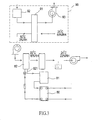
- Fig. 1 is a block diagram of an air conditioner according to the present invention. As shown, the air conditioner mainly includes the following components:
- FIG. 1 an air conditioner according to a first preferred embodiment of the present invention is shown.
- the air conditioner includes two sets of evaporators 31, 32, two sets of condensers 11, 12, two sets of compressors 21, 22, and a set of temperature control circuit 7 on which a temperature value absolutely not lower than a freezing temperature is preset.
- the temperature detector 72 connected to the return pipe 41 of the evaporator 31 detects a temperature higher than the preset temperature value.
- the temperature controller 71 would control the first and the second compressor 21, 22 via two corresponding frequency converters 731, 732. That is, the first compressor 21 is caused to operate at a full speed while the second compressor 22 is caused to operate at a normal speed, so that the indoor temperature may be lowered within a short time. And, when the temperature detector 72 detects that the return pipe 42 has a lowered temperature and a difference between it and the preset temperature value is only 0.5°C, the temperature controller 71 would control the frequency converter 731 connected to the first compressor 21 for the first compressor 21 to slow down and finally return to its normal operating speed.
- the temperature controller 71 would also control the frequency converter 731 for the first compressor 21 to lower down its rotary speed to a minimum allowable speed while the second compressor 22 is maintained at its normal rotary speed. At this point, since the indoor temperature, is very close to the preset temperature for the air conditioning, only one compressor, that is the first compressor 21, is used as a main power source to circulate the refrigerant.
- the temperature detector 72 connected to the return pipe 42 of the evaporator 32 would detect a temperature lower than that preset on the temperature controller 71. Therefore, the temperature controller 71 would reduce the rotary speed of the second compressor 22 via the frequency converter 732 connected to the second compressor 22. Thereby, the gaseous refrigerant output from the condenser 12 to the evaporator 32 is relatively reduced in volume, and the temperature at an outlet of the evaporator 32 rises to maintain a surface temperature of the return pipe 42 at the preset temperature value.
- moisture condensed through heat exchange in the air makes the evaporator 32 having a temperature not lower than the temperature preset for the return pipe 41, so that the air conditioner may stably control the temperature and the humidity.
- the heat bypass valve 61 controlled by the output of the temperature controller 71 is used to control the surplus energy of the compressor 21, so that a part of the heat is automatically bypassed to the low-pressure side to further stabilize the evaporation temperature of the system.
- Fig. 2 shows a second preferred embodiment of the present invention.
- the air conditioner of the second embodiment is generally structurally similar to the first embodiment, except that an additional set of refrigerant circulation system is provided to more quickly reduce the indoor temperature within a preset time.
- the additional refrigerant circulation system is provided on the return pipe 43 of the evaporator 33 with a temperature detector 72 to detect a temperature on the return pipe 43 and input the detected value into the temperature controller 71, so that the temperature controller 71 determines a difference between the temperature detected by the temperature detector 72 and the preset temperature value to control the movements of the compressors 21, 22, 23 based on the determined difference of temperature. That is, the air conditioner may stably control the temperature and humidity through adjusting an output of the refrigerant.
- the present invention utilizes simple temperature control circuit to monitor and control movements of the evaporators and compressors inside the air conditioner, so that the return pipes of the evaporators are always maintained at a temperature higher than the preset temperature value without the risk of having a frozen pipe wall.
- the air conditioner of the present invention with the above-described design not only consumes low electric energy, but also effectively eliminates the problem of a return pipe having frozen pipe wall through utilization of surplus heat to dry the return pipe. Therefore, the present invention enables a general air conditioner to stably control the humidity at low cost and low power consumption without mounting the chemical dehumidifier.
Landscapes
- Engineering & Computer Science (AREA)
- Chemical & Material Sciences (AREA)
- Combustion & Propulsion (AREA)
- Mechanical Engineering (AREA)
- General Engineering & Computer Science (AREA)
- Air Conditioning Control Device (AREA)
Priority Applications (1)
| Application Number | Priority Date | Filing Date | Title |
|---|---|---|---|
| EP03018687A EP1508752A1 (de) | 2003-08-22 | 2003-08-22 | Hygorstatische und thermische Klimaanlage mit Steuerungsmitteln der Verdampfungstemperatur |
Applications Claiming Priority (1)
| Application Number | Priority Date | Filing Date | Title |
|---|---|---|---|
| EP03018687A EP1508752A1 (de) | 2003-08-22 | 2003-08-22 | Hygorstatische und thermische Klimaanlage mit Steuerungsmitteln der Verdampfungstemperatur |
Publications (1)
| Publication Number | Publication Date |
|---|---|
| EP1508752A1 true EP1508752A1 (de) | 2005-02-23 |
Family
ID=34042868
Family Applications (1)
| Application Number | Title | Priority Date | Filing Date |
|---|---|---|---|
| EP03018687A Withdrawn EP1508752A1 (de) | 2003-08-22 | 2003-08-22 | Hygorstatische und thermische Klimaanlage mit Steuerungsmitteln der Verdampfungstemperatur |
Country Status (1)
| Country | Link |
|---|---|
| EP (1) | EP1508752A1 (de) |
Cited By (4)
| Publication number | Priority date | Publication date | Assignee | Title |
|---|---|---|---|---|
| CN105115098A (zh) * | 2015-07-20 | 2015-12-02 | 广东美的暖通设备有限公司 | 一种自动检测风机盘管管温传感器安装位置的方法及系统 |
| CN104595568B (zh) * | 2014-12-25 | 2017-11-21 | 珠海格力电器股份有限公司 | 空调水阀的检测方法和装置 |
| WO2018173120A1 (ja) * | 2017-03-21 | 2018-09-27 | 三菱電機株式会社 | 除湿機 |
| CN112628961A (zh) * | 2020-12-04 | 2021-04-09 | 珠海格力电器股份有限公司 | 一种调温器控制变频空调的调频方式 |
Citations (4)
| Publication number | Priority date | Publication date | Assignee | Title |
|---|---|---|---|---|
| JPH04356646A (ja) * | 1991-06-03 | 1992-12-10 | Matsushita Electric Ind Co Ltd | 除湿乾燥機 |
| US6012296A (en) * | 1997-08-28 | 2000-01-11 | Honeywell Inc. | Auctioneering temperature and humidity controller with reheat |
| JP2000203249A (ja) * | 1999-01-13 | 2000-07-25 | Denso Corp | 空調装置 |
| US6427461B1 (en) * | 2000-05-08 | 2002-08-06 | Lennox Industries Inc. | Space conditioning system with outdoor air and refrigerant heat control of dehumidification of an enclosed space |
-
2003
- 2003-08-22 EP EP03018687A patent/EP1508752A1/de not_active Withdrawn
Patent Citations (4)
| Publication number | Priority date | Publication date | Assignee | Title |
|---|---|---|---|---|
| JPH04356646A (ja) * | 1991-06-03 | 1992-12-10 | Matsushita Electric Ind Co Ltd | 除湿乾燥機 |
| US6012296A (en) * | 1997-08-28 | 2000-01-11 | Honeywell Inc. | Auctioneering temperature and humidity controller with reheat |
| JP2000203249A (ja) * | 1999-01-13 | 2000-07-25 | Denso Corp | 空調装置 |
| US6427461B1 (en) * | 2000-05-08 | 2002-08-06 | Lennox Industries Inc. | Space conditioning system with outdoor air and refrigerant heat control of dehumidification of an enclosed space |
Non-Patent Citations (2)
| Title |
|---|
| PATENT ABSTRACTS OF JAPAN vol. 017, no. 222 (M - 1404) 7 May 1993 (1993-05-07) * |
| PATENT ABSTRACTS OF JAPAN vol. 2000, no. 10 17 November 2000 (2000-11-17) * |
Cited By (9)
| Publication number | Priority date | Publication date | Assignee | Title |
|---|---|---|---|---|
| CN104595568B (zh) * | 2014-12-25 | 2017-11-21 | 珠海格力电器股份有限公司 | 空调水阀的检测方法和装置 |
| CN105115098A (zh) * | 2015-07-20 | 2015-12-02 | 广东美的暖通设备有限公司 | 一种自动检测风机盘管管温传感器安装位置的方法及系统 |
| CN105115098B (zh) * | 2015-07-20 | 2018-02-02 | 广东美的暖通设备有限公司 | 一种自动检测风机盘管管温传感器安装位置的方法及系统 |
| WO2018173120A1 (ja) * | 2017-03-21 | 2018-09-27 | 三菱電機株式会社 | 除湿機 |
| CN110418921A (zh) * | 2017-03-21 | 2019-11-05 | 三菱电机株式会社 | 除湿机 |
| JPWO2018173120A1 (ja) * | 2017-03-21 | 2019-11-07 | 三菱電機株式会社 | 除湿機 |
| CN110418921B (zh) * | 2017-03-21 | 2021-01-19 | 三菱电机株式会社 | 除湿机 |
| CN112628961A (zh) * | 2020-12-04 | 2021-04-09 | 珠海格力电器股份有限公司 | 一种调温器控制变频空调的调频方式 |
| CN112628961B (zh) * | 2020-12-04 | 2022-02-22 | 珠海格力电器股份有限公司 | 一种调温器控制变频空调的调频方式 |
Similar Documents
| Publication | Publication Date | Title |
|---|---|---|
| US9404679B2 (en) | Cooling system and cooling method | |
| US7191543B2 (en) | Drying device and method of operation therefor | |
| CN106871293B (zh) | 采用vrv系统的机房热管空调 | |
| CN102062461B (zh) | 温度和湿度独立的四分程空气调节系统 | |
| CN114857662B (zh) | 一种多联机空调系统及其控制方法 | |
| CN115986260A (zh) | 一种集成制冷、自然冷却和除湿的液冷系统及其控制方法 | |
| CN104949207A (zh) | 温湿双控型空调系统及其的控制方法 | |
| CN107014014A (zh) | 一种热管自然冷却蒸发式冷凝冷水机及其控制方法 | |
| US11313577B2 (en) | Air-conditioning system, machine learning apparatus, and machine learning method | |
| CN109469953B (zh) | 宽温制冷除湿装置 | |
| CN107906640A (zh) | 一种用于数据中心的集成蓄冷空调系统及其控制方法 | |
| CN118336214A (zh) | 集成氟泵的电池簇与pcs并联液冷的温控系统及其控制方法 | |
| CN117006560B (zh) | 一种带自然冷却功能的水冷一体式冷水机组及控制方法 | |
| CN109955676B (zh) | 一种空调控制系统及方法 | |
| KR102257544B1 (ko) | 에너지 절감이 가능한 공조 시스템 및 그 제어방법 | |
| CN101713573B (zh) | 除湿空调系统 | |
| JP2000046423A (ja) | 自然循環式冷房装置 | |
| EP1508752A1 (de) | Hygorstatische und thermische Klimaanlage mit Steuerungsmitteln der Verdampfungstemperatur | |
| JP4074422B2 (ja) | 空調機とその制御方法 | |
| CN114698325A (zh) | 一种集装箱数据中心冷却系统的控制方法 | |
| WO2021224962A1 (ja) | 空気調和装置 | |
| CN118173938A (zh) | 集成氟泵的pcs和电池簇串联节能液冷系统及其控制方法 | |
| JP2001090990A (ja) | 除湿機 | |
| CN114353390B (zh) | 一种实现恒温恒湿的双蒸发器系统及其温湿度调节方法 | |
| CN117146341A (zh) | 除湿控制方法及除湿系统 |
Legal Events
| Date | Code | Title | Description |
|---|---|---|---|
| PUAI | Public reference made under article 153(3) epc to a published international application that has entered the european phase |
Free format text: ORIGINAL CODE: 0009012 |
|
| AK | Designated contracting states |
Kind code of ref document: A1 Designated state(s): AT BE BG CH CY CZ DE DK EE ES FI FR GB GR HU IE IT LI LU MC NL PT RO SE SI SK TR |
|
| AX | Request for extension of the european patent |
Extension state: AL LT LV MK |
|
| AKX | Designation fees paid | ||
| REG | Reference to a national code |
Ref country code: DE Ref legal event code: 8566 |
|
| STAA | Information on the status of an ep patent application or granted ep patent |
Free format text: STATUS: THE APPLICATION IS DEEMED TO BE WITHDRAWN |
|
| 18D | Application deemed to be withdrawn |
Effective date: 20050824 |