EP1508909A1 - Thermische schutzvorrichtung - Google Patents
Thermische schutzvorrichtung Download PDFInfo
- Publication number
- EP1508909A1 EP1508909A1 EP03715682A EP03715682A EP1508909A1 EP 1508909 A1 EP1508909 A1 EP 1508909A1 EP 03715682 A EP03715682 A EP 03715682A EP 03715682 A EP03715682 A EP 03715682A EP 1508909 A1 EP1508909 A1 EP 1508909A1
- Authority
- EP
- European Patent Office
- Prior art keywords
- heating resistor
- thermally responsive
- support
- responsive plate
- plate
- Prior art date
- Legal status (The legal status is an assumption and is not a legal conclusion. Google has not performed a legal analysis and makes no representation as to the accuracy of the status listed.)
- Withdrawn
Links
- 230000001012 protector Effects 0.000 title claims abstract description 54
- 238000010438 heat treatment Methods 0.000 claims abstract description 105
- 229910052751 metal Inorganic materials 0.000 claims description 28
- 239000002184 metal Substances 0.000 claims description 28
- 239000004020 conductor Substances 0.000 claims description 12
- 230000003247 decreasing effect Effects 0.000 claims description 8
- 230000003534 oscillatory effect Effects 0.000 abstract 1
- 238000010276 construction Methods 0.000 description 10
- 230000002093 peripheral effect Effects 0.000 description 5
- 238000003466 welding Methods 0.000 description 5
- 238000004804 winding Methods 0.000 description 5
- 238000003825 pressing Methods 0.000 description 4
- RYGMFSIKBFXOCR-UHFFFAOYSA-N Copper Chemical compound [Cu] RYGMFSIKBFXOCR-UHFFFAOYSA-N 0.000 description 3
- 229910052802 copper Inorganic materials 0.000 description 3
- 239000010949 copper Substances 0.000 description 3
- 239000000463 material Substances 0.000 description 3
- 239000000919 ceramic Substances 0.000 description 2
- 230000000694 effects Effects 0.000 description 2
- 239000000945 filler Substances 0.000 description 2
- 230000020169 heat generation Effects 0.000 description 2
- 238000000034 method Methods 0.000 description 2
- 230000005855 radiation Effects 0.000 description 2
- 229910001316 Ag alloy Inorganic materials 0.000 description 1
- 229910000599 Cr alloy Inorganic materials 0.000 description 1
- 239000000788 chromium alloy Substances 0.000 description 1
- UPHIPHFJVNKLMR-UHFFFAOYSA-N chromium iron Chemical compound [Cr].[Fe] UPHIPHFJVNKLMR-UHFFFAOYSA-N 0.000 description 1
- 239000011248 coating agent Substances 0.000 description 1
- 238000000576 coating method Methods 0.000 description 1
- 239000012141 concentrate Substances 0.000 description 1
- 238000005336 cracking Methods 0.000 description 1
- 230000007547 defect Effects 0.000 description 1
- 230000005489 elastic deformation Effects 0.000 description 1
Images

Classifications
-
- H—ELECTRICITY
- H01—ELECTRIC ELEMENTS
- H01H—ELECTRIC SWITCHES; RELAYS; SELECTORS; EMERGENCY PROTECTIVE DEVICES
- H01H37/00—Thermally-actuated switches
- H01H37/02—Details
- H01H37/32—Thermally-sensitive members
- H01H37/52—Thermally-sensitive members actuated due to deflection of bimetallic element
-
- H—ELECTRICITY
- H01—ELECTRIC ELEMENTS
- H01H—ELECTRIC SWITCHES; RELAYS; SELECTORS; EMERGENCY PROTECTIVE DEVICES
- H01H81/00—Protective switches in which contacts are normally closed but are repeatedly opened and reclosed as long as a condition causing excess current persists, e.g. for current limiting
- H01H81/02—Protective switches in which contacts are normally closed but are repeatedly opened and reclosed as long as a condition causing excess current persists, e.g. for current limiting electrothermally operated
-
- H—ELECTRICITY
- H01—ELECTRIC ELEMENTS
- H01H—ELECTRIC SWITCHES; RELAYS; SELECTORS; EMERGENCY PROTECTIVE DEVICES
- H01H1/00—Contacts
- H01H1/12—Contacts characterised by the manner in which co-operating contacts engage
- H01H1/14—Contacts characterised by the manner in which co-operating contacts engage by abutting
- H01H1/20—Bridging contacts
Definitions
- This invention relates to a thermal protector suitable for protecting, against burnout, electric motors used in enclosed electric compressors, particularly, three-phase motors.
- Conventional thermal protectors include a protector having three pairs of contacts as disclosed in JP-B-46-34532 and a protector having two pairs of contacts as disclosed in JP-A-1-105435 and JP-A-10-21808.
- the number of movable and fixed contacts is six in the thermal protector with the three pairs of contacts, which number is non-economical.
- the three movable contacts are secured to a metal plate serving as a heating resistor, and the metal plate is supported in its central portion by a thermally responsive plate. The central portion of the metal plate is pressed such that the three movable contacts are uniformly pressed, whereupon a stable contacting is achieved.
- the metal plate fixed by caulking or the like in a through hole provided in the central portion of the thermally responsive plate drawn into the shape of a dish. In short, the metal plate is supported on the central portion of the thermally responsive plate, on which portion stress concentrates.
- thermally responsive plate differs depending upon a degree at which the metal plate is caulked relative to the thermally responsive plate, whereupon the characteristic of the thermal protector tends to easily change. That is, there arises a problem that it becomes difficult to stabilize the performance of the thermal protector.
- thermally responsive plate itself in the thermal protector having the two pairs of contacts. Electric current is caused to flow through the thermally responsive plate so that its heat generation reverse the thermally responsive plate to open the contacts.
- This type of thermal protector is called direct heat type. Since the thermally responsive plate is heated up by the electric current in the thermal protector of the direct heat type, a response speed of the thermally responsive plate to an overcurrent is advantageously increased.
- the peripheral components is difficult to heat up. Accordingly, when the thermal protector operates such that a current path is cut off, heat generated by the thermally responsive plate is absorbed by the peripheral components whose temperatures are relatively lower, whereupon a contact opening time cannot be rendered longer. As a result, the temperature of a motor winding having been increased by the overcurrent cannot be reduced sufficiently during cutoff of current such that a temperature reached by the motor winding is inevitably rendered higher while the thermal protector repeats its reverse and return. In this case, there is a problem that the increased temperature reduces the insulating performance of an insulating coating of the motor winding thereby to cause a short circuit which leads to possible burn-out.
- the specific resistance of the thermally responsive plate does not always take a suitable value. That is, there is a problem that it is difficult to design a thermal protector having both suitable values of operating current and operating temperature.
- thermal protector which overcame the foregoing problems and filed a patent application for the invention in Japan (laid open under JP-A-2000-229795).
- This thermal protector is of an indirect heat type in which a thermally responsive plate is reversed by heat generation of a heating resistor.
- the temperature of the thermally responsive plate is increased by heat radiation from the heating resistor when the current increases the temperature of the heating resistor.
- an overcurrent or the like excessively increases the temperature of the heating resistor such that the thermally responsive plate reaches a set operating temperature, the thermally responsive plate quickly reverses thereby to cut off the current path.
- the temperature of the thermally responsive plate but also the temperatures of peripheral components are increased by the heating resistor in the thermal protector of the indirect heat type.
- an object of the present invention is to provide a thermal protector which can be coped with a large operating current in the arrangement that the thermally responsive plate is revered in response to the heating of the heating resistor thereby to cut off the current path.
- the present invention provides a thermal protector which includes a thermally responsive plate reversing when reaching a set temperature and returning when decreased below the set temperature, thereby making and breaking an electric current path, the thermal protector characterized by a casing including a housing made from a metal and having an opening, a metal plate closing the opening and having two through holes and two electrically conductive terminal pins inserted through the respective holes of the metal plate with an insulating filling member interposed therebetween, two fixed contacts fixed to ends of the conductive pins protruding into an interior of the casing respectively, a support including a main portion, a leg provided on the main portion and a support hole provided in the leg, the leg being secured to the metal plate so that the support is disposed in the casing, a heating resistor disposed between the metal plate and the main portion of the support so as to be substantially in parallel to the metal plate, the heating resistor having an end with a protrusion inserted into the support hole, the heating resistor swung about the protrusion so as to come close to
- the movable contacts are normally in contact with the fixed contacts such that two current paths are formed through the heating resistor between the metal plate and each conductive terminal pin, and further, the thermally responsive plate reverses when an overcurrent causes the thermally responsive plate to heat up and the temperature of the thermally responsive plate is increased to each a set temperature.
- a reversing operation of the thermally responsive plate is transferred through the coupler to the heating resistor.
- the heating resistor is swung such that the movable contacts are departed away from the respective fixed contacts, whereupon the current paths are cut off.
- the temperature of the heating resistor is decreased such that the temperature of the thermally responsive plate is decreased to or below the set temperature, the thermally responsive plate returns. Then, the heating resistor is swung to return to its former state, whereupon the movable contacts are brought into contact with the fixed contacts respectively so that the current paths are made.
- the reversing and returning operations of the thermally responsive plate are transferred through the coupler to the heating resistor. Furthermore, the elastic member used for supporting the thermally responsive plate and heating resistor are excluded from the components of the current paths. Accordingly, since the number of components generating heat upon subjection to an overcurrent is reduced other than the heating resistor, the operating current can be set to a large value. In the foregoing construction, particularly, when an electric conductor with a sufficiently small electric resistance is used, an amount of heat generated by the conductor can be restrained to a small value, whereupon the foregoing construction is further effective.
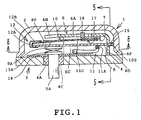
- FIG. 1 is a longitudinal section of a three-phase internal protector as a thermal protector in accordance with the embodiment of the present invention.
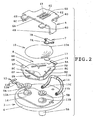
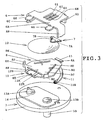
- FIGS. 2 and 3 are exploded perspective views of the internal protector, showing components of the internal protector.
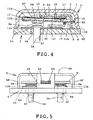
- FIG. 4 is a longitudinal section of the internal protector in its operation.
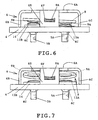
- FIGS. 5 to 7 are side views of the internal protector with a housing and the heating resistor being eliminated in order that the movement of the heating resistor may be explained.
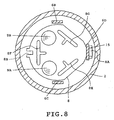
- FIG. 8 a cross section taken along line 8-8 in FIG. 1.
- the internal protector 1 in accordance with the embodiment has a hermetic container 100 (corresponding to a casing) including a circular dome housing 2 made of a metal and a header plate 3 secured to an open end of the housing 2 by ring projection welding or the like.
- a hermetic container 100 corresponding to a casing
- a circular dome housing 2 made of a metal
- a header plate 3 secured to an open end of the housing 2 by ring projection welding or the like.
- the header plate 3 comprises a circular metal plate 4 having two through holes 4A and 4B (see FIG. 5). Electrically conductive terminal pins 5A and 5B are inserted through the holes 4A and 4B respectively and are insulated from and hermetically fixed to the header plate 4 by an electrically insulating filler 4C. A ceramic plate 14 is attached to the upper surface of the metal plate 4 to protect the filler 4 against contact arc. Fixed contacts 13A and 13B each made from a silver alloy are secured by welding or the like to the upper end surfaces of the terminal pins 5A and 5B exposed on the upper surface of the ceramic plate 14 respectively.
- a support 6 is provided in the hermetic container 100. As shown in FIG. 2, the support 6 has a main surface 6A serving as a main portion, three legs 6B, 6C and 6D extending downward from a peripheral portion of the main surface 6A, and arm-shaped portions 6G and 6H provided on one side of the main surface 6A.
- the main surface 6A is provided with three slits 6I.
- the central slit 6I is formed with a screw-inserting portion 6E.
- a screw 16 is inserted through the screw-inserting portion 6E.
- Lower ends of the legs 6B, 6C and 6D secured to the metal plate 4 by spot welding.
- the main surface 6A is parallel with the metal plate 4.
- a substantially circular thermally responsive plate 10 is supported on the lower portion of the support 6 as shown in FIGS. 1, 2 and 4.
- the thermally responsive plate 10 is supported while one end thereof is held between a central portion 7A of a connecting piece 7 and a presser plate 17.
- An end 7B of the connecting piece 7 is secured to the underside of the main surface 6A by the projection welding or the like so that the thermally responsive plate 10 is supported by the support 6.
- the lower end of the screw 16 is in abutment with the central portion 7A of the connecting piece 7.
- the presser plate 17 disperses stress at the secured portion of the thermally responsive plate 10 thereby to prevent the thermally responsive plate 10 from cracking, so that the presser plate has an effect of improving the durability of the thermally responsive plate 10.
- the thermally responsive plate 10 is made by drawing a bimetal or trimetal into the shape of a shallow dish and reverses and returns quickly at predetermined temperatures.
- a substantially circular heating resistor 8 is assembled between the thermally responsive plate 10 and the header plate 3, as shown in FIGS. 1 to 3.
- the heating resistor 8 is made from a resisting material such as an iron-chromium alloy and has a heating portion whose area is substantially equal to an area of the thermally responsive plate 10.
- a protruding piece 8A is provided on a right-hand end of the heating resistor 8 as viewed in FIG. 2.
- a notch 8B is provided in a portion of the heating resistor 8 opposed to the protruding piece 8A.
- a pair of curved protrusions 8P and 8Q are provided on portions of the heating protrusion 8 symmetric about the notch 8B.
- Movable contacts 9A and 9B are secured to the undersides of portions 8C and 8E of the heating resistor 8 opposed to the fixed contacts 13A and 13B respectively. Further, a central part of a conductor 11 is secured to the underside of portion 8D of the heating resistor 8. The conductor 11 has both ends 11B and 11C secured to the legs 6B and 6C of the support 6 respectively. The conductor 11 has a sufficiently low resistance value so as not to heat up and has elasticity so as not to prevent opening and closing operations of the heating resistor 8. The conductor 11 comprises a stranded wire made, for example, by binding a plurality of copper wires. Further, the heating resistor 8 is designed so that resistance values of the portions between 8C-8D, between 8C-8E and between 8D-8E are rendered substantially equal to one another so that amounts of heat generated by these portions become uniform.
- T-shaped slits 8F, 8G and 8H are formed in the portions between 8C-8E, between 8C-8D and between 8D-8E of the heating resistor 8 respectively as shown in FIGS. 2, 3 and 8.
- the slits 8F, 8G and 8H are formed in order that electrical paths of the heating resistor 8 may be narrowed to increase resistance values so that a desired amount of heat is obtained.
- the embodiment exemplifies a protector whose operating current is about 200 A. For example, in the case of the operating current of about 250 A, no slit is necessary since a sufficient amount of heat can be obtained without slit.
- the thickness of the heating resistor is reduced as a method of increasing the resistance value of the heating resistor.
- the mechanical strength of the heating resistor is reduced. Accordingly, when the heating and the opening and closing operations of the heating resistor are repeated for a long period of time, the heating resistor is deformed such that the operating current changes.
- the heating resistor 8 is formed with the T-shaped slits 8F, 8G and 8H in order that the electrical paths thereof may be narrowed so that the resistance value is increased. As a result, the thickness of the heating resistor 8 need not be increased and accordingly, reduction in the mechanical strength can be minimized.
- each slit is formed into the T-shape so that the resistance value can be increased while the area of the heating resistor's portion opposed to the thermally responsive plate is limited to a small value.
- the leg 6D of the support 6 has a generally rectangular through hole 6F (corresponding to a support hole) formed in generally central portion thereof as shown in FIGS. 1 to 3 and 5.
- the protruding piece 8A is inserted into the through hole 6F.
- a fixing piece 15 is secured to the distal end of the protruding piece 8A by welding or the like, whereupon the protruding piece 8A can be prevented from falling off from the hole 6F.
- a short side of the hole 6F is set so as to have a dimension (the width in FIG. 5) larger than the thickness of the protruding piece 8A. Further, the hole 6F has an upper side which is formed into an arc shape.
- the notch 8B is formed in the portion of the heating resistor 8 opposed to the protruding piece 8A.
- a coupler 12 is fixed to the notch 8B.
- the coupler 12 has a protrusion 12A and two arm-shaped portions 12B.
- the thermally responsive plate 10 is inserted between the protrusion 12A and the arm-shaped portions 12B.
- the arm-shaped portions 12B correspond to a first abutting portion in the invention, whereas the protrusion 12A corresponds to a second abutting portion in the invention.
- a gap between the protrusion 12A and the arm-shaped portions 12B is larger than the thickness of the thermally responsive plate 10.
- the thermally responsive plate 10 is coupled to the heating resistor 8 with a play.
- the thermally responsive plate 10 is usually in abutment with the protrusion 12A of the coupler 12 to depress the heating resistor 8 downward as shown in FIG. 1. As a result, contacts are closed.
- the protrusion 12A is located on the central axis passing the center between the movable contacts 9A and 9B and is in abutment at one portion thereof with the thermally responsive plate 10. Thus, a pressing force of the thermally responsive plate 10 is applied uniformly to the contacts.
- the thermally responsive plate 10 when reversing, the thermally responsive plate 10 abuts the two arm-shaped portions 12B of the coupler 12, raising the heating resistor 8. As a result, the contacts are opened.
- the two arm-shaped portions 12B are located symmetrically about the central axis passing the center between the movable contacts 9A and 9B. Accordingly, a reversing force of the thermally responsive plate 10 is applied substantially uniformly to each arm-shaped portion 12B. Accordingly, since the movable contacts 9A and 9B are departed from the respective fixed contacts 13A and 13B without being inclined, the contact openings of the two contact pairs can be prevented from being non-uniform. Further, the curved protrusions 8P and 8Q abut the arm-shaped portions 6G and 6H of the support 6 respectively such that a predetermined contact opening is maintained.
- a force of the screw 16 pressing the thermally responsive plate 10 via the end of the connecting piece 7 is adjusted so that a temperature at which the thermally responsive plate 10 reverses is calibrated.
- the internal protector 1 is constructed by securing the legs 6B, 6C and 6D of the support 6 to the header plate 3 after components have been attached to the header plate 3 and the support 6 and further by securing the peripheral edge of the header plate 3 to the open end of the housing 2.
- the temperature of the thermally responsive plate 10 is not more than an operating temperature when an electric motor to be protected is in normal operation. Accordingly, as shown in FIG. 1, the heating resistor 8 is pressed downward by the pressing force of the thermally responsive plate 10, whereupon the movable contacts 9A and 9B are in contact with the fixed contacts 13A and 13B respectively.
- the internal protector 1 includes current paths between the metal plate 4 and the terminal pins 5A and 5B, that is, current flows from the metal plate 4 through the support 6, conductor 11, heating resistor 8, movable contact 9A (9B) and fixed contact 13A (13B) to the terminal pin 5A (5B).
- the internal protector 1 further includes a current path between the terminal pins 5A and 5B, that is, current flows from the terminal pin 5A through the fixed contact 13A, movable contact 9A, heating resistor 8, movable contact 9B and fixed contact 13B to the terminal pin 5B.
- the heating resistor 8 can be inclined a slight angle since a space is defined around the protruding piece 8A in the through hole 6F. Accordingly, for example, even when there is a difference between the heights of the two fixed contacts 13A and 13B, the pressing force of the movable contacts 9A and 9B applied to the fixed contacts 13A and 13B can be balanced.
- the thermally responsive plate 10 presses the heating resistor 8 downward while the movable contacts 9A and 9B serve as fulcrums and the protrusion 12A of the coupler 12 serves as an emphasis.
- the protruding piece 8A of the heating resistor 8 is normally pressed against the upper side of the through hole 6 (see FIG. 5).
- the upper side of the through hole 6F is formed into an arc shape, so that the protruding piece 8A of the heating resistor 8 is brought into point contact with the upper side of the hole 6F at its central portion. Consequently, the heating resistor 8 tends to be further inclined.
- the thermally responsive plate 10 reverse when an amount of heat generated by the heating resistor 8 is increased with the increase in electric current due to an overload operation of the motor or a locked rotor condition, or the thermally responsive plate 10 reaches a predetermined operating temperature by an increase in the temperature of the motor compressor. Then, as shown in FIG. 5, the heating resistor 8 is raised by the thermally responsive plate 10 such that the movable contacts 9A and 9B are departed from the fixed contacts 13A and 13B respectively. As a result, all the above-mentioned current paths are opened.
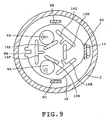
- FIG. 9 illustrates a second embodiment of the present invention. Differences of the second embodiment from the first embodiment will be described.
- FIG. 9 illustrates the construction of the heating resistor 18 in the case where an operating current is set to a small value of about 100 A, for example.
- the heating resistor 18 is further provided with slits 18K, 18L and 18M in addition to the T-shaped slits 18F, 18G and 18H.
- the current paths of the heating resistor 18 are further narrowed by the addition of the slits 18K, 18L and 18M, whereupon the resistance value can be increased.
- the mechanical strength and the area of the heating resistor 18 opposed to the thermally responsive plate 10 can be prevented from being decreased to a large degree while an amount of heat generated by the heating resistor 18 is increased.
- FIG. 10 illustrates a third embodiment of the present invention. Differences of the third embodiment from the first embodiment will be described.
- the heating resistor 28 is formed integrally with the coupler. More specifically, the coupler comprises an abutting portion 28A provided on the end of the heating resistor 28 (corresponding to the first abutting portion) and a pair of arm-shaped portions 28B (corresponding to the second abutting portion) provided on portions of the heating protrusion 8 symmetric about the abutting portion 28A.
- the foregoing construction can also achieve the same effect as the first embodiment.
- the coupler 12 can be formed into various shapes without being limited by the shapes of the arm-shaped portion 12B, protrusion 12A and the like as shown in FIG. 2 when the coupler 12 has a structure that it abuts the thermally responsive plate at two portions thereof upon reversion of the thermally responsive plate and at one portion thereof upon return.
- Either the first or second abutting portion of the coupler may be formed integrally with the heating resistor and the other may be discrete from the heating resistor.
- the conductor 11 should not be limited to the strand of copper wires.
- thin copper plates may be placed one upon another.
- the material and dimensions of the heating resistor may suitably be selected on the basis of an amount of heat generated and rigidity under a high temperature each satisfying the characteristics of the thermal protector.
- the thermal protector of the present invention may be suitable for a protector protecting a three-phase motors against burnout, in particular, is useful as a protector which can cope with a large operating current.
Landscapes
- Physics & Mathematics (AREA)
- Thermal Sciences (AREA)
- Thermally Actuated Switches (AREA)
- Fuses (AREA)
Applications Claiming Priority (3)
| Application Number | Priority Date | Filing Date | Title |
|---|---|---|---|
| JP2002131419 | 2002-05-07 | ||
| JP2002131419 | 2002-05-07 | ||
| PCT/JP2003/004137 WO2003096367A1 (en) | 2002-05-07 | 2003-03-31 | Thermal protector |
Publications (2)
| Publication Number | Publication Date |
|---|---|
| EP1508909A1 true EP1508909A1 (de) | 2005-02-23 |
| EP1508909A4 EP1508909A4 (de) | 2007-08-01 |
Family
ID=29416609
Family Applications (1)
| Application Number | Title | Priority Date | Filing Date |
|---|---|---|---|
| EP03715682A Withdrawn EP1508909A4 (de) | 2002-05-07 | 2003-03-31 | Thermische schutzvorrichtung |
Country Status (9)
| Country | Link |
|---|---|
| US (1) | US7298239B2 (de) |
| EP (1) | EP1508909A4 (de) |
| JP (1) | JP4268124B2 (de) |
| KR (1) | KR100637975B1 (de) |
| CN (1) | CN1288687C (de) |
| AU (1) | AU2003221068A1 (de) |
| BR (1) | BRPI0309817A2 (de) |
| RU (1) | RU2277270C2 (de) |
| WO (1) | WO2003096367A1 (de) |
Cited By (1)
| Publication number | Priority date | Publication date | Assignee | Title |
|---|---|---|---|---|
| AT512814A1 (de) * | 2012-04-17 | 2013-11-15 | Elektronik Werkstaette Ing Wurmb Ges M B H | Temperaturempfindlicher elektrischer Schalter |
Families Citing this family (20)
| Publication number | Priority date | Publication date | Assignee | Title |
|---|---|---|---|---|
| US7298239B2 (en) | 2002-05-07 | 2007-11-20 | Ubukata Industries Co., Ltd. | Thermal protector |
| DE102004036117B4 (de) * | 2004-07-24 | 2006-12-14 | Tmc Sensortechnik Gmbh | Thermobimetallschalter |
| US7319591B2 (en) * | 2005-05-26 | 2008-01-15 | International Business Machines Corporation | Optimized thermally conductive plate and attachment method for enhanced thermal performance and reliability of flip chip organic packages |
| US7382223B2 (en) * | 2005-11-21 | 2008-06-03 | Sensata Technologies, Inc. | Thermal circuit breaker |
| BRPI0716646B1 (pt) * | 2006-08-10 | 2018-07-31 | Ubukata Industries Co., Ltd. | Comutador de resposta térmica |
| MX2009001484A (es) * | 2006-08-10 | 2009-06-02 | Ubukata Ind Co Ltd | Interruptor termicamente reactivo. |
| US7800477B1 (en) * | 2007-03-20 | 2010-09-21 | Thermtrol Corporation | Thermal protector |
| CN100550247C (zh) * | 2007-08-17 | 2009-10-14 | 常熟市名佳电子器材有限公司 | 制冷压缩机用内置式过载保护器 |
| CA2715130C (en) * | 2008-02-08 | 2015-06-02 | Ubukata Industries Co., Ltd. | Thermally responsive switch |
| WO2009144771A1 (ja) * | 2008-05-30 | 2009-12-03 | 株式会社生方製作所 | 熱応動開閉器 |
| CN102203894B (zh) * | 2008-11-05 | 2014-03-26 | 株式会社生方制作所 | 三相电动机的保护装置 |
| US7808361B1 (en) * | 2008-11-25 | 2010-10-05 | Tsung Mou Yu | Dual protection device for circuit |
| IT1392191B1 (it) * | 2008-12-12 | 2012-02-22 | Electrica Srl | Protettore termico per motori elettrici, in particolare per motori eletrici per compressori |
| DE102011101862B4 (de) * | 2011-05-12 | 2012-12-13 | Thermik Gerätebau GmbH | Temperaturabhängiger Schalter mit Stromübertragungsglied |
| US9048048B2 (en) * | 2012-08-16 | 2015-06-02 | Uchiya Thermostat Co., Ltd. | Thermal protector |
| JP6216152B2 (ja) * | 2013-05-13 | 2017-10-18 | ボーンズ株式会社 | ブレーカー及びそれを備えた安全回路並びに2次電池回路 |
| WO2020059086A1 (ja) * | 2018-09-20 | 2020-03-26 | 株式会社生方製作所 | 直流遮断器 |
| JP7083742B2 (ja) * | 2018-12-14 | 2022-06-13 | ボーンズ株式会社 | 熱応動素子、ブレーカー、安全回路及び2次電池パック |
| CN111192792A (zh) * | 2020-03-23 | 2020-05-22 | 常州常荣电器有限公司 | 三相大功率过流过热保护器 |
| WO2022059067A1 (ja) * | 2020-09-15 | 2022-03-24 | 株式会社生方製作所 | モータプロテクタ |
Family Cites Families (32)
| Publication number | Priority date | Publication date | Assignee | Title |
|---|---|---|---|---|
| US2543040A (en) | 1946-09-24 | 1951-02-27 | Charles S Mertler | Snap-action thermostatic switch |
| US3871939A (en) * | 1972-09-20 | 1975-03-18 | Gen Electric | Process for mounting terminal means |
| JPS49129058U (de) * | 1973-03-07 | 1974-11-06 | ||
| US3902149A (en) * | 1974-10-07 | 1975-08-26 | Texas Instruments Inc | Motor protector apparatus |
| US4041432A (en) * | 1975-09-16 | 1977-08-09 | Texas Instruments Incorporated | Motor protector for high temperature applications and thermostat material for use therein |
| US4114127A (en) * | 1976-09-30 | 1978-09-12 | Texas Instruments Incorporated | Current interrupting apparatus |
| US4136323A (en) * | 1977-06-01 | 1979-01-23 | Entremont John R D | Miniature motor protector |
| US4167721A (en) * | 1977-09-15 | 1979-09-11 | Texas Instruments Incorporated | Hermetic motor protector |
| US4231010A (en) * | 1978-11-30 | 1980-10-28 | Texas Instruments Incorporated | Thermostatic switch employing a stud member for calibration of the switch |
| US4224591A (en) * | 1978-12-04 | 1980-09-23 | Texas Instruments Incorporated | Motor protector with metal housing and with preformed external heater thereon |
| US4287499A (en) * | 1978-12-29 | 1981-09-01 | Texas Instruments Incorporated | Current interrupting apparatus having improved contact life |
| US4376926A (en) * | 1979-06-27 | 1983-03-15 | Texas Instruments Incorporated | Motor protector calibratable by housing deformation having improved sealing and compactness |
| US4399423A (en) * | 1982-03-29 | 1983-08-16 | Texas Instruments Incorporated | Miniature electric circuit protector |
| US4476452A (en) * | 1982-09-27 | 1984-10-09 | Texas Instruments Incorporated | Motor protector |
| US4555686A (en) * | 1984-05-29 | 1985-11-26 | Texas Instruments Incorporated | Snap-acting thermostatic switch assembly |
| JPH0831300B2 (ja) | 1987-10-07 | 1996-03-27 | 生方 眞哉 | 三相用サーマルプロテクタ |
| US4866408A (en) * | 1988-10-28 | 1989-09-12 | Texas Instruments Incorporated | Multiphase motor protector apparatus |
| JPH0834074B2 (ja) * | 1989-10-16 | 1996-03-29 | 山田電機製造株式会社 | プロテクタ |
| JP2519549B2 (ja) * | 1989-12-26 | 1996-07-31 | 生方 眞哉 | 熱応動開閉器 |
| AT394914B (de) * | 1990-10-25 | 1992-07-27 | Electrovac | Thermischer schalter |
| JP2844026B2 (ja) * | 1991-06-14 | 1999-01-06 | ウチヤ・サーモスタット株式会社 | サーモスタット |
| US5212465A (en) * | 1992-08-12 | 1993-05-18 | Ubukata Industries Co., Ltd. | Three-phase thermal protector |
| RU2080681C1 (ru) * | 1994-09-28 | 1997-05-27 | Акционерное общество "Термореле" | Термоэлектрический переключатель |
| DE19514853C2 (de) * | 1995-04-26 | 1997-02-27 | Marcel Hofsaes | Temperaturwächter mit einem bei Übertemperatur schaltenden Bimetall-Schaltwerk |
| DE19527253B4 (de) * | 1995-07-26 | 2006-01-05 | Thermik Gerätebau GmbH | Nach dem Baukastenprinzip aufgebauter Temperaturwächter |
| JP3046767B2 (ja) | 1996-07-04 | 2000-05-29 | 株式会社生方製作所 | サーマルプロテクタ |
| DE19727197C2 (de) * | 1997-06-26 | 1999-10-21 | Marcel Hofsaess | Temperaturabhängiger Schalter mit Kontaktbrücke |
| DE19827113C2 (de) * | 1998-06-18 | 2001-11-29 | Marcel Hofsaes | Temperaturabhängiger Schalter mit Stromübertragungsglied |
| RU2142659C1 (ru) * | 1998-09-11 | 1999-12-10 | Жидков Игорь Алексеевич | Термовыключатель |
| JP3849387B2 (ja) | 2000-02-17 | 2006-11-22 | 株式会社生方製作所 | サーマルプロテクタ |
| US6674620B2 (en) * | 2000-12-04 | 2004-01-06 | Texas Instruments Incorporated | Hermetic single phase motor protector |
| US7298239B2 (en) | 2002-05-07 | 2007-11-20 | Ubukata Industries Co., Ltd. | Thermal protector |
-
2003
- 2003-03-31 US US10/513,341 patent/US7298239B2/en not_active Expired - Fee Related
- 2003-03-31 WO PCT/JP2003/004137 patent/WO2003096367A1/ja not_active Ceased
- 2003-03-31 EP EP03715682A patent/EP1508909A4/de not_active Withdrawn
- 2003-03-31 JP JP2004504251A patent/JP4268124B2/ja not_active Expired - Fee Related
- 2003-03-31 RU RU2004135566/09A patent/RU2277270C2/ru not_active IP Right Cessation
- 2003-03-31 AU AU2003221068A patent/AU2003221068A1/en not_active Abandoned
- 2003-03-31 BR BRPI0309817A patent/BRPI0309817A2/pt not_active IP Right Cessation
- 2003-03-31 CN CNB038134667A patent/CN1288687C/zh not_active Expired - Fee Related
- 2003-03-31 KR KR1020047017974A patent/KR100637975B1/ko not_active Expired - Fee Related
Cited By (2)
| Publication number | Priority date | Publication date | Assignee | Title |
|---|---|---|---|---|
| AT512814A1 (de) * | 2012-04-17 | 2013-11-15 | Elektronik Werkstaette Ing Wurmb Ges M B H | Temperaturempfindlicher elektrischer Schalter |
| AT512814B1 (de) * | 2012-04-17 | 2014-01-15 | Elektronik Werkstaette Ing Wurmb Ges M B H | Temperaturempfindlicher elektrischer Schalter |
Also Published As
| Publication number | Publication date |
|---|---|
| JPWO2003096367A1 (ja) | 2005-09-15 |
| RU2004135566A (ru) | 2005-05-10 |
| BRPI0309817A2 (pt) | 2016-08-09 |
| CN1288687C (zh) | 2006-12-06 |
| KR20040111589A (ko) | 2004-12-31 |
| WO2003096367A1 (en) | 2003-11-20 |
| US20050264393A1 (en) | 2005-12-01 |
| JP4268124B2 (ja) | 2009-05-27 |
| RU2277270C2 (ru) | 2006-05-27 |
| KR100637975B1 (ko) | 2006-10-23 |
| US7298239B2 (en) | 2007-11-20 |
| CN1659669A (zh) | 2005-08-24 |
| AU2003221068A1 (en) | 2003-11-11 |
| EP1508909A4 (de) | 2007-08-01 |
Similar Documents
| Publication | Publication Date | Title |
|---|---|---|
| US7298239B2 (en) | Thermal protector | |
| US6005471A (en) | Thermal protector for electric motors | |
| JP3828476B2 (ja) | 無通電式密閉型モータプロテクタ | |
| JP2001035330A (ja) | サーマルプロテクタ | |
| US9000880B2 (en) | Thermal protector | |
| US4843363A (en) | Three-phase thermal protector | |
| JP6979127B2 (ja) | ブレーカー、安全回路及び2次電池パック | |
| EP0714550B1 (de) | Elektrische schalter | |
| KR100947519B1 (ko) | 저전류 전기 모터 보호기 | |
| JPH0432490B2 (de) | ||
| US9472363B2 (en) | Thermal protector | |
| US4914414A (en) | Thermally responsive switch | |
| CN118431027A (zh) | 依赖温度的开关 | |
| JP2002352685A (ja) | サーマルプロテクタ | |
| JP3046767B2 (ja) | サーマルプロテクタ | |
| JP3829882B2 (ja) | サーマルプロテクタ | |
| JP3849387B2 (ja) | サーマルプロテクタ | |
| JP3992320B2 (ja) | サーマルプロテクタ | |
| JP2005005194A (ja) | サーモプロテクタ | |
| JPH0316727B2 (de) | ||
| JP2005158682A (ja) | サーマルプロテクタ | |
| JPH0822757A (ja) | 過負荷保護装置 | |
| KR920006261Y1 (ko) | 열응동 스위치 | |
| JPH0319655B2 (de) | ||
| JP2019009136A (ja) | 熱応動開閉器 |
Legal Events
| Date | Code | Title | Description |
|---|---|---|---|
| PUAI | Public reference made under article 153(3) epc to a published international application that has entered the european phase |
Free format text: ORIGINAL CODE: 0009012 |
|
| 17P | Request for examination filed |
Effective date: 20041202 |
|
| AK | Designated contracting states |
Kind code of ref document: A1 Designated state(s): AT BE BG CH CY CZ DE DK EE ES FI FR GB GR HU IE IT LI LU MC NL PT RO SE SI SK TR |
|
| AX | Request for extension of the european patent |
Extension state: AL LT LV MK |
|
| DAX | Request for extension of the european patent (deleted) | ||
| A4 | Supplementary search report drawn up and despatched |
Effective date: 20070628 |
|
| STAA | Information on the status of an ep patent application or granted ep patent |
Free format text: STATUS: THE APPLICATION HAS BEEN WITHDRAWN |
|
| 18W | Application withdrawn |
Effective date: 20090331 |