EP1509905B1 - Wahrnehmungsbezogene normierung digitaler audiosignale - Google Patents
Wahrnehmungsbezogene normierung digitaler audiosignale Download PDFInfo
- Publication number
- EP1509905B1 EP1509905B1 EP03718091A EP03718091A EP1509905B1 EP 1509905 B1 EP1509905 B1 EP 1509905B1 EP 03718091 A EP03718091 A EP 03718091A EP 03718091 A EP03718091 A EP 03718091A EP 1509905 B1 EP1509905 B1 EP 1509905B1
- Authority
- EP
- European Patent Office
- Prior art keywords
- sub
- bands
- digital audio
- audio data
- band
- Prior art date
- Legal status (The legal status is an assumption and is not a legal conclusion. Google has not performed a legal analysis and makes no representation as to the accuracy of the status listed.)
- Expired - Lifetime
Links
- 238000010606 normalization Methods 0.000 title claims description 16
- 230000005236 sound signal Effects 0.000 title description 19
- 230000009466 transformation Effects 0.000 claims abstract description 45
- 230000000873 masking effect Effects 0.000 claims abstract description 30
- 238000000034 method Methods 0.000 claims abstract description 17
- 230000006870 function Effects 0.000 claims description 8
- 230000015572 biosynthetic process Effects 0.000 claims description 6
- 238000003786 synthesis reaction Methods 0.000 claims description 6
- 230000002194 synthesizing effect Effects 0.000 claims 1
- 238000010586 diagram Methods 0.000 description 6
- 238000001228 spectrum Methods 0.000 description 6
- 238000004422 calculation algorithm Methods 0.000 description 4
- 230000006835 compression Effects 0.000 description 3
- 238000007906 compression Methods 0.000 description 3
- 238000013139 quantization Methods 0.000 description 3
- 238000013459 approach Methods 0.000 description 2
- 238000004364 calculation method Methods 0.000 description 2
- 238000004891 communication Methods 0.000 description 2
- 238000000354 decomposition reaction Methods 0.000 description 2
- 238000013507 mapping Methods 0.000 description 2
- 238000005070 sampling Methods 0.000 description 2
- 238000000844 transformation Methods 0.000 description 2
- 239000000654 additive Substances 0.000 description 1
- 230000000996 additive effect Effects 0.000 description 1
- 230000008901 benefit Effects 0.000 description 1
- 238000006243 chemical reaction Methods 0.000 description 1
- 230000000295 complement effect Effects 0.000 description 1
- 238000005094 computer simulation Methods 0.000 description 1
- 230000001419 dependent effect Effects 0.000 description 1
- 238000012986 modification Methods 0.000 description 1
- 230000004048 modification Effects 0.000 description 1
- 238000005457 optimization Methods 0.000 description 1
- 238000012545 processing Methods 0.000 description 1
- 230000009467 reduction Effects 0.000 description 1
- 230000000717 retained effect Effects 0.000 description 1
- 230000003595 spectral effect Effects 0.000 description 1
Images


Classifications
-
- G—PHYSICS
- G10—MUSICAL INSTRUMENTS; ACOUSTICS
- G10L—SPEECH ANALYSIS TECHNIQUES OR SPEECH SYNTHESIS; SPEECH RECOGNITION; SPEECH OR VOICE PROCESSING TECHNIQUES; SPEECH OR AUDIO CODING OR DECODING
- G10L21/00—Speech or voice signal processing techniques to produce another audible or non-audible signal, e.g. visual or tactile, in order to modify its quality or its intelligibility
- G10L21/02—Speech enhancement, e.g. noise reduction or echo cancellation
- G10L21/0316—Speech enhancement, e.g. noise reduction or echo cancellation by changing the amplitude
- G10L21/0364—Speech enhancement, e.g. noise reduction or echo cancellation by changing the amplitude for improving intelligibility
-
- G—PHYSICS
- G10—MUSICAL INSTRUMENTS; ACOUSTICS
- G10L—SPEECH ANALYSIS TECHNIQUES OR SPEECH SYNTHESIS; SPEECH RECOGNITION; SPEECH OR VOICE PROCESSING TECHNIQUES; SPEECH OR AUDIO CODING OR DECODING
- G10L21/00—Speech or voice signal processing techniques to produce another audible or non-audible signal, e.g. visual or tactile, in order to modify its quality or its intelligibility
- G10L21/02—Speech enhancement, e.g. noise reduction or echo cancellation
-
- G—PHYSICS
- G10—MUSICAL INSTRUMENTS; ACOUSTICS
- G10L—SPEECH ANALYSIS TECHNIQUES OR SPEECH SYNTHESIS; SPEECH RECOGNITION; SPEECH OR VOICE PROCESSING TECHNIQUES; SPEECH OR AUDIO CODING OR DECODING
- G10L21/00—Speech or voice signal processing techniques to produce another audible or non-audible signal, e.g. visual or tactile, in order to modify its quality or its intelligibility
- G10L21/003—Changing voice quality, e.g. pitch or formants
-
- G—PHYSICS
- G10—MUSICAL INSTRUMENTS; ACOUSTICS
- G10L—SPEECH ANALYSIS TECHNIQUES OR SPEECH SYNTHESIS; SPEECH RECOGNITION; SPEECH OR VOICE PROCESSING TECHNIQUES; SPEECH OR AUDIO CODING OR DECODING
- G10L19/00—Speech or audio signals analysis-synthesis techniques for redundancy reduction, e.g. in vocoders; Coding or decoding of speech or audio signals, using source filter models or psychoacoustic analysis
- G10L19/02—Speech or audio signals analysis-synthesis techniques for redundancy reduction, e.g. in vocoders; Coding or decoding of speech or audio signals, using source filter models or psychoacoustic analysis using spectral analysis, e.g. transform vocoders or subband vocoders
- G10L19/0204—Speech or audio signals analysis-synthesis techniques for redundancy reduction, e.g. in vocoders; Coding or decoding of speech or audio signals, using source filter models or psychoacoustic analysis using spectral analysis, e.g. transform vocoders or subband vocoders using subband decomposition
Definitions
- One embodiment of the present invention is directed to digital audio signals. More particularly, one embodiment of the present invention is directed to the perceptual normalization of digital audio signals.
- Digital audio signals are frequently normalized to account for changes in conditions or user preferences. Examples of normalizing digital audio signals include changing the volume of the signals or changing the dynamic range of the signals. An example of when the dynamic range may be required to be changed is when 24-bit coded digital signals must be converted to 16-bit coded digital signals to accommodate a 16-bit playback device.
- Normalization of digital audio signals is often performed blindly on the digital audio source without care for its contents. In most instances, blind audio adjustment results in perceptually noticeable artifacts, due to the fact that all components of the signal are equally altered.
- One method of digital audio normalization consists of compressing or extending the dynamic range of the digital signal by applying functional transforms to the input audio signal. These transforms can be linear or non-linear in nature. However, the most common methods use a point-to-point linear transformation of the input audio.
- Fig. 1 is a graph that illustrates an example where a linear transformation is applied to a normal distribution of digital audio samples. This method does not take into account noise buried within the signal. By applying a function that increases the signal mean and spread, additive noise buried in the signal will also be amplified. For example, if the distribution presented in Fig. 1 corresponds to some error or noise distribution, applying a simple linear transformation will result in a higher mean error accompanied with a wider spread as shown by comparing curve 12 (the input signal) with curve 11 (the normalized signal). That is topically a bad situation in most audio applications.
- US5825320 discloses a method and apparatus for encoding input signals.
- An acoustic model application circuit finds a masking lever based on a psychoacoustic model of the input signal.
- a gain control decision circuit determines the gain control value adaptively selected in accordance with the masking level.
- a gain control circuit controls the gain of the audio signal entering the input terminal in meeting with the gain control value.
- Scalable Embedded Zero tree Wavelet Packet Audio Coding by Pao-Chi Chang et al in IEEE third workshop on signal processing advances in wireless communications 2001 discloses a scalable embedded zero tree wavelet packet audio coding system that is a scalable audio compression system using wavelet packet decomposition and embedded zero-tree coding.
- US5845243 discloses a compression method and apparatus which employs an approximation of a psychoacoustic model for wavelet packet decomposition and has a bit rate control feedback loop particularly well suited to marching the output bit rate of the data compressor to the bandwidth capacity of a communication channel.
- Fig. 1 is a graph that illustrates an example where a linear transformation is applied to a normal distribution of digital audio samples.
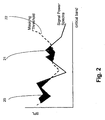
- Fig. 2 is a graph that illustrates a hypothetical example of masking a signal spectrum.
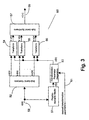
- Fig. 3 is a block diagram of functional blocks of a normalizer in accordance with one embodiment of the present invention.
- Fig. 4 is a diagram that illustrates one embodiment of a Wavelet Packet Tree structure.
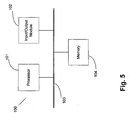
- Fig. 5 is a block diagram of a computer system that can be used to implement one embodiment of the present invention.
- One embodiment of the present invention is a method of normalizing digital audio data by analyzing the data to selectively alter the properties of the audio components based on the characteristics of the auditory system.
- the method includes decomposing the audio data into sub-bands as well as applying a psycho-acoustic model to the data. As a result, the introduction of perceptually noticeable artifacts is prevented.
- One embodiment of the present invention utilizes perceptual models and "critical bands".
- the auditory system is often modeled as a filter bank that decomposes the audio signal into bands called critical bands.
- a critical band consists of one or more audio frequency components that are treated as a single entity. Some audio frequency components can mask other components within a critical band (intra-masking) and components from other critical bands (inter-masking).
- a perceptual model or Psycho-Acoustic Model computes a threshold mask, usually in terms of Sound Pressure Level (“SPL”), as a function of critical bands. Any audio component falling below the threshold skirt will be “masked” and therefore will not be audible. Lossy bit rate reduction or audio coding algorithms take advantage of this phenomenon to hide quantization errors below this threshold. Hence, care should be taken in trying not to uncover these errors. Straightforward linear transformations as illustrated above in conjunction with Fig.1 will potentially amplify these errors, making them audible to the user. In addition, quantization noise from the A/D conversion could become uncovered by a dynamic range expansion procedure. On the other hand, audible signals above the threshold could be masked if straightforward dynamic range compression occurs.
- SPL Sound Pressure Level
- Fig. 2 is a graph that illustrates a hypothetical example of masking a signal spectrum. Shaded regions 20 and 21 are audible to an average listener. Anything falling under the mask 22 will be inaudible.
- Fig. 3 is a block diagram of functional blocks of a normalizer 60 in accordance with one embodiment of the present invention.
- the functionality of the blocks of Fig. 3 can be performed by hardware components, by software instructions that are executed by a processor, or by any combination of hardware or software.
- the incoming digital audio signals are received at input 58.
- an entire file of digital audio signals may be processed by normalizer 60.
- the digital audio signals are received from input 58 at a sub-band analysis module 52.
- the sub-bands are not associated with any critical bands.
- sub-band analysis module 52 utilizes a sub-band analysis scheme based on a Wavelet Packet Tree.
- Fig. 4 is a diagram that illustrates one specific embodiment of a Wavelet Packet Tree structure that consists of 29 output sub-bands assuming input audio sampled at 44.1 KHz. The tree structure shown in Fig. 4 varies depending on the sampling rate. Each line represents decimation by 2 (low-pass filter followed by sub-sampling by a factor of 2).
- Embodiments of a low pass wavelet filter to be used during sub-band analysis can be varied as an optimization parameter, which is dependent on tradeoffs between perceived audio quality and computing performance.
- Each sub-band attempts to be co-centered with the human auditory system critical bands. Therefore, a fair straightforward association between the output of a psycho-acoustic model module 51 and sub-band analysis module 52 can be made.
- Psycho-acoustic model module 51 also receives the digital audio signals from input 58.
- a psycho-acoustic model (“PAM”) utilizes an algorithm to model the human auditory system.
- PAM psycho-acoustic model
- Many different PAM algorithms are known and can be used with embodiments of the present invention. However, the theoretical basis is the same for most of the algorithms:
- critical bands whose P( ⁇ ) is significantly larger than the masking threshold are considered to be dominant and their SDM will approach infinity, while critical bands whose P( ⁇ ) fall below the masking threshold are non-dominant and their SDM will approach negative infinity.
- Transformation parameter generation module 53 in addition to generating the SDM metrics, also modifies desired input transformation parameters 61.
- the parameters ⁇ and ⁇ are either provided by the user/application or automatically computed from the audio signal statistics:
- An automatic method to derive the transformation parameters could be:
- sub-band transform modules 54-56 apply the transformation parameters received from transformation parameter generation module 53 to each of the sub-bands received from sub-band analysis module 52.
- the outputs of sub-band transform modules 54-56 are the final output of normalizer 60.
- the data may be later fed into an encoder, or can be analyzed.
- sub-band synthesis by sub-band synthesis module 57 is accomplished by inverting the Wavelet Tree structure shown in Fig. 4 and using the synthesis filters instead.
- each decimation operation is substituted with an interpolation operation (up-sample and high pass filter) using the complementary wavelet filters.
- Fig. 5 is a block diagram of a computer system 100 that can be used to implement one embodiment of the present invention.
- Computer system 100 includes a processor 101, an input/output module 102, and a memory 104.
- the functionality described above is stored as software on memory 104 and executed by processor 101.
- Input/output module 102 in one embodiment receives input 58 of Fig. 3 and outputs output 59 of Fig. 3 .
- Processor 101 can be any type of general or specific purpose processor.
- Memory 104 can be any type of computer readable medium
- one embodiment of the present invention is a normalizer that accomplishes time domain transformation of digital audio signals while preventing noticeable audible artifacts from being introduced.
- Embodiments use a perceptual model of the human auditory system to accomplish the transformations.
Landscapes
- Engineering & Computer Science (AREA)
- Quality & Reliability (AREA)
- Human Computer Interaction (AREA)
- Signal Processing (AREA)
- Health & Medical Sciences (AREA)
- Audiology, Speech & Language Pathology (AREA)
- Computational Linguistics (AREA)
- Physics & Mathematics (AREA)
- Acoustics & Sound (AREA)
- Multimedia (AREA)
- Compression, Expansion, Code Conversion, And Decoders (AREA)
- Transmission Systems Not Characterized By The Medium Used For Transmission (AREA)
- Tone Control, Compression And Expansion, Limiting Amplitude (AREA)
- Stereophonic System (AREA)
- Diaphragms For Electromechanical Transducers (AREA)
Claims (18)
- Verfahren zur Normalisierung empfangener digitaler Audiodaten, umfassend:Zerlegen der digitalen Audiodaten (58) in mehrere Subbänder;Anwenden eines psycho-akustischen Modells auf die digitalen Audiodaten, um mehrere Maskierungsschwellen zu erzeugen, die jeweils mit einem oder mehreren jeweiligen Subbändern verknüpft sind, wobei das psycho-akustische Modell eine absolute Gehörschwelle umfasst;Erzeugen einer Subband-Dominanzmetrik, die eine Summe absoluter Differenzen zwischen einer Frequenzlinie und den mit dem einen oder mehreren jeweiligen Subbändern verknüpften Maskierungsschwellen darstellt;Erzeugen mehrerer Transformationsanpassungsparameter auf der Grundlage der Maskierungsschwellen und erwünschter Transformationsparameter, wobei die Transformationsanpassungsparameter einen oder mehrere Normalisierungsparameter (61) enthalten, die dazu dienen, einen dynamischen Bereich für die digitalen Audiodaten zu normalisieren;Anpassen der Normalisierungsparameter gemäß der Subband-Dominanzmetrik für jedes Subband; undAnwenden der Transformationsanpassungsparameter auf die Subbänder, um transformierte Subbänder zu erzeugen.
- Verfahren nach Anspruch 1, wobei jedes der mehreren Subbänder einem kritischen Band mehrerer kritischer Bänder des psycho-akustischen Modells entspricht und wobei die Maskierungsschwellen eine Funktion der mehreren kritischen Bänder sind.
- Verfahren nach Anspruch 1, ferner umfassend: Synthetisieren der transformierten Subbänder, um normalisierte digitale Audiodaten (59) zu erzeugen.
- Verfahren nach Anspruch 1, wobei die empfangenen digitalen Audiodaten (58) mehrere digitale Blöcke umfassen.
- Verfahren nach Anspruch 1, wobei die digitalen Audiodaten (58) auf der Grundlage eines Wavelet-Packet-Baums zerlegt werden.
- Normalisierungseinrichtung, umfassend:ein Subband-Analysemodul (52), das empfangene digitale Audiodaten (58) in mehrere Subbänder zerlegt;ein Modul (51) für psycho-akustische Modelle, das ein psycho-akustisches Modell auf die empfangenen digitalen Audiodaten (58) anwendet, um mehrere Maskierungsschwellen zu erzeugen, die jeweils mit einem oder mehreren jeweiligen Subbändern verknüpft sind, wobei das psycho-akustische Modell eine absolute Gehörschwelle umfasst;Erzeugungsmodul (53) für Transformationsparameter, das eine Subband-Dominanzmetrik erzeugt, die eine Summe absoluter Differenzen zwischen einer Frequenzlinie und den mit dem einen oder mehreren jeweiligen Subbändern verknüpften Maskierungsschwellen darstellt, und die mehrere Transformationsanpassungsparameter auf der Grundlage der Maskierungsschwellen und erwünschter Transformationsparameter (61) erzeugt, wobei die Transformationsanpassungsparameter einen oder mehrere Normalisierungsparameter enthalten, die dazu dienen, einen dynamischen Bereich für die digitalen Audiodaten zu normalisieren, und das die Normalisierungsparameter gemäß der Subband-Dominanzmetrik für jedes Subband anpasst; undmehrere Subband-Transformationsmodule (54, 55 und 56), die die Transformationsanpassungsparameter auf die Subbänder anwenden, um transformierte Subbänder zu erzeugen.
- Normalisierungseinrichtung nach Anspruch 6, wobei jedes der mehreren Subbänder einem kritischen Band mehrerer kritischer Bänder des psycho-akustischen Modells entspricht und wobei die Maskierungsschwellen eine Funktion der mehreren kritischen Bänder sind.
- Normalisierungseinrichtung nach Anspruch 6, ferner umfassend: ein Subband-Synthesemodul (57), das die transformierten Subbänder synthetisiert, um normalisierte digitale Audiodaten zu erzeugen.
- Normalisierungseinrichtung nach Anspruch 6, wobei die empfangenen digitalen Audiodaten (58) mehrere digitale Blöcke umfassen.
- Normalisierungseinrichtung nach Anspruch 6, wobei die digitalen Audiodaten (58) auf der Grundlage eines Wavelet-Packet-Baums zerlegt werden.
- Computerlesbares Medium mit darauf gespeicherten Anweisungen, die einen Prozessor, wenn sie von diesem ausgeführt werden, dazu veranlassen:empfangene digitale Audiodaten (58) in mehrere Subbänder zu zerlegen;ein psycho-akustisches Modell auf die digitalen Audiodaten anzuwenden, um mehrere Maskierungsschwellen zu erzeugen, die jeweils mit einem oder mehreren jeweiligen Subbändern verknüpft sind, wobei das psycho-akustische Modell eine absolute Gehörschwelle umfasst;eine Subband-Dominanzmetrik zu erzeugen, die eine Summe absoluter Differenzen zwischen einer Frequenzlinie und den mit dem einen oder mehreren jeweiligen Subbändern verknüpften Maskierungsschwellen darstellt;mehrere Transformationsanpassungsparameter auf der Grundlage der Maskierungsschwellen und erwünschter Transformationsparameter (61) zu erzeugen, wobei die Transformationsanpassungsparameter einen oder mehrere Normalisierungsparameter enthalten, die dazu dienen, einen dynamischen Bereich für die digitalen Audiodaten zu normalisieren;die Normalisierungsparameter gemäß der Subband-Dominanzmetrik für jedes Subband anzupassen; unddie Transformationsanpassungsparameter auf die Subbänder anzuwenden, um transformierte Subbänder zu erzeugen.
- Computerlesbares Medium nach Anspruch 11, wobei jedes der mehreren Subbänder einem kritischen Band mehrerer kritischer Bänder des psycho-akustischen Modells entspricht und wobei die Maskierungsschwellen eine Funktion der mehreren kritischen Bänder sind.
- Computerlesbares Medium nach Anspruch 11, wobei die Anweisungen ferner den Prozessor dazu veranlassen: die transformierten Subbänder zu synthetisieren, um normalisierte digitale Audiodaten zu erzeugen.
- Computerlesbares Medium nach Anspruch 11, wobei die empfangenen digitalen Audiodaten (58) mehrere digitale Blöcke umfassen.
- Computerlesbares Medium nach Anspruch 11, wobei die digitalen Audiodaten (58) auf der Grundlage eines Wavelet-Packet-Baums zerlegt werden.
- Computersystem, umfassend:eine Bus (103);einen mit dem Bus (103) verbundenen Prozessor (102); undeinen mit dem Bus (103) verbundenen Speicher (104);wobei der Speicher (104) Anweisungen speichert, die einen Prozessor (101), wenn sie auf diesem ausgeführt werden, dazu veranlassen:empfangene digitale Audiodaten (58) in mehrere Subbänder zu zerlegen;ein psycho-akustisches Modell auf die digitalen Audiodaten anzuwenden, um mehrere Maskierungsschwellen zu erzeugen, die jeweils mit einem oder mehreren jeweiligen Subbändern verknüpft sind, wobei das psycho-akustische Modell eine absolute Gehörschwelle umfasst;eine Subband-Dominanzmetrik zu erzeugen, die eine Summe absoluter Differenzen zwischen einer Frequenzlinie und den mit dem einen oder mehreren jeweiligen Subbändern verknüpften Maskierungsschwellen darstellt;mehrere Transformationsanpassungsparameter auf der Grundlage der Maskierungsschwellen und erwünschter Transformationsparameter (61) zu erzeugen, wobei die Transformationsanpassungsparameter einen oder mehrere Normalisierungsparameter enthalten, die dazu dienen, einen dynamischen Bereich für die digitalen Audiodaten zu normalisieren;die Normalisierungsparameter gemäß der Subband-Dominanzmetrik für jedes Subband anzupassen; unddie Transformationsanpassungsparameter auf die Subbänder anzuwenden, um transformierte Subbänder zu erzeugen.
- Computersystem nach Anspruch 16, wobei jedes der mehreren Subbänder einem kritischen Band mehrerer kritischer Bänder des psycho-akustischen Modells entspricht und wobei die Maskierungsschwellen eine Funktion der mehreren kritischen Bänder sind.
- Computersystem nach Anspruch 16, ferner umfassend:ein Eingabe-/Ausgabemodul (102), das mit dem Bus (103) verbunden ist.
Applications Claiming Priority (3)
| Application Number | Priority Date | Filing Date | Title |
|---|---|---|---|
| US10/158,908 US7050965B2 (en) | 2002-06-03 | 2002-06-03 | Perceptual normalization of digital audio signals |
| US158908 | 2002-06-03 | ||
| PCT/US2003/009538 WO2003102924A1 (en) | 2002-06-03 | 2003-03-28 | Perceptual normalization of digital audio signals |
Publications (2)
| Publication Number | Publication Date |
|---|---|
| EP1509905A1 EP1509905A1 (de) | 2005-03-02 |
| EP1509905B1 true EP1509905B1 (de) | 2009-11-25 |
Family
ID=29582771
Family Applications (1)
| Application Number | Title | Priority Date | Filing Date |
|---|---|---|---|
| EP03718091A Expired - Lifetime EP1509905B1 (de) | 2002-06-03 | 2003-03-28 | Wahrnehmungsbezogene normierung digitaler audiosignale |
Country Status (10)
| Country | Link |
|---|---|
| US (1) | US7050965B2 (de) |
| EP (1) | EP1509905B1 (de) |
| JP (1) | JP4354399B2 (de) |
| KR (1) | KR100699387B1 (de) |
| CN (1) | CN100349209C (de) |
| AT (1) | ATE450034T1 (de) |
| AU (1) | AU2003222105A1 (de) |
| DE (1) | DE60330239D1 (de) |
| TW (1) | TWI260538B (de) |
| WO (1) | WO2003102924A1 (de) |
Families Citing this family (12)
| Publication number | Priority date | Publication date | Assignee | Title |
|---|---|---|---|---|
| US7542892B1 (en) * | 2004-05-25 | 2009-06-02 | The Math Works, Inc. | Reporting delay in modeling environments |
| KR100902332B1 (ko) * | 2006-09-11 | 2009-06-12 | 한국전자통신연구원 | 변형 선형예측 부호화를 이용한 오디오 부호화 및 복호화장치 및 그 방법 |
| KR101301245B1 (ko) * | 2008-12-22 | 2013-09-10 | 한국전자통신연구원 | 스펙트럼 계수의 서브대역 할당 방법 및 장치 |
| EP2717263B1 (de) * | 2012-10-05 | 2016-11-02 | Nokia Technologies Oy | Verfahren, Vorrichtung und Computerprogrammprodukt zur kategorischen räumlichen Analyse-Synthese des Spektrums eines Mehrkanal-Audiosignals |
| WO2014148848A2 (ko) * | 2013-03-21 | 2014-09-25 | 인텔렉추얼디스커버리 주식회사 | 오디오 신호 크기 제어 방법 및 장치 |
| US20160049162A1 (en) * | 2013-03-21 | 2016-02-18 | Intellectual Discovery Co., Ltd. | Audio signal size control method and device |
| US9350312B1 (en) * | 2013-09-19 | 2016-05-24 | iZotope, Inc. | Audio dynamic range adjustment system and method |
| EP3387647B1 (de) * | 2015-12-10 | 2024-05-01 | Ascava, Inc. | Reduzierung von audiodaten und daten, die auf einem blockverarbeitungsspeichersystem gespeichert sind |
| CN106504757A (zh) * | 2016-11-09 | 2017-03-15 | 天津大学 | 一种基于听觉模型的自适应音频盲水印方法 |
| EP3598440B1 (de) * | 2018-07-20 | 2022-04-20 | Mimi Hearing Technologies GmbH | Systeme und verfahren zur codierung eines audiosignals mit personalisierten psychoakustischen modellen |
| US10455335B1 (en) * | 2018-07-20 | 2019-10-22 | Mimi Hearing Technologies GmbH | Systems and methods for modifying an audio signal using custom psychoacoustic models |
| CN116391226B (zh) * | 2023-02-17 | 2026-03-24 | 北京小米移动软件有限公司 | 心理声学分析方法、装置、设备及存储介质 |
Family Cites Families (9)
| Publication number | Priority date | Publication date | Assignee | Title |
|---|---|---|---|---|
| CA2067599A1 (en) * | 1991-06-10 | 1992-12-11 | Bruce Alan Smith | Personal computer with riser connector for alternate master |
| US5285498A (en) * | 1992-03-02 | 1994-02-08 | At&T Bell Laboratories | Method and apparatus for coding audio signals based on perceptual model |
| US5632003A (en) * | 1993-07-16 | 1997-05-20 | Dolby Laboratories Licensing Corporation | Computationally efficient adaptive bit allocation for coding method and apparatus |
| US5646961A (en) * | 1994-12-30 | 1997-07-08 | Lucent Technologies Inc. | Method for noise weighting filtering |
| US5819215A (en) * | 1995-10-13 | 1998-10-06 | Dobson; Kurt | Method and apparatus for wavelet based data compression having adaptive bit rate control for compression of digital audio or other sensory data |
| US5956674A (en) * | 1995-12-01 | 1999-09-21 | Digital Theater Systems, Inc. | Multi-channel predictive subband audio coder using psychoacoustic adaptive bit allocation in frequency, time and over the multiple channels |
| US5825320A (en) * | 1996-03-19 | 1998-10-20 | Sony Corporation | Gain control method for audio encoding device |
| US6345125B2 (en) * | 1998-02-25 | 2002-02-05 | Lucent Technologies Inc. | Multiple description transform coding using optimal transforms of arbitrary dimension |
| US6128593A (en) * | 1998-08-04 | 2000-10-03 | Sony Corporation | System and method for implementing a refined psycho-acoustic modeler |
-
2002
- 2002-06-03 US US10/158,908 patent/US7050965B2/en not_active Expired - Fee Related
-
2003
- 2003-03-28 JP JP2004509926A patent/JP4354399B2/ja not_active Expired - Fee Related
- 2003-03-28 CN CNB038186225A patent/CN100349209C/zh not_active Expired - Fee Related
- 2003-03-28 DE DE60330239T patent/DE60330239D1/de not_active Expired - Lifetime
- 2003-03-28 KR KR1020047019734A patent/KR100699387B1/ko not_active Expired - Fee Related
- 2003-03-28 WO PCT/US2003/009538 patent/WO2003102924A1/en not_active Ceased
- 2003-03-28 AT AT03718091T patent/ATE450034T1/de not_active IP Right Cessation
- 2003-03-28 EP EP03718091A patent/EP1509905B1/de not_active Expired - Lifetime
- 2003-03-28 AU AU2003222105A patent/AU2003222105A1/en not_active Abandoned
- 2003-05-02 TW TW092112134A patent/TWI260538B/zh not_active IP Right Cessation
Also Published As
| Publication number | Publication date |
|---|---|
| US20030223593A1 (en) | 2003-12-04 |
| WO2003102924A1 (en) | 2003-12-11 |
| KR100699387B1 (ko) | 2007-03-26 |
| ATE450034T1 (de) | 2009-12-15 |
| US7050965B2 (en) | 2006-05-23 |
| JP4354399B2 (ja) | 2009-10-28 |
| EP1509905A1 (de) | 2005-03-02 |
| JP2005528648A (ja) | 2005-09-22 |
| TW200405195A (en) | 2004-04-01 |
| CN100349209C (zh) | 2007-11-14 |
| KR20040111723A (ko) | 2004-12-31 |
| DE60330239D1 (de) | 2010-01-07 |
| AU2003222105A1 (en) | 2003-12-19 |
| CN1675685A (zh) | 2005-09-28 |
| TWI260538B (en) | 2006-08-21 |
Similar Documents
| Publication | Publication Date | Title |
|---|---|---|
| US6144937A (en) | Noise suppression of speech by signal processing including applying a transform to time domain input sequences of digital signals representing audio information | |
| US6240380B1 (en) | System and method for partially whitening and quantizing weighting functions of audio signals | |
| EP1080542B1 (de) | Verfahren und vorrichtung zur maskierung des quantisierungsrauschens von audiosignalen | |
| USRE43191E1 (en) | Adaptive Weiner filtering using line spectral frequencies | |
| US7613603B2 (en) | Audio coding device with fast algorithm for determining quantization step sizes based on psycho-acoustic model | |
| US6253165B1 (en) | System and method for modeling probability distribution functions of transform coefficients of encoded signal | |
| EP3598442B1 (de) | Systeme und verfahren zur modifizierung eines audiosignals mittels massgefertigten psycho-akustischen modellen | |
| US7050965B2 (en) | Perceptual normalization of digital audio signals | |
| US11335355B2 (en) | Estimating noise of an audio signal in the log2-domain | |
| US20060004565A1 (en) | Audio signal encoding device and storage medium for storing encoding program | |
| US12191834B2 (en) | Method and unit for performing dynamic range control | |
| US7603271B2 (en) | Speech coding apparatus with perceptual weighting and method therefor | |
| EP2355094B1 (de) | Subband zur Verarbeitung der Komplexitätsverringerung | |
| JP4024185B2 (ja) | デジタルデータ符号化装置 | |
| EP1335496B1 (de) | Codierung und decodierung | |
| JPH0695700A (ja) | 音声符号化方法及びその装置 | |
| Pasero et al. | Real-time performance measures of perceptual audio coding | |
| Bayer | Mixing perceptual coded audio streams | |
| Jean et al. | Near-transparent audio coding at low bit-rate based on minimum noise loudness criterion | |
| HK1127434B (en) | Device and method of emitting an estimated value |
Legal Events
| Date | Code | Title | Description |
|---|---|---|---|
| PUAI | Public reference made under article 153(3) epc to a published international application that has entered the european phase |
Free format text: ORIGINAL CODE: 0009012 |
|
| 17P | Request for examination filed |
Effective date: 20041109 |
|
| AK | Designated contracting states |
Kind code of ref document: A1 Designated state(s): AT BE BG CH CY CZ DE DK EE ES FI FR GB GR HU IE IT LI LU MC NL PT RO SE SI SK TR |
|
| AX | Request for extension of the european patent |
Extension state: AL LT LV MK |
|
| DAX | Request for extension of the european patent (deleted) | ||
| 17Q | First examination report despatched |
Effective date: 20070605 |
|
| GRAP | Despatch of communication of intention to grant a patent |
Free format text: ORIGINAL CODE: EPIDOSNIGR1 |
|
| GRAS | Grant fee paid |
Free format text: ORIGINAL CODE: EPIDOSNIGR3 |
|
| GRAA | (expected) grant |
Free format text: ORIGINAL CODE: 0009210 |
|
| AK | Designated contracting states |
Kind code of ref document: B1 Designated state(s): AT BE BG CH CY CZ DE DK EE ES FI FR GB GR HU IE IT LI LU MC NL PT RO SE SI SK TR |
|
| REG | Reference to a national code |
Ref country code: GB Ref legal event code: FG4D |
|
| REG | Reference to a national code |
Ref country code: CH Ref legal event code: EP |
|
| REG | Reference to a national code |
Ref country code: IE Ref legal event code: FG4D |
|
| REF | Corresponds to: |
Ref document number: 60330239 Country of ref document: DE Date of ref document: 20100107 Kind code of ref document: P |
|
| REG | Reference to a national code |
Ref country code: NL Ref legal event code: VDEP Effective date: 20091125 |
|
| PG25 | Lapsed in a contracting state [announced via postgrant information from national office to epo] |
Ref country code: FI Free format text: LAPSE BECAUSE OF FAILURE TO SUBMIT A TRANSLATION OF THE DESCRIPTION OR TO PAY THE FEE WITHIN THE PRESCRIBED TIME-LIMIT Effective date: 20091125 Ref country code: SE Free format text: LAPSE BECAUSE OF FAILURE TO SUBMIT A TRANSLATION OF THE DESCRIPTION OR TO PAY THE FEE WITHIN THE PRESCRIBED TIME-LIMIT Effective date: 20091125 Ref country code: PT Free format text: LAPSE BECAUSE OF FAILURE TO SUBMIT A TRANSLATION OF THE DESCRIPTION OR TO PAY THE FEE WITHIN THE PRESCRIBED TIME-LIMIT Effective date: 20100325 |
|
| PG25 | Lapsed in a contracting state [announced via postgrant information from national office to epo] |
Ref country code: SI Free format text: LAPSE BECAUSE OF FAILURE TO SUBMIT A TRANSLATION OF THE DESCRIPTION OR TO PAY THE FEE WITHIN THE PRESCRIBED TIME-LIMIT Effective date: 20091125 Ref country code: CY Free format text: LAPSE BECAUSE OF FAILURE TO SUBMIT A TRANSLATION OF THE DESCRIPTION OR TO PAY THE FEE WITHIN THE PRESCRIBED TIME-LIMIT Effective date: 20091125 |
|
| PG25 | Lapsed in a contracting state [announced via postgrant information from national office to epo] |
Ref country code: AT Free format text: LAPSE BECAUSE OF FAILURE TO SUBMIT A TRANSLATION OF THE DESCRIPTION OR TO PAY THE FEE WITHIN THE PRESCRIBED TIME-LIMIT Effective date: 20091125 Ref country code: BE Free format text: LAPSE BECAUSE OF FAILURE TO SUBMIT A TRANSLATION OF THE DESCRIPTION OR TO PAY THE FEE WITHIN THE PRESCRIBED TIME-LIMIT Effective date: 20091125 |
|
| PG25 | Lapsed in a contracting state [announced via postgrant information from national office to epo] |
Ref country code: EE Free format text: LAPSE BECAUSE OF FAILURE TO SUBMIT A TRANSLATION OF THE DESCRIPTION OR TO PAY THE FEE WITHIN THE PRESCRIBED TIME-LIMIT Effective date: 20091125 Ref country code: DK Free format text: LAPSE BECAUSE OF FAILURE TO SUBMIT A TRANSLATION OF THE DESCRIPTION OR TO PAY THE FEE WITHIN THE PRESCRIBED TIME-LIMIT Effective date: 20091125 Ref country code: ES Free format text: LAPSE BECAUSE OF FAILURE TO SUBMIT A TRANSLATION OF THE DESCRIPTION OR TO PAY THE FEE WITHIN THE PRESCRIBED TIME-LIMIT Effective date: 20100308 Ref country code: NL Free format text: LAPSE BECAUSE OF FAILURE TO SUBMIT A TRANSLATION OF THE DESCRIPTION OR TO PAY THE FEE WITHIN THE PRESCRIBED TIME-LIMIT Effective date: 20091125 Ref country code: RO Free format text: LAPSE BECAUSE OF FAILURE TO SUBMIT A TRANSLATION OF THE DESCRIPTION OR TO PAY THE FEE WITHIN THE PRESCRIBED TIME-LIMIT Effective date: 20091125 Ref country code: BG Free format text: LAPSE BECAUSE OF FAILURE TO SUBMIT A TRANSLATION OF THE DESCRIPTION OR TO PAY THE FEE WITHIN THE PRESCRIBED TIME-LIMIT Effective date: 20100225 |
|
| PG25 | Lapsed in a contracting state [announced via postgrant information from national office to epo] |
Ref country code: SK Free format text: LAPSE BECAUSE OF FAILURE TO SUBMIT A TRANSLATION OF THE DESCRIPTION OR TO PAY THE FEE WITHIN THE PRESCRIBED TIME-LIMIT Effective date: 20091125 Ref country code: CZ Free format text: LAPSE BECAUSE OF FAILURE TO SUBMIT A TRANSLATION OF THE DESCRIPTION OR TO PAY THE FEE WITHIN THE PRESCRIBED TIME-LIMIT Effective date: 20091125 |
|
| PLBE | No opposition filed within time limit |
Free format text: ORIGINAL CODE: 0009261 |
|
| STAA | Information on the status of an ep patent application or granted ep patent |
Free format text: STATUS: NO OPPOSITION FILED WITHIN TIME LIMIT |
|
| PG25 | Lapsed in a contracting state [announced via postgrant information from national office to epo] |
Ref country code: MC Free format text: LAPSE BECAUSE OF NON-PAYMENT OF DUE FEES Effective date: 20100331 Ref country code: GR Free format text: LAPSE BECAUSE OF FAILURE TO SUBMIT A TRANSLATION OF THE DESCRIPTION OR TO PAY THE FEE WITHIN THE PRESCRIBED TIME-LIMIT Effective date: 20100226 |
|
| REG | Reference to a national code |
Ref country code: CH Ref legal event code: PL |
|
| 26N | No opposition filed |
Effective date: 20100826 |
|
| REG | Reference to a national code |
Ref country code: FR Ref legal event code: ST Effective date: 20101130 |
|
| PG25 | Lapsed in a contracting state [announced via postgrant information from national office to epo] |
Ref country code: FR Free format text: LAPSE BECAUSE OF NON-PAYMENT OF DUE FEES Effective date: 20100331 Ref country code: IE Free format text: LAPSE BECAUSE OF NON-PAYMENT OF DUE FEES Effective date: 20100328 |
|
| PG25 | Lapsed in a contracting state [announced via postgrant information from national office to epo] |
Ref country code: LI Free format text: LAPSE BECAUSE OF NON-PAYMENT OF DUE FEES Effective date: 20100331 Ref country code: CH Free format text: LAPSE BECAUSE OF NON-PAYMENT OF DUE FEES Effective date: 20100331 |
|
| PG25 | Lapsed in a contracting state [announced via postgrant information from national office to epo] |
Ref country code: IT Free format text: LAPSE BECAUSE OF FAILURE TO SUBMIT A TRANSLATION OF THE DESCRIPTION OR TO PAY THE FEE WITHIN THE PRESCRIBED TIME-LIMIT Effective date: 20091125 |
|
| PG25 | Lapsed in a contracting state [announced via postgrant information from national office to epo] |
Ref country code: HU Free format text: LAPSE BECAUSE OF FAILURE TO SUBMIT A TRANSLATION OF THE DESCRIPTION OR TO PAY THE FEE WITHIN THE PRESCRIBED TIME-LIMIT Effective date: 20100526 Ref country code: LU Free format text: LAPSE BECAUSE OF NON-PAYMENT OF DUE FEES Effective date: 20100328 |
|
| PG25 | Lapsed in a contracting state [announced via postgrant information from national office to epo] |
Ref country code: TR Free format text: LAPSE BECAUSE OF FAILURE TO SUBMIT A TRANSLATION OF THE DESCRIPTION OR TO PAY THE FEE WITHIN THE PRESCRIBED TIME-LIMIT Effective date: 20091125 |
|
| PGFP | Annual fee paid to national office [announced via postgrant information from national office to epo] |
Ref country code: DE Payment date: 20150324 Year of fee payment: 13 |
|
| PGFP | Annual fee paid to national office [announced via postgrant information from national office to epo] |
Ref country code: GB Payment date: 20150325 Year of fee payment: 13 |
|
| REG | Reference to a national code |
Ref country code: DE Ref legal event code: R119 Ref document number: 60330239 Country of ref document: DE |
|
| GBPC | Gb: european patent ceased through non-payment of renewal fee |
Effective date: 20160328 |
|
| PG25 | Lapsed in a contracting state [announced via postgrant information from national office to epo] |
Ref country code: DE Free format text: LAPSE BECAUSE OF NON-PAYMENT OF DUE FEES Effective date: 20161001 Ref country code: GB Free format text: LAPSE BECAUSE OF NON-PAYMENT OF DUE FEES Effective date: 20160328 |