EP1511204A2 - Procédé de synchronisation de flux de données basés de paquets - Google Patents
Procédé de synchronisation de flux de données basés de paquets Download PDFInfo
- Publication number
- EP1511204A2 EP1511204A2 EP03028288A EP03028288A EP1511204A2 EP 1511204 A2 EP1511204 A2 EP 1511204A2 EP 03028288 A EP03028288 A EP 03028288A EP 03028288 A EP03028288 A EP 03028288A EP 1511204 A2 EP1511204 A2 EP 1511204A2
- Authority
- EP
- European Patent Office
- Prior art keywords
- digital data
- data streams
- primary digital
- state
- primary
- Prior art date
- Legal status (The legal status is an assumption and is not a legal conclusion. Google has not performed a legal analysis and makes no representation as to the accuracy of the status listed.)
- Withdrawn
Links
Images
Classifications
-
- H—ELECTRICITY
- H04—ELECTRIC COMMUNICATION TECHNIQUE
- H04N—PICTORIAL COMMUNICATION, e.g. TELEVISION
- H04N21/00—Selective content distribution, e.g. interactive television or video on demand [VOD]
- H04N21/20—Servers specifically adapted for the distribution of content, e.g. VOD servers; Operations thereof
- H04N21/23—Processing of content or additional data; Elementary server operations; Server middleware
- H04N21/236—Assembling of a multiplex stream, e.g. transport stream, by combining a video stream with other content or additional data, e.g. inserting a URL [Uniform Resource Locator] into a video stream, multiplexing software data into a video stream; Remultiplexing of multiplex streams; Insertion of stuffing bits into the multiplex stream, e.g. to obtain a constant bit-rate; Assembling of a packetised elementary stream
-
- H—ELECTRICITY
- H04—ELECTRIC COMMUNICATION TECHNIQUE
- H04J—MULTIPLEX COMMUNICATION
- H04J3/00—Time-division multiplex systems
- H04J3/02—Details
- H04J3/06—Synchronising arrangements
- H04J3/0602—Systems characterised by the synchronising information used
- H04J3/0605—Special codes used as synchronising signal
- H04J3/0608—Detectors therefor, e.g. correlators, state machines
-
- H—ELECTRICITY
- H04—ELECTRIC COMMUNICATION TECHNIQUE
- H04N—PICTORIAL COMMUNICATION, e.g. TELEVISION
- H04N21/00—Selective content distribution, e.g. interactive television or video on demand [VOD]
- H04N21/20—Servers specifically adapted for the distribution of content, e.g. VOD servers; Operations thereof
- H04N21/23—Processing of content or additional data; Elementary server operations; Server middleware
- H04N21/242—Synchronisation processes, e.g. processing of PCR [Programme Clock References]
-
- H—ELECTRICITY
- H04—ELECTRIC COMMUNICATION TECHNIQUE
- H04N—PICTORIAL COMMUNICATION, e.g. TELEVISION
- H04N7/00—Television systems
- H04N7/24—Systems for the transmission of television signals using pulse code modulation
- H04N7/52—Systems for transmission of a pulse code modulated video signal with one or more other pulse code modulated signals, e.g. an audio signal or a synchronizing signal
Definitions
- the present invention relates to a method for synchronizing packet-based digital data streams.
- a main aspect is in general to delay the respective data streams in a certain way until a state of proper synchronization or a proper temporal relationship or order between the respective digital data streams is achieved. Only when such a state of proper synchronization is found, i. e. a respective delay process or delay cascade has been completed, subsequent processes or components are started to further process the respective received digital data streams. Such an approach may be rather time-consuming.
- the object is achieved by a method for synchronizing packet-based digital data streams according to the features of independent claim 1.
- Preferred embodiments of the inventive method for synchronizing packet-based digital data streams are defined in the dependent sub-claims 2 to 18.
- the object is further achieved by an apparatus or system, a computer program product, and a computer readable storage medium according to the features of independent claims 19, 20, and 21, respectively.
- the inventive method for synchronizing packet-based digital data streams comprises first of all a step of receiving, providing and/or generating primary packet-based digital data streams.
- time stamp structure data are generated which are descriptive and/or representative for the analysis result and/or for said time stamp structure and/or said structure itself.
- a state machine process is performed with respect to said primary digital data streams which is based on said time stamp structure data, in particular by involving a finite size state machine means, thereby generating and/or providing synchronization state data.
- Said synchronization state data are representative and/or descriptive for the synchronization state of said primary digital data streams.
- respective and corresponding secondary digital data streams are generated and/or output with respect to said primary digital data streams.
- Generating and/or outputting of said secondary digital data streams is in particular based on said synchronization state data.
- said synchronization state data are output.
- synchronization state data are generated and/or provided which are representative and/or descriptive for the synchronization state of said received primary digital data streams.
- respective and corresponding secondary digital data streams are generated and/or output.
- said synchronization state data are output. This is in particular done to accordingly inform possible further processing steps and/or components with respect to the synchronization state of the primary digital data streams and/or the secondary digital data streams.
- the time stamps of the primary digital data streams, said respective time stamp structure data and/or said synchronization state data are chosen and/or designed to refer to and/or to be based on a same and common clock.
- the involved state machine process is designed and/or adapted to solve any possible non-synchronous situation state of said received primary digital data streams, in particular for further processing.
- a respective certain number of data packets is read after said analyzing step and/or for a respective step of further processing.
- each combination of temporal relationship or relationships of data packets, in particular having said respective certain numbers, and/or for each temporal order thereof are assigned to a respective certain state of said state machine process.
- one target state may be given according to which the respective primary digital data streams have a temporal relationship and/or a temporal order which are sufficient and/or appropriate, in particular for a correct further processing of said primary digital data streams. That means, that a given temporal relationship and/or temporal order are assigned to said target state if and only if said temporal relationship and/or temporal order is sufficient and/or appropriate.
- the respective certain number of data packets to be read is in particular designed and/or chosen to achieve by reading the respective number of data packets from said respective primary digital data streams a consecutive state of said state machine process to thereby come closer to an appropriate and/or sufficient temporal relationship and/or order or to come closer to said target state according to which a sufficient and/or appropriate temporal relationship is given between said primary digital data streams or the modifications thereof.
- the process of reading the assigned numbers of packets of each of said primary digital data streams leads to a further state machine process and/or to a respective adapted temporal relationship and/or temporal order of the respective primary digital data streams and/or of modifications thereof.
- said state machine process is performed iteratively, in particular until said target state is reached after a finite number of iterations.
- a sequence of intermediate digital data streams is generated, in particular having an altered temporal relationship and/or an altered temporal order.
- the respective total numbers of sequence elements in each sequence of intermediate digital data streams may be identical and/or may depend on the temporal relationship and/or the temporal order of the primary digital data streams.
- the respective last element of each of the sequences of said intermediate digital data streams may be chosen and/or may be designed to correspond to said respective secondary digital data streams having a temporal relationship and/or temporal order suitable for further processing.
- each of said sequence elements may be generated during a respective iteration step of said state machine process thereby realizing an iterative temporal or synchronization adaptation.
- the inventive method for synchronizing packet-based digital data streams does not only analyze and describe the temporal relationship and/or the temporal order of the received digital data streams and their packets but also performs the temporal reorganization and/or reorder to achieve a synchronization of the received primary digital data streams within the inventive method itself.
- the following measures describe an embodiment of the inventive method for synchronizing packet-based digital data streams according to which the synchronization is only prepared by supplying respective synchronization state data and possible operations to resolve a non-synchronization state.
- a sequence of sequential pre-processing operations in particular reading operations with respect to said primary digital data streams, is generated, in particular as at least a part of said synchronization state data and/or in particular within said state machine process.
- the total numbers of sequence elements of each sequence of operations may be identical and/or may be dependent on the temporal relationship and/or temporal order of said primary digital data streams.
- said sequence of said sequential pre-processing operations, in particular of said reading operations with respect to said primary digital data streams may be chosen and/or designed to realize a modified temporal relationship and/or a temporal order of the primary digital data streams or of modifications thereof if the respective pre-processing operations were applied to said primary digital data streams in the sequential order.
- sequence of pre-processing operations may be given as a processing table and/or as a processing list.
- the inventive method for synchronizing packet-based digital data streams may apply to various technical situations. Therefore, said primary digital data streams may be chosen from the group containing video data streams, audio data streams, helper data streams, and/or the like.
- an apparatus and/or a system which is adapted and/or designed to realize and/or to perform the inventive method for synchronizing packet-based digital data streams.
- a computer program product which comprises a computer program means which is adapted and/or designed to realize and/or to perform the inventive method for synchronizing packet-based digital data streams and/or the steps thereof and/or the system for synchronizing packet-based digital data streams.
- This invention proposes a new method for synchronization of at least two packetized streams, for example - but not limited to - video and motion vectors.
- the basic concept starts with the analysis of the structure and the time stamps of the streams.
- the analysis result is passed to a state machine to find an optimized way for solving any possible non-synchronous situation.
- Signaling channels are used to inform the following components of the system about the synchronization state.
- a basic idea of the invention is the synchronization of at least two streams (for example one video stream and one helper information stream) in an iterative approach, which does not block the video processing in the following components of the system.
- two input streams are connected to the synchronization system.
- the streams consist of packets with at least two pieces of information: a header and a payload.
- the time stamps for both input streams must take reference to the same clock.
- the payload of the first stream consists of video images in a compressed or uncompressed format, while the second stream consists of helper information which improves the frame-rate conversion quality.
- This helper information could be a data array containing motion vectors.
- the subsequent block could be the frame-rate-conversion unit, but the invention is not limited to this use-case.
- video images and helper information always arrive synchronized. In case they are not synchronized, this must be indicated to the subsequent processing block.
- n1 packets are read from the first stream, and n2 packets from the second stream.
- the field IDs In a typical stream, the field IDs have to be alternating. Therefore, the field IDs of all other packets are evaluated, too. If the field IDs are not alternating, the analysis is stopped and all packets are passed directly to the motion detection unit. A "not good" indicator is supplied on a signaling channel.
- the motion detection unit evaluates the streams to see if the video streams contain moving video or static images. For this evaluation, a state-of-the-art motion detector may be applied. Alternatively, if the second stream already contains motion information, the second stream may be evaluated.
- the motion detection unit passes the packets to the subsequent processing, including the motion information, which is the result of the motion detection.
- the packets are passed to the time stamp evaluation unit.
- the time stamps of all packets of the two streams are compared and the result is saved. For nj packets in the two streams j, there is only a limited number of possibilities how the time stamps can relate. Some, but not all possibilities are:
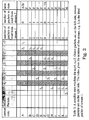
- the state machine can be implemented as a lookup table, which has been filled with data on design of the system. There is one combination, which is the ideal state. This state is defined by the requirements of the subsequent processing block, e.g. by the frame-rate conversion algorithm.
- the lookup table contains for each state a suitable way to get from the wrong state to the ideal state by reading additional packets from one or both streams. In the example in Table 1, the second and third column from the right give the number of packets to read per stream. The last column indicates the state which will be next.
- target state TS is state F.
- the packets are passed to the subsequent processing with a "good” indicator on the signaling channel. In any other case, the packets are passed with a "not good” indicator.
- the motion detection unit may be bypassed, unless the result is needed somewhere later in the system.
- the processing unit which may be a frame-rate conversion unit, receives all n1 packets from the first stream and n2 packets from the second stream. Additionally it consumes the analysis result of the synchronization block on the signaling channel, and also the motion information.
- frame-rate conversion of the first stream is performed using the helper information from the second stream.
- a backup algorithm must be used. Different backup algorithms (like frame repetition and field repetition) are used depending on the result of the motion detection unit.
- Basic advantages of the invention are an optimal and robust solution, which does not block the following components of the system, and a possible adaptation to software or hardware solutions.
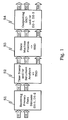
- Fig. 1 is a schematical block diagram elucidating a preferred embodiment of the inventive method for synchronizing packet-based digital data streams.
- a first step S1 of receiving primary digital data streams D1-1 and D1-2 said primary digital data streams D1-1 and D1-2 are received and forwarded to a following step S2 of analyzing the time stamps, the time stamp structure and/or the structure of the received primary digital data streams D1-1 and D1-2 itself. Thereby, time stamp structure data TSD are generated and/or provided.
- said primary digital data streams D1-1 and D1-2 are forwarded to a further step S3 of a state machine process wherein based on said primary digital data streams D1-1 and D1-2 and said time stamp structure data TSD secondary digital data streams D2-1 and D2-2 and/or synchronization state data SSD are generated and/or are provided as output data for a step S4 of outputting said synchronization state data SSD and/or said secondary digital data streams D2-1 and D2-2, for instance for further processing steps S50, S60 described below.
- Fig. 1 only two parallel primary digital data streams D1-1 and D1-2 are received and pre-processed for synchronization, the invention may also be applied to a plurality of primary digital data streams comprising more than two primary digital data streams.
- states A to L are given. Each state corresponds to a distinct temporal order of the four packets 1 1 to 4 1 of said first primary digital data stream D1-1 with respect to the two packets 1 2 and 2 2 of the second primary digital data stream D1-2.
- the current state of the state machine according to the state machine process S3 is given and denoted by one of the capital letters A to L.
- the most right column shows the next state for an iterative state machine process S3 which state is obtained by reading the number of packets from the first primary digital data stream D1-1 as given in the last but two column from the right and by simultaneously reading the number of packets given in the last but one column from the right for said second primary digital data stream D1-2.
- the state machine process S3 is in state A if both packets 1 2 and 2 2 read from said second primary digital data stream D1-2 are temporally advanced before all packets 1 1 to 4 1 of said first primary digital data stream D1-1.
- the next states A, B and/or F two packets from said first primary digital data stream D1-1 and zero packets from said second primary digital data stream D1-2 have to be read.
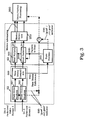
- FIG. 3 demonstrates in more detail a realization of the inventive method for synchronizing packet-based digital data streams in the case of a packetized video stream 1 as said first primary digital data stream D1-1 and a helper stream or packetized stream 2 as said second primary digital data stream D1-2, wherein said second primary digital data stream D1-2 contains some kind of motion vectors or motion information with respect to said first primary digital data stream D1-1.
- step S2 of analyzing the time stamps the time stamp structure and/or the structure of the primary digital data streams D1-1 and D1-2 itself and first of all the already above mentioned field order analysis S21 and S22, respectively, is performed to decide on whether or not the respective packets belong to the correct fields. Then, in a following step S23 a time stamp comparison is performed so as to generate and/or provide time stamp differences, for instance within said time stamp structure data TSD.
- the primary digital data streams D1-1 and D1-2 and said time stamp structure data TSD are supplied and input to a following step S3 wherein the state machine process S3 is performed.
- a state machine S33 for instance by evaluating the Table 1 shown in Fig.
- respective reading processes S31 and S32 with respect to said first and second primary digital data streams D1-1 and D1-2 are performed. This may be done by supplying synchronization state data SSD including information with respect to the packet to be read to the respective reading processes S31 and S32, respectively.
- secondary digital data streams D2-1 and D2-2 are generated and provided, which correspond to the respective primary digital data streams D1-1 and D1-2.
- These secondary digital data streams D2-1 and D2-2 are transmitted to a following step S50 of motion detection and further together with respective motion information derived and/or provided within said step S50 of motion detection to a further following step S60 of video or another way of further processing.
- said synchronization state data may also be used as a good/not good indication for the further processing S60. Therefore, the field order analysis steps S21 and S22 may also provide good/not good indications.
- the good/not good indications are logically combine by an logical OR. The result is supplied to the step of further processing S60.
Landscapes
- Engineering & Computer Science (AREA)
- Signal Processing (AREA)
- Multimedia (AREA)
- Computer Networks & Wireless Communication (AREA)
- Data Exchanges In Wide-Area Networks (AREA)
Priority Applications (2)
| Application Number | Priority Date | Filing Date | Title |
|---|---|---|---|
| EP03028288A EP1511204A3 (fr) | 2003-08-28 | 2003-12-10 | Procédé de synchronisation de flux de données basés de paquets |
| US10/926,669 US7668208B2 (en) | 2003-08-28 | 2004-08-26 | Method for synchronizing packet based digital data streams |
Applications Claiming Priority (3)
| Application Number | Priority Date | Filing Date | Title |
|---|---|---|---|
| EP03019467 | 2003-08-28 | ||
| EP03019467 | 2003-08-28 | ||
| EP03028288A EP1511204A3 (fr) | 2003-08-28 | 2003-12-10 | Procédé de synchronisation de flux de données basés de paquets |
Publications (2)
| Publication Number | Publication Date |
|---|---|
| EP1511204A2 true EP1511204A2 (fr) | 2005-03-02 |
| EP1511204A3 EP1511204A3 (fr) | 2005-10-05 |
Family
ID=34105739
Family Applications (1)
| Application Number | Title | Priority Date | Filing Date |
|---|---|---|---|
| EP03028288A Withdrawn EP1511204A3 (fr) | 2003-08-28 | 2003-12-10 | Procédé de synchronisation de flux de données basés de paquets |
Country Status (2)
| Country | Link |
|---|---|
| US (1) | US7668208B2 (fr) |
| EP (1) | EP1511204A3 (fr) |
Families Citing this family (2)
| Publication number | Priority date | Publication date | Assignee | Title |
|---|---|---|---|---|
| US8792473B2 (en) * | 2008-12-18 | 2014-07-29 | Motorola Solutions, Inc. | Synchronization of a plurality of data streams |
| RU2514092C2 (ru) * | 2012-03-30 | 2014-04-27 | Федеральное государственное унитарное предприятие "Ростовский-на-Дону научно-исследовательский институт радиосвязи" (ФГУП "РНИИРС") | Способ и устройство синхронизации и демультиплексирования компонентных сигналов в цифровых потоках |
Family Cites Families (8)
| Publication number | Priority date | Publication date | Assignee | Title |
|---|---|---|---|---|
| ATE369700T1 (de) * | 1994-06-17 | 2007-08-15 | Snell & Wilcox Ltd | Videokompression |
| US5594660A (en) * | 1994-09-30 | 1997-01-14 | Cirrus Logic, Inc. | Programmable audio-video synchronization method and apparatus for multimedia systems |
| US6567424B1 (en) * | 1995-08-07 | 2003-05-20 | Motorola, Inc. | Apparatus and method for determining a synchronization signal |
| US6233256B1 (en) * | 1996-03-13 | 2001-05-15 | Sarnoff Corporation | Method and apparatus for analyzing and monitoring packet streams |
| US6061399A (en) * | 1997-05-28 | 2000-05-09 | Sarnoff Corporation | Method and apparatus for information stream frame synchronization |
| GB2347596B (en) * | 1998-12-18 | 2003-07-30 | Mitel Corp | Apparatus for estimating jitter in RTP encapsulated voice packets received over a data network |
| US6507592B1 (en) * | 1999-07-08 | 2003-01-14 | Cisco Cable Products And Solutions A/S (Av) | Apparatus and a method for two-way data communication |
| JP4724919B2 (ja) * | 2000-06-02 | 2011-07-13 | ソニー株式会社 | 記録装置および記録方法、再生装置および再生方法、並びに記録媒体 |
-
2003
- 2003-12-10 EP EP03028288A patent/EP1511204A3/fr not_active Withdrawn
-
2004
- 2004-08-26 US US10/926,669 patent/US7668208B2/en not_active Expired - Fee Related
Also Published As
| Publication number | Publication date |
|---|---|
| US20050047446A1 (en) | 2005-03-03 |
| US7668208B2 (en) | 2010-02-23 |
| EP1511204A3 (fr) | 2005-10-05 |
Similar Documents
| Publication | Publication Date | Title |
|---|---|---|
| US6014368A (en) | Packet multiplexing system | |
| KR19990008432A (ko) | 쇼트 셀 다중 에이티엠 전송 시스템 및 전송 방법 | |
| US20030099230A1 (en) | Device and method for compensating data run times | |
| JPH0637746A (ja) | フレーム同期制御方式 | |
| JPH08163116A (ja) | フレーム同期装置 | |
| JP2009500920A (ja) | 交互パリティ・デスキュー・チャネルを使用してデータ・チャネルを同期させる方法および装置 | |
| CN106612452A (zh) | 机顶盒音视频同步的方法及装置 | |
| US5483538A (en) | Audio frame synchronization for embedded audio demultiplexers | |
| US5442636A (en) | Circuit and method for alignment of digital information packets | |
| JP2012513139A (ja) | 外部のコプロセッサを有するマルチプレクサにおいてトランスポートストリームを同期させる方法 | |
| EP0851625A2 (fr) | Dispositif de synchronisation de l'horloge d'un récepteur utilisant l'horloge des données à phases | |
| EP1848221B1 (fr) | Méthode de reconstruction d'une horloge système (STC) sans PCR | |
| EP1883247A2 (fr) | Appareil et procédé de transmission numérique | |
| US7668208B2 (en) | Method for synchronizing packet based digital data streams | |
| US5666547A (en) | Method and apparatus for framing a serial data stream | |
| US6339597B1 (en) | AAL5 jitter reduction method and apparatus | |
| US5771249A (en) | ATM cell synchronous system | |
| US7561622B2 (en) | Video analyzer and video error detector | |
| JPH08501916A (ja) | 同期信号形成用周期的同期基準発生装置および方法 | |
| EP4395330A1 (fr) | Dispositif pour fusionner des flux de transport | |
| CN114389738B (zh) | 一种同步捕获装置及同步捕获方法 | |
| JP2012182618A (ja) | 映像音声処理装置および映像音声処理方法 | |
| JPH04373338A (ja) | チャンネル間同期化方法及び装置 | |
| JP3407647B2 (ja) | 多重信号分離回路、伝送誤り測定回路および伝送誤り測定方法 | |
| JP2003101974A (ja) | Pcr補正装置及びそれに用いるpcr値補正方法 |
Legal Events
| Date | Code | Title | Description |
|---|---|---|---|
| PUAI | Public reference made under article 153(3) epc to a published international application that has entered the european phase |
Free format text: ORIGINAL CODE: 0009012 |
|
| AK | Designated contracting states |
Kind code of ref document: A2 Designated state(s): AT BE BG CH CY CZ DE DK EE ES FI FR GB GR HU IE IT LI LU MC NL PT RO SE SI SK TR |
|
| AX | Request for extension of the european patent |
Extension state: AL LT LV MK |
|
| PUAL | Search report despatched |
Free format text: ORIGINAL CODE: 0009013 |
|
| RAP1 | Party data changed (applicant data changed or rights of an application transferred) |
Owner name: SONY DEUTSCHLAND GMBH |
|
| AK | Designated contracting states |
Kind code of ref document: A3 Designated state(s): AT BE BG CH CY CZ DE DK EE ES FI FR GB GR HU IE IT LI LU MC NL PT RO SE SI SK TR |
|
| AX | Request for extension of the european patent |
Extension state: AL LT LV MK |
|
| RIC1 | Information provided on ipc code assigned before grant |
Ipc: 7H 04N 7/62 B Ipc: 7H 04N 7/26 A |
|
| 17P | Request for examination filed |
Effective date: 20060317 |
|
| AKX | Designation fees paid |
Designated state(s): DE FR GB |
|
| RAP1 | Party data changed (applicant data changed or rights of an application transferred) |
Owner name: SONY DEUTSCHLAND GMBH |
|
| 17Q | First examination report despatched |
Effective date: 20071116 |
|
| STAA | Information on the status of an ep patent application or granted ep patent |
Free format text: STATUS: THE APPLICATION IS DEEMED TO BE WITHDRAWN |
|
| 18D | Application deemed to be withdrawn |
Effective date: 20080527 |