EP1511404B1 - A BUTTON PARTLY MADE OF A MATERIAL having a frozen tension - Google Patents
A BUTTON PARTLY MADE OF A MATERIAL having a frozen tension Download PDFInfo
- Publication number
- EP1511404B1 EP1511404B1 EP02713998A EP02713998A EP1511404B1 EP 1511404 B1 EP1511404 B1 EP 1511404B1 EP 02713998 A EP02713998 A EP 02713998A EP 02713998 A EP02713998 A EP 02713998A EP 1511404 B1 EP1511404 B1 EP 1511404B1
- Authority
- EP
- European Patent Office
- Prior art keywords
- fastening element
- button
- fastening
- tension
- frozen
- Prior art date
- Legal status (The legal status is an assumption and is not a legal conclusion. Google has not performed a legal analysis and makes no representation as to the accuracy of the status listed.)
- Expired - Lifetime
Links
- 239000000463 material Substances 0.000 title claims abstract description 45
- 229920000642 polymer Polymers 0.000 claims description 21
- 229920001169 thermoplastic Polymers 0.000 claims description 9
- 230000000694 effects Effects 0.000 claims description 8
- 239000004416 thermosoftening plastic Substances 0.000 claims description 8
- 229920001577 copolymer Polymers 0.000 claims description 7
- 229920001971 elastomer Polymers 0.000 claims description 7
- 150000001993 dienes Chemical class 0.000 claims description 6
- WSSSPWUEQFSQQG-UHFFFAOYSA-N 4-methyl-1-pentene Chemical compound CC(C)CC=C WSSSPWUEQFSQQG-UHFFFAOYSA-N 0.000 claims description 4
- 239000000806 elastomer Substances 0.000 claims description 4
- 229920000636 poly(norbornene) polymer Polymers 0.000 claims description 4
- 229920005560 fluorosilicone rubber Polymers 0.000 claims description 3
- 229920002554 vinyl polymer Polymers 0.000 claims description 3
- LIKMAJRDDDTEIG-UHFFFAOYSA-N 1-hexene Chemical compound CCCCC=C LIKMAJRDDDTEIG-UHFFFAOYSA-N 0.000 claims description 2
- SMZOUWXMTYCWNB-UHFFFAOYSA-N 2-(2-methoxy-5-methylphenyl)ethanamine Chemical compound COC1=CC=C(C)C=C1CCN SMZOUWXMTYCWNB-UHFFFAOYSA-N 0.000 claims description 2
- NIXOWILDQLNWCW-UHFFFAOYSA-N 2-Propenoic acid Natural products OC(=O)C=C NIXOWILDQLNWCW-UHFFFAOYSA-N 0.000 claims description 2
- 229920000089 Cyclic olefin copolymer Polymers 0.000 claims description 2
- QYKIQEUNHZKYBP-UHFFFAOYSA-N Vinyl ether Chemical class C=COC=C QYKIQEUNHZKYBP-UHFFFAOYSA-N 0.000 claims description 2
- 150000002148 esters Chemical class 0.000 claims description 2
- 229920002313 fluoropolymer Polymers 0.000 claims description 2
- 239000000178 monomer Substances 0.000 claims description 2
- 150000002825 nitriles Chemical class 0.000 claims description 2
- 150000001451 organic peroxides Chemical class 0.000 claims description 2
- 230000035939 shock Effects 0.000 claims description 2
- 125000000391 vinyl group Chemical group [H]C([*])=C([H])[H] 0.000 claims description 2
- VXNZUUAINFGPBY-UHFFFAOYSA-N 1-Butene Chemical compound CCC=C VXNZUUAINFGPBY-UHFFFAOYSA-N 0.000 claims 1
- 229910000925 Cd alloy Inorganic materials 0.000 claims 1
- 229910017870 Cu—Ni—Al Inorganic materials 0.000 claims 1
- VGGSQFUCUMXWEO-UHFFFAOYSA-N Ethene Chemical compound C=C VGGSQFUCUMXWEO-UHFFFAOYSA-N 0.000 claims 1
- 239000005977 Ethylene Substances 0.000 claims 1
- 239000004952 Polyamide Substances 0.000 claims 1
- IAQRGUVFOMOMEM-UHFFFAOYSA-N butene Natural products CC=CC IAQRGUVFOMOMEM-UHFFFAOYSA-N 0.000 claims 1
- 125000003700 epoxy group Chemical group 0.000 claims 1
- TVMXDCGIABBOFY-UHFFFAOYSA-N octane Chemical compound CCCCCCCC TVMXDCGIABBOFY-UHFFFAOYSA-N 0.000 claims 1
- 229920002647 polyamide Polymers 0.000 claims 1
- QQONPFPTGQHPMA-UHFFFAOYSA-N propylene Natural products CC=C QQONPFPTGQHPMA-UHFFFAOYSA-N 0.000 claims 1
- 125000004805 propylene group Chemical group [H]C([H])([H])C([H])([*:1])C([H])([H])[*:2] 0.000 claims 1
- 230000005855 radiation Effects 0.000 claims 1
- 230000003446 memory effect Effects 0.000 abstract description 4
- 239000004753 textile Substances 0.000 description 24
- 230000007704 transition Effects 0.000 description 15
- 238000000034 method Methods 0.000 description 12
- 239000004744 fabric Substances 0.000 description 5
- 239000007787 solid Substances 0.000 description 5
- 239000000126 substance Substances 0.000 description 5
- 238000004132 cross linking Methods 0.000 description 4
- 229910045601 alloy Inorganic materials 0.000 description 3
- 239000000956 alloy Substances 0.000 description 3
- 229920002521 macromolecule Polymers 0.000 description 3
- 229910052751 metal Inorganic materials 0.000 description 3
- 239000002184 metal Substances 0.000 description 3
- 230000008439 repair process Effects 0.000 description 3
- IJGRMHOSHXDMSA-UHFFFAOYSA-N Atomic nitrogen Chemical compound N#N IJGRMHOSHXDMSA-UHFFFAOYSA-N 0.000 description 2
- -1 JP-A-59-53528 ) Chemical compound 0.000 description 2
- 238000001816 cooling Methods 0.000 description 2
- 230000009477 glass transition Effects 0.000 description 2
- 238000010438 heat treatment Methods 0.000 description 2
- 238000004519 manufacturing process Methods 0.000 description 2
- 229910001092 metal group alloy Inorganic materials 0.000 description 2
- 238000013040 rubber vulcanization Methods 0.000 description 2
- 238000009958 sewing Methods 0.000 description 2
- KWKAKUADMBZCLK-UHFFFAOYSA-N 1-octene Chemical compound CCCCCCC=C KWKAKUADMBZCLK-UHFFFAOYSA-N 0.000 description 1
- 229910000838 Al alloy Inorganic materials 0.000 description 1
- 229910000570 Cupronickel Inorganic materials 0.000 description 1
- 229920002292 Nylon 6 Polymers 0.000 description 1
- NINIDFKCEFEMDL-UHFFFAOYSA-N Sulfur Chemical compound [S] NINIDFKCEFEMDL-UHFFFAOYSA-N 0.000 description 1
- 208000027418 Wounds and injury Diseases 0.000 description 1
- 150000001336 alkenes Chemical class 0.000 description 1
- JRBRVDCKNXZZGH-UHFFFAOYSA-N alumane;copper Chemical compound [AlH3].[Cu] JRBRVDCKNXZZGH-UHFFFAOYSA-N 0.000 description 1
- 230000015572 biosynthetic process Effects 0.000 description 1
- WJCRZORJJRCRAW-UHFFFAOYSA-N cadmium gold Chemical compound [Cd].[Au] WJCRZORJJRCRAW-UHFFFAOYSA-N 0.000 description 1
- 238000005266 casting Methods 0.000 description 1
- 230000015556 catabolic process Effects 0.000 description 1
- YOCUPQPZWBBYIX-UHFFFAOYSA-N copper nickel Chemical compound [Ni].[Cu] YOCUPQPZWBBYIX-UHFFFAOYSA-N 0.000 description 1
- 230000006378 damage Effects 0.000 description 1
- 238000006731 degradation reaction Methods 0.000 description 1
- 239000013013 elastic material Substances 0.000 description 1
- 230000002708 enhancing effect Effects 0.000 description 1
- 239000003822 epoxy resin Substances 0.000 description 1
- 239000007789 gas Substances 0.000 description 1
- LNEPOXFFQSENCJ-UHFFFAOYSA-N haloperidol Chemical compound C1CC(O)(C=2C=CC(Cl)=CC=2)CCN1CCCC(=O)C1=CC=C(F)C=C1 LNEPOXFFQSENCJ-UHFFFAOYSA-N 0.000 description 1
- 238000010348 incorporation Methods 0.000 description 1
- 238000001746 injection moulding Methods 0.000 description 1
- 208000014674 injury Diseases 0.000 description 1
- 229910000734 martensite Inorganic materials 0.000 description 1
- 150000002739 metals Chemical class 0.000 description 1
- 229910001000 nickel titanium Inorganic materials 0.000 description 1
- HLXZNVUGXRDIFK-UHFFFAOYSA-N nickel titanium Chemical compound [Ti].[Ti].[Ti].[Ti].[Ti].[Ti].[Ti].[Ti].[Ti].[Ti].[Ti].[Ni].[Ni].[Ni].[Ni].[Ni].[Ni].[Ni].[Ni].[Ni].[Ni].[Ni].[Ni].[Ni].[Ni] HLXZNVUGXRDIFK-UHFFFAOYSA-N 0.000 description 1
- 229910052757 nitrogen Inorganic materials 0.000 description 1
- JFNLZVQOOSMTJK-KNVOCYPGSA-N norbornene Chemical compound C1[C@@H]2CC[C@H]1C=C2 JFNLZVQOOSMTJK-KNVOCYPGSA-N 0.000 description 1
- 239000004033 plastic Substances 0.000 description 1
- 229920003023 plastic Polymers 0.000 description 1
- 229920000647 polyepoxide Polymers 0.000 description 1
- 239000002861 polymer material Substances 0.000 description 1
- 238000003825 pressing Methods 0.000 description 1
- 230000002441 reversible effect Effects 0.000 description 1
- 239000002520 smart material Substances 0.000 description 1
- 125000001424 substituent group Chemical group 0.000 description 1
- 229910052717 sulfur Inorganic materials 0.000 description 1
- 239000011593 sulfur Substances 0.000 description 1
Images


Classifications
-
- A—HUMAN NECESSITIES
- A44—HABERDASHERY; JEWELLERY
- A44B—BUTTONS, PINS, BUCKLES, SLIDE FASTENERS, OR THE LIKE
- A44B1/00—Buttons
- A44B1/18—Buttons adapted for special ways of fastening
- A44B1/42—Buttons adapted for special ways of fastening with deformable prongs
-
- A—HUMAN NECESSITIES
- A41—WEARING APPAREL
- A41H—APPLIANCES OR METHODS FOR MAKING CLOTHES, e.g. FOR DRESS-MAKING OR FOR TAILORING, NOT OTHERWISE PROVIDED FOR
- A41H37/00—Machines, appliances or methods for setting fastener-elements on garments
- A41H37/001—Methods
-
- A—HUMAN NECESSITIES
- A44—HABERDASHERY; JEWELLERY
- A44B—BUTTONS, PINS, BUCKLES, SLIDE FASTENERS, OR THE LIKE
- A44B1/00—Buttons
- A44B1/02—Buttons characterised by their material
-
- A—HUMAN NECESSITIES
- A44—HABERDASHERY; JEWELLERY
- A44B—BUTTONS, PINS, BUCKLES, SLIDE FASTENERS, OR THE LIKE
- A44B18/00—Fasteners of the touch-and-close type; Making such fasteners
- A44B18/0069—Details
- A44B18/0096—Shape memory materials
-
- C—CHEMISTRY; METALLURGY
- C08—ORGANIC MACROMOLECULAR COMPOUNDS; THEIR PREPARATION OR CHEMICAL WORKING-UP; COMPOSITIONS BASED THEREON
- C08L—COMPOSITIONS OF MACROMOLECULAR COMPOUNDS
- C08L2201/00—Properties
- C08L2201/12—Shape memory
Definitions
- the invention relates to a button intended to be fastened to a woven or non-woven material using an element having a frozen tension.
- Buttons of the prior art represented usually by small discs sewed with sewing threads through their two or four holes to one part of clothing and, after the button is passed through a buttonhole made in the second part of clothing, enabling their mutual, removable joint has been used for many generations.
- Fastening with other catching element, e.g. an eye arranged at the bottom part of the button has been also known.
- the fasteners with invertible bases are mentioned in US patent No. 3,247,559 .
- the fasteners of this invention constitute new innovations in fastener structures and in techniques of securing a fastener to a porous, projection-penetrable member, such as a fabric with projection-penetrable interstices.
- the buttons of the appearance described above can be then fastened - sewed with the thread.
- the disadvantage consists particularly in the fact that the procedure mentioned is time-consuming both during manufacturing of clothes and their repairs.
- Another disadvantage of the buttons fastened as mentioned above is the fact that the mechanical properties of the thread (sometimes also the button) show gradual degradation resulting in the button loss.
- Metal buttons being fastened to textiles or other materials by riveting or in a similar way, as given for example in the Patent Application FR 2 755 351 has been also generally known. They are used particularly for work clothing and denim clothes. This fastening method is more reliable.
- the present invention is aimed at creation of a button that would be able to simplify the procedure necessary for its fastening to a material and possibly to reduce or minimize possible injury of an operator sewing the button and simultaneously to ensure maximum reliability of the join made between the button and its background material or, if possible, the fastening element, e.g. a basement fitted with an orifice for a fastening element. Reliability of this method used for button fastening should be comparable to riveting.
- a button fitted with an element through which it is fastened to a woven or non-woven material according to the invention characterized in that at least a fastening part of a button body is manufactured from a material having elastic memory or features only with the frozen tension effect.
- the fastening element having the straight or elongate shape and fixed under the temperature Tg is then passed through a woven or non-woven material or a part of clothing while a "frozen" tension being released by a thermal, mechanical or ultrasonic shock makes the fastening element to return to its original condition, i.e. to return to the stable (permanent) shape of so-called stable position and to join firmly with the textiles.
- the material having the frozen tension suitable at least for the fastening part can be a metal alloy having the frozen tension an elastic or polymer material having the frozen tension.
- a deformable solid substance which metastable condition is fixed by a thermoplastics when, after said thermoplastic is heated, the deformable part of the button returns to the stable condition due to its elasticity and the relevant part of the button reaches the shape ensuring the demanded stable fixation of the button as the whole can be also considered.
- Alloys having the elastic memory are for example copper-nickel and copper-aluminium alloys, gold-cadmium or nickel-titan alloys, the latter being known under the trade name Nitinol.
- the alloy deformed plastically into its low-temperature martensitic phase returns to its original condition after being heated and transited into the austenitic phase.
- thermoplastic polymers having a linear structure usually do not feature with significant elastic memory. On the contrary, they are characterized with so-called "cold flow". It is the event during which segments of a polymer submitted to tension are transited so that tension disappears gradually even under the normal temperature.
- the cold flow appearing in the polymer and causing the loss of the elastic memory can be inhibited through macromolecules cross-linking, formation of crosslinks between the adjacent segments of the polymer, or through incorporation of voluminous lateral substituents into a strand, through enhancing of polymer crystallinity and increasing of molecular weight that shows the similar effect. Cooling of the deformed material below the glass transition point Tg prevents transition of macromolecule segments that returns back to the stable condition after being heated above Tg temperature.
- Rubber vulcanisation seems to be the most known and oldest cross-linking method. Bridges between adjacent elastomer macromolecules are formed in it by sulfur. As it is generally known, the vulcanised rubber (rubber) undergoes deformation under tension and returns to its original shape after tension is released. Temperature of the glass transition Tg under which rubber keeps its deformed, metastable shape, is well below -50 °C. Since rubber vulcanisation was invented, many new polymers featuring with the elastic memory have been invented. In contrast with metals, polymers feature with significantly higher reversible deformability. They have mostly the cross-linked structure. Particularly polymers and copolymers based on norbornene (e.g.
- JP-A-59-53528 copolymers of conjugated dienes, polymers and copolymers of alkenes, e.g. ethylene, propylene, butene, 4-methylpentene, hexene or octene, some epoxy resins, polymers based on aromatic vinyl monomers, unsaturated nitrile polymers, polymers based on esters of acrylic acid ( JP-A.60-28433 ), polymers based on cross-linkable polycaprolactam ( JP-A-59-11315 ) or cross-linked diene polymer, amorphous fluorinated polymers as, for example, vinyl fluoride copolymers, vinyl fluoralkene/olefin copolymers, fluoroacyl vinyl ethers, fluorosilicone elastomers and fluorophosphazenone elastomers can be given as examples.
- the relevant polymer part is made by injection moulding, pressing or casting in the demanded shape
- Elasticity of a deformable solid substance e.g., polymeric cross-linked elastomer, metal, etc. combined with a thermoplastic can be also made use of.
- the important is that the softening point of a thermoplastic shall be lower than that one at which the solid substance looses its elastic properties, i.e. that the elastic properties of the elastically deformed solid substance shall be kept at the temperatures up to the softening temperature point.
- transition temperature at which the transition to the stable shape occurs shall range at the interval of technologically acceptable temperatures, i.e. between 30 °C and 200 °C.
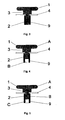
- a button shown in Fig. 1a and Fig. 1b consists of a body 1 with a fit 3 , fitted with a fastening element 2 being e.g. in a shape of a shank that is divided with a longitudinal gap 10 at the direction of its axis.
- the part of the fastening element 2 is made of a material having a frozen tension or featuring with a frozen tension effect. Polynorbornene or fluorosilicone elastomer, etc. can be used for example as the suitable materials.
- the button is fastened to textiles 4 so that the fastening element 2 is heated to the required transition temperature point. When said temperature is reached, the fastening element 2 begins its transition. The material with a frozen tension is then cooled below the transition temperature point. This causes the permanent fixation of the shape of the fastening element 2 and its fastening to the textiles 4 .
- the condition mentioned is shown in Fig. 1b .
- the button as specified consists of the body 1 with the fit 3 and the fastening element 2 made of the material without a frozen tension while at least a jacket 9 of the fastening element 2 is made of the material with a frozen tension, e.g. polynorbornene.
- the body 1 of the button with the fastening element 2 is fastened to the textiles using the known method, i.e. the fastening element 2 having the shape of the shaft penetrates through the textiles 4 and then is heated above the transition temperature point. This enables the material with elastic memory to change the shape of the fastening element 2 , changes its shape and fastens the button to the textiles 4 .
- the button as shown in Fig. 3 consists of the body 1 with the fit 3 and the fastening element 2 made of the material with a frozen tension, e.g. polynorbornene while at least one part of the fastening element 2 is fitted with the jacket 9 made of the material without a frozen tension.
- the body 1 with the fit 3 and the fastening element 2 is fastened to the textiles 4 using the known method, i.e. the fastening element 2 having the shape of the shaft penetrates through the textiles 4 and then is heated above the transition temperature point. This enables the material with elastic memory to change the shape of the fastening element 2 and ensures fastening of the button to the textiles 4 .
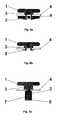
- the button as shown in Fig. 4 consists of the body 1 with the fit 3 and the fastening element 2 made of materials A having elastic memory while the jacket 9 of the fastening element 2 is made of material B without a frozen tension.
- the body 1 of the button with the fastening element 2 is fastened to the cloth using the known method, i.e. the fastening element 2 having the shape of the shaft penetrates through the textiles 4 and then is heated above the transition temperature point. This enables the material with elastic memory to change the shape of the fastening element 2 and ensures fastening of the button to the textiles 4 .
- Material A is e.g. the cross-linked diene polymer and material B is the thermoplastic.
- the button as shown in Fig. 5 consists of the body 1 with the fit 3 and the fastening element 2 made of the materials A having no a frozen tension representing its significant part while the jacket 9 of the fastening element 2 is made of the material B having no a frozen tension. At least one part of the fastening element 2 is made of the material C having elastic memory.
- the body 1 of the button with the fastening element 2 is fastened to the cloth using the known method, i.e. the fastening element 2 having the shape of the shaft penetrates through the cloth and then is heated above the transition temperature point. This enables the material with a frozen tension to change the shape of the fastening element 2 and ensures fastening of the button to the textiles 4 .
- the material A is elastically solid substance while the material B is the thermoplastic and the material C represents, e.g, the cross-linked crystalline diene polymer.
- the button in this embodiment consists of the body 1 with the fit 3 to which a pair of the fastening element 2 is fastened at certain gap-length, having the shape of e.g. small tubes or rods featuring with a frozen tension effect.
- the button in this embodiment consists also of a supporting element 6 having the shape of a basement fitted with two orifices 5 through which the fastening elements 2 pass.
- the button is fastened to the textiles 4 with the fastening elements 2 having the shape of the small tubes or rods fitted e.g. with tips on their ends, the textiles 4 , e.g.
- the fastening elements 2 of the button are then heated at the desired transition temperature point. As the temperature is reached, the fastening element 2 begins to change its shape; after it is cooled below the transition temperature value, the shape of the fastening element 2 begins its fixation and the button is fastened to the textiles 4 .
- Fig. 6a The button intended for fastening to the thicker textiles is given in Fig. 6a . Both the embodiment and fastening is analogous to those ones described and shown in Fig. 6a with the exception that the supporting element 6 is not used for said embodiment.
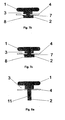
- Fig. 7a and 7b Other preferred embodiment of the button intended for fastening to the textiles is given in Fig. 7a and 7b .
- the button according to said embodiment consists of the body 1 with the fit 3 to which the fastening element 2 featuring with the elastic memory effect in its elongated condition is connected at the direction of its axis fitted with a termination 8 to which a roll-on 7 bearing the termination 8 is set on tightly.
- the roll-on 7 is made of the material without elastic memory.
- the condition before heating above the transition temperature value is shown in Fig. 7a .
- the button intended for fastening to the textiles is shown in Fig. 8a and Fig. 8b .
- the button according to this embodiment consists of the body 1 with the fit 3 and the fastening element 2 in which a deforming element 11 made of the material featuring with the elastic memory effect is located.
- the condition before heating above the transition temperature value is shown in Fig. 8a .
- the condition when the deforming element 11 after being heated, releases gas, e.g. nitrogen that causes the change in the deforming element shape is shown in Fig. 8b . Said change then causes further deformation of the fastening element 2 that fastens the button to the textiles 4 .
- the button intended for fastening using the a frozen tension of the material can be applied in the clothing industry for manufacturing of ready-made clothes and other products made of the woven and non-woven materials, for repairs of clothes in households or repair shops for clothes and other products.
Landscapes
- Engineering & Computer Science (AREA)
- Textile Engineering (AREA)
- Slide Fasteners, Snap Fasteners, And Hook Fasteners (AREA)
- Push-Button Switches (AREA)
- Springs (AREA)
- Footwear And Its Accessory, Manufacturing Method And Apparatuses (AREA)
- Thermotherapy And Cooling Therapy Devices (AREA)
- Food-Manufacturing Devices (AREA)
Applications Claiming Priority (1)
| Application Number | Priority Date | Filing Date | Title |
|---|---|---|---|
| PCT/CZ2002/000021 WO2003092426A1 (en) | 2002-04-09 | 2002-04-09 | A button partly made of a material having elastic memory |
Publications (2)
| Publication Number | Publication Date |
|---|---|
| EP1511404A1 EP1511404A1 (en) | 2005-03-09 |
| EP1511404B1 true EP1511404B1 (en) | 2008-11-05 |
Family
ID=29276046
Family Applications (1)
| Application Number | Title | Priority Date | Filing Date |
|---|---|---|---|
| EP02713998A Expired - Lifetime EP1511404B1 (en) | 2002-04-09 | 2002-04-09 | A BUTTON PARTLY MADE OF A MATERIAL having a frozen tension |
Country Status (8)
| Country | Link |
|---|---|
| EP (1) | EP1511404B1 (pl) |
| AT (1) | ATE413108T1 (pl) |
| AU (1) | AU2002246002A1 (pl) |
| CZ (1) | CZ2004975A3 (pl) |
| DE (1) | DE60229791D1 (pl) |
| PL (1) | PL198382B1 (pl) |
| SK (1) | SK3752004A3 (pl) |
| WO (1) | WO2003092426A1 (pl) |
Families Citing this family (3)
| Publication number | Priority date | Publication date | Assignee | Title |
|---|---|---|---|---|
| US7858891B2 (en) | 2006-04-24 | 2010-12-28 | Volkswagen Group Of America, Inc. | Shape-changing control panel button based on activation/deactivation |
| KR200444016Y1 (ko) * | 2008-08-07 | 2009-04-02 | 정의봉 | 실리콘 단추 |
| BE1027558B1 (nl) * | 2019-09-09 | 2021-04-06 | Regeneration Bv | Rivet en werkwijze voor het demonteren van een rivet |
Family Cites Families (5)
| Publication number | Priority date | Publication date | Assignee | Title |
|---|---|---|---|---|
| US3247559A (en) * | 1965-01-08 | 1966-04-26 | Robert V Mathison | Fasteners with invertible bases |
| US3871089A (en) * | 1972-09-25 | 1975-03-18 | John W Kunz | Upholstery element |
| CH641017A5 (fr) * | 1978-03-16 | 1984-02-15 | Petersson New Prod Bengt | Procede pour fixer un bouton en matiere plastique a un materiau textile et appareil pour la mise en oeuvre de ce procede. |
| JPH0298301A (ja) * | 1988-10-05 | 1990-04-10 | Isao Sakai | ボタン及びボタン装着方法並びにボタン加熱器 |
| US5138779A (en) * | 1991-07-08 | 1992-08-18 | Earnest Michael L | Animated button utilizing shape memory wire |
-
2002
- 2002-04-09 DE DE60229791T patent/DE60229791D1/de not_active Expired - Lifetime
- 2002-04-09 AU AU2002246002A patent/AU2002246002A1/en not_active Abandoned
- 2002-04-09 PL PL372854A patent/PL198382B1/pl unknown
- 2002-04-09 AT AT02713998T patent/ATE413108T1/de not_active IP Right Cessation
- 2002-04-09 SK SK375-2004A patent/SK3752004A3/sk unknown
- 2002-04-09 EP EP02713998A patent/EP1511404B1/en not_active Expired - Lifetime
- 2002-04-09 WO PCT/CZ2002/000021 patent/WO2003092426A1/en not_active Ceased
- 2002-04-09 CZ CZ2004975A patent/CZ2004975A3/cs unknown
Also Published As
| Publication number | Publication date |
|---|---|
| SK3752004A3 (sk) | 2005-02-04 |
| ATE413108T1 (de) | 2008-11-15 |
| PL372854A1 (pl) | 2005-08-08 |
| DE60229791D1 (de) | 2008-12-18 |
| PL198382B1 (pl) | 2008-06-30 |
| CZ2004975A3 (cs) | 2005-02-16 |
| EP1511404A1 (en) | 2005-03-09 |
| WO2003092426A1 (en) | 2003-11-13 |
| AU2002246002A1 (en) | 2003-11-17 |
Similar Documents
| Publication | Publication Date | Title |
|---|---|---|
| EP1426630A1 (en) | Controlled releasable velcro-like fastener system | |
| CN101837801B (zh) | 使用活性材料致动的方向盘释放/冲击 | |
| US9958023B2 (en) | Rate responsive, stretchable devices further improvements | |
| CN101325887B (zh) | 防弹用多轴向纺织品 | |
| US20040074065A1 (en) | Releasable fastener system | |
| EP1511404B1 (en) | A BUTTON PARTLY MADE OF A MATERIAL having a frozen tension | |
| US10765572B2 (en) | Method of assembling at least two units, and a corresponding assembled structure | |
| US20020007884A1 (en) | Semifinished product made from a shape memory alloy having a two-way effect and method for manufacturing the same | |
| KR20040069266A (ko) | 슬라이드 파스너용 테이프 | |
| US6920675B2 (en) | Process for attachment and/or disengagement of components | |
| WO2002052077A3 (en) | Yarn and fabric having improved abrasion resistance | |
| KR20140032452A (ko) | 폴리페닐렌술피드 섬유 및 부직포 | |
| CN103129829A (zh) | 活性绑扎材料及孔眼 | |
| Meng et al. | A smart hollow filament with thermal sensitive internal diameter | |
| WO2003102256A1 (fr) | Fil extremement fin en alliage a memoire de forme, materiau composite destine a la fabrication de ce fil et procede de production associe | |
| CA2098924C (en) | Puncture resistant protective patch | |
| US1232633A (en) | Button. | |
| DE4445384C2 (de) | Verfahren zum Sichern einer mit einem Umwicklungsfaden erzeugten Knopfstielwicklung gegen Wiederaufgehen | |
| Peng et al. | The amorphous phase in high‐speed spun PET fibers | |
| Kvaratskheliya | A study of microstructural changes in synthetic fibres resulting from mechanical deformations | |
| Lin et al. | Manufacturing and mechanical evaluation of HRBP/PPTA intra-ply hybrid nonwovens for protecting cushioning composites | |
| JP6197194B2 (ja) | 布製ループ面ファスナー | |
| KR102219967B1 (ko) | 손가락의 가동 범위 확장용 확장모듈이 구비된 장갑 | |
| US20250366549A1 (en) | Knit goal keeper glove | |
| US20230225462A1 (en) | Novel Fabric Mending Device And Methods Of Use Thereof |
Legal Events
| Date | Code | Title | Description |
|---|---|---|---|
| PUAI | Public reference made under article 153(3) epc to a published international application that has entered the european phase |
Free format text: ORIGINAL CODE: 0009012 |
|
| 17P | Request for examination filed |
Effective date: 20041102 |
|
| AK | Designated contracting states |
Kind code of ref document: A1 Designated state(s): AT BE CH CY DE DK ES FI FR GB GR IE IT LI LU MC NL PT SE TR |
|
| AX | Request for extension of the european patent |
Extension state: AL LT LV MK RO SI |
|
| 17Q | First examination report despatched |
Effective date: 20070720 |
|
| GRAP | Despatch of communication of intention to grant a patent |
Free format text: ORIGINAL CODE: EPIDOSNIGR1 |
|
| RTI1 | Title (correction) |
Free format text: A BUTTON PARTLY MADE OF A MATERIAL HAVING A FROZEN TENSION |
|
| GRAS | Grant fee paid |
Free format text: ORIGINAL CODE: EPIDOSNIGR3 |
|
| GRAA | (expected) grant |
Free format text: ORIGINAL CODE: 0009210 |
|
| AK | Designated contracting states |
Kind code of ref document: B1 Designated state(s): AT BE CH CY DE DK ES FI FR GB GR IE IT LI LU MC NL PT SE TR |
|
| REG | Reference to a national code |
Ref country code: GB Ref legal event code: FG4D |
|
| REG | Reference to a national code |
Ref country code: CH Ref legal event code: EP |
|
| REG | Reference to a national code |
Ref country code: IE Ref legal event code: FG4D |
|
| REF | Corresponds to: |
Ref document number: 60229791 Country of ref document: DE Date of ref document: 20081218 Kind code of ref document: P |
|
| NLV1 | Nl: lapsed or annulled due to failure to fulfill the requirements of art. 29p and 29m of the patents act | ||
| PG25 | Lapsed in a contracting state [announced via postgrant information from national office to epo] |
Ref country code: AT Free format text: LAPSE BECAUSE OF FAILURE TO SUBMIT A TRANSLATION OF THE DESCRIPTION OR TO PAY THE FEE WITHIN THE PRESCRIBED TIME-LIMIT Effective date: 20081105 Ref country code: ES Free format text: LAPSE BECAUSE OF FAILURE TO SUBMIT A TRANSLATION OF THE DESCRIPTION OR TO PAY THE FEE WITHIN THE PRESCRIBED TIME-LIMIT Effective date: 20090216 |
|
| PG25 | Lapsed in a contracting state [announced via postgrant information from national office to epo] |
Ref country code: NL Free format text: LAPSE BECAUSE OF FAILURE TO SUBMIT A TRANSLATION OF THE DESCRIPTION OR TO PAY THE FEE WITHIN THE PRESCRIBED TIME-LIMIT Effective date: 20081105 Ref country code: FI Free format text: LAPSE BECAUSE OF FAILURE TO SUBMIT A TRANSLATION OF THE DESCRIPTION OR TO PAY THE FEE WITHIN THE PRESCRIBED TIME-LIMIT Effective date: 20081105 |
|
| PG25 | Lapsed in a contracting state [announced via postgrant information from national office to epo] |
Ref country code: BE Free format text: LAPSE BECAUSE OF FAILURE TO SUBMIT A TRANSLATION OF THE DESCRIPTION OR TO PAY THE FEE WITHIN THE PRESCRIBED TIME-LIMIT Effective date: 20081105 Ref country code: DK Free format text: LAPSE BECAUSE OF FAILURE TO SUBMIT A TRANSLATION OF THE DESCRIPTION OR TO PAY THE FEE WITHIN THE PRESCRIBED TIME-LIMIT Effective date: 20081105 |
|
| PG25 | Lapsed in a contracting state [announced via postgrant information from national office to epo] |
Ref country code: SE Free format text: LAPSE BECAUSE OF FAILURE TO SUBMIT A TRANSLATION OF THE DESCRIPTION OR TO PAY THE FEE WITHIN THE PRESCRIBED TIME-LIMIT Effective date: 20090205 Ref country code: PT Free format text: LAPSE BECAUSE OF FAILURE TO SUBMIT A TRANSLATION OF THE DESCRIPTION OR TO PAY THE FEE WITHIN THE PRESCRIBED TIME-LIMIT Effective date: 20090406 |
|
| PGFP | Annual fee paid to national office [announced via postgrant information from national office to epo] |
Ref country code: FR Payment date: 20090430 Year of fee payment: 8 |
|
| PLBE | No opposition filed within time limit |
Free format text: ORIGINAL CODE: 0009261 |
|
| STAA | Information on the status of an ep patent application or granted ep patent |
Free format text: STATUS: NO OPPOSITION FILED WITHIN TIME LIMIT |
|
| 26N | No opposition filed |
Effective date: 20090806 |
|
| REG | Reference to a national code |
Ref country code: CH Ref legal event code: PL |
|
| PG25 | Lapsed in a contracting state [announced via postgrant information from national office to epo] |
Ref country code: LI Free format text: LAPSE BECAUSE OF NON-PAYMENT OF DUE FEES Effective date: 20090430 Ref country code: CH Free format text: LAPSE BECAUSE OF NON-PAYMENT OF DUE FEES Effective date: 20090430 |
|
| REG | Reference to a national code |
Ref country code: IE Ref legal event code: MM4A |
|
| PG25 | Lapsed in a contracting state [announced via postgrant information from national office to epo] |
Ref country code: MC Free format text: LAPSE BECAUSE OF NON-PAYMENT OF DUE FEES Effective date: 20090430 Ref country code: IE Free format text: LAPSE BECAUSE OF NON-PAYMENT OF DUE FEES Effective date: 20090409 |
|
| PGFP | Annual fee paid to national office [announced via postgrant information from national office to epo] |
Ref country code: DE Payment date: 20100428 Year of fee payment: 9 |
|
| PG25 | Lapsed in a contracting state [announced via postgrant information from national office to epo] |
Ref country code: GR Free format text: LAPSE BECAUSE OF FAILURE TO SUBMIT A TRANSLATION OF THE DESCRIPTION OR TO PAY THE FEE WITHIN THE PRESCRIBED TIME-LIMIT Effective date: 20090206 |
|
| PGFP | Annual fee paid to national office [announced via postgrant information from national office to epo] |
Ref country code: GB Payment date: 20100401 Year of fee payment: 9 |
|
| REG | Reference to a national code |
Ref country code: FR Ref legal event code: ST Effective date: 20101230 |
|
| PG25 | Lapsed in a contracting state [announced via postgrant information from national office to epo] |
Ref country code: IT Free format text: LAPSE BECAUSE OF FAILURE TO SUBMIT A TRANSLATION OF THE DESCRIPTION OR TO PAY THE FEE WITHIN THE PRESCRIBED TIME-LIMIT Effective date: 20081105 |
|
| PG25 | Lapsed in a contracting state [announced via postgrant information from national office to epo] |
Ref country code: LU Free format text: LAPSE BECAUSE OF NON-PAYMENT OF DUE FEES Effective date: 20090409 |
|
| PG25 | Lapsed in a contracting state [announced via postgrant information from national office to epo] |
Ref country code: TR Free format text: LAPSE BECAUSE OF FAILURE TO SUBMIT A TRANSLATION OF THE DESCRIPTION OR TO PAY THE FEE WITHIN THE PRESCRIBED TIME-LIMIT Effective date: 20081105 |
|
| PG25 | Lapsed in a contracting state [announced via postgrant information from national office to epo] |
Ref country code: CY Free format text: LAPSE BECAUSE OF FAILURE TO SUBMIT A TRANSLATION OF THE DESCRIPTION OR TO PAY THE FEE WITHIN THE PRESCRIBED TIME-LIMIT Effective date: 20081105 |
|
| GBPC | Gb: european patent ceased through non-payment of renewal fee |
Effective date: 20110409 |
|
| PG25 | Lapsed in a contracting state [announced via postgrant information from national office to epo] |
Ref country code: DE Free format text: LAPSE BECAUSE OF NON-PAYMENT OF DUE FEES Effective date: 20111101 |
|
| REG | Reference to a national code |
Ref country code: DE Ref legal event code: R119 Ref document number: 60229791 Country of ref document: DE Effective date: 20111101 |
|
| PG25 | Lapsed in a contracting state [announced via postgrant information from national office to epo] |
Ref country code: GB Free format text: LAPSE BECAUSE OF NON-PAYMENT OF DUE FEES Effective date: 20110409 |
|
| PG25 | Lapsed in a contracting state [announced via postgrant information from national office to epo] |
Ref country code: FR Free format text: LAPSE BECAUSE OF NON-PAYMENT OF DUE FEES Effective date: 20100430 |