EP1514923A1 - Enzym zum abbau von aus seegurke stammendem sulfatiertem fucan - Google Patents
Enzym zum abbau von aus seegurke stammendem sulfatiertem fucan Download PDFInfo
- Publication number
- EP1514923A1 EP1514923A1 EP03733522A EP03733522A EP1514923A1 EP 1514923 A1 EP1514923 A1 EP 1514923A1 EP 03733522 A EP03733522 A EP 03733522A EP 03733522 A EP03733522 A EP 03733522A EP 1514923 A1 EP1514923 A1 EP 1514923A1
- Authority
- EP
- European Patent Office
- Prior art keywords
- sulfated fucan
- endo
- fucosidase
- type
- sulfated
- Prior art date
- Legal status (The legal status is an assumption and is not a legal conclusion. Google has not performed a legal analysis and makes no representation as to the accuracy of the status listed.)
- Withdrawn
Links
Images



Classifications
-
- C—CHEMISTRY; METALLURGY
- C12—BIOCHEMISTRY; BEER; SPIRITS; WINE; VINEGAR; MICROBIOLOGY; ENZYMOLOGY; MUTATION OR GENETIC ENGINEERING
- C12P—FERMENTATION OR ENZYME-USING PROCESSES TO SYNTHESISE A DESIRED CHEMICAL COMPOUND OR COMPOSITION OR TO SEPARATE OPTICAL ISOMERS FROM A RACEMIC MIXTURE
- C12P19/00—Preparation of compounds containing saccharide radicals
- C12P19/04—Polysaccharides, i.e. compounds containing more than five saccharide radicals attached to each other by glycosidic bonds
-
- C—CHEMISTRY; METALLURGY
- C12—BIOCHEMISTRY; BEER; SPIRITS; WINE; VINEGAR; MICROBIOLOGY; ENZYMOLOGY; MUTATION OR GENETIC ENGINEERING
- C12N—MICROORGANISMS OR ENZYMES; COMPOSITIONS THEREOF; PROPAGATING, PRESERVING, OR MAINTAINING MICROORGANISMS; MUTATION OR GENETIC ENGINEERING; CULTURE MEDIA
- C12N9/00—Enzymes; Proenzymes; Compositions thereof; Processes for preparing, activating, inhibiting, separating or purifying enzymes
- C12N9/14—Hydrolases (3)
- C12N9/16—Hydrolases (3) acting on ester bonds (3.1)
-
- C—CHEMISTRY; METALLURGY
- C12—BIOCHEMISTRY; BEER; SPIRITS; WINE; VINEGAR; MICROBIOLOGY; ENZYMOLOGY; MUTATION OR GENETIC ENGINEERING
- C12N—MICROORGANISMS OR ENZYMES; COMPOSITIONS THEREOF; PROPAGATING, PRESERVING, OR MAINTAINING MICROORGANISMS; MUTATION OR GENETIC ENGINEERING; CULTURE MEDIA
- C12N9/00—Enzymes; Proenzymes; Compositions thereof; Processes for preparing, activating, inhibiting, separating or purifying enzymes
- C12N9/14—Hydrolases (3)
- C12N9/24—Hydrolases (3) acting on glycosyl compounds (3.2)
- C12N9/2402—Hydrolases (3) acting on glycosyl compounds (3.2) hydrolysing O- and S- glycosyl compounds (3.2.1)
-
- C—CHEMISTRY; METALLURGY
- C12—BIOCHEMISTRY; BEER; SPIRITS; WINE; VINEGAR; MICROBIOLOGY; ENZYMOLOGY; MUTATION OR GENETIC ENGINEERING
- C12N—MICROORGANISMS OR ENZYMES; COMPOSITIONS THEREOF; PROPAGATING, PRESERVING, OR MAINTAINING MICROORGANISMS; MUTATION OR GENETIC ENGINEERING; CULTURE MEDIA
- C12N9/00—Enzymes; Proenzymes; Compositions thereof; Processes for preparing, activating, inhibiting, separating or purifying enzymes
- C12N9/88—Lyases (4.)
-
- C—CHEMISTRY; METALLURGY
- C12—BIOCHEMISTRY; BEER; SPIRITS; WINE; VINEGAR; MICROBIOLOGY; ENZYMOLOGY; MUTATION OR GENETIC ENGINEERING
- C12P—FERMENTATION OR ENZYME-USING PROCESSES TO SYNTHESISE A DESIRED CHEMICAL COMPOUND OR COMPOSITION OR TO SEPARATE OPTICAL ISOMERS FROM A RACEMIC MIXTURE
- C12P11/00—Preparation of sulfur-containing organic compounds
-
- C—CHEMISTRY; METALLURGY
- C12—BIOCHEMISTRY; BEER; SPIRITS; WINE; VINEGAR; MICROBIOLOGY; ENZYMOLOGY; MUTATION OR GENETIC ENGINEERING
- C12Y—ENZYMES
- C12Y302/00—Hydrolases acting on glycosyl compounds, i.e. glycosylases (3.2)
- C12Y302/01—Glycosidases, i.e. enzymes hydrolysing O- and S-glycosyl compounds (3.2.1)
- C12Y302/01044—Fucoidanase (3.2.1.44)
-
- C—CHEMISTRY; METALLURGY
- C12—BIOCHEMISTRY; BEER; SPIRITS; WINE; VINEGAR; MICROBIOLOGY; ENZYMOLOGY; MUTATION OR GENETIC ENGINEERING
- C12Y—ENZYMES
- C12Y302/00—Hydrolases acting on glycosyl compounds, i.e. glycosylases (3.2)
- C12Y302/01—Glycosidases, i.e. enzymes hydrolysing O- and S-glycosyl compounds (3.2.1)
- C12Y302/01051—Alpha-L-fucosidase (3.2.1.51)
Definitions
- the present invention relates to an enzyme that degrades a sulfated fucan which is useful in a field of glycotechnology, a method for producing the enzyme and various factors that activate the enzyme, as well as a sulfated fucan oligosaccharide which is useful as a reagent for glycotechnology and a method for producing the same.
- sulfated polysaccharides are contained in a sea cucumber. They include a sulfated fucan which is a polysaccharide whose main component is sulfated fucose. An activity of suppressing infection with AIDS virus and an anticoagulant activity of a sulfated fucan derived from a sea cucumber have been reported. If a sulfated fucan derived from a sea cucumber is to be developed as a pharmaceutical, it is necessary to determine its structure. The structure of a sulfated fucan derived from a sea cucumber has been studied although only average values for the structure have been determined at present.
- Sulfated fucans are also contained in various brown algae, and their structures may vary depending on the algae from which they are derived in many cases. For example, sulfated fucans extracted from Fucus evanescens, Laminaria japonica and Nemacystus decipiens have structures different from each other.
- the main object of the present invention is to provide a sulfated fucan-degrading enzyme that degrades a sulfated fucan derived from a sea cucumber and a method for producing the enzyme, as well as a smaller molecule that is obtainable by allowing the enzyme to act on a sulfated fucan and a method for producing the same.
- a further object of the present invention is to provide a factor that activates a sulfated fucan-degrading enzyme.
- the present inventors have found that a bacterial strain belonging to the genus Fucoidanobacter, Fucoidanobacter marinus SI-0098, produces a novel sulfated fucan-degrading enzyme, and found a method for producing the enzyme.
- the present inventors have also found that a novel sulfated fucan oligosaccharide can be produced from a sulfated fucan derived from a sea cucumber utilizing the enzyme. Thus, the present invention has been completed.
- the first aspect of the present invention relates to an endo-type ⁇ -L-fucosidase which is obtainable from a culture of a bacterium of the genus Fucoidanobacter.
- the enzyme can be collected from a culture of a bacterium of the genus Fucoidanobacter capable of producing the endo-type ⁇ -L-fucosidase.
- the second aspect of the present invention relates to a sulfated fucan sulfatase which is obtainable from a culture of a bacterium of the genus Fucoidanobacter.
- the enzyme can be collected from a culture of a bacterium of the genus Fucoidanobacter capable of producing the sulfated fucan sulfatase.
- the third aspect of the present invention relates to a sulfated fucan oligosaccharide which is obtainable by allowing the endo-type ⁇ -L-fucosidase of the first aspect to act on a fraction of a sulfated fucan derived from a sea cucumber.
- the sulfated fucan oligosaccharide of the third aspect can be produced according to a method for producing a sulfated fucan oligosaccharide comprising allowing the endo-type ⁇ -L-fucosidase of the first aspect to act on a fraction of a sulfated fucan derived from a sea cucumber.
- the method may be carried out in the presence of sodium chloride.
- the fourth aspect of the present invention relates to a sulfated fucan oligosaccharide which is obtainable by allowing the endo-type ⁇ -L-fucosidase of the first aspect and the sulfated fucan sulfatase of the second aspect to act on a fraction of a sulfated fucan derived from a sea cucumber.
- the sulfated fucan oligosaccharide of the fourth aspect can be produced according to a method for producing a sulfated fucan oligosaccharide comprising allowing the endo-type ⁇ -L-fucosidase of the first aspect and the sulfated fucan sulfatase of the second aspect to act on a fraction of a sulfated fucan derived from a sea cucumber.
- the method may be carried out in the presence of sodium chloride and/or calcium chloride.
- a sulfated fucan derived from Apostichopus japonicus can be used as a sulfated fucan derived from a sea cucumber according to the present invention.
- Apostichopus japonicus is preferable as a raw material because a high efficiency of producing the sulfated fucan oligosaccharide of the present invention can be achieved with it.
- the endo-type ⁇ -L-fucosidase of the present invention is an enzyme that acts on a sulfated fucan derived from a sea cucumber to generate an oligosaccharide having fucose at the reducing end.
- the sulfated fucan sulfatase of the present invention is an enzyme that releases sulfuric acid upon its action on an oligosaccharide generated by allowing the endo-type ⁇ -L-fucosidase of the present invention on a sulfated fucan derived from a sea cucumber or Apostichopus japonicus.
- the sulfated fucan oligosaccharide of the present invention is an oligosaccharide that is obtainable by allowing the endo-type ⁇ -L-fucosidase of the present invention alone or together with the sulfated fucan sulfatase of the present invention to act on a sulfated fucan derived from a sea cucumber. It has fucose at the reducing end.
- a sulfated polysaccharide fraction is first extracted by soaking a sea cucumber in an aqueous solvent in order to produce a sulfated fucan derived from a sea cucumber used according to the present invention.
- the fraction at pH 4-9 at a temperature of 100°C or below in order to prevent the conversion of the sulfated fucan into smaller molecules.
- amino acids, small molecule pigments or the like in the sulfated polysaccharide fraction can be efficiently removed by ultrafiltration. Active carbon treatment or the like is effective for the removal of hydrophobic substances.
- a sulfated polysaccharide fraction from a sea cucumber can be obtained as described above.
- This fraction can be used as a sulfated fucan fraction, for example, as a substrate for measuring an activity of the endo-type ⁇ -L-fucosidase or the sulfated fucan sulfatase of the present invention, or as a substrate for producing the sulfated fucan oligosaccharide of the present invention.
- a more highly pure sulfated fucan can be obtained by separating the fraction using an anion exchange column.
- Both the sulfated polysaccharide fraction and the sulfated fucan purified using an anion exchange column can be used as substrates for measuring an activity of the endo-type ⁇ -L-fucosidase or the sulfated fucan sulfatase of the present invention, or as substrates for producing the sulfated fucan oligosaccharide of the present invention.
- bacterium used for producing the endo-type ⁇ -L-fucosidase or the sulfated fucan sulfatase of the present invention is a bacterium that produces the enzyme.
- Fucoidanobacter marines SI-0098 may be used.
- This bacterial strain is a bacterium isolated by the present inventors.
- This strain was indicated as Fucoidanobacter marinus SI-0098 and deposited at International Patent Organism Depositary, National Institute of Advanced Science and Technology (AIST Tsukuba Central 6, 1-1, Higashi 1-chome, Tsukuba, Ibaraki 305-8566, Japan) under accession number FERM P-14873 on March 29, 1995 (date of original deposit), and deposited at International Patent Organism Depositary, National Institute of Advanced Science and Technology under Budapest Treaty under accession number FERM BP-5403 on February 15, 1996 (date of request for transmission to international depositary authority).
- the present inventors determined the nucleotide sequence of 16S rRNA-encoding DNA of this strain, examined its homology to those of known bacteria, and confirmed that this strain is a bacterium belonging to a new genus with the closest relation to Verrucomicrobia.
- the sequence of 16S rRNA-encoding DNA of this strain is shown in SEQ ID N0:1.
- the endo-type ⁇ -L-fucosidases, or the sulfated fucan sulfatases, of the present invention include an endo-type ⁇ -L-fucosidase, or a sulfated fucan sulfatase, obtained from a bacterium that is determined to belong to the genus to which Fucoidanobacter marinus SI-0098 belongs based on the sequence of 16S rRNA-encoding DNA.
- Any nutrient source can be added to a medium for culturing a bacterium that produces the endo-type ⁇ -L-fucosidase or the sulfated fucan sulfatase of the present invention as long as it is utilized by the microorganism to produce the enzyme in the presence of the nutrient source.
- a sulfated fucan a sea cucumber, a dried sea cucumber, an alga, alginic acid, laminaran, fucose, glucose, mannitol, glycerol, saccharose, maltose, starch or the like can be utilized as a carbon source.
- Yeast extract peptone, casamino acid, corn steep liquor, meat extract, defatted soybean, ammonium sulfate, ammonium chloride, urea, uric acid or the like is suitable as a nitrogen source.
- a chloride, a phosphate or a sulfate of sodium, potassium, magnesium, calcium, zinc or the like may be added.
- a microorganism isolated from seawater can be very readily grown in seawater or commercially available artificial seawater.
- the culture conditions are determined such that the productivity of the endo-type ⁇ -L-fucosidase or the sulfated fucan sulfatase of the present invention becomes maximal depending on the microorganism to be used, the composition of the medium and the like.
- the maximal productivity of the endo-type ⁇ -L-fucosidase or the sulfated fucan sulfatase of the present invention is achieved by culturing with aeration and stirring at a culture temperature of 15 to 30°C at medium pH of 5 to 9 for 5 to 72 hours.
- the endo-type ⁇ -L-fucosidase or the sulfated fucan sulfatase of the present invention can be obtained from cells and a culture supernatant separated from each other by centrifugation after culturing.
- a cell-free extract is obtained by culturing Fucoidanobacter marinus SI-0098 in an appropriate medium, collecting the cells, and disrupting the cells using a conventional means of cell disruption (e.g., sonication).
- the endo-type ⁇ -L-fucosidase or the sulfated fucan sulfatase of the present invention can be purified from the extract using a conventional means of purification.
- the endo-type ⁇ -L-fucosidase or the sulfated fucan sulfatase of the present invention can be obtained in a purified form using, for example, salting out, ion exchange column chromatography, hydrophobic column chromatography, gel filtration or the like.
- a means of purification similar to that used for the purification of the intracellular enzyme can be used to purify the endo-type ⁇ -L-fucosidase or the sulfated fucan sulfatase of the present invention from the culture supernatant which also contains the enzyme.
- the endo-type ⁇ -L-fucosidase of the present invention can be identified by measuring an activity of degrading a sulfated fucan.
- a supernatant obtained by centrifugation of a culture of a producer strain, a cell-free extract, or an enzyme solution obtained after purification using various column chromatographies may be used for the identification.
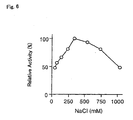
- the endo-type ⁇ -L-fucosidase of the present invention is activated in the presence of sodium chloride.
- Any material containing sodium chloride such as sodium chloride as a reagent, table salt, seawater or artificial seawater may serve as sodium chloride.
- concentration of sodium chloride to be added to a reaction mixture for the endo-type ⁇ -L-fucosidase of the present invention may range from about 1' mM to about 1 M, preferably from about 5 mM to about 900 mM.
- the sulfated fucan sulfatase of the present invention can be identified by measuring released sulfuric acid.
- a supernatant obtained by centrifugation of a culture of a producer strain, a cell-free extract, or an enzyme solution obtained after purification using various column chromatographies may be used for the identification.
- the sulfated fucan sulfatase of the present invention is activated in the presence of sodium chloride and/or a calcium ion.
- any material containing sodium chloride such as sodium chloride as a reagent, table salt, seawater or artificial seawater may serve as sodium chloride.
- concentration of sodium chloride to be added to a reaction mixture for the sulfated fucan sulfatase of the present invention may range from about 1 mM to about 2. M, preferably from about 5 mM to about 1 M.
- any material containing a calcium ion such as calcium chloride or calcium acetate as reagents may serve as a calcium ion.
- concentration of a calcium ion to be added to a reaction mixture for the sulfated fucan sulfatase of the present invention may range from about 0.1 mM to about 1 M, preferably from about 1 mM to about 500 mM.
- Fucoidanobacter marinus SI-0098 is a microorganism that utilizes a sulfated fucan, and produces the endo-type ⁇ -L-fucosidase and the sulfated fucan sulfatase of the present invention inside or outside the cell to degrade the sulfated fucan.
- the sulfated fucan oligosaccharide of the present invention is an oligosaccharide that is obtainable by allowing the endo-type ⁇ -L-fucosidase of the present invention alone or together with the sulfated fucan sulfatase of the present invention to act on a sulfated fucan derived from a sea cucumber or a sulfated fucan-containing material. It has fucose at the reducing end.
- a partially purified preparation of a sulfated fucan, a sulfated polysaccharide fraction derived from a sea cucumber, an extract of a sea cucumber obtained using an aqueous solvent, a dried sea cucumber or a raw sea cucumber can be preferably used as a sulfated fucan-containing material.
- a sulfated fucan or a sulfated fucan-containing material may be dissolved according to a conventional method.
- the sulfated fucan or the sulfated fucan-containing material may be dissolved in the solution at the maximal concentration.
- the concentration is usually selected taking its operationality and the amount of the endo-type ⁇ -L-fucosidase or the sulfated fucan sulfatase of the present invention to be used in a reaction into consideration.
- the solvent for the sulfated fucan may be selected from water, buffers and the like depending on the objects.
- reaction conditions There is no specific limitation concerning the reaction conditions as long as the enzyme to be used exhibits its activity. Usually, the pH of the solution is nearly neutral. The enzymatic reaction is usually carried out at about 30°C.
- the molecular weight of the sulfated fucan oligosaccharide can be controlled by adjusting the ratio or the amounts of the endo-type ⁇ -L-fucosidase and the sulfated fucan sulfatase of the present invention used in the reaction, the composition of the reaction mixture, the reaction time and the like.
- the sulfated fucan oligosaccharide of the present invention having more homogeneous molecular weight or charge density distribution can be prepared by subjecting the sulfated fucan oligosaccharide of the present invention obtained as described above to molecular weight fractionation or fractionation using an anion exchange column.
- a conventional method of molecular weight fractionation e.g., gel filtration or ultrafiltration
- the smaller molecules may be further purified using ion exchange resin treatment, active carbon treatment or the like, or they may be desalted, sterilized or lyophilized.
- the sulfated fucan oligosaccharides of the present invention have sulfate groups within the molecules, which groups form salts with various bases.
- the sulfated fucan oligosaccharide of the present invention is stable when it is in a form of salt. It is usually provided in a form of sodium and/or potassium and/or calcium salt.
- the sulfated fucan oligosaccharide of the present invention in a free form can be derived from a salt thereof by utilizing cation exchange resin such as Dowex 50W. Optionally, it can be subjected to conventional salt-exchange to convert it into any one of various desirable salts.
- salts of the sulfated fucan oligosaccharide of the present invention can be used as the salts of the sulfated fucan oligosaccharide of the present invention.
- the salts include salts with alkaline metals (e.g., sodium and potassium) and alkaline earth metals (e.g., calcium, magnesium and zinc) as well as ammonium salts.
- the endo-type ⁇ -L-fucosidase and the sulfated fucan sulfatase of the present invention can be used for structural analysis of a sulfated fucan because they convert a sulfated fucan into smaller molecules. Additionally, the sulfated fucan oligosaccharide of the present invention can be used as a reagent for glycotechnology.
- a substance that is very useful as a reagent for glycotechnology can be provided by subjecting the oligosaccharide to amination with 2-aminopyridine (PA-labeling) according to the method as described in JP-B 5-65108 to prepare a PA-labeled oligosaccharide.
- PA-labeling 2-aminopyridine
- the sulfated fucan oligosaccharide of the present invention can be utilized as an antigen to produce an antibody that recognizes the sulfated fucan oligosaccharide of the present invention according to a known method.
- An antibody that recognizes the sulfated fucan oligosaccharide of the present invention can be utilized to analyze the structure of a sulfated polysaccharide and, therefore, is very useful.
- the body wall portions of 35 Kg of commercially available sea cucumbers were finely cut, and treated with four volumes of acetone in a homogenizer at 8000 rpm for 5 minutes. The homogenate was then filtered through a filter paper to obtain a residue. The residue was treated with four volumes of acetone in a homogenizer at 8000 rpm for 5 minutes. The homogenate was then filtered through a filter paper to obtain a residue. The thus obtained residue was dried by aspiration to obtain 1132 g of an acetone treatment preparation of sea cucumber body wall.
- the mixture was concentrated to 2 L using an ultrafiltration device equipped with hollow fibers with exclusion molecular weight of 100,000.
- the concentrate was centrifuged to remove insoluble substances.
- the resulting supernatant was subjected to solvent exchange for 100 mM sodium chloride containing 10% ethanol using an ultrafiltration device.
- the solution was cooled to 4°C or below, and the pH was adjusted to 2.0 with hydrochloric acid.
- the formed precipitate was removed by centrifugation to obtain a supernatant.
- the pH of the supernatant was adjusted to 8.0 with sodium hydroxide.
- the supernatant was subjected to solvent exchange for 20 mM sodium chloride using an ultrafiltration device. Insoluble substances were removed from the solution by centrifugation.
- the supernatant was then lyophilized to obtain 37 g of a dried product of sea cucumber-derived sulfated polysaccharide fraction.
- the total sugar content and the uronic acid content of each fraction were measured according to the phenol-sulfuric acid method and the carbazole-sulfuric acid method, respectively. Fractions eluted with 0.8 to 1.5 M sodium chloride (fraction nos. 45-57) were collected to obtain a sulfated fucan fraction.
- One unit of an endo-type ⁇ -L-fucosidase activity is defined as an amount of an enzyme that cleaves one ⁇ mol of sulfated fucan fucosyl bonds in one minute in the above-mentioned reaction system.
- the HPLC was carried out as follows.
- One unit of a sulfated fucan sulfatase activity is defined as an amount of an enzyme that generates one ⁇ mol of sulfuric acid in one minute in the above-mentioned reaction system.
- the HPLC was carried out as follows.
- Fucoidanobacter marinus SI-0098 was inoculated into 5 ml of a medium consisting of artificial seawater (Jamarine Laboratory) containing the sea cucumber-derived sulfated polysaccharide fraction prepared as described in Referential Example 1 and peptone at concentrations of 0.3% and 1%, respectively, (pH 8.2) which had been autoclaved at 120°C for 20 minutes, and cultured at 25°C for two days.
- 150 ⁇ l of the culture was inoculated into 100 ml of a medium containing the same components, and cultured at 25°C for three days.
- the cells were suspended in 200 ml of 10 mM imidazole-hydrochloride buffer, (pH 7.5) containing 100 mM sodium chloride and 5 mM ⁇ -mercaptoethanol, disrupted by sonication and centrifuged to obtain a supernatant. The supernatant was adequately dialyzed against the same buffer and centrifuged to obtain a supernatant.
- the supernatant was loaded onto a 500-ml DEAE-Cellulofine A-800 column equilibrated with the same buffer. After washing with the same buffer, elution was carried out with a gradient of 100 to 500 mM sodium chloride to collect fractions each containing 45 ml of the eluate. The endo-type ⁇ -L-fucosidase activities were measured for the respective fractions and an active fraction was collected.
- the active fraction was adequately dialyzed against 10 mM imidazole-hydrochloride buffer (pH 7.5) containing 50 mM sodium chloride and 5 mM ⁇ -mercaptoethanol for solvent exchange.
- the enzyme solution was loaded onto a 150-ml DEAE-Cellulofine A-800 column equilibrated with the same buffer. After washing with the same buffer, elution was carried out with a gradient of 50 to 400 mM sodium chloride to collect fractions each containing 20 ml of the eluate.
- the endo-type ⁇ -L-fucosidase activities were measured for the respective fractions and an active fraction was collected.
- the active fraction was adequately dialyzed against 10 mM imidazole-hydrochloride buffer (pH 7.5) containing 50 mM sodium chloride and 5 mM ⁇ -mercaptoethanol for solvent exchange.
- the enzyme solution was loaded onto a 80-ml Sulfated Cellulofine column equilibrated with the same buffer. After washing with the same buffer, elution was carried out with a gradient of 50 to 1500 mM sodium chloride to collect fractions each containing 5 ml of the eluate.
- the endo-type ⁇ -L-fucosidase activities were measured for the respective fractions and an active fraction was collected.
- the active fraction was adequately dialyzed against 10 mM imidazole-hydrochloride buffer (pH 7.5) containing 100 mM sodium chloride and 5 mM ⁇ -mercaptoethanol followed by 40 mM potassium phosphate buffer containing 150 mM sodium chloride and 5 mM ⁇ -mercaptoethanol for solvent exchange.
- the enzyme solution was loaded onto a 40-ml Hydroxyapatite column (Wako Pure Chemical Industries) equilibrated with the same buffer. After washing with the same buffer, elution was carried out with a gradient of 40 to 250 mM potassium phosphate to collect fractions each containing 6 ml of the eluate. The endo-type ⁇ -L-fucosidase activities were measured for the respective fractions and an active fraction was collected.
- the active fraction was adequately dialyzed against 10 mM imidazole-hydrochloride buffer (pH 7.5) containing 100 mM sodium chloride and 5 mM p-mercaptoethanol for solvent exchange.
- the enzyme solution was loaded onto a 1520-ml Sephacryl S-200 column (4.4 x 100 cm, Pharmacia) equilibrated with the same buffer. Elution was carried out with the same buffer to collect fractions each containing 13.5 ml of the eluate. The endo-type ⁇ -L-fucosidase activities were measured for the respective fractions.
- the molecular weight of the endo-type ⁇ -L-fucosidase of the present invention was determined to be about 32,000 (distribution: 20,000 to 40,000, based on the position of elution upon gel filtration on Sephacryl S-200) or 42,000 (distribution: 30,000 to 50,000, based on the mobility upon electrophoresis).
- Fucoidanobacter marinus SI-0098 was cultured as described in Example 1 to obtain about 6 g of wet cells from 4.2 L of the culture.
- the cells were suspended in 50 ml of 10 mM sodium phosphate buffer (pH 7.5) containing 50 mM sodium chloride, disrupted by sonication and centrifuged to obtain a supernatant. The supernatant was adequately dialyzed against the same buffer and centrifuged to obtain a supernatant.
- the supernatant was loaded onto a 300-ml DEAE-Cellulofine A-800 column equilibrated with the same buffer. After washing with the same buffer, elution was carried out with a gradient of 50 to 500 mM sodium chloride to collect fractions each containing 25 ml of the eluate. The endo-type ⁇ -L-fucosidase activities were measured for the respective fractions and an active fraction was collected.
- the active fraction was adequately dialyzed against 10 mM sodium phosphate buffer (pH 7.5) containing 100 mM sodium chloride for solvent exchange.
- the enzyme solution was loaded onto a 50-ml DEAE-Cellulofine A-800 column equilibrated with the same buffer. After washing with the same buffer, elution was carried out with a gradient of 100 to 400 mM sodium chloride to collect fractions each containing 10 ml of the eluate.
- the endo-type ⁇ -L-fucosidase activities were measured for the respective fractions and an active fraction was collected.
- the active fraction was adequately dialyzed against 50 mM potassium phosphate buffer (pH 7.5) containing 50 mM sodium chloride for solvent exchange.
- the enzyme solution was loaded onto a 20-ml Hydroxyapatite column equilibrated with the same buffer. After washing with the same buffer, elution was carried out with a gradient of 50 to 200 mM potassium phosphate to collect fractions each containing 10 ml of the eluate.
- the endo-type ⁇ -L-fucosidase activities were measured for the respective fractions and an active fraction was collected.
- the active fraction was loaded onto a 1520-ml Sephacryl S-200 column (4.4 x 100 cm, Pharmacia) equilibrated with 10 mM imidazole-hydrochloride buffer (pH 7.5) containing 100 mM sodium chloride and 5 mM sodium azide. Elution was carried out with the same buffer to collect fractions each containing 13.5 ml of the eluate. The endo-type ⁇ -L-fucosidase activities were measured for the respective fractions.
- Example 3 Preparation of sulfated fucan oligosaccharides using endo-type ⁇ -L-fucosidase
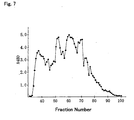
- the distribution as shown in Figure 7 was observed.
- the longitudinal axis represents absorbance at 480 nm observed upon color development according to the phenol-sulfuric acid method, and the horizontal axis represents fraction numbers.
- the sulfated fucan oligosaccharides of the present invention were eluted around fraction nos. 50-75 with distribution of molecular weight around 40,000.
- the oligosaccharides were subjected to analyses of sugar compositions and saccharides at the reducing ends. As a result, fucose was observed for substantially all cases.
- the sulfated fucan oligosaccharides of the present invention having varying molecular weights could be prepared by allowing the endo-type ⁇ -L-fucosidase of the present invention to act on the sea cucumber-derived sulfated fucan fraction.
- an activity that activates the conversion of the sulfated fucan into smaller molecules by the endo-type ⁇ -L-fucosidase of the present invention was found in a fraction eluted from Sulfated Cellulofine with about 600 mM sodium chloride in Example 1. Then, the fraction was allowed to act on the sea cucumber-derived sulfated fucan and substances generated in the reaction mixture were examined. First, the reaction mixture was analyzed according to the method as described in Referential Example 4 using HPLC, and generation of sulfuric acid was observed.
- the total sugar content was measured according to the phenol-sulfuric acid method for each fraction eluted upon gel filtration of the reaction mixture on Cellulofine GCL-25 column (4 x 90 cm) in order to examine whether or not a smaller-molecule sugar-containing component was generated. As a result, generation of a smaller-molecule sugar-containing component was not found.
- the enzyme that activates the conversion the sulfated fucan into smaller molecules by the endo-type ⁇ -L-fucosidase of the present invention was a sulfated fucan sulfatase. Then, a sulfated fucan sulfatase whose activity is detected according to the method as described in Referential Example 4 was purified.
- an active fraction of the sulfated fucan sulfatase of the present invention which were eluted from Sulfated Cellulofine with around 600 mM sodium chloride in Example 1 was collected, and loaded onto a 1520-ml Sephacryl S-200 column equilibrated with 10 mM imidazole-hydrochloride buffer containing 100 mM sodium chloride, 5 mM sodium azide and 5 mM ⁇ -mercaptoethanol. Elution was carried out with the same buffer to collect fractions each containing 13.5 ml of the eluate.
- the molecular weight of the sulfated fucan sulfatase of the present invention was determined to be about 84,000 (distribution: 70,000 to 100,000) based on the position of elution.
- Example 7 Preparation of sulfated fucan oligosaccharides using endo-type ⁇ -L-fucosidase and sulfated fucan sulfatase
- the sulfated fucan oligosaccharides of the present invention having varying molecular weights can be prepared by allowing the endo-type ⁇ -L-fucosidase and the sulfated fucan sulfatase of the present invention to act on the sea cucumber-derived sulfated fucan fraction.
- the present invention provides a novel endo-type ⁇ -L-fucosidase and a novel sulfated fucan sulfatase which can be used for structural analysis of a sulfated fucan derived from a sea cucumber or reproducible production of smaller molecules from a sulfated fucan derived from a sea cucumber.
- the present invention also provides methods of producing the enzymes.
- sea cucumber-derived sulfated fucan oligosaccharides having varying molecular weights, which are useful as reagents for glycotechnology, are provided by using the enzymes.
- additives for efficient uses of the enzymes are provided.
Landscapes
- Chemical & Material Sciences (AREA)
- Organic Chemistry (AREA)
- Life Sciences & Earth Sciences (AREA)
- Health & Medical Sciences (AREA)
- Engineering & Computer Science (AREA)
- Zoology (AREA)
- Wood Science & Technology (AREA)
- Genetics & Genomics (AREA)
- Bioinformatics & Cheminformatics (AREA)
- General Health & Medical Sciences (AREA)
- Biochemistry (AREA)
- General Engineering & Computer Science (AREA)
- Microbiology (AREA)
- Biotechnology (AREA)
- Medicinal Chemistry (AREA)
- Molecular Biology (AREA)
- Biomedical Technology (AREA)
- Chemical Kinetics & Catalysis (AREA)
- General Chemical & Material Sciences (AREA)
- Enzymes And Modification Thereof (AREA)
- Preparation Of Compounds By Using Micro-Organisms (AREA)
- Saccharide Compounds (AREA)
Applications Claiming Priority (5)
| Application Number | Priority Date | Filing Date | Title |
|---|---|---|---|
| JP2002180490 | 2002-06-20 | ||
| JP2002180490 | 2002-06-20 | ||
| JP2002239843 | 2002-08-20 | ||
| JP2002239843 | 2002-08-20 | ||
| PCT/JP2003/007838 WO2004001031A1 (ja) | 2002-06-20 | 2003-06-20 | ナマコ由来硫酸化フカン分解酵素 |
Publications (2)
| Publication Number | Publication Date |
|---|---|
| EP1514923A1 true EP1514923A1 (de) | 2005-03-16 |
| EP1514923A4 EP1514923A4 (de) | 2005-12-21 |
Family
ID=30002252
Family Applications (1)
| Application Number | Title | Priority Date | Filing Date |
|---|---|---|---|
| EP03733522A Withdrawn EP1514923A4 (de) | 2002-06-20 | 2003-06-20 | Enzym zum abbau von aus seegurke stammendem sulfatiertem fucan |
Country Status (6)
| Country | Link |
|---|---|
| US (1) | US20070122875A1 (de) |
| EP (1) | EP1514923A4 (de) |
| JP (1) | JP4119890B2 (de) |
| CN (1) | CN1662648A (de) |
| AU (1) | AU2003242486A1 (de) |
| WO (1) | WO2004001031A1 (de) |
Cited By (1)
| Publication number | Priority date | Publication date | Assignee | Title |
|---|---|---|---|---|
| CN101411523B (zh) * | 2008-11-14 | 2011-04-20 | 钱武刚 | 超声波萃取海参原液的方法 |
Families Citing this family (4)
| Publication number | Priority date | Publication date | Assignee | Title |
|---|---|---|---|---|
| MX2021000864A (es) * | 2018-07-27 | 2021-03-26 | Arc Medical Devices Inc | Fucanos altos en sulfato para el tratamiento de adhesiones fibrosas. |
| US12186334B2 (en) | 2018-07-27 | 2025-01-07 | ARC Medical Inc. | High-molecular-weight fucans for treating fibrous adhesions and other diseases and conditions |
| AU2020230466B2 (en) | 2019-03-05 | 2021-05-13 | Arc Medical Devices Inc. | Systems and methods for tangential flow filtration of viscous compositions |
| CN111675769A (zh) * | 2020-06-28 | 2020-09-18 | 山东诚者海洋科技有限公司 | 一种海参提取液及其制备工艺 |
Family Cites Families (7)
| Publication number | Priority date | Publication date | Assignee | Title |
|---|---|---|---|---|
| EP0870771B1 (de) * | 1995-04-28 | 2008-11-12 | Takara Bio Inc. | Zuckerverbindungen |
| AU720004B2 (en) * | 1996-01-26 | 2000-05-18 | Research Institute For Glycotechnology | Apoptosis inducers |
| AU757992B2 (en) * | 1997-09-03 | 2003-03-13 | Takara Bio Inc. | Gene |
| EP1057833A4 (de) * | 1998-02-17 | 2003-04-16 | Takara Shuzo Co | Sulfatierte saccharide |
| JP2003521902A (ja) * | 2000-01-20 | 2003-07-22 | ユニバーシティ オブ バージニア パテント ファウンデーション | 卵特異的表面タンパク質 |
| AU2001248788A1 (en) * | 2000-04-21 | 2001-11-07 | Takara Bio Inc. | Glucuronofucan sulfate |
| DE60202427T2 (de) * | 2001-10-24 | 2005-12-29 | Takara Bio Inc., Otsu | Sulfatiertes Fucan-Oligosaccharid |
-
2003
- 2003-06-20 EP EP03733522A patent/EP1514923A4/de not_active Withdrawn
- 2003-06-20 JP JP2004515532A patent/JP4119890B2/ja not_active Expired - Fee Related
- 2003-06-20 US US10/518,057 patent/US20070122875A1/en not_active Abandoned
- 2003-06-20 CN CN038143259A patent/CN1662648A/zh active Pending
- 2003-06-20 WO PCT/JP2003/007838 patent/WO2004001031A1/ja not_active Ceased
- 2003-06-20 AU AU2003242486A patent/AU2003242486A1/en not_active Abandoned
Cited By (1)
| Publication number | Priority date | Publication date | Assignee | Title |
|---|---|---|---|---|
| CN101411523B (zh) * | 2008-11-14 | 2011-04-20 | 钱武刚 | 超声波萃取海参原液的方法 |
Also Published As
| Publication number | Publication date |
|---|---|
| AU2003242486A1 (en) | 2004-01-06 |
| US20070122875A1 (en) | 2007-05-31 |
| CN1662648A (zh) | 2005-08-31 |
| JPWO2004001031A1 (ja) | 2005-10-20 |
| WO2004001031A1 (ja) | 2003-12-31 |
| EP1514923A4 (de) | 2005-12-21 |
| JP4119890B2 (ja) | 2008-07-16 |
Similar Documents
| Publication | Publication Date | Title |
|---|---|---|
| US6277616B1 (en) | Endo-fucoidan-lyase | |
| JP2009050271A (ja) | 硫酸化グルクロノフカン | |
| JP4262601B2 (ja) | 硫酸化フカン | |
| EP1176153B1 (de) | Fukogalaktan-sulfate | |
| JPWO2001081560A1 (ja) | 硫酸化グルクロノフカン | |
| US20070122875A1 (en) | Enzyme for decomposition of sulfated fucan derived from sea cucumber | |
| US7041656B2 (en) | Sulfated fucoglucuronomannan | |
| EP1306389B1 (de) | Sulfatiertes Fucan Oligosaccharid | |
| JP3564469B2 (ja) | 硫酸化フカンオリゴ糖 | |
| KR20050016565A (ko) | 해삼으로부터 유래된 황산화 푸칸 분해 효소 | |
| JP2001226408A (ja) | フコース硫酸含有多糖 | |
| JP3991043B2 (ja) | 糖化合物 | |
| JP2001226407A (ja) | フコース硫酸含有多糖 | |
| JP2001218580A (ja) | エンド型フコース硫酸含有多糖分解酵素 | |
| JP2001224394A (ja) | 低分子化物 |
Legal Events
| Date | Code | Title | Description |
|---|---|---|---|
| PUAI | Public reference made under article 153(3) epc to a published international application that has entered the european phase |
Free format text: ORIGINAL CODE: 0009012 |
|
| 17P | Request for examination filed |
Effective date: 20041220 |
|
| AK | Designated contracting states |
Kind code of ref document: A1 Designated state(s): AT BE BG CH CY CZ DE DK EE ES FI FR GB GR HU IE IT LI LU MC NL PT RO SE SI SK TR |
|
| AX | Request for extension of the european patent |
Extension state: AL LT LV MK |
|
| RIC1 | Information provided on ipc code assigned before grant |
Ipc: 7C 12N 15/12 B Ipc: 7C 08B 37/00 B Ipc: 7C 12P 19/04 B Ipc: 7C 12N 9/16 B Ipc: 7C 12N 9/44 A |
|
| DAX | Request for extension of the european patent (deleted) | ||
| A4 | Supplementary search report drawn up and despatched |
Effective date: 20051107 |
|
| RIN1 | Information on inventor provided before grant (corrected) |
Inventor name: KATO, IKUNOSHIN Inventor name: ISHIZUKA, KUMIKO Inventor name: SAKAI, TAKESHI |
|
| 17Q | First examination report despatched |
Effective date: 20070226 |
|
| STAA | Information on the status of an ep patent application or granted ep patent |
Free format text: STATUS: THE APPLICATION IS DEEMED TO BE WITHDRAWN |
|
| 18D | Application deemed to be withdrawn |
Effective date: 20070709 |