EP1520552B1 - Implantierbares chirurgisches Netz - Google Patents
Implantierbares chirurgisches Netz Download PDFInfo
- Publication number
- EP1520552B1 EP1520552B1 EP04256004A EP04256004A EP1520552B1 EP 1520552 B1 EP1520552 B1 EP 1520552B1 EP 04256004 A EP04256004 A EP 04256004A EP 04256004 A EP04256004 A EP 04256004A EP 1520552 B1 EP1520552 B1 EP 1520552B1
- Authority
- EP
- European Patent Office
- Prior art keywords
- absorbable
- filaments
- mesh
- surgical mesh
- implantable surgical
- Prior art date
- Legal status (The legal status is an assumption and is not a legal conclusion. Google has not performed a legal analysis and makes no representation as to the accuracy of the status listed.)
- Expired - Lifetime
Links
- -1 polypropylene Polymers 0.000 claims description 13
- 239000004743 Polypropylene Substances 0.000 claims description 11
- 229920001155 polypropylene Polymers 0.000 claims description 11
- 238000010521 absorption reaction Methods 0.000 claims description 10
- 238000004132 cross linking Methods 0.000 claims description 6
- 229920000747 poly(lactic acid) Polymers 0.000 claims description 5
- 229920002463 poly(p-dioxanone) polymer Polymers 0.000 claims description 4
- 239000000622 polydioxanone Substances 0.000 claims description 4
- 229920001610 polycaprolactone Polymers 0.000 claims description 3
- 239000004632 polycaprolactone Substances 0.000 claims description 3
- 239000004626 polylactic acid Substances 0.000 claims description 3
- 239000004952 Polyamide Substances 0.000 claims description 2
- 239000004698 Polyethylene Substances 0.000 claims description 2
- NIXOWILDQLNWCW-UHFFFAOYSA-N acrylic acid group Chemical group C(C=C)(=O)O NIXOWILDQLNWCW-UHFFFAOYSA-N 0.000 claims description 2
- 229920003235 aromatic polyamide Polymers 0.000 claims description 2
- 229920002313 fluoropolymer Polymers 0.000 claims description 2
- 229920002647 polyamide Polymers 0.000 claims description 2
- 229920000728 polyester Polymers 0.000 claims description 2
- 229920000573 polyethylene Polymers 0.000 claims description 2
- 239000004760 aramid Substances 0.000 claims 1
- NBVXSUQYWXRMNV-UHFFFAOYSA-N fluoromethane Chemical compound FC NBVXSUQYWXRMNV-UHFFFAOYSA-N 0.000 claims 1
- 239000004811 fluoropolymer Substances 0.000 claims 1
- 235000004879 dioscorea Nutrition 0.000 description 46
- 210000001519 tissue Anatomy 0.000 description 43
- 239000004744 fabric Substances 0.000 description 24
- 239000000463 material Substances 0.000 description 23
- 238000000034 method Methods 0.000 description 22
- 238000010276 construction Methods 0.000 description 17
- 239000000835 fiber Substances 0.000 description 13
- 210000003195 fascia Anatomy 0.000 description 11
- 238000009940 knitting Methods 0.000 description 10
- 230000008439 repair process Effects 0.000 description 7
- 231100000241 scar Toxicity 0.000 description 7
- 230000008569 process Effects 0.000 description 6
- 238000009941 weaving Methods 0.000 description 6
- 210000003041 ligament Anatomy 0.000 description 5
- 230000012010 growth Effects 0.000 description 4
- 239000004627 regenerated cellulose Substances 0.000 description 4
- 239000002759 woven fabric Substances 0.000 description 4
- QVGXLLKOCUKJST-UHFFFAOYSA-N atomic oxygen Chemical compound [O] QVGXLLKOCUKJST-UHFFFAOYSA-N 0.000 description 3
- 239000007943 implant Substances 0.000 description 3
- 238000004519 manufacturing process Methods 0.000 description 3
- 229910052760 oxygen Inorganic materials 0.000 description 3
- 239000001301 oxygen Substances 0.000 description 3
- 210000003903 pelvic floor Anatomy 0.000 description 3
- 210000003708 urethra Anatomy 0.000 description 3
- 210000001215 vagina Anatomy 0.000 description 3
- 102000008186 Collagen Human genes 0.000 description 2
- 108010035532 Collagen Proteins 0.000 description 2
- 206010021639 Incontinence Diseases 0.000 description 2
- 206010061218 Inflammation Diseases 0.000 description 2
- 229920001436 collagen Polymers 0.000 description 2
- 230000004054 inflammatory process Effects 0.000 description 2
- 230000004048 modification Effects 0.000 description 2
- 238000012986 modification Methods 0.000 description 2
- 239000004745 nonwoven fabric Substances 0.000 description 2
- 210000000056 organ Anatomy 0.000 description 2
- 230000000399 orthopedic effect Effects 0.000 description 2
- 230000037390 scarring Effects 0.000 description 2
- 210000002460 smooth muscle Anatomy 0.000 description 2
- LCSKNASZPVZHEG-UHFFFAOYSA-N 3,6-dimethyl-1,4-dioxane-2,5-dione;1,4-dioxane-2,5-dione Chemical group O=C1COC(=O)CO1.CC1OC(=O)C(C)OC1=O LCSKNASZPVZHEG-UHFFFAOYSA-N 0.000 description 1
- 241000283690 Bos taurus Species 0.000 description 1
- 206010011224 Cough Diseases 0.000 description 1
- 206010016654 Fibrosis Diseases 0.000 description 1
- 206010019909 Hernia Diseases 0.000 description 1
- 208000012287 Prolapse Diseases 0.000 description 1
- 210000000683 abdominal cavity Anatomy 0.000 description 1
- 230000003187 abdominal effect Effects 0.000 description 1
- 230000002745 absorbent Effects 0.000 description 1
- 239000002250 absorbent Substances 0.000 description 1
- 239000000853 adhesive Substances 0.000 description 1
- 230000001070 adhesive effect Effects 0.000 description 1
- 210000000988 bone and bone Anatomy 0.000 description 1
- 210000000845 cartilage Anatomy 0.000 description 1
- 210000003679 cervix uteri Anatomy 0.000 description 1
- 238000002316 cosmetic surgery Methods 0.000 description 1
- 230000003247 decreasing effect Effects 0.000 description 1
- 201000010099 disease Diseases 0.000 description 1
- 208000037265 diseases, disorders, signs and symptoms Diseases 0.000 description 1
- 230000000694 effects Effects 0.000 description 1
- 230000003628 erosive effect Effects 0.000 description 1
- 230000004761 fibrosis Effects 0.000 description 1
- 230000003176 fibrotic effect Effects 0.000 description 1
- 208000014674 injury Diseases 0.000 description 1
- 210000003127 knee Anatomy 0.000 description 1
- 238000003475 lamination Methods 0.000 description 1
- 230000007246 mechanism Effects 0.000 description 1
- 230000005499 meniscus Effects 0.000 description 1
- 230000003278 mimic effect Effects 0.000 description 1
- 210000003049 pelvic bone Anatomy 0.000 description 1
- 230000000704 physical effect Effects 0.000 description 1
- 229920000642 polymer Polymers 0.000 description 1
- 229920002451 polyvinyl alcohol Polymers 0.000 description 1
- 235000019422 polyvinyl alcohol Nutrition 0.000 description 1
- 210000003689 pubic bone Anatomy 0.000 description 1
- 230000003014 reinforcing effect Effects 0.000 description 1
- 239000011347 resin Substances 0.000 description 1
- 229920005989 resin Polymers 0.000 description 1
- 230000004044 response Effects 0.000 description 1
- 230000036573 scar formation Effects 0.000 description 1
- 239000000126 substance Substances 0.000 description 1
- 238000001356 surgical procedure Methods 0.000 description 1
- 210000000115 thoracic cavity Anatomy 0.000 description 1
- 230000009772 tissue formation Effects 0.000 description 1
- 230000008467 tissue growth Effects 0.000 description 1
- 230000008733 trauma Effects 0.000 description 1
Images





Classifications
-
- A—HUMAN NECESSITIES
- A61—MEDICAL OR VETERINARY SCIENCE; HYGIENE
- A61F—FILTERS IMPLANTABLE INTO BLOOD VESSELS; PROSTHESES; DEVICES PROVIDING PATENCY TO, OR PREVENTING COLLAPSING OF, TUBULAR STRUCTURES OF THE BODY, e.g. STENTS; ORTHOPAEDIC, NURSING OR CONTRACEPTIVE DEVICES; FOMENTATION; TREATMENT OR PROTECTION OF EYES OR EARS; BANDAGES, DRESSINGS OR ABSORBENT PADS; FIRST-AID KITS
- A61F2/00—Filters implantable into blood vessels; Prostheses, i.e. artificial substitutes or replacements for parts of the body; Appliances for connecting them with the body; Devices providing patency to, or preventing collapsing of, tubular structures of the body, e.g. stents
- A61F2/0063—Implantable repair or support meshes, e.g. hernia meshes
-
- A—HUMAN NECESSITIES
- A61—MEDICAL OR VETERINARY SCIENCE; HYGIENE
- A61F—FILTERS IMPLANTABLE INTO BLOOD VESSELS; PROSTHESES; DEVICES PROVIDING PATENCY TO, OR PREVENTING COLLAPSING OF, TUBULAR STRUCTURES OF THE BODY, e.g. STENTS; ORTHOPAEDIC, NURSING OR CONTRACEPTIVE DEVICES; FOMENTATION; TREATMENT OR PROTECTION OF EYES OR EARS; BANDAGES, DRESSINGS OR ABSORBENT PADS; FIRST-AID KITS
- A61F2/00—Filters implantable into blood vessels; Prostheses, i.e. artificial substitutes or replacements for parts of the body; Appliances for connecting them with the body; Devices providing patency to, or preventing collapsing of, tubular structures of the body, e.g. stents
- A61F2/0063—Implantable repair or support meshes, e.g. hernia meshes
- A61F2002/0068—Implantable repair or support meshes, e.g. hernia meshes having a special mesh pattern
-
- A—HUMAN NECESSITIES
- A61—MEDICAL OR VETERINARY SCIENCE; HYGIENE
- A61F—FILTERS IMPLANTABLE INTO BLOOD VESSELS; PROSTHESES; DEVICES PROVIDING PATENCY TO, OR PREVENTING COLLAPSING OF, TUBULAR STRUCTURES OF THE BODY, e.g. STENTS; ORTHOPAEDIC, NURSING OR CONTRACEPTIVE DEVICES; FOMENTATION; TREATMENT OR PROTECTION OF EYES OR EARS; BANDAGES, DRESSINGS OR ABSORBENT PADS; FIRST-AID KITS
- A61F2250/00—Special features of prostheses classified in groups A61F2/00 - A61F2/26 or A61F2/82 or A61F9/00 or A61F11/00 or subgroups thereof
- A61F2250/0014—Special features of prostheses classified in groups A61F2/00 - A61F2/26 or A61F2/82 or A61F9/00 or A61F11/00 or subgroups thereof having different values of a given property or geometrical feature, e.g. mechanical property or material property, at different locations within the same prosthesis
- A61F2250/003—Special features of prostheses classified in groups A61F2/00 - A61F2/26 or A61F2/82 or A61F9/00 or A61F11/00 or subgroups thereof having different values of a given property or geometrical feature, e.g. mechanical property or material property, at different locations within the same prosthesis differing in adsorbability or resorbability, i.e. in adsorption or resorption time
Definitions
- the present invention relates generally to implantable surgical meshes, and more particularly, to implantable surgical meshes that contain both absorbable and non-absorbable portions in a configuration such that, following absorption of the absorbable portions, the mesh becomes discontinuous in a predetermined direction.
- Implantable surgical meshes have been widely used for a variety of different surgical procedures such as hernia repair, pelvic floor repair, urethral slings for treating incontinence, and many others.
- a woven or knitted mesh structure is desirable in that it allows tissue ingrowth into and through the mesh.
- the tissue ingrowth is in the form of a tissue fibrosis, where non-oriented tissue cells invade the mesh and grow in a random, disorganized fashion.
- the combination of mesh and ingrown tissue produces a relatively hard, inflexible construction that does not resemble the tissue structure that it is reinforcing or replacing.
- the mesh structure in combination with the random ingrowth pattern of the tissue does not reflect the natural, organized cell structure in the absence of the foreign body (mesh).
- the resulting relatively inflexible structure can lead to tissue erosion problems in proximity to the implant and/or to organs in the vicinity of the implant.
- Vypro® which is manufactured by Ethicon, Inc. of Somerville, N.J. This mesh is comprised of a combination of about equal parts of polyglactin polymer filaments and polypropylene filaments. When the polyglactin absorbs, it significantly reduces the amount of mesh that remains within the body, leaving only the polypropylene behind.
- Fig. 1 provides a closer look at the mesh structure of Vypro®.
- the absorbable polyglactin filaments 100 are positioned next to one another and follow a somewhat sinusoidal path along the entire width of the mesh, or along the x-axis of Fig. 1 .
- the non-absorbable polypropylene filaments 104 are woven more tightly around the individual polyglactin filaments, but also cross over between adjacent polyglactin filaments, as indicated in area 106. By crossing over, the polypropylene filaments are linked together along the y-axis, as well as extending along the length of the mesh along the x-axis. Thus, when the polyglactin filaments are absorbed, what remains is a mesh of polyproylene filaments that is continuous in both the x and y directions.
- the mesh that remains implanted maintains its full width construction and the scarring that invades the mesh is continuous throughout leaving a wide three-dimensional collagen fiber network.
- This structure ensures tissue ingrowth in a randomized manner along both the entire width and length of the mesh structure. As indicated above, such random ingrowth does not mimic the natural tissue structure of the tissue that is being reinforced or replaced, and may be unsuitable where narrow bands of tissue are to be replaced or reinforced, or where the tissue to be replaced requires more flexibility, especially in one particular direction.
- the document GB1008193 A discloses a surgical mesh according to the preamble of claim 1.
- An implantable surgical mesh is provided in accordance with claim 1.
- the plurality of absorbable and non-absorbable filaments are constructed in a woven configuration, and in another embodiment substantially all of the absorbable filaments are fill and substantially all of the non-absorbable filaments are wrap.
- the plurality of absorbable and non-absorbable filaments are constructed in a knitted configuration.
- the absorbable and non-absorbable filaments may alternate, the ratio of absorbable to non-absorbable filaments may be less or greater than 1:1.
- the plurality of absorbable and non-absorbable filaments may alternatively be constructed in a combination knitted and woven configuration, or in a non-woven configuration.
- the non-absorbable filaments are selected from the group consisting of polypropylene, polyester, polyethylene, acrylic, polyamides, aramids, fluropolymer filaments, and flurocarbon filaments, and in yet another embodiment, the absorbable filaments are selected from the group consisting of polyglacting, polydioxanone, polycaprolactone, polylactic acid, and polylactide.
- an implantable surgical mesh having a plurality of absorbable filaments and a plurality of non-absorbable filaments, wherein substantially all of the non-absorbable filaments are arranged in rows which are aligned in a single direction with substantially no cross-linking therebetween, and wherein the plurality of absorbable filaments are arranged in rows which are aligned in a single direction and interwoven with the non-absorbable filaments to thereby form a bi-directional mesh structure prior to absorption of the absorbable filaments.
- the horizontal portion of the pubocervical fascia 210 supports the bladder and vagina, and extends laterally from the tissue surrounding the vagina, outward to the fascial white line 212.
- the distal or vertical portion of the pubocervical fascia 214 supports the urethra and urethrovesical junction and provides a backstop against which the urethra is compressed during straining activity, such as coughing.
- the horizontal pubocervical fascia includes multiple striations that primarily extend laterally in the direction described above (between the fascial white line and the vaginal tissue), with very little cross-linking between these striations.
- the striations extend primarily in a single direction.
- the vertical pubocervical fascia and for the uterosacral ligaments 216.
- the present invention provides a mesh that will more closely resemble natural tissue structure, such as that of the pubocervical fascia.
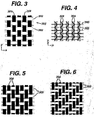
- the mesh 300 is a plain weave mesh including a plurality of absorbable filaments 302 positioned next to one another and extending along the width of the mesh in direction x, and a plurality of non-absorbable filaments 304 positioned next to one another and extending along the length of the mesh in direction y, and woven through the absorbable filaments.
- a mesh structure of non-absorbable fibers that is continuous in a single direction, with substantially no cross-linking among the remaining fibers.
- the remaining mesh will have substantially flexibility in the x direction where there is no cross-linking, and less flexibility in the y direction where the non-absorbable filaments remain.
- a plain weave mesh can be manufactured by any well known technique, such as a shuttle loom, Jacquard loom or Gripper loom. In these looms the process of weaving remains similar, the interlacing of two systems of yams at right angles. This lacing can be simple as in a plain weave ( Fig 3 ) where the lacing is over one and under one. Placing the absorbable yams in one direction, either fill (302) or wrap (304) (for each of Figs.
- reference numeral 302 is used to denote absorbable fibers and 304 to denote non-absorbable fibers
- 304 to denote non-absorbable fibers
- Another method of weaving is a leno weave. In this construction two warp yams are twisted and the fill yams are passed through the twist, Fig. 4 . If the fill yarn302 is absorbable, and the fabric is made in an open construction there is some slack or spacing in the twisted warps 304. This can produce a resultant material, after the fills are re-absorbed, which has some elongation characteristics.
- the warps are not connected and although they are individually embedded with scar tissue, there is no significant cross over of the scar tissue from yarn to yarn.
- alternating yams i.e., yams 702
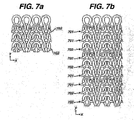
- the ratio of absorbable to non-absorbable yams can be adjusted to control the distance between the discontinuous portions of the mesh. Therefore, by laying-in multiple yams of absorbable and or non-absorbable material the width of the non-absorbable section can be controlled. This will provide different amounts of structural integrity of the remaining yams. As an example illustrated in Fig 7B , using two non absorbable yams 701 side by side, and three absorbable yams 702 side by side between them would produce a final fabric, after absorption, with larger space between the continuous yams and narrower width of the remaining material.
- Variations on this type construction will produce a remaining fabric, which promotes either more of less scar tissue depending on the amount of fabric and distance between sections. This can be adjusted for the type of tissue, which is being replaced.
- a lighter tissue such as a fascia for supporting or connecting organs, can use a knitted mesh that has a wider section of absorbable and a narrower section of non-absorbable.
- a heavy tissue such a ligaments for connecting bones across a joint, can have more non-absorbable yams and less or narrower absorbable portions.
- a second method for knitting a fabric or mesh is warp knitting.
- the yams are introduced in the direction of the growth of the fabric (in the y direction) as is illustrated in Figs. 8A and 8B .
- the yams or filaments are looped vertically and also to a limited extent diagonally, with the diagonal movement connecting the rows of loops.
- alternate yams can be absorbable (i.e., 802) or non-absorbable (i.e., 804). Controlling the number and ratio of absorbable to non-absorbable yams will control the final material configuration and again the amount of in growth of scar tissue.
- alternating absorbable and non-absorbable yams produces a final construction with a narrow space between the remaining yarns which are filled in with tissue.
- the spacing between successive absorbable yams (as shown in Fig. 8B ) the spacing between remaining yams can be selectively increased or decreased.
- the warp knits can be adjusted to create various amounts of tissue creation and therefore can more closely emulate the tissue it is meant to replace.
- a fabric for this purpose can be used to construct a fabric for this purpose, such as Tricots, Raschel and Cidega knits.
- a warp knit with a Raschel knitting machine multiple variations in construction can be achieved. Most will produce a fabric that will function essentially the same as described above. However, there is a technique in Raschel knitting that uses a "fall plate" that can produce a structure that will look more like a woven fabric, as shown in Fig.9 .
- a single yarn 901 is carried across a number of warps, 902 and 903, in a horizontal or diagonal direction. This yarn connects and holds the warps together.
- this yarn is made from an absorbable material and the warps are made from non-absorbable material, the final result after absorption will be only the warps aligned in the length direction with no connection between them.
- variations on the ratio of non-absorbable to absorbable material in the side by side warp yams can produce a resultant construction with the yams further apart or closer depending on how many warps are form either absorbable or non-absorbable material.
- a third method of constructing a fabric consists of combining weaving and knitting. This method is called Co-We-Nit and is illustrated in Figs. 10 and 11 .
- this construction knitting and weaving is combined to create fabrics with greater dimensional stability than conventional knits but with some of the properties of knitted goods.
- the loop yams 1001 are fed from across the fabric, a straight strand or strands of yarns 1 002 are inserted in the opposite or warp direction (the y direction). These strands add stability to the knit in the vertical or warp direction, but do not affect the properties, such as elongation, in the weft direction.
- this fabric would have these laid-in warp yams as non-absorbable and the weft yams as absorbable.
- the resultant fabric would be easy to handle and position within the body, and provide a minimum of structure for the scar tissue to form around after the absorbable yams have gone. Spacing of these warp yams and the size or diameter would control the density of the remaining tissue. This same method can be used to produce a fabric from warp knitting as shown in Fig.
- the plurality of absorbable and non-absorbable filaments are constructed in a non-woven configuration.
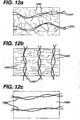
- Fig. 12a illustrates non-absorbable filaments spaced apart and positioned in a substantially uniform direction, with absorbable filaments 1202 being randomly oriented throughout.
- Fig. 12b illustrates non-absorbable filaments 1203 similarly positioned, but with the absorbable filaments 1204 positioned randomly, but substantially perpendicularly to the non-absorbable filaments.
- Fig. 12a illustrates non-absorbable filaments spaced apart and positioned in a substantially uniform direction, with absorbable filaments 1202 being randomly oriented throughout.
- Fig. 12b illustrates non-absorbable filaments 1203 similarly positioned, but with the absorbable filaments 1204 positioned randomly, but substantially perpendicularly to the non-absorbable filaments.
- Fig. 12a illustrates non-absorbable filaments spaced apart and positioned in a substantially uniform direction, with absorbable filaments
- the fibers of the paper can be made from an absorbable material such as the oxygen regenerated cellulose, chopped into short filaments and then cast into a sheet.
- Other paper like constructions can include materials like poly vinyl alcohols, or collagen fibers derived from porcine or bovine sources.
- a mesh according to the present invention can be used to reinforced or replace the pubourethral ligament, or the horizontal portion of the pubocervical fascia, both of which have striations oriented primarily in a single direction as described above.
- the remaining structure mimics the natural striations and allows flexibility in the opposite direction as does the natural ligament.
- the absorbable filament is polygalactin and the non-absorbable filament is Polypropylene monofilament of 2.0 mils to 7.0 mils diameter, however, any suitable biocompatible absorbable and non-absorbable filaments could be used. It may be desirable to select a non-absorbable filament to control the desired structure integrity time, i.e. the time in which is takes for the filaments to absorb.
- the table above also illustrates the breaking strength (BSR) of these materials as compared to the absorption times.
- the BSR measures the time at which the material, in suture or filament form, will lose enough strength so that its tensile strength reaches essentially 0 lbs. Thus, the BSR more closely represents the loss of integrity of the structure.
- the diameter of the filaments can be selected to alter the physical properties of the mesh.
- the absorbable filaments may be of smaller, or larger diameters than the non-absorbable filaments. Increasing the diameter of the filament can increase the absorption time as well.
- a mesh 400 includes a plurality of helically coiled non-absorbable filaments 402 extending the length of the mesh in the x direction, but which are separate and not interwoven with one another.
- a plurality of non-absorbable filaments are positioned between successive absorbable filaments, but are also woven through the non-absorbable filaments on either side. In this manner, the absorbable filaments are part of the structure of the mesh and provide structural integrity for the mesh in the y direction. When the absorbable filaments are completely absorbed, however, what remains is only the non-absorbable filaments extending in the x direction with no binding together or cross-linking of adjacent filaments.
- any weave or knit patterns, or non-woven patterns, in which the absorbable filaments dissolve or are absorbed to leave behind a substantially unidirectional mesh structure is within the scope of the invention.
- the described embodiments show no interweaving among successive non-absorbable filaments, some cross-weaving can take place and still provide a mesh with substantially uni-directional filaments.
- one or two rows of the weft yams 1001 can be non-absorbable and then 5 to 10 rows can be absorbable.
- the resultant fabric will have a loose connection between the warp yams 1002.
- yams can also be laid in a diagonal direction, thereby creating a structure that has permanent support in a third alternate direction.
- the absorbable warp yams 1005, 1006 are set in at two diagonal directions with the non-absorbable fill yams 1007 extending substantially parallel to one another in a single direction, as shown in Fig 12 .
- Changing the absorbable and non-absorbable yams from the fill to the warp, either both or one, provides yet another construction, which when the absorbable warp yams resorb, yields a discontinuous structure, consisting of only the remaining non-absorbable fill yarns.
- the construction of the fabric can made from a non-woven process.
- filaments are mechanically deposited to form a mat.
- the mat is then treated to provide integrity.
- the treatment can include manipulation of the filaments to entangle them or melt them together, or bind them with an adhesive or curing resin.
- alternate strips of the mat can be composed of non-absorbable and absorbable material such that as the absorbable material absorbs and the mat structure becomes discrete strips of material. These remaining strips will be in grown with tissue and provide a unidirectional support for the tissue.
- yarns of non-absorbable material may be laid in in the non-woven fabric.
- the non-absorbable yams will remain and provide the structure for tissue in growth.
- these yams can be interlaced as well as linear. Further, they can be in a sinusoidal pattern or other side to side type pattern, and can be in the machine (warp) direction, cross (weft or fill) direction or diagonal, so long as they provide permanent connection of the remaining structure to the surrounding tissue, and provide a support for the tissue as well as a scaffold for the tissue to grow on and in.
- An additional method to create a structure which will have a continuous construction initially, and then a discontinuous structure after some of the material has dissolved is to build a lamination of different materials.
- a sheet of absorbable material such as oxygenated regenerated cellulose (ORC) can be laminated to filaments of a non-absorbable material such as polypropylene.
- the sheet can be produced with a wet lay process such as in the manufacture of papers, or a dry lay process such as in the manufacture of felts or non-wovens, or as a film.
Landscapes
- Health & Medical Sciences (AREA)
- Cardiology (AREA)
- Oral & Maxillofacial Surgery (AREA)
- Transplantation (AREA)
- Engineering & Computer Science (AREA)
- Biomedical Technology (AREA)
- Heart & Thoracic Surgery (AREA)
- Vascular Medicine (AREA)
- Life Sciences & Earth Sciences (AREA)
- Animal Behavior & Ethology (AREA)
- General Health & Medical Sciences (AREA)
- Public Health (AREA)
- Veterinary Medicine (AREA)
- Prostheses (AREA)
- Materials For Medical Uses (AREA)
Claims (12)
- Implantierbares chirurgisches Netz (300), das aufweist:eine Vielzahl absorbierbarer Filamente (302); undeine Vielzahl nicht absorbierbarer Filamente (304);wobei die Vielzahl der absorbierbaren Filamente mit den nicht absorbierbaren Filamenten verflochten ist, um somit vor der Absorption der absorbierbaren Filamente eine Netzstruktur zu bilden, dadurch gekennzeichnet, daß im wesentlichen alle nicht absorbierbaren Filamente im wesentlichen in einer einzigen Richtung im wesentlichen vernetzungsfrei ausgerichtet sind und daß die Netzstruktur bidirektional ist.
- Implantierbares chirurgisches Netz nach Anspruch 1, bei dem die Vielzahl der absorbierbaren und der nicht absorbierbaren Filamente in einer gewebten Ausgestaltung aufgebaut sind.
- Implantierbares chirurgisches Netz nach Anspruch 2, bei dem im wesentlichen alle absorbierbaren Filamente Füller sind und wesentlich alle nicht absorbierbaren Filamente Windungen sind.
- Implantierbares chirurgisches Netz nach Anspruch 1, bei dem die Vielzahl der absorbierbaren und nicht absorbierbaren Filamente in einer gestrickten Ausgestaltung aufgebaut sind.
- Implantierbares chirurgisches Netz nach Anspruch 4, bei dem sich absorbierbare und nicht absorbierbare Filamente abwechseln.
- Implantierbares chirurgisches Netz nach Anspruch 4 oder Anspruch 5, bei dem das Verhältnis von absorbierbaren zu nicht absorbierbaren Filamenten kleiner als 1:1 ist.
- Implantierbares chirurgisches Netz nach Anspruch 4 oder Anspruch 5, bei dem das Verhältnis von absorbierbaren zu nicht absorbierbaren Filamenten größer als 1:1 ist.
- Implantierbares chirurgisches Netz nach Anspruch 1, bei dem die Vielzahl der absorbierbaren und der nicht absorbierbaren Filamente in einer Kombination aus gestrickter und gewebter Ausgestaltung aufgebaut ist.
- Implantierbares chirurgisches Netz nach Anspruch 1, bei dem die Vielzahl der absorbierbaren und der nicht absorbierbaren Filamente in einer vliesartigen Ausgestaltung aufgebaut ist.
- Implantierbares chirurgisches Netz nach einem der Ansprüche 1 bis 9, bei dem die nicht absorbierbaren Filamente Polypropylen-, Polyester-, Polyethylen-, Acryl-, Polyamid-, Aramid-, Fluorpolymer- oder Fluorkohlenstoff-Filament sind.
- Implantierbares chirurgisches Netz nach einem der Ansprüche 1 bis 10, bei dem die absorbierbaren Filamente Polyglactin, Polydiaoxanon, Polycaprolacton, Polymilchsäure oder Polylactidfilamente sind.
- Implantierbares chirurgisches Netz nach Anspruch 1,
bei dem die nicht absorbierbaren Filamente (304) in Zeilen angeordnet sind; und
bei dem die Vielzahl der absorbierbaren Filamente (302) in Zeilen angeordnet sind, die in eine einzige Richtung ausgerichtet sind.
Applications Claiming Priority (2)
| Application Number | Priority Date | Filing Date | Title |
|---|---|---|---|
| US50719103P | 2003-09-30 | 2003-09-30 | |
| US507191P | 2003-09-30 |
Publications (2)
| Publication Number | Publication Date |
|---|---|
| EP1520552A1 EP1520552A1 (de) | 2005-04-06 |
| EP1520552B1 true EP1520552B1 (de) | 2008-07-30 |
Family
ID=34312473
Family Applications (1)
| Application Number | Title | Priority Date | Filing Date |
|---|---|---|---|
| EP04256004A Expired - Lifetime EP1520552B1 (de) | 2003-09-30 | 2004-09-29 | Implantierbares chirurgisches Netz |
Country Status (3)
| Country | Link |
|---|---|
| US (2) | US20050070930A1 (de) |
| EP (1) | EP1520552B1 (de) |
| DE (1) | DE602004015384D1 (de) |
Cited By (2)
| Publication number | Priority date | Publication date | Assignee | Title |
|---|---|---|---|---|
| WO2013151563A3 (en) * | 2012-04-06 | 2014-02-13 | Poly-Med, Inc. | Polymeric mesh products, method of making and use thereof |
| RU2739682C1 (ru) * | 2020-06-02 | 2020-12-28 | Общество с ограниченной ответственностью «Линтекс» (ООО «Линтекс») | Система доставки лигатур для аксиальной фиксации структур тазового дна при пролапсе тазовых органов и стрессовом недержании мочи |
Families Citing this family (75)
| Publication number | Priority date | Publication date | Assignee | Title |
|---|---|---|---|---|
| DE102004051487A1 (de) * | 2004-10-21 | 2006-04-27 | Ethicon Gmbh | Chirurgisches Implantat |
| US7754241B1 (en) | 2004-11-12 | 2010-07-13 | Clemson University Research Foundation | Macromonomer for preparation of a degradable hydrogel |
| US9566370B2 (en) * | 2004-12-23 | 2017-02-14 | Novus Scientific Ab | Mesh implant for use in reconstruction of soft tissue defects |
| US9717825B2 (en) | 2004-12-23 | 2017-08-01 | Novus Scientific Ab | Mesh implant for use in reconstruction of soft tissue defects |
| US20060235523A1 (en) * | 2005-04-19 | 2006-10-19 | Sdgi Holdings, Inc. | Implant having a sheath with a motion-limiting attribute |
| US20060235525A1 (en) * | 2005-04-19 | 2006-10-19 | Sdgi Holdings, Inc. | Composite structure for biomedical implants |
| US7815562B2 (en) * | 2005-08-11 | 2010-10-19 | Boston Scientific Scimed, Inc. | Tubular implantable sling and related delivery systems, methods and devices |
| US20070141106A1 (en) * | 2005-10-19 | 2007-06-21 | Bonutti Peter M | Drug eluting implant |
| US7513865B2 (en) | 2005-12-20 | 2009-04-07 | Boston Scientific Scimed, Inc. | Flattened tubular mesh sling and related methods |
| US8721519B2 (en) | 2006-06-06 | 2014-05-13 | Boston Scientific Scimed, Inc. | Implantable mesh combining biodegradable and non-biodegradable fibers |
| US8083755B2 (en) | 2006-06-22 | 2011-12-27 | Novus Scientific Pte. Ltd. | Mesh implant for use in reconstruction of soft tissue defects |
| US10675298B2 (en) | 2006-07-27 | 2020-06-09 | Boston Scientific Scimed Inc. | Particles |
| US7614258B2 (en) * | 2006-10-19 | 2009-11-10 | C.R. Bard, Inc. | Prosthetic repair fabric |
| WO2008097901A1 (en) * | 2007-02-02 | 2008-08-14 | Tornier, Inc. | System and method for repairing tendons and ligaments |
| FR2912761B1 (fr) * | 2007-02-15 | 2009-05-08 | Sofradim Production Sa | Tricot prothetique pour le traitement des prolapsus |
| US8016841B2 (en) * | 2007-06-11 | 2011-09-13 | Novus Scientific Pte. Ltd. | Mesh implant with an interlocking knitted structure |
| US20090018655A1 (en) * | 2007-07-13 | 2009-01-15 | John Brunelle | Composite Implant for Surgical Repair |
| US20090187197A1 (en) * | 2007-08-03 | 2009-07-23 | Roeber Peter J | Knit PTFE Articles and Mesh |
| CN101854961A (zh) * | 2007-08-03 | 2010-10-06 | 尼卡斯特有限公司 | 可手术植入的网 |
| US20090036996A1 (en) * | 2007-08-03 | 2009-02-05 | Roeber Peter J | Knit PTFE Articles and Mesh |
| US8293531B1 (en) | 2007-08-31 | 2012-10-23 | Clemson University Research Foundation | Three-dimensional ex vivo system |
| US9387280B2 (en) | 2008-09-05 | 2016-07-12 | Synovis Orthopedic And Woundcare, Inc. | Device for soft tissue repair or replacement |
| FR2935605B1 (fr) * | 2008-09-11 | 2010-10-01 | Sofradim Production | Prothese comprenant un assemblage de tricots, sonotrode et procede de fabrication par soudure sonique |
| US20100198236A1 (en) * | 2009-02-02 | 2010-08-05 | Ralph Zipper | Surgical Meshes and Methods of Use |
| WO2011094313A1 (en) * | 2010-01-28 | 2011-08-04 | Boston Scientific Scimed, Inc. | Composite surgical implants for soft tissue repair |
| DK201070036A (en) * | 2010-02-03 | 2011-08-04 | Coloplast As | Body implantable fabric having closed loop knit |
| CA2789758C (en) | 2010-02-16 | 2018-06-19 | Ams Research Corporation | Bioabsorbable mesh for surgical implants |
| US20120095482A1 (en) * | 2010-05-11 | 2012-04-19 | Dale Peterson | Endoprosthetic textile scaffold |
| US20130172994A1 (en) * | 2010-06-03 | 2013-07-04 | Hilton Becker | Supporting and forming transitional material for use in supporting prosthesis devices, implants and to provide structure in a human body |
| US20110301717A1 (en) * | 2010-06-03 | 2011-12-08 | Hilton Becker | Supporting and Forming Transitional Material for Use in Supporting Prosthesis Devices, Implants and to Provide Structure in a Human Body |
| SE535629C2 (sv) * | 2010-10-28 | 2012-10-23 | Novus Scient Pte Ltd | Elastiskt deformerbart och resorberbart medicinskt nätimplantat |
| JP5952198B2 (ja) * | 2011-02-04 | 2016-07-13 | Hoya株式会社 | 手術用具 |
| WO2012107722A1 (en) * | 2011-02-08 | 2012-08-16 | Rami Atalla | Very lightweight surgical mesh for vaginal prolapse repair |
| US20130066158A1 (en) * | 2011-08-05 | 2013-03-14 | Carlos Rodriguez | Fabric Retraction Device and Method for Minimally Invasive Surgery |
| USD681813S1 (en) | 2012-05-24 | 2013-05-07 | Ams Research Corporation | Implant |
| USD694886S1 (en) | 2012-05-24 | 2013-12-03 | Ams Research Corporation | Implant |
| USD680649S1 (en) | 2012-05-25 | 2013-04-23 | Ams Research Corporation | Implant |
| USD685476S1 (en) | 2012-05-25 | 2013-07-02 | Ams Research Corporation | Implant |
| US20140017263A1 (en) | 2012-06-28 | 2014-01-16 | Clemson University | Delivery Agents for Targeted Treatment of Elastin Degradation |
| US9352071B2 (en) | 2013-03-14 | 2016-05-31 | Ethicon, Inc. | Method of forming an implantable device |
| US10123862B2 (en) | 2013-03-14 | 2018-11-13 | Ethicon, Inc. | Randomly uniform three dimensional tissue scaffold of absorbable and non-absorbable materials |
| US9585695B2 (en) | 2013-03-15 | 2017-03-07 | Woven Orthopedic Technologies, Llc | Surgical screw hole liner devices and related methods |
| US9795573B2 (en) | 2013-09-24 | 2017-10-24 | Clemson University | Multi-step connective tissue stabilization method and stabilized tissue formed thereby |
| US11891727B2 (en) | 2014-01-30 | 2024-02-06 | Poly-Med, Inc. | Thermally and dimensionally stabilized electrospun compositions and methods of making same |
| EP3099316B1 (de) * | 2014-01-30 | 2019-10-30 | Poly-Med, Inc. | Zeitabhängiges synthetisches biologisches barrierematerial |
| US10130457B2 (en) | 2014-03-05 | 2018-11-20 | Tela Bio, Inc. | Surgical attachment device |
| CN104947305A (zh) * | 2014-03-31 | 2015-09-30 | 上海微创医疗器械(集团)有限公司 | 一种疝气修补片及其制备方法 |
| US8956394B1 (en) | 2014-08-05 | 2015-02-17 | Woven Orthopedic Technologies, Llc | Woven retention devices, systems and methods |
| US9907593B2 (en) | 2014-08-05 | 2018-03-06 | Woven Orthopedic Technologies, Llc | Woven retention devices, systems and methods |
| US9943351B2 (en) | 2014-09-16 | 2018-04-17 | Woven Orthopedic Technologies, Llc | Woven retention devices, systems, packaging, and related methods |
| USD740427S1 (en) | 2014-10-17 | 2015-10-06 | Woven Orthopedic Technologies, Llc | Orthopedic woven retention device |
| US20160168769A1 (en) * | 2014-12-12 | 2016-06-16 | Woven Orthopedic Technologies, Llc | Methods and systems for manufacturing woven retention devices |
| WO2017004136A1 (en) | 2015-06-30 | 2017-01-05 | Tela Bio, Inc. | Corner-lock stitch patterns |
| WO2017015421A1 (en) | 2015-07-21 | 2017-01-26 | Tela Bio, Inc. | Compliance control stitching in substrate materials |
| WO2017024277A1 (en) | 2015-08-05 | 2017-02-09 | Woven Orthopedic Technologies, Llc | Tapping devices, systems and methods for use in bone tissue |
| CN111821064B (zh) * | 2015-11-04 | 2023-10-31 | 聚合-医药有限公司 | 时间依赖性生理组织支架 |
| US10596660B2 (en) * | 2015-12-15 | 2020-03-24 | Howmedica Osteonics Corp. | Porous structures produced by additive layer manufacturing |
| WO2017189772A1 (en) | 2016-04-26 | 2017-11-02 | Tela Bio, Inc. | Hernia repair grafts having anti-adhesion barriers |
| US11395681B2 (en) | 2016-12-09 | 2022-07-26 | Woven Orthopedic Technologies, Llc | Retention devices, lattices and related systems and methods |
| KR102361634B1 (ko) | 2017-05-11 | 2022-02-10 | (주)아크로스 | 생분해성 및 생체적합성 복합 소재의 배뇨 장애 질환 치료 용도 |
| US11628517B2 (en) | 2017-06-15 | 2023-04-18 | Howmedica Osteonics Corp. | Porous structures produced by additive layer manufacturing |
| EP4239115B1 (de) | 2017-08-11 | 2025-08-20 | Edwards Lifesciences Corporation | Dichtelement für eine herzklappenprothese |
| US10932903B2 (en) | 2017-08-15 | 2021-03-02 | Edwards Lifesciences Corporation | Skirt assembly for implantable prosthetic valve |
| RU2691053C1 (ru) * | 2017-12-15 | 2019-06-07 | федеральное государственное бюджетное образовательное учреждение высшего образования "Московский государственный медико-стоматологический университет имени А.И. Евдокимова" Министерства здравоохранения Российской Федерации | Устройство для хирургической коррекции пролапса тазовых органов у женщин (варианты) |
| CN108186166B (zh) * | 2017-12-26 | 2023-12-26 | 中国人民解放军第二军医大学第二附属医院 | 骶骨固定支架 |
| EP3755268A1 (de) * | 2018-02-20 | 2020-12-30 | Tepha, Inc. | Expandierbare resorbierbare implantate zur brustrekonstruktion und -vergrösserung |
| EP3761963B1 (de) | 2018-03-09 | 2025-01-22 | Tela Bio, Inc. | Chirurgisches reparaturtransplantat |
| US11129728B1 (en) | 2018-10-03 | 2021-09-28 | Guillermo Molina | Surgically implantable joint spacer |
| CN113347944B (zh) * | 2019-01-18 | 2025-04-08 | W.L.戈尔及同仁股份有限公司 | 可生物吸收的细丝医疗设备 |
| IL285026B2 (en) | 2019-01-22 | 2025-07-01 | Univ Clemson Res Foundation | Anti-elastin antibodies and methods of use |
| US11446130B2 (en) | 2019-03-08 | 2022-09-20 | Tela Bio, Inc. | Textured medical textiles |
| SE1950556A1 (en) | 2019-05-09 | 2020-11-10 | Novus Scientific Ab | Tubular mesh support device for a breast implant |
| US11684485B1 (en) | 2020-02-04 | 2023-06-27 | Guillermo Molina | Surgically implantable joint spacer |
| EP3925544A1 (de) * | 2020-06-16 | 2021-12-22 | Arthrex Inc | Nähvorrichtung |
| US20220331082A1 (en) * | 2021-04-16 | 2022-10-20 | Warsaw Orthopedic, Inc. | Woven mesh for enclosing bone material |
Family Cites Families (13)
| Publication number | Priority date | Publication date | Assignee | Title |
|---|---|---|---|---|
| GB1008193A (en) * | 1961-03-01 | 1965-10-27 | Ethicon Inc | Improvements in or relating to surgical implants |
| US3463158A (en) * | 1963-10-31 | 1969-08-26 | American Cyanamid Co | Polyglycolic acid prosthetic devices |
| US4633873A (en) * | 1984-04-26 | 1987-01-06 | American Cyanamid Company | Surgical repair mesh |
| US4792336A (en) * | 1986-03-03 | 1988-12-20 | American Cyanamid Company | Flat braided ligament or tendon implant device having texturized yarns |
| CA1302140C (en) * | 1988-03-23 | 1992-06-02 | Melvin Bernard Herrin | Method for assembling composite carton blanks |
| DE19613730C2 (de) * | 1996-03-26 | 2002-08-14 | Ethicon Gmbh | Flächiges Implantat zum Verstärken oder Verschließen von Körpergewebe |
| US6042536A (en) * | 1998-08-13 | 2000-03-28 | Contimed, Inc. | Bladder sling |
| FR2792824B1 (fr) * | 1999-04-27 | 2001-06-22 | Sofradim Production | Dispositif de traitement de prolapsus par suspension vaginale |
| GB9912240D0 (en) * | 1999-05-27 | 1999-07-28 | Smith & Nephew | Implantable medical devices |
| ATE334639T1 (de) * | 1999-06-08 | 2006-08-15 | Ethicon Inc | Chirurgische strickgewebe |
| DE19942611C1 (de) * | 1999-08-31 | 2001-07-05 | Ethicon Gmbh | Verstärktes flächiges Implantat |
| DE10121193A1 (de) * | 2001-04-30 | 2002-11-28 | Ethicon Gmbh | Flächiges Implantat |
| US6800082B2 (en) * | 2001-10-19 | 2004-10-05 | Ethicon, Inc. | Absorbable mesh device |
-
2004
- 2004-08-05 US US10/912,605 patent/US20050070930A1/en not_active Abandoned
- 2004-09-29 DE DE602004015384T patent/DE602004015384D1/de not_active Expired - Lifetime
- 2004-09-29 EP EP04256004A patent/EP1520552B1/de not_active Expired - Lifetime
-
2007
- 2007-10-17 US US11/873,686 patent/US20080039877A1/en not_active Abandoned
Cited By (2)
| Publication number | Priority date | Publication date | Assignee | Title |
|---|---|---|---|---|
| WO2013151563A3 (en) * | 2012-04-06 | 2014-02-13 | Poly-Med, Inc. | Polymeric mesh products, method of making and use thereof |
| RU2739682C1 (ru) * | 2020-06-02 | 2020-12-28 | Общество с ограниченной ответственностью «Линтекс» (ООО «Линтекс») | Система доставки лигатур для аксиальной фиксации структур тазового дна при пролапсе тазовых органов и стрессовом недержании мочи |
Also Published As
| Publication number | Publication date |
|---|---|
| US20080039877A1 (en) | 2008-02-14 |
| DE602004015384D1 (de) | 2008-09-11 |
| US20050070930A1 (en) | 2005-03-31 |
| EP1520552A1 (de) | 2005-04-06 |
Similar Documents
| Publication | Publication Date | Title |
|---|---|---|
| EP1520552A1 (de) | Implantierbares chirurgisches Netz | |
| JP5985585B2 (ja) | 補綴デバイスおよびその製作方法 | |
| JP4773351B2 (ja) | 様々な特性を備えた人工的補充用の編成部 | |
| CA2859072C (en) | Knit with strips without barbs, method of making same and prostheses made from said knit | |
| CA2858552C (en) | A prosthetic device and method of manufacturing the same | |
| CN103534397B (zh) | 包括三维镂空编织件的假体 | |
| AU2012360853B2 (en) | Knit with zones without barbs, method of making same and prostheses obtained therefrom | |
| CN111821064B (zh) | 时间依赖性生理组织支架 | |
| US9416471B2 (en) | Lightweight quadriaxial surgical mesh | |
| WO2002007961A1 (en) | Three-dimensional fiber scaffolds for injury repair | |
| CN106955371B (zh) | 一种人工软组织编织物及其制备方法和用途 | |
| EP0751751A1 (de) | Dreidimensionale bioremodelable kollagene | |
| EP3027796A1 (de) | Verfahren zur herstellung eines leichtgewichtigen vierachsigen chirurgischen netzes | |
| US20060281967A1 (en) | Prosthetic safeguard for support implants | |
| CN211704935U (zh) | 一种部分可吸收疝修补片 | |
| CN106929997A (zh) | 一种人工软组织编织物及其制备方法 | |
| CN205636029U (zh) | 一种人工软组织编织物 | |
| CN113262075A (zh) | 一种部分可吸收疝修补片及其制备方法 | |
| CN120037448A (zh) | 一种具备加强筋结构四平衬纬针织人工韧带制备方法 | |
| HK40028402A (en) | Method for making a lightweight quadriaxial surgical mesh | |
| CN120770979A (zh) | 一种人工韧带编织物 | |
| CN118304478A (zh) | 一种可吸收的软组织增强修补网片及其制备方法 | |
| CA2894705A1 (en) | Silk medical device | |
| MXPA96003990A (en) | Bio remodelable collagen fabrics, three-dimensional |
Legal Events
| Date | Code | Title | Description |
|---|---|---|---|
| PUAI | Public reference made under article 153(3) epc to a published international application that has entered the european phase |
Free format text: ORIGINAL CODE: 0009012 |
|
| AK | Designated contracting states |
Kind code of ref document: A1 Designated state(s): AT BE BG CH CY CZ DE DK EE ES FI FR GB GR HU IE IT LI LU MC NL PL PT RO SE SI SK TR |
|
| AX | Request for extension of the european patent |
Extension state: AL HR LT LV MK |
|
| 17P | Request for examination filed |
Effective date: 20050915 |
|
| AKX | Designation fees paid |
Designated state(s): DE FR GB IT |
|
| GRAP | Despatch of communication of intention to grant a patent |
Free format text: ORIGINAL CODE: EPIDOSNIGR1 |
|
| GRAS | Grant fee paid |
Free format text: ORIGINAL CODE: EPIDOSNIGR3 |
|
| GRAA | (expected) grant |
Free format text: ORIGINAL CODE: 0009210 |
|
| AK | Designated contracting states |
Kind code of ref document: B1 Designated state(s): DE FR GB IT |
|
| REG | Reference to a national code |
Ref country code: GB Ref legal event code: FG4D |
|
| REF | Corresponds to: |
Ref document number: 602004015384 Country of ref document: DE Date of ref document: 20080911 Kind code of ref document: P |
|
| PLBE | No opposition filed within time limit |
Free format text: ORIGINAL CODE: 0009261 |
|
| STAA | Information on the status of an ep patent application or granted ep patent |
Free format text: STATUS: NO OPPOSITION FILED WITHIN TIME LIMIT |
|
| 26N | No opposition filed |
Effective date: 20090506 |
|
| REG | Reference to a national code |
Ref country code: FR Ref legal event code: PLFP Year of fee payment: 13 |
|
| REG | Reference to a national code |
Ref country code: FR Ref legal event code: PLFP Year of fee payment: 14 |
|
| REG | Reference to a national code |
Ref country code: FR Ref legal event code: PLFP Year of fee payment: 15 |
|
| PGFP | Annual fee paid to national office [announced via postgrant information from national office to epo] |
Ref country code: DE Payment date: 20190917 Year of fee payment: 16 Ref country code: FR Payment date: 20190815 Year of fee payment: 16 Ref country code: IT Payment date: 20190917 Year of fee payment: 16 |
|
| PGFP | Annual fee paid to national office [announced via postgrant information from national office to epo] |
Ref country code: GB Payment date: 20190926 Year of fee payment: 16 |
|
| REG | Reference to a national code |
Ref country code: DE Ref legal event code: R119 Ref document number: 602004015384 Country of ref document: DE |
|
| GBPC | Gb: european patent ceased through non-payment of renewal fee |
Effective date: 20200929 |
|
| PG25 | Lapsed in a contracting state [announced via postgrant information from national office to epo] |
Ref country code: FR Free format text: LAPSE BECAUSE OF NON-PAYMENT OF DUE FEES Effective date: 20200930 Ref country code: DE Free format text: LAPSE BECAUSE OF NON-PAYMENT OF DUE FEES Effective date: 20210401 |
|
| PG25 | Lapsed in a contracting state [announced via postgrant information from national office to epo] |
Ref country code: GB Free format text: LAPSE BECAUSE OF NON-PAYMENT OF DUE FEES Effective date: 20200929 |
|
| PG25 | Lapsed in a contracting state [announced via postgrant information from national office to epo] |
Ref country code: IT Free format text: LAPSE BECAUSE OF NON-PAYMENT OF DUE FEES Effective date: 20200929 |