EP1522549B1 - Hitzehärtbare Härze - Google Patents
Hitzehärtbare Härze Download PDFInfo
- Publication number
- EP1522549B1 EP1522549B1 EP04255620A EP04255620A EP1522549B1 EP 1522549 B1 EP1522549 B1 EP 1522549B1 EP 04255620 A EP04255620 A EP 04255620A EP 04255620 A EP04255620 A EP 04255620A EP 1522549 B1 EP1522549 B1 EP 1522549B1
- Authority
- EP
- European Patent Office
- Prior art keywords
- heat
- temperature
- settable
- mixture
- resin
- Prior art date
- Legal status (The legal status is an assumption and is not a legal conclusion. Google has not performed a legal analysis and makes no representation as to the accuracy of the status listed.)
- Expired - Lifetime
Links
- 229920005989 resin Polymers 0.000 title claims abstract description 234
- 239000011347 resin Substances 0.000 title claims abstract description 234
- 239000000203 mixture Substances 0.000 claims abstract description 189
- 229920003252 rigid-rod polymer Polymers 0.000 claims abstract description 58
- 239000007787 solid Substances 0.000 claims abstract description 54
- 239000002131 composite material Substances 0.000 claims abstract description 43
- 239000002245 particle Substances 0.000 claims abstract description 39
- 239000003795 chemical substances by application Substances 0.000 claims abstract description 37
- 239000000835 fiber Substances 0.000 claims abstract description 37
- 238000010438 heat treatment Methods 0.000 claims abstract description 28
- 238000004090 dissolution Methods 0.000 claims description 37
- 238000000034 method Methods 0.000 claims description 30
- 238000001816 cooling Methods 0.000 claims description 8
- 238000002844 melting Methods 0.000 claims description 2
- 230000008018 melting Effects 0.000 claims description 2
- 125000001140 1,4-phenylene group Chemical group [H]C1=C([H])C([*:2])=C([H])C([H])=C1[*:1] 0.000 claims 3
- 239000000805 composite resin Substances 0.000 claims 1
- 238000012545 processing Methods 0.000 abstract description 68
- 229920000647 polyepoxide Polymers 0.000 abstract description 26
- 239000003822 epoxy resin Substances 0.000 abstract description 18
- 238000007596 consolidation process Methods 0.000 abstract description 4
- 239000004593 Epoxy Substances 0.000 description 21
- LNEPOXFFQSENCJ-UHFFFAOYSA-N haloperidol Chemical compound C1CC(O)(C=2C=CC(Cl)=CC=2)CCN1CCCC(=O)C1=CC=C(F)C=C1 LNEPOXFFQSENCJ-UHFFFAOYSA-N 0.000 description 16
- 229920000642 polymer Polymers 0.000 description 11
- 229920001187 thermosetting polymer Polymers 0.000 description 11
- 239000000047 product Substances 0.000 description 10
- MQJKPEGWNLWLTK-UHFFFAOYSA-N Dapsone Chemical compound C1=CC(N)=CC=C1S(=O)(=O)C1=CC=C(N)C=C1 MQJKPEGWNLWLTK-UHFFFAOYSA-N 0.000 description 8
- 125000003700 epoxy group Chemical group 0.000 description 8
- KUBDPQJOLOUJRM-UHFFFAOYSA-N 2-(chloromethyl)oxirane;4-[2-(4-hydroxyphenyl)propan-2-yl]phenol Chemical compound ClCC1CO1.C=1C=C(O)C=CC=1C(C)(C)C1=CC=C(O)C=C1 KUBDPQJOLOUJRM-UHFFFAOYSA-N 0.000 description 5
- LJGHYPLBDBRCRZ-UHFFFAOYSA-N 3-(3-aminophenyl)sulfonylaniline Chemical compound NC1=CC=CC(S(=O)(=O)C=2C=C(N)C=CC=2)=C1 LJGHYPLBDBRCRZ-UHFFFAOYSA-N 0.000 description 5
- -1 4-cyanatophenyl Chemical group 0.000 description 5
- 239000000654 additive Substances 0.000 description 5
- OKTJSMMVPCPJKN-UHFFFAOYSA-N Carbon Chemical compound [C] OKTJSMMVPCPJKN-UHFFFAOYSA-N 0.000 description 4
- IISBACLAFKSPIT-UHFFFAOYSA-N bisphenol A Chemical compound C=1C=C(O)C=CC=1C(C)(C)C1=CC=C(O)C=C1 IISBACLAFKSPIT-UHFFFAOYSA-N 0.000 description 4
- 229910002804 graphite Inorganic materials 0.000 description 4
- 239000010439 graphite Substances 0.000 description 4
- 238000009998 heat setting Methods 0.000 description 4
- 239000011159 matrix material Substances 0.000 description 4
- AHIPJALLQVEEQF-UHFFFAOYSA-N 4-(oxiran-2-ylmethoxy)-n,n-bis(oxiran-2-ylmethyl)aniline Chemical compound C1OC1COC(C=C1)=CC=C1N(CC1OC1)CC1CO1 AHIPJALLQVEEQF-UHFFFAOYSA-N 0.000 description 3
- UHOVQNZJYSORNB-UHFFFAOYSA-N Benzene Chemical compound C1=CC=CC=C1 UHOVQNZJYSORNB-UHFFFAOYSA-N 0.000 description 3
- 239000000853 adhesive Substances 0.000 description 3
- 230000001070 adhesive effect Effects 0.000 description 3
- 230000015572 biosynthetic process Effects 0.000 description 3
- 239000000919 ceramic Substances 0.000 description 3
- 239000004643 cyanate ester Substances 0.000 description 3
- 239000007788 liquid Substances 0.000 description 3
- 238000004519 manufacturing process Methods 0.000 description 3
- 239000000126 substance Substances 0.000 description 3
- KZTROCYBPMKGAW-UHFFFAOYSA-N 4-[[4-amino-3,5-di(propan-2-yl)phenyl]methyl]-2,6-di(propan-2-yl)aniline Chemical compound CC(C)C1=C(N)C(C(C)C)=CC(CC=2C=C(C(N)=C(C(C)C)C=2)C(C)C)=C1 KZTROCYBPMKGAW-UHFFFAOYSA-N 0.000 description 2
- IGFHQQFPSIBGKE-UHFFFAOYSA-N 4-nonylphenol Chemical compound CCCCCCCCCC1=CC=C(O)C=C1 IGFHQQFPSIBGKE-UHFFFAOYSA-N 0.000 description 2
- ISWSIDIOOBJBQZ-UHFFFAOYSA-N Phenol Chemical compound OC1=CC=CC=C1 ISWSIDIOOBJBQZ-UHFFFAOYSA-N 0.000 description 2
- 238000000498 ball milling Methods 0.000 description 2
- 239000011230 binding agent Substances 0.000 description 2
- PXKLMJQFEQBVLD-UHFFFAOYSA-N bisphenol F Chemical compound C1=CC(O)=CC=C1CC1=CC=C(O)C=C1 PXKLMJQFEQBVLD-UHFFFAOYSA-N 0.000 description 2
- 229940106691 bisphenol a Drugs 0.000 description 2
- 150000001875 compounds Chemical class 0.000 description 2
- 238000005516 engineering process Methods 0.000 description 2
- 239000004744 fabric Substances 0.000 description 2
- 239000011521 glass Substances 0.000 description 2
- 239000003365 glass fiber Substances 0.000 description 2
- 238000005470 impregnation Methods 0.000 description 2
- 239000000463 material Substances 0.000 description 2
- 238000002156 mixing Methods 0.000 description 2
- 229920003986 novolac Polymers 0.000 description 2
- IGALFTFNPPBUDN-UHFFFAOYSA-N phenyl-[2,3,4,5-tetrakis(oxiran-2-ylmethyl)phenyl]methanediamine Chemical compound C=1C(CC2OC2)=C(CC2OC2)C(CC2OC2)=C(CC2OC2)C=1C(N)(N)C1=CC=CC=C1 IGALFTFNPPBUDN-UHFFFAOYSA-N 0.000 description 2
- GHMLBKRAJCXXBS-UHFFFAOYSA-N resorcinol Chemical compound OC1=CC=CC(O)=C1 GHMLBKRAJCXXBS-UHFFFAOYSA-N 0.000 description 2
- 238000012360 testing method Methods 0.000 description 2
- 239000003981 vehicle Substances 0.000 description 2
- WYTZZXDRDKSJID-UHFFFAOYSA-N (3-aminopropyl)triethoxysilane Chemical compound CCO[Si](OCC)(OCC)CCCN WYTZZXDRDKSJID-UHFFFAOYSA-N 0.000 description 1
- XQUPVDVFXZDTLT-UHFFFAOYSA-N 1-[4-[[4-(2,5-dioxopyrrol-1-yl)phenyl]methyl]phenyl]pyrrole-2,5-dione Chemical compound O=C1C=CC(=O)N1C(C=C1)=CC=C1CC1=CC=C(N2C(C=CC2=O)=O)C=C1 XQUPVDVFXZDTLT-UHFFFAOYSA-N 0.000 description 1
- QTWJRLJHJPIABL-UHFFFAOYSA-N 2-methylphenol;3-methylphenol;4-methylphenol Chemical compound CC1=CC=C(O)C=C1.CC1=CC=CC(O)=C1.CC1=CC=CC=C1O QTWJRLJHJPIABL-UHFFFAOYSA-N 0.000 description 1
- VPWNQTHUCYMVMZ-UHFFFAOYSA-N 4,4'-sulfonyldiphenol Chemical compound C1=CC(O)=CC=C1S(=O)(=O)C1=CC=C(O)C=C1 VPWNQTHUCYMVMZ-UHFFFAOYSA-N 0.000 description 1
- FLNVGZMDLLIECD-UHFFFAOYSA-N 4-[(4-amino-3-methyl-5-propan-2-ylphenyl)methyl]-2-methyl-6-propan-2-ylaniline Chemical compound CC1=C(N)C(C(C)C)=CC(CC=2C=C(C(N)=C(C)C=2)C(C)C)=C1 FLNVGZMDLLIECD-UHFFFAOYSA-N 0.000 description 1
- RZVHIXYEVGDQDX-UHFFFAOYSA-N 9,10-anthraquinone Chemical compound C1=CC=C2C(=O)C3=CC=CC=C3C(=O)C2=C1 RZVHIXYEVGDQDX-UHFFFAOYSA-N 0.000 description 1
- 241000531908 Aramides Species 0.000 description 1
- ZOXJGFHDIHLPTG-UHFFFAOYSA-N Boron Chemical compound [B] ZOXJGFHDIHLPTG-UHFFFAOYSA-N 0.000 description 1
- OTMSDBZUPAUEDD-UHFFFAOYSA-N Ethane Chemical compound CC OTMSDBZUPAUEDD-UHFFFAOYSA-N 0.000 description 1
- 239000002841 Lewis acid Substances 0.000 description 1
- 230000006978 adaptation Effects 0.000 description 1
- 150000008064 anhydrides Chemical class 0.000 description 1
- 238000013459 approach Methods 0.000 description 1
- 150000004982 aromatic amines Chemical class 0.000 description 1
- 229920003235 aromatic polyamide Polymers 0.000 description 1
- 125000003236 benzoyl group Chemical group [H]C1=C([H])C([H])=C(C([H])=C1[H])C(*)=O 0.000 description 1
- 229910052796 boron Inorganic materials 0.000 description 1
- 239000007795 chemical reaction product Substances 0.000 description 1
- 239000011248 coating agent Substances 0.000 description 1
- 238000000576 coating method Methods 0.000 description 1
- 239000003086 colorant Substances 0.000 description 1
- 238000005056 compaction Methods 0.000 description 1
- 229930003836 cresol Natural products 0.000 description 1
- 150000001913 cyanates Chemical class 0.000 description 1
- QGBSISYHAICWAH-UHFFFAOYSA-N dicyandiamide Chemical compound NC(N)=NC#N QGBSISYHAICWAH-UHFFFAOYSA-N 0.000 description 1
- GYZLOYUZLJXAJU-UHFFFAOYSA-N diglycidyl ether Chemical compound C1OC1COCC1CO1 GYZLOYUZLJXAJU-UHFFFAOYSA-N 0.000 description 1
- 239000012467 final product Substances 0.000 description 1
- 238000000227 grinding Methods 0.000 description 1
- 239000004615 ingredient Substances 0.000 description 1
- 238000010902 jet-milling Methods 0.000 description 1
- 238000003475 lamination Methods 0.000 description 1
- 150000007517 lewis acids Chemical class 0.000 description 1
- 239000004005 microsphere Substances 0.000 description 1
- 238000003801 milling Methods 0.000 description 1
- 238000012986 modification Methods 0.000 description 1
- 230000004048 modification Effects 0.000 description 1
- 125000000962 organic group Chemical group 0.000 description 1
- AFEQENGXSMURHA-UHFFFAOYSA-N oxiran-2-ylmethanamine Chemical compound NCC1CO1 AFEQENGXSMURHA-UHFFFAOYSA-N 0.000 description 1
- SVSKNXCGFBCVOM-UHFFFAOYSA-N oxiran-2-ylmethylsilane Chemical class [SiH3]CC1CO1 SVSKNXCGFBCVOM-UHFFFAOYSA-N 0.000 description 1
- 125000000843 phenylene group Chemical group C1(=C(C=CC=C1)*)* 0.000 description 1
- 229920003192 poly(bis maleimide) Polymers 0.000 description 1
- 239000002952 polymeric resin Substances 0.000 description 1
- 239000000843 powder Substances 0.000 description 1
- 230000002028 premature Effects 0.000 description 1
- 238000002360 preparation method Methods 0.000 description 1
- 125000002924 primary amino group Chemical group [H]N([H])* 0.000 description 1
- 230000002787 reinforcement Effects 0.000 description 1
- 239000012783 reinforcing fiber Substances 0.000 description 1
- 238000001694 spray drying Methods 0.000 description 1
- 229920003002 synthetic resin Polymers 0.000 description 1
- 239000004634 thermosetting polymer Substances 0.000 description 1
- 239000012745 toughening agent Substances 0.000 description 1
- 239000002759 woven fabric Substances 0.000 description 1
Images




Classifications
-
- C—CHEMISTRY; METALLURGY
- C08—ORGANIC MACROMOLECULAR COMPOUNDS; THEIR PREPARATION OR CHEMICAL WORKING-UP; COMPOSITIONS BASED THEREON
- C08J—WORKING-UP; GENERAL PROCESSES OF COMPOUNDING; AFTER-TREATMENT NOT COVERED BY SUBCLASSES C08B, C08C, C08F, C08G or C08H
- C08J5/00—Manufacture of articles or shaped materials containing macromolecular substances
- C08J5/04—Reinforcing macromolecular compounds with loose or coherent fibrous material
-
- C—CHEMISTRY; METALLURGY
- C08—ORGANIC MACROMOLECULAR COMPOUNDS; THEIR PREPARATION OR CHEMICAL WORKING-UP; COMPOSITIONS BASED THEREON
- C08J—WORKING-UP; GENERAL PROCESSES OF COMPOUNDING; AFTER-TREATMENT NOT COVERED BY SUBCLASSES C08B, C08C, C08F, C08G or C08H
- C08J2363/00—Characterised by the use of epoxy resins; Derivatives of epoxy resins
Definitions
- the present invention relates generally to composite materials that are cured at elevated temperatures and pressures. Typically, such composite materials are cured in an autoclave where temperatures and pressures can be carefully controlled. More particularly, the present invention relates to the polymer resins that are used in the fabrication of these composite materials.
- the invention involves the preparation and use of liquid heat-settable resin mixtures. The mixtures are formed into curable solid resins that may be heat cured to form composite structures without the need for an autoclave or the application of high consolidation pressures.
- Composite materials are widely used in situations where high strength and low weight are required.
- Composite materials generally include one or more layers of fibers that are embedded in a resin matrix.
- Glass and graphite fibers are particularly popular with many other types of fibers being available. Fibers come in an extremely wide variety of sizes, shapes and configurations. Woven fabric, unidirectional fibers, randomly oriented fiber matting and chopped fibers are just a few examples.
- matrix resins are available, epoxy resins have been extremely popular.
- Composite materials based on the use of graphite or glass fibers in combination with thermosetting polymer resins are frequently found in aerospace and automotive vehicles. These materials are especially well suited for use in aircraft where the combination of high strength and low weight are particularly desirable. Composite materials have been used to produce a wide variety of aircraft parts ranging from non-structural panels and nacelles to structural components including flight control surfaces and structural elements of the wing, fuselage and tail.
- a common process for fabricating composite material parts involves first preparing a number of separate fiber layers that are impregnated with an appropriate resin mixture that includes a thermosetting epoxy and one or more curing agents.
- the resin impregnated fiber layers are referred to as "prepreg".
- the prepreg layers are laminated together, typically in a mold, and cured to form the final composite part.
- prepregs to form composite parts is desirable because it allows one to carefully control the amount of resin that is present in the final composite material.
- Other lamination or lay up procedures include those that involve impregnation of the resin into the dry fiber layers as they are placed in the mold.
- thermosetting composite materials require that the layers of impregnated fibers be consolidated under high compaction pressures while heating to laminate the individual layers together to form the desired composite part.
- curing is usually done using an autoclave where the pressure and temperature can be controlled.
- Even small autoclaves that are intended for use in curing relatively small composite parts can be very expensive. Larger autoclaves that are designed to handle composite parts found on large aircraft and aerospace launch vehicles are even more expensive.
- thermosetting composite materials that can be used to fabricate large parts without the need for an autoclave or other expensive processing equipment.
- Attempts have been made to eliminate the autoclave from the fabrication process.
- These "out-of-autoclave" procedures have been largely unsuccessful.
- One process is based on trying to achieve full cure during the lay down step. In this process, the layers are heated and consolidated against underlying layers to form a finally cured product. In another process, the layers are consolidated together in the lay down step with little or no curing reaction taking place. Both of these approaches are difficult to carry out and have not been entirely successful due to difficulties in achieving uniform and consistent properties.
- heat-settable resin mixtures are provided that can be used to form solid uncured composite materials that may then be heat cured outside of an autoclave at ambient pressures to form composite material parts of all sizes and shapes.
- the present invention is particularly well suited for use in making large and complex composite structures, such as aircraft fuselages and rocket casings.
- the heat-settable resin mixtures may also be used to form fabric binders with extremely long room temperature shelf life and other adhesives with improved green strength.
- the invention involves a heat-settable resin mixture that includes a resin component, a curing agent component and a particulate component.
- the resin component contains one or more uncured resins.
- the curing agent component includes one or more curing agents for the resin component.
- the combined resin component and curing agent component form a curable resin mixture that has a curing temperature such that the curable resin mixture forms a cured resin when heated to a temperature equal to or greater than the curing temperature.
- the particulate component is dispersed within the curable resin mixture to form the heat-settable resin mixture.
- the particulate component is composed of particles of rigid-rod polymer wherein the rigid-rod polymer dissolves in the curable resin mixture at a temperature that is below the curing temperature of the curable resin mixture.
- the resin component, curing agent component and particulate component are chosen such that the heat-settable resin mixture forms a more viscous heat-set mixture when the heat-settable resin mixture is heated to a temperature that is sufficient to dissolve the rigid-rod polymer, but is below the curing temperature of the curable resin mixture, and then cooled back down to ambient temperature.
- the temperature at which the rigid-rod polymer particles first begin to dissolve in the curable resin mixture is the "dissolution temperature”.
- the temperature range between the dissolution temperature of the rigid-rod polymer particles and the curing temperature of the curable resin mixture is referred to herein as the "processing window" or “processing region” for heat setting.
- the heat-set mixture of the present invention is formed by heating the heat-settable mixture to a temperature that is within the processing region for a sufficient time to form the heat-set mixture. Once formed, the heat-set mixture is cooled to a temperature below the dissolution temperature of the rigid-rod polymer particles to form a solid curable resin that has a very high viscosity.
- the solid curable resin may be stored indefinitely at room temperature.
- the final cured product is formed by heating the solid curable resin to a temperature at or above the curing temperature of the curable resin mixture.
- the heat-settable resin mixture is useful in making prepreg that contains the heat-settable resin mixture in combination with a fiber layer. It was found that the heat-settable prepreg can be formed into heat-set bodies by heating the layers to temperatures within the processing window and applying relatively low pressures to produce a consolidated uniform body. Upon cooling, the heat-set body turns into a solid curable composite part that can be stored indefinitely. When desired, the solid curable composite part is cured by heating the part to the curing temperature of the curable resin mixture.
- the present invention covers the heat-settable resin mixtures whether they are used alone or in combination with fibers to form composite material.
- the finally cured products as well as the curable solid heat-set intermediary parts are also included within the invention.
- the invention also covers methods for using the heat-settable resin alone or in combination with fibers and other additives.
- the heat-settable resin mixtures of the present invention include a resin component, a curing agent component and a particulate component.
- the resin component includes one or more thermosetting resins.
- Exemplary resins include epoxy, cyanate ester and bismaleimide resins.
- Exemplary epoxy and cyanate ester resins include: glycidylamine type epoxy resins, such as triglycidyl-p-aminophenol, tetraglycidyldiaminodiphenyl-methane; glycidyl ether type epoxy resins, such as bisphenol A type epoxy resins, bisphenol F type epoxy resins, bisphenol S type epoxy resins, phenol novolak type epoxy resins, cresol novolak type epoxy resins and resorcinol type epoxy resins; and cyanate esters, such as 1,1'-bis(4-cyanatophenyl) ethane (e.g.
- AroCy L-10 available from Vantico, Inc., Brewster, NY
- 1,3-Bis (4-cyanateophenyl-1-1-(1-methylethylidene) benzene e.g. RTX366, available from Vantico, Inc., Brewster, NY.
- Epoxy resins are preferred.
- the epoxy may be composed of trifunctional epoxy, difunctional epoxy and a wide variety of combinations of trifunctional and difunctional epoxies. Tetrafunctional epoxies may also be used.
- Exemplary trifunctional epoxy include triglycidyl p-aminophenol and N,N-Diglycidyl-4-glycidyloxyaniline (MY-0510 or MY-0500 available from Vantico, Inc., Brewster, NY).
- Exemplary difunctional epoxies which may be used in the resin include Bis-F epoxies, such as GY-281, LY-9703 and GY-285 which are available from Vantico, Inc., Brewster, NY).
- Bis-A epoxies such as GY-6010 (Vantico, Inc., Brewster, NY), Epon 828 (Resolution Performance Products) and DER 331 (Dow Chemical, Midland, MI) are suitable Bisphenol-A type epoxies and may also be used.
- An exemplary tetrafunctional epoxy is tetraglycidyl diaminodiphenyl methane (MY-721, MY-720 and MY-9512 available from Vantico, Inc., Brewster, NY).
- Preferred bis-F epoxies include GY281 and GY285 which are available from Vantico, Inc., Brewster, NY. Other commercially available epoxies that have been used in making composite materials are also suitable.
- thermosetting resins that have been used in preparing composite materials are suitable for use making the heat-settable resin mixtures provided that they are compatible with the particulate component.
- a preferred resin component contains a combination of MY721 and MY0510 or equivalent resins. It is preferred that the two resins are mixed together in approximately equal weight amounts.
- Other preferred exemplary resin components include resin mixtures with higher viscosities, such as mixtures of DER 331 and DEN 439 which are also preferably mixed together in equal amounts.
- DEN 439 is a phenol novloac-type epoxy that is available from Dow Chemical (Midland, Michigan).
- the curing agent component can include any of the known curing agents for theromoset curing of resins.
- the curing agents may be used alone or in combination as is well known. Suitable curing agents include: anhydrides; Lewis acids, such as BF3; aromatic amines, such as dicyandiamide; 3,3-diamino-diphenylsulfone (3,3-DDS); amino or glycidyl-silanes such as 3-amino propyltriethoxysilane; CuAcAc/Nonylphenol (1/0.1); 4,4'-diaminodiphenylsulfone (4,4'-DDS); 4,4'-methylenebis(2-isopropyl-6-methylaniline), e.g., Lonzacure M-MIPA (Lonza Corporation, Fair Lawn, NJ); 4,4'-methylenebis(2,6-diisopropylaniline), e.g., Lonzacure M-DIPA
- the curing temperature of the curable resin mixture will depend upon the particular curing agents and resins being used and the relative amounts of each and the desired cure time. In general, the resin(s) and curing agent(s) will be selected so that the curing temperature will be at 120°C and above. The upper limit for curing epoxy resins is typically around 220°C. However, the curing temperature may be higher depending upon the particular resin component/curing agent component combination.
- the resin(s) and curing agents(s) are selected to provide a curable resin mixture that has a curing temperature that is sufficiently higher than the dissolution temperature of the particulate component to allow the heat-settable resin mixture to be heated to a temperature that is sufficient to form the heat-set mixture without causing curing of the mixture.
- the curing temperature should generally be between 20°C and 100°C above the dissolution temperature of the particulate component. Preferably, the curing temperature will be between about 30°C to 50°C above the dissolution temperature of the particulate component.
- the particulate component includes particles that are made from rigid-rod polymers.
- the particles should be sufficiently small so that they can be uniformly dispersed within the curable resin mixture (i.e., the combined resin and curing agent components).
- the particles should be sufficiently small so that they can be substantially dissolved in the resin component when the heat-settable mixture is heated to temperatures above the dissolution temperature of the particles, but below the curing temperature of the curable resin mixture (i.e., the "processing window" for heat setting).
- Different particle sizes may be used depending upon the particular application and desired properties for the end product. In general, the particles should have sizes between 0.1 to 1000 microns.
- the particle size range for a heat-settable mixture containing small particles will be around 0.1 to 2 microns.
- An exemplary particle size range for slightly larger sized rigid-rod polymer particles in a particular mixture is 5 to 20 microns. Mixtures containing larger particles and a wider range of particle sizes are possible.
- the polymer used to make the particles can be any of the linear polymers that have been used as a reinforcement or toughening agent in the resin matrix of composite materials. Such polymers are known in the art as "rigid-rod" polymers.
- Rigid-rod polymers are polymers in which an applied stress or deformation stresses the primary backbone of the polymer without changing the conformation of the polymer.
- a non-rigid or traditional polymer is one in which an applied stress or deformation causes a change in conformation. It is preferred that the rigid-rod polymer have a predominately poly (1,4 phenylene) backbone wherein various R groups are attached to the phenylene backbone.
- the R groups may be derived from a wide variety of organic groups with benzoyl groups being exemplary.
- Rigid-rod polymers are available commercially from Maxdem/Mississippi Polymer Technologies (San Dimas, California) under the tradename PARMAX®.
- Preferred PARMAX® rigid-rod polymers are PX1000 and PX1200.
- PX1000 and PX1200 are typically supplied as relatively large particles that must be ground or otherwise processed to obtain particles within the size range of 0.1 to 1000 microns.
- Suitably sized rigid-rod polymer particles may be obtained by processing the larger particles using known techniques for forming uniform microspheres. Exemplary techniques include ball milling, jet milling, grinding, spray drying and the like. Other processing procedures are possible including processes like those described in United States Patent No. 4,945,154 . Also, see United States Patents Nos. 6,087,467 ; 5,976,437 ; 5,659,005 ; 5,512,630 ; 5,565,543 and related United States patents assigned to Maxdem for additional details regarding rigid-rod polymers.
- the dissolution temperature for rigid-rod polymers will typically range from about 70°C to about 125°C. As mentioned above, the dissolution temperature of the rigid-rod polymer must be below the curing temperature of the curable resin mixture. This is necessary to insure that the particulate component will dissolve at temperatures within the processing window without starting the curing process for the resin mixture.
- the temperature range that defines the limits of the processing window will vary depending upon the particular rigid-rod polymer and the particular curable resin. For example, PX1000 has dissolution temperatures in epoxy resins on the order of 80°C to 90°C. These temperatures define the lower limit of the processing window for PX1000 with the upper limit being defined by the curing temperature of the particular curable resin mixture being used.
- the relative amounts of the three principal ingredients may be varied depending upon the particular compounds being used and the desired properties of the mixture including initial viscosity and curing temperatures and times.
- the heat-settable resin mixture will generally include: 40 to 70 weight percent thermosetting resin; 10 to 40 weight percent curing agent; and 5 to 35 weight percent rigid-rod polymer particles.
- the heat-settable resin mixture will include: 50 to 60 weight percent thermosetting epoxy resin; 20 to 30 weight percent curing agent; and 15 to 25 weight percent rigid-rod polymer particles.
- Additives may be included if desired. Such additives include colorants, intumescent compounds and other conventional additives that are known in the art.
- the resin component and curing agent component may be mixed together prior to addition of the particulate component to form a curable resin mixture to which the particulate component is added.
- the resin component and curing agent component may be mixed together prior to addition of the particulate component to form a curable resin mixture to which the particulate component is added.
- the curing agent and particulate component may be added to the resin component at the same time.
- the various components may be added in any order, as is known in the art, provided that the final result is a heat-settable resin mixture that contains a resin component, curing agent component and particulate component.
- Mixing at room temperature or below is generally preferred although not required.
- the components may be mixed at temperatures above room temperature provided that the temperature is sufficiently below the dissolution temperature of the rigid-rod polymer to prevent any appreciable dissolution of the rigid-rod polymer. Some minor dissolution (less than 5%) is acceptable provided that it does not result in a premature increase in viscosity of the mixture.
- the heat-settable resin mixture may be used alone or combined with fibers to form a prepreg.
- the heat-settable resin mixture When used alone, the heat-settable resin mixture is heated to a temperature within the processing window for a sufficient time to dissolve the particulate component and form the heat-set resin.
- the amount of time the heat-settable resin mixture is kept at temperatures within the processing window will vary widely depending upon a number of parameters including, but not limited to, temperature, type and size of rigid-rod polymer, amount of particles in the mixture, resin/curing agent combinations and the desired properties of the final product.
- the heat-settable resin mixture must be kept at a temperature inside the processing window for a sufficient time to form a heat-set resin wherein the viscosity of the heat-set resin increases as the heat-set resin is cooled to temperatures below the processing window to form the solid curable resin.
- the viscosity of the heat-settable mixture increases as the rigid-rod particles dissolve at temperatures within the processing window. Accordingly, the formation of the heat-set resin can be monitored by heating the heat-settable resin mixture and measuring the increase in viscosity as the temperature and/or time within the processing region increases.
- the heat-set resin is generally considered to be formed once the heat-settable mixture has undergone a substantial increase in viscosity. A substantial increase in viscosity is considered to be when the viscosity of the heat-settable resin mixture inside the processing window is at least 10 times the viscosity of the heat-settable resin mixture when it enters the processing window.
- the heat-settable mixture is heated to a temperature within the processing window for a sufficient time to achieve a viscosity that is close to (i.e. within 20%) or at the maximum viscosity that is obtainable within the processing window.
- the maximum viscosity that can be obtained for a particular heat-settable mixture may be determined by routine experimentation.
- the desired final viscosity of the heat-set resin can be obtained by selecting a wide variety of combinations of processing temperatures and heating times. In general, heating times decrease as the processing temperature increases.
- the heat set resin is cooled to a temperature outside of the processing window to form the solid curable resin.
- An important consideration is that the mixture not be heated to the curing temperature of the resin(s) in order to insure that no advancement of the resin toward final cure occurs. Equally important is that the temperature be sufficiently high for a sufficient time to substantially melt the rigid-rod polymer.
- the rigid-rod polymer is considered to be substantially melted when less than 10 percent of the initial rigid-rod polymer is remains in the mixture.
- Maximum viscosity in the processing window is usually coincident with substantially complete melting of the rigid-rod polymer particles.
- FIG. 1 depicts the relationship between the viscosity of a generic exemplary heat-settable resin and temperature as the heat-settable mixture is processed in accordance with the present invention to form the finally cured resin product.
- the heat-settable resin mixture is initially a relatively viscous liquid paste at temperatures below 50°C as shown at 1. As the heat-settable mixture is heated to the dissolution temperature of the rigid-rod polymer (left edge of the processing window) the viscosity drops as shown by line A. As the temperature of the heat-settable resin mixture enters the processing window or region, the viscosity increases rapidly until it reaches a maximum at point 2 as represented by line B.
- the viscosity maximum in this generic example occurs at a temperature that is close to, but less than, the curing temperature of the thermosetting resin (right edge of the processing window).
- the rigid-rod particles are believed to be substantially dissolved and the heat-settable resin mixture is now a heat-set resin.
- the processing window shown in FIG. 1 is general in nature. The actual processing window will vary for each different type of resin/rigid-rod polymer combination. The viscosity curve will also vary depending upon the chosen processing temperature. It is preferred that the processing window be as wide as possible.
- the left edge of the processing window is determined by the dissolution point of the rigid-rod polymer, and the right edge is determined by the curing temperature of the resin.
- the spread between the right and left edges of the processing window should be at least 20°C and less than 100°C.
- the heat-set resin is cooled to room temperature (Point 3 in FIG. 1 ) as shown by line C.
- the resin is a highly viscous solid that is in an uncured state.
- the material is heated to the final curing temperature.
- the final curing temperature is around 180°C.
- the viscosity of the completely cured resin is shown at Point 4.
- the viscosity profile of the curable solid resin from Point 3 to Point 4 follows lines C and D.
- the viscosity of the curable solid in accordance with the present invention is close to the viscosity of the cured product.
- the formation of such a highly viscous solid intermediary uncured resin is an important feature that provides the ability to fabricate large and complex parts without the need for an autoclave.
- the above description has been directed to the processing of the heat-settable resin mixture by itself into cured products.
- This type of processing is useful in situations where the resin mixture is being used alone as an adhesive, binder or coating.
- the curable solid resin may contain certain additives known in the art for use in polymer adhesives.
- the preferred use of the heat-settable resin mixture is in combination with reinforcing fibers to form composite materials.
- the heat-settable resin mixture may be used in "wet" lay up procedures where the resin mixture is impregnated into the fibers as the fibers are placed in the mold or other fabrication equipment.
- the preferred use is in the formation of prepreg where the fabric is pre-impregnated with the heat-settable mixture prior to lay up in the mold or other processing.
- FIG. 2 An exemplary procedure for using the heat-settable resin mixture to form a part using prepreg is diagrammatically shown in FIG. 2 .
- a side sectional diagrammatic view of an exemplary prepreg is shown at 10.
- the prepreg 10 includes heat-settable resin mixture 12 and fibers 14. It will be understood by those skilled in the art that the prepreg 10 is shown in a simplified form for demonstrative purposes. The drawing is not to scale with respect to the relative amount of resin matrix 12 and fibers 14.
- the fibers 14 may be any of the fiber types used in making composite structures.
- Exemplary fibers include glass, graphite, boron, ceramic and aramide.
- Preferred fibers are graphite and glass fibers.
- the diameter of the fibers and the number of fibers per tow may vary widely depending upon the particular requirements for the structure being made. For large composite parts, tows containing up to 12 thousand fibers (12K) are typically used. In general, any of the fiber types, sizes and orientations that have been used in making thermosetting prepreg may also be used in combination with the heat-settable resin mixture. For structural parts, unidirectional and woven fiber or tow orientations are preferred.
- the prepreg 10 may be made using any of the known fiber pre-impregnation procedures.
- the heat-settable resin mixture may be substituted in place of any of the thermosetting resins normally used in making a prepreg.
- the amount of resin present in the prepreg is carefully controlled to provide a fiber-to-resin weight ratio that provides maximum structural strength at the lightest possible overall weight of the composite material.
- prepreg having a fiber areal weight of 145 grams per square meter (gsm) to 300 gsm fiber are preferred with a resin content on the order of 35 percent by mass.
- the prepreg 10 is placed in the mold or other forming device and heated as indicated at 16 to a temperature within the processing window for a sufficient time to form a heat-set prepreg (Point 2 in FIG. 1 ).
- the heat-set prepreg is then cooled to room temperature to form a curable solid prepreg structure 18.
- a second prepreg 20 is then applied to the solid prepreg 18.
- the second prepreg 20 is also made from a heat-settable resin 22 in accordance with the present invention and fibers 24.
- the second prepreg 20 is heated to a temperature within the processing window and pressed against the solid prepreg 18 with a desired amount of consolidation pressure as shown at 26.
- the resulting solid body is cooled to room temperature to form a consolidated solid body 28.
- the consolidated body 28 can then be stored indefinitely at room temperature. If desired, additional prepreg layers composed of heat-settable resin and fibers may be added to the consolidated body 28 using the same basic process of heating the prepreg to a temperature within the processing window and applying sufficient pressure to consolidate the heated additional layer with the solid body 28.
- Curing of the solid body 28 is accomplished by heating it to the curing temperature for a sufficient time to form the cured part 30.
- the final curing of the solid body can be accomplished at ambient pressure conditions, it may be desirable to apply a desired amount of pressure during the curing step to ensure complete consolidation of the cured part.
- the high pressures typically present in an autoclave are not necessary.
- the second piece of prepreg 20 can be contacted with the solid piece of prepreg 18 and the desired level of pressure applied before prepreg 20 is heated.
- the prepreg 20 is heated, after contact with solid prepreg 18, to a temperature within or above the processing window and then cooled.
- the applied pressure is removed after cooling.
- the contact step, pressure application step and heating step could all be accomplished simultaneously, if desired.
- the cooling step and removal of pressure step could also be accomplished simultaneously.
- the desired pressure is applied while heating occurs, not after, so that when the heat-setting function occurs, the prepreg is under pressure and will be heat-set into the desired compacted shape or thickness.
- a heat-settable resin mixture in accordance with the present invention was made by using two epoxy resins (MY721 and MY0510) to form the resin component and two curing agents (4,4'-DDS and 3,3'-DDS) to form the curing component.
- the epoxy resins were combined and heated to a temperature of 88°C.
- the 4,4'-DDS was added and mixed in for 15 minutes followed by the addition of the 3,3'-DDS and mixing for another 5 minutes to ensure complete dissolution of the curing agents.
- the resulting curable resin mixture was cooled to 65-70°C.
- the rigid-rod polymer was then added and mixed for 5 minutes.
- the resulting heat-settable mixture had the following composition: Weight Percent Curable Resin Mixture MY721 Epoxy 27.1 MY0510 Epoxy 27.1 4,4'-DDS 2.6 3,3'-DDS 23.2 Particulate Component 20.0
- the Particulate Component was formed by ball-milling PX1000 particles, as received from Maxdem/Mississippi Polymer Technologies Inc., with 1 ⁇ 2-inch ceramic media for 16 hours to form a dry powder having particles in the size range of 5 to 20 microns.
- the heat-settable resin mixture was heated to a temperature of 120°C to form a heat-set resin.
- the heat-set resin was then cooled to room temperature to form a curable solid resin.
- the curable solid resin was then heated to 180°C to form the cured product.
- the temperature versus viscosity profile is shown in FIG. 3 for this particular heat-settable resin mixture.
- the PX1000 completely dissolved in the liquid component as the temperature of the mixture went from 85°C to 120°C and the viscosity of the mixture increased over three orders of magnitude.
- the minimum viscosity of the mixture was 28 poise at 87°C with the viscosity increasing to a maximum in the processing window of over 30,000 poise at 120°C.
- a heat-settable resin mixture in accordance with the present invention was made according to Example 1 except that Parmax 1200 was used as the particulate component instead of Parmax 1000.
- the Parmax 1200 as received from the manufacturer, was wet ground in multiple batches to particle sizes on the order of approximately 5-30 microns. Milling time was 20-26 hours and 1 ⁇ 2 inch ceramic media was used in the same manner as Example 1.
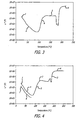
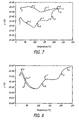
- FIGS. 4-7 The results of thermal testing of the heat-settable resin mixture are shown in FIGS. 4-7 .
- the heat-settable resin mixture was heated to the lower processing window limit (Curve X) and then cooled to ambient temperature followed by heating from ambient temperature up to curing temperature (Curve Y).
- the curves in FIGS. 4-7 are labeled with numbers and letters that correspond to the generalized processing curves shown in FIG. 1 .
- FIG. 5 the heat-settable resin mixture was heated (point 1 to point 2) and then cooled (point 3) in accordance with the present invention to form a heat-set mixture that was then cured by heating from point 3 to point 4.
- FIG. 6 is a graph of time vs. viscosity (curve X) and temperature (curve Y) for the heat-settable resin mixture when it is heated from ambient temperature to the upper limit of the processing window (130°C) and held at that temperature for 1 hour.
- FIG. 7 is a graph of viscosity vs.
- FIG. 7 also shows viscosity vs. temperature for the same heat-settable resin mixture that has previously been held at the upper temperature limit of the processing window (130°C) for 60 minutes (curve Y).
- a heat-settable resin mixture in accordance with the present invention was made by using two epoxy resins (DER 331 and DER 439) to form the resin component and one curing agent (4,4'-DDS) to form the curing component.
- the epoxy resins were combined and heated to a temperature of 90°C.
- the 4,4'-DDS was added and mixed in for 15 minutes under vacuum to insure complete dissolution of the curing agent.
- the resulting curable resin mixture was cooled to 71°C.
- the same rigid-rod polymer as used in Example 2 (Parmax 1200) was then added and mixed for 5 minutes.
- the resulting heat-settable mixture had the following composition: Weight Percent Curable Resin Mixture DER 331 Epoxy 30.3 DER 439 Epoxy 30.3 4,4'-DDS 19.4 3,3'-DDS -- Particulate Component 20.0
- FIG. 8 is a graph of temperature vs. viscosity for a heat-settable resin mixture according to this Example wherein the heat-settable resin mixture is heated to the lower processing window limit (80°C) and then cooled to ambient temperature followed by heating from ambient temperature up to curing temperature.
- the curves in FIGS. 8-11 are also labeled with numbers and letters that correspond to the generalized processing curves shown in FIG. 1 .
- FIG. 10 is a graph of time vs. viscosity (X curves) and temperature (Y curves) for the heat-settable resin mixture where it is heated from ambient temperature to the upper limit of the processing window (130°C) and held at that temperature for 1 hour (Curves Xu and Yu). Time vs. viscosity and temperature is also shown for the heat-settable resin mixture where it is heated from ambient temperature to the lower limit of the processing window (80°C) and held at that temperature for 1 hour (Curves Xl and Yl).
- FIG. 11 also shows a graph of viscosity vs. temperature the heat-settable resin mixture where the resin mixture has previously been held at the lower temperature limit of the processing window for 60 minutes (curve X) and wherein the heat-settable resin mixture has previously been held at the upper temperature limit of the processing window for 60 minutes (curve Y).
- the phase lag is typically referred to in terms of "tan-delta”.
- the initial tan-delta of the resin mixture at point 1 is greater than 1 which is indicative of liquid-like behavior.
- the resulting heat-set mixture is substantially solid-like with a tan-delta that is near zero.
Landscapes
- Chemical & Material Sciences (AREA)
- Medicinal Chemistry (AREA)
- Organic Chemistry (AREA)
- Materials Engineering (AREA)
- Health & Medical Sciences (AREA)
- Chemical Kinetics & Catalysis (AREA)
- Engineering & Computer Science (AREA)
- Polymers & Plastics (AREA)
- Manufacturing & Machinery (AREA)
- Reinforced Plastic Materials (AREA)
- Compositions Of Macromolecular Compounds (AREA)
- Laminated Bodies (AREA)
- Macromolecular Compounds Obtained By Forming Nitrogen-Containing Linkages In General (AREA)
- Organic Insulating Materials (AREA)
- Processing And Handling Of Plastics And Other Materials For Molding In General (AREA)
Claims (16)
- Härtbares Festharz, das durch das die folgenden Schritte umfassende Verfahren hergestellt wird:A) Bereitstellen einer thermisch fixierbaren Mischung umfassend eine Harzkomponente, eine Härtemittelkomponente und eine teilchenförmige Komponente, wobei die thermisch fixierbare Mischung eine Aushärtungstemperatur besitzt, so dass die thermisch fixierbare Mischung bei Erwärmung auf eine Temperatur gleich oder über dieser Aushärtungstemperatur ein gehärtetes Harz bildet, und wobei die teilchenförmige Komponente Teilchen aus einem steifen Stabpolymer umfasst, die eine Auflösungstemperatur aufweisen, bei der die steifen Stabpolymerteilchen sich in der Harzkomponente auflösen, wobei die teilchenförmige Komponente in einer solchen Menge vorhanden ist, dass die thermisch fixierbare Harzmischung eine thermisch fixierbare Mischung bildet, wenn die thermisch fixierbare Harzmischung auf eine Temperatur gleich oder über der Auflösungstemperatur des steifen Stabpolymers und unter der Aushärtungstemperatur der thermisch fixierbaren Mischung erwärmt wird,B) Erwärmen der thermisch fixierbaren Harzmischung auf eine Temperatur gleich oder über der Auflösungstemperatur des steifen Stabpolymers und unter der Aushärtungstemperatur der thermisch fixierbaren Mischung für eine ausreichende Zeitdauer zur Bildung der thermisch fixierten Mischung, undC) Kühlen der thermisch fixierten Mischung auf eine Temperatur unter der Auflösungstemperatur des steifen Stabpolymers zur Bildung des härtbaren Festharzes.
- Härtbarer Festharz-Verbundkörper umfassend Fasern und ein härtbares Festharz nach Anspruch 1.
- Härtbares Festharz nach Anspruch 1, wobei das steife Stabpolymer eine 1,4-Phenylen-Hauptkette aufweist.
- Härtbares Festharz nach Anspruch 1, wobei die Aushärtungstemperatur der thermisch fixierbaren Mischung über 120°C beträgt.
- Härtbares Festharz nach Anspruch 1, wobei die Auflösungstemperatur des steifen Stabpolymers zwischen 75°C und 125°C liegt.
- Verfahren zur Herstellung eines härtbaren festen Harzes, umfassend die Schritte:A) Bereitstellen einer thermisch fixierbaren Mischung umfassend eine Harzkomponente, eine Härtemittelkomponente und eine teilchenförmige Komponente, wobei die thermisch fixierbare Mischung eine Aushärtungstemperatur besitzt, so dass die thermisch fixierbare Mischung bei Erwärmung auf eine Temperatur gleich oder über dieser Aushärtungstemperatur ein gehärtetes Harz bildet, und wobei die teilchenförmige Komponente Teilchen aus einem steifen Stabpolymer umfasst, die eine Auflösungstemperatur aufweisen, bei der die steifen Stabpolymerteilchen sich in der Harzkomponente auflösen, wobei die teilchenförmige Komponente in einer solchen Menge vorhanden ist, dass die thermisch fixierbare Harzmischung eine thermisch fixierbare Mischung bildet, wenn die thermisch fixierbare Harzmischung auf eine Temperatur gleich oder über der Auflösungstemperatur des steifen Stabpolymers und unter der Aushärtungstemperatur der thermisch fixierbaren Mischung erwärmt wird,B) Erwärmen der thermisch fixierbaren Harzmischung auf eine Temperatur gleich oder über der Auflösungstemperatur des steifen Stabpolymers und unter der Aushärtungstemperatur der thermisch fixierbaren Mischung für eine ausreichende Zeitdauer zur Bildung der thermisch fixierten Mischung, undC) Kühlen der thermisch fixierten Mischung auf eine Temperatur unter der Auflösungstemperatur des steifen Stabpolymers zur Bildung des härtbaren Festharzes.
- Verfahren zur Herstellung einer härtbaren Festharzmatte (Prepreg), umfassend die Schritte:A) Zusammenbringen von Fasern mit einer thermisch fixierbaren Harzmischung zur Bildung einer thermisch fixierbaren Harzmattenschicht, wobei die thermisch fixierbare Mischung eine Harzkomponente, eine Härtemittelkomponente und eine teilchenförmige Komponente umfasst, wobei die thermisch fixierbare Mischung eine Aushärtungstemperatur besitzt, so dass die thermisch fixierbare Mischung bei Erwärmung auf eine Temperatur gleich oder über dieser Aushärtungstemperatur ein gehärtetes Harz bildet, und wobei die teilchenförmige Komponente Teilchen aus einem steifen Stabpolymer umfasst, die eine Auflösungstemperatur aufweisen, bei der die steifen Stabpolymerteilchen sich in der Harzkomponente auflösen, wobei die teilchenförmige Komponente in einer solchen Menge vorhanden ist, dass die thermisch fixierbare Harzmischung eine thermisch fixierbare Mischung bildet, wenn die thermisch fixierbare Harzmischung auf eine Temperatur gleich oder über der Auflösungstemperatur des steifen Stabpolymers und unter der Aushärtungstemperatur der thermisch fixierbaren Mischung erwärmt wird,B) Erwärmen der thermisch fixierbaren Harzmattenschicht auf eine Temperatur gleich oder über der Auflösungstemperatur des steifen Stabpolymers und unter der Aushärtungstemperatur der thermisch fixierbaren Mischung für eine ausreichende Zeitdauer zur Bildung einer thermisch fixierten Harzmatte, undC) Kühlen der thermisch fixierten Harzmatte auf eine Temperatur unter der Auflösungstemperatur des steifen Stabpolymers zur Bildung der härtbaren Festharzmatte.
- Verfahren zur Herstellung einer härtbaren Festharzmatte nach Anspruch 7, wobei das steife Stabpolymer eine 1,4-Phenylen-Hauptkette aufweist.
- Verfahren zur Herstellung einer härtbaren Festharzmatte nach Anspruch 7, wobei die Aushärtungstemperatur der thermisch fixierbaren Mischung über 120°C beträgt.
- Verfahren zur Herstellung einer härtbaren Festharzmatte nach Anspruch 7, wobei die Auflösungstemperatur des steifen Stabpolymers zwischen 75°C und 125°C liegt.
- Verfahren zur Herstellung eines härtbaren Festharz-Verbundkörpers, umfassend die Schritte:A) Zusammenbringen von Fasern mit einer thermisch fixierbaren Harzmischung zur Bildung von mindestens zwei thermisch fixierbaren Harzmattenschichten, wobei die thermisch fixierbare Mischung eine Harzkomponente, eine Härtemittelkomponente und eine teilchenförmige Komponente umfasst, wobei die thermisch fixierbare Mischung eine Aushärtungstemperatur besitzt, so dass die thermisch fixierbare Mischung bei Erwärmung auf eine Temperatur gleich oder über dieser Aushärtungstemperatur ein gehärtetes Harz bildet, und wobei die teilchenförmige Komponente Teilchen aus einem steifen Stabpolymer umfasst, die eine Auflösungstemperatur aufweisen, bei der die steifen Stabpolymerteilchen sich in der Harzkomponente auflösen, wobei die teilchenförmige Komponente in einer solchen Menge vorhanden ist, dass die thermisch fixierbare Harzmischung eine thermisch fixierbare Mischung bildet, wenn die thermisch fixierbare Harzmischung auf eine Temperatur gleich oder über der Auflösungstemperatur des steifen Stabpolymers und unter der Aushärtungstemperatur der thermisch fixierbaren Mischung erwärmt wird,B) Zusammenbringen der mindestens zwei thermisch fixierbaren Harzmattenschichten zur Bildung eines thermisch fixierbaren Harzmattenkörpers,C) Erwärmen des thermisch fixierbaren Harzmattenkörpers auf eine Temperatur gleich oder über der Auflösungstemperatur des steifen Stabpolymers und unter der Aushärtungstemperatur der thermisch fixierbaren Mischung für eine ausreichende Zeitdauer zur thermischen Fixierung der Harzmattenschichten und Bildung eines thermisch fixierten Harzmattenkörpers, undD) Kühlen des thermisch fixierten Harzmattenkörpers auf eine Temperatur unter dem Schmelzpunkt des steifen Stabpolymers zur Bildung des härtbaren festen Verbundkörpers.
- Verfahren zur Herstellung eines härtbaren festen Verbundkörpers nach Anspruch 11, wobei das steife Stabpolymer eine 1,4-Phenylen-Hauptkette aufweist.
- Verfahren zur Herstellung eines härtbaren festen Verbundkörpers nach Anspruch 11, wobei die Aushärtungstemperatur der thermisch fixierbaren Mischung über 120°C beträgt.
- Verfahren zur Herstellung eines härtbaren festen Verbundkörpers nach Anspruch 11, wobei die Auflösungstemperatur des steifen Stabpolymers zwischen 75°C und 125°C liegt.
- Verfahren zur Herstellung einer ausgehärteten Verbundschicht umfassend den Schritt des Erwärmens der nach Anspruch 7 hergestellten härtbaren Festharzmatte auf eine Temperatur gleich oder über der Aushärtungstemperatur unter Umgebungsdruck für eine ausreichende Zeitdauer zur Bildung der ausgehärteten Verbundschicht.
- Verfahren zur Herstellung eines ausgehärteten Verbundkörpers umfassend den Schritt des Erwärmens der nach Anspruch 11 hergestellten härtbaren festen Verbundkörpers auf eine Temperatur gleich oder über der Aushärtungstemperatur unter Umgebungsdruck für eine ausreichende Zeitdauer zur Bildung der ausgehärteten Verbundschicht.
Applications Claiming Priority (2)
| Application Number | Priority Date | Filing Date | Title |
|---|---|---|---|
| US672006 | 2003-09-26 | ||
| US10/672,006 US7041740B2 (en) | 2003-09-26 | 2003-09-26 | Heat-settable resins |
Publications (2)
| Publication Number | Publication Date |
|---|---|
| EP1522549A1 EP1522549A1 (de) | 2005-04-13 |
| EP1522549B1 true EP1522549B1 (de) | 2011-04-06 |
Family
ID=34313942
Family Applications (1)
| Application Number | Title | Priority Date | Filing Date |
|---|---|---|---|
| EP04255620A Expired - Lifetime EP1522549B1 (de) | 2003-09-26 | 2004-09-16 | Hitzehärtbare Härze |
Country Status (6)
| Country | Link |
|---|---|
| US (1) | US7041740B2 (de) |
| EP (1) | EP1522549B1 (de) |
| JP (1) | JP4700311B2 (de) |
| AT (1) | ATE504612T1 (de) |
| DE (1) | DE602004032095D1 (de) |
| ES (1) | ES2363426T3 (de) |
Families Citing this family (18)
| Publication number | Priority date | Publication date | Assignee | Title |
|---|---|---|---|---|
| US8067073B2 (en) | 2004-03-25 | 2011-11-29 | Boston Scientific Scimed, Inc. | Thermoplastic medical device |
| US7614347B2 (en) * | 2005-10-13 | 2009-11-10 | Ohnstad Thomas S | Solid-fuel-combustion fire-insulation interface with adjacent container-wall |
| US8747582B2 (en) * | 2008-09-05 | 2014-06-10 | Federal-Mogul Powertrain, Inc. | Self-wrapping textile sleeve with protective coating and method of construction thereof |
| PT2547510E (pt) * | 2010-03-18 | 2014-06-02 | Toho Tenax Europe Gmbh | Tela depositada multiaxial contendo um polímero não tecido e preforma para produzir componentes compósitos |
| JP5638274B2 (ja) * | 2010-04-08 | 2014-12-10 | 東京瓦斯株式会社 | ガス導管に対する緊急ガス遮断工法及びガス遮断装置 |
| GB201009851D0 (en) * | 2010-06-14 | 2010-07-21 | Hexcel Composites Ltd | Improvements in composite materials |
| CN103380161B (zh) | 2011-02-16 | 2016-04-20 | 三菱丽阳株式会社 | 获得纤维强化复合材料的制造方法及其所使用的环氧树脂组合物 |
| EP3075785B1 (de) * | 2013-11-26 | 2019-09-11 | Toho Tenax Co., Ltd. | Wärmehärtbare harzzusammensetzung, prepreg und verfahren zur herstellung eines faserverstärkten verbundwerkstoffes unter verwendung derselben |
| US9862828B2 (en) | 2014-09-23 | 2018-01-09 | The Boeing Company | Polymer nanoparticle additions for resin modification |
| US9587076B2 (en) | 2014-09-23 | 2017-03-07 | The Boeing Company | Polymer nanoparticles for controlling resin reaction rates |
| US9845556B2 (en) | 2014-09-23 | 2017-12-19 | The Boeing Company | Printing patterns onto composite laminates |
| US10072126B2 (en) | 2014-09-23 | 2018-09-11 | The Boeing Company | Soluble nanoparticles for composite performance enhancement |
| US10472472B2 (en) | 2014-09-23 | 2019-11-12 | The Boeing Company | Placement of modifier material in resin-rich pockets to mitigate microcracking in a composite structure |
| US10160840B2 (en) | 2014-09-23 | 2018-12-25 | The Boeing Company | Polymer nanoparticles for controlling permeability and fiber volume fraction in composites |
| US10808123B2 (en) * | 2014-09-23 | 2020-10-20 | The Boeing Company | Nanoparticles for improving the dimensional stability of resins |
| US10662302B2 (en) | 2014-09-23 | 2020-05-26 | The Boeing Company | Polymer nanoparticles for improved distortion capability in composites |
| US10604277B2 (en) * | 2017-05-01 | 2020-03-31 | Hexcel Corporation | Plugged acoustic honeycomb |
| US12122073B2 (en) * | 2020-06-10 | 2024-10-22 | The Boeing Company | Methods and systems for curing composites and associated microcrack-resistant composites |
Family Cites Families (8)
| Publication number | Priority date | Publication date | Assignee | Title |
|---|---|---|---|---|
| US5646231A (en) | 1988-02-17 | 1997-07-08 | Maxdem, Incorporated | Rigid-rod polymers |
| JPH0267333A (ja) * | 1988-07-15 | 1990-03-07 | Amoco Corp | 樹脂粒を充填した繊維強化複合材 |
| US5223584A (en) * | 1989-07-11 | 1993-06-29 | Gencorp Inc. | In situ thermoset molecular composites |
| ES2088781T3 (es) * | 1990-01-19 | 1996-09-16 | Minnesota Mining & Mfg | Composicion termoendurecible. |
| US5869592A (en) * | 1991-08-19 | 1999-02-09 | Maxdem Incorporated | Macromonomers having reactive side groups |
| US5347041A (en) * | 1993-06-16 | 1994-09-13 | Edison Polymer Innovation Corporation | Molecular composites |
| US6261675B1 (en) * | 1999-03-23 | 2001-07-17 | Hexcel Corporation | Core-crush resistant fabric and prepreg for fiber reinforced composite sandwich structures |
| JP4175894B2 (ja) * | 2001-02-27 | 2008-11-05 | ヘクセル コーポレイション | サンドイッチパネル用接着性プレプレグ面シート |
-
2003
- 2003-09-26 US US10/672,006 patent/US7041740B2/en not_active Expired - Lifetime
-
2004
- 2004-09-16 EP EP04255620A patent/EP1522549B1/de not_active Expired - Lifetime
- 2004-09-16 ES ES04255620T patent/ES2363426T3/es not_active Expired - Lifetime
- 2004-09-16 DE DE602004032095T patent/DE602004032095D1/de not_active Expired - Lifetime
- 2004-09-16 AT AT04255620T patent/ATE504612T1/de not_active IP Right Cessation
- 2004-09-24 JP JP2004276651A patent/JP4700311B2/ja not_active Expired - Fee Related
Also Published As
| Publication number | Publication date |
|---|---|
| ES2363426T3 (es) | 2011-08-03 |
| DE602004032095D1 (de) | 2011-05-19 |
| US20050070666A1 (en) | 2005-03-31 |
| US7041740B2 (en) | 2006-05-09 |
| JP4700311B2 (ja) | 2011-06-15 |
| JP2005105267A (ja) | 2005-04-21 |
| EP1522549A1 (de) | 2005-04-13 |
| ATE504612T1 (de) | 2011-04-15 |
Similar Documents
| Publication | Publication Date | Title |
|---|---|---|
| EP1522549B1 (de) | Hitzehärtbare Härze | |
| EP1408084B1 (de) | Epoxidharzzusammensetzungen für die Herstellung von blasenfreien Laminaten | |
| KR101996111B1 (ko) | 프리프레그, 섬유 강화 복합 재료 및 섬유 강화 복합 재료의 제조 방법 | |
| US9051416B2 (en) | Resin compositions with high thermoplastic loading | |
| KR102126294B1 (ko) | 개선된 섬유 보강된 복합물 | |
| CN102746622A (zh) | 一种中温固化环氧树脂为基体材料的预浸料及其制备方法 | |
| CN110637041B (zh) | 纤维增强复合材料用环氧树脂组合物及纤维增强复合材料 | |
| WO2019152190A1 (en) | Prepreg for use in making composite parts which tolerate hot and wet conditions | |
| EP3475349A1 (de) | Verbundstoff mit thermoplastischer gehärteter novolac-basierter epoxidmatrix | |
| KR101884606B1 (ko) | 고내충격성고강도 특성을 갖는 복합재료용 에폭시 수지 조성물 | |
| KR102108053B1 (ko) | 고인성, 고강도 및 내열성 특성을 가진 프리프레그 제조 방법 및 이 방법에 의해 제조된 프리프레그 | |
| JP2001342268A (ja) | プリプレグ及びその製造方法 | |
| JPH04268342A (ja) | 炭素繊維強化複合材料の作製方法 |
Legal Events
| Date | Code | Title | Description |
|---|---|---|---|
| PUAI | Public reference made under article 153(3) epc to a published international application that has entered the european phase |
Free format text: ORIGINAL CODE: 0009012 |
|
| AK | Designated contracting states |
Kind code of ref document: A1 Designated state(s): AT BE BG CH CY CZ DE DK EE ES FI FR GB GR HU IE IT LI LU MC NL PL PT RO SE SI SK TR |
|
| AX | Request for extension of the european patent |
Extension state: AL HR LT LV MK |
|
| 17P | Request for examination filed |
Effective date: 20050801 |
|
| AKX | Designation fees paid |
Designated state(s): AT BE BG CH CY CZ DE DK EE ES FI FR GB GR HU IE IT LI LU MC NL PL PT RO SE SI SK TR |
|
| 17Q | First examination report despatched |
Effective date: 20070920 |
|
| GRAP | Despatch of communication of intention to grant a patent |
Free format text: ORIGINAL CODE: EPIDOSNIGR1 |
|
| GRAS | Grant fee paid |
Free format text: ORIGINAL CODE: EPIDOSNIGR3 |
|
| GRAA | (expected) grant |
Free format text: ORIGINAL CODE: 0009210 |
|
| AK | Designated contracting states |
Kind code of ref document: B1 Designated state(s): AT BE BG CH CY CZ DE DK EE ES FI FR GB GR HU IE IT LI LU MC NL PL PT RO SE SI SK TR |
|
| REG | Reference to a national code |
Ref country code: GB Ref legal event code: FG4D |
|
| REG | Reference to a national code |
Ref country code: CH Ref legal event code: EP |
|
| REG | Reference to a national code |
Ref country code: IE Ref legal event code: FG4D |
|
| REF | Corresponds to: |
Ref document number: 602004032095 Country of ref document: DE Date of ref document: 20110519 Kind code of ref document: P |
|
| REG | Reference to a national code |
Ref country code: DE Ref legal event code: R096 Ref document number: 602004032095 Country of ref document: DE Effective date: 20110519 |
|
| REG | Reference to a national code |
Ref country code: NL Ref legal event code: VDEP Effective date: 20110406 |
|
| REG | Reference to a national code |
Ref country code: ES Ref legal event code: FG2A Ref document number: 2363426 Country of ref document: ES Kind code of ref document: T3 Effective date: 20110803 |
|
| PG25 | Lapsed in a contracting state [announced via postgrant information from national office to epo] |
Ref country code: SI Free format text: LAPSE BECAUSE OF FAILURE TO SUBMIT A TRANSLATION OF THE DESCRIPTION OR TO PAY THE FEE WITHIN THE PRESCRIBED TIME-LIMIT Effective date: 20110406 |
|
| PG25 | Lapsed in a contracting state [announced via postgrant information from national office to epo] |
Ref country code: SE Free format text: LAPSE BECAUSE OF FAILURE TO SUBMIT A TRANSLATION OF THE DESCRIPTION OR TO PAY THE FEE WITHIN THE PRESCRIBED TIME-LIMIT Effective date: 20110406 Ref country code: PT Free format text: LAPSE BECAUSE OF FAILURE TO SUBMIT A TRANSLATION OF THE DESCRIPTION OR TO PAY THE FEE WITHIN THE PRESCRIBED TIME-LIMIT Effective date: 20110808 |
|
| PG25 | Lapsed in a contracting state [announced via postgrant information from national office to epo] |
Ref country code: GR Free format text: LAPSE BECAUSE OF FAILURE TO SUBMIT A TRANSLATION OF THE DESCRIPTION OR TO PAY THE FEE WITHIN THE PRESCRIBED TIME-LIMIT Effective date: 20110707 Ref country code: AT Free format text: LAPSE BECAUSE OF FAILURE TO SUBMIT A TRANSLATION OF THE DESCRIPTION OR TO PAY THE FEE WITHIN THE PRESCRIBED TIME-LIMIT Effective date: 20110406 Ref country code: CY Free format text: LAPSE BECAUSE OF FAILURE TO SUBMIT A TRANSLATION OF THE DESCRIPTION OR TO PAY THE FEE WITHIN THE PRESCRIBED TIME-LIMIT Effective date: 20110406 Ref country code: BE Free format text: LAPSE BECAUSE OF FAILURE TO SUBMIT A TRANSLATION OF THE DESCRIPTION OR TO PAY THE FEE WITHIN THE PRESCRIBED TIME-LIMIT Effective date: 20110406 Ref country code: FI Free format text: LAPSE BECAUSE OF FAILURE TO SUBMIT A TRANSLATION OF THE DESCRIPTION OR TO PAY THE FEE WITHIN THE PRESCRIBED TIME-LIMIT Effective date: 20110406 |
|
| PG25 | Lapsed in a contracting state [announced via postgrant information from national office to epo] |
Ref country code: NL Free format text: LAPSE BECAUSE OF FAILURE TO SUBMIT A TRANSLATION OF THE DESCRIPTION OR TO PAY THE FEE WITHIN THE PRESCRIBED TIME-LIMIT Effective date: 20110406 |
|
| PG25 | Lapsed in a contracting state [announced via postgrant information from national office to epo] |
Ref country code: CZ Free format text: LAPSE BECAUSE OF FAILURE TO SUBMIT A TRANSLATION OF THE DESCRIPTION OR TO PAY THE FEE WITHIN THE PRESCRIBED TIME-LIMIT Effective date: 20110406 Ref country code: EE Free format text: LAPSE BECAUSE OF FAILURE TO SUBMIT A TRANSLATION OF THE DESCRIPTION OR TO PAY THE FEE WITHIN THE PRESCRIBED TIME-LIMIT Effective date: 20110406 |
|
| PLBE | No opposition filed within time limit |
Free format text: ORIGINAL CODE: 0009261 |
|
| STAA | Information on the status of an ep patent application or granted ep patent |
Free format text: STATUS: NO OPPOSITION FILED WITHIN TIME LIMIT |
|
| PG25 | Lapsed in a contracting state [announced via postgrant information from national office to epo] |
Ref country code: PL Free format text: LAPSE BECAUSE OF FAILURE TO SUBMIT A TRANSLATION OF THE DESCRIPTION OR TO PAY THE FEE WITHIN THE PRESCRIBED TIME-LIMIT Effective date: 20110406 Ref country code: RO Free format text: LAPSE BECAUSE OF FAILURE TO SUBMIT A TRANSLATION OF THE DESCRIPTION OR TO PAY THE FEE WITHIN THE PRESCRIBED TIME-LIMIT Effective date: 20110406 Ref country code: DK Free format text: LAPSE BECAUSE OF FAILURE TO SUBMIT A TRANSLATION OF THE DESCRIPTION OR TO PAY THE FEE WITHIN THE PRESCRIBED TIME-LIMIT Effective date: 20110406 Ref country code: SK Free format text: LAPSE BECAUSE OF FAILURE TO SUBMIT A TRANSLATION OF THE DESCRIPTION OR TO PAY THE FEE WITHIN THE PRESCRIBED TIME-LIMIT Effective date: 20110406 |
|
| 26N | No opposition filed |
Effective date: 20120110 |
|
| PG25 | Lapsed in a contracting state [announced via postgrant information from national office to epo] |
Ref country code: MC Free format text: LAPSE BECAUSE OF NON-PAYMENT OF DUE FEES Effective date: 20110930 |
|
| REG | Reference to a national code |
Ref country code: CH Ref legal event code: PL |
|
| REG | Reference to a national code |
Ref country code: DE Ref legal event code: R097 Ref document number: 602004032095 Country of ref document: DE Effective date: 20120110 |
|
| REG | Reference to a national code |
Ref country code: IE Ref legal event code: MM4A |
|
| PG25 | Lapsed in a contracting state [announced via postgrant information from national office to epo] |
Ref country code: IE Free format text: LAPSE BECAUSE OF NON-PAYMENT OF DUE FEES Effective date: 20110916 Ref country code: CH Free format text: LAPSE BECAUSE OF NON-PAYMENT OF DUE FEES Effective date: 20110930 Ref country code: LI Free format text: LAPSE BECAUSE OF NON-PAYMENT OF DUE FEES Effective date: 20110930 |
|
| PG25 | Lapsed in a contracting state [announced via postgrant information from national office to epo] |
Ref country code: LU Free format text: LAPSE BECAUSE OF NON-PAYMENT OF DUE FEES Effective date: 20110916 |
|
| PG25 | Lapsed in a contracting state [announced via postgrant information from national office to epo] |
Ref country code: BG Free format text: LAPSE BECAUSE OF FAILURE TO SUBMIT A TRANSLATION OF THE DESCRIPTION OR TO PAY THE FEE WITHIN THE PRESCRIBED TIME-LIMIT Effective date: 20110706 |
|
| PG25 | Lapsed in a contracting state [announced via postgrant information from national office to epo] |
Ref country code: TR Free format text: LAPSE BECAUSE OF FAILURE TO SUBMIT A TRANSLATION OF THE DESCRIPTION OR TO PAY THE FEE WITHIN THE PRESCRIBED TIME-LIMIT Effective date: 20110406 |
|
| PG25 | Lapsed in a contracting state [announced via postgrant information from national office to epo] |
Ref country code: HU Free format text: LAPSE BECAUSE OF FAILURE TO SUBMIT A TRANSLATION OF THE DESCRIPTION OR TO PAY THE FEE WITHIN THE PRESCRIBED TIME-LIMIT Effective date: 20110406 |
|
| PG25 | Lapsed in a contracting state [announced via postgrant information from national office to epo] |
Ref country code: IT Free format text: LAPSE BECAUSE OF FAILURE TO SUBMIT A TRANSLATION OF THE DESCRIPTION OR TO PAY THE FEE WITHIN THE PRESCRIBED TIME-LIMIT Effective date: 20110406 |
|
| REG | Reference to a national code |
Ref country code: FR Ref legal event code: PLFP Year of fee payment: 13 |
|
| REG | Reference to a national code |
Ref country code: FR Ref legal event code: PLFP Year of fee payment: 14 |
|
| REG | Reference to a national code |
Ref country code: FR Ref legal event code: PLFP Year of fee payment: 15 |
|
| PGFP | Annual fee paid to national office [announced via postgrant information from national office to epo] |
Ref country code: FR Payment date: 20180813 Year of fee payment: 15 Ref country code: DE Payment date: 20180904 Year of fee payment: 15 |
|
| PGFP | Annual fee paid to national office [announced via postgrant information from national office to epo] |
Ref country code: GB Payment date: 20180912 Year of fee payment: 15 |
|
| PGFP | Annual fee paid to national office [announced via postgrant information from national office to epo] |
Ref country code: ES Payment date: 20181001 Year of fee payment: 15 |
|
| REG | Reference to a national code |
Ref country code: DE Ref legal event code: R119 Ref document number: 602004032095 Country of ref document: DE |
|
| PG25 | Lapsed in a contracting state [announced via postgrant information from national office to epo] |
Ref country code: DE Free format text: LAPSE BECAUSE OF NON-PAYMENT OF DUE FEES Effective date: 20200401 |
|
| GBPC | Gb: european patent ceased through non-payment of renewal fee |
Effective date: 20190916 |
|
| PG25 | Lapsed in a contracting state [announced via postgrant information from national office to epo] |
Ref country code: FR Free format text: LAPSE BECAUSE OF NON-PAYMENT OF DUE FEES Effective date: 20190930 Ref country code: GB Free format text: LAPSE BECAUSE OF NON-PAYMENT OF DUE FEES Effective date: 20190916 |
|
| REG | Reference to a national code |
Ref country code: ES Ref legal event code: FD2A Effective date: 20210128 |
|
| PG25 | Lapsed in a contracting state [announced via postgrant information from national office to epo] |
Ref country code: ES Free format text: LAPSE BECAUSE OF NON-PAYMENT OF DUE FEES Effective date: 20190917 |