EP1408084B1 - Epoxidharzzusammensetzungen für die Herstellung von blasenfreien Laminaten - Google Patents
Epoxidharzzusammensetzungen für die Herstellung von blasenfreien Laminaten Download PDFInfo
- Publication number
- EP1408084B1 EP1408084B1 EP03078545A EP03078545A EP1408084B1 EP 1408084 B1 EP1408084 B1 EP 1408084B1 EP 03078545 A EP03078545 A EP 03078545A EP 03078545 A EP03078545 A EP 03078545A EP 1408084 B1 EP1408084 B1 EP 1408084B1
- Authority
- EP
- European Patent Office
- Prior art keywords
- resin
- weight percent
- partially impregnated
- resin composition
- prepreg
- Prior art date
- Legal status (The legal status is an assumption and is not a legal conclusion. Google has not performed a legal analysis and makes no representation as to the accuracy of the status listed.)
- Expired - Lifetime
Links
- 238000004519 manufacturing process Methods 0.000 title description 15
- 239000000203 mixture Substances 0.000 title description 11
- 239000003822 epoxy resin Substances 0.000 title description 6
- 229920000647 polyepoxide Polymers 0.000 title description 6
- 239000011342 resin composition Substances 0.000 claims abstract description 66
- 229920005989 resin Polymers 0.000 claims description 130
- 239000011347 resin Substances 0.000 claims description 130
- 239000000835 fiber Substances 0.000 claims description 40
- 238000000034 method Methods 0.000 claims description 38
- 239000007788 liquid Substances 0.000 claims description 21
- 230000008569 process Effects 0.000 claims description 14
- QGBSISYHAICWAH-UHFFFAOYSA-N dicyandiamide Chemical compound NC(N)=NC#N QGBSISYHAICWAH-UHFFFAOYSA-N 0.000 claims description 9
- 239000000843 powder Substances 0.000 claims description 7
- OKTJSMMVPCPJKN-UHFFFAOYSA-N Carbon Chemical compound [C] OKTJSMMVPCPJKN-UHFFFAOYSA-N 0.000 claims description 4
- 239000011521 glass Substances 0.000 claims description 4
- 238000002156 mixing Methods 0.000 claims description 3
- 230000002787 reinforcement Effects 0.000 claims description 3
- 229910052799 carbon Inorganic materials 0.000 claims description 2
- 229910002804 graphite Inorganic materials 0.000 claims description 2
- 239000010439 graphite Substances 0.000 claims description 2
- 239000010453 quartz Substances 0.000 claims description 2
- VYPSYNLAJGMNEJ-UHFFFAOYSA-N silicon dioxide Inorganic materials O=[Si]=O VYPSYNLAJGMNEJ-UHFFFAOYSA-N 0.000 claims description 2
- 239000002131 composite material Substances 0.000 description 24
- 239000004744 fabric Substances 0.000 description 23
- 238000001723 curing Methods 0.000 description 21
- 239000007787 solid Substances 0.000 description 20
- 238000012360 testing method Methods 0.000 description 17
- IISBACLAFKSPIT-UHFFFAOYSA-N bisphenol A Chemical compound C=1C=C(O)C=CC=1C(C)(C)C1=CC=C(O)C=C1 IISBACLAFKSPIT-UHFFFAOYSA-N 0.000 description 16
- 239000011800 void material Substances 0.000 description 15
- 239000004593 Epoxy Substances 0.000 description 13
- 239000000126 substance Substances 0.000 description 11
- KUBDPQJOLOUJRM-UHFFFAOYSA-N 2-(chloromethyl)oxirane;4-[2-(4-hydroxyphenyl)propan-2-yl]phenol Chemical compound ClCC1CO1.C=1C=C(O)C=CC=1C(C)(C)C1=CC=C(O)C=C1 KUBDPQJOLOUJRM-UHFFFAOYSA-N 0.000 description 10
- 239000000463 material Substances 0.000 description 10
- 229940106691 bisphenol a Drugs 0.000 description 8
- 239000000805 composite resin Substances 0.000 description 8
- 238000011068 loading method Methods 0.000 description 8
- 229920003986 novolac Polymers 0.000 description 8
- 239000003795 chemical substances by application Substances 0.000 description 7
- 238000007906 compression Methods 0.000 description 7
- 230000006835 compression Effects 0.000 description 7
- 239000007789 gas Substances 0.000 description 7
- 239000003039 volatile agent Substances 0.000 description 7
- 0 *=*1OC1**Oc1ccccc1Cc(cccc1)c1O*CC1OC1 Chemical compound *=*1OC1**Oc1ccccc1Cc(cccc1)c1O*CC1OC1 0.000 description 6
- 230000015572 biosynthetic process Effects 0.000 description 6
- 238000010438 heat treatment Methods 0.000 description 6
- RAXXELZNTBOGNW-UHFFFAOYSA-N imidazole Natural products C1=CNC=N1 RAXXELZNTBOGNW-UHFFFAOYSA-N 0.000 description 6
- 239000000758 substrate Substances 0.000 description 6
- GYZLOYUZLJXAJU-UHFFFAOYSA-N diglycidyl ether Chemical compound C1OC1COCC1CO1 GYZLOYUZLJXAJU-UHFFFAOYSA-N 0.000 description 5
- LNEPOXFFQSENCJ-UHFFFAOYSA-N haloperidol Chemical compound C1CC(O)(C=2C=CC(Cl)=CC=2)CCN1CCCC(=O)C1=CC=C(F)C=C1 LNEPOXFFQSENCJ-UHFFFAOYSA-N 0.000 description 5
- 239000012528 membrane Substances 0.000 description 5
- QTWJRLJHJPIABL-UHFFFAOYSA-N 2-methylphenol;3-methylphenol;4-methylphenol Chemical compound CC1=CC=C(O)C=C1.CC1=CC=CC(O)=C1.CC1=CC=CC=C1O QTWJRLJHJPIABL-UHFFFAOYSA-N 0.000 description 4
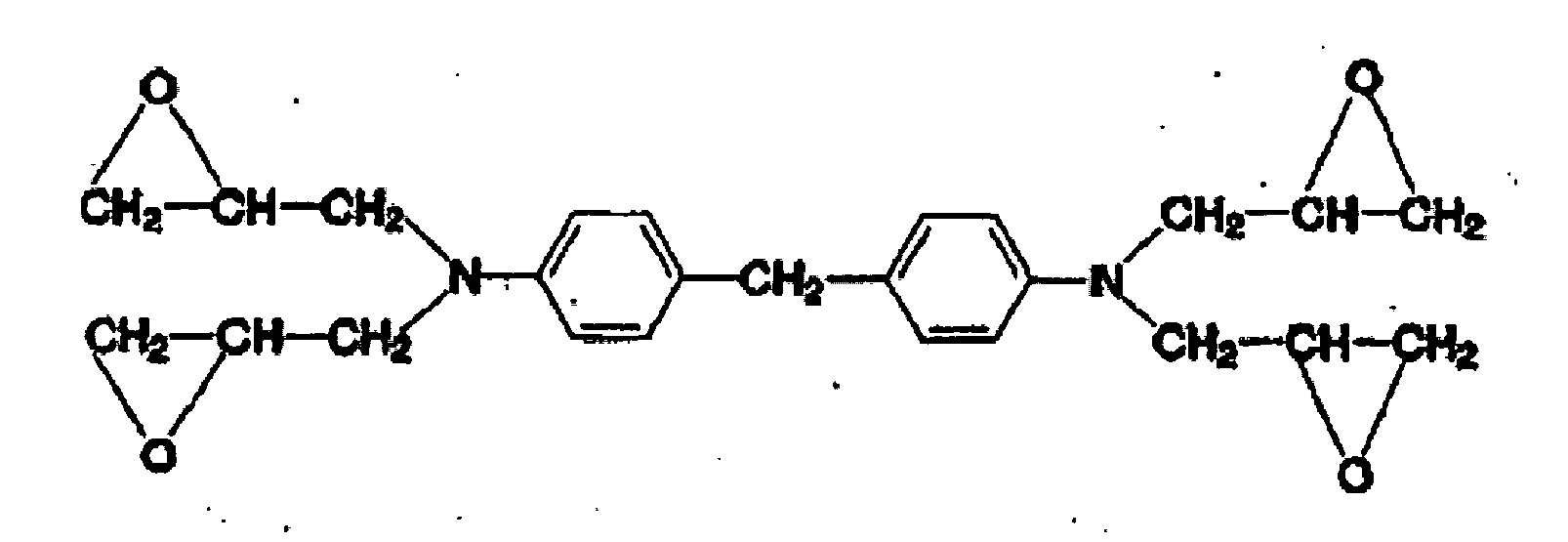
- FAUAZXVRLVIARB-UHFFFAOYSA-N 4-[[4-[bis(oxiran-2-ylmethyl)amino]phenyl]methyl]-n,n-bis(oxiran-2-ylmethyl)aniline Chemical compound C1OC1CN(C=1C=CC(CC=2C=CC(=CC=2)N(CC2OC2)CC2OC2)=CC=1)CC1CO1 FAUAZXVRLVIARB-UHFFFAOYSA-N 0.000 description 4
- 229920000049 Carbon (fiber) Polymers 0.000 description 4
- 230000008901 benefit Effects 0.000 description 4
- 239000004917 carbon fiber Substances 0.000 description 4
- 229930003836 cresol Natural products 0.000 description 4
- 238000009863 impact test Methods 0.000 description 4
- 239000011159 matrix material Substances 0.000 description 4
- VNWKTOKETHGBQD-UHFFFAOYSA-N methane Chemical compound C VNWKTOKETHGBQD-UHFFFAOYSA-N 0.000 description 4
- ISWSIDIOOBJBQZ-UHFFFAOYSA-N phenol group Chemical group C1(=CC=CC=C1)O ISWSIDIOOBJBQZ-UHFFFAOYSA-N 0.000 description 4
- 239000011208 reinforced composite material Substances 0.000 description 4
- 239000004809 Teflon Substances 0.000 description 3
- 229920006362 Teflon® Polymers 0.000 description 3
- 239000003054 catalyst Substances 0.000 description 3
- 238000000576 coating method Methods 0.000 description 3
- 239000011152 fibreglass Substances 0.000 description 3
- 238000009472 formulation Methods 0.000 description 3
- 230000009477 glass transition Effects 0.000 description 3
- 238000003860 storage Methods 0.000 description 3
- 229920001187 thermosetting polymer Polymers 0.000 description 3
- LJBWJFWNFUKAGS-UHFFFAOYSA-N 2-[bis(2-hydroxyphenyl)methyl]phenol Chemical compound OC1=CC=CC=C1C(C=1C(=CC=CC=1)O)C1=CC=CC=C1O LJBWJFWNFUKAGS-UHFFFAOYSA-N 0.000 description 2
- 238000013459 approach Methods 0.000 description 2
- 238000009835 boiling Methods 0.000 description 2
- 235000013877 carbamide Nutrition 0.000 description 2
- 239000011248 coating agent Substances 0.000 description 2
- 238000012669 compression test Methods 0.000 description 2
- 238000007596 consolidation process Methods 0.000 description 2
- 238000013461 design Methods 0.000 description 2
- 229920001971 elastomer Polymers 0.000 description 2
- 238000005516 engineering process Methods 0.000 description 2
- 239000003733 fiber-reinforced composite Substances 0.000 description 2
- 238000012986 modification Methods 0.000 description 2
- 230000004048 modification Effects 0.000 description 2
- 210000001331 nose Anatomy 0.000 description 2
- -1 polytetrafluoroethylene Polymers 0.000 description 2
- 229920001343 polytetrafluoroethylene Polymers 0.000 description 2
- 239000004810 polytetrafluoroethylene Substances 0.000 description 2
- 238000002360 preparation method Methods 0.000 description 2
- 239000000047 product Substances 0.000 description 2
- 230000003014 reinforcing effect Effects 0.000 description 2
- 230000008439 repair process Effects 0.000 description 2
- 230000000630 rising effect Effects 0.000 description 2
- BFKJFAAPBSQJPD-UHFFFAOYSA-N tetrafluoroethene Chemical compound FC(F)=C(F)F BFKJFAAPBSQJPD-UHFFFAOYSA-N 0.000 description 2
- 229920005992 thermoplastic resin Polymers 0.000 description 2
- XLYOFNOQVPJJNP-UHFFFAOYSA-N water Substances O XLYOFNOQVPJJNP-UHFFFAOYSA-N 0.000 description 2
- 239000002023 wood Substances 0.000 description 2
- UIDDPPKZYZTEGS-UHFFFAOYSA-N 3-(2-ethyl-4-methylimidazol-1-yl)propanenitrile Chemical compound CCC1=NC(C)=CN1CCC#N UIDDPPKZYZTEGS-UHFFFAOYSA-N 0.000 description 1
- ZSQNWXGSUBTAJV-UHFFFAOYSA-N C(=O)(NC)NC.C(=O)(NC)NC.C1(=CC=CC=C1)C Chemical compound C(=O)(NC)NC.C(=O)(NC)NC.C1(=CC=CC=C1)C ZSQNWXGSUBTAJV-UHFFFAOYSA-N 0.000 description 1
- 229920000271 Kevlar® Polymers 0.000 description 1
- 239000002841 Lewis acid Substances 0.000 description 1
- 239000004952 Polyamide Substances 0.000 description 1
- 229910000831 Steel Inorganic materials 0.000 description 1
- XSQUKJJJFZCRTK-UHFFFAOYSA-N Urea Chemical compound NC(N)=O XSQUKJJJFZCRTK-UHFFFAOYSA-N 0.000 description 1
- 150000008065 acid anhydrides Chemical class 0.000 description 1
- 239000000853 adhesive Substances 0.000 description 1
- 230000001070 adhesive effect Effects 0.000 description 1
- 150000001412 amines Chemical class 0.000 description 1
- 150000004984 aromatic diamines Chemical class 0.000 description 1
- 239000004841 bisphenol A epoxy resin Substances 0.000 description 1
- 239000004202 carbamide Substances 0.000 description 1
- 239000007795 chemical reaction product Substances 0.000 description 1
- 238000010924 continuous production Methods 0.000 description 1
- 238000007796 conventional method Methods 0.000 description 1
- 238000013036 cure process Methods 0.000 description 1
- 230000003247 decreasing effect Effects 0.000 description 1
- 230000001419 dependent effect Effects 0.000 description 1
- 230000008030 elimination Effects 0.000 description 1
- 238000003379 elimination reaction Methods 0.000 description 1
- 238000011156 evaluation Methods 0.000 description 1
- 239000002657 fibrous material Substances 0.000 description 1
- 239000006260 foam Substances 0.000 description 1
- 238000001879 gelation Methods 0.000 description 1
- 230000005484 gravity Effects 0.000 description 1
- 229940042795 hydrazides for tuberculosis treatment Drugs 0.000 description 1
- 230000002706 hydrostatic effect Effects 0.000 description 1
- 150000002460 imidazoles Chemical class 0.000 description 1
- 238000005470 impregnation Methods 0.000 description 1
- 238000003780 insertion Methods 0.000 description 1
- 238000007689 inspection Methods 0.000 description 1
- 238000010409 ironing Methods 0.000 description 1
- 238000005304 joining Methods 0.000 description 1
- 239000004761 kevlar Substances 0.000 description 1
- 238000009940 knitting Methods 0.000 description 1
- 150000007517 lewis acids Chemical class 0.000 description 1
- 238000013035 low temperature curing Methods 0.000 description 1
- 239000000155 melt Substances 0.000 description 1
- 238000000465 moulding Methods 0.000 description 1
- BCQLZHNWLHXPCJ-UHFFFAOYSA-N n-methylethanamine;trifluoroborane Chemical compound CCNC.FB(F)F BCQLZHNWLHXPCJ-UHFFFAOYSA-N 0.000 description 1
- 239000002245 particle Substances 0.000 description 1
- 230000037361 pathway Effects 0.000 description 1
- 229920002647 polyamide Polymers 0.000 description 1
- 229920000728 polyester Polymers 0.000 description 1
- 229920000642 polymer Polymers 0.000 description 1
- 238000012545 processing Methods 0.000 description 1
- 230000009467 reduction Effects 0.000 description 1
- 239000012779 reinforcing material Substances 0.000 description 1
- 238000007789 sealing Methods 0.000 description 1
- 230000035945 sensitivity Effects 0.000 description 1
- 239000000243 solution Substances 0.000 description 1
- 239000010959 steel Substances 0.000 description 1
- 229920002994 synthetic fiber Polymers 0.000 description 1
- 239000012209 synthetic fiber Substances 0.000 description 1
- 150000003512 tertiary amines Chemical class 0.000 description 1
- 150000003672 ureas Chemical class 0.000 description 1
- 238000005303 weighing Methods 0.000 description 1
- 239000002759 woven fabric Substances 0.000 description 1
Images

Classifications
-
- B—PERFORMING OPERATIONS; TRANSPORTING
- B32—LAYERED PRODUCTS
- B32B—LAYERED PRODUCTS, i.e. PRODUCTS BUILT-UP OF STRATA OF FLAT OR NON-FLAT, e.g. CELLULAR OR HONEYCOMB, FORM
- B32B5/00—Layered products characterised by the non- homogeneity or physical structure, i.e. comprising a fibrous, filamentary, particulate or foam layer; Layered products characterised by having a layer differing constitutionally or physically in different parts
- B32B5/22—Layered products characterised by the non- homogeneity or physical structure, i.e. comprising a fibrous, filamentary, particulate or foam layer; Layered products characterised by having a layer differing constitutionally or physically in different parts characterised by the presence of two or more layers which are next to each other and are fibrous, filamentary, formed of particles or foamed
- B32B5/24—Layered products characterised by the non- homogeneity or physical structure, i.e. comprising a fibrous, filamentary, particulate or foam layer; Layered products characterised by having a layer differing constitutionally or physically in different parts characterised by the presence of two or more layers which are next to each other and are fibrous, filamentary, formed of particles or foamed one layer being a fibrous or filamentary layer
- B32B5/26—Layered products characterised by the non- homogeneity or physical structure, i.e. comprising a fibrous, filamentary, particulate or foam layer; Layered products characterised by having a layer differing constitutionally or physically in different parts characterised by the presence of two or more layers which are next to each other and are fibrous, filamentary, formed of particles or foamed one layer being a fibrous or filamentary layer another layer next to it also being fibrous or filamentary
-
- B—PERFORMING OPERATIONS; TRANSPORTING
- B29—WORKING OF PLASTICS; WORKING OF SUBSTANCES IN A PLASTIC STATE IN GENERAL
- B29C—SHAPING OR JOINING OF PLASTICS; SHAPING OF MATERIAL IN A PLASTIC STATE, NOT OTHERWISE PROVIDED FOR; AFTER-TREATMENT OF THE SHAPED PRODUCTS, e.g. REPAIRING
- B29C70/00—Shaping composites, i.e. plastics material comprising reinforcements, fillers or preformed parts, e.g. inserts
- B29C70/04—Shaping composites, i.e. plastics material comprising reinforcements, fillers or preformed parts, e.g. inserts comprising reinforcements only, e.g. self-reinforcing plastics
- B29C70/28—Shaping operations therefor
- B29C70/40—Shaping or impregnating by compression not applied
- B29C70/42—Shaping or impregnating by compression not applied for producing articles of definite length, i.e. discrete articles
- B29C70/44—Shaping or impregnating by compression not applied for producing articles of definite length, i.e. discrete articles using isostatic pressure, e.g. pressure difference-moulding, vacuum bag-moulding, autoclave-moulding or expanding rubber-moulding
-
- B—PERFORMING OPERATIONS; TRANSPORTING
- B29—WORKING OF PLASTICS; WORKING OF SUBSTANCES IN A PLASTIC STATE IN GENERAL
- B29C—SHAPING OR JOINING OF PLASTICS; SHAPING OF MATERIAL IN A PLASTIC STATE, NOT OTHERWISE PROVIDED FOR; AFTER-TREATMENT OF THE SHAPED PRODUCTS, e.g. REPAIRING
- B29C70/00—Shaping composites, i.e. plastics material comprising reinforcements, fillers or preformed parts, e.g. inserts
- B29C70/04—Shaping composites, i.e. plastics material comprising reinforcements, fillers or preformed parts, e.g. inserts comprising reinforcements only, e.g. self-reinforcing plastics
- B29C70/28—Shaping operations therefor
- B29C70/54—Component parts, details or accessories; Auxiliary operations, e.g. feeding or storage of prepregs or SMC after impregnation or during ageing
- B29C70/546—Measures for feeding or distributing the matrix material in the reinforcing structure
-
- B—PERFORMING OPERATIONS; TRANSPORTING
- B32—LAYERED PRODUCTS
- B32B—LAYERED PRODUCTS, i.e. PRODUCTS BUILT-UP OF STRATA OF FLAT OR NON-FLAT, e.g. CELLULAR OR HONEYCOMB, FORM
- B32B27/00—Layered products comprising a layer of synthetic resin
- B32B27/04—Layered products comprising a layer of synthetic resin as impregnant, bonding, or embedding substance
-
- C—CHEMISTRY; METALLURGY
- C08—ORGANIC MACROMOLECULAR COMPOUNDS; THEIR PREPARATION OR CHEMICAL WORKING-UP; COMPOSITIONS BASED THEREON
- C08G—MACROMOLECULAR COMPOUNDS OBTAINED OTHERWISE THAN BY REACTIONS ONLY INVOLVING UNSATURATED CARBON-TO-CARBON BONDS
- C08G59/00—Polycondensates containing more than one epoxy group per molecule; Macromolecules obtained by polymerising compounds containing more than one epoxy group per molecule using curing agents or catalysts which react with the epoxy groups
- C08G59/18—Macromolecules obtained by polymerising compounds containing more than one epoxy group per molecule using curing agents or catalysts which react with the epoxy groups ; e.g. general methods of curing
- C08G59/20—Macromolecules obtained by polymerising compounds containing more than one epoxy group per molecule using curing agents or catalysts which react with the epoxy groups ; e.g. general methods of curing characterised by the epoxy compounds used
- C08G59/32—Epoxy compounds containing three or more epoxy groups
-
- C—CHEMISTRY; METALLURGY
- C08—ORGANIC MACROMOLECULAR COMPOUNDS; THEIR PREPARATION OR CHEMICAL WORKING-UP; COMPOSITIONS BASED THEREON
- C08G—MACROMOLECULAR COMPOUNDS OBTAINED OTHERWISE THAN BY REACTIONS ONLY INVOLVING UNSATURATED CARBON-TO-CARBON BONDS
- C08G59/00—Polycondensates containing more than one epoxy group per molecule; Macromolecules obtained by polymerising compounds containing more than one epoxy group per molecule using curing agents or catalysts which react with the epoxy groups
- C08G59/18—Macromolecules obtained by polymerising compounds containing more than one epoxy group per molecule using curing agents or catalysts which react with the epoxy groups ; e.g. general methods of curing
- C08G59/20—Macromolecules obtained by polymerising compounds containing more than one epoxy group per molecule using curing agents or catalysts which react with the epoxy groups ; e.g. general methods of curing characterised by the epoxy compounds used
- C08G59/32—Epoxy compounds containing three or more epoxy groups
- C08G59/3218—Carbocyclic compounds
-
- C—CHEMISTRY; METALLURGY
- C08—ORGANIC MACROMOLECULAR COMPOUNDS; THEIR PREPARATION OR CHEMICAL WORKING-UP; COMPOSITIONS BASED THEREON
- C08G—MACROMOLECULAR COMPOUNDS OBTAINED OTHERWISE THAN BY REACTIONS ONLY INVOLVING UNSATURATED CARBON-TO-CARBON BONDS
- C08G59/00—Polycondensates containing more than one epoxy group per molecule; Macromolecules obtained by polymerising compounds containing more than one epoxy group per molecule using curing agents or catalysts which react with the epoxy groups
- C08G59/18—Macromolecules obtained by polymerising compounds containing more than one epoxy group per molecule using curing agents or catalysts which react with the epoxy groups ; e.g. general methods of curing
- C08G59/20—Macromolecules obtained by polymerising compounds containing more than one epoxy group per molecule using curing agents or catalysts which react with the epoxy groups ; e.g. general methods of curing characterised by the epoxy compounds used
- C08G59/32—Epoxy compounds containing three or more epoxy groups
- C08G59/38—Epoxy compounds containing three or more epoxy groups together with di-epoxy compounds
-
- C—CHEMISTRY; METALLURGY
- C08—ORGANIC MACROMOLECULAR COMPOUNDS; THEIR PREPARATION OR CHEMICAL WORKING-UP; COMPOSITIONS BASED THEREON
- C08J—WORKING-UP; GENERAL PROCESSES OF COMPOUNDING; AFTER-TREATMENT NOT COVERED BY SUBCLASSES C08B, C08C, C08F, C08G or C08H
- C08J5/00—Manufacture of articles or shaped materials containing macromolecular substances
- C08J5/24—Impregnating materials with prepolymers which can be polymerised in situ, e.g. manufacture of prepregs
- C08J5/241—Impregnating materials with prepolymers which can be polymerised in situ, e.g. manufacture of prepregs using inorganic fibres
- C08J5/243—Impregnating materials with prepolymers which can be polymerised in situ, e.g. manufacture of prepregs using inorganic fibres using carbon fibres
-
- C—CHEMISTRY; METALLURGY
- C08—ORGANIC MACROMOLECULAR COMPOUNDS; THEIR PREPARATION OR CHEMICAL WORKING-UP; COMPOSITIONS BASED THEREON
- C08L—COMPOSITIONS OF MACROMOLECULAR COMPOUNDS
- C08L63/00—Compositions of epoxy resins; Compositions of derivatives of epoxy resins
-
- C—CHEMISTRY; METALLURGY
- C08—ORGANIC MACROMOLECULAR COMPOUNDS; THEIR PREPARATION OR CHEMICAL WORKING-UP; COMPOSITIONS BASED THEREON
- C08J—WORKING-UP; GENERAL PROCESSES OF COMPOUNDING; AFTER-TREATMENT NOT COVERED BY SUBCLASSES C08B, C08C, C08F, C08G or C08H
- C08J2363/00—Characterised by the use of epoxy resins; Derivatives of epoxy resins
-
- Y—GENERAL TAGGING OF NEW TECHNOLOGICAL DEVELOPMENTS; GENERAL TAGGING OF CROSS-SECTIONAL TECHNOLOGIES SPANNING OVER SEVERAL SECTIONS OF THE IPC; TECHNICAL SUBJECTS COVERED BY FORMER USPC CROSS-REFERENCE ART COLLECTIONS [XRACs] AND DIGESTS
- Y10—TECHNICAL SUBJECTS COVERED BY FORMER USPC
- Y10T—TECHNICAL SUBJECTS COVERED BY FORMER US CLASSIFICATION
- Y10T428/00—Stock material or miscellaneous articles
- Y10T428/249921—Web or sheet containing structurally defined element or component
- Y10T428/249924—Noninterengaged fiber-containing paper-free web or sheet which is not of specified porosity
- Y10T428/249928—Fiber embedded in a ceramic, glass, or carbon matrix
-
- Y—GENERAL TAGGING OF NEW TECHNOLOGICAL DEVELOPMENTS; GENERAL TAGGING OF CROSS-SECTIONAL TECHNOLOGIES SPANNING OVER SEVERAL SECTIONS OF THE IPC; TECHNICAL SUBJECTS COVERED BY FORMER USPC CROSS-REFERENCE ART COLLECTIONS [XRACs] AND DIGESTS
- Y10—TECHNICAL SUBJECTS COVERED BY FORMER USPC
- Y10T—TECHNICAL SUBJECTS COVERED BY FORMER US CLASSIFICATION
- Y10T428/00—Stock material or miscellaneous articles
- Y10T428/249921—Web or sheet containing structurally defined element or component
- Y10T428/249924—Noninterengaged fiber-containing paper-free web or sheet which is not of specified porosity
- Y10T428/249933—Fiber embedded in or on the surface of a natural or synthetic rubber matrix
-
- Y—GENERAL TAGGING OF NEW TECHNOLOGICAL DEVELOPMENTS; GENERAL TAGGING OF CROSS-SECTIONAL TECHNOLOGIES SPANNING OVER SEVERAL SECTIONS OF THE IPC; TECHNICAL SUBJECTS COVERED BY FORMER USPC CROSS-REFERENCE ART COLLECTIONS [XRACs] AND DIGESTS
- Y10—TECHNICAL SUBJECTS COVERED BY FORMER USPC
- Y10T—TECHNICAL SUBJECTS COVERED BY FORMER US CLASSIFICATION
- Y10T428/00—Stock material or miscellaneous articles
- Y10T428/249921—Web or sheet containing structurally defined element or component
- Y10T428/249924—Noninterengaged fiber-containing paper-free web or sheet which is not of specified porosity
- Y10T428/24994—Fiber embedded in or on the surface of a polymeric matrix
-
- Y—GENERAL TAGGING OF NEW TECHNOLOGICAL DEVELOPMENTS; GENERAL TAGGING OF CROSS-SECTIONAL TECHNOLOGIES SPANNING OVER SEVERAL SECTIONS OF THE IPC; TECHNICAL SUBJECTS COVERED BY FORMER USPC CROSS-REFERENCE ART COLLECTIONS [XRACs] AND DIGESTS
- Y10—TECHNICAL SUBJECTS COVERED BY FORMER USPC
- Y10T—TECHNICAL SUBJECTS COVERED BY FORMER US CLASSIFICATION
- Y10T428/00—Stock material or miscellaneous articles
- Y10T428/249921—Web or sheet containing structurally defined element or component
- Y10T428/249924—Noninterengaged fiber-containing paper-free web or sheet which is not of specified porosity
- Y10T428/24994—Fiber embedded in or on the surface of a polymeric matrix
- Y10T428/249942—Fibers are aligned substantially parallel
-
- Y—GENERAL TAGGING OF NEW TECHNOLOGICAL DEVELOPMENTS; GENERAL TAGGING OF CROSS-SECTIONAL TECHNOLOGIES SPANNING OVER SEVERAL SECTIONS OF THE IPC; TECHNICAL SUBJECTS COVERED BY FORMER USPC CROSS-REFERENCE ART COLLECTIONS [XRACs] AND DIGESTS
- Y10—TECHNICAL SUBJECTS COVERED BY FORMER USPC
- Y10T—TECHNICAL SUBJECTS COVERED BY FORMER US CLASSIFICATION
- Y10T428/00—Stock material or miscellaneous articles
- Y10T428/249921—Web or sheet containing structurally defined element or component
- Y10T428/249924—Noninterengaged fiber-containing paper-free web or sheet which is not of specified porosity
- Y10T428/24994—Fiber embedded in or on the surface of a polymeric matrix
- Y10T428/249942—Fibers are aligned substantially parallel
- Y10T428/249944—Fiber is precoated
-
- Y—GENERAL TAGGING OF NEW TECHNOLOGICAL DEVELOPMENTS; GENERAL TAGGING OF CROSS-SECTIONAL TECHNOLOGIES SPANNING OVER SEVERAL SECTIONS OF THE IPC; TECHNICAL SUBJECTS COVERED BY FORMER USPC CROSS-REFERENCE ART COLLECTIONS [XRACs] AND DIGESTS
- Y10—TECHNICAL SUBJECTS COVERED BY FORMER USPC
- Y10T—TECHNICAL SUBJECTS COVERED BY FORMER US CLASSIFICATION
- Y10T428/00—Stock material or miscellaneous articles
- Y10T428/249921—Web or sheet containing structurally defined element or component
- Y10T428/249924—Noninterengaged fiber-containing paper-free web or sheet which is not of specified porosity
- Y10T428/24994—Fiber embedded in or on the surface of a polymeric matrix
- Y10T428/249942—Fibers are aligned substantially parallel
- Y10T428/249945—Carbon or carbonaceous fiber
-
- Y—GENERAL TAGGING OF NEW TECHNOLOGICAL DEVELOPMENTS; GENERAL TAGGING OF CROSS-SECTIONAL TECHNOLOGIES SPANNING OVER SEVERAL SECTIONS OF THE IPC; TECHNICAL SUBJECTS COVERED BY FORMER USPC CROSS-REFERENCE ART COLLECTIONS [XRACs] AND DIGESTS
- Y10—TECHNICAL SUBJECTS COVERED BY FORMER USPC
- Y10T—TECHNICAL SUBJECTS COVERED BY FORMER US CLASSIFICATION
- Y10T428/00—Stock material or miscellaneous articles
- Y10T428/249921—Web or sheet containing structurally defined element or component
- Y10T428/249924—Noninterengaged fiber-containing paper-free web or sheet which is not of specified porosity
- Y10T428/24994—Fiber embedded in or on the surface of a polymeric matrix
- Y10T428/249942—Fibers are aligned substantially parallel
- Y10T428/249947—Polymeric fiber
Definitions
- This invention relates to resin compositions for use in a method of manufacturing void-free laminates at low temperatures under autoclave-pressure or vacuum-bag-only-pressure.
- the invention relates to resin compositions for use in partially impregnated prepregs in which the level of voidage in the resulting laminate is lower than that achieved by vacuum-bag-only-pressure techniques to-date.
- Composite materials consist of a matrix resin and reinforcement fibers. These materials are typically used in areas where high strength and low weight are important, for example, the aerospace and aircraft industries. Most composites used in aerospace structural applications comprise thermosetting resins and carbon fiber materials. Typically, these thermosetting resins are cured at high temperature (e.g. 121-173°C, 250-350°F) and under high pressure (e.g. 586 kPa, 85 psi) using an autoclave.
- high temperature e.g. 121-173°C, 250-350°F
- high pressure e.g. 586 kPa, 85 psi
- a common method of manufacturing composite materials is to lay-up a number of sheets of uncured resin impregnated filaments called prepregs on a suitable tool and subject them to heat and pressure in order to coalesce the sheets, mold them to the configuration of the mold and subsequently gel the resin. The resin is then finally cured by further heat treatment in order to fix the resulting configuration of the molded laminate.
- a major problem encountered in the manufacture of thick composite parts is porosity (or voids) in the final part.
- porosity or voids
- the occurrence of voids in composite materials is not completely understood, it is believed to be, in part, due to the fact that entrapped air cannot escape from the prepregs used in the manufacture of composite materials.
- Campbell et al. have studied the cause of porosity in carbon fiber composites ( Flake C. Campbell et al., Journal of Advanced Materials, 18-33, July 1995 ). Void formation and growth in composite laminates is primarily due to entrapped volatiles.
- Void growth will potentially occur if the void pressure (i.e., the volatile vapor pressure) exceeds the actual pressure on the liquid resin (i.e., the hydrostatic resin pressure) while the resin is still a liquid.
- the void pressure i.e., the volatile vapor pressure
- the actual pressure on the liquid resin i.e., the hydrostatic resin pressure
- An autoclave is capable of subjecting the laid-up prepregs to elevated temperatures and pressures so that they can readily coalesce to form a reinforced composite material.
- This apparatus has the attraction of being capable of supplying sufficient pressure to the resin mass that hydraulic pressure within the mass causes a significant reduction in the size of enclosed gas or vapor bubbles or completely forces them into solution depending on the level of pressure applied. If the pressure is maintained during the gelation of the resin and its subsequent cure, a void-free matrix is achieved.
- a cheaper alternative to autoclaving is using a process in which the laid-up prepregs are placed on a tool and then enclosed by an impervious membrane. The volume enclosed by the membrane is evacuated and the assembly heated up slowly. Ambient atmospheric pressure provides the necessary force to coalesce the prepregs to form the molded laminate and the rising temperature rate ensures that the uncured resin is initially sufficiently mobile to permit maximum consolidation and to finally permit gelling and curing of the resin at more elevated temperatures.
- the resulting laminate is usually of inferior quality because of the occurrence of voids in the resin matrix.
- the voids are trapped in both intralaminar and interlaminar areas. Normally, the center area of the laminate is most effected compared to the edge areas of the laminate.
- the minimum void level of a vacuum molded fiber reinforced composite material is from about 4 to about 6 percent by volume.
- thermosetting resin In bleed curing some of the thermosetting resin is allowed to flow out of the prepreg, carrying out trapped air and volatiles ( Flake C. Campbell, Journal of Advanced Materials, 18-33, July, 1995 ). Although this process can produce reduced void laminates after curing, the resin content is hard to control. Thus, the final composite material does not form a reliable and consistent part. This process usually results in the formation of a thin laminate having voids due to over-bleeding of the resin.
- WO 98/38031 discloses a method of molding a composite comprising laying alternatively on a mold first and second fiber material pre-impregnated with uncured resin, the resin content of the first layer is different from that of the second layer, the layers are enclosed within an impervious membrane which is evacuated and heat is applied to partially cure the resin to harden the material.
- the partially cured material may be removed from the mold and finally cured at an elevated temperature while unsupported by a mold.
- Such a process employs a high resin content first prepreg layer with normal or relatively low viscosity resin and a low resin content second prepreg layer made with relatively toughened, high viscosity resin.
- the employment of two prepreg layers with resins having different characteristics leads to prepregs having different tack. This complicates handling of the prepregs and necessitates that the prepregs employed are registered properly in order to provide a laminate with the desired characteristics.
- utilization of prepregs having resins with different viscosities may lead to additional complications since the viscosities of the resins during storage and/or during transportation may alter. Accordingly, different conditions may have to be controlled for each resin employed, leading to additional expense and effort, in order that the resins maintain their desired viscosity characteristics.
- the present invention relates to a resin compositions for use in a method of forming laminates in which the level of voidage in the resulting laminate is less than about 2% and may be completely eliminated.
- the present invention relates to a partially impregnated prepreg comprising a fiber layer partially impregnated with a resin composition of the invention, whereby said resin composition when heated in a vacuum envelope fully infuses into said fiber layer and cures to form a void-free laminate.
- JP-A-5042536 describes resin compositions for impregnating thermoplastic resin long fibers.
- the resin compositions comprises: 20 parts by weight of a phenolic novolac resin, 50 parts by weight of tetraglycidylmethylenedianiline, 30 parts by weight of a bisphenol-A epoxy resin, and 40 parts by weight of 4,4-diaminodiphenylsulphone (DADS).
- the DADS is a high-temperature curing agent for curing at temperatures in the range 150°C to 175°C.
- the present invention provides a resin composition as defined in claim 1.
- the present invention provides a partially impregnated prepreg comprising a fiber layer partially impregnated with a resin composition according to the present invention, wherein the resin composition when heated in a vacuum envelope fully infuses into the fiber layer and cures to form a void-free laminate.
- Components of (a), (c) and (d) of claim 1 are commercially available from the Dow Chemical Company, Midland, MI under product references DEN439, DER661 and DER669, respectively.
- Component (b) of claim 1 is commercially available from Ciba-Geigy, Hawthorne, NY, under product reference MY9612.
- the resin composition is a semi-solid at room temperature and is a liquid at cure temperatures with a viscosity from about 10 Pas to about 120 Pas (about 100 to 1200 poise).
- the resin compositions and prepregs of the present invention are especially suitable for forming void-free laminates by a method of comprising the steps of:
- the method may include the step of: positioning a second partially impregnated prepreg on said partially impregnated prepreg of step (a). It is within the scope of this method to evacuate the vacuum envelope prior to heating the partially impregnated prepreg or to simultaneously heat the prepreg while evacuating the envelope.
- the resin composition of the present invention comprises:
- the void-free laminates prepared according to the above method may be employed to form reinforced composite materials for use in areas where high strength and low weight are important, for example, in the aircraft industry.
- laminate is defined as cured fiber reinforced resin composite material.
- fiber layer As employed herein the terms “fiber layer” and “fabric layer” are used interchangeably.
- fabric bulk density refers to the volume that the unimpregnated fabric occupies divided by its mass.
- void-free laminate is defined as a laminate in which the level of voidage is less than about 2% and more preferably less than about 1%. Voidage is determined using standard examination techniques well-known to those skilled in the art, such as ultrasonic inspection (a pulse echo reflector plate C-scan) and photomicrographs of the laminate cross sections.
- the phrase "partially impregnated” refers to introducing a resin film, powder and/or liquid into the interstices of a suitable substrate, such as a fiber layer, by application of heat and/or pressure or the like to form a partial resin matrix in the interstices of the substrate.
- a suitable substrate such as a fiber layer
- the resulting partially impregnated prepreg contains a resin loading from about 25 % to about 50 % by weight based on the total weight of the resin and substrate.
- Partially impregnated prepregs are made by partially impregnating a fabric layer with a resin composition by applying heat and pressure in a continuous process.
- the resin composition is first formed into a film with the required thickness by heating the resin composition from about 60°C (140°F) to about 71°C (160°F).
- the hot resin is then coated onto a release paper using a roller coater or blade-over-plate coater.
- the resin now in the form of a single continuous film is laid on a fabric Layer.
- the resin is hot pressed into the fibers at 60°C (140°F) to about 93°C (200°F).
- the impregnation is controlled so that there are sufficient dry fibers in the middle of the prepreg.
- the resin may also be applied to the fabric layer in the form of a powder, and, under application of heat and pressure (such as "ironing"), partially impregnated into the fabric layer.
- Liquid resins may also be employed in the manufacture of the partially impregnated prepregs.
- a liquid resin may, for example, be poured over a fabric layer, allowed to cool to form a film and then heated under pressure to partially impregnate the film into the fabric layer.
- one face of the fabric layer is partially impregnated with a resin composition.
- both the top and bottom faces of fabric layer (s) are partially impregnated when preparing the partially impregnated prepreg.
- the partially impregnated prepregs have dry fibers in the middle of the prepreg which provide escape paths through which entrapped air and/or other volatiles in the prepreg may be removed when a vacuum is applied to the laminate.
- Partially impregnated prepreg is also referred to as thick laminate prepreg ("TLP").
- TLP thick laminate prepreg
- a lay-up is created with a partially impregnated prepreg or by stacking a plurality of partially impregnated prepregs together.
- the orientation of the various layers in a stack of partially impregnated prepregs is based on the desired directional strength of the resulting structure.
- the partially impregnated prepreg or the stack of partially impregnated prepregs are stitched together in the cross-ply direction.
- Curing of the partially impregnated prepreg or a stack of partially impregnated prepregs may be conducted by vacuum bagging methods at low temperatures. Such curing methods are well-known to those of ordinary skill in the art.
- a partially impregnated prepreg or a stack of partially impregnated prepregs are enclosed by a resin content control envelope through which a conduit passes, such as breather tape.
- the resin content control envelope is, in turn, enclosed by a vacuum envelope. Air and other gases are withdrawn via the envelopes. Thereafter, the composite is heated. As the resin enters the partially impregnated prepreg(s), air and other gases remaining in the partially impregnated prepreg(s) are withdrawn via the conduit created by the fibers that form the partially impregnated prepreg(s) and the breather tape.
- the partially impregnated prepreg (s) is located on a tool, which may form part of the vacuum envelope.
- the tool may be separated from the partially impregnated prepreg(s) by a release film, which then forms part of the resin content control envelope.
- the tool molds the adjacent surface of the fiber reinforced resin composite as it is being formed.
- a second tool may be located on the other side of the partially impregnated prepreg(s) from the first tool used to mold the opposed surface of the fiber reinforced composite structure as it is being formed.
- the second tool can be separated from the upper resin layer by a release layer.
- a center core formed of wood, foam, honeycomb or the like may be located between layers of partially impregnated prepregs.
- doubler layers may be located on one side of the partially impregnated prepreg to create elongated reinforcing regions.
- Such embodiments are illustrated in U.S. Patent No. 4,622,091 .
- the void-free laminates are prepared using a process in which the laid-up partially impregnated prepreg(s) is placed on a tool and then enclosed by an impervious membrane, i.e., vacuum-bag-only pressure.
- an impervious membrane i.e., vacuum-bag-only pressure.
- the volume enclosed by the membrane is evacuated and the assembly heated up slowly.
- Ambient atmospheric pressure provides the necessary force to coalesce the prepreg(s) to form the molded laminate and the rising temperature rate ensures that the uncured resin is sufficiently mobile to permit maximum consolidation and to finally permit gelling and curing of the resin at more elevated temperatures.
- An autoclave is capable of subjecting the laid-up partially impregnated repregs to elevated temperatures and pressures so that they can readily coalesce to form a reinforced composite material.
- Each reinforced fabric layer is formed of a plurality of reinforcing and/or supporting continuous fibers.
- the fibers may be in any conventional form, such as unidirectional, woven fabric, knitted fabric, swirl mat, felt mat, wound, braided, and the like.
- the fiber reinforcing material may be glass, quartz, organics such as KEVLAR ® brand polyamide, carbon, graphite and the like.
- each layer is formed of a plurality of parallel oriented tows.
- a tow is a loose, essentially untwisted strand of a large number of unidirectional reinforced synthetic fibers.
- Each tow may comprise, for example, 1,000, 3,000, 6,000, 12,000, 24,000, 48,000, 56,000 or 125,000 fibers or the like.
- the tows may be loosely held in position by cross-tow stitches or by a small amount of resin such as a thermoplastic resin.
- the tows may also be held together by weft-insertion knitting stitches.
- the orientation of the layers is based on the desired directional strength of the resultant fiber reinforced resin composite. As is conventional, some layers lie parallel to a predetermined direction, which is usually the direction of the major force likely to be applied to the resultant monolithic structure. Layers whose tows lie in this direction are commonly referred to as 0° layers. Other layers lie at an angle to the 0° layer. Normally the axis of the tows of some layers lie orthogonal to the tow direction of the 0° layer. These layers are commonly referred to as 90° layers.
- a lay-up is formed of a partially impregnated prepreg or a stack of partially impregnated prepregs 6 on fiber glass reinforced TEFLON ® brand polytetrafluoroethylene 4 on tool surface 2. Then, the partially impregnated prepreg or stack of partially impregnated prepregs 6 is covered with film 16 and glass cloth 18. Then, the partially impregnated prepreg or stack of partially impregnated prepregs 6 is positioned in contact with an evacuation conduit, such as one or more layers of breather tape 20.
- an evacuation conduit such as one or more layers of breather tape 20.
- Rubber dams 10 and fiber glass tape 14 are placed at the edges of the partially impregnated prepreg or stack of partially impregnated prepregs 6 in order to prevent the edges of the resin film on the top and bottom faces from joining together under vacuum.
- the entire setup is enclosed in a vacuum envelope 22 with tacky tape 12 at the edges sealing the system.
- air and other gases within the vacuum envelope are evacuated by opening valve 24 to create a vacuum.
- opening valve 24 Once the vacuum is created in the vacuum envelope, air and other gases are evacuated and the contents of the vacuum envelope are heated. During the heating the partially impregnated resin infuses into inner areas of the reinforced and/or supporting fiber layers creating a fiber reinforced resin composite having very little, if any, porosity.
- the partially impregnated prepreg or stack of partially impregnated prepregs are enclosed in a resin content control envelope and the resin content control envelope is evacuated.
- This technique prevents resin bleed from the lay-up. Unpredictable lay-up resin bleed results in the production of fiber reinforced resin composites whose resin content and, thus, strength is unpredictable. Such composites are unsatisfactory in many environments, such as spacecraft, space vehicles and aircraft.
- the positioning of the resin content control envelope inside of a vacuum envelope creates a double bag arrangement having a number of advantages that cannot be met by a single bag arrangement.
- One reason for the double bag arrangement is that conventional release films (TEFLON ® brand polytetrafluoroethylene, for example) used for high temperature (above 121°C; 250°F) processing make poor vacuum bags because they are soft and, thus, subject to tearing when they contact a sharp object.
- a double bag arrangement provides a way to vent the resin content control envelope at many points. Thus, many escape routes for air and volatiles are provided. If resin flow cuts off some routes, others remain.
- the double bag arrangement creates a glove fit of the resin content control envelope around the lay-up in a way that avoids the need to use large amounts of breather tape to prevent resin from flowing into the vacuum line.
- the preferred resins are storage stable.
- the resins exhibit a minimum viscosity from about 10 Pas (100 poise) to about 120 Pas (1200 poise) at about 55°C to about 75°C.
- the resins of the present invention have a minimum viscosity from about 10 Pas (100 poise) to about 40 Pas (400 poise) at about 55°C to about 75°C.
- the resins of the present invention have a minimum viscosity from about 10 Pas (100 poise) to about 20 Pas (200 poise) at about 60°C to about 70°C.
- the resin compositions of the present invention preferably possess certain additional rheological characteristics.
- the resin compositions are semi-solid at room temperature, i.e., 20-22°C, with modest tack. At ambient temperature the viscosity of the resin composition is such that it cannot flow and block the gas pathway in the prepreg before all of the volatiles can be removed while under vacuum. Additionally, if the resin composition exhibits high tack the prepreg may entrap volatiles and air.
- the resins should be liquefied and have a viscosity ranging from about 10 Pas (100 poise) to 120 Pas (1200 poise) in order to completely wet-out the fibers of the prepreg.
- Epoxy resins having the preferred rheological characteristics i.e., a semi-solid state with modest tack at room temperature and a low viscosity liquid at curing temperatures on the order of 55°C-75°C are commercially available.
- Epoxy cresol novolac resins having such characteristics are preferred.
- Table 1 shows a resin formulation in parts per hundred parts resin ("phr") ECN 9511, an epoxy cresol novolac resin commercially available from Ciba-Geigy, Hawthorne, NY which is employed to partially impregnate a prepreg.
- ECN 9511 is a semi-solid resin at room temperature.
- Curimid-CN is an imidazole catalyst and is commercially available from Poly Organix, Newbury Port, MA. Void-free laminates may be prepared at low pressure and temperature using this resin formulation.
- Table 1 Chemical Name phr ECN 9511 100 Curimid-CN 2
- ECN 9511 has the following formula: wherein n is 1.7
- the present invention includes a resin composition comprising:
- Table 2 shows a typical formulation employing a semi-solid resin with a liquid resin to form a resin composition having the desired rheological characteristics.
- TACTIX 742 is a semi-solid tris(hydroxyphenyl) methane based epoxy resin commercially available from Dow Chemical Company, Midland, MI, and MY9612 is a liquid tetraglycidylmethylenedianiline resin which is commercially available from Ciba-Geigy, Hawthorne, NY.
- Table 2 Chemical Name phr TACTIX 742 80 MY9612 20 Curimid-CN 2
- TACTIX 742 has the following formula:
- MY9612 has the following chemical formula:
- a preferred embodiment of such a resin composition comprises:
- DEN 438 a glycidyl ether of a phenolic novolac solid resin
- DER 331 a bisphenol A exoxy semi-solid resin
- DER 661 a bisphenol A epoxy liquid resin
- DEN 438 has the following formula: wherein n is 2.6.
- DER 331 has the following formula: wherein n is 0.1.
- DER 661 has the following formula: wherein n is 2.5.
- a preferred embodiment of such a resin composition comprises:
- a preferred example of a glycidyl ether of cresol novolac resin is DEN 439 having the following formula:
- each resin in the resin composition may be varied in broad amounts within the scope of the accompanying claims to achieve the objects of the present invention. In general, sufficient amounts of resin are employed to provide a resin composition which is semi-solid at room temperature and liquid at curing temperatures with the viscosity on the order of about 100 to 1200 poise.
- the amount of resin in the partially impregnated prepreg is preferably up to about 50 weight percent, more preferably from 25 weight percent to about 40 weight percent and most preferably from about 30 weight percent to 35 weight percent based on the total weight of the partially impregnated prepreg.
- the resin loading is less than 25 weight percent based on the total weight of the partially impregnated prepreg, the void content of the resulting laminate will increase and may not achieve the objectives of this invention.
- the laminate be essentially void-free then lower resin loadings, less than about 25 weight percent can be employed. If fabric of high bulk density is utilized or the void level of the composite material can be greater than, for example 2%, then the resin loading can be substantially less than 25 weight percent.
- the partially impregnated prepregs provide for channels which facilitate the elimination of entrapped air from the prepreg thereby resulting in the formation of an essentially void-free composite material. Additionally, the partially impregnated prepregs allow more resin on the surface of the prepregs which improves the tack of low tack resins. Resin tack is very important for lay up purposes. For example, when the mold is a vertical surface the prepreg has to be able to stick to the surface and resist falling down due to gravity. Furthermore, a partially impregnated prepreg often improves the drape of the prepreg, i.e., its ability to conform to the mold. Improved drape facilitates easier lay up of the preform.
- Curing agents suitable for use in the compositions of the present invention are well known to those skilled in the art and will depend on the resin composition employed.
- curing agents that are suitable for use include, but are not limited to the following: about 2 phr to about 8 phr cyanoguanidine; about 15 phr to about 45 phr aromatic diamines; about 1 phr to about 30 phr amines; about 1 phr to about 5 phr imidazoles; about 2 phr to about 10 phr substituted ureas; about 1 phr to about 10 phr tertiary amines; about 30 phr to about 135 phr acid anhydrides; about 1 phr to about 5 phr Lewis acids such as BF3-MEA (boron trifluoride methylethylamine); about 10 phr to about 40 phr hydrazides; and combinations of the aforementioned curing agents.
- Another preferred curing agent is from about 1.5 to about 2.5 weight percent of toluene bisdimethyl urea, commercially available as CA 150 from Cytec Fiberite, Havre de Grace, MD, whose structure is as follows:
- An additional preferred curing agent is from about 0.2 to about 0.5 weight percent of
- the invention includes a new and improved resin composition for creating void-free fiber reinforced resin composites ("void-free laminates"). Because the process uses a prepreg that is partially impregnated with resin to create a lay-up, difficulties associated with prior art lay-ups using preimpregnated fiber layers are avoided. More specifically, because the resins used in the partially impregnated prepreg at the cure temperature, are in liquid form and have a viscosity ranging from 10 Pas (100 poise) to 120 Pas (1200 poise), they completely wet out the fibers of the prepreg. Further, because air and gases are evacuated from the partially impregnated prepreg as resin infuses into the layer(s) of the partially impregnated prepreg, a porous end product is avoided.
- the viscosities of the resins of the present invention were measured using an Rheometrics rheometer (RDS-2) using parallel plates having a 1 millimeter gap at 65°C-75°C, with the assumption that the resins had newtonian characteristics.
- RDS-2 Rheometrics rheometer
- Modified epoxy resins for partially impregnating prepregs were prepared according to the following procedure. The amounts of each of the components used to prepare the resin compositions are listed in Table 4. Resin composition A was successfully used to partially impregnate unidirectional tape prepregs and resin composition B was successfully used to partially impregnate cloth prepregs. Table 4 Chemical Name Resin Composition A (phr) Resin Composition B (phr) DEN 439 24.92 24.92 MY9612 41.54 41.54 DER 661 18.69 22.85 DER 669 8.31 4.15 DICY 4.15 4.15 CA 150 2.08 2.08 Curimid-CN 0.31 0.31 0.31
- epoxy resins DEN 439 a glycidyl ether of a phenolic novolac resin
- DER 661 a Bisphenol A epoxy liquid resin
- DER 669 a Bisphenol A epoxy solid resin
- Dow Chemical Company Midland, MI and MY9612 from Ciba-Geigy, Hawthorne, NY
- urea catalyst CA 150 from Cytec Fiberite, Havre de Grace, MD
- imidazole catalyst Curimid-CN from Poly Organix, Newbury Port, MA
- DICY dicyandiamide
- a mixer (MYERS Engineering, Inc., Bell, CA) equipped with a mixing blade and a thermometer was warmed to 132,2°C (270°F) MY9612 was added to the mixer. Once the temperature of MY9612 reached 250°F the mixing blade was turned on and DER 669 was added. The resulting mixture was stirred for 1 hour at 121,1 + 6,6°C (250 + 20°F) to allow all of the solid DER 669 dissolve. DER 661 at 250°F was then added to the mixture. The mixture was stirred for approximately 30 minutes to allow the DER 661 to dissolve. DEN 439 was then added at 121,1°C (250°F) and mixed for 10 minutes. The temperature of the mixture was decreased to 82,2°C (180°F). DICY was then added and mixed for 10 minutes. The resin composition was then ready for use to partially impregnate prepregs.
- Each prepreg comprised G30-500 carbon fibers (obtained from Toho, Japan) partially impregnated with the modified epoxy resins of EXAMPLE 1 (Resin Composition A).
- Each prepreg had an areal fiber weight of 145 g/m and a resin content of 36% by weight. The top and bottom face of each of the prepregs was impregnated.
- the laid-up prepregs were debulked under an absolute pressure of 1/2 inch for 10 minutes at room temperature. Rubber dams and fiber glass tape were used to avoid pinch-off of the prepregs around the edge area. Following release of the vacuum another two prepregs were laid-up on the pair of debulked prepregs and the debulking process was repeated. This process of laying-up prepregs was repeated until 40 prepregs were laid-up having a configuration of [0, 90] 10s . This laid-up configuration is considered to be unfavorable for the production of a void-free laminate because the prepregs are in the least nested orientation.
- a FEP film, glass cloth, and polyester breather were placed over the top of the stack of prepregs in the vacuum envelope.
- the complete vacuum-bag-only-pressure apparatus was then placed in an air-circulating oven and the temperature was increased from room temperature to 65°C at the rate of 1.7°C per minute under an absolute pressure of 1,73 kPa ( ⁇ 13 mmHg).
- the temperature was maintained at 65°C for 14 hours in order to allow the prepregs to outgas, coalesce and gel.
- the temperature was then reduced to room temperature at the rate of 2.8°C per minute before the vacuum was removed and the assembly dismantled to remove the laminate.
- the laminate was post-cured by heating the laminate at the rate of 1.7°C per minute to 177°C. This temperature was maintained for 2 hours. The temperature was then reduced to room temperature at the rate of 2.8°C per minute. The resulting laminate was then subjected to a number of tests described below.
- the void content of the cured laminate was examined using a C-scanner.
- a lead dot was used to calibrate the sensitivity of the C-scan signal.
- the laminate was found to be void-free.
- Void performance was also examined by taking a photomicrograph of the center area of the cured laminate. The laminate was cut and polished prior to examination. The photomicrography study confirmed the C-scan results that no voids were present in the laminate.
- Tg GLASS TRANSITION TEMPERATURE
- a laminate was prepared in accordance with EXAMPLE 2, with the following configuration [45, 0, -45, 90] 4s.
- a Dynatup Model 8200 (Dynatup, Santa Barbara, CA) instrumented impact machine equipped with a 1.58 cm diameter hemispherical tip impactor weighing 5.155 Kg was set at a height to achieve a target impact energy level of 6.675 KJ/m (1,500 in-lb/in) of thickness.
- the laminate was prepared for testing in accordance with SACMA SRM2R-94 and placed on a steel impact support base. The tip of the impactor was allowed to hit the laminate once.
- a laminate was prepared in accordance with EXAMPLE 2 having the configuration [0] 16 .
- Laminate size was 2.53 cm x 0.633 cm (1" x 0.25") with span of 4:1 laminate thickness.
- Table 7. Temperature MPa Room Temperature 119.3 121°C (Dry) 74.5 121°C (Wet 2/ ) 55.2 2/ Exposed to boiling water for 24 hours.
- a laminate was prepared in accordance with EXAMPLE 2 and had the following configuration [0] 3 .
- a 0° compression strength test was performed on the laminate in accordance with ASTM D695. Tabs were used to hold the laminate in place for testing. The tabs were bonded to the laminate using MetalboundTM 1515 adhesive. The results for the 0° compression strength test are presented in Table 8. Table 8. Temperature GPa Room Temperature 1.631 121°C (Dry) 1.532
- the method in EXAMPLE 2 was repeated with the modification that woven cloth prepregs were substituted for the unidirectional tape prepregs.
- Each of the prepregs comprised G30-500-5SH-6K woven material (obtained from Toho, Japan) partially impregnated with the modified epoxy resin from EXAMPLE 1 (Resin Composition B).
- Each prepreg had an areal fiber weight of 373 g/m and a resin content of 40% by weight.
- the void content of the cured laminate was examined according to the methods described in Example 2 and no voids were present.
- Test Result Tg (Dry) 192°C Tg (Wet) 166°C SBS at room temperature 72.4 MPa SBS at 121°C (Dry) 54.5 MPa SBS at 121°C (Wet) 42.1 MPa 0° Compression Strength at room temperature 0.674 GPa 0° Compression at room temperature 0.606 GPa CAI 161 MPa
- Carbon fiber cloth prepregs were partially impregnated with resin compositions from Tables 1-4.
- the partially impregnated prepregs were treated in the same manner as those of EXAMPLE 2 to form a void-free laminate.
- On examination using C-scan and cross-section photomicrography the laminates were found to have less than 1 percent voids present.
- Unidirectional tapes were partially impregnated with the resin compositions from Tables 1-4.
- the partially impregnated prepregs were treated in the same manner as those of EXAMPLE 2 to form a void-free laminate.
- On examination using C-scan and cross-section photomicrography the laminates were found to have less than 1 percent voids present.
- a laminate was prepared according to EXAMPLE 2 having lay up configuration of [0, 90] 10S using partially impregnated prepregs which had been stored at room temperature ( ⁇ 24°C) for ten days.
- Low temperature curable partially impregnated prepregs normally do not have a long out-life.
- Partially impregnated prepregs are known to lose tack and resin viscosity increases over time. Accordingly, a resin with a high viscosity may not be able to completely wet-out fibers at low cure temperatures which may result in the occurrence of voids.
- On examination of the laminate according to the methods described in EXAMPLE 2 no voids were present.
- Laminates were prepared according to EXAMPLES 2 and 6.
- the CAI value of the laminates were measured side by side with a typical 177°C autoclaved cured epoxy/carbon fiber prepreg system, Cycom ® 5239-1 (commercially available from CytecFiberite, Anaheim, CA).
- the Cycom ® 5239-1 laminates were processed using 0.586 MPa (85 psi) pressure.
- the laminates prepared according to EXAMPLES 2 and 6, i.e., vacuum-bag-pressure-only had CAI values very similar to that of the autoclave-cured laminate.
Landscapes
- Chemical & Material Sciences (AREA)
- Organic Chemistry (AREA)
- Polymers & Plastics (AREA)
- Health & Medical Sciences (AREA)
- Chemical Kinetics & Catalysis (AREA)
- Medicinal Chemistry (AREA)
- Engineering & Computer Science (AREA)
- Materials Engineering (AREA)
- Composite Materials (AREA)
- Mechanical Engineering (AREA)
- Inorganic Chemistry (AREA)
- Manufacturing & Machinery (AREA)
- Reinforced Plastic Materials (AREA)
- Epoxy Resins (AREA)
- Laminated Bodies (AREA)
- Compositions Of Macromolecular Compounds (AREA)
- Casting Or Compression Moulding Of Plastics Or The Like (AREA)
Claims (14)
- Harzzusammensetzung, umfassend:(a) 20 bis 30 Gewichtsprozent von
 (b) 35 bis 45 Gewichtsprozent von
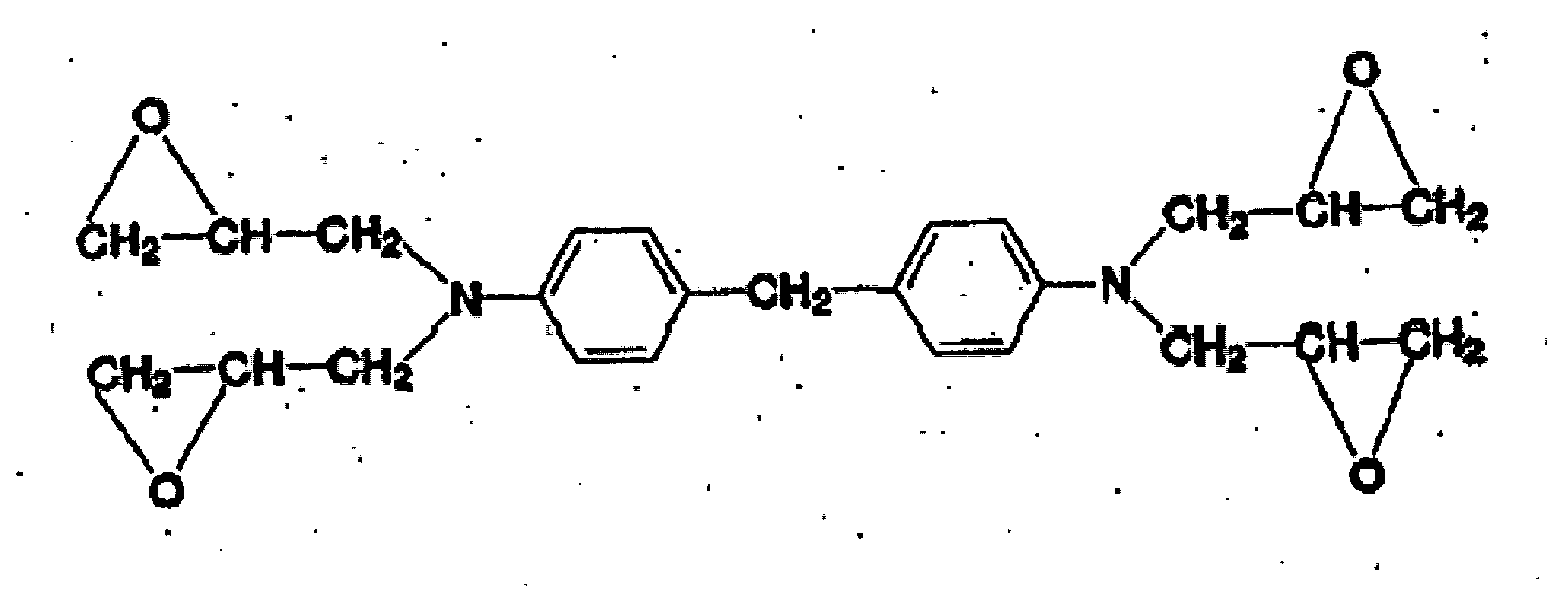 (c) 14 bis 26 Gewichtsprozent von
 (d) 0 bis 8 Gewichtsprozent vonwobei n = 30,5 ist.

- Harzzusammensetzung gemäß Anspruch 1, wobei das Harz umfasst:(a) ungefähr 25 Gewichtsprozent von
 (b) ungefähr 40 Gewichtsprozent von
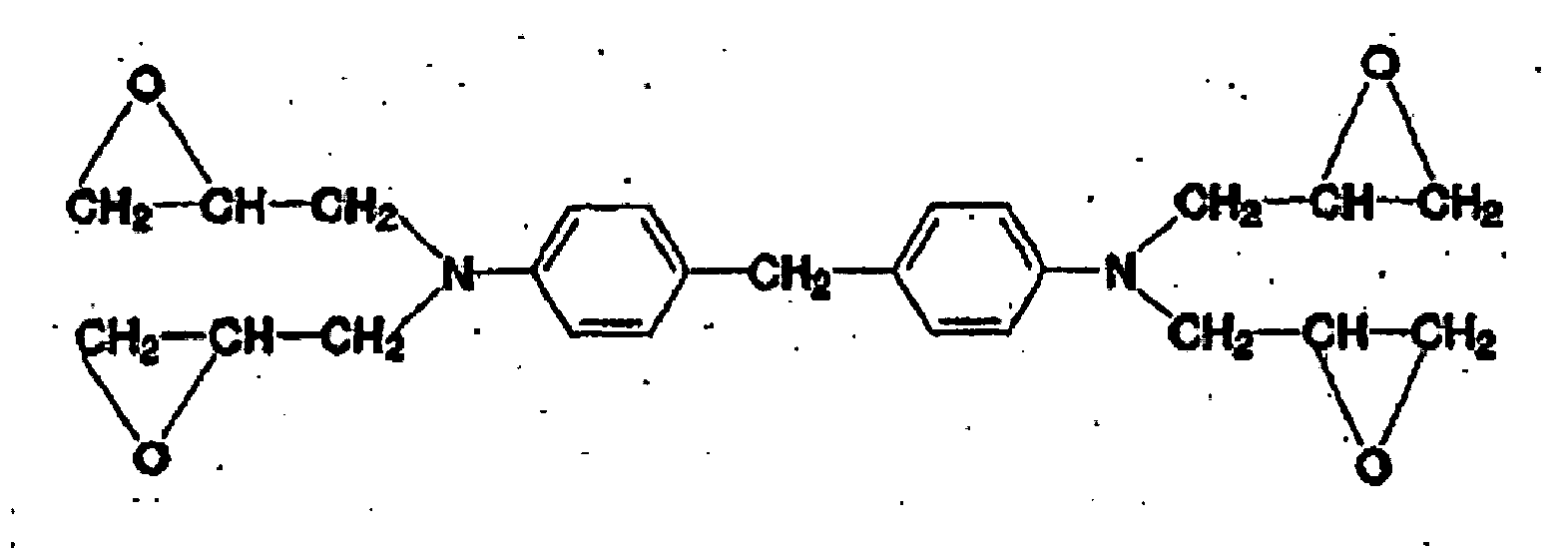 (c) ungefähr 18 Gewichtsprozent von
 (d) ungefähr 8 Gewichtsprozent vonwobei n = 30,5 ist.
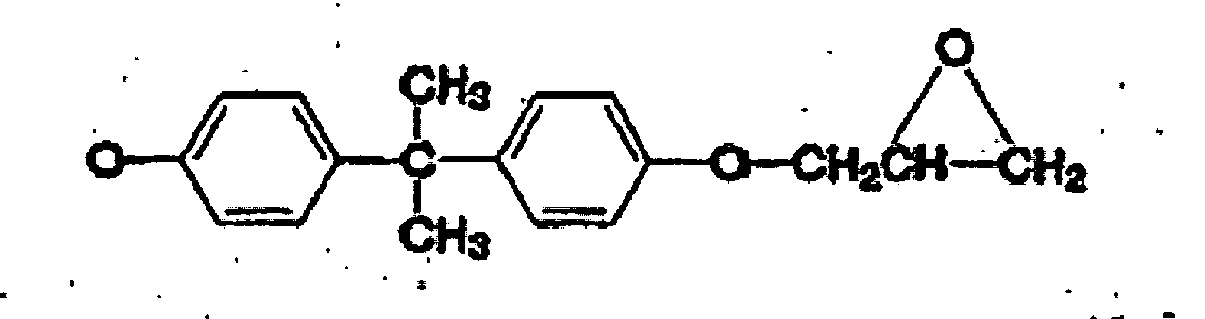
- Harzzusammensetzung gemäß Anspruch 1, wobei das Harz umfasst:(a) ungefähr 24 Gewichtsprozent von
 (b) ungefähr 40 Gewichtsprozent von
 (c) ungefähr 22 Gewichtsprozent von
 (d) ungefähr 4 Gewichtsprozent vonwobei n = 30,5 ist.
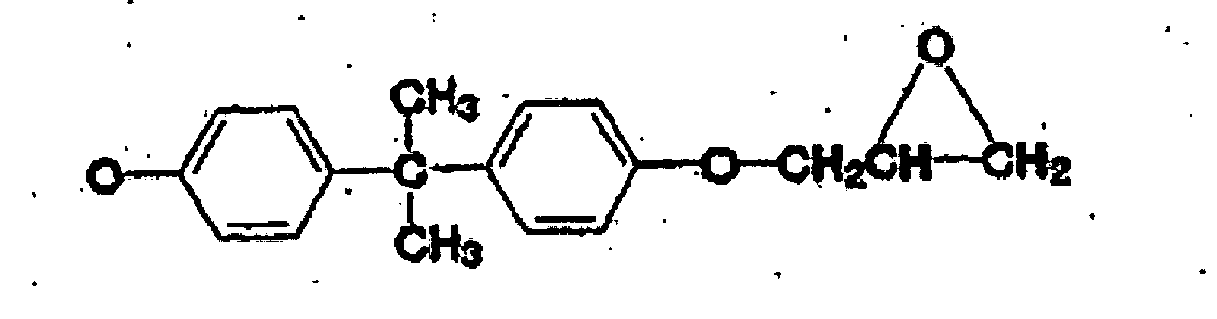
- Harzzusammensetzung gemäß Anspruch 1, wobei die Harzzusammensetzung eine Viskosität von 10 bis 120 Pa·s (100 bis 1200 Poise) bei ungefähr 55°C bis ungefähr 75°C aufweist.
- Harzzusammensetzung gemäß Anspruch 1, ferner 3 bis 5 Gewichtsprozent Dicyandiamid umfassend.
- Harzzusammensetzung gemäß Anspruch 1, ferner 1,5 bis 2,5 Gewichtsprozent von

- Harzzusammensetzung gemäß Anspruch 1, ferner 0,2 bis 0,5 Gewichtsprozent von

- Harzzusammensetzung, die durch das Verfahren hergestellt wird, welches den Schritt des Mischens umfasst von:(a) 20 bis 30 Gewichtsprozent von
 (b) 35 bis 45 Gewichtsprozent von
 (c) 14 bis 26 Gewichtsprozent von
 (d) 0 bis 8 Gewichtsprozent vonwobei n = 30,5 ist.

- Teilweise getränktes Prepreg, eine Faserschicht umfassend, die teilweise mit einer Harzzusammensetzung gemäß einem der vorhergehenden Ansprüche getränkt ist, wobei die Harzzusammensetzung, wenn sie in einer Vakuumhülle erwärmt wird, vollständig in die Faserschicht infundiert wird und aushärtet, um ein blasenfreies Laminat zu bilden.
- Teilweise getränktes Prepreg gemäß Anspruch 9, wobei die Faserschicht von mehreren parallel ausgerichteten Strängen (Tows) gebildet wird, wobei jeder Strang von mehreren unidirektionalen Verstärkungsfasern gebildet wird.
- Teilweise getränktes Prepreg gemäß Anspruch 10, wobei die mehreren unidirektionalen Verstärkungsfasern aus der Gruppe gewählt sind, die aus Glas, Quarz, organischen Stoffen, Kohlenstoff und Graphit besteht.
- Teilweise getränktes Prepreg gemäß Anspruch 9, wobei die Harzzusammensetzung auf einer Seite der Faserschicht teilweise getränkt ist.
- Teilweise getränktes Prepreg gemäß Anspruch 9, wobei die Harzzusammensetzung auf beiden Seiten der Faserschicht teilweise getränkt ist.
- Teilweise getränktes Prepreg gemäß Anspruch 9, wobei die Harzzusammensetzung ein Film, ein Pulver oder eine Flüssigkeit ist.
Applications Claiming Priority (3)
| Application Number | Priority Date | Filing Date | Title |
|---|---|---|---|
| US8614298P | 1998-05-20 | 1998-05-20 | |
| US86142P | 1998-05-20 | ||
| EP99949525A EP1144190B2 (de) | 1998-05-20 | 1999-05-20 | Herstellung von blasenfreien laminaten und deren anwendung |
Related Parent Applications (1)
| Application Number | Title | Priority Date | Filing Date |
|---|---|---|---|
| EP99949525A Division EP1144190B2 (de) | 1998-05-20 | 1999-05-20 | Herstellung von blasenfreien laminaten und deren anwendung |
Publications (3)
| Publication Number | Publication Date |
|---|---|
| EP1408084A2 EP1408084A2 (de) | 2004-04-14 |
| EP1408084A3 EP1408084A3 (de) | 2004-09-22 |
| EP1408084B1 true EP1408084B1 (de) | 2009-10-28 |
Family
ID=22196547
Family Applications (2)
| Application Number | Title | Priority Date | Filing Date |
|---|---|---|---|
| EP03078545A Expired - Lifetime EP1408084B1 (de) | 1998-05-20 | 1999-05-20 | Epoxidharzzusammensetzungen für die Herstellung von blasenfreien Laminaten |
| EP99949525A Expired - Lifetime EP1144190B2 (de) | 1998-05-20 | 1999-05-20 | Herstellung von blasenfreien laminaten und deren anwendung |
Family Applications After (1)
| Application Number | Title | Priority Date | Filing Date |
|---|---|---|---|
| EP99949525A Expired - Lifetime EP1144190B2 (de) | 1998-05-20 | 1999-05-20 | Herstellung von blasenfreien laminaten und deren anwendung |
Country Status (13)
| Country | Link |
|---|---|
| US (1) | US6391436B1 (de) |
| EP (2) | EP1408084B1 (de) |
| JP (1) | JP4477271B2 (de) |
| KR (1) | KR100576767B1 (de) |
| AT (2) | ATE446991T1 (de) |
| AU (1) | AU764214C (de) |
| BR (1) | BR9911042B1 (de) |
| CA (5) | CA2332341C (de) |
| DE (2) | DE69913737T3 (de) |
| ES (2) | ES2213390T5 (de) |
| MX (1) | MXPA00011445A (de) |
| NO (1) | NO325325B1 (de) |
| WO (1) | WO2001000405A2 (de) |
Cited By (1)
| Publication number | Priority date | Publication date | Assignee | Title |
|---|---|---|---|---|
| WO2026022814A1 (en) * | 2024-07-24 | 2026-01-29 | Israel Plastics & Rubber Center (1986) Ltd. | Epoxy compositions and products comprised thereof |
Families Citing this family (89)
| Publication number | Priority date | Publication date | Assignee | Title |
|---|---|---|---|---|
| AU3789801A (en) * | 1999-12-07 | 2001-06-18 | Boeing Company, The | Double bag vacuum infusion process and system for low cost, advanced composite fabrication |
| DE10013409C1 (de) * | 2000-03-17 | 2000-11-23 | Daimler Chrysler Ag | Verfahren und Vorrichtung zur Herstellung von faserverstärkten Bauteilen mittels eines Injektionsverfahrens |
| GB0110316D0 (en) * | 2001-04-27 | 2001-06-20 | Advanced Composites Group Ltd | Improvements in or relating to moulding materials |
| US6676882B2 (en) * | 2001-08-28 | 2004-01-13 | Lockheed Martin Corporation | Methods of hot-melt resin impregnation of 3-D, woven, textile preforms |
| GB0205498D0 (en) | 2002-03-08 | 2002-04-24 | Structural Polymer Systems Ltd | Moulding material |
| US7100656B2 (en) | 2002-04-15 | 2006-09-05 | Northrop Grumman Corporation | System and method for curing composite material |
| ES2527168T3 (es) * | 2002-07-18 | 2015-01-21 | Mitsubishi Rayon Co., Ltd. | Preimpregnado y procedimientos para la producción de materiales compuestos reforzados con fibras |
| WO2004037505A1 (ja) * | 2002-10-23 | 2004-05-06 | Mitsubishi Rayon Co.,Ltd. | プリプレグ及びその製造方法 |
| US20040079474A1 (en) * | 2002-10-24 | 2004-04-29 | Nitto Denko Corporation | Production method of anisotropic conductive connector |
| JP2004330474A (ja) * | 2003-05-01 | 2004-11-25 | Kawasaki Heavy Ind Ltd | 複合材製品の製造方法 |
| US7213629B2 (en) * | 2003-05-14 | 2007-05-08 | The Boeing Company | Vacuum assisted ply placement shoe and method |
| ES2279930T3 (es) * | 2003-10-14 | 2007-09-01 | Saab Ab | Procedimiento de formacion de una estructura compuesta. |
| US20050126699A1 (en) * | 2003-12-15 | 2005-06-16 | Anna Yen | Process for the manufacture of composite structures |
| US20050236736A1 (en) * | 2004-04-23 | 2005-10-27 | Formella Stephen C | Composite product and forming system |
| US20050255311A1 (en) * | 2004-04-23 | 2005-11-17 | Formella Stephen C | Hybrid composite product and system |
| US7153379B2 (en) * | 2004-10-15 | 2006-12-26 | General Electric Company | Methods of producing a ceramic matrix composite |
| US7332049B2 (en) | 2004-12-22 | 2008-02-19 | General Electric Company | Method for fabricating reinforced composite materials |
| DE102005008231A1 (de) * | 2005-02-23 | 2006-08-24 | Hübner GmbH | Elastische Seitenwand zur Abdeckung eines Balges eines Übergangs zwischen zwei gelenkig miteinander verbundenen Fahrzeugen oder Fahrzeugteilen |
| US7766063B2 (en) * | 2005-04-28 | 2010-08-03 | The Boeing Company | Machine assisted laminator and method |
| JP2007098819A (ja) * | 2005-10-06 | 2007-04-19 | Mitsubishi Rayon Co Ltd | サンドイッチパネルの製造方法 |
| JP5144010B2 (ja) * | 2005-10-06 | 2013-02-13 | 三菱レイヨン株式会社 | 繊維強化プラスチックパネルの製造方法 |
| US8066503B2 (en) * | 2005-10-25 | 2011-11-29 | The Boeing Company | Controlled delta pressure bulk resin infusion system |
| US20080044659A1 (en) * | 2005-12-15 | 2008-02-21 | Polystrand, Inc. | Composite laminate and method of manufacture |
| US8043453B2 (en) | 2005-12-23 | 2011-10-25 | The Boeing Company | System and method for reworking composites |
| US20090280324A1 (en) * | 2006-05-22 | 2009-11-12 | Florida State University Research Foundation | Prepreg Nanoscale Fiber Films and Methods |
| DE102006038666B4 (de) * | 2006-08-17 | 2009-09-24 | Airbus Deutschland Gmbh | Herstellungsverfahren für ein Werkstück aus einem Faserverbundwerkstoff und Vorrichtung zum Herstellen eines Werkstücks aus einem Faserverbundwerkstoff |
| EP2051845B1 (de) | 2006-08-17 | 2010-11-03 | Airbus Deutschland GmbH | Herstellungsverfahren für ein aus einem faserverbundwerkstoff bestehendes werkstück und faserverbundkomponente in form eines profils mit einem sich über seine länge verändernden profilquerschnitt |
| JP2009523083A (ja) | 2006-09-06 | 2009-06-18 | ポリストランド インコーポレイティッド | 複合積層板とその製法 |
| US7849729B2 (en) * | 2006-12-22 | 2010-12-14 | The Boeing Company | Leak detection in vacuum bags |
| US20080274343A1 (en) * | 2007-05-01 | 2008-11-06 | The Diller Corporation | Thick solid surface laminate product and method of making same |
| US8568551B2 (en) * | 2007-05-22 | 2013-10-29 | The Boeing Company | Pre-patterned layup kit and method of manufacture |
| US9770871B2 (en) | 2007-05-22 | 2017-09-26 | The Boeing Company | Method and apparatus for layup placement |
| ES2385677T3 (es) | 2007-05-23 | 2012-07-30 | Hexcel Composites, Ltd. | Capa de favorecimiento de la adherencia para conjuntos de material compuesto |
| US9042338B2 (en) | 2007-07-09 | 2015-05-26 | Intel Mobile Communications GmbH | Communication device and method for transmitting data |
| US8029642B2 (en) | 2007-07-27 | 2011-10-04 | The Boeing Company | Tape removal apparatus and process |
| US8936695B2 (en) | 2007-07-28 | 2015-01-20 | The Boeing Company | Method for forming and applying composite layups having complex geometries |
| US8333864B2 (en) * | 2008-09-30 | 2012-12-18 | The Boeing Company | Compaction of prepreg plies on composite laminate structures |
| US8707766B2 (en) | 2010-04-21 | 2014-04-29 | The Boeing Company | Leak detection in vacuum bags |
| US8345269B2 (en) | 2007-09-22 | 2013-01-01 | The Boeing Company | Method and apparatus for measuring the width of composite tape |
| US9302436B2 (en) | 2007-11-26 | 2016-04-05 | Textron Innovations Inc | In-situ, multi-stage debulk, compaction, and single stage curing of thick composite repair laminates |
| CA2705777C (en) | 2007-11-26 | 2014-01-07 | Bell Helicopter Textron Inc. | Multi-stage debulk and compaction of thick composite repair laminates |
| EP2212100B1 (de) * | 2007-11-26 | 2016-02-17 | Bell Helicopter Textron Inc. | In-situ mehrstufiges verkleinern, verdichten und einstufiges aushärten von dicken verbundreparaturlaminaten |
| US8752293B2 (en) | 2007-12-07 | 2014-06-17 | The Boeing Company | Method of fabricating structures using composite modules and structures made thereby |
| US8916010B2 (en) * | 2007-12-07 | 2014-12-23 | The Boeing Company | Composite manufacturing method |
| US7922856B2 (en) | 2008-01-02 | 2011-04-12 | The Boeing Company | Graphite tape supply and backing paper take-up apparatus |
| US8557074B2 (en) | 2008-02-27 | 2013-10-15 | The Boeing Company | Reduced complexity automatic fiber placement apparatus and method |
| US8986482B2 (en) | 2008-07-08 | 2015-03-24 | The Boeing Company | Method and apparatus for producing composite structures |
| ES2395741T3 (es) | 2008-09-30 | 2013-02-14 | Hexcel Composites, Ltd. | Material semi-impregnado con una pelicula de resina de superficie potenciadora y mejoradora de las propiedades del mismo |
| US8696965B2 (en) * | 2008-10-20 | 2014-04-15 | Cytec Technology Corp. | Prepregs with improved processing |
| WO2010048370A1 (en) * | 2008-10-22 | 2010-04-29 | Vec Industries, L.L.C. | Wind turbine blade and method for manufacturing thereof |
| BRPI0919688B1 (pt) * | 2008-10-22 | 2019-04-02 | Cytec Technology Corp. | Método para formar prepregs conformados com componentes voláteis reduzidos |
| US9096734B2 (en) | 2009-01-23 | 2015-08-04 | Hexcel Corporation | Prepreg with integrated multi-dimensional gas venting network |
| US8308101B2 (en) | 2009-03-09 | 2012-11-13 | The Boeing Company | Simplified fiber tensioning for automated fiber placement machines |
| US8454788B2 (en) | 2009-03-13 | 2013-06-04 | The Boeing Company | Method and apparatus for placing short courses of composite tape |
| WO2011037239A1 (ja) | 2009-09-28 | 2011-03-31 | 三菱レイヨン株式会社 | 繊維強化複合材料 |
| JP5473585B2 (ja) * | 2009-12-24 | 2014-04-16 | 三菱レイヨン株式会社 | エポキシ樹脂組成物 |
| GB201009851D0 (en) * | 2010-06-14 | 2010-07-21 | Hexcel Composites Ltd | Improvements in composite materials |
| US9957387B2 (en) | 2010-11-08 | 2018-05-01 | Toray Industries, Inc. | Epoxy resin composition for fiber reinforced composite material, prepreg, and fiber reinforced composite material |
| US8551380B2 (en) | 2010-11-12 | 2013-10-08 | The Boeing Company | Method of laying up prepreg plies on contoured tools using a deformable carrier film |
| US9387657B2 (en) | 2010-11-12 | 2016-07-12 | The Boeing Company | Method of fabricating a curved composite structure using composite prepreg tape |
| US9701067B2 (en) | 2010-11-12 | 2017-07-11 | The Boeing Company | Method of laying up prepreg plies on contoured tools using a deformable carrier film |
| KR101951058B1 (ko) | 2011-03-30 | 2019-02-21 | 도레이 카부시키가이샤 | 프리프레그, 섬유 강화 복합 재료 및 섬유 강화 복합 재료의 제조 방법 |
| WO2012149379A2 (en) | 2011-04-28 | 2012-11-01 | Zin Technologies, Inc. | Bonded and stitched composite structure |
| US20120328811A1 (en) * | 2011-06-24 | 2012-12-27 | Air Products And Chemicals, Inc. | Epoxy Resin Compositions |
| DE102011079947A1 (de) * | 2011-07-27 | 2013-01-31 | Airbus Operations Gmbh | Vorrichtung zur Herstellung eines Klebebauteils mit Faserverbundkunststoffen sowie Verfahren |
| EP2794735B1 (de) * | 2011-12-22 | 2019-07-17 | Hexcel Holding GmbH | Verbesserungen an oder im zusammenhang mit verstärkten verbundwerkstoffen |
| ITMI20120244A1 (it) * | 2012-02-20 | 2013-08-21 | Automobili Lamborghini Spa | Tessuto in fibra di carbonio e processo per la sua fabbricazione |
| EP2676780B1 (de) | 2012-06-18 | 2017-08-02 | Technische Universität Dresden | Verfahren zur Herstellung eines schichtförmigen Halbzeuges |
| KR101574833B1 (ko) * | 2012-10-04 | 2015-12-07 | (주)엘지하우시스 | 복합재료의 함침성 향상을 위한 기능성 필름 및 이를 이용한 복합재료의 제조방법 |
| US9056429B2 (en) * | 2012-10-31 | 2015-06-16 | The Boeing Company | Exposing fibers in composite laminates |
| JP6300326B2 (ja) * | 2012-12-21 | 2018-03-28 | サイテク・インダストリーズ・インコーポレーテツド | 表面開口部のある硬化性プリプレグ |
| BR112015020629A2 (pt) * | 2013-02-26 | 2017-07-18 | Hexcel Holding Gmbh | fabricação de uma peça moldada |
| US9323149B2 (en) * | 2013-03-05 | 2016-04-26 | Irresistible Materials Ltd | Methanofullerenes |
| US9427943B2 (en) * | 2013-03-15 | 2016-08-30 | Henkel IP & Holding GmbH | Prepreg curing process for preparing composites having superior surface finish and high fiber consolidation |
| US9205633B2 (en) * | 2013-03-15 | 2015-12-08 | Henkel IP & Holding GmbH | Prepreg curing process for preparing composites having superior surface finish and high fiber consolidation |
| GB201313420D0 (en) * | 2013-07-26 | 2013-09-11 | Hexcel Composites Ltd | Improvements in or relating to fibre reinforced composites |
| EP2868452B1 (de) * | 2013-10-29 | 2018-12-05 | Airbus Operations GmbH | System und Verfahren zur Herstellung von Verbundkomponenten |
| EP3063592B1 (de) | 2013-10-30 | 2021-04-07 | California Institute of Technology | Direkte fotostrukturierung von robusten und unterschiedlichen materialien |
| US20170021596A1 (en) * | 2015-05-05 | 2017-01-26 | Sunrez Corp. | Fiber Reinforced Core |
| US20160333517A1 (en) * | 2015-05-14 | 2016-11-17 | Johns Manville | Flexible thermoplastic prepregs |
| CN108137839B (zh) | 2015-12-16 | 2021-07-06 | 东丽株式会社 | 预浸料坯、层压体、纤维增强复合材料、及纤维增强复合材料的制造方法 |
| DE102017205792A1 (de) * | 2017-04-05 | 2018-10-11 | Premium Aerotec Gmbh | Halbzeug, Verfahren und Konsolidierungswerkzeug zur Herstellung eines thermoplastischen Faserverbundbauteils |
| RU2655805C1 (ru) * | 2017-08-31 | 2018-05-29 | Акционерное общество "Препрег-Современные Композиционные Материалы" (АО "Препрег-СКМ") | Эпоксидное связующее, препрег на его основе и изделие, выполненное из него |
| EP3746500B1 (de) | 2018-01-31 | 2026-04-15 | Toray Industries, Inc. | Zur herstellung von hohlraumarmen faserverstärkten verbundstoffmaterialien nützliche prepreg-folien und prepreg-stapel |
| US11305498B2 (en) | 2018-12-21 | 2022-04-19 | The Boeing Company | System and method for fabricating a composite ply layup |
| EP3898207B1 (de) * | 2018-12-21 | 2023-02-22 | Cytec Industries, Inc. | Automatische platzierung von prepreg-bändern zur herstellung von verbundteilen |
| US11318689B2 (en) | 2018-12-21 | 2022-05-03 | The Boeing Company | Ply transporting and compacting apparatus and method therefor |
| WO2022113976A1 (ja) * | 2020-11-27 | 2022-06-02 | 東レ株式会社 | プリプレグおよびプリプレグの製造方法 |
| US20220314559A1 (en) * | 2021-03-31 | 2022-10-06 | Chris Durham | Rv and trailer composite panel manufacturing process with interlocking connections assembly system |
Family Cites Families (31)
| Publication number | Priority date | Publication date | Assignee | Title |
|---|---|---|---|---|
| JPS6021057B2 (ja) * | 1976-07-22 | 1985-05-25 | 三菱レイヨン株式会社 | 複合材料の成形方法 |
| US4065340A (en) * | 1977-04-28 | 1977-12-27 | The United States Of America As Represented By The National Aeronautics And Space Administration | Composite lamination method |
| JPS5945422B2 (ja) * | 1978-12-05 | 1984-11-06 | 日東化学工業株式会社 | アンチモン含有酸化物触媒の再生方法 |
| US4357193A (en) * | 1979-05-21 | 1982-11-02 | Rockwell International Corporation | Method of fabricating a composite structure |
| US4311661A (en) * | 1980-05-05 | 1982-01-19 | Mcdonnell Douglas Corporation | Resin impregnation process |
| JPS6047290B2 (ja) * | 1982-01-16 | 1985-10-21 | 東邦レーヨン株式会社 | プリプレグ製造法 |
| GB2124130B (en) * | 1982-07-24 | 1985-11-27 | Rolls Royce | Vacuum moulding fibre reinforced resin |
| JPS6058422A (ja) * | 1983-09-08 | 1985-04-04 | Toray Ind Inc | 炭素繊維強化用エポキシ樹脂組成物 |
| US4622091A (en) * | 1984-11-29 | 1986-11-11 | The Boeing Company | Resin film infusion process and apparatus |
| US4652319A (en) | 1984-12-03 | 1987-03-24 | Hammond Russell E | Method of curing patches on contoured surfaces |
| JPS61168621A (ja) * | 1985-01-21 | 1986-07-30 | Yokohama Rubber Co Ltd:The | エポキシ樹脂組成物 |
| JPS621721A (ja) * | 1985-06-28 | 1987-01-07 | Nippon Oil Co Ltd | エポキシ樹脂組成物 |
| US5123985A (en) | 1986-09-02 | 1992-06-23 | Patricia Evans | Vacuum bagging apparatus and method including a thermoplastic elastomer film vacuum bag |
| US4915896A (en) * | 1987-09-01 | 1990-04-10 | Phillips Petroleum Company | Vacuum bagging process for fiber reinforced thermoplastics |
| JPH01254730A (ja) * | 1988-04-04 | 1989-10-11 | Nippon Oil Co Ltd | プリプレグ用エポキシ樹脂組成物、プリプレグ及び複合材料 |
| US5037599A (en) * | 1989-06-26 | 1991-08-06 | Basf Aktiengesellschaft | Single diaphragm forming of drapeable thermoplastic impregnated composite materials |
| JPH0362821A (ja) * | 1989-07-31 | 1991-03-18 | Tonen Corp | エポキシ樹脂組成物 |
| JPH0662737B2 (ja) * | 1989-10-31 | 1994-08-17 | 東燃株式会社 | エポキシ樹脂組成物 |
| GB8927734D0 (en) | 1989-12-07 | 1990-02-07 | Short Brothers Plc | A composite material |
| JPH03205420A (ja) * | 1990-01-08 | 1991-09-06 | Mitsubishi Kasei Corp | 繊維強化プラスチック用エポキシ樹脂組成物 |
| US5080851A (en) | 1990-09-06 | 1992-01-14 | United Technologies Corporation | Method for stabilizing complex composite preforms |
| JP2510093B2 (ja) * | 1990-12-28 | 1996-06-26 | 東邦レーヨン株式会社 | プリプレグ及び成形物 |
| JP2705319B2 (ja) | 1991-01-28 | 1998-01-28 | 日本電気株式会社 | 炭素繊維強化複合材料の作製方法 |
| JPH04251714A (ja) | 1991-01-28 | 1992-09-08 | Nec Corp | 炭素繊維強化複合材料の作製方法 |
| GB9216186D0 (en) | 1992-07-30 | 1992-09-09 | Ciba Geigy Ag | Product and production method |
| JPH0770406A (ja) * | 1993-08-31 | 1995-03-14 | Tonen Corp | 低温硬化型プリプレグ用エポキシ樹脂組成物及びそれを用いたプリプレグ |
| JPH07227939A (ja) * | 1994-02-16 | 1995-08-29 | Toray Ind Inc | ハニカムコキュア成形方法 |
| JPH09157498A (ja) * | 1995-12-12 | 1997-06-17 | Toray Ind Inc | 繊維強化複合材料用エポキシ樹脂組成物、プリプレグ及び繊維強化複合材料 |
| JPH09278914A (ja) * | 1996-02-13 | 1997-10-28 | Toray Ind Inc | プリプレグおよび炭素繊維強化プラスチック |
| JP3807808B2 (ja) * | 1996-03-29 | 2006-08-09 | ソマール株式会社 | コイル固着用一液性エポキシ樹脂組成物 |
| US6139942A (en) * | 1997-02-06 | 2000-10-31 | Cytec Technology, Inc. | Resin composition, a fiber reinforced material having a partially impregnated resin and composites made therefrom |
-
1999
- 1999-05-20 EP EP03078545A patent/EP1408084B1/de not_active Expired - Lifetime
- 1999-05-20 WO PCT/US1999/011333 patent/WO2001000405A2/en not_active Ceased
- 1999-05-20 JP JP2001506093A patent/JP4477271B2/ja not_active Expired - Lifetime
- 1999-05-20 CA CA002332341A patent/CA2332341C/en not_active Expired - Lifetime
- 1999-05-20 BR BRPI9911042-3A patent/BR9911042B1/pt not_active IP Right Cessation
- 1999-05-20 CA CA002511569A patent/CA2511569C/en not_active Expired - Lifetime
- 1999-05-20 AU AU62376/99A patent/AU764214C/en not_active Expired
- 1999-05-20 US US09/315,064 patent/US6391436B1/en not_active Expired - Lifetime
- 1999-05-20 CA CA002511566A patent/CA2511566C/en not_active Expired - Lifetime
- 1999-05-20 DE DE69913737T patent/DE69913737T3/de not_active Expired - Lifetime
- 1999-05-20 AT AT03078545T patent/ATE446991T1/de active
- 1999-05-20 DE DE69941609T patent/DE69941609D1/de not_active Expired - Lifetime
- 1999-05-20 ES ES99949525T patent/ES2213390T5/es not_active Expired - Lifetime
- 1999-05-20 MX MXPA00011445A patent/MXPA00011445A/es not_active IP Right Cessation
- 1999-05-20 ES ES03078545T patent/ES2334020T3/es not_active Expired - Lifetime
- 1999-05-20 CA CA002511567A patent/CA2511567C/en not_active Expired - Lifetime
- 1999-05-20 KR KR1020007012992A patent/KR100576767B1/ko not_active Expired - Lifetime
- 1999-05-20 CA CA002511571A patent/CA2511571C/en not_active Expired - Lifetime
- 1999-05-20 AT AT99949525T patent/ATE256550T1/de active
- 1999-05-20 EP EP99949525A patent/EP1144190B2/de not_active Expired - Lifetime
-
2000
- 2000-11-17 NO NO20005808A patent/NO325325B1/no not_active IP Right Cessation
Cited By (1)
| Publication number | Priority date | Publication date | Assignee | Title |
|---|---|---|---|---|
| WO2026022814A1 (en) * | 2024-07-24 | 2026-01-29 | Israel Plastics & Rubber Center (1986) Ltd. | Epoxy compositions and products comprised thereof |
Also Published As
Similar Documents
| Publication | Publication Date | Title |
|---|---|---|
| EP1408084B1 (de) | Epoxidharzzusammensetzungen für die Herstellung von blasenfreien Laminaten | |
| EP2794272B1 (de) | Prepreg, faserverstärktes verbundmaterial und herstellungsverfahren für das faserverstärkte verbundmaterial | |
| US11028244B2 (en) | Prepreg, laminate body, fiber reinforced composite material, and manufacturing method for fiber reinforced composite material | |
| EP2794735B1 (de) | Verbesserungen an oder im zusammenhang mit verstärkten verbundwerkstoffen | |
| EP2558266B1 (de) | Verfahren zur herstellung von verbundstoffen mit hervorragender oberflächenbearbeitung und hoher faserkonsolidierung | |
| EP1522549B1 (de) | Hitzehärtbare Härze | |
| GB2409837A (en) | Fibre reinforced resin assembly | |
| KR101884606B1 (ko) | 고내충격성고강도 특성을 갖는 복합재료용 에폭시 수지 조성물 | |
| JP2010059300A (ja) | 炭素繊維強化複合材料およびその製造方法 | |
| JP4480854B2 (ja) | プリプレグ及びその製造方法 |
Legal Events
| Date | Code | Title | Description |
|---|---|---|---|
| PUAI | Public reference made under article 153(3) epc to a published international application that has entered the european phase |
Free format text: ORIGINAL CODE: 0009012 |
|
| AC | Divisional application: reference to earlier application |
Ref document number: 1144190 Country of ref document: EP Kind code of ref document: P |
|
| AK | Designated contracting states |
Kind code of ref document: A2 Designated state(s): AT BE CH CY DE DK ES FI FR GB GR IE IT LI LU MC NL PT SE |
|
| RIN1 | Information on inventor provided before grant (corrected) |
Inventor name: BOYD, JACK Inventor name: REPECKA, LINAS Inventor name: MORTIMER, STEVE Inventor name: XU, GUO FENG Inventor name: PEAKE, STEVE |
|
| PUAL | Search report despatched |
Free format text: ORIGINAL CODE: 0009013 |
|
| AK | Designated contracting states |
Kind code of ref document: A3 Designated state(s): AT BE CH CY DE DK ES FI FR GB GR IE IT LI LU MC NL PT SE |
|
| 17P | Request for examination filed |
Effective date: 20050302 |
|
| RAP1 | Party data changed (applicant data changed or rights of an application transferred) |
Owner name: CYTEC TECHNOLOGY CORPORATION |
|
| AKX | Designation fees paid |
Designated state(s): AT BE CH CY DE DK ES FI FR GB GR IE IT LI LU MC NL PT SE |
|
| 17Q | First examination report despatched |
Effective date: 20061115 |
|
| GRAP | Despatch of communication of intention to grant a patent |
Free format text: ORIGINAL CODE: EPIDOSNIGR1 |
|
| GRAS | Grant fee paid |
Free format text: ORIGINAL CODE: EPIDOSNIGR3 |
|
| GRAA | (expected) grant |
Free format text: ORIGINAL CODE: 0009210 |
|
| AC | Divisional application: reference to earlier application |
Ref document number: 1144190 Country of ref document: EP Kind code of ref document: P |
|
| AK | Designated contracting states |
Kind code of ref document: B1 Designated state(s): AT BE CH CY DE DK ES FI FR GB GR IE IT LI LU MC NL PT SE |
|
| REG | Reference to a national code |
Ref country code: GB Ref legal event code: FG4D |
|
| REG | Reference to a national code |
Ref country code: CH Ref legal event code: EP Ref country code: CH Ref legal event code: NV Representative=s name: BOHEST AG |
|
| REG | Reference to a national code |
Ref country code: IE Ref legal event code: FG4D |
|
| REF | Corresponds to: |
Ref document number: 69941609 Country of ref document: DE Date of ref document: 20091210 Kind code of ref document: P |
|
| REG | Reference to a national code |
Ref country code: SE Ref legal event code: TRGR |
|
| REG | Reference to a national code |
Ref country code: CH Ref legal event code: NV Representative=s name: SERVOPATENT GMBH |
|
| REG | Reference to a national code |
Ref country code: ES Ref legal event code: FG2A Ref document number: 2334020 Country of ref document: ES Kind code of ref document: T3 |
|
| PG25 | Lapsed in a contracting state [announced via postgrant information from national office to epo] |
Ref country code: PT Free format text: LAPSE BECAUSE OF FAILURE TO SUBMIT A TRANSLATION OF THE DESCRIPTION OR TO PAY THE FEE WITHIN THE PRESCRIBED TIME-LIMIT Effective date: 20100301 Ref country code: FI Free format text: LAPSE BECAUSE OF FAILURE TO SUBMIT A TRANSLATION OF THE DESCRIPTION OR TO PAY THE FEE WITHIN THE PRESCRIBED TIME-LIMIT Effective date: 20091028 |
|
| PG25 | Lapsed in a contracting state [announced via postgrant information from national office to epo] |
Ref country code: CY Free format text: LAPSE BECAUSE OF FAILURE TO SUBMIT A TRANSLATION OF THE DESCRIPTION OR TO PAY THE FEE WITHIN THE PRESCRIBED TIME-LIMIT Effective date: 20091028 |
|
| PG25 | Lapsed in a contracting state [announced via postgrant information from national office to epo] |
Ref country code: BE Free format text: LAPSE BECAUSE OF FAILURE TO SUBMIT A TRANSLATION OF THE DESCRIPTION OR TO PAY THE FEE WITHIN THE PRESCRIBED TIME-LIMIT Effective date: 20091028 |
|
| PG25 | Lapsed in a contracting state [announced via postgrant information from national office to epo] |
Ref country code: DK Free format text: LAPSE BECAUSE OF FAILURE TO SUBMIT A TRANSLATION OF THE DESCRIPTION OR TO PAY THE FEE WITHIN THE PRESCRIBED TIME-LIMIT Effective date: 20091028 |
|
| PLBE | No opposition filed within time limit |
Free format text: ORIGINAL CODE: 0009261 |
|
| STAA | Information on the status of an ep patent application or granted ep patent |
Free format text: STATUS: NO OPPOSITION FILED WITHIN TIME LIMIT |
|
| 26N | No opposition filed |
Effective date: 20100729 |
|
| PG25 | Lapsed in a contracting state [announced via postgrant information from national office to epo] |
Ref country code: GR Free format text: LAPSE BECAUSE OF FAILURE TO SUBMIT A TRANSLATION OF THE DESCRIPTION OR TO PAY THE FEE WITHIN THE PRESCRIBED TIME-LIMIT Effective date: 20100129 |
|
| PG25 | Lapsed in a contracting state [announced via postgrant information from national office to epo] |
Ref country code: MC Free format text: LAPSE BECAUSE OF NON-PAYMENT OF DUE FEES Effective date: 20100531 |
|
| PG25 | Lapsed in a contracting state [announced via postgrant information from national office to epo] |
Ref country code: IE Free format text: LAPSE BECAUSE OF NON-PAYMENT OF DUE FEES Effective date: 20100520 |
|
| PG25 | Lapsed in a contracting state [announced via postgrant information from national office to epo] |
Ref country code: LU Free format text: LAPSE BECAUSE OF NON-PAYMENT OF DUE FEES Effective date: 20100520 |
|
| REG | Reference to a national code |
Ref country code: FR Ref legal event code: PLFP Year of fee payment: 18 |
|
| REG | Reference to a national code |
Ref country code: FR Ref legal event code: PLFP Year of fee payment: 19 |
|
| REG | Reference to a national code |
Ref country code: FR Ref legal event code: PLFP Year of fee payment: 20 |
|
| PGFP | Annual fee paid to national office [announced via postgrant information from national office to epo] |
Ref country code: CH Payment date: 20180516 Year of fee payment: 20 Ref country code: ES Payment date: 20180604 Year of fee payment: 20 Ref country code: DE Payment date: 20180508 Year of fee payment: 20 |
|
| PGFP | Annual fee paid to national office [announced via postgrant information from national office to epo] |
Ref country code: IT Payment date: 20180522 Year of fee payment: 20 Ref country code: NL Payment date: 20180514 Year of fee payment: 20 Ref country code: AT Payment date: 20180426 Year of fee payment: 20 Ref country code: FR Payment date: 20180411 Year of fee payment: 20 |
|
| PGFP | Annual fee paid to national office [announced via postgrant information from national office to epo] |
Ref country code: SE Payment date: 20180511 Year of fee payment: 20 |
|
| PGFP | Annual fee paid to national office [announced via postgrant information from national office to epo] |
Ref country code: GB Payment date: 20180516 Year of fee payment: 20 |
|
| REG | Reference to a national code |
Ref country code: DE Ref legal event code: R071 Ref document number: 69941609 Country of ref document: DE |
|
| REG | Reference to a national code |
Ref country code: NL Ref legal event code: MK Effective date: 20190519 |
|
| REG | Reference to a national code |
Ref country code: CH Ref legal event code: PL |
|
| REG | Reference to a national code |
Ref country code: GB Ref legal event code: PE20 Expiry date: 20190519 |
|
| REG | Reference to a national code |
Ref country code: SE Ref legal event code: EUG |
|
| REG | Reference to a national code |
Ref country code: AT Ref legal event code: MK07 Ref document number: 446991 Country of ref document: AT Kind code of ref document: T Effective date: 20190520 |
|
| PG25 | Lapsed in a contracting state [announced via postgrant information from national office to epo] |
Ref country code: GB Free format text: LAPSE BECAUSE OF EXPIRATION OF PROTECTION Effective date: 20190519 |
|
| REG | Reference to a national code |
Ref country code: ES Ref legal event code: FD2A Effective date: 20200721 |
|
| PG25 | Lapsed in a contracting state [announced via postgrant information from national office to epo] |
Ref country code: ES Free format text: LAPSE BECAUSE OF EXPIRATION OF PROTECTION Effective date: 20190521 |