EP1522595A2 - Oligonucléotides, méthodes et système pour détecter par real-time PCR des gènes bactériens de résistance aux antibiotiques - Google Patents
Oligonucléotides, méthodes et système pour détecter par real-time PCR des gènes bactériens de résistance aux antibiotiques Download PDFInfo
- Publication number
- EP1522595A2 EP1522595A2 EP04017805A EP04017805A EP1522595A2 EP 1522595 A2 EP1522595 A2 EP 1522595A2 EP 04017805 A EP04017805 A EP 04017805A EP 04017805 A EP04017805 A EP 04017805A EP 1522595 A2 EP1522595 A2 EP 1522595A2
- Authority
- EP
- European Patent Office
- Prior art keywords
- nucleotide sequence
- primer
- seq
- dye
- pcr
- Prior art date
- Legal status (The legal status is an assumption and is not a legal conclusion. Google has not performed a legal analysis and makes no representation as to the accuracy of the status listed.)
- Withdrawn
Links
Images

Classifications
-
- C—CHEMISTRY; METALLURGY
- C12—BIOCHEMISTRY; BEER; SPIRITS; WINE; VINEGAR; MICROBIOLOGY; ENZYMOLOGY; MUTATION OR GENETIC ENGINEERING
- C12Q—MEASURING OR TESTING PROCESSES INVOLVING ENZYMES, NUCLEIC ACIDS OR MICROORGANISMS; COMPOSITIONS OR TEST PAPERS THEREFOR; PROCESSES OF PREPARING SUCH COMPOSITIONS; CONDITION-RESPONSIVE CONTROL IN MICROBIOLOGICAL OR ENZYMOLOGICAL PROCESSES
- C12Q1/00—Measuring or testing processes involving enzymes, nucleic acids or microorganisms; Compositions therefor; Processes of preparing such compositions
- C12Q1/68—Measuring or testing processes involving enzymes, nucleic acids or microorganisms; Compositions therefor; Processes of preparing such compositions involving nucleic acids
- C12Q1/6876—Nucleic acid products used in the analysis of nucleic acids, e.g. primers or probes
- C12Q1/6888—Nucleic acid products used in the analysis of nucleic acids, e.g. primers or probes for detection or identification of organisms
- C12Q1/689—Nucleic acid products used in the analysis of nucleic acids, e.g. primers or probes for detection or identification of organisms for bacteria
Definitions
- the invention relates to novel oligonucleotides and methods and systems for Detection of antibiotic resistance-mediating genes in microorganisms by means of real-time PCR using the new oligonucleotides.
- Antibiotics play a role in the environmental impact of xenobiotics increasing role. Too frequent and possibly incorrect application as Therapeutic, but also in feed for growth promotion of beef cattle Antibiotics are increasingly introduced into the environment by humans. she can do a variety of pathways from anthropogenic sources in enter the environment and cause an enrichment of antibiotic-resistant Bacteria. Especially bacteria with multiple resistances can then contribute Infections of humans and animals are difficult to combat. Even highly effective Antibiotics, therefore, today only as reserve antibiotics, d. H. when everyone fails Others can be used, lose their effect through resistance.
- PCR polymerase chain reaction
- the derived real-time PCR allows the analysis (Quantification) of the amplification by detection of a fluorescence of one Dye which either directly or indirectly amplified with the amplification DNA is associated (see review in Journal of Molecular Endocrinology 2000 Vol 25, Pp. 169-193).
- the primers used there and the probe for the mecA gene are not suitable for use on biochips, since the primers used are non-multiplexable, ie they are too long to achieve a fast and uniform kinetics. Further, only primers and a probe for the mecA gene are disclosed. Other antibiotic resistance genes, corresponding primers or probes are not mentioned and are not used together.
- Object of the present invention is to provide safe and fast systems for Detection and quantification of clinically relevant antibiotic-resistant bacteria to provide in the environment by means of molecular biological detection systems, the in particular biochip technology and are also species-specific.
- novel oligonucleotides have been comprised of a nucleotide sequence selected from the group of sequences consisting of SEQ # 1-8 found that are suitable as primers for PCR, in particular real-time PCR.
- new oligonucleotides comprising a nucleotide sequence were selected from the group of sequences consisting of SEQ ID NO: 9-12 found themselves are suitable as probes for real-time PCR.
- the primer nucleotide sequences were so selected with them antibiotic- and species-specific tests for the detection of Antibiotic resistance-mediating genes in microorganisms and total DNA bacterial populations using real-time PCR.
- the primer pairs of the antibiotic detection systems are in their length matched to facilitate a PCR in a multiplexed approach, d. H. with the inventive method and the primer nucleotide sequences used therein as well as the probes described below it is possible at the same time, ie in a "pot" on several antibiotic resistance-mediating genes to investigate.
- the first primer nucleotide sequences (A) selected from the group of sequences consisting of SEQ # 1-5 are the forward primers.
- the second primer nucleotide sequences (B) selected from the group of sequences consisting of the SEQ # 6 - 10 are selected, the corresponding reverse Primers, wherein sequences 1 and 6, 2 and 7, 3 and 8, 4 and 9, 5 and 10 as Primer pairs are used. The exact sequences are shown in FIG.
- microorganisms of the genera Pseudomonas, Enterobacteriaceae, Staphylococcus and Enterococcus are particularly preferred for studies of the influence of man on his environment, as they occur especially in aqueous environmental samples. Optionally, these can be pathogenic. Of these, particular preference is given to Pseudomonas aeruginosa , Enterobacter cloacae , Staphylococcus aureus and Enterococcus faecium .
- Some of these microorganisms serve as indicator bacteria fecal Contamination or indicate improper technical treatment processes, z. B. in the drinking water technology out.
- vancomycin-resistant enterococci have been detected in meat, chicken feces, sewage and even surface water.
- the van A gene as a dominant resistance factor in enterococci encodes a ligase capable of altering cell wall properties and thus altering the affinity for vancomycin.
- Pseudomonas aeruginosa may be pathogenic and often associated with nosocomial infections.
- species that carry a bla VIM gene show resistance to ⁇ -lactamase-stable antibiotics such as imipenem.
- Pseudomonas aeruginosa is also present in the environment and has even been found in drinking water.
- bla VIM imine resistance-conferring gene bla VIM
- 18 imipenem-resistant Pseudomonas aeruginosa strains were isolated from different defense probe surfaces. Sequencing of the bla VIM gene showed that only the gene bla VIM -2 was present. Therefore, primer and probe were designed for specific detection of bla VIM- 2.
- the resistance genes bla VIM are encoded on plasmids. Except for Pseudomonas aeruginosa , these genes were also found on plasmids of other bacteria. Compared to genomic localized genes, the genes on plasmids are subject to other propagation mechanisms. DNA can be exchanged between bacteria of the same species and different species (horizontal gene transfer). For example, resistance genes coupled with other plasmid-bound genes may be extremely positive for the survival of the bacterium, while the lack of selection pressure by the antibiotic may adversely affect the persistence of the resistance gene in the cell. It is known that in the absence of selection pressure bacteria can eject the corresponding plasmids from the cell. The gene bla VIM can therefore serve as an indicator of the spread of resistance genes that are located on such mobile genetic elements.
- the enterobacterial gene ampC is a frequently inducible chromosomally encoded resistance gene for the synthesis of a ⁇ -lactamase capable of hydrolyzing penicillin G, ceftazidime and other broad spectrum cephalosporins. Enterobacter cloacae with the amp C resistance gene occur in faeces and sewage.
- Staphylococci are opportunistic bacteria and often occur in nocosomal infections. Almost 50 percent of all infections that occur during intensive care can be attributed to Staphylococcus aureus or coagulase negative staphylococci (CNS). Since the use of the antibiotic methicillin, the incidence of resistant Staphylococcus aureus and CNS has greatly increased, carrying the mecA gene, which is essential for methicillin resistance.
- antibiotics imipenem, ampicillin, methicillin, vancomycin are therefore Of interest, because bacteria with related drug resistance from the clinical Relevance and good indicators of the burden of aquatic systems with antibiotic-resistant bacteria.
- the antibiotic resistance-mediating genes from the group consisting of bla VIM , ampC, mec A and van A are responsible for the resistance in the corresponding microorganisms, also of particular interest and objectives of the method according to the invention.
- PCR-derived real-time PCR allows analysis (Quantification) of the amplification by detection of a fluorescence of one Dye which either directly or indirectly amplified with the amplification DNA is associated.
- a direct method uses a dye that is nonspecific double-stranded DNA binds and fluoresces only at this binding. In the Amplification of the target DNA during real-time PCR binds to this dye the newly formed double-stranded DNA so that the measurable fluorescence increases.
- FRET fluorescence resonance energy transfer Probes
- a FRET probe is a short oligonucleotide complementary to one of the target genome sequence strands is.
- the probe comprises two fluorescent dyes, a "reporter” at the 5 'and a "quencher” at the 3' end of the probe.
- the dyes are in the unbound state by a loop arrangement (Hairpin Loop) kept in close proximity.
- the loop arrangement is through generated complementary sequences at the ends of the actual probe sequence.
- the Quencher Dye is able to, because of its proximity to the reporter, its fluorescence through the FRET to "quench” d. H. extinguish.
- Probe also called “Beacon”
- Beacon is used in the real-time PCR reaction along with the forward and reverse PCR primer used. Binding of the probe to the amplified by the PCR target DNA sequence complementary to the Probe sequence breaks the loop arrangement and thereby separates the both dyes, thereby canceling the FRET interference and fluorescence the reporter dye is measurable.
- a variation of these "Scorpions” consists in the separation of the dyes into two different oligonucleotides, whereby the signal intensity is improved.
- the loop configuration is so replaced by two complementary strands, the quencher dye now not more at the 3 'end of the probe sequence, but on its own Strand at its 3 'end, which is opposite to the 5' end of the probe.
- the quencher dye now not more at the 3 'end of the probe sequence, but on its own Strand at its 3 'end, which is opposite to the 5' end of the probe.
- the primers according to the invention thus serve to detect a antibiotic-specific nucleotide sequence from the genes to be detected.
- the Dyes or the probes with dyes in turn mark the amplified ones Antibiotic resistance-mediating gene sequences for detection via fluorescence measurements.
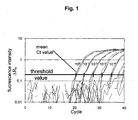
- a threshold value is set, where the fluorescence signal of the reporter dye is well above that Background signal is and the amplification of the target DNA among non-limiting Conditions expire (linear range). From the intersection of the line of Threshold and the amplification curve yields a certain value, the one Represents the amount of target DNA used. Standards with known Starting quantity allow a calibration over which it is possible then the absolute Value of the amount of target DNA. Ie. of the resistance gene.
- the primer / probe systems according to the invention are selected so that they Support materials can be immobilized. These are usually gold, glass, silicon compounds, etc. known to those skilled in the art.
- the primer / probe systems according to the invention are for the Use on biochips.
- the primers and probes z. B. over Nanospotters are applied to carriers and immobilized.
- the first dye (C) for detecting the amplified by PCR DNA is so either a direct DNA dye or a reporter dye, then is used together with the second dye (quencher).
- the at least one first dye (C) when bound to the DNA double strand fluoresces is advantageous if the at least one first dye (C) when bound to the DNA double strand fluoresces. Then the above-mentioned first is direct Method of real-time PCR feasible.
- the dyes are commercially available when stored in the DNA or RNA double strand fluorescent Dyes which are known to the person skilled in the art. Thus, the new at the PCR resulting double strands are detected. Especially often is the Dye SYBR Green used.
- probe nucleotide sequence (D) selected from the group of Sequences consisting of SEQ # 9-12 can be used, one of the others direct or indirect methods of real-time PCR with the invention Primers are performed. The sequences of the probes are also shown in FIG. 1 specified.
- the at least one first dye (C) with the probe nucleotide sequence (D), in particular via its 5 'end is connected.
- any of the primer nucleotide sequences (A, B) with the probe nucleotide sequence (D) is connected via its 3 'end and the 3' end is further connected via a PCR Non-amplifiable compound (E) with the primer nucleotide sequence (A, B) as a method can be the most promising indirect Method of "Scorpions" are used, in particular by their characterized fast unimolecular reaction.
- a second dye (F) is needed which is directly linked to the probe nucleotide sequence (D) and the fluorescence of the first dye (C) at spatial proximity by the so-called FRET (Fluorescence Resonant Energy Transfer).
- probe nucleotide sequence (D) can advantageously be combined with the probe nucleotide sequence (D) via its 3 ' Be connected at the end. Then there is a one-piece "Scorpion".
- the probe nucleotide sequence (D) is then ligated to its 5 'and by complementary sequences 3 'ends held in a loop configuration (hairpin loop). Thus lie the first dye (reporter) and the second dye (quencher) spatially close each other and there is no fluorescence (see above).
- the at least one second dye (F) with one of the Probe nucleotide sequence (D) complementary sequence (G) via its 3 'end connected is. Then there is a two-part "Scorpion" (see above).
- Enterococcus faecium B7641 van A r served as a reference strain for the van A gene.
- the strains Staphylococcus aureus A1 mec A r and Enterobacter cloacae A10 amp r C were identified taxonomically both by sequencing and through its resistance genes and used in each case as a reference.
- Pseudomonas aeruginosa 15 was isolated and also taxonomically identified using the kit API 20NE (bioMerieux, Nürtlingen Germany) and used as a reference for bla VIM -2.
- the strain Pseudomonas aeruginosa VR 143/97 served as reference for the gene bla VIM- 1.
- Water samples 500 ml were taken from the inlet, sewage sludge and waste water public sewage treatment plants and the sewage of hospitals (clinical Wastewater) for cultivation and DNA extraction.
- Enterococci were enriched by culturing at 37 ° C for 24 h in azide dextrose broth (Oxoid, Basingstoke, England). Vancomycin-resistant isolates were obtained by selection on kanamycin-esculin-azide agar (Merck KGaA, Darmstadt, Germany) containing 32 ⁇ g vancomycin per mL according to NCCLS. Due to the large occurrence of Enterobacteriaceae in wastewater isolates were obtained by culturing on Chromocult agar (Merck KGaA, Darmstadt, Germany) with 32 ug / mL ceftazidime as an antibiotic for resistance selection without prior enrichment.
- the sequences of the resistance genes were taken from the NCBI database: gene number Enterobacter cloacae & C AF411145 Pseudomonas aeruginosa bla VIM Y18050 Staphylococcus aureus mec A E09771 Enterococcus faecium plasmid pIP816 van A X56895
- the specificity of the primers and probes was determined by sequence comparison using the BLAST method with the NCBI entries. Cross-reactivity was tested with the appropriate antibiotic-sensitive control strains.
- the primer / probe systems according to the invention were further tested by means of PCR performed in triplicate on the basis of serially diluted reference strains and C t calibration lines were set up (FIG. 2).
- Applied Biosystems uses a universal master mix (uMM) optimized for quantitative PCR assays, which includes dNTPs, AmpliTaq Gold® DNA Polymerase, AmpErase® UNG (uracil N-glycosidase), MgCl 2 and buffer components, as well as the contains fluorogenic dye ROX as a passive reference, so that pipetting errors can be corrected automatically by the evaluation software.
- uMM universal master mix
- the polymerase AmpliTaq Gold used in the TaqMan PCR is a recombinant form of AmpliTaq DNA polymerase and has been first irreversibly activated by a 9 to 12 minute incubation step at 90 ° C.
- the AmpErase UNG was first used two-minute incubation at 50 ° C performed.
- PCR 10 ⁇ l of a template (sample to be examined) were used. amplified in 50 ⁇ L reaction volumes, the 300nM of each primer, 200nM one FAM / TAMARA-labeled probe and 25 ⁇ L 2-fold TaqMan universal Master Mix and 7 ⁇ L of water contained a standard TaqMan temperature profile (2 min at 50 ° C, 10 min at 95 ° C and 40 cycles of 15 s each at 95 ° C, 1 min at 60 ° C) subjected.
- a standard TaqMan temperature profile 2 min at 50 ° C, 10 min at 95 ° C and 40 cycles of 15 s each at 95 ° C, 1 min at 60 ° C
- HotStart Taq polymerase Qiagen, Hilden
- the 27F primer was also used for the sequencing reaction.
- a specific PCR product was amplified by means of the primers vanA1 (5'-TCTGCAATAGAGATAGCCGC-3 ', SEQ ID 15) and vanA2 (5'-GGAGTAGCTATCCCAGCATT-3', SEQ ID 16) (Klein et al , Appl. Environ.Microbiol., 64, 1825, 1998).
- the primer vanA1 was used as a primer for the sequencing.
- the resistance gene ampC was prepared according to Schwartz et al. (FEMS Microbiol. Ecol.
- the sequencing of the PCR products was carried out using the Sanger method (Sambrook et al., Molecular cloning: a laboratory manual, Harbor Laboratory Press, Cold Spring Harbor, New York 2001) using the BigDye Terminator Cycle Sequencing Ready Reaction Chemistry kits from Applied Biosystems.
- the Sequencing reaction was performed with a denaturation step at 95 ° C for 5 min started, followed by 25 cycles at 55 ° C for 5 s each and terminated with a Extension reaction at 60 ° C. for 1 min (GeneAmp PCR System 9700 from Applied Biosystems).
- the resulting fragments were probed with an ABI Prism 310 Genetic Analyzer from the company Appl. Biosystems separated and analyzed. With the thus obtained DNA sequences were searched for BLAST DNA homology in the NCBI database carried out.
- Vancomycin-resistant enterococci and ⁇ -lactam-resistant Enterobacteriaceae were isolated from all wastewater samples after specific enrichment.
- the isolates were first identified biochemically by means of the test kits rapid ID32 strep and API 20E (BioMerieux, Nürtingen, Germany) as Enterococcus faecium and Enterobacter cloacae . These results were confirmed by sequence analysis based on the 16S rDNA.
- the enterococci strains from EF1 to EF4 showed 99 to 100% homology with Enterococcus faecium and the isolated Enterobacteriaceae EB4, EB86, EB101 and EB102 showed 98 to 100% homology with Enterobacter cloacae .
- the C t values (Table 2) were determined by amplification and plotting of the results of serially diluted DNA samples from the reference strains.
- FIG. 1 shows this by way of example for Enterobacter cloacae amp C. Subsequently, these data were used to produce the calibration lines shown in FIG. In a semilogarithmic plot, the linear data areas represent the quantifiable measurement ranges of the primer / probe systems.
- Staphylococcus aureus could be isolated from the corresponding environmental compartments in addition to resistant Enterococcus faecium and Enterobacter cloacae .
- the detection of the corresponding resistance genes of some of these isolates with the associated Ct values is also shown in Table 3.
- coli DSM 1103 > 40 resistant isolates EB 4 19.4 EB 86 18.2 EB 101 18.4 EB 102 18.9 Total DNA wastewater WW8 > 40 ww9 > 40 WW10 34.5 ww11 35.3 WW12 27.3 ww13 29.1 ww14 28.1 ww15 31.4 WW16 29.4 mecA reference S. aureus A1 20.5 sensitive reference S.
- aureus DSM 20231 > 40 resistant isolates S1 21.3 S2 19.7 S3 19.7 S4 19.4 Total DNA wastewater WW8 > 40 ww9 38.6 ww17 > 40 ww18 > 40 ww19 > 40 WW20 > 40 ww21 38.6 Type of sample sample C t- VALUE blah VIM Reference bla VIM -2 Ps. Aeruginosa 15 20.7 Reference bla VIM -1 Ps. Aeruginosa VR 143 / 97VR > 40 sensitive reference Ps. Aeruginosa 22 > 40 resistant wastewater isolates Ps. Aerug. 1 22.2 Ps. Aerug. 9 22.7 Ps. Aerug. 15 23.1 Ps. Aerug. 16 22.4 Ps.
Landscapes
- Chemical & Material Sciences (AREA)
- Life Sciences & Earth Sciences (AREA)
- Analytical Chemistry (AREA)
- Proteomics, Peptides & Aminoacids (AREA)
- Organic Chemistry (AREA)
- Zoology (AREA)
- Wood Science & Technology (AREA)
- Health & Medical Sciences (AREA)
- Engineering & Computer Science (AREA)
- Microbiology (AREA)
- Immunology (AREA)
- Molecular Biology (AREA)
- Biotechnology (AREA)
- Biophysics (AREA)
- Physics & Mathematics (AREA)
- Biochemistry (AREA)
- Bioinformatics & Cheminformatics (AREA)
- General Engineering & Computer Science (AREA)
- General Health & Medical Sciences (AREA)
- Genetics & Genomics (AREA)
- Measuring Or Testing Involving Enzymes Or Micro-Organisms (AREA)
Applications Claiming Priority (2)
| Application Number | Priority Date | Filing Date | Title |
|---|---|---|---|
| DE10339609A DE10339609A1 (de) | 2003-08-28 | 2003-08-28 | Oligonukleotid, Verfahren und System zur Detektion von Antibiotikaresistenz-vermittelnden Genen in Mikroorganismen mittels der Echtzeit-PCR |
| DE10339609 | 2003-08-28 |
Publications (2)
| Publication Number | Publication Date |
|---|---|
| EP1522595A2 true EP1522595A2 (fr) | 2005-04-13 |
| EP1522595A3 EP1522595A3 (fr) | 2005-08-24 |
Family
ID=34202132
Family Applications (1)
| Application Number | Title | Priority Date | Filing Date |
|---|---|---|---|
| EP04017805A Withdrawn EP1522595A3 (fr) | 2003-08-28 | 2004-07-28 | Oligonucléotides, méthodes et système pour détecter par real-time PCR des gènes bactériens de résistance aux antibiotiques |
Country Status (3)
| Country | Link |
|---|---|
| US (1) | US20050059064A1 (fr) |
| EP (1) | EP1522595A3 (fr) |
| DE (1) | DE10339609A1 (fr) |
Cited By (3)
| Publication number | Priority date | Publication date | Assignee | Title |
|---|---|---|---|---|
| WO2009086218A3 (fr) * | 2007-12-21 | 2009-09-03 | Gen-Probe Incorporated | Détection de microorganismes antibiorésistants |
| US9777335B2 (en) | 2001-06-04 | 2017-10-03 | Geneohm Sciences Canada Inc. | Method for the detection and identification of methicillin-resistant Staphylococcus aureus |
| US11834720B2 (en) | 2005-10-11 | 2023-12-05 | Geneohm Sciences, Inc. | Sequences for detection and identification of methicillin-resistant Staphylococcus aureus (MRSA) of MREJ types xi to xx |
Families Citing this family (9)
| Publication number | Priority date | Publication date | Assignee | Title |
|---|---|---|---|---|
| RU2366689C2 (ru) * | 2003-12-12 | 2009-09-10 | Коултэк Корпорейшн | Методология сухого обогащения перед сжиганием и системы для улучшения характеристик твердого топлива |
| US8585788B2 (en) * | 2006-03-31 | 2013-11-19 | Coaltek, Inc. | Methods and systems for processing solid fuel |
| CA2647698C (fr) * | 2006-03-31 | 2015-08-11 | Coaltek Inc. | Procedes et systemes d'amelioration des proprietes des combustibles solides |
| US8585786B2 (en) * | 2006-03-31 | 2013-11-19 | Coaltek, Inc. | Methods and systems for briquetting solid fuel |
| US8148511B2 (en) * | 2006-09-28 | 2012-04-03 | The University Of North Carolina At Chapel Hill | Methods and compositions for the detection and quantification of E. coli and Enterococcus |
| EP2183391A4 (fr) * | 2007-07-31 | 2010-10-27 | Quest Diagnostics Invest Inc | Détection de staphylococcus aureus résistant à la méthicilline et sensible à la méthicilline dans des échantillons biologiques |
| JP2017527288A (ja) | 2014-09-04 | 2017-09-21 | セラノス, インコーポレイテッドTheranos, Inc. | 病原体及び抗菌薬耐性試験 |
| CN106701912A (zh) * | 2016-09-30 | 2017-05-24 | 上海出入境检验检疫局动植物与食品检验检疫技术中心 | 一种Illumina Miseq测序平台检测奶粉中的益生菌的方法 |
| CN107058482A (zh) * | 2016-12-23 | 2017-08-18 | 上海出入境检验检疫局动植物与食品检验检疫技术中心 | 一种乳制品中益生菌的溯源方法 |
Family Cites Families (41)
| Publication number | Priority date | Publication date | Assignee | Title |
|---|---|---|---|---|
| US3239496A (en) * | 1962-09-24 | 1966-03-08 | Nalco Chemical Co | Method for producing polymeric salts of aminoalkylacrylates |
| US4074342A (en) * | 1974-12-20 | 1978-02-14 | International Business Machines Corporation | Electrical package for lsi devices and assembly process therefor |
| JPH07112041B2 (ja) * | 1986-12-03 | 1995-11-29 | シャープ株式会社 | 半導体装置の製造方法 |
| US5489804A (en) * | 1989-08-28 | 1996-02-06 | Lsi Logic Corporation | Flexible preformed planar structures for interposing between a chip and a substrate |
| US5468681A (en) * | 1989-08-28 | 1995-11-21 | Lsi Logic Corporation | Process for interconnecting conductive substrates using an interposer having conductive plastic filled vias |
| US5148266A (en) * | 1990-09-24 | 1992-09-15 | Ist Associates, Inc. | Semiconductor chip assemblies having interposer and flexible lead |
| US5679977A (en) * | 1990-09-24 | 1997-10-21 | Tessera, Inc. | Semiconductor chip assemblies, methods of making same and components for same |
| US5148265A (en) * | 1990-09-24 | 1992-09-15 | Ist Associates, Inc. | Semiconductor chip assemblies with fan-in leads |
| US5404044A (en) * | 1992-09-29 | 1995-04-04 | International Business Machines Corporation | Parallel process interposer (PPI) |
| US6417182B1 (en) * | 1993-08-25 | 2002-07-09 | Anormed Inc. | Pharmaceutical compositions comprising metal complexes |
| JP2833996B2 (ja) * | 1994-05-25 | 1998-12-09 | 日本電気株式会社 | フレキシブルフィルム及びこれを有する半導体装置 |
| US6001564A (en) * | 1994-09-12 | 1999-12-14 | Infectio Diagnostic, Inc. | Species specific and universal DNA probes and amplification primers to rapidly detect and identify common bacterial pathogens and associated antibiotic resistance genes from clinical specimens for routine diagnosis in microbiology laboratories |
| JP3487524B2 (ja) * | 1994-12-20 | 2004-01-19 | 株式会社ルネサステクノロジ | 半導体装置及びその製造方法 |
| US5742100A (en) * | 1995-03-27 | 1998-04-21 | Motorola, Inc. | Structure having flip-chip connected substrates |
| US5994066A (en) * | 1995-09-11 | 1999-11-30 | Infectio Diagnostic, Inc. | Species-specific and universal DNA probes and amplification primers to rapidly detect and identify common bacterial pathogens and associated antibiotic resistance genes from clinical specimens for routine diagnosis in microbiology laboratories |
| US6022761A (en) * | 1996-05-28 | 2000-02-08 | Motorola, Inc. | Method for coupling substrates and structure |
| JP3065549B2 (ja) * | 1997-01-09 | 2000-07-17 | 富士通株式会社 | 半導体チップ部品の実装方法 |
| KR100467946B1 (ko) * | 1997-01-24 | 2005-01-24 | 로무 가부시키가이샤 | 반도체 칩의 제조방법 |
| US5994166A (en) * | 1997-03-10 | 1999-11-30 | Micron Technology, Inc. | Method of constructing stacked packages |
| SG67384A1 (en) * | 1997-04-10 | 1999-09-21 | Texas Instr Singapore Pte Ltd | Integrated circuit package and flat plate molding process for integrated circuit package |
| US6274929B1 (en) * | 1998-09-01 | 2001-08-14 | Texas Instruments Incorporated | Stacked double sided integrated circuit package |
| JPH11307886A (ja) * | 1998-04-21 | 1999-11-05 | Matsushita Electric Ind Co Ltd | フリップチップ接合ランドうねり防止パターン |
| US6777965B1 (en) * | 1998-07-28 | 2004-08-17 | Micron Technology, Inc. | Interposer for electrically coupling a semiconductive device to an electrical apparatus |
| US6048755A (en) * | 1998-11-12 | 2000-04-11 | Micron Technology, Inc. | Method for fabricating BGA package using substrate with patterned solder mask open in die attach area |
| US6232666B1 (en) * | 1998-12-04 | 2001-05-15 | Mciron Technology, Inc. | Interconnect for packaging semiconductor dice and fabricating BGA packages |
| JP3162677B2 (ja) * | 1998-12-10 | 2001-05-08 | 株式会社双晶テック | 多点導電シート |
| US6242932B1 (en) * | 1999-02-19 | 2001-06-05 | Micron Technology, Inc. | Interposer for semiconductor components having contact balls |
| US6295730B1 (en) * | 1999-09-02 | 2001-10-02 | Micron Technology, Inc. | Method and apparatus for forming metal contacts on a substrate |
| EP1246935B1 (fr) * | 1999-09-28 | 2013-08-14 | Geneohm Sciences Canada Inc. | Genes a fort pouvoir de conservation et leur utilisation pour produire des sondes d'acide nucleique specifiques a l'espece, specifiques au gene, specifiques a la famille, specifiques au groupe et universelles et des sondes d'amplification, en vue de detecter et d'identifier rapidement des micro-orga |
| WO2001026147A1 (fr) * | 1999-10-04 | 2001-04-12 | Seiko Epson Corporation | Dispositif a semi-conducteur, son procede de fabrication, carte de circuit imprime et dispositif electronique |
| US6338985B1 (en) * | 2000-02-04 | 2002-01-15 | Amkor Technology, Inc. | Making chip size semiconductor packages |
| JP3597754B2 (ja) * | 2000-04-24 | 2004-12-08 | Necエレクトロニクス株式会社 | 半導体装置及びその製造方法 |
| JP2001332644A (ja) * | 2000-05-19 | 2001-11-30 | Sony Corp | 半導体装置及びインターポーザー、並びにこれらの製造方法 |
| JP4211210B2 (ja) * | 2000-09-08 | 2009-01-21 | 日本電気株式会社 | コンデンサとその実装構造ならびにその製造方法、半導体装置およびその製造方法 |
| JP3798620B2 (ja) * | 2000-12-04 | 2006-07-19 | 富士通株式会社 | 半導体装置の製造方法 |
| JP2002198395A (ja) * | 2000-12-26 | 2002-07-12 | Seiko Epson Corp | 半導体装置及びその製造方法、回路基板並びに電子機器 |
| SG108245A1 (en) * | 2001-03-30 | 2005-01-28 | Micron Technology Inc | Ball grid array interposer, packages and methods |
| JP4103342B2 (ja) * | 2001-05-22 | 2008-06-18 | 日立電線株式会社 | 半導体装置の製造方法 |
| SG122743A1 (en) * | 2001-08-21 | 2006-06-29 | Micron Technology Inc | Microelectronic devices and methods of manufacture |
| DE10164800B4 (de) * | 2001-11-02 | 2005-03-31 | Infineon Technologies Ag | Verfahren zur Herstellung eines elektronischen Bauelements mit mehreren übereinander gestapelten und miteinander kontaktierten Chips |
| SG104293A1 (en) * | 2002-01-09 | 2004-06-21 | Micron Technology Inc | Elimination of rdl using tape base flip chip on flex for die stacking |
-
2003
- 2003-08-28 DE DE10339609A patent/DE10339609A1/de not_active Ceased
-
2004
- 2004-07-28 EP EP04017805A patent/EP1522595A3/fr not_active Withdrawn
- 2004-08-26 US US10/928,647 patent/US20050059064A1/en not_active Abandoned
Cited By (6)
| Publication number | Priority date | Publication date | Assignee | Title |
|---|---|---|---|---|
| US9777335B2 (en) | 2001-06-04 | 2017-10-03 | Geneohm Sciences Canada Inc. | Method for the detection and identification of methicillin-resistant Staphylococcus aureus |
| US10577664B2 (en) | 2001-06-04 | 2020-03-03 | Geneohm Sciences Canada, Inc. | Method for the detection and identification of methicillin-resistant Staphylococcus aureus |
| US10801074B2 (en) | 2001-06-04 | 2020-10-13 | Geneohm Sciences Canada, Inc. | Method for the detection and identification of methicillin-resistant Staphylococcus aureus |
| US11834720B2 (en) | 2005-10-11 | 2023-12-05 | Geneohm Sciences, Inc. | Sequences for detection and identification of methicillin-resistant Staphylococcus aureus (MRSA) of MREJ types xi to xx |
| WO2009086218A3 (fr) * | 2007-12-21 | 2009-09-03 | Gen-Probe Incorporated | Détection de microorganismes antibiorésistants |
| US8911946B2 (en) | 2007-12-21 | 2014-12-16 | Gen-Probe Incorporated | Detection of antibiotic-resistant microorganisms |
Also Published As
| Publication number | Publication date |
|---|---|
| US20050059064A1 (en) | 2005-03-17 |
| EP1522595A3 (fr) | 2005-08-24 |
| DE10339609A1 (de) | 2005-03-24 |
Similar Documents
| Publication | Publication Date | Title |
|---|---|---|
| EP1790735B1 (fr) | Oligonucléotide destiné à la détermination rapide d'ADN/ARN microbielle | |
| DE60131284T2 (de) | Methode zum nachweis von mikroorganismen | |
| DE69527154T2 (de) | Spezifische und universelle amplifizierungs-primer zur raschen bestimmung und identifizierung ueblicher bakterieller pathogene und antibiotikaresistenzgene in klinischen proben zur routinediagnose in mikrobiologie-laboratorien | |
| DE102007041864B4 (de) | Verfahren zum Nachweis von Bakterien und Pilzen | |
| DE60217837T2 (de) | Nachweis von methicillin-resistenten staphylococcus aureus bakterien (mrsa) | |
| DE19945916A1 (de) | Nukleinsäuremoleküle zum Nachweis von Bakterien und phylogenetischen Einheiten von Bakterien | |
| EP1522595A2 (fr) | Oligonucléotides, méthodes et système pour détecter par real-time PCR des gènes bactériens de résistance aux antibiotiques | |
| EP2373813B1 (fr) | Procédé destiné à détecter des souches de staphylocoque doré résistant à la méthicilline (sarm) | |
| EP0998483B1 (fr) | Molecule d'acide nucleique, necessaire et utilisation | |
| EP1232286B1 (fr) | Test pour micro-organismes pour le diagnostic de sepsis | |
| EP1523579A2 (fr) | Oligonucleotides pour la detection de micro-organismes | |
| DE102015012691A1 (de) | Verfahren zum quantitativen Nachweis von Vibrio parahaemolyticus, Vibrio vulnificus und Vibrio cholerae | |
| DE102014116204B3 (de) | Verfahren zum quantitativen Nachweis einer Kontamination einer Flüssigkeit durch einen Mikroorganismus mittels quantitativer Polymerasekettenreaktion | |
| DE10100493A1 (de) | Nachweis von pathogenen Bakterien | |
| WO2003083131A1 (fr) | Procede de detection de micro-organismes par une hybridation in situ et une cytometrie de flux | |
| DE19717346C2 (de) | DNA-Sonden, Verfahren und Kit zur Identifizierung Antibiotika-resistenter Bakterienstämme | |
| EP1606420B1 (fr) | Procede et kit pour detecter m. tuberculosis de maniere specifique | |
| DE102005060090B4 (de) | Nachweis von coliformen Bakterien | |
| EP1208237A2 (fr) | DETECTION PRECOCE HAUTEMENT SPECIFIQUE DE i PSEUDOMONAS AERUGINOSA /i PAR DETECTION PAR SONDE MULTIPLE | |
| EP4705505A1 (fr) | Substrat enzymatique pour la détection de la toxine shiga | |
| Ramdhani et al. | COMPARISON OF FISH AND QUANTITATIVE PCR TO STUDY THE DISTRIBUTION OF NITROBACTER SPP IN TWO FULL-SCALE WASTEWATER TREATMENT PLANTS | |
| DE10124792A1 (de) | Verfahren zum Nachweis und zur Differenzierung von pflanzenpathogenen Subspezies der Art Clavibacter michiganensis | |
| DE102005046361A1 (de) | Verfahren zur Unterscheidung von Salmonella-Serovaren | |
| EP1108064A2 (fr) | Oligonucleotides, procede et kit de detection du monocytogene de la listeria par amplification et/ou hybridation d'acide nucleique |
Legal Events
| Date | Code | Title | Description |
|---|---|---|---|
| PUAI | Public reference made under article 153(3) epc to a published international application that has entered the european phase |
Free format text: ORIGINAL CODE: 0009012 |
|
| AK | Designated contracting states |
Kind code of ref document: A2 Designated state(s): AT BE BG CH CY CZ DE DK EE ES FI FR GB GR HU IE IT LI LU MC NL PL PT RO SE SI SK TR |
|
| AX | Request for extension of the european patent |
Extension state: AL HR LT LV MK |
|
| PUAL | Search report despatched |
Free format text: ORIGINAL CODE: 0009013 |
|
| AK | Designated contracting states |
Kind code of ref document: A3 Designated state(s): AT BE BG CH CY CZ DE DK EE ES FI FR GB GR HU IE IT LI LU MC NL PL PT RO SE SI SK TR |
|
| AX | Request for extension of the european patent |
Extension state: AL HR LT LV MK |
|
| AKX | Designation fees paid | ||
| STAA | Information on the status of an ep patent application or granted ep patent |
Free format text: STATUS: THE APPLICATION IS DEEMED TO BE WITHDRAWN |
|
| 18D | Application deemed to be withdrawn |
Effective date: 20060225 |
|
| REG | Reference to a national code |
Ref country code: DE Ref legal event code: 8566 |