EP1527739A2 - Vorrichtung mit abnehmbarer Kanüle zur Entnahme von Gewebeproben für Biopsieanalyse - Google Patents
Vorrichtung mit abnehmbarer Kanüle zur Entnahme von Gewebeproben für Biopsieanalyse Download PDFInfo
- Publication number
- EP1527739A2 EP1527739A2 EP04021099A EP04021099A EP1527739A2 EP 1527739 A2 EP1527739 A2 EP 1527739A2 EP 04021099 A EP04021099 A EP 04021099A EP 04021099 A EP04021099 A EP 04021099A EP 1527739 A2 EP1527739 A2 EP 1527739A2
- Authority
- EP
- European Patent Office
- Prior art keywords
- cannula
- gear
- mandrel
- fit
- sliding gear
- Prior art date
- Legal status (The legal status is an assumption and is not a legal conclusion. Google has not performed a legal analysis and makes no representation as to the accuracy of the status listed.)
- Withdrawn
Links
Images
Classifications
-
- A—HUMAN NECESSITIES
- A61—MEDICAL OR VETERINARY SCIENCE; HYGIENE
- A61B—DIAGNOSIS; SURGERY; IDENTIFICATION
- A61B10/00—Instruments for taking body samples for diagnostic purposes; Other methods or instruments for diagnosis, e.g. for vaccination diagnosis, sex determination or ovulation-period determination; Throat striking implements
- A61B10/02—Instruments for taking cell samples or for biopsy
- A61B10/0233—Pointed or sharp biopsy instruments
- A61B10/0266—Pointed or sharp biopsy instruments means for severing sample
- A61B10/0275—Pointed or sharp biopsy instruments means for severing sample with sample notch, e.g. on the side of inner stylet
-
- A—HUMAN NECESSITIES
- A61—MEDICAL OR VETERINARY SCIENCE; HYGIENE
- A61B—DIAGNOSIS; SURGERY; IDENTIFICATION
- A61B10/00—Instruments for taking body samples for diagnostic purposes; Other methods or instruments for diagnosis, e.g. for vaccination diagnosis, sex determination or ovulation-period determination; Throat striking implements
- A61B10/02—Instruments for taking cell samples or for biopsy
- A61B2010/0208—Biopsy devices with actuators, e.g. with triggered spring mechanisms
-
- A—HUMAN NECESSITIES
- A61—MEDICAL OR VETERINARY SCIENCE; HYGIENE
- A61B—DIAGNOSIS; SURGERY; IDENTIFICATION
- A61B10/00—Instruments for taking body samples for diagnostic purposes; Other methods or instruments for diagnosis, e.g. for vaccination diagnosis, sex determination or ovulation-period determination; Throat striking implements
- A61B10/02—Instruments for taking cell samples or for biopsy
- A61B2010/0225—Instruments for taking cell samples or for biopsy for taking multiple samples
Definitions
- the present invention fits into the technical sector relating to the manufacturing of instruments for taking biopsy samples, that is for collecting of biological tissue samples from a patient for analysing purposes.
- the present invention relates to a needle instrument, of the kind known as "partially automatic" one.
- This kind of device is fit to perform, once it has been manually inserted in the operating site, and then loaded by an operator, the remaining operations relative to the separation of the biopsic in a substantially automatic mode.
- needle instruments for collecting biopsic sample are so far known. These normally comprise a hollow cannula, which is inserted into a patient's organ or neoformation wherefrom a sample has to be taken. This latter is held inside the cannula using different known techniques, depending on different kind of instruments used. Once the sample has been entrapped, the cannula is then extracted together with the sample.
- Said device comprises a longitudinal groove near the mandrel distal end. While the needle is being inserted into the patient's body, said groove rests inside the cannula. When the needle point reaches the sampling area, the mandrel is pushed forward, putting the longitudinal groove into contact with the surrounding tissue and thus filling it with said tissue. The cannula is then suddenly pushed forward by a known elastic means, and cuts the tissue portion contained in the longitudinal groove with a "guillotine" effect. Both cannula and mandrel are subsequently removed together, bringing the cropped sample with them.
- the needle which comprises the cannula and its corresponding mandrel, is inserted into the patient's body by a specialist manually, under echographic or X-ray control. Once the cannula distal end and the mandrel point reach the sampling area, the needle is operated by the automatic operating device.
- this latter comprises an inner sliding gear.
- the proximal end of the needle cannula is fixed to said sliding gear.
- the proximal end of the mandrel is fixed to a handle, which is placed on the rear side of the automatic device.
- the mandrel is also slidably arranged in a longitudinal hole provided in the sliding gear, wherefrom it comes out inside the cannula and coaxially with the same.
- a spring which surrounds the mandrel coaxially is provided between the handle and the rear end of the sliding gear.
- a toothed bar is moreover associated with the handle, and acts on the sliding gear in order to load it, as the handle is pulled backwards against the elastic reaction of the spring.
- the above known automatic device is operated by loading the sliding gear first, pulling back the handle and the toothed bar, until the same gear reaches one of several possible starting positions. These starting positions correspond to different depth values for performing the biopsy operation.
- the specialist inserts the distal portion of the needle into the patient's body, until the needle point reaches the sampling site.
- a subsequent manual forwarding of the handle, and of the mandrel fixed thereto allows the specialist to push the distal portion of the mandrel into the sampling site until the set-up depth is reached, and then to free the sliding gear.
- This latter pushed by the elastic action of the pre-loaded spring, leads the cannula forward, which completes the sample cutting and enclosing operation.
- the cannula-mandrel assembly is then removed by the patient's body, and the biopsic sample to be analysed is withdrawn from inside the cannula.
- the automatic devices for taking biopsic samples of the kind described above are easy to use, effective and sufficiently reliable, but they have some operating limitations and drawbacks. Even when two or more sampling operations have to be performed in the same site or in sites situated close to the first one, the cannula-mandrel assembly must be removed from the patient's body after each operation, and it must be inserted again by means of a new puncture.
- the needle instrument must be inserted again in the patient's body with a new puncture.
- the main object of the present invention is to provide a needle instrument for taking biopsic samples which is able to allow multiple samples to be taken, at sampling sites close one each other, with a single insertion of the needle in the patient body.
- a further object of the present invention is to provide a biopsy instrument able to achieve the above performance with substantially no increase in the instrument complexity, cost and reliability with respect to the automatic biopsy device of the known art.
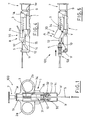
- numeral 100 indicates a needle device, belonging to a needle instrument for performing tissue biopsies made according to the present invention. It is particularly suited for taking biopsic samples, mainly of soft tissues, from a patient's body, in a partially automatic mode.
- the needle device 100 comprises a body 1, which is substantially symmetrical with respect to a longitudinal axis.
- the body 1 comprises, for known manufacturing and functional purposes, a base 1a, an upper shell 1b fixed in the upper part of said base 1a, and a front cradle 1b, fixed to the front part of the same base 1a. This latter is moreover provided with a pair of annular members 2a,2b, arranged at both sides of the same base 1a, fit to help handling the needle device 100.
- Mandrel 5 is arranged along a longitudinal symmetry plane of the body 1.
- Mandrel 5 is substantially a thin needle, sharply pointed at its distal end and also provided, near its distal end, with a longitudinal groove fit to receive a biopsic sample.
- the mandrel 5 extends for the whole body 1 length, and comes out from the front end therefrom, at an opening 1d provided in the cradle 1c.
- the mandrel proximal portion comes out from the rear end 1e of the body 1.
- a mandrel handle 7 is fixed to the mandrel proximal end, for allowing the same mandrel 5 to be handled by a specialist.
- a sliding gear 10 is enclosed between the base 1a and the upper shell 1b of body 1.
- the sliding gear 10 is mounted longitudinally in the same body 1 and is fit to slide between an extended, sampling position and one or more retracted, loading positions.
- Each one of said loading positions which are normally in the number of three, defines a different device penetrating length and, subsequently, a different sample length.
- the sliding gear 10 is provided with a longitudinal through bore 11, fit to sliding receive the above mandrel 5 (see figures 1 and 6).
- a launching spring 3 In the rear portion of the sliding gear 10 there is engaged a launching spring 3, whose opposite end is engaged with an abutment made in the rear portion of the base 1a.
- the launching spring 3 is coaxial with the mandrel 5, and surrounds a rear portion thereof. It is fit to exert an elastic compression against the sliding gear 10 when it slides toward the aforesaid retracted positions, and therefore to load the same gear 10 enough to allow it to go off to the extended position during the known sample taking operation.
- the front portion 12 of the sliding gear 10, wherefrom the aforesaid through bore 11 comes out, has a substantially cylindrical shape. Under said front portion 12 there is provided a key 15, of elongated shape, which extend parallel with respect to the front portion 12.
- the mandrel handle 7 is provided with gear locking means 9, which is only partially visible in the above figures, fit to lock the sliding gear 10 for drag it toward the loading, retracted positions.
- gear locking means 9 which is only partially visible in the above figures, fit to lock the sliding gear 10 for drag it toward the loading, retracted positions.
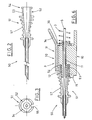
- the needle instrument of the present invention moreover comprises a hollow cannula 50, (see also figures 1 and 2), suitable to be mounted on the sliding gear of the above described needle device 100, fit to slidably receive the mandrel 5.
- the cannula 50 comprises, at its proximal end, a hollow head 51, whose structure will be better detailed in the following.
- a locking member 30, fit to removably fix said cannula 50 to the sliding gear 10.
- the locking member 30 comprises a shell 31, placed in the upper part of the sliding gear 10 and surrounding the same gear.
- the shell 31 is articulated so that it can rotate on a transverse axis Y, in the lower part of the gear 10. In this way it can swing between a releasing position A, wherein it frees the cannula 50 (see figure 5), and a locking position B, wherein it locks the same cannula 50 in a mounted position (see figures 4 and 6).
- the shell 31 is moreover provided, at its front end, with an opening 32 (see figure 1), shaped as the head 51 of cannula 50, when this latter is held by the same shell 31 in cooperation with the front portion 12 of the sliding gear 10.
- the shell 31 is normally held in its locking position B by a suitable elastic member.
- said elastic member is the aforementioned launching spring 3, but used in a different operating mode with respect to its main loading operating mode.
- an upper part of the launching spring 3 is arranged into contact with the upper, inner wall 36 of the shell 31.
- This upper wall is fit to act on the launching spring 3 by means of a cross bending of the same spring, thus receiving a corresponding elastic force.
- the shell 31 moreover comprises a wing 34, placed in the upper rear part of the same shell, which extends slantwise in an upper direction with a predefined angle.
- the wing 31 is fit to allow the shell 31 to be operated manually from its locking position A to its releasing position B.
- the cannula head 51 is provided, at its free end, with complementary locking means 52 (see figures 2,3 and 6), which consists of a cylindrical portion 53 and an annular thick rim 54. These cylindrical portion 53 and annular rim 54 are suitable to be engaged by the aforesaid front portion 12 of sliding gear 10 and front part of shell 31.
- the head 51 also comprises gripping means 57, fit to make the cannula 50 handling by a specialist easier.
- This gripping means 57 comprises a plurality of rings of growing diameter peripherally made on the outer surface of the head 51.
- the cannula 50 As far as it regards the cannula 50, it is mounted on the needle device 100 before its use begins.
- the mandrel 5 is inserted in the cannula head 51, until this latter approaches the front part of the sliding gear 10.
- the shell 31 is then manually raised from its locking position B to its releasing position A, by operating on the wing 34 against the bending reaction of the launching spring 3.
- the cannula head 51 is then moved toward the gear 10, until its cylindrical portion 53 and its annular rim 54 engage the front portion 12 of said gear 10. At this point the shell 31 is moved back to its locking position B, until it encloses and locks the cannula head 51.
- the cannula 50 releasing operation is as much as simple, because it is just necessary to act again on the wing 34 until the shell 31 reaches its releasing position A, then extract the mandrel 5, holding its taken biopsic sample inside its longitudinal groove 55, from the cannula 50, and finally moving back the shell again to its locking position B.
- the biopsic sample could be removed from the patient's body, while the cannula 50 stays "in situ” for a further operation.
- the above described biopsy instrument made according to the present invention advantageously allows the sample taking operations to become easier, faster and less painful, mainly in the case where multiple sampling operations have to be performed on the same site, or where the sample taken from a site would not be satisfactory and a second one must be taken.
- the aforesaid biopsy instrument does not have substantially manufacturing complexity or expensive parts or materials to use. It is also reliable and cost effective.
Landscapes
- Health & Medical Sciences (AREA)
- Life Sciences & Earth Sciences (AREA)
- Medical Informatics (AREA)
- Engineering & Computer Science (AREA)
- Biomedical Technology (AREA)
- Heart & Thoracic Surgery (AREA)
- Pathology (AREA)
- Molecular Biology (AREA)
- Surgery (AREA)
- Animal Behavior & Ethology (AREA)
- General Health & Medical Sciences (AREA)
- Public Health (AREA)
- Veterinary Medicine (AREA)
- Infusion, Injection, And Reservoir Apparatuses (AREA)
Applications Claiming Priority (2)
| Application Number | Priority Date | Filing Date | Title |
|---|---|---|---|
| ITBO20030516 | 2003-09-05 | ||
| ITBO20030516 ITBO20030516A1 (it) | 2003-09-05 | 2003-09-05 | Strumento a cannula amovibile per l'esecuzione di biopsie. |
Publications (2)
| Publication Number | Publication Date |
|---|---|
| EP1527739A2 true EP1527739A2 (de) | 2005-05-04 |
| EP1527739A3 EP1527739A3 (de) | 2005-12-14 |
Family
ID=34401295
Family Applications (1)
| Application Number | Title | Priority Date | Filing Date |
|---|---|---|---|
| EP04021099A Withdrawn EP1527739A3 (de) | 2003-09-05 | 2004-09-06 | Vorrichtung mit abnehmbarer Kanüle zur Entnahme von Gewebeproben für Biopsieanalyse |
Country Status (2)
| Country | Link |
|---|---|
| EP (1) | EP1527739A3 (de) |
| IT (1) | ITBO20030516A1 (de) |
Cited By (3)
| Publication number | Priority date | Publication date | Assignee | Title |
|---|---|---|---|---|
| CN113274133A (zh) * | 2021-06-24 | 2021-08-20 | 哈尔滨理工大学 | 一种基于mri环境下的乳腺活检穿刺机器人及其使用方法 |
| CN113866397A (zh) * | 2021-08-31 | 2021-12-31 | 无锡华纳医疗科技有限公司 | 一种幽门螺杆菌智能诊断仪 |
| CN117064456A (zh) * | 2023-10-17 | 2023-11-17 | 江西省水产科学研究所(江西省鄱阳湖渔业研究中心、江西省渔业资源生态环境监测中心) | 一种鲫鱼类免疫组织自动取样装置 |
Family Cites Families (4)
| Publication number | Priority date | Publication date | Assignee | Title |
|---|---|---|---|---|
| EP0010321A1 (de) * | 1978-10-19 | 1980-04-30 | Renzo Dr. Brun Del Re | Vorrichtung zur einhändigen Bedienung eines Biopsiegerätes |
| US5617874A (en) * | 1989-03-29 | 1997-04-08 | Baran; Gregory W. | Automated biopsy instrument |
| US6165136A (en) * | 1998-12-23 | 2000-12-26 | Scimed Life Systems, Inc. | Semi-automatic biopsy device and related method of use |
| IT1316082B1 (it) * | 2000-05-25 | 2003-03-28 | Beniamino Palmieri | Dispositivo per biopsia |
-
2003
- 2003-09-05 IT ITBO20030516 patent/ITBO20030516A1/it unknown
-
2004
- 2004-09-06 EP EP04021099A patent/EP1527739A3/de not_active Withdrawn
Cited By (4)
| Publication number | Priority date | Publication date | Assignee | Title |
|---|---|---|---|---|
| CN113274133A (zh) * | 2021-06-24 | 2021-08-20 | 哈尔滨理工大学 | 一种基于mri环境下的乳腺活检穿刺机器人及其使用方法 |
| CN113866397A (zh) * | 2021-08-31 | 2021-12-31 | 无锡华纳医疗科技有限公司 | 一种幽门螺杆菌智能诊断仪 |
| CN117064456A (zh) * | 2023-10-17 | 2023-11-17 | 江西省水产科学研究所(江西省鄱阳湖渔业研究中心、江西省渔业资源生态环境监测中心) | 一种鲫鱼类免疫组织自动取样装置 |
| CN117064456B (zh) * | 2023-10-17 | 2024-02-02 | 江西省水产科学研究所(江西省鄱阳湖渔业研究中心、江西省渔业资源生态环境监测中心) | 一种鲫鱼类免疫组织自动取样装置 |
Also Published As
| Publication number | Publication date |
|---|---|
| EP1527739A3 (de) | 2005-12-14 |
| ITBO20030516A1 (it) | 2005-03-06 |
Similar Documents
| Publication | Publication Date | Title |
|---|---|---|
| CA2331444C (en) | Reusable automated biopsy needle handle | |
| US6283925B1 (en) | Biopsy needle handle | |
| US6083176A (en) | Automated biopsy needle handle | |
| US5492130A (en) | Biopsy device and method | |
| US6022324A (en) | Biopsy instrument | |
| US5511556A (en) | Needle core biopsy instrument | |
| US5560373A (en) | Needle core biopsy instrument with durable or disposable cannula assembly | |
| US7156815B2 (en) | Soft tissue biopsy instrument | |
| US4461305A (en) | Automated biopsy device | |
| US5313958A (en) | Surgical biopsy instrument | |
| US5660186A (en) | Spiral biopsy stylet | |
| EP0318447A1 (de) | Probennahmeantriebsgerät | |
| US20010007925A1 (en) | Methods and devices for automated biopsy and collection of soft tissue | |
| JPH06197898A (ja) | 自動組織抽出装置 | |
| JP2001517468A (ja) | 生検検体を連続的に採集、貯蔵、処理する装置および方法 | |
| JPH09501071A (ja) | 多数バイオプシー試料採取器具 | |
| JPH07194599A (ja) | 生検用器具および生検用組織の試料を採取する方法 | |
| EP3292822A2 (de) | Biopsievorrichtung | |
| US7914463B2 (en) | Double core biopsy instrumentation kit | |
| CN108095774B (zh) | 改进的骨骼活组织检查装置 | |
| EP3057513B1 (de) | Biopsievorrichtung | |
| US20050075580A1 (en) | Soft tissue biopsy instrument | |
| EP1527739A2 (de) | Vorrichtung mit abnehmbarer Kanüle zur Entnahme von Gewebeproben für Biopsieanalyse | |
| CN110507371B (zh) | 一种睾丸穿刺取样装置 | |
| CN210871744U (zh) | 一种睾丸穿刺取样装置 |
Legal Events
| Date | Code | Title | Description |
|---|---|---|---|
| PUAI | Public reference made under article 153(3) epc to a published international application that has entered the european phase |
Free format text: ORIGINAL CODE: 0009012 |
|
| AK | Designated contracting states |
Kind code of ref document: A2 Designated state(s): AT BE BG CH CY CZ DE DK EE ES FI FR GB GR HU IE IT LI LU MC NL PL PT RO SE SI SK TR |
|
| AX | Request for extension of the european patent |
Extension state: AL HR LT LV MK |
|
| PUAL | Search report despatched |
Free format text: ORIGINAL CODE: 0009013 |
|
| AK | Designated contracting states |
Kind code of ref document: A3 Designated state(s): AT BE BG CH CY CZ DE DK EE ES FI FR GB GR HU IE IT LI LU MC NL PL PT RO SE SI SK TR |
|
| AX | Request for extension of the european patent |
Extension state: AL HR LT LV MK |
|
| 17P | Request for examination filed |
Effective date: 20060614 |
|
| AKX | Designation fees paid |
Designated state(s): DE ES FR GB IT |
|
| 17Q | First examination report despatched |
Effective date: 20061218 |
|
| GRAP | Despatch of communication of intention to grant a patent |
Free format text: ORIGINAL CODE: EPIDOSNIGR1 |
|
| STAA | Information on the status of an ep patent application or granted ep patent |
Free format text: STATUS: THE APPLICATION IS DEEMED TO BE WITHDRAWN |
|
| 18D | Application deemed to be withdrawn |
Effective date: 20070821 |