EP1533754A1 - Procédé et appareil pour la modélisation de structures héterogène multidimensionnelles par ordinateur - Google Patents
Procédé et appareil pour la modélisation de structures héterogène multidimensionnelles par ordinateur Download PDFInfo
- Publication number
- EP1533754A1 EP1533754A1 EP04077709A EP04077709A EP1533754A1 EP 1533754 A1 EP1533754 A1 EP 1533754A1 EP 04077709 A EP04077709 A EP 04077709A EP 04077709 A EP04077709 A EP 04077709A EP 1533754 A1 EP1533754 A1 EP 1533754A1
- Authority
- EP
- European Patent Office
- Prior art keywords
- cells
- substacks
- modelling
- stack
- cell
- Prior art date
- Legal status (The legal status is an assumption and is not a legal conclusion. Google has not performed a legal analysis and makes no representation as to the accuracy of the status listed.)
- Ceased
Links
Images

Classifications
-
- G—PHYSICS
- G06—COMPUTING OR CALCULATING; COUNTING
- G06T—IMAGE DATA PROCESSING OR GENERATION, IN GENERAL
- G06T17/00—Three-dimensional [3D] modelling for computer graphics
- G06T17/05—Geographic models
-
- G—PHYSICS
- G06—COMPUTING OR CALCULATING; COUNTING
- G06T—IMAGE DATA PROCESSING OR GENERATION, IN GENERAL
- G06T17/00—Three-dimensional [3D] modelling for computer graphics
- G06T17/20—Finite element generation, e.g. wire-frame surface description, tesselation
Definitions
- the invention relates to a method for the modelling of a multidimensional, heterogeneous structure by a digital processing unit by means of a grid built up of stacks of multidimensional cells, in which a cell is bounded by boundary surfaces, representing at least one property of the structure, and in which the composition of a stack, the position of the stacks in the grid and the properties represented by cells are stored in memory means by the processing unit.
- a method of the above kind is used in practice for modelling asymmetrical spaces or structures and the processes that take place in said spaces or structures. Examples of this are the simulation of the flow of heterogeneous media in apparatuses, the flow of air in a three-dimensional space surrounding objects, the calculation of electrical fields or the modelling of oil reserves and the flow of fluids through the subsurface of the earth.
- a tetrahedral grid is used for a continuous three-dimensional space or structure, which grid is very flexible as regards its shape and which can be adapted to practically any space or structure.
- a drawback is the arbitrary nature of said grid, which makes it necessary to store a large amount of information. Said arbitrary nature also leads to complicated algorithms for modelling the grid.
- a digital processing unit such as a computer or a processor, it is necessary in practice to limit the resolution of such a three-dimensional grid.
- discontinuities in the structure or space i.e. discontinuous transitions in properties within the space or structure, such as material transitions caused by shifts in layers of the subsurface of the earth, cannot be modelled with sufficient accuracy and flexibility.
- the simplest grid is the so-called "voxel" model, which is a regular three-dimensional grid built up of cells having fixed dimensions and a fixed number of cells in each of the three directions. The cells are specified by three indices: I, J, K, one for each direction.
- this grid can only provide a very crude approximation of the complexity of the subsurface of the earth in which layers have shifted and folded or broken relative to each other as a result of the movement of the earth's crust.
- the advantage of this model is that such a grid can be defined with a limited number of parameters, as a result of which the amount of information to be processed, and consequently the computational time, are significantly reduced in comparison with the aforesaid flexible grid.
- the above object is accomplished in that, for modelling a discontinuity, a respective stack is divided into two or more substacks separated by separating surfaces, which substacks are aligned along a discontinuity with their separating surfaces, the composition and the position of the substacks in a respective stack being stored in the memory means.
- the invention is based on the perception that, based on the known modelling technique, which makes use of a grid built up of stacks of multidimensional cells, the aforesaid problem of cells being deformed and even reduced to zero at the transitions of a discontinuity can be solved by dividing a respective stack into substacks at the location of a discontinuity. Said substacks can then be processed in the same manner by a digital processing unit and be stored in the same manner as the other stacks of the grid. Using the method according to the invention, a discontinuity will now result in the formation of additional surfaces, separating surfaces, between the substacks of a stack instead of collapsing or deforming the cells that form the stack.
- the processing in accordance with the invention of the information with regard to the separating surfaces between the substacks near a discontinuity does not have any noticeable influence on the total processing time for modelling the space or structure.
- a substack can be divided into further substacks, likewise mutually bounded by separating surfaces. Such a division into further substacks may be necessary or desirable, depending on the nature of the discontinuity.
- the manner in which the division takes place depends substantially on the nature of the discontinuity.
- the division into substacks takes place in the longitudinal direction of a stack or substack.
- this manner of dividing will result in that straight stacks, seen in longitudinal direction, of regularly shaped cells or blocks are formed. This is different from the prior art, in which the cells or stacks are distorted or deformed for modelling a discontinuity, with very irregularly shaped cells or blocks being obtained.
- a separating surface may form a boundary surface of a cell or may extend through one or more cells.
- the method according to the invention stores the position of the stacks by means of a coordinate system, generally indicated the I, J, K coordinate system.
- a coordinate system generally indicated the I, J, K coordinate system.
- the coordinates of the corner points of various surfaces of adjacent stacks are stored.
- the coordinates of the corner points of the separating surfaces between the substacks are stored in the memory means as well.
- the method according to the invention is also suitable for processing data in the known manner, which is important for reasons of compatibility.
- the method according to the invention makes it possible to compute obtained data by means of interpolation techniques and, for example, statistical data of a structure or space, and model said data into a grid.
- the invention is not limited to a representation in I, J and K coordinates, however.
- the stacks and/or cells can also be represented and stored by using cell indices, in particular in the case of an irregularly shaped grid.
- the invention for modelling a discontinuity, can also move stacks and substacks relative to each other and also within the grid, of course, depending also on the shape and the course of the discontinuity in the structure.
- the substacks may have a different geometric shape, for example a geometric shape adapted to a discontinuity, with respect to the stack of which the substacks form part of. This makes it possible to obtain an accurate representation of a discontinuity when using the method according to the invention through a suitable selection of the geometric shape of a substack or substacks.
- the cells in the substacks may have a geometric shape different from that of the cells of the respective stack of which the substack forms part of.
- the inventive idea furthermore makes it possible to locally refine the grid by dividing a cell into a stack of cells. In this way a very accurate representation of discontinuities or other abnormalities in the structure can be locally modelled.
- the cells in a stack of cells may have a geometric shape different from that of the cell of which the stack of cells forms part of, for example a shape that is optimally adapted to the discontinuity that is to be modelled.
- the method according to the invention makes it possible to optimally address adjacent stacks not separated by a discontinuity, for example with the I, J and K coordinates, which will be applied optionally in practice, however, for example depending on the modelling resolution, because it involves an increase of the amount of information that is to be processed.
- a structure not comprising a discontinuity can be modelled with a regular grid of stacks, with the position of a cell in a stack advantageously being represented only by depth information with regard to the position in a respective stack, so as to reduce the amount of information to be processed as much as possible.
- the method according to the invention further provides a very accurate possibility for calculating the surface area of layers in a structure, for example, by calculating the surface area of respective surfaces of corresponding cells, i.e. cells that form part of a respective layer, for example.
- the method according to the invention makes it possible to provide very accurate volume data of layers of a structure, for example, by calculating the volume of corresponding cells.
- the structure can be characterized as a whole, for example all layers, or in part, for example a specific layer, as regards the physical properties thereof, for example.
- the cells in principle do not undergo any deformation by being collapsed or expanded again when using the method according to the invention, relatively simple calculating algorithms may be used, resulting in a very significant reduction of the processing time, for example in the case of a flow modelling, in comparison with the known method.
- flow modelling in the subsurface of the earth, for example, groups of similar cells are combined for calculating pressures in or pressure differences between the groups of cells.
- the method according to the invention enables a significant saving in computational time whilst providing accurate results of a good quality. Also real-time use thereof is possible when using the invention.
- the method according to the invention is very suitable for modelling an earth structure directly from seismological data. That is, after some form of signal processing, such as filtering and the like, the measuring signals obtained from a seismic measurement can be directly processed into a grid by means of the method according to the invention. Further interpretation steps of the measuring signals before they can be modelled are not absolutely necessary when using the method according to the invention. This results not only in a direct economic saving, but also in a considerable saving in time and an improved accuracy as regards the modelling of measuring results and as regards the model becoming available for subjecting the structure to further processing steps, for example. Furthermore it will be easy to update a model with more recent seismic measurement data from a new measurement.
- the structure and the discontinuities present therein can be directly modelled and represented in layers, for example. This can be done by means of a display screen, a printer or other display medium, for example.
- the increased accuracy and the improved processing possibilities of the method according to the invention make it possible to use the method according to the invention advantageously when carrying out operations in the subsurface of the earth, for example drilling a well, a tunnel, carrying out mining operations or the like.
- the modelling of the earth structure on the basis of previously obtained seismological data can be corrected or adapted in real time.
- the model of the earth structure can be adapted to the actual earth structure as optimally as possible, so that the operations can be carried out as accurately as possible, so that standstill of the equipment in question, for example, or other trouble caused by modelling errors are prevented as much as possible.
- the fact is that in practice the operations are carried out on the basis of the model of the earth structure. Inaccuracies in the model may lead to problems and trouble if a discontinuity is actually located at a position other than the position according to the model.
- the invention also relates to a method for scaling the substacks obtained according to the above-described technique for being processed by an IJK reservoir simulator, wherein parameters obtained by modelling according to the invention are scaled to parameters suitable for being processed by the reservoir simulator, taking into account volume and flow properties at the boundary surfaces of the cells.
- the cells can be scaled inter alia on the basis of cell volume size or cell centre geometry.
- the invention also relates to an apparatus provided with a digital processing unit for carrying out the method as described above.
- the digital processing unit may be a usual desktop computer or a portable computer (laptop), of course comprising a state of the art processing unit and sufficient main or working memory and storage capacity.
- the invention furthermore provides a computer programme arranged for carrying out the method according to the invention when loaded in the main memory or working memory of the digital processing unit.
- a data carrier such as a floppy disk, a CD ROM, a DVD, a hard disk or the like storage medium as well as a server in a network, such as the Internet, provided with said computer programme likewise falls within the scope of the present invention.
- the invention will be explained in more detail hereinafter in an application for modelling seismological data of an earth formation comprising a number of layers.
- the invention is not limited to such an application, however, it can be used for modelling arbitrary asymmetrical, multidimensional spaces or multidimensional structures and the processes that take place in said spaces or structures, as discussed in the introduction.
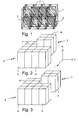
- Fig. 1 schematically shows in perspective view a three-dimensional, tetrahedral grid 1 that is known in practice, which is built up of tetrahedral cells 2.
- the cells 2 represent one or more defined local physical properties of the spaces or structure and can be arbitrarily arranged in the grid 1, depending of course on the properties of the respective space or structure to be modelled.
- a tetrahedral grid generates a large number of data that need to be processed for modelling the space or structure.
- a special, fast processing unit is required in order to keep the processing time within acceptable bounds.
- Fig. 2 is a schematic, perspective view of a simplified embodiment of a modelling technique that is known in practice, which employs a regular, orthogonal, three-dimensional grid 3 built up of stacks 4 that each comprise a fixed number of cells having fixed dimensions in each of the three vector directions I, J and K in which the grid 3 extends.
- the shape of the cells is likewise fixed.
- the position of each cell in the stack 4 is indicated by means of three indices, one in each direction I, J and K.
- one or more of the stacks 4 can be freely shifted in the K-direction of the boundary pillars 6 of the stacks 4. In Fig. 2 this is illustrated by the shifted block 5 of stacks 4.
- a block of stacks 4 can likewise be freely shifted in a desired direction, as is illustrated with the shifted block 7 of stacks 4 in Fig. 3.
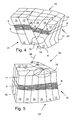
- the geometric shape of the cells 9, 10, 11 in a stack is no longer fixed, as is schematically shown in perspective view with the grid 19 in Fig. 4.
- Reference numeral 20 indicates the upper side of the grid 19
- reference numeral 21 indicates the front side of the grid 19.
- the cells 9, 10, 11 in the stacks 12, 13, 14, 15, 16 and 17 may be bounded, called "truncating" in English professional literature, on the pillars 6 for modelling a discontinuity. That is, the cells 9, 10, 11 in a stack can be collapsed on a pillar 6, even to zero volume.
- the circle 18 in Fig. 4 shows an example of a transition zone where the cell or the stack volume must increase again. Seen from the bottom side 22 and the rear side 23 of the grid 19, as shown in Fig. 5, artefacts that are not in accordance with the actual situation arise in the model. Furthermore it will be apparent from Fig. 5 that the stacks 14, 15 and 16 are fully collapsed, as indicated by the arrow 24. Refer also to the arrow 24 in Fig. 4. Another example of the influence of such artefacts is shown in Fig. 6.
- Fig. 6 shows an erosion event in an earth formation, in which parts of the layer structure have been removed by shearing forces resulting from the force of gravity and the action of water and air.
- the use of the modelling technique has resulted in the various layers 30, 31, 32 and 33 being truncated on the pillars 6, near the fringes 34 and 35, which will by no means be the case in practice.
- the layers 30-33 terminate abruptly at the edges 36, 37 of the trough 38 formed by the erosion.
- an earth structure 40 comprising several layers 41-47 positioned one below the other, seen from top to bottom in the plane of drawing, is shown by way of example.
- each layer is indicated by its own characteristic hatching.
- Reference numeral 48 indicates a discontinuity, a shear zone along which the layers 41-47 have shifted relative to each other.
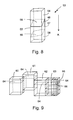
- the stacks 50, 51, 52 and 53 are divided into substacks, with a separating surface being present between the substacks along the shear zone 48. This is shown in more detail in Fig. 8.
- Fig. 8 schematically shows in perspective view a first substack 54 and a second substack 55, which together form the stack 53.
- each layer 41-47 in a stack 50-53 is represented by a respective cell that is shifted in the longitudinal direction of a stack, the K-direction, as indicated by the vector arrow.
- reference numerals 41-47 will also refer to a respective cell, therefore.
- the substacks 54, 55 are separated in the longitudinal direction of the stack 53 (the K-direction) by a separating surface 56 that extends parallel to and along the shear zone 48. Collapsing of cells in the stack 53 is prevented in this manner, enabling better and more accurate calculations of the area and the volume of the cells for computing the properties of certain layers or parts of layers.
- various physical properties or parameters of the structure or space may be assigned to each cell in a stack, such as rock porosity, local temperature, local pressure, etc.
- each substack 54, 55 may have its own layer or cell number.
- the cell numbers in the K-direction are: 41, 42, 43, 44, 45.
- the cell numbers in the K-direction are: 43, 44, 45, 46, 47.
- the method according to the invention remains compatible with the known methods.
- Specific parameters can be associated with the surfaces, the separating surfaces and the boundary edges of the surfaces, which parameters provide information on the modelled structure or space.
- a substack may be divided into further substacks.
- the substack 55 is for example divided in longitudinal direction (the K-direction) into two substacks 57 and 58 separated by a separating surface 59, as is illustrated in broken lines.
- separating surfaces between substacks may extend along a boundary surface of the cell but also through cells.
- modelling can take place mainly with orthogonal cells and stacks of cells in the method according to the invention, relatively simple algorithms can be used for calculating areas, flows, volumes and other properties of the modelled structure or space. As a result, a considerable saving in computational time is achieved in comparison with the known method.
- Fig. 9 schematically shows in perspective view a number of adjacent, mutually shifted stacks 60, 61, 62 and 63 with separating surfaces 64, along which the stacks are divided into substacks.
- a "Dip-Slip” fault is shown to be present between the stacks 61 and 62, wherein stacks may have their adjoining edges in common.
- a "Strike-Slip” fault is shown to be present between the stacks 60 and 61, wherein stacks may have their adjoining edges in common.
- a cell may furthermore be divided into subcells, as is indicated in the stack 64.
- the cell 65 is divided into subcells 66, with separating surfaces possibly being formed between the subcells 66 in this case, too, to conform to a local discontinuity, for example. It will be understood that in this way a very fine and accurate modelling can be realised.
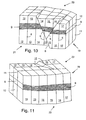
- Figs. 10 and 11 show the modelling of the grid 19 similar to the modelling that is shown in Figs. 4 and 5; in this case, however, said modelling has taken place in accordance with the method according to the invention, in which only vertical (seen in the plane of the drawing) surfaces of the cells and stacks have been used.
- the stacks are orthogonal, except at the location of the discontinuities.
- Fig. 12 shows the erosion event of Fig. 6 as modelled by means of the method according to the invention.
- Stacks have been formed in the longitudinal direction of the pillars 6 again, which stacks have subsequently been divided into substacks at the edges 36 and 37, for example the substacks 70 and 71, which are separated by the separating surface 73.
- this is expressed in the structure that is modelled more in accordance with the actual situation, in which the layers 30-33 are indeed shown to have sheared off along the edges instead of having been artificially drawn to a pillar 6. It goes without saying that in the case of drilling through a specific layer, such as the layer 32, from the edge 34, for example, the method according to the invention will provide a reliable picture as regards the position of the layer 32 along the edge 36.
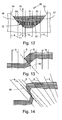
- separating surfaces between the substacks have so far been shown to extend along or in line with the planes of discontinuities, as is illustrated more clearly in Fig. 13, for example, this is not a precondition, of course.
- the stacks and their pillars extend vertically, seen in the plane of the drawing. The stacks are separated by separating surfaces extending in line with or parallel to the discontinuity 80.
- Fig. 14 illustrates a manner of positioning the stacks with their pillars 6 in alignment with the discontinuity 80.
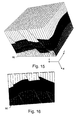
- Fig. 15 is a schematic, perspective view of a structure modelled into I, J, K coordinates by using the method according to the invention, which clearly shows that the stacks of cells have a straight symmetrical shape in the longitudinal direction or the K-direction and are not distorted or deformed near artefacts.
- Fig. 16 is a view of the plane 90 of Fig. 15, which clearly shows that the substacks are in alignment with the discontinuities (the slanting lines in said plane).
- the method according to the invention is furthermore very suitable for accurately modelling overhanging structures, such as salt domes or the like.
- a special advantage of the invention is the fact that substacks and subcells may have various geometric shapes, different from those of the stack of cell of which they form part.
- the geometric shapes can be optimally geared to carrying out volume calculations or the like, for example.
- Suitable shapes are tetrahedral shapes, prismatic shapes, pyramidal shapes, etc. in other words, the stacks do not necessarily have to be cubic, as is shown for the sake of simplicity in the figures in question.
- Hexagonal or octagonal or other polygonal circumferential shapes (polygons) can be processed and modelled without any problem by means of the method according to the invention.
- IJK reservoir simulators are used inter alia for computing flow measurements.
- the letters I, J, K refer to the coordinate system that is used, as shown in Fig. 2 and Fig. 15.
- a problem in this regard is the fact that said reservoir simulators, which are arithmetic programmes, are based on unique I,J,K cells, i.e. cells having unique I,J,K coordinates, for example rectangular cells having six planes and the parameters defined therewith.
- a separating surface of the substacks may extend through one or more cells
- various cells having the same I,J,K coordinates and possibly geometric shapes different from, for example, a standard shape used by the reservoir simulator are according to the invention obtained.
- the grid that is used in the invention may be more finely meshed than the grid of the reservoir simulator. Consequently, a scaling needs to take place, in which the properties that have been assigned to a cell and the value thereof must be taken into account.
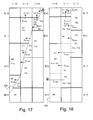
- Figs. 17 and 18 show an embodiment of such a scaling, Figs. 17 showing a modelling according to the invention and Fig. 18 showing a model of a reservoir simulator.
- said scaling is shown in the two-dimensional I, K plane.
- the modelled structure is three-dimensional, that is, having dimensions in the J-direction as well. See Fig. 15, for example.
- Figs. 17 and 18 four layers, numbered 0, 1, 2, 3, are shown in the K-direction and three layers, numbered 0, 1, 2, are shown in the I-direction.
- V of a respective cell and the transmissibility T along the discontinuity 100, which is illustrated in a dashed line in the figures.
- the triangular cell B2 (seen in the two-dimensional plane) of Fig. 17 has been transformed into the rectangular cell B2 of the IJK reservoir simulator in Fig. 18.
- the transmissibility from the cell B2 to the cell A2 over the discontinuity 100 must now be transformed into a transmissibility from the cell B2 to the cell A1-A2 in Fig. 18, schematically indicated T A2/B2 .
- the volume of the cell C2 in Fig. 17 must be added to the volume of the cell B1 in Fig. 17 in order to arrive at the cell B1 in Fig. 18, i.e. V B1 +V C2 .
- the transmissibility T B2/C2 from the cell B2 to the cell C2 over the discontinuity 100 in Fig. 17 must be assigned to the transition between the cell B2 and the cell C2 in Fig. 18, i.e. over the scaled discontinuity 101, etc.
- T C2/A2 With reference to the transmissibility from the cell C2 to the cell A2, T C2/A2 , and with reference to the transmissibility from the cell C2 to the cell A2, T C2/A2 , in Fig.
- the method according to the invention can be carried out with sufficient accuracy on a regular computer or laptop, and consequently it is very suitable for use in the field during activities such as drilling operations, in which information regarding the structure can be directly incorporated in the model.
- This enables a substantially real-time adaptation of the modelling, with all its advantages as regards continuity and preventing damage, for example during ground drilling operations.
- the method according to the invention is very suitable for directly processing seismic measurement data. That is, measuring signals obtained from a seismic measurement can be incorporated in a grid without any further preprocessing after being subjected to signal processing operations that are known per se, such as filtering, limiting, etc. This provides a significant saving in time and cost. Also seismic data obtained from repeat measurements can be directly read into the model according to the invention for updating the seismological data.
- the invention also provides a computer programme for carrying out the method as described above, as well as an apparatus provided with digital processing means and memory means arranged for carrying out said method.
- the memory means may be internally or externally connected with the apparatus, in the latter case via suitable telecommunication links, for example.
- the invention furthermore provides a data carrier provided with said computer programme. Examples of data carriers are floppy disks, CD ROM's, DVD's, hard disks, servers in a network comprising suitable storage means, etc.
Landscapes
- Physics & Mathematics (AREA)
- Engineering & Computer Science (AREA)
- Geometry (AREA)
- Software Systems (AREA)
- Computer Graphics (AREA)
- General Physics & Mathematics (AREA)
- Theoretical Computer Science (AREA)
- Remote Sensing (AREA)
- Management, Administration, Business Operations System, And Electronic Commerce (AREA)
- Processing Or Creating Images (AREA)
- Earth Drilling (AREA)
- Length Measuring Devices With Unspecified Measuring Means (AREA)
Applications Claiming Priority (2)
| Application Number | Priority Date | Filing Date | Title |
|---|---|---|---|
| NL1024444A NL1024444C2 (nl) | 2003-10-03 | 2003-10-03 | Werkwijze, inrichting, computerprogramma en gegevensdrager voor het met een digitale verwerkingseenheid modelleren van een meerdimensionale heterogene structuur. |
| NL1024444 | 2003-10-03 |
Publications (1)
| Publication Number | Publication Date |
|---|---|
| EP1533754A1 true EP1533754A1 (fr) | 2005-05-25 |
Family
ID=34432158
Family Applications (1)
| Application Number | Title | Priority Date | Filing Date |
|---|---|---|---|
| EP04077709A Ceased EP1533754A1 (fr) | 2003-10-03 | 2004-10-04 | Procédé et appareil pour la modélisation de structures héterogène multidimensionnelles par ordinateur |
Country Status (3)
| Country | Link |
|---|---|
| US (1) | US8050892B2 (fr) |
| EP (1) | EP1533754A1 (fr) |
| NL (1) | NL1024444C2 (fr) |
Cited By (5)
| Publication number | Priority date | Publication date | Assignee | Title |
|---|---|---|---|---|
| EP2631685A2 (fr) | 2012-02-22 | 2013-08-28 | Service Pétroliers Schlumberger | Construction de grilles en défaut pour bassin sédimentaire comprenant des interfaces stratigraphiques et structurelles |
| GB2512372A (en) * | 2013-03-28 | 2014-10-01 | Total Sa | Method of modelling a subsurface volume |
| US8965745B2 (en) | 2011-04-14 | 2015-02-24 | Schlumberger Technology Corporation | Grid from depositional space |
| CN104380260A (zh) * | 2012-05-31 | 2015-02-25 | 沙特阿拉伯石油公司 | 利用可伸缩网格计算的储层仿真 |
| CN106560792A (zh) * | 2015-12-27 | 2017-04-12 | 北京科胜永昌软件有限公司 | 海量观测系统双缓存面元计算方法 |
Families Citing this family (28)
| Publication number | Priority date | Publication date | Assignee | Title |
|---|---|---|---|---|
| DE60201831D1 (de) * | 2002-08-26 | 2004-12-09 | Total Sa | Verfahren zur Berechnung von Maschenmodellen eines Reservoirs |
| US8150663B2 (en) * | 2007-03-30 | 2012-04-03 | Paradigm Geophysical (Luxembourg) S.A.R.L. | Partitioning algorithm for building a stratigraphic grid |
| GB0706659D0 (en) * | 2007-04-05 | 2007-05-16 | Statoil Asa | Reduction of airwave contribution in marine electromagnetic data |
| US8768672B2 (en) * | 2007-08-24 | 2014-07-01 | ExxonMobil. Upstream Research Company | Method for predicting time-lapse seismic timeshifts by computer simulation |
| US8548782B2 (en) * | 2007-08-24 | 2013-10-01 | Exxonmobil Upstream Research Company | Method for modeling deformation in subsurface strata |
| US8423337B2 (en) * | 2007-08-24 | 2013-04-16 | Exxonmobil Upstream Research Company | Method for multi-scale geomechanical model analysis by computer simulation |
| US8265915B2 (en) * | 2007-08-24 | 2012-09-11 | Exxonmobil Upstream Research Company | Method for predicting well reliability by computer simulation |
| US20110071799A1 (en) * | 2009-09-21 | 2011-03-24 | Per Arne Slotte | Grid models |
| EP2499567A4 (fr) * | 2009-11-12 | 2017-09-06 | Exxonmobil Upstream Research Company | Procédé et appareil de modélisation et de simulation de réservoirs |
| CA2776764A1 (fr) | 2009-11-30 | 2011-06-03 | Exxonmobil Upstream Research Company | Procede adaptatif de newton pour simulation de gisements |
| US8731887B2 (en) * | 2010-04-12 | 2014-05-20 | Exxonmobile Upstream Research Company | System and method for obtaining a model of data describing a physical structure |
| US9134454B2 (en) | 2010-04-30 | 2015-09-15 | Exxonmobil Upstream Research Company | Method and system for finite volume simulation of flow |
| EP2588952A4 (fr) | 2010-06-29 | 2017-10-04 | Exxonmobil Upstream Research Company | Procédé et système pour modèles de simulation parallèle |
| AU2011283196B2 (en) | 2010-07-29 | 2014-07-31 | Exxonmobil Upstream Research Company | Method and system for reservoir modeling |
| CA2805446C (fr) | 2010-07-29 | 2016-08-16 | Exxonmobil Upstream Research Company | Procedes et systemes de simulation d'ecoulement basee sur un apprentissage machine |
| US10087721B2 (en) | 2010-07-29 | 2018-10-02 | Exxonmobil Upstream Research Company | Methods and systems for machine—learning based simulation of flow |
| BR112013002114A2 (pt) | 2010-09-20 | 2016-05-17 | Exxonmobil Upstream Res Co | formulações flexíveis e adaptáveis para simulações de reservatório complexas |
| US20120179379A1 (en) * | 2011-01-10 | 2012-07-12 | Saudi Arabian Oil Company | Flow Profile Modeling for Wells |
| BR112014005794A2 (pt) | 2011-09-15 | 2017-03-28 | Exxonmobil Upstream Res Co | operações matriciais e vetoriais otimizadas em algoritmos de instrução limitada que executam cálculos de equação de estado |
| EP2901363A4 (fr) | 2012-09-28 | 2016-06-01 | Exxonmobil Upstream Res Co | Suppression des failles dans des modèles géologiques |
| US9311720B2 (en) | 2013-11-26 | 2016-04-12 | Saudi Arabian Oil Company | Automated saw cut correction for 3D core digital modeling from computerized tomography scanner (CTS) images |
| CA2948667A1 (fr) | 2014-07-30 | 2016-02-04 | Exxonmobil Upstream Research Company | Procede de generation de maillage volumetrique dans un domaine ayant des proprietes de materiau heterogenes |
| US10803534B2 (en) | 2014-10-31 | 2020-10-13 | Exxonmobil Upstream Research Company | Handling domain discontinuity with the help of grid optimization techniques |
| CA2963092C (fr) | 2014-10-31 | 2021-07-06 | Exxonmobil Upstream Research Company | Procedes de gestion de discontinuite dans la construction d'espace de conception de modele de subsurface faillee a l'aide de moindres carres mobiles |
| CN104848838B (zh) * | 2015-04-29 | 2017-11-03 | 辽宁工程技术大学 | 两种构形条件下岩土试样剪切带倾角演变规律观测方法 |
| EP3368921B1 (fr) | 2015-10-27 | 2023-06-21 | ConocoPhillips Company | Modification de modèle de sel interactif |
| WO2018118374A1 (fr) | 2016-12-23 | 2018-06-28 | Exxonmobil Upstream Research Company | Procédé et système de simulation de réservoir stable et efficace à l'aide d'indicateurs de stabilité |
| US11041976B2 (en) | 2017-05-30 | 2021-06-22 | Exxonmobil Upstream Research Company | Method and system for creating and using a subsurface model in hydrocarbon operations |
Citations (3)
| Publication number | Priority date | Publication date | Assignee | Title |
|---|---|---|---|---|
| US4991095A (en) * | 1986-07-25 | 1991-02-05 | Stratamodel, Inc. | Process for three-dimensional mathematical modeling of underground geologic volumes |
| US6106561A (en) * | 1997-06-23 | 2000-08-22 | Schlumberger Technology Corporation | Simulation gridding method and apparatus including a structured areal gridder adapted for use by a reservoir simulator |
| WO2001040937A1 (fr) * | 1999-12-03 | 2001-06-07 | Exxonmobil Upstream Research Company | Procede et programme de simulation d'un systeme physique utilisant une programmation orientee objet |
Family Cites Families (26)
| Publication number | Priority date | Publication date | Assignee | Title |
|---|---|---|---|---|
| US441095A (en) * | 1890-11-18 | button | ||
| US5657223A (en) * | 1994-06-03 | 1997-08-12 | Exxon Production Research Company | Method for seismic data processing using depth slice decomposition |
| USRE38229E1 (en) * | 1994-12-12 | 2003-08-19 | Core Laboratories Global N.V. | Method and apparatus for seismic signal processing and exploration |
| US5596547A (en) * | 1995-10-20 | 1997-01-21 | Bancroft; John C. | Prestack seismic migration |
| US5671136A (en) * | 1995-12-11 | 1997-09-23 | Willhoit, Jr.; Louis E. | Process for seismic imaging measurement and evaluation of three-dimensional subterranean common-impedance objects |
| US5838634A (en) * | 1996-04-04 | 1998-11-17 | Exxon Production Research Company | Method of generating 3-D geologic models incorporating geologic and geophysical constraints |
| FR2747490B1 (fr) * | 1996-04-12 | 1998-05-22 | Inst Francais Du Petrole | Methode pour generer un maillage 3d respectant la geometrie d'un corps, dans le but de realiser un modele representatif de ce corps |
| US5798982A (en) * | 1996-04-29 | 1998-08-25 | The Trustees Of Columbia University In The City Of New York | Method for inverting reflection trace data from 3-D and 4-D seismic surveys and identifying subsurface fluid and pathways in and among hydrocarbon reservoirs based on impedance models |
| US5870691A (en) * | 1996-12-06 | 1999-02-09 | Amoco Corporation | Spectral decomposition for seismic interpretation |
| US6131071A (en) * | 1996-12-06 | 2000-10-10 | Bp Amoco Corporation | Spectral decomposition for seismic interpretation |
| US6128577A (en) * | 1996-12-19 | 2000-10-03 | Schlumberger Technology Corporation | Modeling geological structures and properties |
| US5905657A (en) * | 1996-12-19 | 1999-05-18 | Schlumberger Technology Corporation | Performing geoscience interpretation with simulated data |
| US6128580A (en) * | 1998-04-17 | 2000-10-03 | Bp Amoco Corporation | Converted-wave processing in many-layered anisotropic media |
| AU3229900A (en) * | 1999-02-12 | 2000-08-29 | Prange, Michael | Uncertainty constrained subsurface modeling |
| US6549879B1 (en) * | 1999-09-21 | 2003-04-15 | Mobil Oil Corporation | Determining optimal well locations from a 3D reservoir model |
| US6826483B1 (en) * | 1999-10-13 | 2004-11-30 | The Trustees Of Columbia University In The City Of New York | Petroleum reservoir simulation and characterization system and method |
| US6480790B1 (en) * | 1999-10-29 | 2002-11-12 | Exxonmobil Upstream Research Company | Process for constructing three-dimensional geologic models having adjustable geologic interfaces |
| US6980940B1 (en) * | 2000-02-22 | 2005-12-27 | Schlumberger Technology Corp. | Intergrated reservoir optimization |
| US20020013687A1 (en) * | 2000-03-27 | 2002-01-31 | Ortoleva Peter J. | Methods and systems for simulation-enhanced fracture detections in sedimentary basins |
| WO2001078005A2 (fr) * | 2000-04-11 | 2001-10-18 | Cornell Research Foundation, Inc. | Systeme et procede de rendu et d'analyse d'image tridimensionnelle |
| US7277836B2 (en) * | 2000-12-29 | 2007-10-02 | Exxonmobil Upstream Research Company | Computer system and method having a facility network architecture |
| GB0117157D0 (en) * | 2001-07-16 | 2001-09-05 | Imec Inter Uni Micro Electr | Extraction, hierarchical representation and flexible compression of surface meshes derived from 3D data |
| US7072515B2 (en) * | 2001-01-26 | 2006-07-04 | Rensselaer Polytechnic Institute | Method and apparatus for automatically tracing line-structure images |
| US7102636B2 (en) * | 2001-03-31 | 2006-09-05 | Intel Corporation | Spatial patches for graphics rendering |
| US7379854B2 (en) * | 2002-12-19 | 2008-05-27 | Exxonmobil Upstream Research Company | Method of conditioning a random field to have directionally varying anisotropic continuity |
| US7301538B2 (en) * | 2003-08-18 | 2007-11-27 | Fovia, Inc. | Method and system for adaptive direct volume rendering |
-
2003
- 2003-10-03 NL NL1024444A patent/NL1024444C2/nl not_active IP Right Cessation
-
2004
- 2004-10-04 EP EP04077709A patent/EP1533754A1/fr not_active Ceased
- 2004-10-04 US US10/959,669 patent/US8050892B2/en active Active
Patent Citations (3)
| Publication number | Priority date | Publication date | Assignee | Title |
|---|---|---|---|---|
| US4991095A (en) * | 1986-07-25 | 1991-02-05 | Stratamodel, Inc. | Process for three-dimensional mathematical modeling of underground geologic volumes |
| US6106561A (en) * | 1997-06-23 | 2000-08-22 | Schlumberger Technology Corporation | Simulation gridding method and apparatus including a structured areal gridder adapted for use by a reservoir simulator |
| WO2001040937A1 (fr) * | 1999-12-03 | 2001-06-07 | Exxonmobil Upstream Research Company | Procede et programme de simulation d'un systeme physique utilisant une programmation orientee objet |
Non-Patent Citations (3)
| Title |
|---|
| BENNIS C ET AL: "ONE MORE STEP IN GOCAD STRATIGRAPHIC GRID GENERATION: TAKING INTO ACCOUNT FAULTS AND PINCHOUTS", PROCEEDINGS OF THE NPF/SPE EUROPEAN 3-D RESERVOIR MODELLING CONFERENCE, XX, XX, 16 April 1996 (1996-04-16), pages 307 - 316, XP000613094 * |
| THOMAS J LASSETER: "A NEW APPROACH FOR THE EFFICIENT CONSTRUCTION OF 3D GEOLOGICAL MODELS FOR RESERVOIR APPLICATIONS", PROCEEDINGS OF THE EUROPEAN CONFERENCE OF MATHEMATICS OF OILRECOVERY (ECMOR 8 PROCEEDINGS), XX, XX, no. 8TH, 3 September 2002 (2002-09-03), pages 1 - 10, XP003027653, ISBN: 90-73781-24-8 * |
| THOMAS J. LASSETER: "A NEW APPROACH FOR THE EFFICIENT CONSTRUCTION OF 3D GEOLOGICAL MODELS FOR RESERVOIR APPLICATIONS", ECMOR 8 PROCEEDINGS, 8TH EUROPEAN CONFERENCE ON THE MATHEMATICS OF OIL RECOVERY, 3 September 2002 (2002-09-03) - 6 September 2002 (2002-09-06), XP003027653 |
Cited By (9)
| Publication number | Priority date | Publication date | Assignee | Title |
|---|---|---|---|---|
| US8965745B2 (en) | 2011-04-14 | 2015-02-24 | Schlumberger Technology Corporation | Grid from depositional space |
| EP2631685A2 (fr) | 2012-02-22 | 2013-08-28 | Service Pétroliers Schlumberger | Construction de grilles en défaut pour bassin sédimentaire comprenant des interfaces stratigraphiques et structurelles |
| CN104380260A (zh) * | 2012-05-31 | 2015-02-25 | 沙特阿拉伯石油公司 | 利用可伸缩网格计算的储层仿真 |
| CN104380260B (zh) * | 2012-05-31 | 2018-12-14 | 沙特阿拉伯石油公司 | 利用可伸缩网格计算的储层仿真 |
| GB2512372A (en) * | 2013-03-28 | 2014-10-01 | Total Sa | Method of modelling a subsurface volume |
| US10254441B2 (en) | 2013-03-28 | 2019-04-09 | Total S.A. | Method of modelling a subsurface volume |
| GB2512372B (en) * | 2013-03-28 | 2020-07-29 | Total Sa | Method of modelling a subsurface volume |
| CN106560792A (zh) * | 2015-12-27 | 2017-04-12 | 北京科胜永昌软件有限公司 | 海量观测系统双缓存面元计算方法 |
| CN106560792B (zh) * | 2015-12-27 | 2020-05-01 | 北京科胜永昌软件有限公司 | 海量观测系统双缓存面元计算方法 |
Also Published As
| Publication number | Publication date |
|---|---|
| NL1024444C2 (nl) | 2005-04-08 |
| US8050892B2 (en) | 2011-11-01 |
| US20050125203A1 (en) | 2005-06-09 |
Similar Documents
| Publication | Publication Date | Title |
|---|---|---|
| US8050892B2 (en) | Method, device, computer program and data carrier for modeling a multidimensional heterogeneous structure, using a digital processing unit | |
| EP3413098B1 (fr) | Génération de modèles de structure géologique | |
| EP3329307B1 (fr) | Attribution de systèmes de dépositions stratigraphiques | |
| US10061060B2 (en) | Method and apparatus for generating a three-dimensional simulation grid for a reservoir model | |
| CN110529077B (zh) | 在储层仿真中对交叉故障和复杂井眼进行建模 | |
| Lemon et al. | Building solid models from boreholes and user-defined cross-sections | |
| EP2869096B1 (fr) | Systèmes et procédés de maillage multi-échelle pour modélisation de temps géologique | |
| US11042676B2 (en) | Representing structural uncertainty in a mesh representing a geological environment | |
| EP4031911A1 (fr) | Modélisation géomécanique de conditions de contrainte de volume de roche stimulée à des échelles multiples | |
| US20130218539A1 (en) | Building faulted grids for a sedimentary basin including structural and stratigraphic interfaces | |
| WO2018222331A1 (fr) | Construction de modèles structurels du sous-sol | |
| NO20101037A1 (no) | Geologisk modellering uten gitternett | |
| Owen et al. | A comprehensive modeling environment for the simulation of groundwater flow and transport | |
| EP2631685A2 (fr) | Construction de grilles en défaut pour bassin sédimentaire comprenant des interfaces stratigraphiques et structurelles | |
| AU2014306491A1 (en) | Creating a thickness grid for determining reserve estimates for a reservoir | |
| EP4073554B1 (fr) | Stratification pour la géomodélisation | |
| US20210208304A1 (en) | Systems and Methods for Hydrocarbon Reservoir Three Dimensional Unstructured Grid Generation and Development | |
| CN119004603B (zh) | 区分岩性的多尺度开挖区域土石方量快速计算方法及系统 | |
| CN118505921B (zh) | 一种地质档案的模型三维可视化方法及其系统 | |
| EP3371627B1 (fr) | Attributs sismiques tridimensionnels stratigraphiquement cohérents | |
| US20210405250A1 (en) | Conditioning of Surface-Based Geologic Models | |
| CN112292714B (zh) | 基于断层辐射的网格隔分 | |
| CN112780252A (zh) | 一种适用于随钻测井正演模拟的地质导向模型及正演方法 | |
| US12619000B2 (en) | Painting for geomodeling | |
| Thomason et al. | Model creation using stacked surfaces |
Legal Events
| Date | Code | Title | Description |
|---|---|---|---|
| PUAI | Public reference made under article 153(3) epc to a published international application that has entered the european phase |
Free format text: ORIGINAL CODE: 0009012 |
|
| AK | Designated contracting states |
Kind code of ref document: A1 Designated state(s): AT BE BG CH CY CZ DE DK EE ES FI FR GB GR HU IE IT LI LU MC NL PL PT RO SE SI SK TR |
|
| AX | Request for extension of the european patent |
Extension state: AL HR LT LV MK |
|
| 17P | Request for examination filed |
Effective date: 20050811 |
|
| AKX | Designation fees paid |
Designated state(s): AT BE BG CH CY CZ DE DK EE ES FI FR GB GR HU IE IT LI LU MC NL PL PT RO SE SI SK TR |
|
| RAP1 | Party data changed (applicant data changed or rights of an application transferred) |
Owner name: JOA OIL & GAS B.V. |
|
| TPAC | Observations filed by third parties |
Free format text: ORIGINAL CODE: EPIDOSNTIPA |
|
| 17Q | First examination report despatched |
Effective date: 20161223 |
|
| APBK | Appeal reference recorded |
Free format text: ORIGINAL CODE: EPIDOSNREFNE |
|
| APBN | Date of receipt of notice of appeal recorded |
Free format text: ORIGINAL CODE: EPIDOSNNOA2E |
|
| APAF | Appeal reference modified |
Free format text: ORIGINAL CODE: EPIDOSCREFNE |
|
| APBT | Appeal procedure closed |
Free format text: ORIGINAL CODE: EPIDOSNNOA9E |
|
| STAA | Information on the status of an ep patent application or granted ep patent |
Free format text: STATUS: THE APPLICATION HAS BEEN REFUSED |
|
| 18R | Application refused |
Effective date: 20190315 |