EP1536263A1 - Lentille de projection grand-angulaire à grande ouverture - Google Patents
Lentille de projection grand-angulaire à grande ouverture Download PDFInfo
- Publication number
- EP1536263A1 EP1536263A1 EP04022369A EP04022369A EP1536263A1 EP 1536263 A1 EP1536263 A1 EP 1536263A1 EP 04022369 A EP04022369 A EP 04022369A EP 04022369 A EP04022369 A EP 04022369A EP 1536263 A1 EP1536263 A1 EP 1536263A1
- Authority
- EP
- European Patent Office
- Prior art keywords
- lens
- projection
- projection lens
- biconvex
- film
- Prior art date
- Legal status (The legal status is an assumption and is not a legal conclusion. Google has not performed a legal analysis and makes no representation as to the accuracy of the status listed.)
- Granted
Links
- 210000001747 pupil Anatomy 0.000 claims abstract description 15
- 230000003287 optical effect Effects 0.000 claims description 23
- 238000005520 cutting process Methods 0.000 claims description 8
- 239000000463 material Substances 0.000 claims description 3
- 238000005286 illumination Methods 0.000 abstract description 15
- 241000219739 Lens Species 0.000 description 223
- 240000004322 Lens culinaris Species 0.000 description 23
- 238000009434 installation Methods 0.000 description 11
- 230000005540 biological transmission Effects 0.000 description 7
- 230000005499 meniscus Effects 0.000 description 6
- 230000004075 alteration Effects 0.000 description 5
- TZCXTZWJZNENPQ-UHFFFAOYSA-L barium sulfate Chemical compound [Ba+2].[O-]S([O-])(=O)=O TZCXTZWJZNENPQ-UHFFFAOYSA-L 0.000 description 5
- 230000008901 benefit Effects 0.000 description 4
- 238000012937 correction Methods 0.000 description 4
- 238000011161 development Methods 0.000 description 4
- 230000018109 developmental process Effects 0.000 description 4
- 239000006185 dispersion Substances 0.000 description 4
- 238000010276 construction Methods 0.000 description 3
- 238000004519 manufacturing process Methods 0.000 description 3
- 230000002349 favourable effect Effects 0.000 description 2
- 238000003384 imaging method Methods 0.000 description 2
- 238000012546 transfer Methods 0.000 description 2
- 239000011248 coating agent Substances 0.000 description 1
- 238000000576 coating method Methods 0.000 description 1
- 230000007423 decrease Effects 0.000 description 1
- 230000000694 effects Effects 0.000 description 1
- 239000011521 glass Substances 0.000 description 1
- 230000006872 improvement Effects 0.000 description 1
- 238000007689 inspection Methods 0.000 description 1
- 238000005457 optimization Methods 0.000 description 1
- 230000002093 peripheral effect Effects 0.000 description 1
- 239000004033 plastic Substances 0.000 description 1
- 229920003023 plastic Polymers 0.000 description 1
- 230000035945 sensitivity Effects 0.000 description 1
- 238000003860 storage Methods 0.000 description 1
- 238000012360 testing method Methods 0.000 description 1
- 238000012549 training Methods 0.000 description 1
- 238000004804 winding Methods 0.000 description 1
Images
Classifications
-
- G—PHYSICS
- G02—OPTICS
- G02B—OPTICAL ELEMENTS, SYSTEMS OR APPARATUS
- G02B13/00—Optical objectives specially designed for the purposes specified below
- G02B13/02—Telephoto objectives, i.e. systems of the type + - in which the distance from the front vertex to the image plane is less than the equivalent focal length
-
- G—PHYSICS
- G02—OPTICS
- G02B—OPTICAL ELEMENTS, SYSTEMS OR APPARATUS
- G02B9/00—Optical objectives characterised both by the number of the components and their arrangements according to their sign, i.e. + or -
- G02B9/64—Optical objectives characterised both by the number of the components and their arrangements according to their sign, i.e. + or - having more than six components
Definitions
- the invention relates to a high-open projection lens with focal lengths shorter than 50 mm.
- Main application of the Invention is the 35mm cinema projection.
- Projection lenses for the projection of cinema images must fulfill a number of technical constraints which the Influence the selection and arrangement of the optical elements.
- a high luminous intensity, good picture quality and high Depth of field are also to meet installation conditions.
- These installation conditions relate for example to the spatial limitations imposed by commercial cinema projectors the space available for the projection lens.
- the entrance pupil D EP is here defined as the opening of the projection lens that a viewer perceives from the direction of the film. As a rule, this is the image of a diaphragm within the projection lens. A large opening D EP thus causes a small f-number k and vice versa.
- the light source used for the projection also has a specific f-number k SP .
- a parabolic or spherical mirror with focal length f SP and edge diameter D SP is used for the illumination, it is possible to calculate a f-number k SP of the mirror from the ratio of these two quantities.
- the f-number of the projection lens is adjusted to the f-number of the mirror to avoid light loss in the projection lens (too small aperture) or insufficient illumination (too large aperture).
- EP 1 134 606 B1 describes a projection objective, that of at least seven adjacent to each other in air Lenses is constructed.
- the projection lens has a f-number of 1.9 and is characterized by an arrangement of lenses whose first lens viewed from the image side is designed as a positive lens.
- the wide-angle lens is characterized by an arrangement of lenses, its first lens viewed from the image side negative meniscus lens, second lens as a positive meniscus lens and third lens designed as a negative meniscus lens are.
- optical elements typically consist of those for the Construction of projection lenses usual glasses or plastics, in terms of their refractive index and their dispersion properties to be selected. There is also a suitable one Coating for antireflecting the optical elements.
- the proposed projection objective has the advantage that it is also suitable for projectors with high-open illumination mirrors (eg with a f-number of the mirror k SP of 1.7), since the aperture angle u of the projection objective is adapted to the aperture angle ⁇ of the illumination mirrors can. As a result, the light emanating from the illumination mirror is used optimally. At the same time, the projection lens has a relatively long focal length.
- the described construction of the projection lens can by a number of optional additional features in its optical Properties are further improved. These optional additional features are described below.
- At least one lens of the projection lens is an aspherical Have surface. It has proved to be favorable when the third biconvex lens facing surface the second positive lens as an aspherical surface is designed.
- the type and arrangement of the lenses to be chosen so that the entrance pupil between 100 mm and 300 mm on the linen side from the furthest On the film side arranged lens surface of the projection lens is arranged remotely.
- the first is negative Lens of the projection lens on the canvas side and the seventh biconvex lens arranged on the film side.
- the entrance pupil is defined as the opening of the projection lens, the one fictional, film-side positioned observer perceives.
- This training has the advantage that the projected image is optimally illuminated in its peripheral areas. Becomes the entrance pupil closer than at a distance of 100 mm, thus, an outgoing from an outer pixel Beams on the same side of the optical axis as the pixel on its remote from the optical axis Page trimmed by the entrance pupil. It kick thereby light losses.
- the entrance pupil on the other hand is arranged at a distance of more than 300 mm, so will the same ray of light on the opposite to the pixel Side of the optical axis on its from the optical Axis away side through the entrance pupil trimmed.
- a further improvement of the projection objective can be achieved by designing the projection objective in such a way that the following condition is fulfilled between the overall length Sumd, the focal distance S'F 'and the total focal length f' of the projection objective: 2,8f ' ⁇ Sumd + S'F' ⁇ 4,5f'
- the length Sumd indicates the distance between the first canvas side lens surface and the last film side Lens surface.
- the condition (3) is the result of an optimization between uniform illumination of the image and too long a length.
- Sumd + S'F ' ⁇ 2,8f' As a result of insufficient illumination and / or excessive vignetting light losses and thus losses in the light intensity of the projection lens would occur. Furthermore, for too small cutting widths, the distance between the projection lens and the film plane would be less than prescribed by the installation conditions. In the case Sumd + S'F ' ⁇ 4.5f' however, too thick and expensive lens systems would have to be used so that the transmission of the entire system and thus the light intensity decreases.
- the projection lens between the second positive lens and the third biconvex lens an aperture, in particular a variable aperture on.
- this has the advantage that, if necessary, by dimming a larger Depth of field can be achieved. This is especially true at curved cinema screens of advantage, where too low Depth of field on the edge of the image Blurs would occur.
- the film can even in the case of extreme heat the light source is curved more than usual which also requires a greater depth of field. Also, when switching between different movie formats Brightness differences occur, which are also compensate by using a variable aperture to let.
- the diaphragm is preferably arranged at a location at all the beams emanating from the picture are symmetrical Have cross section with respect to the optical axis. Thereby will ensure that no additional edge effects and shadowing (vignetting) through the aperture.
- an aspherical surface for Correction of aberrations used, so it makes sense the aspheric surface adjacent to one of the aperture To arrange surface. Then the aspherical surface allows an optimal correction of the spherical aberrations at high f-number of the projection lens.
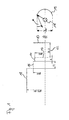
- Fig. 1 are limit curves of the projection lens housing two widespread cinema projectors (company Ernemann Cine Tec GmbH and Fa. Kinoton GmbH) as an example of typical installation conditions for projection lenses.
- outgoing from the film plane 10 can at a distance of the intersection S'F '(in Fig. 1 denoted by 12) a first lens system with a maximum rim diameter 14 of 40 mm and a total thickness of 8 mm can be arranged.
- a second lens system with a maximum rim diameter 16 of 46 mm and one Total thickness of 15 mm can be arranged.
- a third lens system can have a maximum edge diameter 17 of 70.65 mm.
- a projection lens is designed to that the lens system the installation conditions of both Manufacturer met.
- the opening angle ⁇ of the light cone of the light emitted by the light source 18 and reflected by the illumination mirror 19 is also illustrated in FIG. 1.
- the f-number k SP is defined for the illumination mirror as the ratio between the focal length f SP (not shown in FIG. 1) and the diameter D SP of the mirror.
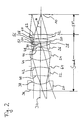
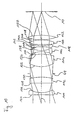
- Fig. 2 shows the basic structure of a projection lens according to a first embodiment. It is about around a projection lens with a focal length of 35 mm and a minimum f-number of 1.7.
- the optical axis is designated 34. Between the second positive lens 22 and third positive lens 24 is one Aperture 64 arranged.
- the aspheric coefficients of the surface 42 are in Tab. 2 listed.
- the specified projection lens When the iris is open, indicates the specified projection lens a f-number of 1.7. So it can be extremely high opened illumination mirrors with an opening angle up to approx. 17 ° used as a light source and used efficiently.
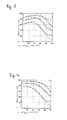
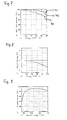
- Fig. 3 shows the resolution of the projection lens according to the first embodiment.
- the illustrated modulation transfer functions are calculated for such a curved film.
- the resolution was calculated for a color weighting equal to the corresponds to the average sensitivity of the human eye.
- Three examples were calculated: the upper two curves belong to the example with a spatial frequency of 20 line pairs per mm (LP / mm), the middle two curves to 40 LP / mm and the lower two curves to 80 LP / mm.
- the solid Line shows each the resolution of radially extending Line pairs and the dashed line the resolution of tangential running line pairs.
- the x-axis gives the relative Deviation from the center of the image to be magnified.
- the modulation transfer function is included on the y-axis a f-number k of 1.7. The picture was taken almost to infinity.
- the resolution of the projection lens according to the first embodiment corresponds to the resolution very good projection lenses.
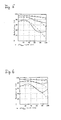
- FIGS. 4 to 6 correspond to FIG. 3.
- Fig. 7 shows the relative illuminance of the edges of the enlarged image compared with the center for the projection lens according to the first embodiment.
- the x-axis corresponds to the x-axis of FIG. 3.
- Fig. 8 shows the distortion for the projection lens according to the first embodiment in% of the deviation from the ideal picture size.
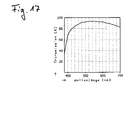
- the transmission is in% for the projection lens according to FIG. 2 for the wavelength range between 400 nm and 700 nm.
- the cinema projection lens points in visible wavelength range tolerable losses.
- the cinema projection lens according to the first embodiment has a cutting width S'F 'of 31.898 mm.
- the length Sumd of the entire projection lens is 90.647 mm.
- the sum of construction length and cutting width is thus 122.545 mm and is thus greater than 2.8 f '(98 mm) and smaller as 4.5 f '(157.5 mm).
- the condition (3) given above is so fulfilled.
- the entrance pupil is 119.87 mm to the left of the Lens surface 62, so also the condition of the location the entrance pupil is met.
- the iris 64 facing surface 130 of the lens 112 is in turn designed as an aspherical surface.
- the aspheric coefficients of this surface 130 are listed in Tab.
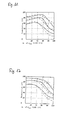
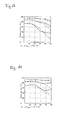
- Figures 11 to 14 correspond to Figures 3 to 6 of the first Embodiment and show the resolution of the projection lens according to the second embodiment at apertures k of 1.7, 2.0, 2.8 and 4.0.
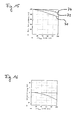
- FIGS. 15 to 17 according to the figures 7 to 9 of the first embodiment and again show the relative illuminance, the distortion and the transmission of the cinema projection lens according to the second embodiment.
- the cinema projection lens according to the second embodiment has a cutting width S'F '12 of 40.002 mm and a Overall length of 101,943 mm.
- the sum of cutting width and length is thus 141.945 mm and is therefore greater than 2,8f '(133 mm) and less than 4,5f' (213,75 mm).
- the above Condition is thus determined by the projection lens according to met the second embodiment
- the entrance pupil is located 233.521 mm to the left of the last lens surface 150, so that also by the projection lens according to the second embodiment, the condition of the position of the entrance pupil is met.
Landscapes
- Physics & Mathematics (AREA)
- General Physics & Mathematics (AREA)
- Optics & Photonics (AREA)
- Lenses (AREA)
Applications Claiming Priority (2)
| Application Number | Priority Date | Filing Date | Title |
|---|---|---|---|
| DE10356338 | 2003-11-28 | ||
| DE10356338A DE10356338B4 (de) | 2003-11-28 | 2003-11-28 | Hoch geöffnetes Weitwinkel-Kinoprojektionsobjektiv |
Related Child Applications (1)
| Application Number | Title | Priority Date | Filing Date |
|---|---|---|---|
| EP10000212.0 Division-Into | 2010-01-12 |
Publications (2)
| Publication Number | Publication Date |
|---|---|
| EP1536263A1 true EP1536263A1 (fr) | 2005-06-01 |
| EP1536263B1 EP1536263B1 (fr) | 2010-07-14 |
Family
ID=34442403
Family Applications (1)
| Application Number | Title | Priority Date | Filing Date |
|---|---|---|---|
| EP04022369A Expired - Lifetime EP1536263B1 (fr) | 2003-11-28 | 2004-09-20 | Lentille de projection grand-angulaire à grande ouverture |
Country Status (4)
| Country | Link |
|---|---|
| US (1) | US7057830B2 (fr) |
| EP (1) | EP1536263B1 (fr) |
| DE (2) | DE10356338B4 (fr) |
| ES (1) | ES2346650T3 (fr) |
Cited By (3)
| Publication number | Priority date | Publication date | Assignee | Title |
|---|---|---|---|---|
| WO2010134980A2 (fr) | 2009-05-21 | 2010-11-25 | Eastman Kodak Company | Mouvement en dehors du plan d'un élément de réduction de la granularité |
| WO2010134951A3 (fr) * | 2009-05-21 | 2011-02-17 | Eastman Kodak Company | Projection avec une surface arrondie d'élément de réduction de la granularité |
| US8172404B2 (en) | 2009-05-21 | 2012-05-08 | Eastman Kodak Company | Projection with lenslet arrangement on speckle reduction element |
Families Citing this family (21)
| Publication number | Priority date | Publication date | Assignee | Title |
|---|---|---|---|---|
| JP2010079252A (ja) * | 2008-09-01 | 2010-04-08 | Fujinon Corp | 小型投写レンズおよびこれを用いた投写型表示装置 |
| JP5253126B2 (ja) * | 2008-12-12 | 2013-07-31 | 日東光学株式会社 | レンズシステムおよび表示装置 |
| US7660048B1 (en) * | 2008-12-18 | 2010-02-09 | ZAO “Impulse” | Wide angle lens with large aperture |
| JP5480064B2 (ja) | 2010-08-19 | 2014-04-23 | 富士フイルム株式会社 | 投写用レンズおよび投写型表示装置 |
| JP5801679B2 (ja) * | 2011-10-11 | 2015-10-28 | 日東光学株式会社 | 投射用レンズシステムおよびプロジェクタ装置 |
| US9726859B1 (en) | 2014-03-16 | 2017-08-08 | Navitar Industries, Llc | Optical assembly for a wide field of view camera with low TV distortion |
| US10139595B1 (en) | 2014-03-16 | 2018-11-27 | Navitar Industries, Llc | Optical assembly for a compact wide field of view digital camera with low first lens diameter to image diagonal ratio |
| US9494772B1 (en) | 2014-03-16 | 2016-11-15 | Hyperion Development, LLC | Optical assembly for a wide field of view point action camera with low field curvature |
| US9091843B1 (en) | 2014-03-16 | 2015-07-28 | Hyperion Development, LLC | Optical assembly for a wide field of view point action camera with low track length to focal length ratio |
| US9316808B1 (en) | 2014-03-16 | 2016-04-19 | Hyperion Development, LLC | Optical assembly for a wide field of view point action camera with a low sag aspheric lens element |
| US9316820B1 (en) | 2014-03-16 | 2016-04-19 | Hyperion Development, LLC | Optical assembly for a wide field of view point action camera with low astigmatism |
| US10386604B1 (en) | 2014-03-16 | 2019-08-20 | Navitar Industries, Llc | Compact wide field of view digital camera with stray light impact suppression |
| US9995910B1 (en) | 2014-03-16 | 2018-06-12 | Navitar Industries, Llc | Optical assembly for a compact wide field of view digital camera with high MTF |
| US10545314B1 (en) | 2014-03-16 | 2020-01-28 | Navitar Industries, Llc | Optical assembly for a compact wide field of view digital camera with low lateral chromatic aberration |
| JP6278354B2 (ja) | 2014-04-15 | 2018-02-14 | 株式会社オプトロジック | 撮像レンズ |
| WO2016033743A1 (fr) * | 2014-09-03 | 2016-03-10 | 深圳市大族激光科技股份有限公司 | Objectif photographique |
| KR102279304B1 (ko) * | 2015-10-19 | 2021-07-21 | 삼성전기주식회사 | 촬상 광학계 |
| KR102662849B1 (ko) * | 2016-11-28 | 2024-05-03 | 삼성전기주식회사 | 촬상 광학계 |
| JP6811088B2 (ja) * | 2016-12-26 | 2021-01-13 | 天津欧菲光電有限公司Tianjin Ofilm Opto Electronics Co., Ltd | 撮像レンズおよび撮像装置 |
| RU2649053C1 (ru) * | 2016-12-28 | 2018-03-29 | Публичное акционерное общество "Красногорский завод им. С.А. Зверева" | Широкоугольный светосильный объектив |
| CN116047718A (zh) * | 2023-01-19 | 2023-05-02 | 诚瑞光学(苏州)有限公司 | 摄像光学镜头 |
Citations (4)
| Publication number | Priority date | Publication date | Assignee | Title |
|---|---|---|---|---|
| DE2436444A1 (de) * | 1974-07-29 | 1976-02-19 | Zeiss Carl Fa | Lichtstarkes photographisches objektiv mit grossem bildwinkel |
| EP1134606A1 (fr) * | 2000-01-18 | 2001-09-19 | Isco-Optic Gmbh | Lentille de projection |
| JP2002341242A (ja) * | 2001-05-21 | 2002-11-27 | Matsushita Electric Ind Co Ltd | 投写レンズとそれを用いたプロジェクター |
| EP1489451A1 (fr) * | 2003-06-20 | 2004-12-22 | Jos. Schneider Optische Werke GmbH | Objectif de projection à grande ouverture |
Family Cites Families (5)
| Publication number | Priority date | Publication date | Assignee | Title |
|---|---|---|---|---|
| DD245059A1 (de) | 1985-12-23 | 1987-04-22 | Zeiss Jena Veb Carl | Siebenlinsiges lichtstarkes objektiv mit korrektionsausgleich |
| DE4212067C2 (de) | 1992-04-10 | 1994-02-03 | Isco Optic Gmbh | Weitwinkelobjektiv vom Retrofokustyp |
| JP3559623B2 (ja) * | 1995-07-14 | 2004-09-02 | 富士写真光機株式会社 | 結像レンズ |
| JP2001337271A (ja) * | 2000-03-21 | 2001-12-07 | Fuji Photo Optical Co Ltd | 画像読取用レンズおよび画像読取装置 |
| DE50007705D1 (de) | 2000-12-18 | 2004-10-14 | Optische Systeme Goettingen Is | Projektionsobjektiv |
-
2003
- 2003-11-28 DE DE10356338A patent/DE10356338B4/de not_active Expired - Fee Related
-
2004
- 2004-09-20 DE DE502004011388T patent/DE502004011388D1/de not_active Expired - Lifetime
- 2004-09-20 ES ES04022369T patent/ES2346650T3/es not_active Expired - Lifetime
- 2004-09-20 EP EP04022369A patent/EP1536263B1/fr not_active Expired - Lifetime
- 2004-11-24 US US10/995,484 patent/US7057830B2/en not_active Expired - Fee Related
Patent Citations (4)
| Publication number | Priority date | Publication date | Assignee | Title |
|---|---|---|---|---|
| DE2436444A1 (de) * | 1974-07-29 | 1976-02-19 | Zeiss Carl Fa | Lichtstarkes photographisches objektiv mit grossem bildwinkel |
| EP1134606A1 (fr) * | 2000-01-18 | 2001-09-19 | Isco-Optic Gmbh | Lentille de projection |
| JP2002341242A (ja) * | 2001-05-21 | 2002-11-27 | Matsushita Electric Ind Co Ltd | 投写レンズとそれを用いたプロジェクター |
| EP1489451A1 (fr) * | 2003-06-20 | 2004-12-22 | Jos. Schneider Optische Werke GmbH | Objectif de projection à grande ouverture |
Non-Patent Citations (1)
| Title |
|---|
| PATENT ABSTRACTS OF JAPAN vol. 2003, no. 03 5 May 2003 (2003-05-05) * |
Cited By (6)
| Publication number | Priority date | Publication date | Assignee | Title |
|---|---|---|---|---|
| WO2010134980A2 (fr) | 2009-05-21 | 2010-11-25 | Eastman Kodak Company | Mouvement en dehors du plan d'un élément de réduction de la granularité |
| WO2010134951A3 (fr) * | 2009-05-21 | 2011-02-17 | Eastman Kodak Company | Projection avec une surface arrondie d'élément de réduction de la granularité |
| WO2010134980A3 (fr) * | 2009-05-21 | 2011-03-03 | Eastman Kodak Company | Mouvement en dehors du plan d'un élément de réduction de la granularité |
| US8172404B2 (en) | 2009-05-21 | 2012-05-08 | Eastman Kodak Company | Projection with lenslet arrangement on speckle reduction element |
| US8172403B2 (en) | 2009-05-21 | 2012-05-08 | Eastman Kodak Company | Projection with curved speckle reduction element surface |
| US8366281B2 (en) | 2009-05-21 | 2013-02-05 | Eastman Kodak Company | Out-of-plane motion of speckle reduction element |
Also Published As
| Publication number | Publication date |
|---|---|
| US20050117225A1 (en) | 2005-06-02 |
| ES2346650T3 (es) | 2010-10-19 |
| EP1536263B1 (fr) | 2010-07-14 |
| DE10356338B4 (de) | 2006-02-23 |
| DE10356338A1 (de) | 2005-07-14 |
| US7057830B2 (en) | 2006-06-06 |
| DE502004011388D1 (de) | 2010-08-26 |
Similar Documents
| Publication | Publication Date | Title |
|---|---|---|
| EP1536263B1 (fr) | Lentille de projection grand-angulaire à grande ouverture | |
| DE102019009255B3 (de) | Optisches System und Bildaufnahmegerät | |
| EP2535751B1 (fr) | Objectif de caméra | |
| DE102010035034B3 (de) | Hoch geöffnetes Weitwinkelobjektiv | |
| DE102015119973B4 (de) | Zoomlinse und Bildprojektionsgerät | |
| DE19529673C2 (de) | Projektionsobjektiv und Projektor | |
| EP1987386A2 (fr) | Système optique de ciné-projection numérique | |
| DE19755565A1 (de) | Linsenanordnungssystem | |
| DE102016223429A1 (de) | Abbildungsobjektiv und Abbildungsvorrichtung | |
| DE102015113661A1 (de) | Optisches system und optische vorrichtung | |
| DE102016223427A1 (de) | Abbildungsobjektiv und Abbildungsvorrichtung | |
| DE102018127743B4 (de) | Optiksystem und Abbildungsgerät | |
| DE2739488B2 (de) | Fotografisches Weitwinkelobjektiv | |
| DE4041240C2 (de) | Projektionsobjektiv | |
| DE602004010560T2 (de) | Optisches Projektionssystem mit variablem Projektionswinkel | |
| DE112011102792T5 (de) | Projektionsanzeigeeinrichtung | |
| DE10328094B4 (de) | Hoch geöffnetes Projektionsobjektiv | |
| DE102016125402B4 (de) | Kompaktes Kameraobjektiv höchster Abbildungsgüte für eine Kamera mit Vollformatsensor, Verwendung eines solchen Kameraobjektivs und Foto- oder Filmkamera mit einem solchen Kameraobjektiv | |
| DE4344289C2 (de) | Projektionsobjektiv | |
| DE60122062T2 (de) | Objektiv mit zwei asphärischen Linsen | |
| DE60025661T2 (de) | Weitwinkeliges katoptrisches System | |
| DE4401364B4 (de) | Reellbildsucher | |
| DE10353563B4 (de) | Projetionsobjektiv für die Projektion digitaler Bilddaten | |
| DE102015103707A1 (de) | Projektionsobjektiv und Projektionstyp-Anzeigevorrichtung | |
| DE102023107006A1 (de) | Optisches System und Bildaufnahmegerät mit dem optischen System |
Legal Events
| Date | Code | Title | Description |
|---|---|---|---|
| PUAI | Public reference made under article 153(3) epc to a published international application that has entered the european phase |
Free format text: ORIGINAL CODE: 0009012 |
|
| AK | Designated contracting states |
Kind code of ref document: A1 Designated state(s): AT BE BG CH CY CZ DE DK EE ES FI FR GB GR HU IE IT LI LU MC NL PL PT RO SE SI SK TR |
|
| AX | Request for extension of the european patent |
Extension state: AL HR LT LV MK |
|
| 17P | Request for examination filed |
Effective date: 20050530 |
|
| AKX | Designation fees paid |
Designated state(s): DE ES FR GB IT |
|
| 17Q | First examination report despatched |
Effective date: 20051019 |
|
| GRAP | Despatch of communication of intention to grant a patent |
Free format text: ORIGINAL CODE: EPIDOSNIGR1 |
|
| GRAS | Grant fee paid |
Free format text: ORIGINAL CODE: EPIDOSNIGR3 |
|
| GRAA | (expected) grant |
Free format text: ORIGINAL CODE: 0009210 |
|
| AK | Designated contracting states |
Kind code of ref document: B1 Designated state(s): DE ES FR GB IT |
|
| REG | Reference to a national code |
Ref country code: GB Ref legal event code: FG4D Free format text: NOT ENGLISH |
|
| REF | Corresponds to: |
Ref document number: 502004011388 Country of ref document: DE Date of ref document: 20100826 Kind code of ref document: P |
|
| REG | Reference to a national code |
Ref country code: ES Ref legal event code: FG2A Ref document number: 2346650 Country of ref document: ES Kind code of ref document: T3 |
|
| PLBE | No opposition filed within time limit |
Free format text: ORIGINAL CODE: 0009261 |
|
| STAA | Information on the status of an ep patent application or granted ep patent |
Free format text: STATUS: NO OPPOSITION FILED WITHIN TIME LIMIT |
|
| 26N | No opposition filed |
Effective date: 20110415 |
|
| REG | Reference to a national code |
Ref country code: DE Ref legal event code: R097 Ref document number: 502004011388 Country of ref document: DE Effective date: 20110415 |
|
| PGFP | Annual fee paid to national office [announced via postgrant information from national office to epo] |
Ref country code: GB Payment date: 20120920 Year of fee payment: 9 |
|
| PGFP | Annual fee paid to national office [announced via postgrant information from national office to epo] |
Ref country code: DE Payment date: 20120927 Year of fee payment: 9 Ref country code: ES Payment date: 20120924 Year of fee payment: 9 Ref country code: IT Payment date: 20120925 Year of fee payment: 9 |
|
| PGFP | Annual fee paid to national office [announced via postgrant information from national office to epo] |
Ref country code: FR Payment date: 20121008 Year of fee payment: 9 |
|
| GBPC | Gb: european patent ceased through non-payment of renewal fee |
Effective date: 20130920 |
|
| REG | Reference to a national code |
Ref country code: DE Ref legal event code: R119 Ref document number: 502004011388 Country of ref document: DE Effective date: 20140401 |
|
| REG | Reference to a national code |
Ref country code: FR Ref legal event code: ST Effective date: 20140530 |
|
| PG25 | Lapsed in a contracting state [announced via postgrant information from national office to epo] |
Ref country code: GB Free format text: LAPSE BECAUSE OF NON-PAYMENT OF DUE FEES Effective date: 20130920 |
|
| PG25 | Lapsed in a contracting state [announced via postgrant information from national office to epo] |
Ref country code: IT Free format text: LAPSE BECAUSE OF NON-PAYMENT OF DUE FEES Effective date: 20130920 Ref country code: FR Free format text: LAPSE BECAUSE OF NON-PAYMENT OF DUE FEES Effective date: 20130930 Ref country code: DE Free format text: LAPSE BECAUSE OF NON-PAYMENT OF DUE FEES Effective date: 20140401 |
|
| REG | Reference to a national code |
Ref country code: ES Ref legal event code: FD2A Effective date: 20150428 |
|
| PG25 | Lapsed in a contracting state [announced via postgrant information from national office to epo] |
Ref country code: ES Free format text: LAPSE BECAUSE OF NON-PAYMENT OF DUE FEES Effective date: 20130921 |