EP1536329B1 - Konfigurations und Optionsaktualisierung in einer Machine nach Einführung - Google Patents
Konfigurations und Optionsaktualisierung in einer Machine nach Einführung Download PDFInfo
- Publication number
- EP1536329B1 EP1536329B1 EP04254490.8A EP04254490A EP1536329B1 EP 1536329 B1 EP1536329 B1 EP 1536329B1 EP 04254490 A EP04254490 A EP 04254490A EP 1536329 B1 EP1536329 B1 EP 1536329B1
- Authority
- EP
- European Patent Office
- Prior art keywords
- machine
- memory
- sok
- option code
- region
- Prior art date
- Legal status (The legal status is an assumption and is not a legal conclusion. Google has not performed a legal analysis and makes no representation as to the accuracy of the status listed.)
- Expired - Lifetime
Links
Images



Classifications
-
- G—PHYSICS
- G06—COMPUTING OR CALCULATING; COUNTING
- G06F—ELECTRIC DIGITAL DATA PROCESSING
- G06F21/00—Security arrangements for protecting computers, components thereof, programs or data against unauthorised activity
- G06F21/50—Monitoring users, programs or devices to maintain the integrity of platforms, e.g. of processors, firmware or operating systems
- G06F21/57—Certifying or maintaining trusted computer platforms, e.g. secure boots or power-downs, version controls, system software checks, secure updates or assessing vulnerabilities
- G06F21/575—Secure boot
-
- H—ELECTRICITY
- H04—ELECTRIC COMMUNICATION TECHNIQUE
- H04N—PICTORIAL COMMUNICATION, e.g. TELEVISION
- H04N1/00—Scanning, transmission or reproduction of documents or the like, e.g. facsimile transmission; Details thereof
Definitions
- the present invention relates generally to the updating of machine options.
- the invention relates to the upgrade of printer and copier machine option features and capabilities.
- the invention relates in particular with regards to a machine controller, wireless controller support memory units, and wireless enabling keys.
- a common business model is to manufacture a single base "platform" in hardware, and then use the software controls over the hardware to provide a set of distinctly different products.
- this may include both software controlled operational upgrades as well as software controlled hardware upgrades.
- ppm pages per minute
- a basic hardware platform capable of outputting 40 pages per minute (ppm) can be slowed down to output pages at 30 ppm or even 20 ppm, purely by altering the control software which operates the identical hardware.
- Typical techniques for slowing down a basic hardware platform include simply running the various electric motors at slower speeds, or deliberately skipping an operational cycle (not feeding a print sheet, and withholding image data) for one or more of a given number of hardware cycles.
- the advantages of this business model include the desirability of selling different speed-rated machines at different prices to meet market demands, and also the ability to speed up a slowed-down machine (such as by loading in new software) should an existing customer decide he wants a faster machine. Also, in a re-manufacturing environment, it is useful to be able to minimize the number of hardware configurations that must be processed.
- Machines sold, installed, and serviced will typically require either customer interaction or service representative intervention to enable some or all of the possible software and hardware features. This may be carried out either by a service representative at the time of install or on a subsequent service call. In the latter case it usually requires some sort of password and enablement key. This is typically obtained by the service representative and is then entered into the machine via a GUI or some service tool. Alternatively, customers are required to interact with the manufacturer either over the phone or through the web to get the desired options enabled. As a consequence for either of the above scenarios, there is a burden on the manufacturer's support infrastructure to obtain needed information from the customer and ensure that the customer receives all they are entitled to.
- United States Patent Application Publication No. 2002/0094207 A1 describes the use of a removable module in a printer or copier.
- the module has a "customer replaceable unit monitor” (CRUM) permanently associated with it.
- CRUM customer replaceable unit monitor
- the present invention relates to a method for managing a machine that is configured with multiple operation options that can be selectively enabled comprising:
- the present invention also relates to a (printing) machine that is configured with multiple operation options that can be selectively enabled comprising:
- EEPROM Electrical Erasable Programmable Read Only Memory
- NVM non-volatile memory
- SOK system operation key
- various problems associated with machine option configuration and updates may be accommodated. Examples of these options may include but are not limited to: device/machine speed; machine stand alone mode, or network connected mode, market segment configuration, scanning enabled; scan to email; scan to Internet Fax; network server Fax enabled; job based accounting; hard disk overwrite; immediate job overwrite; etc.
- SOK install the identity of the machine is written to the NVM, i.e. the machine serial number. This is performed during initial machine power up or reboot sequence.
- the machine will check to ensure no tampering has taken place and that the machine identity and the NVM serial number location data match.
- a new swapped in SOK can be installed so long as the NVM serial number location has not been previously written to with a conflicting identification number. The machine would then write the serial number to the new SOK, thereby protecting it.
- Each SOK can enable different options, which will allow different machines to be configured however they need to be.
- a customer can add options at a later time by receiving a SOK that would enable the desired additional feature or features, and installing it into the machine.
- the number of SOKs that can be installed is limited by the number of interface sockets provided on the machine. Further, by providing a wireless enabled SOK, several customer deployment logistics may be greatly ameliorated, much to the betterment of any ultimate customer satisfaction.
- FIG. 1 is a simplified systems diagram showing essential elements of office equipment, such as a digital ink-jet or "laser” printer, relevant to the present invention.
- the printer 10 (which, for purposes of the claims below, could be a device such as a fax machine; digital or light-lens copier; or part of a multifunction office device) includes what is here called a marker 12, which should generally be considered the set of hardware which operates to place marks on a sheet.
- the marker 12 could include a xerographic engine, an ink-jet printhead, thermal printer elements, etc.
- Print sheets drawn from a stack 14 are caused to move through or past marker 12 to receive marks thereon representing an image desired to be printed.
- the basic hardware forming marker 12 is in turn controlled by software, which is embodied by a control system generally indicated as 16.
- the control 16 includes any number of data-processing hardware circuits combined with suitable software for controlling the marker so as to output desired images.
- the control 16 can thus include a raster image processor, a facsimile capability, or even means for operating the light-lens hardware in a copier.
- control 16 can interact with a network connection 18, through which can be received not only image data but control data instructing the printer 10 to operate in a particular manner.
- control 16 also associated with control 16 are a user interface UI 20, and bustle 200 with a SOK 210 comprising non-volatile memory (NVM) 22.
- the SOK 210 may be one of any number of memories associated with bustle 200 and control 16, but the significance of the particular SOK 210 and NVM 22 in the invention is that it should include thereon, at a predetermined location in memory that can be found by control 16, specific code data as will be described in detail below. What is important is that, in the course of the operation of machine 10, the control 16 at one point or another reads a certain amount of code data from NVM 22, and based on what is read in the NVM 22, determines in one embodiment whether to operate marker 12 at one selected speed or another speed.
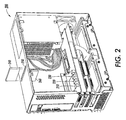
- FIG 2 there is depicted a perspective view of the bustle 200.
- SOK 210 Located within bustle 200 is SOK 210.
- the bustle may also include the controller 16 as well as a power supply or any number of other circuit blocks.
- Wireless SOK 240 is slipped into bustle 200 via a slot 250 so as to be in sufficiently close placement with wireless transceiver card 260.
- a multiplicity of SOKs allows for a greater number of possible options to be configured. In this embodiment there is no requirement that any SOK be present since the machine will simply default to some base configuration in the absence of a SOK.
- An alternative embodiment may require at least one SOK to be present.
- SOK 210 is comprised of NVM 22.
- a SOK may be comprised of additional elements besides memory as for example a power supply, off board drivers, socket hardware, level shifting circuits, interface hardware or as described below wireless communication circuits.
- SOK 210 is comprised solely of NVM 22.
- SOK 22 is embodied as a CRUM.
- NVM 22 is provided for in the form of an EEPROM (Electrically Erasable Programmable Read Only Memory).
- the memory 22 is preferably of a non-volatile type of memory such as the EEPROM just mentioned above.
- EEPROM Electrical Erasable Programmable Read Only Memory
- ROM Read Only Memory
- SOK Compact Only Memory
- ROM Read Only Memory
- the combination may for all practical purposes effect a non-volatile memory as far as the useful life of the SOK is concerned.
- FIG. 3 shown is a flow chart for a methodology incorporating the software option key into the machine boot-up sequence.
- the boot sequence 300 is invoked. First a poll 302 is executed to determine if there are one or more SOKs installed. If the determination 304 is made that there are no SOK present then the branch condition is to jump to step 306 and continue the normal reboot sequence. If however, a SOK is found resident access step 308 is made of the address location in the SOK containing the identification number. In a new SOK this one-time programmable serial number region is supplied initially blank. Determination 310 is made of whether there is a identification number or not burned into the NVM of the SOK.
- the conditional branch 312 is executed and the unique host machine serial number is written into the SOK. Access 314 is subsequently made of the option code(s) in the SOK. However, if a identification number is found determination 316 is made to compare the identification number to the host machine serial number. If there is no match the 318 instruction is invoked the SOK is ignored, a fault will be logged, and the routine branched to step 306 to continue the normal reboot sequence. As will be understood by one skilled in the art, an alternative embodiment may be to flag the presence of the non-matching SOK as an error to the UI 20, or refuse to complete boot-up until the SOK is removed. In the more typically expected event of a match being found access 314 is made of the SOK to find the prescribed option codes. The machine is then set 320 to a configuration as per the just read in option code. With that complete, the reboot sequence 306 may be continued.
- the controller 16 may also be provided with code which continually polls for the swapping of a SOK. In an alternative apparent to one skilled in the art, the controller 16 may respond instead to an interrupt from the swapping of a SOK. In either case upon determination of a swapped, or new SOK, the controller 16 shall poll the SOK and its NVM 22 for indication of option updates or any new system configuration to invoke.
- FIG 4 is a simplified view showing the essential elements of a SOK which is operable through wireless means, according to the present invention.
- the SOK is preferably provided as a badge, plate, or card 240; a portion of which is shown in Figure 4 .
- a SOK requires some sort of wireless interface, such as the RF loop indicated as 430 in Figure 4 (along with, of course, associated circuitry, the nature of which would be apparent to one of skill in the art), although other wireless interfaces, such as an infrared detector, ultrasound detector, or some other optical coupling, could be provided.
- the RF loop 430 which is sensitive to RF signals of a predetermined frequency, is associated with a chip 432.
- this chip 432 includes circuitry which acts as an interface between the RF loop 430 and non-volatile memory 22.
- the non-volatile memory 22 could be disposed within the chip 432, but is here shown separately for purposes of clarity.
- the loop 430 can be formed as an etched loop aerial as part of the circuit board forming the SOK.
- Chip 432 may also have associated therewith a power supply 436, the exact nature of which will depend on a specific design.
- chip 432 includes circuitry for recognizing and processing wireless signals of a particular type which may be detected on loop 430.
- the chip 432 may further be provided with a "hard wire" interface 438, which could be adapted to interact with circuitry within the printer 10.
- the non-volatile memory 22 includes predetermined locations therein for a module serial number, print counts (for the cumulative use of the module and/or a maximum allowed number of prints to be made with the module), re-manufacturing date and option code, including unwritten locations as needed, such as according to the descriptions of SOK functions noted above.
- the wireless operation of a SOK can work in different ways.
- the detection of a suitable wireless signal on loop 430 by chip 432 causes the chip 432 to read out all data relating to the SOK which are stored in non-volatile memory 22 at any given time.
- This data from memory 22 can either be broadcast back through loops 430 by wireless means (if such a transmission means is provided, such as within chip 432) or alternately, can be read out through hard wire interface 438 to, for example, CPU 16.
- this information can be a sent from CPU 16 to a user interface 20 and/or sent to a computer over a local area network 18.
- Another type of wireless operation of a SOK is to have an initially detected wireless signal cause chip 432 to make memory 22 to enter a "write mode".
- the initial wireless contact such as a wireless signal of a predetermined type, which activates the chip 432 while causing the chip 432 to expect another wireless data stream through loop 430 within a predetermined time frame.
- This incoming wireless data can then be used to populate specific locations in the memory 22, such as to reset different performance data parameters within the memory.
- an initial wireless signal could be used to reset the various print counts in the memory to go back to zero or to some other predetermined number.
- wireless means are used to change data in memory 22, it may be desirable to recognize that certain data within the memory 22 associated with a particular model should never be changed. For instance, it may be important that the serial number or master print count of the module is never changed, no matter how often the module is remanufactured. Alternately, if some specific re-manufacturing actions are taken on a module, it may be necessary to change only one of the parameters in memory while leaving the various print counts intact. In such cases, it may be desirable to provide a system in which a special "leave unchanged" code is read into a particular location in memory 22, this special code being interpreted by chip 432 as an instruction to leave whenever data is in that particular location in memory 22 unchanged.
- certain data can go in or out of the SOK through loop 430 or alternately through hard wire interface 438.
- the wireless operation of the various SOK may be on a very simple level, such that the detection of a suitable wireless signal on 430 can simply "unlock" the non-volatile memory 22 for writing therein, although the actual writing to memory 22 may take place through hard wire interface 438.
- basic principles of wireless controls of electromechanical and electronic devices, such as garage doors and televisions are well known. The general principles of operating a wireless SOK are readily adapted from these arts in view of the present specification. As described in U.S. Patent No.
- FIG. 5 is a simplified view showing how a SOK such as 240 disposed within a signal-transmissive (for instance, cardboard) package 500 can be accessed and operated by wireless means.
- a device 524 which emits the suitable RF or infrared radiation, can be used to write relevant data into memory 22 of the SOK 240.
- Such data may be of a time sensitive variety, such as the date a particular package module is mailed to an end user: in such a case, it may be desirable to have the module itself prepackaged and write the date of mailing to memory 22 just as the package 500 is going out the door.
- machine option codes may be provided consonant with the target customers request for a given machine configuration upgrade.
- special codes can be read into memory 22 representing, for example, the identity of the end user intended to receive the module in the mail, or a particular service contract number under which the packaged module is sent. Because of the wireless nature of writing into memory 22, a supply of modules, already in packages 500, can be retained in a warehouse and written into with relevant information only as they are sent to end users.
- Another possibility is to package different SOK 240, and have a bar code reader, such as 502, or equivalent device, read markings on the package 500, and then cause a device 524 to write data relating to the bar code data into memory 22 by wireless means.
- the bar code reader 502 could read a bar code on the outer surface of package 500 representative of the addressee of the package, and cause device 524 to write a code identifying the address into memory 22.
- the SOK is capable of broadcasting back information and memory 22 by wireless means as well
- the particular SOK 240 within package 500 could be queried by wireless means just as it is being sent to a user, and this information recorded, so that a vendor could know exactly which SOK, identified by serial number, were sent to what addressee on any particular day.
- Another possibility is to determine the serial number of a module within a package 500 by wireless means, and then have a bar code writer print a code relating to the serial number on a label to be attached to the package 500.
- Another feature enabled by the use of wireless communication would be the use of one transmitter/receiver within the machine being able to communicate with multiple SOK used within the machine. This would provide a cost saving, as multiple harnesses for each device would not be needed.
Landscapes
- Engineering & Computer Science (AREA)
- Computer Hardware Design (AREA)
- General Engineering & Computer Science (AREA)
- Computer Security & Cryptography (AREA)
- Software Systems (AREA)
- Theoretical Computer Science (AREA)
- General Physics & Mathematics (AREA)
- Physics & Mathematics (AREA)
- Multimedia (AREA)
- Signal Processing (AREA)
- Accessory Devices And Overall Control Thereof (AREA)
- Mobile Radio Communication Systems (AREA)
- Storage Device Security (AREA)
Claims (9)
- Verfahren zum Verwalten einer Maschine die mit mehreren Betriebsoptionen konfiguriert ist, die wahlweise aktiviert werden können, umfassend:Vorsehen eines Software-Betriebsschlüssels (204), der von der Maschine getrennt werden kann, wobei der Software-Betriebsschlüssel weiterhin eine drahtlose Schnittstelle (430) umfasst, und eines Speichers (22), wobei der Speicher weiterhin einen programmierbaren serielle Bereich und einen Optionscode umfasst, wobei der Optionscode verwendet werden kann, um die Maschine anzuweisen, in einer bestimmten Konfiguration betrieben zu werden,Platzieren des Software-Betriebsschlüssels (204) in der Maschine,dadurch gekennzeichnet, dass das Verfahren umfasst:Bestimmen, dass wenigstens ein Software-Betriebsschlüssel vorhanden ist,Lesen, über die drahtlose Schnittstelle (430), des programmierbaren seriellen Bereichs des Speichers und, wenn dieser leer gefunden wird, Initialisieren desselben mit einer Maschinenidentifikationsnummer,Vergleichen des Inhalts des programmierbaren seriellen Bereichs, wenn dieser nicht leer ist, mit der Maschinenidentifikationsnummer,wobei, wenn der Inhalt des programmierbaren seriellen Bereichs nicht mit der Maschinenidentifikationsnummer übereinstimmt, Betreiben der Maschine gemäß einer Standardkonfiguration, und
wenn der Inhalt des programmierbaren seriellen Bereichs mit der Maschinenidentifikationsnummer übereinstimmt, Lesen des Speichers (22) über die drahtlose Schnittstelle (430) und Platzieren des Optionscodes in der Maschine, und
Betreiben der Maschine gemäß dem Optionscode. - Verfahren nach Anspruch 1, wobei die Maschine eine Druckvorrichtung oder ein Multifunktions-Bürogerät ist.
- Verfahren nach Anspruch 1 oder 2, wobei der Software-Betriebsschlüssel ein CRUM (Customer Replacement Unit Monitor) ist.
- Verfahren nach einem der Ansprüche 1 bis 3, wobei die Maschinenidentifikationsnummer die Maschinenseriennummer ist.
- Maschine, die mit mehreren Betriebsoptionen konfiguriert ist, die wahlweise aktiviert werden können, umfassend:einen Softwarebetriebsschlüssel (204) zum Setzen der Optionskonfiguration einer Maschine, die mit mehreren Betriebsoptionen konfiguriert ist, die wahlweise aktiviert werden können, wobei der Schlüssel von der Maschine getrennt werden kann, umfassend:dadurch gekennzeichnet, dass die Maschine umfasst:eine drahtlose Schnittstelle (430),einen Speicher (22), wobei der Speicher wenigstens aufweist:einen Optionscodebereich, undeinen einmalig programmierbaren seriellen Bereich, undeinen Optionscode, der in den Optionscodebereich des Speichers geschrieben wird und, wenn auf ihn über die drahtlose Schnittstelle (430) zugegriffen wird, geeignet ist, um die Maschine für einen Betrieb in einer bestimmten Konfiguration anzuweisen,ein Steuersystem (16), das bestimmt, dass wenigstens ein Softwarebetriebsschlüssel vorhanden ist, und auf den einmalig programmierbaren seriellen Bereich des Speichers (22) über die drahtlose Schnittstelle (430) zugreift und dadurch bestimmt, ob der Softwarebetriebsschlüssel für das Konfigurieren der Maschine verwendet werden soll.
- Maschine nach Anspruch 5, wobei der einmalig programmierbare serielle Bereich einen in denselben geschriebenen Maschinenidentifizierer aufweist.
- Druckmaschine nach Anspruch 5 oder 6.
- Druckmaschine nach Anspruch 7, wobei der nicht-flüchtige Speicher ein CRUM (Customer Replacement Unit Monitor) ist.
- Druckmaschine nach Anspruch 7 oder 8, wobei der Optionscode die Druckmaschine anweist, als ein Scanner und/oder ein Scan-to-Email-Modus und/oder ein Scan-to-Internetfax-Modus und/oder für einen schnelleren Betrieb und/oder für eine Job-basierte Buchhaltung konfiguriert zu werden.
Applications Claiming Priority (2)
| Application Number | Priority Date | Filing Date | Title |
|---|---|---|---|
| US630048 | 1996-04-09 | ||
| US10/630,048 US7197633B2 (en) | 2003-07-30 | 2003-07-30 | Wireless machine post-launch configuration and option upgrade |
Publications (3)
| Publication Number | Publication Date |
|---|---|
| EP1536329A2 EP1536329A2 (de) | 2005-06-01 |
| EP1536329A3 EP1536329A3 (de) | 2006-03-29 |
| EP1536329B1 true EP1536329B1 (de) | 2016-10-19 |
Family
ID=34103750
Family Applications (1)
| Application Number | Title | Priority Date | Filing Date |
|---|---|---|---|
| EP04254490.8A Expired - Lifetime EP1536329B1 (de) | 2003-07-30 | 2004-07-27 | Konfigurations und Optionsaktualisierung in einer Machine nach Einführung |
Country Status (5)
| Country | Link |
|---|---|
| US (1) | US7197633B2 (de) |
| EP (1) | EP1536329B1 (de) |
| JP (1) | JP2005047277A (de) |
| CN (1) | CN100507822C (de) |
| MX (1) | MXPA04007207A (de) |
Families Citing this family (11)
| Publication number | Priority date | Publication date | Assignee | Title |
|---|---|---|---|---|
| US7761921B2 (en) * | 2003-10-31 | 2010-07-20 | Caterpillar Inc | Method and system of enabling a software option on a remote machine |
| US20060082815A1 (en) * | 2004-10-14 | 2006-04-20 | Walker Ray A | Transceiver controlling a plurality of antennas for communication with wireless memory devices in a printing system |
| US7307531B2 (en) * | 2005-05-20 | 2007-12-11 | Xerox Corporation | Coupler board for wireless communication with multiple memory devices |
| US7840998B2 (en) * | 2005-05-20 | 2010-11-23 | Xerox Corporation | System and method for authentication of replaceable modules |
| US8150037B2 (en) | 2007-02-20 | 2012-04-03 | Carnegie Mellon University | Apparatus and method for secure, user-friendly deployment of information |
| KR100997239B1 (ko) * | 2008-03-03 | 2010-11-29 | 삼성전자주식회사 | Crum 유닛, 교체가능유닛 및 이를 이용하는 화상형성장치와, 그 인증 및 암호화 데이터 통신 방법 |
| US8131169B2 (en) * | 2008-06-06 | 2012-03-06 | Xerox Corporation | Apparatus and method for mounting an RF monitoring device onto a fuser roll |
| US8090273B2 (en) * | 2008-10-20 | 2012-01-03 | Xerox Corporation | Custom application fuser roller system |
| TW201104451A (en) * | 2009-07-29 | 2011-02-01 | Inventec Corp | Method for detecting a node of a server device |
| KR101924022B1 (ko) | 2012-04-03 | 2019-02-22 | 삼성전자주식회사 | 메모리 시스템 및 그것의 페이지 교체 방법 |
| US9317009B2 (en) * | 2014-02-19 | 2016-04-19 | Xerox Corporation | Systems and methods for mounting an externally readable monitoring module on a rotating customer replaceable component in an operating device |
Citations (1)
| Publication number | Priority date | Publication date | Assignee | Title |
|---|---|---|---|---|
| US20020094207A1 (en) * | 2000-06-26 | 2002-07-18 | Xerox Corporation | Wireless interaction with memory associated with a replaceable module for office equipment |
Family Cites Families (16)
| Publication number | Priority date | Publication date | Assignee | Title |
|---|---|---|---|---|
| US4496237A (en) | 1982-08-09 | 1985-01-29 | Xerox Corporation | Consumable status display |
| US4961088A (en) | 1989-04-20 | 1990-10-02 | Xerox Corporation | Monitor/warranty system for electrostatographic reproducing machines using replaceable cartridges |
| JPH08328427A (ja) * | 1995-05-31 | 1996-12-13 | Toshiba Corp | 画像形成装置 |
| TW307071B (en) | 1996-03-05 | 1997-06-01 | Microchip Tech Inc | Method and apparatus useful in electronic encoders having a voltage level detection circuit |
| US6088450A (en) | 1996-04-17 | 2000-07-11 | Intel Corporation | Authentication system based on periodic challenge/response protocol |
| FR2778768B1 (fr) | 1998-05-14 | 2000-07-28 | Sagem | Procede de personnalisation d'une carte a puce |
| US6563600B1 (en) | 1999-08-30 | 2003-05-13 | Xerox Corporation | System for enabling a printing apparatus to operate at multiple selectable speeds |
| JP4080698B2 (ja) * | 2001-01-22 | 2008-04-23 | 株式会社リコー | 画像形成装置、画像形成装置の制御方法およびその方法をコンピュータに実行させるためのプログラム |
| JP4242572B2 (ja) * | 2001-02-15 | 2009-03-25 | 株式会社リコー | 画像形成装置 |
| JP2002259151A (ja) * | 2001-03-06 | 2002-09-13 | Ricoh Co Ltd | 通信装置 |
| JP2002268843A (ja) * | 2001-03-13 | 2002-09-20 | Konica Corp | 画像形成装置の制御プログラム更新システム、画像形成装置及びハードディスク記憶装置 |
| JP2003140841A (ja) * | 2001-11-05 | 2003-05-16 | Canon Inc | プログラム書き換え方法及び画像処理システム |
| US20030215248A1 (en) * | 2002-05-17 | 2003-11-20 | Xerox Corporation | Machine post-launch process optimization through customer replaceable unit memory programming |
| US6735399B2 (en) * | 2002-05-17 | 2004-05-11 | Xerox Corporation | Post-launch process optimization of replaceable sub-assembly utilization through customer replaceable unit memory programming |
| US7321966B2 (en) * | 2003-05-29 | 2008-01-22 | Xerox Corporation | Machine post-launch configuration and option upgrade |
| US7334261B2 (en) * | 2003-07-30 | 2008-02-19 | Xerox Corporation | Machine post-launch configuration and option upgrade with master key |
-
2003
- 2003-07-30 US US10/630,048 patent/US7197633B2/en not_active Expired - Fee Related
-
2004
- 2004-07-26 MX MXPA04007207A patent/MXPA04007207A/es active IP Right Grant
- 2004-07-27 EP EP04254490.8A patent/EP1536329B1/de not_active Expired - Lifetime
- 2004-07-28 JP JP2004220697A patent/JP2005047277A/ja active Pending
- 2004-07-30 CN CNB2004100559553A patent/CN100507822C/zh not_active Expired - Fee Related
Patent Citations (1)
| Publication number | Priority date | Publication date | Assignee | Title |
|---|---|---|---|---|
| US20020094207A1 (en) * | 2000-06-26 | 2002-07-18 | Xerox Corporation | Wireless interaction with memory associated with a replaceable module for office equipment |
Also Published As
| Publication number | Publication date |
|---|---|
| US7197633B2 (en) | 2007-03-27 |
| EP1536329A2 (de) | 2005-06-01 |
| MXPA04007207A (es) | 2005-03-31 |
| EP1536329A3 (de) | 2006-03-29 |
| CN1577238A (zh) | 2005-02-09 |
| US20050028100A1 (en) | 2005-02-03 |
| JP2005047277A (ja) | 2005-02-24 |
| CN100507822C (zh) | 2009-07-01 |
Similar Documents
| Publication | Publication Date | Title |
|---|---|---|
| US6865349B2 (en) | Machine post-launch process optimization through wireless connected customer replaceable unit memory | |
| US6532351B2 (en) | Wireless interaction with memory associated with a replaceable module for office equipment | |
| JP4273724B2 (ja) | 消耗品不正使用防止システム | |
| US8281983B2 (en) | Method and apparatus for storing and verifying serial numbers using smart labels in an image production device | |
| EP1536329B1 (de) | Konfigurations und Optionsaktualisierung in einer Machine nach Einführung | |
| JP2000246921A (ja) | 収納容器及び管理システム | |
| US8032037B2 (en) | Image forming apparatus, computer program product, and printing inhibiting method | |
| JP2002202697A (ja) | 純正品判別方法、それに用いられる交換部品、純正品管理装置、純正品対応装置、純正品管理ネットワークシステム並びに純正品判別方法を実行するプログラムを記録したコンピュータ読み取り可能な記録媒体 | |
| US7594115B2 (en) | Contents information output system and contents information output method | |
| JP3902928B2 (ja) | 画像処理装置、情報処理装置、発注方法、発注処理方法、並びに記憶媒体及びプログラム | |
| EP1739538B1 (de) | Vorrichtung zur Annahme einer Operationsanfrage und Steuerverfahren dafür, Kommunikationssystem und Betriebsverfahren dafür, computerlesbares Programm und computerlesbares Speichermedium | |
| JP2008176345A (ja) | 消耗品不正使用防止システム | |
| EP1503268B1 (de) | Konfiguration und wahlweise Aufwertung nach Inbetriebnahme eines Geräts unter Verwendung eines Hauptschlüssels | |
| US6563600B1 (en) | System for enabling a printing apparatus to operate at multiple selectable speeds | |
| US7321966B2 (en) | Machine post-launch configuration and option upgrade | |
| JP4265383B2 (ja) | 画像形成装置及びデータ読み出し書き込み方法 | |
| US7307531B2 (en) | Coupler board for wireless communication with multiple memory devices | |
| JP3890271B2 (ja) | 画像処理装置、画像処理装置の発注方法、プログラム及び記憶媒体 | |
| US11252297B2 (en) | System and method for using a non-contact memory tag to detect fraudulent use of printing devices | |
| US20180220044A1 (en) | Systems and methods for preventing unauthorized usage and movement of electronic components from one device to another device | |
| JP2020166335A (ja) | カード発行装置 | |
| JP2023125499A (ja) | 画像形成装置及び初期化方法 | |
| US20210281694A1 (en) | Printing device including a non-contact memory tag to detect fraudulent use thereof |
Legal Events
| Date | Code | Title | Description |
|---|---|---|---|
| PUAI | Public reference made under article 153(3) epc to a published international application that has entered the european phase |
Free format text: ORIGINAL CODE: 0009012 |
|
| AK | Designated contracting states |
Kind code of ref document: A2 Designated state(s): AT BE BG CH CY CZ DE DK EE ES FI FR GB GR HU IE IT LI LU MC NL PL PT RO SE SI SK TR |
|
| AX | Request for extension of the european patent |
Extension state: AL HR LT LV MK |
|
| PUAL | Search report despatched |
Free format text: ORIGINAL CODE: 0009013 |
|
| AK | Designated contracting states |
Kind code of ref document: A3 Designated state(s): AT BE BG CH CY CZ DE DK EE ES FI FR GB GR HU IE IT LI LU MC NL PL PT RO SE SI SK TR |
|
| AX | Request for extension of the european patent |
Extension state: AL HR LT LV MK |
|
| 17P | Request for examination filed |
Effective date: 20060929 |
|
| AKX | Designation fees paid |
Designated state(s): DE FR GB |
|
| 17Q | First examination report despatched |
Effective date: 20061106 |
|
| RIC1 | Information provided on ipc code assigned before grant |
Ipc: G06F 3/12 20060101ALI20160412BHEP Ipc: G06F 9/44 20060101AFI20160412BHEP Ipc: G06F 21/57 20130101ALN20160412BHEP |
|
| RIC1 | Information provided on ipc code assigned before grant |
Ipc: G06F 3/12 20060101ALI20160415BHEP Ipc: G06F 21/57 20130101ALN20160415BHEP Ipc: G06F 9/44 20060101AFI20160415BHEP |
|
| GRAP | Despatch of communication of intention to grant a patent |
Free format text: ORIGINAL CODE: EPIDOSNIGR1 |
|
| INTG | Intention to grant announced |
Effective date: 20160705 |
|
| GRAS | Grant fee paid |
Free format text: ORIGINAL CODE: EPIDOSNIGR3 |
|
| GRAA | (expected) grant |
Free format text: ORIGINAL CODE: 0009210 |
|
| AK | Designated contracting states |
Kind code of ref document: B1 Designated state(s): DE FR GB |
|
| REG | Reference to a national code |
Ref country code: GB Ref legal event code: FG4D |
|
| REG | Reference to a national code |
Ref country code: DE Ref legal event code: R096 Ref document number: 602004050148 Country of ref document: DE |
|
| REG | Reference to a national code |
Ref country code: DE Ref legal event code: R097 Ref document number: 602004050148 Country of ref document: DE |
|
| PLBE | No opposition filed within time limit |
Free format text: ORIGINAL CODE: 0009261 |
|
| STAA | Information on the status of an ep patent application or granted ep patent |
Free format text: STATUS: NO OPPOSITION FILED WITHIN TIME LIMIT |
|
| 26N | No opposition filed |
Effective date: 20170720 |
|
| REG | Reference to a national code |
Ref country code: DE Ref legal event code: R119 Ref document number: 602004050148 Country of ref document: DE |
|
| GBPC | Gb: european patent ceased through non-payment of renewal fee |
Effective date: 20170727 |
|
| REG | Reference to a national code |
Ref country code: FR Ref legal event code: ST Effective date: 20180330 |
|
| PG25 | Lapsed in a contracting state [announced via postgrant information from national office to epo] |
Ref country code: DE Free format text: LAPSE BECAUSE OF NON-PAYMENT OF DUE FEES Effective date: 20180201 Ref country code: GB Free format text: LAPSE BECAUSE OF NON-PAYMENT OF DUE FEES Effective date: 20170727 |
|
| PG25 | Lapsed in a contracting state [announced via postgrant information from national office to epo] |
Ref country code: FR Free format text: LAPSE BECAUSE OF NON-PAYMENT OF DUE FEES Effective date: 20170731 |