EP1540052B1 - Procede de fabrication de fils de polyamide et fil de polyamide - Google Patents
Procede de fabrication de fils de polyamide et fil de polyamide Download PDFInfo
- Publication number
- EP1540052B1 EP1540052B1 EP03749476A EP03749476A EP1540052B1 EP 1540052 B1 EP1540052 B1 EP 1540052B1 EP 03749476 A EP03749476 A EP 03749476A EP 03749476 A EP03749476 A EP 03749476A EP 1540052 B1 EP1540052 B1 EP 1540052B1
- Authority
- EP
- European Patent Office
- Prior art keywords
- yarn
- polymer
- polyamide polymer
- polyamide
- solid phase
- Prior art date
- Legal status (The legal status is an assumption and is not a legal conclusion. Google has not performed a legal analysis and makes no representation as to the accuracy of the status listed.)
- Expired - Lifetime
Links
- 239000004952 Polyamide Substances 0.000 title claims description 55
- 229920002647 polyamide Polymers 0.000 title claims description 55
- 238000000034 method Methods 0.000 title claims description 38
- 230000008569 process Effects 0.000 title claims description 34
- 229920000642 polymer Polymers 0.000 claims description 80
- 239000007789 gas Substances 0.000 claims description 27
- IJGRMHOSHXDMSA-UHFFFAOYSA-N Atomic nitrogen Chemical compound N#N IJGRMHOSHXDMSA-UHFFFAOYSA-N 0.000 claims description 23
- 239000007790 solid phase Substances 0.000 claims description 23
- 238000010926 purge Methods 0.000 claims description 21
- 238000006068 polycondensation reaction Methods 0.000 claims description 20
- 238000001125 extrusion Methods 0.000 claims description 11
- 239000000155 melt Substances 0.000 claims description 11
- 238000004804 winding Methods 0.000 claims description 9
- 238000010791 quenching Methods 0.000 claims description 7
- 238000002844 melting Methods 0.000 claims description 6
- 230000008018 melting Effects 0.000 claims description 6
- 229910001873 dinitrogen Inorganic materials 0.000 claims description 5
- 230000000171 quenching effect Effects 0.000 claims description 5
- 238000001816 cooling Methods 0.000 claims 1
- 238000009987 spinning Methods 0.000 description 20
- 208000012886 Vertigo Diseases 0.000 description 15
- GWEVSGVZZGPLCZ-UHFFFAOYSA-N Titan oxide Chemical compound O=[Ti]=O GWEVSGVZZGPLCZ-UHFFFAOYSA-N 0.000 description 13
- 229910052757 nitrogen Inorganic materials 0.000 description 9
- XLYOFNOQVPJJNP-UHFFFAOYSA-N water Chemical compound O XLYOFNOQVPJJNP-UHFFFAOYSA-N 0.000 description 7
- 229920002302 Nylon 6,6 Polymers 0.000 description 6
- 230000001143 conditioned effect Effects 0.000 description 5
- 239000000047 product Substances 0.000 description 5
- 239000007857 degradation product Substances 0.000 description 4
- 239000002932 luster Substances 0.000 description 4
- 238000004519 manufacturing process Methods 0.000 description 4
- 230000000087 stabilizing effect Effects 0.000 description 4
- 239000004408 titanium dioxide Substances 0.000 description 4
- 230000015556 catabolic process Effects 0.000 description 3
- 238000004140 cleaning Methods 0.000 description 3
- 230000000052 comparative effect Effects 0.000 description 3
- 230000007547 defect Effects 0.000 description 3
- 238000006731 degradation reaction Methods 0.000 description 3
- 239000004744 fabric Substances 0.000 description 3
- 239000012530 fluid Substances 0.000 description 3
- 230000006872 improvement Effects 0.000 description 3
- 230000002349 favourable effect Effects 0.000 description 2
- 239000012535 impurity Substances 0.000 description 2
- 238000002074 melt spinning Methods 0.000 description 2
- BDAGIHXWWSANSR-UHFFFAOYSA-N methanoic acid Natural products OC=O BDAGIHXWWSANSR-UHFFFAOYSA-N 0.000 description 2
- 238000012986 modification Methods 0.000 description 2
- 230000004048 modification Effects 0.000 description 2
- 238000006116 polymerization reaction Methods 0.000 description 2
- 229920002994 synthetic fiber Polymers 0.000 description 2
- 239000012209 synthetic fiber Substances 0.000 description 2
- OSWFIVFLDKOXQC-UHFFFAOYSA-N 4-(3-methoxyphenyl)aniline Chemical compound COC1=CC=CC(C=2C=CC(N)=CC=2)=C1 OSWFIVFLDKOXQC-UHFFFAOYSA-N 0.000 description 1
- 239000012298 atmosphere Substances 0.000 description 1
- 238000005452 bending Methods 0.000 description 1
- 230000015572 biosynthetic process Effects 0.000 description 1
- 238000009835 boiling Methods 0.000 description 1
- 230000008859 change Effects 0.000 description 1
- 230000003247 decreasing effect Effects 0.000 description 1
- 239000000539 dimer Substances 0.000 description 1
- 230000000694 effects Effects 0.000 description 1
- 235000019253 formic acid Nutrition 0.000 description 1
- 239000008187 granular material Substances 0.000 description 1
- 238000013101 initial test Methods 0.000 description 1
- 210000003127 knee Anatomy 0.000 description 1
- 238000005259 measurement Methods 0.000 description 1
- 230000007246 mechanism Effects 0.000 description 1
- 239000012299 nitrogen atmosphere Substances 0.000 description 1
- 239000012071 phase Substances 0.000 description 1
- 239000000049 pigment Substances 0.000 description 1
- 230000003134 recirculating effect Effects 0.000 description 1
- 230000006641 stabilisation Effects 0.000 description 1
- 238000011105 stabilization Methods 0.000 description 1
- 238000009864 tensile test Methods 0.000 description 1
- 238000010998 test method Methods 0.000 description 1
- 239000002699 waste material Substances 0.000 description 1
Images


Classifications
-
- D—TEXTILES; PAPER
- D01—NATURAL OR MAN-MADE THREADS OR FIBRES; SPINNING
- D01F—CHEMICAL FEATURES IN THE MANUFACTURE OF ARTIFICIAL FILAMENTS, THREADS, FIBRES, BRISTLES OR RIBBONS; APPARATUS SPECIALLY ADAPTED FOR THE MANUFACTURE OF CARBON FILAMENTS
- D01F6/00—Monocomponent artificial filaments or the like of synthetic polymers; Manufacture thereof
- D01F6/58—Monocomponent artificial filaments or the like of synthetic polymers; Manufacture thereof from homopolycondensation products
- D01F6/60—Monocomponent artificial filaments or the like of synthetic polymers; Manufacture thereof from homopolycondensation products from polyamides
-
- C—CHEMISTRY; METALLURGY
- C08—ORGANIC MACROMOLECULAR COMPOUNDS; THEIR PREPARATION OR CHEMICAL WORKING-UP; COMPOSITIONS BASED THEREON
- C08G—MACROMOLECULAR COMPOUNDS OBTAINED OTHERWISE THAN BY REACTIONS ONLY INVOLVING UNSATURATED CARBON-TO-CARBON BONDS
- C08G69/00—Macromolecular compounds obtained by reactions forming a carboxylic amide link in the main chain of the macromolecule
- C08G69/02—Polyamides derived from amino-carboxylic acids or from polyamines and polycarboxylic acids
- C08G69/04—Preparatory processes
- C08G69/06—Solid state polycondensation
-
- C—CHEMISTRY; METALLURGY
- C08—ORGANIC MACROMOLECULAR COMPOUNDS; THEIR PREPARATION OR CHEMICAL WORKING-UP; COMPOSITIONS BASED THEREON
- C08G—MACROMOLECULAR COMPOUNDS OBTAINED OTHERWISE THAN BY REACTIONS ONLY INVOLVING UNSATURATED CARBON-TO-CARBON BONDS
- C08G69/00—Macromolecular compounds obtained by reactions forming a carboxylic amide link in the main chain of the macromolecule
- C08G69/02—Polyamides derived from amino-carboxylic acids or from polyamines and polycarboxylic acids
- C08G69/26—Polyamides derived from amino-carboxylic acids or from polyamines and polycarboxylic acids derived from polyamines and polycarboxylic acids
- C08G69/28—Preparatory processes
- C08G69/30—Solid state polycondensation
-
- D—TEXTILES; PAPER
- D01—NATURAL OR MAN-MADE THREADS OR FIBRES; SPINNING
- D01D—MECHANICAL METHODS OR APPARATUS IN THE MANUFACTURE OF ARTIFICIAL FILAMENTS, THREADS, FIBRES, BRISTLES OR RIBBONS
- D01D4/00—Spinnerette packs; Cleaning thereof
- D01D4/04—Cleaning spinnerettes or other parts of the spinnerette packs
-
- D—TEXTILES; PAPER
- D01—NATURAL OR MAN-MADE THREADS OR FIBRES; SPINNING
- D01D—MECHANICAL METHODS OR APPARATUS IN THE MANUFACTURE OF ARTIFICIAL FILAMENTS, THREADS, FIBRES, BRISTLES OR RIBBONS
- D01D5/00—Formation of filaments, threads, or the like
- D01D5/08—Melt spinning methods
-
- B—PERFORMING OPERATIONS; TRANSPORTING
- B29—WORKING OF PLASTICS; WORKING OF SUBSTANCES IN A PLASTIC STATE IN GENERAL
- B29C—SHAPING OR JOINING OF PLASTICS; SHAPING OF MATERIAL IN A PLASTIC STATE, NOT OTHERWISE PROVIDED FOR; AFTER-TREATMENT OF THE SHAPED PRODUCTS, e.g. REPAIRING
- B29C48/00—Extrusion moulding, i.e. expressing the moulding material through a die or nozzle which imparts the desired form; Apparatus therefor
- B29C48/25—Component parts, details or accessories; Auxiliary operations
- B29C48/36—Means for plasticising or homogenising the moulding material or forcing it through the nozzle or die
- B29C48/365—Means for plasticising or homogenising the moulding material or forcing it through the nozzle or die using pumps, e.g. piston pumps
-
- Y—GENERAL TAGGING OF NEW TECHNOLOGICAL DEVELOPMENTS; GENERAL TAGGING OF CROSS-SECTIONAL TECHNOLOGIES SPANNING OVER SEVERAL SECTIONS OF THE IPC; TECHNICAL SUBJECTS COVERED BY FORMER USPC CROSS-REFERENCE ART COLLECTIONS [XRACs] AND DIGESTS
- Y10—TECHNICAL SUBJECTS COVERED BY FORMER USPC
- Y10T—TECHNICAL SUBJECTS COVERED BY FORMER US CLASSIFICATION
- Y10T428/00—Stock material or miscellaneous articles
- Y10T428/29—Coated or structually defined flake, particle, cell, strand, strand portion, rod, filament, macroscopic fiber or mass thereof
- Y10T428/2913—Rod, strand, filament or fiber
- Y10T428/2929—Bicomponent, conjugate, composite or collateral fibers or filaments [i.e., coextruded sheath-core or side-by-side type]
Definitions
- This invention relates to an improved process for production of polyamide yarns and to an improved polyamide yarn for use in apparel applications.
- the invention relates to an improved process for spinning polyamide yarns using a polymer flake (also called polymer chips or granulate) remelting process.
- a polymer flake also called polymer chips or granulate
- a solid phase polymerizer is used to build the polymer relative viscosity (RV) to a higher level for spinning yarns of higher tenacity and toughness.
- RV polymer relative viscosity
- Yarn quality is directly affected by its tenacity and toughness providing a product which is more widely acceptable in variety of apparel applications.
- Titanium dioxide is a commonly employed delustering pigment.
- a TiO 2 content in the range of 0.03 to about 1.0 per cent by weight in the polyamide polymer provide so-called bright to mid-dull luster in to the filaments.
- a TiO 2 content in the range of greater than 1 to about 3 per cent by weight in the polyamide polymer provide dull or "fully dull" luster filaments, desirable in many apparel applications. It is dull luster filament yarns which tend to present more process problems relating to bent filaments.
- spinneret wiping For a polyamide yarn manufacturing process the cleaning of the spinneret plate on the capillary exit face is often referred to in the art as "spinneret wiping".
- the present invention provides a process for making a synthetic melt spun polyamide filament comprising the steps of:
- the present invention overcomes the problems of the prior art by increasing the flow rate of the purge (make-up) gas and lowering the overall pressure in the SPP makes the removal of thermal degradation products more favourable.
- the removal of this thermal degradation impurity from the polymer flake contributes to improving the "Yarn Quality" and at the same time it extends the spinneret wipe life.
- an improved process for production of polyamide yarns for use in apparel applications comprising:
- the synthetic polyamide polymer is pre-treated in the solid phase polycondensation apparatus at a system pressure in the range of about 115 kPascal (16.5 pounds per inch 2 absolute).
- the invention is directed to an improved process for spinning polyamide yarns using a polymer flake remelting process with an SPP apparatus.
- the process improvement is characterized by an increase in the time between required spinneret plate wiping events.
- the improved process is characterized by an improvement in productivity of the polyamide yarn.
- the invention is also directed to an improved dull luster polyamide yarn with a "Yarn Quality" derived from the yarn tenacity and elongation.
- Yarn quality is an estimate of the area under the stress-strain curve, indicative of the yarn "toughness"; as is known to those skilled in the art.
- the yarn quality improvement provides an apparel polyamide yarn which is more acceptable in varied applications. These applications may include, without limitation, warp knit fabrics, circular knit fabrics, seamless knit garments, hosiery products and light denier technical fabrics.
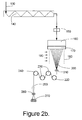
- FIGs 2a and 2b the overall process of solid phase polymerization (SPP), polymer flake melting and synthetic fiber melt spinning from the polymer is represented.
- SPP solid phase polymerization
- a dry nitrogen purge gas also called the makeup gas
- the polymer flake is conveyed to the SPP vessel 50 and additionally treated with nitrogen gas, optionally introduced at 110, along with water vapor introduced at 120.
- the nitrogen gas so humidified with water vapor, is circulated by a blower 70 and heated to a controlled temperature at 80 and allowed to contact the polymer flake in the SPP vessel 50.
- Several vent ports (100 and 90) are provided to control the overall pressure in the SPP vessel 50 which may be controlled at a pressure above atmospheric pressure (101 kPascal); i.e. from 110 to 120 kPascal.
- the circulating nitrogen gas and water vapor all at an elevated temperature within the range of 120° to 220 ° C and more preferably in the range 150 ° to 190 ° C , promote the uniform increase in polymer molecular weight as measured by the polymer relative viscosity RV.
- the polymer treated in the SPP now with an RV in the range of 50 to 53, is conveyed through port 130 into the barrel of a melt extruder 140 in Fig. 2b.
- the polymer melts in the extruder and is forced into a meter pump 150 where the melted polymer is fed at a controlled rate to a spinning filter pack 160 and subsequently to a spinneret plate 170.
- the spinneret plate 170 contains a plurality of shaped passages or capillaries which correspond to the formation of each individual filament comprising the yarn (as represented In side elevation by Fig. 3a and plan view by Fig. 3b.).
- the individual filaments 200 are cooled in a quench cabinet 180 with a side draft of conditioned air 190 and converged and oiled with a primary finish, known in the art, at 210 into a yarn.
- the yarn is forwarded by feed roll 220 onto a draw roll pair 230 where the yarn is stretched and oriented to form a drawn yarn which is directed by roll 240 into a yarn stabilization apparatus 250, commonly used In the art and here optionally employed as a yarn post-treatment step.
- the yarn is wound up as a yarn package at 270, at a yarn speed in the range of 4000 to 6000 meters per minute.
- the yarn RV measured is 51 to 54. During the course of winding at these speeds any need to interrupt the process for the purpose of cleaning the exit side face of the spinneret plate dramatically affects the productivity. Essentially all product which could have been wound up is sent to waste while the spinneret plate is wiped.
- the yarn produced according to the process represented by Figures 2a and 2b is a drawn yarn with elongation of 22 to 60%, the boiling water shrinkage is In the range of 3 to 10%, the yarn tenacity is the range of of 3 to 7 grams per denier, and the RV of the yarn can be varied and controlled well within a range of 40 to 60.
- the Yarn Quality is an approximation to the measure of yarn "toughness.”
- the area under the yarn load elongation curve is proportional to the work done to elongate the yarn.
- tenacity is expressed in terms of force per unit denier, for example, and the elongation expressed as a per cent change per unit of length
- the load elongation curve is the stress-strain curve.
- the area under the stress-strain curve is the work to extend the yarn or the yarn toughness.
- the spinneret wipe life is determined as the time for 10% of ail single filaments in the yarn bundle to appear bent at the exit side of the capillary on the spinneret plate face (175 in Fig. 3b.). Measuring the time to 10% bent filaments was performed directly by observation and a direct count by an operator illuminating the spinneret plate face within the quench cabinet.
- the hot and humid nitrogen atmosphere, due to added water vapor, in the SPP apparatus is extracting a degradation product of polyamide solid phase polymerization.
- a degradation product of polyamide solid phase polymerization may readily react with water at the elevated temperature of the nitrogen recirculating gas atmosphere and become volatile enough to be removed through the normal purge process, via the vent ports of the SPP. If these thermal degradation products were not removed, it is hypothesized that a dimer is formed which is carried with the polymer and contributes to the deposits around the spinneret capillary exit face. It is these deposits which are removed in the wiping operation.
- Yarn tenacity and the yarn elongation are determined according to ASTM method D 2256-80 using an INSTRON tensile test apparatus (Instron Corp., Canton, Massachusetts, USA 02021) and a constant cross head speed. Tenacity is expressed as grams of force per denier, the elongation percent is the increase in length of the specimen as a percentage of the original length at breaking load.
- Polymer relative viscosity RV is measured using the formic acid method according to ASTM D789-86.
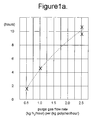
- the spinneret wipe life was investigated as a function of the nitrogen purge gas (make-up gas) flow rate by spinning a yarn of 40 denier (44 dtex) and 13 filaments.
- a nylon 66 polymer of 37.5 RV which contained 1.5% by weight Ti02 in was treated in an SPP with nitrogen purge gas (make-up gas) at flow rates of 0.5, 1.0 and 2.5 (kg N 2 /hour) per (kg of polymer/hour) all at a constant SPP system pressure of 114 kPascal (16.5 pounds per square inch).
- the treated polymer had an RV of 51.5 was melted in an extruder and fed to a spinning machine which was used to prepare the 40-13 yarn, by a process of quenching in conditioned air, converging and treating the yarn with a primary spinning oil, drawing the yarn using unheated godets, stabilizing the yarn with a heated fluid, interlacing the yarn and winding on at a speed of about 5300 meters per minute.
- the spinneret plate 170 on the capillary exit face (175 represented in plan view by Fig. 3b.) required wiping when at least 10% of the filaments were bent.
- Table 1 The data for 4 trials is shown in Table 1 and plotted in Figure 1a.
- a yarn of 40 denier (44 dtex) and 13 filaments was prepared by treating a nylon 66 polymer of 37.5 RV which contained 1.5% by weight Ti02 in an SPP with nitrogen purge gas (make-up gas) at flow rate of 2.5 (kg N 2 /hour) per (kg of polymer/hour) all at a constant SPP system pressure of 114 kPascal (16.5 pounds per square inch).
- the treated polymer had an RV of 51.5 was melted in an extruder and fed to a spinning machine which was used to prepare the 40-13 yarn, by a process of quenching in conditioned air, converging and treating the yarn with a primary spinning oil, drawing the yarn using unheated godets, stabilizing the yarn with a heated fluid-, interlacing the yarn and winding on at a speed of about 5300 meters per minute.
- the spinneret plate 170 on the capillary exit face (175 represented in plan view by Fig. 3b.) required wiping each 10 hours of yarn winding since at least 10% of the filaments were bent.
- the RV, the tenacity and elongation of the wound up 40-13 yarn was measured.
- the RV was 52.5.
- the tenacity and elongation measurements were used to calculate a "yarn quality" parameter using Equation 1.
- the parameter is related to the yarn toughness or work needed to draw the yarn and found here to be 33.1.
- the spinneret wipe life was investigated as a function of the total pressure in the SPP apparatus by spinning a yarn of 40 denier (44 dtex) and 13 filaments.
- a nylon 66 polymer of 37.5 RV which contained 1.5% by weight Ti02 in was treated in an SPP with nitrogen purge gas (make-up gas) at a flow rate of 2.5 (kg N 2 /hour) per (kg of polymer/hour) and varying the SPP system pressure from 114 kPascal (16.5 pounds per square inch), to 121 kPascal (17.5 pounds per square inch), and finally to 128 kPascal (18.5 pounds per square inch).
- the treated polymer had an RV of 51.5 was melted in an extruder and fed to a spinning machine which was used to prepare the 40-13 yarn, by a process of quenching in conditioned air, converging and treating the yarn with a primary spinning oil, drawing the yarn using unheated godets, stabilizing the yarn with a heated fluid, interlacing the yarn and winding on at a speed of about 5300 meters per minute.
- spinneret plate 170 on the capillary exit face (175 represented in plan view by Fig. 3b.) required wiping when at least 10% of the filaments were bent.
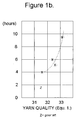
- the data for 4 trials is shown in Table 2 and plotted in Fig. 1 b.
- a yarn of 40 denier (44 dtex) and 13 filaments was prepared by treating a nylon 66 polymer of 37.5 RV which contained 1.5% by weight Ti02 in an SPP with nitrogen purge gas at a flow rate of 0.5 (kg N 2 /hour) per (kg of polymer/hour) gas volume in the SPP at a system pressure of 121 kPascal (17.5 pounds per square inch).
- the treated polymer (51.5 RV) was melted in an extruder and fed to a spinning machine which was used to prepare the 40-13 yarn, by a process of quenching in conditioned air, converging and treating the yarn with a primary spinning oil, drawing the yarn using unheated godets, stabilizing the yarn with a heated fluid, interlacing the yarn and winding on at a speed of about 5300 meters per minute.
- the spinneret plate on the capillary exit required wiping each 1.5 hours of yarn winding, since at least 10% of the filaments were bent.
- the tenacity and elongation of the wound up 40-13 yarn was measured exactly as in the example of the invention.
- the measured RV was of this yarn was 52.5 RV as before.
- the tenacity and elongation were used to calculate a "yarn quality" parameter, which was found to be 31.5 using Equation 1.
- Example 3 points denoted by X
- Comparative Example 1 a point denoted by Z
- Figure 1b The data from Example 3 (points denoted by X) and Comparative Example 1 (a point denoted by Z) are plotted in Figure 1b; the time to 10% bent filaments versus the yarn quality (Equation 1). It can be seen that it is most desireable to have a low total system pressure in the SPP, ca. 114 kPascal and to have a high nitrogen gas purge flow rate, ca. 2.5 (kg N 2 /hour) per (kg of polymer/hour) in order to provide a yarn of sufficiently high yarn quality or toughness and to have at the same time a longer spinneret wipe cycle; as shown by the time to 10% bent filaments.
Landscapes
- Chemical & Material Sciences (AREA)
- Engineering & Computer Science (AREA)
- Chemical Kinetics & Catalysis (AREA)
- Textile Engineering (AREA)
- Medicinal Chemistry (AREA)
- Organic Chemistry (AREA)
- Polymers & Plastics (AREA)
- Health & Medical Sciences (AREA)
- Mechanical Engineering (AREA)
- General Chemical & Material Sciences (AREA)
- Artificial Filaments (AREA)
- Spinning Methods And Devices For Manufacturing Artificial Fibers (AREA)
- Yarns And Mechanical Finishing Of Yarns Or Ropes (AREA)
Claims (6)
- Procédé pour fabriquer un filament de polyamide synthétique filé en fusion, comprenant les étapes consistant:à apporter un polymère de polyamide à un appareil de polycondensation en phase solide;à apporter un gaz de purge à l'appareil de polycondensation en phase solide, à un débit dans la gamme de 2 à 3 kg/heure par kg de polymère par heure;à traiter le polymère de polyamide dans l'appareil de polycondensation en phase solide avec le gaz de purge à une pression de système de polycondensation en phase solide de 110 à 120kPascals;à transporter le polymère de polyamide traité à un appareil d'extrusion à l'état fondu;à faire fondre le polymère de polyamide dans l'appareil d'extrusion à l'état fondu;à extruder le polymère de polyamide fondu à travers une plaque de filière; età former au moins un filament continu du polymère de polyamide.
- Procédé selon la revendication 1, incluant en outre la trempe et le refroidissement du filament.
- Procédé selon la revendication 2, incluant en outre le post-traitement du filament et l'enroulement du filament.
- Procédé selon la revendication 3, incluant en outre l'essuyage de la plaque de filière sur le côté sortie des capillaires, en cycles, dans lequel chaque cycle d'essuyage est séparé de 8 à 12 heures.
- Procédé selon la revendication 1, dans lequel le gaz de purge est composé d'azote gazeux alimenté à un débit dans la gamme de 2 à 3 kg/heure par kg de polymère par heure.
- Filament de polyamide synthétique filé en fusion délustré ayant une QUALITE DE FIL supérieure à environ 32,8, dans lequel la QUALITE DE FIL est définie d'après,
 à apporter un polymère de polyamide synthétique à un appareil de polycondensation en phase solide;à apporter un gaz de purge à l'appareil de polycondensation en phase solide, à un débit dans la gamme de 2 à 3 kg/heure par kg de polymère par heure;à traiter le polymère de polyamide synthétique dans l'appareil de polycondensation en phase solide à une pression de système dans la gamme de 110 à 120 kPascals;à transporter le polymère de polyamide traité à un appareil d'extrusion à l'état fondu;à faire fondre le polymère de polyamide dans l'appareil d'extrusion à l'état fondu;à extruder le polymère de polyamide fondu à travers une plaque de filière; età former au moins un filament continu du polymère de polyamide.
Applications Claiming Priority (3)
| Application Number | Priority Date | Filing Date | Title |
|---|---|---|---|
| US41098402P | 2002-09-16 | 2002-09-16 | |
| US410984P | 2002-09-16 | ||
| PCT/US2003/027949 WO2004025005A1 (fr) | 2002-09-16 | 2003-09-05 | Procede de fabrication de fils de polyamide et fil de polyamide |
Publications (2)
| Publication Number | Publication Date |
|---|---|
| EP1540052A1 EP1540052A1 (fr) | 2005-06-15 |
| EP1540052B1 true EP1540052B1 (fr) | 2007-08-01 |
Family
ID=31994229
Family Applications (1)
| Application Number | Title | Priority Date | Filing Date |
|---|---|---|---|
| EP03749476A Expired - Lifetime EP1540052B1 (fr) | 2002-09-16 | 2003-09-05 | Procede de fabrication de fils de polyamide et fil de polyamide |
Country Status (10)
| Country | Link |
|---|---|
| US (1) | US8052906B2 (fr) |
| EP (1) | EP1540052B1 (fr) |
| JP (1) | JP4519649B2 (fr) |
| KR (1) | KR101052976B1 (fr) |
| CN (1) | CN100408733C (fr) |
| AU (1) | AU2003268509A1 (fr) |
| DE (1) | DE60315314T2 (fr) |
| ES (1) | ES2290490T3 (fr) |
| MX (1) | MXPA05002834A (fr) |
| WO (1) | WO2004025005A1 (fr) |
Cited By (1)
| Publication number | Priority date | Publication date | Assignee | Title |
|---|---|---|---|---|
| CN105040124A (zh) * | 2015-06-26 | 2015-11-11 | 北京三联虹普新合纤技术服务股份有限公司 | 一种粗旦尼龙6全牵伸母丝纤维生产工艺 |
Families Citing this family (2)
| Publication number | Priority date | Publication date | Assignee | Title |
|---|---|---|---|---|
| CN110733932B (zh) * | 2018-07-19 | 2022-12-16 | 欧瑞康纺织有限及两合公司 | 一种熔体纺丝和卷绕纱线的方法 |
| CN114775096A (zh) * | 2022-03-24 | 2022-07-22 | 浙江嘉华特种尼龙有限公司 | 一种采用固相缩聚直纺技术生产再生锦纶6纤维的方法 |
Family Cites Families (9)
| Publication number | Priority date | Publication date | Assignee | Title |
|---|---|---|---|---|
| US3480596A (en) | 1967-03-09 | 1969-11-25 | Fiber Industries Inc | Process of forming polymeric material of increased relative viscosity |
| FR2247552B1 (fr) * | 1973-10-15 | 1978-08-11 | Akzo Nv | |
| CA1198255A (fr) * | 1982-07-08 | 1985-12-24 | Kazuyuki Kitamura | Fibre de poly(hexamethylene adipamide) tres resistante |
| US4952345A (en) | 1989-02-10 | 1990-08-28 | E. I. Du Pont De Nemours And Company | Method for controlling polymer viscosity |
| JPH0830282B2 (ja) * | 1992-08-31 | 1996-03-27 | 旭化成工業 株式会社 | タイヤコード用高強力ポリヘキサメチレンアジパミド |
| US5543495A (en) * | 1994-03-08 | 1996-08-06 | E. I. Du Pont De Nemours And Company | Process for increasing the molecular weight of polyamides and other condensation polymers |
| JPH0931748A (ja) * | 1995-07-21 | 1997-02-04 | Toray Ind Inc | 高強度ポリアミドモノフィラメント及びその製造方法 |
| US5955569A (en) * | 1996-11-27 | 1999-09-21 | E.I. Du Pont De Nemours And Company | Method for solid phase polymerization |
| US6235390B1 (en) | 1998-11-03 | 2001-05-22 | E. I. Du Pont De Nemours And Company | High RV filaments, and apparatus and processes for making high RV flake and the filaments |
-
2003
- 2003-09-05 ES ES03749476T patent/ES2290490T3/es not_active Expired - Lifetime
- 2003-09-05 JP JP2004536127A patent/JP4519649B2/ja not_active Expired - Lifetime
- 2003-09-05 MX MXPA05002834A patent/MXPA05002834A/es active IP Right Grant
- 2003-09-05 KR KR1020057004396A patent/KR101052976B1/ko not_active Expired - Lifetime
- 2003-09-05 US US10/656,057 patent/US8052906B2/en active Active
- 2003-09-05 DE DE60315314T patent/DE60315314T2/de not_active Expired - Lifetime
- 2003-09-05 AU AU2003268509A patent/AU2003268509A1/en not_active Abandoned
- 2003-09-05 WO PCT/US2003/027949 patent/WO2004025005A1/fr not_active Ceased
- 2003-09-05 EP EP03749476A patent/EP1540052B1/fr not_active Expired - Lifetime
- 2003-09-05 CN CNB03821234XA patent/CN100408733C/zh not_active Expired - Lifetime
Non-Patent Citations (1)
| Title |
|---|
| None * |
Cited By (1)
| Publication number | Priority date | Publication date | Assignee | Title |
|---|---|---|---|---|
| CN105040124A (zh) * | 2015-06-26 | 2015-11-11 | 北京三联虹普新合纤技术服务股份有限公司 | 一种粗旦尼龙6全牵伸母丝纤维生产工艺 |
Also Published As
| Publication number | Publication date |
|---|---|
| JP4519649B2 (ja) | 2010-08-04 |
| KR20050047116A (ko) | 2005-05-19 |
| DE60315314T2 (de) | 2008-05-08 |
| EP1540052A1 (fr) | 2005-06-15 |
| WO2004025005A1 (fr) | 2004-03-25 |
| CN100408733C (zh) | 2008-08-06 |
| CN1856600A (zh) | 2006-11-01 |
| ES2290490T3 (es) | 2008-02-16 |
| MXPA05002834A (es) | 2005-05-27 |
| JP2006516307A (ja) | 2006-06-29 |
| US20040126581A1 (en) | 2004-07-01 |
| DE60315314D1 (de) | 2007-09-13 |
| KR101052976B1 (ko) | 2011-08-01 |
| US8052906B2 (en) | 2011-11-08 |
| AU2003268509A1 (en) | 2004-04-30 |
Similar Documents
| Publication | Publication Date | Title |
|---|---|---|
| US7943071B2 (en) | Polyethylene terephthalate filament having high tenacity for industrial use | |
| EP1433881B1 (fr) | Fil multifilamentaire de cellulose pour des câbles de pneumatiques et procédé de fabrication | |
| EP2347042B1 (fr) | Fibre discontinue en nylon à capacité de charge élevée et fils mélangés en nylon et tissus fabriqués à partir de ceux-ci | |
| US6663806B2 (en) | Processes for making poly (trimethylene terephthalate) yarns | |
| US6620505B1 (en) | Poly(trimethylene terephthalate) modified cross-section yarn | |
| WO1997038153A1 (fr) | Procede de fabrication de filaments lyocellulaires | |
| US8052906B2 (en) | Polyamide yarn process | |
| EP0370816B1 (fr) | Procédé de fabrication de filaments de polyester | |
| US6572967B1 (en) | Poly(trimethylene terephthalate) multifilament yarn | |
| JP7647550B2 (ja) | ポリアミド46マルチフィラメント | |
| KR100652089B1 (ko) | 셀룰로오스 멀티필라멘트 제조 방법 | |
| US7165963B2 (en) | Spinneret for producing circular cross section yarn and process for making the same | |
| JP4056288B2 (ja) | ポリエステル極細マルチフィラメント糸の製造方法 | |
| EP1520066B1 (fr) | Procede permettant de produire des enroulements stables de polytrimethylene terephtalate | |
| EP4141153A1 (fr) | Monofilament de polyamide | |
| KR100231195B1 (ko) | 세섬도 모노필라멘트용 방사구금장치 | |
| WO2024162095A1 (fr) | Multifilament en polyamide et monofilament en polyamide | |
| JPH09157948A (ja) | ポリベンザゾール繊維の製造方法および製造装置 | |
| JPH0797717A (ja) | ポリベンザゾール異形断面糸及びその製造方法 | |
| JPH11293513A (ja) | 合成繊維束とその製造方法 | |
| JPH0860436A (ja) | ポリベンザゾール繊維の製造方法 | |
| JPH1193015A (ja) | モノフィラメントおよびその製造方法 | |
| JPH08296118A (ja) | ポリベンザゾール繊維の製造方法 | |
| EP0115041A2 (fr) | Méthode pour la préparation de fibres de polyamide convenant au filature, et fibres ainsi préparées |
Legal Events
| Date | Code | Title | Description |
|---|---|---|---|
| PUAI | Public reference made under article 153(3) epc to a published international application that has entered the european phase |
Free format text: ORIGINAL CODE: 0009012 |
|
| 17P | Request for examination filed |
Effective date: 20050204 |
|
| AK | Designated contracting states |
Kind code of ref document: A1 Designated state(s): AT BE BG CH CY CZ DE DK EE ES FI FR GB GR HU IE IT LI LU MC NL PT RO SE SI SK TR |
|
| AX | Request for extension of the european patent |
Extension state: AL LT LV MK |
|
| DAX | Request for extension of the european patent (deleted) | ||
| RBV | Designated contracting states (corrected) |
Designated state(s): DE ES FR GB IT |
|
| 17Q | First examination report despatched |
Effective date: 20061117 |
|
| GRAP | Despatch of communication of intention to grant a patent |
Free format text: ORIGINAL CODE: EPIDOSNIGR1 |
|
| GRAS | Grant fee paid |
Free format text: ORIGINAL CODE: EPIDOSNIGR3 |
|
| GRAA | (expected) grant |
Free format text: ORIGINAL CODE: 0009210 |
|
| AK | Designated contracting states |
Kind code of ref document: B1 Designated state(s): DE ES FR GB IT |
|
| REG | Reference to a national code |
Ref country code: GB Ref legal event code: FG4D |
|
| REF | Corresponds to: |
Ref document number: 60315314 Country of ref document: DE Date of ref document: 20070913 Kind code of ref document: P |
|
| REG | Reference to a national code |
Ref country code: ES Ref legal event code: FG2A Ref document number: 2290490 Country of ref document: ES Kind code of ref document: T3 |
|
| ET | Fr: translation filed | ||
| RAP2 | Party data changed (patent owner data changed or rights of a patent transferred) |
Owner name: INVISTA TECHNOLOGIES S.A.R.L. |
|
| PLBE | No opposition filed within time limit |
Free format text: ORIGINAL CODE: 0009261 |
|
| STAA | Information on the status of an ep patent application or granted ep patent |
Free format text: STATUS: NO OPPOSITION FILED WITHIN TIME LIMIT |
|
| 26N | No opposition filed |
Effective date: 20080506 |
|
| REG | Reference to a national code |
Ref country code: GB Ref legal event code: 732E Free format text: REGISTERED BETWEEN 20090507 AND 20090513 |
|
| REG | Reference to a national code |
Ref country code: FR Ref legal event code: PLFP Year of fee payment: 14 |
|
| REG | Reference to a national code |
Ref country code: FR Ref legal event code: PLFP Year of fee payment: 15 |
|
| REG | Reference to a national code |
Ref country code: FR Ref legal event code: PLFP Year of fee payment: 16 |
|
| PGFP | Annual fee paid to national office [announced via postgrant information from national office to epo] |
Ref country code: IT Payment date: 20220811 Year of fee payment: 20 Ref country code: GB Payment date: 20220714 Year of fee payment: 20 Ref country code: DE Payment date: 20220609 Year of fee payment: 20 |
|
| PGFP | Annual fee paid to national office [announced via postgrant information from national office to epo] |
Ref country code: FR Payment date: 20220709 Year of fee payment: 20 |
|
| PGFP | Annual fee paid to national office [announced via postgrant information from national office to epo] |
Ref country code: ES Payment date: 20221005 Year of fee payment: 20 |
|
| REG | Reference to a national code |
Ref country code: DE Ref legal event code: R071 Ref document number: 60315314 Country of ref document: DE |
|
| REG | Reference to a national code |
Ref country code: ES Ref legal event code: FD2A Effective date: 20230926 |
|
| REG | Reference to a national code |
Ref country code: GB Ref legal event code: PE20 Expiry date: 20230904 |
|
| PG25 | Lapsed in a contracting state [announced via postgrant information from national office to epo] |
Ref country code: GB Free format text: LAPSE BECAUSE OF EXPIRATION OF PROTECTION Effective date: 20230904 Ref country code: ES Free format text: LAPSE BECAUSE OF EXPIRATION OF PROTECTION Effective date: 20230906 |