EP1541671B1 - Neue bäckerhefestämme und brot unter verwendung davon - Google Patents
Neue bäckerhefestämme und brot unter verwendung davon Download PDFInfo
- Publication number
- EP1541671B1 EP1541671B1 EP02745862A EP02745862A EP1541671B1 EP 1541671 B1 EP1541671 B1 EP 1541671B1 EP 02745862 A EP02745862 A EP 02745862A EP 02745862 A EP02745862 A EP 02745862A EP 1541671 B1 EP1541671 B1 EP 1541671B1
- Authority
- EP
- European Patent Office
- Prior art keywords
- yeast
- strain
- dough
- frozen
- bread
- Prior art date
- Legal status (The legal status is an assumption and is not a legal conclusion. Google has not performed a legal analysis and makes no representation as to the accuracy of the status listed.)
- Expired - Lifetime
Links
Images


Classifications
-
- C—CHEMISTRY; METALLURGY
- C12—BIOCHEMISTRY; BEER; SPIRITS; WINE; VINEGAR; MICROBIOLOGY; ENZYMOLOGY; MUTATION OR GENETIC ENGINEERING
- C12N—MICROORGANISMS OR ENZYMES; COMPOSITIONS THEREOF; PROPAGATING, PRESERVING, OR MAINTAINING MICROORGANISMS; MUTATION OR GENETIC ENGINEERING; CULTURE MEDIA
- C12N1/00—Microorganisms; Compositions thereof; Processes of propagating, maintaining or preserving microorganisms or compositions thereof; Processes of preparing or isolating a composition containing a microorganism; Culture media therefor
- C12N1/14—Fungi; Culture media therefor
- C12N1/16—Yeasts; Culture media therefor
- C12N1/18—Baker's yeast; Brewer's yeast
- C12N1/185—Saccharomyces isolates
-
- C—CHEMISTRY; METALLURGY
- C12—BIOCHEMISTRY; BEER; SPIRITS; WINE; VINEGAR; MICROBIOLOGY; ENZYMOLOGY; MUTATION OR GENETIC ENGINEERING
- C12N—MICROORGANISMS OR ENZYMES; COMPOSITIONS THEREOF; PROPAGATING, PRESERVING, OR MAINTAINING MICROORGANISMS; MUTATION OR GENETIC ENGINEERING; CULTURE MEDIA
- C12N1/00—Microorganisms; Compositions thereof; Processes of propagating, maintaining or preserving microorganisms or compositions thereof; Processes of preparing or isolating a composition containing a microorganism; Culture media therefor
- C12N1/14—Fungi; Culture media therefor
- C12N1/16—Yeasts; Culture media therefor
- C12N1/18—Baker's yeast; Brewer's yeast
-
- A—HUMAN NECESSITIES
- A21—BAKING; EDIBLE DOUGHS
- A21D—TREATMENT OF FLOUR OR DOUGH FOR BAKING, e.g. BY ADDITION OF MATERIALS; BAKING; BAKERY PRODUCTS
- A21D8/00—Methods for preparing or baking dough
- A21D8/02—Methods for preparing dough; Treating dough prior to baking
- A21D8/04—Methods for preparing dough; Treating dough prior to baking treating dough with microorganisms or enzymes
- A21D8/047—Methods for preparing dough; Treating dough prior to baking treating dough with microorganisms or enzymes with yeasts
-
- C—CHEMISTRY; METALLURGY
- C12—BIOCHEMISTRY; BEER; SPIRITS; WINE; VINEGAR; MICROBIOLOGY; ENZYMOLOGY; MUTATION OR GENETIC ENGINEERING
- C12R—INDEXING SCHEME ASSOCIATED WITH SUBCLASSES C12C - C12Q, RELATING TO MICROORGANISMS
- C12R2001/00—Microorganisms ; Processes using microorganisms
- C12R2001/645—Fungi ; Processes using fungi
- C12R2001/85—Saccharomyces
- C12R2001/865—Saccharomyces cerevisiae
Definitions
- the present disclosure relates to novel bakers' yeast strains that are freeze-tolerant and whose offensive taste and odor characteristic of yeast is very weak, as well as to bread made using the same.
- a frozen dough In recent years, bread making techniques using frozen doughs have carried increasing weight in the bread making industry because they are advantageous, e.g., in providing fresh bread hot from the oven and in improving the efficiency of bread making processes to reduce working hours.
- bread ingredients such as wheat flour, sugar, salt, fat, yeast and water are mixed and moulded, followed by frozen storage at around -20°C.
- the frozen dough thus prepared is thawed (if necessary) and subjected to final proof before being baked.
- a frozen dough usually contains a 2- to 3-fold excess amount of yeast as compared to traditional bread, because even freeze-tolerant yeast strains are slightly damaged by freezing, and also to reduce the time required for final proof after thawing.
- a no-time dough process is also commonly employed which needs little time for fermentation after mixing.
- the offensive taste and odor characteristic of yeast will become stronger, making the flavor of the bread unpleasant.
- a no-time dough which needs little time for fermentation also has a stronger offensive taste and odor characteristic of yeast because the fermentation flavor is weak in this dough, thus resulting in a more unpleasant bread flavor.
- bakers' yeast strains are used to make breads such as those supplemented with fats (e.g., expensive cultured butter, sour cream) or those based on fermented starters (e.g., panettone starter, liquor yeast ferment), the offensive taste and odor characteristic of bakers' yeast would mask the aroma of these raw materials and impair the flavor.
- fats e.g., expensive cultured butter, sour cream
- fermented starters e.g., panettone starter, liquor yeast ferment
- JP A 6000052 describes a Saccaromyces cerevisiae SANK5019 isolated from sea water and bread prepared using said yeast that contains less than 112 ppm isobutyric acid and has a weaker offensive of odor than bread prepared using commercial bakers' yeast. This document does not describe that the yeast can be employed in the frozen dough method and as such, this yeast strain is not considered to be freeze-tolerant.
- Winzeler E. et al "Functional characterization of the S. cerevisiae genome by gene deletion and parallel analysis” Science, American Association for the Advancement of Science, New York, US, volume 285, No: 5429, August 6, 1999, pages 901 - 906 , Eden A. et al "Two yeast homologs of ECA39, a target for C-Myc regulation, code for cytosolic and mitochondrial branched-chain amino acid aminotransferases" the Journal of Biological Chemistry, August 23, 1996, volume 271, No: 34, pages 20242 - 20245 , and Mariska Lilly, Florian F.
- EP-A1-1 036 841 discloses super-tolerant yeast for confectionery and bakery. Said yeast does, however, not produce lower levels of isobutyric acid.
- the present disclosure provides a novel bakers' yeast strain whose offensive taste and odor characteristic of yeast is very weak.
- the present disclosure also provides a novel freeze-tolerant bakers' yeast strain whose offensive taste and odor characteristic of yeast is very weak.
- the yeast strains of the present disclosure enable the production of bread with an excellent flavor while eliminating adverse effects due to the offensive taste and odor characteristic of yeast.
- the inventors of the present disclosure have attempted hybridization breeding or classical mutation breeding between stored strains of bakers' yeast, liquor yeast or the like and have succeeded in finding, among the resulting strains, bakers' yeast strains that have high fermentability and whose offensive taste and odor characteristic of yeast is very weak. This finding led to the completion of the present disclosure.
- a novel bakers' yeast strain Saccharomyces cerevisiae FT-4 found in the present disclosure has a very weak, almost undetectable, offensive taste and odor characteristic of yeast. Further, the strain FT-4 has a higher freeze tolerance and shows a fermentation capacity over a wider range of sugars when compared to the applicant's existing strains of freeze-tolerant yeast.
- novel bakers' yeast strain Saccharomyces cerevisiae FT-4 of the present disclosure enables the production of bread with a pleasant flavor, in which the offensive taste and odor characteristic of yeast is clearly weaker than that of bread made using traditional bakers' yeast strains.
- bakeers' yeast strain as used herein is not limited to Saccharomyces cerevisiae and also includes Saccharomyces rosei, Saccharomyces uvarum, Saccharomyces chevalieri and Torulaspora delbrueckii . In some cases, the term can also encompass Kluyveromyces thermotolerans and other Saccharomyces species.
- Morphology Yeast cells were cultured in YPD medium and observed under a microscope.
- Size Yeast cells were cultured in YPD medium and observed under a microscope, as in the case of morphology.
- Sporulation Yeast cells grown on YPD agar medium were inoculated onto Sharman agar medium, cultured at 20°C to 25°C for 3 to 10 days, and observed under a microscope to confirm the presence or absence of sporulation.
- the composition of YPD medium, YPD agar medium and Sharman agar medium are shown in Table 1.
- a loopful of fresh yeast cells grown on YPD agar medium was suspended in 5 ml sterilized water, washed twice with sterilized water by centrifugation and then suspended again in 5 ml sterilized water.
- the suspension thus obtained (0.1 ml) was inoculated into tubes (Sarstedt tubes, 101 mm ⁇ 16.5 mm) containing 5 ml sterilized medium supplemented with various carbon sources, respectively (Yeast nitrogen base 0.67 g, various carbon sources 0.1 g each, water 10 ml), grown in shaking culture at 30°C for 48 hours and then measured for absorbance at 660 nm to determine cell growth by the degree of turbidity.
- Nitrate assimilation Nitrate medium (Yeast carbon base 1.17 g, potassium nitrate 7.8 g, water 10 ml) was dispensed into Sarstedt tubes (5 ml per tube), sterilized and then inoculated with 0.1 ml of a yeast cell suspension prepared in the same manner as described for the test of carbon source assimilation.
- Vitamin requirement Vitamin-deficient medium (Vitamin free-base 1.67 g, each vitamin solution 0.5 ml, water 10 ml) was dispensed into Sarstedt tubes (5 ml per tube), sterilized (provided that the vitamin solutions were each sterilized and cooled before being added through a sterile filter), and then inoculated with 0.1 ml of a yeast cell suspension prepared in the same manner as described for the test of carbon source assimilation. After shaking culture at 30°C for 48 hours, the tubes were measured for absorbance at 660 nm to determine cell growth by the degree of turbidity.
- test strain can be identified as a strain of Saccharomyces cerevisiae.
- the term "offensive taste and odor characteristic of yeast” as used herein is intended to mean a muddy or fishy flavor which is clearly felt, particularly when fresh yeast cells are eaten directly. This flavor is also called yeast odor. Such a flavor can also be found in frozen doughs when prepared using yeast at a ratio of 7 or more relative to wheat flour which is set to 100. Likewise, bread made by a non-freezing process (which uses only 2% to 3% yeast) also has an offensive taste and odor characteristic of yeast, but such a taste and odor is accepted as a part of bread flavor in the case of using conventional yeast.
- isobutyric acid which is known as a branched fatty acid having a foul odor may be one of the causative substances.
- freeze-tolerant or freeze tolerance
- a dough is prepared and allowed to ferment in a thermostat at 30°C for 60 minutes. After the completion of fermentation, the dough is divided into 30 g portions, rounded into balls and then frozen at -20°C. One day later, the dough balls are allowed to ferment while thawing at 38°C for 120 minutes and measured for the volume of carbon dioxide gas generated during fermentation, which is defined as fermentability after 1 day freezing. For comparison, the same dough is frozen for 1 month, allowed to ferment while thawing at 38°C for 120 minutes and measured for the volume of carbon dioxide gas generated during fermentation, which is defined as fermentability after 1 month freezing.
- the percentage of the fermentability after 1 month freezing is determined and defined as persistence of fermentability.
- a freeze-tolerant yeast strain will show 80% or more persistence of fermentability in a low-sugar dough (sugar content: 5%) and 90% or more persistence of fermentability in a high-sugar dough (sugar content: 25%).
- a non-freezing process can be presented as an opposite example of the frozen dough process.
- the non-freezing process involves a series of steps, starting with dough mixing, fermentation (including primary and secondary fermentation), dividing, moulding, final proof and baking, which steps are continuously performed without freezing the dough.
- a wide variety of processes have been used conventionally, such as a sponge dough process, a straight dough process, a no-time dough process, soaker process and an old dough process.
- the novel bakers' yeast strains obtained in the present disclosure are freeze-tolerant, there is no problem in using them in such non-freezing processes as listed above.
- a non-sugar dough refers to a dough containing no sugar.
- a low-sugar dough refers to a dough containing less than 10% sugar, but a dough having a sugar content of 5% is used herein as a low-sugar dough.
- a high-sugar dough usually refers to a dough whose sugar content is from 20% to less than 35%, but a dough having a sugar content of 25% is used herein as a high-sugar dough.
- the bakers' yeast strains of the present disclosure which may be freeze-tolerant and are also characterized by having a very weak offensive taste and odor characteristic of yeast
- sexual reproduction may be performed between a monoploid yeast strain obtained by germinating spores of a diploid bakers' yeast strain which may be freeze-tolerant and another monoploid yeast strain obtained by germinating spores of a diploid alcohol or wiled-type yeast strain whose offensive taste and odor characteristic of yeast is weak, followed by the screening procedure described in Example 1 to select, from among the resulting yeast strains, those having a weak offensive taste and odor characteristic of yeast.
- Example 1 the screening procedure described in Example 1 may also be performed to select freeze-tolerant strains, thus providing freeze-tolerant yeast strains having a very weak offensive taste and odor characteristic of yeast. Such strains are preferred embodiments of the present disclosure. Furthermore, UV irradiation may be performed on freeze-tolerant bakers' yeast strains to cause mutations under conditions where around 99% is killed, followed by the same screening procedure to provide freeze-tolerant strains having a very weak offensive taste and odor characteristic of yeast.
- a diploid yeast strain (the applicant's YF yeast) belonging to Saccharomyces cerevisiae which was at least highly freeze-tolerant were germinated to obtain a monoploid yeast strain.
- spores of a diploid yeast strain (the applicant's sake yeast) belonging to Saccharomyces cerevisiae which was not freeze-tolerant, but whose offensive taste and odor characteristic of yeast was weak were germinated to obtain another monoploid yeast strain.
- These monoploid yeast strains were crossed via sexual reproduction to give a large number of diploid yeast strains.
- YPD liquid medium (3 ml) was introduced into 13 ml tubes, sterilized at 121°C for 15 minutes and then inoculated with a loopful of each strain, followed by shaking culture at 30°C for 20 hours.
- the resulting yeast cells of each strain were collected by centrifugation at 3,000 rpm for 15 minutes, washed twice with cold water and then collected again.
- the collected yeast cells were suspended in 3 ml LF medium (prepared by dissolving 10 g glucose, 30 g maltose and 30 g sucrose in water to 1 L).
- YPD liquid medium 100 ml was dispensed into 500 ml baffled Erlenmeyer flasks, sterilized at 121°C for 15 minutes and then inoculated with a loopful of each strain, followed by shaking culture at 30°C for 20 hours.
- the cultured solutions were transferred to centrifuge tubes and centrifuged at 3000 rpm for 15 minutes to collect the cells, followed by washing twice with cold water to give the yeast cells.
- the resulting strains were then measured for their fermentability in low-sugar doughs.
- Individual raw materials of a low-sugar dough listed in Table 5 were charged into a gram mixer to prepare a dough for each strain under the following conditions: a mixing time of 2 minutes and a final mixed dough temperature of 30°C.
- the resulting doughs were each allowed to ferment in a thermostat at 30°C for 60 minutes.
- each dough was divided into 30 g portions, rounded into balls and then frozen at -20°C.
- the dough balls were allowed to ferment while thawing at 38°C for 120 minutes and measured with a fermograph (ATTO Corporation) for the volume of carbon dioxide gas generated during fermentation, which was defined as fermentability after 1 day freezing.
- the same doughs were each frozen for 1 month, allowed to ferment while thawing at 38°C for 120 minutes and also measured with a fermograph for the volume of carbon dioxide gas generated during fermentation, which was defined as fermentability after 1 month freezing. Assuming that the fermentability after 1 day freezing was set to 100, the percentage of the fermentability after 1 month freezing was determined as persistence of fermentability to select strains showing 80% or more persistence of fermentability.
- the resulting freeze-tolerant strains were screened for the offensive taste and odor characteristic of yeast. Primary screening was performed as follows. As in the case of the test described above, each strain was grown in a 500 ml baffled Erlenmeyer flask, collected and washed to give yeast cells. These yeast cells were subjected to an organoleptic test by 10 subjects to select strains having a weak offensive taste and odor characteristic of yeast.
- yeast cells were disrupted using beads and measured for isobutyric acid content in the supernatant by gas chromatography (Shimadzu Corporation), followed by selecting yeast cells having an isobutyric acid content of 200 ppm or less on a dry cell basis.
- a loopful of the strain FT-4 or bakers' yeast strains marketed by various companies was inoculated into a 500 ml baffled Erlenmeyer flask containing 100 ml YPD liquid medium and then grown in shaking culture at 30°C for 20 hours.
- the cultured solutions were each centrifuged at 3,000 rpm for 5 minutes to collect the cells, followed by washing twice with sterilized distilled water.
- the resulting washed yeast cells were frozen and stored.
- the freeze-dried yeast cells were reconstituted with cold water and adjusted to a solid content of 20%, followed by addition of 10% glass beads to disrupt the yeast cells by vortexing at high speed. After centrifugation at 10,000 rpm for 10 minutes, the supernatant was measured for its isobutyric acid content by gas chromatography to determine an isobutyric acid content calculated on a dry cell basis for each strain.
- Table 3 shows the measured results.
- the strain of the present disclosure had an isobutyric acid content less than one-half of the comparative bakers' yeast strains.
- Table 3 Comparison of isobutyric acid content among bakers' yeast strains marketed by various companies Isobutyric acid content Strain FT-4 125 ppm Non-frozen dough 45 yeast by the applicant 375 ppm Frozen dough YF yeast by the applicant 310 ppm Frozen dough yeast 1 marketed by Company A 530 ppm Frozen dough yeast 2 marketed by Company A 360 ppm Frozen dough yeast 1 marketed by Company B 595 ppm Frozen dough yeast 2 marketed by Company B 990 ppm Frozen dough yeast marketed by Company C 395 ppm Frozen dough yeast marketed by Company D 730 ppm
- cells of the strain FT-4 were cultured in a 300 L jar fermentor and used for measurement of the fermentability in non-frozen doughs using the method of the Japan Yeast Industry Association.
- a loopful of the strain FT-4 was seeded into a 500 ml baffled Erlenmeyer flask containing 200 ml YPD liquid medium and then grown in shaking culture at 30°C for 24 hours.
- the cultured solution was then inoculated into a 30 L jar fermentor containing 15 L molasses medium (see Table 4) and grown under the conditions shown in Table 4 to give seed yeast for 300 L jar fermentor culture.
- the main culture medium shown in Table 4 was prepared in a volume of 150 L in a 300 L jar fermentor and inoculated with the whole volume of the seed culture grown in a 30 L jar fermentor, followed by culture under the following conditions.
- Table 4 Culture conditions for strain FT-4 Ingredient composition Seed culture Main culture Remarks Prepared sugar solution 3.5 L 30 L Waste molasses from -Philippine, adjusted to a sugar concentration of 40% Urea 35 g 800 g Monobasic ammonium phosphate 30 g 350 g Ammonium sulfate 30 g Water 15 L 150 L Culture conditions temperature 30-32°C 30-32°C Aeration volume 30 L/min 300 L/min Agitation 400 rpm 450 rpm PH 5.0-6.0 5.0-6.0 Culture period 16 hours 16 hours 16 hours 16 hours 16 hours
- the cultured solution was centrifuged to separate yeast cells, followed by compression and dehydration using a filter fabric to give yeast cells with a water content of 65% to 67%.
- Table 6 shows the results obtained.
- the strain obtained in the present invention showed high fermentability in the non-sugar and high-sugar doughs under non-frozen conditions, although it was slightly lower in the low-sugar dough, thus suggesting that this strain had broad utility over a wide range of sugars.
- the yeast cells obtained in Example 3 were measured for freeze tolerance in low-sugar and high-sugar doughs.
- raw materials were prepared and mixed in a gram mixer (National, USA) for 2 minutes and the resulting doughs were each allowed to ferment in an incubator at 25°C for 60 minutes. After the completion of fermentation, each dough was divided in to 30 g portions, transferred to a plastic bag, and then frozen and stored at -20°C.
- the doughs were removed from the freezer for the purpose of thawing, transferred to a glass bottle for fermograph measurement and measured for the total gas volume generated at 38°C for 120 minutes using a fermograph (ATTO Corporation).
- Table 7 Dough composition for frozen dough test Wheat flour Sugar Salt Yeast Water Low-sugar dough 100 g 5 g 1.5 g 7 g 62 g High-sugar dough 100 g 25 g 1.5 g 6 g 55 g
- Figure 1 shows a graph of the time course of the total gas volume generated for 120 minutes, while Table 8 shows the persistence of fermentability after frozen storage for 1 month.
- the strain FT-4 of the present disclosure showed 80% or more persistence of fermentability in the low-sugar dough and 90% or more persistence of fermentability in the high-sugar dough. As shown in the time course of fermentability over 3 months, it was also confirmed that the strain FT-4 had a satisfactory freeze tolerance capacity when compared to conventional strains.
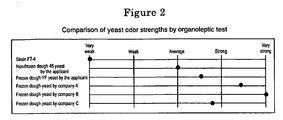
- Figure 2 shows the results obtained.
- the strain of the present disclosure had a very weak offensive taste and odor characteristic of yeast and was almost tasteless and odorless.
- Example 9 a bread making test was performed on the yeast cells obtained in Example 3 by preparing frozen doughs for white bread, table rolls and sweet buns. The frozen doughs were thawed at 1, 2 and 3 months and measured for the time required for final proof and their bread volume after baking.
- Final proof time the time required for each dough to reach its pre-determined volume (In the case of white bread doughs, the time was measured at the top of the case. In the case of table rolls and sweet buns, 100 g rounded doughs were frozen and stored separately and thawed in beakers for measurement).
- Table 10 shows the results of the bread making test. All the frozen doughs prepared using the strain of the present disclosure required less time for final proof than the existing strains; the fermentability of this strain exceeded that of the existing strains in all low-, medium- and high-sugar doughs. Moreover, the flavor of the resulting bread samples was clear and pleasant because yeast odor was weak at the stage after frozen storage for 1 month. Even after long-term frozen storage for 2 and 3 months, the flavor still remained very pleasant, not only because yeast odor was weak, but also because the smell of dead yeast cells caused by freezing damage was significantly prevented when compared to other yeast strains.
- the completion of the present disclosure enables the provision of novel bakers' yeast strains that are freeze-tolerant and whose offensive taste and odor characteristic of yeast is very weak, thus enabling the production of bread with an excellent flavor while eliminating adverse effects due to the offensive taste and odor characteristic of yeast.
Landscapes
- Life Sciences & Earth Sciences (AREA)
- Engineering & Computer Science (AREA)
- Mycology (AREA)
- Health & Medical Sciences (AREA)
- Chemical & Material Sciences (AREA)
- Genetics & Genomics (AREA)
- Wood Science & Technology (AREA)
- Organic Chemistry (AREA)
- Zoology (AREA)
- Biotechnology (AREA)
- Bioinformatics & Cheminformatics (AREA)
- Microbiology (AREA)
- General Engineering & Computer Science (AREA)
- Botany (AREA)
- Virology (AREA)
- Tropical Medicine & Parasitology (AREA)
- Biochemistry (AREA)
- Biomedical Technology (AREA)
- General Health & Medical Sciences (AREA)
- Medicinal Chemistry (AREA)
- Food Science & Technology (AREA)
- Micro-Organisms Or Cultivation Processes Thereof (AREA)
- Bakery Products And Manufacturing Methods Therefor (AREA)
- Coloring Foods And Improving Nutritive Qualities (AREA)
Claims (4)
- Ein Bäckerhefestamm, der unter der Zugriffsnummer FERM BP-8081 hinterlegt ist und Saccharomyces cerevisiae angehört, dadurch gekennzeichnet, dass:i) der Stamm ausreichend gefriertolerant ist, um bei der Herstellung eines gefroren Teigs für Brot verwendet zu werden,ii) der Stamm einen Isobuttersäuregehalt in trockenen Zellen von 150 ppm oder weniger aufweist, bestimmt für eine Probe des Stamms, welcher unter Schütteln in YPD-Flüssigmedium für 20 Stunden bei 30 °C vermehrt wurde,iii) der Stamm in der Lage ist, einen Brotteig über einen Teig-Zuckergehaltsbereich zwischen 0 und weniger als 35 Gew.-%, relativ zu dem Mehl, zu fermentieren,wobei der Stamm erhalten wird durch Kreuzen eines Alkohol-Hefestamms und eines gefriertoleranten Bäckerhefestamms und Screening unter den Hefen der nachfolgenden Generation, um einen Stamm, der die obigen Anforderungen i) - iii) erfüllt, oder eine Mutante oder einen Nachkommen des Stammes, der die obigen Anforderungen i) - iii) erfüllt, zu finden.
- Ein gefrorener Brotteig, der den Bäckerhefestamm nach Anspruch 1 einschließt.
- Ein Verfahren zur Herstellung eines gefrorenen Brotteigs, gekennzeichnet durch Vermischen von Hefe des Stamms nach Anspruch 1 mit Weizenmehl und weiteren Teigzutaten, um einen Teig bereitzustellen, und Einfrieren des Teigs.
- Verwendung der Bäckerhefe des Stamms nach Anspruch 1 zur Herstellung eines gefrorenen Brotteigs.
Applications Claiming Priority (1)
| Application Number | Priority Date | Filing Date | Title |
|---|---|---|---|
| PCT/JP2002/006844 WO2004005490A1 (ja) | 2002-07-05 | 2002-07-05 | 新規パン酵母及びそれを用いたパン |
Publications (3)
| Publication Number | Publication Date |
|---|---|
| EP1541671A1 EP1541671A1 (de) | 2005-06-15 |
| EP1541671A4 EP1541671A4 (de) | 2006-08-30 |
| EP1541671B1 true EP1541671B1 (de) | 2008-11-05 |
Family
ID=30022621
Family Applications (1)
| Application Number | Title | Priority Date | Filing Date |
|---|---|---|---|
| EP02745862A Expired - Lifetime EP1541671B1 (de) | 2002-07-05 | 2002-07-05 | Neue bäckerhefestämme und brot unter verwendung davon |
Country Status (8)
| Country | Link |
|---|---|
| US (1) | US20060134268A1 (de) |
| EP (1) | EP1541671B1 (de) |
| JP (2) | JP4014167B2 (de) |
| KR (1) | KR100858177B1 (de) |
| CN (2) | CN101171936B (de) |
| AU (1) | AU2002318623A1 (de) |
| TW (1) | TWI330665B (de) |
| WO (1) | WO2004005490A1 (de) |
Families Citing this family (18)
| Publication number | Priority date | Publication date | Assignee | Title |
|---|---|---|---|---|
| JP2006271261A (ja) * | 2005-03-29 | 2006-10-12 | Kyoto Life Science Kenkyusho:Kk | 抗酸化健康食品 |
| US20130071491A1 (en) * | 2006-12-18 | 2013-03-21 | Jose De J. Berrios | Extruded Legume Food Products Containing Yeast Autolysate |
| JP4932771B2 (ja) * | 2008-03-31 | 2012-05-16 | 日本たばこ産業株式会社 | 冷凍生地の昇温方法 |
| CN103429730A (zh) * | 2011-03-18 | 2013-12-04 | 株式会社钟化 | 新型面包酵母 |
| FR2972728B1 (fr) * | 2011-03-18 | 2015-08-07 | Lesaffre & Cie | Amelioration des panifications a fort taux de levure |
| JP5507657B1 (ja) * | 2012-12-14 | 2014-05-28 | オリエンタル酵母工業株式会社 | 冷凍耐性パン酵母 |
| JP6541944B2 (ja) * | 2014-06-13 | 2019-07-10 | テーブルマーク株式会社 | 劣化抑制剤 |
| US11597908B2 (en) | 2016-04-12 | 2023-03-07 | Nextferm Technologies Ltd. | Freeze-resistant yeast and uses thereof |
| EP3318646B1 (de) | 2016-11-04 | 2019-02-20 | NextFerm Technologies Ltd. | Frostbeständige hefe und verwendungen davon |
| RS60822B1 (sr) * | 2016-05-03 | 2020-10-30 | Carlsberg Breweries As | Rezervoar za fermentaciju sa bočnim portovima i način rada |
| KR20190049480A (ko) | 2017-10-31 | 2019-05-09 | 씨제이제일제당 (주) | 알룰로스를 포함하는 빵 및 이의 제조방법 |
| JP7455534B2 (ja) * | 2019-09-06 | 2024-03-26 | テーブルマーク株式会社 | 乳酸発酵調味料組成物の製造方法、およびその利用 |
| CN114644988B (zh) * | 2020-12-17 | 2023-05-12 | 中粮面业(海宁)有限公司 | 酿酒酵母、发酵剂及其制备方法和它们在制备发酵食品中的应用、发酵食品及其制备方法 |
| JP2021066739A (ja) * | 2021-01-28 | 2021-04-30 | 株式会社東洋新薬 | 血流改善組成物 |
| KR102383112B1 (ko) | 2021-06-30 | 2022-04-08 | 주식회사 르빵 | 이취가 감소된 신규 사카로마이세스 세레비지에 le pain2021-1 균주 |
| CN113355251B (zh) * | 2021-07-28 | 2022-10-04 | 安琪酵母股份有限公司 | 一种耐冷冻酿酒酵母菌株及其应用 |
| KR102486964B1 (ko) * | 2021-07-29 | 2023-01-11 | 주식회사 르빵 | 제빵 부산물을 포함하는 고체 배지 조성물 및 이를 이용한 건조 효모 제조방법 |
| CN117165456A (zh) * | 2022-05-27 | 2023-12-05 | 安琪酵母股份有限公司 | 酿酒酵母菌株、筛选方法及其应用 |
Family Cites Families (3)
| Publication number | Priority date | Publication date | Assignee | Title |
|---|---|---|---|---|
| JP3086331B2 (ja) * | 1992-06-19 | 2000-09-11 | 三共株式会社 | 海水から分離した酵母を用いるパンの製造法 |
| EP1036841B1 (de) * | 1999-03-12 | 2005-09-14 | Oriental Yeast Co., Ltd. | Hefe mit hoher Zuckertoleranz |
| CN100540651C (zh) * | 1999-09-22 | 2009-09-16 | 钟渊化学工业株式会社 | 新的面包酵母和含有该酵母的面团 |
-
2002
- 2002-07-05 US US10/520,349 patent/US20060134268A1/en not_active Abandoned
- 2002-07-05 CN CN2007101849044A patent/CN101171936B/zh not_active Expired - Lifetime
- 2002-07-05 JP JP2004519183A patent/JP4014167B2/ja not_active Expired - Lifetime
- 2002-07-05 AU AU2002318623A patent/AU2002318623A1/en not_active Abandoned
- 2002-07-05 WO PCT/JP2002/006844 patent/WO2004005490A1/ja not_active Ceased
- 2002-07-05 KR KR1020047021688A patent/KR100858177B1/ko not_active Expired - Lifetime
- 2002-07-05 EP EP02745862A patent/EP1541671B1/de not_active Expired - Lifetime
- 2002-07-05 CN CNB028295544A patent/CN100557011C/zh not_active Expired - Lifetime
- 2002-12-20 JP JP2002370437A patent/JP4226890B2/ja not_active Expired - Lifetime
- 2002-12-31 TW TW091138043A patent/TWI330665B/zh not_active IP Right Cessation
Also Published As
| Publication number | Publication date |
|---|---|
| JP4014167B2 (ja) | 2007-11-28 |
| JPWO2004005490A1 (ja) | 2005-11-04 |
| JP2004033207A (ja) | 2004-02-05 |
| EP1541671A4 (de) | 2006-08-30 |
| WO2004005490A1 (ja) | 2004-01-15 |
| HK1074220A1 (en) | 2005-11-04 |
| AU2002318623A1 (en) | 2004-01-23 |
| EP1541671A1 (de) | 2005-06-15 |
| CN101171936B (zh) | 2011-12-14 |
| KR20050016710A (ko) | 2005-02-21 |
| CN100557011C (zh) | 2009-11-04 |
| TW200401026A (en) | 2004-01-16 |
| CN101171936A (zh) | 2008-05-07 |
| TWI330665B (en) | 2010-09-21 |
| US20060134268A1 (en) | 2006-06-22 |
| CN1681915A (zh) | 2005-10-12 |
| KR100858177B1 (ko) | 2008-09-10 |
| JP4226890B2 (ja) | 2009-02-18 |
Similar Documents
| Publication | Publication Date | Title |
|---|---|---|
| EP1541671A1 (de) | Neue bäckerhefestämme und brot unter verwendung davon | |
| US10015972B2 (en) | Breadmaking yeast strains which are effective on non-sweetened or slightly sweetened doughs | |
| US4680182A (en) | Baker's dough | |
| JP4565789B2 (ja) | 新規パン酵母および該酵母を含有する生地 | |
| JP7362064B2 (ja) | 山幸ブドウから分離した酵母菌株 | |
| JP2019088199A (ja) | 製パン用酵母及び製パン用酵母の作出方法 | |
| US20110129567A1 (en) | Novel breadmaking yeast strains | |
| BR112013028346B1 (pt) | Composição produzindo um produto de panificação, método para preparar tal composição e uso de uma levedura | |
| JP2001321160A (ja) | パンの製造方法 | |
| JPH0779767A (ja) | 新規酵母及び該酵母を含有するパン生地 | |
| US5801049A (en) | Freeze-resistant baker's yeast strain having sugar resistance | |
| JP3906992B2 (ja) | 新規パンの製造方法 | |
| HK1074220B (en) | Novel baker's yeast strains and bread using the same | |
| JP5285987B2 (ja) | パン酵母 | |
| JP3766701B2 (ja) | 新規酵母、該酵母を含有するパン生地および該生地の製造方法 | |
| JP3260919B2 (ja) | 飲食品の製造法 | |
| JP4899138B1 (ja) | 石見銀山梅花酵母、及びそれを用いて製造される発酵飲食品または飼料 | |
| JPH07213277A (ja) | 低温感受性パン酵母及びパン製造法 | |
| KR102938621B1 (ko) | 제빵적성이 우수한 클루이베로마이세스 마르시아누스 mby2641 | |
| CA2153559C (en) | Freeze-resistant baker's yeast having sugar resistance | |
| Kato | A case of wild yeast starter from raisins, in which red koji mold Monascus ruber was identified along with Saccharomyces cerevisiae. | |
| JPH09511406A (ja) | 異化代謝産物非抑制性の基質限定性酵母菌株 | |
| CN110785484B (zh) | 面包酵母 | |
| JP2013172739A (ja) | パン酵母 | |
| SU1531178A1 (ru) | Штамм дрожжей SасснаRомYсеS ceReVISIae, используемый в хлебобулочном производстве |
Legal Events
| Date | Code | Title | Description |
|---|---|---|---|
| PUAI | Public reference made under article 153(3) epc to a published international application that has entered the european phase |
Free format text: ORIGINAL CODE: 0009012 |
|
| 17P | Request for examination filed |
Effective date: 20050125 |
|
| AK | Designated contracting states |
Kind code of ref document: A1 Designated state(s): AT BE BG CH CY CZ DE DK EE ES FI FR GB GR IE IT LI LU MC NL PT SE SK TR |
|
| AX | Request for extension of the european patent |
Extension state: AL LT LV MK RO SI |
|
| DAX | Request for extension of the european patent (deleted) | ||
| RBV | Designated contracting states (corrected) |
Designated state(s): FR GB NL |
|
| REG | Reference to a national code |
Ref country code: HK Ref legal event code: DE Ref document number: 1074220 Country of ref document: HK |
|
| REG | Reference to a national code |
Ref country code: DE Ref legal event code: 8566 |
|
| RIC1 | Information provided on ipc code assigned before grant |
Ipc: C12P 7/52 20060101ALN20060719BHEP Ipc: A21D 8/04 20060101ALN20060719BHEP Ipc: C12N 1/18 20060101AFI20040129BHEP |
|
| A4 | Supplementary search report drawn up and despatched |
Effective date: 20060731 |
|
| 17Q | First examination report despatched |
Effective date: 20070306 |
|
| GRAP | Despatch of communication of intention to grant a patent |
Free format text: ORIGINAL CODE: EPIDOSNIGR1 |
|
| GRAS | Grant fee paid |
Free format text: ORIGINAL CODE: EPIDOSNIGR3 |
|
| GRAA | (expected) grant |
Free format text: ORIGINAL CODE: 0009210 |
|
| AK | Designated contracting states |
Kind code of ref document: B1 Designated state(s): FR GB NL |
|
| REG | Reference to a national code |
Ref country code: GB Ref legal event code: FG4D |
|
| REG | Reference to a national code |
Ref country code: HK Ref legal event code: GR Ref document number: 1074220 Country of ref document: HK |
|
| PLBE | No opposition filed within time limit |
Free format text: ORIGINAL CODE: 0009261 |
|
| STAA | Information on the status of an ep patent application or granted ep patent |
Free format text: STATUS: NO OPPOSITION FILED WITHIN TIME LIMIT |
|
| 26N | No opposition filed |
Effective date: 20090806 |
|
| PGFP | Annual fee paid to national office [announced via postgrant information from national office to epo] |
Ref country code: NL Payment date: 20130716 Year of fee payment: 12 |
|
| PGFP | Annual fee paid to national office [announced via postgrant information from national office to epo] |
Ref country code: GB Payment date: 20130703 Year of fee payment: 12 Ref country code: FR Payment date: 20130724 Year of fee payment: 12 |
|
| REG | Reference to a national code |
Ref country code: NL Ref legal event code: V1 Effective date: 20150201 |
|
| GBPC | Gb: european patent ceased through non-payment of renewal fee |
Effective date: 20140705 |
|
| PG25 | Lapsed in a contracting state [announced via postgrant information from national office to epo] |
Ref country code: NL Free format text: LAPSE BECAUSE OF NON-PAYMENT OF DUE FEES Effective date: 20150201 |
|
| REG | Reference to a national code |
Ref country code: FR Ref legal event code: ST Effective date: 20150331 |
|
| PG25 | Lapsed in a contracting state [announced via postgrant information from national office to epo] |
Ref country code: GB Free format text: LAPSE BECAUSE OF NON-PAYMENT OF DUE FEES Effective date: 20140705 Ref country code: FR Free format text: LAPSE BECAUSE OF NON-PAYMENT OF DUE FEES Effective date: 20140731 |