EP1542380A2 - Optische Vorrichtung für bidirektionale optische Informationsübertragung - Google Patents
Optische Vorrichtung für bidirektionale optische Informationsübertragung Download PDFInfo
- Publication number
- EP1542380A2 EP1542380A2 EP04007645A EP04007645A EP1542380A2 EP 1542380 A2 EP1542380 A2 EP 1542380A2 EP 04007645 A EP04007645 A EP 04007645A EP 04007645 A EP04007645 A EP 04007645A EP 1542380 A2 EP1542380 A2 EP 1542380A2
- Authority
- EP
- European Patent Office
- Prior art keywords
- optical
- section
- demultiplexing
- multiplexing
- input
- Prior art date
- Legal status (The legal status is an assumption and is not a legal conclusion. Google has not performed a legal analysis and makes no representation as to the accuracy of the status listed.)
- Withdrawn
Links
Images



Classifications
-
- H—ELECTRICITY
- H04—ELECTRIC COMMUNICATION TECHNIQUE
- H04J—MULTIPLEX COMMUNICATION
- H04J14/00—Optical multiplex systems
- H04J14/02—Wavelength-division multiplex systems
- H04J14/0226—Fixed carrier allocation, e.g. according to service
-
- H—ELECTRICITY
- H04—ELECTRIC COMMUNICATION TECHNIQUE
- H04B—TRANSMISSION
- H04B10/00—Transmission systems employing electromagnetic waves other than radio-waves, e.g. infrared, visible or ultraviolet light, or employing corpuscular radiation, e.g. quantum communication
- H04B10/40—Transceivers
-
- H—ELECTRICITY
- H04—ELECTRIC COMMUNICATION TECHNIQUE
- H04J—MULTIPLEX COMMUNICATION
- H04J14/00—Optical multiplex systems
- H04J14/02—Wavelength-division multiplex systems
- H04J14/0201—Add-and-drop multiplexing
- H04J14/0202—Arrangements therefor
- H04J14/0208—Interleaved arrangements
-
- H—ELECTRICITY
- H04—ELECTRIC COMMUNICATION TECHNIQUE
- H04J—MULTIPLEX COMMUNICATION
- H04J14/00—Optical multiplex systems
- H04J14/02—Wavelength-division multiplex systems
- H04J14/0201—Add-and-drop multiplexing
- H04J14/0215—Architecture aspects
- H04J14/0216—Bidirectional architectures
-
- H—ELECTRICITY
- H04—ELECTRIC COMMUNICATION TECHNIQUE
- H04J—MULTIPLEX COMMUNICATION
- H04J14/00—Optical multiplex systems
- H04J14/02—Wavelength-division multiplex systems
- H04J14/0227—Operation, administration, maintenance or provisioning [OAMP] of WDM networks, e.g. media access, routing or wavelength allocation
- H04J14/0241—Wavelength allocation for communications one-to-one, e.g. unicasting wavelengths
- H04J14/0242—Wavelength allocation for communications one-to-one, e.g. unicasting wavelengths in WDM-PON
- H04J14/0245—Wavelength allocation for communications one-to-one, e.g. unicasting wavelengths in WDM-PON for downstream transmission, e.g. optical line terminal [OLT] to ONU
- H04J14/0246—Wavelength allocation for communications one-to-one, e.g. unicasting wavelengths in WDM-PON for downstream transmission, e.g. optical line terminal [OLT] to ONU using one wavelength per ONU
-
- H—ELECTRICITY
- H04—ELECTRIC COMMUNICATION TECHNIQUE
- H04J—MULTIPLEX COMMUNICATION
- H04J14/00—Optical multiplex systems
- H04J14/02—Wavelength-division multiplex systems
- H04J14/0227—Operation, administration, maintenance or provisioning [OAMP] of WDM networks, e.g. media access, routing or wavelength allocation
- H04J14/0241—Wavelength allocation for communications one-to-one, e.g. unicasting wavelengths
- H04J14/0242—Wavelength allocation for communications one-to-one, e.g. unicasting wavelengths in WDM-PON
- H04J14/0249—Wavelength allocation for communications one-to-one, e.g. unicasting wavelengths in WDM-PON for upstream transmission, e.g. ONU-to-OLT or ONU-to-ONU
- H04J14/025—Wavelength allocation for communications one-to-one, e.g. unicasting wavelengths in WDM-PON for upstream transmission, e.g. ONU-to-OLT or ONU-to-ONU using one wavelength per ONU, e.g. for transmissions from-ONU-to-OLT or from-ONU-to-ONU
-
- H—ELECTRICITY
- H04—ELECTRIC COMMUNICATION TECHNIQUE
- H04J—MULTIPLEX COMMUNICATION
- H04J14/00—Optical multiplex systems
- H04J14/02—Wavelength-division multiplex systems
- H04J14/03—WDM arrangements
- H04J14/0307—Multiplexers; Demultiplexers
-
- H—ELECTRICITY
- H04—ELECTRIC COMMUNICATION TECHNIQUE
- H04J—MULTIPLEX COMMUNICATION
- H04J14/00—Optical multiplex systems
- H04J14/02—Wavelength-division multiplex systems
- H04J14/0201—Add-and-drop multiplexing
- H04J14/0202—Arrangements therefor
- H04J14/0213—Groups of channels or wave bands arrangements
-
- H—ELECTRICITY
- H04—ELECTRIC COMMUNICATION TECHNIQUE
- H04J—MULTIPLEX COMMUNICATION
- H04J14/00—Optical multiplex systems
- H04J14/02—Wavelength-division multiplex systems
- H04J14/0201—Add-and-drop multiplexing
- H04J14/0215—Architecture aspects
- H04J14/0217—Multi-degree architectures, e.g. having a connection degree greater than two
-
- H—ELECTRICITY
- H04—ELECTRIC COMMUNICATION TECHNIQUE
- H04J—MULTIPLEX COMMUNICATION
- H04J14/00—Optical multiplex systems
- H04J14/02—Wavelength-division multiplex systems
- H04J14/0227—Operation, administration, maintenance or provisioning [OAMP] of WDM networks, e.g. media access, routing or wavelength allocation
-
- H—ELECTRICITY
- H04—ELECTRIC COMMUNICATION TECHNIQUE
- H04J—MULTIPLEX COMMUNICATION
- H04J14/00—Optical multiplex systems
- H04J14/02—Wavelength-division multiplex systems
- H04J14/0278—WDM optical network architectures
- H04J14/0283—WDM ring architectures
Definitions
- the present invention relates to an optical apparatus for bidirectional optical communication, which allocates different wavelengths to upstream (transmission) and downstream (reception) optical signals, to transmit each optical signal using one optical fiber, in optical communication.
- bidirectional optical communication wherein transmission and reception . are performed simultaneously using just one optical fiber.
- WDM Widelength Division Multiplexing
- optical processing for example, optical spectrum supervision, optical amplification, dispersion compensation and the like
- optical processing for example, optical spectrum supervision, optical amplification, dispersion compensation and the like
- optical fiber amplifier and the like usually, since an optical isolator is disposed on the optical path in order to reduce an influence by the reflection of pumping light, it is possible to cope with only optical signals in a single direction.
- optical processing used in the present specification means processing such as the abovementioned optical spectrum supervision, optical amplification, dispersion compensation and the like, and does not refer to the contents of calculations or the like using optical signals.
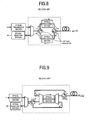
- an apparatus as shown in FIG. 9, for example has been proposed (refer to Japanese Unexamined Patent Publication No. 11 -127121) in which the steams of the optical signals separated into each one-way direction by optical circulators, are made into the steam in a single direction using a pair of optical multiplexing/demultiplexing devices, so that bidirectional optical signals can be processed by one optical processing section.
- the present invention has been accomplished in view of the above-described points, and has an object of providing a small sized optical apparatus with low cost and low loss, by realizing a simple structure optimum to bidirectional optical communication.
- an optical apparatus for bidirectional optical communication comprises: an optical transmission section that outputs a transmitted light; an optical reception section that is input with a received light whose wavelength is different from that of the transmitted light; an apparatus, which includes an optical isolator, outputting the light input thereto, via the optical isolator, a first optical component, which includes first through third ports, outputting the light input to the first port to the third port, and outputting the light input to the second port to the first port; a second optical component multiplexing the transmitted light output from the optical transmission section with the light output from the third port of the first optical component, to output the multiplexed light to the apparatus; and a third optical component separating the light output from the apparatus according to wavelength difference, to output the separated lights to the second port of the first optical component and to the optical reception section, respectively.
- the transmitted light output from the optical transmission section is given to the second optical component.
- the received light output from the third port of the first optical component is also given to this second optical component, and the light in a single direction obtained by multiplexing the transmitted light and received light is output from the second optical component to the apparatus including the optical isolator.
- the light given to that apparatus is given to the third optical component after subjected to predetermined optical processing, to be separated into the transmitted light and received light according to wavelengths, and the transmitted light is output to the first optical component, and the received light is output to the optical reception section.
- optical apparatus for bidirectional optical communication in a simple structure in which three optical components are combined, it becomes possible to make each of optical signals transmitted bidirectinally into the optical signals in a single direction, thereby enabling to process a transmitted light and a received light at the same time using only one apparatus including an optical isolator. Therefore, it is possible to reduce the number of components around the apparatus performing optical processing such as optical amplification, thus enabling an optical signal loss to be reduced, and the apparatus cost to be reduced.
- FIG. 1 is a functional block diagram showing a configuration of an optical apparatus for bidirectional optical communication according to a first embodiment of the present invention.
- the present apparatus 1 comprises for example, an optical transmission section 10, an optical reception section 20, a bidirectional optical unit 30, and a supervisory control section 40.
- the optical transmission section 10 Assuming the case where bidirectional optical transmission is performed for example between its own apparatus and the other apparatus (not shown in the figure), connected via a single transmission path fiber 2, the optical transmission section 10 generates an optical signal to be transmitted from the own apparatus to the other apparatus in accordance with a data signal given to a data input port thereof, and sends out this transmitted light from an optical output port thereof to the transmission path fiber 2 via the bidirectional optical unit 30.
- the optical reception section 20 receives, at an optical input port thereof via the bidirectional optical unit 30, an optical signal which is sent from the other apparatus and is propagated through the transmission path fiber 2 up to the own apparatus, and outputs a data signal obtained by regenerating the received light from a data output port thereof.
- the optical transmission section 10 and the optical reception section 20 are both shown as independent function blocks. However, needless to say, an integrated transmission and reception type optical transceiver may also be used.
- the bidirectional optical unit 30 includes for example, optical multiplexingJdemultiplexing sections 31, 32 and 33 corresponding to first to third optical components, and an optical processing section 34 serving as an apparatus for outputting a light input thereto via an optical isolator.
- Each of the optical multiplexing/demultiplexing sections 31 to 33 here includes first to third ports, and has a transmission characteristic capable of demultiplexing a WDM light input to the first port (the multiplexing side port), to output the demultiplexed light from the second port (the demultiplexing side port corresponding to a wavelength of the transmitted light) or the third port (the demultiplexing side port corresponding to a wavelength of the received light) corresponding to wavelength, and also multiplexing the optical signal input to the second port with the optical signal input to the third port, to output the multiplexed light from the first port.
- each of the optical multiplexing/demultiplexing sections 31 to 33 it is possible to use a known optical multiplexer/demultiplexer, which uses for example, an arrayed waveguide grating (AWG), a fiber Bragg grating (FBG) or the like.
- AWG arrayed waveguide grating
- FBG fiber Bragg grating
- a configuration is adopted in which three optical multiplexing/demultiplexing sections 31 to 33 using AWGs are integrated onto the same substrate, as shown by enclosing with the dotted line in FIG. 1.
- optical multiplexing/demultiplexing section 31 it is possible to use an optical coupler or an optical circulator using a high-pass filter or a low-pass filter.
- optical coupler for each of the optical multiplexing/demultiplexing sections 32 and 33, it is possible to use an optical coupler using a high-pass filter or a low-pass filter.
- the specific description is made on the connections between the ports of the optical multiplexing/demultiplexing sections 31 to 33.
- the first port of the optical multiplexing/demultiplexing section 31 is connected with one end of the transmission path fiber 2.
- the second port of the optical multiplexing/demultiplexing section 32 is connected with the optical output port of the optical transmission section 10
- the third port thereof is connected with the third port of the optical multiplexing/demultiplexing section 31, and the first port thereof is connected with an optical input port of the optical processing section 34.
- the first port of the optical multiplexing/demultiplexing section 33 is connected with an optical output port of the optical processing section 34, the second port thereof is connected with the second port of the optical multiplexing/demultiplexing section 31, and the third port thereof is connected with the optical input port of the optical reception section 20.
- the optical processing section 34 performs predetermined optical processing on an optical signal given to the optical input port thereof, to output it from the optical output port thereof.
- the predetermined optical processing performed in this optical processing section 34 is processing of, for example, optical spectrum measurement, optical amplification, wavelength dispersion compensation and the like, which are usually hard to be made common to both the transmitting side and receiving side, as mentioned previously.
- a device to realize such optical processing has a single directionality necessary to perform individualized processing so as to correspond to a propagation direction of an optical signal.
- an optical fiber amplifier or the like in which an optical isolator is disposed on an optical path in order to suppress an influence by the reflection of pumping light.
- variable dispersion compensator utilizing a virtually imaged phased array (VIPA), which demultiplexes a WDM light into a plurality of optical beams that can be distinguished spatially according to wavelengths.
- VIPA virtually imaged phased array
- the optical processing section 34 of the present invention comprises at least one of the devices described above. A specific structural example of the optical processing section 34 will be described in detail in another embodiment described later.
- the supervisory control section 40 controls the optical processing section 34 of the bidirectional optical unit 30 based on operating states of the optical transmission section 10 and the optical reception section 20, and also controls the optical transmission section 10 or the optical reception section 20 according to the processing results of the optical processing section 34.
- a wavelength ⁇ A is allocated to a transmitted light to be sent from the own apparatus to the other apparatus, and a wavelength ⁇ B is allocated to a received light to be sent from the other apparatus to the own apparatus.
- an optical signal of the wavelength ⁇ A is generated in the optical transmission section 10, to be given to the second port of the optical muftiplexing/demuftiplexing section 32 in the bidirectional optical unit 30.
- An optical signal of the wavelength ⁇ B which is input to the first port of the optical muftiplexing/demultiplexing section 31 after propagated through the transmission path fiber 2 and then, is output from the third port of the optical multiplexing/demultiplexing section 31, is given to the third port of the optical multiplexing/demultiplexing section 32. Accordingly, in the optical multiplexing/demultiplexing section 32, the optical signal of the wavelength ⁇ A and the optical signal of the wavelength ⁇ B are multiplexed, and the optical signals of the wavelengths ⁇ A and ⁇ B, which have been guided into a single direction, are output from the first port, to be given to the optical input port of the optical processing section 34.
- the optical signals of the respective wavelengths ⁇ A and ⁇ B which have been subjected to required optical processing in the optical processing section 34, are given to the first port of the optical multiplexing/demultiplexing section 33 and separated according to the wavelengths ⁇ A and ⁇ B.
- the optical signal of the wavelength ⁇ A, separated by the optical multiplexing/demultiplexing section 33 is given to the second port of the optical multiplexing/demultiplexing section 31, and is output from the first port, to be sent out to the transmission path fiber 2.
- the optical signal of the wavelength ⁇ B, separated by the optical multiplexing/demultiplexing section 33 is given to the optical input port of the optical reception section 20, to be subjected to typical regeneration processing.
- the supervisory control section 40 supervisory controls the optical transmission section 10, the optical reception section 20 and the optical processing section 34.
- this supervisory control for example, the power of the transmitted light output from the optical transmission section 10 and the power of the received light input to the optical reception section 20, are supervised, and an operation of the optical processing section 34 is controlled according to the supervisory information.
- a processing state of the optical processing section 34 is supervised, and operations of the optical transmission section 10 and the optical reception section 20 are controlled according to the supervisory information.
- the supervisory control of each section by this supervisory control section 40 will be described in detail using a specific example in a second embodiment as described later.
- the optical apparatus 1 of the first embodiment by using a combination of the three optical multiplexing/demultiplexing sections 31 to 33, it is possible to process bidirectional optical signals simultaneously using only one optical processing section 34.
- two optical circulators are no longer necessary, in comparison with a conventional configuration shown in FIG. 9. Therefore, it is possible to reduce the number of components disposed around the optical processing section 34. As a resutt, it becomes possible to reduce an optical signal loss and reduce the apparatus cost.
- the three optical multiplexing/demultiplexing sections 31 to 33 are constructed using the same type of devices, it is possible to integrate them. Especially, if the AWGs are used as the optical multiplexing/demultiplexing sections 31 to 33, it becomes possible to realize easily the integration of them on the same optical waveguide substrate. Moreover, by using the AWGs for the optical multiplexing/demultiplexing sections 31 and 32, it is possible to prevent a reflected light of the transmitted light in the bidirectional transmission path fiber 2 from being amplified by the optical processing section 34 as the received light. In addition, in the case where the lights are multiplexed using a WDM coupler or a normal optical coupler, a loss occurs during the multiplexing. However, by multiplexing the lights using the AWG, it is possible to suppress the occurrence of loss as described above, and this effect is significant especially in the case where the number of multiplexed wavelengths of WDM light is increased.
- the AWGs are used as the optical muttiptexing/demuttiptexing sections 31 to 33, since the AWG generally has a filtering characteristic to cut out channels, then when a wavelength of signal light is varied or the temperature of the device is changed, there is a problem of attenuation of the signal light.
- the spacing (inter-channel spacing) between signal lights of respective wavelengths is sufficiently wide relative to the wavelength width of each signal light. Therefore, even if the fitter characteristic of the AWGs is varied, or the signal light wavelength is varied, there is no problem of attenuation of the signal light as described above.
- the device used for the optical processing section 34 in the optical apparatus 1 is capable of being integrated with the optical multiplexing/demultiplexing sections 31 to 33, it becomes also possible to produce the entire bidirectional optical unit 30 as one optical component, thus enabling the optical signal loss and the apparatus cost to be further reduced.
- each of the optical multiplexing/demultiplexing sections 31 to 33 also operates as an optical filter to the optical signals of the respective wavelengths ⁇ A and ⁇ B, then, it becomes also possible to eliminate noise components, for example, ASE or the like, generated when the optical amplification is performed in the optical processing section 34, to thereby reduce the deterioration of the optical signal quality.
- noise components for example, ASE or the like
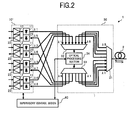
- FIG. 2 is a functional block diagram showing a configuration of the optical apparatus of the second embodiment.
- An optical transmission/reception section 10' consists of, for example, a combination of four integrated transmission and reception type optical transceivers, and transmits and receives the optical signals of the wavelengths ⁇ 1 to ⁇ 8.
- Each optical transceiver of this optical transmission/reception section 10' here, generates a transmission light by means of a light source 11 and a drive circuit 12, and also regenerates a received light by means of a light receiving element 21 and a reception processing circuit 22.
- Each of three optical multiplexing/demultiplexing. sections 31 to 33 in the bidirectional optical unit 30 has eight demultiplexing side ports corresponding to the wavelengths ⁇ 1 to ⁇ 8, respectively, and one multiplexing side port.
- a relationship of connections between the ports of the optical multiplexing/demultiplexing sections 31 to 33 is the same as that in the first embodiment, by corresponding the wavelengths ⁇ 1 to ⁇ 4, to the wavelength ⁇ A in the first embodiment, and corresponding the wavelengths ⁇ 5 to ⁇ 8, to the wavelength ⁇ B in the first embodiment. Therefore, the description thereof is omitted here.
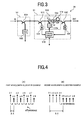
- optical processing section 34 in the bidirectional optical unit 30 Furthermore, a specific configuration as shown for example in FIG. 3 is adopted as the optical processing section 34 in the bidirectional optical unit 30.
- the configuration of the optical processing section is not limited to the example in FIG. 3.
- the optical processing section 34 comprises a monitor circuit 50 for measuring the spectrum of an optical signal given to an optical input port IN thereof, and an optical amplification circuit 51 amplifying the optical signal passed through the monitor circuit 50, to a required level to output the amplified optical signal from an optical output port OUT thereof.
- the monitor circuit 50 branches a part of the optical signal from the optical input port IN by an optical coupler 50A, gives the branched optical signal to an optical spectrum analyzer (OSA) 50B, and outputs a signal indicating information relating to the optical spectrum measured by the optical spectrum analyzer 50B to the supervisory control section 40.
- OSA optical spectrum analyzer
- the optical amplification circuit 51 is provided with a known optical amplifier 51 A to which the optical signal is input from the monitor circuit 50, and a control circuit 51 B for controlling an operation of the optical amplifier 51 A.
- the optical amplifier 51 A includes, for example, an erbium doped fiber (EDF) 51 a, a pumping light source 51 b, a WDM coupler 51c and an optical isolator 51d.
- EDF erbium doped fiber
- a pumping light Lp generated in the pumping light source 51 b is supplied to the EDF 51 a via the WDM coupler 51 c and the optical isolator 51 d.
- the control circuit 51 B is given with: an input monitor signal, which is obtained by branching a part of the optical signal input to the optical amplifier 51 A by an optical coupler 51 C, and photoelectrically converting the branched optical signal by an optical receiver 51 D; an output monitor signal, which is obtained by branching a part of the optical signal output from the optical amplifier 51 A by an optical coupler 50E, and photoelectrically converting the branched optical signal by an optical receiver 51 F; and a control signal sent from the supervisory control section 40.
- a signal for controlling a gain of the optical amplifier 51 A based on each of the signals is output from the control circuit 51 B to the optical amplifier 51 A.
- the optical signals of the wavelengths ⁇ 1 to ⁇ 4 output from the respective light sources of the optical transmission/reception section 10', are respectively given to the demultiplexing side ports corresponding to the wavelengths ⁇ 1 to ⁇ 4 of the optical multiplexing/demultiplexing section 32 in the bidirectional optical unit 30.
- the optical signals of the wavelengths ⁇ 5 to ⁇ 8, which are input to the optical multiplexing/demultiplexing section 31 after propagated through the transmission path fiber 2, and then demultiplexed, are respectively given to the demultiplexing side ports corresponding to the wavelengths ⁇ 5 to ⁇ 8 of this optical multiplexing/demuftiplexing section 32.
- the WDM light in which the optical signals of wavelengths ⁇ 1 to ⁇ 8 are multiplexed to be made into a single direction is output from the multiplexing side port, to be given to the optical input port IN of the optical processing section 34.
- the spectrum of the WDM light from the optical multiplexing/demultiplexing section 32 is first measured in the monitor circuit 50, and a supervisory signal indicating the measurement result is transmitted to the supervisory control section 40.
- the WDM light passed through the monitor circuit 50 is next given to the optical amplification circuit 51, amplified to a required level by the optical amplifier 51 A, whose drive state is controlled by the control circuit 51 B, and output from the optical output port OUT to the multiplexing side port of the optical multiplexing/demultiplexing section 33.
- the WDM light from the optical processing section 34 is demultiplexed, and the optical signals of the wavelengths ⁇ 1 to ⁇ 4 are respectively given to the corresponding demultiplexing side ports of the optical multiplexing/demultiplexing. section 31, and output from the multiplexing side port to the transmission path fiber 2.
- the optical signals of the wavelengths ⁇ 5 to ⁇ 8, demulfiplexed in the optical multiplexing/demultiplexing section 33 are regenerated by the light receiving elements 21 and the reception processing circuits 22 corresponding to the respective wavelengths in the optical transmission/reception section 10'.
- FIG. 4 is a diagram showing two types of wavelength allocation example for bidirectional optical signals of eight wavelengths.
- a first wavelength allocation example shown in (A) of FIG. 4 shows the case where ⁇ 1, ⁇ 3, ⁇ 5 and ⁇ 7 are allocated as wavelengths of the transmitted light, ⁇ 2, ⁇ 4, ⁇ 6 and ⁇ 8 are allocated as wavelengths of the received light, and the wavelengths of the transmitted lights and the received lights are allocated alternately on wavelength grids.
- a second wavelength allocation example shown in (B) of FIG. 4 shows the case where, as described above, ⁇ 1 to ⁇ 4 are allocated as wavelengths of the transmitted light, ⁇ 5 to ⁇ 8 are allocated as wavelengths of the received light, and a wavelength band of the transmitted light and a wavelength band of the received light are set to be different from each other.
- the wavelengths ⁇ 1 to ⁇ 8 are allocated at equal spacing. However, they may be allocated at arbitrary spacing.
- the wavelength bandwidth ⁇ required for the bidirectional transmission may be the optimal width corresponding to the number of channels.
- the bandwidth may be of the minimum wavelength spacing. Therefore, the wavelength band to be used can be controlled flexibly according to an increase and decrease of the number of optical signals transmitted and received, and it is possible to use the bandwidth of the transmission path fiber 2 efficiently.
- each of the three wavelengths ⁇ 3, ⁇ 5 and ⁇ 7 among the received light wavelengths has the transmitted light wavelengths placed on both sides of them. Therefore, there is a possibility that there occurs a lot of interference of the transmitted light to the received light.
- the second wavelength allocation example is adopted in the configuration of the second embodiment shown in FIG. 2.
- which wavelength allocation example is selected can be determined appropriately depending on the specification of a system or the like.
- the supervisory control section 40 supervises the power of the transmitted light output from each of the light sources 11 corresponding to the wavelengths ⁇ 1 to ⁇ 4. Supervision of the transmitted light power is performed, for example, by detecting the power (back power) of a backwardly emitted light traveling in a direction opposite to that of the transmitted light by means of a monitoring optical receiver which is integrated with the normal light source 11, and sending a transmitted light monitor signal indicating the detection result to the supervisory control section 40.
- the transmitted light power of each of the wavelengths is detected based on the transmitted light monitor signal, and a previously set target control value of the transmitted light power is compared with a monitor value. Then, an operation of the drive circuit 12 corresponding to each of the wavelengths is controlled based on the comparison result, such that the transmitted light power of each of the wavelengths ⁇ 1 to ⁇ 4 is fixed at the target value.
- the transmitted light powers of the respective wavelengths are supervised collectively utilizing optical spectrum information monitored by the monitor circuit 50 in the optical processing section 34, and the target control value set in advance in the supervisory control section 40 is updated such that dispersion of the transmitted light powers of the respective wavelengths is corrected, or wavelength dependence of the loss in the transmission path fiber 2 is compensated for in advance.
- the reception state of the optical signals of the respective wavelengths ⁇ 5 to ⁇ 8 is supervised, and the light receiving element 21 or the reception processing circuit 22 corresponding to each wavelength is controlled.
- the reception state is supervised, by sending a part of the signal photoelectrically converted by the light receiving element 21 corresponding to each wavelength, to the supervisory control section 40, as a received light monitor signal.
- the supervisory control section 40 detects information relating to signal amplitude and signal speed (bit rate) corresponding to each wavelength, based on the received light monitor signal.
- the detected information there is performed a control of bias to be applied to the light receiving element 21 corresponding to each wavelength (control of a multiplication factor in the case where the light receiving element 21 is an APD), or a control of the reception band of the reception processing circuit 22.
- the supervisory control section 40 also controls a gain of the optical amplification circuit 51 of the optical processing section 34.
- This gain control is, for example, such that in the case where the received light power is low, and is outside a controllable range by the reception processing circuit 22, a control is performed for increasing the gain of the optical amplifier 51 A within a range where the transmitted light power does not exceed a defined power.
- optical apparatus 1 of the second embodiment for the bidirectional optical signals of eight wavelengths, it is also possible to achieve the same effect as in the first embodiment.
- the number of wavelengths of the bidirectional optical signals is not limited to the above described example, and the present invention may be applied to arbitrary number of wavelengths of bidirectional optical signals.
- the number of wavelengths of the transmitted light and the number of wavelengths of the received light are set to be the same.
- different numbers of wavelengths may be allocated to the transmitted light and the received light.
- FIG. 5 is a diagram showing a configuration example of the node apparatus.
- This node apparatus 60 includes, for example, two optical input-output ports P1 and P2 for a trunk line system optical transmission path, and an optical input-output port P3 for a subscriber interface, which branches an optical signal being propagated through the trunk line system optical transmission path to a subscriber side, and is provided with the optical apparatus 1 as shown in FIG. 2 for each of the optical input-output ports P1 to P3.
- the optical apparatuses 1 are connected by a switch circuit 61 for switching the connection states between the data input ports and data output ports of the respective optical transmission/reception sections, and it is possible to convert an optical signal of an arbitrary wavelength, received by an arbitrary optical input-output port to an optical signal of another arbitrary wavelength, to transmit this from another arbitrary optical input-output port.
- a switch circuit 61 for example, as the switch circuit 61, an operation as a complete switching node is possible.
- the switch circuit 61 of the node apparatus 60 is limited to such a non-blocking type configuration. It is also possible to construct the node apparatus 60 by using a blocking type switch.
- the non-blocking type switch means a switch capable of switching connections between a plurality of ports as desired.
- the node apparatus 60 it is possible to realize required optical processing to be performed for each of the optical input-output ports P1 to P3 to/from which the bidirectional optical signals are input/output, with a simple structure. Therefore, it is possible to provide, at low cost, a small sized node apparatus with low power consumption and low loss.
- FIG. 6 is a diagram showing a configuration example of the above-described bidirectional optical communication network.
- a bidirectional ring network is constructed by connecting the trunk line system optical transmission path optical input-output ports of each of the node apparatuses 60 in a ring shape
- a subscriber interface network is constructed by connecting between the subscriber interface optical input-output ports of each of the node apparatuses 60 and the optical transmitters and receivers (Tx/Rx) of each of a plurality of subscribers, via the bidirectional optical units 30 (refer to FIG. 2) installed for the subscribers.
- bidirectional WDM transmission is performed by one optical fiber ring in the trunk line system
- bidirectional WDM transmission is also performed between the node apparatuses 60 and the bidirectional optical units 30 by one optical fiber in a subscriber system.
- bidirectional optical communication network it is possible to reduce the cost of maintenance and administration of the entire network by using the node apparatuses 60 and the bidirectional optical units 30 with simple structures. Therefore, it is possible to provide an economical bidirectional optical communication network.
- the wavelength allocation of the directional optical signals is performed in accordance with the second wavelength allocation example shown in (B) of FIG. 4.
- ⁇ 1 to ⁇ 4 are allocated as wavelengths of optical signals transmitted from a node apparatus 60 side to a subscriber side
- ⁇ 5 to ⁇ 8 are allocated as wavelengths of optical signals transmitted from the subscriber side to the node apparatus 60 side.
- each subscriber since each subscriber is normally located at an arbitrary base, distances from the bidirectional optical unit 30 to the respective subscribers are different. Accordingly, the setting of transmitted light power, receiver sensitivity and the like, required by the optical transmitters and receivers of the respective subscribers, is different for each subscriber.
- the subscriber interface network shown in FIG. 7 for example, by providing the monitor circuit 50 as exemplarily shown in FIG. 3 as the optical processing section 34 in the bidirectional optical unit 30, it is possible to supervise the levels of the transmitted light and the received light for each subscriber, and control optimally the transmitted light power, receiver sensitivity and the like, of the optical transmitter and receiver of each subscriber by remote control operation according to the supervisory result.
Landscapes
- Engineering & Computer Science (AREA)
- Computer Networks & Wireless Communication (AREA)
- Signal Processing (AREA)
- Physics & Mathematics (AREA)
- Electromagnetism (AREA)
- Optical Communication System (AREA)
Applications Claiming Priority (2)
| Application Number | Priority Date | Filing Date | Title |
|---|---|---|---|
| JP2003393172 | 2003-11-21 | ||
| JP2003393172A JP4294452B2 (ja) | 2003-11-21 | 2003-11-21 | 双方向光通信用の光装置 |
Publications (2)
| Publication Number | Publication Date |
|---|---|
| EP1542380A2 true EP1542380A2 (de) | 2005-06-15 |
| EP1542380A3 EP1542380A3 (de) | 2009-09-02 |
Family
ID=34510432
Family Applications (1)
| Application Number | Title | Priority Date | Filing Date |
|---|---|---|---|
| EP04007645A Withdrawn EP1542380A3 (de) | 2003-11-21 | 2004-03-30 | Optische Vorrichtung für bidirektionale optische Informationsübertragung |
Country Status (3)
| Country | Link |
|---|---|
| US (1) | US7203392B2 (de) |
| EP (1) | EP1542380A3 (de) |
| JP (1) | JP4294452B2 (de) |
Families Citing this family (21)
| Publication number | Priority date | Publication date | Assignee | Title |
|---|---|---|---|---|
| JP4294452B2 (ja) * | 2003-11-21 | 2009-07-15 | 富士通株式会社 | 双方向光通信用の光装置 |
| JP2005341529A (ja) * | 2004-04-28 | 2005-12-08 | Fujitsu Ltd | 光伝送システム,光送受信装置,光伝送装置および光波長チャンネル接続認識制御方法 |
| US7570844B2 (en) * | 2005-01-18 | 2009-08-04 | Doron Handelman | Photonic integrated circuit device and elements thereof |
| JP4900704B2 (ja) | 2007-03-23 | 2012-03-21 | 日本電気株式会社 | 光信号監視システム及び光信号監視方法 |
| US7683312B2 (en) | 2007-10-23 | 2010-03-23 | Us Sensor Systems, Inc. | Fiber-optic interrogator with normalization filters |
| CN102576035A (zh) | 2009-10-23 | 2012-07-11 | 美国地震系统有限公司 | 光纤光学变换器、光纤光学加速度计以及光纤光学感测系统 |
| US9158032B2 (en) | 2010-02-18 | 2015-10-13 | US Seismic Systems, Inc. | Optical detection systems and methods of using the same |
| US8983287B2 (en) | 2010-02-18 | 2015-03-17 | US Seismic Systems, Inc. | Fiber optic personnel safety systems and methods of using the same |
| US8401354B2 (en) | 2010-02-23 | 2013-03-19 | US Seismic Systems, Inc. | Fiber optic security systems and methods of using the same |
| US8701481B2 (en) | 2010-07-06 | 2014-04-22 | US Seismic Systems, Inc. | Borehole sensing and clamping systems and methods of using the same |
| WO2012103085A2 (en) * | 2011-01-25 | 2012-08-02 | US Seismic Systems, Inc. | Light powered communication systems and methods of using the same |
| US9217801B2 (en) | 2011-03-08 | 2015-12-22 | Pacific Western Bank | Fiber optic acoustic sensor arrays and systems, and methods of fabricating the same |
| JP5839049B2 (ja) * | 2012-01-23 | 2016-01-06 | 日本電気株式会社 | 光受信器、光受信器の制御方法、および光受信方法 |
| KR101285766B1 (ko) * | 2012-05-18 | 2013-07-19 | 에스케이텔레콤 주식회사 | 양방향 광 송수신 모듈 |
| US9441433B2 (en) | 2012-07-27 | 2016-09-13 | Avalon Sciences, Ltd | Remotely actuated clamping devices for borehole seismic sensing systems and methods of operating the same |
| US9485083B2 (en) * | 2013-11-20 | 2016-11-01 | Electronics And Telecommunications Research Instit | Method and apparatus for time synchronization between nodes |
| EP3295588A1 (de) * | 2015-05-11 | 2018-03-21 | Neptune Subsea IP Limited | Optische vernetzung |
| WO2017085513A1 (en) | 2015-11-20 | 2017-05-26 | Xtera Communications, Inc. | System and method for optical fibre communication |
| JP2019220775A (ja) | 2018-06-18 | 2019-12-26 | 日本電信電話株式会社 | 光増幅器、光伝送システム及び光ケーブル障害個所測定方法 |
| WO2025169436A1 (ja) * | 2024-02-09 | 2025-08-14 | 三菱電機株式会社 | 光無線通信システムおよび光無線通信装置 |
| WO2025173066A1 (ja) * | 2024-02-13 | 2025-08-21 | Ntt株式会社 | 波長供給光源装置、光通信システム及び波長供給方法 |
Family Cites Families (17)
| Publication number | Priority date | Publication date | Assignee | Title |
|---|---|---|---|---|
| JPS63312732A (ja) | 1987-06-15 | 1988-12-21 | Nec Corp | 双方向波長多重光伝送方式 |
| JPH06342952A (ja) * | 1993-03-19 | 1994-12-13 | Matsushita Electric Ind Co Ltd | 光ファイバ増幅器および光ファイバ伝送システム |
| IT1273465B (it) * | 1995-01-27 | 1997-07-08 | Pirelli Cavi Spa | Sistema di telecomunicazione ottica bidirezionale comprendente un amplificatore ottico bidirezionale |
| US6333799B1 (en) * | 1997-01-07 | 2001-12-25 | Tellium, Inc. | Hybrid wavelength-interchanging cross-connect |
| JPH10322286A (ja) * | 1997-05-15 | 1998-12-04 | Nec Corp | 双方向波長多重伝送装置 |
| JP4031853B2 (ja) | 1997-10-20 | 2008-01-09 | 富士通株式会社 | 双方向光通信用光伝送装置 |
| JP3481456B2 (ja) * | 1998-03-31 | 2003-12-22 | 日本電気株式会社 | 双方向wdm光伝送システム |
| US5959749A (en) * | 1998-05-20 | 1999-09-28 | Nortel Networks Corporation | Optical add/drop multiplexer/demultiplexer |
| US6411407B1 (en) * | 1998-09-17 | 2002-06-25 | Alcatel | Method for providing a bidirectional optical supervisory channel |
| JP3670156B2 (ja) * | 1999-03-18 | 2005-07-13 | 富士通株式会社 | 監視光信号を伝送するための方法、装置及びシステム |
| JP3771785B2 (ja) * | 2000-08-21 | 2006-04-26 | 株式会社日立製作所 | 光増幅装置 |
| JP5093939B2 (ja) | 2000-11-27 | 2012-12-12 | 日本電気株式会社 | 波長多重光通信システム |
| JP2002208895A (ja) * | 2001-01-10 | 2002-07-26 | Fujitsu Ltd | 光アッド/ドロップ装置 |
| KR100378111B1 (ko) * | 2001-04-02 | 2003-03-29 | 삼성전자주식회사 | 광증폭기 및 이를 이용한 양방향 파장분할 다중 광통신시스템 |
| US7599620B2 (en) * | 2001-06-01 | 2009-10-06 | Nortel Networks Limited | Communications network for a metropolitan area |
| JP4089504B2 (ja) * | 2003-05-14 | 2008-05-28 | 日本電気株式会社 | 一芯双方向光伝送システム及び一芯双方向光増幅器並びにその方法 |
| JP4294452B2 (ja) * | 2003-11-21 | 2009-07-15 | 富士通株式会社 | 双方向光通信用の光装置 |
-
2003
- 2003-11-21 JP JP2003393172A patent/JP4294452B2/ja not_active Expired - Fee Related
-
2004
- 2004-03-24 US US10/807,256 patent/US7203392B2/en not_active Expired - Fee Related
- 2004-03-30 EP EP04007645A patent/EP1542380A3/de not_active Withdrawn
Also Published As
| Publication number | Publication date |
|---|---|
| JP2005159586A (ja) | 2005-06-16 |
| US20050111788A1 (en) | 2005-05-26 |
| JP4294452B2 (ja) | 2009-07-15 |
| US7203392B2 (en) | 2007-04-10 |
| EP1542380A3 (de) | 2009-09-02 |
Similar Documents
| Publication | Publication Date | Title |
|---|---|---|
| US7203392B2 (en) | Optical apparatus for bidirectional optical communication | |
| US9444572B2 (en) | Transmission device and transmission method | |
| US6192173B1 (en) | Flexible WDM network architecture | |
| US6535309B1 (en) | Optical multiplexing/demultiplexing apparatus and optical multiplexing/demultiplexing method | |
| KR100334432B1 (ko) | 하나의도파관열격자다중화기를이용한양방향애드/드롭광증폭기모듈 | |
| US6411407B1 (en) | Method for providing a bidirectional optical supervisory channel | |
| US12506555B2 (en) | Monitor window in ASE injection seed | |
| US6512613B1 (en) | WDM transmission repeater, WDM transmission system and WDM transmission method | |
| JP4425105B2 (ja) | 光ネットワークおよび光分岐挿入装置 | |
| US9124382B2 (en) | Transmission device, transmission system, and method for adjusting passband | |
| US6970613B2 (en) | Optical receiver and optical transmission apparatus | |
| JP2008503886A (ja) | 波長分割多重(wdm)光分波器 | |
| EP0967752A2 (de) | WDM Nachrichtenübertragungssystem | |
| KR100498931B1 (ko) | 양방향 파장분할다중방식 자기치유 광통신망 | |
| JPH10322286A (ja) | 双方向波長多重伝送装置 | |
| KR20150139696A (ko) | 가변형 광 분기결합 다중화 시스템 | |
| KR100584386B1 (ko) | 양방향 광 애드-드롭 다중화기 | |
| EP4302429B1 (de) | Optische verstärkervorrichtung und verfahren | |
| JP3821353B2 (ja) | 多波長変換制御装置 | |
| US7133612B1 (en) | Bidirectional WDM transmission system having transmission format for reducing adverse effects of filter concatonation | |
| JP3112261B2 (ja) | 光波ネットワークシステム | |
| JP2001007767A (ja) | 光通信システム、光受信器および光通信方法 | |
| JP2025048760A (ja) | 部分的に着色されたフレキシグリッド波長分割マルチプレクサ/デマルチプレクサ | |
| WO2025169436A1 (ja) | 光無線通信システムおよび光無線通信装置 |
Legal Events
| Date | Code | Title | Description |
|---|---|---|---|
| PUAI | Public reference made under article 153(3) epc to a published international application that has entered the european phase |
Free format text: ORIGINAL CODE: 0009012 |
|
| AK | Designated contracting states |
Kind code of ref document: A2 Designated state(s): AT BE BG CH CY CZ DE DK EE ES FI FR GB GR HU IE IT LI LU MC NL PL PT RO SE SI SK TR |
|
| AX | Request for extension of the european patent |
Extension state: AL LT LV MK |
|
| PUAL | Search report despatched |
Free format text: ORIGINAL CODE: 0009013 |
|
| AK | Designated contracting states |
Kind code of ref document: A3 Designated state(s): AT BE BG CH CY CZ DE DK EE ES FI FR GB GR HU IE IT LI LU MC NL PL PT RO SE SI SK TR |
|
| AX | Request for extension of the european patent |
Extension state: AL LT LV MK |
|
| AKX | Designation fees paid | ||
| STAA | Information on the status of an ep patent application or granted ep patent |
Free format text: STATUS: THE APPLICATION IS DEEMED TO BE WITHDRAWN |
|
| 18D | Application deemed to be withdrawn |
Effective date: 20100303 |
|
| REG | Reference to a national code |
Ref country code: DE Ref legal event code: 8566 |