EP1544133B1 - Verfahren zur Sammlung und Verwaltung von Müll - Google Patents
Verfahren zur Sammlung und Verwaltung von Müll Download PDFInfo
- Publication number
- EP1544133B1 EP1544133B1 EP03104796A EP03104796A EP1544133B1 EP 1544133 B1 EP1544133 B1 EP 1544133B1 EP 03104796 A EP03104796 A EP 03104796A EP 03104796 A EP03104796 A EP 03104796A EP 1544133 B1 EP1544133 B1 EP 1544133B1
- Authority
- EP
- European Patent Office
- Prior art keywords
- waste
- active phase
- refuse
- waste bin
- bin assemblies
- Prior art date
- Legal status (The legal status is an assumption and is not a legal conclusion. Google has not performed a legal analysis and makes no representation as to the accuracy of the status listed.)
- Expired - Lifetime
Links
- 239000002699 waste material Substances 0.000 title claims abstract description 102
- 238000000034 method Methods 0.000 title claims description 33
- 230000000712 assembly Effects 0.000 claims abstract description 45
- 238000000429 assembly Methods 0.000 claims abstract description 45
- 238000007789 sealing Methods 0.000 claims 1
- 230000004913 activation Effects 0.000 abstract description 4
- 239000012071 phase Substances 0.000 description 40
- 238000003780 insertion Methods 0.000 description 11
- 230000037431 insertion Effects 0.000 description 11
- 208000027418 Wounds and injury Diseases 0.000 description 5
- 239000012072 active phase Substances 0.000 description 5
- 230000006378 damage Effects 0.000 description 5
- 239000010791 domestic waste Substances 0.000 description 5
- 208000014674 injury Diseases 0.000 description 5
- 230000007613 environmental effect Effects 0.000 description 4
- 238000004891 communication Methods 0.000 description 3
- 239000012530 fluid Substances 0.000 description 3
- 230000005484 gravity Effects 0.000 description 3
- 230000001681 protective effect Effects 0.000 description 2
- 230000001419 dependent effect Effects 0.000 description 1
- 235000013399 edible fruits Nutrition 0.000 description 1
- 235000013410 fast food Nutrition 0.000 description 1
- 235000021190 leftovers Nutrition 0.000 description 1
- 239000010807 litter Substances 0.000 description 1
- 238000012986 modification Methods 0.000 description 1
- 230000004048 modification Effects 0.000 description 1
- 239000010893 paper waste Substances 0.000 description 1
Images


Classifications
-
- B—PERFORMING OPERATIONS; TRANSPORTING
- B65—CONVEYING; PACKING; STORING; HANDLING THIN OR FILAMENTARY MATERIAL
- B65F—GATHERING OR REMOVAL OF DOMESTIC OR LIKE REFUSE
- B65F5/00—Gathering or removal of refuse otherwise than by receptacles or vehicles
- B65F5/005—Gathering or removal of refuse otherwise than by receptacles or vehicles by pneumatic means, e.g. by suction
Definitions
- the present invention relates to a method of to collecting and managing waste, specifically smaller amounts of waste normally referred to as litter that is introduced in waste or litter bin assemblies.
- Littering that is the discarding of smaller amounts of loose waste/litter, in streets and public open places is not only an environmental problem but is in many countries even a criminal offence. In urban areas, litter should be dropped in litter bins that are frequently placed in public places. However, emptying of the traditional separate litter bins is a rather time consuming and expensive task.
- US-A-3,977,729 discloses a refuse receiving system that uses a method of collecting and managing waste according to the preamble of claim 1 that may serve to receive household waste and that may also be used as a waste-paper or litter bin system.
- the system uses sluice-like waste insertion elements that either alone or in combination with a bottom discharge valve form a space in which inserted waste may be received and from which the collected waste may be emptied into a system transport pipe at selected times and during optional operational phases of the system
- the collecting space is connected to a system transport pipe but may be disconnected from the transport pipe to secure that system vacuum will not be communicated to waste inlets thereof during waste insertion phases, to thereby reduce noise and minimize injury risk.
- the invention provides a solution overcoming the above discussed problems experienced with the prior known techniques.
- the invention provides a method enabling the collecting and managing of smaller amounts of unpackaged waste in waste bin assemblies connected to a refuse vacuum transport system, wherein waste introduced into a waste bin assembly when the refuse vacuum system is active, is held back therein during such an active phase, is emptied therefrom when the system is in a deactivated state to be temporarily stored in a transport pipe of the system and is removed by the refuse vacuum system in connection with the next activation thereof.
- the waste that has been temporarily stored in the transport pipe is removed therefrom in a separate pre-activation phase immediately preceding the next active phase of the entire system.
- an interior of said litter bin assemblies is connected to the refuse vacuum transport system through a controlled discharge valve, whereby all assembly discharge valves are maintained in closed position during activation of the vacuum transport system, so that inserted waste is collected in the respective assembly.
- the discharge valves are then opened during a deactivated phase of the vacuum transport system, to empty the waste bin assemblies and temporarily store the waste in a transport pipe of the system.
- the stored waste is finally removed from the transport pipe in association with the next active phase of the system.
- waste and litter refer specifically to such unpackaged waste in the form of paper, wrappings, fruit, fast food leftovers etc. that has traditionally been collected in so called litter bins provided in public places.
- Fig. 1 is illustrated a very schematic example of a refuse vacuum transport system 1 of the general type that is widely used for collecting larger amounts of primarily domestic/household waste or refuse that is ordinarily packaged in plastic refuse bags.
- a system 1 comprises a collection central 2 having vacuum generating equipment, such as one or several strong exhausters, filter equipment, silencers and a storage capacity for the collected refuse.
- the mentioned collection central equipment may be of any standard type used for such systems and will therefore not be specifically described or illustrated herein.
- refuse is sucked in to the collection central 2 by strong vacuum that is applied to a transport pipe 3 and in the illustrated basic embodiment, drawn with full lines, to the branch or section pipes 13, 23 when the system is in an active phase.
- Said active phase is entered during daytime and early evening only, since this is the time that refuse is introduced into the system, and not least since nighttime operation would in many places cause unacceptable environmental disturbance, in the form of noise caused e.g. by operating exhausters or the application of a strong vacuum.
- insertion points generally designated by the reference numeral 5, that may be in the form of refuse chutes extending through a multi-storage building and having an insertion opening associated with each story, or that may be so called "separate" insertion chutes normally being positioned outdoors and having one insertion opening.
- insertion points generally designated by the reference numeral 5
- a refuse discharge valve CDV-A and CDV-B not specifically illustrated, that supports the inserted refuse until the respective chutes are emptied in a controlled or preset sequence during the active phase of the system 1.
- Fig. 1 indicates that the refuse transport system 1 may contain further branch pipes, such as the additional branches/sections 33, 43 drawn with dash-dot lines therein.
- Said additional branch pipes 33, 43 communicate either directly with the main transport pipe 3 or with another branch pipe, and thereby with the collection central 2, or indirectly therewith through a sectioning valve 40.
- waste/litter bin assemblies 4 are provided therein. Waste bin assemblies 4 are provided at appropriate positions directly above a transport pipe or branch of the vacuum transport system 1 to allow for a gravity feed of waste W (see figs. 2 and 3) from each waste/litter bin assembly 4 into the respective transport pipe or branch. In the embodiments schematically illustrated in fig. 1 waste bin assemblies 4 are provided in association with the branches 23, 33 and 43.
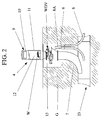
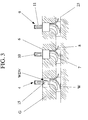
- FIG. 2 An exemplary embodiment of an appropriate waste bin assembly 4 associated with the branch 23, is illustrated in figs. 2 and 3.
- the assembly 4 has an upper insertion structure 9 that is normally positioned above ground G and that consists of an outer housing 11 having at least one insertion opening 10 and partially enclosing an internal collection chamber 12 (fig. 2).
- a lower portion of the waste bin assembly 4 is here received in a service chamber 6 positioned below ground G.
- a front wall of the service chamber 6 has been removed so as to illustrate, at least partially, some of the vital elements received therein.
- This lower portion mainly consists of a discharge valve WDV and connecting members, not specifically designated, for connecting the upper structure 9, and specifically its collection chamber 12, to the inlet of the valve WDV and for connecting the valve outlet to a transport pipe branch 23 of the system 1 through a branching 7 attached thereto.
- the internal collection chamber 12 of each waste bin assembly 4 is connected to a transport pipe/branch.
- the waste discharge valve WDV is to close off the bottom of the internal collection chamber 12 when the valve WDV is in its closed position. In most cases it is also preferred that the valve completely seals off the internal collection chamber 12 from the transport pipe/branch pipe of the system, so that practically no vacuum may be applied to said collection chamber when the valve is closed.
- the discharge valve WDV is a simple and inexpensive flap type valve where the flap 15 is controlled by a fluid cylinder to which fluid is supplied through supply lines 8A that outside the service chamber run in protective tubes 8 extending along the branch pipe 23. Said protective tubes 8 may furthermore or alternatively, depending upon the actual method used for controlling the valves, receive electric lines or fluid control lines. In the closed position (fig.
- figs. 4A and 4B are schematically illustrated in figs. 4A and 4B and will now be briefly explained.
- fig. 4A is illustrated the 24 hour operation of a relatively large system for which it-is justified to maintain the-system in an active phase, with its exhausters operating and applying vacuum to the transport pipes/branches, during the full day. The system is deactivated during late evening, night and early morning when practically no refuse is inserted into the chutes.
- chutes are emptied in a specific sequence that may vary from system to system and that is only exemplified by the shown regular sequence.
- the different chutes 5, or branches 13, 23, 43 are emptied by opening the corresponding chute discharge valves CDV-A, CDV-B and CDV-C, respectively, and, where applicable, the corresponding sectioning valve 40.
- the assembly discharge valves WDV of all waste bin assemblies are closed during the entire active phase of the system 1 as well as during a later described pre-active phase of the system.
- the assembly discharge valves WDV may on the other hand be open during the entire non-active phase of the system 1 or during only a restricted time, shortly before the pre-active phase of the system 1.
- Loose waste/litter W (figs. 2 and 3) that is introduced into the waste bin assemblies 4 when the assembly discharge valves WDV are closed, is collected in the internal collection chambers 12 thereof, supported on the flap 15 of the assembly discharge valves WDV (fig. 4A-B).
- waste W from the collection chambers 12 of the waste bin assemblies 4 is emptied into a corresponding transport pipe/branch pipe 23, 33, 43, of the system 1, thereby allowing waste emptied from the assemblies to be temporarily stored in said pipe 23, 33, 43.
- Closing of the discharge valve WDV of each waste bin assembly 4 again is then performed prior to commencing the next pre-active and active phases of the vacuum transport system.
- the temporarily stored waste W is removed from the pipes 23, 33, 43 in association with said next active phase of the refuse vacuum transport system 1.
- Waste/litter W temporarily stored in transport pipes/branch pipes 23, 33, 43 of the refuse vacuum transport system 1 is removed therefrom in a separate pre-active phase immediately preceding the active phase of the system 1 and by the full system vacuum.
- This will secure a safe and effective transport of the loose waste/litter to the collection central 2 and will still only insignificantly add to the active phase of the system.
- the temporarily stored waste/litter W is removed simultaneously from all pipes 23, 33 and 43, in order to keep the pre-active phase very short. Specifically, this means that to perform efficient removal of all said waste/litter W the exhausters will only have to be started shortly before the actual active phase, with the resulting saving in time and energy.
- the invention also covers embodiments for very large systems, where stored waste/litter W from different groups of waste bin assemblies 4 is removed in separate consecutive steps, such as for one or more of the different groups of bin assemblies or for one or more branches/sections of the system.
- fig. 4B is illustrated the 24 hour operation of a smaller system for which it is not necessary to maintain the system in an active phase, with its exhausters operating and applying vacuum to the transport pipes/branches, during a full day. Therefore, in such a smaller system, several active phases, in the example two, are entered during the day, separated by a further non-active phase.
- the application of the method of the invention to this system is similar to that of the larger system, the assembly discharge valves WDV may be opened during each non-active phase and the pre-active phase is entered immediately before each active phase.
- fig. 4B also indicates that a weak suction may applied to some or all of the transport pipes/branches 23, 33, 43 before a pre-active phase to provide a forced emptying supporting the gravity feed to secure discharge of all waste W from the internal collection chambers 12 of the litter bin assemblies 4 to the transport pipes/branches 23, 33, 43.
- This forced emptying is preferably performed by means of a separate exhauster creating a relatively weak vacuum in the transport pipes/branches 23, 33, 43 before the pre-active phase.
- said forced emptying is likewise preferably performed in one step for all waste bin assemblies 4 in all branches/sections, but it may likewise, depending upon the size of the system, be performed in separate consecutive steps, such as for one or more of the different groups of bin assemblies or for one or more branches/sections of the system.
- the application of such a weak vacuum will not cause any significant noise and will not involve any danger of injuries at the insertion openings.
- waste bin assemblies 4 may be arranged in specific waste bin branches 33 or may be positioned in branches 23, 43 that also contain refuse chutes 5 (see fig. 1). In the branches 23, 33, 43, the waste bin assemblies 4 may also be grouped in groups of different numbers or may be positioned individually. The invention therefore covers all such combinations.
Landscapes
- Refuse Collection And Transfer (AREA)
Claims (14)
- Verfahren zur Sammlung und Entsorgung von Abfall (W), der in Abfallbehälteranordnungen (4) eingebracht wurde, wobei eine innere Sammelkammer (12) jeder Abfallbehälteranordnung verbunden ist mit einem Beförderungsrohr (23, 33, 43) eines intermittierend aktivierten Müllunterdrucktransportsystems (1), während einer Aktivphase des Müllunterdrucktransportsystems (1) in die innere Sammelkammer (12) eingebrachter Abfall (W) wird darin zumindest während des gesamten Umfangs der Aktivphase zurückgehalten, während einer Ruhephase des Müllunterdrucktransportsystems (1) wird Abfall (W) von der Sammelkammer (12) der Abfallbehälteranordnungen (4) in das Beförderungsrohr (23, 33, 43) des Systems geleert, wodurch aus den Anordnungen geleerter Abfall (W) vorübergehend in dem Beförderungsrohr (23, 33, 43) gelagert werden kann, und der vorübergehend gelagerte Abfall (W) aus den Beförderungsrohren (23, 33, 43) in Verbindung mit der nächsten Aktivphase des Müllunterdrucktransportsystems (1) entfernt wird,
dadurch gekennzeichnet,
dass vorübergehend in dem Beförderungsrohr (23, 33, 43) des Müllunterdrucktransportsystems (1) gelagerter Abfall (W) aus diesem entfernt wird in einer separaten ersten der nächsten Aktivphase des Systems (1) vorausgehenden Vor-Aktivphase. - Verfahren nach Anspruch 1,
dadurch gekennzeichnet,
dass der vorübergehend in allen Beförderungsrohren (23, 33, 43) des Müllunterdrucktransportsystems (1) gelagerte Abfall (W) aus diesen gleichzeitig in einem einzigen Ablaufschritt der Vor-Aktivphase entfernt wird. - Verfahren nach Anspruch 1,
dadurch gekennzeichnet,
dass vorübergehend in verschiedenen Beförderungsrohren (23, 33, 43) des Müllunterdrucktransportsystems (1) gelagerter Abfall (W) aus diesen in etlichen aufeinander folgenden Ablaufschritten der Vor-Aktivphase entfernt wird. - Verfahren nach einem der Ansprüche 1 - 3,
dadurch gekennzeichnet,
dass die innere Sammelkammer (12) der Abfallbehälteranordnungen (4) mit Bezug auf das Beförderungsrohr (23, 33, 43) während der ganzen Aktivphase des Systems (1) geschlossen und abgedichtet ist. - Verfahren nach Anspruch 4, wobei die innere Sammelkammer (12) der Abfallbehälteranordnungen (4) mit dem Beförderungsrohr (23, 33, 43) des Müllunterdrucktransportsystems (1) verbunden ist durch ein Auslassventil (WDV), das zwischen offenen und geschlossenen Positionen betätigt wird,
gekennzeichnet durch- Einstellen des Auslassventils (WDV) jeder Abfallbehälteranordnung (4) in eine geschlossene Position und Beibehalten dieser während des ganzen Umfangs der Aktivphase des Unterdrucktransportsystems (1);- Öffnen des Auslassventils (WDV) jeder der Abfallbehälteranordnungen (4) während einer Ruhephase des Unterdrucktransportsystems (1), um zu ermöglichen, dass Abfall (W) aus den Anordnungen in das Beförderungsrohr (23, 33, 43) des Systems (1) entleert und in diesem vorübergehend gelagert wird; und- erneutes Schließen des Auslassventils (WDV) jeder Abfallbehälteranordnung (4) bevor die nächste Aktivphase des Abfallunterdrucktransportsystems (1) eingeleitet wird. - Verfahren nach Anspruch 5,
dadurch gekennzeichnet,
dass Schließen des Auslassventils (WDV) jeder Abfallbehälteranordnung (4) ausgeführt wird, bevor die Vor-Aktivphase des Systems (1) eingeleitet wird. - Verfahren nach einem der Ansprüche 5 oder 6,
gekennzeichnet durch
Einstellen des Auslassventils (WDV) jeder Abfallbehälteranordnung (4) in eine abgedichtete Position mit Bezug auf das Beförderungsrohr (23, 33, 43) und Beibehalten dieser während jeder ganzen Aktivphase und Vor-Aktivphase des Unterdrucktransportsystems (1). - Verfahren nach einem der Ansprüche 5 - 7,
gekennzeichnet durch
Zwangsentleerung einiger oder aller Abfallbehälteranordnungen (4) des Systems (1) während einer Ruhephase des Systems, wenn das Auslassventil (WDV) der entsprechenden Abfallbehälteranordnungen (4) geöffnet ist und vor einer Vor-Aktivphase des Systems, um sicheres Entleeren des ganzen Abfalls (W) aus den Abfallbehälteranordnungen (4) in das entsprechende Transportrohr bzw. die entsprechenden Transportrohre (23, 33, 43) zu unterstützen. - Verfahren nach Anspruch 8,
gekennzeichnet durch
gleichzeitige Zwangsentleerung aller Abfallbehälteranordnungen (4) in einem Ablaufschritt. - Verfahren nach Anspruch 8,
gekennzeichnet durch
Zwangsentleerung der Abfallbehälteranordnungen (4) verschiedener Gruppen von Behälteranordnungen (4) oder einer oder mehrerer Abzweigung(en) (23, 33, 43) des Systems (1) in separaten aufeinander folgenden Ablaufschritten. - Verfahren nach einem der Ansprüche 8 - 10,
gekennzeichnet durch
Ausführen der Zwangsentleerung durch Anwenden eines schwachen Sogs auf das Beförderungsrohr oder jedes Beförderungsrohr (23, 33, 43) des Systems (1) mittels eines separaten Saugers. - Verfahren nach einem der Ansprüche 1 - 11,
gekennzeichnet durch
Anordnen der Abfallbehälteranordnungen (4) in Gruppen verschiedener Anzahl oder durch alternatives individuelles Positionieren von Abfallbehälteranordnungen (4) in dem Abfallunterdrucktransportsystem (1). - Verfahren nach einem der Ansprüche 1 - 12,
gekennzeichnet durch
Anordnen der Abfallbehälteranordnungen (4) in separaten Abzweigungen (33) des Abfallunterdrucktransportsystems (1). - Verfahren nach einem der Ansprüche 1 - 13,
gekennzeichnet durch
Anordnen der Abfallbehälteranordnungen (4) in Abzweigungen (23, 43) des Systems (1), das ebenfalls Müllschlucker (5) beinhaltet.
Priority Applications (5)
| Application Number | Priority Date | Filing Date | Title |
|---|---|---|---|
| DE60312346T DE60312346D1 (de) | 2003-12-18 | 2003-12-18 | Verfahren zur Sammlung und Verwaltung von Müll |
| DK03104796T DK1544133T3 (da) | 2003-12-18 | 2003-12-18 | Fremgangsmåde til indsamling og administration af skrald |
| EP03104796A EP1544133B1 (de) | 2003-12-18 | 2003-12-18 | Verfahren zur Sammlung und Verwaltung von Müll |
| ES03104796T ES2282570T3 (es) | 2003-12-18 | 2003-12-18 | Metodo de recogida y gestion de residuos. |
| AT03104796T ATE356060T1 (de) | 2003-12-18 | 2003-12-18 | Verfahren zur sammlung und verwaltung von müll |
Applications Claiming Priority (1)
| Application Number | Priority Date | Filing Date | Title |
|---|---|---|---|
| EP03104796A EP1544133B1 (de) | 2003-12-18 | 2003-12-18 | Verfahren zur Sammlung und Verwaltung von Müll |
Publications (2)
| Publication Number | Publication Date |
|---|---|
| EP1544133A1 EP1544133A1 (de) | 2005-06-22 |
| EP1544133B1 true EP1544133B1 (de) | 2007-03-07 |
Family
ID=34486404
Family Applications (1)
| Application Number | Title | Priority Date | Filing Date |
|---|---|---|---|
| EP03104796A Expired - Lifetime EP1544133B1 (de) | 2003-12-18 | 2003-12-18 | Verfahren zur Sammlung und Verwaltung von Müll |
Country Status (5)
| Country | Link |
|---|---|
| EP (1) | EP1544133B1 (de) |
| AT (1) | ATE356060T1 (de) |
| DE (1) | DE60312346D1 (de) |
| DK (1) | DK1544133T3 (de) |
| ES (1) | ES2282570T3 (de) |
Families Citing this family (4)
| Publication number | Priority date | Publication date | Assignee | Title |
|---|---|---|---|---|
| SE532831C2 (sv) * | 2007-06-11 | 2010-04-20 | Envac Ab | Ett vakuumdrivet avfallsinsamlingssystem och en metod för att tömma en central avfallslagringstank |
| SE532516C2 (sv) * | 2008-06-04 | 2010-02-16 | Logiwaste Ab | Schakt för uppsamlingsanläggning samt sammanhängande enhet för schakt med löstagbart monterad enhet innefattande bl.a. ett ventilorgan |
| FI20106150A0 (fi) * | 2010-11-03 | 2010-11-03 | Maricap Oy | Menetelmä ja pneumaattinen materiaalinsiirtojärjestelmä |
| FI124207B (fi) * | 2012-10-22 | 2014-05-15 | Maricap Oy | Menetelmä materiaalin syöttämiseksi ja kuljettamiseksi pneumaattisessa materiaalinsiirtojärjestelmässä, materiaalinsiirtojärjestelmän syöttöpiste ja materiaalinsiirtojärjestelmä |
Family Cites Families (3)
| Publication number | Priority date | Publication date | Assignee | Title |
|---|---|---|---|---|
| SE381021B (sv) * | 1973-02-20 | 1975-11-24 | Centralsug Ab | Mottagningsanleggning for skrep, sopor och liknande avfall |
| DE20022103U1 (de) * | 2000-12-30 | 2001-09-13 | Geiger, Johann, 86899 Landsberg | Verpackungs-Entsorgungs-System |
| SE521271C2 (sv) | 2001-06-20 | 2003-10-14 | Centralsug Ab | Inkastschakt med övre och undre schktdel |
-
2003
- 2003-12-18 DK DK03104796T patent/DK1544133T3/da active
- 2003-12-18 ES ES03104796T patent/ES2282570T3/es not_active Expired - Lifetime
- 2003-12-18 AT AT03104796T patent/ATE356060T1/de not_active IP Right Cessation
- 2003-12-18 DE DE60312346T patent/DE60312346D1/de not_active Expired - Lifetime
- 2003-12-18 EP EP03104796A patent/EP1544133B1/de not_active Expired - Lifetime
Also Published As
| Publication number | Publication date |
|---|---|
| DK1544133T3 (da) | 2007-07-02 |
| DE60312346D1 (de) | 2007-04-19 |
| ES2282570T3 (es) | 2007-10-16 |
| EP1544133A1 (de) | 2005-06-22 |
| ATE356060T1 (de) | 2007-03-15 |
Similar Documents
| Publication | Publication Date | Title |
|---|---|---|
| EP0708039B1 (de) | Müllsammelvorrichtung sowie Entleerungs- und Transportvorrichtung dafür | |
| RU2560602C2 (ru) | Способ и устройство в пневматической системе транспортировки материала и система транспортировки отходов | |
| DK2585389T3 (en) | Vacuum waste collection system and method for operating such a system | |
| EP3027536B1 (de) | Verfahren und vorrichtung zum einspeisen und handhaben eines abfallmaterials | |
| EP1165406B1 (de) | Mülltransportsystem | |
| EP1544133B1 (de) | Verfahren zur Sammlung und Verwaltung von Müll | |
| KR101558943B1 (ko) | 쓰레기의 적하 방법 및 쓰레기 저장 탱크 | |
| EP2158142B1 (de) | Verfahren zur abfallverwaltung und abfallsammlungssystem | |
| KR100232836B1 (ko) | 압축공기에 의한 중앙집중식 음식쓰레기 자동포집시스템 | |
| KR100884812B1 (ko) | 쓰레기 자동집하시설의 음식물 쓰레기 수거 시스템 | |
| EP0876971A1 (de) | Vorrichtung zum unterirdischen Sammeln von Müll | |
| US6328522B1 (en) | Method and apparatus for collecting and transferring refuse | |
| EP1465823B1 (de) | Strömungsteiler zur steuerung der abgabe in einem vakuumabfallsammelsystem | |
| CN111169873B (zh) | 一种环卫清理车 | |
| CN105540112A (zh) | 一种餐厨垃圾预处理装置及含其装置的收运车 | |
| CN215157819U (zh) | 一种单投放口单料斗移动式垃圾分类投放装置 | |
| JPH0372158A (ja) | ダストシュート | |
| EP0572469B1 (de) | Verfahren und Vorrichtung zum Räumen von Schlamm aus einem Fischzuchtbecken | |
| KR101320446B1 (ko) | 쓰레기 자동 집하시스템 | |
| JPS58100002A (ja) | 都市ごみ空気輸送方法 | |
| KR101014648B1 (ko) | 기능성 이중 저류밸브 | |
| JPH0462963B2 (de) | ||
| EP1136391A2 (de) | Müllsammelsystem | |
| KR200284794Y1 (ko) | 쓰레기 수거차량의 오수처리장치 | |
| EP1508536B1 (de) | Vorrichtung zum Befüllen eines Müllaufbewahrungsraums |
Legal Events
| Date | Code | Title | Description |
|---|---|---|---|
| PUAI | Public reference made under article 153(3) epc to a published international application that has entered the european phase |
Free format text: ORIGINAL CODE: 0009012 |
|
| AK | Designated contracting states |
Kind code of ref document: A1 Designated state(s): AT BE BG CH CY CZ DE DK EE ES FI FR GB GR HU IE IT LI LU MC NL PT RO SE SI SK TR |
|
| AX | Request for extension of the european patent |
Extension state: AL LT LV MK |
|
| 17P | Request for examination filed |
Effective date: 20051222 |
|
| AKX | Designation fees paid |
Designated state(s): AT BE BG CH CY CZ DE DK EE ES FI FR GB GR HU IE IT LI LU MC NL PT RO SE SI SK TR |
|
| GRAP | Despatch of communication of intention to grant a patent |
Free format text: ORIGINAL CODE: EPIDOSNIGR1 |
|
| GRAS | Grant fee paid |
Free format text: ORIGINAL CODE: EPIDOSNIGR3 |
|
| GRAA | (expected) grant |
Free format text: ORIGINAL CODE: 0009210 |
|
| AK | Designated contracting states |
Kind code of ref document: B1 Designated state(s): AT BE BG CH CY CZ DE DK EE ES FI FR GB GR HU IE IT LI LU MC NL PT RO SE SI SK TR |
|
| PG25 | Lapsed in a contracting state [announced via postgrant information from national office to epo] |
Ref country code: SI Free format text: LAPSE BECAUSE OF FAILURE TO SUBMIT A TRANSLATION OF THE DESCRIPTION OR TO PAY THE FEE WITHIN THE PRESCRIBED TIME-LIMIT Effective date: 20070307 Ref country code: LI Free format text: LAPSE BECAUSE OF FAILURE TO SUBMIT A TRANSLATION OF THE DESCRIPTION OR TO PAY THE FEE WITHIN THE PRESCRIBED TIME-LIMIT Effective date: 20070307 Ref country code: CH Free format text: LAPSE BECAUSE OF FAILURE TO SUBMIT A TRANSLATION OF THE DESCRIPTION OR TO PAY THE FEE WITHIN THE PRESCRIBED TIME-LIMIT Effective date: 20070307 Ref country code: BE Free format text: LAPSE BECAUSE OF FAILURE TO SUBMIT A TRANSLATION OF THE DESCRIPTION OR TO PAY THE FEE WITHIN THE PRESCRIBED TIME-LIMIT Effective date: 20070307 Ref country code: AT Free format text: LAPSE BECAUSE OF FAILURE TO SUBMIT A TRANSLATION OF THE DESCRIPTION OR TO PAY THE FEE WITHIN THE PRESCRIBED TIME-LIMIT Effective date: 20070307 |
|
| REG | Reference to a national code |
Ref country code: GB Ref legal event code: FG4D |
|
| REG | Reference to a national code |
Ref country code: CH Ref legal event code: EP |
|
| REF | Corresponds to: |
Ref document number: 60312346 Country of ref document: DE Date of ref document: 20070419 Kind code of ref document: P |
|
| REG | Reference to a national code |
Ref country code: IE Ref legal event code: FG4D |
|
| REG | Reference to a national code |
Ref country code: SE Ref legal event code: TRGR |
|
| REG | Reference to a national code |
Ref country code: DK Ref legal event code: T3 |
|
| PG25 | Lapsed in a contracting state [announced via postgrant information from national office to epo] |
Ref country code: PT Free format text: LAPSE BECAUSE OF FAILURE TO SUBMIT A TRANSLATION OF THE DESCRIPTION OR TO PAY THE FEE WITHIN THE PRESCRIBED TIME-LIMIT Effective date: 20070807 |
|
| ET | Fr: translation filed | ||
| REG | Reference to a national code |
Ref country code: CH Ref legal event code: PL |
|
| REG | Reference to a national code |
Ref country code: ES Ref legal event code: FG2A Ref document number: 2282570 Country of ref document: ES Kind code of ref document: T3 |
|
| PG25 | Lapsed in a contracting state [announced via postgrant information from national office to epo] |
Ref country code: SK Free format text: LAPSE BECAUSE OF FAILURE TO SUBMIT A TRANSLATION OF THE DESCRIPTION OR TO PAY THE FEE WITHIN THE PRESCRIBED TIME-LIMIT Effective date: 20070307 |
|
| PG25 | Lapsed in a contracting state [announced via postgrant information from national office to epo] |
Ref country code: RO Free format text: LAPSE BECAUSE OF FAILURE TO SUBMIT A TRANSLATION OF THE DESCRIPTION OR TO PAY THE FEE WITHIN THE PRESCRIBED TIME-LIMIT Effective date: 20070307 Ref country code: CZ Free format text: LAPSE BECAUSE OF FAILURE TO SUBMIT A TRANSLATION OF THE DESCRIPTION OR TO PAY THE FEE WITHIN THE PRESCRIBED TIME-LIMIT Effective date: 20070307 |
|
| PLBE | No opposition filed within time limit |
Free format text: ORIGINAL CODE: 0009261 |
|
| STAA | Information on the status of an ep patent application or granted ep patent |
Free format text: STATUS: NO OPPOSITION FILED WITHIN TIME LIMIT |
|
| PG25 | Lapsed in a contracting state [announced via postgrant information from national office to epo] |
Ref country code: DE Free format text: LAPSE BECAUSE OF FAILURE TO SUBMIT A TRANSLATION OF THE DESCRIPTION OR TO PAY THE FEE WITHIN THE PRESCRIBED TIME-LIMIT Effective date: 20070609 |
|
| 26N | No opposition filed |
Effective date: 20071210 |
|
| PG25 | Lapsed in a contracting state [announced via postgrant information from national office to epo] |
Ref country code: GR Free format text: LAPSE BECAUSE OF FAILURE TO SUBMIT A TRANSLATION OF THE DESCRIPTION OR TO PAY THE FEE WITHIN THE PRESCRIBED TIME-LIMIT Effective date: 20070608 |
|
| PG25 | Lapsed in a contracting state [announced via postgrant information from national office to epo] |
Ref country code: MC Free format text: LAPSE BECAUSE OF NON-PAYMENT OF DUE FEES Effective date: 20071231 |
|
| PG25 | Lapsed in a contracting state [announced via postgrant information from national office to epo] |
Ref country code: IE Free format text: LAPSE BECAUSE OF NON-PAYMENT OF DUE FEES Effective date: 20071218 |
|
| PG25 | Lapsed in a contracting state [announced via postgrant information from national office to epo] |
Ref country code: EE Free format text: LAPSE BECAUSE OF FAILURE TO SUBMIT A TRANSLATION OF THE DESCRIPTION OR TO PAY THE FEE WITHIN THE PRESCRIBED TIME-LIMIT Effective date: 20070307 |
|
| PG25 | Lapsed in a contracting state [announced via postgrant information from national office to epo] |
Ref country code: CY Free format text: LAPSE BECAUSE OF FAILURE TO SUBMIT A TRANSLATION OF THE DESCRIPTION OR TO PAY THE FEE WITHIN THE PRESCRIBED TIME-LIMIT Effective date: 20070307 |
|
| PG25 | Lapsed in a contracting state [announced via postgrant information from national office to epo] |
Ref country code: LU Free format text: LAPSE BECAUSE OF NON-PAYMENT OF DUE FEES Effective date: 20071218 Ref country code: BG Free format text: LAPSE BECAUSE OF FAILURE TO SUBMIT A TRANSLATION OF THE DESCRIPTION OR TO PAY THE FEE WITHIN THE PRESCRIBED TIME-LIMIT Effective date: 20070607 |
|
| PG25 | Lapsed in a contracting state [announced via postgrant information from national office to epo] |
Ref country code: HU Free format text: LAPSE BECAUSE OF FAILURE TO SUBMIT A TRANSLATION OF THE DESCRIPTION OR TO PAY THE FEE WITHIN THE PRESCRIBED TIME-LIMIT Effective date: 20070908 Ref country code: TR Free format text: LAPSE BECAUSE OF FAILURE TO SUBMIT A TRANSLATION OF THE DESCRIPTION OR TO PAY THE FEE WITHIN THE PRESCRIBED TIME-LIMIT Effective date: 20070307 |
|
| REG | Reference to a national code |
Ref country code: FR Ref legal event code: PLFP Year of fee payment: 13 |
|
| REG | Reference to a national code |
Ref country code: FR Ref legal event code: PLFP Year of fee payment: 14 |
|
| REG | Reference to a national code |
Ref country code: FR Ref legal event code: PLFP Year of fee payment: 15 |
|
| PGFP | Annual fee paid to national office [announced via postgrant information from national office to epo] |
Ref country code: NL Payment date: 20191212 Year of fee payment: 17 Ref country code: FI Payment date: 20191211 Year of fee payment: 17 Ref country code: SE Payment date: 20191219 Year of fee payment: 17 |
|
| PGFP | Annual fee paid to national office [announced via postgrant information from national office to epo] |
Ref country code: FR Payment date: 20191216 Year of fee payment: 17 Ref country code: DK Payment date: 20191217 Year of fee payment: 17 Ref country code: IT Payment date: 20191119 Year of fee payment: 17 |
|
| PGFP | Annual fee paid to national office [announced via postgrant information from national office to epo] |
Ref country code: GB Payment date: 20200121 Year of fee payment: 17 Ref country code: ES Payment date: 20200113 Year of fee payment: 17 |
|
| REG | Reference to a national code |
Ref country code: FI Ref legal event code: MAE |
|
| REG | Reference to a national code |
Ref country code: DK Ref legal event code: EBP Effective date: 20201231 |
|
| PG25 | Lapsed in a contracting state [announced via postgrant information from national office to epo] |
Ref country code: FI Free format text: LAPSE BECAUSE OF NON-PAYMENT OF DUE FEES Effective date: 20201218 |
|
| REG | Reference to a national code |
Ref country code: SE Ref legal event code: EUG |
|
| REG | Reference to a national code |
Ref country code: NL Ref legal event code: MM Effective date: 20210101 |
|
| GBPC | Gb: european patent ceased through non-payment of renewal fee |
Effective date: 20201218 |
|
| PG25 | Lapsed in a contracting state [announced via postgrant information from national office to epo] |
Ref country code: NL Free format text: LAPSE BECAUSE OF NON-PAYMENT OF DUE FEES Effective date: 20210101 |
|
| PG25 | Lapsed in a contracting state [announced via postgrant information from national office to epo] |
Ref country code: IT Free format text: LAPSE BECAUSE OF NON-PAYMENT OF DUE FEES Effective date: 20201218 Ref country code: FR Free format text: LAPSE BECAUSE OF NON-PAYMENT OF DUE FEES Effective date: 20201231 |
|
| PG25 | Lapsed in a contracting state [announced via postgrant information from national office to epo] |
Ref country code: SE Free format text: LAPSE BECAUSE OF NON-PAYMENT OF DUE FEES Effective date: 20201219 Ref country code: GB Free format text: LAPSE BECAUSE OF NON-PAYMENT OF DUE FEES Effective date: 20201218 |
|
| PG25 | Lapsed in a contracting state [announced via postgrant information from national office to epo] |
Ref country code: DK Free format text: LAPSE BECAUSE OF NON-PAYMENT OF DUE FEES Effective date: 20201231 |
|
| REG | Reference to a national code |
Ref country code: ES Ref legal event code: FD2A Effective date: 20220214 |
|
| PG25 | Lapsed in a contracting state [announced via postgrant information from national office to epo] |
Ref country code: ES Free format text: LAPSE BECAUSE OF NON-PAYMENT OF DUE FEES Effective date: 20201219 |