EP1546272B1 - Procede et ensembles d'encre pour marquer et authentifier des articles - Google Patents
Procede et ensembles d'encre pour marquer et authentifier des articles Download PDFInfo
- Publication number
- EP1546272B1 EP1546272B1 EP03775147A EP03775147A EP1546272B1 EP 1546272 B1 EP1546272 B1 EP 1546272B1 EP 03775147 A EP03775147 A EP 03775147A EP 03775147 A EP03775147 A EP 03775147A EP 1546272 B1 EP1546272 B1 EP 1546272B1
- Authority
- EP
- European Patent Office
- Prior art keywords
- article
- marking
- absorption
- inks
- printing
- Prior art date
- Legal status (The legal status is an assumption and is not a legal conclusion. Google has not performed a legal analysis and makes no representation as to the accuracy of the status listed.)
- Revoked
Links
Images



Classifications
-
- C—CHEMISTRY; METALLURGY
- C09—DYES; PAINTS; POLISHES; NATURAL RESINS; ADHESIVES; COMPOSITIONS NOT OTHERWISE PROVIDED FOR; APPLICATIONS OF MATERIALS NOT OTHERWISE PROVIDED FOR
- C09D—COATING COMPOSITIONS, e.g. PAINTS, VARNISHES OR LACQUERS; FILLING PASTES; CHEMICAL PAINT OR INK REMOVERS; INKS; CORRECTING FLUIDS; WOODSTAINS; PASTES OR SOLIDS FOR COLOURING OR PRINTING; USE OF MATERIALS THEREFOR
- C09D11/00—Inks
- C09D11/50—Sympathetic, colour changing or similar inks
-
- C—CHEMISTRY; METALLURGY
- C09—DYES; PAINTS; POLISHES; NATURAL RESINS; ADHESIVES; COMPOSITIONS NOT OTHERWISE PROVIDED FOR; APPLICATIONS OF MATERIALS NOT OTHERWISE PROVIDED FOR
- C09D—COATING COMPOSITIONS, e.g. PAINTS, VARNISHES OR LACQUERS; FILLING PASTES; CHEMICAL PAINT OR INK REMOVERS; INKS; CORRECTING FLUIDS; WOODSTAINS; PASTES OR SOLIDS FOR COLOURING OR PRINTING; USE OF MATERIALS THEREFOR
- C09D11/00—Inks
- C09D11/30—Inkjet printing inks
-
- B—PERFORMING OPERATIONS; TRANSPORTING
- B41—PRINTING; LINING MACHINES; TYPEWRITERS; STAMPS
- B41M—PRINTING, DUPLICATING, MARKING, OR COPYING PROCESSES; COLOUR PRINTING
- B41M3/00—Printing processes to produce particular kinds of printed work, e.g. patterns
- B41M3/14—Security printing
-
- B—PERFORMING OPERATIONS; TRANSPORTING
- B41—PRINTING; LINING MACHINES; TYPEWRITERS; STAMPS
- B41M—PRINTING, DUPLICATING, MARKING, OR COPYING PROCESSES; COLOUR PRINTING
- B41M5/00—Duplicating or marking methods; Sheet materials for use therein
-
- B—PERFORMING OPERATIONS; TRANSPORTING
- B42—BOOKBINDING; ALBUMS; FILES; SPECIAL PRINTED MATTER
- B42D—BOOKS; BOOK COVERS; LOOSE LEAVES; PRINTED MATTER CHARACTERISED BY IDENTIFICATION OR SECURITY FEATURES; PRINTED MATTER OF SPECIAL FORMAT OR STYLE NOT OTHERWISE PROVIDED FOR; DEVICES FOR USE THEREWITH AND NOT OTHERWISE PROVIDED FOR; MOVABLE-STRIP WRITING OR READING APPARATUS
- B42D25/00—Information-bearing cards or sheet-like structures characterised by identification or security features; Manufacture thereof
- B42D25/30—Identification or security features, e.g. for preventing forgery
- B42D25/36—Identification or security features, e.g. for preventing forgery comprising special materials
- B42D25/378—Special inks
- B42D25/382—Special inks absorbing or reflecting infrared light
-
- B—PERFORMING OPERATIONS; TRANSPORTING
- B42—BOOKBINDING; ALBUMS; FILES; SPECIAL PRINTED MATTER
- B42D—BOOKS; BOOK COVERS; LOOSE LEAVES; PRINTED MATTER CHARACTERISED BY IDENTIFICATION OR SECURITY FEATURES; PRINTED MATTER OF SPECIAL FORMAT OR STYLE NOT OTHERWISE PROVIDED FOR; DEVICES FOR USE THEREWITH AND NOT OTHERWISE PROVIDED FOR; MOVABLE-STRIP WRITING OR READING APPARATUS
- B42D25/00—Information-bearing cards or sheet-like structures characterised by identification or security features; Manufacture thereof
- B42D25/30—Identification or security features, e.g. for preventing forgery
- B42D25/36—Identification or security features, e.g. for preventing forgery comprising special materials
- B42D25/378—Special inks
- B42D25/387—Special inks absorbing or reflecting ultraviolet light
-
- C—CHEMISTRY; METALLURGY
- C09—DYES; PAINTS; POLISHES; NATURAL RESINS; ADHESIVES; COMPOSITIONS NOT OTHERWISE PROVIDED FOR; APPLICATIONS OF MATERIALS NOT OTHERWISE PROVIDED FOR
- C09D—COATING COMPOSITIONS, e.g. PAINTS, VARNISHES OR LACQUERS; FILLING PASTES; CHEMICAL PAINT OR INK REMOVERS; INKS; CORRECTING FLUIDS; WOODSTAINS; PASTES OR SOLIDS FOR COLOURING OR PRINTING; USE OF MATERIALS THEREFOR
- C09D11/00—Inks
- C09D11/30—Inkjet printing inks
- C09D11/38—Inkjet printing inks characterised by non-macromolecular additives other than solvents, pigments or dyes
-
- C—CHEMISTRY; METALLURGY
- C09—DYES; PAINTS; POLISHES; NATURAL RESINS; ADHESIVES; COMPOSITIONS NOT OTHERWISE PROVIDED FOR; APPLICATIONS OF MATERIALS NOT OTHERWISE PROVIDED FOR
- C09D—COATING COMPOSITIONS, e.g. PAINTS, VARNISHES OR LACQUERS; FILLING PASTES; CHEMICAL PAINT OR INK REMOVERS; INKS; CORRECTING FLUIDS; WOODSTAINS; PASTES OR SOLIDS FOR COLOURING OR PRINTING; USE OF MATERIALS THEREFOR
- C09D11/00—Inks
- C09D11/30—Inkjet printing inks
- C09D11/40—Ink-sets specially adapted for multi-colour inkjet printing
-
- G—PHYSICS
- G07—CHECKING-DEVICES
- G07D—HANDLING OF COINS OR VALUABLE PAPERS, e.g. TESTING, SORTING BY DENOMINATIONS, COUNTING, DISPENSING, CHANGING OR DEPOSITING
- G07D7/00—Testing specially adapted to determine the identity or genuineness of valuable papers or for segregating those which are unacceptable, e.g. banknotes that are alien to a currency
- G07D7/06—Testing specially adapted to determine the identity or genuineness of valuable papers or for segregating those which are unacceptable, e.g. banknotes that are alien to a currency using wave or particle radiation
- G07D7/12—Visible light, infrared or ultraviolet radiation
- G07D7/1205—Testing spectral properties
Definitions
- the invention is about security documents and articles, i.e. bank notes, value papers, identity documents, cards, tickets, labels, security foils, security threads and the like, which can be easily authenticated by stationary or portable electronic equipment, such as currency acceptors, processing machines, ticket validators, hand-held authentication devices, etc., and of methods to produce and authenticate such security documents or articles through the application of dyes or pigments exhibiting a specific spectral absorption.
- US-B-6,303,213 is related to the use of two colorants, one thereof being an emitting colorant and the other one being a reflecting colorant. These colorants are selected such that they exhibit similar or identical hues. Therefore, when printed in areas without gaps between each other, the areas in the original may be differentiated by the human eye. However, when reproducing such an item, for example by means of a color copier, because of the similar hues both colored areas are reproduced in the same way. Therefore, in the copy the areas can no longer be differentiated from each other.
- the absorption band of the emitting colorant is virtually completely identical to the absorption band of a standard printing color
- the reflecting colorant corresponds to such a standard printing color.
- the present invention relies on the selection of dyes or pigments which cannot be perceived correctly by the human eye, in particular on a selection of a set of such dyes or pigments constituting a color space which cannot be perceived in its entirety by the human eye.
- Every visible color can noteworthy be expressed within this CIEXYZ-system by three basic color coordinates: X (red), Y (green) and Z (blue); confining the human color vision to a three-dimensional color space.
- the human eye noteworthy lacks light perception in the ultraviolet (UV, below 400 nm wavelength), and in the infrared (IR, above 700 nm wavelength) range of the electromagnetic spectrum.
- the present invention discloses a novel method of marking and/or authentication, based on the use of selected dyes or pigments.
- the present invention is based on a deliberate departure from the base colors of the three-dimensional CIEXYZ color space.
- the marking on a value document or article according to the present invention comprises i) visible colors which are not used in ordinary color reproduction or printing, ii) narrow-band absorbers which do only yield pastel shade color, and iii) invisible 'colors' which correspond to absorption outside the visible range (400 to 700 nm) of the electromagnetic spectrum, either in the ultraviolet (below 400 nm) or in the infrared region (above 700 nm).
- the present invention is related to a printing ink, comprising at least one dye or pigment having at least one absorption maximum in the visible range of the electromagnetic spectrum which is substantially different from the absorption maxima of the base colors of the CIEXYZ system, or which is outside the visible range of the spectrum, and at least one other dye or pigment having an absorption band in the visible range of the electromagnetic spectrum whose band width at half intensity is narrower than 2400 cm -1 , preferably narrower than 2000 cm -1 , and most preferably narrower than 1500 cm -1 , and at least one other dye or pigment having at least one absorption maximum in the ultraviolet or in the infrared region of the electromagnetic spectrum.
- the present invention is related to set of printing inks, comprising at least two printing inks as defined above.
- the present invention discloses the use of a 'hyperchromic color system', embodied by a corresponding set of dyes or pigments and/or a corresponding ink set, and comprising at least 3, preferably at least 4 base colors which are chosen such as to have at least one absorption maximum which is substantially different from the absorption maxima of the base colors of the CIEXYZ-system (which comprises the additive base colors red, green, blue; or the subtractive base colors yellow, magenta and cyan, respectively).
- the color system according to the present invention may hereby comprise selective UV, visible and IR absorbing components, embodied by corresponding dyes or pigments. It may also comprise selective UV, visible and IR reflecting components, embodied by corresponding pigments.
- the visible dyes or pigments are chosen to have spectral transmission or reflection maxima which are different from the 'CIEXYZ-maxima' located at 450 nm (blue), 550 nm (green) and 600 nm (red).
- the color system according to the invention comprises at least one dye or pigment absorbing in the UV or in the IR region of the electromagnetic spectrum; more preferably, the color system comprises at least two dyes or pigments absorbing in the IR region of the electromagnetic spectrum.
- narrow-band absorbing dyes or pigments are narrow-band absorbing dyes or pigments, as they allow for the introduction of more spectral variety inside a given, available spectral range (such as the 300 nm to 1100 nm range).
- preferred dyes or pigments have substantially narrower absorption bands than those of the eye's CIEXYZ Color Matching Functions. It is then possible to cover even the visible spectral domain with more than three of said dyes or pigments, hereby creating a hyperchromic visible color space.
- the first of the indicated numbers refers to the wavelength (in nm); the second number to the energy (in cm -1 ), respectively.
- Substantially narrower absorption bands than the said color matching functions shall mean, in the context of the present invention, an absorption band having a band width at half intensity which is narrower than 2'400 cm -1 .
- the dye or pigment according to the present invention has preferably a band width which is lower than 2'000 cm -1 , more preferably a band width lower than 1'500 cm -1 .
- the band width of said dye or pigment should, however, be larger than 100 cm -1 , excluding rare-earth based extremely-narrow-band absorbers.
- Narrow-band absorbing dyes or pigments are also of interest in the ultraviolet (300 - 400 nm) and in the infrared, in particular in the 700 nm to 1'100 nm wavelength range, which are detectable by the commercially available silicon photodetector devices, such as photodiodes, CMOS- and CCD-cameras.
- CMOS- and CCD-cameras such as photodiodes, CMOS- and CCD-cameras.
- Using a couple of narrow band absorbing compounds in the said IR wavelength range allows noteworthy to implement graphic 'multicolor' security designs, comprising one or more invisible 'infrared colors'.
- three IR-pigments absorbing in the 700 to 800 nm, the 800 to 900 nm, and the 900 to 1'000 nm range, respectively, may be used to print a trichromic picture in the infrared region of the electromagnetic spectrum, which is invisible to the unaided human eye.
- the picture can be camouflaged by overprinting it with one or more IR-transparent visible colors.
- the resulting trichromic IR-picture may then be visualized or inspected with the help of a corresponding electronic 'IR-color' camera and a visual color display.
- the dyes or pigments to be used according to the present invention may in general be selected among the organic molecular compounds, the organic polymeric compounds or the inorganic compounds.
- a 'color' of the hyperchromic color system is embodied by a corresponding, single chemical compound, which may have one or several absorption bands in the 300 to 1'100 nm spectral region.
- a hyperchromic color system comprising at least 3, preferably at least 4 base colors is thus embodied by an ink or a set of inks comprising at least 3, preferably at least 4 different chromophoric compounds, i.e. such which have absorption spectra which are substantially different from each other in the 300 to 1'100 nm wavelength range.
- the vectors s1 and s2 are explained below.
- the dyes or pigments according to the present invention need thus not to be all very different in color; the hyperchromic color system could, e.g., comprise two different yellow, two different blue, and two different red dyes or pigments in varying proportions.
- a photocopying machine would have to reproduce these colors using a single yellow, a single blue and a single red dye.
- a corresponding detection device would rely, in contrary, on two different yellow, two different blue, and two different red channels, and thus be able to differentiate easily between the original and the copy.
- Dyes and pigments which are useful for implementing the method and for making a printing ink or coating composition according to the present invention can be found in several substance classes. In a preferred embodiment they are selected from the group comprising cyanines (polymethines) and the related cyanin-type chromophores; quinones and the related quinone-type chromophores; porphines, phthalocyanines and the related macrocyclic chromophores; as well as heterosubstituted polycyclic hydrocarbon chromophores.
- a chromophore in the context of the present invention, is a "color-generating" chemical group, exhibiting absorption somewhere in the 300 nm to 2'500 nm, wavelength range.
- the chromophore may have a molecular or a polymeric structure; it may furthermore carry chemical substituents of all kind, and/or be linked into or grafted onto a polymer chain.
- Cyanine (polymethine) dyes are known in the art and used as photographic sensitizers ( D.M. Sturmer, The Chemistry of Heterocyclic Compounds, Vol 30, John Wiley, New York, 1977, pp 441-587; Eastman Kodak ). In a more recent application, stable representatives of this compound class, selected from the coumarins and rhodamines, were also used as laser dyes ( J.B. Marling, J.H. Hawley, E.M. Liston, W.B. Grant, Applied Optics, 13 (10), 2317 (1974 )).
- Porphines and related molecules can be viewed as macrocyclic cyanine structures, conformationally rigidized by their cyclic nature, in particular in the presence of a coordinated metal ion, such as Mg 2+ and other.
- a coordinated metal ion such as Mg 2+ and other.
- Chlorophyll-a absorption band at 660 nm; extinction coefficient ⁇ of 85'000
- K. Sauer et al., J. Am. Chem. Soc. 88, (1966), 2681-88 is a dye of this class.
- porphines and related molecules are rather difficult to synthesize, their industrial use is restricted to the naturally available compounds.
- Phthalocyanines and related molecules are the "industrial variant" of porphines. They generally absorb at the long wavelength end of the visible spectrum, and the largeness of their absorption band depends heavily upon their crystal packing (aggregation). Narrow-band absorption is generally observed in diluted solution of such dyes, and for certain pigments in the solid state, in particular if a stacking of the pigment's chromophoric groups is absent.
- the class of phthalocyanines at large comprises as well the higher-conjugated analogs, such as the naphthalocyanines, which absorb farther in the IR, as well as the heterosubstituted analogs of phtalocyanines; the common point defining this compound class is that all of its members are derived from aromatic ortho-dicarboxylic acids or from their derivatives.
- Quinone dyes are known in the art and used for textile and related dying applications (e.g. indigoid dyes, anthraquinone dyes, etc.). Electronegative groups or atoms along the quinone skeleton can be present to enhance the intensity of the absorption band, or to shift it to longer wavelengths. Some dyes of this class, especially those which carry no NH or OH groups, show narrow absorption bands. Examples of such dyes are thioindigos, N,N'-dialkylindigos, N,N'-alkylene-indigos, etc.
- Heterosubstituted polycyclic hydrocarbon dyes are rigid, planar molecular structures, at the image of the graphite lattice, carrying appropriate substituents.
- Peryleneimides, quinacridones, dioxazines, etc. are examples of such dyes.
- An important aspect in prospecting for narrow-band absorbing pigments is to avoid aggregation between the individual dyestuff molecules; a tendency which is inherent to most organic polycyclic compounds and even more enhanced in the case of a molecule's capability to undergo hydrogen bonding. Aggregation in most cases broadens the spectral absorption bands; it is thus to be considered an undesired feature in the context of the present invention. There are different ways to solve this problem:
- Fig. 2a is a Hexadeca-(3-ethoxy-1-thiophenolato)-phthalocyanato-zinc(II) absorbing in the region of 780 nm.
- Fig. 2b is a Deca-(3-ethoxy-1-thiophenolato)-hexa-(3-methyl-1-thiophenolato)-phthalocyanato-zinc(II) absorbing in the region of 850 nm.
- the formula of Fig. 2b is for an industrial product and represents a statistical mean over a certain distribution of the substituents.
- the measured spectral reflection intensity values of the document to be authenticated are not directly used as such, but rather tied to the pigment and/or dye composition on the document, in order to confer the system a higher degree of robustness in practical application.
- the document is authenticated by an assessment of its light reflection properties.
- the method and devices can however be applied with the necessary changes as well to the authentication of a document by an assessment of its light transmission properties, such as practiced in certain types of automatic vending machines.
- the observed reflection color is due to the pigment's spectral absorption, because the incident light is passing a first time through the pigment, scattered back at the white background, and passing a second time trough the pigment.
- the net effect is just a doubling of the apparent color strength, compared to the corresponding transmission case.
- optical densities OD log(I 0 /I reflected ) or log(I 0 /I transmitted ) are used, rather than the reflected or transmitted intensity values themselves.
- a hyperchromic color system the choice of the base colors is free, under the condition that said base colors have substantially different absorption or reflection spectra, such as defined above.
- the correlation between a measured absorption or reflection spectrum S( ⁇ ) and the corresponding 'hyper-color coordinates' x1,x2,x3,x4,... in the chosen hyperchromic color system, which indicate the concentrations or 'optical densities' of the individual chromophoric compounds, can be established with the help of linear algebra. Deriving 'hyper-color coordinates' allows noteworthy to assign a statistically independent value to each dye or pigment of the hyperchromic color system, if the dyes or pigments of the set have partially overlapping absorption spectra.
- the method shall be outlined in the following, using commonly known formalism of matrix algebra.
- Said wavelengths can hereby be chosen freely, but they should be related to the dyes or pigments used, and noteworthy allow a discrimination of the different constituents of the hyperchromic color system.
- the hyperchromic system shall further comprise m different colorants, whereby m is smaller, typically half or less, than n, the number of measured intensity values for different illumination 'wavelengths'.
- m is smaller, typically half or less, than n, the number of measured intensity values for different illumination 'wavelengths'.
- Said m vectors s are arranged in a rectangular matrix A, comprising m columns of n elements each.
- the goodness of fit of the approximation can be assessed by statistical criteria, such as the sum of deviations squared (y-y1)'*(y-y1), or others known in the art. Such criteria may serve as a further authentication tool.
- Said matrix M (A'*A) -1 * A' can be calculated from the absorption spectra of the base colors of the hyperchromic color system.
- Said dyes or pigments of the hyperchromic color system incorporated into a printing ink or coating composition, or into a set of printing inks or coating compositions, are used according to the present invention in a method for marking an article, such as a banknote, a document, a ticket, a foil, a thread, a label, a card, or a commercial good, comprising the step of providing on said article a marking, e.g. in the form of indicia or a user-defined design, which is applied by using at least one printing ink or coating composition, or a set of printing inks or coating compositions as defined above.
- a marking e.g. in the form of indicia or a user-defined design, which is applied by using at least one printing ink or coating composition, or a set of printing inks or coating compositions as defined above.
- said dyes or pigments implemented in a printing ink or coating composition, or in a set of printing inks or coating compositions, and applied to an article, are used according to the present invention in a method for authenticating said article, such as a banknote, a document, a ticket, a foil, a thread, a label, a card, or a commercial good, comprising the steps of:
- the marking and the authenticating part of the method may be performed together or separate from each other, by a same or a different operator, at the same or at a different location, using either a same or a different device.
- Inks and coating compositions useful to impart the marking may be chosen from the group of pasty inks, such as intaglio, letterpress and offset inks; from the group of liquid inks, such as screen-printing, helio-flexo, and gravure inks; or from the group of drop-on-demand and of continuous ink-jet inks.
- Useful coating compostions to impart the marking comprise furthermore toners for electrostatic (dry) or electrophoretic (wet) photoprinting processes.
- the application of said user-defined marking design is performed with the help of inks or ink sets comprising an ink for each of the selected base-colors of the extended, hyperchromic color space.
- An individual ink may also comprise more than one dyes or pigments embodying said base-colors.
- the spectra of the printed design may be measured as known in the art, using either: a combination of a broad-band emitting light source and a plurality of narrow-band sensitive photodetectors; a combination of a broad-band sensitive photodetector and a plurality of narrow-band emitting light sources; or a combination of a broad-band emitting light source and a dispersive or diffractive spectrometer device.
- a combination of a plurality of narrow-band emitting light sources, such as LEDs, and a broad-band sensitive imaging device, such as a CCD- or CMOS- camera, may furthermore be used to perform a spectral or hyperspectral imaging of the printed design.
- hyper-color coordinates rather than crude spectral absorbance, reflectance or transmittance'values
- a hyperchromic color space can noteworthy be chosen to contain first pigments for decorative purposes, together with second pigments for security purposes, wherein the decorative and the security pigments have partially overlapping absorption spectra. It would be difficult, in such a case, to identify the presence and the amount of a security pigment in a marking without transforming the spectral information to the statistically independent quantities of the hyper-color coordinates.
- the method of document protection according to the present invention and the resulting security documents or articles are highly suited for the authentication by machines, such as used in automatic currency acceptors, teller machines, high-speed sorting machines, ticket validators and the like.
- Authentication by machines is noteworthy limited to the checking of such security features whose detection is intrinsically rapid and which do not require a close contact between the document and the reading device, due to the danger of obstruction (jamming).
- Optical methods are therefore among the preferred ones for machine-authentication. Due to the use of selective absorption rather than emission, the available light, as reflected from the document, is more than sufficient, allowing for a very rapid measurement cycle, and thus for a high-speed operation of the authentication device. '
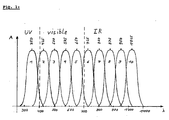
- an extended hyperchromic color space is constituted by ten narrow-band absorbing dyes or pigments labeled 1 to 10. They have absorption maxima within the spectral range of 300 to 1'100 nm wavelength.
- Dye 1 has an absorption maximum in the UV (350 nm).
- Dyes 2, 3, 4, 5 have absorption maxima in the visible (425, 500, 575, 650 nm), and dyes 6,7,8,9,10 have absorption maxima in the IR (725, 800, 875, 950 and 1'025 nm wavelength).
- the visible range is covered by four dyes, instead of three corresponding to the human eye's receptors.
- Visible dyes 3 and 4 are noteworthy selected as to have an absorption maximum of 500 nm, falling in between the blue (450 nm) and the green (550 nm), respectively of 575 nm, falling in between the green (550 nm) and the red (600 nm) photoreceptor of the human eye. Colors such as these, if combined with a pure blue (425 nm) and a pure red (650 nm) dye, will result impossible to reproduce by the standard trichromy process colors, because four constraints cannot be accommodated by three variables.
- An article is now marked using an ink or an ink set comprising one or more of said narrow-band absorbing dyes or pigments.
- the color information comprised on said article is hereby effectively chosen out of a ten-dimensional manifold, although humans only can see and describe it in terms of a three-dimensional color perception.
- the human eye's impression of the security article's color corresponds thus to a projection of said article's real color information onto a three-dimensional color perceiving system. This projection is performed under the light of the illuminating source used to view the document. Changing the light quality of said illuminating source may lead to a different projection, and therefore to a different color perception.
- the use of visible narrow-band absorbing dyes or pigments in coatings invariably results in an illumination-dependent variation of the shades ("untrue" colors).
- said article e.g. a banknote or a document
- its spectral information in the visible domain is channeled by corresponding optical filters into the three base colors red, green and blue.
- a projection of the extended color information contained on said document onto these three color channels is performed under the particular light of the copier or scanner.
- the scanned color information is subsequently reproduced by printing, standard dyes or pigments, corresponding to the human eye's three-dimensional color perception, are deposited on the paper, in place of the original, narrow band absorbing colorants.
- the resulting reproduction will look about the same, if seen under the same light which was used to scan the original. However, it may look quite different if seen under a different light than that used to scan the original.
- the optical features outside the visible range i.e. the ones located in the UV (UV-dye 1) and the ones located in the IR (IR-dyes 6 to 10), are not reproduced by common reproduction equipment, and are thus lacking on the copy.
- the visible features, due to dyes 2 to 5, will be reproduced, but not correctly.
- the resulting "color difference" between the original and its counterfeit can be evidenced to the human eye by comparing both under at least two different visible light sources, and, in the complete UV to IR range of the spectrum, by photodetectors or spectroscopic means.
- Intaglio printing ink set formulation with 5 inks Addition product of tung oil and maleic acid modified phenolic resin in a high boiling mineral oil (PKWF 28/31) 35% Long oil alkyd resin 7.5% Alkylphenolic resin modified with raw tung oil in ink solvent 27/29 (Shell Industrial Chemicals) 16% Polyethylene wax 1.5% Calcium carbonate 30.3% Dyes and Pigments 4.5% Ink solvent 27/29 (Shell Industrial Chemicals) 5% Cobalt octoate (11 % metal) 0.1% Manganese octoate (10 % metal) 0.1%
- Ink 1 absorption peak at 470 nm Acridine Orange Base (Aldrich) 1.0% Calcium carbonate 3.5%
- Ink 2 absorption peak at 850 nm Deca-(3-ethoxy-1-thiophenolato)-hexa-(3-methyl-1-thiophenolato)-phthalocyanato-zinc(II) (Avecia) 4.0% Calcium carbonate 0.5%
- Ink 3 absorption peak at 380 nm Tinuvin 1130 (Ciba) 4.5% Calcium carbonate -
- Ink 4 absorption peak at 980 nm Long-wave NIR aborber (Avecia) 3.0% Calcium carbonate 1.5%
- Ink 5 absorption peaks at 620 and 780 nm X-form copper phthalocyanine pigment 1.8% Calcium carbonate 2.7%
- the ingredients were mixed together and the mixture was homogenized by 2 passes on a triple-roll mill.
- Ink 1 absorption peak at 550 nm Rhodamine B (Aldrich) 1.5% Calcium carbonate 3.0%
- Ink 2 absorption peak at 780 nm Octabutoxy copper(II) naphthalocyanine 4.5% Calcium carbonate -
- Ink 3 absorption peak at 890 nm Hexadeca-(3-ethoxy-1-thiophenolato)-phthalocyanato-zinc(II) (Avecia) 2.7% Calcium carbonate 1.8%
- the ingredients were mixed together and the mixture was homogenized by 2 passes on a triple-roll mill.
- Ink 1 absorption peak at 550 nm Rhodamine B base (Aldrich) 0.4% Ethyl acetate 2.8%
- Ink 2 absorption peaks at 610 and 680 nm Luxol fast blue MSN (Aldrich) 3.2%
- Ink 3 absorption peak at 440 nm Macroflex Yellow 6G (Bayer) 1.0% Ethyl acetate 2.2%
- Ink 4 absorption peak at 800 nm Absorber dye IR P303 (Honeywell) 1.0% Ethyl acetate 2.2%
- the resins were dispersed with the solvents during 15 minutes using a laboratory dispersing equipment.
- the dyes were added subsequently and the formulation was further dispersed during 15 minutes.
- the viscosity of the resulting formulation was adjusted with a blend of ethyl acetate / ethanol 1:1 to reach the required printing viscosity (15-25" cup DIN4, depending on the application).
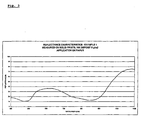
- Example 1 Intaglio ink, obtained by mixing Ink 1 and Ink 2 of formulation 1 (above) in a ratio 1:1 and printing on paper at 8 g/m 2 .
- the reflectance spectrum is given in Fig. 3 .
- Example 2 Intaglio ink, obtained by mixing Ink 3, Ink 4 and Ink 5 of formulation 1 (above) in a ratio 1:1:1 and printing on paper at 8 g/m 2 .
- the reflectance spectrum is given in Fig. 4 .
- Example 3 Dry-offset UV-ink, obtained by mixing Ink 1, Ink 2 and Ink 3 of formulation 2 (above) in a ratio 1:1:1 and printing on paper at 1 g/m 2 .
- the reflectance spectrum is given in Fig. 5 .
- Example 4 Gravure ink, obtained by mixing Ink 1, Ink 2, Ink 3 and Ink 4 of formulation 3 (above) in a ratio 1:1:1:1 and applying on paper with a hand coater at 4 ⁇ m (theoretical wet film). The reflectance spectrum is given in Fig. 6 .
- a reader device has 12 spectral channels centered at 400, 450, 500, 550, 600, 650, 700, 750, 800, 850, 900, and 950 nm wavelength, respectively.
- a different number of channels, at different values of wavelength, may be chosen as well.
- the channels need not even to be regularly spaced, and a 'channel' might comprise more than one 'wavelengths' or 'spectral bands'.
- a hyperchromic color space comprising 6 base colors, is embodied by dyes or pigments having 6 substantially different absorption spectra. These dyes or pigments yield the 'optical density' responses 'Spec 1', 'Spec 2', 'Spec 3', 'Spec 4', 'Spec 5', and 'Spec 6', respectively, with the said reader device; the ensemble of these values constitute the matrix A defining the mathematical basis of the hyperchromic color space.
- the resulting color coordinates (CCRD) of y in terms of the 6 base colors are: 0.35, 0.10, 0.00, 0.40, 0.00, 0.15. This is exactly the linear combination which was used to construct y in this schematic worked example.
- the matrix M For a given base color system and a given type of reader device, the matrix M must be calculated only once, and can then be stored in the reader device, as a part of the authentication algorithm. It can be interpreted as a sort of key which enables to extract the relevant color-coordinates out of a more abundant spectral information.
- a hypercolor system is assumed to be spanned out by 6 dyes or pigments having the spectra (Spec1, ... Spec 6) forming matrix A.
- the reflection intensity is assumed to be measured for 12 illumination bands, centered at the wavelengths 400, 450, 500, 550, 600, 650, 700, 750, 800, 850, 900, and 950 nm.
- a first 'measured' vector 'Spec y1' is constructed by assuming the 'concentration ratios' of 0.35, 0.10, 0.00, 0.40, 0.00, 0.15 for the 6 base colors and calculating the corresponding theoretical reflection optical density values for the 12 illumination bands. After transformation of the vector 'Spec y1' to hypercolor-coordinates, CCRD1, the input concentration ratios are nicely reproduced, with a residual value R of 0.000045, i.e. close to zero.
- the vector 'Spec y1' is now perturbed by adding to it a random signal of moderate amplitude, resulting in a 'measured' vector 'Spec y2'.
- CCRD2 hypercolor-coordinates
- the values deviate moderately from the original ones, but still reproduce them in the big lines.
- the residual value R of 0.015 is quite acceptable, telling that the specimen having the reflection spectrum 'Spec y2' still lies within the defined, hyperchromic color space of the application and can therefore be accepted as authentic, however somewhat soiled.
- the vector 'Spec y1' is substantially modified at one single point (700 nm; highlighted figure), to yield a 'measured' vector 'Spec y3'.
- the derived hypercolor-coordinates, CCRD3, still reproduce astonishingly well the original ones; however, the high residual value R of 0.212 is clearly indicating that the specimen having 'Spec y3' is lying outside the defined, hyperchromic color space of the application, and must therefore be rejected as being a counterfeit
- the document under test would be rejected if the transformation of its measured reflection optical density spectrum to hypercolor coordinates of the corresponding hyperchromic system yields a residual value R above 0.10, or if one of the obtained hypercolor coordinates lies outside of its initial 'should be'-value, i.e. outside a corresponding, predefined concentration fork.
- the step of deriving and comparing hyper-color coordinates and R-values, rather than crude spectral absorbance, reflectance or transmittance values, brings in the advantage of robustness and the feasibility of an almost 100% false rejection, all realizable with low-cost, all-round, non-contact, optical, and high-speed operate-able authentication equipment, combined with customer-specific, material-based security elements printed on the document.
Landscapes
- Chemical & Material Sciences (AREA)
- Life Sciences & Earth Sciences (AREA)
- Engineering & Computer Science (AREA)
- Materials Engineering (AREA)
- Wood Science & Technology (AREA)
- Organic Chemistry (AREA)
- Health & Medical Sciences (AREA)
- Physics & Mathematics (AREA)
- General Health & Medical Sciences (AREA)
- Toxicology (AREA)
- Spectroscopy & Molecular Physics (AREA)
- General Physics & Mathematics (AREA)
- Inks, Pencil-Leads, Or Crayons (AREA)
- Printing Methods (AREA)
- Credit Cards Or The Like (AREA)
- Duplication Or Marking (AREA)
- Ink Jet (AREA)
- Ink Jet Recording Methods And Recording Media Thereof (AREA)
Claims (25)
- Encre d'impression, comportant :a) au moins un colorant ou pigment présentant au moins un maximum d'absorption dans le domaine visible du spectre électromagnétique, sensiblement différent des maxima d'absorption des couleurs de base du système CIEXYZ,b) au moins un autre colorant ou pigment présentant une bande d'absorption dans le domaine visible du spectre électromagnétique dont la largeur de bande à demi-intensité est plus étroite que 2400 cm-1, etc) au moins un autre colorant ou pigment présentant au moins un maximum d'absorption dans la région ultraviolette ou infrarouge du spectre électromagnétique.
- Encre d'impression selon la revendication 1, comportant au moins trois colorants ou pigments différents présentant des spectres d'absorption sensiblement différents les uns des autres.
- Encre d'impression selon l'une quelconque des revendications 1 et 2, comportant au moins deux colorants ou pigments différents présentant au moins un maximum d'absorption dans le domaine infrarouge du spectre électromagnétique.
- Encre d'impression selon l'une quelconque des revendications 1 à 3, comportant au moins quatre colorants ou pigments différents présentant au moins un maximum d'absorption dans le domaine visible du spectre électromagnétique.
- Encre d'impression selon l'une quelconque des revendications 1 à 4, comportant en outre un pigment réfléchissant.
- Ensemble d'encres d'impression, comportant au moins deux encres d'impression selon l'une quelconque des revendications 1 à 5.
- Ensemble d'encres d'impression selon la revendication 6, comportant au moins trois encres d'impression différentes selon l'une quelconque des revendications 1 à 5, chacune dotée d'un colorant ou pigment différent des colorants ou pigments présents dans les autres encres d'impression.
- Ensemble d'encres d'impression selon la revendication 7, les différents colorants ou pigments présentant au moins un maximum d'absorption dans le domaine visible du spectre électromagnétique.
- Ensemble d'encres d'impression selon l'une quelconque des revendications 6 à 8, au moins une encre d'impression comportant un colorant ou pigment présentant au moins un maximum d'absorption dans la région ultraviolette ou infrarouge du spectre électromagnétique.
- Ensemble d'encres d'impression selon l'une quelconque des revendications 6 à 9, au moins une encre d'impression comportant un pigment réfléchissant.
- Procédé de marquage d'un article, tel qu'un billet de banque, un document, un ticket, une feuille, un fil, une étiquette, une carte ou un produit du commerce, comportant l'étape consistant à mettre en place sur ledit article un marquage appliqué à l'aide d'au moins une encre d'impression selon l'une quelconque des revendications 1 à 5 ou un ensemble d'encres d'impression selon l'une quelconque des revendications 6 à 10, ou à l'aide d'au moins une composition de revêtement comportant au moins une encre d'impression selon l'une quelconque des revendications 1 à 5 ou un ensemble d'encres d'impression selon l'une quelconque des revendications 6 à 10.
- Procédé selon la revendication 11, ladite ou lesdites compositions de revêtement étant choisies dans le groupe formé d'encres pâteuses comprenant les encres pour impression en taille douce, les encres typographiques et les encres offset, dans le groupe formé d'encres liquides comprenant les encres pour sérigraphie, les encres hélio-flexographiques et les encres pour gravure, dans le groupe formé de toners pour impression électrostatique ou par électrophorèse, ou dans le groupe formé d'encres pour jet d'encre comprenant les encres pour jet d'encre à la demande et les encres pour jet d'encre en continu.
- Procédé d'authentification d'un article, tel qu'un billet de banque, un document, un ticket, une feuille, un fil, une étiquette, une carte ou un produit du commerce, comportant les étapes consistant à :a) mesurer un spectre d'absorption, de réflexion ou de transmission d'un article marqué par le procédé selon l'une quelconque des revendications 11 et 12, dans le domaine des longueurs d'ondes UV et / ou visibles et / ou IR du spectre électromagnétique ;b) comparer le spectre mesuré en a) et / ou des informations dérivées de celui-ci à un spectre correspondant d'un article authentique et / ou à des informations dérivées de celui-ci.
- Procédé selon la revendication 13, ledit procédé étant réalisé par une machine telle qu'un encaisseur de monnaie, un validateur de tickets ou un dispositif portatif d'authentification.
- Procédé selon la revendication 13 ou 14, ledit spectre étant mesuré lors de l'étape a) sous la forme d'un vecteur de valeurs numériques représentant l'absorption et / ou la réflexion et / ou la transmission dudit marquage à un nombre choisi de longueurs d'ondes ou sur un nombre choisi de domaines de longueurs d'ondes.
- Procédé selon la revendication 13 ou 14, l'étape b) étant réalisée en tirant du vecteur de valeurs digitales mesurées à l'étape a) les coordonnées statistiquement indépendantes en hyper-couleurs dudit marquage, en comparant au moins une desdites coordonnées en hyper-couleurs à une valeur de référence correspondante d'un article authentique, et en tirant du résultat de la comparaison un indicateur d'authenticité à l'aide d'un critère de décision préétabli.
- Procédé d'authentification d'un article selon l'une des revendications 13 à 16, ledit spectre étant mesuré à l'aide d'une combinaison d'une source lumineuse émettant en large bande et d'une pluralité de photodétecteurs sensibles en bande étroite, ou à l'aide d'une combinaison d'un photodétecteur sensible en large bande et d'une pluralité de sources lumineuses émettant en bande étroite, ou à l'aide d'une combinaison d'une source lumineuse émettant en large bande et d'un dispositif de spectromètre diffractif ou dispersif.
- Procédé d'authentification d'un article selon l'une des revendications 13 à 16, ledit spectre étant mesuré à l'aide d'une combinaison d'une pluralité de sources lumineuses émettant en bande étroite, telles que des DEL, et d'un dispositif d'imagerie sensible en large bande, tel qu'une caméra CCD ou CMOS, fournissant des informations d'imagerie spectrale ou hyperspectrale.
- Procédé d'authentification d'un article selon l'une des revendications 13 à 18, lesdites coordonnées statistiquement indépendantes en hyper-couleurs étant tirées du spectre mesuré au moyen d'un algorithme mathématique de moindres carrés.
- Marquage comportant au moins une encre d'impression selon l'une quelconque des revendications 1 à 5 et / ou au moins un ensemble d'encres d'impression selon l'une quelconque des revendications 6 à 10.
- Article, tel qu'un billet de banque, un document, un ticket, une feuille, un fil, une étiquette, une carte ou un produit du commerce, comportant au moins un marquage selon la revendication 20.
- Utilisation d'une combinaisona) d'au moins un colorant ou pigment présentant au moins un maximum d'absorption dans le domaine visible du spectre électromagnétique, sensiblement différent des maxima d'absorption des couleurs de base du système CIEXYZ, etb) d'au moins un autre colorant ou pigment présentant une bande d'absorption dans le domaine visible du spectre électromagnétique dont la largeur de bande à demi-intensité est plus étroite que 2400 cm-1, etc) d'au moins un autre colorant ou pigment présentant au moins un maximum d'absorption dans la région ultraviolette ou infrarouge du spectre électromagnétique,pour marquer et / ou authentifier un article, tel qu'un billet de banque, un document, un ticket, une feuille, un fil, une étiquette, une carte ou un produit du commerce.
- Utilisation d'une encre d'impression selon l'une quelconque des revendications 1 à 5 pour marquer et / ou authentifier un article, tel qu'un billet de banque, un document, un ticket, une feuille, un fil, une étiquette, une carte ou un produit du commerce.
- Utilisation d'un ensemble d'encres d'impression selon l'une quelconque des revendications 6 à 10 pour marquer et / ou authentifier un article, tel qu'un billet de banque, un document, un ticket, une feuille, un fil, une étiquette, une carte ou un produit du commerce.
- Utilisation d'un marquage selon la revendication 20 pour authentifier un article, tel qu'un billet de banque, un document, un ticket, une feuille, un fil, une étiquette, une carte ou un produit du commerce.
Priority Applications (4)
| Application Number | Priority Date | Filing Date | Title |
|---|---|---|---|
| ES03775147T ES2305533T3 (es) | 2002-09-24 | 2003-09-05 | Metodo y conjuntos de tintas para marcar y autentificar articulos. |
| SI200331310T SI1546272T1 (sl) | 2002-09-24 | 2003-09-05 | Postopek in garniture äśrnil za oznaäśevanje in avtentikacijo artiklov |
| EP03775147A EP1546272B1 (fr) | 2002-09-24 | 2003-09-05 | Procede et ensembles d'encre pour marquer et authentifier des articles |
| CY20081100906T CY1108290T1 (el) | 2002-09-24 | 2008-08-25 | Μεθοδος και ομαδες μελανιων για σημανση και ταυτοποιηση γνησιοτητας αντικειμενων |
Applications Claiming Priority (4)
| Application Number | Priority Date | Filing Date | Title |
|---|---|---|---|
| EP02021179 | 2002-09-24 | ||
| EP20020021179 EP1403333A1 (fr) | 2002-09-24 | 2002-09-24 | Procédé et système d' encres pour marquer et authentifier les articles |
| PCT/EP2003/009848 WO2004029163A1 (fr) | 2002-09-24 | 2003-09-05 | Procede et ensembles d'encre pour marquer et authentifier des articles |
| EP03775147A EP1546272B1 (fr) | 2002-09-24 | 2003-09-05 | Procede et ensembles d'encre pour marquer et authentifier des articles |
Publications (2)
| Publication Number | Publication Date |
|---|---|
| EP1546272A1 EP1546272A1 (fr) | 2005-06-29 |
| EP1546272B1 true EP1546272B1 (fr) | 2008-05-28 |
Family
ID=31970291
Family Applications (2)
| Application Number | Title | Priority Date | Filing Date |
|---|---|---|---|
| EP20020021179 Withdrawn EP1403333A1 (fr) | 2002-09-24 | 2002-09-24 | Procédé et système d' encres pour marquer et authentifier les articles |
| EP03775147A Revoked EP1546272B1 (fr) | 2002-09-24 | 2003-09-05 | Procede et ensembles d'encre pour marquer et authentifier des articles |
Family Applications Before (1)
| Application Number | Title | Priority Date | Filing Date |
|---|---|---|---|
| EP20020021179 Withdrawn EP1403333A1 (fr) | 2002-09-24 | 2002-09-24 | Procédé et système d' encres pour marquer et authentifier les articles |
Country Status (22)
| Country | Link |
|---|---|
| US (2) | US7892338B2 (fr) |
| EP (2) | EP1403333A1 (fr) |
| JP (2) | JP5014577B2 (fr) |
| KR (1) | KR101038035B1 (fr) |
| CN (1) | CN100549110C (fr) |
| AT (1) | ATE397048T1 (fr) |
| AU (1) | AU2003283239B2 (fr) |
| BR (1) | BR0314726A (fr) |
| CA (1) | CA2499820C (fr) |
| CY (1) | CY1108290T1 (fr) |
| DE (1) | DE60321365D1 (fr) |
| DK (1) | DK1546272T3 (fr) |
| ES (1) | ES2305533T3 (fr) |
| IL (1) | IL167173A (fr) |
| MX (1) | MXPA05003201A (fr) |
| MY (1) | MY140379A (fr) |
| PT (1) | PT1546272E (fr) |
| RU (1) | RU2305119C2 (fr) |
| SI (1) | SI1546272T1 (fr) |
| UA (1) | UA82335C2 (fr) |
| WO (1) | WO2004029163A1 (fr) |
| ZA (1) | ZA200502404B (fr) |
Cited By (1)
| Publication number | Priority date | Publication date | Assignee | Title |
|---|---|---|---|---|
| EP2695146B1 (fr) | 2011-04-08 | 2016-07-13 | Giesecke & Devrient GmbH | Procédé de contrôle de documents de valeur |
Families Citing this family (91)
| Publication number | Priority date | Publication date | Assignee | Title |
|---|---|---|---|---|
| DE10243051A1 (de) * | 2002-09-17 | 2004-03-25 | Giesecke & Devrient Gmbh | Verfahren und Pfüfeinrichtung zur Prüfung von Wertdokumenten |
| US8372648B2 (en) | 2003-04-16 | 2013-02-12 | APDN (B.V.I.), Inc. | Optical reporter compositions |
| US20070048761A1 (en) * | 2005-05-20 | 2007-03-01 | Applied Dna Sciences, Inc. | System and method for authenticating multiple components associated with a particular product |
| US20090286250A1 (en) * | 2006-05-19 | 2009-11-19 | James Arthur Hayward | Incorporating soluble security markers into cyanoacrylate solutions |
| US20100285985A1 (en) * | 2003-04-15 | 2010-11-11 | Applied Dna Sciences, Inc. | Methods and Systems for the Generation of Plurality of Security Markers and the Detection Therof |
| US8426216B2 (en) | 2003-04-16 | 2013-04-23 | APDN (B.V.I.), Inc. | Methods for authenticating articles with optical reporters |
| US8415164B2 (en) | 2003-04-16 | 2013-04-09 | Apdn (B.V.I.) Inc. | System and method for secure document printing and detection |
| US8415165B2 (en) * | 2003-04-16 | 2013-04-09 | APDN (B.V.I.), Inc. | System and method for authenticating sports identification goods |
| US8420400B2 (en) | 2003-04-16 | 2013-04-16 | APDN (B.V.I.), Inc. | System and method for authenticating tablets |
| US8124333B2 (en) | 2003-04-16 | 2012-02-28 | APDN, Inc. | Methods for covalent linking of optical reporters |
| DE102004011347A1 (de) * | 2004-03-05 | 2005-09-29 | Basf Ag | Druckfarben für den Offset- und/oder Hochdruck mit NIR-Absorbern sowie in Offset- und/oder Hochdruckfarben lösliche NIR-Absorber |
| US7939239B2 (en) * | 2004-05-20 | 2011-05-10 | LaserLock Technologies Inc. | Illumination sources and subjects having distinctly matched and mismatched narrow spectral bands |
| US7741379B2 (en) | 2005-03-01 | 2010-06-22 | Hewlett-Packard Development Company, L.P. | System and a method for a UV curable ink having infrared sensitivity |
| GB0505319D0 (en) * | 2005-03-15 | 2005-04-20 | Kiz Llp | Authentication method employing colour signature |
| WO2006123341A1 (fr) * | 2005-05-18 | 2006-11-23 | Green Vision Systems Ltd. | Systeme d'analyse et d'imagerie hyperspectrale servant a authentifier un article authentique |
| DK1790701T4 (da) | 2005-11-25 | 2012-04-02 | Sicpa Holding Sa | IR-absorberende dybtryksfarve |
| US8727212B2 (en) | 2006-02-10 | 2014-05-20 | Wilopen Products, Lc | Embossing pattern card security system |
| US8727213B2 (en) * | 2006-02-10 | 2014-05-20 | Wilopen Products, Lc | Varnish printing document securing system and method |
| US10741034B2 (en) | 2006-05-19 | 2020-08-11 | Apdn (B.V.I.) Inc. | Security system and method of marking an inventory item and/or person in the vicinity |
| US9790538B2 (en) | 2013-03-07 | 2017-10-17 | Apdn (B.V.I.) Inc. | Alkaline activation for immobilization of DNA taggants |
| JP5064490B2 (ja) * | 2007-03-29 | 2012-10-31 | 太陽ホールディングス株式会社 | 光硬化性樹脂組成物、ドライフィルム、硬化物、及びプリント配線板 |
| US8687241B2 (en) * | 2007-06-06 | 2014-04-01 | Hewlett-Packard Development Company, L.P. | Method for security printing |
| US8330122B2 (en) * | 2007-11-30 | 2012-12-11 | Honeywell International Inc | Authenticatable mark, systems for preparing and authenticating the mark |
| CN101503038B (zh) * | 2008-02-04 | 2011-03-23 | 中国印钞造币总公司 | 防伪标记物及设置有该标记物的有价物品 |
| CN101247466B (zh) * | 2008-02-28 | 2010-12-15 | 复旦大学 | 基于超复数色彩旋转的彩色失真图像评估方法 |
| US8367193B1 (en) * | 2008-03-20 | 2013-02-05 | Inmat Inc | Aqueous nanocomposite dispersions containing invisible marker dye for transparent barrier coatings and preparations and use thereof |
| US20090287450A1 (en) | 2008-05-16 | 2009-11-19 | Lockheed Martin Corporation | Vision system for scan planning of ultrasonic inspection |
| US8822954B2 (en) * | 2008-10-23 | 2014-09-02 | Intematix Corporation | Phosphor based authentication system |
| US8940485B2 (en) | 2008-11-12 | 2015-01-27 | Apdn (B.V.I.) Inc. | Methods for genotyping mature cotton fibers and textiles |
| US8669079B2 (en) | 2008-11-12 | 2014-03-11 | Cara Therapeutics, Inc. | Methods for genetic analysis of textiles made of Gossypium barbadense and Gossypium hirsutum cotton |
| RU2379194C1 (ru) * | 2008-11-18 | 2010-01-20 | Федеральное Государственное Унитарное Предприятие "Гознак" (Фгуп "Гознак") | Защищенный от подделки ценный документ с защитным элементом (варианты), способ защиты от подделки ценного документа (варианты), устройство визуализации и защитный элемент (варианты) |
| TWI487626B (zh) | 2008-12-10 | 2015-06-11 | Sicpa Holding Sa | 用於磁性取向及印刷的裝置及製程 |
| US9749607B2 (en) | 2009-07-16 | 2017-08-29 | Digimarc Corporation | Coordinated illumination and image signal capture for enhanced signal detection |
| CN102471618A (zh) * | 2009-07-31 | 2012-05-23 | 惠普开发有限公司 | 具有近红外检测能力的油墨组及其使用方法 |
| GB0913798D0 (en) * | 2009-08-07 | 2009-09-16 | Innovative Technology Ltd | Banknote validator |
| US8610893B2 (en) | 2009-10-16 | 2013-12-17 | Basf Se | Marking agents having narrow bands |
| RU2425757C1 (ru) * | 2010-02-18 | 2011-08-10 | Федеральное Государственное Унитарное Предприятие "Гознак" (Фгуп "Гознак") | Способ защиты от подделки ценного документа, ценный документ, защищенный от подделки, способ идентификации его подлинности и устройство для контроля подлинности ценного документа |
| MX2012013492A (es) * | 2010-05-25 | 2012-12-17 | Sicpa Holding Sa | Colorantes de perileno enlazados a polimero y composiciones que los contienen. |
| DE102010041975A1 (de) * | 2010-10-05 | 2012-04-05 | Bundesdruckerei Gmbh | Verfahren zum Erfassen eines Wert- und/oder Sicherheitsdokuments |
| AU2012212388B2 (en) * | 2011-02-01 | 2014-09-04 | Reserve Bank Of Australia | Transparent infrared absorbing materials |
| EP2505618A1 (fr) * | 2011-04-01 | 2012-10-03 | Fábrica Nacional De Moneda Y Timbre | Utilisation des marqueurs de sécurité absorbant des ondes éléctromagnétique |
| AR086509A1 (es) * | 2011-05-25 | 2013-12-18 | Sicpa Holding Sa | Tintes de quaterrileno y/o terrileno unidos a polimeros y composiciones que los contienen |
| TW201335295A (zh) * | 2011-11-30 | 2013-09-01 | 西克帕控股公司 | 經標記之塗層組成物及其認證之方法 |
| EP2605219A1 (fr) * | 2011-12-14 | 2013-06-19 | Mark Dobbs | Stylo de détection de contrefaçon utilisant deux modes de test |
| CA2857335A1 (fr) * | 2011-12-15 | 2013-06-20 | 3M Innovative Properties Company | Objet de securite personnalise et methodes d'authentification d'un objet de securite et de verification d'un porteur d'un objet de securite |
| DE102011122240A1 (de) * | 2011-12-23 | 2013-06-27 | Giesecke & Devrient Gmbh | Sicherheitsmerkmal mit mehreren Komponenten |
| WO2014041564A1 (fr) | 2012-09-12 | 2014-03-20 | Council Of Scientific & Industrial Research | Composition de marqueurs de sécurité dissimulés et procédé d'authentification |
| US9297032B2 (en) | 2012-10-10 | 2016-03-29 | Apdn (B.V.I.) Inc. | Use of perturbants to facilitate incorporation and recovery of taggants from polymerized coatings |
| US9266370B2 (en) | 2012-10-10 | 2016-02-23 | Apdn (B.V.I) Inc. | DNA marking of previously undistinguished items for traceability |
| RU2523812C2 (ru) * | 2012-10-25 | 2014-07-27 | Федеральное госурственное унитарное предприятие "Гознак" (ФГУП "Гознак") | Ценный документ, защищенный от подделки, и способ определения его подлинности |
| AU2013354454A1 (en) * | 2012-12-07 | 2015-04-16 | Sicpa Holding Sa | Non-periodic tiling document security element |
| TW201435830A (zh) | 2012-12-11 | 2014-09-16 | 3M Innovative Properties Co | 不顯眼之光學標籤及其方法 |
| US9963740B2 (en) | 2013-03-07 | 2018-05-08 | APDN (B.V.I.), Inc. | Method and device for marking articles |
| RU2536748C1 (ru) * | 2013-07-12 | 2014-12-27 | Федеральное Государственное Унитарное Предприятие "Гознак" (Фгуп "Гознак") | Изделие, содержащее бумажный или полимерный носитель с защитной маркировкой, и способ определения подлинности изделия |
| WO2015054188A1 (fr) | 2013-10-07 | 2015-04-16 | Apdn (B.V.I), Inc. | Lecteur multimode d'image et spectral |
| US9635378B2 (en) | 2015-03-20 | 2017-04-25 | Digimarc Corporation | Sparse modulation for robust signaling and synchronization |
| US10424038B2 (en) | 2015-03-20 | 2019-09-24 | Digimarc Corporation | Signal encoding outside of guard band region surrounding text characters, including varying encoding strength |
| US10745825B2 (en) | 2014-03-18 | 2020-08-18 | Apdn (B.V.I.) Inc. | Encrypted optical markers for security applications |
| CN106103121B (zh) | 2014-03-18 | 2019-12-06 | 亚普蒂恩(B.V.I.)公司 | 用于安全应用的加密光学标记物 |
| RU2544772C1 (ru) * | 2014-04-07 | 2015-03-20 | федеральное государственное бюджетное образовательное учреждение высшего профессионального образования "Московский государственный университет печати имени Ивана Федорова" (МГУП имени Ивана Федорова) | Способ контроля подлинности многоцветной печатной продукции |
| CN104371423A (zh) * | 2014-09-11 | 2015-02-25 | 中钞油墨有限公司 | 含dna片段的隐形红外吸收喷墨墨水及其制备方法 |
| DE102014015746A1 (de) * | 2014-10-24 | 2016-04-28 | Giesecke & Devrient Gmbh | Vorrichtung und Verfahren zur Prüfung von Wertdokumenten, insbesondere Banknoten, sowie Wertdokumentbearbeitungssystem |
| US10760182B2 (en) | 2014-12-16 | 2020-09-01 | Apdn (B.V.I.) Inc. | Method and device for marking fibrous materials |
| US10783601B1 (en) | 2015-03-20 | 2020-09-22 | Digimarc Corporation | Digital watermarking and signal encoding with activable compositions |
| US9754341B2 (en) | 2015-03-20 | 2017-09-05 | Digimarc Corporation | Digital watermarking and data hiding with narrow-band absorption materials |
| RU2718980C2 (ru) * | 2015-03-30 | 2020-04-15 | Шайнифилд | Средство на основе хлорофилла, предназначенное для нанесения разметки и знаков маркировки на живые зеленые насаждения |
| EP3095825B1 (fr) * | 2015-05-19 | 2019-10-02 | Agfa-Gevaert N.V. | Encres aqueuses pour jet d'encre |
| JP2017013408A (ja) * | 2015-07-02 | 2017-01-19 | 株式会社リコー | 被処理物改質装置、被処理物改質システム、画像形成システムおよび画像形成方法 |
| EP3317624B1 (fr) | 2015-07-05 | 2019-08-07 | The Whollysee Ltd. | Système et étiquettes de caractérisation et d'identification optiques |
| US10065441B2 (en) | 2015-09-01 | 2018-09-04 | Digimarc Corporation | Counterfeiting detection using machine readable indicia |
| DE102016000012A1 (de) * | 2016-01-05 | 2017-07-06 | Giesecke & Devrient Gmbh | Echtheitsprüfung von Wertdokumenten |
| DE102016001465A1 (de) * | 2016-02-09 | 2017-08-10 | Giesecke & Devrient Gmbh | Verifikation eines mit einem Sicherheitselement versehenen Gegenstands |
| EP3417274A1 (fr) * | 2016-02-15 | 2018-12-26 | ExxonMobil Research and Engineering Company | Systèmes et procédés pour authentifier des fluides actifs |
| CN109070130B (zh) | 2016-04-11 | 2022-03-22 | 亚普蒂恩(B V I)公司 | 用于标记纤维素产品的方法 |
| US10995371B2 (en) | 2016-10-13 | 2021-05-04 | Apdn (B.V.I.) Inc. | Composition and method of DNA marking elastomeric material |
| US10920274B2 (en) | 2017-02-21 | 2021-02-16 | Apdn (B.V.I.) Inc. | Nucleic acid coated submicron particles for authentication |
| US11062108B2 (en) | 2017-11-07 | 2021-07-13 | Digimarc Corporation | Generating and reading optical codes with variable density to adapt for visual quality and reliability |
| US10872392B2 (en) | 2017-11-07 | 2020-12-22 | Digimarc Corporation | Generating artistic designs encoded with robust, machine-readable data |
| US10896307B2 (en) | 2017-11-07 | 2021-01-19 | Digimarc Corporation | Generating and reading optical codes with variable density to adapt for visual quality and reliability |
| CN109367266A (zh) * | 2018-09-07 | 2019-02-22 | 中华人民共和国北京出入境边防检查总站 | 一种紫外光激发的荧光真彩色图像及制作工艺方法 |
| KR20200072699A (ko) | 2018-12-13 | 2020-06-23 | 주식회사 무궁화엘앤비 | 근적외선 잉크를 이용한 인쇄물 및 그 제조 방법 |
| US11589703B1 (en) | 2019-05-08 | 2023-02-28 | Microtrace, LLC. | Spectral signature systems that use encoded image data and encoded spectral signature data |
| CN112063185B (zh) * | 2019-06-11 | 2022-06-03 | 苏州大学 | 一种适用于防伪化学纤维的元素母液及其制备方法 |
| US20230298044A1 (en) | 2020-08-19 | 2023-09-21 | Microtrace, Llc | Strategies and systems that use spectral signatures and a remote authentication authority to authenticate physical items and linked documents |
| US12333624B1 (en) | 2021-06-04 | 2025-06-17 | Digimarc Corporation | Modulating surface topcoats to embed digital watermarking |
| WO2023075778A1 (fr) * | 2021-10-28 | 2023-05-04 | Hewlett-Packard Development Company, L.P. | Matériau d'impression comprenant un composé salen |
| US12337609B1 (en) | 2021-11-03 | 2025-06-24 | Digimarc Corporation | Encoding signals with fluorescing inks |
| CN115817010B (zh) * | 2022-11-15 | 2025-10-14 | 南京林业大学 | 一种基于控制基色梯度改善印刷油墨配色方法 |
| HU5571U (hu) * | 2022-11-24 | 2023-03-28 | Any Biztonsagi Nyomda Nyrt | Biztonsági dokumentum infravörös fényben aktív biztonsági elemekkel |
| FR3151693A1 (fr) * | 2023-07-25 | 2025-01-31 | Oberthur Fiduciaire Sas | Procédé d’identification et/ou d’authentification d’un article de sécurité |
| CN119708911B (zh) * | 2024-11-05 | 2025-12-19 | 天津大学 | 一种油性结构色颜料墨水及其应用 |
Family Cites Families (19)
| Publication number | Priority date | Publication date | Assignee | Title |
|---|---|---|---|---|
| CN1013681B (zh) * | 1987-05-05 | 1991-08-28 | 中国人民银行印制科学技术研究所 | 含有近红外线吸收剂的安全油墨 |
| JP2684436B2 (ja) | 1990-02-23 | 1997-12-03 | 富士写真フイルム株式会社 | 熱転写色素供与材料 |
| US5289547A (en) * | 1991-12-06 | 1994-02-22 | Ppg Industries, Inc. | Authenticating method |
| DE4318983A1 (de) * | 1993-06-08 | 1994-12-15 | Basf Ag | Naphthalocyanine |
| US5368334A (en) * | 1993-06-10 | 1994-11-29 | Moore Business Forms, Inc. | Variable data clear mark imaging |
| DE19611351A1 (de) | 1996-03-22 | 1997-09-25 | Basf Ag | Farbstoffmischungen, enthaltend Thienyl- und/oder Thiazolazofarbstoffe |
| JP3673957B2 (ja) | 1996-11-20 | 2005-07-20 | 独立行政法人 国立印刷局 | 印刷物の識別法 |
| EP1041436A1 (fr) * | 1999-04-01 | 2000-10-04 | Bayer Ag | Substrats protégés contre le copiage non-authorisé et procédé pour leur fabrication |
| US6786954B1 (en) * | 1999-06-10 | 2004-09-07 | The Board Of Trustees Of The Leland Stanford Junior University | Document security method utilizing microdrop combinatorics, ink set and ink composition used therein, and product formed |
| WO2000077104A1 (fr) * | 1999-06-10 | 2000-12-21 | The Board Of Trustees Of The Leland Stanford Junior University | Serie de composants d'encre et composition d'encre utilisee pour des procedes relatifs a des documents de securite et produit de fabrication |
| JP2001019887A (ja) * | 1999-07-05 | 2001-01-23 | Nippon Kores Kk | 偽造防止用インキ及びサーマルリボン |
| CN1297970A (zh) * | 1999-11-26 | 2001-06-06 | 北大德力科技有限公司 | 长短波防伪印油和防伪油墨 |
| JP4089114B2 (ja) | 2000-01-25 | 2008-05-28 | 凸版印刷株式会社 | 偽造防止用インキおよび偽造防止印刷物及びこの印刷物の偽造防止方法 |
| WO2002016497A1 (fr) | 2000-08-23 | 2002-02-28 | Teijin Limited | Film polyester a orientation biaxiale, film adhesif et film de revetement dur colore |
| JP2002069356A (ja) * | 2000-08-29 | 2002-03-08 | Riso Kagaku Corp | 油中水(w/o)型孔版印刷用有彩色エマルションインキ |
| DE10154051A1 (de) | 2000-11-04 | 2002-06-20 | Kurz Leonhard Fa | Mehrschichtenbild in einem mindestens zwei Schichten aufweisenden Schichtenaufbau einer Beschichtung oder einer Folie sowie Verfahren zur Herstellung eines solchen Mehrschichtenbildes |
| GB0219938D0 (en) | 2002-08-28 | 2002-10-02 | Avecia Ltd | Compound |
| US7192474B2 (en) * | 2004-06-22 | 2007-03-20 | Pitney Bowes Inc. | IR absorbing photosensitive optically variable ink compositions and process |
| US7138009B2 (en) * | 2004-06-22 | 2006-11-21 | Pitney Bowes Inc. | Signature protected photosensitive optically variable ink compositions and process |
-
2002
- 2002-09-24 EP EP20020021179 patent/EP1403333A1/fr not_active Withdrawn
-
2003
- 2003-05-09 UA UAA200503944A patent/UA82335C2/uk unknown
- 2003-09-05 EP EP03775147A patent/EP1546272B1/fr not_active Revoked
- 2003-09-05 WO PCT/EP2003/009848 patent/WO2004029163A1/fr not_active Ceased
- 2003-09-05 PT PT03775147T patent/PT1546272E/pt unknown
- 2003-09-05 MX MXPA05003201A patent/MXPA05003201A/es active IP Right Grant
- 2003-09-05 AT AT03775147T patent/ATE397048T1/de active
- 2003-09-05 CA CA2499820A patent/CA2499820C/fr not_active Expired - Fee Related
- 2003-09-05 AU AU2003283239A patent/AU2003283239B2/en not_active Ceased
- 2003-09-05 SI SI200331310T patent/SI1546272T1/sl unknown
- 2003-09-05 DE DE60321365T patent/DE60321365D1/de not_active Expired - Lifetime
- 2003-09-05 CN CNB038227428A patent/CN100549110C/zh not_active Expired - Lifetime
- 2003-09-05 JP JP2004538865A patent/JP5014577B2/ja not_active Expired - Fee Related
- 2003-09-05 US US10/528,264 patent/US7892338B2/en active Active
- 2003-09-05 DK DK03775147T patent/DK1546272T3/da active
- 2003-09-05 BR BR0314726-6A patent/BR0314726A/pt not_active Application Discontinuation
- 2003-09-05 ES ES03775147T patent/ES2305533T3/es not_active Expired - Lifetime
- 2003-09-05 KR KR1020057004869A patent/KR101038035B1/ko not_active Expired - Fee Related
- 2003-09-05 RU RU2005112259/04A patent/RU2305119C2/ru active
- 2003-09-16 MY MYPI20033514A patent/MY140379A/en unknown
-
2005
- 2005-03-01 IL IL167173A patent/IL167173A/en not_active IP Right Cessation
- 2005-03-23 ZA ZA2005/02404A patent/ZA200502404B/en unknown
-
2008
- 2008-08-25 CY CY20081100906T patent/CY1108290T1/el unknown
-
2010
- 2010-04-30 JP JP2010105934A patent/JP5491949B2/ja not_active Expired - Fee Related
- 2010-08-27 US US12/870,473 patent/US8159657B2/en not_active Expired - Lifetime
Cited By (1)
| Publication number | Priority date | Publication date | Assignee | Title |
|---|---|---|---|---|
| EP2695146B1 (fr) | 2011-04-08 | 2016-07-13 | Giesecke & Devrient GmbH | Procédé de contrôle de documents de valeur |
Also Published As
Similar Documents
| Publication | Publication Date | Title |
|---|---|---|
| EP1546272B1 (fr) | Procede et ensembles d'encre pour marquer et authentifier des articles | |
| KR100944177B1 (ko) | 잉크 세트, 인쇄된 물품, 인쇄 방법 및 착색제의 용도 | |
| KR100486052B1 (ko) | 안료조성물 | |
| CA2110425A1 (fr) | Methode servant a fabriquer des articles imprimes colores et a l'epreuve de la falsification | |
| US6303213B1 (en) | Substrates secure against unauthorized copying and their production | |
| JP4089114B2 (ja) | 偽造防止用インキおよび偽造防止印刷物及びこの印刷物の偽造防止方法 | |
| JP4378789B2 (ja) | 偽造防止印刷物 | |
| KR102561007B1 (ko) | 보안 요소 및 이를 이용한 진위 판별 방법 | |
| HK1081580B (en) | Method and ink sets for marking and authenticating articles | |
| WO2024155729A1 (fr) | Système de marquage et de vérification de sécurité | |
| Mutanen et al. | Luminescent Security Properties of Banknotes | |
| JP2002226753A (ja) | 偽造防止用インキ及び印刷物 |
Legal Events
| Date | Code | Title | Description |
|---|---|---|---|
| PUAI | Public reference made under article 153(3) epc to a published international application that has entered the european phase |
Free format text: ORIGINAL CODE: 0009012 |
|
| 17P | Request for examination filed |
Effective date: 20050301 |
|
| AK | Designated contracting states |
Kind code of ref document: A1 Designated state(s): AT BE BG CH CY CZ DE DK EE ES FI FR GB GR HU IE IT LI LU MC NL PT RO SE SI SK TR |
|
| AX | Request for extension of the european patent |
Extension state: AL LT LV MK |
|
| 17Q | First examination report despatched |
Effective date: 20070302 |
|
| RIN1 | Information on inventor provided before grant (corrected) |
Inventor name: MUELLER, EDGAR Inventor name: DEGOTT, PIERRE Inventor name: DESPLAND, CLAUDE-ALAIN |
|
| GRAP | Despatch of communication of intention to grant a patent |
Free format text: ORIGINAL CODE: EPIDOSNIGR1 |
|
| GRAS | Grant fee paid |
Free format text: ORIGINAL CODE: EPIDOSNIGR3 |
|
| GRAA | (expected) grant |
Free format text: ORIGINAL CODE: 0009210 |
|
| AK | Designated contracting states |
Kind code of ref document: B1 Designated state(s): AT BE BG CH CY CZ DE DK EE ES FI FR GB GR HU IE IT LI LU MC NL PT RO SE SI SK TR |
|
| AX | Request for extension of the european patent |
Extension state: AL LT LV MK |
|
| REG | Reference to a national code |
Ref country code: GB Ref legal event code: FG4D |
|
| REG | Reference to a national code |
Ref country code: CH Ref legal event code: EP |
|
| REF | Corresponds to: |
Ref document number: 60321365 Country of ref document: DE Date of ref document: 20080710 Kind code of ref document: P |
|
| REG | Reference to a national code |
Ref country code: CH Ref legal event code: NV Representative=s name: HEPP WENGER RYFFEL AG |
|
| REG | Reference to a national code |
Ref country code: IE Ref legal event code: FG4D |
|
| REG | Reference to a national code |
Ref country code: RO Ref legal event code: EPE |
|
| REG | Reference to a national code |
Ref country code: GR Ref legal event code: EP Ref document number: 20080402012 Country of ref document: GR |
|
| REG | Reference to a national code |
Ref country code: PT Ref legal event code: SC4A Free format text: AVAILABILITY OF NATIONAL TRANSLATION Effective date: 20080826 |
|
| REG | Reference to a national code |
Ref country code: SE Ref legal event code: TRGR |
|
| REG | Reference to a national code |
Ref country code: DK Ref legal event code: T3 |
|
| REG | Reference to a national code |
Ref country code: ES Ref legal event code: FG2A Ref document number: 2305533 Country of ref document: ES Kind code of ref document: T3 |
|
| PLBI | Opposition filed |
Free format text: ORIGINAL CODE: 0009260 |
|
| PLAX | Notice of opposition and request to file observation + time limit sent |
Free format text: ORIGINAL CODE: EPIDOSNOBS2 |
|
| 26 | Opposition filed |
Opponent name: BUNDESDRUCKEREI GMBH Effective date: 20090302 |
|
| NLR1 | Nl: opposition has been filed with the epo |
Opponent name: BUNDESDRUCKEREI GMBH |
|
| PLBB | Reply of patent proprietor to notice(s) of opposition received |
Free format text: ORIGINAL CODE: EPIDOSNOBS3 |
|
| PLAB | Opposition data, opponent's data or that of the opponent's representative modified |
Free format text: ORIGINAL CODE: 0009299OPPO |
|
| REG | Reference to a national code |
Ref country code: HU Ref legal event code: AG4A Ref document number: E006121 Country of ref document: HU |
|
| RAP2 | Party data changed (patent owner data changed or rights of a patent transferred) |
Owner name: SICPA HOLDING SA |
|
| RDAF | Communication despatched that patent is revoked |
Free format text: ORIGINAL CODE: EPIDOSNREV1 |
|
| APBM | Appeal reference recorded |
Free format text: ORIGINAL CODE: EPIDOSNREFNO |
|
| APBP | Date of receipt of notice of appeal recorded |
Free format text: ORIGINAL CODE: EPIDOSNNOA2O |
|
| APAH | Appeal reference modified |
Free format text: ORIGINAL CODE: EPIDOSCREFNO |
|
| APBQ | Date of receipt of statement of grounds of appeal recorded |
Free format text: ORIGINAL CODE: EPIDOSNNOA3O |
|
| PGFP | Annual fee paid to national office [announced via postgrant information from national office to epo] |
Ref country code: LU Payment date: 20130822 Year of fee payment: 11 |
|
| PGFP | Annual fee paid to national office [announced via postgrant information from national office to epo] |
Ref country code: HU Payment date: 20130925 Year of fee payment: 11 Ref country code: EE Payment date: 20130822 Year of fee payment: 11 Ref country code: IE Payment date: 20130821 Year of fee payment: 11 Ref country code: BG Payment date: 20130821 Year of fee payment: 11 Ref country code: RO Payment date: 20130905 Year of fee payment: 11 Ref country code: PT Payment date: 20130305 Year of fee payment: 11 Ref country code: MC Payment date: 20130821 Year of fee payment: 11 Ref country code: DK Payment date: 20130821 Year of fee payment: 11 Ref country code: FI Payment date: 20130821 Year of fee payment: 11 Ref country code: SI Payment date: 20130827 Year of fee payment: 11 Ref country code: SK Payment date: 20130828 Year of fee payment: 11 Ref country code: CZ Payment date: 20130826 Year of fee payment: 11 |
|
| PGFP | Annual fee paid to national office [announced via postgrant information from national office to epo] |
Ref country code: CY Payment date: 20130821 Year of fee payment: 11 |
|
| PGFP | Annual fee paid to national office [announced via postgrant information from national office to epo] |
Ref country code: DE Payment date: 20140822 Year of fee payment: 12 Ref country code: CH Payment date: 20140826 Year of fee payment: 12 |
|
| PGFP | Annual fee paid to national office [announced via postgrant information from national office to epo] |
Ref country code: SE Payment date: 20140826 Year of fee payment: 12 Ref country code: GB Payment date: 20140822 Year of fee payment: 12 Ref country code: TR Payment date: 20140902 Year of fee payment: 12 |
|
| PGFP | Annual fee paid to national office [announced via postgrant information from national office to epo] |
Ref country code: FR Payment date: 20140922 Year of fee payment: 12 |
|
| REG | Reference to a national code |
Ref country code: DE Ref legal event code: R064 Ref document number: 60321365 Country of ref document: DE Ref country code: DE Ref legal event code: R103 Ref document number: 60321365 Country of ref document: DE |
|
| APBU | Appeal procedure closed |
Free format text: ORIGINAL CODE: EPIDOSNNOA9O |
|
| REG | Reference to a national code |
Ref country code: PT Ref legal event code: MM4A Free format text: LAPSE DUE TO NON-PAYMENT OF FEES Effective date: 20150305 |
|
| REG | Reference to a national code |
Ref country code: DK Ref legal event code: EBP Effective date: 20140930 |
|
| REG | Reference to a national code |
Ref country code: LT Ref legal event code: MM9D Effective date: 20140905 |
|
| PG25 | Lapsed in a contracting state [announced via postgrant information from national office to epo] |
Ref country code: PT Free format text: LAPSE BECAUSE OF NON-PAYMENT OF DUE FEES Effective date: 20150305 Ref country code: MC Free format text: LAPSE BECAUSE OF NON-PAYMENT OF DUE FEES Effective date: 20140930 Ref country code: RO Free format text: LAPSE BECAUSE OF NON-PAYMENT OF DUE FEES Effective date: 20140905 Ref country code: CZ Free format text: LAPSE BECAUSE OF NON-PAYMENT OF DUE FEES Effective date: 20140905 Ref country code: LU Free format text: LAPSE BECAUSE OF NON-PAYMENT OF DUE FEES Effective date: 20140905 Ref country code: FI Free format text: LAPSE BECAUSE OF NON-PAYMENT OF DUE FEES Effective date: 20140905 |
|
| REG | Reference to a national code |
Ref country code: EE Ref legal event code: MM4A Ref document number: E002340 Country of ref document: EE Effective date: 20140930 |
|
| PG25 | Lapsed in a contracting state [announced via postgrant information from national office to epo] |
Ref country code: CY Free format text: LAPSE BECAUSE OF NON-PAYMENT OF DUE FEES Effective date: 20140905 |
|
| REG | Reference to a national code |
Ref country code: SK Ref legal event code: MM4A Ref document number: E 3942 Country of ref document: SK Effective date: 20140905 |
|
| REG | Reference to a national code |
Ref country code: IE Ref legal event code: MM4A |
|
| REG | Reference to a national code |
Ref country code: SI Ref legal event code: KO00 Effective date: 20150504 |
|
| PG25 | Lapsed in a contracting state [announced via postgrant information from national office to epo] |
Ref country code: SI Free format text: LAPSE BECAUSE OF NON-PAYMENT OF DUE FEES Effective date: 20140906 Ref country code: EE Free format text: LAPSE BECAUSE OF NON-PAYMENT OF DUE FEES Effective date: 20140930 Ref country code: SK Free format text: LAPSE BECAUSE OF NON-PAYMENT OF DUE FEES Effective date: 20140905 |
|
| RDAG | Patent revoked |
Free format text: ORIGINAL CODE: 0009271 |
|
| STAA | Information on the status of an ep patent application or granted ep patent |
Free format text: STATUS: PATENT REVOKED |
|
| REG | Reference to a national code |
Ref country code: CH Ref legal event code: PLX Ref country code: PT Ref legal event code: MP4A Effective date: 20150826 |
|
| PG25 | Lapsed in a contracting state [announced via postgrant information from national office to epo] |
Ref country code: IE Free format text: LAPSE BECAUSE OF NON-PAYMENT OF DUE FEES Effective date: 20140905 Ref country code: HU Free format text: LAPSE BECAUSE OF NON-PAYMENT OF DUE FEES Effective date: 20140906 |
|
| 27W | Patent revoked |
Effective date: 20150203 |
|
| GBPR | Gb: patent revoked under art. 102 of the ep convention designating the uk as contracting state |
Effective date: 20150203 |
|
| PGFP | Annual fee paid to national office [announced via postgrant information from national office to epo] |
Ref country code: NL Payment date: 20150820 Year of fee payment: 13 |
|
| REG | Reference to a national code |
Ref country code: EE Ref legal event code: MF4A Ref document number: E002340 Country of ref document: EE Effective date: 20150915 |
|
| REG | Reference to a national code |
Ref country code: DE Ref legal event code: R107 Ref document number: 60321365 Country of ref document: DE |
|
| PG25 | Lapsed in a contracting state [announced via postgrant information from national office to epo] |
Ref country code: CH Free format text: LAPSE BECAUSE OF THE APPLICANT RENOUNCES Effective date: 20080528 Ref country code: LI Free format text: LAPSE BECAUSE OF THE APPLICANT RENOUNCES Effective date: 20080528 Ref country code: DK Free format text: LAPSE BECAUSE OF NON-PAYMENT OF DUE FEES Effective date: 20140930 |
|
| PGFP | Annual fee paid to national office [announced via postgrant information from national office to epo] |
Ref country code: ES Payment date: 20150910 Year of fee payment: 13 |
|
| PGFP | Annual fee paid to national office [announced via postgrant information from national office to epo] |
Ref country code: GR Payment date: 20150824 Year of fee payment: 13 Ref country code: AT Payment date: 20150821 Year of fee payment: 13 Ref country code: BE Payment date: 20150821 Year of fee payment: 13 |
|
| PGFP | Annual fee paid to national office [announced via postgrant information from national office to epo] |
Ref country code: IT Payment date: 20150828 Year of fee payment: 13 |
|
| REG | Reference to a national code |
Ref country code: AT Ref legal event code: MA03 Ref document number: 397048 Country of ref document: AT Kind code of ref document: T Effective date: 20150203 |
|
| REG | Reference to a national code |
Ref country code: SE Ref legal event code: ECNC |