EP1547536B1 - Cathéter à ballonet pour le traitement d'un organe vivant - Google Patents
Cathéter à ballonet pour le traitement d'un organe vivant Download PDFInfo
- Publication number
- EP1547536B1 EP1547536B1 EP20040102453 EP04102453A EP1547536B1 EP 1547536 B1 EP1547536 B1 EP 1547536B1 EP 20040102453 EP20040102453 EP 20040102453 EP 04102453 A EP04102453 A EP 04102453A EP 1547536 B1 EP1547536 B1 EP 1547536B1
- Authority
- EP
- European Patent Office
- Prior art keywords
- balloon
- fluid
- heat
- catheter shaft
- temperature
- Prior art date
- Legal status (The legal status is an assumption and is not a legal conclusion. Google has not performed a legal analysis and makes no representation as to the accuracy of the status listed.)
- Expired - Lifetime
Links
- 210000000056 organ Anatomy 0.000 title abstract description 41
- 239000012530 fluid Substances 0.000 claims abstract description 87
- 238000010438 heat treatment Methods 0.000 claims description 28
- 238000000071 blow moulding Methods 0.000 claims description 20
- 239000013307 optical fiber Substances 0.000 claims description 17
- 229910001220 stainless steel Inorganic materials 0.000 claims description 15
- 229920005992 thermoplastic resin Polymers 0.000 claims description 14
- 230000003247 decreasing effect Effects 0.000 claims description 13
- 238000007599 discharging Methods 0.000 claims description 13
- 239000010935 stainless steel Substances 0.000 claims description 13
- 239000002184 metal Substances 0.000 claims description 11
- 229910052751 metal Inorganic materials 0.000 claims description 11
- 238000001816 cooling Methods 0.000 claims description 6
- PXHVJJICTQNCMI-UHFFFAOYSA-N Nickel Chemical compound [Ni] PXHVJJICTQNCMI-UHFFFAOYSA-N 0.000 claims description 4
- 229910045601 alloy Inorganic materials 0.000 claims description 3
- 239000000956 alloy Substances 0.000 claims description 3
- 229910000831 Steel Inorganic materials 0.000 claims description 2
- RTAQQCXQSZGOHL-UHFFFAOYSA-N Titanium Chemical compound [Ti] RTAQQCXQSZGOHL-UHFFFAOYSA-N 0.000 claims description 2
- 229910052759 nickel Inorganic materials 0.000 claims description 2
- 239000010959 steel Substances 0.000 claims description 2
- 239000010936 titanium Substances 0.000 claims description 2
- 229910052719 titanium Inorganic materials 0.000 claims description 2
- 210000002268 wool Anatomy 0.000 claims description 2
- 229910000859 α-Fe Inorganic materials 0.000 claims description 2
- 238000003825 pressing Methods 0.000 claims 1
- 210000004204 blood vessel Anatomy 0.000 abstract description 87
- 238000000034 method Methods 0.000 abstract description 28
- 230000006378 damage Effects 0.000 abstract description 22
- 201000010099 disease Diseases 0.000 abstract description 20
- 208000037265 diseases, disorders, signs and symptoms Diseases 0.000 abstract description 20
- 238000011282 treatment Methods 0.000 abstract description 17
- 210000003141 lower extremity Anatomy 0.000 description 42
- 230000005856 abnormality Effects 0.000 description 38
- 230000000052 comparative effect Effects 0.000 description 38
- 210000001519 tissue Anatomy 0.000 description 35
- 239000004952 Polyamide Substances 0.000 description 22
- 229920002647 polyamide Polymers 0.000 description 22
- 241000283973 Oryctolagus cuniculus Species 0.000 description 19
- 208000031481 Pathologic Constriction Diseases 0.000 description 19
- 230000036262 stenosis Effects 0.000 description 19
- 208000037804 stenosis Diseases 0.000 description 19
- 238000011156 evaluation Methods 0.000 description 17
- 229920001721 polyimide Polymers 0.000 description 17
- 239000004642 Polyimide Substances 0.000 description 16
- 238000007664 blowing Methods 0.000 description 13
- 210000001367 artery Anatomy 0.000 description 12
- 229920000642 polymer Polymers 0.000 description 10
- 229920005989 resin Polymers 0.000 description 10
- 239000011347 resin Substances 0.000 description 10
- 239000004677 Nylon Substances 0.000 description 9
- 229920001778 nylon Polymers 0.000 description 9
- 239000000463 material Substances 0.000 description 8
- 230000000694 effects Effects 0.000 description 7
- 229920001971 elastomer Polymers 0.000 description 7
- 239000000806 elastomer Substances 0.000 description 7
- 210000004027 cell Anatomy 0.000 description 6
- 230000008569 process Effects 0.000 description 6
- 210000004369 blood Anatomy 0.000 description 5
- 239000008280 blood Substances 0.000 description 5
- 230000008859 change Effects 0.000 description 5
- 239000002872 contrast media Substances 0.000 description 5
- 238000007887 coronary angioplasty Methods 0.000 description 5
- 230000007423 decrease Effects 0.000 description 5
- WABPQHHGFIMREM-UHFFFAOYSA-N lead(0) Chemical compound [Pb] WABPQHHGFIMREM-UHFFFAOYSA-N 0.000 description 5
- 239000002609 medium Substances 0.000 description 5
- 229920001774 Perfluoroether Polymers 0.000 description 4
- 239000004962 Polyamide-imide Substances 0.000 description 4
- 230000002159 abnormal effect Effects 0.000 description 4
- 239000002504 physiological saline solution Substances 0.000 description 4
- 229920002312 polyamide-imide Polymers 0.000 description 4
- 229920000728 polyester Polymers 0.000 description 4
- 239000010453 quartz Substances 0.000 description 4
- VYPSYNLAJGMNEJ-UHFFFAOYSA-N silicon dioxide Inorganic materials O=[Si]=O VYPSYNLAJGMNEJ-UHFFFAOYSA-N 0.000 description 4
- 210000000130 stem cell Anatomy 0.000 description 4
- 238000005516 engineering process Methods 0.000 description 3
- 230000001747 exhibiting effect Effects 0.000 description 3
- 239000003779 heat-resistant material Substances 0.000 description 3
- KHYBPSFKEHXSLX-UHFFFAOYSA-N iminotitanium Chemical compound [Ti]=N KHYBPSFKEHXSLX-UHFFFAOYSA-N 0.000 description 3
- 239000012528 membrane Substances 0.000 description 3
- 239000000203 mixture Substances 0.000 description 3
- 210000002460 smooth muscle Anatomy 0.000 description 3
- 239000002344 surface layer Substances 0.000 description 3
- 229920001187 thermosetting polymer Polymers 0.000 description 3
- XKRFYHLGVUSROY-UHFFFAOYSA-N Argon Chemical compound [Ar] XKRFYHLGVUSROY-UHFFFAOYSA-N 0.000 description 2
- 102000008186 Collagen Human genes 0.000 description 2
- 108010035532 Collagen Proteins 0.000 description 2
- 229920002614 Polyether block amide Polymers 0.000 description 2
- 239000004809 Teflon Substances 0.000 description 2
- 229920006362 Teflon® Polymers 0.000 description 2
- 230000006907 apoptotic process Effects 0.000 description 2
- 230000000740 bleeding effect Effects 0.000 description 2
- 229920001436 collagen Polymers 0.000 description 2
- 238000004132 cross linking Methods 0.000 description 2
- 238000010586 diagram Methods 0.000 description 2
- 238000007598 dipping method Methods 0.000 description 2
- 238000001125 extrusion Methods 0.000 description 2
- 230000009545 invasion Effects 0.000 description 2
- 229910001000 nickel titanium Inorganic materials 0.000 description 2
- 102000004169 proteins and genes Human genes 0.000 description 2
- 108090000623 proteins and genes Proteins 0.000 description 2
- BFKJFAAPBSQJPD-UHFFFAOYSA-N tetrafluoroethene Chemical compound FC(F)=C(F)F BFKJFAAPBSQJPD-UHFFFAOYSA-N 0.000 description 2
- 239000010409 thin film Substances 0.000 description 2
- 238000012546 transfer Methods 0.000 description 2
- AWFYPPSBLUWMFQ-UHFFFAOYSA-N 2-[5-[2-(2,3-dihydro-1H-inden-2-ylamino)pyrimidin-5-yl]-1,3,4-oxadiazol-2-yl]-1-(1,4,6,7-tetrahydropyrazolo[4,3-c]pyridin-5-yl)ethanone Chemical compound C1C(CC2=CC=CC=C12)NC1=NC=C(C=N1)C1=NN=C(O1)CC(=O)N1CC2=C(CC1)NN=C2 AWFYPPSBLUWMFQ-UHFFFAOYSA-N 0.000 description 1
- 244000043261 Hevea brasiliensis Species 0.000 description 1
- 206010028851 Necrosis Diseases 0.000 description 1
- 239000004696 Poly ether ether ketone Substances 0.000 description 1
- 229910004337 Ti-Ni Inorganic materials 0.000 description 1
- 229910011209 Ti—Ni Inorganic materials 0.000 description 1
- 206010000891 acute myocardial infarction Diseases 0.000 description 1
- 230000002411 adverse Effects 0.000 description 1
- 230000000172 allergic effect Effects 0.000 description 1
- 229910052786 argon Inorganic materials 0.000 description 1
- 229940090047 auto-injector Drugs 0.000 description 1
- 230000015572 biosynthetic process Effects 0.000 description 1
- 210000001124 body fluid Anatomy 0.000 description 1
- 239000010839 body fluid Substances 0.000 description 1
- 229920001688 coating polymer Polymers 0.000 description 1
- 239000002131 composite material Substances 0.000 description 1
- 210000004351 coronary vessel Anatomy 0.000 description 1
- 238000002425 crystallisation Methods 0.000 description 1
- 230000008025 crystallization Effects 0.000 description 1
- 238000000354 decomposition reaction Methods 0.000 description 1
- 230000000593 degrading effect Effects 0.000 description 1
- 230000001419 dependent effect Effects 0.000 description 1
- 238000011161 development Methods 0.000 description 1
- 239000002612 dispersion medium Substances 0.000 description 1
- 238000000605 extraction Methods 0.000 description 1
- 239000000835 fiber Substances 0.000 description 1
- 125000001153 fluoro group Chemical group F* 0.000 description 1
- -1 fluororesins Polymers 0.000 description 1
- 238000003780 insertion Methods 0.000 description 1
- 230000037431 insertion Effects 0.000 description 1
- 238000013532 laser treatment Methods 0.000 description 1
- 239000003550 marker Substances 0.000 description 1
- 238000005259 measurement Methods 0.000 description 1
- 229920003052 natural elastomer Polymers 0.000 description 1
- 229920001194 natural rubber Polymers 0.000 description 1
- 230000017074 necrotic cell death Effects 0.000 description 1
- 230000000704 physical effect Effects 0.000 description 1
- 229920002492 poly(sulfone) Polymers 0.000 description 1
- 229920006122 polyamide resin Polymers 0.000 description 1
- 229920001225 polyester resin Polymers 0.000 description 1
- 239000004645 polyester resin Substances 0.000 description 1
- 229920002530 polyetherether ketone Polymers 0.000 description 1
- 229920001601 polyetherimide Polymers 0.000 description 1
- 239000009719 polyimide resin Substances 0.000 description 1
- 229920005672 polyolefin resin Polymers 0.000 description 1
- 229920005749 polyurethane resin Polymers 0.000 description 1
- 230000011514 reflex Effects 0.000 description 1
- 230000004044 response Effects 0.000 description 1
- 229920002050 silicone resin Polymers 0.000 description 1
- 239000002904 solvent Substances 0.000 description 1
- 239000000126 substance Substances 0.000 description 1
- 229920003051 synthetic elastomer Polymers 0.000 description 1
- 239000005061 synthetic rubber Substances 0.000 description 1
- XLYOFNOQVPJJNP-UHFFFAOYSA-N water Substances O XLYOFNOQVPJJNP-UHFFFAOYSA-N 0.000 description 1
Images


Classifications
-
- A—HUMAN NECESSITIES
- A61—MEDICAL OR VETERINARY SCIENCE; HYGIENE
- A61M—DEVICES FOR INTRODUCING MEDIA INTO, OR ONTO, THE BODY; DEVICES FOR TRANSDUCING BODY MEDIA OR FOR TAKING MEDIA FROM THE BODY; DEVICES FOR PRODUCING OR ENDING SLEEP OR STUPOR
- A61M25/00—Catheters; Hollow probes
- A61M25/10—Balloon catheters
-
- A—HUMAN NECESSITIES
- A61—MEDICAL OR VETERINARY SCIENCE; HYGIENE
- A61B—DIAGNOSIS; SURGERY; IDENTIFICATION
- A61B18/00—Surgical instruments, devices or methods for transferring non-mechanical forms of energy to or from the body
- A61B18/04—Surgical instruments, devices or methods for transferring non-mechanical forms of energy to or from the body by heating
-
- A—HUMAN NECESSITIES
- A61—MEDICAL OR VETERINARY SCIENCE; HYGIENE
- A61B—DIAGNOSIS; SURGERY; IDENTIFICATION
- A61B17/00—Surgical instruments, devices or methods
- A61B17/22—Implements for squeezing-off ulcers or the like on inner organs of the body; Implements for scraping-out cavities of body organs, e.g. bones; for invasive removal or destruction of calculus using mechanical vibrations; for removing obstructions in blood vessels, not otherwise provided for
- A61B17/22031—Gripping instruments, e.g. forceps, for removing or smashing calculi
- A61B17/22032—Gripping instruments, e.g. forceps, for removing or smashing calculi having inflatable gripping elements
-
- A—HUMAN NECESSITIES
- A61—MEDICAL OR VETERINARY SCIENCE; HYGIENE
- A61B—DIAGNOSIS; SURGERY; IDENTIFICATION
- A61B17/00—Surgical instruments, devices or methods
- A61B17/22—Implements for squeezing-off ulcers or the like on inner organs of the body; Implements for scraping-out cavities of body organs, e.g. bones; for invasive removal or destruction of calculus using mechanical vibrations; for removing obstructions in blood vessels, not otherwise provided for
- A61B2017/22001—Angioplasty, e.g. PCTA
- A61B2017/22002—Angioplasty, e.g. PCTA preventing restenosis
-
- A—HUMAN NECESSITIES
- A61—MEDICAL OR VETERINARY SCIENCE; HYGIENE
- A61B—DIAGNOSIS; SURGERY; IDENTIFICATION
- A61B18/00—Surgical instruments, devices or methods for transferring non-mechanical forms of energy to or from the body
- A61B2018/00005—Cooling or heating of the probe or tissue immediately surrounding the probe
- A61B2018/00011—Cooling or heating of the probe or tissue immediately surrounding the probe with fluids
- A61B2018/00023—Cooling or heating of the probe or tissue immediately surrounding the probe with fluids closed, i.e. without wound contact by the fluid
-
- A—HUMAN NECESSITIES
- A61—MEDICAL OR VETERINARY SCIENCE; HYGIENE
- A61B—DIAGNOSIS; SURGERY; IDENTIFICATION
- A61B18/00—Surgical instruments, devices or methods for transferring non-mechanical forms of energy to or from the body
- A61B2018/00053—Mechanical features of the instrument of device
- A61B2018/00214—Expandable means emitting energy, e.g. by elements carried thereon
- A61B2018/0022—Balloons
-
- A—HUMAN NECESSITIES
- A61—MEDICAL OR VETERINARY SCIENCE; HYGIENE
- A61B—DIAGNOSIS; SURGERY; IDENTIFICATION
- A61B18/00—Surgical instruments, devices or methods for transferring non-mechanical forms of energy to or from the body
- A61B18/04—Surgical instruments, devices or methods for transferring non-mechanical forms of energy to or from the body by heating
- A61B2018/044—Surgical instruments, devices or methods for transferring non-mechanical forms of energy to or from the body by heating the surgical action being effected by a circulating hot fluid
- A61B2018/046—Surgical instruments, devices or methods for transferring non-mechanical forms of energy to or from the body by heating the surgical action being effected by a circulating hot fluid in liquid form
Definitions
- the present invention relates to a balloon catheter for treating a living organ.
- the present invention relates to a balloon catheter which can cure a diseased tissue by heating and cooling a living organ in a very short time and, in particular, can expand a blood vessel without causing damages when the balloon catheter is used in the percutanuous transluminal coronary angioplasty. .
- PTCA percutanuous transluminal coronary angioplasty
- examples of the operation in which PTCA was applied and the diseases to which PTCA could be applied were rather limited. Due to the progress in instruments and technology, the application of this technology has been expanded not only to multivessel diseases but also to complete occlusion and acute myocardial infarction. However, the frequency of recurrence of stenosis is great, and this is considered to be the greatest problem of PTCA. To prevent the recurrence of stenosis, various stents have been developed and used.
- a blood vessel is forced to expand by a pressure as great as 800 to 1,000 kPa in the ordinary PTCA, the tissue is torn or the tissue of the blood vessel is degraded by the great force. Therefore, the recurrence of stenosis tends to take place due to excessive growth of the cells of the smooth muscle during the restoration of the coronary artery.
- PTCA as catheter which can solidify the inner face of a blood vessel by heating to prevent recurrence of stenosis without causing damages on the inner membrane of the blood vessel
- a catheter equipped with a balloon made of a fluoro resin and having a heating tube absorbing laser beams and a laser fiber protruding into the balloon is proposed JP-B- 2535250 . pages 1 and 2).
- the thickness of the blood vessel tends to decrease when the inner wall of the blood vessel is heated at 80 to 90°C.
- a balloon catheter which comprises a proximally disposed connecting member having an inlet for a fluid, an outlet for a fluid and an inlet for energy, a balloon, a catheter shaft having a lumen for introducing the fluid into the balloon and a lumen for discharging the fluid from the balloon, and a heat-generating member, wherein the proximally disposed connecting member and a proximal portion of the catheter shaft are connected to each other, a distal portion of the catheter shaft and a proximal portion of the balloon are connected to each other, and the heat-generating member is in contact with the fluid inside of the balloon or in a distale portion of the catheter shaft.
- this catheter requires relative long time for heating and cooling living organ.
- the present invention has the object of providing a balloon catheter, for treating a living organ which can heat and cool the living organ within a very short time to cure a diseased tissue and expand a blood vessel without damages, in particular, in application to the percutanuous transluminal coronary angioplasty.
- the balloon catheter of the present invention comprises a proximally disposed connecting member comprising an inlet for fluid, an outlet for fluid and an inlet for energy, a balloon, a catheter shaft comprising a lumen for introducing the fluid into the balloon and a lumen for discharging the fluid from the balloon, and a heat-generating member.
- the proximally disposed connecting member and a proximal portion of the catheter shaft are connected to each other, a distal portion of the catheter shaft and a proximal portion of the balloon are connected to each other, and the heat-generating member is in contact with the fluid inside the balloon or in a distal portion of the catheter shaft.
- the balloon catheter of the configuration shown in Figure 1 comprises a proximally disposed connecting member 1 comprising an inlet for a fluid, an outlet for a fluid and an inlet for energy, a balloon 8, a catheter shaft 6 through which a lumen 2 for introducing the fluid into the balloon and a lumen 3 for discharging the fluid from the balloon, an optical fiber 4 for introducing laser beams and a lead wire to a temperature sensor 5 are inserted, and a heat-generating member 7.
- An apparatus for introducing a fluid 9 and an apparatus emitting laser beams 10 are disposed at proximal positions.
- a temperature sensor 11 is disposed at the inside of the balloon.
- This catheter is inserted into a living organ so that the balloon reaches the portion of disease.
- the balloon is expanded by introducing a fluid into the balloon.
- Laser beams are emitted, and the energy of the laser beams is converted into heat by the heat-generating member.
- the temperature of the surface of the balloon is raised to a prescribed temperature by the obtained heat in a short time.
- the emission of the laser beams is stopped, and the surface of the balloon is cooled in a short time with a fluid at the room temperature. In this manner, the tubular organ can be expanded without causing damages to the living organ.
- the balloon catheter according to the invention shown in Figure 2 comprises a proximally disposed connecting member 12 comprising an inlet for a fluid, an outlet for a fluid and an inlet for energy, a balloon 19, a catheter shaft 17 through which a lumen 13 for introducing the fluid into the balloon and a lumen 14 for discharging the fluid from the balloon, an optical fiber 15 for introducing laser beams and a lead wire 16 to a temperature sensor are inserted, and a heat-generating member 18.
- a temperature sensor 20 is disposed at the inside of the balloon.
- the shapes of the lumen for introducing the fluid into the balloon and the lumen for discharging the fluid from the balloon are not particularly limited. Two tubes may be used separately as the two lumens. As another shape, the inside of a single tube having a circular sectional shape may be separated into two portions with an inner wall extending in the longitudinal direction, and the formed two portions may be used as the two lumens. In combination with the lumens for the fluid, for example, a lead wire for passing a high frequency electric current as the energy and a lumen for inserting a thermocouple for the measurement of the temperature may be inserted.
- the proximally disposed connecting member and a proximal portion of the catheter shaft are connected to each other, and a distal portion of the catheter shaft and a proximal portion of the balloon is connected to each other.
- the heat-generating member 7 is in contact with the fluid at the inside of the balloon 8.
- the heat-generating member 18 is in contact with the fluid introduced into the balloon 19 at a position in a distal portion of the catheter shaft 17.
- the method for bringing the heat-generating member into contact with the fluid introduced into the balloon is not particularly limited.
- the heat-generating member may be disposed at the inside of the lumen for introducing a fluid into the balloon in a distal portion of the catheter shaft, or a portion of the lumen for introducing a fluid into the balloon at a distal portion of the catheter shaft may be formed into the heat-generating member.
- the heat-generating member may also be disposed at the outside of the discharging end of the lumen for introducing a fluid into the balloon in a distal portion of the catheter shaft.
- the heat-generating member 7 as the device for converting the energy of laser beams is disposed at the inside of the balloon.
- the polymer at a portion at the discharging end of the lumen for introducing a fluid into the balloon is removed, and the exposed metal braid works as the heat-generating member 18 of the device for converting the energy of laser beams.
- the heat-generating member is present at the inside of the balloon or in a distal portion of the catheter shaft in the balloon catheter of the present invention, the fluid is heated at the inside of the balloon or immediately before being introduced into the balloon, and the temperature of the balloon can be accurately controlled with stability.
- the form of the balloon catheter of the present invention is not particularly limited.
- the form may be a form of the monorail type having a guide wire lumen between the distal portion of the balloon and a guide wire port open at an intermediate portion of the catheter shaft, or a form of the over-the-wire type having a guide wire lumen inserted through the entire length of the catheter.
- a metal member absorbing the laser beams and converting the beams into heat such as stainless steel, chromium steel, ferrite steel and a nickel/titanium ultraelastic alloy can be used as the heat-generating member.
- a metal member absorbing the laser beams and converting the beams into heat
- chromium steel, ferrite steel and a nickel/titanium ultraelastic alloy can be used as the heat-generating member.
- the metal member can also be used as the X-ray marker.
- thermosetting resin having a great heat resistance
- a thermosetting resin As the material of the balloon, damages caused by the contact of the heat-generating member and the balloon with each other can be prevented.
- a thermoplastic resin can be used as the material of the balloon since there is no possibility that the heat-generating member and the balloon are in contact with each other.
- the thermoplastic resin can be formed into a thin film with more excellent productivity than the thermosetting resin, and the balloon can be produced economically in accordance with the blow molding or the like process.
- thermoplastic resin Since a thin film of the thermoplastic resin has a small modulus, the properties for folding, re-wrapping and insertion into a body cavity are excellent, and the folded balloon deforms delicately to follow the curved shape of the body cavity and can be inserted with a small resistance.
- heat is transferred to the fluid through the contact of the heat-generating member with the fluid at the inside of the catheter or in the distal portion of the catheter shaft.
- the over-all heat transfer coefficient is great, and the fluid can be heated efficiently. Since the fluid is heated to the prescribed temperature at the inside of the balloon or is introduced into the balloon immediately after being heated to the prescribed temperature, the entire portions at the surface and at the inside of the balloon can be kept at the same temperature.
- the balloon catheter of the present invention when the heat-generating member is in contact with the fluid in the distal portion of the catheter shaft, it is preferable that the balloon comprises a thermoplastic resin and is produced in accordance with the blow molding process.
- thermoplastic resins having no crosslinking at all but also thermoplastic resins having partial crosslinking can be used as the thermoplastic resin as long as the thermoplastic resin can be molded in accordance with the extrusion molding process or the blow molding process.
- thermoplastic resin used in the present invention examples include polyolefin resins, polyamide resin, polyamide elastomers, polyether amide resins, polyester resins, polyester elastomers, fluororesins, polyurethane resins, silicone resins, natural rubber and synthetic rubbers.
- the process for producing the balloon comprising the thermoplastic resin in accordance with the blow molding is not particularly limited.
- the balloon can be obtained by cutting a tube obtained from the thermoplastic resin in accordance with the extrusion molding process to form a parison, followed by blow molding the obtained parison with biaxial stretching.
- the stretching ratio in the blow molding with biaxial stretching is not particularly limited. It is preferable that the stretching ratio is in the range of 1.5 to 5 in the longitudinal direction and in the range of 2 to 5 in the radial direction, and more preferably in the range of 2 to 4 in the longitudinal direction and in the range of 2.5 to 4 in the radial direction.
- the temperature of the blow molding to prepare the balloon is 100°C or higher, more preferably 105°C or higher and most preferable 110°C or higher. Since a physiological saline or a contrast medium for X-ray using water as the solvent or the dispersion medium is used as the medium for heating the balloon in almost all cases, the temperature of the balloon does not exceed 100°C in almost all cases. Therefore, when the blow molding to prepare the balloon is conducted at a temperature exceeding 100°C, the balloon can be used safely with little possibility of deformation by heating during the used of the balloon catheter.
- the balloon produced in accordance with the so-called cold blowing process at a temperature of about 40 to 80°C tends to show a decrease in the diameter of the balloon due to the reversion of the shape when the balloon is heated at a temperature higher than that of the blow molding although the strength relative to the thickness is great due to the orientation of the polymer with crystallization.
- the balloon prepared in accordance with the blow molding process at a high temperature can be used with excellent stability under heating although the blow molding process at a high temperature has heretofore been considered to cause insufficient strength.
- the entire catheter shaft or the distal portion of the catheter shaft where the heat-generating member is disposed comprises a heat-resistant material.
- the heat-resistant material include Ni-Ti ultraelastic alloys, stainless steel, polyimides, polyether imides, polysulfones, polyether ether ketones and composite materials comprising these materials. Since these materials have a suitable flexibility in combination with the heat resistance, the catheter shaft exhibiting an excellent balance can be obtained.
- the medical apparatus of the present invention comprises a balloon catheter described above and a temperature sensor disposed at the inside of the balloon or at the catheter shaft at a distal position from the heat-generating member.
- the fluid at a low temperature is introduced from the inlet for a fluid, flows through the inside of the balloon and is discharged from the outlet for a fluid.
- Energy is introduced from the inlet for energy into the catheter shaft, is converted into heat by the heat-generating member and heats the fluid.
- a living organ is heated and cooled for a medical treatment by the balloon which is heated and cooled, respectively, with the fluid.
- the medical apparatus of the present invention can heat the fluid efficiently and raise the temperature of the balloon in a short time since heat is transferred from the heat-generating member disposed at the inside of the balloon or in the distal portion of the catheter shaft to the fluid introduced into the balloon in the field of flow.
- the temperature of the balloon can be accurately controlled by sending the signal detected by the temperature sensor to the apparatus for output of the energy and controlling the amount of the introduced energy. Since the heat-generating member is disposed at the inside of the balloon or in the distal portion of the catheter shaft, the fluid at a low temperature flows through the inside of the balloon immediately after stopping the introduction of the energy, and the temperature of the balloon can be lowered in a short time.
- a living organ is constituted with proteins containing collagen as the main component, and proteins are softened at higher temperatures similarly to ordinary polymers.
- the effect of heat to living cells is relatively mild with respect to the time. Necrosis of cells takes place when the cells are kept at a high temperature for a long time. Change in the physical properties of collagen in tissues of blood vessels is a physicochemical phenomenon and takes place instantaneously. Therefore, by heating a living tissue rapidly in a short time, very thin surface layers of the living tissue alone can be heated to kill the tissue or to provide the apoptosis factor without causing biological damages to deeper portions.
- the tubular cavity for obtaining sufficient blood stream is secured without causing damages to the tissue due to excessive forces, and the stable opening of the tubular cavity can be achieved by the sufficient blood stream after the treatment.
- the medical apparatus of the present invention has the ability of heating the balloon from 35 ⁇ 40°C to 60 ⁇ 80°C within 30 seconds and cooling from the temperature attained by the heating to a temperature of 45°C or lower within 40 seconds.
- the medical treatment can be conducted without causing great invasion to the living organ.
- the medical apparatus of the present invention comprises a means for detecting the pressure
- the balloon can be expanded by applying a pressure with adjustment of the degrees of opening of the inlet for a fluid and the outlet for a fluid or the pressure of the introduced fluid.
- the medical apparatus of the present invention uses laser beams as the energy. Laser beams show quick responses, and a great output can be obtained using a small apparatus.
- the tip portion of the optical fiber for introduction of the laser beams may have a cone shape or a round shape having the diameter gradually decreasing towards the tip.
- the tip portion of the optical fiber may have a rough surface.
- Figure 3 shows a side view of a cone shape of the tip portion of an optical fiber having the diameter gradually decreasing towards the tip. Due to the cone shape, the round shape or the rough surface of the tip portion 21 of the optical fiber, the temperature at the inside of the balloon can be maintained uniformly. It is preferable that the tip portion of the optical fiber has, among these shapes, a cone shape having a diameter gradually decreasing towards the tip.
- the medical apparatus of the present invention can be used for method for treating the diseases in which it is desirable to heat very thin surface layer of the living tissue of the portion of disease.
- Using the medical apparatus of the present invention it is possible for example, to make the very thin surface layers of the living tissue of the portion of disease alone to die by heating the tissue rapidly in a short time or to provide the apoptosis factor without causing biological damages to deeper portions. It is particularly useful for the method of treating stenosis in a living organ.
- the tubular cavity for obtaining sufficient blood stream is secured without causing damages to the tissue due to excessive forces, and the stable opening of the tubular cavity can be achieved by the sufficient blood stream after the treatment.
- the catheter In applying the medical apparatus of the present invention to a patient in need of such treatment for treating a living organ, the catheter is inserted into a living organ so that the balloon of the catheter reaches the portion of disease and the fluid at low temperature is introduced into the balloon and energy is introduced to the heat-generating member during a period of time to effect the portion of disease is heated to a temperature level which is effective for the treatment of the portion of disease.
- the level of the temperature at which the portion of disease is heated and the period of time during which the energy is introduced to the heat-generating member are not particularly limited. They are determined so that the effect of heating the potion of disease is effective for the treatment but not excessive resulting in the damage of living organ.
- the energy is cut off and the portion of disease is cooled quickly by the fluid at lower temperature flowing into the balloon to the temperature level at which the living organ is not damaged.
- the balloon is expanded by applying a pressure to an appropriate level.
- a portion of disease of the living organ is heated from 35 ⁇ 40°C to 60 ⁇ 80°C within 30 seconds, expanded by applying a pressure of 500 kPa or smaller to the balloon and cooled from the temperature attained by the heating to a temperature of 45°C or lower within 40 seconds.
- the order of heating the portion of disease and expanding the balloon by application of a pressure is not particularly limited.
- the temperature may be raised after a pressure of 500 kPa or smaller is applied to the balloon. In this case, when the pressure of 500 kPa or smaller is applied to the balloon, the expansion of the living organ does not take place at temperatures around the room temperature, but takes place when the temperature reaches 60 to 80°C.
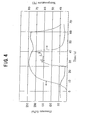
- Figure 4 shows a diagram exhibiting the changes in the pressure at the inside of the balloon and the temperature at the surface of the balloon with time.
- the pressure at the inside of the balloon begins to be raised and reaches 200 kPa after 14 seconds.
- the pressure at the inside of the balloon reaches 240 kPa 25 seconds after the start of the introduction of the fluid, the emission of the laser beams is started.
- the temperature of the balloon at the surface is rapidly raised and reaches 60°C 4 seconds after the start of the emission of the laser beams.
- the emission of laser beams is controlled by switching on and off the apparatus based on the signal transferred from the temperature sensor in a manner such that the temperature at the surface of the balloon is kept in the range of 60 to 70°C.
- the balloon When the emission of the laser beams is stopped 15 seconds after the start of the emission of the laser beams, the balloon is rapidly cooled with the fluid, and the temperature at the surface of the balloon is lowered to 45°C 3 seconds after the stopping of the emission of the laser beams.
- the introduction of the fluid is stopped 20 seconds after the stopping of the emission of the laser beams, and the pressure at the inside of the balloon is lowered.
- the time required to raise the temperature from 35 ⁇ 40°C to 60 ⁇ 80°C exceeds 30 seconds, there is the possibility that the thickness of the living organ decreases due to damages, and the stenosis takes place with passage of time.
- the temperature at the portion of disease of the living organ is lower than 60°C, there is the possibility that the expansion is insufficient under a pressure of the balloon of 500 kPa or smaller.
- the pressure of the balloon exceeds 500 kPa, there is the possibility that the tissue of the living organ is torn or degraded.
- the time of lowering the temperature to 45°C or lower exceeds 40 seconds, there is the possibility that the thickness of the living organ decreases due to damages, and the stenosis takes place with passage of time.
- the tissue of the inner skin is not stabilized even when the tissue is formed, and this is considered to cause the recurrence of the stenosis.
- the surface of the tissue of the blood vessel alone is heated instantaneously.
- the tissue of the tubular cavity is expanded by application of a small pressure without causing damages in deeper portions of the tubular cavity, and the tissue of the blood vessel is treated safely and effectively without causing damages to the tissue of the blood vessel by an unnecessarily great force.
- the excellent effect of the medical treatment can be obtained.
- a living organ can be heated and cooled within a very short time to cure a diseased tissue and a blood vessel can be expanded without damages, in particular, in application to the percutanuous transluminal coronary angioplasty (PTCA).
- PTCA percutanuous transluminal coronary angioplasty
- a medical apparatus shown in Figure 1 was used.
- a catheter shaft was made of a polyamide and had an outer diameter of 1 mm and a whole length of 1,400 mm.
- a balloon was made of a polyimide and had an outer diameter of 3 mm and a length of 15 mm when the balloon was expanded.
- a lumen for introducing a fluid and a lumen for discharging a fluid each having an outer diameter of 200 ⁇ m, a quartz optical fiber having an outer diameter of 100 ⁇ m and a thermocouple were inserted through the catheter shaft.
- a device for converting laser energy made of stainless steel and a contact point for the thermocouple were placed at the inside of the balloon.
- a pressure sensor, a pressure-resistant syringe having a volume of 20 ml and an apparatus for introducing a fluid composed of an auto-injector were connected, and a fluid which was a mixture of a contrast medium and a physiological saline in a ratio of the amounts by volume of 1:1 was introduced while a prescribed pressure was maintained.
- the fluid flowing out of the end of the lumen for discharging a fluid was received into a vessel placed on a microbalance and weighed.
- a YAG laser having an output of 5 W was connected to a proximal position of the quartz optical fiber.
- the information from the pressure sensor and the temperature sensor and the weight obtained by the microbalance were input into a computer, and the flow rate of the heating medium and the output of the laser were controlled so that the prescribed pressure, rate of raising the temperature, maintained temperature and rate of lowering the temperature in the balloon were achieved.
- the catheter shaft and the balloon of the medical apparatus were placed in a tank kept constant at 37°C, and the condition of the operation for achieving the prescribed time, temperature and pressure was obtained. It was confirmed that the prescribed relations between the time, the temperature and the pressure were achieved when the medical apparatus was operated under the obtained condition.
- the rabbit was returned to a cage, bred there for 2 months and killed for examination. The rabbit was then dissected, and the condition of blood vessels was observed. The inner diameter of a blood vessel d 1 at the treated portion and the inner diameter of a blood vessel do in an adjacent portion were measured, and the ratio of the inner diameters of blood vessels d 1 /d 0 was obtained. Based on the result of the observation and the ratio of inner diameters of blood vessels obtained above, the overall evaluation was made.
- Example 2 Similarly to Example 1 and Comparative Example 1, a left hind leg of a rabbit was used in Example 2, and a right hind leg was used in Comparative Example 2.
- Example 2 in which the left hind leg was used, the temperature at the surface of the balloon was raised from 37°C to 70°C in 20 seconds, kept at 70°C for 10 seconds and lowered to 45°C in 20 seconds.
- Comparative Example 2 in which the right hind leg was used, the temperature at the surface of the balloon was raised from 37°C to 90°C in 10 seconds, kept at 90°C for 10 seconds and lowered to 45°C in 10 seconds.
- the ratio of the inner diameters of blood vessels was 1.3.
- the result of the overall evaluation was good.
- the thickness of the blood vessel of the right hind leg was found to have decreased.
- the ratio of the inner diameters of blood vessels was 0.7.
- the result of the overall evaluation was poor.
- Example 3 Similarly to Example 1 and Comparative Example 1, a left hind leg of a rabbit was used in Example 3, and a right hind leg was used in Example 4.
- Example 3 the temperature at the surface of the balloon was raised from 37°C to 80°C in 10 seconds, kept at 80°C for 10 seconds and lowered to 45°C in 10 seconds.
- Example 4 the same procedures as those conducted in Example 3 were conducted except that the temperature at the surface of the balloon was raised to 70°C and kept at 70°C for 10 seconds.
- Example 5 Similarly to Example 1 and Comparative Example 1, a left hind leg of a rabbit was used in Example 5, and a right hind leg was used in Example 6.
- Example 5 the temperature at the surface of the balloon was raised from 37°C to 65°C in 10 seconds, kept at 65°C for 10 seconds and lowered to 45°C in 10 seconds.
- Example 6 the same procedures as those conducted in Example 5 were conducted except that the temperature at the surface of the balloon was raised to 60°C and kept at 60°C for 10 seconds.
- Example 7 Similarly to Example 1 and Comparative Example 1, a left hind leg of a rabbit was used in Example 7, and a right hind leg was used in Example 8.
- Example 7 in which the left hind leg was used, the temperature at the surface of the balloon was raised from 37°C to 57°C in 10 seconds, kept at 57°C for 10 seconds and lowered to 45°C in 10 seconds.
- Example 8 in which the right hind leg was used, the same procedures as those conducted in Example 7 were conducted except that the temperature at the surface of the balloon was raised to 55°C and kept at 55°C for 10 seconds.
- a left hind leg of a rabbit was used in Example 9, and a right hind leg was used in Comparative Example 3.
- the catheter shaft was inserted, and the heating medium was introduced through the catheter shaft.
- the pressure in the left hind leg was kept at 400 kPa, and the pressure in the right hind leg was kept at 600 kPa.
- the temperature at the surface of the balloon was raised from 37°C to 70°C in 10 seconds, kept at 70°C for 10 seconds and lowered to 45°C in 10 seconds.
- the ratio of the inner diameters of blood vessels was 1.5.
- the result of the overall evaluation was excellent.
- the thickness of the media in the blood vessel of the right hind leg was found to have increased although the diameter of the blood vessel increased.
- the ratio of the inner diameters of blood vessels was 1.2. The result of the overall evaluation was fair to poor.
- a left hind leg of a rabbit was used in Comparative Example 4, and a right hind leg was used in Comparative Example 5.
- the catheter shaft was inserted, and the heating medium at the room temperature was introduced through the catheter shaft without irradiation with the laser beams. After the pressure in the left hind leg was kept at 1,200 kPa for 10 seconds, and the pressure in the right hind leg was kept at 400 kPa for 10 seconds, the introduction of the heating medium was stopped.
- the ratio of the inner diameters of blood vessels was 0.8.
- the result of the overall evaluation was poor. Almost no abnormality was found in the blood vessel of the right hind leg. However, the blood vessel was not expanded. The ratio of the inner diameters of blood vessels was 1.0. The result of the overall evaluation was poor.
- Example 1 When the results of Example 1 and Comparative Example 1 are compared, the excellent result was obtained in Example 1 in which the temperature was raised in 30 seconds and lowered in 40 seconds. In contrast, the thickness of the blood vessel decreased, and the blood vessel was not expanded in Comparative Example 1 in which the times for raising and lowering the temperature were each longer than the above by 10 seconds even though the pressure applied to the balloon and the temperature at the surface of the balloon were kept at the same as those in Example 1, i.e., 200 kPa and 70°C, respectively.
- These results show that it is important for obtaining the excellent results that the surface of the balloon is heated and cooled in a short time.
- Example 3 When the results of Example 3 and Comparative Example 2 are compared, the excellent result was obtained in Example 3 in which the temperature of the surface of the balloon was 80°C. In contrast, the thickness of the blood vessel decreased, and the blood vessel was not expanded in Comparative Example 2 in which the temperature of the surface of the balloon was 90°C even though the pressure applied to the balloon and the times for raising and lowering the temperature were kept at the same as those in Example 3, i.e., 200 kPa and 10 seconds, respectively.
- These results show that it is important for obtained the excellent results that the temperature of the surface of the balloon is not excessively high.
- Example 9 When the results of Example 9 and Comparative Example 3 are compared, the excellent result was obtained in Example 9 in which the pressure applied to the balloon was 400 kPa. In contrast, the thickness of the media in the blood vessel increased and, as the result, the ratio of the inner diameters of the blood vessels increased only to 1.2 in Comparative Example 3 in which the pressure applied to the balloon was increased to 600 kPa even though the temperature of the surface of the balloon and the times for raising and lowering the temperature were kept at the same as those in Example 9, i.e., 70°C and 10 seconds, respectively. These results show that an excessively great pressure applied to the balloon gives the inferior result of the evaluation.
- a medical apparatus shown in Figure 2 was used.
- a balloon was made of a polyamide [manufactured by UBE KOSAN Co., Ltd.; UBE NYLON 5033J12; the hardness: R80], had a diameter of 3 mm, a length of 15 mm and a thickness of 20 ⁇ m and was prepared in accordance with the blow molding process at a blowing temperature of 100°C under a blowing pressure of 700 kPa.
- a catheter shaft was a tube having a braid of stainless steel, made of a polyamide tube and having an outer diameter of 1 mm, a thickness of 50 ⁇ m and a whole length of 1,400 mm.
- a lumen for introducing a fluid, which was a mixture of a contrast medium and a physiological saline, and a lumen for discharging the fluid each having an outer diameter of 0.45 mm and a thickness of 30 ⁇ m, a quartz optical fiber having an outer diameter of 100 ⁇ m and a thermocouple were inserted through the catheter shaft.
- a coating polymer by the length of 20 mm in the distal end portion of the lumen for introducing the fluid was removed so that the metal braid was exposed, and the exposed braid was used as the device for converting the laser energy.
- the tip of the quartz optical fiber was disposed at a position of a proximal end of the device for converting the laser energy.
- the temperature sensor was disposed at the central portion of the balloon.
- a 6F sheath was inserted, and the balloon catheter was inserted through the sheath.
- the mixture of a contrast medium and a physiological saline in a ratio of the amounts by volume of 1:1 was continuously introduced under a pressure using a pump for injecting a contrast medium, and the pressure applied to the balloon was kept at 200 kPa.
- Laser beams were emitted from a YAG laser having an output capacity of 5 W, and the temperature of the balloon was raised from 37°C to 70°C in 20 seconds, kept at 70°C for 10 seconds and lowered from 70°C to 45°C in 20 seconds.
- the signal output from the temperature sensor is fed back, and the temperature was adjusted by switching on and off the laser.
- the balloon exhibited an excellent property for folding and re-wrapping.
- the property for inserting the balloon catheter was also excellent. Only slight deformation was found in the balloon after the use. Very slight deformation was found in the catheter shaft after the use.
- the diameter of the blood vessel d 1 at the treated portion and the diameter of a blood vessel do at an adjacent portion were measured, and the ratio of the two diameters d 1 /d 0 was obtained.
- d 1 /d 0 was found to be 2.0. No abnormality was found in the blood vessel.
- the balloon exhibited an excellent property for folding and re-wrapping.
- the property for inserting the balloon catheter was also excellent. Only slight deformation was found in the balloon after the use. Very slight deformation was found in the catheter shaft after the use. d 1 /d 0 was 2.0. No abnormality was found in the blood vessel.
- An artery in the left femoral region of a rabbit was used for the examination under the same conditions in accordance with the same procedures as those in Example 10 except that a tube made of a polyamide [manufactured by UBE KOSAN Co., Ltd.; UBE NYLON 5033J12; the hardness: R80] and having a braid of stainless steel and a Ti-Ni lining at the inner face was used for the catheter shaft.
- the balloon exhibited an excellent property for folding and re-wrapping.
- the property for inserting the balloon catheter was also excellent. Slight deformation was found in the balloon after the use. No deformation was found at all in the catheter shaft after the use. d 1 /d 0 was 2.0. No abnormality was found in the blood vessel.
- An artery in the left femoral region of a rabbit was used for the examination under the same conditions in accordance with the same procedures as those in Example 1 except that a balloon made of a polyamide [manufactured by UBE KOSAN Co., Ltd.; UBE NYLON 5033J12; the hardness: R80] and prepared in accordance with the blow molding process at a blowing temperature of 120°C under a blowing pressure of 400 kPa was used, and a tube made of a polyamide [manufactured by UBE KOSAN Co., Ltd.; UBE NYLON 5033J12; the hardness: R80] / a polyimide [manufactured by TORAY Co., Ltd.; TI POLYMER; the hardness: E86] and having a braid of stainless steel was used for the catheter shaft.
- the balloon exhibited an excellent property for folding and re-wrapping.
- the property for inserting the balloon catheter was also excellent. Very slight deformation was found in the balloon and the catheter after the use. d 1 /d 0 was 2.0. No abnormality was found in the blood vessel.
- Example 4 an artery in the right femoral region of the rabbit was used for the examination under the same conditions in accordance with the same procedures as those in Example 4 except that a balloon made of a polyester elastomer [manufactured by TOYO BOSEKI Co., Ltd.; PELPRENE S6001; the hardness: D72] and prepared in accordance with the blow molding process at a blowing temperature of 130°C under a blowing pressure of 600 kPa was used, and a tube made of a polyamide [manufactured by TOYO BOSEKI Co., Ltd.; PELPRENE S6001; the hardness: D72] / a polyimide [manufactured by TORAY Co., Ltd.; TI POLYMER; the hardness: E86] and having a braid of a metal was used for the catheter shaft.
- a balloon made of a polyester elastomer [manufactured by TOYO BOSEKI Co., Ltd.; PELPR
- the balloon exhibited an excellent property for folding and re-wrapping.
- the property for inserting the balloon catheter was slightly inferior. Very slight deformation was found in the balloon after the use. Very slight deformation was found in the catheter shaft after the use. d 1 /d 0 was 2.0. No abnormality was found in the blood vessel.
- An artery in the left femoral region of a rabbit was used for the examination under the same conditions in accordance with the same procedures as those in Example 10 except that a balloon made of a polyimide [manufactured by TORAY Co., Ltd.; TI POLYMER; the hardness: E86] and prepared in accordance with the dipping process was used, and a tube made of a polyimide [manufactured by TORAY Co., Ltd.; TI POLYMER; the hardness: E86] and having a braid of stainless steel was used for the catheter shaft.
- Example 15 an artery in the right femoral region of the rabbit was used for the examination under the same conditions in accordance with the same procedures as those in Example 15 except that a balloon made of a perfluoroalkoxy resin [manufactured by MITSUI-DU PONT FLUORO-CHEMICAL Co., Ltd.; TEFLON PFA; the hardness: D60] and prepared in accordance with the blow molding process at a blowing temperature of 220°C under a blowing pressure of 700 kPa was used, and a tube made of a perfluoroalkoxy resin [manufactured by MITSUI-DU PONT FLUORO-CHEMICAL Co., Ltd.; TEFLON PFA; the hardness: D60] and having a braid of stainless steel was used for the catheter shaft.
- a balloon made of a perfluoroalkoxy resin manufactured by MITSUI-DU PONT FLUORO-CHEMICAL Co., Ltd.; TEFLON PFA; the hard
- An artery in the left femoral region of a rabbit was used for the examination under the same conditions in accordance with the same procedures as those in Example 10 except that a balloon made of a polyamide [manufactured by UBE KOSAN Co., Ltd.; UBE NYLON 5033J12; the hardness: R80] and prepared in accordance with the blow molding process at a blowing temperature of 120°C under a blowing pressure of 400 kPa was used, a tube made of a polyamide [manufactured by UBE KOSAN Co., Ltd.; UBE NYLON 5033J12; the hardness: R80] / a polyimide [manufactured by TORAY Co., Ltd.; TI POLYMER; the hardness: E86] and having a braid of stainless steel was used for the catheter shaft, and the temperature of the balloon was raised from 37°C to 70°C in 10 seconds, kept at 70°C for 10 seconds and lowered from 70°C to 45°C in 10 seconds
- the balloon exhibited an excellent property for folding and re-wrapping.
- the property for inserting the balloon catheter was also excellent. Very slight deformation was found in the balloon and the catheter after the use. d 1 /d 0 was 1.9. No abnormality was found in the blood vessel.
- Example 17 an artery in the right femoral region of the rabbit was used for the examination under the same conditions in accordance with the same procedures as those in Example 17 except that a balloon made of a polyamide [manufactured by UBE KOSAN Co., Ltd.; UBE NYLON 5033J12; the hardness: R80] and prepared in accordance with the blow molding process at a blowing temperature of 120°C under a blowing pressure of 400 kPa was used, a tube made of a polyamide [manufactured by UBE KOSAN Co., Ltd.; UBE NYLON 5033J12; the hardness R80] / a polyimide [manufactured by TORAY Co., Ltd.; TI POLYMER; the hardness: E86] and having a braid of stainless steel was used for the catheter shaft, and the temperature of the balloon was raised from 37°C to 70°C in 40 seconds, kept at 70°C for 10 seconds and lowered from 70°C to 45°C
- the balloon exhibited an excellent property for folding and re-wrapping.
- the property for inserting the balloon catheter was also excellent. Very slight deformation was found in the balloon and the catheter after the use. d 1 /d 0 was 2.3. The thickness of the blood vessel was found to have decreased.
- Example 10 The conditions of Examples 10 to 17 and Comparative Example 6 are shown in Table 2, and the results are shown in Table 3.
- Table 2 - 1 Material Temperature of blow molding (°C) Pressure of blow molding (kPa) balloon catheter
- Example 10 polyamide polyamide 100 700
- Example 11 polyamide elastomer polyamide / polyimide 100 700
- Example 12 polyamide polyamide / Ni-Ti lining 100 700
- Example 13 polyamide polyamide / polyimide 120 400
- Example 14 polyester elastomer polyester elastomer / polyimide 130 600
- Example 15 polyimide polyimide dipping
- Example 16 perfluoroalkoxy resin perfluoroalkoxy resin 220 700
- Example 17 polyamide polyamide / polyimide 120 400
- Comparative Example 6 polyamide polyamide / polyimide 120 400
- Example 10 20
- Example 11 20
- Example 12 20
- the balloon made of a thermoplastic resin was used and the temperature was raised to 70°C in 10 to 20 seconds and lowered to 45°C in 10 to 20 seconds, the operability of the balloon catheter was excellent, the deformation of the balloon and the catheter shaft after the use was slight, and almost no abnormality was found in the blood vessel.
Landscapes
- Health & Medical Sciences (AREA)
- Life Sciences & Earth Sciences (AREA)
- Surgery (AREA)
- Engineering & Computer Science (AREA)
- Heart & Thoracic Surgery (AREA)
- Animal Behavior & Ethology (AREA)
- General Health & Medical Sciences (AREA)
- Veterinary Medicine (AREA)
- Biomedical Technology (AREA)
- Public Health (AREA)
- Medical Informatics (AREA)
- Molecular Biology (AREA)
- Nuclear Medicine, Radiotherapy & Molecular Imaging (AREA)
- Physics & Mathematics (AREA)
- Otolaryngology (AREA)
- Plasma & Fusion (AREA)
- Biophysics (AREA)
- Child & Adolescent Psychology (AREA)
- Pulmonology (AREA)
- Anesthesiology (AREA)
- Hematology (AREA)
- Orthopedic Medicine & Surgery (AREA)
- Vascular Medicine (AREA)
- Media Introduction/Drainage Providing Device (AREA)
- Surgical Instruments (AREA)
Claims (8)
- Cathéter à ballonnet pour le traitement et le refroidissement de tissus, comprenant un élément de raccordement (12) disposé sur le plan proximal ayant un orifice d'entrée de fluide, un orifice de sortie de fluide et une entrée d'énergie, un ballonnet (19), une tige de cathéter (17) ayant un lumen (13) pour introduire un fluide dans le ballonnet et un lumen (14) pour évacuer le fluide du ballonnet et un élément générant de la chaleur (18), dans lequel l'élément de raccordement disposé sur le plan proximal et la partie proximale de la tige du cathéter sont raccordés l'un à l'autre, et la partie distale de la tige du cathéter et la partie proximale du ballonnet étant raccordées l'une à l'autre, caractérisé en ce que l'élément générant de la chaleur (18) est disposé dans le lumen (13) pour introduire un fluide dans le ballonnet à l'extrémité distale de la tige de cathéter (17) et est en contact avec le fluide à l'intérieur de la partie distale de la tige du cathéter (17) et en ce que l'énergie est un faisceau laser qui est introduit dans la tige de cathéter (17) par l'entrée d'énergie via une fibre optique (15), l'élément générant de la chaleur (18) étant capable d'absorber le faisceau laser et de convertir l'énergie du faisceau laser en chaleur, un capteur de température (20) étant disposé à l'intérieur du ballonnet (19), et en ce qu'un fluide à basse température est introduit de l'orifice d'entrée de fluide [lumen (13)], s'écoule dans le ballonnet (19) et est évacué par l'orifice de sortie de fluide (lumen 14).
- Cathéter à ballonnet selon la revendication 1,
dans lequel le ballonnet (19) est déployé en appliquant une pression avec ajustement de degrés d'ouverture de l'orifice d'entrée de fluide (13) et de l'orifice de sortie de fluide (14) ou une pression du fluide introduit, ladite pression étant contrôlée en utilisant un moyen de détection de la pression. - Cathéter à ballonnet selon la revendication 1 ou 2, dans lequel l'élément générant de la chaleur (18) est un élément métallique.
- Cathéter à ballonnet selon la revendication 3,
dans lequel l'élément métallique (18) est choisi parmi l'acier inoxydable, l'acier au chrome, l'acier ferrique et/ou un alliage ultra-élastique de nickel/titane. - Cathéter à ballonnet selon l'une quelconque des revendications 1 à 4, dans lequel l'élément générant de la chaleur (18) a la forme d'une lame, d'une bobine, d'une toile, d'une tresse ou de laine.
- Cathéter à ballonnet selon l'une quelconque des revendications 1 à 5, dans lequel une partie de pointe (21) de la fibre optique (15) est de forme conique ayant un diamètre diminuant progressivement vers la pointe ou a une surface rugueuse.
- Cathéter à ballonnet selon l'une quelconque des revendications 1 à 6, dans lequel le ballonnet (19) comprend une résine thermoplastique.
- Cathéter à ballonnet selon l'une quelconque des revendications 1 à 7, dans lequel le ballonnet (19) est préparé par moulage par extrusion-soufflage à une température de 100°C ou supérieure et l'élément générant de la chaleur (18) est en contact avec le fluide dans la partie distale de la tige de cathéter (17).
Applications Claiming Priority (2)
| Application Number | Priority Date | Filing Date | Title |
|---|---|---|---|
| JP2003434588 | 2003-12-26 | ||
| JP2003434588A JP4669218B2 (ja) | 2003-12-26 | 2003-12-26 | 医療装置 |
Publications (2)
| Publication Number | Publication Date |
|---|---|
| EP1547536A1 EP1547536A1 (fr) | 2005-06-29 |
| EP1547536B1 true EP1547536B1 (fr) | 2010-04-21 |
Family
ID=34545108
Family Applications (1)
| Application Number | Title | Priority Date | Filing Date |
|---|---|---|---|
| EP20040102453 Expired - Lifetime EP1547536B1 (fr) | 2003-12-26 | 2004-06-02 | Cathéter à ballonet pour le traitement d'un organe vivant |
Country Status (4)
| Country | Link |
|---|---|
| EP (1) | EP1547536B1 (fr) |
| JP (1) | JP4669218B2 (fr) |
| AT (1) | ATE464851T1 (fr) |
| DE (1) | DE602004026677D1 (fr) |
Families Citing this family (5)
| Publication number | Priority date | Publication date | Assignee | Title |
|---|---|---|---|---|
| JP4624964B2 (ja) * | 2006-06-23 | 2011-02-02 | オリンパスメディカルシステムズ株式会社 | 内視鏡用処置具 |
| JPWO2013094326A1 (ja) * | 2011-12-22 | 2015-04-27 | 学校法人慶應義塾 | バルーンカテーテル装置及びバルーンカテーテルの加熱方法 |
| AU2013226062B2 (en) * | 2012-02-27 | 2017-10-19 | Fractyl Health, Inc. | Heat ablation systems, devices and methods for the treatment of tissue |
| US11832869B2 (en) * | 2019-03-04 | 2023-12-05 | Gyrus Acmi, Inc. | Resistive heat ablation for treatment of the anatomy |
| JP2025108112A (ja) * | 2024-01-10 | 2025-07-23 | 日本ライフライン株式会社 | バルーンカテーテル |
Citations (1)
| Publication number | Priority date | Publication date | Assignee | Title |
|---|---|---|---|---|
| US6302904B1 (en) * | 1998-12-17 | 2001-10-16 | Wallsten Medical S.A. | Device and method for medical treatment |
Family Cites Families (5)
| Publication number | Priority date | Publication date | Assignee | Title |
|---|---|---|---|---|
| JPS5957650A (ja) * | 1982-09-27 | 1984-04-03 | 呉羽化学工業株式会社 | 腔内加熱用プロ−ブ |
| US5226430A (en) * | 1984-10-24 | 1993-07-13 | The Beth Israel Hospital | Method for angioplasty |
| US5344419A (en) * | 1993-04-23 | 1994-09-06 | Wayne State University | Apparatus and method for making a diffusing tip in a balloon catheter system |
| US5417689A (en) * | 1994-01-18 | 1995-05-23 | Cordis Corporation | Thermal balloon catheter and method |
| US6223085B1 (en) * | 1997-05-06 | 2001-04-24 | Urologix, Inc. | Device and method for preventing restenosis |
-
2003
- 2003-12-26 JP JP2003434588A patent/JP4669218B2/ja not_active Expired - Lifetime
-
2004
- 2004-06-02 AT AT04102453T patent/ATE464851T1/de not_active IP Right Cessation
- 2004-06-02 EP EP20040102453 patent/EP1547536B1/fr not_active Expired - Lifetime
- 2004-06-02 DE DE200460026677 patent/DE602004026677D1/de not_active Expired - Lifetime
Patent Citations (1)
| Publication number | Priority date | Publication date | Assignee | Title |
|---|---|---|---|---|
| US6302904B1 (en) * | 1998-12-17 | 2001-10-16 | Wallsten Medical S.A. | Device and method for medical treatment |
Also Published As
| Publication number | Publication date |
|---|---|
| JP4669218B2 (ja) | 2011-04-13 |
| JP2005185760A (ja) | 2005-07-14 |
| EP1547536A1 (fr) | 2005-06-29 |
| DE602004026677D1 (de) | 2010-06-02 |
| ATE464851T1 (de) | 2010-05-15 |
Similar Documents
| Publication | Publication Date | Title |
|---|---|---|
| CA2078032C (fr) | Article dilatable a faible expansion elastique | |
| US5456661A (en) | Catheter with thermally stable balloon | |
| CA2401128C (fr) | Catheter de guidage avec revetement interne lubrifiant | |
| EP0651666B1 (fr) | Ensemble ballon a parties gonflables separement | |
| CN100368034C (zh) | 气球导管 | |
| US20080249595A1 (en) | Electrophysiology Catheter With Improved Tip Electrode | |
| EP2895226B1 (fr) | Procédé de fabrication d'un cathéter à ballonnet à pointe molle | |
| JP3711500B2 (ja) | 生体器官瞬間加熱冷却用カテーテル | |
| US6878329B2 (en) | Method of making a catheter balloon using a polyimide covered mandrel | |
| US6293924B1 (en) | Balloon assembly with separately inflatable sections | |
| US8025638B2 (en) | Balloon catheter, medical apparatus and method for treating living organ | |
| JP6259560B2 (ja) | バルーンカテーテル用バルーン | |
| EP1547536B1 (fr) | Cathéter à ballonet pour le traitement d'un organe vivant | |
| JP4785567B2 (ja) | カテーテル | |
| JP2006015064A (ja) | バルーンカテーテル | |
| JP2004073570A (ja) | 肺静脈電気的隔離用バルーンカテーテル | |
| WO1994002197A9 (fr) | Catheter extraplat avec element tubulaire externe expansible | |
| WO1994002197A1 (fr) | Catheter extraplat avec element tubulaire externe expansible | |
| US20020171180A1 (en) | Method of making a catheter balloon | |
| JP2021030091A (ja) | バルーンカテーテル | |
| JP6184070B2 (ja) | バルーンカテーテル用バルーンの製造方法 | |
| Shimazaki et al. | Laser-driven short-duration heating angioplasty: dilatation performance in cadaver atherosclerotic femoral arteries | |
| JPH07132146A (ja) | カテーテル |
Legal Events
| Date | Code | Title | Description |
|---|---|---|---|
| PUAI | Public reference made under article 153(3) epc to a published international application that has entered the european phase |
Free format text: ORIGINAL CODE: 0009012 |
|
| AK | Designated contracting states |
Kind code of ref document: A1 Designated state(s): AT BE BG CH CY CZ DE DK EE ES FI FR GB GR HU IE IT LI LU MC NL PL PT RO SE SI SK TR |
|
| AX | Request for extension of the european patent |
Extension state: AL HR LT LV MK |
|
| 17P | Request for examination filed |
Effective date: 20051220 |
|
| AKX | Designation fees paid |
Designated state(s): AT BE BG CH CY CZ DE DK EE ES FI FR GB GR HU IE IT LI LU MC NL PL PT RO SE SI SK TR |
|
| RAP1 | Party data changed (applicant data changed or rights of an application transferred) |
Owner name: KEIO UNIVERSITY |
|
| 17Q | First examination report despatched |
Effective date: 20060222 |
|
| RAP1 | Party data changed (applicant data changed or rights of an application transferred) |
Owner name: NIPRO CORPORATION Owner name: KEIO UNIVERSITY |
|
| GRAP | Despatch of communication of intention to grant a patent |
Free format text: ORIGINAL CODE: EPIDOSNIGR1 |
|
| RTI1 | Title (correction) |
Free format text: BALLOON CATHETER FOR TREATING LIVING ORGAN |
|
| GRAS | Grant fee paid |
Free format text: ORIGINAL CODE: EPIDOSNIGR3 |
|
| GRAA | (expected) grant |
Free format text: ORIGINAL CODE: 0009210 |
|
| AK | Designated contracting states |
Kind code of ref document: B1 Designated state(s): AT BE BG CH CY CZ DE DK EE ES FI FR GB GR HU IE IT LI LU MC NL PL PT RO SE SI SK TR |
|
| REG | Reference to a national code |
Ref country code: GB Ref legal event code: FG4D |
|
| REG | Reference to a national code |
Ref country code: CH Ref legal event code: EP |
|
| REG | Reference to a national code |
Ref country code: IE Ref legal event code: FG4D |
|
| REF | Corresponds to: |
Ref document number: 602004026677 Country of ref document: DE Date of ref document: 20100602 Kind code of ref document: P |
|
| REG | Reference to a national code |
Ref country code: NL Ref legal event code: VDEP Effective date: 20100421 |
|
| PG25 | Lapsed in a contracting state [announced via postgrant information from national office to epo] |
Ref country code: ES Free format text: LAPSE BECAUSE OF FAILURE TO SUBMIT A TRANSLATION OF THE DESCRIPTION OR TO PAY THE FEE WITHIN THE PRESCRIBED TIME-LIMIT Effective date: 20100801 Ref country code: NL Free format text: LAPSE BECAUSE OF FAILURE TO SUBMIT A TRANSLATION OF THE DESCRIPTION OR TO PAY THE FEE WITHIN THE PRESCRIBED TIME-LIMIT Effective date: 20100421 Ref country code: SE Free format text: LAPSE BECAUSE OF FAILURE TO SUBMIT A TRANSLATION OF THE DESCRIPTION OR TO PAY THE FEE WITHIN THE PRESCRIBED TIME-LIMIT Effective date: 20100421 |
|
| PG25 | Lapsed in a contracting state [announced via postgrant information from national office to epo] |
Ref country code: SI Free format text: LAPSE BECAUSE OF FAILURE TO SUBMIT A TRANSLATION OF THE DESCRIPTION OR TO PAY THE FEE WITHIN THE PRESCRIBED TIME-LIMIT Effective date: 20100421 Ref country code: AT Free format text: LAPSE BECAUSE OF FAILURE TO SUBMIT A TRANSLATION OF THE DESCRIPTION OR TO PAY THE FEE WITHIN THE PRESCRIBED TIME-LIMIT Effective date: 20100421 Ref country code: FI Free format text: LAPSE BECAUSE OF FAILURE TO SUBMIT A TRANSLATION OF THE DESCRIPTION OR TO PAY THE FEE WITHIN THE PRESCRIBED TIME-LIMIT Effective date: 20100421 |
|
| PG25 | Lapsed in a contracting state [announced via postgrant information from national office to epo] |
Ref country code: PL Free format text: LAPSE BECAUSE OF FAILURE TO SUBMIT A TRANSLATION OF THE DESCRIPTION OR TO PAY THE FEE WITHIN THE PRESCRIBED TIME-LIMIT Effective date: 20100421 Ref country code: CY Free format text: LAPSE BECAUSE OF FAILURE TO SUBMIT A TRANSLATION OF THE DESCRIPTION OR TO PAY THE FEE WITHIN THE PRESCRIBED TIME-LIMIT Effective date: 20100421 Ref country code: GR Free format text: LAPSE BECAUSE OF FAILURE TO SUBMIT A TRANSLATION OF THE DESCRIPTION OR TO PAY THE FEE WITHIN THE PRESCRIBED TIME-LIMIT Effective date: 20100722 |
|
| PG25 | Lapsed in a contracting state [announced via postgrant information from national office to epo] |
Ref country code: PT Free format text: LAPSE BECAUSE OF FAILURE TO SUBMIT A TRANSLATION OF THE DESCRIPTION OR TO PAY THE FEE WITHIN THE PRESCRIBED TIME-LIMIT Effective date: 20100823 Ref country code: EE Free format text: LAPSE BECAUSE OF FAILURE TO SUBMIT A TRANSLATION OF THE DESCRIPTION OR TO PAY THE FEE WITHIN THE PRESCRIBED TIME-LIMIT Effective date: 20100421 Ref country code: DK Free format text: LAPSE BECAUSE OF FAILURE TO SUBMIT A TRANSLATION OF THE DESCRIPTION OR TO PAY THE FEE WITHIN THE PRESCRIBED TIME-LIMIT Effective date: 20100421 Ref country code: MC Free format text: LAPSE BECAUSE OF NON-PAYMENT OF DUE FEES Effective date: 20100630 |
|
| REG | Reference to a national code |
Ref country code: CH Ref legal event code: PL |
|
| PLBE | No opposition filed within time limit |
Free format text: ORIGINAL CODE: 0009261 |
|
| STAA | Information on the status of an ep patent application or granted ep patent |
Free format text: STATUS: NO OPPOSITION FILED WITHIN TIME LIMIT |
|
| PG25 | Lapsed in a contracting state [announced via postgrant information from national office to epo] |
Ref country code: RO Free format text: LAPSE BECAUSE OF FAILURE TO SUBMIT A TRANSLATION OF THE DESCRIPTION OR TO PAY THE FEE WITHIN THE PRESCRIBED TIME-LIMIT Effective date: 20100421 Ref country code: CZ Free format text: LAPSE BECAUSE OF FAILURE TO SUBMIT A TRANSLATION OF THE DESCRIPTION OR TO PAY THE FEE WITHIN THE PRESCRIBED TIME-LIMIT Effective date: 20100421 Ref country code: SK Free format text: LAPSE BECAUSE OF FAILURE TO SUBMIT A TRANSLATION OF THE DESCRIPTION OR TO PAY THE FEE WITHIN THE PRESCRIBED TIME-LIMIT Effective date: 20100421 Ref country code: BE Free format text: LAPSE BECAUSE OF FAILURE TO SUBMIT A TRANSLATION OF THE DESCRIPTION OR TO PAY THE FEE WITHIN THE PRESCRIBED TIME-LIMIT Effective date: 20100421 |
|
| 26N | No opposition filed |
Effective date: 20110124 |
|
| PG25 | Lapsed in a contracting state [announced via postgrant information from national office to epo] |
Ref country code: IT Free format text: LAPSE BECAUSE OF NON-PAYMENT OF DUE FEES Effective date: 20100602 |
|
| PG25 | Lapsed in a contracting state [announced via postgrant information from national office to epo] |
Ref country code: IE Free format text: LAPSE BECAUSE OF NON-PAYMENT OF DUE FEES Effective date: 20100602 Ref country code: LI Free format text: LAPSE BECAUSE OF NON-PAYMENT OF DUE FEES Effective date: 20100630 Ref country code: CH Free format text: LAPSE BECAUSE OF NON-PAYMENT OF DUE FEES Effective date: 20100630 |
|
| PGRI | Patent reinstated in contracting state [announced from national office to epo] |
Ref country code: IT Effective date: 20110616 |
|
| PG25 | Lapsed in a contracting state [announced via postgrant information from national office to epo] |
Ref country code: LU Free format text: LAPSE BECAUSE OF NON-PAYMENT OF DUE FEES Effective date: 20100602 Ref country code: HU Free format text: LAPSE BECAUSE OF FAILURE TO SUBMIT A TRANSLATION OF THE DESCRIPTION OR TO PAY THE FEE WITHIN THE PRESCRIBED TIME-LIMIT Effective date: 20101022 Ref country code: BG Free format text: LAPSE BECAUSE OF FAILURE TO SUBMIT A TRANSLATION OF THE DESCRIPTION OR TO PAY THE FEE WITHIN THE PRESCRIBED TIME-LIMIT Effective date: 20100421 |
|
| PG25 | Lapsed in a contracting state [announced via postgrant information from national office to epo] |
Ref country code: TR Free format text: LAPSE BECAUSE OF FAILURE TO SUBMIT A TRANSLATION OF THE DESCRIPTION OR TO PAY THE FEE WITHIN THE PRESCRIBED TIME-LIMIT Effective date: 20100421 |
|
| PG25 | Lapsed in a contracting state [announced via postgrant information from national office to epo] |
Ref country code: BG Free format text: LAPSE BECAUSE OF FAILURE TO SUBMIT A TRANSLATION OF THE DESCRIPTION OR TO PAY THE FEE WITHIN THE PRESCRIBED TIME-LIMIT Effective date: 20100721 |
|
| REG | Reference to a national code |
Ref country code: FR Ref legal event code: PLFP Year of fee payment: 13 |
|
| REG | Reference to a national code |
Ref country code: FR Ref legal event code: PLFP Year of fee payment: 14 |
|
| REG | Reference to a national code |
Ref country code: FR Ref legal event code: PLFP Year of fee payment: 15 |
|
| PGFP | Annual fee paid to national office [announced via postgrant information from national office to epo] |
Ref country code: IT Payment date: 20230510 Year of fee payment: 20 Ref country code: FR Payment date: 20230510 Year of fee payment: 20 Ref country code: DE Payment date: 20230502 Year of fee payment: 20 |
|
| PGFP | Annual fee paid to national office [announced via postgrant information from national office to epo] |
Ref country code: GB Payment date: 20230427 Year of fee payment: 20 |
|
| REG | Reference to a national code |
Ref country code: DE Ref legal event code: R071 Ref document number: 602004026677 Country of ref document: DE |
|
| REG | Reference to a national code |
Ref country code: GB Ref legal event code: PE20 Expiry date: 20240601 |
|
| PG25 | Lapsed in a contracting state [announced via postgrant information from national office to epo] |
Ref country code: GB Free format text: LAPSE BECAUSE OF EXPIRATION OF PROTECTION Effective date: 20240601 |
|
| PG25 | Lapsed in a contracting state [announced via postgrant information from national office to epo] |
Ref country code: GB Free format text: LAPSE BECAUSE OF EXPIRATION OF PROTECTION Effective date: 20240601 |