EP1548080B1 - Ruban adhésif technique et son procédé de fabrication - Google Patents
Ruban adhésif technique et son procédé de fabrication Download PDFInfo
- Publication number
- EP1548080B1 EP1548080B1 EP04106239A EP04106239A EP1548080B1 EP 1548080 B1 EP1548080 B1 EP 1548080B1 EP 04106239 A EP04106239 A EP 04106239A EP 04106239 A EP04106239 A EP 04106239A EP 1548080 B1 EP1548080 B1 EP 1548080B1
- Authority
- EP
- European Patent Office
- Prior art keywords
- adhesive
- adhesive tape
- cross
- base
- coating
- Prior art date
- Legal status (The legal status is an assumption and is not a legal conclusion. Google has not performed a legal analysis and makes no representation as to the accuracy of the status listed.)
- Expired - Lifetime
Links
- 239000002390 adhesive tape Substances 0.000 title claims abstract description 50
- 238000000034 method Methods 0.000 title claims abstract description 16
- 238000004519 manufacturing process Methods 0.000 title abstract description 10
- 230000001070 adhesive effect Effects 0.000 claims abstract description 71
- 239000000853 adhesive Substances 0.000 claims abstract description 70
- 238000000576 coating method Methods 0.000 claims abstract description 60
- 239000011248 coating agent Substances 0.000 claims abstract description 58
- 239000004820 Pressure-sensitive adhesive Substances 0.000 claims abstract description 19
- 229910000831 Steel Inorganic materials 0.000 claims abstract description 19
- 239000010959 steel Substances 0.000 claims abstract description 19
- 238000004132 cross linking Methods 0.000 claims abstract description 17
- NIXOWILDQLNWCW-UHFFFAOYSA-M Acrylate Chemical compound [O-]C(=O)C=C NIXOWILDQLNWCW-UHFFFAOYSA-M 0.000 claims abstract description 9
- 239000000463 material Substances 0.000 claims abstract description 7
- 239000002994 raw material Substances 0.000 claims description 12
- 230000005855 radiation Effects 0.000 claims description 9
- 239000000203 mixture Substances 0.000 claims description 8
- 238000010276 construction Methods 0.000 claims description 7
- XEEYBQQBJWHFJM-UHFFFAOYSA-N Iron Chemical compound [Fe] XEEYBQQBJWHFJM-UHFFFAOYSA-N 0.000 claims description 6
- QSHDDOUJBYECFT-UHFFFAOYSA-N mercury Chemical compound [Hg] QSHDDOUJBYECFT-UHFFFAOYSA-N 0.000 claims description 6
- 229910052753 mercury Inorganic materials 0.000 claims description 6
- GYHNNYVSQQEPJS-UHFFFAOYSA-N Gallium Chemical compound [Ga] GYHNNYVSQQEPJS-UHFFFAOYSA-N 0.000 claims description 5
- 150000001252 acrylic acid derivatives Chemical class 0.000 claims description 5
- 229910052733 gallium Inorganic materials 0.000 claims description 5
- 230000002787 reinforcement Effects 0.000 claims description 5
- 238000012546 transfer Methods 0.000 claims description 5
- 239000004744 fabric Substances 0.000 claims description 4
- 230000004888 barrier function Effects 0.000 claims description 3
- 239000003085 diluting agent Substances 0.000 claims description 3
- 239000003063 flame retardant Substances 0.000 claims description 3
- 229910052742 iron Inorganic materials 0.000 claims description 3
- RNFJDJUURJAICM-UHFFFAOYSA-N 2,2,4,4,6,6-hexaphenoxy-1,3,5-triaza-2$l^{5},4$l^{5},6$l^{5}-triphosphacyclohexa-1,3,5-triene Chemical compound N=1P(OC=2C=CC=CC=2)(OC=2C=CC=CC=2)=NP(OC=2C=CC=CC=2)(OC=2C=CC=CC=2)=NP=1(OC=1C=CC=CC=1)OC1=CC=CC=C1 RNFJDJUURJAICM-UHFFFAOYSA-N 0.000 claims description 2
- 238000009792 diffusion process Methods 0.000 claims description 2
- 239000000945 filler Substances 0.000 claims description 2
- 238000010438 heat treatment Methods 0.000 claims description 2
- 238000010030 laminating Methods 0.000 claims description 2
- 239000011888 foil Substances 0.000 claims 1
- 239000003999 initiator Substances 0.000 claims 1
- 238000009413 insulation Methods 0.000 claims 1
- 238000007789 sealing Methods 0.000 claims 1
- 238000004804 winding Methods 0.000 claims 1
- 239000002904 solvent Substances 0.000 description 7
- 239000004745 nonwoven fabric Substances 0.000 description 6
- 239000000123 paper Substances 0.000 description 6
- 239000012876 carrier material Substances 0.000 description 5
- 239000010410 layer Substances 0.000 description 5
- XLYOFNOQVPJJNP-UHFFFAOYSA-N water Substances O XLYOFNOQVPJJNP-UHFFFAOYSA-N 0.000 description 5
- 239000002131 composite material Substances 0.000 description 4
- 239000006185 dispersion Substances 0.000 description 4
- 239000000758 substrate Substances 0.000 description 4
- 238000001035 drying Methods 0.000 description 3
- 239000002655 kraft paper Substances 0.000 description 3
- 238000010422 painting Methods 0.000 description 3
- 239000004831 Hot glue Substances 0.000 description 2
- 239000008199 coating composition Substances 0.000 description 2
- 230000000052 comparative effect Effects 0.000 description 2
- 239000011086 glassine Substances 0.000 description 2
- 239000012943 hotmelt Substances 0.000 description 2
- 238000003475 lamination Methods 0.000 description 2
- 230000000873 masking effect Effects 0.000 description 2
- 238000005259 measurement Methods 0.000 description 2
- 230000006855 networking Effects 0.000 description 2
- 239000000047 product Substances 0.000 description 2
- 239000004753 textile Substances 0.000 description 2
- 239000002023 wood Substances 0.000 description 2
- QNODIIQQMGDSEF-UHFFFAOYSA-N (1-hydroxycyclohexyl)-phenylmethanone Chemical compound C=1C=CC=CC=1C(=O)C1(O)CCCCC1 QNODIIQQMGDSEF-UHFFFAOYSA-N 0.000 description 1
- KWVGIHKZDCUPEU-UHFFFAOYSA-N 2,2-dimethoxy-2-phenylacetophenone Chemical compound C=1C=CC=CC=1C(OC)(OC)C(=O)C1=CC=CC=C1 KWVGIHKZDCUPEU-UHFFFAOYSA-N 0.000 description 1
- 238000010521 absorption reaction Methods 0.000 description 1
- 230000032683 aging Effects 0.000 description 1
- 229910052782 aluminium Inorganic materials 0.000 description 1
- XAGFODPZIPBFFR-UHFFFAOYSA-N aluminium Chemical compound [Al] XAGFODPZIPBFFR-UHFFFAOYSA-N 0.000 description 1
- 229920005601 base polymer Polymers 0.000 description 1
- 238000010924 continuous production Methods 0.000 description 1
- 238000001816 cooling Methods 0.000 description 1
- 238000005260 corrosion Methods 0.000 description 1
- 239000002270 dispersing agent Substances 0.000 description 1
- 238000009826 distribution Methods 0.000 description 1
- 230000000694 effects Effects 0.000 description 1
- 238000004049 embossing Methods 0.000 description 1
- 239000003995 emulsifying agent Substances 0.000 description 1
- 238000005265 energy consumption Methods 0.000 description 1
- 238000005516 engineering process Methods 0.000 description 1
- 230000002349 favourable effect Effects 0.000 description 1
- 239000000835 fiber Substances 0.000 description 1
- 239000010408 film Substances 0.000 description 1
- 238000007654 immersion Methods 0.000 description 1
- 230000001678 irradiating effect Effects 0.000 description 1
- 239000006101 laboratory sample Substances 0.000 description 1
- 239000000178 monomer Substances 0.000 description 1
- 239000004014 plasticizer Substances 0.000 description 1
- 229920000058 polyacrylate Polymers 0.000 description 1
- 229920000728 polyester Polymers 0.000 description 1
- 238000006116 polymerization reaction Methods 0.000 description 1
- 229920000098 polyolefin Polymers 0.000 description 1
- 229920001296 polysiloxane Polymers 0.000 description 1
- 230000002028 premature Effects 0.000 description 1
- 238000012545 processing Methods 0.000 description 1
- 238000011084 recovery Methods 0.000 description 1
- 238000004064 recycling Methods 0.000 description 1
- 238000011160 research Methods 0.000 description 1
- 239000011347 resin Substances 0.000 description 1
- 229920005989 resin Polymers 0.000 description 1
- 230000035945 sensitivity Effects 0.000 description 1
- 238000009958 sewing Methods 0.000 description 1
- 230000003595 spectral effect Effects 0.000 description 1
- 239000000126 substance Substances 0.000 description 1
- 239000013589 supplement Substances 0.000 description 1
- 229920003051 synthetic elastomer Polymers 0.000 description 1
- 239000005061 synthetic rubber Substances 0.000 description 1
- 238000012360 testing method Methods 0.000 description 1
- 238000009281 ultraviolet germicidal irradiation Methods 0.000 description 1
- 239000002759 woven fabric Substances 0.000 description 1
Images
Classifications
-
- C—CHEMISTRY; METALLURGY
- C09—DYES; PAINTS; POLISHES; NATURAL RESINS; ADHESIVES; COMPOSITIONS NOT OTHERWISE PROVIDED FOR; APPLICATIONS OF MATERIALS NOT OTHERWISE PROVIDED FOR
- C09J—ADHESIVES; NON-MECHANICAL ASPECTS OF ADHESIVE PROCESSES IN GENERAL; ADHESIVE PROCESSES NOT PROVIDED FOR ELSEWHERE; USE OF MATERIALS AS ADHESIVES
- C09J7/00—Adhesives in the form of films or foils
- C09J7/30—Adhesives in the form of films or foils characterised by the adhesive composition
- C09J7/38—Pressure-sensitive adhesives [PSA]
- C09J7/381—Pressure-sensitive adhesives [PSA] based on macromolecular compounds obtained by reactions involving only carbon-to-carbon unsaturated bonds
- C09J7/385—Acrylic polymers
Definitions
- the present invention relates to a technical adhesive tape, in particular for use in construction, with a band-shaped support and with a pressure-sensitive adhesive coating applied on at least one side consisting of an acrylate-based UV-crosslinked pressure-sensitive adhesive and a specific basis weight of at least 100 g / m 2 has. Furthermore, the present invention relates to a method for producing such a technical adhesive tape.
- adhesive tapes made of impregnated paper or scrim-reinforced films with extremely high application weights of about 200 g / m 2 are used, as for example in the CH 687 328 A5 is described.
- the high adhesive application allows a particularly aggressive adhesion to rough substrates, even under the non-ideal bonding conditions frequently encountered in construction sites, such as dusty, slightly damp or cold surfaces.
- dispersion adhesives or solvent adhesives have the disadvantage that during the coating, the solvents or water must be removed as a dispersant.
- Recycling cost for the environmentally sound recovery of solvents is the main disadvantage of these techniques the low production rate. Since the drying process of thick layers of dispersion or solvent adhesives is always associated with a diffusion process of the solvent / water from the underside of the layer to the surface and premature superficial filming is to be avoided, such drying processes must be relatively slow. To be able to work at all in a continuous process, long drying channels are therefore necessary.
- Dispersion adhesives have the additional disadvantage that they contain large amounts of emulsifiers which in turn reduce the moisture resistance of the adhesive tapes coated therewith.
- hot-melt pressure-sensitive adhesives are based primarily on synthetic rubber as the base polymer, which has been tackified with resins and plasticizers. These adhesives have the disadvantage that they have only a limited weathering and UV stability due to their unsaturated chemical character.
- UV-crosslinking acrylate hotmelt pressure-sensitive adhesives are therefore expressly used only for application weights of about 2 to 80 g / m 2 , in exceptional cases to 100 g / m 2 .
- Typical values of the bond strength of such tapes are in the range of 1 to 5 N / cm.
- the known adhesive tape is not an adhesive tape of the type mentioned, insofar as it is - as explicitly stated - is a photopolymerized from monomers mass, but not crosslinked acrylates in the adhesive composition used.
- the present invention has for its object to provide a technical adhesive tape of the type mentioned above and a corresponding manufacturing method, wherein the adhesive tape are preferably suitable for use in the construction sector and have a good adhesion to rough surfaces in less expensive production.
- an adhesive tape or a method for producing an adhesive tape of the aforementioned type in which the adhesive coating has a coating weight of 160-250 g / m 2 and is applied and crosslinked such that the adhesive tape has an initial adhesion to FTM 9 on steel of at least 8 N / cm, a bond strength according to DIN EN 1939 on steel of at least 10 N / cm and a shear strength according to FTM 8 (100 mm 2 , 0.5 kg) of at least 15 min.
- the adhesive tape according to the invention exhibits excellent cohesion and very good adhesion to rough substrates with a high thickness of the adhesive coating.
- the adhesive coating with an application weight of 160-220 g / m 2 can be applied, and there can be an initial adhesion to FTM 9 on steel of at least 10 N / cm, an adhesive force according to DIN EN 1939 on steel of at least 15 N. / cm and / or a shear strength according to FTM 8 (100 mm 2 , 0.5 kg) of at least 30 min.
- the application and crosslinking according to the invention which is determined by the application method for the coating, in particular the use of a transfer method, preferably in conjunction with a specific UV lamp selection and a coordinated ratio of a web speed of the coated support to the irradiated UV power, it is surprisingly succeeded, contrary to the previously published opinion, to produce an adhesive tape that overcomes the aforementioned disadvantages of the known prior art.
- Papers can preferably be provided with water repellency by means of a PE coating or a wax layer, while PE or PP films can preferably be reinforced with a scrim to improve the tensile strength.
- support textiles preferably woven or nonwoven fabrics of polyester or polyolefins can be used.
- nonwovens a distinction is made between spunbonded nonwovens of continuous filaments and spunbonded nonwovens made of staple fibers of defined length, which are equally suitable.
- the nonwovens can be consolidated by various methods such as sewing, needling, embossing or with the aid of a water steel.
- the adhesive raw materials used for the adhesive coating based on polyacrylates preferably of Hotmet acrylates
- a high aging and moisture stability can be ensured.
- commercially available raw materials of the product series AcResin from BASF can be used.
- UV-crosslinkable acrylates which, according to the invention, contain from 0.1 to 1.0% of an additional photoinitiator which has an effective UV absorption in the wavelength range 300-400 nm, with 0-15% of a reactive diluent, with 0-15%. 20% fillers and / or flame retardants can be mixed.
- Such a raw material or such a mixture also has the necessary viscosity at the processing temperature in order to be applied at a basis weight of 120-250, preferably 160-220 g / m 2 .
- the raw material is inventively preferably not applied directly to the carrier, but first on a siliconized intermediate carrier.
- a siliconized intermediate carrier For this serve preferably single- or double-sided siliconized papers or temperature-stable films.
- the coating can also be carried out on a siliconized carrier top side with a transfer to the carrier underside following UV irradiation.
- the more crosslinked and less sticky side of the adhesive coating reaches the side facing the carrier material, which forms the initial adhesion, bond strength and shear strength values according to the invention favored.
- the coating composition obtains its pressure-sensitively adhesive properties according to the invention.
- at least part of the UV lamps used are not pure medium-pressure mercury lamps, but that in addition or alternatively, preferably with iron, lead or gallium doped radiators are used ,
- the coating composition should not be cold during the irradiation. It is more favorable to irradiate the still hot mass or a heated mass which, e.g. via a heating roller, to a temperature above the room temperature, preferably to a temperature of more than 100 ° C, can be brought.
- the adhesive By laminating the coated intermediate carrier with the actual carrier material, the adhesive can be transferred to this.
- a possible scrim or fabric reinforcement can be included in the lamination in a technologically advantageous manner. Due to the siliconization of the intermediate carrier, a subsequent detachment of the latter from the carrier material now provided with adhesive is possible without any problem.
- a coated mother roll of large width can finally be assembled via a slitter to commercially available narrow rolls.
- a double-sided siliconized kraft paper having a basis weight of 65 g / m 2 is provided with a coating of 180 g / m 2 AcResin 3552 from BASF.
- the raw material is crosslinked without prior cooling at a temperature of about 130 ° C with a consisting of three doped with gallium and four undoped Ouecksilberstrahlem UV unit.
- the flow rate v is 30 m / min, the UV dose 200 mJ / cm 2 .
- the coated web is cooled and laminated with a commercially available PE-coated paper having a basis weight of 120 g / m 2 .
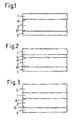
- This paper serves as a carrier 1 of the adhesive tape according to the invention for the adhesive coating 2, on which the kraft paper remains as a liner 3, as this Fig. 1 shows.
- the adhesive coating 2 has a more strongly crosslinked side A and a less strongly crosslinked side B, the more crosslinked side A facing the carrier 1.
- the finished composite is wound up and then, in a further production step, assembled with a slitter into sellable narrow rolls.
- the adhesive tape of the invention has a bond strength according to DIN 1939 of 17 N / cm on steel, an initial adhesion to FTM 9 on steel of 12 N / cm and excellent adhesion to substrates such as rough sawn timber or commercial roof underlays.
- the crosslinking results in a shear strength according to FTM 8 (100 mm 2 , 0.5 kg) of 30 - 60 min achieved. This is sufficient for the application described, but the roles have a limited shelf life due to a still existing cold flow of the adhesive coating 2.
- a double-sided siliconized glassine paper having a weight per unit area of 90 g / m 2 is mixed with 150 g / m 2 of a mixture of 90% AcResin 258 from BASF, 5% Laromer PO 43F from BASF as reactive diluent, 4.5% Exolit 5087 Clariant as a flame retardant and 0.5% Irgacure 184 Fa. Ciba coated as an additional photoinitiator.
- the mixture is cross-linked with a UV unit consisting of three iron doped and four undoped mercury beams.
- the flow rate v is 20 m / min, the UV dose 300 mJ / cm 2 .
- the coated web is then cooled and laminated with a commercially available PE film of thickness 80 microns.
- This film serves as a carrier 1 of the adhesive tape according to the invention for the adhesive coating 2, on which the glassine paper remains as a liner 3, as this Fig. 2 shows.
- additional reinforcement 4 a commercially available lattice scrim (eg the Fa. Chavanoz) laminated with.
- the finished composite is wound up and then, in a further production step, assembled with a slitter into sellable narrow rolls.
- the adhesive tape has a bond strength according to DIN 1939 of 16 N / cm on steel, a shear strength according to FTM 8 (100 mm 2 , 0.5 kg) of 40-100 min, an initial adhesion to FTM 9 on steel of 10 N / cm and Excellent adhesion to surfaces such as sawn wood or commercially available roof underlays.
- the tape also has excellent water resistance. Even after 60 minutes, no reemulsification of the adhesive shows up in the immersion test. With a width of 50 - 70 mm, in conjunction with a roof underpass of fire class B2, the tape meets the requirements of DIN 4102 for fire class B2.
- the coating is crosslinked with a UV unit consisting of three gallium doped and four undoped mercury beams.
- the passage speed v is 30 m / min, the UV dose 180 mJ / cm 2 .
- the coated web is then cooled and laminated with a commercially available hydroentangled, the carrier 1 for the adhesive coating 2 forming PET spunbonded nonwoven, which has a basis weight of 60 g / m 2 .
- the composite is wound up.
- the second side of the silicone paper contained in the composite is then again coated with 150 g / m 2 of the adhesive mixture.
- the crosslinking is again carried out with a consisting of three doped with gallium and four undoped mercury beam UV unit with a flow rate v of 30 m / min and a UV dose of 180 mJ / cm 2 .
- the coated web is then cooled and wound on itself. In this case, the transfer of the second adhesive coating 5 takes place on the carrier 1.
- Fig. 3 the structure of the adhesive tape according to the invention consisting of the carrier 1, the first adhesive coating 2, the liner 3 and the second adhesive coating 5 can be seen.
- the double-sided nonwoven adhesive tape produced in this way has a bond strength according to DIN 1939 of 15 N / cm on steel, an initial adhesion to FTM 9 on steel of 10 N / cm, a shear strength according to FTM 8 (100 mm 2 , 0.5 kg) of more 60 min and excellent adhesion to substrates such as sawn wood or standard roof underlays.
- the tape also has a high flexibility and thus adapts to excellent vapor permeable underlays made of nonwovens.
- the information described above relates to measurements made with a radiation meter from the company UV technology, Ortenberg with a UV-C-sensitive sensor.
- the carrier material may be a carrier 1 in which the specific basis weight is 50-180 g / m 2 , preferably 65-100 g / m 2 .
- the specific basis weight is 50-180 g / m 2 , preferably 65-100 g / m 2 .
- the adhesive coating can be applied on one of the two sides in a conventional manner, without departing from the scope of the invention.
- the web speed v of the carrier 1 with the adhesive coating 2 intended for crosslinking may vary. In particular, it may be in a range of 10-50 m / min, or, as already apparent from the examples, preferably in a range of 20-30 m / min.
Landscapes
- Chemical & Material Sciences (AREA)
- Chemical Kinetics & Catalysis (AREA)
- Organic Chemistry (AREA)
- Adhesive Tapes (AREA)
Claims (23)
- Ruban adhésif technique, en particulier destiné à être utilisé dans le bâtiment, ce ruban comprenant un support en forme de bande (1) et, déposé au moins sur une face, un revêtement adhésif sensible à la pression (2, 5) qui se compose d'un adhésif à base d'acrylate réticulé aux UV et qui présente un grammage spécifique au moins égal à 100 g/m2, caractérisé en ce que le revêtement adhésif (2, 5) présente un poids de dépôt de 160 à 250 g/m2 et en ce qu'il est déposé et réticulé de telle façon que le ruban adhésif présente une adhérence initiale suivant FTM 9 sur l'acier d'au moins 8 N/cm, un pouvoir adhésif suivant DIN EN 1939 sur l'acier d'au moins 10 N/cm et une tenue au cisaillement suivant FTM 8 (100 mm2, 0,5 kg) d'au moins 15 minutes.
- Ruban adhésif selon la revendication 1, caractérisé par une adhérence initiale suivant FTM 9 sur l'acier d'au moins 10 N/cm, un pouvoir adhésif suivant DIN EN 1939 sur l'acier d'au moins 15 N/cm et/ou une tenue au cisaillement suivant FTM 8 (100 mm2, 0,5 kg) d'au moins 30 minutes.
- Ruban adhésif selon la revendication 1 ou la revendication 2, caractérisé en ce que l'adhésif se compose d'un ou plusieurs acrylates réticulables aux UV additionnés de 0 à 1%, de préférence de 0 à 0,5% d'un photoamorceur, de 0 à 20%, de préférence de 0 à 10% d'un diluant réactif, de 0 à 20%, de préférence de 0 à 10% d'une matière de charge et/ou de 0 à 20%, de préférence de 0 à 10% d'un agent ignifugeant.
- Ruban adhésif selon l'une des revendications 1 à 3, caractérisé en ce que le support (1) est constitué d'une feuille de PE, de PP ou d'un mélange de PE et de PP.
- Ruban adhésif selon l'une des revendications 1 à 3, caractérisé en ce que le support (1) est constitué de papier ou d'un papier revêtu de cire ou de PE.
- Ruban adhésif selon l'une des revendications 1 à 3, caractérisé en ce que le support (1) est constitué d'un tissu ou d'un non-tissé de PP, de PET ou d'un mélange de PE ou de PET.
- Ruban adhésif selon l'une des revendications 1 à 6, caractérisé en ce que le grammage spécifique du support (1) se situe dans la plage de 50 à 180 g/m2, de préférence de 65 à 100 g/m2.
- Ruban adhésif selon l'une des revendications 1 à 7, caractérisé en ce que le support (1) est siliconé sur la face supérieure de la bande.
- Ruban adhésif selon l'une des revendications 1 à 8, caractérisé en ce qu'un renfort supplémentaire (4), en particulier inséré par placage, notamment sous la forme d'un tissu ou d'un non-tissé, est disposé entre le support (1) et le revêtement adhésif (2).
- Ruban adhésif selon l'une des revendications 1 à 9, caractérisé en ce que le revêtement adhésif (2) présente une face plus fortement réticulée (A) et une face moins fortement réticulée (B), la face plus fortement réticulée (A) étant dirigée vers le support (1).
- Ruban adhésif selon l'une des revendications 1 à 10, caractérisé en ce que le revêtement adhésif (2, 5) est déposé à un poids de dépôt allant de 160 à 220 g/m2.
- Ruban adhésif selon l'une des revendications 1 à 11, caractérisé en ce que le revêtement adhésif (2) est recouvert d'un côté ou des deux côtés par une pellicule détachable siliconée (3).
- Procédé de fabrication d'un ruban adhésif technique, en particulier d'un ruban adhésif selon l'une des revendications 1 à 12, dans lequel on dépose au moins sur une face d'un support en forme de bande (1) un revêtement adhésif sensible à la pression (2, 5) qui se compose d'un adhésif à base d'acrylate réticulé aux UV et qui présente un grammage spécifique d'au moins 100 g/m2, caractérisé en ce que le revêtement adhésif (2) est déposé à un poids de dépôt de 160 à 250 g/m2 et réticulé de telle façon que le ruban adhésif présente une adhérence initiale suivant FTM 9 sur l'acier d'au moins 8 N/cm, un pouvoir adhésif suivant DIN EN 1939 sur l'acier d'au moins 10 N/cm et une tenue au cisaillement suivant FTM 8 (100 mm2, 0,5 kg) d'au moins 15 minutes.
- Procédé selon la revendication 13, caractérisé en ce que la matière première adhésive utilisée pour le revêtement adhésif (2) est d'abord déposée sur une pellicule détachable siliconée (3) puis réticulée sur celle-ci et ensuite transférée par placage sur le support (1).
- Procédé selon la revendication 13, caractérisé en ce que le revêtement adhésif (2) est d'abord déposé sur la face siliconée d'un support (1) siliconé sur une seule face puis réticulée sur celle-ci et ensuite transférée sur l'autre face non siliconée du support (1) en enroulant ce dernier sur lui-même.
- Procédé selon l'une des revendications 13 à 15, caractérisé en ce que la matière première adhésive utilisée pour le revêtement adhésif (2) est réticulée en utilisant une dose d'UV allant de 120 à 350 mJ/cm2, de préférence de 150 à 300 mJ/cm2.
- Procédé selon l'une des revendications 13 à 16, caractérisé en ce que la valeur de la dose d'UV qui agit sur le produit est déterminée au moyen de la formule

où D est la dose d'UV en mJ/cm2, S est l'étendue insolée du revêtement à réticuler, 1 est l'intensité moyenne en W/cm2 du rayonnement dans la zone insolée par les lampes UV utilisées pour l'insolation, et v est la vitesse d'avance en m/min du support (1) portant le revêtement adhésif (2) à réticuler. - Procédé selon l'une des revendications 13 à 17, caractérisé par une vitesse d'avance (v) du support (1) portant le revêtement adhésif (2) à réticuler de 10 à 50 m/min, en particulier de 20 à 30 m/min, lors de la réticulation aux UV.
- Procédé selon l'une des revendications 13 à 18, caractérisé en ce que, pour la réticulation aux UV de la matière première adhésive utilisée pour le revêtement adhésif (2), on utilise, en plus ou à la place des lampes à vapeur de mercure à moyenne pression, des lampes dopées au gallium, au plomb ou au fer.
- Procédé selon l'une des revendications 13 à 19, caractérisé en ce que le revêtement adhésif (2) est porté et/ou maintenu avant ou pendant la réticulation aux UV à une température supérieure à la température ambiante, de préférence à une température supérieure à 100°C, en particulier au moyen de rouleaux chauffants.
- Procédé selon l'une des revendications 14 à 20, caractérisé en ce que, lors du transfert du revêtement adhésif (2) sur le support (1), un renfort supplémentaire (4), en particulier sous la forme d'un tissu ou d'un non-tissé, est introduit, en particulier par placage, entre le support (1) et le revêtement adhésif (2).
- Utilisation d'un ruban adhésif technique selon l'une des revendications 1 à 12 à des fins d'étanchéification ou d'isolation.
- Utilisation selon la revendication 22, caractérisée par l'usage du ruban adhésif pour fixer des écrans sous toitures, des pare-vapeur, des films perméables à la diffusion et/ou des non-tissés dans le bâtiment et les travaux publics.
Applications Claiming Priority (2)
| Application Number | Priority Date | Filing Date | Title |
|---|---|---|---|
| DE10359630A DE10359630A1 (de) | 2003-12-18 | 2003-12-18 | Technisches Klebeband und Verfahren zu seiner Herstellung |
| DE10359630 | 2003-12-18 |
Publications (2)
| Publication Number | Publication Date |
|---|---|
| EP1548080A1 EP1548080A1 (fr) | 2005-06-29 |
| EP1548080B1 true EP1548080B1 (fr) | 2008-03-26 |
Family
ID=34530336
Family Applications (1)
| Application Number | Title | Priority Date | Filing Date |
|---|---|---|---|
| EP04106239A Expired - Lifetime EP1548080B1 (fr) | 2003-12-18 | 2004-12-02 | Ruban adhésif technique et son procédé de fabrication |
Country Status (3)
| Country | Link |
|---|---|
| EP (1) | EP1548080B1 (fr) |
| AT (1) | ATE390467T1 (fr) |
| DE (3) | DE10359630A1 (fr) |
Cited By (13)
| Publication number | Priority date | Publication date | Assignee | Title |
|---|---|---|---|---|
| DE102008036933A1 (de) | 2008-08-08 | 2010-02-11 | Tesa Se | Verfahren zur Herstellung von stark klebrigen Haftklebebändern für das Bauwesen |
| DE202010014075U1 (de) | 2010-10-11 | 2012-01-12 | Coroplast Fritz Müller Gmbh & Co. Kg | Technisches Klebeband zur Verklebung von Folien oder Vliesen im Baubereich |
| DE202012000836U1 (de) | 2012-01-30 | 2012-03-05 | Bowcraft Gmbh | Klebeband und Schutzband |
| EP2439062A1 (fr) | 2010-10-11 | 2012-04-11 | Coroplast Fritz Müller GmbH & Co. KG | Bande adhésive technique et son utilisation pour le collage de films ou d'étoffes dans le domaine de la construction |
| DE202014104045U1 (de) | 2014-08-28 | 2014-09-08 | Certoplast Vorwerk & Sohn Gmbh | Technisches Klebeband für insbesondere Anwendungen im Baubereich |
| DE202016101644U1 (de) | 2016-03-24 | 2017-06-27 | Coroplast Fritz Müller Gmbh & Co. Kg | Überputzbares Klebeband |
| DE102017114266A1 (de) | 2017-06-27 | 2018-12-27 | Certoplast Technische Klebebänder Gmbh | Verfahren zur Herstellung eines Klebebandes |
| DE102017114256A1 (de) | 2017-06-27 | 2018-12-27 | Certoplast Technische Klebebänder Gmbh | Verfahren zur Herstellung eines Klebebandes |
| EP3036099B1 (fr) | 2013-09-18 | 2019-03-13 | Firestone Building Products Co., LLC | Membranes de toiture à pelage et collage dotées d'adhésifs sensibles à la pression réticulés |
| US11624189B2 (en) | 2016-03-25 | 2023-04-11 | Holcim Technology Ltd | Fully-adhered roof system adhered and seamed with a common adhesive |
| US12006692B2 (en) | 2016-03-25 | 2024-06-11 | Holcim Technology Ltd | Fully-adhered roof system adhered and seamed with a common adhesive |
| US12173509B2 (en) | 2016-03-25 | 2024-12-24 | Holcim Technology Ltd | Method of reroofing |
| US12385253B2 (en) | 2016-03-25 | 2025-08-12 | Holcim Technology Ltd | Fabric-backed roofing membrane composite |
Families Citing this family (9)
| Publication number | Priority date | Publication date | Assignee | Title |
|---|---|---|---|---|
| DE102007011511A1 (de) | 2007-03-09 | 2008-09-11 | Henkel Ag & Co. Kgaa | Ein-Komponenten-Montageklebstoff mit hoher Anfangshaftung |
| DE102008025979A1 (de) | 2008-05-30 | 2009-12-03 | Tesa Se | Klebeband insbesondere für Außenanwendungen mit einem textilen Träger |
| EP2303977A1 (fr) * | 2008-07-23 | 2011-04-06 | Tesa Se | Bande adhésive comportant un support composé d'un tissu |
| DE202012104291U1 (de) | 2012-11-08 | 2014-02-12 | Coroplast Fritz Müller Gmbh & Co. Kg | Klebeband zum Umwickeln von Walzen oder Rollen oder zum Abdecken von Griff- oder Standflächen |
| DE102014207364A1 (de) | 2014-04-16 | 2015-10-22 | Tesa Se | Klebemassen, UV-vernetzbare Haftklebemassen sowie Haftmittel mit UV-vernetzten Haftklebemassen |
| DE102015226578A1 (de) | 2015-12-22 | 2017-06-22 | Tesa Se | Verfahren zur Herstellung von farblosen und alterungsstabilen Haftklebemassen auf Polyacrylatbasis |
| FR3053976B1 (fr) * | 2016-07-13 | 2019-11-29 | Adhex Technologies | Element adhesif a double encollage |
| DE202018105611U1 (de) | 2018-09-28 | 2018-10-15 | Certoplast Technische Klebebänder Gmbh | Technisches Klebeband insbesondere Kabelwickelband |
| DE102024110268A1 (de) * | 2024-04-12 | 2025-10-16 | Silu Verwaltung Ag | Klebeband |
Family Cites Families (4)
| Publication number | Priority date | Publication date | Assignee | Title |
|---|---|---|---|---|
| DE3935097A1 (de) * | 1989-10-21 | 1991-04-25 | Lohmann Gmbh & Co Kg | Verfahren zur herstellung von dicken haftklebeschichten |
| DE4211448A1 (de) * | 1992-04-06 | 1993-10-07 | Lohmann Gmbh & Co Kg | Verfahren zur Herstellung von Haftklebematerialien in flächiger Verteilung durch radikalische Polymerisation von Acrylsäure und/oder Acrylsäurederivate enthaltenden Zubereitungen |
| JPH05331435A (ja) * | 1992-06-03 | 1993-12-14 | Sekisui Chem Co Ltd | 布粘着テープ |
| CH687328A5 (de) | 1996-03-07 | 1996-11-15 | Silu Verwaltung Ag | Einseitig Klebendes Montageband |
-
2003
- 2003-12-18 DE DE10359630A patent/DE10359630A1/de not_active Withdrawn
-
2004
- 2004-12-02 EP EP04106239A patent/EP1548080B1/fr not_active Expired - Lifetime
- 2004-12-02 DE DE202004021472U patent/DE202004021472U1/de not_active Expired - Lifetime
- 2004-12-02 AT AT04106239T patent/ATE390467T1/de active
- 2004-12-02 DE DE502004006653T patent/DE502004006653D1/de not_active Expired - Lifetime
Cited By (20)
| Publication number | Priority date | Publication date | Assignee | Title |
|---|---|---|---|---|
| DE102008036933A1 (de) | 2008-08-08 | 2010-02-11 | Tesa Se | Verfahren zur Herstellung von stark klebrigen Haftklebebändern für das Bauwesen |
| DE202010014075U1 (de) | 2010-10-11 | 2012-01-12 | Coroplast Fritz Müller Gmbh & Co. Kg | Technisches Klebeband zur Verklebung von Folien oder Vliesen im Baubereich |
| EP2439062A1 (fr) | 2010-10-11 | 2012-04-11 | Coroplast Fritz Müller GmbH & Co. KG | Bande adhésive technique et son utilisation pour le collage de films ou d'étoffes dans le domaine de la construction |
| EP2700688A2 (fr) | 2010-10-11 | 2014-02-26 | Coroplast Fritz Müller GmbH & Co. KG | Bande adhésive technique et son utilisation pour le collage de films ou d'étoffes dans le domaine de la construction |
| DE202012000836U1 (de) | 2012-01-30 | 2012-03-05 | Bowcraft Gmbh | Klebeband und Schutzband |
| EP3036099B1 (fr) | 2013-09-18 | 2019-03-13 | Firestone Building Products Co., LLC | Membranes de toiture à pelage et collage dotées d'adhésifs sensibles à la pression réticulés |
| EP3036099B2 (fr) † | 2013-09-18 | 2022-11-30 | Holcim Technology Ltd | Membranes de toiture à pelage et collage dotées d'adhésifs sensibles à la pression réticulés |
| DE202014104045U1 (de) | 2014-08-28 | 2014-09-08 | Certoplast Vorwerk & Sohn Gmbh | Technisches Klebeband für insbesondere Anwendungen im Baubereich |
| WO2016030074A1 (fr) | 2014-08-28 | 2016-03-03 | Certoplast Technische Klebebänder Gmbh | Ruban adhésif technique destiné à être utilisé en particulier dans le domaine de la construction |
| DE102017105028A1 (de) | 2016-03-24 | 2017-09-28 | Coroplast Fritz Müller Gmbh & Co. Kg | "Überputzbares Klebeband" |
| DE202016101644U1 (de) | 2016-03-24 | 2017-06-27 | Coroplast Fritz Müller Gmbh & Co. Kg | Überputzbares Klebeband |
| DE102017105028B4 (de) | 2016-03-24 | 2021-07-15 | Coroplast Fritz Müller Gmbh & Co. Kg | Überputzbares Klebeband und Verwendung |
| US11624189B2 (en) | 2016-03-25 | 2023-04-11 | Holcim Technology Ltd | Fully-adhered roof system adhered and seamed with a common adhesive |
| US12006692B2 (en) | 2016-03-25 | 2024-06-11 | Holcim Technology Ltd | Fully-adhered roof system adhered and seamed with a common adhesive |
| US12173509B2 (en) | 2016-03-25 | 2024-12-24 | Holcim Technology Ltd | Method of reroofing |
| US12385253B2 (en) | 2016-03-25 | 2025-08-12 | Holcim Technology Ltd | Fabric-backed roofing membrane composite |
| DE102017114266A1 (de) | 2017-06-27 | 2018-12-27 | Certoplast Technische Klebebänder Gmbh | Verfahren zur Herstellung eines Klebebandes |
| DE102017114256A1 (de) | 2017-06-27 | 2018-12-27 | Certoplast Technische Klebebänder Gmbh | Verfahren zur Herstellung eines Klebebandes |
| WO2019002312A1 (fr) | 2017-06-27 | 2019-01-03 | Certoplast Technische Klebebänder Gmbh | Procédé de production d'un ruban adhésif |
| WO2019002314A1 (fr) | 2017-06-27 | 2019-01-03 | Certoplast Technische Klebebänder Gmbh | Procédé de production d'un ruban adhésif |
Also Published As
| Publication number | Publication date |
|---|---|
| EP1548080A1 (fr) | 2005-06-29 |
| ATE390467T1 (de) | 2008-04-15 |
| DE202004021472U1 (de) | 2008-07-10 |
| DE502004006653D1 (de) | 2008-05-08 |
| DE10359630A1 (de) | 2005-07-21 |
Similar Documents
| Publication | Publication Date | Title |
|---|---|---|
| DE202004021472U1 (de) | Technisches Klebeband | |
| EP1000127B1 (fr) | Bande adhesive pour enrober des produits allonges, comme des faisceaux de cables, des profiles en plastique ou similaire | |
| EP2123727A2 (fr) | Matière adhésive plate, comme une bande adhésive, une feuille adhésive ou un bord adhésif, notamment pour l'utilisation dans le domaine de la construction | |
| DE69008481T2 (de) | Ultraviolette Fotopolymerisation von druckempfindlichen Klebstoffzusammensetzungen. | |
| DE69424491T2 (de) | Hochtemperaturbeständiges Abdeckband | |
| EP1709133A1 (fr) | Matieres auto-adhesives d'acrylate orientees, leur procede de production et leur utilisation | |
| WO2004050782A1 (fr) | Bande auto-adhesive antistatique | |
| DE102007063021A1 (de) | Corona-behandelte Klebemassen | |
| DE10163545A1 (de) | Verfahren zur Vernetzung und Polymerisation von bahnförmigem Material mittels Elektronenstrahlen und/oder UV-Strahlen | |
| DE102008038595A1 (de) | Verfahren zur Herstellung von bandförmigen Laminaten | |
| EP2439062B1 (fr) | Bande adhésive technique et son utilisation pour le collage de films ou d'étoffes dans le domaine de la construction | |
| EP1453926A1 (fr) | Procede de production d'articles decoupes adhesifs | |
| DE102008038472A1 (de) | Klebeband zum Isolieren und Wickeln von Drähten oder Kabeln mit einem Trägermaterial, das ein- oder beidseitig mit einer Klebmasse beschichtet ist, sowie die Verwendung desselben | |
| EP1453927A1 (fr) | Procede pour la production de produits decoupes adhesifs par contact | |
| EP1576064A1 (fr) | Article autoadhesif presentant au moins une couche d'une masse autoadhesive electroconductrice et procede de fabrication dudit article | |
| DE10157154A1 (de) | Verfahren zur Herstellung orientierter Acrylathotmelts | |
| EP1347026B1 (fr) | Bande adhesive sensible a la pression et méthode de préparation | |
| DE102017105028A1 (de) | "Überputzbares Klebeband" | |
| EP1645587B1 (fr) | Procédé pour la réticulation d'une composition adhésive dans un substrat ayant deux couches de silicone anti-adhésives au moyen de rayons d'électrons | |
| WO2006108509A1 (fr) | Élément adhésif plat pour la construction | |
| DE202010014075U1 (de) | Technisches Klebeband zur Verklebung von Folien oder Vliesen im Baubereich | |
| DE10311433B4 (de) | Verfahren zur Herstellung von haftklebender Materialien und Dichtungsmaterialien mit dreidimensionaler Struktur | |
| DE102008054031A1 (de) | Herstellung eines Klebebandes | |
| DE102019003849A1 (de) | Einseitig haftklebend ausgerüstetes Band insbesondere für Bauanwendungen | |
| EP3216838B1 (fr) | Système composite avec un matériau de revêtement à faible adhésion |
Legal Events
| Date | Code | Title | Description |
|---|---|---|---|
| PUAI | Public reference made under article 153(3) epc to a published international application that has entered the european phase |
Free format text: ORIGINAL CODE: 0009012 |
|
| AK | Designated contracting states |
Kind code of ref document: A1 Designated state(s): AT BE BG CH CY CZ DE DK EE ES FI FR GB GR HU IE IS IT LI LT LU MC NL PL PT RO SE SI SK TR |
|
| AX | Request for extension of the european patent |
Extension state: AL BA HR LV MK YU |
|
| 17P | Request for examination filed |
Effective date: 20050930 |
|
| AKX | Designation fees paid |
Designated state(s): AT CH DE IT LI |
|
| RIN1 | Information on inventor provided before grant (corrected) |
Inventor name: LODDE, CHRISTOPH Inventor name: FRIGGE, CHRISTOPH |
|
| 17Q | First examination report despatched |
Effective date: 20051222 |
|
| GRAP | Despatch of communication of intention to grant a patent |
Free format text: ORIGINAL CODE: EPIDOSNIGR1 |
|
| GRAS | Grant fee paid |
Free format text: ORIGINAL CODE: EPIDOSNIGR3 |
|
| GRAA | (expected) grant |
Free format text: ORIGINAL CODE: 0009210 |
|
| AK | Designated contracting states |
Kind code of ref document: B1 Designated state(s): AT CH DE IT LI |
|
| REG | Reference to a national code |
Ref country code: CH Ref legal event code: EP Ref country code: CH Ref legal event code: NV Representative=s name: BRAUNPAT BRAUN EDER AG |
|
| REF | Corresponds to: |
Ref document number: 502004006653 Country of ref document: DE Date of ref document: 20080508 Kind code of ref document: P |
|
| PLBI | Opposition filed |
Free format text: ORIGINAL CODE: 0009260 |
|
| PLAX | Notice of opposition and request to file observation + time limit sent |
Free format text: ORIGINAL CODE: EPIDOSNOBS2 |
|
| 26 | Opposition filed |
Opponent name: CERTOPLAST VORWERK & SOHN GMBH Effective date: 20081220 |
|
| PLBB | Reply of patent proprietor to notice(s) of opposition received |
Free format text: ORIGINAL CODE: EPIDOSNOBS3 |
|
| PLCK | Communication despatched that opposition was rejected |
Free format text: ORIGINAL CODE: EPIDOSNREJ1 |
|
| APBM | Appeal reference recorded |
Free format text: ORIGINAL CODE: EPIDOSNREFNO |
|
| APBP | Date of receipt of notice of appeal recorded |
Free format text: ORIGINAL CODE: EPIDOSNNOA2O |
|
| APAH | Appeal reference modified |
Free format text: ORIGINAL CODE: EPIDOSCREFNO |
|
| APBQ | Date of receipt of statement of grounds of appeal recorded |
Free format text: ORIGINAL CODE: EPIDOSNNOA3O |
|
| REG | Reference to a national code |
Ref country code: DE Ref legal event code: R100 Ref document number: 502004006653 Country of ref document: DE |
|
| APBU | Appeal procedure closed |
Free format text: ORIGINAL CODE: EPIDOSNNOA9O |
|
| PLBN | Opposition rejected |
Free format text: ORIGINAL CODE: 0009273 |
|
| STAA | Information on the status of an ep patent application or granted ep patent |
Free format text: STATUS: OPPOSITION REJECTED |
|
| 27O | Opposition rejected |
Effective date: 20150116 |
|
| REG | Reference to a national code |
Ref country code: DE Ref legal event code: R100 Ref document number: 502004006653 Country of ref document: DE Effective date: 20150116 |
|
| REG | Reference to a national code |
Ref country code: DE Ref legal event code: R079 Ref document number: 502004006653 Country of ref document: DE Free format text: PREVIOUS MAIN CLASS: C09J0007020000 Ipc: C09J0007200000 |
|
| REG | Reference to a national code |
Ref country code: CH Ref legal event code: PCAR Free format text: NEW ADDRESS: HOLEESTRASSE 87, 4054 BASEL (CH) |
|
| P01 | Opt-out of the competence of the unified patent court (upc) registered |
Effective date: 20230524 |
|
| PGFP | Annual fee paid to national office [announced via postgrant information from national office to epo] |
Ref country code: IT Payment date: 20231117 Year of fee payment: 20 Ref country code: AT Payment date: 20231120 Year of fee payment: 20 |
|
| PGFP | Annual fee paid to national office [announced via postgrant information from national office to epo] |
Ref country code: DE Payment date: 20240226 Year of fee payment: 20 Ref country code: CH Payment date: 20240102 Year of fee payment: 20 |
|
| REG | Reference to a national code |
Ref country code: DE Ref legal event code: R071 Ref document number: 502004006653 Country of ref document: DE |
|
| REG | Reference to a national code |
Ref country code: CH Ref legal event code: PL |
|
| REG | Reference to a national code |
Ref country code: AT Ref legal event code: MK07 Ref document number: 390467 Country of ref document: AT Kind code of ref document: T Effective date: 20241202 |