EP1548213A2 - Betätigungsvorrichtung für Türen oder Klappen an Fahrzeugen - Google Patents
Betätigungsvorrichtung für Türen oder Klappen an Fahrzeugen Download PDFInfo
- Publication number
- EP1548213A2 EP1548213A2 EP04029010A EP04029010A EP1548213A2 EP 1548213 A2 EP1548213 A2 EP 1548213A2 EP 04029010 A EP04029010 A EP 04029010A EP 04029010 A EP04029010 A EP 04029010A EP 1548213 A2 EP1548213 A2 EP 1548213A2
- Authority
- EP
- European Patent Office
- Prior art keywords
- tower
- cam
- actuating device
- counter
- slider
- Prior art date
- Legal status (The legal status is an assumption and is not a legal conclusion. Google has not performed a legal analysis and makes no representation as to the accuracy of the status listed.)
- Granted
Links
Images


Classifications
-
- E—FIXED CONSTRUCTIONS
- E05—LOCKS; KEYS; WINDOW OR DOOR FITTINGS; SAFES
- E05B—LOCKS; ACCESSORIES THEREFOR; HANDCUFFS
- E05B79/00—Mounting or connecting vehicle locks or parts thereof
- E05B79/02—Mounting of vehicle locks or parts thereof
- E05B79/06—Mounting of handles, e.g. to the wing or to the lock
-
- E—FIXED CONSTRUCTIONS
- E05—LOCKS; KEYS; WINDOW OR DOOR FITTINGS; SAFES
- E05B—LOCKS; ACCESSORIES THEREFOR; HANDCUFFS
- E05B85/00—Details of vehicle locks not provided for in groups E05B77/00 - E05B83/00
- E05B85/10—Handles
- E05B85/14—Handles pivoted about an axis parallel to the wing
- E05B85/16—Handles pivoted about an axis parallel to the wing a longitudinal grip part being pivoted at one end about an axis perpendicular to the longitudinal axis of the grip part
-
- Y—GENERAL TAGGING OF NEW TECHNOLOGICAL DEVELOPMENTS; GENERAL TAGGING OF CROSS-SECTIONAL TECHNOLOGIES SPANNING OVER SEVERAL SECTIONS OF THE IPC; TECHNICAL SUBJECTS COVERED BY FORMER USPC CROSS-REFERENCE ART COLLECTIONS [XRACs] AND DIGESTS
- Y10—TECHNICAL SUBJECTS COVERED BY FORMER USPC
- Y10S—TECHNICAL SUBJECTS COVERED BY FORMER USPC CROSS-REFERENCE ART COLLECTIONS [XRACs] AND DIGESTS
- Y10S292/00—Closure fasteners
- Y10S292/31—Lever operator, flush
-
- Y—GENERAL TAGGING OF NEW TECHNOLOGICAL DEVELOPMENTS; GENERAL TAGGING OF CROSS-SECTIONAL TECHNOLOGIES SPANNING OVER SEVERAL SECTIONS OF THE IPC; TECHNICAL SUBJECTS COVERED BY FORMER USPC CROSS-REFERENCE ART COLLECTIONS [XRACs] AND DIGESTS
- Y10—TECHNICAL SUBJECTS COVERED BY FORMER USPC
- Y10T—TECHNICAL SUBJECTS COVERED BY FORMER US CLASSIFICATION
- Y10T292/00—Closure fasteners
- Y10T292/57—Operators with knobs or handles
-
- Y—GENERAL TAGGING OF NEW TECHNOLOGICAL DEVELOPMENTS; GENERAL TAGGING OF CROSS-SECTIONAL TECHNOLOGIES SPANNING OVER SEVERAL SECTIONS OF THE IPC; TECHNICAL SUBJECTS COVERED BY FORMER USPC CROSS-REFERENCE ART COLLECTIONS [XRACs] AND DIGESTS
- Y10—TECHNICAL SUBJECTS COVERED BY FORMER USPC
- Y10T—TECHNICAL SUBJECTS COVERED BY FORMER US CLASSIFICATION
- Y10T70/00—Locks
- Y10T70/10—Miscellaneous
-
- Y—GENERAL TAGGING OF NEW TECHNOLOGICAL DEVELOPMENTS; GENERAL TAGGING OF CROSS-SECTIONAL TECHNOLOGIES SPANNING OVER SEVERAL SECTIONS OF THE IPC; TECHNICAL SUBJECTS COVERED BY FORMER USPC CROSS-REFERENCE ART COLLECTIONS [XRACs] AND DIGESTS
- Y10—TECHNICAL SUBJECTS COVERED BY FORMER USPC
- Y10T—TECHNICAL SUBJECTS COVERED BY FORMER US CLASSIFICATION
- Y10T70/00—Locks
- Y10T70/50—Special application
- Y10T70/5611—For control and machine elements
- Y10T70/5757—Handle, handwheel or knob
- Y10T70/5761—Retractable or flush handle
-
- Y—GENERAL TAGGING OF NEW TECHNOLOGICAL DEVELOPMENTS; GENERAL TAGGING OF CROSS-SECTIONAL TECHNOLOGIES SPANNING OVER SEVERAL SECTIONS OF THE IPC; TECHNICAL SUBJECTS COVERED BY FORMER USPC CROSS-REFERENCE ART COLLECTIONS [XRACs] AND DIGESTS
- Y10—TECHNICAL SUBJECTS COVERED BY FORMER USPC
- Y10T—TECHNICAL SUBJECTS COVERED BY FORMER US CLASSIFICATION
- Y10T70/00—Locks
- Y10T70/70—Operating mechanism
- Y10T70/7441—Key
- Y10T70/7486—Single key
- Y10T70/7508—Tumbler type
- Y10T70/7559—Cylinder type
- Y10T70/7655—Cylinder attaching or mounting means
-
- Y—GENERAL TAGGING OF NEW TECHNOLOGICAL DEVELOPMENTS; GENERAL TAGGING OF CROSS-SECTIONAL TECHNOLOGIES SPANNING OVER SEVERAL SECTIONS OF THE IPC; TECHNICAL SUBJECTS COVERED BY FORMER USPC CROSS-REFERENCE ART COLLECTIONS [XRACs] AND DIGESTS
- Y10—TECHNICAL SUBJECTS COVERED BY FORMER USPC
- Y10T—TECHNICAL SUBJECTS COVERED BY FORMER US CLASSIFICATION
- Y10T70/00—Locks
- Y10T70/80—Parts, attachments, accessories and adjuncts
- Y10T70/8432—For key-operated mechanism
- Y10T70/8459—Housings
- Y10T70/8541—Mounting arrangements
Definitions
- the invention is directed to an actuating device in the preamble of Claim 1 specified type.
- a so-called “Tower” which can either have a lock cylinder, or only as Styling dummy is formed.
- Such a tower is usually only after the Fixing the carrier inside the door from the outside of the door into an opening Inserted by the carrier and by a slidably guided on the carrier slide locked.
- the slider has a shoulder and the wearer Counter shoulder, which lie in one position of the slider in a row and thus determine a "locking position". Will the slider in a "Unlocking position” shifted, so the shoulder free the counter shoulder and the Tower can be plugged into the carrier or pulled out of this again.
- the invention is based on the object, an actuating device of the To develop preamble of claim 1 mentioned type, which is characterized by a greater tear resistance of the assembled tower in the carrier is characterized. this will According to the invention achieved by the measures specified in claim 1, which the following special significance.
- a radial outer surface facing away in the direction of withdrawal of the tower Cam on slide on a radial inner surface of a provided on the tower To lie against counter cam.
- This counter cam points in the direction of insertion of the tower and is located at a radial distance to an adjacent peripheral surface of the Tower.
- the cam moves into the radial distance of the tower and gets in front of his counter cam. If unauthorized inside the vehicle try to force the tower through in the direction of withdrawal pointing forces axially out of the carrier. With such extraction forces press the counter-shoulders onto the shoulders of the slider.
- the formation of a cam on the slide on the one hand and a counter-cam on Tower on the other hand requires little material and space.
- the high pull-out strength results without the use of expensive materials of high strength and without high material thicknesses in the slide and carrier, which would take up space.
- the slide is plate-shaped.
- To the To increase pull-out strength one can in the area of the shoulder one Provide plate thickening, which in the locking position in front of the counter-shoulder of the tower. Such a plate thickening can simply come out of a block exist, which sits on the back of the plate-shaped support.
- the displacement of the slider can be done automatically by inserting the tower in the opening and / or pulling out of the opening of the carrier can be achieved. For this it is sufficient on the tower in the insertion direction inclined running control surfaces and provide the slide shelves, which have a counter-inclination. So can when inserting the tower, the local control surface on the footprint of Sliders push and this, e.g. from the locking position into the unlocking position Push back. It is recommended that such control surfaces on the radial projection of Tower, while the shelves on the cam and / or block of Slider be arranged. This automatic reset of the slide is present especially when a spring load acts on the slider, which this e.g. to be transferred to the locking position.
- the actuator according to the invention first includes a carrier 10, the is fastened inside the door.
- a so-called “tower” 20 mounted e.g. includes a lock cylinder 40.
- a handle and the lock cylinder 40 act in usually associated with a door provided in the castle.
- the tower 20 is subsequently, from the Outside of the door, in the there already mounted carrier in the sense of the local arrow 28 inserted into an opening 13.
- the insertion movement 28 takes place substantially perpendicular to the carrier 10.
- the handle is usually subsequently on the carrier 10, prior to plugging 28 of the tower 20.
- Figs. 1 and 2 The full insertion position of the tower 20 in the carrier 10 is shown in Figs. 1 and 2.
- Fig. 2 is also an outer panel 50 of the door to recognize.
- the Outer lining 50 is a suitable opening 53 for mounting the Tower 20 and the handle.
- Einstecklage comes a widened head 29 of the tower to lie on the outside 51 of the panel 50, while on the inside 52nd the carrier 10 comes to rest.
- the outer panel 50 is omitted Service.
- On the outside of the door also comes a cap 41 from the lock cylinder 40th to lie, in which a lock cylinder associated, not shown in detail Key finds his access 42 to the lock cylinder inside the tower 40.
- Such a lock cylinder could also be missing, which is usually at the rear Doors of a vehicle is common. Then comes a similar to the tower shown Dummy for use, which is why the following description so far for this design applies.
- the front 18 is located from the carrier 10 a slider 30 on.
- the carrier 10 is at least in the region of the slider plate-shaped and has on both sides arranged guide edges 17, between which the slider in the direction of the arrows 35 and 35 'is longitudinally displaceable.
- the slider 30 has a cutout 36 which at least occasionally with the Opening 13 of the carrier 10 is aligned and the insertion 28 of the tower in the Assembly Carrier slider 10, 30 allows. Remain on both sides of the cutout 36 Edge strips 37, whose outer longitudinal edges in the slide movement 35, 35 'at slide along the leading edge 37. In plug-in case, the precursor in Fig. 6 to is recognizable, the opposite inner longitudinal edge 38 of these edge strips 37th the associated side wall 27 facing from the tower 20.
- the slider 30 serves to lock the insertion position shown in FIGS. 1 and 2 of the tower 20 in the carrier 10. It can between a locking position of Fig. 1, which is marked there by the auxiliary line 30.1, in one of Fig. 6 apparent Unlocking be transferred, is marked with the auxiliary line 30.2.
- the locking position 30.1 as is apparent from Fig. 2, in the direction of withdrawal 28 'seen on both side walls 37 of the tower 20 four shoulders 31 from Slider 30 to lie in front of four counter-shoulders 21, which are provided on the tower 20.
- a Plate thickening 39 provided. This plate thickening 39 is in Embodiment of one on the back 49 of the slider 30 axially projecting blocks 55 and 56 formed.
- the slider 30 has at each of its two inner Longitudinal edges 38 two cams 45, 46 for the described shoulders 31. At the place of two cams 45, 46 and two blocks 55, 56 are provided, as shown in FIG. 4th evident.
- the cam closer to the handle 25 or block 55 is called “initial cam” or “Initial block” and the other referred to as “end cams” or “end block”.
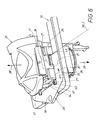
- the counter cam 22 is formed from a continuous bar. These Counter cam 22 is not only at a radial distance 23 of the associated Side wall 27 of the tower 20 away, but also, as shown in FIG. 2, in such a way high axial distance 43 from the counter shoulder 21 generating sales areas the two radial projections 25, 26 that the slider 30 with its profiles fits in between. According to Fig. 5, the counter cam bar extends over the full length of initial projection 25, but only over part of the opposite shoulder 21 from the end projection 26. Finally, it is noteworthy that that shown in FIG. 5 recognizable distance 54 between the two radial projections 25, 26 larger, at most equal to the length 47 of the end cam 46 is formed. This is in particular from Fig. 6 can be seen, will be discussed.
- the slider 30 is normally always in his from Fig. 1 apparent Locking position 30.1. This is ensured by a between the slider 30 and the carrier 10 acting spring load 32, their arrangement and operation is particularly good can be seen from Fig. 3. This is achieved by two compression springs 33, the on are arranged opposite sides of the tower 20, as shown in FIG. 2 can be seen.
- the slider 30 is in this case with an axially projecting flap 14 provided, which projects through a slot 15 in the carrier.
- the carrier 10 in turn has a projecting on its back 19 tab 16. Between the flap 14 and the Tab 16 each one of the two compression springs 33 is supported.
- the tower 20 has a direction of insertion 28 inclined control surface 59.
- control surfaces 59 located on the broad side 63 of the tower 20 are located and part of the two-sided end projections 26 are.
- This Control surfaces 59 are associated with two shelves 44 on the slider 30, a Contradicting. These shelves 44 are, as Fig. 4 illustrates, Part of both sides of the slider cutout 36 arranged two End cams 46 and Endklötze 56.
- Fig. 4 illustrates, Part of both sides of the slider cutout 36 arranged two End cams 46 and Endklötze 56.
- At the insertion movement 28 of the tower bump the two control surfaces 59 on the shelves 44 and push the slider 30 in The meaning of the arrow 35 of FIG. 5 back. This shift back 35 takes place against the Effect of spring load 32.
- the tower 20 has at its broad side 63, the between the two tower side walls 27 extends, a transverse rib 64 which with a contact surface 65 pointing in the withdrawal direction 28 'is provided.
- the two Edge strips 37 from the slider 30 are connected by an end web 66 with each other connected.
- the transverse rib 64 can axially below the support surface 65 a Have slope surface 67, which, seen in the insertion direction 28 of the tower 20, inclined.
- a locking screw 60 To secure the locking position 30.1 is a locking screw 60, the As shown in FIG. 4 from a screw shaft 51 and a to the attack of a Turning tool serving screw head 62 is.
- the screw head 62 is of the back 19 of the carrier 10 from accessible, where also a receptacle for the Screw shaft 61 is located. If the locking position 30.1 is reached, that is Shank end of the screw 60 with a hole 68 in the end web 66 of the slider 30th aligned.
- the shaft end Upon actuation of the locking screw 60, the shaft end moves into the Hole 68 and can be up to a provided in the head 29 of the tower 20 Threaded hole 69 pass, in which then screwed the screw 60 can be.
Landscapes
- Lock And Its Accessories (AREA)
- Power-Operated Mechanisms For Wings (AREA)
- Seats For Vehicles (AREA)
Abstract
Description
- Fig. 1
- in perspektivischer Darstellung ein Teilstück der fertig montierten Betätigungsvorrichtung nach der Erfindung, wobei sowohl das den Griff aufweisende benachbarte Teilstück, als auch die Außenverkleidung der Tür weggelassen worden sind,
- Fig. 2
- einen schematischen Querschnitt durch die fertig montierte Betätigungsvorrichtung von Fig. 1 längs der dortigen Schnittlinie II - II, wo aber die Türaußenverkleidung ergänzend eingezeichnet worden ist,
- Fig. 3
- ein Detail von Fig. 2 in Richtung der durch die Schnittlinie III-III verdeutlichte Schnittebene der Vorrichtung,
- Fig. 4
- die perspektivische Ansicht eines Bestandteils der erfindungsgemäßen Vorrichtung, nämlich eines Schiebers,
- Fig. 5
- in einer der Fig. 1 übereinstimmenden Perspektive zwei Bestandteile der Vorrichtung in einer ersten Phase ihres Zusammenbaus und
- Fig. 6
- eine weitere Phase dieses Zusammenbaus deren Ergebnis dann der in Fig. 1 gezeigte Endzustand der Vorrichtung ist.
- 10
- Träger
- 11
- Endbereich von 10
- 12
- Nachbarbereich von 10
- 13
- Öffnung in 10 für 20
- 14
- axialer Lappen an 30 (Fig. 3)
- 15
- Schlitz in 10 für 14 (Fig. 3)
- 16
- axiale Lasche an 10 (Fig. 3)
- 17
- Führungskante für 30
- 18
- Vorderseite von 10
- 19
- Rückseite von 10
- 20
- Turm
- 21
- Gegenschulter, Axialabsatz von 25, 26
- 22
- Gegennocken, Gegennockenleiste
- 23
- radialer Abstand zwischen 22 und 27 (Fig. 2)
- 24
- Radialinnenfläche von 22
- 25
- Radialvorsprung, Anfangsvorsprung
- 26
- Radialvorsprung, Endvorsprung
- 27
- Seitenwand von 20
- 28
- Pfeil der Einsteckbewegung von 20 in 10 (Fig. 5, 6)
- 28'
- Pfeil der Herausziehbewegung von 20 aus 10 (Fig. 5, 6)
- 29
- Kopf von 20
- 30
- Schieber
- 30.1
- Verriegelungslage von 30 (Fig. 1)
- 30.2
- Entriegelungslage von 30 (Fig. 6)
- 31
- Schulter an 30
- 32
- Federbelastung von 30 in 30.1 (Fig. 3)
- 33
- Druckfeder für 32 (Fig. 3)
- 34
- Radialaußenfläche von 45, 46 (Fig. 2)
- 35
- Verschiebung von 30, Rückverschiebung (Fig. 5, 6)
- 35'
- Verschiebung von 30, Vorwärtsverschiebung (Fig. 5, 6)
- 36
- Ausschnitt in 30
- 37
- Randstreifen in 30
- 38
- innerer Längsrand von 37
- 39
- Plattenverdickung von 30
- 40
- Schließzylinder in 20
- 41
- Kappe von 40
- 42
- Schlüsselzugang zu 40
- 43
- axialer Abstand zwischen 21 und 22 (Fig. 2)
- 44
- Stellfläche an 30 (Fig. 5)
- 45
- Nocken an 48, Anfangsnocken
- 46
- Nocken an 48, Endnocken
- 47
- Länge von 26 (Fig. 5)
- 48
- Vorderseite von 30
- 49
- Rückseite von 30
- 50
- Außenverkleidung der Tür (Fig. 2)
- 51
- Außenseite von 50 (Fig. 2)
- 52
- Innenseite von 50 (Fig. 2)
- 53
- Durchbruch in 50 (Fig. 2)
- 54
- Entfernung zwischen 25, 26, Zwischenraum (Fig. 5, 6)
- 55
- Klotz an 49, Anfangsklotz
- 56
- Klotz an 49, Endklotz
- 57
- Aufbiegekraft von 58 (Fig. 2)
- 58
- Ausziehkraft auf 20 (Fig. 2)
- 59
- Steuerfläche an 26 (Fig. 5)
- 60
- Sicherungsschraube (Fig. 4)
- 61
- Schraubenschaft von 60 (Fig. 4)
- 62
- Schraubenkopf von 60 (Fig. 4)
- 63
- Breitseite von 20 (Fig. 5, 6)
- 64
- Querrippe bei 63 (Fig. 6)
- 65
- Anlagefläche von 64 (Fig. 6)
- 66
- Endsteg zwischen 37 bei 30 (Fig. 6)
- 67
- Neigungsfläche bei 64
- 68
- Loch in 30 für 61
- 69
- Gewindebohrung in 29 für 61 (Fig. 1)
Claims (30)
- Betätigungsvorrichtung für Türen oder Klappen an Fahrzeugen
mit einem Träger (10), der im Türinneren befestigbar ist,
mit einem entweder einen Schließzylinder (40) oder eine Styling-Attrappe aufweisenden Turm (20), der in eine Öffnung (13) vom Träger (10) einsteckbar (28) ist,
mit einem im Träger (10) längsverschieblich (35, 35') geführten Schieber (30), der einen den eingesteckten Turm (20) wenigstens bereichsweise umgreifenden Ausschnitt (36) aufweist,
mit mindestens einer Schulter (31) am Schieber (30) und mit einer Gegenschulter (21) am Turm (20),
wobei der Schieber (30) gegenüber dem Turm (20) zwischen einer Verriegelungslage (30.1) und einer Entriegelungslage (30.2) verschiebbar (35, 35') ist
und in der Verriegelungslage (30.1) die Schulter (31) vom Schieber (30) die Gegenschulter (21) übergreift und den Turm (20) in seiner Einstecklage in der Trägeröffnung (13) verriegelt,
während in der Entriegelungslage (30.2) die Schulter (31) die Gegenschulter (21) freigibt und den Turm (20) im Träger (10) einsteckbar (28) bzw. herausziehbar (28') macht,
dadurch gekennzeichnet , dass der Schieber (30) auf seiner in Ausziehrichtung (28') weisenden Vorderseite (48) wenigstens einen Nocken (45, 46) besitzt, der eine vom eingesteckten Turm (20) weggerichtete Radialaußenfläche (34) aufweist,
dass der Turm (20) einen in Einsteckrichtung (28) weisenden Gegennocken (22) besitzt,
der in radialem Abstand (23) zu einer benachbarten Umfangszone des Turms (20) angeordnet ist und eine dem Turm (20) zugekehrte Radialinnenfläche (24) aufweist,
und dass beim Verschieben (35') in die Verriegelungslage (30.1) der Nocken (45, 46) vom Schieber (30) in den radialen Abstand (23) des Turms (20) einfährt und hinter den Gegennocken (22) des eingesteckten Turms (20) gelangt, wo seine Radialaußenfläche (34) sich an der Radialinnenfläche (24) des Gegennockens (22) abstützt. - Betätigungsvorrichtung nach Anspruch 1, dadurch gekennzeichnet, dass der Turm (20) unterhalb der den Gegennocken (22) aufweisenden Umfangszone mindestens einen Radialvorsprung (25, 26) besitzt,
dass der Radialvorsprung (25, 26) zu dieser Umfangszone hin einen Axialabsatz (21) aufweist
und dass dieser Axialabsatz (21) die Gegenschulter für den Schieber (30) erzeugt. - Betätigungsvorrichtung nach Anspruch 1, dadurch gekennzeichnet, dass der plattenförmige Schieber (30) im Bereich seiner Schulter (31) eine Plattenverdickung (39) aufweist,
welche in der Verriegelungslage (30.1) vor die Gegenschulter (21) bzw. den Axialabsatz vom eingesteckten Turm (20) fährt. - Betätigungsvorrichtung nach Anspruch 3, dadurch gekennzeichnet, dass die Plattenverdickung (39) aus einem Klotz (55, 56) besteht, der auf der Rückseite (49) des plattenförmigen Schiebers (30) sitzt.
- Betätigungsvorrichtung nach einem oder mehreren der Ansprüche 1 bis 4, dadurch gekennzeichnet, dass der vorderseitige Nocken (45, 46) und der rückseitige Klotz (55, 56) im wesentlichen an der gleichen Stelle des Schiebers (30) sitzen.
- Betätigungsvorrichtung nach einem oder mehreren der Ansprüche 1 bis 5, dadurch gekennzeichnet, dass der Nocken (45, 46) und/oder der Klotz (55, 56) beidlängsseits vom Ausschnitt (36) an den inneren Längsrändern (38) vom Schieber (30) angeordnet sind.
- Betätigungsvorrichtung nach Anspruch 6, dadurch gekennzeichnet, dass am inneren Längsrand (38) vom Schieber (30) zwei Nocken (45, 46) und/oder Klötze (55, 56) angeordnet sind, die - in Verschiebungsrichtung (35') des Schiebers (30) gesehen - voneinander entfernt sind.
- Betätigungsvorrichtung nach Anspruch 7, dadurch gekennzeichnet, dass der eine Nocken und/oder Klotz im Bereich von dem Griff zugekehrten Anfang des Ausschnitts (36) angeordnet ist und dort einen Anfangsnocken (45) bzw. Anfangsklotz (55) erzeugt,
während der andere Nocken und/oder Klotz am im Bereich von dem Griff entfernten Ende des Ausschnitts (36) positioniert ist und daher ein Endnocken (46) bzw. Endklotz (56) bilden. - Betätigungsvorrichtung nach Anspruch 7 oder 8, dadurch gekennzeichnet, dass dem Anfangsnocken (45) und dem Endnocken (46) vom Schieber (30) ein gemeinsamer Gegennocken (22) am Turm (20) zugeordnet ist.
- Betätigungsvorrichtung nach Anspruch 9, dadurch gekennzeichnet, dass der gemeinsame Gegennocken (22) aus einer durchgehenden Leiste (Gegennockenleiste) besteht.
- Betätigungsvorrichtung nach einem oder mehreren der Ansprüche 2 bis 10, dadurch gekennzeichnet, dass die Radialvorsprünge (25, 26) an zueinander gegenüberliegenden Seitenwänden (27) vom Turm (20) angeordnet sind,
wobei die Seitenwände (27) bei eingestecktem Turm (20) und in Verriegelungslage (30.1) den inneren Längsrändern (38) vom Schieber (30) zugekehrt sind. - Betätigungsvorrichtung nach einem oder mehreren der Ansprüche 7 bis 11, dadurch gekennzeichnet, dass an der Seitenwand (27) vom Turm (20) zwei Radialvorsprünge (25, 26) angeordnet sind
und dass die beiden Radialvorsprünge (25, 26) in Verschiebungsrichtung (35, 35') des Schiebers (30) voneinander entfernt (54) sind und im Einsteckfall des Turms (20) einen dem Griff zugekehrten Anfangsvorsprung (25) und einen vom Griff entfernten Endvorsprung (26) bilden. - Betätigungsvorrichtung nach Anspruch 12, dadurch gekennzeichnet, dass in Verriegelungslage (30.1) der Anfangsvorsprung (25) vom Turm (20) mit dem Anfangsnocken (45) bzw. Anfangsklotz (55) vom Schieber (30) ausgerichtet ist
und dass der Endvorsprung (26) vom Turm (20) mit dem Endnocken (46) bzw. Endklotz (56) vom Schieber (30) fluchtet. - Betätigungsvorrichtung nach Anspruch 12 oder 13, dadurch gekennzeichnet, dass dem Anfangsvorsprung (25) und dem Endvorsprung (26) ein gemeinsamer, leistenförmiger Gegennocken (Gegennockenleiste 22) zugeordnet ist
und dass die Gegennockenleiste (22) in axialem Abstand (43) von den beiden, die Gegenschulter (21) erzeugenden axialen Absätzen der beiden Radialvorsprünge (25, 26) angeordnet ist. - Betätigungsvorrichtung nach einem oder mehreren der Ansprüche 12 bis 14, dadurch gekennzeichnet, dass die Entfernung (54) zwischen den beiden Radialvorsprüngen (25, 26) größer/gleich der Länge (47) des Endnockens (46) bzw. Endklotzes (56) vom Schieber (30) ausgebildet ist.
- Betätigungsvorrichtung nach einem oder mehreren der Ansprüche 12 bis 15, dadurch gekennzeichnet, dass die durchgehende Gegennockenleiste (22) zwar im wesentlichen die ganze Gegenschulter (21) vom Anfangsvorsprung (25), aber nur einen Teil der Gegenschulter (21) vom Endvorsprung (26) überdeckt.
- Betätigungsvorrichtung nach einem oder mehreren der Ansprüche 1 bis 16, dadurch gekennzeichnet, dass der Turm (20) wenigstens eine zur Einsteckrichtung (28) geneigt verlaufende Steuerfläche (59) aufweist,
dass der Schieber (30) eine Stellfläche (44) besitzt, die eine Gegenneigung zur Steuerfläche (59) aufweist,
und dass beim Einstecken (28) die Steuerfläche (59) vom Turm (20) auf die Stellfläche (44) stößt und den Schieber (30) selbsttätig aus dessen Verriegelungslage (30.1) in die Entriegelungslage (30.2) zurückschiebt. - Betätigungsvorrichtung nach Anspruch 17, dadurch gekennzeichnet, dass die Steuerfläche (44) sich am Radialvorsprung (26) des Turms (20) befindet
und dass die Stellfläche (44) am Nocken (46) und/oder am Klotz (56) sitzt. - Betätigungsvorrichtung nach Anspruch 18, dadurch gekennzeichnet, dass die Steuerfläche (59) auf einer Breitseite (63) vom Radialvorsprung (26) sitzt und - in Einsteckrichtung (28) des Turms (20) gesehen -ihrem Axialabsatz (21) axial vorauseilt.
- Betätigungsvorrichtung nach einem oder mehreren der Ansprüche 1 bis 19, dadurch gekennzeichnet, dass an der Breitseite (63) des Turms (20), die sich zwischen den beiden Seitenwänden (27) des Turms (20) befindet, eine Querrippe (64) sitzt, die eine in Ausziehrichtung (28') des Turms (20) weisende Anlagefläche (65) besitzt,
dass der Ausschnitt (36) vom Schieber (30) durch einen Endsteg (66) begrenzt ist
und dass in der Verriegelungslage (30.1) der Endsteg (66) vom Schieber (30) über die Anlagefläche (65) der Querrippe (64) vom Turm (20) fährt. - Betätigungsvorrichtung nach Anspruch 20, dadurch gekennzeichnet, dass die Querrippe (64) axial unterhalb der Auflagefläche (65) eine Neigungsfläche (67) aufweist
und dass die Neigungsfläche (67) in Einsteckrichtung (28') des Turms (20) geneigt verläuft. - Betätigungsvorrichtung nach einem oder mehreren der Ansprüche 1 bis 21, dadurch gekennzeichnet, dass eine Federbelastung (32) zwischen dem Schieber (30) und dem Träger (10) angeordnet ist
und dass die Federbelastung (32) bestrebt ist, den Schieber (30) in seiner Verriegelungslage (30.1) zu drücken. - Betätigungsvorrichtung nach Anspruch 22, dadurch gekennzeichnet, dass die Federbelastung (32) von zwei Druckfedern (33) erzeugt ist
und dass die beiden Druckfedern (33) bei eingestecktem Turm (20) sich auf einander gegenüberliegenden Seitenwänden (27) des Turms (20) befinden. - Betätigungsvorrichtung nach Anspruch 23, dadurch gekennzeichnet, dass der Schieber (30) einen axial abragenden Lappen (14) aufweist,
dass der Lappen (14) einen Schlitz (15) im Träger (10) durchgreift und auf der Träger-Rückseite (19) herausragt,
dass der Träger (10) auf seiner Rückseite (19) eine Lasche (16) besitzt, die mit dem Lappen (14) ausgerichtet ist,
und dass die Druckfeder (33) sich zwischen der Lasche (16) und dem Lappen (14) abstützt. - Betätigungsvorrichtung nach einem der Ansprüche 1 bis 24, dadurch gekennzeichnet, dass der Träger (10) wenigstens im Bereich seiner Öffnung (13), die zum Einstecken (28) des Turms (20) dient, plattenförmig ausgebildet ist
und dass der plattenförmige Schieber (30) auf der in Ausziehrichtung (28') des Turms (20) weisenden Vorderseite (18) des Trägers (10) aufliegt. - Betätigungsvorrichtung nach Anspruch 25, dadurch gekennzeichnet, dass der Träger (10) auf seiner Vorderseite (18) Führungskanten (17) aufweist, zwischen denen der Schieber (30) sitzt,
und dass der Schieber (30) beim Verschieben (35, 35') zwischen den Führungskanten (17) gleitet. - Betätigungsvorrichtung nach einem oder mehreren der Ansprüche 1 bis 26, dadurch gekennzeichnet, dass eine Sicherungsschraube (60) vorgesehen ist,
welche die Verriegelungslage (30.1) des Schiebers (30) gegenüber dem Träger (10) und/oder dem Turm (20) sichert. - Betätigungsvorrichtung nach Anspruch 27, dadurch gekennzeichnet, dass der Träger (10) eine Gewindeaufnahme für die Sicherungsschraube (60) aufweist,
dass das eine Ende der Sicherungsschraube (Schraubenkopf 62) zu ihrer Drehbetätigung dient, während das andere Schraubenende (Schraubenschaft 61) fungiert,
dass der Schraubenschaft (61) der Sicherungsschraube (60) in der Verriegelungslage (30.1) mit einem Loch (68) im Schieber (30) ausgerichtet ist
und dass beim Verschrauben die Sicherungsschraube (60) in der Verriegelungslage (30.1) in das Loch (68) einfährt und den Schieber (30) sichert. - Betätigungsvorrichtung nach Anspruch 27, dadurch gekennzeichnet, dass der das Loch (68) im Schieber (30) durchsetzende Schraubenschaft (61) in einer Gewindebohrung (69) vom Turm (20) einschraubbar ist.
- Betätigungsvorrichtung nach Anspruch 27, 28 oder 29, dadurch gekennzeichnet, dass der Schraubenkopf (62) der Sicherungsschraube (60) sich auf der Rückseite (19) des Trägers (10) befindet.
Applications Claiming Priority (2)
| Application Number | Priority Date | Filing Date | Title |
|---|---|---|---|
| DE10360175 | 2003-12-20 | ||
| DE2003160175 DE10360175B4 (de) | 2003-12-20 | 2003-12-20 | Betätigungsvorrichtung für Türen oder Klappen an Fahrzeugen |
Publications (4)
| Publication Number | Publication Date |
|---|---|
| EP1548213A2 true EP1548213A2 (de) | 2005-06-29 |
| EP1548213A3 EP1548213A3 (de) | 2008-02-06 |
| EP1548213B1 EP1548213B1 (de) | 2009-08-12 |
| EP1548213B8 EP1548213B8 (de) | 2009-11-11 |
Family
ID=34530341
Family Applications (1)
| Application Number | Title | Priority Date | Filing Date |
|---|---|---|---|
| EP20040029010 Expired - Lifetime EP1548213B8 (de) | 2003-12-20 | 2004-12-08 | Betätigungsvorrichtung für Türen oder Klappen an Fahrzeugen |
Country Status (4)
| Country | Link |
|---|---|
| US (1) | US7260964B2 (de) |
| EP (1) | EP1548213B8 (de) |
| AT (1) | ATE439493T1 (de) |
| DE (2) | DE10360175B4 (de) |
Families Citing this family (10)
| Publication number | Priority date | Publication date | Assignee | Title |
|---|---|---|---|---|
| US7359721B2 (en) * | 2004-09-29 | 2008-04-15 | Motorola, Inc. | Communication device for displaying a shared message |
| IT1395117B1 (it) * | 2009-07-29 | 2012-09-05 | Valeo Spa | Procedimento di assemblaggio di una maniglia in una porta di un autoveicolo e relativa maniglia di porta |
| CN103917728B (zh) * | 2011-06-20 | 2016-03-30 | Adac塑模公司 | 门把手组件、子组件及其安装方法 |
| DE102012112520B4 (de) * | 2012-12-18 | 2025-07-10 | Dr. Ing. H.C. F. Porsche Aktiengesellschaft | Türaußengriffsystem bei einem Kraftfahrzeug |
| JP6133624B2 (ja) * | 2013-02-28 | 2017-05-24 | サカエ理研工業株式会社 | ドア施開錠操作装置及び車両ドア用キーシリンダ組み付けパーツ |
| US10196842B2 (en) | 2014-06-20 | 2019-02-05 | Huf North America Automotive Parts Manufacturing Corp. | Retention mechanism for insertion member in vehicular door handle assembly |
| US10145151B2 (en) * | 2015-04-30 | 2018-12-04 | Huf North America Automotive Parts Manufacturing Corp. | Retention mechanism for vehicular door handle assembly |
| US20180051492A1 (en) * | 2016-08-17 | 2018-02-22 | GM Global Technology Operations LLC | Handle chassis with multi-height mounting boss for vehicle door assembly |
| US11007972B2 (en) | 2017-09-22 | 2021-05-18 | GM Global Technology Operations LLC | Multi-pull latch and lock systems for compartment closure assemblies of motor vehicles |
| US10704304B2 (en) | 2017-10-26 | 2020-07-07 | GM Global Technology Operations LLC | Memory levers for latch mechanisms of vehicle compartment closure assemblies |
Family Cites Families (10)
| Publication number | Priority date | Publication date | Assignee | Title |
|---|---|---|---|---|
| US2040258A (en) * | 1934-08-27 | 1936-05-12 | Briggs & Stratton Corp | Mounting means for automobile doorlocks |
| DE19826778A1 (de) * | 1998-06-11 | 1999-12-23 | Brose Fahrzeugteile | Vorrichtung zum Verbinden eines Außengriffs mit einem Schließsystem |
| FR2789426B1 (fr) * | 1999-02-05 | 2001-06-15 | Valeo Securite Habitacle | Poignee d'ouvrant de vehicule automobile |
| FR2789428B1 (fr) * | 1999-02-05 | 2001-04-13 | Valeo Securite Habitacle | Poignee d'ouvrant de vehicule automobile comportant des moyens perfectionnes de blocage d'un element externe |
| JP4345128B2 (ja) * | 1999-03-30 | 2009-10-14 | アイシン精機株式会社 | 車両用ドアロック操作システム及び該車両ドアロック操作システムを備えた車両ドア |
| US6494066B2 (en) * | 2001-03-09 | 2002-12-17 | U-Shin Ltd. | Cylinder lock mounting device |
| US6523379B2 (en) * | 2001-04-20 | 2003-02-25 | Ryadon, Inc. | Locking cylinder and housing |
| DE10146026C1 (de) * | 2001-09-18 | 2002-10-31 | Huf Huelsbeck & Fuerst Gmbh | Griffbeschlag |
| DE10151862A1 (de) * | 2001-10-24 | 2003-05-15 | Huf Huelsbeck & Fuerst Gmbh | Vorrichtung zur Betätigung eines Verschlusses von Türen oder Klappen, insbesondere an Fahrzeugen |
| ITTO20011208A1 (it) * | 2001-12-21 | 2003-06-21 | Valeo Sicurezza Abitacolo Spa | Maniglia di un autoveicolo, in particolare per una porta laterale disposta dalla parte del lato passeggero. |
-
2003
- 2003-12-20 DE DE2003160175 patent/DE10360175B4/de not_active Withdrawn - After Issue
-
2004
- 2004-12-08 DE DE200450009883 patent/DE502004009883D1/de not_active Expired - Lifetime
- 2004-12-08 AT AT04029010T patent/ATE439493T1/de not_active IP Right Cessation
- 2004-12-08 EP EP20040029010 patent/EP1548213B8/de not_active Expired - Lifetime
- 2004-12-17 US US11/016,541 patent/US7260964B2/en not_active Expired - Fee Related
Also Published As
| Publication number | Publication date |
|---|---|
| EP1548213B8 (de) | 2009-11-11 |
| ATE439493T1 (de) | 2009-08-15 |
| DE10360175A1 (de) | 2005-07-28 |
| EP1548213B1 (de) | 2009-08-12 |
| US7260964B2 (en) | 2007-08-28 |
| US20060277954A1 (en) | 2006-12-14 |
| DE10360175B4 (de) | 2006-08-31 |
| EP1548213A3 (de) | 2008-02-06 |
| DE502004009883D1 (de) | 2009-09-24 |
Similar Documents
| Publication | Publication Date | Title |
|---|---|---|
| EP1867817B1 (de) | Treibstangenverschluss | |
| DE102004001894B4 (de) | Betätigungsvorrichtung für Türen oder Klappen an Fahrzeugen | |
| DE202007018811U1 (de) | Fußbodenbelag | |
| DE4228132A1 (de) | Schließvorrichtung für Fenster, Türen o. dgl. | |
| EP1316466A1 (de) | Arretiervorrichtung mit mehreren Sperrstiften | |
| DE102012112520A1 (de) | Türaußengriffsystem bei einem Kraftfahrzeug | |
| DE10107887A1 (de) | Setzgerät | |
| DE10360175B4 (de) | Betätigungsvorrichtung für Türen oder Klappen an Fahrzeugen | |
| EP1606483A1 (de) | Schliesszylinder | |
| DE19808619A1 (de) | Verriegelungseinrichtung für eine Vorrichtung zum Verändern der Steuerzeiten von Gaswechselventilen einer Brennkraftmaschine, insbesondere für eine Flügelzellen-Verstelleinrichtung | |
| DE3506008A1 (de) | Werkzeughalter | |
| DE102007038254B4 (de) | Kupplungsglied für eine Mitnehmerkupplung und Herstellungsverfahren | |
| DE69907311T2 (de) | Axial entkuppelndes Schloss für ein Schlossmechanismus eines Personenkraftwagens | |
| EP1167670B1 (de) | Befestigungsplatte zur Befestigung eines Scharnierarmes eines Möbelscharniers | |
| EP2156060B1 (de) | Befestiger zum lösbaren verbinden eines profils an ein gegenprofil | |
| DE102006025749A1 (de) | Dämpfer | |
| EP2165033B1 (de) | Verschlussbolzen | |
| DE202009001896U1 (de) | Schloss mit geräuschgedämpfter Falle | |
| DE19604350B4 (de) | Verschlußvorrichtung mit einem Schließzylinder für insbesondere an Fahrzeugen vollziehbare Schließfunktionen | |
| DE102013103790A1 (de) | Kodierung über Sperrbalken | |
| DE102016125383A1 (de) | Profilverriegelung für ZIP-Führung | |
| DE10351395A1 (de) | Verbindungselement unter Verwendung eines solchen Verbindungselements realisierte Montageeinheit | |
| EP1518978B1 (de) | Aufnahmetopf für eine Leiste | |
| WO2022100983A1 (de) | Schlüssellochverdeck | |
| DE29803656U1 (de) | Tür- oder Fensterbeschlag |
Legal Events
| Date | Code | Title | Description |
|---|---|---|---|
| PUAI | Public reference made under article 153(3) epc to a published international application that has entered the european phase |
Free format text: ORIGINAL CODE: 0009012 |
|
| AK | Designated contracting states |
Kind code of ref document: A2 Designated state(s): AT BE BG CH CY CZ DE DK EE ES FI FR GB GR HU IE IS IT LI LT LU MC NL PL PT RO SE SI SK TR |
|
| AX | Request for extension of the european patent |
Extension state: AL BA HR LV MK YU |
|
| PUAL | Search report despatched |
Free format text: ORIGINAL CODE: 0009013 |
|
| AK | Designated contracting states |
Kind code of ref document: A3 Designated state(s): AT BE BG CH CY CZ DE DK EE ES FI FR GB GR HU IE IS IT LI LT LU MC NL PL PT RO SE SI SK TR |
|
| AX | Request for extension of the european patent |
Extension state: AL BA HR LV MK YU |
|
| 17P | Request for examination filed |
Effective date: 20080328 |
|
| AKX | Designation fees paid |
Designated state(s): AT BE BG CH CY CZ DE DK EE ES FI FR GB GR HU IE IS IT LI LT LU MC NL PL PT RO SE SI SK TR |
|
| GRAP | Despatch of communication of intention to grant a patent |
Free format text: ORIGINAL CODE: EPIDOSNIGR1 |
|
| GRAS | Grant fee paid |
Free format text: ORIGINAL CODE: EPIDOSNIGR3 |
|
| GRAA | (expected) grant |
Free format text: ORIGINAL CODE: 0009210 |
|
| AK | Designated contracting states |
Kind code of ref document: B1 Designated state(s): AT BE BG CH CY CZ DE DK EE ES FI FR GB GR HU IE IS IT LI LT LU MC NL PL PT RO SE SI SK TR |
|
| REG | Reference to a national code |
Ref country code: GB Ref legal event code: FG4D Free format text: NOT ENGLISH |
|
| REG | Reference to a national code |
Ref country code: CH Ref legal event code: EP |
|
| REG | Reference to a national code |
Ref country code: IE Ref legal event code: FG4D |
|
| REF | Corresponds to: |
Ref document number: 502004009883 Country of ref document: DE Date of ref document: 20090924 Kind code of ref document: P |
|
| LTIE | Lt: invalidation of european patent or patent extension |
Effective date: 20090812 |
|
| PG25 | Lapsed in a contracting state [announced via postgrant information from national office to epo] |
Ref country code: IS Free format text: LAPSE BECAUSE OF FAILURE TO SUBMIT A TRANSLATION OF THE DESCRIPTION OR TO PAY THE FEE WITHIN THE PRESCRIBED TIME-LIMIT Effective date: 20091212 Ref country code: LT Free format text: LAPSE BECAUSE OF FAILURE TO SUBMIT A TRANSLATION OF THE DESCRIPTION OR TO PAY THE FEE WITHIN THE PRESCRIBED TIME-LIMIT Effective date: 20090812 Ref country code: ES Free format text: LAPSE BECAUSE OF FAILURE TO SUBMIT A TRANSLATION OF THE DESCRIPTION OR TO PAY THE FEE WITHIN THE PRESCRIBED TIME-LIMIT Effective date: 20091123 Ref country code: SE Free format text: LAPSE BECAUSE OF FAILURE TO SUBMIT A TRANSLATION OF THE DESCRIPTION OR TO PAY THE FEE WITHIN THE PRESCRIBED TIME-LIMIT Effective date: 20090812 Ref country code: FI Free format text: LAPSE BECAUSE OF FAILURE TO SUBMIT A TRANSLATION OF THE DESCRIPTION OR TO PAY THE FEE WITHIN THE PRESCRIBED TIME-LIMIT Effective date: 20090812 |
|
| NLV1 | Nl: lapsed or annulled due to failure to fulfill the requirements of art. 29p and 29m of the patents act | ||
| PG25 | Lapsed in a contracting state [announced via postgrant information from national office to epo] |
Ref country code: PL Free format text: LAPSE BECAUSE OF FAILURE TO SUBMIT A TRANSLATION OF THE DESCRIPTION OR TO PAY THE FEE WITHIN THE PRESCRIBED TIME-LIMIT Effective date: 20090812 Ref country code: NL Free format text: LAPSE BECAUSE OF FAILURE TO SUBMIT A TRANSLATION OF THE DESCRIPTION OR TO PAY THE FEE WITHIN THE PRESCRIBED TIME-LIMIT Effective date: 20090812 Ref country code: SI Free format text: LAPSE BECAUSE OF FAILURE TO SUBMIT A TRANSLATION OF THE DESCRIPTION OR TO PAY THE FEE WITHIN THE PRESCRIBED TIME-LIMIT Effective date: 20090812 |
|
| REG | Reference to a national code |
Ref country code: IE Ref legal event code: FD4D |
|
| PG25 | Lapsed in a contracting state [announced via postgrant information from national office to epo] |
Ref country code: PT Free format text: LAPSE BECAUSE OF FAILURE TO SUBMIT A TRANSLATION OF THE DESCRIPTION OR TO PAY THE FEE WITHIN THE PRESCRIBED TIME-LIMIT Effective date: 20091212 Ref country code: BG Free format text: LAPSE BECAUSE OF FAILURE TO SUBMIT A TRANSLATION OF THE DESCRIPTION OR TO PAY THE FEE WITHIN THE PRESCRIBED TIME-LIMIT Effective date: 20091112 |
|
| PG25 | Lapsed in a contracting state [announced via postgrant information from national office to epo] |
Ref country code: RO Free format text: LAPSE BECAUSE OF FAILURE TO SUBMIT A TRANSLATION OF THE DESCRIPTION OR TO PAY THE FEE WITHIN THE PRESCRIBED TIME-LIMIT Effective date: 20090812 Ref country code: CZ Free format text: LAPSE BECAUSE OF FAILURE TO SUBMIT A TRANSLATION OF THE DESCRIPTION OR TO PAY THE FEE WITHIN THE PRESCRIBED TIME-LIMIT Effective date: 20090812 Ref country code: IE Free format text: LAPSE BECAUSE OF FAILURE TO SUBMIT A TRANSLATION OF THE DESCRIPTION OR TO PAY THE FEE WITHIN THE PRESCRIBED TIME-LIMIT Effective date: 20090812 Ref country code: EE Free format text: LAPSE BECAUSE OF FAILURE TO SUBMIT A TRANSLATION OF THE DESCRIPTION OR TO PAY THE FEE WITHIN THE PRESCRIBED TIME-LIMIT Effective date: 20090812 Ref country code: DK Free format text: LAPSE BECAUSE OF FAILURE TO SUBMIT A TRANSLATION OF THE DESCRIPTION OR TO PAY THE FEE WITHIN THE PRESCRIBED TIME-LIMIT Effective date: 20090812 |
|
| PG25 | Lapsed in a contracting state [announced via postgrant information from national office to epo] |
Ref country code: SK Free format text: LAPSE BECAUSE OF FAILURE TO SUBMIT A TRANSLATION OF THE DESCRIPTION OR TO PAY THE FEE WITHIN THE PRESCRIBED TIME-LIMIT Effective date: 20090812 |
|
| PLBE | No opposition filed within time limit |
Free format text: ORIGINAL CODE: 0009261 |
|
| STAA | Information on the status of an ep patent application or granted ep patent |
Free format text: STATUS: NO OPPOSITION FILED WITHIN TIME LIMIT |
|
| BERE | Be: lapsed |
Owner name: HUF HULSBECK & FURST G.M.B.H. & CO. KG Effective date: 20091231 |
|
| 26N | No opposition filed |
Effective date: 20100517 |
|
| PG25 | Lapsed in a contracting state [announced via postgrant information from national office to epo] |
Ref country code: MC Free format text: LAPSE BECAUSE OF NON-PAYMENT OF DUE FEES Effective date: 20100701 |
|
| REG | Reference to a national code |
Ref country code: CH Ref legal event code: PL |
|
| GBPC | Gb: european patent ceased through non-payment of renewal fee |
Effective date: 20091208 |
|
| REG | Reference to a national code |
Ref country code: FR Ref legal event code: ST Effective date: 20100831 |
|
| PG25 | Lapsed in a contracting state [announced via postgrant information from national office to epo] |
Ref country code: BE Free format text: LAPSE BECAUSE OF NON-PAYMENT OF DUE FEES Effective date: 20091231 Ref country code: CH Free format text: LAPSE BECAUSE OF NON-PAYMENT OF DUE FEES Effective date: 20091231 Ref country code: FR Free format text: LAPSE BECAUSE OF NON-PAYMENT OF DUE FEES Effective date: 20091231 Ref country code: GR Free format text: LAPSE BECAUSE OF FAILURE TO SUBMIT A TRANSLATION OF THE DESCRIPTION OR TO PAY THE FEE WITHIN THE PRESCRIBED TIME-LIMIT Effective date: 20091113 Ref country code: LI Free format text: LAPSE BECAUSE OF NON-PAYMENT OF DUE FEES Effective date: 20091231 |
|
| PG25 | Lapsed in a contracting state [announced via postgrant information from national office to epo] |
Ref country code: GB Free format text: LAPSE BECAUSE OF NON-PAYMENT OF DUE FEES Effective date: 20091208 |
|
| PG25 | Lapsed in a contracting state [announced via postgrant information from national office to epo] |
Ref country code: IT Free format text: LAPSE BECAUSE OF FAILURE TO SUBMIT A TRANSLATION OF THE DESCRIPTION OR TO PAY THE FEE WITHIN THE PRESCRIBED TIME-LIMIT Effective date: 20090812 |
|
| PG25 | Lapsed in a contracting state [announced via postgrant information from national office to epo] |
Ref country code: LU Free format text: LAPSE BECAUSE OF NON-PAYMENT OF DUE FEES Effective date: 20091208 |
|
| PG25 | Lapsed in a contracting state [announced via postgrant information from national office to epo] |
Ref country code: AT Free format text: LAPSE BECAUSE OF NON-PAYMENT OF DUE FEES Effective date: 20091208 |
|
| PG25 | Lapsed in a contracting state [announced via postgrant information from national office to epo] |
Ref country code: HU Free format text: LAPSE BECAUSE OF FAILURE TO SUBMIT A TRANSLATION OF THE DESCRIPTION OR TO PAY THE FEE WITHIN THE PRESCRIBED TIME-LIMIT Effective date: 20100213 |
|
| PG25 | Lapsed in a contracting state [announced via postgrant information from national office to epo] |
Ref country code: TR Free format text: LAPSE BECAUSE OF FAILURE TO SUBMIT A TRANSLATION OF THE DESCRIPTION OR TO PAY THE FEE WITHIN THE PRESCRIBED TIME-LIMIT Effective date: 20090812 |
|
| PG25 | Lapsed in a contracting state [announced via postgrant information from national office to epo] |
Ref country code: CY Free format text: LAPSE BECAUSE OF FAILURE TO SUBMIT A TRANSLATION OF THE DESCRIPTION OR TO PAY THE FEE WITHIN THE PRESCRIBED TIME-LIMIT Effective date: 20090812 |
|
| PGFP | Annual fee paid to national office [announced via postgrant information from national office to epo] |
Ref country code: DE Payment date: 20201125 Year of fee payment: 17 |
|
| REG | Reference to a national code |
Ref country code: DE Ref legal event code: R119 Ref document number: 502004009883 Country of ref document: DE |
|
| PG25 | Lapsed in a contracting state [announced via postgrant information from national office to epo] |
Ref country code: DE Free format text: LAPSE BECAUSE OF NON-PAYMENT OF DUE FEES Effective date: 20220701 |