EP1550638B1 - Procede pour reduire le volume de boue et appareil prevu a cet effet - Google Patents
Procede pour reduire le volume de boue et appareil prevu a cet effet Download PDFInfo
- Publication number
- EP1550638B1 EP1550638B1 EP20030797527 EP03797527A EP1550638B1 EP 1550638 B1 EP1550638 B1 EP 1550638B1 EP 20030797527 EP20030797527 EP 20030797527 EP 03797527 A EP03797527 A EP 03797527A EP 1550638 B1 EP1550638 B1 EP 1550638B1
- Authority
- EP
- European Patent Office
- Prior art keywords
- sludge
- extracted
- converted
- tank
- biological
- Prior art date
- Legal status (The legal status is an assumption and is not a legal conclusion. Google has not performed a legal analysis and makes no representation as to the accuracy of the status listed.)
- Expired - Lifetime
Links
Images




Classifications
-
- C—CHEMISTRY; METALLURGY
- C02—TREATMENT OF WATER, WASTE WATER, SEWAGE, OR SLUDGE
- C02F—TREATMENT OF WATER, WASTE WATER, SEWAGE, OR SLUDGE
- C02F3/00—Biological treatment of water, waste water, or sewage
- C02F3/02—Aerobic processes
- C02F3/12—Activated sludge processes
- C02F3/1205—Particular type of activated sludge processes
- C02F3/1221—Particular type of activated sludge processes comprising treatment of the recirculated sludge
-
- C—CHEMISTRY; METALLURGY
- C02—TREATMENT OF WATER, WASTE WATER, SEWAGE, OR SLUDGE
- C02F—TREATMENT OF WATER, WASTE WATER, SEWAGE, OR SLUDGE
- C02F1/00—Treatment of water, waste water, or sewage
- C02F1/66—Treatment of water, waste water, or sewage by neutralisation; pH adjustment
-
- C—CHEMISTRY; METALLURGY
- C02—TREATMENT OF WATER, WASTE WATER, SEWAGE, OR SLUDGE
- C02F—TREATMENT OF WATER, WASTE WATER, SEWAGE, OR SLUDGE
- C02F11/00—Treatment of sludge; Devices therefor
- C02F11/18—Treatment of sludge; Devices therefor by thermal conditioning
-
- Y—GENERAL TAGGING OF NEW TECHNOLOGICAL DEVELOPMENTS; GENERAL TAGGING OF CROSS-SECTIONAL TECHNOLOGIES SPANNING OVER SEVERAL SECTIONS OF THE IPC; TECHNICAL SUBJECTS COVERED BY FORMER USPC CROSS-REFERENCE ART COLLECTIONS [XRACs] AND DIGESTS
- Y02—TECHNOLOGIES OR APPLICATIONS FOR MITIGATION OR ADAPTATION AGAINST CLIMATE CHANGE
- Y02W—CLIMATE CHANGE MITIGATION TECHNOLOGIES RELATED TO WASTEWATER TREATMENT OR WASTE MANAGEMENT
- Y02W10/00—Technologies for wastewater treatment
- Y02W10/10—Biological treatment of water, waste water, or sewage
-
- Y—GENERAL TAGGING OF NEW TECHNOLOGICAL DEVELOPMENTS; GENERAL TAGGING OF CROSS-SECTIONAL TECHNOLOGIES SPANNING OVER SEVERAL SECTIONS OF THE IPC; TECHNICAL SUBJECTS COVERED BY FORMER USPC CROSS-REFERENCE ART COLLECTIONS [XRACs] AND DIGESTS
- Y02—TECHNOLOGIES OR APPLICATIONS FOR MITIGATION OR ADAPTATION AGAINST CLIMATE CHANGE
- Y02W—CLIMATE CHANGE MITIGATION TECHNOLOGIES RELATED TO WASTEWATER TREATMENT OR WASTE MANAGEMENT
- Y02W10/00—Technologies for wastewater treatment
- Y02W10/30—Wastewater or sewage treatment systems using renewable energies
- Y02W10/37—Wastewater or sewage treatment systems using renewable energies using solar energy
Definitions
- This invention relates to a method and an apparatus for completely removing or appreciably reducing the volume of sludge, generated by treatment of sewage water, by chemical or physical techniques.
- Patent Publication 1 a method for reducing the volume of sludge by first dissolving sludge by alkali addition and heating and subsequently subjecting the resulting mass to an aerobic biological treatment method.
- Patent Publication 2 a method for reducing the volume of sludge by heating and pressurizing sludge, solubilizing the resulting mass on pulverization and subjecting the resulting mass to aerobic biological treatment.
- Patent Publication 3 a method for reducing the volume of sludge by solubilizing the sludge under subcritical conditions and subsequently subjecting the resulting mass to aerobic biological treatment.
- Patent Publication 1 JP Patent Kokoku JP-B-49-11813
- Patent Publication 2 JP Patent Kokai JP-A-2000-354896
- Patent Publication 3 JP Patent Kokai JP-A-2000-218285
- US-A-5 433 868 discloses a method for treating municipal sewage or similar waste water treatment plant streams, which method has three steps and which greatly reduces the amount of ammonia in sewage plant effluent.
- the first step is dewatering without first digesting, thereby producing a first ammonia-containing stream having a low concentration of ammonia, and a second solids-containing stream.
- the second step is sending the second solids-containing stream through a means for separating the solids from the liquid and producing an aqueous stream containing a high concentration of ammonia.
- the second step can be an alkaline digestion at temperatures from about 265 °C to about 350 °C under pressure leading to the formation of insoluble oil and char.
- the third step is removal of ammonia from the aqueous stream using a hydrothermal process.
- J. A. Müller discloses in Water Science and Technology, Vol. 44, No. 10, 2001, p. 121 to 128 , XP002539897, sludge pre-treatment processes in order to disintegrate sludge solids, while the dissolved components subsequently can be subjected to biological degradation.
- the disintegration method amongst others can be heat treatment in the temperature range from 40°C to 180°C, chemical treatment using alkali, or a combination of chemical, and thermal treatment.
- JP 2001 225091 A discloses a method for treating sewage and sludge, wherein sludge is solubilized by a combination of a temperature of 50 to 300 °C and a pressure of 0,1 to 10 MPa and subsequently is biologically treated in a biological treatment tank.
- JP 2001 079584 A discloses chemical treatment of sludge with sodium hydroxide and subsequent biological treatment.
- WO 97/39987 A discloses the usage of a reaction accelerator in a process of wet oxidation of sludge with oxygenic gas, wherein the pH of the sludge is adjusted to 1 to 7 and said process is conducted at a temperature of 50 to 200°C and a pressure of 1 to 60 bar.
- the sludge subsequently can be biologically purified.
- the extracted sludge adjusted to a pH of 8 to 14 may be heated to 110°C to 250°C at a pressure equal to or higher than saturated steam pressure to solubilize the sludge to a state readily degradable by microorganisms, and a preset amount of the solubilized extracted sludge may then be injected into a biological oxidizing tank, configured for degrading the extracted sludge by aerobic treatment.
- the pH of the sludge in the biological oxidizing tank is then adjusted to 5 to 9, at least a fraction of the re-converted sludge is then taken out from the biological oxidizing tank, and the extracted re-converted sludge is then returned to the step of adjusting the pH of the sludge to 8 to 14.
- the extracted sludge adjusted to a pH of 8 to 14 may be heated to 110°C to 250°C at a pressure equal to or higher than saturated steam pressure to solubilize the sludge to a state readily degradable by microorganisms, and a preset amount of the solubilized extracted sludge may then be injected into a first biological oxidizing tank, configured for degrading the extracted sludge by aerobic treatment.
- the pH of the sludge in the first biological oxidizing tank is then adjusted to 5 to 9, and at least a fraction of the re-converted sludge is taken out from the first biological oxidizing tank.
- the so taken out re-converted sludge is then injected into a second biological oxidizing tank, configured for degrading the re-converted sludge by aerobic treatment. At least a fraction of re-re-converted sludge is then taken out from the second biological oxidizing tank, and the pH of the extracted re-re-converted sludge is adjusted to 8 to 14.
- the pH-adjusted re-re-converted sludge is then heated to 110°C to 250°C at a pressure equal to or higher than saturated steam pressure to solubilize the sludge to a state readily degradable by microorganisms. A preset amount of the solubilized re-re-converted sludge is then returned into the second biological oxidizing tank, and the pH of the sludge in the second biological oxidizing tank is adjusted to 5 to 9.
- the extracted sludge adjusted to a pH of 8 to 14 may be heated to 110°C to 250°C at a pressure equal to or higher than saturated steam pressure to solubilize the sludge to a state readily degradable by microorganisms.
- a preset amount of the solubilized extracted sludge is then injected into a biological oxidizing tank, configured for degrading the extracted sludge by aerobic treatment, and the pH of the sludge in the biological oxidizing tank is then adjusted to 5 to 9.
- At least a fraction of the re-converted sludge is then taken out from the biological oxidizing tank to adjust the pH of the so taken out re-converted sludge to 8 to 14.
- the pH-adjusted re-converted sludge is then heated to 110°C to 250°C at a pressure equal to or higher than saturated steam pressure to solubilize the sludge to a state readily degradable by microorganisms.
- a preset amount of the solubilized re-converted sludge is then returned into the biological oxidizing tank, and the pH of the sludge in the biological oxidizing tank is then adjusted to 5 to 9.
- the extracted sludge adjusted to a pH of 8 to 14 may be heated to 110°C to 250°C at a pressure equal to or higher than saturated steam pressure to solubilize the sludge to a state readily degradable by microorganisms.
- a preset amount of the solubilized extracted sludge is then injected into a first biological oxidizing tank, configured for degrading the extracted sludge by aerobic treatment, and the pH of the sludge in the first biological oxidizing tank is adjusted to 5 to 9.
- At least a fraction of re-converted sludge is then taken out from the first biological oxidizing tank, and the pH of the so taken out re-converted sludge is then adjusted to 8 to 14.
- the pH-adjusted re-converted sludge is then heated to 110°C to 250°C at a pressure equal to or higher than saturated steam pressure to solubilize the sludge to a state readily degradable by microorganisms.
- a preset amount of the solubilized re-converted sludge is then injected into a second biological oxidizing tank, configured for degrading the re-converted sludge by aerobic treatment, and the pH of the sludge in the second biological oxidizing tank is then adjusted to 5 to 9. At least a fraction of re-re-converted sludge then is taken out from the second biological oxidizing tank, and the so taken out re-re-converted sludge is returned to the step of adjusting the pH of the re-converted sludge to 8 to 14.
- At least a fraction of sludge as extracted sludge may be taken out from a sewage water treatment device, configured for degrading organic sewage water by a biological treatment, and the pH of the so taken out extracted sludge may then be adjusted to 8 to 14.
- the pH-adjusted extracted sludge is then heated to 110°C to 250°C at a pressure equal to or higher than saturated steam pressure, to solubilize the sludge to a state readily degradable by microorganisms.
- a preset amount of the solubilized extracted sludge is then injected into a biological oxidizing tank, configured for degrading the extracted sludge by aerobic treatment, and the pH of the sludge in the biological oxidizing tank is then adjusted to 5 to 9. At least a fraction of re-converted sludge is taken out from the biological oxidizing tank, and the so taken out re-converted sludge is returned to the sewage water treatment device.
- At least a fraction of sludge is taken out as extracted sludge from a sewage water treatment device 1, configured for degrading organic sewage water by biological treatment, and the so taken out extracted sludge is then injected into a sewage water treatment device 2, configured for degrading the organic sewage water and solubilized extracted sludge by biological treatment.
- At least a fraction of sludge as extracted sludge is taken out from the sewage water treatment device 2, and the pH of the so taken out extracted sludge is adjusted to 8 to 14.
- the pH-adjusted extracted sludge is then heated to 110°C to 250 °C at a pressure equal to or higher than saturated steam pressure to solubilize the sludge to a state readily degradable by microorganisms.
- a preset amount of the solubilized extracted sludge is then returned to the sewage water treatment device 2, and the pH of the sludge in the sewage water treatment device is then adjusted to 5 to 9.
- the solubilized sludge, re-converted sludge or the re-re-converted sludge may be returned or injected into an anaerobic treatment device, configured for degrading the solubilized extracted sludge, re-converted sludge or re-re-converted sludge by anaerobic treatment, or into an intermittent aerating tank alternately carrying out aerobic treatment and anaerobic treatment, instead of into the biological oxidizing tank, the first biological oxidizing tank, the second biological oxidizing tank, the sewage water treatment device or the sewage water treatment device 2.
- the solubilized extracted sludge, re-converted sludge or re-re-converted sludge, adjusted to a pH of 8 to 14, may be heated to 110°C to 250°C at a pressure higher than the saturated steam pressure.
- phosphorus and/or nitrogen may be removed from the solubilized extracted sludge, re-converted sludge or re-re-converted sludge.
- the adjustment of pH of from 8 to 14 may be by addition of alkali.
- the alkali may be sodium hydroxide.
- the solid content in the solubilized extracted sludge, re-converted sludge or re-re-converted sludge is separated before return or injection into the biological oxidizing tank, the first biological oxidizing tank, the second biological oxidizing tank, the sewage water treatment device or into the sewage water treatment device 2, so that only liquid content is returned or injected.
- the separated solid content may be returned to the step of solubilizing the extracted sludge, re-converted sludge or re-re-converted sludge, adjusted to the pH of 8 to 14, to the state readily degradable by microorganisms by heating to 110°C to 250°C at a pressure equal to or higher than saturated steam pressure.
- the mixed liquor suspended solids (MSLL) of the extracted sludge, re-converted sludge or re-re-converted sludge may be adjusted to 10000 mg/L to 120000 mg/L by a sludge condensing device or a sludge dewatering device.
- At least a fraction of the solubilized extracted sludge, re-converted sludge or re-re-converted sludge, is allowed to outflow as an efflux.
- the solubilized extracted sludge, re-converted sludge or re-re-converted sludge may be treated by an oxidizing agent or by a photocatalyst, and/or by a flocculant for flocculation/ precipitation. At least a fraction of the solubilized sludge, treated with acid or flocculated/ precipitated, may be allowed to outflow directly as an effluent.
- At least a fraction of the solubilized extracted sludge, re-converted sludge or re-re-converted sludge may be taken out and the pH of the so taken out sludge may then be adjusted to 8 to 14.
- the pH-adjusted sludge is then heated to 110°C to 250°C at a pressure equal to or higher than the saturated steam pressure, as the sludge is solubilized by ultrasonic treatment to a state readily degradable by microorganisms.
- a preset amount of the solubilized re-converted sludge or re-re-converted sludge is then returned to the biological oxidizing tank, first biological oxidizing tank, second biological oxidizing tank, sewage water treatment device, anaerobic treatment device or to the intermittent aerating tank, as the pH of the sludge in the tank or device is adjusted to 5 to 9.
- the extracted sludge adjusted to a pH of 8 to 14 may be heated to 110°C to 250°C at a pressure equal to or higher than the saturated steam pressure, to solubilize the sludge to a state readily degradable by microorganisms, and a preset amount of the solubilized extracted sludge may then be injected into a biological oxidizing tank, configured for degrading the extracted sludge by aerobic treatment.
- the pH of the sludge in the biological oxidizing tank is then adjusted to 5 to 9.
- At least a fraction of the re-converted sludge is then taken out from the biological oxidizing tank, and the so taken out re-converted sludge is then injected into an anaerobic treatment tank configured for degrading the so taken out re-converted sludge by anaerobic treatment. At least a fraction of re-re-converted sludge is then taken out from the anaerobic treatment tank, and the so taken out re-re-converted sludge is returned into the biological oxidizing tank.
- The.present invention also provides a first embodiment of an apparatus for reducing the volume of sludge comprising:
- means for adjusting the pH of the extracted sludge to 8 to 14 may be provided; a solubilizing device for solubilizing the pH-adjusted extracted sludge to a state readily degradable by microorganisms; means for heating sludge in the solubilizing device to 110°C to 250°C at a pressure equal to an higher than saturated steam pressure; a biological oxidizing tank for degrading the extracted sludge by aerobic treatment, means for injecting the solubilized extracted sludge, taken out from the solubilizing device, into the biological oxidizing tank; and for adjusting the pH of the sludge in the biological oxidizing tank to 5 to 9, and means for returning the re-converted sludge, taken out from the biological oxidizing tank, to the means for adjusting the re-converted sludge, extracted from the biological oxidizing tank, to pH of 8 to 14.
- means for adjusting the pH of extracted sludge to 8 to 14 a first solubilizing device for solubilizing the pH-adjusted extracted sludge to a state readily degradable by microorganisms; means for heating sludge in the first solubilizing device to 110°C to 250°C at a pressure equal to or higher than saturated steam pressure; a first biological oxidizing tank for degrading the extracted sludge by aerobic treatment; means for injecting the solubilized extracted sludge, taken out from the first solubilizing device, into the first biological oxidizing tank, and for adjusting the pH of the sludge in the first biological oxidizing tank to 5 to 9; a second biological oxidizing tank for degrading re-converted sludge by aerobic treatment; means for injecting the re-converted sludge, extracted from the first biological oxidizing tank, into the
- means for adjusting the pH of extracted sludge to 8 to 14 may be provided; a first solubilizing device for solubilizing the pH-adjusted extracted sludge to a state readily degradable by microorganisms; means for heating sludge in the first solubilizing device to 110°C to 250°C at a pressure equal to or higher than saturated steam pressure; a biological oxidizing tank for degrading the extracted sludge by aerobic treatment, means for injecting the solubilized extracted sludge, taken out from the first solubilizing device, into the biological oxidizing tank, and for adjusting the pH of the sludge in the biological oxidizing tank to 5 to 9; means for adjusting the pH of the re-converted sludge, taken out from the biological oxidizing tank, to 8 to 14; a second solubilizing device for solubilizing the pH-adjusted
- means for adjusting the pH of extracted sludge to 8 to 14 may be provided; a first solubilizing device for solubilizing the pH-adjusted extracted sludge to a state readily degradable by microorganisms; means for heating sludge in the first solubilizing device to 110°C to 250°C at a pressure equal to or higher than saturated steam pressure; a first biological oxidizing tank for degrading the extracted sludge by aerobic treatment; means for injecting the solubilized extracted sludge, taken out from the first solubilizing device, into the first biological oxidizing tank, and for adjusting the pH of the sludge in the first biological oxidizing tank to 5 to 9; means for adjusting the pH of re-converted sludge, taken out from the first biological oxidizing tank, to 8 to 14; a second solubilizing device for solubilizing the pH-adjust
- a sewage water treatment device for decomposing organic sewage water by biological treatment; a solubilizing device for solubilizing the extracted sludge, taken out from the sewage water treatment device, to a state readily degradable with microorganisms; means for adjusting the pH of the extracted sludge, taken out from the sewage water treatment device, to 8 to 14; means for heating the sludge in the solubilizing device to 110°C to 250°C at a pressure equal to or higher than saturated steam pressure; a biological oxidizing tank for degrading the extracted sludge by aerobic treatment; means for injecting the solubilized extracted sludge, taken out from the solubilizing device, into the second biological oxidizing tank, and for adjusting the pH of the sludge in the biological oxidizing tank to 5 to 9; and means for returning re-converted sludge, taken out from the biological oxidizing tank, into
- a sewage water treatment device 1 for decomposing organic sewage water by biological treatment a sewage water treatment device 2 for decomposing organic sewage water and solubilized extracted sludge by biological treatment; means for injecting extracted sludge taken out from the sewage water treatment device 1 into the sewage water treatment device 2; a solubilizing device for solubilizing the extracted sludge taken out from the sewage water treatment device 2 to a state degradable by microorganisms; means for adjusting the pH of the extracted sludge taken out from the sewage water treatment device 2 to 8 to 14; means for heating the sludge in the solubilizing device to 110°C to 250°C at a pressure eqaul to or higher than the saturated steam pressure; and means for returning the solubilized extracted sludge, taken out from the solubilizing device, to the sewage water treatment device 2, and for adjusting the pH in the
- any of the above apparatus according to the second embodiment there is provided, in place of at least one of the biological oxidizing tank, first biological oxidizing tank, second biological oxidizing tank, sewage water treatment device and the sewage water treatment device 2, to which the solubilized extracted sludge, taken out from the solubilizing device, re-converted sludge or re-re-converted sludge is returned or injected, an anaerobic treatment device for degrading the solubilized extracted sludge, re-converted sludge or re-re-converted sludge by anaerobic treatment device, or an intermittent aerating tank for alternately carrying out aerobic treatment and anaerobic treatment.
- a dephosphorization device for removing phosphorus from the solubilized extracted sludge, re-converted sludge or re-re-converted sludge
- a denitrification device for removing nitrogen from the solubilized extracted sludge, re-converted sludge or re-re-converted sludge
- an oxidizing device for treating the solubilized extracted sludge, re-converted sludge or re-re-converted sludge with an oxidizing agent or a photocatalyst
- a flocculation precipitation device for treating the solubilized extracted sludge, re-converted sludge or re-re-converted sludge with an oxidizing agent or a photocatalyst.
- At least one of the dephosphorization device for removing phosphorus, denitrification device for removing nitrogen, oxidizing device and the flocculation precipitation device is subordinate to the solubilizing device, the first solubilizing device or to the second solubilizing device.
- the solubilizing device, the first solubilizing device or the second solubilizing device is subordinate to at least one of the biological oxidizing tank, first biological oxidizing tank and the second biological oxidizing tank.
- any of the above apparatus there may be provided means for separating solid content in the solubilized extracted sludge, re-converted sludge or re-re-converted sludge prior to return or injection into the biological oxidizing tank, first biological oxidizing tank, second biological oxidizing tank, sewage water treatment device or the sewage water treatment device 2 to return or inject only liquid content
- any of the above apparatus there may be provided means for heating the sludge in the solubilizing device, the first solubilizing device or the second solubilizing device to 110°C to 250°C at a pressure higher than the saturated steam pressure.
- a sludge condensing device or a sludge dewatering device for adjusting the mixed liquor suspended solids (MLSS) of sludge to 10000 mg/L to 120000 mg/L
- the present invention also provides an apparatus for reducing the volume of sludge comprising one of a biological oxidizing tank, a first biological oxidizing tank, a second biological oxidizing tank, a sewage water treatment device, an anaerobic treatment device and an intermittent aerating tank for degrading extracted sludge, re-converted sludge or re-re-converted sludge by aerobic treatment; a solubilizing device for solubilizing the sludge taken out from the tank or device to a state readily degradable by microorganisms; means for adjusting the pH of the sludge taken out from the tank or device to 8 to 14; means for injecting the pH-adjusted sludge into the solubilizing device; means for heating the sludge in the solubilizing device to 110°C to 250°C at a pressure equal to or higher than the saturated steam pressure; an ultrasonic treatment device for applying ultrasonic waves to the sludge in the solubilizing
- An apparatus for reducing the volume of sludge according to the present invention may comprise means for adjusting the pH of extracted sludge to 8 to 14; a solubilizing device for solubilizing the pH-adjusted extracted sludge to a state readily degradable by microorganisms; means for heating the sludge in the solubilizing device to 110°C to 250°C at a pressure equal to or higher than the saturated steam pressure; a biological oxidizing tank for degrading a preset amount of the solubilized extracted sludge by aerobic treatment; means for adjusting the pH of the sludge in the biological oxidizing tank to 5 to 9; means for taking out at least a fraction of the re-converted sludge from the biological oxidizing tank; an anaerobic treatment tank for degrading the re-converted sludge taken out by anaerobic treatment; and means for taking out at least a fraction of re-re-converted sludge from the ana
- the 'excess sludge' denotes redundant microorganisms, newly generated in the treatment of sewage water, metabolically degrading the organic matter by biological treatment.
- the excess sludge needs to be removed because these microorganisms, if increased in excess quantities, render it difficult to separate the solid content and the liquid content of the mixed liquid sludge from each other.
- the 'extracted sludge' denotes sludge extracted from the sewage water treatment device to outside the treatment system, and may include excess sludge.
- the 're-converted sludge' denotes sludge generated in the course of biological treatment of solubilized extracted sludge and may include the extracted sludge.
- the 're-re-converted sludge' denotes sludge generated in the course of biological treatment of solubilized re-converted sludge and may include the re-converted sludge.
- the 'microorganisms' denote all microorganisms that may be in operation in degrading the organic matter by biological treatment.
- aerobic microorganisms are used for biological treatment of general organic sewage water. These aerobic microorganisms may be enumerated by bacteria, such as Alcaligenes, Bacillus, Escherichia, Flavobacterium, Pseudomonous or Zoogloea, and minor quantities of Protozoa, such as filamentous fungi, Ciliata or Rotatoria.
- microorganisms used in the method of the present invention, may include, in addition to the above common microorganisms, other aerobes, facultative anaerobes and anaerobes.
- these may include yeast, ascomycetes, and cellulolytic bacteria, mainly comprising aerobes, proteolytic bacteria, lactic acid bacteria and grass bacillus, mainly comprising facultative anaerobes, photosynthetic bacteria, nitrogen fixing bacteria, acetic acid bacteria or lactic acid bacteria, mainly comprising anaerobes.
- the 'biological oxidizing tank' is a tank for metabolically degrading the solubilized sludge by aerobic biological treatment.
- the biological oxidizing tank does not include a first biological oxidizing tank nor a second biological oxidizing tank.
- the 'anaerobic treatment device' is a device for metabolically degrading the solubilized sludge by anaerobic biological treatment.
- the 'aerobic treatment' mainly means metabolically degrading the organic matter using aerobes and does not prescribe specified techniques, it being only sufficient if aerobes are used.
- the 'anaerobic treatment' mainly means metabolically degrading the organic matter using anaerobes and does not prescribe specified techniques, it being only sufficient if anaerobes are used.
- the 'sewage water treatment device' means a device for biologically metabolically degrading organic sewage water and may include crude sewage water tanks, aerating tanks and solid-liquid separating devices.
- the sewage water treatment device does not include a sewage water treatment device 1 nor a sewage water treatment device 2.
- the expression 'solubilizing sludge to a state readily degradable by microorganisms' primarily denotes that the substance forming the sludge, in particular the substance making up the cell wall, is solubilized and lowered in molecular weight to such an extent that the solubilized sludge may readily pass through the cell membrane of microorganisms. It is, however, not mandatory that the sludge be solubilized and lowered in molecular weight completely.
- the 'solubilizing device' means a device for heating the pH-adjusted sludge to a state readily degradable by microorganisms, by heating method provided in the solubilizing device, and may include a pressurizing device for maintaining the pressure to the sludge in the solubilizing device at higher than saturated steam pressure.
- the solubilizing device does not include a first solubilizing device nor a second solubilizing device.
- the 'heating' means maintaining the temperature within a range of 110°C to 250°C and may include temperature variations in the up-and-down direction.
- the 'solid content' means floating substances and/or solids included in extracted sludge, re-converted sludge or re-re-converted sludge, solubilized by solubilizing treatment.
- the 'liquid content' means the extracted sludge, re-converted sludge or re-re-converted sludge, solubilized by solubilizing treatment, freed of the solid content.
- the 'oxidizing agent' denotes a chemical oxidizing agent, as used for degrading biodegradation-resistant substances or chemical oxidants used as deodorants, and may be enumerated by, for example, hydrogen peroxide, chlorine, hypochlorous acid, persulfate ions, per carbonates and ozone.
- the 'photocatalyst' denotes a catalyst activated by sunbeams or light radiated from a fluorescent lamp to yield superoxide anions or hydroxyl radicals, and may be exemplified by e.g. titanium oxide (TiO 2 ).
- the photocatalyst used may be formed by titanium oxide or a composite material, including titanium oxide, carried on the surface of a carrier composed of metals, ceramics or mixtures thereof.
- titanium oxide may be deposited as a coating layer on the carrier surface.
- a coating of titanium oxide is preferably formed on the surface of a spherically-shaped particle in order to increase a surface area acting as a catalyst layer.
- a column charged with this catalyst is prepared and irradiated with UV rays, using a UV lamp, as the liquefied sludge is passed therethrough.
- the particle coated with titanium oxide may be prepared by a number of methods known in the art. Examples of these methods include a sol-gel method, a binder method, and a blasting method.
- the 'flocculant' may be an inorganic flocculant or a high molecular weight flocculant, and may be used for removing biodegradation-resistant materials.
- the inorganic flocculants may be classified into aluminum salt based flocculants and iron salt based flocculants.
- the former type flocculants may be exemplified by aluminum sulfate, sodium aluminate, magnesium aluminate and aluminum polychloride.
- the latter type flocculants may be exemplified by ferrous sulfate, ferric sulfate, iron polysulfate and ferric chloride.
- Alum, calcium hydroxide or flyash may also be used.
- the high molecular weight flocculant may be exemplified by sodium alginate, CMC tetrium, sodium polyacrylate, polyacrylic acid amide partial hydrolyzate, and maleic acid co-polymer. These may be used either alone or in combination.
- solubilizing device first solubilizing device or the second solubilizing device is subordinate to the biological oxidizing tank, first biological oxidizing tank, second biological oxidizing tank, dephosphorizing device or to the denitrification device means that the solubilizing devices are not provided with own pumps or the like units and may be in operation in dependence upon the pumps or the like devices provided to these tanks or devices.
- the temperature necessary for solubilizing the sludge, adjusted to the pH of 8 to 14, by heating and pressurization, to a state readily degradable by microorganisms, is preferably 110°C to 250°C, more preferably 110°C to 190°C and most preferably 110°C to 149°C.
- the pressure is preferably higher than saturated steam pressure.
- the sludge is heated to 110°C to 250°C at a pressure equal to or higher than the saturated steam pressure and thereby solubilized to a state readily degradable by microorganisms, the pH of the solubilized sludge is adjusted to 5 to 9 and the resulting sludge is degraded by aerobic treatment in the biological oxidizing tank, the sludge may be diminished in volume without producing undegraded residues economically.
- the solubilized sludge needs to be sufficiently solubilized and lowered in molecular weight to to pass through the cell wall of the microorganisms.
- the solubilizing treatment by the physico-chemical techniques already proposed, the percentage of the extracted sludge sufficiently solubilized and lowered in molecular weight is low, with the result that the percentage of the solubilized extracted sludge passing readily through the cell wall of the microorganisms is also low.
- the extracted sludge not sufficiently solubilized and lowered in molecular weight, and hence unable to pass through the cell wall of the microorganisms and unable to be degraded metabolically, is gradually solubilized and lowered in molecular weight, only at an extremely low rate, such that many days, for example several months, of treatment are needed, thus detracting from economic profitability. If the treatment for solubilizing the extracted sludge is continued from day to day in such a state the extracted sludge not sufficiently solubilized and reduced in molecular weight is left over, the sludge not sufficiently solubilized and reduced in molecular weight is left over in the biological oxidizing tank in a volume increasing with lapse of time.
- the extracted sludge is sufficiently solubilized and reduced in molecular weight to such an extent that the sludge is able to pass readily through the cell wall of the microorganisms and able to be degraded by the microorganisms, after which the solubilized sludge is transferred to the biological oxidizing tank where the solubilized sludge is efficiently metabolically degraded by microorganisms making up the sludge.
- the sludge may be reduced in volume highly efficiently with economic profitability, safety and compactness of the apparatus.
- the sludge volume reducing effect is stable, there is no limitation to the type of the extracted sludge, and organic matter in the crude sewage water may be present in the undegraded state in the extracted sludge.
- the maintenance of the sludge volume reducing apparatus according to the present invention is easy, with the running cost of the apparatus being appreciably low as compared to that of other physico-chemical techniques.
- the sludge is heated at a pressure higher than the saturated steam pressure, and hence the ion product of water can be prohibited from being lowered, with the result that the hydrolysis, in the liquid phase reaction, can be carried out highly efficiently such that the organic matter can be solubilized by 100%.
- heating is carried out at the saturated steam pressure, the liquid phase reaction and the vapor phase reaction proceed simultaneously.
- the sludge solubilized and reduced in molecular weight is re-combined and increased in molecular weight with the vapor phase reaction to generate substances difficultly degradable with microorganisms.
- the rate of solubilization is low.
- the sludge contains substances difficultly degradable with microorganisms, the metabolic degradation by microorganisms making up the sludge is extremely time-consuming.
- the temperature necessary for solubilizing the sludge to a state readily degradable by microorganisms, from the aspect of costs is preferably 110°C to 250°C, more preferably 110°C to 190°C and most preferably 110°C to 149°C.
- the concentration of the sludge injected into the biological oxidizing tank or into the solubilizing device is adjusted by providing a sludge condensing device or by a sludge dewatering device, the biological oxidizing tank or the solubilizing device may be reduced in capacity, while the initial cost may be lowered. The initial cost and the running cost for pH adjustment may also be lowered.
- the phosphorus or nitrogen in the sludge is removed by providing a dephosphorizing device or a denitrification device, it is possible to prevent the quality of the treated sewage water from being lowered, thereby reducing costs. More specifically, efflux of phosphorus or nitrogen is conductive to eutrophication of aqueous environments of rivers or lakes to destruct the environment. Consequently, the standard of emission of phosphorus or nitrogen is becoming rigorous from year to year such that suitable measures must be taken to reduce the level of emission of phosphorus or nitrogen. So far, a method comprising dissipating nitrogen as nitrogen gas into atmosphere by biological denitrification has been in use.
- solubilized sludge may be used as hydrogen donor in case of removing nitrogen contained in the solubilized sludge in the course of the sludge volume reducing process.
- the solubilized sludge is condensed appreciably, there is no necessity for providing a large denitrification layer for the denitrification reaction, with the result that denitrification can be effected highly economically.
- the conventional practice has been to discharge phosphorus out of the system as waste along with excess sludge by taking advantage of the properties of phosphorus of being adsorbed to the sludge, or to elute phosphorus from the sludge under anaerobic conditions and removed it by chemical techniques.
- flocculants such as lime or iron-based flocculants, or aluminum-based flocculants, may be used for the sludge solubilized in the course of the sludge volume reducing process, in order to remove phosphorus, with the result that dephosphorization may be effected highly economically.
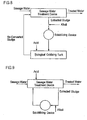
- Fig.1 is a schematic view of an apparatus for reducing the volume of sludge according to an embodiment of the present invention.
- the apparatus 1 for reducing the volume of sludge includes a tank 2 for biological oxidization, configured for decomposing solubilized sludge by aerobic treatment, a hermetically sealed solubilizing device 3 for solubilizing the sludge to a state readily degradable by microorganisms, a sludge supply line 6 for extracting excess sludge injected into the tank 2 for biological oxidization into the solubilizing device 3, a pump 10 provided in the sludge supply line 6, an alkali supply device 4, an alkali supply line 7 for adding alkali from the alkali supply device 4 to the sludge extracted from the tank 2 for biological oxidization, a pump 11 provided on the alkali supply line 7, and a liquefied sludge injection line 8 for returning the sludge in the solubilizing device 3, solubilized to the state readily
- the apparatus for reducing the volume of sludge further includes an acid supply device 5, and an acid supply line 9 for adding acid from the acid supply device 5 to the tank 2 for biological oxidization.
- the excess sludge, injected into the tank 2 for biological oxidization, is taken out via sludge supply line 6 from the tank 2 for biological oxidization into the solubilizing device 3.
- the pump 11 then is actuated to add alkali via alkali supply line 7 to the sludge taken out into the solubilizing device 3.
- the sludge is heated in the solubilizing device 3 at a pressure higher than the saturated steam temperature so as to be solubilized and made available as a BOD source.
- the sludge taken out into the solubilizing device 3 is preferably adjusted to a pH of 8 to 14 by the pump 11 provided to the alkali supply line 7.
- the heating in the solubilizing device 3 is preferably carried out at 110°C to 250°C.
- the sludge in the solubilizing device is solubilized and rendered available as a BOD source by the catalytic action of the alkali added.
- the present invention contemplates reducing the volume of sludge by returning the sludge, solubilized by the catalytic action of the alkali, into the tank for biological oxidization, as a BOD source.
- the apparatus 1 for reducing the volume of sludge may be provided with a device for reducing the volume of sludge by condensing excess sludge to adjust the MLSS of sludge, not shown, or with a sludge dewatering device, also not shown.
- the MLSS of sludge injected into the tank for biological oxidization may preferably be adjusted to 10000 mg/L to 120000 mg/L, and hence the excess sludge may be decomposed more efficiently by aerobic treatment.
- the tank for biological oxidization since the sludge injected into the tank for biological oxidization may be made higher in concentration, the tank for biological oxidization may be reduced in size.
- solubilizing device also may be reduced in size, the cost for heating may be reduced. Additionally, the amounts of the alkali and the acid, added to the solubilizing device and to the tank for biological oxidization, may be reduced, thus giving rise to favorable results to the environment and to economic merits.
- the pH of the solubilized sludge is close to neutral, or the inside of the tank for biological oxidization is acidic, there is no necessity of providing the acid supply device 5 used for adding acid to the solubilized sludge to adjust the pH of the sludge. In this case, the sludge may be processed more simply, more promptly and more economically.
- the sludge is pressurized in the solubilizing device 3 to a pressure higher than the saturated steam pressure, it is possible to suppress the vapor phase reaction, to promote the liquid phase reaction and to suppress generation of biodegradation-resistant substances or turning into oil owing to thermal degradation. Since the rate of chemical reaction is improved by acquisition of thermal energy, ascribable to increase in temperature, treatment may be completed in a short time. Moreover, since the ionic product of water may be prevented from being decreased by pressurizing the sludge to a pressure higher than the saturated steam pressure, the reaction of hydrolysis may be carried out more efficiently.
- the apparatus 1 for reducing the volume of sludge in Fig. 1 may be provided at least with one of a denitrification device and a dephosphorization device.
- a denitrification device By liquefying the sludge, nitrogen and phosphorus in the sludge may be removed more efficiently than with the conventional system, so that sludge treatment may be more benign to environment.
- the nitrogen removing method is varied with the state of nitrogen.
- an ammonia stripping method comprising aerating the drainage or a sludge (mixed liquid) after raising its pH and allowing nitrogen to be dissipated as ammonia gas into a vapor phase, for removal subsequently, has so far been widely used in case ammonia is present to a high concentration in the drainage treatment process.
- a denitrification device is provided in the apparatus for reducing the volume of sludge, according to the present invention, nitrogen present as ammonia may be removed by adding alkali to the sludge to adjust the pH and by aerating liquefied sludge prior to neutralization to effect thermal degradation.
- nitrogen inherently present in an existing processing device may also be removed.
- nitrogen present as nitric acid or nitrous acid most of nitrogen present in the drainage treatment process is converted into nitrogen as nitric acid, through nitrogen as nitrous acid, in the course of the aerobic biological treatment process.
- the major removing method for this form of nitrogen is the biological denitrification method, according to which nitrogen may be removed by a reducing action of nitrogen removing bacteria under anaerobic conditions by a route of nitric acid ⁇ nitrous acid ⁇ nitrogen gas which is dissipated into atmosphere.
- a sufficient quantity of hydrogen donors is required for the progress of this biological reaction.
- methanol is used as a hydrogen donor.
- liquefied sludge may be used as a hydrogen donor, and hence the cost of methanol needed for nitrogen removal may be reduced.
- the result is that the cost for removing nitrogen as nitric acid or as nitrous acid, generated in the course of reducing the volume of sludge by liquefying treatment, as well as nitrogen as nitric acid or as nitrous acid, generated inherently in a pre-existing treatment device, may be reduced.
- the conventional main dephosphorizing method comprises using a lime-, aluminum- or iron-based flocculant to cause phosphorus, eluted under anaerobic conditions, to be precipitated as insoluble precipitates, which are then removed.
- the adsorbing power of phosphorus is improved appreciably in case the sludge is in the phosphorus depleted state under an anaerobic condition as pre-treatment.
- the apparatus for reducing the volume of sludge according to the present invention is provided with a dephosphorizing device, sludge is liquefied, so that phosphorus in the sludge is eluted, and hence the complicated treatment, such as anaerobic treatment or aerobic treatment, may be dispensed with.
- the phosphorus in the sludge which is not eluted with the anaerobic treatment or aerobic treatment, is eluted, with the result that phosphorus generated in the course of the sludge volume reducing process by liquefying treatment or the phosphorus generated in pre-existing drainage treatment equipment may be removed highly efficiently.
- the solubilizing device 3 may be subordinate to the dephosphorizing device or to the denitrification device by solubilizing device 3 co-owning e.g. the pump with the dephosphorizing device or the denitrification device.
- Fig.2 shows a schematic structure of the sludge volume reducing apparatus 1 shown in Fig.1 .
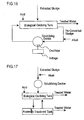
- Figs.3 to 11 , 16 and 17 show other schematic structures of the sludge volume reducing apparatus 1 according to the present invention.
- the sludge volume reducing apparatus 1 may again be provided with a sludge condensing device or a sludge dewatering device, not shown, for condensing the extracted sludge, the re-converted sludge or the re-re-converted sludge to adjust the MLSS of the sludge.
- the sludge Since the MLSS of the sludge, injected into the solubilizing device, biological oxidizing tank, anaerobic treatment device or into a treatment device can be adjusted readily, the sludge can be decomposed more efficiently. On the other hand, the sludge may be condensed and hence the biological oxidizing tank or a liquefying device may be reduced in size. Consequently, the cost for heating may be lowered and that for chemicals needed may also be lowered, with the result that sludge treatment may be more benign to environment with marked economical advantages.
- the biological oxidizing tank, anaerobic treatment device or the treatment device is provided with a solid-liquid separating device, not shown, for solid-liquid separating the sludge.
- a solid-liquid separating device for solid-liquid separating the sludge.
- the sludge (mixed liquid) in the tank or devices is separated into transparent supernatant and sludge.
- the supernatant is treated e.g. for disinfection and allowed to outflow as an effluent.
- This method converts the organic matter into methane or carbon dioxide by the action of anaerobic organisms, and is termed methane fermentation. It is said that microorganisms of two different eco-systems are taking part in methane fermentation. Initially, sugar, protein, nucleic acid and lipids are decomposed by anaerobic or facultative anaerobes (such as Bacillus, Clostridium or Staphylococcus) to yield lower fatty acids or carbon dioxide. Methane is then yielded by the action of absolute anaerobic methane generating bacteria. The methane generating bacteria, used for methane fermentation, may be enumerated by, for example, Methanobacterium, Methanococcus and Methanosarcina.
- anaerobic or facultative anaerobes such as Bacillus, Clostridium or Staphylococcus
- anaerobic treatment device or the drainage treatment device may be carried out before, after or in the course of injection or return of the solubilized sludge into the tank or devices, or directly into the solubilized sludge.
- pH of the sludge in the biological oxidizing tank, anaerobic treatment device or the drainage treatment device, after injection or return of the solubilized sludge ranges from 5 to 9, acid addition may be omitted, in which case sludge may be treated more readily, promptly and economically.
- the extracted sludge, re-converted sludge or re-re-converted sludge from the biological oxidizing tank, anaerobic treatment device or the drainage treatment device may be injected or returned into any line other than the line shown in the drawing, or into any device or tank of the sludge volume reducing apparatus.
- the liquefied sludge, extracted from the solubilizing device may similarly be injected or returned into any line other than the line shown in the drawing, or into any device or tank of the sludge volume reducing device.
- the sludge volume reducing apparatus may be provided with at least one of the denitrification device and the dephosphorizing device. These devices may also be subordinate to the solubilizing device.
- the sludge volume reducing device shown in Fig.16 , includes, in addition to the device shown in Fig.2 , an ultrasonic treatment device, designed for further promoting the solubilization and modification of sludge, in the inside of the solubilizing device.
- This ultrasonic treatment device includes, for example, an oscillator for ultrasonic treatment, and a power supply for applying the voltage to the oscillator.
- the oscillator generates ultrasonic waves of the frequency of 10 to 3000 kHz, preferably 10 to 200 kHz, with the sound wave intensity being of the order of 0.05 to 5.0 W/cm2 and preferably 0.1 to 1.5 W/cm2.
- the oscillator may be of various shapes, such as a horn shape or a shape of an oscillating plate.
- ultrasonic waves may be continuously or intermittently applied to the sludge kept in circulation within the modifying tank. Such ultrasonic treatment operates in addition to the catalytic action of the alkali under elevated temperature and pressure in the solubilizing device to promote sludge solubilization.
- the organic matter decomposed only insufficiently by the alkali treatment, is turned into a material of low molecular weight, with destruction of e.g. cell membranes of the microorganisms in the sludge, thus improving biological degradation further.
- an anaerobic treatment tank is provided to the sludge volume reducing apparatus shown in Fig.17 .
- the biological oxidizing tank and the anaerobic treatment tank, shown in Fig.17 are provided with a line for reciprocal circulation of the sludge contained in the tanks.
- aerobic treatment may be carried out as air is supplied thereto.
- anaerobic treatment may desirably be carried out under interruption of air supply to the anaerobic treatment tank.
- the aerobic treatment and anaerobic treatment may be carried out in the respective opposite tanks.
- solubilized sludge As the solubilized sludge is circulated between the two tanks, the biological oxidizing reactions by different metabolic enzymatic systems proceed alternately to accelerate degradation of solubilized sludge, that is, the rate of BOD lowering is promoted.
- aerobic treatment and anaerobic treatment may be carried out alternately at a preset time interval, within the same biological oxidizing tank of the device shown in Fig.3 (intermittent aerating tank).
- By adjusting the amounts of air supplied for intermittent aeration it is possible to optimize the proportions of the aerobes, facultative anaerobes and anaerobes in the bacteria in the biological oxidizing tank.
- the proportions of ca. 60 to 80% of aerobes, ca, 20 to 10% of facultative anaerobes and ca. 20 to 10% of anaerobes are most effective.
- the re-converted sludge subjected to biological oxidation treatment in the biological oxidizing treatment or in the aerating tank, may again be returned to the solubilizing tank.
- the thermal efficiency of heating treatment in the solubilizing device may be raised by exploiting waste heat generated by biological oxidation.
- extracted sludge from sewage water treatment equipment is transferred to at least one of a biological oxidizing tank for aerobic biological treatment, an anaerobic treatment tank for anaerobic biological treatment and an aerating tank alternately repeating aerobic treatment and anaerobic treatment at stated intervals.
- At least a fraction of re-converted sludge or re-re-converted sludge in each tank is adjusted to pH of 8 to 14 and solubilized to yield liquefied sludge, which liquefied sludge is injected into the aforementioned at least one of the tanks, inclusive of the sewage water treatment equipment, where the liquefied sludge is adjusted to the pH of from 5 to 9.
- At least a fraction of the re-converted sludge or re-re-converted sludge in the tank in question is adjusted to the pH of 8 to 14 and liquefied by liquefaction treatment to yield liquefied sludge, which liquefied sludge is directly or indirectly transferred to at least one of the aforementioned tanks, inclusive of the sewage water treatment equipment, where it is adjusted to the pH of from 5 to 9.
- the extracted sludge is adjusted to the pH of 8 to 14 and solubilized to yield liquefied sludge which is then directly or indirectly injected into the aforementioned at least one of the aforementioned tanks, inclusive of the sewage water treatment equipment, where it is adjusted to the pH of from 5 to 9.
- At least a fraction of re-converted sludge or re-re-converted sludge in the tank in question is extracted and has its pH adjusted to 8 to 14 to yield solubilized liquefied sludge, which liquefied sludge is directly or indirectly transferred to at least one of the aforementioned tanks, where it is adjusted to the pH of from 5 to 9.
- the above reduces the volume of sludge.
- the above re-converted sludge or re-re-converted sludge in the tank in question is transferred between the respective tanks, including the sewage treatment equipment, so that treated water may be allowed to outflow from at least one of the aforementioned tanks and the sewage water treatment equipment.
- Fig.12 shows the relation between the treatment temperature and time needed in 85% solubilization of sludge with organic sludge concentration of 10,000 mg/L in case the sludge is solubilized by heat and pulverizing treatment (pattern 1), by heat and alkali treatment (pattern 2) and by heat, alkali, and pressure treatment (pattern 3).
- the solubilizing treatment of the pattern 1 is a method comprising heating the sludge, without pH adjustment, that is, at pH 7, by a solubilizing device, and pulverizing the sludge by expansion on depressurization produced in ejecting the heated sludge to outside the solubilizing device under the saturated steam pressure at the heating temperature.
- the solubilizing treatment of the pattern 2 is a method comprising adjusting the pH of the sludge by alkali, solubilizing the sludge by heating it under saturated steam pressure by a solubilizing device and releasing the resulting solubilized sludge on decreasing the pressure in the solubilizing device to an atmospheric pressure.
- the solubilizing treatment of the pattern 3 is a method comprising adjusting the pH of the sludge by alkali, heating the sludge by a solubilizing device at a pressure higher than the saturated steam pressure and releasing the so heated sludge on decreasing the pressure in the solubilizing device to an atmospheric pressure.
- alkali treatment was carried out so that the pH will be equal to 14.
- the saturated steam pressures for 110°C, 150°C, 200°C, and 250°C are 0.145 MPa, 0.49 MPa, 1.65 MPa, and 4.3 MPa
- the pressures of 0.2 MPa, 0.6 MPa, 2 MPa, 5 MPa, 35 MPa and 69 MPa were applied in the pattern 3 for the respective temperatures.
- the method comprising solubilizing the sludge by heating the sludge under subcritical conditions as disclosed in the JP Patent Kokai JP-A-2000-218215 is omitted here because the method is lower in the sludge solubilizing effect than the solubilizing treatment method of pattern 1 comprising heating followed by pulverization.
- the treatment time of 150 minutes is needed at 110°C for solubilizing the sludge of 10000 mg/L by 85%
- the treatment time could be shortened to 80 minutes by carrying out alkali treatment in addition to the heat treatment.
- the treatment time for 85% solubilization was 27 minutes, which represents reduction by ca. one-fifth that of the pattern 1 and ca. one-third that of the pattern 2.
- the treatment time becomes shorter with rise in temperature.
- the treatment time of 15 minutes and the treatment time of 35 minutes are needed for 85% solubilization, even at 350°C, with the patterns 1 and 2, respectively, while the 85% solubilization of sludge may be achieved in 9 seconds with the pattern 3.
- the treatment comprising the combination of heating treatment, pressurizing treatment and alkali treatment, the treatment time may be reduced appreciably with marked favorable effects.
- the following Example shows the relation between the rate of solubilization and the treatment time for solubilizing the sludge.
- Fig.13 shows the relation between the rate of solubilization and the treatment time for the sludge with organic sludge content of 10,000 mg/L, in case the sludge treatment is carried out by heat and pulverizing treatment (pattern 1), heat and alkali treatment (pattern 2) and heat, alkali and pressure treatment (pattern 3).
- the inorganic content in the sludge is disregarded.
- the heating temperature was set to 250°C
- the pH value of sludge was set to 14 for the alkali treatment for the patterns 2 and 3.
- the saturated steam pressure was used for the treatment with the patterns 1 and 2, while the pressurizing treatment with the pattern 3 was carried out under a pressure of 5 MPa higher than the saturated steam pressure of 4.3 MPa for 250°C.
- biodegradability of solubilized sludge was scrutinized from changes in the amount of oxygen consumption of activated sludge in case the solubilized sludge has been added to the activated sludge as a BOD source.
- sludge solubilized by heat and alkali treatment was solid-liquid separated and only the liquid part free of solid content was used as a BOD source.
- the liquid part of sludge, solubilized by ca. 100% by the heat, alkali and pressure treatment was added as a BOD source.
- the BOD source was added in an amount such that the dry weight of sludge prior to solubilization accounts for 0.1 times the dry weight of activated sludge.
- the heating temperature was set to 200°C
- the pH by alkali addition was set to 14
- the heating time was set to 15 minutes.
- treatment was carried out under a saturated steam pressure of 1.65 MPa and, in the Run 2, solubilized sludge, treated at 2MPa, higher than the saturated steam pressure, was added to activated sludge of 500 mg of dry weight so that pre-solubilization dry weight is 50 mg as compared to the activated sludge of 500 mg of dry weight.
- the sludge not added with the BOD source was labeled Blank. The results are shown in Fig.14 .
- the amount of oxygen consumption is inversely proportionate to the concentration of dissolved oxygen.
- solubilized sludge is added as BOD source, the concentration of dissolved oxygen is decreased, with the amount of oxygen concentration of the activated sludge increasing significantly. It is because activated sludge absorbs solubilized sludge as substrate and consumes oxygen in the course of metabolic degradation. It is seen that solubilized sludge undergoes metabolic degradation by activated sludge. The amount of oxygen consumption is increased on addition of solubilized sludge by heat, alkali and pressure treatment, as compared to the case of adding solubilized sludge by heat and alkali treatment. Comparison of the rate of oxygen consumption per unit has revealed that the rates of oxygen consumption of the Blank, Run 1 and Run 2 are ca.
- the maximum load factor is represented by the ratio of the dry weight of the sludge prior to the solubilizing treatment to the dry weight of the activated sludge.
- a preset amount of sludge was taken out, solubilized and returned into the vessel to carry out an aerobic treatment.
- the load factor of the solubilized sludge amounts to 0.01/ day to 0.5/ day.
- the heating temperature was set to 200°C, and the pH values of sludge for alkaline treatment in the patterns 2 and 3 were adjusted to 14.
- sludge generated from other tank(s) were supplied each day, as excess sludge, in amounts of ca. 1.2 kg, ca. 1.9 kg and ca. 8.6 kg, for the patterns 1, 2 and 3, respectively.
- the treated water was solid-liquid separated by a membrane type filtration device provided in the biological oxidizing tank and allowed to outflow as efflux water.
- the solubilizing conditions for the respective patterns used namely the temperature, pressure and treatment time, were the same as those of the preliminary experiments.
- the validating experiments were conducted under the above-defined conditions.
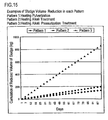
- the cumulative volume of the sludge supplied during the experimental periods from the other tank(s) as excess sludge into the biological oxidizing tank, that is, the sludge reduced in volume in the biological oxidizing tank, is shown in Fig.15 .
- the volume of sludge in the biological oxidizing tank is not increased under the maximum load factors of the respective patterns and the quality of treated water from the biological oxidizing tank was not aggravated.
- the sludge volume decreasing effect of the pattern 3 is higher than that of the other two patterns. Specifically, the sludge volume decreasing effect of the pattern 3 was 7 times that of the pattern 1 and 4.5 times that of the pattern 2. The reason is that sludge has substantially completely been solubilized by the heat, alkali and pressure treatment and promptly metabolically degraded by the sludge contained in the biological oxidizing tank.
- the concentration of the excess sludge being solubilized was set to 50,000 mg/L.
- 100% solubilization is possible, while such is not possible with the patterns 1, 2.
- Table 1 shows the rates of solubilization for the respective patterns, and the values of the capacity needed for the solubilizing device as found from the time for solubilization until the rates of solubilization are reached.
- the operating time of the solubilization device is 24 hours/ day.
- the concentration of the sludge being solubilized can be five times that with the patterns 1 and 2, so that the amount of the sludge solution supplied to the solubilizing device as described above can be reduced to approximately one-fifth.
- the treatment time for the pattern 3 until the solubilization rate of 100% was reached is approximately two minutes, in comparison with the treatment time for the pattern 1 of approximately 40 minutes until the solubilization rate of 85% was reached and with the treatment time for the pattern 2 of approximately 15 minutes until the solubilization rate of 90% was reached.
- This treatment time of 2 minutes is as short as 1/20 of that for the pattern 1 and 1/7.5 of that for the pattern 2.
- the capacity of the solubilization device of the pattern 3 could be reduced to approximately 1/106 and approximately 1/39 of that of the pattern 1 and the pattern 2, respectively.
- Table 2 shows the effective capacity of the biological oxidizing tank, as found from the maximum loading factor of activated sludge with solubilized sludge, under such a state in which the amount of the sludge in the biological oxidizing tank is not increased and in which the BOD in the treated water is not aggravated.
- This effective capacity was found by calculations based on the data of the preliminary test that the loading factor for which the activated sludge is capable of degrading the biodegradation-resistant undegraded sludge, that is, sludge that remained undegraded by the solubilizing treatment, is approximately 0.007/ day.
- the loading factor of 0.007/ day means that, in case the undegraded sludge is loaded on the sludge in the biological oxidizing tank to a loading factor higher than 0.007/ day, the sludge in the biological oxidizing tank is unable to degrade the undegraded sludge, such that, due to accumulation of the undegraded sludge, the quantity of the sludge in the biological oxidizing tank is increased.
- the loading factors for the patterns 1 and 2 are 0.047 and 0.07, respectively, while that of the pattern 3 may be 0.4, so that the capacity of the biological oxidizing tank of the pattern 3 may be reduced to approximately 1/8.6 and approximately 1/5.7 of those for the patterns 1 and 2.
- the results of Tables 1 and 2 indicate that, with the pattern 3, according to the present invention, as compared to the sludge treatment for the patterns 1 and 2, the solubilizing device and the biological oxidizing tank may be appreciably reduced in size, and hence the initial cost needed for sludge treatment can be decreased significantly. More specifically, the initial cost, including that of all of the devices needed for reducing the sludge volume, including e.g., the sludge volume reducing device and the biological oxidizing tank, may roughly be estimated to be 200,000,000 yen for the pattern 1, while that for the pattern 3 is ca. 50,000,000 yen, indicating that the sludge volume reducing device according to the present invention may be extremely inexpensive as compared to that of the conventional sludge volume reducing device.
- Table 3 shows running costs needed for reducing the sludge volume as found from the respective patterns. It is assumed that waste heat of the solubilized high-temperature sludge emanating from the solubilizing device has been subjected to waste heat exchange with the sludge to be sent to the solubilizing device next in order to pre-heat the sludge about to be solubilized.
- the capacity of the biological oxidizing tank is small, power costs for aeration are low, such that, in a sum total, the running costs for the pattern 3, is 1/3 and 1/3.6 of those of the patterns 1 and 2, respectively.
- the cost involved in dewatering the sludge into a cake for disposal as industrial waste in the conventional practice is ca. 200 yen per kg, while the cost for reducing the same volume of sludge by the pattern 3 are 117 yen.
- sludge volume reduction by the method and the apparatus of the present invention may be carried out at an extremely low cost.
- organic sludge may be liquefied sufficiently and the so liquefied sludge may further be metabolically degraded.
- the method may be introduced into the organic sewage water disposal system to provide a sewage water treatment system where there is generated no organic sludge waste, so that marked contribution may be expected to be achieved towards reducing the volume of industrial wastes.
Landscapes
- Life Sciences & Earth Sciences (AREA)
- Biodiversity & Conservation Biology (AREA)
- Microbiology (AREA)
- Hydrology & Water Resources (AREA)
- Engineering & Computer Science (AREA)
- Environmental & Geological Engineering (AREA)
- Water Supply & Treatment (AREA)
- Chemical & Material Sciences (AREA)
- Organic Chemistry (AREA)
- Treatment Of Sludge (AREA)
- Activated Sludge Processes (AREA)
Claims (37)
- Procédé pour réduire le volume de boue comprenant les étapes consistant à :(i) prélever au moins une fraction de boue d'une cuve d'oxydation biologique, configurée pour dégrader une boue extraite par traitement aérobie,(ii) ajuster le pH de ladite boue prélevée à 8 à 14,(iii) chauffer la boue ajustée en pH à 110 °C à 250 °C à une pression égale à ou supérieure à la pression de vapeur saturée pour solubiliser la boue à un état aisément dégradable par des micro-organismes,(iv) renvoyer/injecter une quantité prédéfinie de la boue solubilisée dans(a) ladite cuve d'oxydation biologique et ajuster le pH de la boue dans ladite cuve d'oxydation biologique à 5 à 9,
ou(b) un dispositif de traitement anaérobie, configuré pour dégrader ladite boue par traitement anaérobie, et ajuster le pH de la boue dans ledit dispositif de traitement anaérobie à 5 à 9,
ou(c) une cuve d'aération intermittente conduisant alternativement un traitement aérobie et traitement anaérobie et ajuster le pH de la boue dans ladite cuve d'aération intermittente à 5 à 9. - Procédé pour réduire le volume de boue comprenant les étapes consistant à :(i) ajuster le pH de boue prélevée en tant que boue extraite à partir d'un dispositif de traitement d'eaux usées à 8 à 14,(ii) chauffer la boue extraite ajustée en pH à 110 °C à 250 °C à une pression égale à ou supérieure à la pression de vapeur saturée pour solubiliser la boue à un état aisément dégradable par des micro-organismes,(iii) injecter une quantité prédéfinie de la boue extraite solubilisée dans(a) une cuve d'oxydation biologique, configurée pour dégrader la boue extraite par traitement aérobie, et ajuster le pH de la boue dans ladite cuve d'oxydation biologique à 5 à 9,
ou(b) un dispositif de traitement d'eaux usées, configuré pour dégrader des eaux usées organiques et une boue extraite solubilisée par traitement biologique, à partir de laquelle la boue extraite a été prélevée sous la forme d'au moins une fraction de boue située dans ledit dispositif de traitement d'eaux usées avant l'ajustement de pH de l'étape (i), et ajuster le pH de la boue dans ledit dispositif de traitement d'eaux usées à 5 à 9,
ou(c) un dispositif de traitement anaérobie, configuré pour dégrader ladite boue extraite solubilisée par traitement anaérobie, et ajuster le pH de la boue dans ledit dispositif de traitement anaérobie à 5 à 9,
ou(d) une cuve d'aération intermittente conduisant alternativement un traitement aérobie et un traitement anaérobie et ajuster le pH de la boue dans ladite cuve d'aération intermittente à 5 à 9. - Procédé pour réduire le volume de boue tel que défini dans la revendication 2 comprenant les étapes consistant à :chauffer une boue extraite, ajustée à un pH de 8 à 14, à 110 °C à 250 °C à une pression égale à ou supérieure à la pression de vapeur saturée pour solubiliser la boue à un état aisément dégradable par des micro-organismes ;injecter une quantité prédéfinie de la boue extraite solubilisée dans une cuve d'oxydation biologique, configurée pour dégrader la boue extraite par traitement aérobie ;ajuster le pH de la boue dans ladite cuve d'oxydation biologique à 5 à 9 ;prélever au moins une fraction de boue reconvertie depuis ladite cuve d'oxydation biologique ; etrenvoyer la boue extraite reconvertie vers ladite étape d'ajustement du pH de la boue à 8 à 14.
- Procédé pour réduire le volume de boue tel que défini dans la revendication 2 comprenant les étapes consistant à :chauffer une boue extraite, ajustée à un pH de 8 à 14, à 110°C à 250 °C à une pression égale à ou supérieure à la pression de vapeur saturée pour solubiliser la boue à un état aisément dégradable par des micro-organismes ;injecter une quantité prédéfinie de la boue extraite solubilisée dans une première cuve d'oxydation biologique, configurée pour dégrader la boue extraite par traitement aérobie ;ajuster le pH de la boue dans ladite première cuve d'oxydation biologique à 5 à 9 ;prélever au moins une fraction de boue reconvertie à partir de ladite première cuve d'oxydation biologique ;injecter ladite boue prélevée reconvertie dans une seconde cuve d'oxydation biologique, configurée pour dégrader la boue reconvertie par traitement aérobie ;prélever au moins une fraction de boue re-reconvertie à partir de ladite seconde cuve d'oxydation biologique ;ajuster le pH de la boue extraite re-reconvertie à 8 à 14 ;chauffer la boue ajustée en pH re-reconvertie à 110 °C à 250 °C à une pression égale à ou supérieure à la pression de vapeur saturée pour solubiliser la boue à un état aisément dégradable par des micro-organismes ;renvoyer une quantité prédéfinie de la boue re-reconvertie solubilisée dans ladite seconde cuve d'oxydation biologique ; etajuster le pH de la boue dans ladite seconde cuve d'oxydation biologique à 5 à 9.
- Procédé pour réduire le volume de boue tel que défini dans la revendication 2 comprenant les étapes consistant à :chauffer une boue extraite, ajustée à un pH de 8 à 14, à 110 °C à 250 °C à une pression égale à ou supérieure à la pression de vapeur saturée pour solubiliser la boue à un état aisément dégradable par des micro-organismes ;injecter une quantité prédéfinie de la boue extraite solubilisée dans une cuve d'oxydation biologique, configurée pour dégrader la boue extraite par traitement aérobie ;ajuster le pH de la boue dans ladite cuve d'oxydation biologique à 5 à 9 ;prélever au moins une fraction de la boue reconvertie à partir de ladite cuve d'oxydation biologique ;ajuster le pH de ladite boue prélevée reconvertie à 8 à 14 ;chauffer la boue ajustée en pH reconvertie à 110 °C à 250 °C à une pression égale à ou supérieure à la pression de vapeur saturée pour solubiliser la boue à un état aisément dégradable par des micro-organismes ;renvoyer une quantité prédéfinie de la boue solubilisée reconvertie dans ladite cuve d'oxydation biologique ; etajuster le pH de la boue dans ladite cuve d'oxydation biologique à 5 à 9.
- Procédé pour réduire le volume de boue tel que défini dans la revendication 2 comprenant les étapes consistant à :chauffer une boue extraite, ajustée à un pH de 8 à 14, à 110 °C à 250 °C à une pression égale à ou supérieure à la pression de vapeur saturée pour solubiliser la boue à un état aisément dégradable par des micro-organismes ;injecter une quantité prédéfinie de la boue extraite solubilisée dans une première cuve d'oxydation biologique, configurée pour dégrader la boue extraite par traitement aérobie ;ajuster le pH de la boue dans ladite première cuve d'oxydation biologique à 5 à 9 ;prélever au moins une fraction de boue reconvertie à partir de ladite première cuve d'oxydation biologique ;ajuster le pH de ladite boue prélevée reconvertie à 8 à 14 ;chauffer la boue reconvertie ajustée en pH à 110 °C à 250 °C à une pression égale à ou supérieure à la pression de vapeur saturée pour solubiliser la boue à un état aisément dégradable par des micro-organismes ;injecter une quantité prédéfinie de ladite boue reconvertie solubilisée dans une seconde cuve d'oxydation biologique, configurée pour dégrader la boue reconvertie par traitement aérobie ;ajuster le pH de la boue dans ladite seconde cuve d'oxydation biologique à 5 à 9 ;prélever au moins une fraction de boue re-reconvertie à partir de ladite seconde cuve d'oxydation biologique ; etrenvoyer ladite boue prélevée re-reconvertie vers ladite étape d'ajustement du pH de ladite boue reconvertie à 8 à 14.
- Procédé pour réduire le volume de boue tel que défini dans la revendication 2 comprenant les étapes consistant à :prélever au moins une fraction de boue en tant que boue extraite à partir d'un dispositif de traitement d'eaux usées, configuré pour dégrader des eaux usées organiques par traitement biologique ;ajuster le pH de ladite boue extraite prélevée à 8 à 14 ;chauffer la boue extraite ajustée en pH à 110 °C à 250 °C à une pression égale à ou supérieure à la pression de vapeur saturée pour solubiliser la boue dans un état aisément dégradable par des micro-organismes ;injecter une quantité prédéfinie de la boue extraite solubilisée dans une cuve d'oxydation biologique, configurée pour dégrader la boue extraite par traitement aérobie ;ajuster le pH de la boue dans ladite cuve d'oxydation biologique à 5 à 9 ;prélever au moins une fraction de boue reconvertie à partir de ladite cuve d'oxydation biologique ; etrenvoyer ladite boue prélevée reconvertie vers ledit dispositif de traitement d'eaux usées.
- Procédé pour réduire le volume de boue tel que défini dans la revendication 2 comprenant les étapes consistant à :prélever au moins une fraction de boue en tant que boue extraite à partir d'un dispositif de traitement d'eaux usées 1, configuré pour dégrader des eaux usées organiques par traitement biologique ;injecter ladite boue extraite prélevée dans un dispositif de traitement d'eaux usées 2, configuré pour dégrader les eaux usées organiques et la boue extraite solubilisée par traitement biologique ;extraire au moins une fraction de boue en tant que boue extraite à partir dudit dispositif de traitement d'eaux usées 2 ;ajuster le pH de ladite boue extraite prélevée à 8 à 14 ;chauffer la boue extraite ajustée en pH à 110 °C à 250 °C à une pression égale à ou supérieure à la pression de vapeur saturée pour solubiliser la boue à un état aisément dégradable par des micro-organismes ;renvoyer une quantité prédéfinie de la boue extraite solubilisée vers ledit dispositif de traitement d'eaux usées 2 ; etajuster le pH de la boue dans ledit dispositif de traitement d'eaux usées 2 à 5 à 9.
- Procédé pour réduire le volume de boue tel que défini dans l'une quelconque des revendications 3 à 8, dans lequel ladite boue extraite solubilisée, ladite boue reconvertie ou ladite boue re-reconvertie est retournée ou injectée dans un dispositif de traitement anaérobie, configuré pour dégrader ladite boue extraite solubilisée, boue reconvertie ou boue re-reconvertie par traitement anaérobie, ou dans une cuve d'aération intermittente conduisant alternativement un traitement aérobie et un traitement anaérobie, plutôt que dans au moins un parmi ladite cuve d'oxydation biologique, ladite première cuve d'oxydation biologique, ladite seconde cuve d'oxydation biologique, ledit dispositif de traitement d'eaux usées et ledit dispositif de traitement d'eaux usées 2.
- Procédé pour réduire le volume de boue tel que défini dans l'une quelconque des revendications 1 à 9, dans lequel le phosphore et/ou l'azote sont éliminés de ladite boue extraite solubilisée, ladite boue reconvertie ou ladite boue re-reconvertie.
- Procédé pour réduire le volume de boue tel que défini dans l'une quelconque des revendications 1 à 10, dans lequel l'ajustement de pH de 8 à 14 est effectué par ajout d'alcali.
- Procédé pour réduire le volume de boue tel que défini dans la revendication 11, dans lequel l'alcali est l'hydroxyde de sodium.
- Procédé pour réduire le volume de boue tel que défini dans l'une quelconque des revendications 1 à 12, dans lequel le contenu solide dans ladite boue extraite solubilisée, ladite boue reconvertie ou ladite boue re-reconvertie est séparé avant retour ou injection dans ladite cuve d'oxydation biologique, ladite première cuve d'oxydation biologique, ladite seconde cuve d'oxydation biologique, ledit dispositif de traitement d'eaux usées ou ledit dispositif de traitement d'eaux usées 2 , de sorte que seul le contenu liquide soit retourné ou injecté.
- Procédé pour réduire le volume de boue tel que défini dans la revendication 13, dans lequel le contenu solide séparé est retourné vers l'étape de solubilisation de la boue extraite, boue reconvertie ou boue re-reconvertie, ajusté au pH de 8 à 14, à un état aisément dégradable par des micro-organismes par chauffage à 110 °C à 250 °C à une pression égale à ou supérieure à la pression de vapeur saturée.
- Procédé pour réduire le volume de boue tel que défini dans l'une quelconque des revendications 1 à 14, dans lequel au moins une fraction de ladite boue extraite solubilisée, ladite boue reconvertie ou ladite boue re-reconvertie, est autorisée à s'écouler sous la forme d'un écoulement.
- Procédé pour réduire le volume de boue tel que défini dans l'une quelconque des revendications 1 à 15, dans lequel ladite boue extraite solubilisée, ladite boue reconvertie ou ladite boue re-reconvertie, est dégradée par oxydation par un agent oxydant ou par un photocatalyseur.
- Procédé pour réduire le volume de boue tel que défini dans l'une quelconque des revendications 1 à 16, dans lequel ladite boue extraite solubilisée, ladite boue reconvertie ou ladite boue re-reconvertie, est floculée/précipitée avec un floculant.
- Procédé pour réduire le volume de boue tel que défini dans la revendication 16 ou 17, dans lequel au moins une fraction de la boue solubilisée, oxydée ou floculée et précipitée est autorisée à s'écouler sous la forme d'un écoulement.
- Procédé pour réduire le volume de boue tel que défini dans l'une quelconque des revendications 1 à 18, dans lequel au moins une fraction de la boue extraite solubilisée, boue reconvertie ou boue re-reconvertie, est prélevée, le pH de ladite boue prélevée est ajusté à 8 à 14, la boue ajustée en pH est chauffée à 110 °C à 250 °C à une pression égale à ou supérieure à la pression de vapeur saturée, simultanément avec une solubilisation par traitement ultrasonique à un état aisément dégradable par des micro-organismes, et dans lequel une quantité prédéfinie de la boue reconvertie ou boue re-reconvertie solubilisée est retournée vers ladite cuve d'oxydation biologique, ladite première cuve d'oxydation biologique, ladite seconde cuve d'oxydation biologique, ledit dispositif de traitement d'eaux usées, ledit dispositif de traitement anaérobie ou vers ladite cuve d'aération intermittente, tandis que le pH de la boue dans ladite cuve ou dispositif est ajusté à 5 à 9.
- Procédé pour réduire le volume de boue tel que défini dans la revendication 2 comprenant les étapes consistant à :chauffer la boue extraite, ajustée à un pH de 8 à 14, à 110 °C à 250 °C à une pression égale à ou supérieure à la pression de vapeur saturée, pour solubiliser la boue à un état aisément dégradable par des micro-organismes ;injecter une quantité prédéfinie de la boue extraite solubilisée dans une cuve d'oxydation biologique, configurée pour dégrader la boue extraite par traitement aérobie ;ajuster le pH de la boue dans ladite cuve d'oxydation biologique à 5 à 9 ;prélever au moins une fraction de la boue reconvertie à partir de ladite cuve d'oxydation biologique ;injecter ladite boue prélevée reconvertie dans une cuve de traitement anaérobie configurée pour dégrader ladite boue prélevée reconvertie par traitement anaérobie ;prélever au moins une fraction de boue re-reconvertie à partir de ladite cuve de traitement anaérobie ; etrenvoyer ladite boue prélevée re-reconvertie dans la cuve d'oxydation biologique.
- Procédé pour réduire le volume de boue tel que défini dans l'une quelconque des revendications 1 à 20, dans lequel ladite boue extraite solubilisée, ladite boue reconvertie ou ladite boue re-reconvertie, ajustée à un pH de 8 à 14, est chauffée à 110 °C à 250 °C à une pression supérieure à la pression de vapeur saturée.
- Appareil pour réduire le volume de boue comprenant :(I) une cuve d'oxydation biologique pour dégrader une boue extraite par traitement aérobie,(II) un dispositif de solubilisation pour solubiliser la boue, prélevée à partir de ladite cuve d'oxydation biologique, à un état aisément dégradable par des micro-organismes,(III) des moyens pour ajuster le pH de la boue, prélevée à partir de ladite cuve d'oxydation biologique, à 8 à 14,(IV) des moyens pour injecter la boue ajustée en pH dans ledit dispositif de solubilisation,(V) des moyens pour chauffer la boue dans ledit dispositif de solubilisation à 110 °C à 250 °C à une pression égale à ou supérieure à la pression de vapeur saturée,(VI) des moyens pour renvoyer/injecter la boue solubilisée, prélevée dans un état solubilisé à partir dudit dispositif de solubilisation, vers(A) ladite cuve d'oxydation biologique et des moyens pour ajuster le pH de la boue dans ladite cuve d'oxydation biologique à 5 à 9,
ou(B) un dispositif de traitement anaérobie pour dégrader ladite boue par traitement anaérobie, ledit dispositif de traitement anaérobie et des moyens pour ajuster le pH de la boue dans ledit dispositif de traitement anaérobie à 5 à 9,
ou(C) une cuve d'aération intermittente pour conduire alternativement un traitement aérobie et un traitement anaérobie, ladite cuve d'aération intermittente et des moyens pour ajuster le pH de la boue dans ladite cuve d'aération intermittente à 5 à 9. - Appareil pour réduire le volume de boue comprenant :(I) des moyens pour ajuster le pH de boue prélevée en tant que boue extraite à partir d'un dispositif de traitement d'eaux usées à 8 à 14,(II) un dispositif de solubilisation pour solubiliser la boue extraite ajustée en pH à un état aisément dégradable par des micro-organismes,(III) des moyens pour chauffer la boue dans ledit dispositif de solubilisation à 110 °C à 250 °C à une pression égale à ou supérieure à la pression de vapeur saturée,(IV)(A) une cuve d'oxydation biologique pour dégrader la boue extraite par traitement aérobie et des moyens pour injecter une fraction prédéfinie de la boue extraite solubilisée, prélevée à partir du dispositif de solubilisation, dans ladite cuve d'oxydation biologique, et pour ajuster le pH de la boue dans ladite cuve d'oxydation biologique à 5 à 9,
ou(B) un dispositif de traitement d'eaux usées pour dégrader les eaux usées organiques et la boue extraite solubilisée par traitement biologique et des moyens pour renvoyer la boue extraite solubilisée, prélevée à partir dudit dispositif de solubilisation, de retour vers ledit dispositif de traitement d'eaux usées, à partir duquel la boue extraite a été prélevée avant ajustement du pH, et pour ajuster le pH de la boue dans ledit dispositif de traitement d'eaux usées à 5 à 9, ou(C) un dispositif de traitement anaérobie pour dégrader ladite boue extraite solubilisée par traitement anaérobie et des moyens pour injecter une fraction prédéfinie de la boue extraite solubilisée, prélevée à partir du dispositif de solubilisation, dans ledit dispositif de traitement anaérobie, et pour ajuster le pH de la boue dans ledit dispositif de traitement anaérobie à 5 à 9,
ou(D) une cuve d'aération intermittente pour conduire alternativement un traitement aérobie et un traitement anaérobie et des moyens pour injecter une fraction prédéfinie de la boue extraite solubilisée, prélevée à partir du dispositif de solubilisation, dans ladite cuve d'aération intermittente, et pour ajuster le pH de la boue dans ladite cuve d'aération intermittente à 5 à 9. - Appareil pour réduire le volume de boue tel que défini dans la revendication 23 comprenant :des moyens pour ajuster le pH de la boue extraite à 8 à 14 ;un dispositif de solubilisation pour solubiliser la boue extraite ajustée en pH à un état aisément dégradable par des micro-organismes ;des moyens pour chauffer la boue dans ledit dispositif de solubilisation à 110 °C à 250 °C à une pression égale à ou supérieure à la pression de vapeur saturée ;une cuve d'oxydation biologique pour dégrader la boue extraite par traitement aérobie ;des moyens pour injecter la boue extraite solubilisée, prélevée à partir du dispositif de solubilisation, dans ladite cuve d'oxydation biologique, et pour ajuster le pH de la boue dans ladite cuve d'oxydation biologique à 5 à 9 ; etdes moyens pour renvoyer la boue reconvertie, prélevée à partir de la cuve d'oxydation biologique, vers lesdits moyens pour ajuster le pH de 8 à 14.
- Appareil pour réduire le volume de boue tel que défini dans la revendication 23 comprenant :des moyens pour ajuster le pH de la boue extraite à 8 à 14 ;un premier dispositif de solubilisation pour solubiliser la boue extraite ajustée en pH à un état aisément dégradable par des micro-organismes ;des moyens pour chauffer la boue dans ledit premier dispositif de solubilisation à 110 °C à 250 °C à une pression égale à ou supérieure à la pression de vapeur saturée ;une première cuve d'oxydation biologique pour dégrader la boue extraite par traitement aérobie ;des moyens pour injecter la boue extraite solubilisée, prélevée à partir du premier dispositif de solubilisation, dans ladite première cuve d'oxydation biologique, et pour ajuster le pH de la boue dans ladite première cuve d'oxydation biologique à 5 à 9 ;une seconde cuve d'oxydation biologique pour dégrader la boue reconvertie par traitement aérobie ;des moyens pour injecter la boue reconvertie, extraite à partir de ladite première cuve d'oxydation biologique, dans ladite seconde cuve d'oxydation biologique ;des moyens pour ajuster le pH de la boue re-reconvertie, prélevée à partir de la seconde cuve d'oxydation biologique, à 8 à 14 ;un second dispositif de solubilisation pour solubiliser la boue re-reconvertie ajustée en pH à un état aisément dégradable par des micro-organismes ;des moyens pour chauffer la boue dans ledit second dispositif de solubilisation à 110 °C à 250 °C à une pression égale à ou supérieure à la pression de vapeur saturée ; etdes moyens pour renvoyer la boue re-reconvertie solubilisée, extraite dudit second dispositif de solubilisation, vers ladite seconde cuve d'oxydation biologique, et pour ajuster le pH de la boue dans ladite seconde cuve d'oxydation biologique à 5 à 9.
- Appareil pour réduire le volume de boue tel que défini dans la revendication 23 comprenant :des moyens pour ajuster le pH de la boue extraite à 8 à 14 ;un premier dispositif de solubilisation pour solubiliser la boue extraite ajustée en pH à un état aisément dégradable par des micro-organismes ;des moyens pour chauffer la boue dans ledit premier dispositif de solubilisation à 110 °C à 250 °C à une pression égale à ou supérieure à la pression de vapeur saturée ;une cuve d'oxydation biologique pour dégrader la boue extraite par traitement aérobie ;des moyens pour injecter la boue extraite solubilisée, prélevée à partir du premier dispositif de solubilisation, dans ladite cuve d'oxydation biologique, et pour ajuster le pH de la boue dans ladite cuve d'oxydation biologique à 5 à 9 ;des moyens pour ajuster le pH de la boue reconvertie, prélevée à partir de ladite cuve d'oxydation biologique, à 8 à 14 ;un second dispositif de solubilisation pour solubiliser la boue reconvertie ajustée en pH à un état aisément dégradable par des micro-organismes ;des moyens pour chauffer la boue dans ledit second dispositif de solubilisation à 110 °C à 250 °C à une pression égale à ou supérieure à la pression de vapeur saturée ; etdes moyens pour renvoyer la boue solubilisée reconvertie, prélevée du second dispositif de solubilisation, vers ladite cuve d'oxydation biologique, et pour ajuster le pH de la boue dans la cuve d'oxydation biologique à 5 à 9.
- Appareil pour réduire le volume de boue tel que défini dans la revendication 23 comprenant :des moyens pour ajuster le pH de la boue extraite à 8 à 14 ;un premier dispositif de solubilisation pour solubiliser la boue extraite ajustée en pH à un état aisément dégradable par des micro-organismes ;des moyens pour chauffer la boue dans ledit premier dispositif de solubilisation à 110 °C à 250 °C à une pression égale à ou supérieure à la pression de vapeur saturée ;une première cuve d'oxydation biologique pour dégrader la boue extraite par traitement aérobie ;des moyens pour injecter la boue extraite solubilisée, prélevée du premier dispositif de solubilisation, dans ladite première cuve d'oxydation biologique, et pour ajuster le pH de la boue dans ladite première cuve d'oxydation biologique à 5 à 9 ;des moyens pour ajuster le pH de la boue reconvertie, prélevée à partir de ladite première cuve d'oxydation biologique, à 8 à 14 ;un second dispositif de solubilisation pour solubiliser la boue reconvertie ajustée en pH à un état aisément dégradable par des micro-organismes ;des moyens pour chauffer la boue dans ledit second dispositif de solubilisation à 110 °C à 250 °C à une pression égale à ou supérieure à la pression de vapeur saturée ;une seconde cuve d'oxydation biologique pour dégrader la boue reconvertie par traitement aérobie ;des moyens pour injecter la boue reconvertie solubilisée, extraite dudit second dispositif de solubilisation, dans ladite seconde cuve d'oxydation biologique, et pour ajuster le pH de la boue dans ladite seconde cuve d'oxydation biologique à 5 à 9 ; etdes moyens pour renvoyer la boue re-reconvertie, prélevée à partir de ladite seconde cuve d'oxydation biologique, dans lesdits moyens configurés pour ajuster le pH de ladite boue reconvertie à 8 à 14.
- Appareil pour réduire le volume de boue tel que défini dans la revendication 23 comprenant :un dispositif de traitement d'eaux usées pour décomposer des eaux usées organiques par traitement biologique ;un dispositif de solubilisation pour solubiliser la boue extraite, prélevée à partir dudit dispositif de traitement d'eaux usées, à un état aisément dégradable par des micro-organismes ;des moyens pour ajuster le pH de la boue extraite, prélevée à partir dudit dispositif de traitement d'eaux usées, à 8 à 14 ;des moyens pour chauffer la boue dans ledit dispositif de solubilisation à 110 °C à 250 °C à une pression égale à ou supérieure à la pression de vapeur saturée ;une cuve d'oxydation biologique pour dégrader la boue extraite par traitement aérobie ;des moyens pour injecter la boue extraite solubilisée, prélevée à partir dudit dispositif de solubilisation, dans ladite seconde cuve d'oxydation biologique, et pour ajuster le pH de la boue dans ladite cuve d'oxydation biologique à 5 à 9 ; etdes moyens pour renvoyer la boue reconvertie, prélevée à partir de ladite cuve d'oxydation biologique, dans ledit dispositif de traitement d'eaux usées.
- Appareil pour réduire le volume de boue tel que défini dans la revendication 23 comprenant :un dispositif de traitement d'eaux usées 1 pour dégrader des eaux usées organiques par traitement biologique ;un dispositif de traitement d'eaux usées 2 pour dégrader des eaux usées organiques et la boue extraite solubilisée par traitement biologique ;des moyens pour injecter la boue extraite prélevée à partir dudit dispositif de traitement d'eaux usées 1 dans ledit dispositif de traitement d'eaux usées 2 ;un dispositif de solubilisation pour solubiliser la boue extraite prélevée à partir dudit dispositif de traitement d'eaux usées 2 à un état dégradable par des micro-organismes ;des moyens pour ajuster le pH de la boue extraite prélevée à partir dudit dispositif de traitement d'eaux usées 2 à 8 à 14 ;des moyens pour chauffer la boue dans ledit dispositif de solubilisation à 110 °C à 250 °C à une pression égale à ou supérieure à la pression de vapeur saturée ; etdes moyens pour renvoyer la boue extraite solubilisée, prélevée à partir dudit dispositif de solubilisation, vers ledit dispositif de traitement d'eaux usées 2, et pour ajuster le pH dans ledit dispositif de traitement d'eaux usées 2 à 5 à 9.
- Appareil pour réduire le volume de boue tel que défini dans l'une quelconque des revendications 24 à 29, dans lequel, à la place d'au moins un parmi ladite cuve d'oxydation biologique, ladite première cuve d'oxydation biologique, ladite seconde cuve d'oxydation biologique, ledit dispositif de traitement d'eaux usées et ledit dispositif de traitement d'eaux usées 2, vers lesquels la boue extraite solubilisée, prélevée à partir dudit dispositif de solubilisation, ladite boue reconvertie ou ladite boue re-reconvertie est renvoyée ou injectée, comprenant un dispositif de traitement anaérobie pour dégrader ladite boue extraite solubilisée, ladite boue reconvertie ou ladite boue re-reconvertie par traitement anaérobie ou une cuve d'aération intermittente pour conduire alternativement un traitement aérobie et un traitement anaérobie.
- Appareil pour réduire le volume de boue tel que défini dans l'une quelconque des revendications 22 à 30 comprenant en outre :au moins un parmi un dispositif de déphosphoration pour éliminer le phosphore de la boue extraite solubilisée, la boue reconvertie ou la boue re-reconvertie,un dispositif de dénitrification pour éliminer l'azote de la boue extraite solubilisée, la boue reconvertie, la boue re-reconvertie,un dispositif d'oxydation pour traiter la boue extraite solubilisée, la boue reconvertie ou la boue re-reconvertie avec un agent oxydant ou un photocatalyseur, etun dispositif de floculation-précipitation.
- Appareil pour réduire le volume de boue tel que défini dans la revendication 31, dans lequel au moins parmi lesdits dispositif de déphosphoration pour éliminer le phosphore, dispositif de dénitrification pour éliminer l'azote, dispositif d'oxydation et dispositif de floculation-précipitation est subordonné audit dispositif de solubilisation, audit premier dispositif de solubilisation ou audit second dispositif de solubilisation.
- Appareil pour réduire le volume de boue tel que défini dans l'une quelconque des revendications 22 à 32, dans lequel ledit dispositif de solubilisation, ledit premier dispositif de solubilisation ou ledit second dispositif de solubilisation est subordonné à au moins un parmi lesdits cuve d'oxydation biologique, première cuve d'oxydation biologique, seconde cuve d'oxydation biologique, dispositif de traitement anaérobie ou cuve d'aération intermittente.
- Appareil pour réduire le volume de boue tel que défini dans l'une quelconque des revendications 22 à 33 comprenant en outre :des moyens pour séparer le contenu solide dans la boue extraite solubilisée, la boue reconvertie ou la boue re-reconvertie avant renvoi ou injection dans lesdits cuve d'oxydation biologique, première cuve d'oxydation biologique, seconde cuve d'oxydation biologique, dispositif de traitement d'eaux usées ou dispositif de traitement d'eaux usées 2 pour renvoyer ou injecter uniquement du contenu liquide.
- Appareil pour réduire le volume de boue tel que défini dans la revendication 22 ou 23 comprenant :l'un parmi une cuve d'oxydation biologique, une première cuve d'oxydation biologique, une seconde cuve d'oxydation biologique par traitement aérobie, un dispositif de traitement anaérobie et une cuve d'aération intermittente pour dégrader la boue extraite, la boue reconvertie ou la boue re-reconvertie ;un dispositif de solubilisation pour solubiliser ladite boue prélevée à partir desdits cuve ou dispositif à un état aisément dégradable par des micro-organismes ;des moyens pour ajuster le pH de ladite boue prélevée à partir desdits cuve ou dispositif à 8 à 14 ;des moyens pour injecter la boue ajustée en pH dans ledit dispositif de solubilisation ;des moyens pour chauffer la boue dans ledit dispositif de solubilisation à 110 °C à 250 °C à une pression égale à ou supérieure à la pression de vapeur saturée ;un dispositif de traitement ultrasonique pour appliquer des ondes ultrasoniques à ladite boue dans ledit dispositif de solubilisation ; etdes moyens pour renvoyer la boue solubilisée prélevée à partir dudit dispositif de solubilisation vers lesdits cuve ou dispositif et pour ajuster le pH de la boue dans lesdits cuve ou dispositif à 5 à 9.
- Appareil pour réduire le volume de boue tel que défini dans la revendication 23 comprenant :des moyens pour ajuster le pH de la boue extraite à 8 à 14 ;un dispositif de solubilisation pour solubiliser la boue extraite ajustée en pH à un état aisément dégradable par des micro-organismes ;des moyens pour chauffer la boue dans ledit dispositif de solubilisation à 110 °C à 250 °C à une pression égale à ou supérieure à la pression de vapeur saturée ;une cuve d'oxydation biologique pour dégrader une quantité prédéfinie de ladite boue extraite solubilisée par traitement aérobie ;des moyens pour ajuster le pH de la boue dans ladite cuve d'oxydation biologique à 5 à 9 ;des moyens pour prélever au moins une fraction de la boue reconvertie à partir de ladite cuve d'oxydation biologique ;une cuve de traitement anaérobie pour dégrader la boue reconvertie prélevée par traitement anaérobie ; etdes moyens pour prélever au moins une fraction de boue re-reconvertie à partir de ladite cuve de traitement anaérobie pour renvoyer ladite boue extraite re-reconvertie dans ladite cuve d'oxydation biologique.
- Appareil pour réduire le volume de boue tel que défini dans l'une quelconque des revendications 22 à 36 comprenant des moyens pour chauffer la boue dans ledit dispositif de solubilisation à 110 °C à 250 °C à une pression supérieure à la pression de vapeur saturée.
Applications Claiming Priority (5)
| Application Number | Priority Date | Filing Date | Title |
|---|---|---|---|
| JP2002256721 | 2002-09-02 | ||
| JP2002256721 | 2002-09-02 | ||
| JP2003147897 | 2003-05-26 | ||
| JP2003147897 | 2003-05-26 | ||
| PCT/JP2003/010732 WO2004026774A1 (fr) | 2002-09-02 | 2003-08-26 | Procede pour reduire le volume de boue et appareil prevu a cet effet |
Publications (3)
| Publication Number | Publication Date |
|---|---|
| EP1550638A1 EP1550638A1 (fr) | 2005-07-06 |
| EP1550638A4 EP1550638A4 (fr) | 2009-09-16 |
| EP1550638B1 true EP1550638B1 (fr) | 2012-10-17 |
Family
ID=32032849
Family Applications (1)
| Application Number | Title | Priority Date | Filing Date |
|---|---|---|---|
| EP20030797527 Expired - Lifetime EP1550638B1 (fr) | 2002-09-02 | 2003-08-26 | Procede pour reduire le volume de boue et appareil prevu a cet effet |
Country Status (6)
| Country | Link |
|---|---|
| US (2) | US7258791B2 (fr) |
| EP (1) | EP1550638B1 (fr) |
| JP (1) | JP3754979B2 (fr) |
| CN (1) | CN1328193C (fr) |
| AU (1) | AU2003257701A1 (fr) |
| WO (1) | WO2004026774A1 (fr) |
Families Citing this family (32)
| Publication number | Priority date | Publication date | Assignee | Title |
|---|---|---|---|---|
| EP1550638B1 (fr) * | 2002-09-02 | 2012-10-17 | Koga, Takeshi | Procede pour reduire le volume de boue et appareil prevu a cet effet |
| AU2005240524C1 (en) * | 2004-04-22 | 2009-12-24 | Evoqua Water Technologies Llc | Filtration apparatus comprising a membrane bioreactor and a treatment vessel for digesting organic materials |
| JP2006346556A (ja) * | 2005-06-15 | 2006-12-28 | Koga Takeshi | 汚泥減量装置及び方法 |
| US20070215542A1 (en) * | 2006-01-20 | 2007-09-20 | Mckinney Jerry L | Apparatus and method for denitrification of treated water from aerobic wastewater treatment systems |
| WO2007103499A2 (fr) * | 2006-03-07 | 2007-09-13 | Siemens Water Technologies Corp. | Contrôle d'ions métalliques multivalents pour des procédés de traitement de de boues à faible rendement |
| KR20070096786A (ko) * | 2006-03-27 | 2007-10-02 | 가부시키가이샤 아쿠아마이토 | 잉여 오니 처리방법 및 그 설비 |
| US8894856B2 (en) | 2008-03-28 | 2014-11-25 | Evoqua Water Technologies Llc | Hybrid aerobic and anaerobic wastewater and sludge treatment systems and methods |
| KR20100136989A (ko) | 2008-03-28 | 2010-12-29 | 지멘스 워터 테크놀로지스 코포레이션 | 호기성 및 혐기성 하이브리드 폐수 및 슬러지 처리 시스템 및 방법 |
| CN101746941B (zh) * | 2008-12-10 | 2012-11-14 | 清华大学 | 一种城市污水厂脱水污泥生物干化处理方法 |
| WO2011068931A1 (fr) | 2009-12-03 | 2011-06-09 | Siemens Industry, Inc. | Systèmes et procédés d'extraction de nutriments dans des systèmes de traitement biologiques systems and methods for nutrient removal in biological treatment systems |
| CN101759336B (zh) * | 2009-12-18 | 2011-07-27 | 北京工业大学 | 剩余活性污泥两级碱性水解酸化处理装置 |
| CN103402926A (zh) | 2010-04-21 | 2013-11-20 | 西门子私人有限公司 | 废水处理系统和方法 |
| US9359236B2 (en) | 2010-08-18 | 2016-06-07 | Evoqua Water Technologies Llc | Enhanced biosorption of wastewater organics using dissolved air flotation with solids recycle |
| WO2012024279A1 (fr) | 2010-08-18 | 2012-02-23 | Siemens Industry, Inc. | Systèmes hybrides de stabilisation par contact-flottation primaire |
| CN102173501B (zh) * | 2011-02-17 | 2012-12-05 | 广州市恒兆环境生物工程有限公司 | 一种用于城市污泥减量的复合酶制剂 |
| EP2852559B1 (fr) | 2012-05-23 | 2019-02-20 | Wetox Limited | Procédé de traitement des boues |
| CN103121778A (zh) * | 2012-06-26 | 2013-05-29 | 深圳市环源科技发展有限公司 | 基于低压催化热水解的污泥处理及资源化利用方法及其应用 |
| CN103570200A (zh) * | 2012-08-06 | 2014-02-12 | 吴俊斌 | 一种污泥液化及干燥处理系统及其处理方法 |
| WO2014131134A1 (fr) | 2013-03-01 | 2014-09-04 | Paradigm Environmental Technologies Inc. | Procédé et système de traitement des eaux usées |
| US9145315B2 (en) | 2013-03-01 | 2015-09-29 | Paradigm Environmental Technologies Inc. | Wastewater treatment process and system |
| WO2014182533A1 (fr) | 2013-05-06 | 2014-11-13 | Erdogan Argun O | Biosorption d'eaux usées par flottation par air dissous |
| CN104724823A (zh) * | 2013-12-20 | 2015-06-24 | 清华大学 | 污水处理装置及污水处理系统 |
| JP5557301B1 (ja) * | 2013-12-30 | 2014-07-23 | 誠一 金 | 汚排水浄化システム |
| TWI571443B (zh) * | 2015-07-08 | 2017-02-21 | Lin Zhi-Yan | Biological sludge reduction method |
| CN107162359A (zh) * | 2017-05-31 | 2017-09-15 | 北京朗清源节能环保科技有限公司 | 含油污泥处理方法 |
| CN111186969B (zh) * | 2018-10-29 | 2022-06-28 | 中国石油化工股份有限公司 | 减量处理生化剩余污泥的方法和系统 |
| CN109761471B (zh) * | 2018-12-10 | 2022-01-25 | 唐山冀油瑞丰化工有限公司 | 连续超声耦合临界水共处理含油污泥/污水的方法及设备 |
| CN109761672A (zh) * | 2019-03-12 | 2019-05-17 | 珠海聚碳复合材料有限公司 | 一种采用复合嗜热菌处理污泥的方法 |
| CN110590100A (zh) * | 2019-09-12 | 2019-12-20 | 昆山科技大学 | 均质机搭配双氧水之节能型污泥减量方法 |
| CN115745343A (zh) * | 2022-11-24 | 2023-03-07 | 尚微生态科技有限公司 | 一种基于亚临界水技术的污泥处理工艺 |
| US12269763B1 (en) * | 2024-07-26 | 2025-04-08 | Min He | Treatment method for complete harmless treatment of activated sludge and complete resource utilization of activated sludge's products |
| CN120025002A (zh) * | 2025-04-21 | 2025-05-23 | 青岛理工大学 | 一种废水污泥处理系统及处理方法 |
Family Cites Families (26)
| Publication number | Priority date | Publication date | Assignee | Title |
|---|---|---|---|---|
| DE129270C (fr) * | ||||
| JPS4911813B1 (fr) | 1970-06-17 | 1974-03-19 | ||
| JPS558835A (en) * | 1978-07-04 | 1980-01-22 | Shinryo Air Conditioning Co Ltd | Treatment of surplus sludge |
| HU184347B (en) * | 1980-11-14 | 1984-08-28 | Tatabanyai Szenbanyak | Process regenerating rear-earth-metals-with digesting combustion residues of rear-earth-metal-containing stone coals, first of all brown coals |
| DE4015832A1 (de) * | 1990-05-17 | 1991-11-21 | Thomae Gmbh Dr K | Verfahren zur inaktivierung der biologischen aktivitaet von dna |
| JPH0558835A (ja) * | 1991-08-30 | 1993-03-09 | Noritake Co Ltd | 歯科用陶材フレームおよびその製造方法 |
| US5369031A (en) * | 1992-07-21 | 1994-11-29 | University Of Houston | Bioremediation of polar organic compounds |
| US5540847A (en) * | 1993-04-29 | 1996-07-30 | Stultz; Jeffrey H. | Sludge digestion |
| US5433868A (en) * | 1993-09-09 | 1995-07-18 | Battelle Memorial Institute | Sewage treatment method |
| JP3526081B2 (ja) * | 1994-07-29 | 2004-05-10 | 株式会社荏原総合研究所 | 有機性汚水の処理方法及び装置 |
| US5681481A (en) * | 1995-05-18 | 1997-10-28 | Rdp Company | Process and apparatus for liquid sludge stabilization |
| JP3447028B2 (ja) * | 1995-11-13 | 2003-09-16 | 株式会社荏原製作所 | 有機性汚泥の減量化方法 |
| WO1997039987A1 (fr) * | 1996-04-23 | 1997-10-30 | ETH Zürich | Procede de production d'un accelerateur de reaction pour l'oxydation de substances organiques dans la phase liquide |
| JPH1080699A (ja) * | 1996-05-31 | 1998-03-31 | Takeo Terada | 有機性汚泥の処理方法 |
| JP3267935B2 (ja) * | 1997-12-19 | 2002-03-25 | 神鋼パンテツク株式会社 | 有機性廃水の処理方法及びその処理装置 |
| US6224769B1 (en) * | 1997-06-05 | 2001-05-01 | Shinko Pantec Co., Ltd. | Method and apparatus for treating organic waste water |
| JP3853971B2 (ja) * | 1998-04-17 | 2006-12-06 | ユニチカ株式会社 | 余剰汚泥の好気性消化方法 |
| US6110323A (en) * | 1998-08-03 | 2000-08-29 | Betafoods Corporation | Methods of refining agricultural residues to absorbent cellulose, xylose, and plant nutrient liquor, and products produced by such methods |
| JP2000218285A (ja) | 1999-01-29 | 2000-08-08 | Sanyo Electric Co Ltd | 汚水処理装置 |
| JP3689804B2 (ja) * | 1999-02-01 | 2005-08-31 | 定瞭 村上 | 水熱反応を利用する余剰汚泥ゼロエミッション型生物処理法 |
| JP2000354896A (ja) | 1999-04-15 | 2000-12-26 | Unitika Ltd | 汚泥の好気性消化方法及び好気性消化装置 |
| JP2001079584A (ja) * | 1999-09-14 | 2001-03-27 | Nihon Hels Industry Corp | 有機性排水の浄化処理方法 |
| JP2001225091A (ja) * | 2000-02-18 | 2001-08-21 | Hitachi Kiden Kogyo Ltd | 汚水と汚泥の処理方法及びその処理装置 |
| JP4004766B2 (ja) * | 2001-10-12 | 2007-11-07 | 株式会社テクノフロンティア | 水熱反応を利用する余剰汚泥生物処理方法 |
| US20040004038A1 (en) * | 2002-07-03 | 2004-01-08 | Jfe Engineering Corporation | Method and apparatus for treating sludge, and method and apparatus for treating wastewater utilizing the same |
| EP1550638B1 (fr) * | 2002-09-02 | 2012-10-17 | Koga, Takeshi | Procede pour reduire le volume de boue et appareil prevu a cet effet |
-
2003
- 2003-08-26 EP EP20030797527 patent/EP1550638B1/fr not_active Expired - Lifetime
- 2003-08-26 JP JP2004537537A patent/JP3754979B2/ja not_active Expired - Fee Related
- 2003-08-26 CN CNB038208067A patent/CN1328193C/zh not_active Expired - Fee Related
- 2003-08-26 WO PCT/JP2003/010732 patent/WO2004026774A1/fr not_active Ceased
- 2003-08-26 AU AU2003257701A patent/AU2003257701A1/en not_active Abandoned
-
2005
- 2005-03-02 US US11/069,063 patent/US7258791B2/en not_active Expired - Fee Related
-
2007
- 2007-07-20 US US11/878,041 patent/US7438805B2/en not_active Expired - Fee Related
Also Published As
| Publication number | Publication date |
|---|---|
| JPWO2004026774A1 (ja) | 2006-01-12 |
| CN1328193C (zh) | 2007-07-25 |
| US20050199547A1 (en) | 2005-09-15 |
| JP3754979B2 (ja) | 2006-03-15 |
| WO2004026774A1 (fr) | 2004-04-01 |
| US7438805B2 (en) | 2008-10-21 |
| EP1550638A4 (fr) | 2009-09-16 |
| US20070289909A1 (en) | 2007-12-20 |
| AU2003257701A1 (en) | 2004-04-08 |
| US7258791B2 (en) | 2007-08-21 |
| CN1678537A (zh) | 2005-10-05 |
| EP1550638A1 (fr) | 2005-07-06 |
Similar Documents
| Publication | Publication Date | Title |
|---|---|---|
| EP1550638B1 (fr) | Procede pour reduire le volume de boue et appareil prevu a cet effet | |
| CN101182092B (zh) | 生物污泥的减量化方法 | |
| Neumann et al. | Developments in pre-treatment methods to improve anaerobic digestion of sewage sludge | |
| Sievers et al. | Sludge treatment by ozonation Ð evaluation of full-scale results | |
| JP2004042043A (ja) | 酸化による廃棄物処理方法 | |
| KR100849671B1 (ko) | 열팽창을 이용한 슬러지 감량화 시스템 및 방법 | |
| CN101224935A (zh) | 垃圾渗滤液的处理方法 | |
| KR20020080285A (ko) | 슬러지 분해가용화 방법을 이용한 슬러지 무배출하수고도처리방법 | |
| US5762809A (en) | Process for treating a medium containing organic constituents | |
| JP2002361293A (ja) | 有機性汚泥の減量化方法及び装置 | |
| KR20100028413A (ko) | 고농도 유기성 폐수의 처리방법 | |
| JP2004034000A (ja) | 余剰汚泥の発生量を低減する汚泥処理方法及び装置 | |
| JP3272614B2 (ja) | 汚水処理装置 | |
| JP4449273B2 (ja) | 有機性排水処理方法 | |
| JP2004290778A (ja) | 汚泥の嫌気性処理方法 | |
| HRP20030843B1 (hr) | Rastvaranje anaerobno obrađenog taloga kanalskog otpada | |
| JP3223145B2 (ja) | 有機性廃水の処理方法 | |
| Yamaguchi et al. | Biological sludge solubilisation for reduction of excess sludge production in wastewater treatment process | |
| JP4230617B2 (ja) | 有機性固形物含有廃水の処理装置 | |
| JP2011131159A (ja) | スケーリング防止汚泥減量方法および装置、並びにバイオガス発生/取得方法および装置 | |
| CN108996836A (zh) | 一种工业污水处理工艺 | |
| JP3756827B2 (ja) | 汚泥減量方法および装置 | |
| Seaf et al. | Sludge disintegration techniques: In-depth review | |
| Aboulfotoh et al. | Sludge disintegration techniques: In-depth review | |
| JP2002045884A (ja) | 汚泥の可溶化方法 |
Legal Events
| Date | Code | Title | Description |
|---|---|---|---|
| PUAI | Public reference made under article 153(3) epc to a published international application that has entered the european phase |
Free format text: ORIGINAL CODE: 0009012 |
|
| 17P | Request for examination filed |
Effective date: 20050324 |
|
| AK | Designated contracting states |
Kind code of ref document: A1 Designated state(s): AT BE BG CH CY CZ DE DK EE ES FI FR GB GR HU IE IT LI LU MC NL PT RO SE SI SK TR |
|
| AX | Request for extension of the european patent |
Extension state: AL LT LV MK |
|
| DAX | Request for extension of the european patent (deleted) | ||
| A4 | Supplementary search report drawn up and despatched |
Effective date: 20090818 |
|
| RIC1 | Information provided on ipc code assigned before grant |
Ipc: C02F 11/08 20060101ALI20090807BHEP Ipc: C02F 3/12 20060101ALI20090807BHEP Ipc: C02F 11/04 20060101ALI20090807BHEP Ipc: C02F 11/02 20060101ALI20090807BHEP Ipc: C02F 11/18 20060101AFI20040406BHEP |
|
| GRAP | Despatch of communication of intention to grant a patent |
Free format text: ORIGINAL CODE: EPIDOSNIGR1 |
|
| GRAC | Information related to communication of intention to grant a patent modified |
Free format text: ORIGINAL CODE: EPIDOSCIGR1 |
|
| GRAS | Grant fee paid |
Free format text: ORIGINAL CODE: EPIDOSNIGR3 |
|
| GRAA | (expected) grant |
Free format text: ORIGINAL CODE: 0009210 |
|
| AK | Designated contracting states |
Kind code of ref document: B1 Designated state(s): AT BE BG CH CY CZ DE DK EE ES FI FR GB GR HU IE IT LI LU MC NL PT RO SE SI SK TR |
|
| REG | Reference to a national code |
Ref country code: GB Ref legal event code: FG4D |
|
| REG | Reference to a national code |
Ref country code: CH Ref legal event code: EP |
|
| REG | Reference to a national code |
Ref country code: IE Ref legal event code: FG4D |
|
| REG | Reference to a national code |
Ref country code: AT Ref legal event code: REF Ref document number: 579828 Country of ref document: AT Kind code of ref document: T Effective date: 20121115 |
|
| REG | Reference to a national code |
Ref country code: SE Ref legal event code: TRGR |
|
| REG | Reference to a national code |
Ref country code: DE Ref legal event code: R096 Ref document number: 60342390 Country of ref document: DE Effective date: 20121213 |
|
| REG | Reference to a national code |
Ref country code: AT Ref legal event code: MK05 Ref document number: 579828 Country of ref document: AT Kind code of ref document: T Effective date: 20121017 |
|
| REG | Reference to a national code |
Ref country code: NL Ref legal event code: VDEP Effective date: 20121017 |
|
| PG25 | Lapsed in a contracting state [announced via postgrant information from national office to epo] |
Ref country code: FI Free format text: LAPSE BECAUSE OF FAILURE TO SUBMIT A TRANSLATION OF THE DESCRIPTION OR TO PAY THE FEE WITHIN THE PRESCRIBED TIME-LIMIT Effective date: 20121017 Ref country code: NL Free format text: LAPSE BECAUSE OF FAILURE TO SUBMIT A TRANSLATION OF THE DESCRIPTION OR TO PAY THE FEE WITHIN THE PRESCRIBED TIME-LIMIT Effective date: 20121017 |
|
| PG25 | Lapsed in a contracting state [announced via postgrant information from national office to epo] |
Ref country code: PT Free format text: LAPSE BECAUSE OF FAILURE TO SUBMIT A TRANSLATION OF THE DESCRIPTION OR TO PAY THE FEE WITHIN THE PRESCRIBED TIME-LIMIT Effective date: 20130218 Ref country code: CY Free format text: LAPSE BECAUSE OF FAILURE TO SUBMIT A TRANSLATION OF THE DESCRIPTION OR TO PAY THE FEE WITHIN THE PRESCRIBED TIME-LIMIT Effective date: 20121017 Ref country code: SI Free format text: LAPSE BECAUSE OF FAILURE TO SUBMIT A TRANSLATION OF THE DESCRIPTION OR TO PAY THE FEE WITHIN THE PRESCRIBED TIME-LIMIT Effective date: 20121017 Ref country code: BE Free format text: LAPSE BECAUSE OF FAILURE TO SUBMIT A TRANSLATION OF THE DESCRIPTION OR TO PAY THE FEE WITHIN THE PRESCRIBED TIME-LIMIT Effective date: 20121017 Ref country code: GR Free format text: LAPSE BECAUSE OF FAILURE TO SUBMIT A TRANSLATION OF THE DESCRIPTION OR TO PAY THE FEE WITHIN THE PRESCRIBED TIME-LIMIT Effective date: 20130118 |
|
| PG25 | Lapsed in a contracting state [announced via postgrant information from national office to epo] |
Ref country code: AT Free format text: LAPSE BECAUSE OF FAILURE TO SUBMIT A TRANSLATION OF THE DESCRIPTION OR TO PAY THE FEE WITHIN THE PRESCRIBED TIME-LIMIT Effective date: 20121017 |
|
| PG25 | Lapsed in a contracting state [announced via postgrant information from national office to epo] |
Ref country code: CZ Free format text: LAPSE BECAUSE OF FAILURE TO SUBMIT A TRANSLATION OF THE DESCRIPTION OR TO PAY THE FEE WITHIN THE PRESCRIBED TIME-LIMIT Effective date: 20121017 Ref country code: BG Free format text: LAPSE BECAUSE OF FAILURE TO SUBMIT A TRANSLATION OF THE DESCRIPTION OR TO PAY THE FEE WITHIN THE PRESCRIBED TIME-LIMIT Effective date: 20130117 Ref country code: EE Free format text: LAPSE BECAUSE OF FAILURE TO SUBMIT A TRANSLATION OF THE DESCRIPTION OR TO PAY THE FEE WITHIN THE PRESCRIBED TIME-LIMIT Effective date: 20121017 Ref country code: SK Free format text: LAPSE BECAUSE OF FAILURE TO SUBMIT A TRANSLATION OF THE DESCRIPTION OR TO PAY THE FEE WITHIN THE PRESCRIBED TIME-LIMIT Effective date: 20121017 Ref country code: DK Free format text: LAPSE BECAUSE OF FAILURE TO SUBMIT A TRANSLATION OF THE DESCRIPTION OR TO PAY THE FEE WITHIN THE PRESCRIBED TIME-LIMIT Effective date: 20121017 |
|
| PLBE | No opposition filed within time limit |
Free format text: ORIGINAL CODE: 0009261 |
|
| STAA | Information on the status of an ep patent application or granted ep patent |
Free format text: STATUS: NO OPPOSITION FILED WITHIN TIME LIMIT |
|
| PG25 | Lapsed in a contracting state [announced via postgrant information from national office to epo] |
Ref country code: RO Free format text: LAPSE BECAUSE OF FAILURE TO SUBMIT A TRANSLATION OF THE DESCRIPTION OR TO PAY THE FEE WITHIN THE PRESCRIBED TIME-LIMIT Effective date: 20121017 Ref country code: IT Free format text: LAPSE BECAUSE OF FAILURE TO SUBMIT A TRANSLATION OF THE DESCRIPTION OR TO PAY THE FEE WITHIN THE PRESCRIBED TIME-LIMIT Effective date: 20121017 |
|
| 26N | No opposition filed |
Effective date: 20130718 |
|
| PG25 | Lapsed in a contracting state [announced via postgrant information from national office to epo] |
Ref country code: ES Free format text: LAPSE BECAUSE OF FAILURE TO SUBMIT A TRANSLATION OF THE DESCRIPTION OR TO PAY THE FEE WITHIN THE PRESCRIBED TIME-LIMIT Effective date: 20130128 |
|
| REG | Reference to a national code |
Ref country code: DE Ref legal event code: R097 Ref document number: 60342390 Country of ref document: DE Effective date: 20130718 |
|
| REG | Reference to a national code |
Ref country code: CH Ref legal event code: PL |
|
| PG25 | Lapsed in a contracting state [announced via postgrant information from national office to epo] |
Ref country code: CH Free format text: LAPSE BECAUSE OF NON-PAYMENT OF DUE FEES Effective date: 20130831 Ref country code: MC Free format text: LAPSE BECAUSE OF FAILURE TO SUBMIT A TRANSLATION OF THE DESCRIPTION OR TO PAY THE FEE WITHIN THE PRESCRIBED TIME-LIMIT Effective date: 20121017 Ref country code: LI Free format text: LAPSE BECAUSE OF NON-PAYMENT OF DUE FEES Effective date: 20130831 |
|
| REG | Reference to a national code |
Ref country code: IE Ref legal event code: MM4A |
|
| PG25 | Lapsed in a contracting state [announced via postgrant information from national office to epo] |
Ref country code: IE Free format text: LAPSE BECAUSE OF NON-PAYMENT OF DUE FEES Effective date: 20130826 |
|
| PG25 | Lapsed in a contracting state [announced via postgrant information from national office to epo] |
Ref country code: TR Free format text: LAPSE BECAUSE OF FAILURE TO SUBMIT A TRANSLATION OF THE DESCRIPTION OR TO PAY THE FEE WITHIN THE PRESCRIBED TIME-LIMIT Effective date: 20121017 |
|
| PG25 | Lapsed in a contracting state [announced via postgrant information from national office to epo] |
Ref country code: LU Free format text: LAPSE BECAUSE OF NON-PAYMENT OF DUE FEES Effective date: 20130826 Ref country code: HU Free format text: LAPSE BECAUSE OF FAILURE TO SUBMIT A TRANSLATION OF THE DESCRIPTION OR TO PAY THE FEE WITHIN THE PRESCRIBED TIME-LIMIT; INVALID AB INITIO Effective date: 20030826 |
|
| REG | Reference to a national code |
Ref country code: FR Ref legal event code: PLFP Year of fee payment: 14 |
|
| REG | Reference to a national code |
Ref country code: FR Ref legal event code: PLFP Year of fee payment: 15 |
|
| REG | Reference to a national code |
Ref country code: FR Ref legal event code: PLFP Year of fee payment: 16 |
|
| PGFP | Annual fee paid to national office [announced via postgrant information from national office to epo] |
Ref country code: DE Payment date: 20180828 Year of fee payment: 16 Ref country code: FR Payment date: 20180828 Year of fee payment: 16 |
|
| PGFP | Annual fee paid to national office [announced via postgrant information from national office to epo] |
Ref country code: GB Payment date: 20180829 Year of fee payment: 16 Ref country code: SE Payment date: 20180828 Year of fee payment: 16 |
|
| REG | Reference to a national code |
Ref country code: DE Ref legal event code: R119 Ref document number: 60342390 Country of ref document: DE |
|
| REG | Reference to a national code |
Ref country code: SE Ref legal event code: EUG |
|
| GBPC | Gb: european patent ceased through non-payment of renewal fee |
Effective date: 20190826 |
|
| PG25 | Lapsed in a contracting state [announced via postgrant information from national office to epo] |
Ref country code: SE Free format text: LAPSE BECAUSE OF NON-PAYMENT OF DUE FEES Effective date: 20190827 |
|
| PG25 | Lapsed in a contracting state [announced via postgrant information from national office to epo] |
Ref country code: DE Free format text: LAPSE BECAUSE OF NON-PAYMENT OF DUE FEES Effective date: 20200303 Ref country code: FR Free format text: LAPSE BECAUSE OF NON-PAYMENT OF DUE FEES Effective date: 20190831 |
|
| PG25 | Lapsed in a contracting state [announced via postgrant information from national office to epo] |
Ref country code: GB Free format text: LAPSE BECAUSE OF NON-PAYMENT OF DUE FEES Effective date: 20190826 |