EP1551928B1 - Solid support comprising a functionalized electricity conductor or semiconductor surface, method for preparing same and uses thereof - Google Patents
Solid support comprising a functionalized electricity conductor or semiconductor surface, method for preparing same and uses thereof Download PDFInfo
- Publication number
- EP1551928B1 EP1551928B1 EP03762703.1A EP03762703A EP1551928B1 EP 1551928 B1 EP1551928 B1 EP 1551928B1 EP 03762703 A EP03762703 A EP 03762703A EP 1551928 B1 EP1551928 B1 EP 1551928B1
- Authority
- EP
- European Patent Office
- Prior art keywords
- interest
- fact
- organic
- groups
- electro
- Prior art date
- Legal status (The legal status is an assumption and is not a legal conclusion. Google has not performed a legal analysis and makes no representation as to the accuracy of the status listed.)
- Expired - Lifetime
Links
- 238000000034 method Methods 0.000 title claims description 37
- 239000007787 solid Substances 0.000 title claims description 10
- 230000005611 electricity Effects 0.000 title description 12
- 239000004065 semiconductor Substances 0.000 title description 5
- 239000004020 conductor Substances 0.000 title description 2
- 125000000524 functional group Chemical group 0.000 claims description 81
- 238000006243 chemical reaction Methods 0.000 claims description 64
- PCHJSUWPFVWCPO-UHFFFAOYSA-N gold Chemical compound [Au] PCHJSUWPFVWCPO-UHFFFAOYSA-N 0.000 claims description 48
- 229910052737 gold Inorganic materials 0.000 claims description 47
- 239000010931 gold Substances 0.000 claims description 47
- 239000002243 precursor Substances 0.000 claims description 43
- 239000000178 monomer Substances 0.000 claims description 39
- 150000001412 amines Chemical group 0.000 claims description 35
- 230000015572 biosynthetic process Effects 0.000 claims description 27
- 230000006870 function Effects 0.000 claims description 26
- ZMXDDKWLCZADIW-UHFFFAOYSA-N N,N-Dimethylformamide Chemical compound CN(C)C=O ZMXDDKWLCZADIW-UHFFFAOYSA-N 0.000 claims description 24
- -1 C1-C4 alkyl radical Chemical class 0.000 claims description 23
- 150000001408 amides Chemical class 0.000 claims description 23
- 230000000295 complement effect Effects 0.000 claims description 21
- 239000000203 mixture Substances 0.000 claims description 19
- 125000002887 hydroxy group Chemical group [H]O* 0.000 claims description 17
- 150000002825 nitriles Chemical class 0.000 claims description 17
- WOBHKFSMXKNTIM-UHFFFAOYSA-N Hydroxyethyl methacrylate Chemical compound CC(=C)C(=O)OCCO WOBHKFSMXKNTIM-UHFFFAOYSA-N 0.000 claims description 16
- WYURNTSHIVDZCO-UHFFFAOYSA-N Tetrahydrofuran Chemical compound C1CCOC1 WYURNTSHIVDZCO-UHFFFAOYSA-N 0.000 claims description 16
- KZNICNPSHKQLFF-UHFFFAOYSA-N succinimide Chemical compound O=C1CCC(=O)N1 KZNICNPSHKQLFF-UHFFFAOYSA-N 0.000 claims description 15
- 229920002818 (Hydroxyethyl)methacrylate Polymers 0.000 claims description 13
- 102000004169 proteins and genes Human genes 0.000 claims description 13
- 108090000623 proteins and genes Proteins 0.000 claims description 13
- 125000006850 spacer group Chemical group 0.000 claims description 12
- 150000003573 thiols Chemical class 0.000 claims description 11
- WEVYAHXRMPXWCK-UHFFFAOYSA-N Acetonitrile Chemical compound CC#N WEVYAHXRMPXWCK-UHFFFAOYSA-N 0.000 claims description 9
- 150000001732 carboxylic acid derivatives Chemical class 0.000 claims description 9
- 239000002253 acid Substances 0.000 claims description 8
- YLQBMQCUIZJEEH-UHFFFAOYSA-N tetrahydrofuran Natural products C=1C=COC=1 YLQBMQCUIZJEEH-UHFFFAOYSA-N 0.000 claims description 8
- 125000004122 cyclic group Chemical group 0.000 claims description 7
- 239000012948 isocyanate Substances 0.000 claims description 7
- 150000002513 isocyanates Chemical class 0.000 claims description 7
- 125000000962 organic group Chemical group 0.000 claims description 7
- XEKOWRVHYACXOJ-UHFFFAOYSA-N Ethyl acetate Chemical compound CCOC(C)=O XEKOWRVHYACXOJ-UHFFFAOYSA-N 0.000 claims description 6
- BASFCYQUMIYNBI-UHFFFAOYSA-N platinum Chemical compound [Pt] BASFCYQUMIYNBI-UHFFFAOYSA-N 0.000 claims description 6
- 229960002317 succinimide Drugs 0.000 claims description 6
- 230000000975 bioactive effect Effects 0.000 claims description 5
- 125000002348 vinylic group Chemical group 0.000 claims description 5
- ZAMOUSCENKQFHK-UHFFFAOYSA-N Chlorine atom Chemical compound [Cl] ZAMOUSCENKQFHK-UHFFFAOYSA-N 0.000 claims description 4
- XEEYBQQBJWHFJM-UHFFFAOYSA-N Iron Chemical compound [Fe] XEEYBQQBJWHFJM-UHFFFAOYSA-N 0.000 claims description 4
- PXHVJJICTQNCMI-UHFFFAOYSA-N Nickel Chemical compound [Ni] PXHVJJICTQNCMI-UHFFFAOYSA-N 0.000 claims description 4
- 238000005868 electrolysis reaction Methods 0.000 claims description 4
- 239000001257 hydrogen Substances 0.000 claims description 4
- 229910052739 hydrogen Inorganic materials 0.000 claims description 4
- 150000002463 imidates Chemical class 0.000 claims description 4
- 230000000269 nucleophilic effect Effects 0.000 claims description 4
- AZQWKYJCGOJGHM-UHFFFAOYSA-N 1,4-benzoquinone Chemical compound O=C1C=CC(=O)C=C1 AZQWKYJCGOJGHM-UHFFFAOYSA-N 0.000 claims description 3
- WKBOTKDWSSQWDR-UHFFFAOYSA-N Bromine atom Chemical compound [Br] WKBOTKDWSSQWDR-UHFFFAOYSA-N 0.000 claims description 3
- PXGOKWXKJXAPGV-UHFFFAOYSA-N Fluorine Chemical compound FF PXGOKWXKJXAPGV-UHFFFAOYSA-N 0.000 claims description 3
- BQCADISMDOOEFD-UHFFFAOYSA-N Silver Chemical compound [Ag] BQCADISMDOOEFD-UHFFFAOYSA-N 0.000 claims description 3
- 239000000460 chlorine Substances 0.000 claims description 3
- 229910052801 chlorine Inorganic materials 0.000 claims description 3
- KPUWHANPEXNPJT-UHFFFAOYSA-N disiloxane Chemical class [SiH3]O[SiH3] KPUWHANPEXNPJT-UHFFFAOYSA-N 0.000 claims description 3
- 239000003792 electrolyte Substances 0.000 claims description 3
- 150000002148 esters Chemical class 0.000 claims description 3
- 150000003949 imides Chemical class 0.000 claims description 3
- VKFFWRNLDPAXOT-UHFFFAOYSA-N n-(6-aminohexyl)-2-methylprop-2-enamide Chemical compound CC(=C)C(=O)NCCCCCCN VKFFWRNLDPAXOT-UHFFFAOYSA-N 0.000 claims description 3
- 229910000510 noble metal Inorganic materials 0.000 claims description 3
- 108020004707 nucleic acids Proteins 0.000 claims description 3
- 150000007523 nucleic acids Chemical class 0.000 claims description 3
- 102000039446 nucleic acids Human genes 0.000 claims description 3
- 150000002924 oxiranes Chemical class 0.000 claims description 3
- XKJCHHZQLQNZHY-UHFFFAOYSA-N phthalimide Chemical compound C1=CC=C2C(=O)NC(=O)C2=C1 XKJCHHZQLQNZHY-UHFFFAOYSA-N 0.000 claims description 3
- 229910052697 platinum Inorganic materials 0.000 claims description 3
- 229910052709 silver Inorganic materials 0.000 claims description 3
- 239000004332 silver Substances 0.000 claims description 3
- SMZOUWXMTYCWNB-UHFFFAOYSA-N 2-(2-methoxy-5-methylphenyl)ethanamine Chemical compound COC1=CC=C(C)C=C1CCN SMZOUWXMTYCWNB-UHFFFAOYSA-N 0.000 claims description 2
- NIXOWILDQLNWCW-UHFFFAOYSA-N 2-Propenoic acid Natural products OC(=O)C=C NIXOWILDQLNWCW-UHFFFAOYSA-N 0.000 claims description 2
- NIXVAPHNPNMUIX-UHFFFAOYSA-N 6-amino-2-methylhex-2-enamide Chemical compound NC(=O)C(C)=CCCCN NIXVAPHNPNMUIX-UHFFFAOYSA-N 0.000 claims description 2
- RYGMFSIKBFXOCR-UHFFFAOYSA-N Copper Chemical compound [Cu] RYGMFSIKBFXOCR-UHFFFAOYSA-N 0.000 claims description 2
- IAYPIBMASNFSPL-UHFFFAOYSA-N Ethylene oxide Chemical class C1CO1 IAYPIBMASNFSPL-UHFFFAOYSA-N 0.000 claims description 2
- CERQOIWHTDAKMF-UHFFFAOYSA-M Methacrylate Chemical compound CC(=C)C([O-])=O CERQOIWHTDAKMF-UHFFFAOYSA-M 0.000 claims description 2
- CERQOIWHTDAKMF-UHFFFAOYSA-N Methacrylic acid Chemical compound CC(=C)C(O)=O CERQOIWHTDAKMF-UHFFFAOYSA-N 0.000 claims description 2
- XUIMIQQOPSSXEZ-UHFFFAOYSA-N Silicon Chemical compound [Si] XUIMIQQOPSSXEZ-UHFFFAOYSA-N 0.000 claims description 2
- 229910000831 Steel Inorganic materials 0.000 claims description 2
- RTAQQCXQSZGOHL-UHFFFAOYSA-N Titanium Chemical compound [Ti] RTAQQCXQSZGOHL-UHFFFAOYSA-N 0.000 claims description 2
- NRTOMJZYCJJWKI-UHFFFAOYSA-N Titanium nitride Chemical compound [Ti]#N NRTOMJZYCJJWKI-UHFFFAOYSA-N 0.000 claims description 2
- 150000008065 acid anhydrides Chemical class 0.000 claims description 2
- 229910052782 aluminium Inorganic materials 0.000 claims description 2
- XAGFODPZIPBFFR-UHFFFAOYSA-N aluminium Chemical compound [Al] XAGFODPZIPBFFR-UHFFFAOYSA-N 0.000 claims description 2
- 125000003118 aryl group Chemical group 0.000 claims description 2
- 229920000249 biocompatible polymer Polymers 0.000 claims description 2
- GDTBXPJZTBHREO-UHFFFAOYSA-N bromine Substances BrBr GDTBXPJZTBHREO-UHFFFAOYSA-N 0.000 claims description 2
- 229910052794 bromium Inorganic materials 0.000 claims description 2
- PFKFTWBEEFSNDU-UHFFFAOYSA-N carbonyldiimidazole Chemical compound C1=CN=CN1C(=O)N1C=CN=C1 PFKFTWBEEFSNDU-UHFFFAOYSA-N 0.000 claims description 2
- 239000010941 cobalt Substances 0.000 claims description 2
- 229910017052 cobalt Inorganic materials 0.000 claims description 2
- GUTLYIVDDKVIGB-UHFFFAOYSA-N cobalt atom Chemical compound [Co] GUTLYIVDDKVIGB-UHFFFAOYSA-N 0.000 claims description 2
- 229910052802 copper Inorganic materials 0.000 claims description 2
- 239000010949 copper Substances 0.000 claims description 2
- 229910052731 fluorine Inorganic materials 0.000 claims description 2
- 239000011737 fluorine Substances 0.000 claims description 2
- 125000005843 halogen group Chemical group 0.000 claims description 2
- 125000004435 hydrogen atom Chemical group [H]* 0.000 claims description 2
- 229910052741 iridium Inorganic materials 0.000 claims description 2
- GKOZUEZYRPOHIO-UHFFFAOYSA-N iridium atom Chemical compound [Ir] GKOZUEZYRPOHIO-UHFFFAOYSA-N 0.000 claims description 2
- 229910052742 iron Inorganic materials 0.000 claims description 2
- 229910052759 nickel Inorganic materials 0.000 claims description 2
- 229910052758 niobium Inorganic materials 0.000 claims description 2
- 239000010955 niobium Substances 0.000 claims description 2
- GUCVJGMIXFAOAE-UHFFFAOYSA-N niobium atom Chemical compound [Nb] GUCVJGMIXFAOAE-UHFFFAOYSA-N 0.000 claims description 2
- HWLDNSXPUQTBOD-UHFFFAOYSA-N platinum-iridium alloy Chemical compound [Ir].[Pt] HWLDNSXPUQTBOD-UHFFFAOYSA-N 0.000 claims description 2
- 229910052710 silicon Inorganic materials 0.000 claims description 2
- 239000010703 silicon Substances 0.000 claims description 2
- 239000010935 stainless steel Substances 0.000 claims description 2
- 229910001220 stainless steel Inorganic materials 0.000 claims description 2
- 239000010959 steel Substances 0.000 claims description 2
- MZLGASXMSKOWSE-UHFFFAOYSA-N tantalum nitride Chemical compound [Ta]#N MZLGASXMSKOWSE-UHFFFAOYSA-N 0.000 claims description 2
- 239000010936 titanium Substances 0.000 claims description 2
- 229910052719 titanium Inorganic materials 0.000 claims description 2
- 229910052721 tungsten Inorganic materials 0.000 claims description 2
- 239000010937 tungsten Substances 0.000 claims description 2
- 239000004411 aluminium Substances 0.000 claims 1
- 239000000969 carrier Substances 0.000 claims 1
- 239000003292 glue Substances 0.000 claims 1
- 150000004820 halides Chemical class 0.000 claims 1
- ZHCAAFJSYLFLPX-UHFFFAOYSA-N nitrocyclohexatriene Chemical group [O-][N+](=O)C1=CC=C=C[CH]1 ZHCAAFJSYLFLPX-UHFFFAOYSA-N 0.000 claims 1
- 238000003499 nucleic acid array Methods 0.000 claims 1
- RPQRDASANLAFCM-UHFFFAOYSA-N oxiran-2-ylmethyl prop-2-enoate Chemical compound C=CC(=O)OCC1CO1 RPQRDASANLAFCM-UHFFFAOYSA-N 0.000 claims 1
- 238000003498 protein array Methods 0.000 claims 1
- 238000001228 spectrum Methods 0.000 description 47
- 239000000243 solution Substances 0.000 description 44
- 229920003214 poly(methacrylonitrile) Polymers 0.000 description 42
- IJGRMHOSHXDMSA-UHFFFAOYSA-N Atomic nitrogen Chemical compound N#N IJGRMHOSHXDMSA-UHFFFAOYSA-N 0.000 description 36
- YXFVVABEGXRONW-UHFFFAOYSA-N Toluene Chemical compound CC1=CC=CC=C1 YXFVVABEGXRONW-UHFFFAOYSA-N 0.000 description 33
- 125000003277 amino group Chemical group 0.000 description 28
- 229920000642 polymer Polymers 0.000 description 25
- XLYOFNOQVPJJNP-UHFFFAOYSA-N water Substances O XLYOFNOQVPJJNP-UHFFFAOYSA-N 0.000 description 25
- HEMHJVSKTPXQMS-UHFFFAOYSA-M Sodium hydroxide Chemical compound [OH-].[Na+] HEMHJVSKTPXQMS-UHFFFAOYSA-M 0.000 description 24
- 238000000576 coating method Methods 0.000 description 21
- 238000007306 functionalization reaction Methods 0.000 description 21
- 239000008367 deionised water Substances 0.000 description 20
- 229910021641 deionized water Inorganic materials 0.000 description 20
- FLCHTFNOXYTTDK-UHFFFAOYSA-N 3-(2-methylprop-2-enoyl)pyrrolidine-2,5-dione Chemical compound CC(=C)C(=O)C1CC(=O)NC1=O FLCHTFNOXYTTDK-UHFFFAOYSA-N 0.000 description 19
- XKRFYHLGVUSROY-UHFFFAOYSA-N Argon Chemical compound [Ar] XKRFYHLGVUSROY-UHFFFAOYSA-N 0.000 description 18
- 229910052757 nitrogen Inorganic materials 0.000 description 18
- 239000011248 coating agent Substances 0.000 description 17
- CSCPPACGZOOCGX-UHFFFAOYSA-N Acetone Chemical compound CC(C)=O CSCPPACGZOOCGX-UHFFFAOYSA-N 0.000 description 16
- 239000010410 layer Substances 0.000 description 16
- QAEDZJGFFMLHHQ-UHFFFAOYSA-N trifluoroacetic anhydride Chemical compound FC(F)(F)C(=O)OC(=O)C(F)(F)F QAEDZJGFFMLHHQ-UHFFFAOYSA-N 0.000 description 16
- KXDHJXZQYSOELW-UHFFFAOYSA-M Carbamate Chemical compound NC([O-])=O KXDHJXZQYSOELW-UHFFFAOYSA-M 0.000 description 15
- 125000000391 vinyl group Chemical group [H]C([*])=C([H])[H] 0.000 description 15
- 239000000523 sample Substances 0.000 description 14
- XSQUKJJJFZCRTK-UHFFFAOYSA-N Urea Chemical compound NC(N)=O XSQUKJJJFZCRTK-UHFFFAOYSA-N 0.000 description 13
- 238000004458 analytical method Methods 0.000 description 12
- 238000007664 blowing Methods 0.000 description 12
- RRAMGCGOFNQTLD-UHFFFAOYSA-N hexamethylene diisocyanate Chemical compound O=C=NCCCCCCN=C=O RRAMGCGOFNQTLD-UHFFFAOYSA-N 0.000 description 12
- 238000004519 manufacturing process Methods 0.000 description 12
- VVJKKWFAADXIJK-UHFFFAOYSA-N Allylamine Chemical compound NCC=C VVJKKWFAADXIJK-UHFFFAOYSA-N 0.000 description 11
- 108090001008 Avidin Proteins 0.000 description 11
- 239000004202 carbamide Substances 0.000 description 11
- 125000002560 nitrile group Chemical group 0.000 description 11
- 239000000126 substance Substances 0.000 description 11
- WGHUNMFFLAMBJD-UHFFFAOYSA-M tetraethylazanium;perchlorate Chemical compound [O-]Cl(=O)(=O)=O.CC[N+](CC)(CC)CC WGHUNMFFLAMBJD-UHFFFAOYSA-M 0.000 description 11
- 229920002554 vinyl polymer Polymers 0.000 description 11
- 229920000663 Hydroxyethyl cellulose Polymers 0.000 description 10
- 239000004354 Hydroxyethyl cellulose Substances 0.000 description 10
- 108091034117 Oligonucleotide Proteins 0.000 description 10
- 238000004833 X-ray photoelectron spectroscopy Methods 0.000 description 10
- 235000019447 hydroxyethyl cellulose Nutrition 0.000 description 10
- 229910052751 metal Inorganic materials 0.000 description 10
- 239000002184 metal Substances 0.000 description 10
- JUJWROOIHBZHMG-UHFFFAOYSA-N Pyridine Chemical group C1=CC=NC=C1 JUJWROOIHBZHMG-UHFFFAOYSA-N 0.000 description 9
- 229910052786 argon Inorganic materials 0.000 description 9
- 229920002521 macromolecule Polymers 0.000 description 9
- 230000008569 process Effects 0.000 description 9
- 238000011282 treatment Methods 0.000 description 9
- YBJHBAHKTGYVGT-ZKWXMUAHSA-N (+)-Biotin Chemical group N1C(=O)N[C@@H]2[C@H](CCCCC(=O)O)SC[C@@H]21 YBJHBAHKTGYVGT-ZKWXMUAHSA-N 0.000 description 8
- 125000003178 carboxy group Chemical group [H]OC(*)=O 0.000 description 8
- 229920000578 graft copolymer Polymers 0.000 description 8
- 239000002808 molecular sieve Substances 0.000 description 8
- URGAHOPLAPQHLN-UHFFFAOYSA-N sodium aluminosilicate Chemical compound [Na+].[Al+3].[O-][Si]([O-])=O.[O-][Si]([O-])=O URGAHOPLAPQHLN-UHFFFAOYSA-N 0.000 description 8
- 229920002307 Dextran Polymers 0.000 description 7
- QGZKDVFQNNGYKY-UHFFFAOYSA-O ammonium group Chemical group [NH4+] QGZKDVFQNNGYKY-UHFFFAOYSA-O 0.000 description 7
- VOZRXNHHFUQHIL-UHFFFAOYSA-N glycidyl methacrylate Chemical compound CC(=C)C(=O)OCC1CO1 VOZRXNHHFUQHIL-UHFFFAOYSA-N 0.000 description 7
- 238000003760 magnetic stirring Methods 0.000 description 7
- 238000003786 synthesis reaction Methods 0.000 description 7
- PPBRXRYQALVLMV-UHFFFAOYSA-N Styrene Chemical compound C=CC1=CC=CC=C1 PPBRXRYQALVLMV-UHFFFAOYSA-N 0.000 description 6
- RHQDFWAXVIIEBN-UHFFFAOYSA-N Trifluoroethanol Chemical compound OCC(F)(F)F RHQDFWAXVIIEBN-UHFFFAOYSA-N 0.000 description 6
- 239000000427 antigen Substances 0.000 description 6
- 102000036639 antigens Human genes 0.000 description 6
- 108091007433 antigens Proteins 0.000 description 6
- 230000008901 benefit Effects 0.000 description 6
- 125000004093 cyano group Chemical group *C#N 0.000 description 6
- 230000008034 disappearance Effects 0.000 description 6
- 230000000694 effects Effects 0.000 description 6
- 239000012280 lithium aluminium hydride Substances 0.000 description 6
- 230000009467 reduction Effects 0.000 description 6
- 229910001868 water Inorganic materials 0.000 description 6
- 108060003951 Immunoglobulin Proteins 0.000 description 5
- 125000002915 carbonyl group Chemical group [*:2]C([*:1])=O 0.000 description 5
- LOKCTEFSRHRXRJ-UHFFFAOYSA-I dipotassium trisodium dihydrogen phosphate hydrogen phosphate dichloride Chemical compound P(=O)(O)(O)[O-].[K+].P(=O)(O)([O-])[O-].[Na+].[Na+].[Cl-].[K+].[Cl-].[Na+] LOKCTEFSRHRXRJ-UHFFFAOYSA-I 0.000 description 5
- VANNPISTIUFMLH-UHFFFAOYSA-N glutaric anhydride Chemical compound O=C1CCCC(=O)O1 VANNPISTIUFMLH-UHFFFAOYSA-N 0.000 description 5
- 102000018358 immunoglobulin Human genes 0.000 description 5
- 239000002953 phosphate buffered saline Substances 0.000 description 5
- 238000002360 preparation method Methods 0.000 description 5
- 150000003254 radicals Chemical class 0.000 description 5
- 230000009257 reactivity Effects 0.000 description 5
- NLXLAEXVIDQMFP-UHFFFAOYSA-N Ammonia chloride Chemical compound [NH4+].[Cl-] NLXLAEXVIDQMFP-UHFFFAOYSA-N 0.000 description 4
- LFQSCWFLJHTTHZ-UHFFFAOYSA-N Ethanol Chemical compound CCO LFQSCWFLJHTTHZ-UHFFFAOYSA-N 0.000 description 4
- 238000010306 acid treatment Methods 0.000 description 4
- 150000001298 alcohols Chemical class 0.000 description 4
- 238000007112 amidation reaction Methods 0.000 description 4
- 150000008064 anhydrides Chemical class 0.000 description 4
- 229960002685 biotin Drugs 0.000 description 4
- 235000020958 biotin Nutrition 0.000 description 4
- 239000011616 biotin Substances 0.000 description 4
- 239000012634 fragment Substances 0.000 description 4
- 150000002500 ions Chemical class 0.000 description 4
- IQPQWNKOIGAROB-UHFFFAOYSA-N isocyanate group Chemical group [N-]=C=O IQPQWNKOIGAROB-UHFFFAOYSA-N 0.000 description 4
- 239000012044 organic layer Substances 0.000 description 4
- 125000002467 phosphate group Chemical group [H]OP(=O)(O[H])O[*] 0.000 description 4
- 238000006116 polymerization reaction Methods 0.000 description 4
- UMJSCPRVCHMLSP-UHFFFAOYSA-N pyridine Natural products COC1=CC=CN=C1 UMJSCPRVCHMLSP-UHFFFAOYSA-N 0.000 description 4
- VWDWKYIASSYTQR-UHFFFAOYSA-N sodium nitrate Chemical compound [Na+].[O-][N+]([O-])=O VWDWKYIASSYTQR-UHFFFAOYSA-N 0.000 description 4
- 125000003368 amide group Chemical group 0.000 description 3
- 239000002585 base Substances 0.000 description 3
- 239000000872 buffer Substances 0.000 description 3
- 125000002843 carboxylic acid group Chemical group 0.000 description 3
- 229920002678 cellulose Polymers 0.000 description 3
- 239000001913 cellulose Substances 0.000 description 3
- 230000008878 coupling Effects 0.000 description 3
- 239000007822 coupling agent Substances 0.000 description 3
- 238000010168 coupling process Methods 0.000 description 3
- 238000005859 coupling reaction Methods 0.000 description 3
- 239000012954 diazonium Substances 0.000 description 3
- 238000007598 dipping method Methods 0.000 description 3
- 229940072221 immunoglobulins Drugs 0.000 description 3
- 230000007246 mechanism Effects 0.000 description 3
- QJGQUHMNIGDVPM-UHFFFAOYSA-N nitrogen group Chemical group [N] QJGQUHMNIGDVPM-UHFFFAOYSA-N 0.000 description 3
- 125000002524 organometallic group Chemical group 0.000 description 3
- 230000003071 parasitic effect Effects 0.000 description 3
- 230000010287 polarization Effects 0.000 description 3
- 238000006467 substitution reaction Methods 0.000 description 3
- 238000002604 ultrasonography Methods 0.000 description 3
- XXJGBENTLXFVFI-UHFFFAOYSA-N 1-amino-methylene Chemical compound N[CH2] XXJGBENTLXFVFI-UHFFFAOYSA-N 0.000 description 2
- LRMSQVBRUNSOJL-UHFFFAOYSA-N 2,2,3,3,3-pentafluoropropanoic acid Chemical compound OC(=O)C(F)(F)C(F)(F)F LRMSQVBRUNSOJL-UHFFFAOYSA-N 0.000 description 2
- RTZKZFJDLAIYFH-UHFFFAOYSA-N Diethyl ether Chemical compound CCOCC RTZKZFJDLAIYFH-UHFFFAOYSA-N 0.000 description 2
- VEXZGXHMUGYJMC-UHFFFAOYSA-N Hydrochloric acid Chemical compound Cl VEXZGXHMUGYJMC-UHFFFAOYSA-N 0.000 description 2
- GYCMBHHDWRMZGG-UHFFFAOYSA-N Methylacrylonitrile Chemical compound CC(=C)C#N GYCMBHHDWRMZGG-UHFFFAOYSA-N 0.000 description 2
- 241000283973 Oryctolagus cuniculus Species 0.000 description 2
- 241001494479 Pecora Species 0.000 description 2
- FAPWRFPIFSIZLT-UHFFFAOYSA-M Sodium chloride Chemical compound [Na+].[Cl-] FAPWRFPIFSIZLT-UHFFFAOYSA-M 0.000 description 2
- QAOWNCQODCNURD-UHFFFAOYSA-N Sulfuric acid Chemical compound OS(O)(=O)=O QAOWNCQODCNURD-UHFFFAOYSA-N 0.000 description 2
- 238000000026 X-ray photoelectron spectrum Methods 0.000 description 2
- 238000004026 adhesive bonding Methods 0.000 description 2
- 230000009435 amidation Effects 0.000 description 2
- 235000019270 ammonium chloride Nutrition 0.000 description 2
- 125000000129 anionic group Chemical group 0.000 description 2
- 150000004982 aromatic amines Chemical class 0.000 description 2
- QVVNESPRWFWTTM-UHFFFAOYSA-M benzyl(trimethyl)azanium;perchlorate Chemical compound [O-]Cl(=O)(=O)=O.C[N+](C)(C)CC1=CC=CC=C1 QVVNESPRWFWTTM-UHFFFAOYSA-M 0.000 description 2
- 230000001588 bifunctional effect Effects 0.000 description 2
- 125000004432 carbon atom Chemical group C* 0.000 description 2
- 230000001627 detrimental effect Effects 0.000 description 2
- 229940082150 encore Drugs 0.000 description 2
- 150000004676 glycans Chemical class 0.000 description 2
- 239000003102 growth factor Substances 0.000 description 2
- 230000007062 hydrolysis Effects 0.000 description 2
- 238000006460 hydrolysis reaction Methods 0.000 description 2
- 238000002329 infrared spectrum Methods 0.000 description 2
- 239000003112 inhibitor Substances 0.000 description 2
- 229910052500 inorganic mineral Inorganic materials 0.000 description 2
- 150000002739 metals Chemical class 0.000 description 2
- 239000011707 mineral Substances 0.000 description 2
- 230000037361 pathway Effects 0.000 description 2
- 239000008188 pellet Substances 0.000 description 2
- 229920001282 polysaccharide Polymers 0.000 description 2
- 239000005017 polysaccharide Substances 0.000 description 2
- 125000002924 primary amino group Chemical group [H]N([H])* 0.000 description 2
- 230000001737 promoting effect Effects 0.000 description 2
- 150000003242 quaternary ammonium salts Chemical class 0.000 description 2
- 238000002791 soaking Methods 0.000 description 2
- 235000010344 sodium nitrate Nutrition 0.000 description 2
- 239000004317 sodium nitrate Substances 0.000 description 2
- LPXPTNMVRIOKMN-UHFFFAOYSA-M sodium nitrite Chemical compound [Na+].[O-]N=O LPXPTNMVRIOKMN-UHFFFAOYSA-M 0.000 description 2
- 239000002904 solvent Substances 0.000 description 2
- 238000004611 spectroscopical analysis Methods 0.000 description 2
- 238000003756 stirring Methods 0.000 description 2
- 125000001273 sulfonato group Chemical class [O-]S(*)(=O)=O 0.000 description 2
- KBLZDCFTQSIIOH-UHFFFAOYSA-M tetrabutylazanium;perchlorate Chemical compound [O-]Cl(=O)(=O)=O.CCCC[N+](CCCC)(CCCC)CCCC KBLZDCFTQSIIOH-UHFFFAOYSA-M 0.000 description 2
- 230000009466 transformation Effects 0.000 description 2
- 238000012795 verification Methods 0.000 description 2
- KIUKXJAPPMFGSW-DNGZLQJQSA-N (2S,3S,4S,5R,6R)-6-[(2S,3R,4R,5S,6R)-3-Acetamido-2-[(2S,3S,4R,5R,6R)-6-[(2R,3R,4R,5S,6R)-3-acetamido-2,5-dihydroxy-6-(hydroxymethyl)oxan-4-yl]oxy-2-carboxy-4,5-dihydroxyoxan-3-yl]oxy-5-hydroxy-6-(hydroxymethyl)oxan-4-yl]oxy-3,4,5-trihydroxyoxane-2-carboxylic acid Chemical compound CC(=O)N[C@H]1[C@H](O)O[C@H](CO)[C@@H](O)[C@@H]1O[C@H]1[C@H](O)[C@@H](O)[C@H](O[C@H]2[C@@H]([C@@H](O[C@H]3[C@@H]([C@@H](O)[C@H](O)[C@H](O3)C(O)=O)O)[C@H](O)[C@@H](CO)O2)NC(C)=O)[C@@H](C(O)=O)O1 KIUKXJAPPMFGSW-DNGZLQJQSA-N 0.000 description 1
- NXLNNXIXOYSCMB-UHFFFAOYSA-N (4-nitrophenyl) carbonochloridate Chemical compound [O-][N+](=O)C1=CC=C(OC(Cl)=O)C=C1 NXLNNXIXOYSCMB-UHFFFAOYSA-N 0.000 description 1
- FPQQSJJWHUJYPU-UHFFFAOYSA-N 3-(dimethylamino)propyliminomethylidene-ethylazanium;chloride Chemical compound Cl.CCN=C=NCCCN(C)C FPQQSJJWHUJYPU-UHFFFAOYSA-N 0.000 description 1
- FWMNVWWHGCHHJJ-SKKKGAJSSA-N 4-amino-1-[(2r)-6-amino-2-[[(2r)-2-[[(2r)-2-[[(2r)-2-amino-3-phenylpropanoyl]amino]-3-phenylpropanoyl]amino]-4-methylpentanoyl]amino]hexanoyl]piperidine-4-carboxylic acid Chemical compound C([C@H](C(=O)N[C@H](CC(C)C)C(=O)N[C@H](CCCCN)C(=O)N1CCC(N)(CC1)C(O)=O)NC(=O)[C@H](N)CC=1C=CC=CC=1)C1=CC=CC=C1 FWMNVWWHGCHHJJ-SKKKGAJSSA-N 0.000 description 1
- CWSZBVAUYPTXTG-UHFFFAOYSA-N 5-[6-[[3,4-dihydroxy-6-(hydroxymethyl)-5-methoxyoxan-2-yl]oxymethyl]-3,4-dihydroxy-5-[4-hydroxy-3-(2-hydroxyethoxy)-6-(hydroxymethyl)-5-methoxyoxan-2-yl]oxyoxan-2-yl]oxy-6-(hydroxymethyl)-2-methyloxane-3,4-diol Chemical compound O1C(CO)C(OC)C(O)C(O)C1OCC1C(OC2C(C(O)C(OC)C(CO)O2)OCCO)C(O)C(O)C(OC2C(OC(C)C(O)C2O)CO)O1 CWSZBVAUYPTXTG-UHFFFAOYSA-N 0.000 description 1
- NIXOWILDQLNWCW-UHFFFAOYSA-M Acrylate Chemical compound [O-]C(=O)C=C NIXOWILDQLNWCW-UHFFFAOYSA-M 0.000 description 1
- NLHHRLWOUZZQLW-UHFFFAOYSA-N Acrylonitrile Chemical compound C=CC#N NLHHRLWOUZZQLW-UHFFFAOYSA-N 0.000 description 1
- 108020000948 Antisense Oligonucleotides Proteins 0.000 description 1
- VFAFAJGGTHKXOS-UHFFFAOYSA-N C(CC)CC1=C(C(=O)O)O1.C(C(=C)C)(=O)OCC1CO1 Chemical compound C(CC)CC1=C(C(=O)O)O1.C(C(=C)C)(=O)OCC1CO1 VFAFAJGGTHKXOS-UHFFFAOYSA-N 0.000 description 1
- 0 CCC*CC(*)C(*)C(C(*)C(*)C(*)CC(*)/C(/C*)=C(\CCCCC*)/CCCCC*C(C)/C=C(\CCC)/[N+])=C Chemical compound CCC*CC(*)C(*)C(C(*)C(*)C(*)CC(*)/C(/C*)=C(\CCCCC*)/CCCCC*C(C)/C=C(\CCC)/[N+])=C 0.000 description 1
- GAWIXWVDTYZWAW-UHFFFAOYSA-N C[CH]O Chemical group C[CH]O GAWIXWVDTYZWAW-UHFFFAOYSA-N 0.000 description 1
- 208000031968 Cadaver Diseases 0.000 description 1
- OKTJSMMVPCPJKN-UHFFFAOYSA-N Carbon Chemical compound [C] OKTJSMMVPCPJKN-UHFFFAOYSA-N 0.000 description 1
- VYZAMTAEIAYCRO-UHFFFAOYSA-N Chromium Chemical compound [Cr] VYZAMTAEIAYCRO-UHFFFAOYSA-N 0.000 description 1
- 238000000018 DNA microarray Methods 0.000 description 1
- HTTJABKRGRZYRN-UHFFFAOYSA-N Heparin Chemical compound OC1C(NC(=O)C)C(O)OC(COS(O)(=O)=O)C1OC1C(OS(O)(=O)=O)C(O)C(OC2C(C(OS(O)(=O)=O)C(OC3C(C(O)C(O)C(O3)C(O)=O)OS(O)(=O)=O)C(CO)O2)NS(O)(=O)=O)C(C(O)=O)O1 HTTJABKRGRZYRN-UHFFFAOYSA-N 0.000 description 1
- UFHFLCQGNIYNRP-UHFFFAOYSA-N Hydrogen Chemical compound [H][H] UFHFLCQGNIYNRP-UHFFFAOYSA-N 0.000 description 1
- 238000004566 IR spectroscopy Methods 0.000 description 1
- 239000002841 Lewis acid Substances 0.000 description 1
- 239000002879 Lewis base Substances 0.000 description 1
- 229910010082 LiAlH Inorganic materials 0.000 description 1
- VVQNEPGJFQJSBK-UHFFFAOYSA-N Methyl methacrylate Chemical compound COC(=O)C(C)=C VVQNEPGJFQJSBK-UHFFFAOYSA-N 0.000 description 1
- NQTADLQHYWFPDB-UHFFFAOYSA-N N-Hydroxysuccinimide Chemical compound ON1C(=O)CCC1=O NQTADLQHYWFPDB-UHFFFAOYSA-N 0.000 description 1
- 229910019142 PO4 Inorganic materials 0.000 description 1
- ABLZXFCXXLZCGV-UHFFFAOYSA-N Phosphorous acid Chemical group OP(O)=O ABLZXFCXXLZCGV-UHFFFAOYSA-N 0.000 description 1
- OAICVXFJPJFONN-UHFFFAOYSA-N Phosphorus Chemical compound [P] OAICVXFJPJFONN-UHFFFAOYSA-N 0.000 description 1
- 238000003482 Pinner synthesis reaction Methods 0.000 description 1
- NINIDFKCEFEMDL-UHFFFAOYSA-N Sulfur Chemical compound [S] NINIDFKCEFEMDL-UHFFFAOYSA-N 0.000 description 1
- 238000004847 absorption spectroscopy Methods 0.000 description 1
- 238000010669 acid-base reaction Methods 0.000 description 1
- 230000002378 acidificating effect Effects 0.000 description 1
- 239000013543 active substance Substances 0.000 description 1
- 230000001464 adherent effect Effects 0.000 description 1
- 125000003158 alcohol group Chemical group 0.000 description 1
- 150000001413 amino acids Chemical class 0.000 description 1
- 238000002399 angioplasty Methods 0.000 description 1
- 238000010539 anionic addition polymerization reaction Methods 0.000 description 1
- 238000002048 anodisation reaction Methods 0.000 description 1
- 239000000074 antisense oligonucleotide Substances 0.000 description 1
- 238000012230 antisense oligonucleotides Methods 0.000 description 1
- 238000003491 array Methods 0.000 description 1
- 239000003637 basic solution Substances 0.000 description 1
- 238000012742 biochemical analysis Methods 0.000 description 1
- 239000012620 biological material Substances 0.000 description 1
- 230000003592 biomimetic effect Effects 0.000 description 1
- 230000000903 blocking effect Effects 0.000 description 1
- 230000005587 bubbling Effects 0.000 description 1
- 229910052799 carbon Inorganic materials 0.000 description 1
- 150000007942 carboxylates Chemical group 0.000 description 1
- 150000001735 carboxylic acids Chemical class 0.000 description 1
- 125000002091 cationic group Chemical group 0.000 description 1
- 230000021164 cell adhesion Effects 0.000 description 1
- 239000000919 ceramic Substances 0.000 description 1
- 150000005829 chemical entities Chemical class 0.000 description 1
- 239000013000 chemical inhibitor Substances 0.000 description 1
- 239000003153 chemical reaction reagent Substances 0.000 description 1
- 150000001805 chlorine compounds Chemical class 0.000 description 1
- 239000000470 constituent Substances 0.000 description 1
- 238000005260 corrosion Methods 0.000 description 1
- 230000036425 denaturation Effects 0.000 description 1
- 238000004925 denaturation Methods 0.000 description 1
- 238000001212 derivatisation Methods 0.000 description 1
- 150000001989 diazonium salts Chemical class 0.000 description 1
- 238000006193 diazotization reaction Methods 0.000 description 1
- IJGRMHOSHXDMSA-UHFFFAOYSA-O diazynium Chemical group [NH+]#N IJGRMHOSHXDMSA-UHFFFAOYSA-O 0.000 description 1
- 150000001993 dienes Chemical class 0.000 description 1
- 125000005442 diisocyanate group Chemical group 0.000 description 1
- 238000004090 dissolution Methods 0.000 description 1
- 239000012039 electrophile Substances 0.000 description 1
- 238000011010 flushing procedure Methods 0.000 description 1
- 150000003948 formamides Chemical class 0.000 description 1
- 239000007789 gas Substances 0.000 description 1
- 239000011521 glass Substances 0.000 description 1
- 239000010439 graphite Substances 0.000 description 1
- 229910002804 graphite Inorganic materials 0.000 description 1
- 229910052736 halogen Inorganic materials 0.000 description 1
- 150000002367 halogens Chemical class 0.000 description 1
- 229920000669 heparin Polymers 0.000 description 1
- 229960002897 heparin Drugs 0.000 description 1
- 229920002674 hyaluronan Polymers 0.000 description 1
- 229960003160 hyaluronic acid Drugs 0.000 description 1
- 238000009396 hybridization Methods 0.000 description 1
- 150000002433 hydrophilic molecules Chemical class 0.000 description 1
- 230000005660 hydrophilic surface Effects 0.000 description 1
- 230000002209 hydrophobic effect Effects 0.000 description 1
- XLYOFNOQVPJJNP-UHFFFAOYSA-M hydroxide Chemical compound [OH-] XLYOFNOQVPJJNP-UHFFFAOYSA-M 0.000 description 1
- 230000002779 inactivation Effects 0.000 description 1
- 238000002129 infrared reflectance spectroscopy Methods 0.000 description 1
- 230000000977 initiatory effect Effects 0.000 description 1
- 239000012212 insulator Substances 0.000 description 1
- 150000002527 isonitriles Chemical class 0.000 description 1
- 150000007517 lewis acids Chemical class 0.000 description 1
- 150000007527 lewis bases Chemical class 0.000 description 1
- 238000005461 lubrication Methods 0.000 description 1
- 239000000463 material Substances 0.000 description 1
- 239000012038 nucleophile Substances 0.000 description 1
- 229920001542 oligosaccharide Polymers 0.000 description 1
- 150000002482 oligosaccharides Chemical class 0.000 description 1
- 239000011368 organic material Substances 0.000 description 1
- 229920000620 organic polymer Polymers 0.000 description 1
- 238000006053 organic reaction Methods 0.000 description 1
- 230000003647 oxidation Effects 0.000 description 1
- 238000007254 oxidation reaction Methods 0.000 description 1
- 230000001590 oxidative effect Effects 0.000 description 1
- 239000002245 particle Substances 0.000 description 1
- 235000010603 pastilles Nutrition 0.000 description 1
- WXZMFSXDPGVJKK-UHFFFAOYSA-N pentaerythritol Chemical compound OCC(CO)(CO)CO WXZMFSXDPGVJKK-UHFFFAOYSA-N 0.000 description 1
- VLTRZXGMWDSKGL-UHFFFAOYSA-N perchloric acid Chemical class OCl(=O)(=O)=O VLTRZXGMWDSKGL-UHFFFAOYSA-N 0.000 description 1
- 235000021317 phosphate Nutrition 0.000 description 1
- 150000003013 phosphoric acid derivatives Chemical group 0.000 description 1
- 125000004437 phosphorous atom Chemical group 0.000 description 1
- 229910052698 phosphorus Inorganic materials 0.000 description 1
- 239000011574 phosphorus Substances 0.000 description 1
- 238000009832 plasma treatment Methods 0.000 description 1
- 229920000083 poly(allylamine) Polymers 0.000 description 1
- 150000004291 polyenes Chemical class 0.000 description 1
- 229920006254 polymer film Polymers 0.000 description 1
- 150000003141 primary amines Chemical class 0.000 description 1
- 239000003586 protic polar solvent Substances 0.000 description 1
- 238000010526 radical polymerization reaction Methods 0.000 description 1
- 239000012429 reaction media Substances 0.000 description 1
- 230000035484 reaction time Effects 0.000 description 1
- 230000003252 repetitive effect Effects 0.000 description 1
- 150000003839 salts Chemical class 0.000 description 1
- 125000005373 siloxane group Chemical group [SiH2](O*)* 0.000 description 1
- WBHQBSYUUJJSRZ-UHFFFAOYSA-M sodium bisulfate Chemical compound [Na+].OS([O-])(=O)=O WBHQBSYUUJJSRZ-UHFFFAOYSA-M 0.000 description 1
- 229910000342 sodium bisulfate Inorganic materials 0.000 description 1
- 239000011780 sodium chloride Substances 0.000 description 1
- 235000010288 sodium nitrite Nutrition 0.000 description 1
- 238000001179 sorption measurement Methods 0.000 description 1
- 230000002269 spontaneous effect Effects 0.000 description 1
- 238000005507 spraying Methods 0.000 description 1
- 229910052717 sulfur Inorganic materials 0.000 description 1
- 239000011593 sulfur Substances 0.000 description 1
- 150000003467 sulfuric acid derivatives Chemical group 0.000 description 1
- 238000005211 surface analysis Methods 0.000 description 1
- 230000002194 synthesizing effect Effects 0.000 description 1
- 150000007944 thiolates Chemical class 0.000 description 1
- 125000005490 tosylate group Chemical group 0.000 description 1
- 238000002834 transmittance Methods 0.000 description 1
- 238000001075 voltammogram Methods 0.000 description 1
- 238000009736 wetting Methods 0.000 description 1
Images





Classifications
-
- C—CHEMISTRY; METALLURGY
- C09—DYES; PAINTS; POLISHES; NATURAL RESINS; ADHESIVES; COMPOSITIONS NOT OTHERWISE PROVIDED FOR; APPLICATIONS OF MATERIALS NOT OTHERWISE PROVIDED FOR
- C09D—COATING COMPOSITIONS, e.g. PAINTS, VARNISHES OR LACQUERS; FILLING PASTES; CHEMICAL PAINT OR INK REMOVERS; INKS; CORRECTING FLUIDS; WOODSTAINS; PASTES OR SOLIDS FOR COLOURING OR PRINTING; USE OF MATERIALS THEREFOR
- C09D5/00—Coating compositions, e.g. paints, varnishes or lacquers, characterised by their physical nature or the effects produced; Filling pastes
- C09D5/44—Coating compositions, e.g. paints, varnishes or lacquers, characterised by their physical nature or the effects produced; Filling pastes for electrophoretic applications
- C09D5/4476—Coating compositions, e.g. paints, varnishes or lacquers, characterised by their physical nature or the effects produced; Filling pastes for electrophoretic applications comprising polymerisation in situ
Definitions
- the present invention relates to a functionalized solid support comprising a conductive or semiconducting surface of electricity covered with a functionalized electrografted organic layer in which at least 90% of the number of functional groups is accessible, to the process for the preparation of such a support, as well as for its uses, in particular as an adhesion primer for the fixation of molecules of interest or of objects carrying a complementary function ("molecular velcro®").
- the functionalization of a surface is the operation by which it is possible to fix a molecule of interest (for example a molecule having proven properties in solution) on a surface, so - at least - that it retains all or part of its properties.
- a molecule of interest for example a molecule having proven properties in solution
- the functionalization of a surface therefore supposes that the molecule of interest and an associated process are available to fix it on the surface.
- the molecule of interest is most often an organic (or organometallic) molecule
- the most commonly used method consists in taking advantage of the very large library of reactions of organic chemistry: the logic is only to be able to find groups functional, respectively on the surface and on the molecule of interest, which are compatible, that is to say that can easily - and if possible quickly - react with each other.
- a surface having hydroxyl or amine groups When, for example, a surface having hydroxyl or amine groups is available, it can be functionalized by endowing the molecule of interest with, for example, isocyanate or siloxane groups such as that described, for example, in the patent application.
- this surface can be pre-functionalized with a bifunctional intermediate organic molecule, one of whose functional groups is compatible with those of the surface, and the other with those of the molecule that we want to fix. It is sometimes said that the molecule is a primary adhesion (see for example: EP Plueddmann, in “Fundamentals of Adhesion", LH Lee (Ed.), P.279, Plenum Press, New York (1990) )).
- this adhesion primer that should be considered as the molecule of interest: here we are interested in how to fix a first organic fragment on a surface, particularly when it is mineral, the following stages of post-functionalization being considered as pure organic reactions.
- the electronic states of the surface are delocalized states.
- the notion of "functional grouping" in the sense of organic chemistry does not make sense, and it is thus impossible to use the library of reactions of organic chemistry to fix a molecule of interest on a surface.
- the oxide layer and its mode of production are delegated a large part of the responsibility. in the strength of the interface that will be manufactured between the organic molecule of interest and the metal surface (but some oxides, especially when they are non-stoichiometric, are not covering or even non-adherent).
- this pathway requires at least two or three steps to achieve the binding of a molecule of interest, since the oxide layer must first be constructed before the molecule is hooked up (two steps). ), or before hanging an adhesion primer that will allow the attachment of the molecule of interest (three steps).
- the use of the diazonium salt grafting process requires an intermediate step during of which the electrografted layer is functionalized by a bi-functional adhesion primer, at least one of which is compatible with the functional groups of the molecule of interest.
- this method does not allow - in practice - to produce thick layers, which leads to a relatively small number of functional groups grafted, and very close to the surface.
- the functional groups that have been grafted are globally moderately accessible for subsequent functionalization reactions with an organic molecule.
- the most direct practical consequence of this remark is that the post-functionalization reactions on conductive surfaces covered with an organic layer according to this method are slow.
- electro-graft polymers as described in this prior document is not obvious, because the characteristics of the method do not allow to graft directly on the surface a sufficient variety of usable functional groups.
- direct grafting is meant the fact of using vinyl or cyclic monomers which comprise the functional groups which it is desired to fix on the surface, or which comprise original simple precursors (that is to say precursors which are not only protected groups) of desired functional groups.
- the grafting reaction corresponds to step 1, where the growth takes place from the surface.
- Step 2 is the main parasitic reaction, which leads to obtaining an ungrafted polymer.
- the growth of the grafted chains is therefore carried out by purely chemical polymerization, that is to say independently of the polarization of the conductive surface which gave rise to the grafting. This step is therefore sensitive to (it is in particular interrupted by) the presence of chemical inhibitors of this growth.
- electro-grafted polymer films have mainly been used to carry out passive functions: anti-corrosion or lubrication as already described, for example, in patent applications.
- the Applicant has in particular set itself the goal of solving the mineral / organic interface problem so as to provide a conductive or semi-conducting support for electricity comprising a functionalized attachment zone or "molecular velcro®" useful for fixing molecules of interest (probe molecules) or objects carrying a complementary function.
- the present invention therefore has as its first object a solid support comprising at least one conductive and / or semiconducting region of reducible oxide electricity on its surface, characterized in that at least one zone of said surface is functionalized by an electro-grafted organic film obtained from electroactive organic precursors each comprising at least one functional group of interest, said organic precursors being chosen from vinyl or cyclic monomers carrying protic groups, optionally mixed with organic electro precursors -active agents having no functional group of interest, and in that the number of functional groups of interest accessible for the formation of a covalent bond, ionic or hydrogen with a complementary group within said film represents at least 90 % of the total number of functional organic groups of interest.
- One of the important specificities of the present invention is that electrografting of organic coatings is carried out by a carpet of functional groups of interest, a large part of which is accessible for post-functionalisation reactions - typically more than 90%.
- the electrografting of organic coatings makes it possible to manufacture covalent interface bonds between a conductive or semiconductor material of electricity and an organic material.
- the functionalized organic film of the support according to the present invention constitutes a true "molecular velcro®" on which we can then take advantage directly of all the properties of the precursor which has been electrografted, whether chemical properties or to fix various objects, such as molecules (chemical or biochemical), polymers, cells, or even obtain a gluing function towards a macroscopic object, for example by chemical adhesion to the grafted precursor.
- the term "functional group of accessible interest” means a functional group that is sufficiently available, in particular in steric terms, to form covalent or ionic bonds or hydrogen bonds with a complementary group of a size comparable to its own.
- the carrier molecule of this complementary functional group will be called probe molecule.
- complementary groups functional groups of organic or organometallic chemistry which can react or interact with each other to give adducts sufficiently stable to be the source of a binding between the two chemical entities - the coating and the probe molecule - who wear them.
- it can therefore be electrophilic groups or Lewis acids, such as carbonyls, carboxyls, isocyanates, epoxides, dienophiles ..., capable of reacting with nucleophilic groups or Lewis bases such as amines, alcohols, thiols, dienes and polyenes ...; of donor groups of H bonds such as amines, alcohols, thiols, carboxylic acids, etc., capable of interacting with donors of free doublets such as amines, alcohols, thiols, carboxyls, carbonyls, linkages unsaturated electron-rich ...; cationic groups, such as ammoniums, antimoniums, sulphoniums, diazoniums ...,
- the accessibility of the functional groups of interest can be evaluated, quantitatively, for example by measuring the conversion rate of these functional groups (for example by spectroscopy, infrared, UV-visible, photoelectrons, etc.) at the time of placing. reaction of the coating containing these groups with a probe molecule containing a complementary functional group. If the probe molecule is small, it may indeed react with all the functional groups of interest of the coating.
- the term "electroactive organic precursors” does not include a functional group of interest any organic group optionally functionalized but incapable of forming bonds of covalent bonds, ionic bonds or hydrogen bonds with the given complementary group and such that defined above.
- R 1 and R 2 are groups which depend on an index i not indicated, i being between 0 and n. This expresses the fact that the groups R 1 and R 2 may in fact be different from one (C (R 1 ) R 2 ) to the other in the structure of the cyclic molecules of formula (II) above.
- HEMA hydroxyethyl methacrylate
- acrylic acid and methacrylic acid aminopropyl methacrylamide
- aminohexyl methacrylamide aminohexyl methacrylamide
- the conductive or semi-conductive surface of the electricity is preferably a surface of stainless steel, steel, iron, copper, nickel, cobalt, niobium, aluminum (especially when it is freshly brushed), silver, titanium, silicon (doped or not), titanium nitride, tungsten nitride, tantalum nitride or a noble metal surface chosen by gold, platinum surfaces iridium or platinum iridium; gold surfaces being particularly preferred according to the invention.
- the density of the accessible functional groups of interest is preferably between 10 4 / ⁇ m 2 and 10 10 / ⁇ m 2 .
- the surface can be functionalized with various organic groups, and a real "molecular velcro®" can be made, which can then directly benefit from all the properties of the polymer that has been grafted, whether chemical or physical, to fix various "objects", such as molecules (chemical or biochemical), polymers, cells, or even obtain a function of gluing to a macroscopic object, for example by chemical adhesion to the graft polymer .
- objects such as molecules (chemical or biochemical), polymers, cells, or even obtain a function of gluing to a macroscopic object, for example by chemical adhesion to the graft polymer .
- the idea of the present invention is that it is not necessary to ensure growth of long chains on the surface in order to benefit from the fixation of the functional groups of interest initially borne by the functionalized vinyl monomers. .
- the parasitic reactions, or even the termination reactions, which may occur due to the presence - on the initial vinyl monomer - of unprotected protic or reactive functional groups with respect to the growing end are shortly of importance, as long as they do not consume all the functional groups of interest present on the precursors.
- the electrografting of vinyl or cyclic monomers carrying organic groups of varied interest thus makes it possible to envisage electro-grafted organic films as a means of obtaining in one step, on the conductive and semiconducting surfaces, this that it was possible to obtain at least two stages through the prior manufacture of an oxide layer (for example by combining the manufacture of an oxide layer and chemical functionalization with a bi-functional adhesion primer) .
- the method according to the invention allows the formation of covalent bonds between the metal and the graft polymer, which allows to ensure the manufacture of a layer having a significant contribution to the strength of the interface.
- the adjustment of the potential protocol makes it possible, in particular in the case of polymers, to adjust the degree of grafting, that is to say the number of graft polymers per unit area: a moderate grafting rate will allow for example a sufficient chain spacing to allow the wetting of the coating in its thickness by a suitable solvent, as well as the entry into the film of the coating of probe molecules.
- the degree of grafting is adjusted to a value of between 10 and 40%.
- the functional groups of interest are spaced apart from one another by performing electrografting from a mixture of different monomers, only a portion of which carries the functional groups of interest that the we want to see present on the final coating.
- the relative proportions of the different monomers then make it possible to adjust the number of functional groups of interest, and therefore their accessibility.
- the electroactive organic precursors having no functional group of interest represent from 0.1 to 50% of the total number of precursors present in said composition.
- the functionalized precursor concentration conditions are variable from one precursor to another. Concentrations of between 0.1 and 10 mol / l, and in particular between 0.1 and 5 mol / l, with regard to the electroactive organic precursors containing a functional group of interest, may however be considered preferential. When electroactive organic precursors which do not comprise a functional group of interest are present within the organic composition (variant b), these are then present at a concentration preferably of between 10 -3 and 18 mol / l and even more preferably between 10 -3 and 9 mol / l.
- the accessibility of the functional groups of interest can also be improved by placing them at the end of a spacer arm, which may for example be a chain of a few carbon atoms.
- This spacer arm could have been present directly on the precursors of the electrografted coating, or added a posteriori.
- These spacer arms are particularly useful when the object to be fixed on the coating is large: fixing a spacer arm on an electrografted coating is easier than that of a large object because the molecule (probe) that contains the spacer arm is usually smaller than the object. It can therefore be fixed on almost all of the functional groups of interest accessible to the electrografted coating, and replace them with even more accessible groups.
- the electrolysis is preferably carried out by polarization under voltammetric conditions.
- the organic medium used during this process is preferably selected from dimethylformamide, ethyl acetate, acetonitrile and tetrahydrofuran.
- This organic medium may also contain at least one support electrolyte that can be chosen in particular from quaternary ammonium salts such as perchlorates, tosylates, tetrafluoroborates, hexafluorophosphates, quaternary ammonium halides, sodium nitrate and sodium nitrate. sodium chloride.
- quaternary ammonium salts such as perchlorates, tosylates, tetrafluoroborates, hexafluorophosphates, quaternary ammonium halides, sodium nitrate and sodium nitrate. sodium chloride.
- TEAP tetraethylammonium perchlorate
- TBAP tetrabutylammonium perchlorate
- TPAP tetrapropylammonium perchlorate
- BTMAP benzyltrimethylammonium perchlorate
- a gold poly-methacryloylsuccinimide film is obtained by carrying out 10 voltammetric scans of -0.4 to -2.8 V / (Ag + / Ag) at 50 mV / s on a surface of gold immersed in a 0.5 mol / l solution of methacryloylsuccinimide in DMF, in the presence of 5 ⁇ 10 -2 mol / l of TEAP.
- the succinimide functions are detected by infrared reflection / absorption spectroscopy (IRRAS) on the obtained film after a 5 minute flushing under ultrasound.
- this grafted film easily allows the attachment of poly-allyl-amine, by reaction of the amine groups of the poly-allyl-amine with the succinimide groups of the poly-methacryloyl-succinimide electrolyte. graft.
- a poly-methacryloylsuccinimide film can also be obtained at 0.18 mol / l in acetonitrile, both in gold and on platinum.
- PHEMA poly-hydroxyethyl methacrylate
- this film is obtained with a monomer carrying unprotected hydroxyl groups, whereas the prior art mentioned that it was necessary to protect these hydroxyl groups in order to electrograft the HEMA (see in particular the patent application EP-A-0 665 275 ).
- this electro-grafted PHEMA film reacts easily with diisocyanate groups, to obtain a post-functionalization of the surface, which shows that the growth of the chains, however hampered by the presence of the protic group, is not necessary to obtain coatings electro-grafted that can serve as "molecular velcro®".
- the invention finally relates to the use of the support according to the invention as an adhesion primer ("molecular velcro®”) for the fixation of molecules of interest (probe molecules) or carrier objects. a complementary function.
- an adhesion primer molecular velcro®
- the support according to the invention can be used for the attachment of proteins (avidin, anti-body, growth factors, etc.).
- proteins avidin, anti-body, growth factors, etc.
- Potential applications concern, for example, the production of bio-active surfaces (angioplasty, bio-active prostheses, etc.) promoting cell adhesion and possibly recolonization; the creation of surfaces that can be used for selective cell sorting (by fixing anti-bodies specific to the wall of a given cell); the production of protein chip arrays based on a support with conductive pads.
- the support according to the invention can also be used for the fixation of nucleic acid molecules such as DNA, RNA or oligonucleotide molecules, for example to the production of bioactive surfaces (antisense oligonucleotides), or attachment pads for chips with chemical or biochemical analysis, such as for example nucleic acid chips such as DNA chips.
- nucleic acid molecules such as DNA, RNA or oligonucleotide molecules
- bioactive surfaces antisense oligonucleotides
- attachment pads for chips with chemical or biochemical analysis such as for example nucleic acid chips such as DNA chips.
- the support according to the invention can also be used for the fixation of oligosaccharides, and more generally of biomaterials (biocompatible polymers such as polysaccharides, for example dextrans, ceramics ... etc.) for example for the production of biocompatible surfaces or encapsulating properties.
- biomaterials biocompatible polymers such as polysaccharides, for example dextrans, ceramics ... etc.
- the support according to the invention can also be used to realize bonding objects on conductive or semiconductive surfaces by surface chemical reactions.
- This example illustrates both the electro-grafting of a monomer carrying a functional group of interest that can enter the functionalization by an organic molecule (succinimide group, electrophilic), and the post-functionalization reaction itself. via the reaction of amines (nucleophiles) on the succinimide groups of the electrografted polymer.
- the probe carrying the amine groups is a polymer, the poly-allyl amine, and the post-functionalisation reaction is therefore a polymer-on-polymer reaction, which illustrates the high accessibility of the succinimide groups of the electrografted coating.
- This IRRAS spectrum was performed after rinsing with acetone for 5 minutes under ultrasound.
- IRRAS% C O MASU 0.18M 5 * 1 VC, 50mV / s from -0.6 to -2.8 7.78 MASU 0.18M 5VC, 50mV / s from -0.6 to -2.8 7.13 MASU 0.25M 10VC, 50mV / s from -0.3 to -2.5 17.2 MASU 0.5M 10VC, 50mV / s from -0.6 to -2.5 45 MASU 0.5M 10VC, 50mV / s from -0.4 to -2.8 55
- This example illustrates the electrografting of a monomer carrying hydroxyl groups (HEMA), and the formation of a PHEMA film, as well as the use of the hydroxyl groups of PHEMA to react with the isocyanate groups of diisocyanatohexane to form a carbamate. It also illustrates the high accessibility of the hydroxyl groups of the electrografted polymer vis-à-vis the probe molecule that is the diisocyanatohexane, since all the groups are converted during the reaction.
- HEMA monomer carrying hydroxyl groups
- a gold PHEMA film was made by 10 voltammetric scans at 50 mV / sec -2.4 to +1 V (Ag + / Ag) on a surface of gold dipped in a solution of hydroxyethyl methacrylate (HEMA). at 2.7 mol / l in DMF, in the presence of 5 ⁇ 10 -2 mol / l of TEAP.
- HEMA hydroxyethyl methacrylate
- the tube is closed and then allowed to react at room temperature under argon for 142 hours.
- the slide was removed, rinsed with dry toluene and then dry acetone by jets. It is then dried with nitrogen.
- EXAMPLE 3 Obtaining Amino Groups on a Gold Blade by Reducing the Nitriles of an Electrografted Polymethylacrylonitrile Film
- This example illustrates the use of nitrile groups of a poly-methacrylonitrile (PMAN) film as precursors of amine groups, and the reactivity of these amine groups by formation of amides with trifluoroacetic anhydride.
- PMAN poly-methacrylonitrile
- a PMAN film on gold is made by carrying out 10 voltammetric scans of -0.5 to -2.7 V / (Ag + / Ag) at 50 mV / s on a surface of gold immersed in a 2.5 solution.
- mol / l of methacrylonitrile in DMF in the presence of 5 ⁇ 10 -2 mol / l of TEAP.
- the nitrile groups of the polymer formed by the band at 2235 cm -1 are identified by IRRAS.
- step a In a tube equipped with a septum, introducing the blade covered with the PMAN film obtained above in step a), blown with nitrogen. The septum is closed, then 20 ml of dried pyridine on molecular sieves are introduced under argon, with the aid of a purged syringe, and 1 ml of 1 mol / l LiAlH 4 lithium aluminum hydride solution are added. 1 in tetrahydrofuran (THF) dried over molecular sieves. The slide is left in the reaction medium for 2 minutes at 70 ° C.
- THF tetrahydrofuran
- the slide is then rinsed with pyridine by dipping for 5 minutes, then with jet-deionized water, dried by blowing with nitrogen, sonicated for 1 minute in a 1 mol / l solution of sodium hydroxide, rinsed with water. deionized water then dried by blowing with nitrogen.
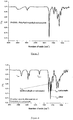
- the Figure 5 annexed represents the IRRAS spectra of the gold plate covered with an electro-grafted PMAN film (top), after reduction of the nitrile groups to amine by lithium aluminum hydride (medium), and after reaction of these groups amine with trifluoroacetic anhydride to form the amide (bottom).
- This example is intended to verify that the amine groups that were manufactured above in Example 3 are accessible and retain their reactivity. This is achieved by amidation of the amine functions, according to the procedure described in J. Org. Chem., 1989, 54, 2498 , and rehabilitated in this case for a reaction on a gold surface.
- Example 3 In a tube, 20 ml of a solution of 0.35 mol / l of trifluoroacetic anhydride in THF is prepared. The slide obtained at the end of Example 3 is immersed for 2 minutes at room temperature under argon (septum). The slide is removed, rinsed with dry THF and then dried by blowing with nitrogen.
- the coating obtained is analyzed by IRRAS (not shown), and is very characteristic of the formation of amide groups from amines: the appearance of the amide band at 1694 cm -1 , the lengthening band CN and NH strain at 1572 cm -1 , the elongation band CF at 1209 cm -1 with, around 1250 cm -1 , the deformation band CNH. At the same time, the almost total disappearance of the amine elongation band around 2929 cm -1 is observed.
- EXAMPLE 5 REACTIVITY OF AMINE GROUPS FORMED IN EXAMPLE 3 REACTION WITH 1,6-DIISOCYANATOHEXANE, FORMATION OF UREA.
- This example illustrates the reaction of the amine groups formed in Example No. 3 with a bifunctional coupling agent, to form a urea.
- Urea formed on the surface is used to fix an alcohol.
- the procedure for synthesizing urea at the surface is adapted from Org. Synth., 1988, VI, 951 .
- the film obtained is indeed reacted with trifluoroethanol according to the following protocol: in a tube, 30 ml of dry toluene (4 ⁇ molecular sieve), 1.5 ml of trifluoroethanol, and 3 drops of DBU are introduced.
- the slide carrying the electrografted film modified with 1,6-diisocyanatohexane and covered with a layer of dry toluene is placed therein.
- the slide is left in contact with the solution, under argon and with magnetic stirring, for 88 hours at room temperature.
- the slide is removed, rinsed with dry toluene, then with acetone, with deionized water, and finally with acetone by jets, and dried by blowing with nitrogen.
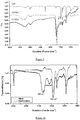
- the figure 6 annexed shows the IRRAS spectra of the gold plate covered with an electro-grafted PMAN film (CN), after reduction of the nitrile groups to amine by lithium aluminum hydride (CH 2 NH 2 ), after reaction of these amine groups with 1,6-diisocyanatohexane to form urea (CH 2 NHCONH (CH 2 ) 6 NCO), and after reaction with trifluoroethanol to form the carbamate (CH 2 NHCONH (CH 2 ) 6 NHCOOCH 2 CF 3 ).
- CN electro-grafted PMAN film
- the NCO band was also note the disappearance of the NCO band at 2271 cm -1 .
- Example 5 It is illustrated here that the urea formed in Example 5 above also allows the attachment of hydroxyethyl cellulose, and more generally polysaccharides.
- This pathway illustrates the reaction of a macromolecule of complex three-dimensional structure, the attachment of which is made possible by the great accessibility of the functional groups of interest on the electrografted coating. It is interesting because it allows the fixing of polymers or macromolecules which are difficult to fix on electrically conductive surfaces, and in particular on metals, and whose interest is to open the road to the surface realization biomimetics (heparin, modified dextrans, hyaluronic acid, etc ...) on metals, and binding module of molecules of biological interest complexes (DNA, proteins, growth factors ... etc.).
- a gold plate coated with an electrografted film modified with 1,6-diisocyanatohexane and bearing free isocyanate groups is produced, as described in Example 5 above.
- the IRRAS spectra of the support thus obtained is represented on the Figure 7 attached.
- CN electro-grafted PMAN film
- the secondary carbamate band at 1715 cm -1 is observed, as are the characteristic bands of hydroxyethyl cellulose between 1200 and 1000 cm -1 , which correspond to the elongation bands of the ether (COC) and alcohol (OH) groups.
- the Figure 8 shows, for comparison, the spectrum of the film obtained with the gold plate according to the invention and that of a KBr pellet containing hydroxyethyl cellulose. This spectrum confirms the binding of hydroxyethylcellulose to the support of the invention.
- Both reactions are carried out in the atmosphere, at 100 ° C (internal temperature) in Bechers or open flasks. After each treatment, the slides are rinsed by soaking for 5 minutes in water and then dried by blowing with nitrogen.
- Partial treatment is obtained by dipping the slide in the acidic medium for a time equal to or less than 5 seconds and dipping it for 5 to 10 seconds in the basic medium. A treatment of 30 seconds in the two media leads to the complete disappearance of the nitrile functions, which corresponds to their complete conversion.
- An IRRAS analysis is carried out before and after each step: gold leaf covered with the electro-grafted PMAN film before and after hydrolysis of the nitrile groups to amide (acid treatment) and then after conversion to carboxylic acid functions (basic treatment).
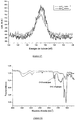
- the IRRAS spectra obtained are represented on the figure 9 attached.
- Example 3 30 ml of a 2 mg / l solution of avidin in phosphate-buffered saline (PBS) pH 7.2 are introduced into a tube equipped with a septum. A gold plate coated with an electro-grafted PMAN film as prepared above was placed in Example 3. The slide was allowed to react for 15 hours at a temperature of 4 ° C. It is then removed and rinsed with deionized water.
- PBS phosphate-buffered saline
- the IRRAS spectrum of the blade thus obtained is represented on the figure 10 attached.
- EXAMPLE 9 VERIFICATION OF THE ACTIVITY OF THE AVIDINE FIXED ON AN ELECTRO-GRAFTED PMAN FILM
- the avidin fixed according to the protocol of Example 8 is active, using it as a binding point for a biotinylated oligonucleotide (ODN).
- ODN biotinylated oligonucleotide
- the ODN used is the following 15-mer: Biotin - 5 '- GCTTGCTGAAGTTCG - 3' (Biotin - SEQ ID NO: 1)
- the slide obtained according to the method of Example 8 is immersed in a 25 ⁇ M solution of this ODN in PBS buffer (pH 7.2). The slide is reacted at room temperature for 15 hours, discharged and repeatedly rinsed with deionized water.
- ODN X-ray photoelectron spectroscopy
- EXAMPLE 10 FIXATION OF ANTI-BODIES ON AN ELECTRO-GRAFTED PMAN FILM AND VERIFICATION OF ITS ACTIVITY
- an electrografted film can be used as a primer for fixing molecules of complex three-dimensional structure, and where the structure is determining in the properties of the molecule.
- the great accessibility of the functional groups of interest present on the surface makes it possible in fact a minimal distortion of the probe protein, which can thus maintain an active conformation.
- an anti-body IgG anti-rabbit immunoglobulin is carried out.
- the activity and the specificity of this antibody are then verified by reaction with a specific antigen (rabbit IgG) and with a nonspecific anti-gene (sheep IgG).
- binding of anti-bodies in particular opens the way to cell attachment via electro-grafted polymers.
- the amine and alcohol functions are often used to bind antibodies to a surface. There are thus many commercial coupling agents for creating covalent bonds between the surface functions and those of immunoglobulins.
- the cyano function allows the direct fixation of the biomolecule. This method is original and has never been used to attach an immunoglobulin to a surface, including a conductive surface.
- the antibodies contain different functions: amine (NH 2 ), acid (COOH), hydroxyl (OH) and disulphide bridges (SS) which can lead to their clashes on surfaces.
- the amine and acid functions come from the amino acids, constituents of the antibodies, and are distributed throughout the protein. There are therefore several possible binding sites, allowing an easy but non-localized coupling, which can lead to an inactivation of the antibody (denaturation) with respect to the antigen.
- the amine and acid functions make it possible to graft the whole antibody to a surface. On the contrary, it is necessary to cut the disulfide bridges (SS) and thus generate thiol functions (SH). It is then the FAB 'fragments that are fixed.
- the biomolecule layer thus obtained is denser in reactive sites and further the antibodies are oriented because the thiol functions are present in the remaining constant part. This last characteristic is important because the antibody does not bind to one of its active sites. Immunoglobulins thus immobilized are less likely to be denatured and inactivated with respect to the antigens.
- the electrografted films make it possible both to provide a primary layer and to offer functional groups of interest immediately available for the attachment of biological probe molecules.
- the thus treated slide is plunged into a specific anti-gene solution (rabbit-IgG) at 2 mg / l in PBS buffer, and left for 15 hours at room temperature. It is then removed, rinsed by jets with deionized water and dried by blowing with nitrogen.
- a specific anti-gene solution (rabbit-IgG) at 2 mg / l in PBS buffer, and left for 15 hours at room temperature. It is then removed, rinsed by jets with deionized water and dried by blowing with nitrogen.
- the slide is analyzed by IRRAS before and after treatment with the antibody as well as after treatment with the antigen.
- ODN oligonucleotide
- carboxylic acid functions of an electrografted polymer are used to react with the amine functions of a single-stranded ODN carrying an amine function on its 5 'end: H 2 N - 5 '- GCTTGCTGAAGTTCG - 3' (H 2 N - SEQ ID NO: 1)
- a prior complementary functionalization of the film is carried out: starting from an electro-grafted PMAN film, on which the nitriles are reduced to amines, for example as indicated in FIG. Example 3
- the amines are reacted with glutaric anhydride to obtain carboxylic acid functions, according to the following protocol: in a tube is introduced 30 ml of dried THF on molecular sieve (4 ⁇ ), in which we add 1 g of glutaric anhydride.
- the slide carrying amine groups is introduced into the tube, and allowed to react for 17 hours at a temperature of 50 ° C under argon and magnetic stirring (septum). The slide is then rinsed with acetone and then dried by blowing with nitrogen.
- the residual amine groups are then destroyed by amidation with trifluoroacetic anhydride, according to the following protocol: in a tube is introduced 30 ml of dried THF on molecular sieve, then 1 ml of trifluoroacetic anhydride. Then the slide of the previous step, which is allowed to react for 2.5 minutes under argon with magnetic stirring, at room temperature. The blade is removed and then rinsed by soaking in deionized water for 5 minutes, then by jets of deionized water, and finally dried by blowing with nitrogen.
- the slide is analyzed by IRRAS before and after each step; the spectra thus obtained being represented on the Figure 13 attached.
- the surface thus functionalized is then reacted with a 15 ⁇ M solution of the ODN (15-mer) amine in position 5 ', in deionized water, in the presence of N-hydroxy-succinimide (NHS) and 1 Hydrochloric acid (dimethylaminopropyl) -3-ethyl carbodiimide (EDC) at room temperature for 15 hours.
- NHS N-hydroxy-succinimide
- EDC Hydrochloric acid
- the slide was removed, rinsed with deionized water and blown dry with nitrogen, then analyzed by IRRAS and XPS.
- the slide thus obtained is then reacted with a solution of the ODN strand complementary to the fixed first strand, in deionized water, for 15 hours at room temperature, taken out, rinsed with deionized water, and then dried by blowing. 'nitrogen.
- XPS analysis of the slide reveals the presence of phosphorus at a binding energy characteristic of the phosphate groups of the DNA.
- EXAMPLE 12 ELECTROGREYPING OF A PRECURSOR MONOMER WITH A SPACER ARM.
- AminoHexyl MethAcrylAmide (AHMAA) of the following formula:
- Example No. 3 This example illustrates the possibility of performing electrografting of a monomer carrying protic groups, a spacer arm, giving rise to an electrografted polymer whose functional groups of interest are all accessible. They constitute an alternative route to that of Example No. 3 to obtain an electro-grafted film carrying amine groups. Examples 4, 5, 6 and 11, repeated with the films of the present example, give similar results.
- a gold poly-AHMAA (PAHMMA) film is made by carrying out 20 voltammetric scans of -0.5 to -3.3 V / (Ag + / Ag) at 100 mV / s on a gold surface immersed in a 0.25 mol / l solution of AHMAA in DMF, in the presence of 5.10 -2 mol / l of TEAP. The slide is removed from the electrochemical cell and then rinsed vigorously with deionized water and then with acetone, and finally dried under a stream of nitrogen.
- IRRAS spectrum (not shown) is characteristic of the expected polymer, in particular with the characteristic bands of the ammonium group at 1613, 1522 and the harmonic at 2050 cm -1 , as well as a set of fine bands between 2400 and 2800 cm -1. , and the NH + elongation band at 3327 cm -1 , in addition to the amide bands at 1535 and 1465 cm -1 .
- the PAHMAA film obtained is then soaked with stirring for 15 minutes in a 1 mol / l solution of sodium hydroxide (NaOH).
- the slide is then rinsed with deionized water and then with acetone and finally dried as before.
- Its IRRAS spectrum (not shown) reveals the complete disappearance of the bands characteristic of the ammonium groups, and the appearance of the bands characteristic of the amine groups at 2933 cm -1 (elongation CH 2 -NH 2 ) and 3360 cm -1 (elongation NH d a primary amine). This result demonstrates accessibility total ammonium groups that are converted to amines by acid-base reaction with sodium hydroxide.
- the slide is then again soaked in a hydrochloric acid solution at 1 mol / l for 20 minutes, then rinsed and dried.
- the nitrogen K (N1s) threshold region has two peaks at 400 (amide) and 402 eV (ammonium) when the film is in ammonium form, and a single peak centered around 400.5 eV when in the form of amine.
- the aim of this example is to demonstrate that the electrografting of a partially derivatized macromolecule by activated vinyl groups can be carried out, and to have non-derivatized functional groups of said molecule for subsequent post-functionalization.
- the macromolecule used is a dextran functionalized with glycidyl-methacrylate (GMA) groups.
- dextran-GMA The macro-electrophile considered, named dextran-GMA, is represented by the formula below:
- dextran-GMA solution A solution, called dextran-GMA solution, is prepared by dissolving 0.25 g of dextran-GMA in 50 ml of DMF at 10 -2 mol / l in TEAP. The solution is therefore approximately 3.3 ⁇ 10 -4 mol / l dextran-GMA.
- gold blades are prepared by spraying Joule gold on glass slides pretreated with a chrome veil.
Landscapes
- Life Sciences & Earth Sciences (AREA)
- Chemical & Material Sciences (AREA)
- Health & Medical Sciences (AREA)
- Molecular Biology (AREA)
- Engineering & Computer Science (AREA)
- Materials Engineering (AREA)
- Wood Science & Technology (AREA)
- Organic Chemistry (AREA)
- Addition Polymer Or Copolymer, Post-Treatments, Or Chemical Modifications (AREA)
- Application Of Or Painting With Fluid Materials (AREA)
- Thin Film Transistor (AREA)
- Polymerisation Methods In General (AREA)
- Other Resins Obtained By Reactions Not Involving Carbon-To-Carbon Unsaturated Bonds (AREA)
- Apparatus Associated With Microorganisms And Enzymes (AREA)
- Other Surface Treatments For Metallic Materials (AREA)
- Electroluminescent Light Sources (AREA)
- Laminated Bodies (AREA)
- Adhesives Or Adhesive Processes (AREA)
Description
La présente Invention est relative à un support solide fonctionnalisé comportant une surface conductrice ou semi-conductrice de l'électricité recouverte d'une couche organique électro-greffée fonctionnalisée au sein de laquelle au moins 90 % du nombre des groupements fonctionnels est accessible, au procédé de préparation d'un tel support, ainsi qu'à ses utilisations, notamment à titre de primaire d'adhésion pour la fixation de molécules d'intérêt ou d'objets porteurs d'une fonction complémentaire ("velcro® moléculaire").The present invention relates to a functionalized solid support comprising a conductive or semiconducting surface of electricity covered with a functionalized electrografted organic layer in which at least 90% of the number of functional groups is accessible, to the process for the preparation of such a support, as well as for its uses, in particular as an adhesion primer for the fixation of molecules of interest or of objects carrying a complementary function ("molecular velcro®").
La fonctionnalisation d'une surface est l'opération par laquelle on parvient à fixer une molécule d'intérêt (par exemple une molécule ayant des propriétés avérées en solution) sur une surface, de façon - au moins - à ce qu'elle y conserve tout ou partie de ses propriétés. La fonctionnalisation d'une surface suppose donc que l'on dispose de la molécule d'intérêt et d'un procédé associé pour la fixer sur la surface.The functionalization of a surface is the operation by which it is possible to fix a molecule of interest (for example a molecule having proven properties in solution) on a surface, so - at least - that it retains all or part of its properties. The functionalization of a surface therefore supposes that the molecule of interest and an associated process are available to fix it on the surface.
La molécule d'intérêt étant le plus souvent une molécule organique (ou organo-métallique), le procédé le plus souvent utilisé consiste à tirer partie de la très large bibliothèque de réactions de la chimie organique : la logique est seulement de pouvoir trouver des groupements fonctionnels, respectivement sur la surface et sur la molécule d'intérêt, qui soient compatibles, c'est-à-dire qui puissent facilement - et si possible rapidement - réagir entre eux.Since the molecule of interest is most often an organic (or organometallic) molecule, the most commonly used method consists in taking advantage of the very large library of reactions of organic chemistry: the logic is only to be able to find groups functional, respectively on the surface and on the molecule of interest, which are compatible, that is to say that can easily - and if possible quickly - react with each other.
Lorsque l'on dispose par exemple d'une surface possédant des groupements hydroxyle ou amine, on peut la fonctionnaliser en dotant la molécule d'intérêt par exemple de groupements isocyanate ou siloxane tel que cela est par exemple décrit dans la demande de brevet
Lorsque la molécule d'intérêt ne dispose pas de groupements fonctionnels directement compatibles avec ceux de la surface, on peut pré-fonctionnaliser cette surface avec une molécule organique intermédiaire bifonctionnelle, dont l'un des groupements fonctionnels est compatible avec ceux de la surface, et l'autre avec ceux de la molécule que l'on veut fixer. On dit parfois que la molécule est un primaire d'adhésion (voir par exemple :
Selon la présente Invention, c'est la fixation de ce primaire d'adhésion qu'il convient de considérer comme la molécule d'intérêt : on s'intéresse ici à la façon de fixer un premier fragment organique sur une surface, en particulier lorsqu'elle est minérale, les étapes suivantes de post-fonctionnalisation étant considérées comme des réactions organiques pures.According to the present invention, it is the fixation of this adhesion primer that should be considered as the molecule of interest: here we are interested in how to fix a first organic fragment on a surface, particularly when it is mineral, the following stages of post-functionalization being considered as pure organic reactions.
De ce point de vue, on constate que la fonctionnalisation d'une surface n'est qu'un cas particulier de réactions de la chimie organique où l'un des deux réactifs est une surface, plutôt qu'une molécule en solution. Certes la cinétique associée aux réactions hétérogènes entre une solution et une surface est sensiblement différente de la réaction analogue en phase homogène, mais les mécanismes réactionnels sont - sur le principe - identiques.From this point of view, it is found that the functionalization of a surface is only a particular case of reactions of organic chemistry where one of the two reagents is a surface, rather than a molecule in solution. Although the kinetics associated with the heterogeneous reactions between a solution and a surface are substantially different from the analogous reaction in the homogeneous phase, the reaction mechanisms are identical in principle.
Dans certains cas, on active la surface en la pré-traitant de façon à y créer des groupements fonctionnels ayant une réactivité supérieure, de façon à obtenir une réaction plus rapide. Il peut notamment s'agir de groupements fonctionnels instables, formés de façon transitoire, comme par exemple des radicaux formés par oxydation brutale de la surface, soit par voie chimique, soit par voie d'irradiation :
- on peut fonctionnaliser une surface portant des groupements azotés en la bombardant par des particules (ions, électrons, protons...) de façon à transformer ces groupements azotés en nitrènes, qui peuvent réagir avec un grand nombre de groupements fonctionnels organiques tel que cela a déjà été décrit dans la demande internationale
WO 98/22542 US 6,022,597 - on peut fonctionnaliser une surface en lui faisant subir un traitement plasma, dans lequel le gaz de plasma contient un monomère susceptible de réagir avec les groupements réactifs formés lors de l'irradiation tel que cela a déjà été décrit dans le brevet
US 6,287,687 WO 01/34313 - on peut fonctionnaliser une surface hydroxylée en l'oxydant fortement par des sels métalliques, de façon à y fabriquer des radicaux susceptibles d'initier des réactions de polymérisation organique tel que cela a par exemple déjà été décrit dans les brevets
US 4,421,569 US 5,043,226 US 5,785,791 - on peut fonctionnaliser une surface par l'intermédiaire de radicaux, soit par irradiation aux ions lourds comme décrit par exemple dans le brevet
US 6,306,975 WO 98/49206 WO 99/16907
- we can functionalize a surface carrying nitrogenous groups by bombarding it with particles (ions, electrons, protons ...) so as to transform these nitrogenous groups into nitrenes, which can react with a large number of organic functional groups such that this has already described in the international application
WO 98/22542 US 6,022,597 - a surface can be functionalized by subjecting it to a plasma treatment, in which the plasma gas contains a monomer capable of reacting with the reactive groups formed during the irradiation as already described in the patent
US 6,287,687 WO 01/34313 - a hydroxylated surface can be functionalized by strongly oxidizing it with metal salts, so as to produce radicals capable of initiating organic polymerization reactions such as has already been carried out, for example described in the patents
US 4,421,569 US 5,043,226 US5,785,791 - one can functionalize a surface via radicals, or by irradiation with heavy ions as described for example in the patent
US 6,306,975 WO 98/49206 WO 99/16907
Dans tous ces exemples, dont la liste n'est pas exhaustive, on modifie donc soit la surface soit la molécule d'intérêt, de façon à ce que - une fois modifiée(s) - l'accrochage entre les deux entités se ramène à une réaction connue par ailleurs dans la bibliothèque des réactions de la chimie organique.In all these examples, the list of which is not exhaustive, therefore modifies either the surface or the molecule of interest, so that - once modified (s) - the snap between the two entities is reduced to a reaction known elsewhere in the library of reactions of organic chemistry.
Or, on observe que ce raisonnement n'est possible que dans la mesure où la surface a une structure électronique analogue à celle d'un isolant : dans le langage des physiciens, on peut dire qu'il faut que la surface possède des états localisés. Dans celui des chimistes, qu'elle possède des groupements fonctionnels.However, we observe that this reasoning is only possible insofar as the surface has an electronic structure similar to that of an insulator: in the language of physicists, we can say that the surface must have localized states . In that of chemists, that it possesses functional groupings.
Lorsque la surface est un conducteur ou un semi-conducteur non ou peu dopé, de tels états localisés n'existent pas : les états électroniques de la surface sont des états délocalisés. En d'autres termes, la notion de "groupement fonctionnel" (au sens de la chimie organique) n'a pas de sens, et il est ainsi impossible d'utiliser la bibliothèque des réactions de la chimie organique pour fixer une molécule d'intérêt sur une surface.When the surface is a conductor or semi-conductor with little or no doping, such localized states do not exist: the electronic states of the surface are delocalized states. In other words, the notion of "functional grouping" (in the sense of organic chemistry) does not make sense, and it is thus impossible to use the library of reactions of organic chemistry to fix a molecule of interest on a surface.
Deux exceptions notables existent : ce sont les réactions chimiques spontanées des fonctions thiols (-SH, voir notamment :
Or, ces réactions ne sont pas exploitables dans toutes les situations. En effet, les thiols, par exemple, donnent lieu à des liaisons soufre/métal fragiles. Ces liaisons sont rompues, par exemple, lorsque le métal est ultérieurement polarisé cathodiquement ou anodiquement, pour former respectivement des thiolates et des sulfonates, qui désorbent.However, these reactions are not exploitable in all situations. Indeed, thiols, for example, give rise to fragile sulfur / metal bonds. These bonds are broken, for example, when the metal is subsequently polarized cathodically or anodically, to form respectively thiolates and sulfonates, which desorb.
Mis à part ces deux exemples isolés, il n'existe pas de réaction chimique simple permettant de fonctionnaliser des surfaces conductrices ou semi-conductrices de l'électricité.Apart from these two isolated examples, there is no simple chemical reaction for functionalizing conductive or semiconducting surfaces. electricity.
Le moyen le plus employé pour réaliser la fixation de molécules organiques sur des surfaces conductrices ou semi-conductrices de l'électricité est de contourner la difficulté en se ramenant à un problème connu. Il s'agit de former sur ces surfaces, au préalable, des groupements hydroxyle, en assurant la promotion d'une couche d'oxyde (totalement ou partiellement hydratée) sur le métal. Sur le graphite, qui ne possède pas d'oxyde solide, l'anodisation produit cependant des groupements hydroxyle qui sont exploitables (on peut, dans certaines conditions, y fabriquer également des groupements carboxyles). Lorsque l'on a pu former des groupements hydroxyles sur la surface, on est ramené à une surface qui possède des états électroniques de surface localisés, c'est-à-dire des groupements fonctionnels, et on est ramené à un problème connu. En particulier, il est alors possible d'appliquer tous les procédés de fonctionnalisation qui ont été listés plus haut pour les surfaces d'isolants.The most used way to achieve the fixation of organic molecules on electrically conductive or semiconductive surfaces is to circumvent the difficulty by reducing to a known problem. It is to form on these surfaces, beforehand, hydroxyl groups, promoting a layer of oxide (totally or partially hydrated) on the metal. On graphite, which does not have a solid oxide, anodization produces, however, hydroxyl groups which are exploitable (it is possible, under certain conditions, to also make carboxyl groups therein). When hydroxyl groups have been formed on the surface, one is brought back to a surface which has localized surface electronic states, i.e., functional groups, and is brought back to a known problem. In particular, it is then possible to apply all the functionalization methods which have been listed above for the insulating surfaces.
Cependant, outre le fait qu'il est impossible de former une couche d'oxyde sur l'or ainsi que sur de nombreux métaux nobles, on délègue à la couche d'oxyde et à son mode d'obtention une large part de la responsabilité dans la solidité de l'interface qui sera fabriquée entre la molécule organique d'intérêt et la surface métallique (or certains oxydes, en particulier lorsqu'ils sont non stoechiométriques, ne sont pas couvrants voire non adhérents). De plus, cette voie nécessite au moins deux ou trois étapes pour aboutir à la fixation d'une molécule d'intérêt, puisqu'il faut d'abord construire la couche d'oxyde avant d'accrocher la molécule elle-même (deux étapes), ou bien avant d'accrocher un primaire d'adhésion qui permettra l'accrochage de la molécule d'intérêt (trois étapes).However, besides the fact that it is impossible to form an oxide layer on gold as well as on many noble metals, the oxide layer and its mode of production are delegated a large part of the responsibility. in the strength of the interface that will be manufactured between the organic molecule of interest and the metal surface (but some oxides, especially when they are non-stoichiometric, are not covering or even non-adherent). In addition, this pathway requires at least two or three steps to achieve the binding of a molecule of interest, since the oxide layer must first be constructed before the molecule is hooked up (two steps). ), or before hanging an adhesion primer that will allow the attachment of the molecule of interest (three steps).
Il est également possible de fixer des fragments organiques sur des surfaces conductrices et semi-conductrices par voie électrochimique.It is also possible to attach organic moieties to conductive and semiconductive surfaces electrochemically.
Le procédé décrit dans la demande internationale
Dans certains cas, lorsque aucun groupement fonctionnel n'est compatible à la fois avec ceux de la molécule d'intérêt et avec la réaction de diazotisation, l'utilisation du procédé de greffage des sels de diazonium nécessite de passer par une étape intermédiaire au cours de laquelle la couche électro-greffée est fonctionnalisée par un primaire d'adhésion bi-fonctionnel, dont l'un des groupements au moins est compatible avec les groupements fonctionnels de la molécule d'intérêt.In some cases, when no functional group is compatible both with those of the molecule of interest and with the diazotisation reaction, the use of the diazonium salt grafting process requires an intermediate step during of which the electrografted layer is functionalized by a bi-functional adhesion primer, at least one of which is compatible with the functional groups of the molecule of interest.
De plus, ce procédé ne permet pas - dans la pratique - de réaliser des couches épaisses, ce qui conduit à un nombre de groupements fonctionnels greffés relativement faible, et très proches de la surface. Les groupements fonctionnels qui ont été greffés sont globalement modérément accessibles pour des réactions de fonctionnalisation ultérieure avec une molécule organique. La conséquence pratique la plus directe de cette remarque est que les réactions de post-fonctionnalisation sur les surfaces conductrices recouvertes d'une couche organique selon ce procédé sont lentes.In addition, this method does not allow - in practice - to produce thick layers, which leads to a relatively small number of functional groups grafted, and very close to the surface. The functional groups that have been grafted are globally moderately accessible for subsequent functionalization reactions with an organic molecule. The most direct practical consequence of this remark is that the post-functionalization reactions on conductive surfaces covered with an organic layer according to this method are slow.
Or, on sait, depuis les années 1980, réaliser l'électro-greffage de polymères issus de monomères vinyliques ou cycliques sur des surfaces conductrices et semi-conductrices de l'électricité comme cela est décrit par exemple dans la demande de brevet
Il a par ailleurs déjà été proposé, notamment dans la demande de brevet
C'est dans la compréhension actuelle des mécanismes de l'électrogreffage, et dans les a priori qui y sont associés, que l'on peut comprendre les raisons pour lesquelles l'Homme de l'art ne s'est pas orienté vers l'utilisation de monomères présentant des groupements fonctionnels variés.It is in the current understanding of the mechanisms of electrografting, and in the a priori associated with it, that we can understand the reasons why the person skilled in the art did not turn towards the use of monomers having various functional groups.
Il semble aujourd'hui admis que l'obtention de films polymères greffés par électrogreffage de monomères vinyliques activés sur surfaces conductrices procède grâce à une électro-initiation de la réaction de polymérisation à partir de la surface, suivie d'une croissance des chaînes, monomère par monomère (C. Bureau, et al., 1997, pré-cité ;
Cette réaction de polymérisation est représentée sur le schéma A ci-après :

Dans ce schéma, la réaction de greffage correspond à l'étape 1, où la croissance a lieu à partir de la surface. L'étape 2 est la réaction parasite principale, qui conduit à l'obtention d'un polymère non greffé.In this scheme, the grafting reaction corresponds to step 1, where the growth takes place from the surface.
La croissance des chaînes greffées s'effectue donc par polymérisation purement chimique, c'est-à-dire indépendamment de la polarisation de la surface conductrice qui a donné lieu au greffage. Cette étape est donc sensible à (elle est en particulier interrompue par) la présence d'inhibiteurs chimiques de cette croissance.The growth of the grafted chains is therefore carried out by purely chemical polymerization, that is to say independently of the polarization of the conductive surface which gave rise to the grafting. This step is therefore sensitive to (it is in particular interrupted by) the presence of chemical inhibitors of this growth.
Dans l'exemple de la réaction représentée sur le schéma A ci-dessus, où l'on a considéré l'électrogreffage de l'acrylonitrile sous polarisation cathodique, la croissance des chaînes greffées s'effectue par polymérisation anionique. Cette croissance est interrompue notamment par des protons, et il a été démontré que la teneur en protons constitue même le paramètre majeur qui pilote la formation de polymère en solution, ainsi que les informations récupérées en cours de synthèse, et notamment l'allure des voltammogrammes qui accompagnent la synthèse (
Les traces d'eau, et plus généralement les protons labiles des solvants protiques, constituent des sources de protons préjudiciables à la croissance des chaînes greffées. Avant même que les mécanismes réactionnels de l'électrogreffage de monomères vinyliques aient été compris, ce point technique bloquant avait été clairement identifié par l'Homme de l'art.Traces of water, and more generally the labile protons of the protic solvents, constitute sources of protons detrimental to the growth of the grafted chains. Even before the reaction mechanisms of the electrografting of vinyl monomers were understood, this blocking technical point had been clearly identified by those skilled in the art.
C'est pourquoi, il apparaît impossible d'envisager une réaction d'électropolymérisation mettant en oeuvre des monomères comportant des groupements fonctionnels sources de protons (monomères protiques).Therefore, it appears impossible to envisage an electropolymerization reaction using monomers comprising functional groups sources of protons (protic monomers).
Du fait de ces limitations sévères portant à la fois sur les solvants et les types de monomères de synthèse, l'électrogreffage de monomères vinyliques sur les surfaces conductrices ou semi-conductrices de l'électricité reste un procédé ne permettant que le greffage de polymères relativement peu intéressants du point de vue de la fonctionnalisation chimique des surfaces.Due to these severe limitations on both the solvents and the types of synthetic monomers, the electrografting of vinyl monomers on conductive or semiconducting surfaces of electricity remains a method allowing only the grafting of polymers relatively not interesting from the point of view of the chemical functionalization of surfaces.
Pour cette raison, les films de polymères électro-greffés ont surtout été utilisés pour réaliser des fonctions passives : anti-corrosion ou lubrification comme cela a par exemple déjà été décrit dans les demandes de brevet
La Demande Internationale
Un besoin existe donc de pouvoir réaliser la fonctionnalisation de surfaces conductrices ou semi-conductrices de l'électricité par des couches organiques présentant une grande variété de groupements fonctionnels, ainsi qu'un grand nombre de groupements fonctionnels d'intérêt accessibles par unité de surface, de façon à assurer des réactions de post-fonctionnalisation plus rapides que celles disponibles actuellement.A need therefore exists to be able to achieve the functionalization of electrically conductive or semiconducting surfaces by organic layers having a large variety of functional groups, as well as a large number of functional groups of interest accessible per unit area, so that provide faster post-functionalization reactions than currently available.
La Demanderesse s'est en particulier donnée pour but de résoudre le problème d'interface minéral/organique de façon à pourvoir à un support conducteur ou semi-conducteur de l'électricité comportant une zone d'accroche fonctionnalisée ou "velcro® moléculaire" utile pour la fixation de molécules d'intérêt (molécules sondes) ou d'objets porteurs d'une fonction complémentaire.The Applicant has in particular set itself the goal of solving the mineral / organic interface problem so as to provide a conductive or semi-conducting support for electricity comprising a functionalized attachment zone or "molecular velcro®" useful for fixing molecules of interest (probe molecules) or objects carrying a complementary function.
Les détails techniques de la présente Invention, ainsi que les exemples de réalisation, démontrent qu'il est notamment possible, contrairement à l'enseignement de l'art antérieur, d'obtenir des groupements fonctionnels protiques - soit directement, soit indirectement - par électrogreffage, en ayant recours à des monomères vinyliques ou cycliques portant eux-mêmes des groupements protiques.The technical details of the present invention, as well as the exemplary embodiments, demonstrate that it is possible in particular, contrary to the teaching of the prior art, to obtain protic functional groups - either directly or indirectly - by electrografting. by using vinyl or cyclic monomers themselves carrying protic groups.
La présente Invention a donc pour premier objet un support solide comportant au moins une région conductrice et/ou semi-conductrice de l'électricité à oxyde réductible sur sa surface, caractérisé par le fait qu'au moins une zone de ladite surface est fonctionnalisée par un film organique électro-greffé obtenu à partir de précurseurs organiques électro-actifs comportant chacun au moins un groupement fonctionnel d'intérêt, lesdits précurseurs organiques étant choisis parmi les monomères vinyliques ou cycliques porteurs de groupements protiques, éventuellement en mélange avec des précurseurs organiques électro-actifs ne comportant pas de groupement fonctionnel d'intérêt, et par le fait que le nombre de groupements fonctionnels d'intérêt accessibles pour la formation d'une liaison covalente, ionique ou hydrogène avec un groupement complémentaire au sein dudit film représente au moins 90 % du nombre total des groupements organiques fonctionnels d'intérêt.The present invention therefore has as its first object a solid support comprising at least one conductive and / or semiconducting region of reducible oxide electricity on its surface, characterized in that at least one zone of said surface is functionalized by an electro-grafted organic film obtained from electroactive organic precursors each comprising at least one functional group of interest, said organic precursors being chosen from vinyl or cyclic monomers carrying protic groups, optionally mixed with organic electro precursors -active agents having no functional group of interest, and in that the number of functional groups of interest accessible for the formation of a covalent bond, ionic or hydrogen with a complementary group within said film represents at least 90 % of the total number of functional organic groups of interest.
Une des spécificités importantes de la présente Invention est que l'on réalise, par électrogreffage de revêtements organiques, un tapis de groupements fonctionnels d'intérêt dont une grande partie est accessible pour des réactions de post-fonctionnalisation - typiquement plus de 90 %.One of the important specificities of the present invention is that electrografting of organic coatings is carried out by a carpet of functional groups of interest, a large part of which is accessible for post-functionalisation reactions - typically more than 90%.
L'électrogreffage de revêtements organiques permet de fabriquer des liaisons d'interface de nature covalente entre un matériau conducteur ou semi-conducteur de l'électricité et un matériau organique.The electrografting of organic coatings makes it possible to manufacture covalent interface bonds between a conductive or semiconductor material of electricity and an organic material.
Le film organique fonctionnalisé du support conforme à la présente Invention constitue un véritable "velcro® moléculaire" sur lequel on peut ensuite tirer parti directement de toutes les propriétés du précurseur qui a été électro-greffé, qu'il s'agisse de propriétés chimiques ou physiques, pour y fixer divers objets, comme par exemple des molécules (chimiques ou biochimiques), des polymères, des cellules, ou même obtenir une fonction de collage envers un objet macroscopique, par exemple par adhésion chimique sur le précurseur greffé.The functionalized organic film of the support according to the present invention constitutes a true "molecular velcro®" on which we can then take advantage directly of all the properties of the precursor which has been electrografted, whether chemical properties or to fix various objects, such as molecules (chemical or biochemical), polymers, cells, or even obtain a gluing function towards a macroscopic object, for example by chemical adhesion to the grafted precursor.
Selon la présente Invention, on entend par groupement fonctionnel d'intérêt accessible, un groupement fonctionnel suffisamment disponible, notamment en termes stériques, pour former des liaisons covalentes, ioniques ou des liaisons hydrogène avec un groupement complémentaire d'une taille comparable à la sienne. La molécule porteuse de ce groupement fonctionnel complémentaire sera nommée molécule sonde.According to the present invention, the term "functional group of accessible interest" means a functional group that is sufficiently available, in particular in steric terms, to form covalent or ionic bonds or hydrogen bonds with a complementary group of a size comparable to its own. The carrier molecule of this complementary functional group will be called probe molecule.
Par groupements complémentaires, on entend des groupements fonctionnels de la chimie organique ou organométallique pouvant réagir ou interagir les uns avec les autres pour donner des adduits suffisamment stables pour être la source d'une fixation entre les deux entités chimiques - le revêtement et la molécule sonde - qui les portent. Dans ce cadre, il peut donc s'agir de groupements électrophiles ou acides de Lewis, comme les carbonyles, les carboxyles, les isocyanates, les époxydes, les diénophiles..., aptes à réagir avec des groupements nucléophiles ou bases de Lewis comme les amines, les alcools, les thiols, les diènes et polyènes... ; de groupements donneurs de liaisons H comme les amines, les alcools, les thiols, les acides carboxyliques..., aptes à interagir avec les donneurs de doublets libres comme les amines, les alcools, les thiols, les carboxyles, les carbonyles, les liaisons insaturées riches en électrons... ; de groupements cationiques, comme les ammoniums, les antimoniums, les sulfoniums, les diazoniums..., aptes à interagir avec les groupements anioniques comme les carboxylates, les phosphates, les phosphonates, les sulfates, les sulfonates, ... On pourra trouver facilement, dans toute monographie de chimie organique, une liste plus exhaustive des paires de groupements fonctionnels complémentaires.By complementary groups is meant functional groups of organic or organometallic chemistry which can react or interact with each other to give adducts sufficiently stable to be the source of a binding between the two chemical entities - the coating and the probe molecule - who wear them. In this context, it can therefore be electrophilic groups or Lewis acids, such as carbonyls, carboxyls, isocyanates, epoxides, dienophiles ..., capable of reacting with nucleophilic groups or Lewis bases such as amines, alcohols, thiols, dienes and polyenes ...; of donor groups of H bonds such as amines, alcohols, thiols, carboxylic acids, etc., capable of interacting with donors of free doublets such as amines, alcohols, thiols, carboxyls, carbonyls, linkages unsaturated electron-rich ...; cationic groups, such as ammoniums, antimoniums, sulphoniums, diazoniums ..., capable of interacting with anionic groups such as carboxylates, phosphates, phosphonates, sulphates, sulphonates, etc. It will be easy to find in any monograph of organic chemistry, a more exhaustive list of pairs of complementary functional groups.
L'accessibilité des groupements fonctionnels d'intérêt peut être évaluée, quantitativement, en mesurant par exemple le taux de conversion de ces groupements fonctionnels (par exemple par spectroscopie, infrarouge, UV-visible, de photoélectrons...etc) lors de la mise à réaction du revêtement contenant ces groupements avec une molécule sonde contenant un groupement fonctionnel complémentaire. Si la molécule sonde est de petite taille, elle pourra en effet probablement réagir avec tous les groupements fonctionnels d'intérêt du revêtement.The accessibility of the functional groups of interest can be evaluated, quantitatively, for example by measuring the conversion rate of these functional groups (for example by spectroscopy, infrared, UV-visible, photoelectrons, etc.) at the time of placing. reaction of the coating containing these groups with a probe molecule containing a complementary functional group. If the probe molecule is small, it may indeed react with all the functional groups of interest of the coating.
Selon l'Invention, on entend par précurseurs organiques électro-actifs ne comportant pas de groupement fonctionnel d'intérêt tout groupement organique éventuellement fonctionnalisé mais incapable de former des liaisons des liaisons covalentes, ioniques ou des liaisons hydrogène avec le groupement complémentaire donné et tel que défini ci-dessus.According to the invention, the term "electroactive organic precursors" does not include a functional group of interest any organic group optionally functionalized but incapable of forming bonds of covalent bonds, ionic bonds or hydrogen bonds with the given complementary group and such that defined above.
L'avantage d'un support comportant un revêtement ayant un grand nombre de fonctions accessibles s'exprime encore davantage lorsqu'il s'agit de fixer un objet de taille grande à très grande devant celle du groupement fonctionnel (typiquement, les objets de taille supérieure au nanomètre, et a fortiori supérieure à la dizaine, la centaine de nanomètres, voire au micromètre). Dans cette situation, tous les groupements d'intérêt accessibles du revêtement ne seront pas utilisés, mais ils seront en nombre suffisant pour s'accommoder au mieux aux contraintes stériques et plus généralement à la topologie de l'objet que l'on désire fixer sur ce revêtement. Généralement les précurseurs organiques sont choisis parmi :
- les monomères polymérisables et électrogreffables portant au moins un groupement fonctionnel organique d'intérêt. Le film organique électro-greffé obtenu est alors un polymère ;
- les monomères polymérisables et électrogreffables portant au moins un groupement fonctionnel permettant d'obtenir simplement, par dérivatisation, le groupement organique fonctionnel réactif d'intérêt voulu. On dit encore qu'il s'agit de monomères porteurs de synthons des groupements fonctionnels réactifs d'intérêt voulus. Le film organique électro-greffé obtenu est alors un polymère ;
- les molécules, macromolécules et objets fonctionnalisés par des monomères tels que ceux décrits ci-dessus. Le film organique obtenu n'est alors pas nécessairement de nature polymérique.
- polymerizable and electrograftable monomers bearing at least one organic functional group of interest. The electrografted organic film obtained is then a polymer;
- polymerizable and electrograftable monomers carrying at least one functional group which makes it possible to simply obtain, by derivatization, the reactive organic functional group of interest. It is still said that these monomers carry synthons reactive functional groups of interest. The electrografted organic film obtained is then a polymer;
- molecules, macromolecules and functionalized objects by monomers such as those described above. The organic film obtained is then not necessarily of a polymeric nature.
Parmi les monomères polymérisables, on peut en particulier citer les monomères vinyliques activés et les molécules clivables par attaque nucléophile, répondant respectivement aux formules (I) et (II) suivantes :

- A, B, R1 et R2, identiques ou différents, représentent un atome d'hydrogène, un radical alkyle en C1-C4, un radical nitrile ou une fonction organique choisie parmi les fonctions hydroxyle, aminé : -NHx avec x = 1 ou 3, thiol, acide carboxylique, ester, amide : -C(=O)NHy dans laquelle y = 1 ou 2, imide, imido-ester, aromatique et notamment pyridine, styrène ou halogéno styrène, halogénure d'acide : -C(=O)X dans laquelle X représente un atome d'halogène choisi parmi le fluor, le chlore et le brome, anhydride d'acide : -C(=O)OC(=O), nitrile, succinimide, phtalimide, isocyanate, époxyde, siloxane : -Si(OH)z dans laquelle z est un nombre entier compris entre 1 et 3 inclusivement, benzoquinone, carbonyle-diimidazole, para-toluène sulfonyle, para-nitrophényl chloroformiate, éthylénique et vinylique ou un groupement organique (ou bras espaceur) portant au moins une des fonctions énumérées ci-dessus tels que les groupements comportant plusieurs fonctions vinyliques comme par exemple le penta-érythritol tetra-méthacrylique ; étant entendu que l'un au moins de A et B et que l'un au moins de R1 et R2 représente une desdites fonctions organiques ou un groupement organique portant au moins une desdites fonctions ;
- n, m et p, identiques ou différents, sont des nombres entiers compris entre 0 et 20 inclusivement.
- A, B, R 1 and R 2 , which may be identical or different, represent a hydrogen atom, a C 1 -C 4 alkyl radical, a nitrile radical or an organic function chosen from hydroxyl functions, amine: -NH x with x = 1 or 3, thiol, carboxylic acid, ester, amide: -C (= O) NH y in which y = 1 or 2, imide, imido-ester, aromatic and in particular pyridine, styrene or halogen styrene, halogenide; acid: -C (= O) X wherein X represents a halogen atom selected from fluorine, chlorine and bromine, acid anhydride: -C (= O) OC (= O), nitrile, succinimide, phthalimide, isocyanate, epoxide, siloxane: -Si (OH) z in which z is an integer between 1 and 3 inclusive, benzoquinone, carbonyl-diimidazole, para-toluenesulfonyl, para-nitrophenyl chloroformate, ethylenic and vinylic or a group organic (or spacer arm) bearing at least one of the functions listed above such as groups comprising several vinyl functions c for example, tetra-methacrylic pentaerythritol; it being understood that at least one of A and B and at least one of R 1 and R 2 represents one of said organic functions or an organic group carrying at least one of said functions;
- n, m and p, identical or different, are integers between 0 and 20 inclusive.
Dans la notation ci-dessus, R1 et R2 sont des groupements qui dépendent d'un indice i non indiqué, i étant compris entre 0 et n. Ceci exprime le fait que les groupements R1 et R2 peuvent être en fait différents d'un (C(R1)R2) à l'autre dans la structure des molécules cycliques de formule (II) ci-dessus.In the above notation, R 1 and R 2 are groups which depend on an index i not indicated, i being between 0 and n. This expresses the fact that the groups R 1 and R 2 may in fact be different from one (C (R 1 ) R 2 ) to the other in the structure of the cyclic molecules of formula (II) above.
Parmi les monomères vinyliques activés de formule (I) ci-dessus, selon l'invention on peut notamment citer l'hydroxyéthyl-méthacrylate (HEMA), l'acrylate et le méthacrylate de glycidyle, l'acide acrylique, l'acide méthacrylique, l'aminopropyl méthacrylamide, et l'aminohexyl méthacrylamide. Parmi les molécules clivables par attaque nucléophile de formule (II) ci-dessus, on peut notamment citer des oxydes d'éthylène substitués. Selon l'Invention la surface conductrice ou semi-conductrice de l'électricité est de préférence une surface d'inox, d'acier, de fer, de cuivre, de nickel, de cobalt, de niobium, d'aluminium (notamment lorsqu'il est fraîchement brossé), d'argent, de titane, de silicium (dopé ou non), de nitrure de titane, de nitrure de tungstène, de nitrure de tantale ou une surface métallique noble choisie par les surfaces d'or, de platine, d'iridium ou de platine iridié ; les surfaces d'or étant particulièrement préférées selon l'Invention.Among the activated vinyl monomers of formula (I) above, according to the invention, mention may especially be made of hydroxyethyl methacrylate (HEMA), acrylate and glycidyl methacrylate, acrylic acid and methacrylic acid, aminopropyl methacrylamide, and aminohexyl methacrylamide. Among the Cleavable Molecules by Nucleophilic Attack of Formula (II) above, there may be mentioned substituted ethylene oxides. According to the invention the conductive or semi-conductive surface of the electricity is preferably a surface of stainless steel, steel, iron, copper, nickel, cobalt, niobium, aluminum (especially when it is freshly brushed), silver, titanium, silicon (doped or not), titanium nitride, tungsten nitride, tantalum nitride or a noble metal surface chosen by gold, platinum surfaces iridium or platinum iridium; gold surfaces being particularly preferred according to the invention.
Sur le support conforme à l'Invention, la densité des groupements fonctionnels d'intérêt accessibles est de préférence comprise entre 104/µm2 et 1010/µm2.On the support according to the invention, the density of the accessible functional groups of interest is preferably between 10 4 / μm 2 and 10 10 / μm 2 .
La présente Invention a également pour objet un procédé de préparation d'un support tel que décrit précédemment, caractérisé par le fait qu'il consiste à réaliser l'électrogreffage, en une seule étape, de précurseurs organiques électro-actifs sur au moins une zone d'au moins une région conductrice et/ou semi-conductrice de l'électricité à oxyde réductible sur sa surface d'un support solide, par électrolyse en milieu organique, d'une composition renfermant, dans ledit milieu organique, au moins un précurseur organique électro-actif comportant au moins un groupement fonctionnel d'intérêt, par mise en contact de ladite composition avec ladite zone, cette dernière étant soumise à un protocole de potentiel au cours duquel elle est portée, pendant tout ou partie du protocole de potentiel (voltammétrique, potentiostatique, multicréneaux, etc...), à un potentiel supérieur ou égal à un potentiel électrique seuil déterminé par rapport à une électrode de référence, ledit potentiel électrique seuil étant le potentiel au-delà duquel se produit le greffage desdits précurseurs et par le fait qu'un taux d'accessibilité en groupements fonctionnels d'intérêt d'au moins 90 % (en nombre) est obtenu :
- a) en ajustant le protocole de potentiel, et notamment le nombre de balayages et la vitesse de balayage lors d'un protocole répétitif (balayages voltammétriques multicréneaux, etc...) de façon à entraîner un taux de greffage inférieur ou égal à 60 %, et/ou
- b) par l'utilisation d'une composition dans laquelle les précurseurs organiques électro-actifs fonctionnalisés sont présents en mélange avec des précurseurs organiques électro-actifs ne comportant pas de groupement fonctionnel d'intérêt, ces derniers représentant alors de 0,1 % à 95 % du nombre total de précurseurs présents au sein de ladite composition, et/ou
- c) par l'utilisation de précurseurs organiques électro-actifs choisis parmi ceux dans lesquels le groupement fonctionnel d'intérêt est porté à l'extrémité d'un bras espaceur.
- a) by adjusting the potential protocol, and in particular the number of scans and the scanning speed during a repetitive protocol (multicellular voltammetric scans, etc.) so as to cause a grafting rate of less than or equal to 60% , and or
- b) by using a composition in which the functionalized electroactive organic precursors are present in a mixture with electroactive organic precursors which do not comprise a functional group of interest, the latter then representing from 0.1% to 95% of the total number of precursors present in said composition, and / or
- c) by the use of electroactive organic precursors chosen from those in which the functional group of interest is carried at the end of a spacer arm.
Par ce procédé, on peut fonctionnaliser la surface avec divers groupements organiques, et réaliser un véritable "velcro® moléculaire" sur lequel on peut ensuite tirer parti directement de toutes les propriétés du polymère qui a été greffé, qu'il s'agisse de propriétés chimiques ou physiques, pour y fixer divers "objets", comme par exemple des molécules (chimiques ou biochimiques), des polymères, des cellules, ou même obtenir une fonction de collage envers un objet macroscopique, par exemple par adhésion chimique sur le polymère greffé.By this method, the surface can be functionalized with various organic groups, and a real "molecular velcro®" can be made, which can then directly benefit from all the properties of the polymer that has been grafted, whether chemical or physical, to fix various "objects", such as molecules (chemical or biochemical), polymers, cells, or even obtain a function of gluing to a macroscopic object, for example by chemical adhesion to the graft polymer .
Ce résultat est inattendu, étant donné que tout groupement réactif présent sur un monomère vinylique (autre que la liaison vinylique elle-même), est susceptible de faire des réactions parasites voire d'interrompre ou d'interdire la croissance des chaînes lors de l'électro-polymérisation des chaînes greffées (voir par exemple :
Cependant, l'idée de la présente Invention tient en ce qu'il n'est pas nécessaire d'assurer une croissance de chaînes longues sur la surface pour pouvoir bénéficier de la fixation des groupements fonctionnels d'intérêt initialement portés par les monomères vinyliques fonctionnalisés. Dans cette optique, les réactions parasites, voire les réactions de terminaison, qui peuvent apparaître du fait de la présence - sur le monomère vinylique initial - de groupements fonctionnels protiques ou réactifs par rapport à l'extrémité en croissance, non protégés, sont de peu d'importance, tant qu'elles ne consomment pas la totalité des groupements fonctionnels d'intérêt présents sur les précurseurs.However, the idea of the present invention is that it is not necessary to ensure growth of long chains on the surface in order to benefit from the fixation of the functional groups of interest initially borne by the functionalized vinyl monomers. . In this regard, the parasitic reactions, or even the termination reactions, which may occur due to the presence - on the initial vinyl monomer - of unprotected protic or reactive functional groups with respect to the growing end, are shortly of importance, as long as they do not consume all the functional groups of interest present on the precursors.
En particulier, l'électrogreffage de monomères vinyliques ou cycliques porteurs de groupements organiques d'intérêt variés permet donc d'envisager les films organiques électro-greffés comme un moyen d'obtenir en une étape, sur les surfaces conductrices et semi-conductrices, ce que l'on pouvait obtenir en deux étapes au moins en passant par la fabrication préalable d'une couche d'oxyde (par exemple en combinant fabrication d'une couche d'oxyde et fonctionnalisation chimique par un primaire d'adhésion bi-fonctionnel). Le procédé conforme à l'Invention permet la formation de liaisons covalentes entre le métal et le polymère greffé, ce qui permet d'assurer la fabrication d'une couche ayant une contribution importante à la solidité de l'interface.In particular, the electrografting of vinyl or cyclic monomers carrying organic groups of varied interest thus makes it possible to envisage electro-grafted organic films as a means of obtaining in one step, on the conductive and semiconducting surfaces, this that it was possible to obtain at least two stages through the prior manufacture of an oxide layer (for example by combining the manufacture of an oxide layer and chemical functionalization with a bi-functional adhesion primer) . The method according to the invention allows the formation of covalent bonds between the metal and the graft polymer, which allows to ensure the manufacture of a layer having a significant contribution to the strength of the interface.
Selon ce procédé, et dans le cas de la variante a), l'ajustement du protocole de potentiel permet, notamment dans le cas des polymères, d'ajuster le taux de greffage, c'est-à-dire le nombre de chaînes de polymères greffées par unité de surface : un taux de greffage modéré permettra par exemple un espacement des chaînes suffisant pour permettre le mouillage du revêtement dans son épaisseur par un solvant adéquat, ainsi que l'entrée dans le film du revêtement de molécules sondes. Selon une forme de réalisation préférée de cette variante a), le taux de greffage est ajusté à une valeur comprise entre 10 et 40 %.According to this method, and in the case of variant a), the adjustment of the potential protocol makes it possible, in particular in the case of polymers, to adjust the degree of grafting, that is to say the number of graft polymers per unit area: a moderate grafting rate will allow for example a sufficient chain spacing to allow the wetting of the coating in its thickness by a suitable solvent, as well as the entry into the film of the coating of probe molecules. According to a preferred embodiment of this variant a), the degree of grafting is adjusted to a value of between 10 and 40%.
Dans le cas de la variante b), les groupements fonctionnels d'intérêt sont espacés les uns des autres en effectuant l'électrogreffage à partir d'un mélange de monomères différents, dont une partie seulement porte les groupements fonctionnels d'intérêt que l'on souhaite voir présents sur le revêtement final. Les proportions relatives des différents monomères permettent alors d'ajuster le nombre de groupements fonctionnels d'intérêt, et donc leur accessibilité. Selon une forme de réalisation préférée de cette variante b), les précurseurs organiques électro-actifs ne comportant pas de groupement fonctionnel d'intérêt représentent de 0,1 à 50 % du nombre total de précurseurs présents au sein de ladite composition.In the case of variant b), the functional groups of interest are spaced apart from one another by performing electrografting from a mixture of different monomers, only a portion of which carries the functional groups of interest that the we want to see present on the final coating. The relative proportions of the different monomers then make it possible to adjust the number of functional groups of interest, and therefore their accessibility. According to a preferred embodiment of this variant b), the electroactive organic precursors having no functional group of interest represent from 0.1 to 50% of the total number of precursors present in said composition.
Les conditions de concentration en précurseur fonctionnalisé (monomère ou autre) sont variables d'un précurseur à l'autre. On pourra cependant considérer comme préférentielles les concentrations comprises entre 0,1 et 10 mol/l, et en particulier entre 0,1 et 5 mol/l en ce qui concerne les précurseurs organiques électro-actifs comportant un groupement fonctionnel d'intérêt. Lorsque des précurseurs organiques électro-actifs ne comportant pas de groupement fonctionnel d'intérêt sont présents au sein de la composition organique (variante b)), ceux-ci sont alors présents à une concentration de préférence comprise entre 10-3 et 18 mol/l et encore plus préférentiellement entre 10-3 et 9 mol/l.The functionalized precursor concentration conditions (monomer or other) are variable from one precursor to another. Concentrations of between 0.1 and 10 mol / l, and in particular between 0.1 and 5 mol / l, with regard to the electroactive organic precursors containing a functional group of interest, may however be considered preferential. When electroactive organic precursors which do not comprise a functional group of interest are present within the organic composition (variant b), these are then present at a concentration preferably of between 10 -3 and 18 mol / l and even more preferably between 10 -3 and 9 mol / l.
Selon la variante c), on peut également améliorer l'accessibilité des groupements fonctionnels d'intérêt en les plaçant à l'extrémité d'un bras espaceur, qui peut être par exemple une chaîne de quelques atomes de carbone. Ce bras espaceur aura pu être présent directement sur les précurseurs du revêtement électro-greffé, ou bien rajouté a posteriori. Ces bras espaceurs trouvent notamment leur utilité lorsque l'objet à fixer sur le revêtement est de taille importante : la fixation d'un bras espaceur sur un revêtement électro-greffé est plus facile que celle d'un objet de taille importante, car la molécule (sonde) qui contient le bras espaceur est en général plus petite que l'objet. Elle peut donc se fixer sur la quasi-totalité des groupements fonctionnels d'intérêt accessibles du revêtement électro-greffé, et les remplacer par des groupements encore plus accessibles.According to variant c), the accessibility of the functional groups of interest can also be improved by placing them at the end of a spacer arm, which may for example be a chain of a few carbon atoms. This spacer arm could have been present directly on the precursors of the electrografted coating, or added a posteriori. These spacer arms are particularly useful when the object to be fixed on the coating is large: fixing a spacer arm on an electrografted coating is easier than that of a large object because the molecule (probe) that contains the spacer arm is usually smaller than the object. It can therefore be fixed on almost all of the functional groups of interest accessible to the electrografted coating, and replace them with even more accessible groups.
Selon ce procédé, l'électrolyse est de préférence réalisée par polarisation en conditions voltammétriques.According to this method, the electrolysis is preferably carried out by polarization under voltammetric conditions.
Le milieu organique mis en oeuvre au cours de ce procédé est de préférence choisi parmi la diméthylformamide, l'acétate d'éthyle, l'acétonitrile et le tétrahydrofurane.The organic medium used during this process is preferably selected from dimethylformamide, ethyl acetate, acetonitrile and tetrahydrofuran.
Ce milieu organique peut en outre renfermer au moins un électrolyte support pouvant notamment être choisi parmi les sels d'ammoniums quaternaires tels que les perchlorates, les tosylates, les tetrafluoroborates, les hexafluorophosphates, les halogénures d'ammoniums quaternaires, le nitrate de sodium et le chlorure de sodium.This organic medium may also contain at least one support electrolyte that can be chosen in particular from quaternary ammonium salts such as perchlorates, tosylates, tetrafluoroborates, hexafluorophosphates, quaternary ammonium halides, sodium nitrate and sodium nitrate. sodium chloride.
Parmi ces sels d'ammoniums quaternaires on peut en particulier citer à titre d'exemple le perchlorate de tetraéthylammonium (TEAP), le perchlorate de tetrabutylammonium (TBAP), le perchlorate de tetrapropylammonium (TPAP), le perchlorate de benzyltriméthylammonium (BTMAP).Among these quaternary ammonium salts, mention may be made, for example, of tetraethylammonium perchlorate (TEAP), tetrabutylammonium perchlorate (TBAP), tetrapropylammonium perchlorate (TPAP), benzyltrimethylammonium perchlorate (BTMAP).
On obtient par exemple un film de poly-méthacryloyl-succinimide sur or en réalisant 10 balayages voltammétriques de - 0,4 à -2,8 V/(Ag+/Ag) à 50 mV/s sur une surface d'or plongée dans une solution à 0,5 mol/l de méthacryloyl-succinimide dans la DMF, en présence de 5.10-2 mol/l de TEAP. Les fonctions succinimide sont détectées en spectroscopie infrarouge en réflexion/absorption (IRRAS) sur le film obtenu, après un rinçage de 5 minutes sous ultrasons. Comme il est détaillé ensuite dans les exemples de réalisation, ce film greffé permet facilement l'accrochage de poly-allyl-amine, par réaction des groupements amine de la poly-allyl-amine avec les groupements succinimide du poly-méthacryloyl-succinimide électro-greffé.For example, a gold poly-methacryloylsuccinimide film is obtained by carrying out 10 voltammetric scans of -0.4 to -2.8 V / (Ag + / Ag) at 50 mV / s on a surface of gold immersed in a 0.5 mol / l solution of methacryloylsuccinimide in DMF, in the presence of 5 × 10 -2 mol / l of TEAP. The succinimide functions are detected by infrared reflection / absorption spectroscopy (IRRAS) on the obtained film after a 5 minute flushing under ultrasound. As is further detailed in the exemplary embodiments, this grafted film easily allows the attachment of poly-allyl-amine, by reaction of the amine groups of the poly-allyl-amine with the succinimide groups of the poly-methacryloyl-succinimide electrolyte. graft.
On observe par ailleurs qu'un film de poly-méthacryloyl-succinimide peut également être obtenu à 0,18 mol/l dans l'acétonitrile, aussi bien sur or que sur platine.It is furthermore observed that a poly-methacryloylsuccinimide film can also be obtained at 0.18 mol / l in acetonitrile, both in gold and on platinum.
De façon alternative, on observe la formation d'un film électro-greffé de poly-hydroxyéthyl méthacrylate (PHEMA) sur or en réalisant 10 balayages voltammétriques de + 1,0 à - 3,0 V/(Ag+/Ag) à 50 mV/s sur une surface d'or plongée dans une solution à 0,4 mol/l d'hydroxyéthyl méthacrylate dans la DMF, en présence de 5.10-2 mol/l de TEAP (Tétra Ethyl Ammonium Perchlorate). On pourra remarquer que ce film est obtenu avec un monomère porteur de groupements hydroxyle non protégés, alors que l'art antérieur mentionnait qu'il fallait protéger ces groupements hydroxyle pour réaliser l'électrogreffage du HEMA (voir notamment la demande de brevet
L'Invention a enfin pour objet l'utilisation du support conforme à l'Invention à titre de primaire d'adhésion ("velcro® moléculaire") pour la fixation de molécules d'intérêt (molécules sondes) ou d'objets porteurs d'une fonction complémentaire.The invention finally relates to the use of the support according to the invention as an adhesion primer ("molecular velcro®") for the fixation of molecules of interest (probe molecules) or carrier objects. a complementary function.
Selon une première forme de réalisation avantageuse de cette utilisation, le support conforme à l'Invention peut être utilisé pour la fixation de protéines (avidine, anti-corps, facteurs de croissance...). Les applications potentielles concernent par exemple la réalisation de surfaces bio-actives (angioplastie, prothèses bio-actives...) favorisant l'adhésion cellulaire et éventuellement la recolonisation ; la réalisation de surfaces pouvant servir au tri cellulaire sélectif (par fixation d'anti-corps spécifiques de la paroi d'une cellule donnée) ; la réalisation de matrices de puces à protéines basées sur un support à plots conducteurs.According to a first advantageous embodiment of this use, the support according to the invention can be used for the attachment of proteins (avidin, anti-body, growth factors, etc.). Potential applications concern, for example, the production of bio-active surfaces (angioplasty, bio-active prostheses, etc.) promoting cell adhesion and possibly recolonization; the creation of surfaces that can be used for selective cell sorting (by fixing anti-bodies specific to the wall of a given cell); the production of protein chip arrays based on a support with conductive pads.
Selon une deuxième forme de réalisation avantageuse de cette utilisation, le support conforme à l'Invention peut également être utilisé pour la fixation de molécules d'acide nucléique telles que des molécules d'ADN, d'ARN ou d'oligonucléotides, par exemple pour la réalisation de surfaces bio-actives (oligo-nucléotides anti-sens), ou de plots d'accrochage pour les puces à analyse chimique ou biochimique, comme par exemple les puces à acide nucléique telles que les puces à ADN.According to a second advantageous embodiment of this use, the support according to the invention can also be used for the fixation of nucleic acid molecules such as DNA, RNA or oligonucleotide molecules, for example to the production of bioactive surfaces (antisense oligonucleotides), or attachment pads for chips with chemical or biochemical analysis, such as for example nucleic acid chips such as DNA chips.
Selon une troisième forme de réalisation avantageuse de cette utilisation, le support conforme à l'Invention peut également être utilisé une pour la fixation d'oligo-saccharides, et plus généralement de biomatériaux (polymères biocompatibles tels que des polysaccharides comme par exemple les dextranes, céramiques... etc) par exemple pour la réalisation de surfaces biocompatibles ou à propriétés encapsulantes.According to a third advantageous embodiment of this use, the support according to the invention can also be used for the fixation of oligosaccharides, and more generally of biomaterials (biocompatible polymers such as polysaccharides, for example dextrans, ceramics ... etc.) for example for the production of biocompatible surfaces or encapsulating properties.
Enfin, selon une quatrième forme de réalisation avantageuse de cette utilisation, le support conforme à l'Invention peut également être utilisé pour réaliser le collage d'objets sur des surfaces conductrices ou semi-conductrices par réactions chimiques de surface.Finally, according to a fourth advantageous embodiment of this use, the support according to the invention can also be used to realize bonding objects on conductive or semiconductive surfaces by surface chemical reactions.
Outre les dispositions qui précèdent, l'Invention comprend encore d'autres dispositions qui ressortiront de la description qui va suivre, qui se réfère à des exemples de préparations de supports conformes à l'Invention comportant une surface recouverte d'un film de poly-méthacryloyl-succinimide, de poly-hydroxyéthylméthacrylate ou de polyméthacrylonitrile (PMAN), un exemple illustrant l'utilisation d'un support recouvert d'un film de poly-méthacryloyl-succinimide électrogreffé à titre de primaire d'adhésion pour la fixation de poly-allyl-amine, à un exemple illustrant l'utilisation d'un support recouvert par un film de poly-hydroxyéthylméthacrylate à titre de primaire d'adhésion pour la formation d'un carbamate, à des exemples illustrant l'utilisation d'un support comportant un film de polyméthacrylonitrile à titre de primaire d'adhésion pour la fixation de diverses molécules ou macromolécules, ainsi qu'aux
- la
figure 1 représente le spectre IRRAS d'une surface d'or recouverte d'un film de poly-méthacryloyl-succinimide électrogreffé ; - la
figure 2 représente le spectre IRRAS d'une surface d'or recouverte d'un film de poly-méthacryloyl-succinimide, post-fonctionnalisé par de la poly-allyl-amine ; - la
figure 3 représente le spectre IRRAS d'une surface d'or recouverte d'un film de poly-hydroxyéthylméthacrylate ; - la
figure 4 représente le spectre IRRAS d'une surface d'or recouverte d'un film de poly-hydroxyéthylméthacrylate après réaction avec le diisocyanatohexane et formation d'un carbamate ; - la
figure 5 représente les spectres IRRAS d'une surface d'or recouverte d'un film de PMAN électrogreffé (spectre du haut), après réduction des groupements nitriles en amines (spectre du milieu) et après réaction de ces groupements amine avec l'anhydride trifluoroacétique pour former un amide (spectre du bas) ; - la
figure 6 représente les spectres IRRAS d'une surface d'or recouverte d'un film de PMAN électrogreffé (CN), après réduction des groupements nitriles en amines par l'alumino-hydrure de lithium (CH2NH2), après réaction de ces groupements amines avec le 1,6-diisocyanatohexane pour former l'urée (CH2NHCONH(CH2)6NCO), et après réaction sur le trifluoroéthanol pour former le carbamate (CH2NHCONH(CH2)6NHCOOCH2CF3) ; - la
figure 7 représente les spectres IRRAS d'une surface d'or recouverte d'un film de PMAN électrogreffé (CN), après réduction des groupements nitriles en amines par l'alumino-hydrure de lithium (CH2NH2), après réaction de ces groupements amines avec le 1,6-diisocyanatohexane pour former l'urée (CH2NHCONH(CH2)6NCO), et après réaction sur l'hydroxyéthyl cellulose pour former le carbamate correspondant ; - la
figure 8 représente les spectres IRRAS d'une surface d'or recouverte d'un film de PMAN électrogreffé sur lequel on a greffé de l'hydroxyéthyl cellulose et celui d'une pastille de KBr renfermant de l'hydroxyéthyl cellulose ; - la
figure 9 représente les spectres IRRAS d'une surface d'or recouverte d'un film de PMAN électrogreffé après hydrolyse des groupements nitrile e amide (traitement acide), puis en acide carboxylique (traitement basique) ; - la
figure 10 représente les spectres IRRAS d'une surface d'or recouverte d'un film de PMAN électrogreffé sur lequel on a greffé de l'avidine ; - la
figure 11 représente la région P2p du spectre réalisé en spectroscopie de photoélectrons X (XPS) d'une surface d'or recouverte d'un film de PMAN électrogreffé (a) ; après fixation d'avidine (b) et après fixation d'avidine et d'un oligonucléotide biotinylé à son extrémité 5' ; - la
figure 12 représente les spectres IRRAS d'une surface d'or recouverte d'un film de PMAN électrogreffé (a), sur lequel a été fixé un anti-corps anti-IgG de lapin (b), traitée par une solution d'antigène spécifique (c) ; - la
figure 13 représente les spectres IRRAS d'une surface d'or recouverte d'un film de PMAN électrogreffé (a), sur lequel les groupements nitriles ont été réduits (b), traités par l'anhydride glutarique pour former des amides (c), puis par l'anhydride trifluoroacétique (d) ; - la
figure 14 représente les spectres IRRAS de lafigure 13 (d), après réaction avec un oligonucléotide simple brin aminé en position 5', puis avec un second oligonucléotide complémentaire du premier ; - la
figure 15 représente la région P2p du spectre XPS du film de lafigure 13 (d) après réaction avec un oligonucléotide simple brin aminé en position 5', puis avec un second oligonucléotide complémentaire du premier ; et - la
figure 16 représente le spectre IRRAS d'un film de dextrane fonctionnalisé par des groupements glycidyl-méthacrylate électrogreffé (spectre haut) et le spectre du dextrane fonctionnalisé par des groupements glycidyl-méthacrylate avant électrogreffage (spectre bas).
- the
figure 1 represents the IRRAS spectrum of a gold surface covered with an electrografted poly-methacryloyl-succinimide film; - the
figure 2 represents the IRRAS spectrum of a gold surface covered with a poly-methacryloylsuccinimide film, post-functionalized with poly-allyl-amine; - the
figure 3 represents the IRRAS spectrum of a gold surface covered with a poly-hydroxyethyl methacrylate film; - the
figure 4 represents the IRRAS spectrum of a gold surface coated with a poly-hydroxyethylmethacrylate film after reaction with diisocyanatohexane and formation of a carbamate; - the
figure 5 represents the IRRAS spectra of a gold surface covered with an electrografted PMAN film (top spectrum), after reduction of the nitrile groups to amines (spectrum of the medium) and after reaction of these amine groups with trifluoroacetic anhydride for form an amide (bottom spectrum); - the
figure 6 represents the IRRAS spectra of a gold surface covered with an electrografted PMAN film (CN), after reduction of the nitrile groups to amines by lithium aluminum hydride (CH 2 NH 2 ), after reaction of these amine groups with 1,6-diisocyanatohexane to form urea (CH 2 NHCONH (CH 2 ) 6 NCO), and after reaction with trifluoroethanol to form carbamate (CH 2 NHCONH (CH 2 ) 6 NHCOOCH 2 CF 3 ) ; - the
figure 7 represents the IRRAS spectra of a gold surface covered with an electrografted PMAN film (CN), after reduction of the nitrile groups to amines by lithium aluminum hydride (CH 2 NH 2 ), after reaction of these groups amines with 1,6-diisocyanatohexane to form urea (CH 2 NHCONH (CH 2 ) 6 NCO), and after reaction on hydroxyethyl cellulose to form the corresponding carbamate; - the
figure 8 represents the IRRAS spectra of a gold surface covered with an electrografted PMAN film on which hydroxyethyl cellulose has been grafted and that of a KBr pellet containing hydroxyethyl cellulose; - the
figure 9 represents the IRRAS spectra of a gold surface covered with an electrografted PMAN film after hydrolysis of the nitrile and amide groups (acid treatment), then in carboxylic acid (basic treatment); - the
figure 10 represents the IRRAS spectra of a gold surface covered with an electrografted PMAN film onto which avidin has been grafted; - the
figure 11 represents the P 2p region of the spectrum made by X-ray photoelectron spectroscopy (XPS) of a gold surface covered with an electrografted PMAN film (a); after avidin fixation (b) and after binding of avidin and a biotinylated oligonucleotide at its 5 'end; - the
figure 12 represents the IRRAS spectra of a gold surface covered with an electrografted PMAN film (a), on which was fixed a rabbit anti-IgG antibody (b), treated with a specific antigen solution ( vs) ; - the
figure 13 represents the IRRAS spectra of a gold surface covered with an electrografted PMAN film (a), on which the nitrile groups were reduced (b), treated with glutaric anhydride to form amides (c), and then by trifluoroacetic anhydride (d); - the
figure 14 represents the IRRAS spectra of thefigure 13 (d) after reaction with a single-stranded amino oligonucleotide at the 5 'position, then with a second oligonucleotide complementary to the first; - the
figure 15 represents the P 2p region of the XPS spectrum of the film of thefigure 13 (d) after reaction with a single-stranded amino oligonucleotide at the 5 'position, then with a second oligonucleotide complementary to the first; and - the
figure 16 represents the IRRAS spectrum of a dextran film functionalized by electrografted glycidyl-methacrylate groups (high spectrum) and the spectrum of dextran functionalized by glycidyl-methacrylate groups before electrografting (low spectrum).
Les exemples 1 et 3-11 sont des exemples de référence.Examples 1 and 3-11 are reference examples.
Cet exemple illustre à la fois l'électro-greffage d'un monomère porteur d'un groupement fonctionnel d'intérêt pouvant entrer dans la fonctionnalisation par une molécule organique (groupement succinimide, électrophile), et la réaction de post-fonctionnalisation elle-même, via la réaction d'amines (nucléophiles) sur les groupements succinimide du polymère électro-greffé. La sonde porteuse des groupements amine est un polymère, la poly-allyl-amine, et la réaction de post-fonctionnalisation est donc une réaction polymère-sur-polymère, ce qui illustre la grande accessibilité des groupements succinimide du revêtement électro-greffé.This example illustrates both the electro-grafting of a monomer carrying a functional group of interest that can enter the functionalization by an organic molecule (succinimide group, electrophilic), and the post-functionalization reaction itself. via the reaction of amines (nucleophiles) on the succinimide groups of the electrografted polymer. The probe carrying the amine groups is a polymer, the poly-allyl amine, and the post-functionalisation reaction is therefore a polymer-on-polymer reaction, which illustrates the high accessibility of the succinimide groups of the electrografted coating.
On réalise 10 balayages voltamétriques de - 0,3 à - 2,5 V (Ag+/Ag) à 50 mV/s sur une surface d'or plongée dans une solution à 0,18 ; 0,25 ou 0,5mol/l de méthacryloyl-succinimide (MASU) dans la DMF, en présence de 5.10-2 mol/l de TEAP. On obtient un film de poly-méthacryloyl-succinimide, comme le prouve le spectre IRRAS de la surface représenté sur la
Ce spectre IRRAS a été réalisé après rinçage à l'acétone pendant 5 minutes sous ultrasons.This IRRAS spectrum was performed after rinsing with acetone for 5 minutes under ultrasound.
Le tableau 1 ci-après résume les caractéristiques IRRAS (intensité de la bande C=O des groupements succinimide) en fonction des conditions de synthèse.Table 1 below summarizes the IRRAS characteristics (intensity of the C = O band of the succinimide groups) as a function of the synthesis conditions.
Dans ce tableau VC indique un balayage en conditions voltamétriques ; les bornes de potentiel indiquées sont repérées par rapport à une électrode d'argent.
Dans un tube rôdé muni d'un agitateur magnétique, on introduit 20 ml d'eau désionisée, puis 0,5 ml d'une solution de poly-allyl-amine à 20 % en poids dans l'eau désionisée. On introduit ensuite la lame d'or portant un film de poly-méthacryloyl-succinimide électro-greffé, obtenu selon le protocole ci-dessus. La lame est laissée, sous agitation, pendant 1 heure et 30 min à température ambiante.20 ml of deionized water are introduced into a roamed tube equipped with a magnetic stirrer, followed by 0.5 ml of a 20% by weight solution of polyallyl amine in deionized water. The gold slide carrying an electrografted poly-methacryloyl succinimide film, obtained according to the above protocol, is then introduced. The slide is left, with stirring, for 1 hour and 30 min at room temperature.
Elle est ensuite sortie du tube, rincée à l'eau désionisée par jets, puis aux ultrasons dans l'eau désionisée pendant 2 minutes, et enfin séchée par soufflage d'azote.It is then removed from the tube, rinsed with deionized water by jets, then with ultrasound in deionized water for 2 minutes, and finally dried by blowing with nitrogen.
On observe par IRRAS (
Cet exemple illustre l'électrogreffage d'un monomère porteur de groupements hydroxyle (le HEMA), et la formation d'un film de PHEMA, ainsi que l'utilisation des groupements hydroxyle du PHEMA pour réagir avec les groupements isocyanate du diisocyanatohexane pour former un carbamate. Il illustre également la grande accessibilité des groupements hydroxyle du polymère électro-greffé vis-à-vis de la molécule sonde que constitue le diisocyanatohexane, puisque la totalité des groupements est convertie lors de la réaction.This example illustrates the electrografting of a monomer carrying hydroxyl groups (HEMA), and the formation of a PHEMA film, as well as the use of the hydroxyl groups of PHEMA to react with the isocyanate groups of diisocyanatohexane to form a carbamate. It also illustrates the high accessibility of the hydroxyl groups of the electrografted polymer vis-à-vis the probe molecule that is the diisocyanatohexane, since all the groups are converted during the reaction.
On réalise un film de PHEMA sur or par 10 balayages voltammétriques à 50 mV/s de -2,4 à +1 V (Ag+/Ag) sur une surface d'or plongée dans une solution d'hydroxyéthyl-méthacrylate (HEMA) à 2,7 mol/l dans la DMF, en présence de 5.10-2 mol/l de TEAP. Le spectre IRRAS du film obtenu est présenté sur la
Dans un tube rôdé sec, on introduit 30 ml de toluène séché sur tamis moléculaires 4 Å, 1,5 ml de diisocyanatohexane à 5 % en volume dans du toluène et 2 gouttes de 1,8-diazabicyclo [5,4,0] undec-7-ène (DBU).30 ml dried toluene on 4 Å molecular sieves, 1.5 ml of 5% by volume diisocyanatohexane in toluene and 2 drops of 1,8-diazabicyclo [5.4.0] undec were introduced into a dry roasted tube. -7-ene (DBU).
On introduit ensuite la lame d'or recouverte d'un film de PHEMA électro-greffé obtenue ci-dessus à l'étape précédente, préalablement trempée dans et recouverte d'une couche de toluène sec.Then introduced the gold plate covered with an electrografted PHEMA film obtained above in the previous step, previously soaked in and covered with a dry toluene layer.
Le tube est fermé, puis laissé à réagir à température ambiante sous argon pendant 142 heures. La lame est sortie, rincée au toluène sec puis à l'acétone sèche par jets. Elle est ensuite séchée à l'azote.The tube is closed and then allowed to react at room temperature under argon for 142 hours. The slide was removed, rinsed with dry toluene and then dry acetone by jets. It is then dried with nitrogen.
Le spectre IRRAS de la lame réalisé après réaction avec le diisocyanatohexane et formation du carbamate est représenté sur la
On observe l'apparition des bandes d'élongation νNH à 3330 cm-1, de la bande isocyanate N=C=O à 2264 cm-1. La bande à 1623 cm-1 est probablement due à la présence DBU résiduel. On observe également la disparition de la bande vers 3500 cm-1 due aux groupements hydroxyle, ce qui montre que la conversion de ces groupements a été quantitative, et qu'ils étaient donc tous accessibles pour la molécule sonde.The appearance of elongation bands ν NH at 3330 cm -1 is observed, from the isocyanate band N = C = O at 2264 cm -1 . The band at 1623 cm -1 is probably due to the presence of residual DBU. We also observe the disappearance of the band at 3500 cm -1 due to the hydroxyl groups, which shows that the conversion of these groups was quantitative, and that they were therefore all accessible for the probe molecule.
Cet exemple illustre l'utilisation des groupements nitrile d'un film de poly-méthacrylonitrile (PMAN) comme précurseurs de groupements amine, et la réactivité de ces groupements amine par formation d'amides avec l'anhydride trifluoroacétique. Ici encore, la réaction de fonctionnalisation est quantitative, ce qui montre que les groupements nitrile, puis amine, sont très accessibles.This example illustrates the use of nitrile groups of a poly-methacrylonitrile (PMAN) film as precursors of amine groups, and the reactivity of these amine groups by formation of amides with trifluoroacetic anhydride. Here again, the functionalization reaction is quantitative, which shows that the nitrile and then the amine groups are very accessible.
On réalise un film de PMAN sur or en effectuant 10 balayages voltammétriques de - 0,5 à - 2,7 V/(Ag+/Ag) à 50 mV/s sur une surface d'or plongée dans une solution à 2,5 mol/l de méthacrylonitrile dans la DMF, en présence de 5.10-2 mol/l de TEAP. On identifie les groupements nitrile du polymère formé par la bande à 2235 cm-1 en IRRAS.A PMAN film on gold is made by carrying out 10 voltammetric scans of -0.5 to -2.7 V / (Ag + / Ag) at 50 mV / s on a surface of gold immersed in a 2.5 solution. mol / l of methacrylonitrile in DMF, in the presence of 5 × 10 -2 mol / l of TEAP. The nitrile groups of the polymer formed by the band at 2235 cm -1 are identified by IRRAS.
Dans un tube équipé d'un septum, on introduit la lame recouverte du film de PMAN obtenue ci-dessus à l'étape a), soufflée à l'azote. On ferme le septum, puis on introduit sous argon, à l'aide d'une seringue purgée, 20 ml de pyridine séchée sur tamis moléculaire, et 1 ml d'une solution d'alumino-hydrure de lithium LiAlH4 à 1 mol/l dans du tetrahydrofuranne (THF) séché sur tamis moléculaire. On laisse la lame dans le milieu réactionnel pendant 2 minutes à 70°C. La lame est ensuite rincée à la pyridine par trempage pendant 5 minutes, puis à l'eau désionisée par jets, séchée par soufflage d'azote, traitée aux ultrasons pendant 1 minute dans une solution de soude à 1 mol/l, rincée à l'eau désionisée puis séchée par soufflage d'azote.In a tube equipped with a septum, introducing the blade covered with the PMAN film obtained above in step a), blown with nitrogen. The septum is closed, then 20 ml of dried pyridine on molecular sieves are introduced under argon, with the aid of a purged syringe, and 1 ml of 1 mol / l LiAlH 4 lithium aluminum hydride solution are added. 1 in tetrahydrofuran (THF) dried over molecular sieves. The slide is left in the reaction medium for 2 minutes at 70 ° C. The slide is then rinsed with pyridine by dipping for 5 minutes, then with jet-deionized water, dried by blowing with nitrogen, sonicated for 1 minute in a 1 mol / l solution of sodium hydroxide, rinsed with water. deionized water then dried by blowing with nitrogen.
La
On observe, la disparition de la bande d'élongation des nitriles à 2235 cm-1, et l'apparition de la bande d'élongation νNH des groupements NH2 entre 3250 et 3450 cm-1, la bande d'élongation asymétrique des CH2(NH2) à 2929 cm-1, et la bande de déformation des NH2 à 1642 cm-1, caractéristiques de la formation de poly-allyl-amine.The disappearance of the nitrile elongation band at 2235 cm -1 is observed, and the appearance of the ν NH elongation band of the NH 2 groups between 3250 and 3450 cm -1 , the asymmetric elongation band of CH 2 (NH 2 ) at 2929 cm -1 , and the deformation band of NH 2 at 1642 cm -1 , characteristic of the poly-allyl-amine formation.
Cet exemple a pour but de vérifier que les groupements amine qui ont été fabriqués ci-dessus à l'exemple 3 sont accessibles et conservent leur réactivité. Ceci est réalisé par amidation des fonctions amine, selon le mode opératoire décrit dans
Dans un tube, on réalise 20 ml d'une solution à 0,35 mol/l d'anhydride trifluoroacétique dans le THF. On trempe la lame obtenue à l'issue de l'exemple 3 pendant 2 minutes à température ambiante sous argon (septum). La lame est sortie, rincée au THF sec puis séchée par soufflage d'azote.In a tube, 20 ml of a solution of 0.35 mol / l of trifluoroacetic anhydride in THF is prepared. The slide obtained at the end of Example 3 is immersed for 2 minutes at room temperature under argon (septum). The slide is removed, rinsed with dry THF and then dried by blowing with nitrogen.
Le revêtement obtenu est analysé par IRRAS (non représenté), et est bien caractéristique de la formation de groupements amide à partir des aminés : on observe l'apparition de la bande amide à 1694 cm-1, la bande d'allongement CN et de déformation N-H à 1572 cm-1, la bande d'élongation C-F à 1209 cm-1 avec, vers 1250 cm-1, la bande de déformation CNH. Dans le même temps, on observe la disparition quasi totale de la bande d'élongation des amines vers 2929 cm-1.The coating obtained is analyzed by IRRAS (not shown), and is very characteristic of the formation of amide groups from amines: the appearance of the amide band at 1694 cm -1 , the lengthening band CN and NH strain at 1572 cm -1 , the elongation band CF at 1209 cm -1 with, around 1250 cm -1 , the deformation band CNH. At the same time, the almost total disappearance of the amine elongation band around 2929 cm -1 is observed.
On illustre dans cet exemple la réaction des groupements amine formés dans l'exemple n°3 avec un agent de couplage bi-fonctionnel, pour former une urée. L'urée formée en surface est mise à profit pour y fixer un alcool. Le mode opératoire de synthèse de l'urée en surface est adapté de
Dans un tube, on introduit 30 ml d'une solution à 5 % en volume de 1,6-diisocyanatohexane (ONC-(CH2)6-NCO) dans le toluène sec (séché sur tamis moléculaires 4 Å). On introduit une lame d'or portant un film électro-greffé contenant des groupements amine, et telle qu'obtenue à partir de l'exemple n°3, recouverte d'une couche de toluène sec. La lame est laissée à réagir pendant 22 heures à température ambiante sous agitation magnétique, sous argon. Elle est sortie du tube, rincée par jets de toluène sec, puis séchée par soufflage d'azote.In a tube, 30 ml of a 5% by volume solution of 1,6-diisocyanatohexane (ONC- (CH 2 ) 6 -NCO) in dry toluene (dried over 4 Å molecular sieves) are introduced. A gold plate carrying an electro-grafted film containing amine groups is introduced, and as obtained from Example No. 3, covered with a layer of dry toluene. The slide is allowed to react for 22 hours at room temperature under magnetic stirring under argon. It was removed from the tube, rinsed with jets of dry toluene and then dried by blowing with nitrogen.
Le film obtenu est en effet mis à réagir avec le trifluoroéthanol selon le protocole suivant : dans un tube, on introduit 30 ml de toluène sec (tamis moléculaire 4 Å), 1,5 ml de trifluoroéthanol, et 3 gouttes de DBU. On y place la lame portant le film électro-greffé modifié par le 1,6-diisocyanatohexane, recouverte d'une couche de toluène sec. La lame est laissée au contact de la solution, sous argon et sous agitation magnétique, pendant 88 heures à température ambiante. La lame est sortie, rincée au toluène sec, puis à l'acétone, à l'eau désionisée, et enfin à l'acétone par jets, et séchée par soufflage d'azote.The film obtained is indeed reacted with trifluoroethanol according to the following protocol: in a tube, 30 ml of dry toluene (4 Å molecular sieve), 1.5 ml of trifluoroethanol, and 3 drops of DBU are introduced. The slide carrying the electrografted film modified with 1,6-diisocyanatohexane and covered with a layer of dry toluene is placed therein. The slide is left in contact with the solution, under argon and with magnetic stirring, for 88 hours at room temperature. The slide is removed, rinsed with dry toluene, then with acetone, with deionized water, and finally with acetone by jets, and dried by blowing with nitrogen.
La
On observe les bandes d'allongement νN-H à 3330 cm-1, la bande d'élongation O=C=N à 2271 cm-1, ainsi que les bandes urée à 1633 et 1576 cm-1, preuves de la réaction des groupements amine initiaux avec au moins un des deux groupements isocyanate du 1,6-diisocyanatohexane. La bande O=C=N montre, de plus, qu'une partie des sites isocyanates reste disponible, ce qui est prouvé par l'utilisation de ces groupements pour réagir avec un alcool.The lengthening bands ν NH at 3330 cm -1 , the elongation band O = C = N at 2271 cm -1 , and the urea bands at 1633 and 1576 cm -1 are observed, evidence of the reaction of the groups amines with at least one of the two isocyanate groups of 1,6-diisocyanatohexane. The band O = C = N shows, moreover, that a part of the isocyanate sites remains available, which is proved by the use of these groups to react with an alcohol.
Après réaction sur le trifluoroéthanol pour former le carbamate (CH2NHCONH(CH2)6NHCOOCH2CF3, le spectre IRRAS de la lame obtenue montre également la bande C=O du carbamate à 1722 et à 1590 cm-1 (confondue avec celle de l'urée), la bande CH2O (CF3CH2O-) à 1256 cm-1, et les bandes d'élongation des liaisons C-F à 1179 cm-1. On note également la disparition de la bande NCO à 2271 cm-1.After reaction with trifluoroethanol to form the carbamate (CH 2 NHCONH (CH 2 ) 6 NHCOOCH 2 CF 3 , the IRRAS spectrum of the obtained plate also shows the C = O band of the carbamate at 1722 and at 1590 cm -1 (combined with that of urea), the CH 2 O (CF 3 CH 2 O-) band at 1256 cm -1 , and the CF bond elongation bands at 1179 cm -1 . We also note the disappearance of the NCO band at 2271 cm -1 .
Ici encore, la conversion des groupements fonctionnels successivement réalisés sur le revêtement est quantitative, ce qui montre leur grande accessibilité.Here again, the conversion of the functional groups successively carried out on the coating is quantitative, which shows their great accessibility.
On illustre ici le fait que l'urée formée dans l'exemple 5 ci-dessus permet également la fixation d'hydroxyéthyl cellulose, et plus généralement des polysaccharides. Cette voie illustre la réaction d'une macromolécule de structure tridimensionnelle complexe, dont l'accrochage est rendu possible par la grande accessibilité des groupements fonctionnels d'intérêt sur le revêtement électro-greffé. Elle est intéressante car elle permet la fixation de polymères ou de macromolécules qui sont difficiles à fixer sur des surfaces conductrices de l'électricité, et en particulier sur les métaux, et dont l'intérêt est d'ouvrir la route vers la réalisation de surface biomimétiques (héparine, dextranes modifiés, acide hyaluronique, etc...) sur métaux, et de module de fixation de molécules d'intérêt biologique complexes (ADN, protéines, facteurs de croissance...etc).It is illustrated here that the urea formed in Example 5 above also allows the attachment of hydroxyethyl cellulose, and more generally polysaccharides. This pathway illustrates the reaction of a macromolecule of complex three-dimensional structure, the attachment of which is made possible by the great accessibility of the functional groups of interest on the electrografted coating. It is interesting because it allows the fixing of polymers or macromolecules which are difficult to fix on electrically conductive surfaces, and in particular on metals, and whose interest is to open the road to the surface realization biomimetics (heparin, modified dextrans, hyaluronic acid, etc ...) on metals, and binding module of molecules of biological interest complexes (DNA, proteins, growth factors ... etc.).
On réalise une lame d'or recouverte d'un film électro-greffé modifié par du 1,6-diisocyanatohexane et porteuse de groupements isocyanate libres, comme décrit dans l'exemple 5 ci-dessus.A gold plate coated with an electrografted film modified with 1,6-diisocyanatohexane and bearing free isocyanate groups is produced, as described in Example 5 above.
Dans un tube, on introduit 30 ml de DMF séchée sur tamis moléculaire 4 Å. La solution est dégazée par barbotage d'argon pendant 10 minutes. On introduit ensuite 0,6 g d'hydroxyéthyl cellulose, et on chauffe la solution à 60°C pour obtenir la dissolution, sous agitation magnétique pendant 15 minutes. On ajoute ensuite 5 gouttes de DBU, puis on introduit la lame porteuse de groupements isocyanate, recouverte de sa solution de synthèse (toluène et 1,6-diisocyanatohexane en excès). La lame est laissée à réagir pendant 46 heures à 50°C sous argon et avec agitation magnétique. La lame est sortie et rincée pendant une heure dans l'eau désionisée sous agitation magnétique.In a tube, 30 ml of DMF dried on 4 Å molecular sieve is introduced. The solution is degassed by bubbling argon for 10 minutes. 0.6 g of hydroxyethyl cellulose is then introduced, and the solution is heated to 60 ° C. in order to obtain the dissolution, with magnetic stirring for 15 minutes. 5 drops of DBU are then added, then the slide carrying isocyanate groups is introduced, covered with its synthesis solution (toluene and 1,6-diisocyanatohexane in excess). The slide is allowed to react for 46 hours at 50 ° C under argon and with magnetic stirring. The slide is removed and rinsed for one hour in deionized water with magnetic stirring.
Les spectres IRRAS du support ainsi obtenu est représenté sur la
La
On illustre ici le fait que l'on peut utiliser un film de PMAN tel que celui obtenu ci-dessus à l'exemple 3 comme précurseur simple de groupements amide et acide carboxylique sur des surfaces métalliques. Cette transformation présente l'avantage d'aboutir facilement à la formation de groupements réactifs différents du film de départ, mais aussi de permettre la réalisation simple de surfaces hydrophiles à partir de films électro-greffés hydrophobes (ce qui facilite notamment l'utilisation des films comme primaires d'adhésion de composés hydrophiles, et peut être utile dans la fabrication de revêtements mieux admis dans les applications biomédicales).It is illustrated here that one can use a PMAN film such as that obtained above in Example 3 as a simple precursor of amide groups and carboxylic acid on metal surfaces. This transformation has the advantage of easily resulting in the formation of different reactive groups of the starting film, but also to allow the simple production of hydrophilic surfaces from hydrophobic electro-grafted films (which facilitates in particular the use of films as primary adhesion of hydrophilic compounds, and may be useful in the manufacture of coatings better accepted in biomedical applications).
Les fonctions nitrile ont été modifiées en fonctions acide carboxylique en deux étapes :
- Une étape acide :

R-CN + H2SO4 → R-CONH2
- Une étape basique :
R-CONH2 + NaOH → R-COOH
- An acid step:
R-CN + H 2 SO 4 → R-CONH 2
- A basic step:
R-CONH 2 + NaOH → R-COOH
Suivant le temps de réaction, on peut avoir de quelques % à 100 % de transformation. Ces traitements s'accompagnent d'une perte d'épaisseur importante. Après le traitement acide, la zone traitée est hydrophile. L'eau mouille bien la partie modifiée et forme "une couche" sur la surface.Depending on the reaction time, it can be from a few% to 100% of transformation. These treatments are accompanied by a significant loss of thickness. After the acid treatment, the treated area is hydrophilic. The water wets the modified part well and forms a "layer" on the surface.
Les deux réactions sont effectuées à l'atmosphère, à 100°C (température interne) dans des Bechers ou flacons ouverts. Après chaque traitement, les lames sont rincées par trempage de 5 minutes dans l'eau puis séchées par soufflage à l'azote.Both reactions are carried out in the atmosphere, at 100 ° C (internal temperature) in Bechers or open flasks. After each treatment, the slides are rinsed by soaking for 5 minutes in water and then dried by blowing with nitrogen.
Les solutions utilisées sont les suivantes :
- Solution acide :
- 21 ml de H2SO4 à 95% minimum
- 3,5 g de NaHSO4 : solution à environ 37 N ;
- Solution basique :
18 g de NaOH / 25 ml H2O : solution à 18 N.
- Acid solution :
- 21 ml of H 2 SO 4 at 95% minimum
- 3.5 g of NaHSO 4 : solution at approximately 37 N;
- Basic solution:
18 g of NaOH / 25 ml H 2 O: 18N solution
Un traitement partiel est obtenu en trempant la lame dans le milieu acide pendant un temps égal ou inférieur à 5 secondes et en la trempant pendant 5 à 10 secondes dans le milieu basique. Un traitement de 30 secondes dans les 2 milieux conduit à la disparition totale des fonctions nitrile, ce qui correspond à leur conversion complète.Partial treatment is obtained by dipping the slide in the acidic medium for a time equal to or less than 5 seconds and dipping it for 5 to 10 seconds in the basic medium. A treatment of 30 seconds in the two media leads to the complete disappearance of the nitrile functions, which corresponds to their complete conversion.
Une analyse IRRAS est effectuée avant et après chaque étape : lame d'or recouverte du film de PMAN électro-greffé avant et après hydrolyse des groupements nitrile en amide (traitement acide) puis après conversion en fonctions acide carboxylique (traitement basique).An IRRAS analysis is carried out before and after each step: gold leaf covered with the electro-grafted PMAN film before and after hydrolysis of the nitrile groups to amide (acid treatment) and then after conversion to carboxylic acid functions (basic treatment).
Les spectres IRRAS obtenus sont représentés sur la
L'analyse de ces spectres révèle, pour le traitement acide, la formation de bandes amide à 1680 cm-1 (élongation C=O), et des bandes de déformation des groupements NH2 à 1605 cm-1. Après traitement basique, on remarque le décalage de la bande carbonyle vers 1700 cm-1, ce qui correspond à des groupements acide carboxylique, probablement dimérisés.The analysis of these spectra reveals, for the acid treatment, the formation of amide bands at 1680 cm -1 (elongation C = O), and deformation bands of the NH 2 groups at 1605 cm -1 . After basic treatment, the offset of the carbonyl band is observed around 1700 cm -1 , which corresponds to carboxylic acid groups, probably dimerized.
On illustre ici que les groupements nitriles d'un film de PMAN électrogreffé peuvent être utilisés pour la fixation covalente de protéines. On sait en effet que les nitriles peuvent réagir avec les alcools, pour donner des imino-ethers (synthèse de Pinner, cf. :
R-CN + R'-OH → R-C(OR')=NH
It is shown here that the nitrile groups of an electrografted PMAN film can be used for the covalent attachment of proteins. It is known that nitriles can react with alcohols to give imino ethers (Pinner synthesis, cf.
R-CN + R'-OH → RC (OR ') = NH
Le même type de réaction est également connu pour les amines et les thiols. Comme dans l'exemple 6 ci-dessus, on parvient à réaliser la fixation d'une macromolécule de structure tridimensionnelle complexe, ce qui n'est possible que du fait de la grande accessibilité des fonctions nitrile du polymère électro-greffé. Dans l'exemple suivant, on illustre que cette accessibilité est telle qu'elle permet même la fixation de la protéine dans une conformation où elle conserve son activité, par réaction avec une molécule porteuse d'un fragment biotine ayant une très grande affinité pour l'avidine.The same type of reaction is also known for amines and thiols. As in Example 6 above, it is possible to achieve the fixing of a macromolecule of complex three-dimensional structure, which is possible only because of the high accessibility of the nitrile functions of the electrografted polymer. In the following example, it is shown that this accessibility is such that it even allows the binding of the protein in a conformation where it retains its activity, by reaction with a molecule carrying a biotin fragment having a very high affinity for the protein. avidin.
Dans un tube équipé d'un septum, on introduit 30 ml d'une solution à 2 mg/l d'avidine dans un tampon phosphate salin (PBS) de pH 7,2. On place une lame d'or recouverte d'un film de PMAN électro-greffé tel que préparée ci-dessus à l'exemple 3. La lame est laissée à réagir pendant 15 heures à une température de 4°C. Elle est ensuite sortie et rincée à l'eau désionisée.30 ml of a 2 mg / l solution of avidin in phosphate-buffered saline (PBS) pH 7.2 are introduced into a tube equipped with a septum. A gold plate coated with an electro-grafted PMAN film as prepared above was placed in Example 3. The slide was allowed to react for 15 hours at a temperature of 4 ° C. It is then removed and rinsed with deionized water.
Le spectre IRRAS de la lame ainsi obtenu est représenté sur la
L'analyse de ce spectre montre la présence des bandes amide I (1666 cm-1) et II (1545 cm-1), ainsi que les bandes du squelette (1469 cm-1) caractéristiques de la protéine.Analysis of this spectrum shows the presence of the amide I (1666 cm -1 ) and II (1545 cm -1 ) bands, as well as the backbone bands (1469 cm -1 ) characteristic of the protein.
On illustre dans cet exemple que l'avidine fixée selon le protocole de l'exemple 8 est active, en l'utilisant comme point de fixation d'un oligonucléotide (ODN) biotinylé. L'ODN utilisé est le 15-mer suivant :
Biotine - 5' - GCTTGCTGAAGTTCG - 3' (Biotine - SEQ ID N°1)
It is illustrated in this example that the avidin fixed according to the protocol of Example 8 is active, using it as a binding point for a biotinylated oligonucleotide (ODN). The ODN used is the following 15-mer:
Biotin - 5 '- GCTTGCTGAAGTTCG - 3' (Biotin - SEQ ID NO: 1)
Dans un tube, on plonge la lame obtenue selon le procédé de l'exemple 8 dans une solution à 25 µM de cet ODN dans un tampon PBS (pH 7,2). La lame est mise à réagir à température ambiante pendant 15 heures, sortie et rincée par jets à plusieurs reprises à l'eau désionisée.In a tube, the slide obtained according to the method of Example 8 is immersed in a 25 μM solution of this ODN in PBS buffer (pH 7.2). The slide is reacted at room temperature for 15 hours, discharged and repeatedly rinsed with deionized water.
La présence de l'ODN est détectée par spectroscopie de photoélectrons X (XPS). Les courbes correspondant à cette analyse ainsi qu'à celle d'une lame recouverte d'un simple film de PMAN électro-greffé et à celle de la lame obtenu ci-dessus à l'exemple 8 (après fixation de l'avidine) sont représentées sur la
Ces résultats montrent que la lame préparée conformément à l'exemple 8 permet de fixer l'avidine dans une conformation où elle conserve son activité, par réaction avec une molécule porteuse d'un fragment biotine ayant une très grande affinité pour l'avidine.These results show that the slide prepared according to Example 8 makes it possible to fix the avidin in a conformation in which it retains its activity, by reaction with a molecule carrying a biotin fragment having a very high affinity for avidin.
On illustre ici le fait qu'un film électro-greffé peut être utilisé comme primaire de fixation de molécules de structure tridimensionnelle complexe, et où la structure est déterminante dans les propriétés de la molécule. La grande accessibilité des groupements fonctionnels d'intérêt présents sur la surface permet en effet une distorsion minimale de la protéine sonde, qui peut ainsi conserver une conformation active.It is illustrated here that an electrografted film can be used as a primer for fixing molecules of complex three-dimensional structure, and where the structure is determining in the properties of the molecule. The great accessibility of the functional groups of interest present on the surface makes it possible in fact a minimal distortion of the probe protein, which can thus maintain an active conformation.
On réalise pour cela la fixation d'un anti-corps, l'immunoglobuline anti-rabbit IgG. L'activité et la spécificité de cet anti-corps sont ensuite vérifiés par réaction d'une part avec un anti-gène spécifique (rabbit IgG), et d'autre part avec un anti-gène non spécifique (sheep IgG).For this purpose, the binding of an anti-body IgG anti-rabbit immunoglobulin is carried out. The activity and the specificity of this antibody are then verified by reaction with a specific antigen (rabbit IgG) and with a nonspecific anti-gene (sheep IgG).
Il est à noter que la fixation d'anti-corps ouvre notamment la voie vers la fixation de cellule via des polymères électro-greffés.It should be noted that the binding of anti-bodies in particular opens the way to cell attachment via electro-grafted polymers.
Pour permettre la fixation d'anticorps sur une surface (par exemple sur le transducteur d'un capteur), il est en général nécessaire, au préalable, de modifier l'électrode. De ce fait, de nombreux groupements superficiels peuvent être créés, mais qui doivent permettre le couplage des immunoglobulines, aussi trois types de fonctions ont retenu notre attention : amine, alcool, cyano.To allow the attachment of antibodies on a surface (for example on the transducer of a sensor), it is generally necessary, beforehand, to modify the electrode. As a result, many superficial groupings can be created, but which must allow the coupling of the immunoglobulins, also three types of functions caught our attention: amine, alcohol, cyano.
Les fonctions amine et alcool sont souvent utilisées pour fixer des anticorps sur une surface. Il existe ainsi de nombreux agents de couplage commerciaux permettant de créer des liaisons covalentes entre les fonctions superficielles et celles des immunoglobulines.The amine and alcohol functions are often used to bind antibodies to a surface. There are thus many commercial coupling agents for creating covalent bonds between the surface functions and those of immunoglobulins.
Par contre, la fonction cyano permet la fixation directe de la biomolécule. Cette méthode est originale et n'a jamais été utilisée pour fixer une immunoglobuline à une surface, et notamment à une surface conductrice.On the other hand, the cyano function allows the direct fixation of the biomolecule. This method is original and has never been used to attach an immunoglobulin to a surface, including a conductive surface.
Les anticorps contiennent différentes fonctions : amine (NH2), acide (COOH), hydroxyle (OH) et ponts disulfure (S-S) pouvant conduire à leurs accrochages sur des surfaces. Les fonctions amine et acide proviennent des acides aminés, constituants des anticorps, et sont réparties dans toute la protéine. Il y a donc plusieurs sites de fixation possibles, permettant un couplage aisé mais non localisé, pouvant conduire à une inactivation de l'anticorps (dénaturation) vis-à-vis de l'antigène. Les fonctions amine et acide permettent de greffer l'anticorps entier à une surface. Au contraire, il est nécessaire de couper les ponts disulfure (S-S) et donc de générer des fonctions thiol (SH). Ce sont alors les fragments FAB' qui sont fixés. La couche de biomolécules ainsi obtenue est plus dense en sites réactifs et de plus les anticorps sont orientés car les fonctions thiol sont présentes dans la partie constante restante. Cette dernière caractéristique est importante car l'anticorps ne se fixe pas par l'un de ses sites actifs. Les immunoglobulines ainsi immobilisées ont moins de risque d'être dénaturées et inactivées vis-à-vis des antigènes.The antibodies contain different functions: amine (NH 2 ), acid (COOH), hydroxyl (OH) and disulphide bridges (SS) which can lead to their clashes on surfaces. The amine and acid functions come from the amino acids, constituents of the antibodies, and are distributed throughout the protein. There are therefore several possible binding sites, allowing an easy but non-localized coupling, which can lead to an inactivation of the antibody (denaturation) with respect to the antigen. The amine and acid functions make it possible to graft the whole antibody to a surface. On the contrary, it is necessary to cut the disulfide bridges (SS) and thus generate thiol functions (SH). It is then the FAB 'fragments that are fixed. The biomolecule layer thus obtained is denser in reactive sites and further the antibodies are oriented because the thiol functions are present in the remaining constant part. This last characteristic is important because the antibody does not bind to one of its active sites. Immunoglobulins thus immobilized are less likely to be denatured and inactivated with respect to the antigens.
Excepté dans le cas des fonctions cyano, il est indispensable d'utiliser un agent de couplage qui permet de relier de façon covalente les fonctions de la surface et de l'anticorps. On illustre ici le fait que les films électro-greffés permettent à la fois d'assurer une couche primaire et d'offrir des groupements fonctionnels d'intérêt immédiatement disponibles pour l'accrochage de molécules sondes biologiques.Except in the case of cyano functions, it is essential to use a coupling agent that covalently connects the functions of the surface and the antibody. It is illustrated here that the electrografted films make it possible both to provide a primary layer and to offer functional groups of interest immediately available for the attachment of biological probe molecules.
Dans un tube on introduit une solution à 2 mg/l d'anti-rabbit IgG en tampon PBS (pH 7,2). On plonge dans cette solution une lame d'or recouverte d'un film de PMAN électro-greffé telle que préparée ci-dessus à l'exemple 3. La lame est laissée à réagir pendant 15 heures à 4°C, puis sortie et rincée par jets d'eau désionisée et séchée par soufflage d'azote.In a tube is introduced a solution of 2 mg / l of anti-rabbit IgG in PBS buffer (pH 7.2). This solution is dipped into a gold plate covered with an electro-grafted PMAN film as prepared above in Example 3. The blade is left to react for 15 hours at 4 ° C, then out and rinsed by jets of deionized water and dried by blowing with nitrogen.
La lame ainsi traitée est replongée dans une solution d'anti-gène spécifique (rabbit-IgG) à 2 mg/l en tampon PBS, et laissée pendant 15 heures à température ambiante. Elle est ensuite sortie, rincée par jets à l'eau désionisée et séchée par soufflage d'azote.The thus treated slide is plunged into a specific anti-gene solution (rabbit-IgG) at 2 mg / l in PBS buffer, and left for 15 hours at room temperature. It is then removed, rinsed by jets with deionized water and dried by blowing with nitrogen.
La lame est analysée par IRRAS avant et après traitement par l'anticorps ainsi qu'après traitement par l'antigène.The slide is analyzed by IRRAS before and after treatment with the antibody as well as after treatment with the antigen.
Les spectres IRRAS ainsi obtenus sont représentés sur la
L'analyse de ces spectres révèle les bandes amide I (1655 cm-1) et II (1546 cm-1), ainsi que les bandes du squelette de la protéine à 1469 cm-1.Analysis of these spectra reveals the amide I (1655 cm -1 ) and II (1546 cm -1 ) bands, as well as the backbone bands of the protein at 1469 cm -1 .
On observe également une augmentation des bandes amide I (1655 cm-1) et II (1546 cm-1), et des bandes du squelette de la protéine à 1469 cm-1, prouvant que la quantité de protéines fixées sur la surface a augmenté (on remarque un quasi doublement de l'intensité de ces bandes sous l'effet du couplage avec l'antigène, dont la taille est approximativement la même que celle de l'anti-corps).An increase in amide I (1655 cm -1 ) and II (1546 cm -1 ) bands and skeletal bands of the protein at 1469 cm -1 are also observed, showing that the amount of protein bound to the surface has increased (We note a quasi doubling of the intensity of these bands under the effect of the coupling with the antigen, whose size is approximately the same as that of the anti-body).
Ce résultat est d'autant plus probant que lorsque l'on traite dans les mêmes conditions une lame recouverte d'anti-corps (anti-rabbit IgG) dans une solution contenant un anti-gène non spécifique (sheep IgG), on n'observe - sur le spectre IRRAS (non représenté) - qu'une très faible augmentation des bandes caractéristiques ci-dessus (probablement du fait d'adsorptions non spécifiques).This result is all the more convincing when, under the same conditions, treating a slide coated with anti-body (anti-rabbit IgG) in a solution containing a non-specific anti-gene (sheep IgG), it is not possible to observed - on the IRRAS spectrum (not shown) - a very small increase in the above characteristic bands (probably due to non-specific adsorptions).
On illustre ici la fixation d'oligonucléotides (ODN) sur les fonctions réactives d'un polymère électro-greffé, selon une voie alternative de celle vue dans l'exemple 9 ci-dessus.Here, the oligonucleotide (ODN) binding to the reactive functions of an electrografted polymer is illustrated in an alternative way from that seen in Example 9 above.
Pour cela, on utilise les fonctions acide carboxylique d'un polymère électro-greffé pour les faire réagir avec les fonctions amine d'un ODN simple brin portant une fonction amine sur son extrémité 5' :
H2N - 5' - GCTTGCTGAAGTTCG - 3' (H2N- SEQ ID N° 1)
For this purpose, the carboxylic acid functions of an electrografted polymer are used to react with the amine functions of a single-stranded ODN carrying an amine function on its 5 'end:
H 2 N - 5 '- GCTTGCTGAAGTTCG - 3' (H 2 N - SEQ ID NO: 1)
La fixation de ce brin est ensuite révélée par hybridation avec le brin complémentaire non fonctionnalisé :
5' - CGAACGACTTCAAGC - 3' (SEQ ID N°2)
Fixation of this strand is then revealed by hybridization with the nonfunctionalised complementary strand:
5 '- CGAACGACTTCAAGC - 3' (SEQ ID NO: 2)
De façon à illustrer ici le recours possible à des bras espaceurs, on effectue une fonctionnalisation complémentaire préalable du film : on part d'un film de PMAN électro-greffé, sur lequel les nitriles sont réduits en amines, par exemple comme indiqué dans l'exemple 3. Les amines sont mises à réagir avec de l'anhydride glutarique pour obtenir des fonctions acide carboxylique, selon le protocole suivant : dans un tube, on introduit 30 ml de THF séché sur tamis moléculaire (4 Å), dans lesquels on rajoute 1 g d'anhydride glutarique. La lame porteuse de groupements amine est introduite dans le tube, et laissée à réagir pendant 17 heures à une température de 50°C sous argon et agitation magnétique (septum). La lame est ensuite rincée à l'acétone, puis séchée par soufflage d'azote.In order to illustrate here the possible use of spacer arms, a prior complementary functionalization of the film is carried out: starting from an electro-grafted PMAN film, on which the nitriles are reduced to amines, for example as indicated in FIG. Example 3 The amines are reacted with glutaric anhydride to obtain carboxylic acid functions, according to the following protocol: in a tube is introduced 30 ml of dried THF on molecular sieve (4 Å), in which we add 1 g of glutaric anhydride. The slide carrying amine groups is introduced into the tube, and allowed to react for 17 hours at a temperature of 50 ° C under argon and magnetic stirring (septum). The slide is then rinsed with acetone and then dried by blowing with nitrogen.
Les groupements amine résiduels sont ensuite détruits par amidation avec l'anhydride trifluoroacétique, selon le protocole suivant : dans un tube, on introduit 30 ml de THF séché sur tamis moléculaire, puis 1 ml d'anhydride trifluoroacétique. On introduit ensuite la lame de l'étape précédente, qui est laissée à réagir pendant 2,5 minutes sous argon avec agitation magnétique, à température ambiante. La lame est sortie puis rincée par trempage dans l'eau désionisée pendant 5 minutes, puis par jets d'eau désionisée, et enfin séchée par soufflage d'azote.The residual amine groups are then destroyed by amidation with trifluoroacetic anhydride, according to the following protocol: in a tube is introduced 30 ml of dried THF on molecular sieve, then 1 ml of trifluoroacetic anhydride. Then the slide of the previous step, which is allowed to react for 2.5 minutes under argon with magnetic stirring, at room temperature. The blade is removed and then rinsed by soaking in deionized water for 5 minutes, then by jets of deionized water, and finally dried by blowing with nitrogen.
La lame est analysée par IRRAS avant et après chacune des étapes ; les spectres ainsi obtenus étant représentés sur la
Avant la réaction d'amidation, l'analyse IRRAS révèle les bandes d'élongation C=O de groupements acide carboxylique (1700 cm-1), ainsi que les bandes amide II à 1591 cm-1, plaidant pour une structure au moins partiellement fonctionnalisée de structure : R-(CH2-NH2)x-(CH2-NH(C=O)-(CH2)3-COOH)y, où y/(x+y) est le taux de substitution des groupements amine initiaux par l'anhydride glutarique, et R le squelette du PMAN électro-greffé.Before the amidation reaction, the IRRAS analysis reveals the C = O elongation bands of carboxylic acid groups (1700 cm -1 ), as well as the amide II bands at 1591 cm -1 , arguing for a structure at least partially functionalized structure: R- (CH 2 -NH 2 ) x - (CH 2 -NH (C = O) - (CH 2 ) 3 -COOH) y , where y / (x + y) is the substitution rate of initial amine groups with glutaric anhydride, and R the electro-grafted PMAN backbone.
Après la réaction d'amidation, l'analyse IRRAS confirme les bandes d'élongation C=O de groupements acide carboxylique (1700 cm-1), ainsi que les bandes amide II à 1591 cm-1, et révèle les bandes d'élongation C-F des groupements CF3 (1203 cm-1), plaidant pour une structure fonctionnalisée de structure suivante :
R-(CH2-NH(C=O)CF3)x-(CH2-NH(C=O)-(CH2)3-COOH)y,
dans laquelle y/(x+y) est le taux de substitution des groupements amine initiaux par l'anhydride glutarique, et R le squelette du PMAN électro-greffé.After the amidation reaction, the IRRAS analysis confirms the C = O elongation bands of carboxylic acid groups (1700 cm -1 ), as well as the amide II bands at 1591 cm -1 , and reveals the elongation bands. CF CF 3 groups (1203 cm -1 ), arguing for a functionalized structure of following structure:
R - (CH 2 -NH (C = O) CF 3 ) x - (CH 2 -NH (C = O) - (CH 2 ) 3 -COOH) y ,
in which y / (x + y) is the degree of substitution of the initial amine groups with glutaric anhydride, and R is the backbone of electro-grafted PMAN.
La surface ainsi fonctionnalisée est ensuite mise à réagir avec une solution à 15 µM de l'ODN (15-mer) aminé en position 5', dans l'eau désionisée, en présence de N-hydroxy-succinimide (NHS) et de 1-3(diméthylaminopropyl)-3-éthyl carbodiimide chlorhydrique (EDC), à température ambiante pendant 15 heures.The surface thus functionalized is then reacted with a 15 μM solution of the ODN (15-mer) amine in position 5 ', in deionized water, in the presence of N-hydroxy-succinimide (NHS) and 1 Hydrochloric acid (dimethylaminopropyl) -3-ethyl carbodiimide (EDC) at room temperature for 15 hours.
La lame est sortie, rincée à l'eau désionisée et séchée par soufflage à l'azote, puis analysée par IRRAS et XPS.The slide was removed, rinsed with deionized water and blown dry with nitrogen, then analyzed by IRRAS and XPS.
La lame ainsi obtenue est ensuite mise à réagir avec une solution du brin d'ODN complémentaire du premier brin fixé, dans l'eau désionisée, pendant 15 heures à température ambiante, sortie, rincée à l'eau désionisée, puis séchée par soufflage d'azote.The slide thus obtained is then reacted with a solution of the ODN strand complementary to the fixed first strand, in deionized water, for 15 hours at room temperature, taken out, rinsed with deionized water, and then dried by blowing. 'nitrogen.
Les spectres IRRAS ainsi obtenus sont représentés sur la
Les spectres XPS sont représentés sur la
L'analyse des spectres IRRAS avant réaction avec le brin d'ODN complémentaire du premier brin fixé révèle l'apparition de bandes amide des bases azotées, ainsi que des bandes d'élongation des liaisons P=O des groupements phosphate, vers 1273 cm-1.Analysis of IRRAS spectra before reaction with the complementary strand ODN First strand fixed reveals banding amide nitrogen bases, as well as connections of the elongation strips P = O of phosphate groups near 1273 cm - 1 .
L'analyse XPS de la lame révèle la présence de phosphore à une énergie de liaison caractéristique des groupements phosphate de l'ADN.XPS analysis of the slide reveals the presence of phosphorus at a binding energy characteristic of the phosphate groups of the DNA.
L'analyse des spectres IRRAS après réaction avec le brin d'ODN complémentaire du premier brin fixé confirme les bandes amide des bases azotées, et montre une augmentation significative de l'intensité des bandes d'élongation des liaisons P=O des groupements phosphate, vers 1273 cm-1. Cette observation est confirmée par l'analyse XPS.Analysis of the IRRAS spectra after reaction with the ODN strand complementary to the first fixed strand confirms the amide bands of the nitrogenous bases, and shows a significant increase in the intensity of the elongation bands of the P = O bonds of the phosphate groups, around 1273 cm -1 . This observation is confirmed by the XPS analysis.
On illustre ici l'électrogreffage d'un monomère porteur d'un bras espaceur comportant 6 atomes de carbone, et porteur d'un groupement amine d'intérêt (sous forme de chlorure d'ammonium) : l'AminoHexyl MéthAcrylAmide (AHMAA) de formule suivante :

Cet exemple illustre la possibilité de réaliser l'électrogreffage d'un monomère portant des groupements protiques, un bras espaceur, donnant lieu à un polymère électro-greffé dont les groupements fonctionnels d'intérêt sont tous accessibles. Ils constituent une voie alternative à celle de l'exemple n°3 pour obtenir un film électro-greffé porteur de groupements amine. Les exemples, 4, 5, 6 et 11, reconduits avec les films du présent exemple, donnent des résultats analogues.This example illustrates the possibility of performing electrografting of a monomer carrying protic groups, a spacer arm, giving rise to an electrografted polymer whose functional groups of interest are all accessible. They constitute an alternative route to that of Example No. 3 to obtain an electro-grafted film carrying amine groups. Examples 4, 5, 6 and 11, repeated with the films of the present example, give similar results.
On réalise un film de poly-AHMAA (PAHMMA) sur or en effectuant 20 balayages voltammétriques de - 0,5 à - 2,3 V/(Ag+/Ag) à 100 mV/s sur une surface d'or plongée dans une solution à 0,25 mol/l de AHMAA dans la DMF, en présence de 5.10-2 mol/l de TEAP. La lame est sortie de la cellule électrochimique puis rincée énergiquement à l'eau désionisée puis à l'acétone, et enfin séchée sous courant d'azote.A gold poly-AHMAA (PAHMMA) film is made by carrying out 20 voltammetric scans of -0.5 to -3.3 V / (Ag + / Ag) at 100 mV / s on a gold surface immersed in a 0.25 mol / l solution of AHMAA in DMF, in the presence of 5.10 -2 mol / l of TEAP. The slide is removed from the electrochemical cell and then rinsed vigorously with deionized water and then with acetone, and finally dried under a stream of nitrogen.
Son spectre IRRAS (non représenté) est caractéristique du polymère attendu, avec notamment les bandes caractéristiques du groupement ammonium à 1613, 1522 et l'harmonique à 2050 cm-1, ainsi qu'un ensemble de bandes fines entre 2400 et 2800 cm-1, et la bande d'élongation N-H+ à 3327 cm-1, en plus des bandes amide à 1535 et 1465 cm-1.Its IRRAS spectrum (not shown) is characteristic of the expected polymer, in particular with the characteristic bands of the ammonium group at 1613, 1522 and the harmonic at 2050 cm -1 , as well as a set of fine bands between 2400 and 2800 cm -1. , and the NH + elongation band at 3327 cm -1 , in addition to the amide bands at 1535 and 1465 cm -1 .
Le film de PAHMAA obtenu est ensuite trempé sous agitation pendant 15 minutes dans une solution de soude (NaOH) à 1 mol/l. La lame est ensuite rincée à l'eau désionisée puis à l'acétone et enfin séchée comme précédemment. Son spectre IRRAS (non représenté) révèle la disparition complète des bandes caractéristiques des groupements ammonium, et l'apparition des bandes caractéristiques des groupements amine à 2933 cm-1 (élongation CH2-NH2) et 3360 cm-1 (élongation N-H d'une amine primaire). Ce résultat démontre l'accessibilité totale des groupements ammonium qui sont convertis en amines par réaction acide-base avec la soude.The PAHMAA film obtained is then soaked with stirring for 15 minutes in a 1 mol / l solution of sodium hydroxide (NaOH). The slide is then rinsed with deionized water and then with acetone and finally dried as before. Its IRRAS spectrum (not shown) reveals the complete disappearance of the bands characteristic of the ammonium groups, and the appearance of the bands characteristic of the amine groups at 2933 cm -1 (elongation CH 2 -NH 2 ) and 3360 cm -1 (elongation NH d a primary amine). This result demonstrates accessibility total ammonium groups that are converted to amines by acid-base reaction with sodium hydroxide.
La lame est ensuite à nouveau trempée dans une solution d'acide chlorhydrique à 1 mol/l pendant 20 minutes, puis rincée et séchée.The slide is then again soaked in a hydrochloric acid solution at 1 mol / l for 20 minutes, then rinsed and dried.
Son spectre IRRAS (non représenté) est en tous points identique à celui obtenu précédemment, ce qui montre que les groupements amine formés sont eux-mêmes totalement convertis, à nouveau, en groupements ammonium.Its IRRAS spectrum (not shown) is in all respects identical to that obtained previously, which shows that the amine groups formed are themselves completely converted, again, into ammonium groups.
Ces résultats sont confirmés par XPS (non représentés), où l'on observe nettement la présence de chlore sur le spectre global lorsque le film est sous forme de chlorure d'ammonium, et son absence lorsqu'il est sous forme d'amine. Dans le même temps, la région du seuil K de l'azote (N1s) comporte deux pics à 400 (amide) et 402 eV (ammonium) lorsque le film est sous forme d'ammonium, et un seul pic centré vers 400,5 eV lorsqu'il est sous forme d'amine.These results are confirmed by XPS (not shown), where the presence of chlorine on the overall spectrum is clearly observed when the film is in the form of ammonium chloride, and its absence when it is in the form of amine. At the same time, the nitrogen K (N1s) threshold region has two peaks at 400 (amide) and 402 eV (ammonium) when the film is in ammonium form, and a single peak centered around 400.5 eV when in the form of amine.
Le but de cet exemple est de démontrer que l'on peut réaliser l'électrogreffage d'une macromolécule partiellement dérivatisée par des groupements vinyliques activés, et disposer des groupements fonctionnels non dérivatisés de ladite molécule pour une post-fonctionnalisation ultérieure. La macromolécule utilisée est un dextrane fonctionnalisé par des groupements glycidyl-méthacrylate (GMA).The aim of this example is to demonstrate that the electrografting of a partially derivatized macromolecule by activated vinyl groups can be carried out, and to have non-derivatized functional groups of said molecule for subsequent post-functionalization. The macromolecule used is a dextran functionalized with glycidyl-methacrylate (GMA) groups.
Le macro-électrophile considéré, nommé dextrane-GMA, est représenté par la formule ci-après :

Dans la formule ci-dessus, et par souci de clarté, seul un hydroxyle a été indiqué comme substitué par le GMA. La proportion varie en fait en fonction des conditions de synthèse.In the above formula, and for the sake of clarity, only one hydroxyl has been indicated as substituted by GMA. The proportion varies in fact according to the conditions of synthesis.
Le dextrane-GMA est obtenu à partir d'un dextrane de masse M = 15000 et de méthacrylate de glycidyl (2,3-epoxypropyl méthylpropénoate), selon le protocole décrit dans W.N.E. par van
L'analyse du produit par RMN 1H et 13C (non représentée) montre que le dextrane-GMA est obtenu avec un degré de substitution de 77 %.Analysis of the product by 1 H NMR and 13 C NMR (not shown) shows that dextran-GMA is obtained with a degree of substitution of 77%.
On réalise une solution, dite solution de dextrane-GMA, en dissolvant 0,25 g du dextrane-GMA dans 50 ml de DMF à 10-2 mol/l en TEAP. La solution est donc environ à 3,3.10-4 mol/l en dextrane-GMA.A solution, called dextran-GMA solution, is prepared by dissolving 0.25 g of dextran-GMA in 50 ml of DMF at 10 -2 mol / l in TEAP. The solution is therefore approximately 3.3 × 10 -4 mol / l dextran-GMA.
On prépare quelques surfaces d'or, appelées lames d'or, en pulvérisant de l'or par effet Joule sur des lames de verres pré-traitées avec un voile de chrome.Some gold surfaces, called gold blades, are prepared by spraying Joule gold on glass slides pretreated with a chrome veil.
On réalise selon le procédé conforme à l'Invention, l'électrogreffage du dextrane-GMA sur une lame d'or utilisée comme électrode de travail d'un montage à trois électrodes, dans la solution de dextrane-GMA, selon le protocole de potentiel suivant : conditions voltammétriques avec 15 balayages de Einitial = -0,6 V/(Ag+/Ag) à Efinal = -2,8 V/(Ag+/Ag) à une vitesse de -100 mV/s.The electrografting of dextran-GMA is carried out according to the process according to the invention on a gold plate used as a working electrode for an assembly. with three electrodes, in the dextran-GMA solution, according to the following potential protocol: voltammetric conditions with 15 sweeps of initial E = -0.6 V / (Ag + / Ag) at final E = -2.8 V / (Ag + / Ag) at a rate of -100 mV / s.
On obtient, après rinçage de la lame à l'acétone et à l'eau, un film de 200 nm d'épaisseur, dont les caractéristiques, vérifiées par spectrophotométrie IR correspondent à celles du poly(dextrane-GMA) (
On observe en particulier la présence d'une bande vers 3500 cm-1, caractéristique des nombreux groupements OH du dextrane électro-greffé.In particular, the presence of a band around 3500 cm -1 , characteristic of the numerous OH groups of electro-grafted dextran, is observed.
- <110> COMMISSARIAT A L'ENERGIE ATOMIQUE<110> COMMITTEE ON ATOMIC ENERGY
- <120> SUPPORT SOLIDE COMPORTANT UNE SURFACE CONDUCTRICE OU SEMI-CONDUCTRICE DE L'ELECTRICITE FONCTIONNALISEE, SON PROCEDE DE PREPARATION ET SES UTILISATIONS<120> SOLID SUPPORT COMPRISING A CONDUCTIVE OR SEMICONDUCTOR SURFACE OF FUNCTIONALIZED ELECTRICITY, PROCESS FOR PREPARING THE SAME AND USES THEREOF
- <130> F263 CAS 80 PCT<130> F263 CAS 80 PCT
-
<150>
FR 02/08381
<151> 2002-07-04<150>FR 02/08381
<151> 2002-07-04 - <160> 2<160> 2
- <170> PatentIn version 3.1<170> PatentIn version 3.1
-
<210> 1
<211> 15
<212> DNA
<213> SEQUENCE ARTIFICIELLE : OLIGONUCLEOTIDE<210> 1
<211> 15
<212> DNA
<213> ARTIFICIAL SEQUENCE: OLIGONUCLEOTIDE -
<400> 1
gcttgctgaa gttcg 15<400> 1
gcttgctgaa gttcg 15 -
<210> 2
<211> 15
<212> DNA
<213> SEQUENCE ARTIFICIELLE : OLIGONUCLEOTIDE<210> 2
<211> 15
<212> DNA
<213> ARTIFICIAL SEQUENCE: OLIGONUCLEOTIDE -
<400> 2
cgaacgactt caagc 15<400> 2
cgaacgactt caagc 15
Claims (19)
- Solid support comprising at least one electrically conductive and/or semi-conductive region with reducible oxide on its surface, characterised by the fact that at least one zone of said surface is functionalised by an electro-grafted organic film obtained from electro-active organic precursors, each comprising at least one functional group of interest, said organic precursors being chosen from vinylic or cyclic monomers that are carriers of protic groups, optionally as a mixture with electro-active organic precursors that do not comprise a functional group of interest, and by the fact that the number of functional groups of interest that can be accessed for the formation of a covalent, ionic or hydrogen bond with a complementary group in said film represents at least 90 % of the total number of organic functional groups of interest.
- Support according to claim 1, characterised by the fact that said organic precursors are chosen from the activated vinylic monomers and the molecules that are cleavable by nucleophilic attack, having the following formulas (I) and (II), respectively:
 - A, B, R1 and R2, identical or different, represent a hydrogen atom, a C1-C4 alkyl radical, a nitrile radical or an organic function chosen from the hydroxyl, amine functions: -NHx with x = 1 or 3, thiol, carboxylic acid, ester, amide: -C(=O)NHy wherein y = 1 or 2, imide, imido-ester, aromatic, acid halide: -C(=O)X wherein X represents a halogen atom chosen from fluorine, chlorine and bromine, acid anhydride: -C(=O)OC(=O), nitrile, succinimide, phthalimide, isocyanate, epoxide, siloxane: -Si(OH)z wherein z is an integer between 1 and 3 inclusively, benzoquinone, carbonyl-diimidazole, paratoluene sulfonyl, para-nitrophenyl chloroformiate, ethylenic and vinylic or an organic group (or spacer arm) carrying at least one of the functions listed hereinabove; with the understanding that at least one of A and B and that at least one of R1 and R2 represents one of said organic functions or an organic group carrying at least one of said functions;- n, m and p, identical or different, are integers between 0 and 20 inclusively.
 - Support according to claim 2, characterised by the fact that the activated vinylic monomers having formula (I) are chosen from hydroxyethyl-methacrylate, glycidyl acrylate and methacrylate, acrylic acid, methacrylic acid, aminopropyl methacrylamide, and aminohexyl methacrylamide.
- Support according to claim 2, characterised by the fact that the molecules that are cleavable by nucleophilic attack having formula (II) are substituted ethylene oxides.
- Support as claimed in any preceding claim, characterised by the fact that the electrically conductive or semi-conductive surface is a stainless steel, steel, iron, copper, nickel, cobalt, niobium, aluminium, silver, titanium, silicon, titanium nitride, tungsten nitride, tantalum nitride surface or a noble metal surface chosen from the surfaces of gold, platinum, iridium or platinum iridium.
- Support as claimed in any preceding claim, characterised by the fact that the density of the functional groups of interest that can be accessed ranges preferably between 104/µm2 and 1010/µm2.
- Method for preparing a support such as defined in any of claims 1 to 6, characterised by the fact that it consists in carrying out, in a single step, the electro-grafting of electro-active organic precursors on at least one zone of at least one electrically conductive and/or semi-conductive region with reducible oxide on its surface of a solid support, by electrolysis in organic medium, of a composition containing, in said organic medium, at least one electro-active organic precursor comprising at least one functional group of interest, by putting into contact said composition with said zone, with the latter being subjected to a potential protocol during which it is carried, during all or a portion of the potential protocol, to a potential greater than or equal to an electric potential threshold determined with respect to a reference electrode, said electric potential threshold being the potential beyond which the grafting of said precursors is produced and by the fact that a rate of accessibility in functional groups of interest of at least 90 % (in number) is obtained:a) by adjusting the potential protocol in such a way as to cause a grafting rate less than or equal to 60 %; and/orb) through the use of a composition wherein the functionalised electro-active organic precursors are present in a mixture with the electro-active organic precursors that do not contain any functional group of interest, the latter then represent from 0.1 % to 95 % of the total number of precursors present in said composition; and/orc) through the use of electro-active organic precursors chosen from those in which the functional group of interest is carried at the end of a spacer arm.
- Method according to claim 7, characterised by the fact that the rate of grafting is adjusted to a value between 10 and 40 %.
- Method according to claim 7 or 8, characterised by the fact that, according to the alternative b), the electro-active organic precursors that do not contain a functional group of interest represent from 0.1 to 50 % of the total number of precursors present in said composition.
- Method according to any of claims 7 to 9, characterised by the fact that the concentration in electro-active organic precursors comprising a functional group of interest ranges between 0.1 and 10 mol/l.
- Method according to any of claims 7 to 10, characterised by the fact that the concentration in electro-active organic precursors that do not contain a functional group of interest in said organic composition ranges between 10-3 and 18 mol/l.
- Method according to any of claims 7 to 11, characterised by the fact that the electrolysis is carried out in voltammetric conditions.
- Method according to any of claims 7 to 12, characterised by the fact that the organic medium is chosen from dimethylformamide, ethyl acetate, acetonitrile and tetrahydrofuran.
- Method according to any of claims 7 to 13, characterised by the fact that the organic medium further contains at least one support electrolyte.
- Use of a solid support such as defined in any of claims 1 to 6, as an adhesion primer for the fixing of molecules of interest or of objects carrying a complementary function.
- Use according to claim 15, characterised by the fact that the molecules of interest are proteins and that said support is then used as a bio-active surface or as a protein array.
- Use according to claim 15, characterised by the fact that the molecules of interest are nucleic acid molecules and that said support is then used as a bio-active surface or as a nucleic acid array.
- Use according to claim 15, characterised by the fact that the molecules of interest or the objects carrying a complementary function are chosen from biocompatible polymers and that said support is then used as a biocompatible surface or as a surface with encapsulating properties.
- Use of a solid support according to any of claims 1 to 6, in order to glue objects on conductive or semi-conductive surfaces by surface-based chemical reactions.
Applications Claiming Priority (3)
| Application Number | Priority Date | Filing Date | Title |
|---|---|---|---|
| FR0208381A FR2841908B1 (en) | 2002-07-04 | 2002-07-04 | SOLID SUPPORT COMPRISING A CONDUCTIVE OR SEMICONDUCTOR SURFACE OF THE FUNCTIONALIZED ELECTRICITY, ITS PREPARATION PROCESS AND USES THEREOF |
| FR0208381 | 2002-07-04 | ||
| PCT/FR2003/001814 WO2004005410A1 (en) | 2002-07-04 | 2003-06-16 | Solid support comprising a functionalized electricity conductor or semiconductor surface, method for preparing same and uses thereof |
Publications (2)
| Publication Number | Publication Date |
|---|---|
| EP1551928A1 EP1551928A1 (en) | 2005-07-13 |
| EP1551928B1 true EP1551928B1 (en) | 2018-09-05 |
Family
ID=29725155
Family Applications (1)
| Application Number | Title | Priority Date | Filing Date |
|---|---|---|---|
| EP03762703.1A Expired - Lifetime EP1551928B1 (en) | 2002-07-04 | 2003-06-16 | Solid support comprising a functionalized electricity conductor or semiconductor surface, method for preparing same and uses thereof |
Country Status (9)
| Country | Link |
|---|---|
| US (2) | US20050272143A1 (en) |
| EP (1) | EP1551928B1 (en) |
| JP (1) | JP4403459B2 (en) |
| AU (1) | AU2003263238A1 (en) |
| BR (1) | BR0312460B1 (en) |
| CA (1) | CA2491589C (en) |
| ES (1) | ES2699830T3 (en) |
| FR (1) | FR2841908B1 (en) |
| WO (1) | WO2004005410A1 (en) |
Cited By (1)
| Publication number | Priority date | Publication date | Assignee | Title |
|---|---|---|---|---|
| CN109370359A (en) * | 2018-09-28 | 2019-02-22 | 吴亚琴 | A kind of preparation method of high dispersive conductive coating |
Families Citing this family (16)
| Publication number | Priority date | Publication date | Assignee | Title |
|---|---|---|---|---|
| US6723299B1 (en) | 2001-05-17 | 2004-04-20 | Zyvex Corporation | System and method for manipulating nanotubes |
| US20040034177A1 (en) | 2002-05-02 | 2004-02-19 | Jian Chen | Polymer and method for using the polymer for solubilizing nanotubes |
| US6905667B1 (en) | 2002-05-02 | 2005-06-14 | Zyvex Corporation | Polymer and method for using the polymer for noncovalently functionalizing nanotubes |
| JP2004097173A (en) * | 2002-07-17 | 2004-04-02 | Toyo Kohan Co Ltd | Solid support having electrostatic layer and its use |
| WO2004106420A2 (en) | 2003-05-22 | 2004-12-09 | Zyvex Corporation | Nanocomposites and method for production |
| US7296576B2 (en) | 2004-08-18 | 2007-11-20 | Zyvex Performance Materials, Llc | Polymers for enhanced solubility of nanomaterials, compositions and methods therefor |
| CA2653156C (en) | 2006-06-13 | 2012-12-18 | Christophe Bureau | Drug eluting stent with a biodegradable release layer attached with an electro-grafted primer coating |
| FR2910008B1 (en) * | 2006-12-19 | 2009-03-06 | Commissariat Energie Atomique | PROCESS FOR PREPARING AN ORGANIC FILM ON THE SURFACE OF A SOLID SUPPORT UNDER NON-ELECTROCHEMICAL CONDITIONS, SOLID CARRIER THUS OBTAINED AND PREPARATION KIT |
| FR2910007B1 (en) | 2006-12-19 | 2009-03-06 | Commissariat Energie Atomique | PROCESS FOR PREPARING AN ORGANIC FILM ON THE SURFACE OF A SOLID SUPPORT UNDER NON-ELECTROCHEMICAL CONDITIONS, SOLID CARRIER THUS OBTAINED AND PREPARATION KIT |
| FR2910010B1 (en) * | 2006-12-19 | 2009-03-06 | Commissariat Energie Atomique | PROCESS FOR PREPARING AN ORGANIC FILM ON THE SURFACE OF A SOLID SUPPORT UNDER NON-ELECTROCHEMICAL CONDITIONS, SOLID CARRIER THUS OBTAINED AND PREPARATION KIT |
| US9725602B2 (en) | 2006-12-19 | 2017-08-08 | Commissariat A L'energie Atomique Et Aux Energies Alternatives | Method for preparing an organic film at the surface of a solid support under non-electrochemical conditions, solid support thus obtained and preparation kit |
| FR2910009B1 (en) * | 2006-12-19 | 2009-03-06 | Commissariat Energie Atomique | PROCESS FOR THE PREPARATION OF AN ORGANIC FILM ON THE SURFACE OF A SOLID SUPPORT UNDER NON-ELECTROCHEMICAL CONDITIONS, A SOLID SUPPORT OBTAINED THEREBY AND A PREPARATION KIT |
| FR2929137B1 (en) * | 2008-03-28 | 2011-03-11 | Commissariat Energie Atomique | LOCALIZED ELECTROGREASING PROCESS ON CONDUCTIVE OR SEMICONDUCTOR SUBSTRATES IN THE PRESENCE OF A MICROELECTRODE |
| FR2952384B1 (en) * | 2009-11-10 | 2012-12-14 | Commissariat Energie Atomique | SELECTIVE DEPOSITION OF NANOPARTICLES |
| WO2011082379A1 (en) * | 2010-01-03 | 2011-07-07 | Alchimer, S.A. | Solar cells |
| US20110162701A1 (en) * | 2010-01-03 | 2011-07-07 | Claudio Truzzi | Photovoltaic Cells |
Citations (1)
| Publication number | Priority date | Publication date | Assignee | Title |
|---|---|---|---|---|
| WO2002098926A2 (en) * | 2001-06-04 | 2002-12-12 | Universite De Liege | Process for depositing strong adherend polymer coating onto an electrically conductive surface |
Family Cites Families (8)
| Publication number | Priority date | Publication date | Assignee | Title |
|---|---|---|---|---|
| JPS5015485B1 (en) * | 1970-08-17 | 1975-06-05 | ||
| JPS4923808B1 (en) * | 1970-12-21 | 1974-06-18 | ||
| FR2480314A1 (en) * | 1980-04-11 | 1981-10-16 | Commissariat Energie Atomique | METHOD FOR ELECTROPOLYMERIZATION DEPOSITION OF ORGANIC THIN FILMS ON SURFACES CONDUCTING ELECTRICITY, ESPECIALLY ON METALLIC SURFACES, AND THIN FILMS THUS OBTAINED |
| US4691045A (en) * | 1984-12-06 | 1987-09-01 | Nippon Shokubai Kagaku Co., Ltd. | Hydroxyl group-containing (meth)acrylate oligomer, prepolymer therefrom, and method for use thereof |
| US5766934A (en) * | 1989-03-13 | 1998-06-16 | Guiseppi-Elie; Anthony | Chemical and biological sensors having electroactive polymer thin films attached to microfabricated devices and possessing immobilized indicator moieties |
| FR2672661B1 (en) | 1991-02-12 | 1993-08-27 | Commissariat Energie Atomique | METAL PIECE COVERED WITH A LUBRICATING FILM AND ITS MANUFACTURING METHOD. |
| BE1008086A3 (en) * | 1994-01-20 | 1996-01-16 | Cockerill Rech & Dev | PROCESS FOR FILING BY electropolymerisation FILM ON CONDUCTING ORGANIC SURFACE OF ELECTRICITY. |
| FR2761377B1 (en) * | 1997-03-27 | 1999-05-07 | Centre Nat Rech Scient | PROCESS FOR THE ELECTROCHEMICAL PRODUCTION OF A CARBON MATERIAL WHOSE SURFACE IS MODIFIED BY ORGANIC GROUPS, USE OF THE MODIFIED MATERIAL |
-
2002
- 2002-07-04 FR FR0208381A patent/FR2841908B1/en not_active Expired - Lifetime
-
2003
- 2003-06-16 AU AU2003263238A patent/AU2003263238A1/en not_active Abandoned
- 2003-06-16 JP JP2004518831A patent/JP4403459B2/en not_active Expired - Lifetime
- 2003-06-16 CA CA2491589A patent/CA2491589C/en not_active Expired - Lifetime
- 2003-06-16 US US10/518,923 patent/US20050272143A1/en not_active Abandoned
- 2003-06-16 EP EP03762703.1A patent/EP1551928B1/en not_active Expired - Lifetime
- 2003-06-16 BR BRPI0312460-6A patent/BR0312460B1/en active IP Right Grant
- 2003-06-16 ES ES03762703T patent/ES2699830T3/en not_active Expired - Lifetime
- 2003-06-16 WO PCT/FR2003/001814 patent/WO2004005410A1/en not_active Ceased
-
2009
- 2009-10-01 US US12/571,739 patent/US20100279900A1/en not_active Abandoned
Patent Citations (1)
| Publication number | Priority date | Publication date | Assignee | Title |
|---|---|---|---|---|
| WO2002098926A2 (en) * | 2001-06-04 | 2002-12-12 | Universite De Liege | Process for depositing strong adherend polymer coating onto an electrically conductive surface |
Cited By (2)
| Publication number | Priority date | Publication date | Assignee | Title |
|---|---|---|---|---|
| CN109370359A (en) * | 2018-09-28 | 2019-02-22 | 吴亚琴 | A kind of preparation method of high dispersive conductive coating |
| CN109370359B (en) * | 2018-09-28 | 2021-01-29 | 北京优氧朗芬莱环保科技有限公司 | Preparation method of high-dispersion conductive coating |
Also Published As
| Publication number | Publication date |
|---|---|
| FR2841908A1 (en) | 2004-01-09 |
| BR0312460B1 (en) | 2013-05-28 |
| US20050272143A1 (en) | 2005-12-08 |
| JP4403459B2 (en) | 2010-01-27 |
| CA2491589A1 (en) | 2004-01-15 |
| WO2004005410A1 (en) | 2004-01-15 |
| FR2841908B1 (en) | 2004-09-24 |
| CA2491589C (en) | 2012-09-11 |
| AU2003263238A1 (en) | 2004-01-23 |
| ES2699830T3 (en) | 2019-02-13 |
| EP1551928A1 (en) | 2005-07-13 |
| US20100279900A1 (en) | 2010-11-04 |
| BR0312460A (en) | 2005-04-26 |
| JP2005531678A (en) | 2005-10-20 |
Similar Documents
| Publication | Publication Date | Title |
|---|---|---|
| CA2491589C (en) | Solid support comprising a functionalized electricity conductor or semiconductor surface, method for preparing same and uses thereof | |
| EP1595001B1 (en) | Surface-coating method | |
| EP1687463B1 (en) | Method for forming a polymer film on a surface that conducts or semiconducts electricity by means of electrografting, surfaces obtained, and applications thereof | |
| EP2285923B1 (en) | Method for assembling two surfaces, or one surface, with a molecule of interest | |
| EP0569503B1 (en) | Process for modifying the surface of carbon-containing materials by electrochemical reduction of diazonium salts, applicable in particular to carbon fibres for composite materials; carbon-containing materials so modified | |
| EP2077918B1 (en) | Two-step method for forming organic films on electrically conducting surfaces from aqueous solutions | |
| FR2910010A1 (en) | PROCESS FOR PREPARING AN ORGANIC FILM ON THE SURFACE OF A SOLID SUPPORT UNDER NON-ELECTROCHEMICAL CONDITIONS, SOLID CARRIER THUS OBTAINED AND PREPARATION KIT | |
| WO2000036145A1 (en) | Method for making a biochip and biochip | |
| EP1989345B1 (en) | Method of forming organic films on electrically conducting or semiconducting surfaces from aqueous solutions | |
| EP1203047B1 (en) | Electrically conductive polymers capable of being covalently grafted on by light, method for obtaining same and uses as supports in probes for specific identification in electronic biosensors | |
| CA2479364C (en) | Method of fixing macro-objects to an electricity conducting- or semi-conducting-surface by means of electrografting, surfaces thus obtained and applications thereof | |
| FR2883299A1 (en) | FORMATION OF ULTRAMINAL FILMS GRAFTED ON CONDUCTIVE OR SEMICONDUCTOR SURFACES OF ELECTRICITY | |
| FR2910007A1 (en) | PROCESS FOR PREPARING AN ORGANIC FILM ON THE SURFACE OF A SOLID SUPPORT UNDER NON-ELECTROCHEMICAL CONDITIONS, SOLID CARRIER THUS OBTAINED AND PREPARATION KIT | |
| FR2910006A1 (en) | Formation of organic film at surface of solid support, involves contacting solid support surface with liquid solution having protic solvent(s) and adhesion primer(s) under non-electrochemical condition, and forming radical entities | |
| EP2720806B1 (en) | Process for functionalizing a surface with an object or molecule of interest | |
| FR2897876A1 (en) | PROCESS FOR FORMING ORGANIC FILMS ON CONDUCTIVE OR SEMICONDUCTOR SURFACES OF ELECTRICITY FROM AQUEOUS SOLUTIONS | |
| FR2910008A1 (en) | Formation of organic film at surface of solid support, involves contacting solid support surface with liquid solution having protic solvent(s) and adhesion primer(s) under non-electrochemical condition, and forming radical entities |
Legal Events
| Date | Code | Title | Description |
|---|---|---|---|
| PUAI | Public reference made under article 153(3) epc to a published international application that has entered the european phase |
Free format text: ORIGINAL CODE: 0009012 |
|
| 17P | Request for examination filed |
Effective date: 20050201 |
|
| AK | Designated contracting states |
Kind code of ref document: A1 Designated state(s): AT BE BG CH CY CZ DE DK EE ES FI FR GB GR HU IE IT LI LU MC NL PT RO SE SI SK TR |
|
| AX | Request for extension of the european patent |
Extension state: AL LT LV MK |
|
| 111L | Licence recorded |
Free format text: 0100 ALCHIMER S.A. Effective date: 20050630 |
|
| DAX | Request for extension of the european patent (deleted) | ||
| 17Q | First examination report despatched |
Effective date: 20091008 |
|
| RAP1 | Party data changed (applicant data changed or rights of an application transferred) |
Owner name: COMMISSARIAT A L'ENERGIE ATOMIQUE ET AUX ENERGIES |
|
| GRAP | Despatch of communication of intention to grant a patent |
Free format text: ORIGINAL CODE: EPIDOSNIGR1 |
|
| STAA | Information on the status of an ep patent application or granted ep patent |
Free format text: STATUS: GRANT OF PATENT IS INTENDED |
|
| INTG | Intention to grant announced |
Effective date: 20180328 |
|
| GRAS | Grant fee paid |
Free format text: ORIGINAL CODE: EPIDOSNIGR3 |
|
| GRAA | (expected) grant |
Free format text: ORIGINAL CODE: 0009210 |
|
| STAA | Information on the status of an ep patent application or granted ep patent |
Free format text: STATUS: THE PATENT HAS BEEN GRANTED |
|
| 111L | Licence recorded |
Designated state(s): AT BE BG CH CY CZ DE DK EE ES FI FR GB GR HU IE IT LU MC NL PT RO SE SI SK TR Name of requester: ALCHIMER S.A., FR Effective date: 20050630 |
|
| AK | Designated contracting states |
Kind code of ref document: B1 Designated state(s): AT BE BG CH CY CZ DE DK EE ES FI FR GB GR HU IE IT LI LU MC NL PT RO SE SI SK TR |
|
| REG | Reference to a national code |
Ref country code: GB Ref legal event code: FG4D Free format text: NOT ENGLISH |
|
| REG | Reference to a national code |
Ref country code: CH Ref legal event code: EP |
|
| REG | Reference to a national code |
Ref country code: AT Ref legal event code: REF Ref document number: 1037764 Country of ref document: AT Kind code of ref document: T Effective date: 20180915 |
|
| REG | Reference to a national code |
Ref country code: DE Ref legal event code: R096 Ref document number: 60351445 Country of ref document: DE |
|
| REG | Reference to a national code |
Ref country code: IE Ref legal event code: FG4D Free format text: LANGUAGE OF EP DOCUMENT: FRENCH |
|
| REG | Reference to a national code |
Ref country code: NL Ref legal event code: MP Effective date: 20180905 |
|
| PG25 | Lapsed in a contracting state [announced via postgrant information from national office to epo] |
Ref country code: FI Free format text: LAPSE BECAUSE OF FAILURE TO SUBMIT A TRANSLATION OF THE DESCRIPTION OR TO PAY THE FEE WITHIN THE PRESCRIBED TIME-LIMIT Effective date: 20180905 Ref country code: BG Free format text: LAPSE BECAUSE OF FAILURE TO SUBMIT A TRANSLATION OF THE DESCRIPTION OR TO PAY THE FEE WITHIN THE PRESCRIBED TIME-LIMIT Effective date: 20181205 Ref country code: GR Free format text: LAPSE BECAUSE OF FAILURE TO SUBMIT A TRANSLATION OF THE DESCRIPTION OR TO PAY THE FEE WITHIN THE PRESCRIBED TIME-LIMIT Effective date: 20181206 Ref country code: SE Free format text: LAPSE BECAUSE OF FAILURE TO SUBMIT A TRANSLATION OF THE DESCRIPTION OR TO PAY THE FEE WITHIN THE PRESCRIBED TIME-LIMIT Effective date: 20180905 |
|
| REG | Reference to a national code |
Ref country code: CH Ref legal event code: PK Free format text: RECTIFICATIONS |
|
| REG | Reference to a national code |
Ref country code: ES Ref legal event code: FG2A Ref document number: 2699830 Country of ref document: ES Kind code of ref document: T3 Effective date: 20190213 |
|
| RIC2 | Information provided on ipc code assigned after grant |
Ipc: C25D 13/04 20060101ALI20040127BHEP Ipc: C09D 5/44 20060101AFI20040127BHEP |
|
| REG | Reference to a national code |
Ref country code: AT Ref legal event code: MK05 Ref document number: 1037764 Country of ref document: AT Kind code of ref document: T Effective date: 20180905 |
|
| PG25 | Lapsed in a contracting state [announced via postgrant information from national office to epo] |
Ref country code: EE Free format text: LAPSE BECAUSE OF FAILURE TO SUBMIT A TRANSLATION OF THE DESCRIPTION OR TO PAY THE FEE WITHIN THE PRESCRIBED TIME-LIMIT Effective date: 20180905 Ref country code: AT Free format text: LAPSE BECAUSE OF FAILURE TO SUBMIT A TRANSLATION OF THE DESCRIPTION OR TO PAY THE FEE WITHIN THE PRESCRIBED TIME-LIMIT Effective date: 20180905 Ref country code: RO Free format text: LAPSE BECAUSE OF FAILURE TO SUBMIT A TRANSLATION OF THE DESCRIPTION OR TO PAY THE FEE WITHIN THE PRESCRIBED TIME-LIMIT Effective date: 20180905 Ref country code: CZ Free format text: LAPSE BECAUSE OF FAILURE TO SUBMIT A TRANSLATION OF THE DESCRIPTION OR TO PAY THE FEE WITHIN THE PRESCRIBED TIME-LIMIT Effective date: 20180905 Ref country code: NL Free format text: LAPSE BECAUSE OF FAILURE TO SUBMIT A TRANSLATION OF THE DESCRIPTION OR TO PAY THE FEE WITHIN THE PRESCRIBED TIME-LIMIT Effective date: 20180905 |
|
| PG25 | Lapsed in a contracting state [announced via postgrant information from national office to epo] |
Ref country code: SK Free format text: LAPSE BECAUSE OF FAILURE TO SUBMIT A TRANSLATION OF THE DESCRIPTION OR TO PAY THE FEE WITHIN THE PRESCRIBED TIME-LIMIT Effective date: 20180905 Ref country code: PT Free format text: LAPSE BECAUSE OF FAILURE TO SUBMIT A TRANSLATION OF THE DESCRIPTION OR TO PAY THE FEE WITHIN THE PRESCRIBED TIME-LIMIT Effective date: 20190105 |
|
| REG | Reference to a national code |
Ref country code: DE Ref legal event code: R097 Ref document number: 60351445 Country of ref document: DE |
|
| PLBE | No opposition filed within time limit |
Free format text: ORIGINAL CODE: 0009261 |
|
| STAA | Information on the status of an ep patent application or granted ep patent |
Free format text: STATUS: NO OPPOSITION FILED WITHIN TIME LIMIT |
|
| PG25 | Lapsed in a contracting state [announced via postgrant information from national office to epo] |
Ref country code: DK Free format text: LAPSE BECAUSE OF FAILURE TO SUBMIT A TRANSLATION OF THE DESCRIPTION OR TO PAY THE FEE WITHIN THE PRESCRIBED TIME-LIMIT Effective date: 20180905 |
|
| 26N | No opposition filed |
Effective date: 20190606 |
|
| PG25 | Lapsed in a contracting state [announced via postgrant information from national office to epo] |
Ref country code: SI Free format text: LAPSE BECAUSE OF FAILURE TO SUBMIT A TRANSLATION OF THE DESCRIPTION OR TO PAY THE FEE WITHIN THE PRESCRIBED TIME-LIMIT Effective date: 20180905 |
|
| PG25 | Lapsed in a contracting state [announced via postgrant information from national office to epo] |
Ref country code: MC Free format text: LAPSE BECAUSE OF FAILURE TO SUBMIT A TRANSLATION OF THE DESCRIPTION OR TO PAY THE FEE WITHIN THE PRESCRIBED TIME-LIMIT Effective date: 20180905 |
|
| REG | Reference to a national code |
Ref country code: CH Ref legal event code: PL |
|
| REG | Reference to a national code |
Ref country code: BE Ref legal event code: MM Effective date: 20190630 |
|
| PG25 | Lapsed in a contracting state [announced via postgrant information from national office to epo] |
Ref country code: TR Free format text: LAPSE BECAUSE OF FAILURE TO SUBMIT A TRANSLATION OF THE DESCRIPTION OR TO PAY THE FEE WITHIN THE PRESCRIBED TIME-LIMIT Effective date: 20180905 |
|
| PG25 | Lapsed in a contracting state [announced via postgrant information from national office to epo] |
Ref country code: LU Free format text: LAPSE BECAUSE OF NON-PAYMENT OF DUE FEES Effective date: 20190616 Ref country code: CH Free format text: LAPSE BECAUSE OF NON-PAYMENT OF DUE FEES Effective date: 20190630 Ref country code: BE Free format text: LAPSE BECAUSE OF NON-PAYMENT OF DUE FEES Effective date: 20190630 Ref country code: LI Free format text: LAPSE BECAUSE OF NON-PAYMENT OF DUE FEES Effective date: 20190630 |
|
| PG25 | Lapsed in a contracting state [announced via postgrant information from national office to epo] |
Ref country code: CY Free format text: LAPSE BECAUSE OF FAILURE TO SUBMIT A TRANSLATION OF THE DESCRIPTION OR TO PAY THE FEE WITHIN THE PRESCRIBED TIME-LIMIT Effective date: 20180905 |
|
| PG25 | Lapsed in a contracting state [announced via postgrant information from national office to epo] |
Ref country code: HU Free format text: LAPSE BECAUSE OF FAILURE TO SUBMIT A TRANSLATION OF THE DESCRIPTION OR TO PAY THE FEE WITHIN THE PRESCRIBED TIME-LIMIT; INVALID AB INITIO Effective date: 20030616 |
|
| PGFP | Annual fee paid to national office [announced via postgrant information from national office to epo] |
Ref country code: IE Payment date: 20220616 Year of fee payment: 20 Ref country code: GB Payment date: 20220624 Year of fee payment: 20 Ref country code: DE Payment date: 20220621 Year of fee payment: 20 |
|
| PGFP | Annual fee paid to national office [announced via postgrant information from national office to epo] |
Ref country code: FR Payment date: 20220630 Year of fee payment: 20 |
|
| PGFP | Annual fee paid to national office [announced via postgrant information from national office to epo] |
Ref country code: IT Payment date: 20220630 Year of fee payment: 20 Ref country code: ES Payment date: 20220719 Year of fee payment: 20 |
|
| REG | Reference to a national code |
Ref country code: DE Ref legal event code: R071 Ref document number: 60351445 Country of ref document: DE |
|
| REG | Reference to a national code |
Ref country code: ES Ref legal event code: FD2A Effective date: 20230626 |
|
| REG | Reference to a national code |
Ref country code: GB Ref legal event code: PE20 Expiry date: 20230615 |
|
| PG25 | Lapsed in a contracting state [announced via postgrant information from national office to epo] |
Ref country code: ES Free format text: LAPSE BECAUSE OF EXPIRATION OF PROTECTION Effective date: 20230617 |
|
| REG | Reference to a national code |
Ref country code: IE Ref legal event code: MK9A |
|
| PG25 | Lapsed in a contracting state [announced via postgrant information from national office to epo] |
Ref country code: IE Free format text: LAPSE BECAUSE OF EXPIRATION OF PROTECTION Effective date: 20230616 Ref country code: GB Free format text: LAPSE BECAUSE OF EXPIRATION OF PROTECTION Effective date: 20230615 |