EP1552896A1 - Verfahren zur herstellung von feinem metallpulver - Google Patents
Verfahren zur herstellung von feinem metallpulver Download PDFInfo
- Publication number
- EP1552896A1 EP1552896A1 EP03736151A EP03736151A EP1552896A1 EP 1552896 A1 EP1552896 A1 EP 1552896A1 EP 03736151 A EP03736151 A EP 03736151A EP 03736151 A EP03736151 A EP 03736151A EP 1552896 A1 EP1552896 A1 EP 1552896A1
- Authority
- EP
- European Patent Office
- Prior art keywords
- solution
- titanium ions
- fine metal
- ions
- metal powder
- Prior art date
- Legal status (The legal status is an assumption and is not a legal conclusion. Google has not performed a legal analysis and makes no representation as to the accuracy of the status listed.)
- Granted
Links
Images
Classifications
-
- B—PERFORMING OPERATIONS; TRANSPORTING
- B22—CASTING; POWDER METALLURGY
- B22F—WORKING METALLIC POWDER; MANUFACTURE OF ARTICLES FROM METALLIC POWDER; MAKING METALLIC POWDER; APPARATUS OR DEVICES SPECIALLY ADAPTED FOR METALLIC POWDER
- B22F9/00—Making metallic powder or suspensions thereof
- B22F9/16—Making metallic powder or suspensions thereof using chemical processes
- B22F9/18—Making metallic powder or suspensions thereof using chemical processes with reduction of metal compounds
- B22F9/24—Making metallic powder or suspensions thereof using chemical processes with reduction of metal compounds starting from liquid metal compounds, e.g. solutions
-
- C—CHEMISTRY; METALLURGY
- C25—ELECTROLYTIC OR ELECTROPHORETIC PROCESSES; APPARATUS THEREFOR
- C25C—PROCESSES FOR THE ELECTROLYTIC PRODUCTION, RECOVERY OR REFINING OF METALS; APPARATUS THEREFOR
- C25C5/00—Electrolytic production, recovery or refining of metal powders or porous metal masses
- C25C5/02—Electrolytic production, recovery or refining of metal powders or porous metal masses from solutions
-
- B—PERFORMING OPERATIONS; TRANSPORTING
- B22—CASTING; POWDER METALLURGY
- B22F—WORKING METALLIC POWDER; MANUFACTURE OF ARTICLES FROM METALLIC POWDER; MAKING METALLIC POWDER; APPARATUS OR DEVICES SPECIALLY ADAPTED FOR METALLIC POWDER
- B22F2998/00—Supplementary information concerning processes or compositions relating to powder metallurgy
-
- B—PERFORMING OPERATIONS; TRANSPORTING
- B22—CASTING; POWDER METALLURGY
- B22F—WORKING METALLIC POWDER; MANUFACTURE OF ARTICLES FROM METALLIC POWDER; MAKING METALLIC POWDER; APPARATUS OR DEVICES SPECIALLY ADAPTED FOR METALLIC POWDER
- B22F2998/00—Supplementary information concerning processes or compositions relating to powder metallurgy
- B22F2998/10—Processes characterised by the sequence of their steps
Definitions
- the present invention relates to a method for producing a significantly minute fine metal powder.
- Japanese Laid Opened Patent Application No. 11-80816 (1999) discloses a method of producing a fine nickel powder by reducing vapors of nickel chloride within an atmosphere containing sulfur as an example of a producing method by a gas phase method.
- CVD chemical vapor deposition
- Japanese Laid Opened Patent Application No. 11-302709 (1999) discloses a method of producing a fine powder of nickel or its alloy by dropping a solution containing at least nickel ions in a reducing agent solution containing hydrazine, alkali hypophosphite, or alkali borohydride as a reducing agent, to reduce and deposit the nickel ions or the like.
- the growth speed of a metal is low. Further, it is difficult to produce fine metal powders in large amounts at one time because the above-mentioned producing apparatus is of a batch type.
- the growth speed of a metal is low, so that a reaction time period must be made long. Therefore, fine metal powders which are deposited in the early stages of reaction and start to grow and fine metal powders which are deposited later and start to grow greatly differ in particle diameter at the time when the reaction is terminated. Accordingly, the particle diameter distribution of the produced fine metal powders tends to be broad. When an attempt to obtain fine metal powders which are uniform in particle diameter is made, therefore, the fine metal powders whose particle diameters are too large and the fine metal powders whose particle diameters are too small must be removed in large amounts, resulting in significantly reduced yield.
- the liquid phase method can be implemented if there is at least an apparatus for agitating a solution. Therefore, the initial cost and the running cost of the producing apparatus can be made significantly lower, as compared with those in the gas phase method.
- the growth speed of a metal is higher than that in the gas phase method. Moreover, it is also easier to increase the size of the apparatus. Therefore, the metal powders can be mass-produced at one time even by a batch-type producing apparatus. Further, fine metal powders can be further mass-produced by employing a continuous-type producing apparatus.
- the method of using alkali hypophosphite or alkali borohydride as a reducing agent has the disadvantage that the purity of fine metal powders to be produced is reduced and correspondingly, characteristics such as conductivity are degraded because phosphorous or boron is deposited together with a metal.
- Japanese Patent Application No. 3018655 discloses a producing method using titanium trichloride as a method of producing fine metal powders by a liquid phase method using a new reducing agent which does not have these problems.
- An object of the present invention is to provide a new method for producing a fine metal powder, in which high purity fine metal powders which are more minute than ever before, are uniform in particle diameter, and contain no impurities can be produced at lower cost, in larger amounts, and in safety.
- a method for producing a fine metal powder according to the present invention is characterized by comprising the steps of subjecting a solution containing tetravalent titanium ions and having a pH of not more than 7 to cathode electrolytic treatment to reduce parts of the tetravalent titanium ions to trivalent titanium ions, to obtain a reducing agent solution containing both the trivalent titanium ions and the tetravalent titanium ions, and adding a water-soluble compound of at least one type of metal element forming the fine metal powder to the reducing agent solution, followed by mixing, to reduce and deposit ions of the metal element by the reducing action at the time of oxidation of the trivalent titanium ions to the tetravalent titanium ions, to obtain the fine metal powder.
- the trivalent titanium ions have the function of reducing and depositing ions of the metal element to make the fine metal powder grow when the titanium ions themselves are oxidized, as described above.
- the tetravalent titanium ions have the function of restraining the growth of the fine metal powder according to the examination of the inventors.
- both the trivalent and tetravalent titanium ions cannot completely independently exist.
- a plurality of trivalent ions and a plurality of tetravalent ions compose a cluster, to exist in a hydrated and complexed state as a whole.
- the fine metal powder is formed while exerting the function of reducing and depositing the ions of the metal element by the trivalent titanium ions to make the fine metal powder grow and the function of restraining the growth of the fine metal powder by the tetravalent titanium ions on the same fine metal powder in one cluster.
- the producing method according to the present invention it is possible to produce minute fine metal powders having smaller particle diameters and having an average particle diameter of not more than 400 nm, as compared with those in the conventional liquid phase method using the reducing agent having only the function of making fine metal powders grow or the producing method disclosed in Japanese Patent Application No. 3018655 having only the function of making fine metal powders grow by using up titanium trichloride at one time.
- the strength or weakness of the conflicting functions by both trivalent and tetravalent titanium ions in the cluster can be adjusted by changing the existence ratio of the trivalent titanium ions and the tetravalent titanium ions in the reducing agent solution at the time when reaction is started, thereby making it possible to arbitrarily control the average particle diameter of the fine metal powders to be produced.
- a larger number of fine metal powders can be almost simultaneously deposited and made to grow by making a reaction time period short because the growth speed in the liquid phase method is higher than that in the gas phase method. Therefore, fine metal powders whose particle diameter distribution is sharp and whose particle diameters are uniform can be produced with a high yield.
- the tendency of ionization of the titanium ions is significantly great, so that the titanium ions are hardly deposited as a titanium metal in reducing and depositing the ions of the metal element.
- the produced fine metal powder substantially contains no titanium (even if it contains titanium, the content thereof is not more than 100 ppm). Accordingly, the fine metal powder has a high purity, and is superior in properties such as conductivity.
- the total amount of the titanium ions existing in the solution is hardly changed.
- the fine metal powder is deposited by the above-mentioned reaction, almost all of the titanium ions are only oxidized to tetravalent titanium ions.
- the solution after the reaction is subjected to the cathode electrolytic treatment, to reduce parts of the tetravalent titanium ions to the trivalent titanium ions, therefore, the solution can be reproduced as a reducing agent solution even many times, and can be repeatedly employed for producing the fine metal powder.
- titanium tetrachloride which is its main raw material is industrially more versatile than titanium trichloride used in the producing methods disclosed in the above-mentioned gazettes, so that it is easily available and is significantly low in cost.
- a solution containing tetravalent titanium ions which is produced at the time of the initial reaction or recovered after the previous reaction is stable because it is used for the subsequent cathode electrolytic treatment and the deposition of the fine metal powder in a state where the pH thereof is not more than 7. That is, the pH of the solution varies at the time of the subsequent cathode electrolytic treatment and deposition of the fine metal powder. If the pH of the solution containing the tetravalent titanium ions which is a starting material is not more than 7, as described above, however, the fine metal powder can be produced without producing titanium oxide by hydrolysis throughout all the steps of the production.
- the existence ratio of the trivalent titanium ions and the tetravalent titanium ions can be simply adjusted, as described above, by controlling the conditions of the electrolytic treatment.
- a solution containing the tetravalent titanium ions forming the reducing agent solution a solution containing chlorine ions having a molar ratio which is not less than four times that of the ions is used.
- the tetravalent titanium ions react with hydroxide ions (OH - ) so that TiO 2+ ions are easily produced in water containing fewer chlorine ions than those in the above-mentioned range. Moreover, the ions are stable. In almost all of cases, even if the cathode electrolytic treatment is performed, therefore, reduction reaction of the tetravalent titanium ions in the above-mentioned TiO 2+ ions to trivalent titanium ions does not progress, so that approximately the whole current-carrying amount is consumed for reducing hydrogen ions to only produce hydrogen gas.
- titanium chloride complex (x is 1 ⁇ 4) Since tetravalent titanium ions in the titanium chloride complex are in a relatively free state, they can be reduced to trivalent titanium ions more simply and efficiently by the cathode electrolytic treatment.
- Examples of the metal element which can be deposited by the reducing action at the time of oxidation of the trivalent titanium ions to the tetravalent titanium ions include Ag, Au, Bi, Co, Cu, Fe, In, Ir, Mn, Mo, Ni, Pb, Pd, Pt, Re, Rh, Sn and Zn. If one type of the metal elements is used, a fine metal powder composed of only the metal element can be produced. If at least two types of metal elements are used, a fine metal powder composed of an alloy of the metals can be produced.
- significantly minute fine metal powders having an average particle diameter of not more than 400 nm, as described above, which could not be so far produced, can be produced.
- the solution containing the tetravalent titanium ions after the deposition of the fine metal powder is reproduced as the reducing agent solution by the cathode electrolytic treatment, as described above, and can be repeatedly used for producing the fine metal powder. This allows the production cost of the fine metal powder to be significantly reduced.
- a method for producing a fine metal powder according to the present invention comprises the steps of
- An example of the former solution produced at the time of initial reaction is a stable hydrochloric acid solution of titanium tetrachloride.
- Such a solution may be used as it is for the cathode electrolytic treatment which is the subsequent step because the pH thereof is naturally not more than 7, or may be used for the cathode electrolytic treatment after the pH thereof is further adjusted.
- the latter solution recovered after the previous reaction (which is the remainder of a mixed solution which is a mixture of ions of a metal element and a reducing agent solution and therefore, is referred to as a "residual mixed solution”) may be used, if the pH thereof is a predetermined value of not more than 7, as it is for the cathode electrolytic treatment which is the subsequent step, or may be used for the cathode electrolytic treatment after the pH thereof is further adjusted.
- the solution may be used, if the pH thereof exceeds 7, for the cathode electrolytic treatment after the pH is adjusted to the predetermined value of not more than 7.
- an acid may be simply added thereto.
- chlorine ions are supplied, as described below, or the effect of storage of ions in the solution is made as small as possible, however, it is preferable that hydrochloric acid having the same anion as that of titanium tetrachloride and having a simple structure is used as the above-mentioned acid.
- the solution produced at the time of the initial reaction and the residual mixed solution recovered after the previous reaction may be simultaneously used.
- Examples of a scene requiring simultaneous use include cases such as a case where the residual mixed solution lost in amount at the time of filtering the fine metal powder, for example, is replenished with a new solution.
- both the solution produced at the time of the initial reaction and the residual mixed solution recovered after the previous reaction include chorine ions having a molar ratio which is four or more times that of the tetravalent titanium ions, as previously described.
- the solution When titanium tetrachloride is used as a starting material to produce a solution, as described above, at the time of the initial reaction, the solution already has contained chlorine ions having a molar ratio which is four times that of titanium ions which are derived from the titanium tetrachloride. Since the solution of the titanium tetrachloride is made hydrochloric acidic such that it should be stabilized, as described above, the solution also contains chlorine ions which are derived from such a hydrochloric acid, so that the amount of the chlorine ions relative to the amount of the titanium ions is sufficient.
- the chlorine ions are moved toward an anode, to go out of the solution as chlorine gas after being deprived of electrons by the anode.
- the cathode electrolytic treatment is repeated, the amount of the chlorine ions tends to be gradually reduced.
- chlorine ions are supplied as required particularly to the residual mixed solution recovered after the previous reaction in order to maintain the residual mixed solution such that the molar ratio of the chlorine ions is not four or less times that of the titanium ions.
- a water-soluble compound containing chlorine ions may be separately added to the solution.
- a hydrochloric acid is used as an acid for reducing the pH of the solution, as previously described, or chloride is used as a water-soluble compound of a metal element to be deposited, to supply chlorine ions simultaneously with replenishment of the compound, as described later.
- cathode efficiency indicating what degree of the current-carrying amount at the time of the cathode electrolytic treatment is utilized for reducing the tetravalent titanium ions to trivalent titanium ions is several percents. If the cathode efficiency is remarkably raised to 60 % if the molar ratio of the chlorine ions is set to six times that of the tetravalent titanium ions, and raised to 95 % if the molar ratio of the chlorine ions is set to eight times that of the tetravalent titanium ions.
- both the molar ratio of the chlorine ions contained in the solution produced at the time of the initial reaction or the residual mixed solution recovered after the previous reaction is four to ten times the molar ratio of the tetravalent titanium ions.
- the solution or the residual mixed solution is then subjected to the cathode electrolytic treatment to reduce parts of the trivalent titanium ions to the trivalent titanium ions, thereby obtaining the reducing agent solution containing both the trivalent titanium ions and the tetravalent titanium ions.
- a two-cell type electrolytic cell divided by a anion exchange membrane which is the same as that employed at the time of adjusting the pH, for example, is prepared.
- the solution or the residual mixed solution is then poured into one of the cells in the electrolytic cell, and a sodium sulfate solution or the like is poured into the other cell.
- a DC current is caused to flow with the side of the solution or the residual mixed solution containing the tetravalent titanium ions used as a cathode and the side of the sodium sulfate solution used as an anode in a state where electrodes are dipped into both the solutions.
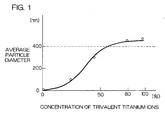
- the average particle diameter of fine metal powders to be produced can be arbitrarily controlled, as shown in Fig. 1, for example.
- the horizontal axis represents the concentration (%) which trivalent titanium ions occupy in the total amount of trivalent and tetravalent titanium ions in a reducing agent solution at the time when reaction is started
- the vertical axis represents the average particle diameter (nm) of fine metal powders to be produced.
- the average particle diameter of the fine metal powders to be formed exceeds 400 nm.
- the concentration of the trivalent titanium ions is reduced and correspondingly, the concentration of the tetravalent titanium ions is increased, however, the average particle diameter of the fine metal powders is gradually reduced.
- the concentration of the trivalent titanium ions is 0 %, that is, no trivalent titanium ions exists and the tetravalent titanium ions occupying the total amount of the reducing agent solution, reduction reaction does not progress. This indicates that no fine metal powders are formed, that is, the average particle diameter is 0 nm.
- Fig. 1 is only one example. It is clear from the results of examples, described later, that the relationship between the concentration of the trivalent titanium ions and the average particle diameter of the fine metal powders is not limited to one shown in Fig. 1.
- the average particle diameter of fine nickel powders is 260 nm.
- the average particle diameter of fine nickel powders is 150 nm. In either case, the particle diameter is shifted toward the smaller particle diameter from that shown in Fig. 1. It is also found from the results of the example 1 and the examples 3 to 5 that even if the concentration of trivalent titanium ions is fixed to 60 %, the particle diameter of the fine metal powder differs depending on a metal element to be deposited.
- the conditions of the cathode electrolytic treatment such as the pH of the solution and a time period for electrolytic treatment, may be controlled. For example, the longer a time period for the cathode electrolytic treatment is made, the higher the existence ratio of the trivalent titanium ions can be made.
- a water-soluble compound of at least one type of metal element forming the fine metal powder is added to the reducing agent solution produced in the foregoing manner, followed by mixing.
- Examples of the metal element include one type or two or more types of Ag, Au, Bi, Co, Cu, Fe, In, Ir, Mn, Mo, Ni, Pb, Pd, Pt, Re, Rh, Sn and Zn, as described above.
- water-soluble compound of the metal elements examples include various types of water-soluble compounds such as a sulfate compound and chloride. Considering that in continuously and repeatedly producing the fine metal powder, chlorine ions are also simultaneously supplied, as previously described, or the effect of storage of ions in the solution is made as small as possible and further in consideration of the magnitude of solubility in water, however, chloride is preferable as the water-soluble compound.
- the water-soluble compound of the metal element may be directly put into the reducing agent solution. In the case, however, reaction first locally progresses around the put compound. Consequently, particle diameters of fine metal powders may be made non-uniform, and the particle diameter distribution thereof may be broadened.
- the water-soluble compound of the metal element is added to the reducing agent solution in the state of a solution which is diluted by being dissolved in water (hereinafter referred to as a "reaction solution").
- a complexing agent may be blended as required with the reaction solution to be initially added.
- complexing agent Usable as the complexing agent are various types of complexing agents conventionally known.
- the complexing agent having such a function include at least one type selected from a group consisting of trisodium citrate [Na 3 C 6 H 5 O 7 ], sodium tartrate [Na 2 C 4 H 4 O 6 ], sodium acetate [NaCH 3 CO 2 ], gluconic acid [C 6 H 12 O 7 ], sodium thiosulfate [Na 2 S 2 O 3 ], ammonia [NH 3 ], and ethylendiaminetetraacetic acid [C 10 H 16 N 2 O 8 ].
- the water-soluble compound of the metal element corresponding to the ions to be replenished is dissolved in the residual mixed solution to produce a replenished reaction solution, and the replenished reaction solution is added to the reducing agent solution reproduced by the cathode electrolytic treatment.
- the concentration of the mixed solution to be kept constant. In this case, the complexing agent is not consumed.
- the complexing agent initially added exists in the solution, so that the complexing agent need not be replenished.
- the pH of the reducing agent solution is adjusted in a predetermined range.
- the timing at which the pH of the reducing agent solution is adjusted may be previous to or subsequent to adding the reaction solution to the reducing agent solution.
- a sodium carbonate solution, an ammonia solution, or a sodium hydroxide solution for example, may be added as a pH adjuster.
- the pH of the reducing agent solution is within a predetermined range from the beginning, however, the adjustment of the pH can be omitted.
- the adjustment of the pH can be omitted because the range in which the pH of the reducing agent solution is initially adjusted is maintained in a normal case. Accordingly, in the second and subsequent reactions, it is desirable that only when the pH departs from a predetermined range, the pH is adjusted by adding a pH adjuster, also in consideration of prevention of the change in the composition of the solution.
- the pH of the reducing agent solution affects the deposition speed of a metal and therefore, affects the shape of a fine metal powder to be deposited.
- significantly minute fine metal powders produced in large amounts have a single crystal structure in the early stages of reaction and therefore, are simply polarized into a bipolar phase to easily enter a state where a large number of metal powders are connected to one another in a chain shape. Moreover, when the reaction progresses, the metal or its alloy is further deposited thereon to fix the chain-shaped structure. Accordingly, the fine metal powders having paramagnetism are brought into a chain shape.
- the particle diameter of the fine metal powder produced in the solution in the early stages of reaction increases, and the number of fine metal powders decreases. Therefore, the growth thereof tends to uniformly progress on surfaces of the fine metal powders. Consequently, the shape of the fine metal powder is brought near a spherical shape.
- a 20 % hydrochloric acid solution of titanium tetrachloride was prepared.
- the amount of the titanium tetrachloride was set such that when a reducing agent solution obtained by subjecting the solution to cathode electrolytic treatment in the subsequent step was mixed with a reaction solution, described in the following item, at a predetermined ratio, and a pH adjuster or ion exchanged water, as required, was added to produce a predetermined amount of mixed solution, the molar ratio of the sum of trivalent and tetravalent titanium ions to the total amount of the mixed solution would be 0.2 M (mole/litter).
- the pH of the solution was 4.
- the solution was then poured into one of cells in a two-cell type electrolytic cell divided by an anion exchange membrane produced by Asahi Glass Co., Ltd. Further, a sodium sulfate solution having a molar ratio of 0.1 M was poured into the other cell.
- a reducing agent solution was prepared by dipping carbon felt electrodes in the solution, and carrying a 3.5 V DC current under constant-voltage control between the electrodes, the electrode dipped in the solution of titanium tetrachloride used as a cathode and the electrode dipped in the sodium sulfate solution used as an anode.
- Nickel chloride and trisodium citrate were dissolved in ion exchanged water, to produce a reaction solution.
- the amount of the nickel chloride was set such that the molar ratio thereof to the total amount of the mixed solution would be still 0.16 M.
- the amount of the trisodium citrate was adjusted such that the molar ratio thereof to the total amount of the mixed solution would be 0.3 M.
- the reducing agent solution was poured into a reaction cell, and was agitated while maintaining the liquid temperature thereof at 50 °C, a saturated solution of sodium carbonate serving as a pH adjuster was added to the solution to adjust the pH of the solution to 5.2, the reaction solution was gradually added to the solution, and ion exchanged water was further added thereto as required, to produce a predetermined amount of mixed solution.
- the reaction solution and the ion exchanged water which have been previously warmed to 50 °C, were added.
- the mixed solution continued to be agitated for several minutes while maintaining the liquid temperature thereof at 50 °C, sediments were deposited. Accordingly, the agitation was stopped, to immediately filter, rinse, and dry the sediments, to obtain fine powders.
- the pH of the mixed solution at the time point where the reaction was terminated was 4.0. Almost all of the titanium ions in the mixed solution were tetravalent.
- composition of the obtained fine powder was measured by ICP (Inductivity Coupled Plasma) emission spectrometry, it was confirmed that the composition was nickel having a purity of 99.94 %.
- the appearance of the fine nickel powder was photographed using a scanning-type electron microscope.
- the particle diameters of all the fine nickel powders whose actual sizes fall within a rectangular shape area of 1.8 ⁇ m ⁇ 2.4 ⁇ m of the photograph were measured and averaged, the average was 260 nm.
- the amount of the nickel chloride was set such that when the replenished reaction solution was added to a reducing agent solution reproduced by subjecting the remainder of the residual mixed solution to cathode electrolytic treatment in the subsequent step to produce a predetermined amount of new mixed solution, the molar ratio thereof to the total amount of the new mixed solution would be 0.16 M.
- the total amount of the remainder of the residual mixed solution was poured into one of cells in the same two-cell type electrolytic cell as the foregoing one, and a sodium sulfate solution having a molar ratio of 0.1 M was poured into the other cell.
- Carbon felt electrodes were dipped into the residual mixed solution and the sodium sulfate solution, and a 3.5 V DC current was carried under constant-voltage control between the electrodes, the electrode dipped in the residual mixed solution used as a cathode and the electrode dipped in the sodium sulfate solution used as an anode, to subject the solutions to cathode electrolytic treatment.
- the cathode electrolytic treatment was performed such that 60 % of tetravalent titanium ions in the total amount of the residual mixed solution were reduced to trivalent titanium ions, thereby reproducing the remainder of the residual mixed solution as a reducing agent solution. Further, in the cathode, the electrolysis of water progressed in parallel therewith. Accordingly, hydrogen ions were consumed, so that the pH of the reproduced reducing agent solution became 7.
- the pH of the residual mixed solution used for reproducing the reducing agent solution and producing the replenished reaction solution of nickel was adjusted to 4.0. That is, when the pH of the mixed solution at the time when the previous reaction was terminated was 4.0, as described above, the residual mixed solution after recovery of the fine metal powder was employed as it was. When the pH was larger than 4.0, however, a hydrochloric acid solution was added to the residual mixed solution, to adjust the pH to 4.0.
- the residual mixed solution was poured into one of the cells in the above-mentioned two-cell type electrolytic cell, and a sodium sulfate solution having a molar ratio of 0.1 M was put into the other cell, and the residual mixed solution was left at rest, to adjust the pH to 4.0 by diffusion of hydroxide ions.
- the reducing agent solution reproduced in the foregoing manner was poured into a reaction cell, and was agitated while maintaining the liquid temperature thereof at 50°C, and the above-mentioned replenished reaction solution was added thereto, to produce a predetermined amount of new mixed solution.
- the pH thereof was 5 to 6.
- composition of the obtained fine powder was measured by ICP emission spectrometry, it was confirmed that the composition was nickel having a purity of 99.94 %.
- the pH of a residual mixed solution after the first production of fine nickel powders was adjusted to 4.0 as required, and only a part of the residual mixed solution was then gradually added to powdered nickel chloride, to produce a replenished reaction solution of nickel.
- the amount of the nickel chloride was set such that when the replenished reaction solution was added to a reducing agent solution reproduced by subjecting the remainder of the residual mixed solution to cathode electrolytic treatment in the subsequent step to produce a predetermined amount of new mixed solution, the molar ratio thereof to the total amount of the new mixed solution would be 0.08 M.
- the total amount of the remainder of the residual mixed solution was poured into one of the cells in the same two-cell type electrolytic cell as the foregoing one, and a sodium sulfate solution having a molar ratio of 0.1 M was poured into the other cell.
- Carbon felt electrodes were dipped into the residual mixed solution and the sodium sulfate solution, and a 3.5 V DC current was carried under constant-voltage control between the electrodes, the electrode dipped in the residual mixed solution used as a cathode and the electrode dipped in the sodium sulfate solution used as an anode, to subject the solutions to cathode electrolytic treatment.
- the cathode electrolytic treatment was performed such that 30 % of tetravalent titanium ions in the total amount of the residual mixed solution were reduced to trivalent titanium ions, thereby reproducing the remainder of the residual mixed solution as a reducing agent solution. Further, in the cathode, the electrolysis of water progressed in parallel therewith. Accordingly, hydrogen ions were consumed, so that the pH of the reproduced reducing agent solution became 6.2.
- the reducing agent solution reproduced in the foregoing manner was poured into a reaction cell, and was agitated while maintaining the liquid temperature thereof at 50°C, and the above-mentioned replenished reaction solution was added thereto, to produce a predetermined amount of new mixed solution.
- the pH thereof was 5 to 6.
- composition of the obtained fine powder was measured by ICP emission spectrometry, it was confirmed that the composition was nickel having a purity of 99.9 %.
- the particle diameters of the fine nickel powders produced second in the example 2 were so controlled that the average particle diameter thereof was smaller than that of the fine nickel powders initially produced by reducing the existence ratio of trivalent titanium ions in the solution at the time when reaction was started, the particle diameter distribution thereof was sharp, and the particle diameters thereof were uniform.
- Copper chloride, trisodium citrate, and sodium tartrate were dissolved in ion exchanged water, to produce a reaction solution.
- the amount of the copper chloride was set such that in mixing the reaction solution with the reducing agent solution, described above, at a predetermined ratio as well as adding a pH adjuster or ion exchanged water, as required, thereto, to produce a predetermined amount of mixed solution, the molar ratio thereof to the total amount of the mixed solution would be 0.16 M.
- the amounts of the trisodium citrate and the sodium tartrate were respectively adjusted such that the molar ratios thereof to the total amount of the mixed solution would be respectively 0.15 M.
- the reducing agent solution was poured into a reaction cell, and was agitated while maintaining the liquid temperature thereof at 50 °C, a 25 % ammonia solution serving as a pH adjuster was added to the solution to adjust the pH of the solution to 5.2, the reaction solution was gradually added to the solution, and ion exchanged water was further added thereto as required, to produce a predetermined amount of mixed solution.
- the reaction solution and the ion exchanged water which have been previously warmed to 50 °C, were added.
- composition of the obtained fine powder was measured by ICP emission spectrometry, it was confirmed that the composition was copper having a purity of 99.9 %.
- Palladium Chloride, chloroplatinic acid, trisodium citrate, and sodium tartrate were dissolved in ion exchanged water, to produce a reaction solution.
- the amount of the palladium chloride was set such that in mixing the reaction solution with the reducing agent solution, described above, at a predetermined ratio as well as adding a pH adjuster or ion exchanged water, as required, thereto, to produce a predetermined amount of mixed solution, the molar ratio thereof to the total amount of the mixed solution would be 0.06 M.
- the amount of the chloroplatinic acid was adjusted such that the molar ratio thereof to the total amount of the mixed solution would be 0.06 M.
- the amounts of the trisodium citrate and the sodium tartrate were respectively adjusted such that the molar ratios thereof to the total amount of the mixed solution would be respectively 0.15 M.
- the above-mentioned reducing agent solution was poured into a reaction cell, and was agitated while maintaining the liquid temperature thereof at 50 °C, an 1N sodium hydroxide solution serving as a pH adjuster was added to the solution to adjust the pH of the solution to 5.2, the reaction solution was gradually added to the solution, and ion exchanged water was further added thereto as required, to produce a predetermined amount of mixed solution.
- the reaction solution and the ion exchanged water which have been previously warmed to 50 °C, were added.
- composition of the obtained fine powder was measured by ICP emission spectrometry, it was confirmed that the composition was a 50Pd-50Pt alloy. The purity thereof was 99.9 %.
- Silver Chloride, a 25 % ammonia solution, trisodium citrate, and sodium tartrate were dissolved in ion exchanged water, to produce a reaction solution.
- the amount of the silver chloride was set such that in mixing the reaction solution with the reducing agent solution, described above, at a predetermined ratio as well as adding ion exchanged water thereto as required, to produce a predetermined amount of mixed solution, the molar ratio thereof to the total amount of the mixed solution would be 0.24 M.
- the amount of the ammonia solution was adjusted such that the molar ratio of ammonia to the total amount of the mixed solution would be 1.2 M.
- the amounts of the trisodium citrate and the sodium tartrate were respectively adjusted such that the molar ratios thereof to the total amount of the mixed solution would be respectively 0.15 M.
- the above-mentioned reducing agent solution was poured into a reaction cell, and was agitated while maintaining the liquid temperature thereof at 50 °C, the reaction solution was gradually added to the solution, and ion exchanged water was further added thereto as required, to produce a predetermined amount of mixed solution.
- composition of the obtained fine powder was measured by ICP emission spectrometry, it was confirmed that the composition was silver having a purity of 99.9 %.
- Nickel Chloride, nitorilotrisodium triacetate, and trisodium citrate were dissolved in ion exchanged water, to produce an solution.
- a 25 % ammonia solution was then added to the solution to adjust the pH thereof to 10.0, and was then agitated while maintaining the liquid temperature thereof at 50 °C, and titanium trichloride was poured thereinto using an injection syringe such that it does not come in contact with outward air in a nitrogen gas current, to produce a predetermined amount of mixed solution.
- the molar ratio of each of components to the total amount of the mixed solution was 0.04 M of the nickel chloride, 0.1 M of the nitorilotrisodium triacetate, 0.1 M of the trisodium citrate, and 0.04 M of the titanium trichloride.
- the segments in two colors were separately extracted, and were respectively rinsed and dried, to obtain fine powders in two colors, i.e., white and black.
- composition of the white fine powders was measured by ICP emission spectrometry, it was titanium oxide.
- amount thereof was weighed, it was confirmed that almost all of titanium ions added to the solution were deposited as titanium oxide.
- the black fine powder was nickel having a purity of 76 %.
- the average particle diameter of the fine nickel powders was 1 ⁇ m when it was measured in the same manner as described above.
- titanium trichloride could be employed only by being used up at one time in the comparative example 1, and the fine nickel powders having a small average particle diameter of not more than 400 nm could not be produced.
- Nickel Chloride, nitorilotrisodium triacetate, and trisodium citrate were dissolved in ion exchanged water, to produce an solution.
- a 25 % ammonia solution was then added to the solution to adjust the pH thereof to 10.5, and was then agitated while maintaining the liquid temperature thereof at 50 °C, and a 20 % hydrochloric acid solution of titanium trichloride was poured thereinto using an injection syringe such that it does not come in contact with outward air in a nitrogen gas current, to produce a predetermined amount of mixed solution.
- the molar ratio of each of components to the total amount of the mixed solution was 0.04 M of the nickel chloride, 0.1 M of the nitorilotrisodium triacetate, 0.1 M of the trisodium citrate, and 0.04 M of the titanium trichloride.
- the segments in two colors were separately extracted, and were respectively rinsed and dried, to obtain fine powders in two colors, i.e., white and black.
- composition of the white fine powder was actually measured by ICP emission spectrometry, it was titanium oxide.
- amount thereof was weighed, it was confirmed that approximately 20 % of titanium ions added to the solution were deposited as titanium oxide.
- the black fine powder was nickel having a purity of 92 %.
- the average particle diameter of the fine nickel powders was 0.8 ⁇ m when it was measured in the same manner as described above.
- titanium trichloride could be also employed only by being used up at one time even in the comparative example 2, and the fine nickel powders having a small average particle diameter of not more than 400 nm could not be produced.
Landscapes
- Chemical & Material Sciences (AREA)
- Chemical Kinetics & Catalysis (AREA)
- General Chemical & Material Sciences (AREA)
- Engineering & Computer Science (AREA)
- Electrochemistry (AREA)
- Materials Engineering (AREA)
- Metallurgy (AREA)
- Organic Chemistry (AREA)
- Manufacture Of Metal Powder And Suspensions Thereof (AREA)
- Manufacture And Refinement Of Metals (AREA)
Applications Claiming Priority (3)
| Application Number | Priority Date | Filing Date | Title |
|---|---|---|---|
| JP2002174563 | 2002-06-14 | ||
| JP2002174563A JP3508766B2 (ja) | 2002-06-14 | 2002-06-14 | 金属微粉末の製造方法 |
| PCT/JP2003/007392 WO2003106083A1 (ja) | 2002-06-14 | 2003-06-11 | 金属微粉末の製造方法 |
Publications (3)
| Publication Number | Publication Date |
|---|---|
| EP1552896A1 true EP1552896A1 (de) | 2005-07-13 |
| EP1552896A4 EP1552896A4 (de) | 2005-09-21 |
| EP1552896B1 EP1552896B1 (de) | 2006-12-13 |
Family
ID=29727977
Family Applications (1)
| Application Number | Title | Priority Date | Filing Date |
|---|---|---|---|
| EP03736151A Expired - Lifetime EP1552896B1 (de) | 2002-06-14 | 2003-06-11 | Verfahren zur herstellung von feinem metallpulver |
Country Status (8)
| Country | Link |
|---|---|
| US (1) | US7470306B2 (de) |
| EP (1) | EP1552896B1 (de) |
| JP (1) | JP3508766B2 (de) |
| KR (1) | KR100917948B1 (de) |
| CN (2) | CN102350507A (de) |
| DE (1) | DE60310435T2 (de) |
| TW (1) | TWI247637B (de) |
| WO (1) | WO2003106083A1 (de) |
Cited By (5)
| Publication number | Priority date | Publication date | Assignee | Title |
|---|---|---|---|---|
| WO2008017731A1 (en) * | 2006-08-11 | 2008-02-14 | Outotec Oyj | Method for the production of metal powder |
| EP1743723A4 (de) * | 2004-04-30 | 2009-06-10 | Sumitomo Electric Industries | Verfahren zur herstellung von kettenmetallpulvern, dadurch hergestellte kettenmetallpulver und durch verwendung der pulver hergestellte anisotrope leitende filme |
| WO2011092375A1 (en) * | 2010-01-29 | 2011-08-04 | Outotec Oyj | Method and arrangement for producing metal powder |
| CN104131317A (zh) * | 2014-08-01 | 2014-11-05 | 昆明理工大学 | 一种电沉积制备细铅粉的方法 |
| CN107059064A (zh) * | 2016-12-08 | 2017-08-18 | 汤恭年 | 铅酸蓄电池专用纳米铅粉的电生长制粉法 |
Families Citing this family (19)
| Publication number | Priority date | Publication date | Assignee | Title |
|---|---|---|---|---|
| JP2004244485A (ja) * | 2003-02-13 | 2004-09-02 | Sumitomo Electric Ind Ltd | 熱媒体 |
| JP2004244484A (ja) * | 2003-02-13 | 2004-09-02 | Sumitomo Electric Ind Ltd | 熱媒体 |
| JP4254313B2 (ja) * | 2003-04-09 | 2009-04-15 | 住友電気工業株式会社 | 導電性インク及びその製造方法 |
| JP4320447B2 (ja) * | 2004-02-03 | 2009-08-26 | Dowaエレクトロニクス株式会社 | 銀粉およびその製造方法 |
| US7242573B2 (en) * | 2004-10-19 | 2007-07-10 | E. I. Du Pont De Nemours And Company | Electroconductive paste composition |
| JP2009079239A (ja) * | 2007-09-25 | 2009-04-16 | Sumitomo Electric Ind Ltd | ニッケル粉末、またはニッケルを主成分とする合金粉末およびその製造方法、導電性ペースト、並びに積層セラミックコンデンサ |
| JP5407495B2 (ja) * | 2009-04-02 | 2014-02-05 | 住友電気工業株式会社 | 金属粉末および金属粉末製造方法、導電性ペースト、並びに積層セラミックコンデンサ |
| KR20120003458A (ko) * | 2009-04-24 | 2012-01-10 | 스미토모 덴키 고교 가부시키가이샤 | 프린트 배선판용 기판, 프린트 배선판, 및 그들의 제조방법 |
| CN103391824B (zh) * | 2011-02-25 | 2015-11-25 | 株式会社村田制作所 | 镍粉末的制造方法 |
| US20140183047A1 (en) * | 2013-01-01 | 2014-07-03 | Panisolar Inc. | Regeneration System for Metal Electrodes |
| JP5862835B2 (ja) * | 2013-04-05 | 2016-02-16 | 株式会社村田製作所 | 金属粉末の製造方法、導電性ペーストの製造方法、および積層セラミック電子部品の製造方法 |
| CN106134299B (zh) | 2014-03-20 | 2018-10-23 | 住友电气工业株式会社 | 印刷线路板用基板、印刷线路板以及制造印刷线路板用基板的方法 |
| US10237976B2 (en) | 2014-03-27 | 2019-03-19 | Sumitomo Electric Industries, Ltd. | Substrate for printed circuit board, printed circuit board, and method for producing substrate for printed circuit board |
| US9967976B2 (en) * | 2014-12-25 | 2018-05-08 | Sumitomo Electric Industries, Ltd. | Substrate for printed circuit board, printed circuit board, and method for producing substrate for printed circuit board |
| CN107211537A (zh) | 2015-01-22 | 2017-09-26 | 住友电气工业株式会社 | 印刷线路板用基材、印刷线路板以及印刷线路板的制造方法 |
| WO2018047150A1 (en) * | 2016-09-12 | 2018-03-15 | Lucky Iron Fish, Inc. | Electrolytic iron cooking implement |
| CN106757174B (zh) * | 2017-02-23 | 2020-08-21 | 黄芃 | 一种电沉积制备金属粉末的方法 |
| CN107955952A (zh) * | 2017-11-02 | 2018-04-24 | 马鞍山市宝奕金属制品工贸有限公司 | 一种利用铁渣生产高纯铁粉的方法 |
| CN112719286B (zh) * | 2020-12-22 | 2023-05-30 | 任沁锋 | 一种铜纳米颗粒的制备方法 |
Family Cites Families (9)
| Publication number | Priority date | Publication date | Assignee | Title |
|---|---|---|---|---|
| US4230542A (en) * | 1978-10-13 | 1980-10-28 | Oronzio De Nora Impianti Elettrochimici S.P.A. | Electrolytic process for treating ilmenite leach solution |
| DE3300865A1 (de) | 1982-01-16 | 1983-07-21 | Basf Ag, 6700 Ludwigshafen | Verfahren zur herstellung von waessrigen ti(iii)-clorid-loesungen |
| JP2622019B2 (ja) * | 1990-07-31 | 1997-06-18 | 福田金属箔粉工業株式会社 | 粒状銅微粉末の製造方法 |
| JP3018655B2 (ja) * | 1991-09-20 | 2000-03-13 | 株式会社村田製作所 | 微粉末の製造方法 |
| US5435830A (en) * | 1991-09-20 | 1995-07-25 | Murata Manufacturing Co., Ltd. | Method of producing fine powders |
| US5246553A (en) * | 1992-03-05 | 1993-09-21 | Hydro-Quebec | Tetravalent titanium electrolyte and trivalent titanium reducing agent obtained thereby |
| JPH1180816A (ja) | 1997-09-10 | 1999-03-26 | Sumitomo Metal Mining Co Ltd | 導電ペースト用ニッケル粉末とその製造方法 |
| JP3921805B2 (ja) | 1998-04-24 | 2007-05-30 | 株式会社村田製作所 | ニッケル微粉末の製造方法 |
| JP3597098B2 (ja) * | 2000-01-21 | 2004-12-02 | 住友電気工業株式会社 | 合金微粉末とその製造方法、それを用いた成型用材料、スラリーおよび電磁波シールド材料 |
-
2002
- 2002-06-14 JP JP2002174563A patent/JP3508766B2/ja not_active Expired - Lifetime
-
2003
- 2003-06-11 CN CN2011103324437A patent/CN102350507A/zh active Pending
- 2003-06-11 DE DE60310435T patent/DE60310435T2/de not_active Expired - Lifetime
- 2003-06-11 US US10/517,821 patent/US7470306B2/en not_active Expired - Lifetime
- 2003-06-11 EP EP03736151A patent/EP1552896B1/de not_active Expired - Lifetime
- 2003-06-11 WO PCT/JP2003/007392 patent/WO2003106083A1/ja not_active Ceased
- 2003-06-11 KR KR1020047020137A patent/KR100917948B1/ko not_active Expired - Fee Related
- 2003-06-11 CN CN038138182A patent/CN1662332A/zh active Pending
- 2003-06-13 TW TW092116040A patent/TWI247637B/zh not_active IP Right Cessation
Cited By (10)
| Publication number | Priority date | Publication date | Assignee | Title |
|---|---|---|---|---|
| EP1743723A4 (de) * | 2004-04-30 | 2009-06-10 | Sumitomo Electric Industries | Verfahren zur herstellung von kettenmetallpulvern, dadurch hergestellte kettenmetallpulver und durch verwendung der pulver hergestellte anisotrope leitende filme |
| EP2216113A1 (de) * | 2004-04-30 | 2010-08-11 | Sumitomo Electric Industries, Ltd. | Verfahren zur Herstellung von Kettenmetallpulver, damit hergestelltes Kettenmetallpulver und mit dem Pulver hergestellte anisotrope leitfähige Folie |
| WO2008017731A1 (en) * | 2006-08-11 | 2008-02-14 | Outotec Oyj | Method for the production of metal powder |
| EA014408B1 (ru) * | 2006-08-11 | 2010-12-30 | Ототек Оюй | Способ получения металлического порошка |
| US8398740B2 (en) | 2006-08-11 | 2013-03-19 | Outotec Oyj | Method for the production of metal powder |
| WO2011092375A1 (en) * | 2010-01-29 | 2011-08-04 | Outotec Oyj | Method and arrangement for producing metal powder |
| EA021918B1 (ru) * | 2010-01-29 | 2015-09-30 | Ототек Оюй | Способ и устройство для получения металлического порошка |
| CN104131317A (zh) * | 2014-08-01 | 2014-11-05 | 昆明理工大学 | 一种电沉积制备细铅粉的方法 |
| CN104131317B (zh) * | 2014-08-01 | 2016-08-24 | 昆明理工大学 | 一种电沉积制备细铅粉的方法 |
| CN107059064A (zh) * | 2016-12-08 | 2017-08-18 | 汤恭年 | 铅酸蓄电池专用纳米铅粉的电生长制粉法 |
Also Published As
| Publication number | Publication date |
|---|---|
| JP2004018923A (ja) | 2004-01-22 |
| CN1662332A (zh) | 2005-08-31 |
| DE60310435T2 (de) | 2007-09-27 |
| KR20050007608A (ko) | 2005-01-19 |
| KR100917948B1 (ko) | 2009-09-21 |
| TW200413120A (en) | 2004-08-01 |
| WO2003106083A1 (ja) | 2003-12-24 |
| EP1552896A4 (de) | 2005-09-21 |
| US7470306B2 (en) | 2008-12-30 |
| JP3508766B2 (ja) | 2004-03-22 |
| CN102350507A (zh) | 2012-02-15 |
| EP1552896B1 (de) | 2006-12-13 |
| TWI247637B (en) | 2006-01-21 |
| US20050217425A1 (en) | 2005-10-06 |
| DE60310435D1 (de) | 2007-01-25 |
Similar Documents
| Publication | Publication Date | Title |
|---|---|---|
| US7470306B2 (en) | Method for producing fine metal powder | |
| EP0363552B1 (de) | Verfahren zur Herstellung von Metallpulver | |
| JP4168108B2 (ja) | 銀被覆銅粉の製法 | |
| CN115893526A (zh) | 一种钠离子电池用镍铁锰层状氢氧化物前驱体、制备方法及应用 | |
| JP4496026B2 (ja) | 金属銅微粒子の製造方法 | |
| JP4821014B2 (ja) | 銅粉の製造法 | |
| WO2011132258A1 (ja) | 触媒の製造方法 | |
| US5514202A (en) | Method for producing fine silver-palladium alloy powder | |
| JP2005042135A (ja) | 還元剤溶液とそれを用いた金属粉末の製造方法、および金属被膜の形成方法 | |
| JP5312958B2 (ja) | ニッケル正極用活物質として有用な結晶凝集粒子の製造方法 | |
| JP4352121B2 (ja) | 銅粉の製造法 | |
| JP4038553B2 (ja) | アルカリ電池用負極材の製造方法 | |
| JPH07278619A (ja) | ニッケル粉末の製造方法 | |
| JP3640552B2 (ja) | 粒度分布の小さい銅粉の製造法 | |
| JP2005023395A (ja) | ニッケル粉末の製造方法 | |
| CN118198343A (zh) | 一种改性三元正极材料及其制备方法 | |
| RU2283208C2 (ru) | Способ получения порошка серебра | |
| JP4012961B2 (ja) | 板状銅粉の製法 | |
| JP7842456B2 (ja) | PtAu合金粉末の製造方法 | |
| JPH03180481A (ja) | 電解による酸化銅粉の製造方法 | |
| JP2002363618A (ja) | 銅超微粒子とその製造方法 | |
| JP2004035320A (ja) | 水酸化コバルトを被覆した水酸化ニッケル粉末の製造方法 | |
| JP2004035321A (ja) | 水酸化コバルトで被覆した水酸化ニッケル粉末の製造方法 | |
| WO2026061885A1 (en) | Method for producing metal-containing hydroxide or oxyhydroxide material | |
| JPH0593214A (ja) | 銅微粉の製造方法 |
Legal Events
| Date | Code | Title | Description |
|---|---|---|---|
| PUAI | Public reference made under article 153(3) epc to a published international application that has entered the european phase |
Free format text: ORIGINAL CODE: 0009012 |
|
| 17P | Request for examination filed |
Effective date: 20050107 |
|
| AK | Designated contracting states |
Kind code of ref document: A1 Designated state(s): AT BE BG CH CY CZ DE DK EE ES FI FR GB GR HU IE IT LI LU MC NL PT RO SE SI SK TR |
|
| A4 | Supplementary search report drawn up and despatched |
Effective date: 20050804 |
|
| RIC1 | Information provided on ipc code assigned before grant |
Ipc: 7C 25C 5/02 B Ipc: 7B 22F 9/24 A Ipc: 7B 22F 1/00 B |
|
| RBV | Designated contracting states (corrected) |
Designated state(s): DE FI FR GB |
|
| GRAP | Despatch of communication of intention to grant a patent |
Free format text: ORIGINAL CODE: EPIDOSNIGR1 |
|
| GRAS | Grant fee paid |
Free format text: ORIGINAL CODE: EPIDOSNIGR3 |
|
| GRAA | (expected) grant |
Free format text: ORIGINAL CODE: 0009210 |
|
| AK | Designated contracting states |
Kind code of ref document: B1 Designated state(s): DE FI FR GB |
|
| REG | Reference to a national code |
Ref country code: GB Ref legal event code: FG4D |
|
| REF | Corresponds to: |
Ref document number: 60310435 Country of ref document: DE Date of ref document: 20070125 Kind code of ref document: P |
|
| ET | Fr: translation filed | ||
| PLBE | No opposition filed within time limit |
Free format text: ORIGINAL CODE: 0009261 |
|
| STAA | Information on the status of an ep patent application or granted ep patent |
Free format text: STATUS: NO OPPOSITION FILED WITHIN TIME LIMIT |
|
| 26N | No opposition filed |
Effective date: 20070914 |
|
| REG | Reference to a national code |
Ref country code: FR Ref legal event code: PLFP Year of fee payment: 13 |
|
| PGFP | Annual fee paid to national office [announced via postgrant information from national office to epo] |
Ref country code: DE Payment date: 20150602 Year of fee payment: 13 Ref country code: GB Payment date: 20150610 Year of fee payment: 13 Ref country code: FI Payment date: 20150609 Year of fee payment: 13 |
|
| PGFP | Annual fee paid to national office [announced via postgrant information from national office to epo] |
Ref country code: FR Payment date: 20150608 Year of fee payment: 13 |
|
| REG | Reference to a national code |
Ref country code: DE Ref legal event code: R119 Ref document number: 60310435 Country of ref document: DE |
|
| PG25 | Lapsed in a contracting state [announced via postgrant information from national office to epo] |
Ref country code: FI Free format text: LAPSE BECAUSE OF NON-PAYMENT OF DUE FEES Effective date: 20160611 |
|
| GBPC | Gb: european patent ceased through non-payment of renewal fee |
Effective date: 20160611 |
|
| REG | Reference to a national code |
Ref country code: FR Ref legal event code: ST Effective date: 20170228 |
|
| PG25 | Lapsed in a contracting state [announced via postgrant information from national office to epo] |
Ref country code: FR Free format text: LAPSE BECAUSE OF NON-PAYMENT OF DUE FEES Effective date: 20160630 Ref country code: DE Free format text: LAPSE BECAUSE OF NON-PAYMENT OF DUE FEES Effective date: 20170103 |
|
| PG25 | Lapsed in a contracting state [announced via postgrant information from national office to epo] |
Ref country code: GB Free format text: LAPSE BECAUSE OF NON-PAYMENT OF DUE FEES Effective date: 20160611 |