EP1553220A1 - Tissu elastique et materiau a face elastique - Google Patents
Tissu elastique et materiau a face elastique Download PDFInfo
- Publication number
- EP1553220A1 EP1553220A1 EP03784510A EP03784510A EP1553220A1 EP 1553220 A1 EP1553220 A1 EP 1553220A1 EP 03784510 A EP03784510 A EP 03784510A EP 03784510 A EP03784510 A EP 03784510A EP 1553220 A1 EP1553220 A1 EP 1553220A1
- Authority
- EP
- European Patent Office
- Prior art keywords
- yarn
- elastic
- fabric
- yarns
- elastic fabric
- Prior art date
- Legal status (The legal status is an assumption and is not a legal conclusion. Google has not performed a legal analysis and makes no representation as to the accuracy of the status listed.)
- Withdrawn
Links
Images






Classifications
-
- D—TEXTILES; PAPER
- D03—WEAVING
- D03D—WOVEN FABRICS; METHODS OF WEAVING; LOOMS
- D03D7/00—Woven fabrics designed to be resilient, i.e. to recover from compressive stress
-
- A—HUMAN NECESSITIES
- A47—FURNITURE; DOMESTIC ARTICLES OR APPLIANCES; COFFEE MILLS; SPICE MILLS; SUCTION CLEANERS IN GENERAL
- A47C—CHAIRS; SOFAS; BEDS
- A47C31/00—Details or accessories for chairs, beds, or the like, not provided for in other groups of this subclass, e.g. upholstery fasteners, mattress protectors, stretching devices for mattress nets
- A47C31/006—Use of three-dimensional fabrics
-
- D—TEXTILES; PAPER
- D03—WEAVING
- D03D—WOVEN FABRICS; METHODS OF WEAVING; LOOMS
- D03D11/00—Double or multi-ply fabrics not otherwise provided for
- D03D11/02—Fabrics formed with pockets, tubes, loops, folds, tucks or flaps
-
- D—TEXTILES; PAPER
- D03—WEAVING
- D03D—WOVEN FABRICS; METHODS OF WEAVING; LOOMS
- D03D15/00—Woven fabrics characterised by the material, structure or properties of the fibres, filaments, yarns, threads or other warp or weft elements used
- D03D15/50—Woven fabrics characterised by the material, structure or properties of the fibres, filaments, yarns, threads or other warp or weft elements used characterised by the properties of the yarns or threads
- D03D15/56—Woven fabrics characterised by the material, structure or properties of the fibres, filaments, yarns, threads or other warp or weft elements used characterised by the properties of the yarns or threads elastic
-
- D—TEXTILES; PAPER
- D03—WEAVING
- D03D—WOVEN FABRICS; METHODS OF WEAVING; LOOMS
- D03D25/00—Woven fabrics not otherwise provided for
- D03D25/005—Three-dimensional woven fabrics
-
- D—TEXTILES; PAPER
- D04—BRAIDING; LACE-MAKING; KNITTING; TRIMMINGS; NON-WOVEN FABRICS
- D04B—KNITTING
- D04B1/00—Weft knitting processes for the production of fabrics or articles not dependent on the use of particular machines; Fabrics or articles defined by such processes
- D04B1/14—Other fabrics or articles characterised primarily by the use of particular thread materials
- D04B1/18—Other fabrics or articles characterised primarily by the use of particular thread materials elastic threads
-
- D—TEXTILES; PAPER
- D04—BRAIDING; LACE-MAKING; KNITTING; TRIMMINGS; NON-WOVEN FABRICS
- D04B—KNITTING
- D04B21/00—Warp knitting processes for the production of fabrics or articles not dependent on the use of particular machines; Fabrics or articles defined by such processes
- D04B21/10—Open-work fabrics
- D04B21/12—Open-work fabrics characterised by thread material
-
- D—TEXTILES; PAPER
- D04—BRAIDING; LACE-MAKING; KNITTING; TRIMMINGS; NON-WOVEN FABRICS
- D04B—KNITTING
- D04B21/00—Warp knitting processes for the production of fabrics or articles not dependent on the use of particular machines; Fabrics or articles defined by such processes
- D04B21/14—Fabrics characterised by the incorporation by knitting, in one or more thread, fleece, or fabric layers, of reinforcing, binding, or decorative threads; Fabrics incorporating small auxiliary elements, e.g. for decorative purposes
- D04B21/18—Fabrics characterised by the incorporation by knitting, in one or more thread, fleece, or fabric layers, of reinforcing, binding, or decorative threads; Fabrics incorporating small auxiliary elements, e.g. for decorative purposes incorporating elastic threads
-
- D—TEXTILES; PAPER
- D10—INDEXING SCHEME ASSOCIATED WITH SUBLASSES OF SECTION D, RELATING TO TEXTILES
- D10B—INDEXING SCHEME ASSOCIATED WITH SUBLASSES OF SECTION D, RELATING TO TEXTILES
- D10B2403/00—Details of fabric structure established in the fabric forming process
- D10B2403/02—Cross-sectional features
- D10B2403/021—Lofty fabric with equidistantly spaced front and back plies, e.g. spacer fabrics
- D10B2403/0213—Lofty fabric with equidistantly spaced front and back plies, e.g. spacer fabrics with apertures, e.g. with one or more mesh fabric plies
-
- D—TEXTILES; PAPER
- D10—INDEXING SCHEME ASSOCIATED WITH SUBLASSES OF SECTION D, RELATING TO TEXTILES
- D10B—INDEXING SCHEME ASSOCIATED WITH SUBLASSES OF SECTION D, RELATING TO TEXTILES
- D10B2403/00—Details of fabric structure established in the fabric forming process
- D10B2403/02—Cross-sectional features
- D10B2403/024—Fabric incorporating additional compounds
- D10B2403/0241—Fabric incorporating additional compounds enhancing mechanical properties
- D10B2403/02412—Fabric incorporating additional compounds enhancing mechanical properties including several arrays of unbent yarn, e.g. multiaxial fabrics
-
- D—TEXTILES; PAPER
- D10—INDEXING SCHEME ASSOCIATED WITH SUBLASSES OF SECTION D, RELATING TO TEXTILES
- D10B—INDEXING SCHEME ASSOCIATED WITH SUBLASSES OF SECTION D, RELATING TO TEXTILES
- D10B2505/00—Industrial
- D10B2505/08—Upholstery, mattresses
Definitions
- the present invention relates to an elastic top material for use as a pillow, cushion, bench, backrest, armrest, chair, seat, bed, mattress and the like, all of which are used for supporting ones limbs, by sitting on or sitting in.
- Elastic top materials are formed by covering such a porous construction such as urethane foam or other resin foams, or by covering stratified formations which are formed by stratifying polyester fiber or other fibers, with a flexible top material such as fabric, leather and the like.
- This kind of elastic top material is also formed by covering a spring construction formed from flat springs, coil springs or other springs together with a flexible top material such as fabric, leather and the like.
- a conventional elastic top material effects an agreeable soft feeling when ones limbs are supported thereon due to balancing of pressed strain, which may be raised in its thickness direction, and elastic recovery force which may be raised in accordance with the pressed strain.
- the pressed strain rises relatively too little in comparison with elastic recovery force, a hard and painful feeling may be effected.
- the conventional elastic top material has to be made thick.
- the conventional elastic top material is thick, hard to carry and occupies a good deal of space. It is bulky and a hindrance when it is not in use. In this regard there is a need to improve conventional elastic top material.
- the present invention is intended to provide an improved elastic top material on which limbs may be supported stably, and which is thin, light weight and less bulky as a whole, and which is easier to deal with as compared with conventional materials.
- An elastic fabric of the present invention is characterized by following matters.
- elastic yarns may be applied to either the warp yarns or weft yarns, inelastic yarns may be used for the other yarn. That is, inelastic yarns may be used for intersecting yarns (22) which cross the elastic yarns (11) at right angles.
- the woven elastic fabric (10) in a manner where the bulk density (J ; dtex/cm) of the elastic yarn (11) is from 0.5 to 3.0 times the bulk density of the intersecting yarn (22) which is an inelastic yarn and crosses the elastic yarn (11) at right angles (0.5 ⁇ j ⁇ J ⁇ 3.
- An elastic top material (62) is formed by stretching and hanging an elastic fabric (10), which is intended for supporting limbs, between frame parts (61a,61b) which are projected at both sides of a frame (60) in a manner where both frame parts (61a,61b) are opposite one another.
- the cushioning surface (63) of the elastic top material is formed from the elastic fabric (10) for supporting limbs.
- the elastic fabric (10) is stretched over the frame (60) by aligning the direction (X) of extension the elastic yarn (11) parallel to the direction in which both frame parts (61a,61b) oppose one another, that is, by setting the direction (X) in the width direction of the elastic top material (62).
- the elastic fabric is designed by incorporating the elastic yarn (11) into the elastic fabric in a manner where the elastic yarns are located in line either lengthwise or crosswise, so that the elastic fabric has;
- the elastic fabric effects bottomed sticky feeling when limbs are put on it, and it becomes hard to recover its original form, and a load mark tends to appear over the elastic fabric after limbs are removed. Then, it becomes hard to obtain cushioning goods which are rich in soft feeling and load-hysteresis fatigue resistance.
- the elastic fabric is designed so that stress at 10% elongation (F) becomes to 200 ⁇ 400 N/ 5 cm and the rate of hysteresis loss ( ⁇ E) at 10 % elongation becomes about 25 %.
- the rate of hysteresis loss ⁇ E is calculated by dividing a hysteresis loss (C) by value(V), where the value of hysteresis loss(C) is calculated as the difference between values (V) and (W).
- the value (V) is calculated by integrating the load-elongation equation f o ( ⁇ ) from 0 % to 10 % elongation in the direction (X) where the elastic yarn is continuous without breaks in the elastic fabric, where the load-elongation equation f o ( ⁇ ) is defined by the loading curve (f o) of the hysteresis in the load-elongation diagram.
- the integral value (W) is calculated by integrating the load-elongation equation f o ( ⁇ ) from at 10 % to at 0 % elongation in the direction (X) where the elastic yarn is in continuous without beaks in the elastic fabric, where the load-elongation equation f o ( ⁇ ) is defined by the load-reducing curve (f 1 ) of the hysteresis in the load-elongation diagram.
- ⁇ E rate of hysteresis loss
- a reason to design stress at 10% elongation (B) in the 45 degrees bias direction (Z), which has inclination of 45 degrees to the direction of extension (X), to more than 5 % and less than 20% in comparison with stress at 10% elongation (F) in the direction of extension (X) is explained as follows: In the case where stress at 10% elongation (B) in the 45 degrees bias direction (Z) becomes less than 5 % of the stress at 10% elongation (F) in the direction of extension (X), where the elastic yarn is in continuous, the elastic fabric becomes hard to recover its original form after the limbs were removed, and knitting textile designs or weaving textile designs of the elastic fabric becomes transformable, that is, a distortion of so-called textile opening tends to raise due to slipping of yarns (11,22).
- the elastic fabric is to be designed so that somewhat distortion of the knitting or weaving textile designs is caused slightly by a lot of elastic yarn as far as the elastic fabric turns into its original form after limbs (or load or weight) are removed.
- the elastic fabric becomes rich in load-hysteresis fatigue resistance and load marks hardly remain the portion where limbs have been supported for a long time.
- ⁇ E hysteresis loss
- the covering rate (K) of the elastic yarn (11) is set up more than 30 % .
- the covering rate (K) of the elastic yarn (11) is set up more than 30 %.
- the elastic fabric becomes rich in elastic transformability so as to fit the shape of limbs which are put thereon and also becomes rich in soft feeling and load-hysteresis fatigue resistance.
- the elastic yarn (11) is woven or knitted in the elastic fabric in a manner to be intermittently continuous in the width direction of the fabric or continuous through the full width of the fabric, or in a manner to be intermittently continuous in the length direction of the fabric or through the full length of the fabric. It is desirable to set up the bulk density (J) of the elastic yarn to be more than 17000 dtex/cm by designing the average fineness (T) of the elastic yarn in thick and by designing the density (G) of the arrangement of the elastic yarn in loose so that the arranged situation of the elastic yarn is easily kept in line. It is also desirable to compose the elastic yarn as a type of monofilament yarn so that the arranged situation of the elastic yarn is easily kept in line.
- the elastic yarn is composed of multiple fibers or yarns as a type of multifilament yarn
- the number of the fibers or the number of single yarns of the elastic yarn should be set up less than 5 (threads). That is, the elastic yarn should be composed of several thick monofilament yarns in a shape as if these yarns were drawn in parallel.
- the elastic yarn may be composed together with elastic fibers and inelastic fibers in sheath core shape by twining and covering the elastic fibers with the inelastic fibers.
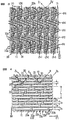
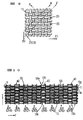
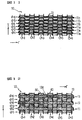
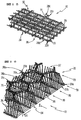
- Figures 1-4 show examples of the textile design of the elastic fabrics.
- the inelastic yarns (the intersecting yarns(13)) form base weft knitted fabric.
- the elastic yarns (11) are threaded in the base weft knitted fabric and pass under the space between the needle loops (40,40) of every neighboring wales in each course and are continuous in line in the knitting width direction ( ⁇ ).
- the inelastic yarns (the intersecting yarns (13)) form the base warp knitted fabric.
- the elastic yarns (11) are threaded in the base weft knitted fabric and pass through the space between the needle loop (40) and the sinker loop (50) and are in continuous in line in the knitting width direction ( ⁇ ).
- the base warp knitted fabric is formed with the inelastic yarns (13x) which form the chain stitched rows in line in the knitting length direction and the inelastic inserted yarns (the intersecting yarns 22a) which are connecting the adjacent chain stitched rows.
- the elastic yarns (11) are threaded in the base warp knitted fabric and pass through the space between the adjacent chain stitched rows (39,39) in a manner of passing over the inelastic inserted yarn (22a) and passing under the inelastic inserted yarn (22a) in each course and are in continuous in line in the knitting length direction ( ⁇ ).
- the elastic knitted fabric it is desirable to apply the inelastic yarn to all of the intersecting yarns (22) which cross the elastic yarn (11) which is continuous in line.
- the elastic yarn (11) may be arranged in line weftwise and warpwise.
- Figure 4 shows the elastic woven fabric wherein the elastic yarn is applied to the weft yarn and the inelastic yarn is applied to the warp yarn.
- the elastic knitted fabric is transformable lengthwise and crosswise, since the base warp knitted fabric is formed with arched needle loops (40) and arched sinker loops (40) where the yarns are bent into arched shape. Therefore, there is not a special difference between stress at 10% elongation (B 1 ) in the 45 degrees leftwise bias direction (Z 1 ), where has left-wise inclination of 45 degrees against the direction (X), and stress at 10% elongation (B 2 ) in the 45 degrees rightwise bias direction (Z 2 ), whereas rightwise inclination of 45 degrees against the prolonging direction (X).
- stress at 10% elongation (B 1 ) in the 45 degrees leftwise bias direction (Z 1 ) where has left-wise inclination of 45 degrees against the direction (X)
- stress at 10% elongation (B 2 ) in the 45 degrees rightwise bias direction (Z 2 ) whereas rightwise inclination of 45 degrees against the prolonging direction (X).
- the elastic woven fabric becomes larger in accordance with a manner of the continuity of the intersection points (20) in the weaving textile design. Therefore, the elastic woven fabric becomes lacking in load-hysteresis fatigue resistance in comparison with the elastic knitted fabric in accordance with the difference of stress at 10% elongation between the 45 degrees leftwise bias direction (Z 1 ) and the 45 degrees rightwise bias direction (Z 2 ).
- the satin weave which lacks course of action in the disposition of the intersection points (20) may be applied to the elastic woven fabric.
- an elastic woven fabric which is rich in load-hysteresis fatigue resistance is not obtained, since the satin weave lacks fixedness between the warp yarn and the weft yarn, so that stress is hardly propagated between adjacent elastic yarns.
- the intersection points (20) continue in the 45 degrees leftwise bias direction (Z 1 ) and in the 45 degrees rightwise bias direction (Z 2 ) at the same rate, as a result fixedness between the warp yarn and the weft yarn is kept, and the continuity of the intersection points (20) in the 45 degrees leftwise bias direction (Z 1 ) and in the 45 degrees rightwise bias direction (Z 2 ) becomes even. Therefore, large difference of stress at 10% elongation (B) between those bias directions (Z 1 , Z 2 ) does not rise, and load-hysteresis fatigue resistance of the elastic woven fabric increases.
- covering rate (K) of the elastic yarn (11) is to be set up more than 30 % so as to minimize slippage between the elastic yarns for reasons of that the elastic yarns (11a, 11b, 11c ⁇ ) stick fast to one another being collected between the intersection points (20m,20n) by potential inside shrinking stress of the intersecting yarns (22) which is effected as a reaction stress when the intersecting yarns (22) are elongated between the intersection points (20m,20n) result from or through or by the elastic yarns (11a, 11b, 11c ⁇ ).
- the covering rate (K) of the elastic yarn (11) is set up more than 30 %, when the fineness of the elastic yarn is thicker than regular fineness, which should be set and limited in proportion to the weaving density, the elastic fabric which is rich in load-hysteresis fatigue resistance can not be always obtained.
- the weft yarn (11) is brought into extremely strained situation at inside of the woven fabric, (2) potential inside shrinking stress, which is to act to restore the regular length of the weft yarn (11) in proportion to the regular number of warp yarns (intersecting yarns 22a,22b,22c), arises at the inside of the woven fabric, (3) then, the weft yarn (11) is to be brought into the situation where it tends to shrink, (4) on the other hand, the plurality of warp yarns (22a, 22b, 22c) also act to restore the regular width between the intersections (20a,20b) in proportion to the regular number of warp yarns, (5) as a result, the warp yarn (22) tend proportionally to swell out in the thickness direction of the woven fabric.
- the regular plain surface of the woven fabric is not maintained. It is the same in the case where the density of the weft is greater (more tight) than the regular density which should be suitably designed (set up) in proportion to the fineness of the weft yarn (11).
- the reason to design (set up) the rate of the intersection (H) less than 0.5 is that the intersecting yarns (22) which cross to the elastic yarn (11) are not so far elongated between the intersections (20m, 20n) that the undulatory puckers or crimps appear over the surface of the elastic fabric. That is the case where the rate of the intersection (H) is more than 0.5, means such a case where frequency of forming of the intersection point (20) formed together with the warp yarns (22) and the weft yarns (elastic yarn 11) is few, and also means such a case where the warp yarns(22) passes over a lot of weft yarns(elastic yarn 11) and float out of the surface of the elastic fabric.
- Rate of the intersection (H) of elastic yarns may be various in accordance with each of the plural elastic yarns which compose the complete textile. Even in such a case, average rate of the intersection (H) of each elastic yarn is designed less than 0.5, and average product value of average rate of the intersection (H) and covering rate (K)is designed more than 0.1. Where several kinds of elastic yarns of different fineness are employed, average diameter (D) is calculated by dividing total diameter (D 1 +D 2 +D 3 + ⁇ +D n ) by the number of kinds of elastic yarns.
- the reason to design (set up) the bulk density (J; dtex/cm) of the elastic yarn (11) from 0.5 to 3.0 times of the bulk density (j; dtex/cm) of the intersecting yarn (22) (0. 5 ⁇ j ⁇ J ⁇ 3.0 ⁇ j) is to maintain balance between the arranged situation of the weft yarns and the arranged situation of warp yarns. It is desirable to design the ratio (J/j) between the bulk (J) of the elastic yarn (11) and the density of bulk (j) of the intersecting yarn (22) 1.0 ⁇ 2.5 , more preferably about 1.0.
- the fineness of the intersecting yarn (22), which crosses the elastic yarn (11), is to be thinner than the fineness of the elastic yarn (11)
- the density of the arrangement(g) of the intersecting yarn (22) is to be denser (more tight)
- the ratio (J/j) between the bulk (J) of the elastic yarn (11) and the density of bulk (j) of the intersecting yarn (22) is to be designed 0.5-3.0.
- the potential shrinking stress of the intersecting yarn (22) does not act to raise undulatory puckers or crimps over the elastic fabric. Since, in the intersecting yarn (22) made from multiple inelastic fibers, latent potential shrinking stress which might be raised and stored at inside of the intersecting yarn (22) in the weaving process will be relaxed and gradually disappear in accordance with the passage of time, even if the number of the elastic yarns (11) which might be included between the intersections (20m,20n) is many and the intersecting yarn (22) might be elongated by a lot of elastic yarns (11) which exist between the intersections (20m,20n). Thus, to make the elastic fabric dimensionally stable, it is desirable to apply a multi-fiber yarn to the intersecting yarn (22).
- a polyester spun yarn (fineness: 2 ply/meter count of 10 in single yarn) is set in warping with density of the warp of 55/10cm.
- a thermo adhesible sheath core conjugate polyether-ester elastic yarn made of polyether-ester applied to core component polymer and thermo adhesible polymer, of which melting point is lower than core component polymer, applied to sheath component polymer (fineness: 2080 dtex, product name of Toyobo Co. Ltd. "Dia-Flora") is applied to the weft yarn.
- the fabric applied the herring-bone twill weaves, shown in Figure 4, is woven with density of the weft 155 / 10cm.
- the woven fabric is finished up as an elastic woven fabric by passing through dry-heating treatment at 190°C ⁇ for 3 minutes and by thermally adhering the warp yarn (11) and the weft yarn (22).
- the elastic top material (62) is formed by hanging the elastic woven fabric (10) between frame parts and by fixing both edges of the fabric to the frame parts (61a,61b) which are projected at both sides of a frame (60) apart one another 50 cm and are in opposite to one another ( Figure 7).
- the length of the frame part is 45 cm.
- a sensory test is put to the elastic top material (62) by sitting on the elastic woven fabric (10). As a result, the elastic woven fabric (10) was estimated that it effected stable feeling and was good in comfortableness in sitting.
- a polyester spun yarn (fineness: 2 ply/meter count of 10 in single yarn) is set in warping with density of the warp of 55 / 10cm .
- the fabric applied the twill weaves, shown in Figure 8, is woven with density of the weft 155 / 10cm .
- the woven fabric is finished up as an elastic woven fabric by passing through dry-heating treatment at 190°C ⁇ for 3 minutes and by thermally adhering the warp yarn (11) and the weft yarn (22).
- the elastic top material (62) is formed by hanging the elastic woven fabric (10) between frame parts and by fixing both edges of the fabric to the frame parts (61a,61b) which are projected at both sides of a frame (60) apart one another 50 cm and are opposite to one another ( Figure 7).
- the length of the frame part is 45 cm.
- the sensory test is put to the elastic top material (62) by sitting on the elastic woven fabric (10). As a result, the elastic woven fabric (10) was estimated that it raised a difference of elongation between the leftwise bias direction and the rightwise bias direction, effected unstable feeling, and was not so good in comfortableness in sitting.
- a polyester multifilament yarn (fineness:1333 dtex) is set in warping with density of the warp of 91 / 10cm .
- a thermo adhesible sheath core conjugate polyether-ester elastic yarn made of polyether-ester applied to core component polymer and thermo adhesible polymer, of which melting point is lower than core component polymer, applied to sheath component polymer (fineness: 2080 dtex, product name of Toyobo Co. Ltd. "Dia-Flora") is applied to the weft yarn.
- the fabric applied the twill weaves, shown in Figure 8, is woven with density of the weft 155 / 10cm.
- the woven fabric is finished up as an elastic woven fabric by passing through dry-heating treatment at 190°C ⁇ for 3 minutes and by thermally adhering the warp yarn (11) and the weft yarn (22).
- the elastic top material (62) is formed by hanging the elastic woven fabric (10) between frame parts and by fixing both edges of the fabric to the frame parts (61a,61b) which are projected at both sides of a frame (60) apart one another 50 cm and are opposite to one another ( Figure 7).
- the length of the frame part is 45 cm.
- the sensory test is put to the elastic top material (62) by sitting on the elastic woven fabric (10). As a result, the elastic woven fabric (10) was estimated that it raised a difference of elongation between the leftwise bias direction and the rightwise bias direction, effected unstable and hard feeling, and was bad in sitting feeling.
- a polyester spun yarn (fineness: 2 ply/meter count of 10 in single yarn) is set in warping with density of the warp of 55 / 10cm .
- the fabric applied the plain weaves, shown in Figure 9, is woven with density of the weft 100 / 10cm.
- the woven fabric is finished up as an elastic woven fabric by passing through dry-heating treatment at 190°C ⁇ for 3 minutes and by thermally adhering the warp yarn (11) and the weft yarn (22).
- the elastic top material (62) is formed by hanging the elastic woven fabric (10) between frame parts and by fixing both edges of the fabric to the frame parts (61a,61b) which are projected at both sides of a frame (60) apart one another 50 cm and are opposite to one another ( Figure 7). The length of the frame part is 45 cm.
- the sensory test is put to the elastic top material (62) by sitting on the elastic woven fabric (10).
- the elastic woven fabric (10) was estimated that it does not raise a difference of elongation between in the leftwise bias direction and in the rightwise bias direction, but it effected unstable and hard feeling, bottomed sticky feeling and bad insitting feeling since the elastic fabric sagged tooly as a whole.
- Weft knitted fabric is more stretchable than warp knitted fabric and woven fabric, sags outly, and effects cramped and unstable feeling when limbs are supported on it.
- an elastic fabric (10) as a weft knitted fabric, an inelastic yarn (13) is applied to a base knitted fabric, and an elastic yarn (11) is knitted in the base knitted fabric in a manner where the elastic yarn continues in line in the knitting width direction ( ⁇ ) over at least plural wales of at least one of plural courses so that its stress at 10% elongation (F) in the knitting length direction ( ⁇ ) can be designed more than 25 N/5cm.
- the bulk density (J ; dtex/cm) of the elastic yarn is calculated as the product of the average fineness (T; dtex) of the elastic yarns (11) and the density of the arrangement (G ; number/cm) of the elastic yarns (11) which are arranged in the knitting length direction ( ⁇ ) and designed more than 17000 dtex/cm (J ⁇ 17000 dtex/cm).
- stress at 10% elongation (B) in 45 degrees bias direction (Z), which has inclination of 45 degrees against the prolonging direction (X) of the elastic yarns (11) is designed more than 5 % and less than 20 % of stress at 10% elongation (F) in the prolonging direction (X) of the elastic weft knitted fabric (0. 05 ⁇ F ⁇ B ⁇ 0.20).
- ⁇ to knit an elastic yarn (11) in the base knitted fabric in a manner where the elastic yarn continues in line in the knitting width direction ( ⁇ ) over at least plural wales ⁇ means that the elastic yarn may be knitted to form needle loops together with a inelastic yarn every plural wales in a manner to continue in line in the knitting width direction ( ⁇ ) such that the second inelastic yarn (13b) forms needle loops together with the first inelastic yarn (13a) over plural wales and continues without forming a needle loop over plural wales as shown in Figure 10.
- the elastic yarn is knitted to form needle loops together with a inelastic yarn every plural wales, it is possible to avoid that the portion of the elastic yarn which continues in line over plural wales without forming a needle loop slips aside from the knitting width direction ( ⁇ ).
- slipping of needle loops and sinker loops formed of the inelastic yarn are restrained by the elastic yarn and a sagging on the elastic fabric, due to the weight of limbs on the fabric, increases, then, the lower stretching elastic fabric which does not effect painful cramped feeling can be obtained.
- Knitting textile design is not limited. Plain stitch knitting textile design, rib stitch knitting textile design and purl stitch knitting textile design may be applied to the base knitted fabric.
- the base knitted fabric applied plain stitch knitting textile design of the weft knitted fabric (10) shown in Figure 11 is formed from the inelastic yarn (13) which is knitted in by replacing floating wales ( ⁇ 1, ⁇ 2, ⁇ 3 ⁇ ) every one course. In the course ( ⁇ 1, ⁇ 2, ⁇ 3), the first elastic yarn(11a) is inserted in the space between needle loops (40,40) of adjacent wales ( ⁇ 1, ⁇ 2).
- the first elastic yarn (11a) and the second elastic yarn (11b) of which elasticities are different are inserted in the space between needle loops (40, 40) of adjacent wales ( ⁇ 1, ⁇ 2).
- the first elastic yarn (11a), the second elastic yarn (11b) and the third elastic yarn (11c) of which elasticities are different are inserted in the space between needle loops (40,40) of adjacent wales ( ⁇ 1, ⁇ 2).
- float stitch knitting textile design is applied and formed from the second inelastic yarn (13b).
- the second inelastic yarn (13b) forms a needle loop together with the first inelastic yarn (13a) every 6 needle loops (40a, 40b, 40c, 40d, 40e, 40f) in the course where the first inelastic yarn (13a) is knitted in.
- the sinker loop (50) which is formed from the second inelastic yarn (13b), is extending in line in the knitting width direction ( ⁇ ) over 5 wales ( ⁇ 2, ⁇ 3, ⁇ 4, ⁇ 5, ⁇ 6 / ⁇ 5, ⁇ 6, ⁇ 1, ⁇ 2, ⁇ 3) from the needle loop formed together with the first inelastic yarn (13a) and the second inelastic yarn (13b) to other needle loop formed together with the first inelastic yarn(13a) and the second inelastic yarn (13b).
- the second inelastic yarn (13b) is remained in the situation of yarn since it does not form needle loops over several wales. Therefore, the elongation of the elastic yarn (11) is restrained by the second inelastic yarn (13b).Thus, the lower stretching elastic fabric which does not cause undulable puckers or crimps and which does not effect painful cramped feeling can be obtained.
- the elastic yarn (11) is inserted in the space between needle loops of adjacent Wales ( ⁇ 1, ⁇ 2) every other course ( ⁇ 2, ⁇ 4, ⁇ 6 ) of the base knitted fabric which is formed from the inelastic yarn (13) by applying rib stitch knitting textile design and by replacing floating wales ( ⁇ 1, ⁇ 2, ⁇ 3 ⁇ ) every one course.
- Figure 12 shows the positional relationship of the needle loops (40) and the sinker loops (50) of the inelastic yarn (13) and the elastic yarn (11) which may be drawn in the knitting textile design paper wherein the needle loop and the sinker loop are drawn in the same shape.
- the appearance of the needle loop (40) and the appearance of the sinker loop (50) of the weft knitted fabric is not same.
- Figure 13 shows the appearance of the weft knitted fabric which may be knitted according to the knitting textile design shown in Figure 12. That is, in the weft knitted fabric shown in figures 12 and 13,
- Thick elastic monofilament yarn of which fineness is more than 500 dtex, preferably more than 1000 dtex, further preferably more than 1650 ⁇ 3000 dtex and which has stress at 10% elongation of more than 0.1 cN/dtex, preferably 0.3 ⁇ 0.8 cN/dtex is applied for the elastic yarn (11) and is knitted in by hardly elongating in the knitting process.
- An inelastic polyester multifilament yarn (fineness:500 dtex) is applied to the base stitch yarn(13).
- the base knitted fabric applied the plain stitch knitting textile design, shown in Figures 12 and 13, is knitted with density of the wale 12 wales/25.4mm and density of the course 44 courses/25.4mm.
- the inserted yarn (11) is interknitted in line weftwise every other course ( ⁇ 2, ⁇ 4, ⁇ 6) in a manner where it passes over one needle loop (40) and passes under the next one needle loop (40) of the base knitted fabric.
- the weft knitted fabric is finished up as an elastic weft knitted fabric by passing through dry-heating treatment at 190 °C ⁇ for 3 minutes. In this manner, the elastic weft knitted fabric where the inserted yarn is thermally adhered to the base knitted fabric is obtained.
- An inelastic polyester multifilament yarn (fineness:500 dtex) is applied to the base stitch yarn (13).
- the base knitted fabric applied the plain stitch knitting textile design, shown in Figures 12 and 13, is knitted with density of the wale 12 wales/25.4mm and density of the course 44 courses/25.4mm.
- a thermo adhesible sheath core conjugate polyether-ester elastic yarn made of polyether-ester applied to core component polymer and thermo adhesible polymer, of which melting point is lower than core component polymer, applied to sheath component polymer(fineness: 2080 dtex, product name of Toyobo Co. Ltd. "Dia-Flora") is applied to the inserted yarn(11).
- the inserted yarn (11) is interknitted in line weftwise every other course ( ⁇ 2, ⁇ 4, ⁇ 6) in a manner where it passes over one needle loop (40) and passes under the next one needle loop(40) of the base knitted fabric.
- the weft knitted fabric is used for an elastic top material without dry-heating treatment.
- An inelastic polyester multifilament yarn (fineness:667 dtex) is applied to the base stitch yarn(13).
- the base knitted fabric applied the plain stitch knitting textile design, shown in Figure 10 is knitted with a density of the wale 12 wales/25.4mm and density of the course 44 courses/25.4mm.
- the inserted yarn(11) is interknitted in every third course ( ⁇ 2, ⁇ 5) of 6 courses ( ⁇ 1, ⁇ 2, ⁇ 3, ⁇ 4, ⁇ 5, ⁇ 6) in line weftwise in a manner where it passes over one needle loop (40) and passes under the next one needle loop(40) of the base knitted fabric.
- the weft knitted fabric is finished up as an elastic weft knitted fabric by passing through dry-heating treatment at 190 °C ⁇ for 3 minutes. In this manner, the elastic weft knitted fabric where the inserted yarn is thermally adhered to the base knitted fabric is obtained.
- the elastic top material (62) is formed by hanging the elastic weft knitted woven fabric(10) obtained in above Embodiment[B-1],Comparison[B-1] and Comparison[B-2] between frame parts made of aluminum pipe, length 40 cm, of a frame(60) where these frame parts are 40 cm apart.
- the sensory test about cramped feeling, stable feeling, hardness, painful feel and fatigued feeling is put to the elastic top material(62) by sitting on the elastic woven fabric for 10 minutes.
- Sagging manner of the surface of the elastic fabric (10) and reaction from the elastic fabric (10) are partially changeable according to stretching manner of the elastic fabric (10) and loading manner to the elastic fabric (10).
- the elongation of the elastic yarn applied to the back fabric is restrained by the face fabric formed from the inelastic yarn, three-dimensional elastic top material which does not partially elongate and sag and is useful for sofas and mattresses can be obtained.
- the face fabric (32) and the back fabric (34) are simultaneously woven or knitted and are connected by one kind of face or back yarns.
- three-dimensional elastic double fabric may be woven as one kind of warp-weft-double woven fabrics by using a conventional loom.
- Three-dimensional elastic double fabric knitted by using the weft knitting machine is shown in Figure 14.
- double stitch opening is formed with the face yarn (31) and the back yarn (33).
- the face fabric (32) and the back fabric (34) are connected through the double stitch opening.
- the interspace stratum (36) may be formed.
- the face fabric (32) is formed in plain weave textile design with the face warp yarn (31y) and the face weft yarn (31x).
- the back fabric (34) is formed in plain weave textile design with the back warp yarn (33y) and the back weft yarn (33x).
- the interspace stratum (36) is formed between the face fabric (32) and the back fabric (34) which are connected by the connecting yarn (35).
- FIG 16. Three-dimensional elastic double fabric knitted by using the double raschel warp knitting machine is shown in Figure 16.
- the face fabric (32) and the back fabric (34) are connected by the connecting yarn (35).
- the thickness of the interspace stratum (36) formed between the face fabric (32) and the back fabric (34) may be designed more than 0.3 mm.
- the elastic yarn is used for the back yarn (33) and the connecting yarn (35), and the inelastic yarn is used for the face yarn (31).
- the face yarns(31) forms two kinds of chain stitch openings (38a,38b) alternately every several courses.
- the each of the two kinds of chain stitch openings (38a,38b) is formed over several courses.
- One (38a) of the two kinds of chain stitch openings is formed together with one (31a) of the face yarns and other face yarn (31b) which is adjacent left side of the one (31a) of the face yarns in the knitting width direction ( ⁇ ), and another one (38b) of the two kinds of chain stitch openings is formed together with the one (31a) of face yarns and another face yarn (31c) which is adjacent right side of the one (31a) of face yarns in the knitting width direction ( ⁇ ). Consequently, this two kind of chain stitch openings (38a, 38b) are to form the chain stitch opening row (39) extending in the knitting length direction ( ⁇ ) in a zigzag manner.
- openings (37) having an opening area which may be more than 1 mm 2 are formed between adjacent chain stitch opening rows (39,39), three-dimensional elastic double fabric is knitted up in mesh shape as a knitted net fabric.
- the back fabric (34) is formed with the ground stitch back yarn (33a) for forming the chain stitch opening row (39) extending in the knitting length direction ( ⁇ ) and the inserted back yarn (33b) which is applied for connecting adjacent chain stitch opening rows (39,39) without forming a needle loop.
- Three-dimensional elastic double fabric is superior in warmth keeping property since the interspace stratum (36) having a bag like opening is formed between the face fabric (32) and the back fabric (34).
- the back fabric (34) may be formed in thick, touch feeling of the face fabric (32) is not spoiled, even though the face fabric (32) may be formed in mesh shape as a knitted net fabric, the shape of the face fabric (32) is maintained in stable form by the thick back fabric (34).
- the three-dimensional elastic double fabric of which the face fabric is formed in mesh shape, becomes suitable for sofa and mattress.
- the three-dimensional elastic double fabric wherein the elastic yarn (11) is applied for the connecting yarn (35), is superior in cushioning, becomes suitable for sofa and mattress, and does not effect stuffy feeling.
- the tensile stresses which act in any one of yarns continuous direction and also act respectively at least 2 apart portions being apart in the other direction crossing at right angles to that one of yarns continuous direction and also act at regular rate of elongation of the elastic fabric, are designed in various. That is, the elasticity of the cushioning surface is designed partially in various in a manner of that at one portion, where heavy load acts, sags largely and forms a deep recess, and other portions, where heavy load does not act, sags preferably and forms shallow recess. In such a manner, the cushioning surface becomes into to fit the shape of limbs. So that, in accordance with the present invention, the elastic top material (10) which does not effect painful and fatigued feeling when limbs are put on the cushioning surface for a long time can be obtained.
- ⁇ the tensile stress at regular rate of elongation of the elastic fabric (hence called" regular tensile strength " )
- ⁇ means the tensile stress which acts to the elastic fabric at a time it is elongated and its rate of elongation reaches at regular rate of elongation that is needed to compare the stretching elasticity of different portions of the cushioning surface which may be formed from the elastic fabric.
- Such two portions can be shown in Figure 19, wherein the elastic fabric is formed with the warp yarn (18) which is in continuous in the length direction (h) of the fabric and the weft yarn (19) which is in continuous in the width direction(r) of the fabric such as a weft inserted warp knitted fabric and a woven fabric.
- the elastic fabric is formed with the warp yarn (18) which is in continuous in the length direction (h) of the fabric and the weft yarn (19) which is in continuous in the width direction(r) of the fabric such as a weft inserted warp knitted fabric and a woven fabric.
- two kinds of yarn may be applied for the warp yarn (18) and the weft yarn (19).
- the "regular strength different positions" are shown as the wales ( ⁇ 1, ⁇ 2, ⁇ 3, ⁇ 4, ⁇ 5 ⁇ ) where several various kinds of yarn can be selectively threaded in to vary the "regular tensile strength" according to the kind of yarn.
- the "regular strength different positions” are shown as the course ( ⁇ 1, ⁇ 2, ⁇ 3, ⁇ 4, ⁇ 5 ⁇ ) where several various kinds of yarn can be selectively threaded in for the variation of the "regular tensile strength” according to the kinds of yarn and as the wales ( ⁇ 1, ⁇ 2, ⁇ 3, ⁇ 4, ⁇ 5 ⁇ ) where several various kinds of yarn can be selectively thread in for the variation of the "regular tensile strength" according to the kinds of yarn.
- the elastic top material (62) which is formed by fitting the knitting length direction ( ⁇ ) to the width direction of the frame (i) and by stretching and hanging the elastic knitted fabric between frame parts (61a,61b) ( Figure 20)
- the weft inserted warp knitted fabric wherein several kinds of yarn being various in the stretching elasticity are selectively threaded in the wales ( ⁇ 1, ⁇ 2, ⁇ 3, ⁇ 4, ⁇ 5 ⁇ ) is applied to cushioning surface(74)
- the" regular strength different positions are different positions in the width direction(r) where several various kinds of warp yarn (18) can be selectively arranged and different positions in the weaving length direction (h) at where several various kinds of weft yarn (19) can be selectively picked into the shed between warp yarns (18,18).
- a check pattern with crosswise stripes (75) and lengthwise stripes (76), a crosswise stripe pattern and a lengthwise stripe pattern may be drawn depending on the difference of the kind of the yarn, and the "regular tensile strength" which may act in both width and depth directions (i, q) at the regular strength different positions becomes variable.
- Second means to avoid such an appearance is the specifications of lower stretch yarn and high stretch yarn, which are applied as several various kinds of yarn, are to be designed even, and that textile design of woven and knitted fabric, density of warp and weft of woven fabrics, density of warp and weft of knitted fabrics at the "regular strength different positions" are to be designed even.
- Other manner to avoid above appearance is that the surface of the "regular strength different positions" are to be covered with cut piles, loop piles, or fluffs formed from the yarns which are even in connection with dyeing property, fineness, number of twists, material of fiber, and the like.
- the elastic fabric is formed as a double fabric with a surface stratum formed from face yarns and a back stratum formed from back yarns, lower stretch yarns which are even in connection with material of fiber, fineness, number of fiber, number of twist are preferably applied for the surface stratum of the "regular strength different positions".
- the elastic yarn of which fineness more than 300 dtex is bar shape and its surface is flat and slippery. Therefore, the surface of the elastic fabric is also flat and slippery. And, when limbs are put on the elastic top material formed from such elastic fabric, the limbs can not be maintained in comfortable posture, and a fatigued feeling is felt.
- average frictional modulus of elasticity( ⁇ ) of the surface of the elastic fabric is designed more than 0.26 (0.26 ⁇ ) by applying a non-slip yarn, which has fine fibers of a single fiber fineness less than 30 dtex, to the elastic fabric, and by floating out the fine fibers over the surface of the elastic fabric in a manner of that the fine fibers float out or the non-slip yarn exposes at least among a rectangular area of 1cm 2 (lengthwise 1 cm ⁇ crosswise 1 cm).
- average frictional modulus of elasticity ( ⁇ ) of the surface of the elastic fabric is calculated by the following steps:
- Stainless rectangular contact segment having 20 lines of cut channel of width 0.1 mm and depth 0.1 mm over the undersurface, size lengthwise 10 mm ⁇ crosswise 10 mm, is put on the test fabric.
- Load of 50 gf is set on the test fabric through the contact segment.
- the contact segment is moved at speed of 0.1 mm/second to and from 30 mm in the right angled direction of the cut channel.
- Frictional modulus of elasticity ( ⁇ 1 ) in the longitudinal direction of the elastic fabric is calculated by dividing the average value of the frictional force (F 1 ; gf) between the contact segment and the test fabric by the load (50 gf).
- Frictional modulus of elasticity ( ⁇ 2 ) in the lateral direction of the elastic fabric is calculated by dividing average value of the frictional force (F 2 ; gf) between the contact segment and the test fabric by the load (50 gf).
- Average frictional modulus of elasticity( ⁇ ) of the surface of the elastic fabric is calculated as average (0.5 ⁇ 1 + 0.5 ⁇ 2 ) of frictional modulus of elasticity ( ⁇ 1 ) in the longitudinal direction and frictional modulus of elasticity ( ⁇ 2 ) in the lateral direction.
- the elastic fabric may be formed in similar to conventional fabric which is made from a fiber of fineness less than 30 dtex.
- a reason to set the size of measuring area in lengthwise 10 mm ⁇ crosswise 10 mm by the undersurface of the contact segment is that a non-slip effect caused by the non-slip yarn can not expect a porous fabric of which the space between yarns is designed more than 10 mm. As such, it is required to distribute equally the fine fibers of fineness less than 30 dtex over the whole surface of the elastic fabric for the non-slip effect due to the non-slip yarn.
- the present invention intends to relatively minimize ratio of exposing area of the thick and slippery elastic yarn through existence of the fine fibers of fineness less than 30 dtex.
- ⁇ average frictional modulus of elasticity ( ⁇ ) of the surface of the elastic fabric is to be designed less than 0.60 (0.26 ⁇ ⁇ ⁇ 0.60), preferably within 0.30 ⁇ 0. 50 (0.30 ⁇ ⁇ ⁇ 0.50), further preferably within 0.35 ⁇ 0.40 (0.35 ⁇ ⁇ ⁇ 0.40).
- the ratio of exposing area of the non-slip yarn in the measuring area may be generally designed less than 50 %, preferably within 5 % ⁇ 30 %, further preferably within 15 % ⁇ 25 % (generally about 20 %).
- the elastic fabric may be finished by raising its surface to nap the surface of the non-slip yarn exposed thereon.
- the surface of the elastic fabric may be covered with piles formed by these conventional yarns .
- the elastic fabric is formed in the shape of double fabric with a surface stratum formed from face yarns and a back stratum formed from back yarns, it is desirable to apply the elastic yarn to the back fabric (34) and apply the non-slip yarn to the face fabric (32).
- a polyester spun yarn (fineness: 2 ply/meter count of 10 in single yarn) is set in warping with density of the warp of 64/10cm.
- a thermo adhesible sheath core conjugate polyether-ester elastic yarn made of polyether-ester applied to core component polymer and thermo adhesible polymer, of which melting point is lower than core component polymer, applied to sheath component polymer (fineness: 2080 dtex, product name of Toyobo Co. Ltd. "Dia-Flora") is applied to the first weft yarn.
- the fabric applied the twill weaves is woven by inserting reciprocally the first weft yarn and the second weft yarn every picking with density of the weft 120 / 10cm .
- the woven fabric is finished up as an elastic woven fabric(10) by passing through dry-heating treatment at 190°C ⁇ for 3 minutes and by thermally adhering the warp yarn and the weft yarn.
- Stress at 10% elongation (F) in the width direction (r) of the elastic woven fabric (10) is 217 (N/ 5 cm).
- Frictional modulus of elasticity ( ⁇ h ) in the weaving length direction of the elastic woven fabric (10) is 0.375 .
- Frictional modulus of elasticity ( ⁇ r ) in the weaving width direction of the elastic woven fabric (10) is 0.387.
- Average frictional modulus of elasticity ( ⁇ ) of the surface of the elastic fabric is 0.381.
- a polyester spun yarn (fineness: 2 ply/meter count of 10 in single yarn) is set in warping with density of the warp of 64 / 10cm .
- a thermo adhesible sheath core conjugate polyether-ester elastic yarn made of polyether-ester applied to core component polymer and thermo adhesible polymer, of which melting point is lower than core component polymer, applied to sheath component polymer (fineness: 2080 dtex, product name of Toyobo Co. Ltd. "Dia-Flora") is applied to the first weft yarn.
- a chenille yarn fineness: meter count of 1/2.8 made by applying a multifilament texturized yarn (fineness: 167 dtex) to a decorative yarn and by applying a polyester spun yarn (fineness:cotton count of 20, single fiber fineness: 1.4 dtex) and a thermo adhesible nylon monofilament yarn (fineness: 78 dtex) to a core yarn is applied to the second weft yarn.
- a ring yarn (fineness:meter count of 1/3.8) made by applying a polyester multifilament yarn (fineness: 501 dtex (167 ⁇ 3), single fiber fineness:3.4 dtex) to an annex yarn , by applying a multifilament texturized yarn (fineness: 166 dtex (83 ⁇ 2), single fiber fineness: 3.4 dtex) to a core yarn , and by applying a multifilament texturized yarn (fineness: 83 dtex, single fiber fineness: 3.4 dtex) and a multifilament texturized yarn (fineness: 167 dtex ,single fiber fineness: 3.4 dtex) to a bind yarn , is applied to the third weft yarn (non-slip yarn).
- the fabric applied the twill weaves is woven by inserting the first weft yarn and the second weft yarn and the third weft yarn in order with density of the weft 136 / 10cm .
- the woven fabric is finished up as an elastic woven fabric(10) by passing through dry-heating treatment at 190°C ⁇ for 3 minutes and by thermally adhering the warp yarn and the weft yarn.
- Stress at 10% elongation (F) in the width direction (r) of the elastic woven fabric (10) is 266 (N/5 cm).
- Frictional modulus of elasticity ( ⁇ h ) in the weaving length direction of the elastic woven fabric (10) is 0.398 .
- Frictional modulus of elasticity ( ⁇ r ) in the weaving width direction of the elastic woven fabric (10) is 0.391.
- Average frictional modulus of elasticity ( ⁇ ) of the surface of the elastic fabric is 0.385 .
- a polyester spun yarn (fineness: 2 ply/meter count of 10 in single yarn) is set in warping with density of the warp of 64/10cm.
- a thermo adhesible sheath core conjugate polyether-ester elastic yarn made of polyether-ester applied to core component polymer and thermo adhesible polymer, of which melting point is lower than core component polymer, applied to sheath component polymer (fineness: 2080 dtex, product name of Toyobo Co.Ltd.”Dia-Flora") is applied to the weft yarn.
- the fabric applied the twill weaves is woven with density of the weft 136 / 10cm.
- the woven fabric is finished up as an elastic woven fabric (10) by passing through dry-heating treatment at 190°C ⁇ for 3 minutes and by thermally adhering the warp yarn and the weft yarn.
- Stress at 10% elongation (F) in the width direction (r) of the elastic woven fabric (10) is 403 (N/ 5 cm).
- Frictional modulus of elasticity ( ⁇ h ) in the weaving length direction of the elastic woven fabric(10) is 0.202 .
- Frictional modulus of elasticity ( ⁇ r ) in the weaving width direction of the elastic woven fabric(10) is 0.273 .
- Average frictional modulus of elasticity( ⁇ ) of the surface of the elastic fabric is 0.238.
- weight of limbs loaded on the elastic fabric disperses in all directions, a sagged recess is formed there according to the shape of limbs, bottomed sticky feeling is not felt, undulatory puckers or crimps do not appear over the surface of the elastic fabric.
- the elastic fabric which are rich in soft feeling and load-hysteresis fatigue resistance can be obtained.
Landscapes
- Engineering & Computer Science (AREA)
- Textile Engineering (AREA)
- Woven Fabrics (AREA)
- Knitting Of Fabric (AREA)
- Mattresses And Other Support Structures For Chairs And Beds (AREA)
Applications Claiming Priority (11)
| Application Number | Priority Date | Filing Date | Title |
|---|---|---|---|
| JP2002230526 | 2002-08-07 | ||
| JP2002230525 | 2002-08-07 | ||
| JP2002230525 | 2002-08-07 | ||
| JP2002230526 | 2002-08-07 | ||
| JP2002293013 | 2002-10-04 | ||
| JP2002293013 | 2002-10-04 | ||
| JP2002293014 | 2002-10-04 | ||
| JP2002293014 | 2002-10-04 | ||
| JP2002381385 | 2002-12-27 | ||
| JP2002381385 | 2002-12-27 | ||
| PCT/JP2003/009847 WO2004015181A1 (fr) | 2002-08-07 | 2003-08-04 | Tissu elastique et materiau a face elastique |
Publications (2)
| Publication Number | Publication Date |
|---|---|
| EP1553220A1 true EP1553220A1 (fr) | 2005-07-13 |
| EP1553220A4 EP1553220A4 (fr) | 2010-04-28 |
Family
ID=31721818
Family Applications (1)
| Application Number | Title | Priority Date | Filing Date |
|---|---|---|---|
| EP03784510A Withdrawn EP1553220A4 (fr) | 2002-08-07 | 2003-08-04 | Tissu elastique et materiau a face elastique |
Country Status (7)
| Country | Link |
|---|---|
| US (1) | US7827829B2 (fr) |
| EP (1) | EP1553220A4 (fr) |
| JP (1) | JP3928178B2 (fr) |
| CN (1) | CN1681984B (fr) |
| AU (1) | AU2003254800A1 (fr) |
| MX (1) | MXPA05001338A (fr) |
| WO (1) | WO2004015181A1 (fr) |
Cited By (7)
| Publication number | Priority date | Publication date | Assignee | Title |
|---|---|---|---|---|
| WO2011127998A1 (fr) * | 2010-04-16 | 2011-10-20 | Bodet & Horst Gmbh & Co. Kg | Matériau composite pour revêtements |
| EP1990393B1 (fr) * | 2007-05-11 | 2013-05-15 | Coroplast Fritz Müller GmbH & Co. KG | Bande adhésive en tissu pouvant être déchirée à la main |
| CN104313783A (zh) * | 2014-09-30 | 2015-01-28 | 宁夏吴忠市精艺裘皮制品有限公司 | 一种滩羊皮经纬双向编织方法 |
| EP2934215A4 (fr) * | 2012-12-21 | 2016-08-10 | Nike Innovate Cv | Tige tissée d'article chaussant comportant un verrouillage |
| EP3075277A3 (fr) * | 2015-03-31 | 2016-10-19 | adidas AG | Tige de chaussure pour chaussures de sport |
| US10743608B2 (en) | 2017-12-28 | 2020-08-18 | Under Armour, Inc. | Fiber reinforced plate for articles of footwear and methods of making |
| TWI919979B (zh) | 2025-07-30 | 2026-03-21 | 台灣百和工業股份有限公司 | 織物結構 |
Families Citing this family (63)
| Publication number | Priority date | Publication date | Assignee | Title |
|---|---|---|---|---|
| JP4736087B2 (ja) * | 2002-08-07 | 2011-07-27 | 株式会社川島織物セルコン | 弾性布帛 |
| US10238089B1 (en) * | 2003-11-03 | 2019-03-26 | Hyper Pet Brands Llc | Dog boot with liner having integral protruding cushioning pad |
| US9629336B1 (en) * | 2003-11-03 | 2017-04-25 | Stephen E. Paxton | Dog boot |
| JP4798519B2 (ja) * | 2005-03-22 | 2011-10-19 | 千葉 博子 | 身体支持装置品表面材 |
| US20060213234A1 (en) * | 2005-03-24 | 2006-09-28 | Gladfelter Harry F | Substrate incorporating non-woven elements |
| JP4618582B2 (ja) * | 2005-03-25 | 2011-01-26 | 株式会社川島織物セルコン | スリングシート |
| JP2007020840A (ja) * | 2005-07-15 | 2007-02-01 | Kawashima Selkon Textiles Co Ltd | クッションパネル |
| JP4665250B2 (ja) * | 2005-10-19 | 2011-04-06 | Tbカワシマ株式会社 | 弾性織物 |
| US7490634B2 (en) * | 2006-01-20 | 2009-02-17 | Textile Network, Inc. | Stretchable strap with gripper and method of making the same |
| DE102006028444A1 (de) * | 2006-04-03 | 2007-11-29 | Kobleder Strickmode Gmbh & Co. | Freitragende Bespannung für Sitz- und Liegemöbel |
| JP4947514B2 (ja) * | 2006-06-22 | 2012-06-06 | 株式会社川島織物セルコン | 背凭れ |
| JP2008093058A (ja) * | 2006-10-09 | 2008-04-24 | Kawashima Selkon Textiles Co Ltd | 乗り物用シート |
| USD610811S1 (en) * | 2007-03-14 | 2010-03-02 | Skylotec Gmbh | Strap |
| JP2009018018A (ja) * | 2007-07-12 | 2009-01-29 | Kawashima Selkon Textiles Co Ltd | 身体に当接して使用される装身ベルト |
| JP2009050299A (ja) * | 2007-08-23 | 2009-03-12 | Teijin Fibers Ltd | 動物用創傷保護衣料 |
| JP4925009B2 (ja) * | 2007-08-24 | 2012-04-25 | 株式会社川島織物セルコン | 部分異硬度弾性経編地 |
| JP5391201B2 (ja) | 2007-09-20 | 2014-01-15 | ハーマン、ミラー、インコーポレイテッド | 荷重支持構造 |
| US7795519B2 (en) * | 2008-04-02 | 2010-09-14 | Hsien Chao-Ying | Enhanced low-noise drum tympan |
| USD606321S1 (en) * | 2008-05-09 | 2009-12-22 | Mehmet Abdullah Sencopur | Decorative yarn |
| USD609016S1 (en) * | 2008-05-09 | 2010-02-02 | Yunteks Tekstil Sanayi Veticaret Limited Sirketi | Decorative yarn |
| JP5100539B2 (ja) * | 2008-07-04 | 2012-12-19 | 株式会社モンベル | 収納袋 |
| DE202008016802U1 (de) * | 2008-12-19 | 2009-04-02 | E. Oppermann, Einbeck, Mechanische Gurt- Und Bandweberei Gmbh | Gurt |
| FR2954723B1 (fr) * | 2009-12-29 | 2012-04-20 | Saint Gobain Abrasives Inc | Article abrasif comprenant un espace creux entre ses faces avant et arriere, et procede de fabrication |
| US20110240827A1 (en) * | 2010-03-31 | 2011-10-06 | Malloy Cassie M | Exhaust hanger band assembly and textile sleeve expansion limiter therefor and method of increasing the tensile strength of an exhaust hanger band |
| EP2395140A1 (fr) * | 2010-06-09 | 2011-12-14 | Textilma Ag | Métier à tisser destiné à la fabrication de produits tissés avec un fil travaillé inséré |
| DE102010046945A1 (de) * | 2010-09-29 | 2012-03-29 | Bsn-Jobst Gmbh | Kompressionsartikel mit Einsatz |
| CN103210128B (zh) * | 2010-11-29 | 2014-06-25 | 东丽株式会社 | 织物和使用它的电气配线用包覆料 |
| JP5758838B2 (ja) * | 2012-04-25 | 2015-08-05 | 東レ株式会社 | ストレッチ織物 |
| JP5899526B2 (ja) * | 2012-06-01 | 2016-04-06 | 富山県 | 支持部材と人体サポート用具並びに人体サポート用具の製造方法 |
| CN102975406B (zh) * | 2012-11-14 | 2015-11-11 | 广州誉发纺织科技有限公司 | 一种止滑织物 |
| US9226540B2 (en) | 2013-02-28 | 2016-01-05 | Nike, Inc. | Method of knitting a knitted component with a vertically inlaid tensile element |
| DE102013102813B4 (de) * | 2013-03-19 | 2015-01-15 | Müller Textil GmbH | Abstandsgewirke sowie Verfahren zur Herstellung eines Abstandsgewirkeabschnitts |
| EP3020856B1 (fr) * | 2013-07-12 | 2018-06-27 | Asahi Kasei Kabushiki Kaisha | Article tricoté circulaire élastique |
| US11297800B2 (en) | 2014-03-07 | 2022-04-12 | Cosmic Pet Brands Llc | Trail boot with molded liner and adjustable metatarsal and metacarpal pad |
| US20160184154A1 (en) * | 2014-12-31 | 2016-06-30 | Stryker Corporation | Support surface system |
| BR112017014533A2 (pt) * | 2015-01-16 | 2018-01-16 | Miller Herman Inc | estrutura de assento de suspensão zoneadas |
| US20160281275A1 (en) * | 2015-03-26 | 2016-09-29 | Sanko Tekstil Isletmeleri San. Ve Tic. A.S. | Elastic fabric and process of preparation |
| USD751840S1 (en) | 2015-05-26 | 2016-03-22 | Hermine Walston-Henry | Pillow cover |
| TR201517806A2 (tr) * | 2015-12-31 | 2016-09-21 | Kipas Mensucat Isletmeleri Anonim Sirketi | Pamuk i̇pli̇kleri̇yle dokunmuş kumaşa zimparalama prosesi̇ uygulamaksizin zimparalanmiş kumaş özelli̇kleri̇ni̇n elde edi̇lmesi̇ |
| CN105903118B (zh) * | 2016-07-08 | 2018-05-11 | 河南亚都实业有限公司 | 一种多根气管插管固定架 |
| US11589693B2 (en) * | 2016-10-20 | 2023-02-28 | Purple Innovation, Llc | Bed linens, and related bedding assemblies and methods |
| US11617416B2 (en) * | 2017-03-20 | 2023-04-04 | Asics Corporation | Shoe upper |
| EP3427672B1 (fr) * | 2017-05-08 | 2020-03-04 | Tcm Biosciences Inc. | Appareil de collecte d'échantillon tel qu'un écoulement vaginal comprenant une cellule cervicale |
| US10851482B2 (en) * | 2018-01-19 | 2020-12-01 | Nke, Inc. | Protected float |
| US11486064B2 (en) * | 2018-02-14 | 2022-11-01 | Toray Industries, Inc. | Woven/knit fabric |
| WO2019178415A1 (fr) | 2018-03-14 | 2019-09-19 | Hyper Pet Brands Llc | Botte tout-terrain avec doublure moulée et coussinet métatarsien et métacarpien réglable |
| CN108625012A (zh) * | 2018-03-16 | 2018-10-09 | 华尔科技集团股份有限公司 | 混合纺织工艺以及应用该工艺的设备和产品 |
| CN108468150B (zh) * | 2018-04-03 | 2021-03-19 | 海宁纺织综合企业有限公司 | 一种弹性非织造布的制造方法、弹性非织造布及弹性制品 |
| PT3802935T (pt) * | 2018-05-25 | 2023-02-21 | Feetness S R L | Peça de vestuário de malha e método de fabrico |
| EP3816332A4 (fr) * | 2018-06-26 | 2022-03-09 | Seiren Co., Ltd. | Tissu tricoté circulaire |
| AT521363B1 (de) * | 2018-12-21 | 2020-01-15 | Sattler Pro Tex Gmbh | Membran für textile Architektur |
| WO2020232161A1 (fr) | 2019-05-14 | 2020-11-19 | Ige, Llc | Système de support comprenant des couches de tissu d'espacement et matériau de détente de pression non viscoélastique, et procédé de mesure de propriétés de pression de distribution de pression et d'un système de support |
| IT201900007821A1 (it) | 2019-06-03 | 2020-12-03 | Lonati Spa | Struttura di tomaia e procedimento per la produzione di una struttura di tomaia. |
| IT201900011508A1 (it) * | 2019-07-11 | 2021-01-11 | Dv8 Id S R L | Tessuto per seggiola componibile |
| KR102804804B1 (ko) * | 2019-10-18 | 2025-05-12 | 현대자동차주식회사 | 자동차 내장재 |
| JP2021091996A (ja) * | 2019-12-12 | 2021-06-17 | 東レ株式会社 | 繊維構造体 |
| US12215445B2 (en) * | 2020-07-31 | 2025-02-04 | Herman Miller, Inc. | System and method of manufacturing suspension member |
| JPWO2023238389A1 (fr) * | 2022-06-10 | 2023-12-14 | ||
| CN115449961B (zh) * | 2022-08-19 | 2023-10-27 | 闽南理工学院 | 一种方格花色效应的多行挂针织物及其编织方法 |
| CN115474482B (zh) * | 2022-08-30 | 2023-08-01 | 常州市鑫辉网具有限公司 | 一种编织网 |
| WO2024054583A1 (fr) * | 2022-09-09 | 2024-03-14 | MillerKnoll, Inc. | Structure de siège dotée d'un matériau de suspension tricoté |
| CN115994439A (zh) * | 2022-10-08 | 2023-04-21 | 杭州电子科技大学 | 一种植绒拉刀的切削性能预测方法 |
| CN117818158A (zh) * | 2023-12-04 | 2024-04-05 | 韶关市北纺智造科技有限公司 | 一种防滑弹的面料生产方法 |
Family Cites Families (17)
| Publication number | Priority date | Publication date | Assignee | Title |
|---|---|---|---|---|
| US4340091A (en) * | 1975-05-07 | 1982-07-20 | Albany International Corp. | Elastomeric sheet materials for heart valve and other prosthetic implants |
| US3981415A (en) * | 1975-10-29 | 1976-09-21 | E. I. Du Pont De Nemours And Company | Dispenser with expansible member and contracting fabric |
| US4052866A (en) * | 1976-09-27 | 1977-10-11 | E. I. Du Pont De Nemours And Company | High-recovery force warp knit stretch fabric with lengthwise stabilization |
| US4173131A (en) * | 1977-08-30 | 1979-11-06 | The Kendall Co. | Porous elastic bandage |
| US4733545A (en) * | 1987-06-04 | 1988-03-29 | Collins & Aikman Corporation | Ravel resistant warp knit elastic tape and method |
| SE465448B (sv) * | 1990-01-31 | 1991-09-16 | Eng Tex Ab | Foer arbetsklaeder avsett inlaegg, som skydd mot kedjesaag |
| US5133199A (en) * | 1990-12-10 | 1992-07-28 | The Kendall Company | Conformable stretch bandage |
| JPH0657579A (ja) | 1992-07-30 | 1994-03-01 | Unitika Ltd | 多層構造織編物 |
| JPH09157994A (ja) | 1995-12-12 | 1997-06-17 | Asahi Chem Ind Co Ltd | 防滑性織物 |
| FR2774703B1 (fr) * | 1998-02-11 | 2000-04-21 | Picardie Lainiere | Tissu de draperie, son procede de fabrication et ses utilisations |
| JP4431906B2 (ja) | 1999-02-26 | 2010-03-17 | 東洋紡績株式会社 | インテリア用伸縮性編地、その製造方法及びシート成形方法 |
| JP3548930B2 (ja) * | 1999-05-14 | 2004-08-04 | 富士紡績株式会社 | 熱接着用ポリウレタン弾性糸巻糸体 |
| JP4560691B2 (ja) | 1999-11-29 | 2010-10-13 | 東洋紡績株式会社 | クッション性および耐ヘタリ性に優れる弾性織編物およびクッション材 |
| TW477837B (en) * | 1999-11-18 | 2002-03-01 | Toray Industries | Polyester yarn and process for producing the same |
| JP2001303395A (ja) * | 2000-04-27 | 2001-10-31 | Toyobo Co Ltd | 弾性織編物及びその製造方法 |
| JP4212801B2 (ja) | 2001-11-21 | 2009-01-21 | 旭化成せんい株式会社 | 座席シート用立体編物 |
| DE60322428D1 (de) * | 2002-09-09 | 2008-09-04 | Kawashimaorimono Co Ltd | Elastisches kettengewirk |
-
2003
- 2003-08-04 US US10/523,712 patent/US7827829B2/en not_active Expired - Fee Related
- 2003-08-04 JP JP2004527328A patent/JP3928178B2/ja not_active Expired - Lifetime
- 2003-08-04 WO PCT/JP2003/009847 patent/WO2004015181A1/fr not_active Ceased
- 2003-08-04 CN CN038220377A patent/CN1681984B/zh not_active Expired - Lifetime
- 2003-08-04 EP EP03784510A patent/EP1553220A4/fr not_active Withdrawn
- 2003-08-04 MX MXPA05001338A patent/MXPA05001338A/es active IP Right Grant
- 2003-08-04 AU AU2003254800A patent/AU2003254800A1/en not_active Abandoned
Non-Patent Citations (2)
| Title |
|---|
| No further relevant documents disclosed * |
| See also references of WO2004015181A1 * |
Cited By (11)
| Publication number | Priority date | Publication date | Assignee | Title |
|---|---|---|---|---|
| EP1990393B1 (fr) * | 2007-05-11 | 2013-05-15 | Coroplast Fritz Müller GmbH & Co. KG | Bande adhésive en tissu pouvant être déchirée à la main |
| WO2011127998A1 (fr) * | 2010-04-16 | 2011-10-20 | Bodet & Horst Gmbh & Co. Kg | Matériau composite pour revêtements |
| EP2934215A4 (fr) * | 2012-12-21 | 2016-08-10 | Nike Innovate Cv | Tige tissée d'article chaussant comportant un verrouillage |
| EP2934216A4 (fr) * | 2012-12-21 | 2016-08-10 | Nike Innovate Cv | Tige tissée d'article chaussant comportant un ensemble de verrouillage |
| US10342289B2 (en) | 2012-12-21 | 2019-07-09 | Nike, Inc. | Woven planar footwear upper |
| CN104313783A (zh) * | 2014-09-30 | 2015-01-28 | 宁夏吴忠市精艺裘皮制品有限公司 | 一种滩羊皮经纬双向编织方法 |
| EP3075277A3 (fr) * | 2015-03-31 | 2016-10-19 | adidas AG | Tige de chaussure pour chaussures de sport |
| US11197517B2 (en) | 2015-03-31 | 2021-12-14 | Adidas Ag | Shoe upper for sports shoes |
| US10743608B2 (en) | 2017-12-28 | 2020-08-18 | Under Armour, Inc. | Fiber reinforced plate for articles of footwear and methods of making |
| US11058172B2 (en) | 2017-12-28 | 2021-07-13 | Under Armour, Inc. | Fiber reinforced plate for articles of footwear and methods of making |
| TWI919979B (zh) | 2025-07-30 | 2026-03-21 | 台灣百和工業股份有限公司 | 織物結構 |
Also Published As
| Publication number | Publication date |
|---|---|
| US20060207296A1 (en) | 2006-09-21 |
| US7827829B2 (en) | 2010-11-09 |
| AU2003254800A1 (en) | 2004-02-25 |
| MXPA05001338A (es) | 2005-09-08 |
| CN1681984B (zh) | 2011-05-18 |
| CN1681984A (zh) | 2005-10-12 |
| WO2004015181A1 (fr) | 2004-02-19 |
| JP3928178B2 (ja) | 2007-06-13 |
| JPWO2004015181A1 (ja) | 2005-12-08 |
| EP1553220A4 (fr) | 2010-04-28 |
Similar Documents
| Publication | Publication Date | Title |
|---|---|---|
| EP1553220A1 (fr) | Tissu elastique et materiau a face elastique | |
| US7201024B2 (en) | Elastic warp-knit fabric | |
| CN100523345C (zh) | 坐垫用立体编织物 | |
| JP3867669B2 (ja) | 二重編地 | |
| US6630414B1 (en) | Three-dimensional net, and composite structural material using the same | |
| US6477865B1 (en) | Three-dimensional marquisette style knitted fabric | |
| JP3125065B2 (ja) | 立体構造状ネット | |
| WO2010089801A1 (fr) | Tissu tricoté en chaîne élastique pour porter un corps | |
| US20100055381A1 (en) | Sheet Material | |
| JP4947521B2 (ja) | 身体支持用弾性経編地 | |
| US8142872B2 (en) | Vehicular upholstery polypropyleneterephthalate fiber fabric | |
| JP2009052149A5 (fr) | ||
| WO2012090460A1 (fr) | Tricot chaîne et procédé de fabrication associé | |
| JP5142064B2 (ja) | 身体支持用弾性経編布帛 | |
| JPS6137214A (ja) | クッション材 | |
| JP4736087B2 (ja) | 弾性布帛 | |
| JP4925009B2 (ja) | 部分異硬度弾性経編地 | |
| JP2010115869A (ja) | 肢体支持面材 | |
| JP4609641B2 (ja) | 弾性経編布帛 | |
| US20260083236A1 (en) | Backpack including suspension strap | |
| JP2004229894A (ja) | 座席および車両 | |
| JPS62240092A (ja) | 部分的に強度が相違する芯地を使用した身体用支持具 | |
| Nwosu et al. | A COMPREHENSIVE ANALYSIS OF FABRIC SUBSTRATE FORMATION | |
| JP2004285547A (ja) | 三次元立体構造編物 | |
| JPH03184511A (ja) | 敷物 |
Legal Events
| Date | Code | Title | Description |
|---|---|---|---|
| PUAI | Public reference made under article 153(3) epc to a published international application that has entered the european phase |
Free format text: ORIGINAL CODE: 0009012 |
|
| 17P | Request for examination filed |
Effective date: 20050307 |
|
| AK | Designated contracting states |
Kind code of ref document: A1 Designated state(s): AT BE BG CH CY CZ DE DK EE ES FI FR GB GR HU IE IT LI LU MC NL PT RO SE SI SK TR |
|
| AX | Request for extension of the european patent |
Extension state: AL LT LV MK |
|
| DAX | Request for extension of the european patent (deleted) | ||
| A4 | Supplementary search report drawn up and despatched |
Effective date: 20100330 |
|
| STAA | Information on the status of an ep patent application or granted ep patent |
Free format text: STATUS: THE APPLICATION IS DEEMED TO BE WITHDRAWN |
|
| 18D | Application deemed to be withdrawn |
Effective date: 20100629 |