EP1553734A1 - Verfahren und einrichtung für roaming-verbindung in einem globalen netzwerk - Google Patents
Verfahren und einrichtung für roaming-verbindung in einem globalen netzwerk Download PDFInfo
- Publication number
- EP1553734A1 EP1553734A1 EP03754176A EP03754176A EP1553734A1 EP 1553734 A1 EP1553734 A1 EP 1553734A1 EP 03754176 A EP03754176 A EP 03754176A EP 03754176 A EP03754176 A EP 03754176A EP 1553734 A1 EP1553734 A1 EP 1553734A1
- Authority
- EP
- European Patent Office
- Prior art keywords
- address
- router
- network
- packet
- global
- Prior art date
- Legal status (The legal status is an assumption and is not a legal conclusion. Google has not performed a legal analysis and makes no representation as to the accuracy of the status listed.)
- Withdrawn
Links
Images



Classifications
-
- H—ELECTRICITY
- H04—ELECTRIC COMMUNICATION TECHNIQUE
- H04L—TRANSMISSION OF DIGITAL INFORMATION, e.g. TELEGRAPHIC COMMUNICATION
- H04L61/00—Network arrangements, protocols or services for addressing or naming
- H04L61/50—Address allocation
- H04L61/5007—Internet protocol [IP] addresses
-
- H—ELECTRICITY
- H04—ELECTRIC COMMUNICATION TECHNIQUE
- H04L—TRANSMISSION OF DIGITAL INFORMATION, e.g. TELEGRAPHIC COMMUNICATION
- H04L69/00—Network arrangements, protocols or services independent of the application payload and not provided for in the other groups of this subclass
- H04L69/30—Definitions, standards or architectural aspects of layered protocol stacks
- H04L69/32—Architecture of open systems interconnection [OSI] 7-layer type protocol stacks, e.g. the interfaces between the data link level and the physical level
- H04L69/322—Intralayer communication protocols among peer entities or protocol data unit [PDU] definitions
- H04L69/329—Intralayer communication protocols among peer entities or protocol data unit [PDU] definitions in the application layer [OSI layer 7]
-
- H—ELECTRICITY
- H04—ELECTRIC COMMUNICATION TECHNIQUE
- H04W—WIRELESS COMMUNICATION NETWORKS
- H04W8/00—Network data management
- H04W8/02—Processing of mobility data, e.g. registration information at HLR [Home Location Register] or VLR [Visitor Location Register]; Transfer of mobility data, e.g. between HLR, VLR or external networks
-
- H—ELECTRICITY
- H04—ELECTRIC COMMUNICATION TECHNIQUE
- H04W—WIRELESS COMMUNICATION NETWORKS
- H04W36/00—Hand-off or reselection arrangements
- H04W36/0005—Control or signalling for completing the hand-off
-
- H—ELECTRICITY
- H04—ELECTRIC COMMUNICATION TECHNIQUE
- H04W—WIRELESS COMMUNICATION NETWORKS
- H04W36/00—Hand-off or reselection arrangements
- H04W36/0005—Control or signalling for completing the hand-off
- H04W36/0011—Control or signalling for completing the hand-off for data sessions of end-to-end connection
- H04W36/0019—Control or signalling for completing the hand-off for data sessions of end-to-end connection adapted for mobile IP [MIP]
-
- H—ELECTRICITY
- H04—ELECTRIC COMMUNICATION TECHNIQUE
- H04W—WIRELESS COMMUNICATION NETWORKS
- H04W60/00—Affiliation to network, e.g. registration; Terminating affiliation with the network, e.g. de-registration
- H04W60/04—Affiliation to network, e.g. registration; Terminating affiliation with the network, e.g. de-registration using triggered events
-
- H—ELECTRICITY
- H04—ELECTRIC COMMUNICATION TECHNIQUE
- H04W—WIRELESS COMMUNICATION NETWORKS
- H04W8/00—Network data management
- H04W8/02—Processing of mobility data, e.g. registration information at HLR [Home Location Register] or VLR [Visitor Location Register]; Transfer of mobility data, e.g. between HLR, VLR or external networks
- H04W8/04—Registration at HLR or HSS [Home Subscriber Server]
-
- H—ELECTRICITY
- H04—ELECTRIC COMMUNICATION TECHNIQUE
- H04W—WIRELESS COMMUNICATION NETWORKS
- H04W8/00—Network data management
- H04W8/02—Processing of mobility data, e.g. registration information at HLR [Home Location Register] or VLR [Visitor Location Register]; Transfer of mobility data, e.g. between HLR, VLR or external networks
- H04W8/06—Registration at serving network Location Register, VLR or user mobility server
-
- H—ELECTRICITY
- H04—ELECTRIC COMMUNICATION TECHNIQUE
- H04W—WIRELESS COMMUNICATION NETWORKS
- H04W8/00—Network data management
- H04W8/02—Processing of mobility data, e.g. registration information at HLR [Home Location Register] or VLR [Visitor Location Register]; Transfer of mobility data, e.g. between HLR, VLR or external networks
- H04W8/08—Mobility data transfer
- H04W8/082—Mobility data transfer for traffic bypassing of mobility servers, e.g. location registers, home PLMNs or home agents
-
- H—ELECTRICITY
- H04—ELECTRIC COMMUNICATION TECHNIQUE
- H04W—WIRELESS COMMUNICATION NETWORKS
- H04W80/00—Wireless network protocols or protocol adaptations to wireless operation
- H04W80/04—Network layer protocols, e.g. mobile IP [Internet Protocol]
-
- H—ELECTRICITY
- H04—ELECTRIC COMMUNICATION TECHNIQUE
- H04W—WIRELESS COMMUNICATION NETWORKS
- H04W84/00—Network topologies
- H04W84/005—Moving wireless networks
Definitions
- the present invention relates to packet transmission in internetworking of packet-switched data communications network.
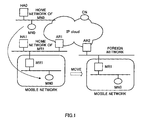
- FIG. 1 is a diagram illustrating one example of a global network described above.
- IP cloud comprising CN (Corresponding Node), AR1 (Access Router 1), AR2, and HA1 (Home Agent 1) which constitute fixed network nodes, there are a home network for MN0 (Mobile Node 0), which is an edge network, and mobile networks (the home network and a foreign network of MR1) developed around it.
- MN0 Mobile Node 0
- MN0 Mobile Node 0
- mobile networks the home network and a foreign network of MR1
- a mobile network is a type of network in which the network as a whole changes its point of attachment to the Internet, and which normally necessitates a mobile router (a router which connects a mobile network to the Internet: denoted as MR1 in the figure) in the mobile network which changes its point of attachment to the Internet between different access routers AR1 and AR2 (practically, such access router themselves may be mobile).
- a mobile network include a network connected to general public (known as a Personal Area Network or PAN), or a sensor network deployed in a vehicle such as an automobile, train, vessel, and aircraft.
- Each individual node in such a mobile network (MN0 in FIG. 1) is normally connected to a central apparatus (i.e. mobile router MR1), and does not change its point of attachment when its network is in motion; instead the mobile router MR1 changes its point of attachment in such a case so that the network as a whole moves.
- a central apparatus i.e. mobile router MR1
- the present invention describes a solution proposed to address the problem of a network in motion.
- the issue of a network in motion lies in providing continuous Internet connectivity for nodes in a network which is mobile as a whole.
- the node MN0 in a mobile network might not be aware that the network is changing its point of attachment to the Internet; in this point, it differs from the classical issue of mobility support which is dealt with in mobile IPv4 (Non-Patent Document 5) of Internet Protocol Version 4 (IPv4; Non-Patent Document 6) and mobile IPv6 (Non-Patent Document 7) of Internet Protocol Version 6 (IPv6; Non-Patent Document 8) .
- IPv4 Internet Protocol Version 4
- IPv6 Internet Protocol Version 6
- Non-Patent Document 8 Internet Protocol Version 6
- each mobile node has a permanent home domain.
- a permanent global address known as a home-address is assigned to the mobile node.
- a temporary global address known as a care-of-address is usually assigned to the mobile node.
- the idea of mobility support is such that the mobile node can be reached at the home-address even when it is attached to other foreign networks. This is achieved in the Non-Patent Documents 5 and 7 with the introduction of a home network entity known as a home agent. Mobile nodes register their care-of-addresses with the home agents using messages known as Binding Updates.
- the home agent is responsible to intercept messages that are addressed to the mobile node's home-address, and forward the packet to the mobile node's care-of-address using IP-in-IP Tunneling (Non-Patent Documents 9 and 10).
- IP-in-IP tunneling involves encapsulating an original IP packet in another IP packet. The original packet is sometimes called as an inner packet, whereas a new packet which encapsulates the inner packet is sometimes called as an outer packet.
- Non-Patent Document 5 There have been several major attempts for solving the problem of a network in motion, all of which are based on mobile IP (Non-Patent Document 5, 7).
- Non-Patent Document 11 One of the solutions proposed for a network in motion is mobile router support (Non-Patent Document 11).
- the mobile router performs the routing of packets from / to the mobile network by using several routing protocols, whereas in a case where the mobile router and the mobile network move to a foreign domain, the mobile router registers a care-of-address with its home agent, and thereafter, an IP-in-IP tunneling is set between the mobile router and the home agent.
- the routing protocols which are used when the mobile router is located in its home domain are also executed on the IP-in-IP tunneling again.
- Non-Patent Document 12 Another solution proposed in Non-Patent Document 12 is an enhancement of mobile router support (Non-Patent Document 11).
- the solution contains the use of a Reverse Routing Header in order to avoid encapsulation in too many levels in a case where a mobile network is made in nesting (that is, a mobile network is connected to another mobile network).
- a mobile network of the lowest level sets a Reverse Routing Header to its home agent inside a tunnel packet.
- the mobile router of the higher level Upon interception of the tunnel packet on its way by a mobile router of a higher level, the mobile router of the higher level skips encapsulation of this packet into another IP-in-IP tunneling; and instead the mobile router of the higher level copies a source address in the packet to the Reverse Routing Header, and places its own care-of-address as the source address.
- the home agent is able to determine the chain of mobile routers lying on a path between the first mobile router and the home agent itself.
- Non-Patent Document 8 a Routing Header in the forwarded packet so that the packet is directly sent to the first mobile router by way of the mobile router of the higher level.
- Non-Patent Document 13 which is known as Prefix Scope Binding Update.
- a proposal for solutions is made which adds information related to a mobile network prefix to a Binding Update sent by a mobile router.
- a home agent is able to guess that nodes having a prefix which matches with one identified by the Binding Update are connected to the mobile router, and accordingly, the home agent is able to forward packets bound for such nodes to the mobile router.
- Non-Patent Document 11 the use of an IP-in-IP tunneling causes a detrimental effect known as route triangulation.
- This detrimental effect is caused in a situation where a packet from a certain node to another node needs to pass through a third party (a home agent in this case) which is not located on its optimal route between a start point (source) to an end point (destination), and the effect of route triangulation should be contained therein in a case where the mobile network is made in nesting. For example, a packet from a mobile network which must be forwarded through three mobile routers is considered. Using the solution proposed by the Non-Patent Document 11, the packet needs to be encapsulated in three different tunnels.
- each tunnel is destined for a different home agent for a different mobile router.
- a number of these tunneling not only causes a significant delay in packet delivery, but also increases the chance of packet fragmentation on its way because the entire packet size is increased due to encapsulation. Re-assembly of such packets subjected to fragmentation results in further delay in processing, and the packet as a whole must be discarded in a case where even one piece among the fragments is lost.
- Non-Patent Document 12 attempts to overcome the problem by avoiding a lot of tunnels.
- the first mobile router sets an IP-in-IP tunnel with its home agent.
- Subsequent mobile routers do not perform further encapsulation of the packet; and instead these routers record a Reverse Routing Header in an original source address, change the source address with their care-of-address, and forward the packet to its destination without passing through their home agent.
- this solution is highly effective and solves many tunnel problems, it is very difficult for the home agent to verify the reliability of an address list recorded in the Reverse Routing Header.
- Non-Patent Document 12 as a Routing Header is constructed for whichever packet it is to forward it to the mobile router directly, and so a home agent using the list of addresses in the Reverse Routing Header is required, and therefore, it is critically important for the home agent to be able to verify that the address recorded in the Reverse Routing Header is an authentic one.
- the solution of the Non-Patent document 12 provides no improvements against a threat to a safety security which the Reverse Routing Header must face with.
- Another simple solution for overcoming the problem of a lot of tunneling is to make it possible for mobile routers of later location to forward outer packets directly to a specified destination (further instead of performing encapsulation of outer packets at the level of tunneling to the home agent for the mobile routers).
- Non-Patent Document 1 is Soliman, H., and Pettersson, M., "Mobile Networks (MONET) Problem Statement and Scope”, Internet Draft: draft-soliman-monet-statement-00.txt, Feb 2002, Work In Progress;
- Non-Patent Document 2 is Ernst, T., and Lach, H., "Network Mobility Support Requirements”, Internet Draft: draft-ernst-monet-requirements-00.txt, Feb 2002, Work In Progress;
- Non-Patent Document 3 is Lach, H. et.
- Non-Patent Document 4 Kniventon, T. J., and Yegin, A. E., "Problem Scope and Requirements for Mobile Networks Working Group”, Internet Draft: draft-kniventon-monet-requiremetns-00.txt, Feb 2002, Work In Progress; the document referred to as Non-Patent Document 5 is Perkins, C. E.
- Non-Patent Document 6 DARPA, "Internet Protocol”, IETF RFC 791, September 1981; the document referred to as Non-Patent Document 7 is Johnson D. B., Perkins C.
- Non-Patent Document 8 Deering, S., and Hinden, R., "Internet Protocol Version 6 (IPv6) Specification", IETF RFC 2460, December 1998;
- Non-Patent Document 9 is Simpson, W., "IP-in-IP tunneling", IETF RFC 1853, October 1995;
- Non-Patent Document 10 is Conta, A., and Deering, S., “Generic Packet Tunneling in IPv6", IETF RFC 2473, Dec 1998;
- Non-Patent Document 11 Kniveton, T., "Mobile Router Support with Mobile IP”, Internet Draft: draft-kniveton-mobrtr-01.txt, Work In Progress, Mar
- a mobile network element employs a mechanism for passing information related to an access router to which a mobile node is attached on to its home agent or other corresponding nodes. Utilizing this information, without inviting a penalty which is applied in route triangulation, a home agent or corresponding nodes are able to construct a routing header which is for sending packets directly to a mobile node.
- the information related to the router to which the mobile node is attached is sent by the mobile node itself, and accordingly, the reliability of the information is inevitably established.
- the home agent or other corresponding nodes have received the information related to the router to which the mobile node is attached, it is possible to verify that a packet arriving through a tunnel with one outer source address of access routers is from an authentic source. Therefore, because it is possible for a recipient to verify the reliability of a forwarding router, it is possible for a mobile router to forward an outer packet directly to a specified destination.
- the present invention encompasses the internetworking of packet-switched data networks. Some networks among these networks are in motion; for example, a router controlling an inner network side interface of the network changes its point of attachment.
- the present invention provides enhancements to existing solutions in order to provide a global connectivity to roaming hosts, and as its consequence, it is possible to achieve such a global connectivity to roaming hosts.
- the present invention discloses several algorithms to be used in three major types of nodes. These types are: mobile hosts which change their point of attachment to global data communications networks, mobile routers which control inner network side interfaces of moving networks, and other hosts on global data communications networks which conduct communications with mobile hosts and mobile routers. With full deployment of these algorithms, it is possible to deliver packets bound for / coming from networks in motion with minimum delay to intended destinations.
- Every network element which supports or implements a method and a mechanism disclosed in the present invention is referred to as an "invention-enabled" network element.
- mobile nodes connected to a network segment controlled by the mobile router should be able to know the home-address of the above-mentioned mobile router.
- Non-Patent Document 8 Under a circumstance of Internet Protocol Version 6 (Non-Patent Document 8), it is possible to insert home-address option into a router advertisement message identified by IPv6 vicinity search (Non-Patent Document 14), which is for advertising its home-address, and is sent by an invention-enabled router.
- the home-address option should include the next fields: (1) a type field for identifying that the option is home-address option (2) a length field indicating the size of the option, and (3) a home-address field for identifying the home-address of a sender.
- Binding Update messages in variously implementable different methods, which depend on the basic protocol used in a global data communications network.
- an access-router-address option may be inserted in a Binding Update message specified in Mobile IPv6 (Non-Patent Document 7), and such an option should include the next fields: (1) an access-router-address option for identifying that the option is an access router home-address (2) a length field indicating the size of the option, and (3) an access-router-address field for identifying the home-address of the access router to which a sender is attached.
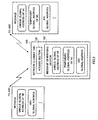
- FIG. 2 is a block diagram illustrating the main configuration of network element apparatus 100 which enables the operation described above.
- This network element apparatus 100 comprises access section 101 and message generating section 102.
- Network element apparatus 100 possesses a global address which is uniquely assigned thereto in a global network, and is currently attached to access router AR1 using this address. Then, as the apparatus itself moves along, and as it becomes necessary to establish a roaming connection with another edge network which is not one to which the apparatus currently belongs, the following operation is conducted.
- access section 101 gets access to access router 2 using another global address which is temporarily assigned to network element apparatus 100 from an upper station (not shown in the figure) in the global network.
- Message generating section 102 generates a Binding Update message which contains a global address which is uniquely assigned to network element apparatus 100, a global address which is assigned temporarily, and a global address of access router AR1, which is a serving router before move.
- Access section 101 transmits the Binding Update message generated at the message generating section to access router AR2, which is a serving router after move.
- Binding Entries should include at least the next three fields: (1) a home-address field containing the home-address of a mobile node (2) a care-of-address field containing the care-of-address of the mobile node, and (3) an access-router-address field containing the home-address of the access router. It is possible to take the values of these three fields out of a Binding Update message.
- FIG. 3 is a flowchart indicating an algorithm to be used at an invention-enabled network element for updating Binding Entries when the network element receives a Binding Update message (abbreviated as BUM in the figure).
- step denoted as characters ST 101 an entry with a home-address field which is the same as the home-address in the Binding Update message is searched in Binding Entries.
- steps denoted as characters ST 102 and ST 103 a new entry is generated as illustrated in steps denoted as characters ST 102 and ST 103.
- the Binding Update message contains the home-address of an access router, as illustrated in steps denoted as characters ST 108 and ST 109, the access-router-address field in the entry is subjected to updating.
- the Binding Update message does not contain the home-address of an access router, it is assumed that the sender of the Binding Update is attached to an access router which does not enable the present invention, and in such a case, as illustrated in step denoted as character ST 110, it is specified in the access-router-address field that the field is not valid.
- the sender of a Binding Update is able to request a Binding Acknowledgement freely, which allows the recipient of the Binding Update to notify the sender thereof of the result of updating.
- an invention-enabled recipient who receives a Binding Update containing a valid access-router-address information replies with a Binding Acknowledgement it is necessary to predetermine an index in the Binding Acknowledgement in such a manner that the recipient of the Binding Acknowledgement is able to guess that the sender of the Binding Acknowledgement is invention-enabled one. It should be obvious for a person skilled in the art that such an indexing may be achieved with, for example, a bit flag or a specific pattern of a bit stream in a Binding Acknowledgement, or in any other various methods not limited thereto.
- a routing header may be constructed so that a packet is first forwarded to the home-address of an access router, and then forwarded to the care-of-address of a mobile node. In this way, it is not necessary for a packet to traverse the home domain of a mobile node, and instead the packet is intercepted by a home agent and subsequently forwarded to the mobile node utilizing its care-of-address.
- any invention-enabled mobile nodes should maintain a list of other hosts (both of a home agent and corresponding nodes) to which the node sent a Binding Update.
- a Bound Hosts List is referred to as a Bound Hosts List.
- the mobile node should notify hosts on Bound Hosts List by sending respective nodes Binding Updates, however, in order to avoid the burst of Binding Updates each time the mobile node moves, there should be a slight shift between consecutive transmissions of Binding Updates.
- any home agent and corresponding invention-enabled nodes are able to obtain a sufficient knowledge related to the network topology on the periphery of the mobile node to optimize the delivery of packets to the mobile node. In order to do so, it is possible to employ an algorithm as illustrated below when a routing header is constructed from Binding Entries.
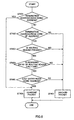
- FIG. 4 is a flowchart indicating an algorithm to be used at a network host when constructing a routing header for delivering a packet directly to a mobile node.
- Binding Entries are used for obtaining the care-of-addresses of mobile nodes and their access routers in a recursive manner, whereas a stack is used for storing these addresses, making it possible to return the addresses in reverse order when constructing a routing header.
- a stack (last-in-first-out information storage structure) is used to aid the construction of a routing header.
- a stack is initialized to empty itself, and then as illustrated in a step denoted as character ST 202, two of temporary variables "src" and "dst" are respectively set with the address of the packet source (i.e. the home agent or corresponding nodes which send the packet) and the address of its termination (i.e. the home-address of the mobile node).
- the algorithm enters the processing loop illustrated in steps denoted as characters ST 203 - ST 209, and in that loop, a search in Binding Entries is conducted for an entry having a home-address field matching with the value stored in dst.
- the processing leaves the loop as illustrated in steps denoted as characters ST 203 and ST 204, whereas in a case where the searched entry is found, the value in dst is checked to confirm whether the value is the home-address of the mobile node or not (a correct result should be obtained only at the first repetition of the loop).
- the value in dst is put into the stack.
- step denoted as character ST 207 the algorithm updates the value in dst to be stored in the care-of-address field found in the Binding Entries. Thereafter, the access-router-address field of the Binding Entries is checked to confirm whether the field contains a valid address or not. In a case where the field contains a valid address, the loop is repeated as illustrated in steps denoted as characters ST 208 and ST 209. In the ST 209, the contents of the dst field is also put in the stack, whereas in a case where the access-router-field is invalid, the processing exits the loop.
- step ST 210 the contents of the stack is pushed out in reverse order to be added to the routing header. Furthermore, in a case where the stack is emptied, as illustrated in step denoted as character ST 212, the packet termination field is set into the value stored in dst, and the algorithm ends.
- a routing header constructed in this way makes it possible to optimize the routing of a packet delivered to a mobile node, it also invites some kind of security threat.
- the most serious threat lies in that an attacker is able to construct a specific routing header which reflects a packet from a node in a mobile network, and as its consequence, it becomes possible for the attacker to reach the part of a global data communications network where the attacker would not be accessible if s/he were using other methods.
- any invention-enabled mobile nodes should follow the algorithm described below to discard all packets which are suspicious to be forged.
- FIG. 5 is a flowchart indicating an algorithm to be executed by a router when the router intercepts a packet transmitted to one connected to the router in a local network. This test sequence makes it possible to reduce the vulnerability of the local network against security threats.
- the router Upon interception of a packet by a router, as illustrated in steps denoted as characters ST 301 and ST 303, first of all, the router checks whether its termination address matches with its home-address or its care-of-address. In a case where the termination address matches with the home-address, as illustrated in step denoted as character ST 302, the packet is consumed (used) . Or in a case where the termination address matches with the care-of-address, as illustrated in step denoted as character ST 304, the presence of a routing header is checked.
- step denoted as character ST 305 it is checked whether the termination address is a valid address in the local area network connected to the router or not.
- the packet is forwarded to its destination, whereas in a case it is not, the packet is discarded as illustrated in step denoted as character ST 310.
- step denoted as character ST 304 the presence of the routing header is checked, and in a case where it is not present, the packet is discarded as illustrated in step denoted as character ST 310. Or in a case where the routing header is present, it is checked whether the next address in the routing header is the last entry or not.
- next address in the routing header is not the last entry
- the entry is replaced with the termination address of the packet, and as illustrated in steps denoted as characters ST 306, ST 307, and ST 305, it is checked again whether the termination address is a valid address in the local area network connected to the router or not; whereas in a case where the next address in the routing header is the last entry, as illustrated in steps denoted as characters ST 306, and ST 308, the last entry is checked to confirm whether it is the home-address of the router or not.
- the packet is consumed (used), whereas in a case where it is not, the packet is discarded as illustrated in step denoted as character ST 310.
- FIG. 6 is a flowchart indicating an algorithm to be used by a mobile node (i.e. a mobile node which is not functioning as a router), and this figure illustrates check processing performed by a mobile node when the mobile node receives a packet.
- the check process described herein makes it possible to reduce the vulnerability of the mobile nodes against security threats.
- step denoted as character ST 401 the termination address is checked to confirm whether it is the home-address of the mobile node or not. If Yes, as illustrated in step denoted as character ST 406, the packet is consumed (used), whereas in a case where it is not, the termination address is checked to confirm whether it is the care-of-address of the mobile node or not as illustrated in step denoted as character ST 402. In a case where it is not the care-of-address of the mobile node, as illustrated in step denoted as character ST 407, the packet is discarded, whereas in a case where the termination address matches with the care-of-address of the mobile node, the presence of a routing header is checked.
- the remaining routing header entry is one, and therefore, that entry must be the home-address of the mobile node.
- the packet is discarded, whereas in a case where all of the tests are passed, the packet is consumed (used) as illustrated in step denoted as character ST 406.
- the above descriptions fully explain a method which delivers a packet to a mobile node without passing through a home agent of the mobile node and an access router, thereby decreasing delivery latency.
- the next disclosed descriptions focus on a packet sent from a mobile node. It should be noted herein that, in a case where a mobile node which is away sends a packet, it uses its care-of-address as a packet source. In many deployed packet-switched data network, this is done because ingress filtering is employed for a security reason. Ingress filtering applies the discarding of a packet from a local network because a discarded packet has a source address which is topologically incompatible with an address used in the above-mentioned local network.
- a mobile node which is away uses its home-address as a source address in order to send a packet from within a foreign domain, there is a possibility that the packet is discarded due to ingress filtering. Accordingly, in order to avoid the ingress filtering, its care-of-address (an address which has a topological compatibility with an address used in a foreign domain) is employed as a source address. To help the recipient to identify the creator of the packet, the mobile node which is away includes its home-address in the header of the packet.
- the mobile node in a case where the mobile node which is away sends a packet, the mobile node fills its care-of-address in the source address of the packet, and inserts its home-address as special information in the packet header.
- the access router In a case where the mobile node is aware that the access router is invention-enabled one, it becomes possible for the access router to forward the packet sent from the mobile node directly to its destination without involving the tunneling of the packet between the access router and the home agent of the access router.
- any router at later location does not wish for an attempt to forward the packet directly to its destination without using any packet tunneling or encapsulation technique
- an intermediate router to disable the direct forwarding request signal.
- the mobile router In a case where any invention-enabled mobile router intercepts this packet, and then becomes aware that the direct forwarding request is specified in the packet, the mobile router then checks whether the source address of the packet is a valid address from the local network or not. If not done, it means that there is at least one intermediate network element which does not enable the present invention between the creator of the packet and the router itself, and in such a case, the router is unable to execute direct forwarding. Next, the mobile router checks whether the packet has a Binding Update provided with a specific destination or not.
- the mobile router changes the source address into the care-of-address to send the packet to its destination.
- the packet is subjected to encapsulation to be tunneled to the home agent of the mobile router, and is subjected to de-capsulation at the home agent of the mobile router to be forwarded to its actual destination.
- this is based on the premise that the mobile router is away from its home, and in a case where it is at home, there is no necessity to check the direct forwarding request. All packets from the local network intercepted by the mobile router are forwarded to its destination by default without the necessity to tunnel the packet to the home agent.
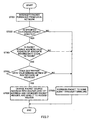
- FIG. 7 is a flowchart indicating an algorithm to be used by a router for processing of an outbound packet, that is, a packet sent out by a node in a local network connected to the router toward other host on a global data communications network.
- step denoted as character ST 501 in a case where an invention-enabled mobile router which is away from home intercepts a packet, first of all, the mobile router checks whether the packet is characterized by a direct forwarding request or not as illustrated in step denoted as character ST 502. Next, as illustrated in step denoted as character ST 503, it is checked that the source address in the packet is a valid address of the mobile router in the local network. Finally, as illustrated in step denoted as character ST 504, the specified destination is checked to confirm whether it is where the mobile router has sent a Binding Update before or not. In a case where any answer for the three tests are negative, as illustrated in step denoted as character ST 505, the packet is forwarded to the home agent through tunneling.
- the packet is forwarded directly as illustrated in step denoted as character ST 506.
- the invention-enabled mobile router modifies the packet header, and as its consequence, the source address is replaced with the care-of-address.
- the source address of a packet is changed by a router on its way, there must be a method which allows the recipient of the packet to verify that the packet has been sent out from a reliable source. Containing the home-address of the mobile node which sends the packet in the packet header provides one form of verification methods. However, it is possible for an attacker to forge a packet, and then insert forged home-address information in its packet header. Therefore, it is critically important for the recipient to be able to verify that the source address of a received packet is the access router of an invention-enabled authorized sender (the sender herein relates to a mobile node having a specified home-address) . As one method for that purpose, there is a method for checking through Binding Entries, which makes it possible to verify that the source address of a received packet is linked with the home-address inserted in its packet header.
- FIG. 8 is a flowchart illustrating a processing algorithm for verifying such a relation.
- the figure shows a verification process used by a network host such as a home agent or corresponding nodes in order to check that a packet having a specified source address is linked with the home-address contained in its packet header by the last Binding Update.
- the algorithm which is basically illustrated in the figure investigates repetitive Binding Entries in order to verify the relation between the source address and the home-address.
- the algorithm shown in this figure returns a Boolean value TRUE, or returns a Boolean value FALSE otherwise.
- a variable "temp" is initialized in order to store the home-address identified in the packet header.
- the algorithm subsequently enters a loop (a loop denoted with characters ST 602 - ST 607) in order to check the Binding Entries in detail.
- the value in temp is checked against the source address of the packet.
- the algorithm If they match up, the algorithm returns TRUE as illustrated in step denoted as character ST 602, whereas if they do not match up, the algorithm searches for an entry having a home-address field matching with the value stored in temp in the Binding Entries as illustrated in step denoted as character ST 603. If the searched entry is not found, the algorithm returns FALSE as illustrated in step denoted as character ST 604, whereas if the searched entry is found, the algorithm compares the source address of the packet with the care-of-address field of the found entry as illustrated in step denoted as character ST 605.
- step denoted as character ST 606 it is checked whether the access-router-address field of the found entry contains a valid entry or not. In a case where the access-router-address field is not valid, the algorithm returns FALSE, whereas in a case where the access-router-address field is valid, the address in the access-router-address field is stored in temp, and the loop is repeated as illustrated in step denoted as character ST 607.
- Binding Acknowledgement There is a necessity for a invention-enabled basic node to execute Binding Entries and an algorithm as illustrated in FIG. 3 which updates the Binding Entries. In addition, it should characterize a Binding Acknowledgement with such special information that allows the recipient of the Binding Acknowledgement to recognize that information related to the home-address of the access router in the corresponding Binding Update message is received.
- an invention-enabled node to execute an algorithm as illustrated in FIG. 8 which checks the source address of the received packet. After all, it is necessary for an invention-enabled basic node to execute an algorithm as illustrated in FIG. 4 which constructs a routing header so that it becomes possible to optimize the delivery of a packet to an invention-enabled mobile node.
- an invention-enabled node starts the forwarding of a packet to the sender of a Binding Update message through a specific access router shortly after receiving the Binding Update message having additional information related to the home-address of the access router to which the above-mentioned sender is attached.
- any arbitrary packet transmitted from an invention-enabled node after the reception of a Binding Update has one of the following characteristics: (1) the above-mentioned packet has a source address field which is set into the home-address of an access router, accompanied by a routing header containing the care-of-address and the home-address of the above-mentioned sender of the Binding Update only (2) the above-mentioned packet has a source address field which is set into the home-address of an access router, accompanied by a routing header containing the care-of-address of the above-mentioned sender of the Binding Update as the initial entry.
- the above-mentioned access router should also send a Binding Update containing its care-of-address to the same invention-enabled node, and a packet transmitted from the invention-enabled node has one of the following characteristics: (1) the above-mentioned packet has a source address field which is set into the care-of-address of an access router, accompanied by a routing header containing the care-of-address and the home-address of the above-mentioned sender of the Binding Update only (2) the above-mentioned packet has a source address field which is set into the care-of-address of an access router, accompanied by a routing header containing the care-of-address of the above-mentioned sender of the Binding Update as the initial entry, or (3) the above-mentioned packet is appended with a routing header containing the care-of-addresses of the above-mentioned sender of the Binding Update and the access router,
- an invention-enabled mobile node In addition to such functions specified for an invention-enabled basic node, an invention-enabled mobile node must be implemented with a function to insert a direct forwarding request in a packet and a function to insert the home-address of the access router in a Binding Update message. In a case where a mobile node does not function as a mobile router, it is necessary to execute an algorithm as illustrated in FIG. 6 for checking input packets.
- an invention-enabled mobile router has to implement a function to check packets from a local network (i.e. the inner network side interface of the above-mentioned router (ingress interface)) for a direct forwarding signal as illustrated in FIG. 7.
- a local network i.e. the inner network side interface of the above-mentioned router (ingress interface)
- the router has to conduct a security check.
- an invention-enabled node may simply forward the packet by changing the source address of the above-mentioned packet into the care-of-address or the home-address of the node itself. This happens when the Bound Host List of an access router contains a host specified in the destination field of the packet, and in a case where the specified destination is not listed on the Bound Host List, an invention-enabled router is also able to send a Binding Update message to the specified destination.
- the 1st aspect of the present invention is a method for providing global connectivity to roaming networks used in an internetworking of packet-switched data communications networks, wherein network elements in the communications networks are uniquely addressed by a primary global address such that the network element can be reached even when it is roaming anywhere in the communication networks, whereas the network elements that are roaming with in the communications networks can be assigned with a temporary global address for a duration of which the roaming network element is attached to a single access router, through which the roaming network element gains access to a global data communications network, comprising the step of sending a Binding Update message from the roaming network element to a singular or plural other network elements, wherein the Binding Update message contains the primary global address and the temporary global address of the sending roaming network element, for which the objective is to allow the receiving network elements relate the specified temporary global address to the specified primary global address, and further contains the primary global address of the access router to which the roaming network element is currently attached.
- the 2nd aspect of the present invention is the above-described method for providing the global connectivity to the roaming networks used in the internetworking of the packet-switched data communications networks, wherein the network element in the internetworking of the packet-switched data communications networks adds a data format to a Binding Update message in order to insert the primary global address of the access router to which the roaming network element is attached in the Binding Update message, wherein the data format has (i) a type field for making it possible to identify that the data format contains the primary global address of the access router to which the sender is attached (ii) a length field for making it possible to identify the length of the data format (iii) an Access-Router-Address field containing the primary global address of the access router to which the sender is attached.
- the 3rd aspect of the present invention is the above-described method for providing the global connectivity to the roaming networks, used in the internetworking of packet-switched data communications networks, wherein the access router in the internetworking of the packet-switched data communications networks adds a data format to an advertisement message in order to insert its primary global address of the access router in the advertisement message, wherein the data format has (i) a type field for making it possible to identify that the data format contains the primary global address of the sender (ii) a length field for making it possible to identify a length of the data format (iii) an Access-Router-Address field containing the primary global address of the sender.
- the 4th aspect of the present invention is a method for providing a global connectivity to roaming networks used among a plurality of network elements in the internetworking of packet-switched data communications networks, wherein one of the network elements roams in the internetworking of the packet-switched data communications networks, the method comprising the steps of: (i) transmitting the Binding Update message from the roaming network element to another network element containing a predetermined global address and a temporary global address assigned additionally to the roaming network element performing the transmission so that the receiving network element is able to associate the specified temporary global address with the specified primary global address and further containing the primary global address of the access router to which the roaming network element is currently attached (ii) replying from the recipient of the Binding Update message to the roaming network element using a Binding Acknowledgement message, wherein the Binding Update message contains information related to the reception or rejection of the Binding Update message, and further contains information indicating that a function is provided to notify the recipient of the Binding Update message that the sender of the
- the 5th aspect of the present invention is the above-described method for providing the global connectivity to the roaming networks, wherein, in a case where a network entity receives a Binding Update message, the network entity is able to record the Binding Update message in Binding Entries, further wherein the binding entry is made up of the following fields: (i) a Home-Address field containing the primary global address of the roaming network element (ii) a Care-Of-Address field containing the temporary global address of the roaming network element (iii) an Access-Router-Address field containing the primary global address of the access router to which the roaming network element is attached.
- the 6th aspect of the present invention is the above-described method for providing the global connectivity to the roaming networks, wherein, in a case where the network entity receives the Binding Update message, the network entity updates Binding Entries, the method comprising the steps of: (i) checking whether the Binding Entries contain an entry having the Home-Address field matching with the primary global address specified in the received Binding Update message, and creating a new entry in a case w here no entry is found (ii) deleting the entry in the Binding Entries having the Home-Address field matching with the primary global address specified in the received Binding Update message in a case where the Binding Update message does not contain information related to the temporary global address of the sender of the Binding Update message (iii) deleting the entry in the Binding Entries having the Home-Address field matching with the primary global address specified in the received Binding Update message in a case where the information related to the temporary global address is contained in the Binding Update message matching with the Home-Address
- the 7th aspect of the present invention is the above-described method for providing the global connectivity to the roaming networks, wherein the network element constructs a routing header added to a data packet, further wherein the routing header is used to instruct the network element to which destination is indicated with termination address specified in the packet to forward it to another destination, the method comprising the steps of: (i) emptying last-in-first-out data structure to initialize a temporary variable in order to store the primary global address of the final destination of the packet (ii) searching for an entry whose Home-Address field contains the same address as one stored in the above-mentioned temporary variable in the Binding Entries (iii) storing the value of the temporary variable in the upper tier of the last-in-first-out structure in a case where the entry is found in the Binding Entries and where the value of the temporary global address matches with the primary global address of the final destination of the packet (iv) storing the value contained in the Care-Of-Address field of the entry in the temporary variable in a
- the 8th aspect of the present invention is the above-described method for providing the global connectivity to the roaming networks, the method further comprising the steps of: inserting a unique signal in the data packet to make a request to the access router to which the network element is attached so that the network element is able to forward the data packet directly to the destination specified in the data packet.
- the 9th aspect of the present invention is the above-described method for providing the global connectivity to the roaming networks, the method further comprising the steps of: invalidating the unique signal in the data packet which is made clear in the above-described method so that the series of intermediate routers do not forward the data packet directly to the destination specified in the data packet.
- the 10th aspect of the present invention is the above-described method for providing the global connectivity to the roaming networks, wherein an intermediate network element in the internetworking of the packet-switcheddata communications networks performs the processing of a data packet received from its inner network side interface, and the intermediate network element functions as abridge router between a single or a plurality of local data communications network of its inner network side interface and the internetworking of the packet-switched data communications networks of its outer network side interface, the method comprising the steps of: (i) forwarding the received packet in a case where the intermediate network element does not roam in the internetworking of the packet-switched data communications networks (ii) encapsulating the received packet using another newly created packet in order to transmit it to a specific network element in the internetworking of the packet-switched data communications networks, wherein, in a case where the intermediate network element roams in the internetworking of the packet-switched data communications networks and where the element is assigned the temporary global address, if the received packet does not contain a unique address or if the
- the 11th aspect of the present invention is the above-described method for providing the global connectivity to the roaming networks, wherein an intermediate network element in the internetworking of the packet-switched data communications networks checks whether a source address specified in a received packet addressed to the network element is an authentic one or not, the received data packet containing information related to an address which is the primary global address of the access router to which the sender of the received packet is attached, and which is different one from the source address specified in the received data packet, the method comprising the steps of: (i) initializing a temporary variable in order to store the primary global address contained in the received data packet (ii) declaring that the source address is an authentic one in a case where the value stored in the temporary variable matches with the source address specified in the data packet (iii) searching for an entry in the Binding Entries which has the value matching with the value stored in the temporary variable in the Home-Address field in a case where the value stored in the temporary variable does not match with the source address specified in the data packet (iv) declaring that the
- the 12th aspect of the present invention is the above-described method for providing the global connectivity to the roaming networks in order to send a data packet containing a routing header, wherein the method is used after a successful reception of the Binding Update message containing the primary global address of the access router to which the sender of the Binding Update message is attached, the method comprising the steps of: (i) setting the source address of the data packet to be the primary global address of the access router (ii) setting so that the routing header contain the temporary global address and the primary global address of the sender of the Binding Update message only.
- the 13th aspect of the present invention is the above-described method for providing the global connectivity to the roaming networks in order to send a data packet containing a routing header, wherein the method is used after a successful reception of the Binding Update message containing the primary global address of the access router to which the sender of the Binding Update message is attached, the method comprising the steps of: (i) setting the source address of the data packet to be the primary global address of the access router (ii) setting so that the routing header contain the temporary global address of the sender of the Binding Update message as the initial entry.
- the 14th aspect of the present invention is the above-described method for providing the global connectivity to the roaming networks in order to send a data packet containing a routing header, wherein the method is used after a successful reception of the first Binding Update message containing the primary global address of the access router to which the sender of the Binding Update message is attached, and after a successful reception of the second Binding Update message which is transmitted by the access router and contains the temporary global address of the access router, the method comprising the steps of: (i) setting the source address of the data packet to be the primary global address of the access router (ii) setting so that the routing header contain the temporary global address and the primary global address of the sender of the first Binding Update message only.
- the 15th aspect of the present invention is the above-described method for providing the global connectivity to the roaming networks in order to send a data packet containing a routing header, wherein the method is used after a successful reception of the first Binding Update message containing the primary global address of the access router to which the sender of the Binding Update message is attached, and after a successful reception of the second Binding Update message which is transmitted by the access router and contains the temporary global address of the access router, the method comprising the steps of: (i) setting the source address of the data packet to be the temporary global address of the access router (ii) setting so that the routing header contain the temporary global address of the sender of the first Binding Update message as the initial entry.
- the 16th aspect of the present invention is the above-described method for providing the global connectivity to the roaming networks in order to send a data packet containing a routing header, wherein the method is used after a successful reception of the first Binding Update message containing the primary global address of the access router to which the sender of the Binding Update message is attached, and after a successful reception of the second Binding Update message which is transmitted by the access router and contains the temporary global address of the access router, the method comprising the step of setting so that the routing header contain the temporary global address of the sender of the first Binding Update message and the temporary global address of the access router as the initial entry and that the temporary global address of the access router appears just before the temporary global address of the sender of the first Binding Update message in the routing header.
- the 17th aspect of the present invention is the above-described method for providing the global connectivity to the roaming networks, wherein the network element roams in the internetworking of communications networks, and functions as a bridge router between a single or a plurality of local data communications network of its inner network side interface and the internetworking of the packet-switched data communications networks of its outer network side output interface, and after receiving the data packet containing the unique signal from its inner network side interface, the method comprising the steps of: (i) changing the source address of the data packet into its temporary global address (ii) forwarding the data packet to its outer network side interface.
- the 18th aspect of the present invention is an apparatus used in a network element which is used in the internetworking of the packet-switched data communications networks as made clear from the above-described method, comprising means for realizing the following methods: (i) a method of using the Binding Entries as made clear from the above (ii) a method of updating the Binding Entries as made clear from the above (iii) a method of inserting instructions into a Binding Acknowledgement message, and thereby making it possible to notify the recipient of the Binding Acknowledgement message that the sender is able to understand and take an appropriate action to have the Binding Update message contain the primary global address of the access router with the presence of such instructions as made clear from the above (iv) a method of checking the source address of a data packet as made clear from the above (v) a method of constructing a routing header as made clear from the above.
- the 19th aspect of the present invention is an apparatus used in a network element which is used in the internetworking of the packet-switched data communications networks as made clear from the above-described method, wherein the network element roams in the internetworking of communications networks, comprising means for realizing the following methods: (i) a method of using the Binding Entries as made clear from the above (ii) a method of updating the Binding Entries as made clear from the above (iii) a method of inserting instructions into a Binding Acknowledgement message, and thereby making it possible to notify the recipient of the Binding Acknowledgement message that the sender is able to understand and take an appropriate action to have the Binding Update message contain the primary global address of the access router with the presence of such instructions as made clear from the above (iv) a method of checking the source address of a data packet as made clear from the above (v) a method of constructing a routing header as made clear from the above (vi) a method of inserting into a data packet
- the 20th aspect of the present invention is an apparatus used in a network element which is used in the internetworking of the packet-switched data communications networks as made clear from the above-described method, wherein the network element roams in the internetworking of communications networks, and functions as a bridge router between a single or a plurality of local data communications network of its inner network side interface and the internetworking of the packet-switched data communications networks of its outer network side interface, comprising means for realizing the following methods: (i) a method of adding information on the primary global address of the network element to an advertisement message as made clear from the above (ii) a method of using the Binding Entries as made clear from the above (iii) a method of updating the Binding Entries as made clear from the above (iv) a method of inserting instructions into a Binding Acknowledgement message, and thereby making it possible to notify the recipient of the Binding Acknowledgement message that the sender is able to understand and take an appropriate action to have the Binding Update message
- the present invention allows a host in internetworking of packet-switched data networks to resort to existing solutions which provide a global connectivity to a mobile host, and extends these solutions to further provide a global connectivity to a network changing its point of attachment.
- Using a method disclosed in the document herein it is possible to deliver packets between mobile networks to their intended destinations with the minimum delay, and moreover, adopting a verification method presented by the present invention makes it further possible to alleviate a security threat which a network element is exposed to.
- the present invention is applicable to packet transmission in internetworking of packet-switched data communications network. Especially, the disclosed invention addresses a problem involved when providing network connectivity to a node which constantly changes its point of attachment to a global data communications network. Furthermore, it is possible to consider the present invention as an enhancement to existing solutions for providing a global connectivity to a roaming host.
Landscapes
- Engineering & Computer Science (AREA)
- Computer Networks & Wireless Communication (AREA)
- Signal Processing (AREA)
- Databases & Information Systems (AREA)
- Computer Security & Cryptography (AREA)
- Data Exchanges In Wide-Area Networks (AREA)
- Mobile Radio Communication Systems (AREA)
Applications Claiming Priority (3)
| Application Number | Priority Date | Filing Date | Title |
|---|---|---|---|
| JP2002303879 | 2002-10-18 | ||
| JP2002303879 | 2002-10-18 | ||
| PCT/JP2003/013348 WO2004036841A1 (ja) | 2002-10-18 | 2003-10-20 | グローバル・ネットワークにおける ローミング接続方法及び装置 |
Publications (2)
| Publication Number | Publication Date |
|---|---|
| EP1553734A1 true EP1553734A1 (de) | 2005-07-13 |
| EP1553734A4 EP1553734A4 (de) | 2009-04-29 |
Family
ID=32105089
Family Applications (1)
| Application Number | Title | Priority Date | Filing Date |
|---|---|---|---|
| EP03754176A Withdrawn EP1553734A4 (de) | 2002-10-18 | 2003-10-20 | Verfahren und einrichtung für roaming-verbindung in einem globalen netzwerk |
Country Status (6)
| Country | Link |
|---|---|
| US (2) | US7508828B2 (de) |
| EP (1) | EP1553734A4 (de) |
| JP (1) | JP3887640B2 (de) |
| CN (1) | CN1706159A (de) |
| AU (1) | AU2003273044A1 (de) |
| WO (1) | WO2004036841A1 (de) |
Cited By (11)
| Publication number | Priority date | Publication date | Assignee | Title |
|---|---|---|---|---|
| WO2007066817A1 (en) * | 2005-12-08 | 2007-06-14 | Matsushita Electric Industrial Co., Ltd. | Routing loop detection control apparatus |
| WO2007145371A1 (en) * | 2006-06-14 | 2007-12-21 | Panasonic Corporation | Filtering policy in nemo mobile router |
| WO2008004713A1 (en) * | 2006-07-07 | 2008-01-10 | Panasonic Corporation | Apparatus for controlling tunneling loop detection |
| WO2014179235A1 (en) * | 2013-04-29 | 2014-11-06 | Oceus Networks Inc. | Mobile cellular network backhaul |
| US9198221B2 (en) | 2012-08-24 | 2015-11-24 | Oceus Networks Inc. | Mobile cellular networks |
| US9445280B2 (en) | 2012-08-24 | 2016-09-13 | Oceus Networks Inc. | Mobile cellular networks |
| US9686238B1 (en) | 2016-07-07 | 2017-06-20 | Oceus Networks Inc. | Secure network enrollment |
| US9924427B2 (en) | 2016-07-07 | 2018-03-20 | Oceus Networks Inc. | Network backhaul access |
| US10172078B2 (en) | 2017-03-31 | 2019-01-01 | Oceus Networks Inc. | Targeted user equipment-base station communication link |
| US10873891B2 (en) | 2016-07-06 | 2020-12-22 | Oceus Networks, Llc | Secure network rollover |
| US11246031B2 (en) | 2018-08-15 | 2022-02-08 | Oceus Networks, Llc | Disguising UE communications in a cellular network |
Families Citing this family (33)
| Publication number | Priority date | Publication date | Assignee | Title |
|---|---|---|---|---|
| US8081968B2 (en) * | 2000-10-11 | 2011-12-20 | Gogo Llc | System for creating an air-to-ground IP tunnel in an airborne wireless cellular network to differentiate individual passengers |
| JP3621917B2 (ja) * | 2001-12-21 | 2005-02-23 | 株式会社日立製作所 | データ中継方法、及びその方法に用いられるデータ中継装置 |
| KR100513863B1 (ko) * | 2003-04-29 | 2005-09-09 | 삼성전자주식회사 | 호스트의 이동성을 지원할 수 있는 무선 근거리 네트워크시스템 및 그의 동작방법 |
| US7849217B2 (en) * | 2003-04-30 | 2010-12-07 | Cisco Technology, Inc. | Mobile ethernet |
| KR100552471B1 (ko) * | 2003-10-13 | 2006-02-15 | 삼성전자주식회사 | 무선네트워크에서 억세스포인트를 이용하여 CoA를 미리예약하고 라우팅을 하여 빠른 핸드오프를 수행하는 방법 |
| US7496684B2 (en) * | 2004-01-20 | 2009-02-24 | International Business Machines Corporation | Developing portable packet processing applications in a network processor |
| US7206859B2 (en) * | 2004-02-18 | 2007-04-17 | Motorola, Inc. | Method for optimized local routing between mobile nodes |
| JP2008508837A (ja) * | 2004-06-10 | 2008-03-21 | ネットモーション ワイヤレス インコーポレイテッド | コンピュータ環境におけるモバイル及び他の断続的接続性を提供する方法及び装置 |
| US7836506B2 (en) * | 2004-09-22 | 2010-11-16 | Cyberdefender Corporation | Threat protection network |
| US8005093B2 (en) * | 2004-09-23 | 2011-08-23 | Nokia Corporation | Providing connection between networks using different protocols |
| US20060095546A1 (en) * | 2004-10-07 | 2006-05-04 | Nokia Corporation | Method and system for locating services in proximity networks for legacy application |
| EP1902566B3 (de) | 2005-07-08 | 2011-12-21 | Panasonic Corporation | Mobiler knoten und kommunikationssteuerungsverfahren |
| US7633898B2 (en) * | 2006-02-02 | 2009-12-15 | Qualcomm Incorporated | Mobile IP addressing |
| KR100943888B1 (ko) | 2006-12-07 | 2010-02-24 | 삼성전자주식회사 | 다수의 이종망들을 이용한 패킷 데이터 서비스 장치 및방법 |
| CN101606361A (zh) * | 2007-02-13 | 2009-12-16 | 日本电气株式会社 | 移动终端管理系统、网络设备及用于它们的移动终端控制方法 |
| EP2137903B1 (de) * | 2007-03-16 | 2011-01-19 | Telefonaktiebolaget LM Ericsson (publ) | Schnittstellenauswahl in einem beweglichen netz |
| WO2008132780A1 (ja) * | 2007-04-12 | 2008-11-06 | Panasonic Corporation | オーバレイネットワークノード及びモバイルノード並びにモバイルルータ |
| CN101675676B (zh) * | 2007-05-04 | 2014-01-22 | 苹果公司 | 协商不同的移动ip输送方式 |
| US8862095B2 (en) * | 2007-06-19 | 2014-10-14 | Cisco Technology, Inc. | Managing mobile nodes in a lawful intercept architecture |
| US8060086B1 (en) * | 2007-11-02 | 2011-11-15 | Sprint Spectrum L.P. | Method and apparatus for processing mobile-IP registration requests |
| US20100332593A1 (en) * | 2009-06-29 | 2010-12-30 | Igor Barash | Systems and methods for operating an anti-malware network on a cloud computing platform |
| JP4934728B2 (ja) * | 2010-01-15 | 2012-05-16 | 株式会社エヌ・ティ・ティ・ドコモ | 通信制御装置、通信制御システム、及び通信制御方法 |
| US9479348B2 (en) * | 2014-09-30 | 2016-10-25 | Vmware, Inc. | Technique to submit multicast membership state in absence of querier |
| US10999182B2 (en) | 2019-05-13 | 2021-05-04 | 128 Technology, Inc. | Routing using segment-based metrics |
| US11005749B2 (en) | 2019-05-13 | 2021-05-11 | 128 Technology, Inc. | Multicast source and receiver access control |
| US11451464B2 (en) | 2019-05-13 | 2022-09-20 | 128 Technology, Inc. | Central authority for service and topology exchange |
| US11329912B2 (en) * | 2019-05-13 | 2022-05-10 | 128 Technology, Inc. | Source-based routing |
| US11153202B2 (en) | 2019-05-13 | 2021-10-19 | 128 Technology, Inc. | Service and topology exchange protocol |
| US11070465B2 (en) | 2019-05-13 | 2021-07-20 | 128 Technology, Inc. | Distribution of multicast information in a routing system |
| US12137045B2 (en) | 2019-05-13 | 2024-11-05 | Juniper Networks, Inc. | Metric-based multi-hop path selection |
| US11363060B2 (en) * | 2019-10-24 | 2022-06-14 | Microsoft Technology Licensing, Llc | Email security in a multi-tenant email service |
| EP4173238B1 (de) | 2020-06-24 | 2024-03-13 | Juniper Networks, Inc. | Punkt-zu-mehrpunkt-schicht-2-netzwerkerweiterung über ein schicht-3-netzwerk |
| US12506687B2 (en) * | 2022-12-08 | 2025-12-23 | Nokia Solutions And Networks Oy | In-network solution for low-latency communications using segment routing |
Family Cites Families (30)
| Publication number | Priority date | Publication date | Assignee | Title |
|---|---|---|---|---|
| US5161156A (en) * | 1990-02-02 | 1992-11-03 | International Business Machines Corporation | Multiprocessing packet switching connection system having provision for error correction and recovery |
| US5517618A (en) * | 1992-02-10 | 1996-05-14 | Matsushita Electric Industrial Co., Ltd. | Mobile migration communications control device |
| US5799012A (en) * | 1995-08-11 | 1998-08-25 | Motorola, Inc. | System controlled asymmetrical automatic repeat request protocol method |
| JP3555710B2 (ja) * | 1995-12-20 | 2004-08-18 | ソニー株式会社 | データ伝送方法および装置 |
| US6208644B1 (en) * | 1998-03-12 | 2001-03-27 | I-Cube, Inc. | Network switch providing dynamic load balancing |
| US6625135B1 (en) * | 1998-05-11 | 2003-09-23 | Cargenie Mellon University | Method and apparatus for incorporating environmental information for mobile communications |
| US6912232B1 (en) * | 1998-10-19 | 2005-06-28 | At&T Corp. | Virtual private network |
| US6496505B2 (en) * | 1998-12-11 | 2002-12-17 | Lucent Technologies Inc. | Packet tunneling optimization to wireless devices accessing packet-based wired networks |
| US6578085B1 (en) * | 1999-01-27 | 2003-06-10 | Nortel Networks Limited | System and method for route optimization in a wireless internet protocol network |
| EP1117231A3 (de) * | 2000-01-14 | 2004-03-24 | Sony Corporation | Informationsverarbeitungsvorrichtung, Verfahren dafür, und Aufnahmemedium |
| JP2001224070A (ja) * | 2000-02-09 | 2001-08-17 | Fujitsu Ltd | モバイル通信システム及びその方法 |
| EP1158742A1 (de) * | 2000-05-24 | 2001-11-28 | Motorola, Inc. | Kommunikationssystem und Verfahren dafür |
| JP3636637B2 (ja) * | 2000-05-30 | 2005-04-06 | 三菱電機株式会社 | 経路最適化方法 |
| JP4020576B2 (ja) * | 2000-09-14 | 2007-12-12 | 株式会社東芝 | パケット転送方法、移動端末装置及びルータ装置 |
| JP2002185520A (ja) * | 2000-12-12 | 2002-06-28 | Fujitsu Ltd | 移動端末対応ルータおよびホームエージェント・ルータ |
| US7333482B2 (en) * | 2000-12-22 | 2008-02-19 | Interactive People Unplugged Ab | Route optimization technique for mobile IP |
| JP4453205B2 (ja) * | 2001-01-15 | 2010-04-21 | ソニー株式会社 | 情報処理装置および方法、記録媒体、並びにプログラム |
| US6856624B2 (en) * | 2001-02-21 | 2005-02-15 | Alcatel | Temporary unique private address |
| EP1379034A4 (de) * | 2001-03-13 | 2009-09-09 | Nec Corp | System zur verwaltung eines mobilen knotens in einem mobilnetzwerk |
| GB2367986B (en) * | 2001-03-16 | 2002-10-09 | Ericsson Telefon Ab L M | Address mechanisms in internet protocol |
| JP3633503B2 (ja) * | 2001-04-20 | 2005-03-30 | 日本電気株式会社 | 階層化された移動ネットワークの位置管理システムおよびその方法 |
| JP4097914B2 (ja) * | 2001-06-11 | 2008-06-11 | 富士通株式会社 | 移動端末対応ルータ |
| US7027400B2 (en) * | 2001-06-26 | 2006-04-11 | Flarion Technologies, Inc. | Messages and control methods for controlling resource allocation and flow admission control in a mobile communications system |
| JP3709816B2 (ja) * | 2001-08-15 | 2005-10-26 | 株式会社Kddi研究所 | モバイルipの経路制御方法 |
| US7180887B1 (en) * | 2002-01-04 | 2007-02-20 | Radisys Patent Properties | Routing and forwarding table management for network processor architectures |
| US7561553B2 (en) * | 2002-02-27 | 2009-07-14 | Motorola, Inc. | Method and apparatus for providing IP mobility for mobile networks and detachable mobile network nodes |
| JP4081017B2 (ja) * | 2002-03-11 | 2008-04-23 | リサーチ イン モーション リミテッド | データを移動装置へ押し進めるためのシステム及び方法 |
| US7130614B2 (en) * | 2002-08-30 | 2006-10-31 | Nokia Corporation | Mobile unit attachment/update to cellular communication network |
| US6850532B2 (en) * | 2002-09-20 | 2005-02-01 | Cisco Technology, Inc. | Arrangement in a gateway for registering mobile routers of a mobile ad hoc network to respective home agents |
| US7035940B2 (en) * | 2002-11-07 | 2006-04-25 | Nokia Corporation | System and method for mobile router cost metric updates for routing protocols |
-
2003
- 2003-10-20 EP EP03754176A patent/EP1553734A4/de not_active Withdrawn
- 2003-10-20 AU AU2003273044A patent/AU2003273044A1/en not_active Abandoned
- 2003-10-20 JP JP2004544988A patent/JP3887640B2/ja not_active Expired - Fee Related
- 2003-10-20 CN CNA2003801016083A patent/CN1706159A/zh active Pending
- 2003-10-20 WO PCT/JP2003/013348 patent/WO2004036841A1/ja not_active Ceased
- 2003-10-20 US US10/531,206 patent/US7508828B2/en not_active Expired - Lifetime
-
2009
- 2009-02-10 US US12/368,860 patent/US8064430B2/en not_active Expired - Fee Related
Non-Patent Citations (3)
| Title |
|---|
| ERNST THIERRY: "Network Mobility Support in IPv6" THESIS DEPARTMENT OF MATHEMATICS AND COMPUTER SCIENCE, XX, XX, 29 October 2001 (2001-10-29), pages 1-101, XP002215680 * |
| HYUNSIK KANG KEECHEON KIM SUNYOUNG HAN KONKUK UNIVERSITY KYEONG-JIN LEE JUNG-SOO PARK ETRI JUNE 2003: "Route Optimization for Mobile Network by Using Bi-directional Between Home Agent and Top Level Mobile Router; draft-hkang-nemo-ro-tlmr-00.txt" IETF STANDARD-WORKING-DRAFT, INTERNET ENGINEERING TASK FORCE, IETF, CH, 1 June 2003 (2003-06-01), XP015001186 ISSN: 0000-0004 * |
| See also references of WO2004036841A1 * |
Cited By (39)
| Publication number | Priority date | Publication date | Assignee | Title |
|---|---|---|---|---|
| WO2007066817A1 (en) * | 2005-12-08 | 2007-06-14 | Matsushita Electric Industrial Co., Ltd. | Routing loop detection control apparatus |
| US7852776B2 (en) | 2005-12-08 | 2010-12-14 | Panasonic Corporation | Routing loop detection control apparatus |
| WO2007145371A1 (en) * | 2006-06-14 | 2007-12-21 | Panasonic Corporation | Filtering policy in nemo mobile router |
| US8249086B2 (en) | 2006-06-14 | 2012-08-21 | Panasonic Corporation | Apparatus for flow control |
| WO2008004713A1 (en) * | 2006-07-07 | 2008-01-10 | Panasonic Corporation | Apparatus for controlling tunneling loop detection |
| US11240677B2 (en) | 2012-08-24 | 2022-02-01 | Oceus Networks, Llc | Mobile cellular networks |
| US11582671B2 (en) | 2012-08-24 | 2023-02-14 | Oceus Networks, Llc | Mobile cellular networks |
| US12120533B2 (en) | 2012-08-24 | 2024-10-15 | Oceus Networks, Llc | Mobile cellular networks |
| US9445280B2 (en) | 2012-08-24 | 2016-09-13 | Oceus Networks Inc. | Mobile cellular networks |
| US9451646B2 (en) | 2012-08-24 | 2016-09-20 | Oceus Networks Inc. | Mobile cellular networks |
| US11743740B2 (en) | 2012-08-24 | 2023-08-29 | Oceus Networks, Llc | Mobile cellular networks |
| US9198221B2 (en) | 2012-08-24 | 2015-11-24 | Oceus Networks Inc. | Mobile cellular networks |
| US9769674B2 (en) | 2012-08-24 | 2017-09-19 | Oceus Networks Inc. | Mobile cellular networks |
| US10757579B2 (en) | 2012-08-24 | 2020-08-25 | Oceus Networks Inc. | Mobile cellular networks |
| US10750423B2 (en) | 2012-08-24 | 2020-08-18 | Oceus Networks Inc. | Mobile cellular networks |
| US10021619B2 (en) | 2012-08-24 | 2018-07-10 | Oceus Networks Inc. | Mobile cellular networks |
| US10244405B2 (en) | 2012-08-24 | 2019-03-26 | Oceus Networks Inc. | Mobile cellular networks |
| WO2014179235A1 (en) * | 2013-04-29 | 2014-11-06 | Oceus Networks Inc. | Mobile cellular network backhaul |
| US10382393B2 (en) | 2013-04-29 | 2019-08-13 | Oceus Networks Inc. | Mobile cellular network backhaul |
| US9226192B2 (en) | 2013-04-29 | 2015-12-29 | Oceus Networks Inc. | Mobile cellular network backhaul |
| US11991143B2 (en) | 2013-04-29 | 2024-05-21 | Oceus Networks, Llc | Mobile cellular network backhaul |
| US9742729B2 (en) | 2013-04-29 | 2017-08-22 | Oceus Networks Inc. | Mobile cellular network backhaul |
| US11252128B2 (en) | 2013-04-29 | 2022-02-15 | Oceus Networks, Llc | Mobile cellular network backhaul |
| US11671893B2 (en) | 2016-07-06 | 2023-06-06 | Oceus Networks, Llc | Secure network rollover |
| US10873891B2 (en) | 2016-07-06 | 2020-12-22 | Oceus Networks, Llc | Secure network rollover |
| US10742610B2 (en) | 2016-07-07 | 2020-08-11 | Oceus Networks Inc. | Secure network enrollment |
| US9686238B1 (en) | 2016-07-07 | 2017-06-20 | Oceus Networks Inc. | Secure network enrollment |
| US9912640B2 (en) | 2016-07-07 | 2018-03-06 | Oceus Networks Inc. | Secure network enrollment |
| US12167288B2 (en) | 2016-07-07 | 2024-12-10 | Oceus Networks, Llc | Network backhaul access |
| US9924427B2 (en) | 2016-07-07 | 2018-03-20 | Oceus Networks Inc. | Network backhaul access |
| US11134425B2 (en) | 2016-07-07 | 2021-09-28 | Oceus Networks, Llc | Network backhaul access |
| US11588790B2 (en) | 2016-07-07 | 2023-02-21 | Oceus Networks, Llc | Secure network enrollment |
| US10602410B2 (en) | 2016-07-07 | 2020-03-24 | Oceus Networks Inc. | Network backhaul access |
| US10172078B2 (en) | 2017-03-31 | 2019-01-01 | Oceus Networks Inc. | Targeted user equipment-base station communication link |
| US11792721B2 (en) | 2017-03-31 | 2023-10-17 | Oceus Networks, Llc | Targeted user equipment-base station communication link |
| US10631237B2 (en) | 2017-03-31 | 2020-04-21 | Oceus Networks Inc. | Targeted user equipment-base station communication link |
| US11184840B2 (en) | 2017-03-31 | 2021-11-23 | Oceus Networks, Llc | Targeted user equipment-base station communication link |
| US11246031B2 (en) | 2018-08-15 | 2022-02-08 | Oceus Networks, Llc | Disguising UE communications in a cellular network |
| US12507066B2 (en) | 2018-08-15 | 2025-12-23 | Oceus Networks, Llc | Disguising UE communications in a cellular network |
Also Published As
| Publication number | Publication date |
|---|---|
| US8064430B2 (en) | 2011-11-22 |
| JP3887640B2 (ja) | 2007-02-28 |
| CN1706159A (zh) | 2005-12-07 |
| US20060062214A1 (en) | 2006-03-23 |
| JPWO2004036841A1 (ja) | 2006-02-16 |
| US20090147789A1 (en) | 2009-06-11 |
| US7508828B2 (en) | 2009-03-24 |
| WO2004036841A1 (ja) | 2004-04-29 |
| EP1553734A4 (de) | 2009-04-29 |
| AU2003273044A1 (en) | 2004-05-04 |
Similar Documents
| Publication | Publication Date | Title |
|---|---|---|
| US8064430B2 (en) | Network element apparatus and intermediate router apparatus | |
| Wakikawa et al. | Multiple care-of addresses registration | |
| US7436804B2 (en) | Methods and apparatus for using a Care of Address option | |
| AU767782B2 (en) | Buffer management for mobile internet protocol | |
| EP1505780B1 (de) | Verfahren zur validierten Kommunikation | |
| JP4681631B2 (ja) | 通信システム及びアクセスルータ並びにモバイルノード | |
| JP5080490B2 (ja) | 通信ネットワークにおけるルート最適化のための方法および装置 | |
| KR20070043822A (ko) | 네트워크 모빌리티 관리 방법 및 그 장치 | |
| JP4756048B2 (ja) | プレフィックススコープバインディング更新をセキュアにするためのシステム及び関連方法並びに装置 | |
| US7895339B2 (en) | Network managing method and network managing apparatus | |
| EP2047656B1 (de) | Adressenaktualisierungsverfahren, entsprechendes mobiles endgerät und knoten | |
| US20100241737A1 (en) | Method and apparatus for address verification during multiple addresses registration | |
| Thubert et al. | IPv6 backbone router | |
| US20100189000A1 (en) | Prefix information check device and communication device | |
| US8036232B2 (en) | Apparatus and method for filtering packet in a network system using mobile IP | |
| JP2009516954A (ja) | 通信経路最適化方法及び通信経路最適化制御装置 | |
| Kavitha et al. | A secure route optimization protocol in mobile IPv6 | |
| EP2110998A1 (de) | Verfahren für durchlaufverwaltungsaktivierte Knoten zur Bewältigung mit IPv6 Fragmentpaketfilterung | |
| Perkins | Mobile IP and the IETF | |
| CN113839909A (zh) | 数据报文处理的方法、装置和系统 | |
| Bernardos et al. | RFC 8885: Proxy Mobile IPv6 Extensions for Distributed Mobility Management | |
| Devarapalli et al. | RFC 5648: Multiple Care-of Addresses Registration | |
| So et al. | Secure Mobile IP with HIP Style Handshaking and Readdressing for public-key based IP network | |
| KR20070017337A (ko) | 동적 네트워크 관리 시스템 및 동적 네트워크 관리 장치 및동적 네트워크 관리 방법 | |
| CN101385302A (zh) | 网络移动性管理方法以及相应装置 |
Legal Events
| Date | Code | Title | Description |
|---|---|---|---|
| PUAI | Public reference made under article 153(3) epc to a published international application that has entered the european phase |
Free format text: ORIGINAL CODE: 0009012 |
|
| 17P | Request for examination filed |
Effective date: 20050413 |
|
| AK | Designated contracting states |
Kind code of ref document: A1 Designated state(s): AT BE BG CH CY CZ DE DK EE ES FI FR GB GR HU IE IT LI LU MC NL PT RO SE SI SK TR |
|
| AX | Request for extension of the european patent |
Extension state: AL LT LV MK |
|
| DAX | Request for extension of the european patent (deleted) | ||
| RBV | Designated contracting states (corrected) |
Designated state(s): DE FR GB |
|
| RAP1 | Party data changed (applicant data changed or rights of an application transferred) |
Owner name: PANASONIC CORPORATION |
|
| A4 | Supplementary search report drawn up and despatched |
Effective date: 20090326 |
|
| 17Q | First examination report despatched |
Effective date: 20100527 |
|
| STAA | Information on the status of an ep patent application or granted ep patent |
Free format text: STATUS: THE APPLICATION IS DEEMED TO BE WITHDRAWN |
|
| 18D | Application deemed to be withdrawn |
Effective date: 20101007 |