EP1553843B1 - Sel monovalent ameliorant la solubilite d'un concentre de proteine de lait - Google Patents
Sel monovalent ameliorant la solubilite d'un concentre de proteine de lait Download PDFInfo
- Publication number
- EP1553843B1 EP1553843B1 EP02774083A EP02774083A EP1553843B1 EP 1553843 B1 EP1553843 B1 EP 1553843B1 EP 02774083 A EP02774083 A EP 02774083A EP 02774083 A EP02774083 A EP 02774083A EP 1553843 B1 EP1553843 B1 EP 1553843B1
- Authority
- EP
- European Patent Office
- Prior art keywords
- mpc
- protein
- solubility
- mpi
- cation
- Prior art date
- Legal status (The legal status is an assumption and is not a legal conclusion. Google has not performed a legal analysis and makes no representation as to the accuracy of the status listed.)
- Expired - Lifetime
Links
Images







Classifications
-
- A—HUMAN NECESSITIES
- A23—FOODS OR FOODSTUFFS; TREATMENT THEREOF, NOT COVERED BY OTHER CLASSES
- A23J—PROTEIN COMPOSITIONS FOR FOODSTUFFS; WORKING-UP PROTEINS FOR FOODSTUFFS; PHOSPHATIDE COMPOSITIONS FOR FOODSTUFFS
- A23J1/00—Obtaining protein compositions for foodstuffs; Bulk opening of eggs and separation of yolks from whites
- A23J1/20—Obtaining protein compositions for foodstuffs; Bulk opening of eggs and separation of yolks from whites from milk, e.g. casein; from whey
- A23J1/205—Obtaining protein compositions for foodstuffs; Bulk opening of eggs and separation of yolks from whites from milk, e.g. casein; from whey from whey, e.g. lactalbumine
-
- A—HUMAN NECESSITIES
- A23—FOODS OR FOODSTUFFS; TREATMENT THEREOF, NOT COVERED BY OTHER CLASSES
- A23C—DAIRY PRODUCTS, e.g. MILK, BUTTER OR CHEESE; MILK OR CHEESE SUBSTITUTES; PREPARATION THEREOF
- A23C19/00—Cheese; Cheese preparations; Making thereof
- A23C19/02—Making cheese curd
- A23C19/05—Treating milk before coagulation; Separating whey from curd
- A23C19/053—Enrichment of milk with whey, whey components, substances recovered from separated whey, isolated or concentrated proteins from milk
-
- A—HUMAN NECESSITIES
- A23—FOODS OR FOODSTUFFS; TREATMENT THEREOF, NOT COVERED BY OTHER CLASSES
- A23C—DAIRY PRODUCTS, e.g. MILK, BUTTER OR CHEESE; MILK OR CHEESE SUBSTITUTES; PREPARATION THEREOF
- A23C9/00—Milk preparations; Milk powder or milk powder preparations
- A23C9/14—Milk preparations; Milk powder or milk powder preparations in which the chemical composition of the milk is modified by non-chemical treatment
- A23C9/142—Milk preparations; Milk powder or milk powder preparations in which the chemical composition of the milk is modified by non-chemical treatment by dialysis, reverse osmosis or ultrafiltration
- A23C9/1422—Milk preparations; Milk powder or milk powder preparations in which the chemical composition of the milk is modified by non-chemical treatment by dialysis, reverse osmosis or ultrafiltration by ultrafiltration, microfiltration or diafiltration of milk, e.g. for separating protein and lactose; Treatment of the UF permeate
-
- A—HUMAN NECESSITIES
- A23—FOODS OR FOODSTUFFS; TREATMENT THEREOF, NOT COVERED BY OTHER CLASSES
- A23J—PROTEIN COMPOSITIONS FOR FOODSTUFFS; WORKING-UP PROTEINS FOR FOODSTUFFS; PHOSPHATIDE COMPOSITIONS FOR FOODSTUFFS
- A23J3/00—Working-up of proteins for foodstuffs
- A23J3/04—Animal proteins
- A23J3/08—Dairy proteins
Definitions
- This invention relates to milk products, processes for their preparation and use, particularly in cheese manufacture.
- a “milk protein concentrate” is a milk protein product in which greater than 55%, preferably greater than 75%, of the dry matter is milk protein and the ratio of casein to whey proteins is approximately that of milk. Such concentrates are known in the art. MPCs are frequently described with the % dry matter as milk protein being appended to "MPC". For example MPC70 is an MPC with 70% of the dry matter as milk protein.
- milk protein isolate refers to a milk protein composition comprising a substantially unaltered proportion of casein to whey proteins wherein the dry matter consists of greater than 85% milk protein. Such isolates are known in the art.
- MPC and MPI are used in cheese manufacture. By addition of these to increase the protein concentration of milk used in the manufacture of cheese, cheese making can be made more consistent and more efficient.
- nuggets are thin protein gels of a different colour in the cheese. Nugget formation is consistently a problem when dried MPI with 85% dry matter as milk protein is used.
- WO 01/41578 falling under Article 54(3) EPC describes methods for preparing dried MPC or MPI using calcium removal by one of (1) use of a cation exchanger (2) acidification and dialysis and (3) chelation.
- a need for a simple method for preparing dried MPC and MPI with good solubility properties remains as these methods involve either extra processing steps or addition of chelating agents.
- WO 0051440 discloses a method for preparing MPC having good solubility.
- An object of the present invention is to provide an improved method for preparing a dried milk protein product with enhanced solubility properties and/or a reduced tendency to cause nugget formation in cheesemaking without the need for use of cation exchange, acidification or addition of chelation agents, or at least to provide the public with a useful choice.
- the invention provides a method for preparing a dried enhanced-solubility MPC or MPI product comprising:
- this process and other processes of the invention include a dewatering step, preferably using evaporation.
- enhanced-solubility refers to the property of a product which on reconstitution into a 5% w/v solution provides less sediment on centrifugation for 10 minutes at 700g relative to the corresponding product without salt treatment.
- the enhanced-solubility may be solubility at 20°C where there is less than 5% sediment on centrifugation at 10 minutes at 700g.
- the enhanced solubility may be demonstrable at a range of temperatures below 60°C.
- the enhanced solubility will be enhanced solubility following storage. That particular property may not be readily measurable immediately after manufacture but becomes apparent subsequently.
- the monovalent or divalent salt is added directly to the skim milk used to prepare the MPI or MPC.
- the invention provides a method for preparing a dried enhanced-solubility MPC or MPI product comprising:
- the amount of salt used is greater to allow for loss during ultrafiltration and any diafiltration. This may be calculated so that the ratio of added salt to protein at the time of drying is equivalent to that in the first aspect of the invention at the same stage.
- the monovalent salt is added during diafiltration.
- the monovalent salt is added to the MPC or MPI during or after a dewatering step which reduces the water content of the MPI or MPC, but does not dry the product.
- salts are sodium and potassium salts, preferably chlorides.
- Sodium salts are currently preferred, especially sodium chloride.
- Divalent salts may be added additionally, including calcium salts. Salts which may be used include Mg, Fe and Zn salts.
- the MPC or MPI may be prepared by conventional methods using ultrafiltration optionally with diafiltration.
- the dewatering and drying steps may also be those conventionally used.
- the starting material is preferably freshly prepared MPI or MPC in aqueous solution/suspension as opposed to being reconstituted and dried.
- MPC or MPI with poor reconstitution properties and use the method of the invention to improve its properties. Because of the poor reconstitution properties, reconstitution is carried out at temperature sufficient to solubilise it, for example 50°C. However following processing according to the invention improved solubility at lower temperature can be obtained.
- the choice of sodium or potassium, or the pH of the retentate post ultrafiltration and diafiltration it is possible to vary the flavour of the product.
- the pH used would be in the range 6.2-7.0.
- drying techniques used in the invention include thermal falling film evaporation and spray drying. Drying may be proceeded by dewatering.
- skim milk includes skim milks which have undergone some pretreatment which does not substantially alter the proportions of casein to whey proteins.
- skim milk particularly freshly prepared skim milk, is a preferred starting material.
- addition of a monovalent or divalent salt includes methods of increasing the salt content indirectly, for example by addition of a base such as sodium hydroxide or potassium hydroxide following addition of a buffer, not itself composed of mono and divalent salts.
- the amount of monovalent salt to be added is generally an amount which will provide an increase in the cation to protein ratio of 0.013-0.30 moles per 100g protein, preferably 0.035-0.25 moles per 100g protein, most preferably 0.035-0.10 moles per 100g protein.
- the amount to be added is lower - 0.004-0.15 moles per 100g protein, preferably 0.006-0.08 moles per 100g protein.
- solubility properties of the products of the process of the invention make the resulting dried MPC and MPI advantageous in the preparation of a variety of products.
- the increased solubility allows for more ease of use in incorporation into beverages.
- the dried MPC and MPI of the invention may be advantageously used in cheese manufacture for avoidance of nugget formation.
- Table 1 shows the amount of added cation for samples A-O described in the Examples.
- Table 1 The added cation composition of the experimental MPC powders described in the Examples. Powder type and sample ID Moles of cation added to MPC retentate (as chloride) Na (moles/100g protein) K (moles/100g protein) Ca (moles/100g protein) (A) MPC85 0.05 (B) Small-scale MPC85 control (C) Large-scale MPC85 0.045 (D) Large-scale MPC85 control (E) Pilot-scale MPC85 control (F) Pilot-scale MPC85 0.06 (G) Pilot-scale MPC85 0.10 (H) Pilot-scale MPC70 control (I) Pilot-scale MPC70 0.06 (J) Pilot-scale 0 0.11 (K) Pilot-scale MPC85 0.030 (L) Pilot-scale MPC85 0.030 (M) Pilot-scale MPC85 0.023 (N) Pilot-scale MPC85 0.0
- An MPC retentate is produced when skim milk is subjected to concentration on an ultrafiltration (or a microfiltration) membrane (Koch S4 HFK 131 type membranes having a nominal molecular cut-off of 10,000 daltons) to produce an MPC retentate.
- an ultrafiltration (or a microfiltration) membrane Koch S4 HFK 131 type membranes having a nominal molecular cut-off of 10,000 daltons
- the MPC retentate will have a protein content in the range of 42 to 85% of the dry matter as milk protein.
- sodium ions in the form of its chloride salt, were added to the retentate at the same protein:sodium ratio as found in skim milk (0.05 moles sodium/100g protein). 30.91 g of NaCl dissolved in 100ml of deionised water was added to 5 litres of retentate and mixed at 40°C for 90 minutes.
- the second batch was used as a control.
- To the control batch (5 litres of retentate) 100ml of deionised water was added and mixed at 40°C for 90 minutes.
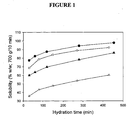
- the cold water solubility of the powder was determined at 20°C. A 5% w/w solution for each was prepared in cold water (20°C). Samples were extracted 30, 60,120, 280 and 455 minutes of reconstitution and spun in a centrifuge at 700g for 10 minutes. The total solids content of the supernatant from each sample was compared to the total solids of the bulk solution to give a percent solubility. This data was plotted to give the cold water solubility profile shown in Figure 1. The cation-enhanced product (sample A - Table 1) was more soluble than the control (sample B - Table 1). The effect was more pronounced after storage for 7 days at 40°C (see Figure 1).
- the trial was performed by pumping a brine solution (20% w/w NaCI) into MPC85 retentate prior to evaporation and drying.
- the addition of the brine solution diluted the retentate by about 0.5%.
- the brine solution had a contact time with the retentate in the pipe-work prior to the evaporator of about 5-10 minutes.
- the powders were stored at 40°C in sealed foil sachets.
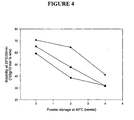
- 40°C is a temperature that powder can typically reach during transportation, particularly in the holds of ships and on wharves and in warehouses in warm climates. Deterioration reactions in powders happen at a faster rate at 40°C than at lower temperatures. Time-scales for differences in powders at lower temperatures such as 20°C will likely be an order of magnitude longer. According to Labuza (in An integrated approach to food chemistry: Illustrative cases. In Food Chemistry, Fenema, O. (ed). Pp 913-938, (1985)) a shelf life of 1 month at 40°C can be equivalent to 18 months shelf life at 23°C for dehydrated foods.
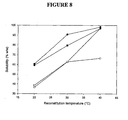
- the temperature solubility profiles were obtained by mixing samples of the powders in water for 30 minutes at a range of temperatures and then centrifuging at 700g for 10 minutes. The solubility was determined by comparison of the supernatant total solids with the bulk solution total solids as in Example 1.
- solubility profile of the powders made on large scale were somewhat different from the powders made on pilot plant scale and small scale. This difference is probably due to the use of different driers. No difference in solubility was detected between the solubility/temperature profiles of the fresh powder with added salt and the fresh control powder with no added salt.
- the cation-enhanced powder After storing the powder at 40°C for one month the difference is even more dramatic. For example at a reconstitution temperature of 50°C the cation-enhanced powder has a solubility of 95% whereas the control powder has a solubility of less than 46%.
- the transmission electron microscopy images shown in Figure 3 also demonstrate the stability of the cation-enhanced powders.
- the protein (stained black in the images) in the control powder changes on storage at 40°C whereas the morphology of the cation-enhanced powder remains constant.
- the implication of these images is that the protein in the cation-enhanced powders maintains its functional properties for longer than standard high protein powders.
- the improved solubility on storage (even at large scale) will enable more consistent product to reach customers and affords the powder with more robustness with regard to temperature abuse during shipping and storage prior to use.
- Example 2 This experiment was carried out to determine if the improved solubility in the stored powder of Example 2 could be duplicated simply by adding salt to dried MPC85.
- a 10g sample of the stored (7 days at 40°C) control powder (sample D - Table 1) was dissolved in a 190g solution (30°C) containing the same amount of dissolved salt (0.2288g) that would be added if 10g of cation-enhanced powder were being dissolved.
- the composition of this control solution with added salt was therefore no different to a solution of cation-enhanced powder.
- the solubility of the stored control sample was no different dissolved in a salt solution (53.34% w/w) than it was dissolved in pure water (53.68% w/w). This experiment shows that surprisingly the addition of salt prior to drying is necessary to confer improved solubility.
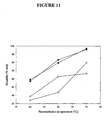
- the solubility/storage profile ( Figure 11) for powder N shows that with the technology described here it is possible to add divalent cations, in combination with a monovalent cation, with no detrimental effect in the solubility of fresh powder reconstituted in water between 20 to 40°C.
- the divalent enhanced powder shows improved solubility characteristics, when reconstituted at 40°C, over the control powder.
- the improved solubility characteristics were not seen at reconstitution temperatures of 20°C nor 30°C.
- a commercial MPC85 powder was reconstituted at 50°C, had sodium (0.081 moles/100g protein) and potassium (0.14 moles/100g protein) ions added (in the form of their chloride salts) and then re-dried to give a cation-enhanced powder (sample O in Table 1).
- Figure 12 shows that compared to the base starting powder, the cation-enhanced powder was converted to an MPC powder with a significantly improved cold (20°C) solubility profile. The solubility of the converted powder is 88% fresh and 87% after 7 days storage at 40°C compared to 46 and 35% solubility for the original powder respectively.
- This example shows that application of the technology described here can convert-old stock with poor solubility properties into powder with excellent solubility.
- the milk solution was divided into four batches. To each batch a different MPC containing 85% protein was added. One batch received the fresh large scale control MPC85 (sample D-Table 1), a second received a large scale control MPC85 (sample D - Table 1) that had been stored at 40°C for 7 days. The third batch received the fresh large scale cation enhanced MPC85 (sample C-Table 1) and the fourth batch received large scale cation enhanced MPC85 (sample C- Table 1) stored at 40°C for 7 days. The reconstitution was carried out at 4.5 to 8.5°C.
Landscapes
- Life Sciences & Earth Sciences (AREA)
- Chemical & Material Sciences (AREA)
- Engineering & Computer Science (AREA)
- Food Science & Technology (AREA)
- Polymers & Plastics (AREA)
- Biochemistry (AREA)
- Zoology (AREA)
- Health & Medical Sciences (AREA)
- Nutrition Science (AREA)
- Water Supply & Treatment (AREA)
- Dairy Products (AREA)
- Peptides Or Proteins (AREA)
Claims (13)
- Procédé pour préparer un produit de concentré protéique lacté (MPC) ou d'isolat protéique lacté (MPI) en poudre, à solubilité améliorée, consistant à :a) fournir un MPI ou MPC ayant au moins 70% de matière sèche en tant que protéine lactée en solution/suspension aqueuse ;b) ajouter au moins un sel monovalent dans une quantité qui confère audit produit une solubilité améliorée quand il aura séché ; etc) sécher le produit ;dans lequel la quantité de cation ajoutée est de 0,013-0,30 mole de cation pour 100 g de protéine.
- Procédé pour préparer un produit de MPC ou MPI en poudre, à solubilité améliorée, consistant à :a) fournir un lait écrémé sous la forme d'une solution/suspension aqueuse;b) ajouter au moins un sel monovalent ;c) concentrer la solution obtenue par ultrafiltration, éventuellement avec diafiltration pour former un MPI ou MPC ayant au moins 70% de poids à l'état sec en tant que protéine etd) sécher pour préparer un produit en poudre avec une solubilité améliorée ;dans lequel la quantité de cation ajoutée est de 0,013-0,30 mole de cation pour 100 g de protéine.
- Procédé pour préparer un MPC ou MPI en poudre, à solubilité améliorée, consistant à :a) fournir une solution de lait écrémé sous la forme d'une solution/suspension aqueuse ;b) concentrer le lait écrémé par ultrafiltration, avec diafiltration, pour former un MPI ou MPC ayant au moins 70% de poids à l'état sec en tant que protéine ;c) sécher pour préparer un produit en poudre à solubilité améliorée ;dans lequel le milieu de diafiltration comprend au moins un sel monovalent et le MPC ou MPI formé contient 0,013-0,30 mole de cation ajouté pour 100 g de protéine.
- Procédé tel que revendiqué dans la revendication 1, dans lequel, entre les étapes (a) et (b), une partie de l'eau est éliminée du MPI ou MPC en solution/suspension aqueuse.
- Procédé tel que revendiqué dans la revendication 4, dans lequel l'étape de déshydratation est une étape d'évaporation.
- Procédé tel que revendiqué dans une quelconque des revendications 1-4, dans lequel le sel est un sel de potassium ou de sodium.
- Procédé tel que revendiqué dans la revendication 6, dans lequel le sel est du chlorure de sodium.
- Procédé tel que revendiqué dans une quelconque des revendications 1-7, dans lequel au moins un sel divalent est ajouté avant l'étape de séchage.
- Procédé tel que revendiqué dans la revendication 8 dans lequel le sel divalent est un sel de calcium.
- Procédé tel que revendiqué dans une quelconque des revendications 1-9, dans lequel 0,035-0,25 mole de cation est ajouté pour 100 g de protéine.
- Procédé tel que revendiqué dans la revendication 10 dans lequel 0,035-0,10 mole de cation est ajouté pour 100 g de protéine.
- Procédé tel que revendiqué dans la revendication 1 ou la revendication 4, dans lequel le MPI ou MPC en solution/suspension aqueuse est formé en reconstituant un MPI ou MPC en poudre à une température suffisante pour le solubiliser.
- Procédé de fabrication de fromage comprenant l'étape d'étendre la matière de départ lactée avec un MPC ou MPI en poudre préparé par un procédé tel que revendiqué dans une quelconque des revendications 1-12.
Applications Claiming Priority (5)
| Application Number | Priority Date | Filing Date | Title |
|---|---|---|---|
| NZ51209801 | 2001-05-31 | ||
| NZ512098A NZ512098A (en) | 2001-05-31 | 2001-05-31 | Addition of monovalent or divalent salts to enhance solubility of a dried milk protein concentrate and its use in cheese manufacture |
| NZ51228101 | 2001-06-08 | ||
| NZ51228101 | 2001-06-08 | ||
| PCT/NZ2002/000105 WO2002096208A2 (fr) | 2001-05-31 | 2002-05-31 | Sel monovalent ameliorant la solubilite d'un concentre de proteine de lait |
Publications (3)
| Publication Number | Publication Date |
|---|---|
| EP1553843A2 EP1553843A2 (fr) | 2005-07-20 |
| EP1553843A4 EP1553843A4 (fr) | 2005-09-07 |
| EP1553843B1 true EP1553843B1 (fr) | 2007-05-16 |
Family
ID=26652257
Family Applications (1)
| Application Number | Title | Priority Date | Filing Date |
|---|---|---|---|
| EP02774083A Expired - Lifetime EP1553843B1 (fr) | 2001-05-31 | 2002-05-31 | Sel monovalent ameliorant la solubilite d'un concentre de proteine de lait |
Country Status (9)
| Country | Link |
|---|---|
| US (1) | US20040208955A1 (fr) |
| EP (1) | EP1553843B1 (fr) |
| JP (1) | JP2005506055A (fr) |
| AT (1) | ATE362319T1 (fr) |
| AU (1) | AU2002344204B2 (fr) |
| CA (1) | CA2448929A1 (fr) |
| DE (1) | DE60220193T2 (fr) |
| ES (1) | ES2287317T3 (fr) |
| WO (1) | WO2002096208A2 (fr) |
Cited By (2)
| Publication number | Priority date | Publication date | Assignee | Title |
|---|---|---|---|---|
| CN102630802A (zh) * | 2012-05-15 | 2012-08-15 | 东北农业大学 | 一种高持水性的牛乳蛋白浓缩物及其制备方法 |
| CN104904989A (zh) * | 2015-07-06 | 2015-09-16 | 光明乳业股份有限公司 | 高热稳定性的乳蛋白浓缩物及其制备方法 |
Families Citing this family (10)
| Publication number | Priority date | Publication date | Assignee | Title |
|---|---|---|---|---|
| JP3833129B2 (ja) * | 2002-03-19 | 2006-10-11 | 株式会社Adeka | 濃縮牛乳状組成物 |
| AU2003265631A1 (en) | 2002-08-23 | 2004-03-11 | Fonterra Co-Operative Group Ltd. | Method for producing a food product from a concentrated protein |
| NZ523394A (en) * | 2002-12-24 | 2006-03-31 | New Zealand Dairy Board | Dairy protein processing and applications thereof |
| US7220442B2 (en) | 2003-02-20 | 2007-05-22 | Slim-Fast Foods Company, Division Of Conopco, Inc. | Nutrition bar and process of making components |
| CN102755634A (zh) * | 2005-08-29 | 2012-10-31 | 味之素株式会社 | 营养组合物 |
| NZ549470A (en) * | 2006-08-28 | 2009-01-31 | Fonterra Co Operative Group | Dairy product and process |
| US9232808B2 (en) | 2007-06-29 | 2016-01-12 | Kraft Foods Group Brands Llc | Processed cheese without emulsifying salts |
| WO2017027081A1 (fr) | 2015-08-07 | 2017-02-16 | Tamarack Biotics Llc | Procédés de production d'un produit laitier immunoactif et utilisations associées |
| RU2673903C2 (ru) * | 2016-12-13 | 2018-12-03 | Федеральное государственное бюджетное образовательное учреждение высшего образования "Восточно-Сибирский государственный университет технологий и управления" | Способ получения кальцийсодержащего молочно-белкового концентрата |
| CN106902657A (zh) * | 2017-02-23 | 2017-06-30 | 安徽顺和生物科技有限公司 | 一种婴幼儿辅食配料时充分混合均匀的方法 |
Family Cites Families (2)
| Publication number | Priority date | Publication date | Assignee | Title |
|---|---|---|---|---|
| US5128156A (en) * | 1990-11-21 | 1992-07-07 | Borden, Inc. | Process for preparing an alternate protein source for coffee whiteners and other products |
| AU3279999A (en) * | 1999-03-01 | 2000-09-21 | New Zealand Dairy Board | Membrane filtered milk proteins varying in composition and functional attributes |
-
2002
- 2002-05-31 AU AU2002344204A patent/AU2002344204B2/en not_active Ceased
- 2002-05-31 EP EP02774083A patent/EP1553843B1/fr not_active Expired - Lifetime
- 2002-05-31 ES ES02774083T patent/ES2287317T3/es not_active Expired - Lifetime
- 2002-05-31 DE DE60220193T patent/DE60220193T2/de not_active Expired - Fee Related
- 2002-05-31 JP JP2002592730A patent/JP2005506055A/ja active Pending
- 2002-05-31 US US10/479,401 patent/US20040208955A1/en not_active Abandoned
- 2002-05-31 AT AT02774083T patent/ATE362319T1/de not_active IP Right Cessation
- 2002-05-31 WO PCT/NZ2002/000105 patent/WO2002096208A2/fr not_active Ceased
- 2002-05-31 CA CA002448929A patent/CA2448929A1/fr not_active Abandoned
Cited By (3)
| Publication number | Priority date | Publication date | Assignee | Title |
|---|---|---|---|---|
| CN102630802A (zh) * | 2012-05-15 | 2012-08-15 | 东北农业大学 | 一种高持水性的牛乳蛋白浓缩物及其制备方法 |
| CN104904989A (zh) * | 2015-07-06 | 2015-09-16 | 光明乳业股份有限公司 | 高热稳定性的乳蛋白浓缩物及其制备方法 |
| CN104904989B (zh) * | 2015-07-06 | 2019-01-08 | 光明乳业股份有限公司 | 高热稳定性的乳蛋白浓缩物及其制备方法 |
Also Published As
| Publication number | Publication date |
|---|---|
| WO2002096208A2 (fr) | 2002-12-05 |
| ES2287317T3 (es) | 2007-12-16 |
| CA2448929A1 (fr) | 2002-12-05 |
| EP1553843A4 (fr) | 2005-09-07 |
| US20040208955A1 (en) | 2004-10-21 |
| DE60220193D1 (de) | 2007-06-28 |
| AU2002344204B2 (en) | 2008-07-31 |
| WO2002096208A3 (fr) | 2005-05-19 |
| ATE362319T1 (de) | 2007-06-15 |
| DE60220193T2 (de) | 2008-01-17 |
| EP1553843A2 (fr) | 2005-07-20 |
| JP2005506055A (ja) | 2005-03-03 |
Similar Documents
| Publication | Publication Date | Title |
|---|---|---|
| US7157108B2 (en) | Milk protein products and processes | |
| US4018752A (en) | Ultrafiltration process for the recovery of proteins from milk | |
| AU700748B2 (en) | Physical separation of casein and whey proteins | |
| US6495194B2 (en) | Processed whey protein and process for manufacturing the same | |
| AU2002338661B2 (en) | Modified milk protein concentrates and their use in making gels and dairy products | |
| US20080305235A1 (en) | Whey Product and Process | |
| AU2003288836B2 (en) | Dairy protein process and applications thereof | |
| AU2002344204B2 (en) | Monovalent salt enhances solubility of milk protein concentrate | |
| EP1653811B1 (fr) | Traitement de preparation d'un ingredient concentre a base de proteine de lait | |
| AU2002344204A1 (en) | Monovalent salt enhances solubility of milk protein concentrate | |
| US4125527A (en) | Process for the recovery of proteins | |
| AU3877601A (en) | Method for producing milk calcium composition | |
| MXPA06001282A (es) | Produccion de una composicion proteinica a partir de una corriente lactea y su uso como un ingrediente en la elaboracion de un queso. | |
| EP0427307B1 (fr) | Produits laitiers | |
| Mucchetti et al. | The pre-concentration of milk by nanofiltration in the production of Quarg-type fresh cheeses | |
| NZ512098A (en) | Addition of monovalent or divalent salts to enhance solubility of a dried milk protein concentrate and its use in cheese manufacture | |
| DE DK et al. | EINWERTIGES SALZ VERBESSERT DIE LÖSLICHKEIT VON MILCHPROTEINKONZENTRAT SEL MONOVALENT AMELIORANT LA SOLUBILITE D’UN CONCENTRE DE PROTEINE DE LAIT | |
| SU1664238A1 (ru) | Смесь дл кумыса и способ ее получени |
Legal Events
| Date | Code | Title | Description |
|---|---|---|---|
| PUAI | Public reference made under article 153(3) epc to a published international application that has entered the european phase |
Free format text: ORIGINAL CODE: 0009012 |
|
| 17P | Request for examination filed |
Effective date: 20031218 |
|
| AK | Designated contracting states |
Kind code of ref document: A2 Designated state(s): AT BE CH CY DE DK ES FI FR GB GR IE IT LI LU MC NL PT SE TR |
|
| AX | Request for extension of the european patent |
Extension state: AL LT LV MK RO SI |
|
| A4 | Supplementary search report drawn up and despatched |
Effective date: 20050725 |
|
| RIC1 | Information provided on ipc code assigned before grant |
Ipc: 7A 23C 9/142 B Ipc: 7A 23J 1/20 B Ipc: 7A 23C 19/05 B Ipc: 7A 23C 1/16 A Ipc: 7A 23J 3/08 B |
|
| DAX | Request for extension of the european patent (deleted) | ||
| GRAP | Despatch of communication of intention to grant a patent |
Free format text: ORIGINAL CODE: EPIDOSNIGR1 |
|
| GRAS | Grant fee paid |
Free format text: ORIGINAL CODE: EPIDOSNIGR3 |
|
| GRAA | (expected) grant |
Free format text: ORIGINAL CODE: 0009210 |
|
| AK | Designated contracting states |
Kind code of ref document: B1 Designated state(s): AT BE CH CY DE DK ES FI FR GB GR IE IT LI LU MC NL PT SE TR |
|
| PG25 | Lapsed in a contracting state [announced via postgrant information from national office to epo] |
Ref country code: CH Free format text: LAPSE BECAUSE OF FAILURE TO SUBMIT A TRANSLATION OF THE DESCRIPTION OR TO PAY THE FEE WITHIN THE PRESCRIBED TIME-LIMIT Effective date: 20070516 Ref country code: FI Free format text: LAPSE BECAUSE OF FAILURE TO SUBMIT A TRANSLATION OF THE DESCRIPTION OR TO PAY THE FEE WITHIN THE PRESCRIBED TIME-LIMIT Effective date: 20070516 Ref country code: LI Free format text: LAPSE BECAUSE OF FAILURE TO SUBMIT A TRANSLATION OF THE DESCRIPTION OR TO PAY THE FEE WITHIN THE PRESCRIBED TIME-LIMIT Effective date: 20070516 |
|
| REG | Reference to a national code |
Ref country code: GB Ref legal event code: FG4D |
|
| REG | Reference to a national code |
Ref country code: CH Ref legal event code: EP |
|
| REG | Reference to a national code |
Ref country code: IE Ref legal event code: FG4D |
|
| REF | Corresponds to: |
Ref document number: 60220193 Country of ref document: DE Date of ref document: 20070628 Kind code of ref document: P |
|
| PG25 | Lapsed in a contracting state [announced via postgrant information from national office to epo] |
Ref country code: SE Free format text: LAPSE BECAUSE OF FAILURE TO SUBMIT A TRANSLATION OF THE DESCRIPTION OR TO PAY THE FEE WITHIN THE PRESCRIBED TIME-LIMIT Effective date: 20070816 |
|
| REG | Reference to a national code |
Ref country code: GR Ref legal event code: EP Ref document number: 20070402491 Country of ref document: GR |
|
| ET | Fr: translation filed | ||
| PG25 | Lapsed in a contracting state [announced via postgrant information from national office to epo] |
Ref country code: AT Free format text: LAPSE BECAUSE OF FAILURE TO SUBMIT A TRANSLATION OF THE DESCRIPTION OR TO PAY THE FEE WITHIN THE PRESCRIBED TIME-LIMIT Effective date: 20070516 |
|
| REG | Reference to a national code |
Ref country code: CH Ref legal event code: PL |
|
| REG | Reference to a national code |
Ref country code: ES Ref legal event code: FG2A Ref document number: 2287317 Country of ref document: ES Kind code of ref document: T3 |
|
| PG25 | Lapsed in a contracting state [announced via postgrant information from national office to epo] |
Ref country code: BE Free format text: LAPSE BECAUSE OF FAILURE TO SUBMIT A TRANSLATION OF THE DESCRIPTION OR TO PAY THE FEE WITHIN THE PRESCRIBED TIME-LIMIT Effective date: 20070516 |
|
| PG25 | Lapsed in a contracting state [announced via postgrant information from national office to epo] |
Ref country code: DK Free format text: LAPSE BECAUSE OF FAILURE TO SUBMIT A TRANSLATION OF THE DESCRIPTION OR TO PAY THE FEE WITHIN THE PRESCRIBED TIME-LIMIT Effective date: 20070516 Ref country code: MC Free format text: LAPSE BECAUSE OF NON-PAYMENT OF DUE FEES Effective date: 20070531 Ref country code: PT Free format text: LAPSE BECAUSE OF FAILURE TO SUBMIT A TRANSLATION OF THE DESCRIPTION OR TO PAY THE FEE WITHIN THE PRESCRIBED TIME-LIMIT Effective date: 20071016 |
|
| PLBE | No opposition filed within time limit |
Free format text: ORIGINAL CODE: 0009261 |
|
| STAA | Information on the status of an ep patent application or granted ep patent |
Free format text: STATUS: NO OPPOSITION FILED WITHIN TIME LIMIT |
|
| 26N | No opposition filed |
Effective date: 20080219 |
|
| PGFP | Annual fee paid to national office [announced via postgrant information from national office to epo] |
Ref country code: DE Payment date: 20080521 Year of fee payment: 7 Ref country code: ES Payment date: 20080424 Year of fee payment: 7 |
|
| PGFP | Annual fee paid to national office [announced via postgrant information from national office to epo] |
Ref country code: IT Payment date: 20080515 Year of fee payment: 7 |
|
| PGFP | Annual fee paid to national office [announced via postgrant information from national office to epo] |
Ref country code: IE Payment date: 20080514 Year of fee payment: 7 Ref country code: NL Payment date: 20080516 Year of fee payment: 7 |
|
| PGFP | Annual fee paid to national office [announced via postgrant information from national office to epo] |
Ref country code: GB Payment date: 20080527 Year of fee payment: 7 |
|
| REG | Reference to a national code |
Ref country code: ES Ref legal event code: FD2A Effective date: 20090204 |
|
| PG25 | Lapsed in a contracting state [announced via postgrant information from national office to epo] |
Ref country code: ES Free format text: LAPSE BECAUSE OF THE APPLICANT RENOUNCES Effective date: 20090204 |
|
| PGFP | Annual fee paid to national office [announced via postgrant information from national office to epo] |
Ref country code: GR Payment date: 20080423 Year of fee payment: 7 |
|
| PG25 | Lapsed in a contracting state [announced via postgrant information from national office to epo] |
Ref country code: CY Free format text: LAPSE BECAUSE OF FAILURE TO SUBMIT A TRANSLATION OF THE DESCRIPTION OR TO PAY THE FEE WITHIN THE PRESCRIBED TIME-LIMIT Effective date: 20070516 |
|
| PG25 | Lapsed in a contracting state [announced via postgrant information from national office to epo] |
Ref country code: LU Free format text: LAPSE BECAUSE OF NON-PAYMENT OF DUE FEES Effective date: 20070531 |
|
| PG25 | Lapsed in a contracting state [announced via postgrant information from national office to epo] |
Ref country code: TR Free format text: LAPSE BECAUSE OF FAILURE TO SUBMIT A TRANSLATION OF THE DESCRIPTION OR TO PAY THE FEE WITHIN THE PRESCRIBED TIME-LIMIT Effective date: 20070516 |
|
| GBPC | Gb: european patent ceased through non-payment of renewal fee |
Effective date: 20090531 |
|
| NLV4 | Nl: lapsed or anulled due to non-payment of the annual fee |
Effective date: 20091201 |
|
| PG25 | Lapsed in a contracting state [announced via postgrant information from national office to epo] |
Ref country code: NL Free format text: LAPSE BECAUSE OF NON-PAYMENT OF DUE FEES Effective date: 20091201 |
|
| REG | Reference to a national code |
Ref country code: FR Ref legal event code: ST Effective date: 20100129 |
|
| PG25 | Lapsed in a contracting state [announced via postgrant information from national office to epo] |
Ref country code: FR Free format text: LAPSE BECAUSE OF NON-PAYMENT OF DUE FEES Effective date: 20090602 Ref country code: IE Free format text: LAPSE BECAUSE OF NON-PAYMENT OF DUE FEES Effective date: 20090531 |
|
| PGFP | Annual fee paid to national office [announced via postgrant information from national office to epo] |
Ref country code: FR Payment date: 20080428 Year of fee payment: 7 |
|
| PG25 | Lapsed in a contracting state [announced via postgrant information from national office to epo] |
Ref country code: GB Free format text: LAPSE BECAUSE OF NON-PAYMENT OF DUE FEES Effective date: 20090531 |
|
| PG25 | Lapsed in a contracting state [announced via postgrant information from national office to epo] |
Ref country code: DE Free format text: LAPSE BECAUSE OF NON-PAYMENT OF DUE FEES Effective date: 20091201 Ref country code: GR Free format text: LAPSE BECAUSE OF NON-PAYMENT OF DUE FEES Effective date: 20091202 |
|
| PG25 | Lapsed in a contracting state [announced via postgrant information from national office to epo] |
Ref country code: IT Free format text: LAPSE BECAUSE OF NON-PAYMENT OF DUE FEES Effective date: 20090531 |