EP1554060B1 - Systeme et procede de triage automatique d'objets - Google Patents
Systeme et procede de triage automatique d'objets Download PDFInfo
- Publication number
- EP1554060B1 EP1554060B1 EP03756448A EP03756448A EP1554060B1 EP 1554060 B1 EP1554060 B1 EP 1554060B1 EP 03756448 A EP03756448 A EP 03756448A EP 03756448 A EP03756448 A EP 03756448A EP 1554060 B1 EP1554060 B1 EP 1554060B1
- Authority
- EP
- European Patent Office
- Prior art keywords
- basis
- gamma
- objects
- sorting
- sensor device
- Prior art date
- Legal status (The legal status is an assumption and is not a legal conclusion. Google has not performed a legal analysis and makes no representation as to the accuracy of the status listed.)
- Expired - Lifetime
Links
- 238000000034 method Methods 0.000 title claims abstract description 53
- 238000005259 measurement Methods 0.000 claims abstract description 82
- 230000005855 radiation Effects 0.000 claims abstract description 36
- 230000007246 mechanism Effects 0.000 claims abstract description 15
- 230000004907 flux Effects 0.000 claims abstract description 12
- 238000001514 detection method Methods 0.000 claims abstract description 9
- 239000000126 substance Substances 0.000 claims description 33
- 239000002699 waste material Substances 0.000 claims description 24
- 229910052739 hydrogen Inorganic materials 0.000 claims description 18
- 239000001257 hydrogen Substances 0.000 claims description 18
- 239000000523 sample Substances 0.000 claims description 15
- XEEYBQQBJWHFJM-UHFFFAOYSA-N Iron Chemical compound [Fe] XEEYBQQBJWHFJM-UHFFFAOYSA-N 0.000 claims description 10
- 238000003947 neutron activation analysis Methods 0.000 claims description 8
- 238000007621 cluster analysis Methods 0.000 claims description 6
- XUIMIQQOPSSXEZ-UHFFFAOYSA-N Silicon Chemical compound [Si] XUIMIQQOPSSXEZ-UHFFFAOYSA-N 0.000 claims description 5
- 239000004411 aluminium Substances 0.000 claims description 5
- 229910052782 aluminium Inorganic materials 0.000 claims description 5
- XAGFODPZIPBFFR-UHFFFAOYSA-N aluminium Chemical compound [Al] XAGFODPZIPBFFR-UHFFFAOYSA-N 0.000 claims description 5
- 238000007405 data analysis Methods 0.000 claims description 5
- 229910052742 iron Inorganic materials 0.000 claims description 5
- 238000007670 refining Methods 0.000 claims description 5
- 239000010703 silicon Substances 0.000 claims description 5
- 229910052710 silicon Inorganic materials 0.000 claims description 5
- 239000003575 carbonaceous material Substances 0.000 claims description 4
- 125000004435 hydrogen atom Chemical class [H]* 0.000 claims 2
- 238000004458 analytical method Methods 0.000 abstract description 8
- 230000004044 response Effects 0.000 abstract description 3
- 239000000463 material Substances 0.000 description 16
- UFHFLCQGNIYNRP-UHFFFAOYSA-N Hydrogen Chemical compound [H][H] UFHFLCQGNIYNRP-UHFFFAOYSA-N 0.000 description 12
- OKTJSMMVPCPJKN-UHFFFAOYSA-N Carbon Chemical compound [C] OKTJSMMVPCPJKN-UHFFFAOYSA-N 0.000 description 7
- 239000004033 plastic Substances 0.000 description 7
- 229920003023 plastic Polymers 0.000 description 7
- 229910052785 arsenic Inorganic materials 0.000 description 6
- 238000004364 calculation method Methods 0.000 description 6
- 229910052799 carbon Inorganic materials 0.000 description 6
- 238000012545 processing Methods 0.000 description 6
- RQNWIZPPADIBDY-UHFFFAOYSA-N arsenic atom Chemical compound [As] RQNWIZPPADIBDY-UHFFFAOYSA-N 0.000 description 5
- VYZAMTAEIAYCRO-UHFFFAOYSA-N Chromium Chemical compound [Cr] VYZAMTAEIAYCRO-UHFFFAOYSA-N 0.000 description 4
- 238000010521 absorption reaction Methods 0.000 description 4
- 229910052796 boron Inorganic materials 0.000 description 4
- 239000000460 chlorine Substances 0.000 description 4
- 229910052802 copper Inorganic materials 0.000 description 4
- 239000010949 copper Substances 0.000 description 4
- 229910001385 heavy metal Inorganic materials 0.000 description 4
- 150000002431 hydrogen Chemical class 0.000 description 4
- 238000004064 recycling Methods 0.000 description 4
- ZOXJGFHDIHLPTG-UHFFFAOYSA-N Boron Chemical compound [B] ZOXJGFHDIHLPTG-UHFFFAOYSA-N 0.000 description 3
- 239000004698 Polyethylene Substances 0.000 description 3
- 230000008901 benefit Effects 0.000 description 3
- 229910052801 chlorine Inorganic materials 0.000 description 3
- PCHJSUWPFVWCPO-UHFFFAOYSA-N gold Chemical group [Au] PCHJSUWPFVWCPO-UHFFFAOYSA-N 0.000 description 3
- 229910052737 gold Inorganic materials 0.000 description 3
- 239000010931 gold Substances 0.000 description 3
- -1 polyethylene Polymers 0.000 description 3
- 229920000573 polyethylene Polymers 0.000 description 3
- 230000008569 process Effects 0.000 description 3
- 230000009467 reduction Effects 0.000 description 3
- FVAUCKIRQBBSSJ-UHFFFAOYSA-M sodium iodide Chemical compound [Na+].[I-] FVAUCKIRQBBSSJ-UHFFFAOYSA-M 0.000 description 3
- XLYOFNOQVPJJNP-UHFFFAOYSA-N water Substances O XLYOFNOQVPJJNP-UHFFFAOYSA-N 0.000 description 3
- IJGRMHOSHXDMSA-UHFFFAOYSA-N Atomic nitrogen Chemical compound N#N IJGRMHOSHXDMSA-UHFFFAOYSA-N 0.000 description 2
- RYGMFSIKBFXOCR-UHFFFAOYSA-N Copper Chemical compound [Cu] RYGMFSIKBFXOCR-UHFFFAOYSA-N 0.000 description 2
- 238000006243 chemical reaction Methods 0.000 description 2
- 229910052804 chromium Inorganic materials 0.000 description 2
- 238000004891 communication Methods 0.000 description 2
- 230000000694 effects Effects 0.000 description 2
- 238000005516 engineering process Methods 0.000 description 2
- 229910052500 inorganic mineral Inorganic materials 0.000 description 2
- 238000004519 manufacturing process Methods 0.000 description 2
- 239000011707 mineral Substances 0.000 description 2
- 235000010755 mineral Nutrition 0.000 description 2
- 239000012188 paraffin wax Substances 0.000 description 2
- 230000000149 penetrating effect Effects 0.000 description 2
- 238000000611 regression analysis Methods 0.000 description 2
- 230000035945 sensitivity Effects 0.000 description 2
- ZAMOUSCENKQFHK-UHFFFAOYSA-N Chlorine atom Chemical compound [Cl] ZAMOUSCENKQFHK-UHFFFAOYSA-N 0.000 description 1
- 230000003321 amplification Effects 0.000 description 1
- 238000013459 approach Methods 0.000 description 1
- 229910052786 argon Inorganic materials 0.000 description 1
- 238000013528 artificial neural network Methods 0.000 description 1
- 125000004429 atom Chemical group 0.000 description 1
- 230000002238 attenuated effect Effects 0.000 description 1
- 238000009529 body temperature measurement Methods 0.000 description 1
- 239000004568 cement Substances 0.000 description 1
- 230000008859 change Effects 0.000 description 1
- 238000012512 characterization method Methods 0.000 description 1
- 239000003245 coal Substances 0.000 description 1
- 238000002485 combustion reaction Methods 0.000 description 1
- 238000010276 construction Methods 0.000 description 1
- 238000001816 cooling Methods 0.000 description 1
- 238000012937 correction Methods 0.000 description 1
- 238000000326 densiometry Methods 0.000 description 1
- 238000011161 development Methods 0.000 description 1
- 239000010791 domestic waste Substances 0.000 description 1
- 230000007613 environmental effect Effects 0.000 description 1
- 239000003344 environmental pollutant Substances 0.000 description 1
- 239000012634 fragment Substances 0.000 description 1
- 230000006870 function Effects 0.000 description 1
- 239000010439 graphite Substances 0.000 description 1
- 229910002804 graphite Inorganic materials 0.000 description 1
- 230000003993 interaction Effects 0.000 description 1
- 239000007788 liquid Substances 0.000 description 1
- 238000005065 mining Methods 0.000 description 1
- 239000000203 mixture Substances 0.000 description 1
- 238000012544 monitoring process Methods 0.000 description 1
- 238000010202 multivariate logistic regression analysis Methods 0.000 description 1
- 229910052757 nitrogen Inorganic materials 0.000 description 1
- 229910052755 nonmetal Inorganic materials 0.000 description 1
- 238000003199 nucleic acid amplification method Methods 0.000 description 1
- 230000003287 optical effect Effects 0.000 description 1
- 239000003973 paint Substances 0.000 description 1
- 239000002245 particle Substances 0.000 description 1
- 238000003909 pattern recognition Methods 0.000 description 1
- 230000000737 periodic effect Effects 0.000 description 1
- 231100000719 pollutant Toxicity 0.000 description 1
- 239000002994 raw material Substances 0.000 description 1
- 239000004065 semiconductor Substances 0.000 description 1
- 238000000926 separation method Methods 0.000 description 1
- 238000007493 shaping process Methods 0.000 description 1
- 239000010802 sludge Substances 0.000 description 1
- 229940083599 sodium iodide Drugs 0.000 description 1
- 235000009518 sodium iodide Nutrition 0.000 description 1
- 239000007787 solid Substances 0.000 description 1
- 230000003595 spectral effect Effects 0.000 description 1
- 238000001228 spectrum Methods 0.000 description 1
- 230000001629 suppression Effects 0.000 description 1
- 239000002344 surface layer Substances 0.000 description 1
- 230000009897 systematic effect Effects 0.000 description 1
- 230000009466 transformation Effects 0.000 description 1
- 230000000007 visual effect Effects 0.000 description 1
Images


Classifications
-
- B—PERFORMING OPERATIONS; TRANSPORTING
- B07—SEPARATING SOLIDS FROM SOLIDS; SORTING
- B07C—POSTAL SORTING; SORTING INDIVIDUAL ARTICLES, OR BULK MATERIAL FIT TO BE SORTED PIECE-MEAL, e.g. BY PICKING
- B07C5/00—Sorting according to a characteristic or feature of the articles or material being sorted, e.g. by control effected by devices which detect or measure such characteristic or feature; Sorting by manually actuated devices, e.g. switches
- B07C5/34—Sorting according to other particular properties
- B07C5/346—Sorting according to other particular properties according to radioactive properties
Definitions
- This invention relates to a system and a method of automatically sorting objects, including objects contained in a flow of waste.
- the invention relates to a system (and a corresponding method) comprising a conveyor mechanism configured for conveying an object to a sorter device; a sensor device arranged such that the object conveyed is caused to be located essentially within a predetermined reading space; and a calculator unit configured for receiving an electrical sensor signal representative of measurement data from said sensor device and configured for generating and emitting a control signal to said sorter device configured for sorting conveyed objects in response to/on the basis of said control signal.
- the amount of possible classes is limited to comprise only a few classes, such as 'metallic' and 'non-metallic', eg when flows of environmentally problematic waste are to be sorted. In that case it is necessary to be able to determine common features for each sorted object belonging to a specific class, said features relating the object to the given class despite possible variations within each class.
- Sorting of flows of material is extremely important in a large number of production processes, and in the establishment of a socially viable economy of materials, the sorting of waste flows will play an increasingly important part. Sorting may serve the purpose of eg minimising or eliminating the presence of harmful substances in recyclable flows of waste. Sorting may also be used in connection with on-line monitoring of outgoing flows from plants that treat household waste or particular types of waste, wherein the waste product, eg the sludge from combustion plants, needs to observe threshold values in respect of several elemental substances in order to be suitable for recycling or be deposited in the most inexpensive manner.
- Sorting may also serve the object of ensuring a minimum concentration of a desired component in connection with recycling.
- Sorting of eg pressure-impregnated timber from non-impregnated timber is not a simple matter, as it may be an extremely difficult task to distinguish these two from each other, in particular as the timber ages and/or if the surface of the timber is coated.
- pressure-impregnated timber typically contains heavy metals such as cupper, chrome, arsenic and boron that are unacceptable pollutants.
- US patent disclosure No. 4,830,193 concerns sorting lumps of gold-bearing minerals by means of neutron activation analysis, wherein gamma radiation and neutron irradiation occur at different times. More specifically the mineral lumps are sorted into two groups depending on size and are irradiated, following which the intensity of gamma rays, having an energy of 297 KeV, is subsequently measured and either accepted or rejected in response to the measured intensity at 297 KeV.
- Patent No. GB 2 055 465 also relates to determination of the gold content of a material by use of neutron activation analysis, wherein the material is irradiated with neutrons and wherein the intensity of gamma rays having an energy of 279 KeV (probably 297 KeV was intended) was subsequently determined to achieve acceptance or rejection.
- Patent No. EP 0 059 033 relates to sorting of ore, wherein ore is bombarded with neutrons by a number of irradiation units to form isotopes.
- the gamma radiation is detected - emitted by isotopes of elements such as gold - by a number of detectors, thereby enabling identification of the isotopes. It says that it is normally required that all ore particles are subjected to at least substantially the same amount of irradiation and a solution is provided.
- EP-A- 096 092 discloses a system according to the preamble of claim 1.
- said sensor device is based on Prompt Gamma-Neutron Activation Analysis (PGNAA) and comprises a neutron source configured for emitting neutrons; a moderator surrounding said neutron source and said measurement space, and configured for moderating said emitted neutrons; and a detector configured for detecting gamma radiation emitted by an object arranged within said measurement space when the object is exposed to a neutron flux with a given energy distribution; and generation of said electrical sensor signal on the basis of said detection; and wherein said control signal is generated on the basis of said sensor signal.
- PNAA Prompt Gamma-Neutron Activation Analysis
- a system according to the invention presents the advantage that, in addition to being automated, the number of sorting errors is reduced to a level that is sufficient for complying with the requirements made with respect to the environment.
- a system according to the invention may multiply the number of processed objects compared to previous methods.
- the sorting system may be configured eg for sorting timer into heavy-metal-containing timber or non-metal-containing timber, respectively.
- the sorting system may be configured for sorting plastics into PVC-containing plastics or PVC-free plastics.
- said sensor device further comprises a gamma shield and/or a neutron shield, wherein said gamma shield is located between said source and said measurement space, and/or wherein said neutron shield is located between said detector and said measurement space.
- said sensor device further comprises a gamma shield arranged around said neutron source, thereby minimising direct radiation of gamma from the neutron source to said neutron source.
- said sorting system is configured for sorting a flow of waste.
- said detection is accomplished contact-free in relation to the object.
- a reduction in operating costs is achieved due ia to the minimal wear that occurs in connection with a touch-free embodiment and economies in respect of manual labour.
- an estimate is provided of the amount of sample material in said measurement space on the basis of gamma radiation of an elemental substance, eg hydrogen, aluminium, silicon or iron, present in the sample material in a known concentration.
- an elemental substance eg hydrogen, aluminium, silicon or iron
- the described sensor technology is designated Prompt Gamma Neutron Activation Analysis (PGNAA) and is a well-known technique.
- PNAA Prompt Gamma Neutron Activation Analysis
- the object is irradiated with neutrons with relatively low kinetic energy (so-called thermal neutrons) from a suitable source, whereby the cores of the elemental substances become unstable and immediately fall back to a state of reduced energy while emitting gamma radiation with a characteristic energy.
- a reaction between an atomic nucleus and a thermal neutron is designated neutron capture and results in the nucleus changing atomic weight corresponding to the mass of the neutron. This process will leave the nucleus in an excited/energy-rich state, from which it decays momentarily while emitting gamma radiation characteristic of the nucleus in question.
- This gamma radiation is designated 'prompt gamma' as it is emitted momentarily.
- a Prompt Gamma Neutron Activation Analysis (PGNAA) method is based on the fact that all elemental substances can react with low-energetic neutrons, the so-called 'thermal neutrons'.
- the various elemental substances have very different capacities when it comes to reacting with thermal neutrons. This capacity is designated by a value typically designated the reactive cross section which varies by more than 11 value factors throughout the periodic table of the elemental substances without apparent systematics.
- the sensitivity to PGNAA of a given elemental substance varies, on the one hand, with the amount and kind of the emitted gamma radiation and, on the other, with the nature of the detector system.
- This analysis technique is well-suited for detecting treated objects that are not readily visually distinguishable, such as pressure-impregnated timber, as it is possible, on the one hand, to measure through voluminous objects such as posts and poles relatively unaffected by surface layers such as paint and, on the other, wherein elemental substances such as cupper, chrome, arsenic and boron have such high reactive cross-sections that a determination of the concentrations seems to be possible.
- said sensor device primarily comprises carbon material as moderator (rather than hydrogen).
- moderator (rather than hydrogen).
- the scattering cross section of carbon and hence its performance as moderator is smaller than the performance of hydrogen; however, carbon has a far smaller absorption cross section, which yet again entails improved utilisation of neutrons and considerably less noise in the form of undesired gamma radiation.
- the use of a hydrogen-poor moderator enables an almost direct measurement of the hydrogen content of the object, on the basis of which an estimate of the amount of timber in the reading space can be calculated; this part measurement being necessary for determining the concentration within an object.
- the system is configured for receiving measurements of objects of a known classification; and wherein the classification unit comprises means for calculating weight factors of a number of weighted sums established by a multivariable data analysis, calibration on an, iterative method by which an incremental refining successively provides an improved set of weight factors.
- said control signal is provided by the classification unit on the basis of signals comprising said weight factors and said sensor signal.
- said sensor signal comprises a gamma spectre representing recorded gamma radiation intensity within a given photon/energy range.
- said control signal (307) is provided on the basis of the difference between a sensor signal (306) and a predetermined reference spectre obtained with empty measurement space (6) and stored in a memory unit (403).
- the invention also relates to a method of automatically sorting objects, wherein the method comprises
- the method comprises minimisation of the flux of thermal neutrons into the detector by means of a gamma shield and/or a neutron shield in said sensor device; wherein said gamma shield is arranged between said source and said measurement space and/or wherein said neutron shield is arranged between said detector and said measurement space.
- the method comprises further minimisation of direct gamma radiation from the neutron source to said detector by means of a gamma shield arranged around said neutron source in said sensor device, such that radiation of gamma rays from source to detector is attenuated.
- the method comprises sorting of a flow of waste.
- said detection is performed contact-free with respect to the object.
- an estimate is provided of the amount of sample material in said measurement space on the basis of gamma radiation of an elemental substance, eg hydrogen, aluminium, silicon or iron, present in the sample material in a known concentration.
- an elemental substance eg hydrogen, aluminium, silicon or iron
- said sensor device primarily comprises carbon material as moderator.
- the method comprises receipt of measurements of objects of a known classification and calculation of weight factors of a number of weighted sums established by a multivariable data analysis, calibration or an iterative method by which incremental refining successively brings about an improved set of weight factors.
- the method further comprises that said control signal is provided by the classification unit on the basis of signals comprising said weight factors and said sensor signal.
- cluster analysis is used as a step in automatically generating suggestions for categorising sample objects on the basis of patterns in measurement data corresponding to said objects.
- said sensor signal comprises a gamma spectre representing registered gamma radiation intensity within a given photon/energy range.
- said control signal (307) is provided on the basis of the difference between a sensor signal (306) and a predetermined reference spectre received with empty measurement space (6) and stored in a memory unit (403).
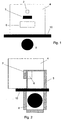
- Figure 1 schematically illustrates a cross section of a part of an embodiment of a sensor device (302) according to the invention and comprising a neutron source (2), a moderator (4), a measurement space (6), a gamma shield (3), a neutron shield/a neutron screen (10) and a detector/sensor (8).
- the neutron source (2) emits a neutron flux, ie neutrons with high kinetic energy, and is surrounded by a moderator (4) that serves the purpose of moderating the neutrons to thermal velocities.
- the moderator (4) comprises a massive volume of a material having a large content of a number of elemental substances (eg hydrogen and carbon) with high scattering cross-sections such as paraffin, polyethylene, graphite or water. In the moderator (4) there is thereby formed an area containing thermal neutrons that will, following a number of scatterings, no longer have a predominant direction.
- the measurement space/the three-dimensional measurement area (6) has a well-defined volume/space within which a uniform and high neutron flux is established through a convenient shaping of the moderator (4) which typically, to a large or small extent, surrounds said measurement space (6).
- the measurement space (6) may have many different configurations, eg depending on the relevant objects to be sorted.
- the detector (8) that captures gamma radiation emitted by objects arranged within the measurement space (6) will typically be sensitive to both thermal neutrons and gamma radiation emitted by the neutron source (2) and the moderator (4) and radiation from natural nucleides in the surroundings of the sensor device.
- both gamma (3) and neutron shielding (10) materials will be arranged in convenient places within the reading area.
- the detector (8) may eg be of the scintillation type, eg tallium-doted sodium-iodide; but it may also be of other types, eg the semi-conductor type.
- the latter detectors typically presuppose a cooling, eg by means of liquid nitrogen, which makes practical use thereof rather difficult.
- neutron sources such as isotope or accelerator-based sources
- emit almost exclusively neutrons with high kinetic energy with high kinetic energy (within a range 10 6 -10 7 eV).
- the source is surrounded by the moderator (4) that consists of a material of a high scattering cross-section and a low absorption cross section.
- the moderator consists of hydrogen-containing materials, such as water, paraffin or polyethylene, etc.
- a neutron will, during its lifetime within the material, scatter elastically several times and, as described previously, it will lose energy at each collision until the energy level corresponds to the thermal movement of the moderator's atoms.
- a moderator material is used that primarily contains carbon instead of hydrogen.
- the scattering cross section of carbon and hence its performance as moderator is smaller than the performance of hydrogen; however, carbon has a far smaller absorption cross section which, in turn, means that an improved neutron utilisation is accomplished and far smaller noise in the form of undesired gamma radiation.
- a hydrogen-poor moderator enables an almost direct measurement of the hydrogen content of the object, on the basis of which an estimate of the amount of material (eg plastics or timber) contained in the reading space can be calculated, as this part measurement is requisite in order to enable determination of the concentration of an object.
- weighted sums of the set of measurement variables are provided.
- each individual variable is constituted of the number of obtained detector events per time unit within a given gamma-quantum-energy range.
- the weight factors for calculating the weighted sums can be provided by multivariable regression analysis, by calibration or by iterative method, by which an improved set of weight factors is accomplished by incremental refining. Multivariable analysis is based on an approach to multi-data characterised in that underlying variation patterns are identified and used by means of methods known from mathematical statistics.
- signals from PGNAA sensors are multivariable, as the individual signal is present as a plurality of variables.
- measurements of sets of objects having known classification can be used.
- a reference point in a multidimensional space of a number of dimensions corresponding to the number of measurement variables is associated with each individual class or classification.
- the individual reference point can be calculated as the average of the measurement points representing the objects belonging to the relevant class.
- PGNAA can be utilised for a contact-free in-depth elemental substance analysis of eg waste or recycling material.
- the measurement signal for a given object is preferably defined as the simultaneous change of all variables detected when an object is conveyed through the reading space and subsequently measured during a time interval relative to a measurement with an empty measurement space.
- the information on the basis of which the classification unit is to conclude is described as a vector consisting of a sequence of numerical values.
- a given elemental substance in the measurement space will give rise to a measurement signal of a given pattern and proportional with the amount of the relevant elemental substance.
- the overall measurement signal is then the sum of these contributions.
- FIG. 2 schematically illustrates a cross-section of a part of an alternative embodiment of a sensor system according to the invention.
- the neutron source (2) and a gamma shield (5), eg a lead shield, around same is arranged such that direct radiation of gamma from the neutron source (2) is minimised.
- the measurement space (6) is located close to the source where the neutron flux is high and a comparatively thick moderator material (4) between the detector (8) and the source (2) and a neutron shield (10) minimise the flux of intermediate neutrons into the detector (8) which causes an attenuation of the measured noise level.
- Figure 3 illustrates an embodiment of the system according to the invention comprising a conveyor mechanism (301), a sensor (302), a sorter device (304) and a classification unit (303).
- the system comprises a conveyor mechanism (301) for conveying objects (208) to and from the measurement space/reading area (6); a determination/calculation/classification unit (303) for processing measurement data from the sensor device (302) and determining to which fraction/group a given object (308) belongs; and a sorter device (304) for sorting objects (308) on the background of the decisions of the calculation/classification unit (303).
- a sorting object (308) may eg be waste to be sorted, optionally with a view to recycling and/or expedient further processing.
- the decision system (303) determines to which group it belongs based on data/information received from the sensor device (302) preferably in the form of measured gamma radiation such as eg number of recorded quanta and their energy distribution.
- the system may comprise one or more further sensors, wherein the calculation/classification unit (303) is further configured for receiving and processing data originating from such other sources.
- the further sensors(s) may be eg sensors for temperature measurement, measurement of neutron flux within the measurement space, gamma densiometry of objects, weighting cells, image-forming sensors (eg "vision" - TV camera + frame grabber), image-forming x-ray scan or other types of sensors (not shown).
- the calculator unit (303) is configured for calculating concentrations of relevant elemental substances, which may occur on the basis of an estimate of the sampled amount.
- concentrations of relevant elemental substances may occur on the basis of an estimate of the sampled amount.
- the sample material contains a well-defined concentration of hydrogen, eg water, plastics or timber
- this estimate may be provided by use of a hydrogen-poor moderator that enables an almost direct measurement of the hydrogen contents of an object, on the basis of which an estimate of the amount of object (eg amount of timber) in the reading space could be determined with useful accuracy.
- the estimated amount of object can then be used to estimate the current concentration of the elemental substances.
- an estimate of the amount of sample material in said measurement space is provided on the basis of gamma radiation of an elemental substance, eg hydrogen, aluminium, silicon or iron, present in the sample material in a known concentration.
- the conveyor mechanism (301) is able to advance objects (308) by means of a conveyor belt; knob belt or the like, pushing or pulling mechanisms, pneumatic conveyance or the like, seizing or guiding mechanisms (including robot systems), etc.
- the sorter mechanism/sorter device (304) may for instance be realised as belt or guiding mechanism (eg a funnel device) that changes direction, as ejector with arm or jet of air or other medium, seizing mechanisms (including robot systems), etc.
- belt or guiding mechanism eg a funnel device
- seizing mechanisms including robot systems
- the conveyance mechanism (301) is a seizing mechanism (including robot)
- the conveyor (301) and sorter mechanism (304) may be one and the same.
- a system according to the invention can be used eg for sorting pressure-impregnated timber from other timber, sorting PVC from other plastics materials, etc.
- Figure 4 shows an embodiment of a classification unit (303) according to the invention comprising one or more microprocessors (402) and/or one or more digital signal processors (406); a memory unit (403) and means for receiving and emitting signals (404) connected via a common data/address bus (405).
- the microprocessor(s) (402) and/or the number of digital processors (406) interact with the memory unit (403) and the means for receiving/emitting signals (404).
- the means for receiving and emitting signals (404) are responsible for communication with the number of available sensors, including the sensor device (302) and user interfaces, if any.
- the communication between the classification unit (303) and external units such as the sensor device (302), the sorter device (304), etc, may occur eg by means of IrDa, Bluetooth, IEEE 802.11, wireless LAN, etc. but it may also be executed by means of conventional permanent links.
- the memory unit (403) may store relevant information such as a dedicated computer programme and classification variables, calibration data, processing algorithms, etc.
- the memory unit (403) preferably comprises volatile and/or non-volatile memory units, such as ROM, RAM, magnetic memory, optical memory and combinations thereof.
- Processing of data may also be comprised in one single multi-functional processor.
- multi-functional processors instead of dedicated digital signal processors may be advantageous in connection with some embodiments.
- Albeit digital signal processors are extremely suitable for handling signal calculation in a system, most embodiments also require a microprocessor for other tasks such as memory handling, user interaction, etc. Therefore it may be advantageous to use a multi-functional processor which is capable of performing all of the mentioned task types in order to thereby reduce the number of components and to minimise the power consumption and production costs, etc. Reduction of the number of processors to one will also mean that fewer sets of instructions are to be mastered during the development of this classification unit.
- Data from a PGNAA analysis are in the form of gamma spectre and preferably the difference between a reference spectre recorded with empty measurement space (stored in memory unit (403)) and a relevant spectre provided via the sensor device is used. This difference is processed by the calculator unit(s) (402; 404) with a view to determining a class for the relevant object.
- the measurement signal/sensor signal from the detector comprises a gamma spectre per measurement (alternatively it is an option to mediate across a number of spectres in order to reduce noise).
- spectre may consist of eg 1024 integers, where the spectre represents the number of recorded events (ie gamma radiation intensity) within a given photon-energy-range (see eg Figure 5).
- the observed patterns/profiles are specific to the individual elemental substance. In case a number of elemental substances are present in the measurement space, the pattern/profile for each elemental substance will be added, preferably to the relative amount of the relevant elemental substance and the absolute sensitivity of the apparatus relative thereto.
- spectres are split into a smaller number of windows to limit the number of variables and to reduce random noise.
- the window splitting involves a reduction of the random noise while conserving as much multivariable signal as possible. As opposed to this, splitting into a few windows reduces the most noise, while many windows conserves the most of the multivariable signal. Since both measurements are critical to a good data analysis, the determination of the optimal number of windows is important. The optimal number and the positions of the windows depend on the relevant task, ie which set of possible elemental substances is to be analysed in the relevant embodiment.
- a general example of a splitting of spectres with 1024 integers is splitting into ten windows covering the gamma field 2-10 MeV.
- Figure 5 shows examples of PGNAA spectres.
- the spectre depicts the distribution of gamma energy against the intensity of a given energy, the horizontal axis of the spectre being divided into 1024 channels, such that each channel corresponds to 10 KeV, and the number of recorded recordings per second in the relevant channel is depicted in the vertical axis of the spectre.
- a peak around channel 225 thus corresponds to a gamma energy of 2.25 MeV.
- the predictors are robust as they are simultaneously and independently of each other able to predict the amount of the individual elemental substances.
- levels of significance were determined.
- Levels of significance are calculation factors that partake in the estimation of the performance of a full-scale plant.
- the levels of significance can be determined as the ratio between the signal magnitude and the standard deviation on the background.
- the signal is determined on the basis of the difference between the average of the predictors for reference object and all of the samples.
- As the standard deviation on the background the observed one is used on all of the samples for the current predictor.
- a calibration - in the current case to be understood as an establishment of a prescription for how a measurement signal is converted into a classification - the system is able to determine and sort an object within a given category.
- the calibration is validated to search for the ability to classify new measurement data. If the system is unable to identify the difference necessary for the classification in relation to proximate classes, said calibration may result in a negative acceptance, whereby the system is able to eg report to which objects or classes the problems relate. These objects may then optionally be subjected to renewed measurement, or the classification problem can be reformulated to the effect that the object classes the system is having problems distinguishing are combined.
- Automatic categorisation is a substantial element during the construction of a self-calibrating and user-friendly analysis plant; such plant having to be able to be calibrated by means of a set of objects that combine to represent the scattering that may occur during measurement. Following a number of completed sample measurements the system comes up with a suggested sort key that is refined interactively in cooperation with an operator.
- Examples of automatic calibration include a so-called cluster analysis performed on a five-dimensional set of data consisting of predictions for Cu, Cr, As, Cl and B.
- Cluster analysis is a technique for organising a number of points in a piece of timber, whereby the points that are most proximate each other are most proximate in the timber.
- a cluster analysis presupposes that, to each point, a position is associated in an n-dimensional space, and that this space is associated with a distance code, whereby the term 'distance' makes sense.
- the analysis is performed by identifying the two most proximate points in a data set. They are replaced and form a node to which the halfway position between the two points is allocated. Now the node replaces the two original points in the data set. The process is repeated until only one node remains.
Landscapes
- Analysing Materials By The Use Of Radiation (AREA)
- Threshing Machine Elements (AREA)
- Sorting Of Articles (AREA)
Claims (24)
- Système de tri automatique d'objets, dans lequel ledit système comprend :- un mécanisme transporteur (301) configuré pour transporter au moins un objet (308) vers un dispositif de tri (304) ;- un dispositif de détection (302) disposé de façon telle que les objets transportés (308) se trouvent situés essentiellement au sein d'un espace de lecture prédéterminé (6) ; et- un calculateur/unité de classification (303) configuré(e) pour recevoir un signal de détecteur électrique (306) représentant des données de mesure provenant dudit dispositif de détection (302), et configuré(e) pour générer et émettre un signal de commande (307) audit dispositif de tri (304) configuré pour trier des objets transportés (308) sur la base dudit signal de commande (307);caractérisé- en ce que ledit dispositif de détection est basé sur une analyse par activation neutronique et gammas rapides (AANGR) et comprend- une source de neutrons (2) configurée pour émettre des neutrons ;- un modérateur (4) entourant ladite source de neutrons (2) et ledit espace de mesure (6), et configuré pour modérer lesdits neutrons émis ; et- un détecteur (8) configuré pour détecter le rayonnement gamma émis par un objet (308) disposé au sein dudit espace de mesure (6) lorsque l'objet (308) est exposé à un flux de neutrons ayant une répartition d'énergie donnée, et la génération dudit signal de détecteur électrique (306) sur la base de ladite détection ; et- en ce que ledit signal de commande (307) est généré sur la base dudit signal de détecteur (306).
- Système selon la revendication 1, caractérisé en ce que ledit dispositif de détection (302) comprend de plus un écran de protection contre les rayons gamma (3) et/ou une protection neutronique (10), dans lequel ledit écran de protection contre les rayons gamma (3) est situé entre ladite source (2) et ledit espace de mesure (6) et/ou dans lequel ladite protection neutronique (10) est disposée entre ledit détecteur (8) et ledit espace de mesure (6).
- Système selon la revendication 1 ou 2, caractérisé en ce que ledit dispositif de détection (302) comprend de plus un écran de protection contre les rayons gamma (5) disposé autour de ladite source de neutrons (2) de façon telle qu'un rayonnement direct de gamma depuis la source de neutrons (2) vers ledit détecteur (8) est minimisé.
- Système selon les revendications 1 à 3, caractérisé en ce que ledit système de tri est configuré pour trier un flux de déchets.
- Système selon les revendications 1 à 4, caractérisé en ce que ladite détection est réalisée sans contact par rapport à l'objet (308).
- Système selon les revendications 1 à 5, caractérisé en ce qu'une estimation de 1a quantité de matériau échantillon dans ledit espace de mesure (6) est fournie sur la base du rayonnement gamma d'une substance élémentaire, par exemple de l'hydrogène, de l'aluminium, du silicium ou du fer, présente dans le matériau d'échantillon selon une concentration connue.
- Système selon les revendications 1 à 6, caractérisé en ce que ledit dispositif de détection comprend principalement un matériau de carbone en tant que modérateur.
- Système selon les revendications 1 à 7, caractérisé en ce que 1e système est configuré pour recevoir des mesures d'objets avec une classification connue ; en ce que l'unité de classification (303) comprend des moyens permettant de calculer des facteurs de pondération d'un nombre de sommes pondérées établi par analyse de données à plusieurs variables, étalonnage ou itération, où on atteint successivement un jeu amélioré de facteurs de pondération par affinement incrémentiel.
- Système selon la revendication 8, caractérisé en ce que ledit signal de commande (307) est fourni par l'unité de classification (303) sur 1a base de signaux comprenant lesdits facteurs de pondération et ledit signal de détecteur (306).
- Système selon les revendications 1 à 9, caractérisé en ce que l'on utilise une analyse de groupement en tant qu'étape de génération automatique de suggestions permettant de catégoriser des objets échantillons sur la base de motifs de données de mesure correspondant auxdits objets.
- Système selon les revendications 1 à 10, caractérisé en ce que ledit signal de détecteur (306) comprend un spectre gamma représentant l'intensité de rayonnement gamma enregistrée avec une plage donnée de photon/énergie.
- Système selon les revendications 1 à 11, caractérisé en ce que ledit signal de commande (307) est fourni sur la base d'une différence entre un signal de détecteur (306) et un spectre de référence prédéterminé obtenu avec un espace de mesure vide (6) et enregistré dans une unité de mémoire (403).
- Méthode de tri automatique d'objets, dans lequel ladite méthode comprend les étapes suivantes :- transport d'au moins un objet (308) vers un dispositif de tri (304) ; où ledit transport fait que les objets transportés se trouvent essentiellement au sein d'un espace de lecture prédéterminé (6) d'un dispositif de détection (302) ;- réception d'un signal de détecteur électrique (306) représentant les données de mesure dans une unité de calculateur/unité de classification (303) depuis ledit dispositif de détection (302) ; et- génération et émission d'un signal de commande vers ledit dispositif de tri (304) configuré pour trier des objets transportés (308) sur la base dudit signal de commande (307) ;caractérisée en ce que la méthode comprend en outre :- l'émission de neutrons depuis une source de neutrons (2) dans ledit dispositif de détection (302) ;- 1a modération desdits neutrons émis au moyen d'un modérateur (4) dans ledit dispositif de détection (302), où ledit modérateur (4) entoure ladite source de neutrons (2) et ledit espace de mesure (6) ;- 1a détection, sur la base d'une analyse par activation neutronique et gammas rapides (AANGR), par un détecteur (8) dans ledit dispositif de détection (302), du rayonnement gamma émis par un objet (308) au sein dudit espace de mesure (6) lorsqu'il est exposé à un flux de neutrons ayant une répartition d'énergie donnée, et la fourniture dudit signal de détecteur (306) dans ledit dispositif de détection (302) sur la base dudit signal de détection (306) ; et- la génération dudit signal de commande (307) sur la base dudit signal de détecteur (306).
- Méthode selon la revendication 13, caractérisée en ce que la méthode comprend la minimisation du flux de neutrons thermiques dans le détecteur par un écran de protection contre les rayons gamma (3) et/ou de protection neutronique (10) dans ledit dispositif de détection (302), où ledit écran de protection contre les rayons gamma (3) est situé entre ladite source (2) et ledit espace de mesure (6) et/ou où ladite protection neutronique (10) est disposée entre ledit détecteur (8) et ledit espace de mesure (6).
- Méthode selon la revendication 13 ou 14, caractérisée en ce que 1a méthode comprend de plus la minimisation d'un rayonnement direct de gamma depuis 1a source de neutrons (2) vers ledit détecteur (8) par un écran de protection contre les rayons gamma (5) disposé autour de ladite source de neutrons (2) dans ledit dispositif de détection (302).
- Méthode selon les revendications 13 à 15, caractérisée en ce que la méthode comprend le tri d'un flux de déchets.
- Méthode selon les revendications 13 à 16, caractérisée en ce que ladite détection est réalisée sans contact par rapport à l'objet (308).
- Méthode selon les revendications 13 à 17, caractérisée en ce qu'une estimation de la quantité de matériau échantillon dans ledit espace de mesure (6) est fournie sur la base du rayonnement gamma d'une substance élémentaire, par exemple de l'hydrogène, de l'aluminium, du silicium ou du fer, présente dans le matériau d'échantillon selon une concentration connue.
- Méthode selon les revendications 13 à 18, caractérisée en ce que ledit dispositif de détection comprend principalement un matériau de carbone en tant que modérateur.
- Méthode selon les revendications 13 à 19, caractérisée en ce que 1a méthode comprend 1a réception de mesures d'objets d'une classification connue ; et en ce que la classification comprend des moyens permettant de calculer des facteurs de pondération d'un nombre de sommes pondérées établi par analyse de données à plusieurs variables, étalonnage ou itération, où on atteint successivement un jeu amélioré de facteurs de pondération par affinement incrémentiel.
- Méthode selon la revendication 20, caractérisée en ce que la méthode comprend de plus le fait que ledit signal de commande (307) est fourni par l'unité de classification (303) sur la base de signaux comprenant lesdits facteurs de pondération et ledit signal de détecteur (306).
- Méthode selon les revendications 13 à 21, caractérisée en ce que l'on utilise une analyse de groupement en tant qu'étape de génération automatique de suggestions permettant de catégoriser des objets échantillons sur la base de motifs de données de mesure correspondant à ces objets.
- Méthode selon les revendications 13 à 22, caractérisée en ce que ledit signal de détecteur (306) comprend un spectre gamma représentant l'intensité de rayonnement gamma enregistrée au sein d'une plage donnée de photon/énergie.
- Méthode selon les revendications 13 à 23, caractérisée en ce que ledit signal de commande (307) est fourni sur la base de la différence entre un signal de détecteur (306) et un spectre de référence prédéterminé obtenu avec un espace de mesure vide (6) et enregistré dans une unité de mémoire (403).
Applications Claiming Priority (3)
| Application Number | Priority Date | Filing Date | Title |
|---|---|---|---|
| DKPA200201548 | 2002-10-11 | ||
| DK200201548 | 2002-10-11 | ||
| PCT/DK2003/000685 WO2004033117A1 (fr) | 2002-10-11 | 2003-10-10 | Systeme et procede de triage automatique d'objets |
Publications (2)
| Publication Number | Publication Date |
|---|---|
| EP1554060A1 EP1554060A1 (fr) | 2005-07-20 |
| EP1554060B1 true EP1554060B1 (fr) | 2006-11-29 |
Family
ID=32087899
Family Applications (1)
| Application Number | Title | Priority Date | Filing Date |
|---|---|---|---|
| EP03756448A Expired - Lifetime EP1554060B1 (fr) | 2002-10-11 | 2003-10-10 | Systeme et procede de triage automatique d'objets |
Country Status (9)
| Country | Link |
|---|---|
| US (1) | US20060115037A1 (fr) |
| EP (1) | EP1554060B1 (fr) |
| AT (1) | ATE346698T1 (fr) |
| AU (1) | AU2003300069A1 (fr) |
| CA (1) | CA2501051A1 (fr) |
| DE (1) | DE60310118T2 (fr) |
| ES (1) | ES2276103T3 (fr) |
| PL (1) | PL208399B1 (fr) |
| WO (1) | WO2004033117A1 (fr) |
Cited By (2)
| Publication number | Priority date | Publication date | Assignee | Title |
|---|---|---|---|---|
| FR2923403A1 (fr) * | 2007-11-13 | 2009-05-15 | Veolia Proprete Sa | Procede de traitement automatique de dechets |
| WO2022132671A1 (fr) | 2020-12-14 | 2022-06-23 | Anellotech, Inc. | Séparation robotique de matières plastiques pour recyclage chimique |
Families Citing this family (17)
| Publication number | Priority date | Publication date | Assignee | Title |
|---|---|---|---|---|
| US8426821B2 (en) | 2005-03-01 | 2013-04-23 | Scantech International Pty Ltd. | On-belt analyser system |
| US10202711B2 (en) * | 2007-05-09 | 2019-02-12 | Massachusetts Institute Of Technology | Tunable surface |
| ES2359691B1 (es) * | 2007-12-27 | 2012-03-30 | Marcos Furió Bruno | M�?quina de tr�?a de part�?culas emisoras de radiación (con o sin estimulación f�?sica) a partir de materiales geológicos. |
| US7886915B2 (en) | 2008-03-19 | 2011-02-15 | Shulman Alvin D | Method for bulk sorting shredded scrap metal |
| US9216862B2 (en) | 2012-08-13 | 2015-12-22 | Tgw Systems, Inc. | Narrow belt sorter |
| US10006874B2 (en) * | 2013-05-03 | 2018-06-26 | XRSciences, LLC | Alternative fuels analyzer |
| DE102015209589A1 (de) * | 2015-05-26 | 2016-12-01 | Wacker Chemie Ag | Vorrichtung zur Förderung eines Produktstroms aus Polysiliciumbruch oder Polysiliciumgranulat |
| US9518941B1 (en) * | 2016-07-29 | 2016-12-13 | Sabia Inc. | Weight-percent analysis for prompt gamma neutron activation substance analyzers |
| EP3318339B1 (fr) * | 2016-11-03 | 2020-01-29 | AMAG casting GmbH | Dispositif et procédé de tri de grenaille d'aluminium |
| JP7104780B2 (ja) | 2017-05-31 | 2022-07-21 | アーヘン インスティテュート フォー ニュークリア トレーニング ゲーエムベーハー | 中性子放射化に基づく多原子分析のための方法及びデバイス並びに使用 |
| DE102017111935B4 (de) * | 2017-05-31 | 2019-03-14 | Aachen Institute for Nuclear Training GmbH (AINT) | Verfahren und Vorrichtung zur Multielementanalyse basierend auf Neutronenaktivierung sowie Computerprogrammprodukt dafür |
| CN108480232B (zh) * | 2018-03-20 | 2020-03-20 | 上海理工大学 | 基于形状和饱满度特征的枸杞分类方法 |
| CN108535300B (zh) * | 2018-05-11 | 2021-05-11 | 南京航空航天大学 | 一种内置式中子元素分析装置 |
| EP3928086A4 (fr) * | 2019-02-21 | 2022-10-19 | Phoenix, LLC | Activation et détection de neutrons d'un matériau dangereux, indésirable ou à valeur élevée |
| CN110586518B (zh) * | 2019-09-04 | 2021-06-15 | 中国疾病预防控制中心辐射防护与核安全医学所 | 一种全袋式粮食放射性检测装置 |
| NO348825B1 (en) * | 2023-07-07 | 2025-06-16 | Norsk Hydro As | A method and apparatus for analysis of materials |
| CN118464964B (zh) * | 2024-07-11 | 2024-10-11 | 合肥金星智控科技股份有限公司 | 一种基于中子活化技术的厚度不均匀物料检测方法及装置 |
Family Cites Families (12)
| Publication number | Priority date | Publication date | Assignee | Title |
|---|---|---|---|---|
| US2707555A (en) * | 1950-06-08 | 1955-05-03 | Antoine M Gaudin | Beryl ore selector |
| GB2055465B (en) * | 1979-06-14 | 1983-10-19 | Atomic Energy Authority Uk | Determining gold content |
| CA1181535A (fr) * | 1981-06-10 | 1985-01-22 | Colin G. Clayton | Tri du minerai aurifere |
| EP0096092B1 (fr) * | 1982-06-07 | 1987-01-28 | Klaus Prof. Dipl.-Ing. Sczimarowski | Dispositif de tri de pièces métalliques |
| GB8314029D0 (en) * | 1983-05-20 | 1983-06-29 | Atomic Energy Authority Uk | Ore irradiator divider |
| AT398174B (de) * | 1991-02-08 | 1994-10-25 | Andritz Patentverwaltung | Verfahren und vorrichtung zum trennen von entrindeten holzknüppeln |
| US5133901A (en) * | 1991-03-01 | 1992-07-28 | Westinghouse Electric Corp. | System and method for on-line monitoring and control of heavy metal contamination in soil washing process |
| CA2138503C (fr) * | 1993-12-22 | 2004-10-12 | Ulf Anders Staffan Tapper | Methode et appareil servant a classer des matieres particulaires |
| US5948137A (en) * | 1998-07-23 | 1999-09-07 | The David J. Joseph Company | Scrap metal measuring and weighing process and apparatus |
| DE10124917B4 (de) * | 2001-05-28 | 2007-03-22 | Bionorica Ag | Verfahren zur Klassifizierung von Wein und Kaffee |
| US6657189B2 (en) * | 2001-11-07 | 2003-12-02 | Analyser Systems Ag | Maintaining measurement accuracy in prompt gamma neutron activation analyzers with variable material flow rates or material bed depth |
| US6922455B2 (en) * | 2002-01-28 | 2005-07-26 | Starfire Industries Management, Inc. | Gas-target neutron generation and applications |
-
2003
- 2003-10-10 WO PCT/DK2003/000685 patent/WO2004033117A1/fr not_active Ceased
- 2003-10-10 AT AT03756448T patent/ATE346698T1/de not_active IP Right Cessation
- 2003-10-10 ES ES03756448T patent/ES2276103T3/es not_active Expired - Lifetime
- 2003-10-10 DE DE60310118T patent/DE60310118T2/de not_active Expired - Lifetime
- 2003-10-10 US US10/530,769 patent/US20060115037A1/en not_active Abandoned
- 2003-10-10 CA CA002501051A patent/CA2501051A1/fr not_active Abandoned
- 2003-10-10 EP EP03756448A patent/EP1554060B1/fr not_active Expired - Lifetime
- 2003-10-10 AU AU2003300069A patent/AU2003300069A1/en not_active Abandoned
- 2003-10-10 PL PL375164A patent/PL208399B1/pl unknown
Cited By (4)
| Publication number | Priority date | Publication date | Assignee | Title |
|---|---|---|---|---|
| FR2923403A1 (fr) * | 2007-11-13 | 2009-05-15 | Veolia Proprete Sa | Procede de traitement automatique de dechets |
| WO2009068811A3 (fr) * | 2007-11-13 | 2010-03-11 | Veolia Proprete | Procede de traitement automatique de dechets |
| AU2008328624B2 (en) * | 2007-11-13 | 2013-11-14 | Veolia Proprete | Automatic waste treatment process |
| WO2022132671A1 (fr) | 2020-12-14 | 2022-06-23 | Anellotech, Inc. | Séparation robotique de matières plastiques pour recyclage chimique |
Also Published As
| Publication number | Publication date |
|---|---|
| EP1554060A1 (fr) | 2005-07-20 |
| AU2003300069A1 (en) | 2004-05-04 |
| WO2004033117A1 (fr) | 2004-04-22 |
| US20060115037A1 (en) | 2006-06-01 |
| PL208399B1 (pl) | 2011-04-29 |
| DE60310118T2 (de) | 2007-07-05 |
| AU2003300069A8 (en) | 2004-05-04 |
| PL375164A1 (en) | 2005-11-28 |
| ES2276103T3 (es) | 2007-06-16 |
| ATE346698T1 (de) | 2006-12-15 |
| DE60310118D1 (de) | 2007-01-11 |
| CA2501051A1 (fr) | 2004-04-22 |
Similar Documents
| Publication | Publication Date | Title |
|---|---|---|
| EP1554060B1 (fr) | Systeme et procede de triage automatique d'objets | |
| US6519315B2 (en) | High speed materials sorting using x-ray fluorescence | |
| US8144831B2 (en) | Method and apparatus for sorting materials according to relative composition | |
| US8476545B2 (en) | Sorting pieces of material based on photonic emissions resulting from multiple sources of stimuli | |
| US7099433B2 (en) | Method and apparatus for sorting materials according to relative composition | |
| US7899153B2 (en) | Automated x-ray fluorescence analysis | |
| WO1996023212A1 (fr) | Procede et systeme pour la determination de la composition du verre | |
| Cesetti et al. | Waste processing: new near infrared technologies for material identification and selection | |
| JPH08300354A (ja) | プラスチック分別装置 | |
| CN112024451B (zh) | 一种基于受试者操作特征曲线分析的矿石拣选决策方法 | |
| US3710104A (en) | Method and apparatus for x-ray interrogation of a sample | |
| Bakraji | Application of multivariate statistical methods to classify archaeological pottery from Tel‐Alramad site, Syria, based on x‐ray fluorescence analysis | |
| GB2066456A (en) | Analyser | |
| CN114019555A (zh) | 一种放射性固体废物检测分类系统 | |
| EP0746760A1 (fr) | Detection des impuretes dans un ensemble de dechets metalliques | |
| CN118779713B (zh) | 基于γ辐射场数值矩阵分解的铀矿石品位分选方法 | |
| Müller et al. | Sorting of Construction and Demolition Waste for coarse fractions | |
| Klein et al. | Sensor based bulk ore sorting of precious metal ores |
Legal Events
| Date | Code | Title | Description |
|---|---|---|---|
| PUAI | Public reference made under article 153(3) epc to a published international application that has entered the european phase |
Free format text: ORIGINAL CODE: 0009012 |
|
| 17P | Request for examination filed |
Effective date: 20050322 |
|
| AK | Designated contracting states |
Kind code of ref document: A1 Designated state(s): AT BE BG CH CY CZ DE DK EE ES FI FR GB GR HU IE IT LI LU MC NL PT RO SE SI SK TR |
|
| AX | Request for extension of the european patent |
Extension state: AL LT LV MK |
|
| RAX | Requested extension states of the european patent have changed |
Extension state: LT Payment date: 20050322 Extension state: LV Payment date: 20050322 |
|
| GRAP | Despatch of communication of intention to grant a patent |
Free format text: ORIGINAL CODE: EPIDOSNIGR1 |
|
| GRAS | Grant fee paid |
Free format text: ORIGINAL CODE: EPIDOSNIGR3 |
|
| GRAA | (expected) grant |
Free format text: ORIGINAL CODE: 0009210 |
|
| AK | Designated contracting states |
Kind code of ref document: B1 Designated state(s): AT BE BG CH CY CZ DE DK EE ES FI FR GB GR HU IE IT LI LU MC NL PT RO SE SI SK TR |
|
| AX | Request for extension of the european patent |
Extension state: LT LV |
|
| PG25 | Lapsed in a contracting state [announced via postgrant information from national office to epo] |
Ref country code: SK Free format text: LAPSE BECAUSE OF FAILURE TO SUBMIT A TRANSLATION OF THE DESCRIPTION OR TO PAY THE FEE WITHIN THE PRESCRIBED TIME-LIMIT Effective date: 20061129 Ref country code: CZ Free format text: LAPSE BECAUSE OF FAILURE TO SUBMIT A TRANSLATION OF THE DESCRIPTION OR TO PAY THE FEE WITHIN THE PRESCRIBED TIME-LIMIT Effective date: 20061129 Ref country code: AT Free format text: LAPSE BECAUSE OF FAILURE TO SUBMIT A TRANSLATION OF THE DESCRIPTION OR TO PAY THE FEE WITHIN THE PRESCRIBED TIME-LIMIT Effective date: 20061129 Ref country code: LI Free format text: LAPSE BECAUSE OF FAILURE TO SUBMIT A TRANSLATION OF THE DESCRIPTION OR TO PAY THE FEE WITHIN THE PRESCRIBED TIME-LIMIT Effective date: 20061129 Ref country code: RO Free format text: LAPSE BECAUSE OF FAILURE TO SUBMIT A TRANSLATION OF THE DESCRIPTION OR TO PAY THE FEE WITHIN THE PRESCRIBED TIME-LIMIT Effective date: 20061129 Ref country code: FI Free format text: LAPSE BECAUSE OF FAILURE TO SUBMIT A TRANSLATION OF THE DESCRIPTION OR TO PAY THE FEE WITHIN THE PRESCRIBED TIME-LIMIT Effective date: 20061129 Ref country code: SI Free format text: LAPSE BECAUSE OF FAILURE TO SUBMIT A TRANSLATION OF THE DESCRIPTION OR TO PAY THE FEE WITHIN THE PRESCRIBED TIME-LIMIT Effective date: 20061129 Ref country code: BE Free format text: LAPSE BECAUSE OF FAILURE TO SUBMIT A TRANSLATION OF THE DESCRIPTION OR TO PAY THE FEE WITHIN THE PRESCRIBED TIME-LIMIT Effective date: 20061129 Ref country code: NL Free format text: LAPSE BECAUSE OF FAILURE TO SUBMIT A TRANSLATION OF THE DESCRIPTION OR TO PAY THE FEE WITHIN THE PRESCRIBED TIME-LIMIT Effective date: 20061129 Ref country code: CH Free format text: LAPSE BECAUSE OF FAILURE TO SUBMIT A TRANSLATION OF THE DESCRIPTION OR TO PAY THE FEE WITHIN THE PRESCRIBED TIME-LIMIT Effective date: 20061129 |
|
| REG | Reference to a national code |
Ref country code: GB Ref legal event code: FG4D |
|
| REG | Reference to a national code |
Ref country code: CH Ref legal event code: EP |
|
| REG | Reference to a national code |
Ref country code: IE Ref legal event code: FG4D |
|
| REF | Corresponds to: |
Ref document number: 60310118 Country of ref document: DE Date of ref document: 20070111 Kind code of ref document: P |
|
| PG25 | Lapsed in a contracting state [announced via postgrant information from national office to epo] |
Ref country code: SE Free format text: LAPSE BECAUSE OF FAILURE TO SUBMIT A TRANSLATION OF THE DESCRIPTION OR TO PAY THE FEE WITHIN THE PRESCRIBED TIME-LIMIT Effective date: 20070228 Ref country code: BG Free format text: LAPSE BECAUSE OF FAILURE TO SUBMIT A TRANSLATION OF THE DESCRIPTION OR TO PAY THE FEE WITHIN THE PRESCRIBED TIME-LIMIT Effective date: 20070228 Ref country code: DK Free format text: LAPSE BECAUSE OF FAILURE TO SUBMIT A TRANSLATION OF THE DESCRIPTION OR TO PAY THE FEE WITHIN THE PRESCRIBED TIME-LIMIT Effective date: 20070228 |
|
| PG25 | Lapsed in a contracting state [announced via postgrant information from national office to epo] |
Ref country code: PT Free format text: LAPSE BECAUSE OF FAILURE TO SUBMIT A TRANSLATION OF THE DESCRIPTION OR TO PAY THE FEE WITHIN THE PRESCRIBED TIME-LIMIT Effective date: 20070430 |
|
| LTIE | Lt: invalidation of european patent or patent extension |
Effective date: 20061129 |
|
| NLV1 | Nl: lapsed or annulled due to failure to fulfill the requirements of art. 29p and 29m of the patents act | ||
| ET | Fr: translation filed | ||
| REG | Reference to a national code |
Ref country code: CH Ref legal event code: PL |
|
| REG | Reference to a national code |
Ref country code: ES Ref legal event code: FG2A Ref document number: 2276103 Country of ref document: ES Kind code of ref document: T3 |
|
| PLBE | No opposition filed within time limit |
Free format text: ORIGINAL CODE: 0009261 |
|
| STAA | Information on the status of an ep patent application or granted ep patent |
Free format text: STATUS: NO OPPOSITION FILED WITHIN TIME LIMIT |
|
| 26N | No opposition filed |
Effective date: 20070830 |
|
| PG25 | Lapsed in a contracting state [announced via postgrant information from national office to epo] |
Ref country code: GR Free format text: LAPSE BECAUSE OF FAILURE TO SUBMIT A TRANSLATION OF THE DESCRIPTION OR TO PAY THE FEE WITHIN THE PRESCRIBED TIME-LIMIT Effective date: 20070301 |
|
| PG25 | Lapsed in a contracting state [announced via postgrant information from national office to epo] |
Ref country code: MC Free format text: LAPSE BECAUSE OF NON-PAYMENT OF DUE FEES Effective date: 20071031 |
|
| PG25 | Lapsed in a contracting state [announced via postgrant information from national office to epo] |
Ref country code: IE Free format text: LAPSE BECAUSE OF NON-PAYMENT OF DUE FEES Effective date: 20071010 |
|
| PG25 | Lapsed in a contracting state [announced via postgrant information from national office to epo] |
Ref country code: EE Free format text: LAPSE BECAUSE OF FAILURE TO SUBMIT A TRANSLATION OF THE DESCRIPTION OR TO PAY THE FEE WITHIN THE PRESCRIBED TIME-LIMIT Effective date: 20061129 |
|
| PG25 | Lapsed in a contracting state [announced via postgrant information from national office to epo] |
Ref country code: LU Free format text: LAPSE BECAUSE OF NON-PAYMENT OF DUE FEES Effective date: 20071010 Ref country code: CY Free format text: LAPSE BECAUSE OF FAILURE TO SUBMIT A TRANSLATION OF THE DESCRIPTION OR TO PAY THE FEE WITHIN THE PRESCRIBED TIME-LIMIT Effective date: 20061129 |
|
| PG25 | Lapsed in a contracting state [announced via postgrant information from national office to epo] |
Ref country code: TR Free format text: LAPSE BECAUSE OF FAILURE TO SUBMIT A TRANSLATION OF THE DESCRIPTION OR TO PAY THE FEE WITHIN THE PRESCRIBED TIME-LIMIT Effective date: 20061129 Ref country code: HU Free format text: LAPSE BECAUSE OF FAILURE TO SUBMIT A TRANSLATION OF THE DESCRIPTION OR TO PAY THE FEE WITHIN THE PRESCRIBED TIME-LIMIT Effective date: 20070530 |
|
| REG | Reference to a national code |
Ref country code: FR Ref legal event code: PLFP Year of fee payment: 14 |
|
| REG | Reference to a national code |
Ref country code: FR Ref legal event code: PLFP Year of fee payment: 15 |
|
| REG | Reference to a national code |
Ref country code: FR Ref legal event code: PLFP Year of fee payment: 16 |
|
| PGFP | Annual fee paid to national office [announced via postgrant information from national office to epo] |
Ref country code: DE Payment date: 20191021 Year of fee payment: 17 |
|
| PGFP | Annual fee paid to national office [announced via postgrant information from national office to epo] |
Ref country code: IT Payment date: 20191023 Year of fee payment: 17 Ref country code: FR Payment date: 20191018 Year of fee payment: 17 Ref country code: ES Payment date: 20191104 Year of fee payment: 17 |
|
| PGFP | Annual fee paid to national office [announced via postgrant information from national office to epo] |
Ref country code: GB Payment date: 20191018 Year of fee payment: 17 |
|
| REG | Reference to a national code |
Ref country code: DE Ref legal event code: R119 Ref document number: 60310118 Country of ref document: DE |
|
| GBPC | Gb: european patent ceased through non-payment of renewal fee |
Effective date: 20201010 |
|
| PG25 | Lapsed in a contracting state [announced via postgrant information from national office to epo] |
Ref country code: DE Free format text: LAPSE BECAUSE OF NON-PAYMENT OF DUE FEES Effective date: 20210501 Ref country code: FR Free format text: LAPSE BECAUSE OF NON-PAYMENT OF DUE FEES Effective date: 20201031 |
|
| PG25 | Lapsed in a contracting state [announced via postgrant information from national office to epo] |
Ref country code: GB Free format text: LAPSE BECAUSE OF NON-PAYMENT OF DUE FEES Effective date: 20201010 |
|
| PG25 | Lapsed in a contracting state [announced via postgrant information from national office to epo] |
Ref country code: IT Free format text: LAPSE BECAUSE OF NON-PAYMENT OF DUE FEES Effective date: 20201010 |
|
| REG | Reference to a national code |
Ref country code: ES Ref legal event code: FD2A Effective date: 20220121 |
|
| PG25 | Lapsed in a contracting state [announced via postgrant information from national office to epo] |
Ref country code: ES Free format text: LAPSE BECAUSE OF NON-PAYMENT OF DUE FEES Effective date: 20201011 |