EP1554228B1 - Matériau de construction à base végétale et procédé de fabrication de ce matériau de construction. - Google Patents
Matériau de construction à base végétale et procédé de fabrication de ce matériau de construction. Download PDFInfo
- Publication number
- EP1554228B1 EP1554228B1 EP20020808045 EP02808045A EP1554228B1 EP 1554228 B1 EP1554228 B1 EP 1554228B1 EP 20020808045 EP20020808045 EP 20020808045 EP 02808045 A EP02808045 A EP 02808045A EP 1554228 B1 EP1554228 B1 EP 1554228B1
- Authority
- EP
- European Patent Office
- Prior art keywords
- mixture
- construction material
- binder
- material according
- resp
- Prior art date
- Legal status (The legal status is an assumption and is not a legal conclusion. Google has not performed a legal analysis and makes no representation as to the accuracy of the status listed.)
- Expired - Lifetime
Links
Images


Classifications
-
- E—FIXED CONSTRUCTIONS
- E04—BUILDING
- E04C—STRUCTURAL ELEMENTS; BUILDING MATERIALS
- E04C5/00—Reinforcing elements, e.g. for concrete; Auxiliary elements therefor
- E04C5/07—Reinforcing elements of material other than metal, e.g. of glass, of plastics, or not exclusively made of metal
- E04C5/073—Discrete reinforcing elements, e.g. fibres
-
- C—CHEMISTRY; METALLURGY
- C04—CEMENTS; CONCRETE; ARTIFICIAL STONE; CERAMICS; REFRACTORIES
- C04B—LIME, MAGNESIA; SLAG; CEMENTS; COMPOSITIONS THEREOF, e.g. MORTARS, CONCRETE OR LIKE BUILDING MATERIALS; ARTIFICIAL STONE; CERAMICS; REFRACTORIES; TREATMENT OF NATURAL STONE
- C04B18/00—Use of agglomerated or waste materials or refuse as fillers for mortars, concrete or artificial stone; Treatment of agglomerated or waste materials or refuse, specially adapted to enhance their filling properties in mortars, concrete or artificial stone
- C04B18/04—Waste materials; Refuse
- C04B18/18—Waste materials; Refuse organic
- C04B18/24—Vegetable refuse, e.g. rice husks, maize-ear refuse; Cellulosic materials, e.g. paper, cork
- C04B18/28—Mineralising; Compositions therefor
-
- C—CHEMISTRY; METALLURGY
- C04—CEMENTS; CONCRETE; ARTIFICIAL STONE; CERAMICS; REFRACTORIES
- C04B—LIME, MAGNESIA; SLAG; CEMENTS; COMPOSITIONS THEREOF, e.g. MORTARS, CONCRETE OR LIKE BUILDING MATERIALS; ARTIFICIAL STONE; CERAMICS; REFRACTORIES; TREATMENT OF NATURAL STONE
- C04B28/00—Compositions of mortars, concrete or artificial stone, containing inorganic binders or the reaction product of an inorganic and an organic binder, e.g. polycarboxylate cements
- C04B28/02—Compositions of mortars, concrete or artificial stone, containing inorganic binders or the reaction product of an inorganic and an organic binder, e.g. polycarboxylate cements containing hydraulic cements other than calcium sulfates
-
- C—CHEMISTRY; METALLURGY
- C04—CEMENTS; CONCRETE; ARTIFICIAL STONE; CERAMICS; REFRACTORIES
- C04B—LIME, MAGNESIA; SLAG; CEMENTS; COMPOSITIONS THEREOF, e.g. MORTARS, CONCRETE OR LIKE BUILDING MATERIALS; ARTIFICIAL STONE; CERAMICS; REFRACTORIES; TREATMENT OF NATURAL STONE
- C04B28/00—Compositions of mortars, concrete or artificial stone, containing inorganic binders or the reaction product of an inorganic and an organic binder, e.g. polycarboxylate cements
- C04B28/14—Compositions of mortars, concrete or artificial stone, containing inorganic binders or the reaction product of an inorganic and an organic binder, e.g. polycarboxylate cements containing calcium sulfate cements
-
- E—FIXED CONSTRUCTIONS
- E01—CONSTRUCTION OF ROADS, RAILWAYS, OR BRIDGES
- E01F—ADDITIONAL WORK, SUCH AS EQUIPPING ROADS OR THE CONSTRUCTION OF PLATFORMS, HELICOPTER LANDING STAGES, SIGNS, SNOW FENCES, OR THE LIKE
- E01F8/00—Arrangements for absorbing or reflecting air-transmitted noise from road or railway traffic
- E01F8/02—Arrangements for absorbing or reflecting air-transmitted noise from road or railway traffic specially adapted for sustaining vegetation or for accommodating plants ; Embankment-type or crib-type noise barriers; Retaining walls specially adapted to absorb or reflect noise
- E01F8/021—Arrangements for absorbing or reflecting air-transmitted noise from road or railway traffic specially adapted for sustaining vegetation or for accommodating plants ; Embankment-type or crib-type noise barriers; Retaining walls specially adapted to absorb or reflect noise with integral support structure
- E01F8/023—Arrangements for absorbing or reflecting air-transmitted noise from road or railway traffic specially adapted for sustaining vegetation or for accommodating plants ; Embankment-type or crib-type noise barriers; Retaining walls specially adapted to absorb or reflect noise with integral support structure made of stacked or staggered elements, e.g. hollow
-
- E—FIXED CONSTRUCTIONS
- E02—HYDRAULIC ENGINEERING; FOUNDATIONS; SOIL SHIFTING
- E02D—FOUNDATIONS; EXCAVATIONS; EMBANKMENTS; UNDERGROUND OR UNDERWATER STRUCTURES
- E02D29/00—Independent underground or underwater structures; Retaining walls
- E02D29/02—Retaining or protecting walls
- E02D29/0225—Retaining or protecting walls comprising retention means in the backfill
- E02D29/0241—Retaining or protecting walls comprising retention means in the backfill the retention means being reinforced earth elements
-
- E—FIXED CONSTRUCTIONS
- E02—HYDRAULIC ENGINEERING; FOUNDATIONS; SOIL SHIFTING
- E02D—FOUNDATIONS; EXCAVATIONS; EMBANKMENTS; UNDERGROUND OR UNDERWATER STRUCTURES
- E02D29/00—Independent underground or underwater structures; Retaining walls
- E02D29/02—Retaining or protecting walls
- E02D29/025—Retaining or protecting walls made up of similar modular elements stacked without mortar
-
- E—FIXED CONSTRUCTIONS
- E02—HYDRAULIC ENGINEERING; FOUNDATIONS; SOIL SHIFTING
- E02D—FOUNDATIONS; EXCAVATIONS; EMBANKMENTS; UNDERGROUND OR UNDERWATER STRUCTURES
- E02D29/00—Independent underground or underwater structures; Retaining walls
- E02D29/02—Retaining or protecting walls
- E02D29/0258—Retaining or protecting walls characterised by constructional features
- E02D29/0266—Retaining or protecting walls characterised by constructional features made up of preformed elements
-
- E—FIXED CONSTRUCTIONS
- E04—BUILDING
- E04B—GENERAL BUILDING CONSTRUCTIONS; WALLS, e.g. PARTITIONS; ROOFS; FLOORS; CEILINGS; INSULATION OR OTHER PROTECTION OF BUILDINGS
- E04B9/00—Ceilings; Construction of ceilings, e.g. false ceilings; Ceiling construction with regard to insulation
- E04B9/04—Ceilings; Construction of ceilings, e.g. false ceilings; Ceiling construction with regard to insulation comprising slabs, panels, sheets or the like
-
- E—FIXED CONSTRUCTIONS
- E04—BUILDING
- E04C—STRUCTURAL ELEMENTS; BUILDING MATERIALS
- E04C2/00—Building elements of relatively thin form for the construction of parts of buildings, e.g. sheet materials, slabs, or panels
- E04C2/02—Building elements of relatively thin form for the construction of parts of buildings, e.g. sheet materials, slabs, or panels characterised by specified materials
- E04C2/04—Building elements of relatively thin form for the construction of parts of buildings, e.g. sheet materials, slabs, or panels characterised by specified materials of concrete or other stone-like material; of asbestos cement; of cement and other mineral fibres
-
- E—FIXED CONSTRUCTIONS
- E04—BUILDING
- E04C—STRUCTURAL ELEMENTS; BUILDING MATERIALS
- E04C2/00—Building elements of relatively thin form for the construction of parts of buildings, e.g. sheet materials, slabs, or panels
- E04C2/02—Building elements of relatively thin form for the construction of parts of buildings, e.g. sheet materials, slabs, or panels characterised by specified materials
- E04C2/10—Building elements of relatively thin form for the construction of parts of buildings, e.g. sheet materials, slabs, or panels characterised by specified materials of wood, fibres, chips, vegetable stems, or the like; of plastics; of foamed products
- E04C2/16—Building elements of relatively thin form for the construction of parts of buildings, e.g. sheet materials, slabs, or panels characterised by specified materials of wood, fibres, chips, vegetable stems, or the like; of plastics; of foamed products of fibres, chips, vegetable stems, or the like
-
- E—FIXED CONSTRUCTIONS
- E04—BUILDING
- E04C—STRUCTURAL ELEMENTS; BUILDING MATERIALS
- E04C2/00—Building elements of relatively thin form for the construction of parts of buildings, e.g. sheet materials, slabs, or panels
- E04C2/30—Building elements of relatively thin form for the construction of parts of buildings, e.g. sheet materials, slabs, or panels characterised by the shape or structure
- E04C2/38—Building elements of relatively thin form for the construction of parts of buildings, e.g. sheet materials, slabs, or panels characterised by the shape or structure with attached ribs, flanges, or the like, e.g. framed panels
- E04C2/386—Building elements of relatively thin form for the construction of parts of buildings, e.g. sheet materials, slabs, or panels characterised by the shape or structure with attached ribs, flanges, or the like, e.g. framed panels with a frame of unreconstituted or laminated wood
-
- E—FIXED CONSTRUCTIONS
- E04—BUILDING
- E04C—STRUCTURAL ELEMENTS; BUILDING MATERIALS
- E04C5/00—Reinforcing elements, e.g. for concrete; Auxiliary elements therefor
- E04C5/07—Reinforcing elements of material other than metal, e.g. of glass, of plastics, or not exclusively made of metal
-
- C—CHEMISTRY; METALLURGY
- C04—CEMENTS; CONCRETE; ARTIFICIAL STONE; CERAMICS; REFRACTORIES
- C04B—LIME, MAGNESIA; SLAG; CEMENTS; COMPOSITIONS THEREOF, e.g. MORTARS, CONCRETE OR LIKE BUILDING MATERIALS; ARTIFICIAL STONE; CERAMICS; REFRACTORIES; TREATMENT OF NATURAL STONE
- C04B2111/00—Mortars, concrete or artificial stone or mixtures to prepare them, characterised by specific function, property or use
- C04B2111/00034—Physico-chemical characteristics of the mixtures
- C04B2111/00129—Extrudable mixtures
-
- C—CHEMISTRY; METALLURGY
- C04—CEMENTS; CONCRETE; ARTIFICIAL STONE; CERAMICS; REFRACTORIES
- C04B—LIME, MAGNESIA; SLAG; CEMENTS; COMPOSITIONS THEREOF, e.g. MORTARS, CONCRETE OR LIKE BUILDING MATERIALS; ARTIFICIAL STONE; CERAMICS; REFRACTORIES; TREATMENT OF NATURAL STONE
- C04B2111/00—Mortars, concrete or artificial stone or mixtures to prepare them, characterised by specific function, property or use
- C04B2111/00474—Uses not provided for elsewhere in C04B2111/00
- C04B2111/00612—Uses not provided for elsewhere in C04B2111/00 as one or more layers of a layered structure
-
- C—CHEMISTRY; METALLURGY
- C04—CEMENTS; CONCRETE; ARTIFICIAL STONE; CERAMICS; REFRACTORIES
- C04B—LIME, MAGNESIA; SLAG; CEMENTS; COMPOSITIONS THEREOF, e.g. MORTARS, CONCRETE OR LIKE BUILDING MATERIALS; ARTIFICIAL STONE; CERAMICS; REFRACTORIES; TREATMENT OF NATURAL STONE
- C04B2111/00—Mortars, concrete or artificial stone or mixtures to prepare them, characterised by specific function, property or use
- C04B2111/20—Resistance against chemical, physical or biological attack
-
- C—CHEMISTRY; METALLURGY
- C04—CEMENTS; CONCRETE; ARTIFICIAL STONE; CERAMICS; REFRACTORIES
- C04B—LIME, MAGNESIA; SLAG; CEMENTS; COMPOSITIONS THEREOF, e.g. MORTARS, CONCRETE OR LIKE BUILDING MATERIALS; ARTIFICIAL STONE; CERAMICS; REFRACTORIES; TREATMENT OF NATURAL STONE
- C04B2111/00—Mortars, concrete or artificial stone or mixtures to prepare them, characterised by specific function, property or use
- C04B2111/52—Sound-insulating materials
-
- E—FIXED CONSTRUCTIONS
- E04—BUILDING
- E04B—GENERAL BUILDING CONSTRUCTIONS; WALLS, e.g. PARTITIONS; ROOFS; FLOORS; CEILINGS; INSULATION OR OTHER PROTECTION OF BUILDINGS
- E04B1/00—Constructions in general; Structures which are not restricted either to walls, e.g. partitions, or floors or ceilings or roofs
- E04B1/62—Insulation or other protection; Elements or use of specified material therefor
- E04B1/74—Heat, sound or noise insulation, absorption, or reflection; Other building methods affording favourable thermal or acoustical conditions, e.g. accumulating of heat within walls
- E04B2001/742—Use of special materials; Materials having special structures or shape
- E04B2001/745—Vegetal products, e.g. plant stems, barks
-
- E—FIXED CONSTRUCTIONS
- E04—BUILDING
- E04B—GENERAL BUILDING CONSTRUCTIONS; WALLS, e.g. PARTITIONS; ROOFS; FLOORS; CEILINGS; INSULATION OR OTHER PROTECTION OF BUILDINGS
- E04B1/00—Constructions in general; Structures which are not restricted either to walls, e.g. partitions, or floors or ceilings or roofs
- E04B1/62—Insulation or other protection; Elements or use of specified material therefor
- E04B1/74—Heat, sound or noise insulation, absorption, or reflection; Other building methods affording favourable thermal or acoustical conditions, e.g. accumulating of heat within walls
- E04B1/82—Heat, sound or noise insulation, absorption, or reflection; Other building methods affording favourable thermal or acoustical conditions, e.g. accumulating of heat within walls specifically with respect to sound only
- E04B1/84—Sound-absorbing elements
- E04B2001/8414—Sound-absorbing elements with non-planar face, e.g. curved, egg-crate shaped
-
- Y—GENERAL TAGGING OF NEW TECHNOLOGICAL DEVELOPMENTS; GENERAL TAGGING OF CROSS-SECTIONAL TECHNOLOGIES SPANNING OVER SEVERAL SECTIONS OF THE IPC; TECHNICAL SUBJECTS COVERED BY FORMER USPC CROSS-REFERENCE ART COLLECTIONS [XRACs] AND DIGESTS
- Y02—TECHNOLOGIES OR APPLICATIONS FOR MITIGATION OR ADAPTATION AGAINST CLIMATE CHANGE
- Y02A—TECHNOLOGIES FOR ADAPTATION TO CLIMATE CHANGE
- Y02A30/00—Adapting or protecting infrastructure or their operation
- Y02A30/24—Structural elements or technologies for improving thermal insulation
- Y02A30/244—Structural elements or technologies for improving thermal insulation using natural or recycled building materials, e.g. straw, wool, clay or used tires
-
- Y—GENERAL TAGGING OF NEW TECHNOLOGICAL DEVELOPMENTS; GENERAL TAGGING OF CROSS-SECTIONAL TECHNOLOGIES SPANNING OVER SEVERAL SECTIONS OF THE IPC; TECHNICAL SUBJECTS COVERED BY FORMER USPC CROSS-REFERENCE ART COLLECTIONS [XRACs] AND DIGESTS
- Y02—TECHNOLOGIES OR APPLICATIONS FOR MITIGATION OR ADAPTATION AGAINST CLIMATE CHANGE
- Y02W—CLIMATE CHANGE MITIGATION TECHNOLOGIES RELATED TO WASTEWATER TREATMENT OR WASTE MANAGEMENT
- Y02W30/00—Technologies for solid waste management
- Y02W30/50—Reuse, recycling or recovery technologies
- Y02W30/91—Use of waste materials as fillers for mortars or concrete
-
- Y—GENERAL TAGGING OF NEW TECHNOLOGICAL DEVELOPMENTS; GENERAL TAGGING OF CROSS-SECTIONAL TECHNOLOGIES SPANNING OVER SEVERAL SECTIONS OF THE IPC; TECHNICAL SUBJECTS COVERED BY FORMER USPC CROSS-REFERENCE ART COLLECTIONS [XRACs] AND DIGESTS
- Y10—TECHNICAL SUBJECTS COVERED BY FORMER USPC
- Y10T—TECHNICAL SUBJECTS COVERED BY FORMER US CLASSIFICATION
- Y10T428/00—Stock material or miscellaneous articles
- Y10T428/24—Structurally defined web or sheet [e.g., overall dimension, etc.]
- Y10T428/24942—Structurally defined web or sheet [e.g., overall dimension, etc.] including components having same physical characteristic in differing degree
- Y10T428/24992—Density or compression of components
Definitions
- the invention relates to a building material based on plants according to the preamble of claim 1.
- the invention also relates to a process for the preparation of this building material and the components and articles produced from the latter.
- Miscanthus Merposidus
- EP-1,108,696 A1 is a Vormineralisation of renewable fibrous raw material particles such as wood, hemp, - and / or reed particles by cement, preferably Portland cement, performed as a mineralizer.
- the pre-mineralization of the vegetable raw materials is carried out in a separate operation, after which the raw materials treated with mineralization fluid are dried. Subsequently, a use of pretreated plant parts for the production of concrete or mortar is possible. From this approach, there is the disadvantage that an additional treatment of the vegetable raw materials for the purpose of Vormineralmaschine is necessary. An additional operation is also associated with additional costs, and the construction industry is endeavoring to save additional procedural steps due to a continuing high cost pressure. An increase in the cost of environmentally sustainable construction greatly diminishes the attractiveness of such a construction method and can not lead to the alternative application of these plant-based building materials in relation to the conventional building materials.
- inventive building materials produced by the process according to the invention have, in particular compared to the known building materials of the same type, a significantly better adhesiveness and adapted mechanical properties. Furthermore, they are inexpensive and ecological, because of the application of renewable raw material and the savings of operations - where the manufacturing plants can be made much simpler and cheaper and, as it were a continuous production of the inventive building material can be provided as an intermediate storage or even an intermediate drying of mineralized vegetable raw materials is not required - and at a logistical level. Finally, the possible applications and fields of use of the building materials according to the invention are virtually inexhaustible.
- Miscanthus (miscanthus), hemp shives, hemp fibers, softwood, Sugarcane, Ströh (eg wheat or rye straw), switchgrass (panicum virgatum), Italian ryegrass, reed reed individually or used in various combinations with each other.
- the vegetable raw materials are crushed before their use. The comminution takes place depending on the type of raw material and depending on the type of the desired building material and the components to be produced from it to longitudinal particles up to 40 mm or granules to about 8 mm in diameter.
- the desired length of the fibers is up to 40 mm and the grain size is between 0 and 8 mm if the building material is used for the production of external walls or bricks, while these values are preferably between 0 and 2 mm, if the building material for the plaster is intended.
- a mixture M1 is mixed in one operation.
- This mixture M1 consists of a binder, for example Portland cement or a mixture of different Portland cements, but preferably Portland cement grade PZ 52.5, and a mineralizer.
- the mineralizer is added directly to the Portland cement plant according to the recipe, ie in given application-oriented or -dependent proportions, the Portlanzement.
- the mixture M1 can then be taken out of a single silo and weighed by means of a balance before it enters a mixer in which PB and M1 are mixed together.
- the weight fractions of the components forming the mixture M1 are in a range of about 50% to about 90%, preferably between 6/10 - 4/5 for the Portland cement and in a range of about 10% to about 50%, preferably between 1/5 - 4/10 for the mineralizer.
- the mineralizer consists of a defined application-oriented or mixture M2 of calcium carbonate CaCO 3 and magnesium carbonate MgCO 3 , wherein the weight fractions in a range of about 60% to about 95%, preferably between 2/3 - 9/10, for since CaCO 3 and in a range of about 5% and about 40%, preferably between 1/10 - 1/3, for the MgCO 3 .
- Practical applications have shown that the mineralizer thus composed ensures a significantly better adhesiveness of the vegetable raw materials, and thus integration into the matrix, in comparison with the known mineralizers.
- the solidification begins after a very short time, namely about 75 minutes after the touch and the setting process is accelerated. Furthermore, in comparison to all known building materials, including those based on plants materials that are reduced in volume, that increase bulkiness, improve vapor diffusion and thermal insulation, and significantly increase the properties of compressive, tensile, and flexural strength values - which are markedly above the DIN standards for concrete and mortar.
- the mixture ⁇ PB + M1 ⁇ forms, so to speak, a universal base mixture, which can be used and applied as such in a variety and advantageous manner.
- M1 binder + mineralizer M2
- M2 calcium carbonate + magnesium carbonate
- the universal masterbatch can be added to another M3 mix - which will be discussed in detail later.
- the expert in this mixture will take account of the aforementioned adaptation.
- FIGS. 1-3 applications - such as sound-absorbing and - absorbing components that can be produced from them - are now illustrated by way of illustration FIGS. 1-3 described.
- a sound-insulating component according to an advantageous embodiment of the invention is in Fig. 1 shown.
- a vegetable raw material for 85 percent by weight Miscanthus and 15 percent by weight softwood chips are used.
- the building material is then poured into a mold.
- the material density of the resulting component after setting is between 450 and 600 kg / m 3 , depending on the particle size and the resulting porosity of the vegetable constituents.
- the sound-absorbing component preferably has lamellae 2 for enlarging the sound-absorbing surface.
- These components are designed, for example, with a height of 2.90 m and a length of 4.00 m.
- the sound-absorbing component is constructed from two layers. It then consists of a support layer 3 and an absorber layer 4.
- the device itself has a thickness h of 25 cm.
- the support layer 3 has a bearing function with a density of 1250 kg / m 3 , during which the absorber layer 4 with a density of 500 kg / m 3 has predominantly sound damping function.
- the absorber layer 4 consists of a layer f, on which lamellae 2 are arranged trapezoidal.
- the slats 2 have a height e of 10 cm and a width d of 10 cm at the fin foot.
- the layers f are measured according to the embodiment with 4 cm.
- the total weight of the component 1, based on the projected area, is 205 kg / m 2 .
- this is formed in a layer or made of a material.
- the sound-absorbing components have a very good de-icing salt resistance. This is particularly important for use for noise barriers on highways, which are heavily burdened in winter by de-salted spray water.
- the sound absorption properties were investigated in accordance with DIN / EN 20 354 standardized methods, and it was found that the sound absorption coefficient of the inventive sound-absorbing components at a frequency of 250 Hz to 5000 Hz was between 0.71 and 0.88.
- the sound-absorbing surface of the components can be advantageously increased by further segmentation of the slats 2.
- the resulting pyramid-like protuberances increase the area for sound absorption such that per square meter projected area of the sound-absorbing components 1.96 m 2 sound-absorbing surface arise.
- the plant-based building material is also advantageous to Hangschssteinen 5 processable.
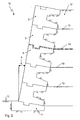
- Fig. 2.1 is such a cuboid Hang Anlagensstein 5 for the form-fitting joining together of a plurality Hangommessteine 5 shown.
- the slope securing block 5 has a pin 8 and a groove 9 for the positive joining together of several of these stones.
- a recess 7 is provided, which is filled in the use of the stone to form a slope securing wall of the limiting soil 12. Through the recess 7 is further advantageously achieved that the stone is additionally fixed by the soil.
- the stone On the side facing away from the soil 12 of the slope stabilization stone 6 are according to Fig. 2.2 Slats 2 arranged for sound absorption.
- the stone is additionally functionally a higher sound absorption own, which makes him preferably for slope protection walls along highways or roads used.
- Fig. 3 is a slope securing wall 10 of slope stabilizers 5 shown schematically.
- the slope securing stones 5 are constructed by form-fitting joining of the pins 8 in the corresponding grooves 9.
- the slope securing wall 10 is inclined by the solder by an angle ⁇ of about 10 degrees in the direction of slope.
- a foundation 11 is provided, which receives substantially the vertical forces from the slope securing wall 10.
- components can be produced with the building material according to the invention, which can even be used as ceiling elements.
- a reinforcement of the ceiling elements with hemp ropes takes place, wherein the support cables have a diameter of 12 mm or more.
- the spacings of the supporting cables and the arrangement of the distributors are selected.
- the supporting cables are arranged at a distance of 10 cm parallel in the ceiling element.
- hemp ropes with a diameter of 8 mm at a distance of 30 cm are used as distributors in the ceiling element.
- the building material according to the invention is thus very versatile in use and processable.
- a building material with high porosity is used as filling material for a timber truss.
- the timber framework fulfills the static function of the component, the building material based on plant excellent thermal insulation and sound insulation properties.
- the formulation of a lightweight concrete for wall elements with insulation and filler function is given as follows:
- a hollow block brick can be pressed, which can be processed conventionally.
- a brick has a width of 30 cm, a height of 24 cm and a length of 36.5 cm.
- the volume of the brick is 26.28 dm 3 , the cavities make up with 7.04 dm 3 a share of 27%. His weight is 15.50 kg.
- An inventive composition of vegetable raw materials for the building material is 75% Miscanthuss Georgne and 20% softwood chips with a hemp fiber content of 5% corresponding to the desired static strength.
- the process for the production of specific building materials can be extended by admixing this mixture (or, in view of the existing plants, the mixture M1 or M2) with a mixture M3 of application-related proportions, in application-related proportions ,
- M3 mixture is a conventional flow agent such as lignosulfonates, polycarboxylates, naphthalene sulfonate or naphthalene acrylate. It has in fact surprisingly been found that in this way extruded components can be produced.
- the building material is preferably extruded after the addition of flow agents.
- the resulting profiles have higher tensile strength and flexural strength compared to the conventional PVC rods (for the manufacture of window profiles, among others).
- a particularly tensile strand-like component of the building material thus produced can be produced by the use of 10 percent by volume hemp or miscanthus fibers (or a mixture of this fiber) as part of the vegetable raw material. These fibers are excellently integrated into the building material matrix and, due to their fiber structure, produce excellent bending and tensile strengths.
- the building materials described and claimed herein are breathable, recyclable, resource-saving and ecological and have no toxins.
- the latter building materials differ from these known and a fortiori from conventional building materials in that they have a lighter volume weight, better chemical, physical and mechanical properties and are cheaper to produce.
- the building materials according to the invention cover a quasi-inexhaustible wide range of applications and possible uses.
Landscapes
- Engineering & Computer Science (AREA)
- Architecture (AREA)
- Structural Engineering (AREA)
- Chemical & Material Sciences (AREA)
- Civil Engineering (AREA)
- Ceramic Engineering (AREA)
- Life Sciences & Earth Sciences (AREA)
- Environmental & Geological Engineering (AREA)
- Materials Engineering (AREA)
- General Engineering & Computer Science (AREA)
- Organic Chemistry (AREA)
- Paleontology (AREA)
- General Life Sciences & Earth Sciences (AREA)
- Mining & Mineral Resources (AREA)
- Chemical Kinetics & Catalysis (AREA)
- Inorganic Chemistry (AREA)
- Physics & Mathematics (AREA)
- Electromagnetism (AREA)
- Wood Science & Technology (AREA)
- Curing Cements, Concrete, And Artificial Stone (AREA)
- Panels For Use In Building Construction (AREA)
- Conveying And Assembling Of Building Elements In Situ (AREA)
Claims (31)
- Matériau de construction à base végétale (PB) comprenant un mélange M1 d'un liant et d'un minéralisateur, caractérisé en ce que les proportions en poids des constituants formant le mélange M1 sont comprises entre 50 % et 90 % pour le liant et entre 10 % et 50 % pour le minéralisateur, et que ce dernier est composé d'un mélange M2 de carbonate de calcium CaCO3 et de carbonate de magnésium MgCO3, les proportions en poids des constituants formant ce mélange M2 étant comprises entre 60 % et 95 % pour le CaCO3 et entre 5 % et 40 % pour le MgCO3.
- Matériau de construction selon la revendication 1, caractérisé en ce que les proportions en poids des constituants formant le mélange M1 sont préférablement comprises entre 6/10 et 4/5 pour le liant et entre 1/5 et 4/10 pour le minéralisateur.
- Matériau de construction selon la revendication 1 ou 2, caractérisé en ce que les proportions en poids des constituants formant le mélange M2 sont préférablement comprises entre 2/3 et 9/10 pour le CaCO3 et entre 1/10 et 1/3 pour le MgCO3.
- Matériau de construction selon l'une des revendications 1 à 3, caractérisé en ce que sur 1 m3 de PB, le mélange M1 est composé de 75 kg de minéralisateur M2 et de 225 kg de liant (proportions en poids 25 % à 75 %) et le mélange M2 de 60 kg de carbonate de calcium et de 15 kg de carbonate de magnésium (proportions en poids 80 à 20 %).
- Matériau de construction selon l'une des revendications 1 à 4, caractérisé en ce qu'il comprend un mélange supplémentaire M3 contenu en proportions définies, orientées vers ou dépendantes de l'application.
- Matériau de construction selon la revendication 5, caractérisé en ce que le mélange M3 est composé de plâtre, préférablement additionné d'amidon.
- Matériau de construction selon la revendication 5, caractérisé en ce que le mélange M3 est constitué d'un agent d'écoulement.
- Matériau de construction selon la revendication 5 ou 6, caractérisé en ce que sur 1 m3 de PB, le mélange M1 est composé de 60 kg de minéralisateur selon M2 et de 100 kg de liant (proportions en poids 37,50 % à 62,50 %) et le mélange M2 de 42 kg de carbonate de calcium et de 18 kg de carbonate de magnésium (proportions en poids 70 % à 30 %) et le mélange M3 préférablement de 200 kg de plâtre.
- Matériau de construction selon l'une des revendications 1 à 8, caractérisé en ce que la base végétale PB est avantageusement constituée de Miscanthus (roseau de Chine), de chanvre, de bois de conifères, de canne à sucre, de paille, de panic raide (panicum virgatum), de lolium italien, de roseau, individuellement ou en différentes combinaisons, ces matières premières végétales étant fragmentées selon des spécifications prédéterminées.
- Matériau de construction selon la revendication 9, caractérisé en ce que la fragmentation produit des particules allongées telles que des fibres jusqu'à 40 mm et/ou des granules d'une taille jusqu'à 8 mm.
- Matériau de construction selon la revendication 9 ou 10, caractérisé en ce que la base végétale PB comprend un mélange de Miscanthus et de bois de conifères, préférablement à des proportions en poids de 85 % et 15 %, respectivement.
- Matériau de construction selon la revendication 9 ou 10, caractérisé en ce que la base végétale PB comprend un mélange de Miscanthus, de bois de conifères et de chanvre, préférablement à des proportions en poids de 75 %, 20 % et 5 %, respectivement.
- Matériau de construction selon l'une des revendications 1 à 12, caractérisé en ce que le mélange {PB + M1} respectivement {PB + M1 + M3} est gâché avec une quantité d'eau à gâcher telle qu'une consistance Ki prédéfinie et souhaitée est obtenue.
- Matériau de construction selon la revendication 13, caractérisé en ce que sur 1 m3 de PB, la quantité d'eau à gâcher est égale à 300 litres.
- Matériau de construction selon la revendication 13 ou 14, caractérisé en ce qu'une préparation fongicide est ajoutée à ladite eau à gâcher, préférablement par addition de 2/3 de litre d'hydroxide de sodium sur 1000 litres d'eau à gâcher.
- Matériau de construction selon l'une des revendications 1 à 15, caractérisé en ce que le liant est préférablement du ciment Portland de la qualité 52.5.
- Procédé pour fabriquer un matériau de construction selon l'une des revendications 1 à 16, caractérisé en ce que- le mélange minéralisateur M2 composé de carbonate de calcium CaCO3 et de carbonate de magnésium MgCO3 est préparé en proportions définies, orientées vers ou dépendantes de l'application,- le cas échéant, un mélange M3 composé d'au moins une matière additionnelle est préparé en proportions définies, orientées vers ou dépendantes de l'application et ajouté au mélange M2,- le mélange {M2} respectivement {M2 + M3} est ajouté au liant en proportions définies, orientées vers ou dépendantes de l'application, et le mélange ainsi obtenu {M1} (={liant + M2}) respectivement {M1 + M3} est ajouté à la base végétale (PB), et que- le mélange {PB + M1} respectivement {PB + M1 + M3} est délayé dans une quantité d'eau à gâcher définie selon la consistance Ki souhaitée.
- Procédé pour fabriquer un matériau de construction selon l'une des revendications 5 à 16, caractérisé en ce que- le mélange minéralisateur M2 composé de carbonate de calcium CaCO3 et de carbonate de magnésium MgCO3 est préparé en proportions définies, orientées vers ou dépendantes de l'application,- le mélange M3 composé d'au moins une matière additionnelle est préparé en proportions définies, orientées vers ou dépendantes de l'application et ajouté au mélange M2,- le mélange {M2 + M3} est ajouté au liant en proportions définies, orientées vers ou dépendantes de l'application, et le mélange ainsi obtenu {liant + M2 + M3} respectivement {M1 + M3} est ajouté à la base végétale (PB), et que- le mélange {PB + M1 + M3} est extrudé.
- Procédé selon la revendication 17 ou 18, caractérisé en ce que la préparation du mélange {PB + M1} respectivement {PB + M1 + M3} est réalisée par opérations successives, le minéralisateur respectivement le minéralisateur et le mélange M3 étant préalablement ajoutés au liant directement à l'usine de liant d'après des spécifications déterminées.
- Elément de construction ou objet fabriqué à partir d'un matériau de construction selon l'une des revendications 1 à 16.
- Elément de construction selon la revendication 20, caractérisé en ce qu'il forme un élément (1) d'isolation acoustique et comporte pour l'isolation acoustique des lamelles (2) afin d'augmenter la surface d'absorption acoustique.
- Elément de construction acoustiquement isolant selon la revendication 21, caractérisé en ce qu'il présente la forme d'une panneau.
- Elément de construction acoustiquement isolant selon la revendication 21 ou 22, caractérisé en ce qu'il est composé de deux couches, une couche de support (3) à fonction principalement statique étant pourvue d'une couche d'absorption (4) pour l'absorption acoustique.
- Elément de construction acoustiquement isolant selon la revendication 23, caractérisé en ce qu'il a une épaisseur (h) de 25 cm, la couche de support (3) avec une densité de 1250 kg/m3 ayant une épaisseur (g) de 10 cm et la couche d'absorption (4) avec une densité de 500 kg/m3 étant constituée de lamelles (2) ayant une hauteur (e) de 10 cm, une largeur (d) de 10 cm au pied de la lamelle, une largeur (a) de 6 cm à la tête de la lamelle et un écart (c) entre les lamelles de 3 cm au pied des lamelles, et d'une couche sous les lamelles d'une épaisseur (f) de 5 cm, et que le poids total de l'élément de construction (1), par rapport à la surface projetée, est égal à 205 kg/m2.
- Elément de construction selon la revendication 20, caractérisé en ce qu'il forme un élément de talus (5) parallélépipédique, qu'un tenon (8) et une mortaise (9) sont formées pour l'aboutement géométrique de plusieurs éléments de talus (5) et qu'un évidement (7) est en outre prévu du côté en regard du sol, ledit évidement pouvant être rempli de terre (12).
- Elément de talus selon la revendication 25, caractérisé en ce que des lamelles (2) d'absorption acoustique sont agencées du côté de l'élément de talus (6) opposé au sol (12).
- Mur de consolidation de talus composé d'éléments de talus selon la revendication 25 ou 26, caractérisé en ce que plusieurs éléments de talus (5, 6) forment un mur de consolidation (10) par assemblage géométrique, et que celui-ci est incliné d'un angle α par rapport à la verticale et qu'une fondation (11) est prévue pour recevoir les forces verticales ainsi que des nattes (13) de géonontissé et des bandes de tension (14) pour recevoir les forces horizontales exercées par le mur de consolidation (10).
- Mur de consolidation de talus selon la revendication 27, caractérisé en ce que l'angle α est égal à 10°.
- Elément de construction selon la revendication 20, caractérisé en ce qu'il est compressé sous forme de parpaing.
- Elément de construction selon la revendication 20, caractérisé en ce que des cordes de chanvre d'un diamètre de 12 mm sont disposées comme armature à des intervalles de 10 cm, que des cordes de chanvre d'un diamètre de 8 mm sont disposées comme distributeurs à des intervalles de 30 cm et que les éléments de construction ont une longueur de 3,5 m et sont utilisables comme éléments de plafond.
- Elément de construction selon la revendication 20, caractérisé en ce qu'une charpente de bois est prévue qui remplit la fonction statique de l'élément de construction, et que le matériau de construction à base végétale remplit la charpente de bois de manière bidimensionnelle et remplit une fonction d'isolation thermique et acoustique.
Applications Claiming Priority (1)
| Application Number | Priority Date | Filing Date | Title |
|---|---|---|---|
| PCT/CH2002/000583 WO2004037742A1 (fr) | 2002-10-28 | 2002-10-28 | Procede pour fabriquer un materiau de construction a base vegetale et materiau de construction resultant de ce procede |
Publications (2)
| Publication Number | Publication Date |
|---|---|
| EP1554228A1 EP1554228A1 (fr) | 2005-07-20 |
| EP1554228B1 true EP1554228B1 (fr) | 2011-10-05 |
Family
ID=32111448
Family Applications (1)
| Application Number | Title | Priority Date | Filing Date |
|---|---|---|---|
| EP20020808045 Expired - Lifetime EP1554228B1 (fr) | 2002-10-28 | 2002-10-28 | Matériau de construction à base végétale et procédé de fabrication de ce matériau de construction. |
Country Status (10)
| Country | Link |
|---|---|
| US (1) | US8070877B2 (fr) |
| EP (1) | EP1554228B1 (fr) |
| CN (1) | CN100354226C (fr) |
| AT (1) | ATE527222T1 (fr) |
| AU (1) | AU2002333152A1 (fr) |
| CA (1) | CA2505081C (fr) |
| DE (1) | DE50207532D1 (fr) |
| ES (1) | ES2375050T3 (fr) |
| PT (1) | PT1554228E (fr) |
| WO (1) | WO2004037742A1 (fr) |
Families Citing this family (7)
| Publication number | Priority date | Publication date | Assignee | Title |
|---|---|---|---|---|
| ATE388926T1 (de) * | 2004-07-09 | 2008-03-15 | Miscanthus Nawaro Innovations | Baustoff mit pflanzlichem zuschlag |
| EP2177489B1 (fr) * | 2008-09-29 | 2012-11-07 | Inge Höhn | Matériau de construction comprenant un additif d'origine végétale |
| US9249572B2 (en) | 2010-10-11 | 2016-02-02 | Michael Neumayr | Prefabricated shear wall system with integrated channels |
| IT1404226B1 (it) * | 2011-02-18 | 2013-11-15 | Ambiente Azzurro Onlus | Procedimento per la produzione di fibrocemento ecologico, fibrocemento ottenuto e suoi impieghi. |
| FR3020113A1 (fr) * | 2014-04-17 | 2015-10-23 | Mireille Avril | Utilisation de morceaux de roseaux en tant que materiau isolant au moins thermique, procede de fabrication d'un element de construction et element de construction associes |
| US10661473B2 (en) | 2016-03-18 | 2020-05-26 | Centroplexus Innovations Inc. | Integral composite shuttering panel and monolithic wall building system |
| CN107866896A (zh) * | 2017-12-12 | 2018-04-03 | 青岛天力多维生态有限公司 | 一种制造挡墙板的模具 |
Family Cites Families (20)
| Publication number | Priority date | Publication date | Assignee | Title |
|---|---|---|---|---|
| GB557777A (en) * | 1941-01-03 | 1943-12-06 | Kadoory Darwish | Improvements in and relating to the process of manufacture of a light weight building material and insulating boards, hollow blocks and other building products formed therewith |
| DE884088C (de) * | 1950-04-18 | 1953-07-23 | Karl Bauer | Formbauteil mit Bewehrung |
| DE2135877A1 (de) * | 1971-07-17 | 1973-02-01 | Hans Jakob Maul | Gegenstaende zur schall-eindaemmung |
| JPS5425925A (en) * | 1977-07-29 | 1979-02-27 | Nippon Hardboard | Noncombustible building material and method of making same |
| CH636393A5 (de) * | 1979-03-05 | 1983-05-31 | Rolf Scheiwiller | Bausatz aus verbundsteinen, insbesondere fuer die hangsicherung und flussbettverbauung. |
| DE3632394C2 (de) * | 1986-09-24 | 1996-01-18 | Basaltin Gmbh & Co | Verfahren und Vorrichtung zum Herstellen eines Lärmschutzelementes |
| KR0156535B1 (ko) * | 1989-04-17 | 1998-12-01 | 헨젤 | 식물섬유로부터 얻어진 강화 및 또는 가공섬유와 그의 제조방법 및 그의 용도 |
| NO170626C (no) * | 1990-05-18 | 1992-11-11 | Norsk Proco As | Ildsikkert, vannfast og syrebestandig produkt |
| CH688721A5 (de) * | 1994-06-23 | 1998-01-30 | Zewag Laermtech Ag | Lärmschutzwand, aufstellbar insbesondere entlang von Verkehrswegen zur Abschirmung von Verkehrslärm. |
| DE9411796U1 (de) * | 1994-07-21 | 1995-11-23 | Killmer, Erika, 45355 Essen | Mineralischer, faserverstärkter Verbundwerkstoff |
| DE19628043C2 (de) * | 1995-09-06 | 1999-03-18 | Graf Dragica | Gefacheelement |
| ATE498597T1 (de) * | 1995-12-05 | 2011-03-15 | Dolomatrix Internat Ltd | Abbindende zusammensetzung und ihre verwendung |
| DE19704198A1 (de) * | 1997-02-05 | 1998-08-06 | Haesler Andreas Dipl Ing Fh | Kerbschlitzziegel |
| DE19914280A1 (de) * | 1999-03-25 | 2000-09-28 | Uec Umwelt Entsorgungs Center | Verfahren zur Herstellung von porösen, schwer entflammbaren Faserverbundwerkstoffen aus nachwachsenden Rohstoffen durch thermo-mechanische Aufbereitung und hydro-thermale Weiterverarbeitung |
| GB2349665B (en) * | 1999-04-19 | 2003-05-21 | Mcandrews Concrete Products Lt | A soil erosion block |
| DE29918294U1 (de) * | 1999-10-16 | 2000-03-23 | Grötz, Georg, 76597 Loffenau | Schallschutzwand für Verkehrswege |
| YU49018B (sh) * | 1999-11-24 | 2003-07-07 | Miladin Knežević | Noseći blok za zidanje sa otvorom i pokretnim elementom |
| AUPQ879000A0 (en) | 2000-07-14 | 2000-08-10 | Davco Construction Materials Pty Limited | Mortar composition and method |
| LU90627B1 (de) | 2000-08-09 | 2002-02-12 | Heribert Hoehn | Verfahren zum Herstellen von Beton oder Moertel mit einem pflanzlichen Zuschlag |
| WO2002028795A2 (fr) * | 2000-10-04 | 2002-04-11 | James Hardie Research Pty Limited | Materiaux composite de fibro-ciment utilisant des fibres cellulosiques calibrees |
-
2002
- 2002-10-28 AT AT02808045T patent/ATE527222T1/de active
- 2002-10-28 CA CA 2505081 patent/CA2505081C/fr not_active Expired - Fee Related
- 2002-10-28 AU AU2002333152A patent/AU2002333152A1/en not_active Abandoned
- 2002-10-28 EP EP20020808045 patent/EP1554228B1/fr not_active Expired - Lifetime
- 2002-10-28 DE DE50207532T patent/DE50207532D1/de not_active Expired - Lifetime
- 2002-10-28 US US10/532,957 patent/US8070877B2/en not_active Expired - Fee Related
- 2002-10-28 ES ES02808045T patent/ES2375050T3/es not_active Expired - Lifetime
- 2002-10-28 CN CNB028298322A patent/CN100354226C/zh not_active Expired - Fee Related
- 2002-10-28 PT PT02808045T patent/PT1554228E/pt unknown
- 2002-10-28 WO PCT/CH2002/000583 patent/WO2004037742A1/fr not_active Ceased
Also Published As
| Publication number | Publication date |
|---|---|
| EP1554228A1 (fr) | 2005-07-20 |
| DE50207532D1 (de) | 2006-08-24 |
| CA2505081C (fr) | 2015-01-06 |
| CN100354226C (zh) | 2007-12-12 |
| AU2002333152A1 (en) | 2004-05-13 |
| CA2505081A1 (fr) | 2004-05-06 |
| US20060165966A1 (en) | 2006-07-27 |
| CN1694854A (zh) | 2005-11-09 |
| WO2004037742A1 (fr) | 2004-05-06 |
| ES2375050T3 (es) | 2012-02-24 |
| US8070877B2 (en) | 2011-12-06 |
| ATE527222T1 (de) | 2011-10-15 |
| PT1554228E (pt) | 2006-11-30 |
Similar Documents
| Publication | Publication Date | Title |
|---|---|---|
| DE60110402T2 (de) | Strukturverbaupanele | |
| DE69521407T2 (de) | Trennwand | |
| DE69726880T2 (de) | Wandelement und dazugehörige konstruktionsmethode | |
| EP2069255A1 (fr) | Matériau avec un supplément végétal | |
| EP0903328B1 (fr) | Matériaux de construction en limon ou argile cru | |
| DE2524147B2 (de) | Verfahren zum Herstellen von Leichtbauplatten aus einem porösen Zuschlagstoff und Gips | |
| EP2177489B1 (fr) | Matériau de construction comprenant un additif d'origine végétale | |
| WO2004037742A1 (fr) | Procede pour fabriquer un materiau de construction a base vegetale et materiau de construction resultant de ce procede | |
| DE2646429A1 (de) | Verfahren zur herstellung selbsttragender elemente, insbesondere dachtafeln und tafeln fuer bauelemente | |
| DE19643605C2 (de) | Wärmedämmender Baustoff und dessen Verwendung | |
| EP2939991B1 (fr) | Mélange pouvant s'écouler destiné à la formation d'une couche d'isolation thermique | |
| EP3929169A2 (fr) | Éléments d'argile pour les murs à la protection contre le bruit et la construction de bâtiments | |
| EP3404001B1 (fr) | Béton frais à consistance de terre humide et éléments en béton frais à consistance de terre humide durci | |
| WO2009065521A1 (fr) | Elément de construction et procédé de fabrication d'un élément de construction | |
| DE2719860A1 (de) | Mauerstein, insbesondere ziegel | |
| DE102006033061A1 (de) | Lärmschutzwerkstoff | |
| AT501684B1 (de) | Leichtbeton | |
| AT394184B (de) | Verfahren zur herstellung von leichtbeton | |
| EP4339390A1 (fr) | Système d'isolation multicouche | |
| CH584597A5 (en) | Fireproof building block made of expanded phlogopite - has low wt. and provides heat and sound insulation | |
| DE19804770A1 (de) | Lärmschutzwände und schallabsorbierende Bekleidungen | |
| DE10141265B4 (de) | Modifizierte Verbundplatte | |
| WO2017055413A1 (fr) | Mélange sec de ciment contenant du gypse et éléments de construction préfabriqués | |
| DE102014013291A1 (de) | Baustoffmischung zur Herstellung von den Schall absorbierenden und mit guten thermischen Eigenschaften ausgestatteten Bauelementen | |
| DE1609620C3 (de) | Verbundplatte |
Legal Events
| Date | Code | Title | Description |
|---|---|---|---|
| PUAI | Public reference made under article 153(3) epc to a published international application that has entered the european phase |
Free format text: ORIGINAL CODE: 0009012 |
|
| 17P | Request for examination filed |
Effective date: 20050409 |
|
| AK | Designated contracting states |
Kind code of ref document: A1 Designated state(s): AT BE BG CH CY CZ DE DK EE ES FI FR GB GR IE IT LI LU MC NL PT SE SK TR |
|
| AX | Request for extension of the european patent |
Extension state: AL LT LV MK RO SI |
|
| GRAP | Despatch of communication of intention to grant a patent |
Free format text: ORIGINAL CODE: EPIDOSNIGR1 |
|
| DAX | Request for extension of the european patent (deleted) | ||
| RAP1 | Party data changed (applicant data changed or rights of an application transferred) |
Owner name: NAWARO AG |
|
| GRAS | Grant fee paid |
Free format text: ORIGINAL CODE: EPIDOSNIGR3 |
|
| GRAA | (expected) grant |
Free format text: ORIGINAL CODE: 0009210 |
|
| AK | Designated contracting states |
Kind code of ref document: B1 Designated state(s): AT BE BG CH CY CZ DE DK EE ES FI FR GB GR IE IT LI LU MC NL PT SE SK TR |
|
| REG | Reference to a national code |
Ref country code: GB Ref legal event code: FG4D Free format text: NOT ENGLISH |
|
| RTI1 | Title (correction) |
Free format text: CONSTRUCTION MATERIAL ON A PLANT BASIS AND METHOD FOR THE PRODUCING OF THIS CONSTRUCTION MATERIAL. |
|
| REG | Reference to a national code |
Ref country code: CH Ref legal event code: EP |
|
| PUAC | Information related to the publication of a b1 document modified or deleted |
Free format text: ORIGINAL CODE: 0009299EPPU |
|
| REG | Reference to a national code |
Ref country code: CH Ref legal event code: NV Representative=s name: AMMANN PATENTANWAELTE AG BERN |
|
| GBT | Gb: translation of ep patent filed (gb section 77(6)(a)/1977) |
Effective date: 20060725 |
|
| DB1 | Publication of patent cancelled | ||
| REG | Reference to a national code |
Ref country code: IE Ref legal event code: FG4D Free format text: LANGUAGE OF EP DOCUMENT: GERMAN |
|
| REF | Corresponds to: |
Ref document number: 50207532 Country of ref document: DE Date of ref document: 20060824 Kind code of ref document: P |
|
| REG | Reference to a national code |
Ref country code: CH Ref legal event code: PK Free format text: BERICHTIGUNG. |
|
| REG | Reference to a national code |
Ref country code: GB Ref legal event code: ERR Free format text: NOTIFICATION HOWEVER HAS BEEN RECEIVED THAT PROCEEDINGS BEFORE THE EPO WERE STAYED BEFORE THE DATE OF GRANT. THIS CORRECTION WILL BE PUBLISHED IN EUROPEAN PATENT BULLETIN NO. 2006/34 DATED 20060823 |
|
| NLXE | Nl: other communications concerning ep-patents (part 3 heading xe) |
Free format text: PAT. BUL. 09/2006: PATENTNUMBER 1554228 SHOULD BE DELETED (SEE EUROPEAN BULLETIN 20060823/34) |
|
| REG | Reference to a national code |
Ref country code: PT Ref legal event code: SC4A Free format text: AVAILABILITY OF NATIONAL TRANSLATION Effective date: 20061004 |
|
| EN | Fr: translation not filed | ||
| REG | Reference to a national code |
Ref country code: PT Ref legal event code: MM4A Free format text: LAPSE DUE TO NON-PAYMENT OF FEES Effective date: 20070730 |
|
| BERE | Be: lapsed |
Owner name: *NAWARO A.G. Effective date: 20061031 |
|
| 19F | Resumption of proceedings before grant (after stay of proceedings) |
Effective date: 20110701 |
|
| RAP3 | Party data changed (applicant data changed or rights of an application transferred) |
Owner name: NAWARO AG |
|
| RAP1 | Party data changed (applicant data changed or rights of an application transferred) |
Owner name: NAWARO AG |
|
| GRAA | (expected) grant |
Free format text: ORIGINAL CODE: 0009210 |
|
| AK | Designated contracting states |
Kind code of ref document: B1 Designated state(s): AT BE BG CH CY CZ DE DK EE ES FI FR GB GR IE IT LI LU MC NL PT SE SK TR |
|
| REG | Reference to a national code |
Ref country code: GB Ref legal event code: FG4D Free format text: NOT ENGLISH |
|
| REG | Reference to a national code |
Ref country code: CH Ref legal event code: PK Free format text: DIE ERTEILUNG VOM 12.07.2006 IST VOM EPA WIDERRUFEN WORDEN Ref country code: CH Ref legal event code: EP Ref country code: CH Ref legal event code: NV Representative=s name: AMMANN PATENTANWAELTE AG BERN |
|
| REG | Reference to a national code |
Ref country code: NL Ref legal event code: T3 |
|
| REG | Reference to a national code |
Ref country code: PT Ref legal event code: SC4A Free format text: AVAILABILITY OF NATIONAL TRANSLATION Effective date: 20120123 |
|
| REG | Reference to a national code |
Ref country code: ES Ref legal event code: FG2A Ref document number: 2375050 Country of ref document: ES Kind code of ref document: T3 Effective date: 20120224 |
|
| REG | Reference to a national code |
Ref country code: DE Ref legal event code: R082 Ref document number: 50207532 Country of ref document: DE Representative=s name: MAI DOERR BESIER PATENTANWAELTE, DE Ref country code: DE Ref legal event code: R082 Ref document number: 50207532 Country of ref document: DE Representative=s name: MAI DOERR BESIER EUROPEAN PATENT ATTORNEYS - E, DE |
|
| REG | Reference to a national code |
Ref country code: DE Ref legal event code: R082 Ref document number: 50207532 Country of ref document: DE Representative=s name: MAI DOERR BESIER PATENTANWAELTE, DE Ref country code: DE Ref legal event code: R082 Ref document number: 50207532 Country of ref document: DE Representative=s name: MAI DOERR BESIER EUROPEAN PATENT ATTORNEYS - E, DE |
|
| PG25 | Lapsed in a contracting state [announced via postgrant information from national office to epo] |
Ref country code: MC Free format text: LAPSE BECAUSE OF NON-PAYMENT OF DUE FEES Effective date: 20111031 |
|
| PG25 | Lapsed in a contracting state [announced via postgrant information from national office to epo] |
Ref country code: CY Free format text: LAPSE BECAUSE OF FAILURE TO SUBMIT A TRANSLATION OF THE DESCRIPTION OR TO PAY THE FEE WITHIN THE PRESCRIBED TIME-LIMIT Effective date: 20111005 |
|
| PG25 | Lapsed in a contracting state [announced via postgrant information from national office to epo] |
Ref country code: EE Free format text: LAPSE BECAUSE OF FAILURE TO SUBMIT A TRANSLATION OF THE DESCRIPTION OR TO PAY THE FEE WITHIN THE PRESCRIBED TIME-LIMIT Effective date: 20111005 Ref country code: DK Free format text: LAPSE BECAUSE OF FAILURE TO SUBMIT A TRANSLATION OF THE DESCRIPTION OR TO PAY THE FEE WITHIN THE PRESCRIBED TIME-LIMIT Effective date: 20111005 |
|
| REG | Reference to a national code |
Ref country code: SK Ref legal event code: T3 Ref document number: E 11668 Country of ref document: SK |
|
| PLBE | No opposition filed within time limit |
Free format text: ORIGINAL CODE: 0009261 |
|
| STAA | Information on the status of an ep patent application or granted ep patent |
Free format text: STATUS: NO OPPOSITION FILED WITHIN TIME LIMIT |
|
| 26N | No opposition filed |
Effective date: 20120706 |
|
| REG | Reference to a national code |
Ref country code: DE Ref legal event code: R097 Ref document number: 50207532 Country of ref document: DE Effective date: 20120706 |
|
| REG | Reference to a national code |
Ref country code: DE Ref legal event code: R096 Ref document number: 50207532 Country of ref document: DE Effective date: 20121122 |
|
| PG25 | Lapsed in a contracting state [announced via postgrant information from national office to epo] |
Ref country code: FI Free format text: LAPSE BECAUSE OF NON-PAYMENT OF DUE FEES Effective date: 20111005 |
|
| PG25 | Lapsed in a contracting state [announced via postgrant information from national office to epo] |
Ref country code: SE Free format text: LAPSE BECAUSE OF FAILURE TO SUBMIT A TRANSLATION OF THE DESCRIPTION OR TO PAY THE FEE WITHIN THE PRESCRIBED TIME-LIMIT Effective date: 20111005 |
|
| PG25 | Lapsed in a contracting state [announced via postgrant information from national office to epo] |
Ref country code: TR Free format text: LAPSE BECAUSE OF FAILURE TO SUBMIT A TRANSLATION OF THE DESCRIPTION OR TO PAY THE FEE WITHIN THE PRESCRIBED TIME-LIMIT Effective date: 20111005 |
|
| PGFP | Annual fee paid to national office [announced via postgrant information from national office to epo] |
Ref country code: IE Payment date: 20131029 Year of fee payment: 12 Ref country code: SK Payment date: 20131025 Year of fee payment: 12 Ref country code: BG Payment date: 20131011 Year of fee payment: 12 |
|
| PGFP | Annual fee paid to national office [announced via postgrant information from national office to epo] |
Ref country code: NL Payment date: 20131022 Year of fee payment: 12 |
|
| PG25 | Lapsed in a contracting state [announced via postgrant information from national office to epo] |
Ref country code: GR Free format text: LAPSE BECAUSE OF FAILURE TO SUBMIT A TRANSLATION OF THE DESCRIPTION OR TO PAY THE FEE WITHIN THE PRESCRIBED TIME-LIMIT Effective date: 20111005 |
|
| REG | Reference to a national code |
Ref country code: NL Ref legal event code: V1 Effective date: 20150501 |
|
| REG | Reference to a national code |
Ref country code: SK Ref legal event code: MM4A Ref document number: E 11668 Country of ref document: SK Effective date: 20141028 |
|
| REG | Reference to a national code |
Ref country code: IE Ref legal event code: MM4A |
|
| PG25 | Lapsed in a contracting state [announced via postgrant information from national office to epo] |
Ref country code: BG Free format text: LAPSE BECAUSE OF NON-PAYMENT OF DUE FEES Effective date: 20150630 Ref country code: SK Free format text: LAPSE BECAUSE OF NON-PAYMENT OF DUE FEES Effective date: 20141028 |
|
| PG25 | Lapsed in a contracting state [announced via postgrant information from national office to epo] |
Ref country code: NL Free format text: LAPSE BECAUSE OF NON-PAYMENT OF DUE FEES Effective date: 20150501 |
|
| PG25 | Lapsed in a contracting state [announced via postgrant information from national office to epo] |
Ref country code: IE Free format text: LAPSE BECAUSE OF NON-PAYMENT OF DUE FEES Effective date: 20141028 |
|
| REG | Reference to a national code |
Ref country code: FR Ref legal event code: PLFP Year of fee payment: 14 |
|
| REG | Reference to a national code |
Ref country code: FR Ref legal event code: PLFP Year of fee payment: 15 |
|
| REG | Reference to a national code |
Ref country code: FR Ref legal event code: PLFP Year of fee payment: 16 |
|
| PG25 | Lapsed in a contracting state [announced via postgrant information from national office to epo] |
Ref country code: PT Free format text: LAPSE BECAUSE OF NON-PAYMENT OF DUE FEES Effective date: 20190429 |
|
| PGFP | Annual fee paid to national office [announced via postgrant information from national office to epo] |
Ref country code: GB Payment date: 20200427 Year of fee payment: 18 Ref country code: BE Payment date: 20200427 Year of fee payment: 18 |
|
| GBPC | Gb: european patent ceased through non-payment of renewal fee |
Effective date: 20201028 |
|
| PGFP | Annual fee paid to national office [announced via postgrant information from national office to epo] |
Ref country code: LU Payment date: 20210429 Year of fee payment: 19 |
|
| REG | Reference to a national code |
Ref country code: BE Ref legal event code: MM Effective date: 20201031 |
|
| PG25 | Lapsed in a contracting state [announced via postgrant information from national office to epo] |
Ref country code: CZ Free format text: LAPSE BECAUSE OF NON-PAYMENT OF DUE FEES Effective date: 20201028 |
|
| PGFP | Annual fee paid to national office [announced via postgrant information from national office to epo] |
Ref country code: IT Payment date: 20210429 Year of fee payment: 19 Ref country code: CZ Payment date: 20210427 Year of fee payment: 19 Ref country code: DE Payment date: 20210429 Year of fee payment: 19 Ref country code: FR Payment date: 20210429 Year of fee payment: 19 |
|
| PG25 | Lapsed in a contracting state [announced via postgrant information from national office to epo] |
Ref country code: GB Free format text: LAPSE BECAUSE OF NON-PAYMENT OF DUE FEES Effective date: 20201028 Ref country code: BE Free format text: LAPSE BECAUSE OF NON-PAYMENT OF DUE FEES Effective date: 20201031 |
|
| PGFP | Annual fee paid to national office [announced via postgrant information from national office to epo] |
Ref country code: ES Payment date: 20210521 Year of fee payment: 19 Ref country code: CH Payment date: 20210426 Year of fee payment: 19 Ref country code: AT Payment date: 20210430 Year of fee payment: 19 |
|
| REG | Reference to a national code |
Ref country code: DE Ref legal event code: R119 Ref document number: 50207532 Country of ref document: DE |
|
| REG | Reference to a national code |
Ref country code: CH Ref legal event code: PL |
|
| REG | Reference to a national code |
Ref country code: AT Ref legal event code: MM01 Ref document number: 527222 Country of ref document: AT Kind code of ref document: T Effective date: 20211028 |
|
| PG25 | Lapsed in a contracting state [announced via postgrant information from national office to epo] |
Ref country code: LU Free format text: LAPSE BECAUSE OF NON-PAYMENT OF DUE FEES Effective date: 20211028 Ref country code: DE Free format text: LAPSE BECAUSE OF NON-PAYMENT OF DUE FEES Effective date: 20220503 Ref country code: CZ Free format text: LAPSE BECAUSE OF NON-PAYMENT OF DUE FEES Effective date: 20211028 |
|
| PG25 | Lapsed in a contracting state [announced via postgrant information from national office to epo] |
Ref country code: LI Free format text: LAPSE BECAUSE OF NON-PAYMENT OF DUE FEES Effective date: 20211031 Ref country code: CH Free format text: LAPSE BECAUSE OF NON-PAYMENT OF DUE FEES Effective date: 20211031 Ref country code: AT Free format text: LAPSE BECAUSE OF NON-PAYMENT OF DUE FEES Effective date: 20211028 |
|
| PG25 | Lapsed in a contracting state [announced via postgrant information from national office to epo] |
Ref country code: FR Free format text: LAPSE BECAUSE OF NON-PAYMENT OF DUE FEES Effective date: 20211031 |
|
| PG25 | Lapsed in a contracting state [announced via postgrant information from national office to epo] |
Ref country code: IT Free format text: LAPSE BECAUSE OF NON-PAYMENT OF DUE FEES Effective date: 20211028 |
|
| REG | Reference to a national code |
Ref country code: ES Ref legal event code: FD2A Effective date: 20230206 |
|
| PG25 | Lapsed in a contracting state [announced via postgrant information from national office to epo] |
Ref country code: ES Free format text: LAPSE BECAUSE OF NON-PAYMENT OF DUE FEES Effective date: 20211029 |