EP1556973B1 - Procede de synchronisation decentralisee dans un systeme de communication radio auto-organise - Google Patents
Procede de synchronisation decentralisee dans un systeme de communication radio auto-organise Download PDFInfo
- Publication number
- EP1556973B1 EP1556973B1 EP03809336A EP03809336A EP1556973B1 EP 1556973 B1 EP1556973 B1 EP 1556973B1 EP 03809336 A EP03809336 A EP 03809336A EP 03809336 A EP03809336 A EP 03809336A EP 1556973 B1 EP1556973 B1 EP 1556973B1
- Authority
- EP
- European Patent Office
- Prior art keywords
- synchronisation
- synchronization
- mobile stations
- data
- mobile
- Prior art date
- Legal status (The legal status is an assumption and is not a legal conclusion. Google has not performed a legal analysis and makes no representation as to the accuracy of the status listed.)
- Expired - Lifetime
Links
- 238000000034 method Methods 0.000 title claims abstract description 36
- 238000004891 communication Methods 0.000 title claims abstract description 30
- 230000006872 improvement Effects 0.000 abstract description 2
- 230000005540 biological transmission Effects 0.000 description 29
- 101100368149 Mus musculus Sync gene Proteins 0.000 description 9
- 230000001413 cellular effect Effects 0.000 description 7
- 238000001514 detection method Methods 0.000 description 7
- 230000035945 sensitivity Effects 0.000 description 7
- 238000012935 Averaging Methods 0.000 description 3
- 108010003272 Hyaluronate lyase Proteins 0.000 description 3
- 230000007246 mechanism Effects 0.000 description 3
- 238000010295 mobile communication Methods 0.000 description 3
- 238000001228 spectrum Methods 0.000 description 3
- 230000007480 spreading Effects 0.000 description 3
- 241001136792 Alle Species 0.000 description 2
- 230000008901 benefit Effects 0.000 description 2
- 125000004122 cyclic group Chemical group 0.000 description 2
- 230000004048 modification Effects 0.000 description 2
- 238000012986 modification Methods 0.000 description 2
- 230000001360 synchronised effect Effects 0.000 description 2
- 230000002123 temporal effect Effects 0.000 description 2
- 238000004364 calculation method Methods 0.000 description 1
- 210000004027 cell Anatomy 0.000 description 1
- 210000003850 cellular structure Anatomy 0.000 description 1
- 238000013016 damping Methods 0.000 description 1
- 230000006735 deficit Effects 0.000 description 1
- 230000001934 delay Effects 0.000 description 1
- 230000001419 dependent effect Effects 0.000 description 1
- 238000011161 development Methods 0.000 description 1
- 230000018109 developmental process Effects 0.000 description 1
- 238000005516 engineering process Methods 0.000 description 1
- 230000008520 organization Effects 0.000 description 1
- 230000000737 periodic effect Effects 0.000 description 1
- 230000010363 phase shift Effects 0.000 description 1
- 230000008569 process Effects 0.000 description 1
- 230000005855 radiation Effects 0.000 description 1
- 230000009467 reduction Effects 0.000 description 1
- 238000005070 sampling Methods 0.000 description 1
- 238000000926 separation method Methods 0.000 description 1
- 230000008054 signal transmission Effects 0.000 description 1
- 239000011701 zinc Substances 0.000 description 1
- 229910052725 zinc Inorganic materials 0.000 description 1
Images


Classifications
-
- H—ELECTRICITY
- H04—ELECTRIC COMMUNICATION TECHNIQUE
- H04W—WIRELESS COMMUNICATION NETWORKS
- H04W56/00—Synchronisation arrangements
- H04W56/001—Synchronization between nodes
- H04W56/002—Mutual synchronization
-
- H—ELECTRICITY
- H04—ELECTRIC COMMUNICATION TECHNIQUE
- H04B—TRANSMISSION
- H04B7/00—Radio transmission systems, i.e. using radiation field
- H04B7/24—Radio transmission systems, i.e. using radiation field for communication between two or more posts
- H04B7/26—Radio transmission systems, i.e. using radiation field for communication between two or more posts at least one of which is mobile
- H04B7/2662—Arrangements for Wireless System Synchronisation
- H04B7/2671—Arrangements for Wireless Time-Division Multiple Access [TDMA] System Synchronisation
- H04B7/2678—Time synchronisation
- H04B7/2687—Inter base stations synchronisation
- H04B7/2696—Over the air autonomous synchronisation, e.g. by monitoring network activity
Definitions
- the invention relates to a method for synchronization in an at least partially self-organizing radio communication system with a number of mobile stations according to the preamble of claim 1.
- the invention further relates to a mobile station in an at least partially self-organizing radio communication system according to the preamble of claim 13, as well as a radio communication system.
- the radio communication systems are of great importance due to the mobility of the participants.
- information for example voice, image information, video information, SMS [Short Message Service] or other data
- information is transmitted by means of electromagnetic waves via a radio interface between transmitting and receiving station (base station or subscriber station).
- the radiation of the electromagnetic waves takes place with carrier frequencies that in lie the frequency band provided for the respective system.
- the GSM Global System for Mobile Communication
- SMS Short message service
- SMS short message service
- SMS short message service
- SMS short message service
- the access of stations to the common radio resources of the transmission medium is controlled in these radio communication systems by multiple access (MA).
- MA multiple access
- each transmit and receive frequency band is divided into time slots, with one or more cyclically repeated time slots allocated to the stations.
- TDMA separates the radio resource time station-specifically.
- FDMA Frequency Division Multiple Access
- CDMA code division multiple access
- the power / information to be transmitted is station-specifically coded by a spreading code consisting of many individual so-called chips, whereby the power to be transmitted is randomly spread over a large frequency range due to the code.
- the spreading codes used by different stations within a cell / base station are mutually orthogonal or substantially orthogonal, whereby a receiver recognizes its intended signal power and suppresses other signals.
- CDMA separates the radio resource power station-specifically by spreading codes.
- Orthogonal Frequency Division Multiple Access the data is transmitted in a broadband manner, dividing the frequency band into equidistant, orthogonal subcarriers so that the simultaneous phase shift of the subcarriers spans a two-dimensional data flow in the time-frequency domain.
- OFDM Orthogonal Frequency Division Multiple Access
- the radio resource frequency is station-specifically separated by means of orthogonal subcarriers.
- the combined data symbols transmitted on the orthogonal subcarriers during a time unit are referred to as OFDM symbols.
- the multiple access methods can be combined.
- many radio communication systems use a combination of the TDMA and FDMA techniques, where each narrowband frequency band is divided into time slots.
- the TDD mode is characterized in particular by the fact that a common frequency band is used both for the signal transmission in the uplink (UL uplink) and in the downlink (DL downlink), while the FDD mode for the two transmission directions each have a different frequency band uses.
- information may be transmitted via channel switched (CS Circuit Switched) or packet switched (PS Packet Switched).
- CS Circuit Switched channel switched
- PS Packet Switched packet switched
- Base station and radio network controller are usually components of a base station subsystem (RNS Radio Network Subsystem).
- RNS Radio Network Subsystem A cellular radio communication system typically includes multiple base station subsystems connected to a core network (CN Core Network).
- CN Core Network core network
- the radio network control device of the base station subsystem is usually connected to an access device of the core network.
- Self-organizing radio communication systems generally also allow direct communication between mobile terminals and do not necessarily have a central entity controlling access to the transmission medium.
- Self-organizing radio communication systems allow data packets to be exchanged directly between mobile radio stations without the intervention of base stations. Consequently, in such a radio network, infrastructure in the form of base stations within a cellular structure is not required. Instead, data packets can be exchanged between mobile radio stations, which are within radio range of each other. In order to enable the exchange of data packets in principle, a synchronization between the mobile radio stations is usually required. In the case of wireless transmission via electromagnetic waves, this means e.g. the adjustment of carrier frequency (frequency synchronization) and time grid (time synchronization).
- the mobile stations can have a common reference, which is transmitted via GPS, for example.
- GPS Global System for Mobile Communications
- a disadvantage of this method is, on the one hand, that all mobile stations must have a cost-intensive GPS receiver.
- the reception of GPS signals, eg in buildings, is not always fully guaranteed.
- other systems such as TETRA, ensure the selection of a master that performs the function of a 'clock' for its assigned frequency range.
- TDMA time division multiple access
- CDMA code
- a third group of systems such as IEEE802.11, do not use a common time grid.
- the mobile stations synchronize in the form of a one-shot synchronization on the respective received data burst.
- Reserving resources in the form of time slots to ensure QoS is no longer possible.
- the invention has for its object to provide a method, a mobile station and radio communication system of the type mentioned above, which allow temporal synchronization between mobile radio stations for a self-organizing radio network without the need for a cellular infrastructure must be present.
- the synchronization should not rely on GPS and be decentrally organized. Nevertheless, a frame structure should be able to be supported in a highly time-variant network topology, since in particular the synchronization should be enabled with high mobility of the subscribers, i. with heavy fluctuation of the network topology (e.g., in mobile stations in moving vehicles, see Fig. 1).
- the association of asynchronously running clusters should be considered with regard to the synchronization, wherein mobile stations lying in mutual radio range are referred to as clusters.
- the object is achieved for the method with the features of claim 1, for the mobile station with the features of claim 13 and for the radio communication system with the features of claim 15.
- At least some mobile stations are transmitted from the number of mobile stations synchronization sequences, based on which a part of or all mobile stations of the number of mobile stations synchronize.
- the subscriber stations can but do not have to be mobile. Hereinafter, these subscriber stations will be referred to as mobile stations.
- the invention is particularly suitable for TDD / TDMA based technologies - as currently discussed for the next generation of mobile communications.
- the invention can be used with advantage in a variant of the (current) 3rd Generation of mobile communication, because the decentralized organized synchronization for highly mobile radio data networks can be realized for the Low Chip Rate (LCR) variant of UTRA TDD. Porting the algorithms to TSM or HCR are easy to implement.
- LCR Low Chip Rate
- the application to other timeslot-oriented Access systems, such as. DECT possible.
- a single mobile station takes over the function of the clock, but a subset of all participating mobile stations. In the limiting case, even all mobile stations can be used to maintain synchronization.
- these mobile stations In addition to the actual user data, these mobile stations also transmit synchronization sequences.
- the synchronization sequences can be part of an information-bearing data packet. You can, too separately by its own, that is defined by the user data transmission separate synchronization channel, which is defined by frequency, time and / or code multiplex, the radio network are provided.
- Synchronizing mobile stations detect the synchronization positions T SYNC, i of the other mobile stations and derive their own synchronization position therefrom.
- T SYNC ⁇ ⁇ T SYNC . old + 1 - ⁇ ⁇ i G i ⁇ i G i ⁇ T SYNC . i ; 0 ⁇ ⁇ ⁇ 1
- the variance of the synchronization attitude may be higher. This can be taken into account when dimensioning the corresponding guard intervals. At a range of 1 km, e.g. This results in an additional tolerance of up to 3 ⁇ s, which should be compensated, solely because of the differences in transit time.
- FIG. 3 shows the marking of the synchronization sequence for frame synchronization to example 2.
- the synchronization sequence always depends on the position in the frame, ie each time slot is assigned a unique synchronization sequence. a set of unique synchronization sequences). The time slot synchronization thus inherently provides the frame synchronization.
- the disadvantage here is the high numerical complexity, since a separate correlator must be operated for each independent synchronization sequence.
- Time slot # n (n from 0 to 6): the n th traffic time slot, 864 chips duration; DwPTS: downlink pilot time slot, 96 chips duration; UpPTS: uplink pilot time slot, 160 chips duration; GP: main guard period for TDD operation, 96 chips duration;
- the selected frame structure is also valid for TSM.
- a port to the high-chip rate variant of UTRA-TDD is easily possible.
- UTRA-TDD has been optimized for operation in cellular networks. For the operation in a self-organizing radio network slight modifications are required. Among other things, it is proposed for the solution of the power impairment problem that within a time slot only one mobile station is allowed to record transmission. The up to 16 different codes are then used to address different receiving mobiles. Since one operates in a kind of 'down-zinc mode', it is possible to dispense with different midambles within a time slot, since each of the receiving mobiles only depends on the estimation of a single channel. Due to the correlation to the characteristic midamble of the respective timeslot, the timing of the respective mobile can be determined in relation to its own timing.
- FIG. 5 For explanation of sequential and joint decentral synchronization, see FIG. 5 .
- the sequential decentral synchronization and in the lower part of FIG. 5B, the joint decentral synchronization is shown.
- the following section looks at the synchronization of asynchronous clusters / stations.
- the principle of the protection zone is used.
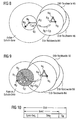
- FIG. 6 illustrates one of the major challenges that synchronization in mobile self-organizing networks represents .
- 2 clusters each with 3 stations
- 3 stations are set up which operate asynchronously because of their distance (both clusters lie outside their mutual radio range) can be.
- a reference such as GPS or the base station of a mobile radio system
- a synchronous synchronization of both clusters can not be guaranteed.
- a method which, especially in the case of 'merging' clusters, achieves a 'local' synchronization of the synchronization parameters even before there is an exchange of data between the mobiles of the different clusters.
- the solution shown applies to self-organizing radio networks with a centrally organized synchronization, but also independently.
- the data radio range should be defined as the range in which a potential receiver can 'just' guarantee a specified BER. Accordingly, the synchronization range is defined as the range in which the correct detection of the synchronization parameters, e.g. the timing, by a potential recipient with a certain probability can be guaranteed.
- the synchronization range of a station should be greater than the resulting range of the user data ("data radio range").
- the overreach of the synchronization information defines the so-called protection zone, which can advantageously be used to achieve a local synchronization of certain system parameters before the data exchange between the stations of the same cluster is significantly disturbed by the transmissions of one or more stations of the second, approaching cluster ,
- Fig. 7 illustrates the principle on the one hand an active protection zone and on the other hand a passive protection zone.
- the protection zone ensures that all stations within the data radio range receive the data sent by stations N1; in the second case that all stations within the data radio range of the stations N1 can deliver the data without an asynchronously running second cluster can lead to disturbances.
- a station N 2 lies in data radio range of N 1 .
- the interference power of a potential interferer (station N 4 ) should be lower by ⁇ D than the received power of the data packet transmitted by the station N 1 .
- the path loss between receiving station N 2 and potential interferer N 4 should accordingly be ⁇ D + ⁇ D.
- ⁇ / dB 32.44 + 20 log 10 ( r / km ) + 20 log 10 ( f C / MHz ) this results in a data range ⁇ 50 m.
- Fig. 9 shows the following:
- the passive one does not protect the data reception of a third station which is within the data reach of N 1 but rather guarantees that data transmission from stations such as N 2 , N 3 to N 1 is due to the approaching second cluster from the nodes N 4 , N 5 , N 6 is not disturbed significantly.
- ⁇ D ⁇ S ⁇ 0 dB.
- An increase in the Receiver sensitivity is not required. There remains a reserve of 7 dB.
- the achievable data ranges are well over 10 km.
- each subscriber sends his data immediately after their generation in data packets of fixed length. Since the current allocation of the radio channel is not checked before the broadcast, it can easily come to collisions with the broadcasts of other participants. Two data packets are lost if they collide, i. overlap only slightly in time.
- slotted ALOHA A significant improvement in the number of successful transmissions can be achieved in that the participants are only allowed to send at certain times.
- This modification of the pure ALOHA process is referred to as slotted ALOHA.
- slotted ALOHA the time interval in which two data packets can collide is halved compared to pure ALOHA.
- a burst transmitted within a timeslot on the slotted ALOHA could have the structure shown in FIG .
- the burst contains at least one additional sequence, which is known to both the transmitter and the receiver and can be used for both synchronization and channel estimation.
- the burst contains at least one additional sequence, which is known to both the transmitter and the receiver and can be used for both synchronization and channel estimation.
- GP guard period
- synchronization is done with spread-spectrum techniques. This can be advantageously used for the synchronization of the time slots, the presented under point 3, decentralized slot synchronization.
Landscapes
- Engineering & Computer Science (AREA)
- Computer Networks & Wireless Communication (AREA)
- Signal Processing (AREA)
- Mobile Radio Communication Systems (AREA)
- Synchronisation In Digital Transmission Systems (AREA)
- Time-Division Multiplex Systems (AREA)
- Radio Relay Systems (AREA)
- Crystals, And After-Treatments Of Crystals (AREA)
- Telephonic Communication Services (AREA)
- Small-Scale Networks (AREA)
Claims (15)
- Procédé de synchronisation dans un système de radiocommunication au moins partiellement auto-organisant comprenant un nombre de stations mobiles qui se trouvent à portée radio réciproque via une interface aérienne,
dans lequel au moins quelques stations mobiles du nombre de stations mobiles transmettent des séquences de synchronisation à l'aide desquelles une partie des stations mobiles ou toutes les stations mobiles du nombre de stations mobiles se synchronisent,
caractérisé en ce que, pour au moins l'une des stations mobiles, la portée d'une séquence de synchronisation émise est supérieure à la portée de données utiles qu'elle émet. - Procédé selon la revendication 1, caractérisé en ce que les séquences de synchronisation font partie d'un paquet de données porteur d'informations.
- Procédé selon la revendication 1, caractérisé en ce que les séquences de synchronisation sont transmises dans un propre canal de synchronisation.
- Procédé selon l'une des revendications 1 à 3, caractérisé en ce que des stations mobiles synchronisantes détectent les positions de synchronisation des autres stations mobiles et en déduisent leur propre position de synchronisation.
- Procédé selon la revendication 4, caractérisé en ce que, pour la détermination de sa propre position de synchronisation, une station mobile tient compte de la qualité des positions de synchronisation individuelles détectées et/ou de sa position de synchronisation précédente.
- Procédé selon l'une des revendications 1 à 5, caractérisé en ce que la transmission des données de synchronisation a lieu dans la même salve que celle qui porte les données utiles.
- Procédé selon l'une des revendications 1 à 5, caractérisé en ce que les données de synchronisation sont transmises via une autre salve séparée de la salve de données utiles à proprement parler.
- Procédé selon l'une des revendications 1 à 7, caractérisé en ce que les séquences de synchronisation sont transmises cycliquement ou périodiquement.
- Procédé selon l'une des revendications 1 à 8, caractérisé en ce qu'une mesure de la qualité de la référence est indiquée pour améliorer la synchronisation.
- Procédé selon l'une des revendications 1 à 9, caractérisé en ce que les données de synchronisation sont transmises via une autre salve séparée de la salve de données utiles à proprement parler.
- Procédé selon l'une des revendications 1 à 10, caractérisé en ce qu'une synchronisation pour créneaux temporels est utilisée pour une synchronisation de trames temporelles.
- Procédé selon l'une des revendications 1 à 11, caractérisé en ce que, à l'intérieur d'un créneau temporel, une seule station mobile se met en mode d'émission.
- Station mobile pour un système de radiocommunication au moins partiellement auto-organisant comprenant des moyens pour émettre des séquences de synchronisation à l'aide desquelles d'autres stations mobiles peuvent se synchroniser, caractérisée en ce que les moyens sont réalisés de manière telle que la portée d'une séquence de synchronisation émise est supérieure à la portée de données utiles émises par la station mobile.
- Station mobile selon la revendication 13, caractérisée par la présence de moyens pour recevoir des séquences de synchronisation de quelques stations mobiles d'un nombre de stations mobiles.
- Système de radiocommunication comprenant plusieurs stations mobiles selon l'une des revendications 13 ou 14.
Priority Applications (1)
| Application Number | Priority Date | Filing Date | Title |
|---|---|---|---|
| EP03809336A EP1556973B1 (fr) | 2002-10-28 | 2003-10-28 | Procede de synchronisation decentralisee dans un systeme de communication radio auto-organise |
Applications Claiming Priority (4)
| Application Number | Priority Date | Filing Date | Title |
|---|---|---|---|
| EP02257475 | 2002-10-28 | ||
| EP02257475A EP1416648A1 (fr) | 2002-10-28 | 2002-10-28 | Procédé de synchronisation décentralisée dans un système de communication radio auto-organisant |
| EP03809336A EP1556973B1 (fr) | 2002-10-28 | 2003-10-28 | Procede de synchronisation decentralisee dans un systeme de communication radio auto-organise |
| PCT/EP2003/011962 WO2004038959A1 (fr) | 2002-10-28 | 2003-10-28 | Procede de synchronisation decentralisee dans un systeme de communication radio auto-organise |
Publications (2)
| Publication Number | Publication Date |
|---|---|
| EP1556973A1 EP1556973A1 (fr) | 2005-07-27 |
| EP1556973B1 true EP1556973B1 (fr) | 2006-07-12 |
Family
ID=32088054
Family Applications (2)
| Application Number | Title | Priority Date | Filing Date |
|---|---|---|---|
| EP02257475A Withdrawn EP1416648A1 (fr) | 2002-10-28 | 2002-10-28 | Procédé de synchronisation décentralisée dans un système de communication radio auto-organisant |
| EP03809336A Expired - Lifetime EP1556973B1 (fr) | 2002-10-28 | 2003-10-28 | Procede de synchronisation decentralisee dans un systeme de communication radio auto-organise |
Family Applications Before (1)
| Application Number | Title | Priority Date | Filing Date |
|---|---|---|---|
| EP02257475A Withdrawn EP1416648A1 (fr) | 2002-10-28 | 2002-10-28 | Procédé de synchronisation décentralisée dans un système de communication radio auto-organisant |
Country Status (9)
| Country | Link |
|---|---|
| US (1) | US7400894B2 (fr) |
| EP (2) | EP1416648A1 (fr) |
| JP (2) | JP4273080B2 (fr) |
| CN (1) | CN100468992C (fr) |
| AT (1) | ATE333168T1 (fr) |
| AU (1) | AU2003276196A1 (fr) |
| DE (1) | DE50304247D1 (fr) |
| ES (1) | ES2264037T3 (fr) |
| WO (1) | WO2004038959A1 (fr) |
Families Citing this family (37)
| Publication number | Priority date | Publication date | Assignee | Title |
|---|---|---|---|---|
| GB2396275B (en) * | 2002-12-09 | 2006-03-15 | Ipwireless Inc | Support of plural chip rates in a CDMA system |
| GB2396775B (en) * | 2002-12-23 | 2005-04-13 | Motorola Inc | Method and apparatus for establishing direct communication for mobiles in a radio communication system |
| CN1622677A (zh) * | 2003-11-27 | 2005-06-01 | 皇家飞利浦电子股份有限公司 | 一种无线通信网络中支持点到点通信切换的方法 |
| JP4442338B2 (ja) * | 2004-02-06 | 2010-03-31 | ソニー株式会社 | 無線通信システム、無線通信装置及び無線通信方法、並びにコンピュータ・プログラム |
| JP4398886B2 (ja) * | 2005-03-07 | 2010-01-13 | ソニー株式会社 | 通信端末装置、通信システム、通信方法、およびプログラム |
| EP1744472B1 (fr) * | 2005-07-13 | 2012-06-13 | NTT DoCoMo, Inc. | Dispositif et Procédé de synchronisation d'un premiere dispositif d'émission et de réception à un deuxième dispositif d'émission et de réception |
| US7706432B2 (en) | 2005-08-18 | 2010-04-27 | Sony Corporation | Data transfer system, wireless communication device, wireless communication method, and computer program |
| CN100466771C (zh) * | 2006-03-31 | 2009-03-04 | 华为技术有限公司 | 一种实现集群通信的方法 |
| JP2007295031A (ja) * | 2006-04-20 | 2007-11-08 | Toyota Motor Corp | 無線通信システム |
| DE602006001584D1 (de) * | 2006-05-02 | 2008-08-07 | Ntt Docomo Inc | Vorrichtung und Verfahren zum Synchronisieren einer ersten Sende- oder Empfangseinrichtung mit einer zweiten Sende- oder Empfangseinrichtung |
| GB2439613B (en) * | 2006-06-30 | 2008-08-27 | Motorola Inc | Processor, method and terminal for use in communications |
| JP4762067B2 (ja) * | 2006-07-11 | 2011-08-31 | 富士通株式会社 | 移動体通信装置及びプログラム |
| KR101388932B1 (ko) * | 2006-07-14 | 2014-04-24 | 코닌클리케 필립스 엔.브이. | 비컨 송·수신의 방법 및 시스템 |
| JP5190233B2 (ja) * | 2006-09-01 | 2013-04-24 | パナソニック株式会社 | 無線通信装置 |
| WO2008026760A1 (fr) * | 2006-09-01 | 2008-03-06 | Panasonic Corporation | Procede et dispositif de communication radio |
| US20100039969A1 (en) * | 2006-11-16 | 2010-02-18 | Nec Corporation | Radio communication device, radio communication method, and radio communication program |
| WO2008096537A1 (fr) * | 2007-02-06 | 2008-08-14 | Panasonic Corporation | Procédé de communication radio et dispositif de communication radio |
| JP5241254B2 (ja) * | 2007-02-06 | 2013-07-17 | パナソニック株式会社 | 無線通信方法および無線通信装置 |
| WO2008115105A1 (fr) * | 2007-03-16 | 2008-09-25 | Telefonaktiebolaget Lm Ericsson (Publ) | Procédé et dispositif de réduction des interférences dans un système d'accès cellulaire. |
| TW200926660A (en) * | 2007-08-22 | 2009-06-16 | Koninkl Philips Electronics Nv | Synchronisation method |
| JP5191549B2 (ja) * | 2008-01-25 | 2013-05-08 | 株式会社オプトエレクトロニクス | 電子棚札管理システム及びそれにおける無線通信方法 |
| US9407357B1 (en) * | 2009-05-29 | 2016-08-02 | Rockwell Collins, Inc. | Systems and methods for radio node synchronization based on range calculations |
| EP2429105B1 (fr) | 2010-09-13 | 2013-03-27 | Ntt Docomo, Inc. | Noued dans un système sans fil avec synchronisation du temps et de la fréquence d'horloge et procédé correspondant |
| US9077912B2 (en) * | 2010-09-23 | 2015-07-07 | Intel Corporation | Motion initiated time synchronization |
| US8934596B2 (en) | 2010-09-28 | 2015-01-13 | Qualcomm Incorporated | Methods and apparatuses for synchronization of wireless devices in wireless networks |
| EP2482596B1 (fr) * | 2011-01-26 | 2013-09-04 | Nxp B.V. | Synchronisation de dispositifs sans fil |
| BR112013020985A2 (pt) * | 2011-02-28 | 2018-07-10 | Nec Corp | dispositivo de controle de trajetória de comunicação, dispositivo de comunicação, método de controle de trajetória de comunicação, método de comunicação, programa de um dispositivo de controle de trajetória de comunicação e programa de um dispositivo de comunicação. |
| CN103534957A (zh) * | 2011-04-06 | 2014-01-22 | 麦克斯泰通信网络有限公司 | 动态自组织点对点时分多址通信同步方法 |
| CN102348277B (zh) * | 2011-11-24 | 2014-02-12 | 电信科学技术研究院 | 一种在混合自组织网络中实现终端同步的方法及系统 |
| DE102012214912B4 (de) * | 2012-08-22 | 2015-04-23 | Deutsches Zentrum für Luft- und Raumfahrt e.V. | Verfahren zum direkten drahtlosen Datenaustausch in einem Ad-hoc Modus |
| US9137763B2 (en) * | 2012-11-16 | 2015-09-15 | Qualcomm Incorporated | Methods and apparatus for enabling distributed frequency synchronization |
| US9167544B2 (en) | 2014-01-28 | 2015-10-20 | Industrial Technology Research Institute | Device to device synchronization method applicable to user equipment and user equipment using the same |
| ES2552711B2 (es) * | 2014-05-28 | 2016-11-08 | Juan Antonio MAYOR CUESTA | Procedimiento de caracterización de trayectorias encarriladas desconocidas recorridas por un móvil, y dispositivo utilizado |
| KR102259333B1 (ko) | 2015-01-02 | 2021-06-02 | 삼성전자주식회사 | 무선통신 시스템에서 동기검출을 위한 방법 및 장치 |
| UA124479C2 (uk) * | 2020-03-06 | 2021-09-22 | Аджакс Сістемс Кіпр Холдінгс Лтд | Спосіб синхронізації датчиків охоронної системи (варіанти) |
| DE102020114097A1 (de) * | 2020-05-26 | 2021-12-02 | Bayerische Motoren Werke Aktiengesellschaft | Verfahren, Computerprogramm und Sende-Empfängermodul zum Anpassen einer Zeitsynchronisierung |
| CN111954194B (zh) * | 2020-08-12 | 2023-12-05 | 深圳市蓝信物联科技有限公司 | 基于物联网的无线智能标签刷新控制方法及装置 |
Family Cites Families (16)
| Publication number | Priority date | Publication date | Assignee | Title |
|---|---|---|---|---|
| JP2775003B2 (ja) * | 1990-09-04 | 1998-07-09 | 松下電器産業株式会社 | 移動通信システム |
| CA2111980C (fr) | 1991-07-01 | 2002-08-20 | Hakan Lans | Systeme de positionnement |
| JPH07177126A (ja) * | 1993-12-20 | 1995-07-14 | Canon Inc | 多重通信装置 |
| CA2157846A1 (fr) * | 1994-09-09 | 1996-03-10 | Ashraf Mansur Dahod | Matrice de commutation reconfigurable pour reseau local |
| SE518132C2 (sv) * | 1996-06-07 | 2002-08-27 | Ericsson Telefon Ab L M | Metod och anordning för synkronisering av kombinerade mottagare och sändare i ett cellulärt system |
| SE518224C2 (sv) * | 1997-06-24 | 2002-09-10 | Ericsson Telefon Ab L M | Sätt och system i ett cellbaserat nät |
| JPH11164352A (ja) * | 1997-11-28 | 1999-06-18 | Oki Electric Ind Co Ltd | 無線通信装置及び移動体通信システム |
| JP2000004220A (ja) * | 1998-06-15 | 2000-01-07 | Oki Electric Ind Co Ltd | 移動通信方法 |
| JP2000253446A (ja) * | 1999-03-04 | 2000-09-14 | Matsushita Electric Ind Co Ltd | 基地局装置及びフレーム同期取得方法 |
| IT1313125B1 (it) * | 1999-08-27 | 2002-06-17 | Italtel Spa | Procedimento e sistema per sincronizzare tra loro le unita' mobili ele stazioni radio base nelle reti di telecomunicazione digitale |
| US6785510B2 (en) * | 2000-03-09 | 2004-08-31 | Salbu Resarch & Development (Proprietary) Limited | Routing in a multi-station network |
| WO2001099330A1 (fr) * | 2000-06-19 | 2001-12-27 | Ip2H Ag | Procede de synchronisation du mode d'emission et de reception d'emetteurs et de recepteurs dans un reseau de telecommunication destine a la mise en oeuvre de ce procede |
| WO2002017511A2 (fr) * | 2000-08-21 | 2002-02-28 | Koninklijke Philips Electronics N.V. | Procede de transmission d'informations et appareil faisant appel audit procede |
| EP1317814A1 (fr) * | 2000-09-12 | 2003-06-11 | Kvaser Consultant Ab | Agencement avec un nombre d'unites pouvant communiquer entre elles via un systeme de connexion sans fil et procede de mise en oeuvre avec un tel systeme |
| US7190961B2 (en) * | 2001-10-18 | 2007-03-13 | Intel Corporation | Method for discovery and routing within mobile ad-hoc networks |
| DE50214289D1 (de) * | 2001-02-14 | 2010-04-29 | Nokia Siemens Networks Gmbh | Verfahren und kommunikationsvorrichtung zum synchronisieren von stationen in einem funk-kommunikationssystem |
-
2002
- 2002-10-28 EP EP02257475A patent/EP1416648A1/fr not_active Withdrawn
-
2003
- 2003-10-28 US US10/532,989 patent/US7400894B2/en not_active Expired - Lifetime
- 2003-10-28 AU AU2003276196A patent/AU2003276196A1/en not_active Abandoned
- 2003-10-28 ES ES03809336T patent/ES2264037T3/es not_active Expired - Lifetime
- 2003-10-28 JP JP2004546020A patent/JP4273080B2/ja not_active Expired - Fee Related
- 2003-10-28 AT AT03809336T patent/ATE333168T1/de not_active IP Right Cessation
- 2003-10-28 CN CNB2003801022402A patent/CN100468992C/zh not_active Expired - Fee Related
- 2003-10-28 DE DE50304247T patent/DE50304247D1/de not_active Expired - Lifetime
- 2003-10-28 WO PCT/EP2003/011962 patent/WO2004038959A1/fr not_active Ceased
- 2003-10-28 EP EP03809336A patent/EP1556973B1/fr not_active Expired - Lifetime
-
2008
- 2008-12-25 JP JP2008330809A patent/JP2009118505A/ja active Pending
Also Published As
| Publication number | Publication date |
|---|---|
| JP2009118505A (ja) | 2009-05-28 |
| EP1416648A1 (fr) | 2004-05-06 |
| US7400894B2 (en) | 2008-07-15 |
| EP1556973A1 (fr) | 2005-07-27 |
| ATE333168T1 (de) | 2006-08-15 |
| CN100468992C (zh) | 2009-03-11 |
| JP2006504307A (ja) | 2006-02-02 |
| US20060030343A1 (en) | 2006-02-09 |
| ES2264037T3 (es) | 2006-12-16 |
| AU2003276196A1 (en) | 2004-05-13 |
| WO2004038959A1 (fr) | 2004-05-06 |
| JP4273080B2 (ja) | 2009-06-03 |
| DE50304247D1 (de) | 2006-08-24 |
| CN1708925A (zh) | 2005-12-14 |
Similar Documents
| Publication | Publication Date | Title |
|---|---|---|
| EP1556973B1 (fr) | Procede de synchronisation decentralisee dans un systeme de communication radio auto-organise | |
| DE69910728T2 (de) | Verfahren zur Synchronisierung von Basisstationen in einem drahtlosen Kommunikationsnetzwerk | |
| DE69228676T2 (de) | Zellulares funksystem mit gemeinsamen funkhauptnetz | |
| DE69602078T2 (de) | Kommunikationssystem und verfahren dafür | |
| DE69624628T2 (de) | Direkt-modus-relaisstation in einem mobilfunksystem | |
| DE69926297T2 (de) | Verfahren zum Weiterreichen zwischen zwei Relays einer Zelle eines digitalen zellularen Funkkommunikationssystems mittels eines gemeinsamen Übergangskanals. | |
| DE69622847T2 (de) | Empfang in mobilen endgeräten durch einen kanal in direkter betriebsweise | |
| DE69727291T2 (de) | Dynamische kanalzuteilung | |
| DE69328809T2 (de) | Verfahren um zusammen mit einen Befehl zum Wechsel der Basisstation in einem zellularen System ein Laufzeitkorrektursignal an eine Mobilstation auszusenden | |
| EP1530855B1 (fr) | Procede d'attribution de ressources radio dans un systeme de communication radio auto-organise | |
| EP1118175B1 (fr) | Procede pour faire fonctionner sans perturbation au moins deux stations de base | |
| EP1743455B1 (fr) | Procede de transmission de signal dans un systeme de communication radio | |
| EP1393473B1 (fr) | Procede permettant de synchroniser des stations de base dans un systeme de radiocommunication | |
| EP1652321B1 (fr) | Procede de synchronisation d'un systeme de radiocommunication reparti en cellules radio, ainsi que station de base et station mobile dans un systeme de ce type | |
| DE10145759B4 (de) | Verfahren und Funk-Kommunikationssystem zur Datenübertragung | |
| WO1999055108A1 (fr) | Procede et station de base pour le transfert d'informations dans un systeme de radiocommunications | |
| WO2004075437A1 (fr) | Procede pour transmettre des signaux dans un systeme de communication radio | |
| EP1226666B1 (fr) | Procede de synchronisation d'une transmission de signal ascendente dans un systeme de communication radio | |
| WO2004021607A1 (fr) | Procede de commande de transmission dans un systeme de communication radio | |
| EP1382136B1 (fr) | Procede et dispositif de communication pour la synchronisation de stations dans un systeme de communication radio | |
| EP1027815A2 (fr) | Systeme de communication radio et dispositif de commande | |
| DE10334431B4 (de) | Verfahren zur Zeitsynchronisation von Mobilstationen in einem selbstorganisierenden Funkkommunikationssystem | |
| WO2008055774A1 (fr) | Réacheminement d'informations utiles et de contrôle lors d'un transfert continu | |
| EP1173996A1 (fr) | Rach pour grosses cellules | |
| WO2005004377A1 (fr) | Procede de transmission de paquets de donnees dans un systeme de radiotelecommunication |
Legal Events
| Date | Code | Title | Description |
|---|---|---|---|
| PUAI | Public reference made under article 153(3) epc to a published international application that has entered the european phase |
Free format text: ORIGINAL CODE: 0009012 |
|
| 17P | Request for examination filed |
Effective date: 20050322 |
|
| AK | Designated contracting states |
Kind code of ref document: A1 Designated state(s): AT BE BG CH CY CZ DE DK EE ES FI FR GB GR HU IE IT LI LU MC NL PT RO SE SI SK TR |
|
| AX | Request for extension of the european patent |
Extension state: AL LT LV MK |
|
| GRAP | Despatch of communication of intention to grant a patent |
Free format text: ORIGINAL CODE: EPIDOSNIGR1 |
|
| DAX | Request for extension of the european patent (deleted) | ||
| GRAS | Grant fee paid |
Free format text: ORIGINAL CODE: EPIDOSNIGR3 |
|
| GRAA | (expected) grant |
Free format text: ORIGINAL CODE: 0009210 |
|
| AK | Designated contracting states |
Kind code of ref document: B1 Designated state(s): AT BE BG CH CY CZ DE DK EE ES FI FR GB GR HU IE IT LI LU MC NL PT RO SE SI SK TR |
|
| PG25 | Lapsed in a contracting state [announced via postgrant information from national office to epo] |
Ref country code: IT Free format text: LAPSE BECAUSE OF FAILURE TO SUBMIT A TRANSLATION OF THE DESCRIPTION OR TO PAY THE FEE WITHIN THE PRESCRIBED TIME-LIMIT;WARNING: LAPSES OF ITALIAN PATENTS WITH EFFECTIVE DATE BEFORE 2007 MAY HAVE OCCURRED AT ANY TIME BEFORE 2007. THE CORRECT EFFECTIVE DATE MAY BE DIFFERENT FROM THE ONE RECORDED. Effective date: 20060712 Ref country code: IE Free format text: LAPSE BECAUSE OF FAILURE TO SUBMIT A TRANSLATION OF THE DESCRIPTION OR TO PAY THE FEE WITHIN THE PRESCRIBED TIME-LIMIT Effective date: 20060712 Ref country code: CZ Free format text: LAPSE BECAUSE OF FAILURE TO SUBMIT A TRANSLATION OF THE DESCRIPTION OR TO PAY THE FEE WITHIN THE PRESCRIBED TIME-LIMIT Effective date: 20060712 Ref country code: SK Free format text: LAPSE BECAUSE OF FAILURE TO SUBMIT A TRANSLATION OF THE DESCRIPTION OR TO PAY THE FEE WITHIN THE PRESCRIBED TIME-LIMIT Effective date: 20060712 Ref country code: SI Free format text: LAPSE BECAUSE OF FAILURE TO SUBMIT A TRANSLATION OF THE DESCRIPTION OR TO PAY THE FEE WITHIN THE PRESCRIBED TIME-LIMIT Effective date: 20060712 Ref country code: RO Free format text: LAPSE BECAUSE OF FAILURE TO SUBMIT A TRANSLATION OF THE DESCRIPTION OR TO PAY THE FEE WITHIN THE PRESCRIBED TIME-LIMIT Effective date: 20060712 Ref country code: NL Free format text: LAPSE BECAUSE OF FAILURE TO SUBMIT A TRANSLATION OF THE DESCRIPTION OR TO PAY THE FEE WITHIN THE PRESCRIBED TIME-LIMIT Effective date: 20060712 Ref country code: FI Free format text: LAPSE BECAUSE OF FAILURE TO SUBMIT A TRANSLATION OF THE DESCRIPTION OR TO PAY THE FEE WITHIN THE PRESCRIBED TIME-LIMIT Effective date: 20060712 |
|
| REG | Reference to a national code |
Ref country code: GB Ref legal event code: FG4D Free format text: NOT ENGLISH |
|
| REG | Reference to a national code |
Ref country code: CH Ref legal event code: EP |
|
| GBT | Gb: translation of ep patent filed (gb section 77(6)(a)/1977) |
Effective date: 20060802 |
|
| REG | Reference to a national code |
Ref country code: IE Ref legal event code: FG4D Free format text: LANGUAGE OF EP DOCUMENT: GERMAN |
|
| REF | Corresponds to: |
Ref document number: 50304247 Country of ref document: DE Date of ref document: 20060824 Kind code of ref document: P |
|
| PG25 | Lapsed in a contracting state [announced via postgrant information from national office to epo] |
Ref country code: DK Free format text: LAPSE BECAUSE OF FAILURE TO SUBMIT A TRANSLATION OF THE DESCRIPTION OR TO PAY THE FEE WITHIN THE PRESCRIBED TIME-LIMIT Effective date: 20061012 Ref country code: BG Free format text: LAPSE BECAUSE OF FAILURE TO SUBMIT A TRANSLATION OF THE DESCRIPTION OR TO PAY THE FEE WITHIN THE PRESCRIBED TIME-LIMIT Effective date: 20061012 Ref country code: SE Free format text: LAPSE BECAUSE OF FAILURE TO SUBMIT A TRANSLATION OF THE DESCRIPTION OR TO PAY THE FEE WITHIN THE PRESCRIBED TIME-LIMIT Effective date: 20061012 |
|
| PG25 | Lapsed in a contracting state [announced via postgrant information from national office to epo] |
Ref country code: MC Free format text: LAPSE BECAUSE OF NON-PAYMENT OF DUE FEES Effective date: 20061031 |
|
| PG25 | Lapsed in a contracting state [announced via postgrant information from national office to epo] |
Ref country code: PT Free format text: LAPSE BECAUSE OF FAILURE TO SUBMIT A TRANSLATION OF THE DESCRIPTION OR TO PAY THE FEE WITHIN THE PRESCRIBED TIME-LIMIT Effective date: 20061212 |
|
| ET | Fr: translation filed | ||
| REG | Reference to a national code |
Ref country code: ES Ref legal event code: FG2A Ref document number: 2264037 Country of ref document: ES Kind code of ref document: T3 |
|
| NLV1 | Nl: lapsed or annulled due to failure to fulfill the requirements of art. 29p and 29m of the patents act | ||
| REG | Reference to a national code |
Ref country code: IE Ref legal event code: FD4D |
|
| PLBE | No opposition filed within time limit |
Free format text: ORIGINAL CODE: 0009261 |
|
| STAA | Information on the status of an ep patent application or granted ep patent |
Free format text: STATUS: NO OPPOSITION FILED WITHIN TIME LIMIT |
|
| 26N | No opposition filed |
Effective date: 20070413 |
|
| BERE | Be: lapsed |
Owner name: SIEMENS A.G. Effective date: 20061031 |
|
| PG25 | Lapsed in a contracting state [announced via postgrant information from national office to epo] |
Ref country code: AT Free format text: LAPSE BECAUSE OF NON-PAYMENT OF DUE FEES Effective date: 20061028 |
|
| PG25 | Lapsed in a contracting state [announced via postgrant information from national office to epo] |
Ref country code: GR Free format text: LAPSE BECAUSE OF FAILURE TO SUBMIT A TRANSLATION OF THE DESCRIPTION OR TO PAY THE FEE WITHIN THE PRESCRIBED TIME-LIMIT Effective date: 20061013 |
|
| REG | Reference to a national code |
Ref country code: CH Ref legal event code: PL |
|
| PG25 | Lapsed in a contracting state [announced via postgrant information from national office to epo] |
Ref country code: EE Free format text: LAPSE BECAUSE OF FAILURE TO SUBMIT A TRANSLATION OF THE DESCRIPTION OR TO PAY THE FEE WITHIN THE PRESCRIBED TIME-LIMIT Effective date: 20060712 |
|
| PG25 | Lapsed in a contracting state [announced via postgrant information from national office to epo] |
Ref country code: LU Free format text: LAPSE BECAUSE OF NON-PAYMENT OF DUE FEES Effective date: 20061028 Ref country code: CH Free format text: LAPSE BECAUSE OF NON-PAYMENT OF DUE FEES Effective date: 20071031 Ref country code: HU Free format text: LAPSE BECAUSE OF FAILURE TO SUBMIT A TRANSLATION OF THE DESCRIPTION OR TO PAY THE FEE WITHIN THE PRESCRIBED TIME-LIMIT Effective date: 20070113 Ref country code: TR Free format text: LAPSE BECAUSE OF FAILURE TO SUBMIT A TRANSLATION OF THE DESCRIPTION OR TO PAY THE FEE WITHIN THE PRESCRIBED TIME-LIMIT Effective date: 20060712 Ref country code: LI Free format text: LAPSE BECAUSE OF NON-PAYMENT OF DUE FEES Effective date: 20071031 |
|
| PG25 | Lapsed in a contracting state [announced via postgrant information from national office to epo] |
Ref country code: CY Free format text: LAPSE BECAUSE OF FAILURE TO SUBMIT A TRANSLATION OF THE DESCRIPTION OR TO PAY THE FEE WITHIN THE PRESCRIBED TIME-LIMIT Effective date: 20060712 |
|
| PG25 | Lapsed in a contracting state [announced via postgrant information from national office to epo] |
Ref country code: BE Free format text: LAPSE BECAUSE OF FAILURE TO SUBMIT A TRANSLATION OF THE DESCRIPTION OR TO PAY THE FEE WITHIN THE PRESCRIBED TIME-LIMIT Effective date: 20061031 |
|
| REG | Reference to a national code |
Ref country code: FR Ref legal event code: PLFP Year of fee payment: 13 |
|
| REG | Reference to a national code |
Ref country code: FR Ref legal event code: PLFP Year of fee payment: 14 |
|
| REG | Reference to a national code |
Ref country code: FR Ref legal event code: PLFP Year of fee payment: 15 |
|
| REG | Reference to a national code |
Ref country code: FR Ref legal event code: PLFP Year of fee payment: 16 |
|
| PGFP | Annual fee paid to national office [announced via postgrant information from national office to epo] |
Ref country code: FR Payment date: 20191017 Year of fee payment: 17 Ref country code: IT Payment date: 20191029 Year of fee payment: 17 |
|
| PGFP | Annual fee paid to national office [announced via postgrant information from national office to epo] |
Ref country code: GB Payment date: 20191002 Year of fee payment: 17 Ref country code: DE Payment date: 20191219 Year of fee payment: 17 Ref country code: ES Payment date: 20200127 Year of fee payment: 17 |
|
| REG | Reference to a national code |
Ref country code: DE Ref legal event code: R119 Ref document number: 50304247 Country of ref document: DE |
|
| GBPC | Gb: european patent ceased through non-payment of renewal fee |
Effective date: 20201028 |
|
| PG25 | Lapsed in a contracting state [announced via postgrant information from national office to epo] |
Ref country code: DE Free format text: LAPSE BECAUSE OF NON-PAYMENT OF DUE FEES Effective date: 20210501 Ref country code: FR Free format text: LAPSE BECAUSE OF NON-PAYMENT OF DUE FEES Effective date: 20201031 |
|
| PG25 | Lapsed in a contracting state [announced via postgrant information from national office to epo] |
Ref country code: GB Free format text: LAPSE BECAUSE OF NON-PAYMENT OF DUE FEES Effective date: 20201028 |
|
| PG25 | Lapsed in a contracting state [announced via postgrant information from national office to epo] |
Ref country code: IT Free format text: LAPSE BECAUSE OF NON-PAYMENT OF DUE FEES Effective date: 20201028 |
|
| REG | Reference to a national code |
Ref country code: ES Ref legal event code: FD2A Effective date: 20220128 |
|
| PG25 | Lapsed in a contracting state [announced via postgrant information from national office to epo] |
Ref country code: ES Free format text: LAPSE BECAUSE OF NON-PAYMENT OF DUE FEES Effective date: 20201029 |