EP1557323A1 - Système pour l'évaluation de comportement de véhicule et un système de protection d'un occupant d'un véhicule - Google Patents
Système pour l'évaluation de comportement de véhicule et un système de protection d'un occupant d'un véhicule Download PDFInfo
- Publication number
- EP1557323A1 EP1557323A1 EP05001207A EP05001207A EP1557323A1 EP 1557323 A1 EP1557323 A1 EP 1557323A1 EP 05001207 A EP05001207 A EP 05001207A EP 05001207 A EP05001207 A EP 05001207A EP 1557323 A1 EP1557323 A1 EP 1557323A1
- Authority
- EP
- European Patent Office
- Prior art keywords
- vehicle
- angular velocity
- rolling
- rolling angular
- judgment
- Prior art date
- Legal status (The legal status is an assumption and is not a legal conclusion. Google has not performed a legal analysis and makes no representation as to the accuracy of the status listed.)
- Granted
Links
- 238000005096 rolling process Methods 0.000 claims abstract description 172
- 230000000694 effects Effects 0.000 claims description 8
- 230000008859 change Effects 0.000 description 14
- 230000001133 acceleration Effects 0.000 description 3
- 230000007306 turnover Effects 0.000 description 3
- 244000145845 chattering Species 0.000 description 2
- 238000001514 detection method Methods 0.000 description 2
- 238000010586 diagram Methods 0.000 description 2
- 238000005070 sampling Methods 0.000 description 2
- 238000006243 chemical reaction Methods 0.000 description 1
- 238000007796 conventional method Methods 0.000 description 1
- 230000010354 integration Effects 0.000 description 1
- 238000000034 method Methods 0.000 description 1
- 238000012986 modification Methods 0.000 description 1
- 230000004048 modification Effects 0.000 description 1
- 238000011022 operating instruction Methods 0.000 description 1
- 230000004044 response Effects 0.000 description 1
Images


Classifications
-
- B—PERFORMING OPERATIONS; TRANSPORTING
- B60—VEHICLES IN GENERAL
- B60R—VEHICLES, VEHICLE FITTINGS, OR VEHICLE PARTS, NOT OTHERWISE PROVIDED FOR
- B60R21/00—Arrangements or fittings on vehicles for protecting or preventing injuries to occupants or pedestrians in case of accidents or other traffic risks
- B60R21/01—Electrical circuits for triggering passive safety arrangements, e.g. airbags, safety belt tighteners, in case of vehicle accidents or impending vehicle accidents
- B60R21/013—Electrical circuits for triggering passive safety arrangements, e.g. airbags, safety belt tighteners, in case of vehicle accidents or impending vehicle accidents including means for detecting collisions, impending collisions or roll-over
- B60R21/0132—Electrical circuits for triggering passive safety arrangements, e.g. airbags, safety belt tighteners, in case of vehicle accidents or impending vehicle accidents including means for detecting collisions, impending collisions or roll-over responsive to vehicle motion parameters, e.g. to vehicle longitudinal or transversal deceleration or speed value
- B60R21/01332—Electrical circuits for triggering passive safety arrangements, e.g. airbags, safety belt tighteners, in case of vehicle accidents or impending vehicle accidents including means for detecting collisions, impending collisions or roll-over responsive to vehicle motion parameters, e.g. to vehicle longitudinal or transversal deceleration or speed value by frequency or waveform analysis
- B60R21/01336—Electrical circuits for triggering passive safety arrangements, e.g. airbags, safety belt tighteners, in case of vehicle accidents or impending vehicle accidents including means for detecting collisions, impending collisions or roll-over responsive to vehicle motion parameters, e.g. to vehicle longitudinal or transversal deceleration or speed value by frequency or waveform analysis using filtering
-
- B—PERFORMING OPERATIONS; TRANSPORTING
- B60—VEHICLES IN GENERAL
- B60R—VEHICLES, VEHICLE FITTINGS, OR VEHICLE PARTS, NOT OTHERWISE PROVIDED FOR
- B60R21/00—Arrangements or fittings on vehicles for protecting or preventing injuries to occupants or pedestrians in case of accidents or other traffic risks
- B60R21/01—Electrical circuits for triggering passive safety arrangements, e.g. airbags, safety belt tighteners, in case of vehicle accidents or impending vehicle accidents
- B60R21/013—Electrical circuits for triggering passive safety arrangements, e.g. airbags, safety belt tighteners, in case of vehicle accidents or impending vehicle accidents including means for detecting collisions, impending collisions or roll-over
- B60R21/0132—Electrical circuits for triggering passive safety arrangements, e.g. airbags, safety belt tighteners, in case of vehicle accidents or impending vehicle accidents including means for detecting collisions, impending collisions or roll-over responsive to vehicle motion parameters, e.g. to vehicle longitudinal or transversal deceleration or speed value
-
- B—PERFORMING OPERATIONS; TRANSPORTING
- B60—VEHICLES IN GENERAL
- B60R—VEHICLES, VEHICLE FITTINGS, OR VEHICLE PARTS, NOT OTHERWISE PROVIDED FOR
- B60R21/00—Arrangements or fittings on vehicles for protecting or preventing injuries to occupants or pedestrians in case of accidents or other traffic risks
- B60R2021/0002—Type of accident
- B60R2021/0018—Roll-over
-
- B—PERFORMING OPERATIONS; TRANSPORTING
- B60—VEHICLES IN GENERAL
- B60R—VEHICLES, VEHICLE FITTINGS, OR VEHICLE PARTS, NOT OTHERWISE PROVIDED FOR
- B60R21/00—Arrangements or fittings on vehicles for protecting or preventing injuries to occupants or pedestrians in case of accidents or other traffic risks
- B60R21/01—Electrical circuits for triggering passive safety arrangements, e.g. airbags, safety belt tighteners, in case of vehicle accidents or impending vehicle accidents
- B60R2021/01122—Prevention of malfunction
- B60R2021/01129—Problems or faults
- B60R2021/0117—Noise
-
- B—PERFORMING OPERATIONS; TRANSPORTING
- B60—VEHICLES IN GENERAL
- B60R—VEHICLES, VEHICLE FITTINGS, OR VEHICLE PARTS, NOT OTHERWISE PROVIDED FOR
- B60R21/00—Arrangements or fittings on vehicles for protecting or preventing injuries to occupants or pedestrians in case of accidents or other traffic risks
- B60R21/01—Electrical circuits for triggering passive safety arrangements, e.g. airbags, safety belt tighteners, in case of vehicle accidents or impending vehicle accidents
- B60R21/013—Electrical circuits for triggering passive safety arrangements, e.g. airbags, safety belt tighteners, in case of vehicle accidents or impending vehicle accidents including means for detecting collisions, impending collisions or roll-over
- B60R2021/01306—Electrical circuits for triggering passive safety arrangements, e.g. airbags, safety belt tighteners, in case of vehicle accidents or impending vehicle accidents including means for detecting collisions, impending collisions or roll-over monitoring vehicle inclination
-
- B—PERFORMING OPERATIONS; TRANSPORTING
- B60—VEHICLES IN GENERAL
- B60R—VEHICLES, VEHICLE FITTINGS, OR VEHICLE PARTS, NOT OTHERWISE PROVIDED FOR
- B60R21/00—Arrangements or fittings on vehicles for protecting or preventing injuries to occupants or pedestrians in case of accidents or other traffic risks
- B60R21/01—Electrical circuits for triggering passive safety arrangements, e.g. airbags, safety belt tighteners, in case of vehicle accidents or impending vehicle accidents
- B60R21/013—Electrical circuits for triggering passive safety arrangements, e.g. airbags, safety belt tighteners, in case of vehicle accidents or impending vehicle accidents including means for detecting collisions, impending collisions or roll-over
- B60R21/0132—Electrical circuits for triggering passive safety arrangements, e.g. airbags, safety belt tighteners, in case of vehicle accidents or impending vehicle accidents including means for detecting collisions, impending collisions or roll-over responsive to vehicle motion parameters, e.g. to vehicle longitudinal or transversal deceleration or speed value
- B60R2021/01327—Angular velocity or angular acceleration
Definitions
- the present invention relates to a vehicle behavior judgment system and a vehicle occupant-protecting system using such a vehicle behavior judgment system. More particularly, the invention relates to improved rollover judgment based on at least the rolling angular velocity.
- the occupant-protecting system for the vehicle judges whether the vehicle rolls over or not, based on two-dimensional values defined by a rolling angle and a rolling angular velocity (rolling rate), and controls the operation of the occupant-protecting device based on this judgment result as to "rollover".
- the rolling angular velocity ⁇ is mainly detected by a rolling angular velocity sensor (rolling angular velocity detector).
- the sensor may output a signal in which a noise component N is superposed upon a normal signal S representing an actual rolling angular velocity w, when the sensor receives influences of high-frequency noise generated from a variety of devices such as an ignition plug of an engine mounted on the vehicle.
- the rolling angular velocity containing such a noise component N exhibits a value instantaneously projecting.
- the present invention has been accomplished in view of the above circumstance, and is to provide a vehicle behavior judgment system capable of effecting accurate judgment as to "rollover” and a vehicle occupant-protecting system capable of operating such an occupant-protecting system even if the detected rolling angular velocity exhibits the above instantaneously projecting value under the influence of the noise.
- a first vehicle behavior judgment system comprises a rolling angular velocity detector adapted for detecting a rolling angular velocity of a vehicle, and a rollover judgment device adapted for judging, based on at least a rolling angular velocity of a vehicle, whether the vehicle rolls over or not, and a noise-cutting filter adapted for removing a noise component from the rolling angular velocity.
- the wording "based on at least a rolling angular velocity of a vehicle” means that the judgment may be “based on a rolling angular velocity alone” or “based on combination of a rolling angular velocity of a vehicle and other physical amount(s) (for example, rolling angle of the vehicle, etc.). This is applicable to other aspects of the present invention.
- the noise component is a signal component, for example, which corresponds to a behavior never occurring in the actual vehicle, and such a noise component may be preliminarily empirically determined.
- a second vehicle behavior judgment system comprises a rolling angular velocity detector adapted for detecting a rolling angular velocity of a vehicle, and a rollover judgment device adapted for judging, based on at least the rolling angular velocity of the vehicle detected by the rolling angular velocity detector, whether the vehicle rolls over or not, wherein if a difference between a newest rolling angular velocity and a just previous rolling angular velocity as viewed in a time series exceeds a preset threshold value with respect to the rolling angular velocities detected by the detector, the rollover judgment device replaces the newest rolling angular velocity by the just previous one and then effects judgment as to "rollover" of the vehicle by using the just previous rolling angular velocity instead of the newest one.
- the preset threshold value has only to be a value which corresponds to a behavior never occurring in the actual vehicle, and such a threshold value may be appropriately 50 deg./sec. (10 x 10 3 deg./sec.2 as converted in terms of the angular velocity), for example, when the given time interval is 5 msec.
- a first vehicle occupant-protecting system comprises the first or second vehicle behavior judgment system as mentioned above, and an occupant-protecting device which protects the occupant through operating corresponding to a judgment result as to "rollover" obtained by the vehicle behavior judgment system.
- a second vehicle occupant-protecting system comprises the first or second vehicle behavior judgment system as mentioned above, an inclination sensor adapted to detect whether the vehicle is inclined beyond a given inclination angle in a width direction of the vehicle or not, and an occupant-protecting device adapted for protecting the occupant through operating corresponding upon a judgment result as to "rollover” obtained by the vehicle behavior judgment system and a judgment result as to "inclination” obtained by the inclination sensor.
- the occupant-protecting device is intended to mean a variety of occupant-protecting devices operating for the purpose of protecting the occupant at the time of rollover of the vehicle, such as an airbag system commencing with a curtain airbag, a seat belt pretensioner device, an active rollover protection device and the like.
- the passage "operating corresponding upon a judgment result as to rollover" means, for example, (1): (a) a rolling operation by which the slacked seat belt is instantaneously rolled up and removed, or (b) a rollup rate during the rolling up operation is varied or (c) no rolling-up operation is effected, when the occupant-protecting device is the seat belt pretensioner device and (2) : (a) an inflating operation by which the airbag is inflated, or (b) an inflating rate of the airbag is varied during the inflating operation or (c) no inflating operation is effected, when the occupant-protecting device is the airbag system.
- the noise-cutting filter removes any noise component corresponding to that behavior which would never occur in the actual vehicle, that is, a signal component such as an instantaneously projected value, from the rolling angular velocity signal detected by the rolling angular velocity detector, whether "rollover" occurred or not can be judged by using the rolling angular velocity from which such a noise component is removed.
- a signal component such as an instantaneously projected value
- accuracy in the judgment of "rollover” can be also enhanced for the following reasons. That is, if a difference between the newest rolling angular velocity and the just previous rolling angular velocity exceeds a given threshold corresponding to a vehicle behavior never occurring in the actual vehicle with respect to the rolling angular velocities determined every given time interval, that newest rolling angular velocity is a reliability-low value.
- the rollover judgment device replaces that newest rolling angular velocity by the just previous rolling angular velocity as viewed in the time series, and judges, based on the just previous rolling angular velocity replacing the newest one or based on this just previous rolling angular velocity and other physical amount(s) (for example, a rolling angle), whether the vehicle rolls over or not.
- the accuracy in the judgment as to "rollover" can be enhanced.
- the occupant-protecting device since the occupant-protecting device effects the occupant-protecting operation based on the "rollover" judgment result having judgment accuracy enhanced with the vehicle behavior judgment system, accuracy in effecting the protecting operation can be enhanced.
- the occupant-protecting device since the occupant-protecting device also effects the occupant-protecting operation based on the "rollover" judgment result having judgment accuracy enhanced with the vehicle behavior judgment system, accuracy in effecting the protecting operation can be enhanced.
- the judgment accuracy can be further enhanced.
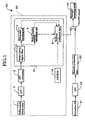
- the occupant-protecting system 50 comprises a vehicle behavior judgment system 20 of the present invention as a part thereof.
- This vehicle behavior judgment system 20 which is mounted on a vehicle not shown, comprises a rolling angular velocity sensor 1 (rolling angular velocity detector) for detecting a signal corresponding to a rolling angular velocity ⁇ (i) of the vehicle, a rolling angle calculator 4 for calculating a rolling angle ⁇ (i) based on the signal detected with the rolling angular velocity sensor 1, a rolling angular velocity calculator 6 for calculating a rolling angular velocity ⁇ (i) by removing a noise component from the signal detected by the rolling angular velocity sensor 1, and a rollover judgment unit 8 for judging whether the vehicle rolls or not, based on the rolling angle ⁇ (i) and the rolling angular velocity ⁇ (i).
- a rolling angular velocity sensor 1 rolling angular velocity detector
- a rolling angle calculator 4 for calculating a rolling angle ⁇ (i) based on the signal detected with the rolling ang
- the rolling angle calculator 4, the rolling angular velocity calculator 6 and the rollover judging unit 8 are built in a microcomputer 9.
- the rolling judgment system 20 further comprises a low pass filter (hereinafter referred to as LPF) 2 for removing high frequency noise from a signal detected with the rolling angular velocity sensor 1 and an A/D converter 3 for effecting digital conversion of an analogue output passing the LPF 2 according to a given sampling cycle of 5 msec, for example.
- LPF low pass filter
- A/D converter 3 for effecting digital conversion of an analogue output passing the LPF 2 according to a given sampling cycle of 5 msec, for example.
- the rolling angle-calculating unit 4 calculates a rolling angle ⁇ (i) based on the digital output value from the A/D converter 3.
- control unit 9 comprises a noise-cutting digital filter 5 for cutting noises from the digital output values from the A/D converter.
- the rolling angle-calculating unit 4 calculates a noise-removed rolling angle ⁇ (i) based on the output of the noise cut digital filter 5.
- the rolling angular velocity-calculating unit 6 calculates a noise-removed rolling angular velocity ⁇ (i) based on the output from the noise-cutting digital filter 5.
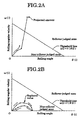
- the rollover judgment unit 8 judges that the vehicle is rolling if a two-dimensional point (coordinate point) defined by the rolling angle ⁇ (i) and the rolling angular velocity ⁇ (i) actually obtained is located above the threshold line (judgment of "rolling over"), whereas it judges that the vehicle is not rolled over if the two-dimensional value (coordinate point) is located under the threshold line (judgment of "not rolled over").
- the rollover judgment unit 8 replaces a newest calculated rolling angular velocity ⁇ (i) by that ⁇ (i-1) calculated just one before as viewed in a time series, and thereafter judges whether the vehicle is rolling or not, based on the rolling angle ⁇ (i) and the rolling angular velocity ⁇ (i -1) having replaced the newest one.
- the threshold value ⁇ 0 is a value never indicated in a "normal vehicle rollover behavior".
- the occupant-protecting system 50 comprises an occupant-protecting device 40, which is adapted to protect an occupant upon operation in response to a rollover judgment result obtained with the vehicle behavior judgment system 20.
- the vehicle is equipped with an air bag system including a curtain air bag and/or a seat belt pretensioner device.
- the occupant-protecting system 50 comprises an inclination SW 31 (inclination sensor) for detecting whether the vehicle inclines at a given angle in a width direction of the vehicle or not, an LPF 32 for preventing chattering with an output from the inclination SW 31, a binarily processing unit 33 for binarily converting outputs from the LPF 32 into binary inclination ON signals and inclination OFF signals and outputting the inclination ON signals only, and an AND ciruict 34 for outputting operating instruction signals to the occupant-protecting device 40 under an AND condition (the inclination ON signals and the rollover judgment) only between the outputs of the binarily processing unit 33 and the rollover judgment result of the vehicle behavior judgment system 20.
- an inclination SW 31 inclination sensor
- LPF 32 for preventing chattering with an output from the inclination SW 31
- a binarily processing unit 33 for binarily converting outputs from the LPF 32 into binary inclination ON signals and inclination OFF signals and outputting the
- the rolling angular velocity sensor 1 continuously detects signals S corresponding to rolling angular velocities ⁇ (i) of the vehicle (#1), and the detected signals S are inputted into the LPF 2, which output signals to the A/D converter 3 after cutting high-frequency noises in an analogue signal zone from the inputted signals S.
- the A/D converter 3 converts the inputted signals S to digital signals D every sampling interval such as 5 (msec.), and the noise-cutting digital filter 5 of the microcomputer 9 removes noise components in a digital signal region from digital signals D outputted from the A/D converter 3, and the rolling angular velocity calculator 6 calculates rolling angular velocities ⁇ (i) every time interval of 5 (msec.) based on the noise-removed digital signals D (#2).
- the rollover judgment unit 8 judges that the vehicle behavior is a vehicle behavior never normally occurring. That is, the rollover judgment unit 8 judges that the signal S detected by the rolling angular velocity sensor 1 is a reliability-low signal due to influence of noise. Thus, the rollover judgment unit 8 replaces the newest rolling angular velocity ⁇ (i) by the just previous rolling angular velocity ⁇ (i -1) as viewed in the time series (#4). On the other hand, if the calculated change amount ⁇ with lapse of the rolling angular velocity ⁇ is not greater than the threshold value ⁇ 0, the above replacement (#4) is not carried out.
- the rolling angle calculating unit 4 is controlled so that the rolling angle ⁇ (i) may be calculated based on the replacing rolling angular velocity ⁇ (i -1).
- the rolling angle calculator 4 calculates the rolling angle ⁇ (i) based on the just previour rolling angular velocity replacing the newest one (#5), and the calculated rolling angle ⁇ (i) is inputted into the rollover judgment unit 8.
- the rollover judgment unit 8 controls the rolling angle-calculating unit 4 such that the rolling angle-calculating unit 4 may calculate the rolling angle ⁇ (i) based on a digital signal D issued after the removal of the noise with the noise-cutting digital filter 5. According to this control, the rolling angle-calculating unit 4 calculates the rolling angle ⁇ (i) (#5), and the calculated rolling angle ⁇ (i) is inputted into the rollover judgment unit 8.
- the rolling angle-calculating unit 4 effects time integration to calculate the rolling angle ⁇ (i) every 5 msec.
- the rollover judgment unit 8 compares in magnitude the threshold line defined by the rolling angles ⁇ and the rolling rates ⁇ and preliminarily stored in the EEPROM 10 (See Figs. 2(a) and 2(b)) with two-dimensional values ( ⁇ (i), ⁇ (i)) of the rolling angles ⁇ (i) and the rolling angular velocities ⁇ (i) determined in the above processing, thereby determining whether the vehicle rolls over or not (#6).
- the rollover is concretely judged in #6 such that if the coordinate point ( ⁇ (i), ⁇ (i)) defined by the rolling angle ⁇ (i) and the rolling rate ⁇ (i) inputted is located in an upper zone above the threshold line shown in Figs. 2(a) and 2(b) (rolling-judged zone), it is judged that the vehicle rolls over, whereas if this coordinate point ( ⁇ (i), ⁇ (i)) is located in a lower zone under the threshold line shown in Figs. 2(a) and 2(b) (non-rolling judged zone), it is judged that the vehicle is not rolled over.
- the rollover judgment accuracy can be enhanced in the vehicle behavior judgment system 20 according to the embodiment of the present invention since the rollover judgment unit 8 judges in #6 whether the vehicle is rolling or not, after the rollover judgment unit 8 replaces the newest rolling angular velocity ⁇ (i), which never occurs in the actual vehicle, by the just previous rolling angular velocity ⁇ (i -1) as viewed in the time series (#4, Fig. 2(b)).
- the AND circuit 34 of the occupant-protecting system 50 receives an inclination-detected result, which is detected by the inclination SW 31 and passes the binary processing unit 33 via the LPF 32 for preventing the chattering, as well as the judgment result as to "rolling" by the vehicle behavior judgment system 20.
- the AND circuit 34 When the AND condition that the vehicle behavior judgment system 20 judges the vehicle is rolling over and the inclination SW judges the vehicle is inclined (inclination ON signal) is met, the AND circuit 34 outputs an operating signal into the occupant-protecting device 40 so that the device 40 may be operated based on this signal. Otherwise, the AND circuit will not output such an operating signal to the occupant-protecting device 40.
- the device 40 When the operating signal is inputted to the occupant-protecting device 40 from the AND circuit 34, the device 40 effects the occupant-protecting operation. On the other hand, when no operating signal is inputted, the device will not effect the occupant-protecting operation.
- the operating accuracy of the occupant-protecting device can be enhanced through increased judgment accuracy as to "rollover" with the vehicle behavior judgment system 20.
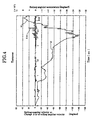
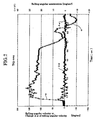
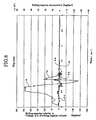
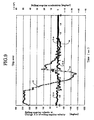
- Figs. 4 to 9 show experimental results obtained for setting the threshold value ⁇ 0 of the change amount ⁇ with lapse of time of the rolling angular velocity.
- Fig. 4 is a graph showing change amounts ⁇ (deg./sec.) with lapse of time of the rolling angular velocity ⁇ every time interval of 5 msec. in turnover type rollover among various rollover variations of the vehicle.
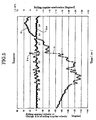
- Fig. 5 is a graph showing enlarging a region in a time interval from 2.0 sec. to 3.0 sec. in Fig. 4.
- An ordinate at a right side of each graph denotes values obtained by converting time-change amounts ⁇ (deg./sec.) of the rolling angular velocity ⁇ into the angular acceleration ( ⁇ / ⁇ t [deg./sec.2]). The above is applicable to the other graphs mentioned later.
- Fig. 6 is a graph showing change amounts ⁇ (deg./sec.) with lapse of the rolling angular velocity ⁇ every time interval of 5 msec. in tripover type rollover among various rollover variations of the vehicle.
- Fig. 7 is a graph showing enlarging a region in a time interval from 0.0 sec. to 1.0 sec. in Fig. 6.
- Fig. 8 is a graph showing change amounts ⁇ (deg./scc.) with lapse of time of the rolling angular velocity ⁇ every time interval of 5 msec. in another tripover type rollover among various rollover variations of the vehicle.
- Fig. 9 is a graph showing enlarging a region in a time interval from 0.5 sec. to 1.5 sec. in Fig. 8.
- the threshold value is not limited to the above specific value, and can be appropriately adjusted depending upon behavior characteristics of the vehicle upon which the vehicle behavior judgmemt system is mounted.
- the occupant-protecting device 40 is operated based on the rollover judgment result obtained by the vehicle behavior judgment system 20 and the inclination-detected result obtained by the inclination SW 31. Such an inclination-detected result is combined to ensure the higher accuracy operation.
- the vehicle occupant-protecting system according to the present invention the first vehicle occupant-protecting system of the present invention
- the occupant-protecting device 40 may be operated depending only upon the judgment result of the rollover judgment result of the rollover judgment system.
Landscapes
- Engineering & Computer Science (AREA)
- Mechanical Engineering (AREA)
- Air Bags (AREA)
- Automotive Seat Belt Assembly (AREA)
Applications Claiming Priority (2)
| Application Number | Priority Date | Filing Date | Title |
|---|---|---|---|
| JP2004016824 | 2004-01-26 | ||
| JP2004016824A JP2005206099A (ja) | 2004-01-26 | 2004-01-26 | 車両挙動判定システムおよび乗員保護システム |
Publications (2)
| Publication Number | Publication Date |
|---|---|
| EP1557323A1 true EP1557323A1 (fr) | 2005-07-27 |
| EP1557323B1 EP1557323B1 (fr) | 2009-03-04 |
Family
ID=34631972
Family Applications (1)
| Application Number | Title | Priority Date | Filing Date |
|---|---|---|---|
| EP05001207A Expired - Lifetime EP1557323B1 (fr) | 2004-01-26 | 2005-01-21 | Système pour l'évaluation de comportement de véhicule et un système de protection d'un occupant d'un véhicule |
Country Status (4)
| Country | Link |
|---|---|
| US (1) | US7454276B2 (fr) |
| EP (1) | EP1557323B1 (fr) |
| JP (1) | JP2005206099A (fr) |
| DE (1) | DE602005013010D1 (fr) |
Cited By (1)
| Publication number | Priority date | Publication date | Assignee | Title |
|---|---|---|---|---|
| CN104670141B (zh) * | 2013-11-29 | 2017-04-12 | 现代摩比斯株式会社 | 汽车的乘客保护装置及控制方法 |
Families Citing this family (2)
| Publication number | Priority date | Publication date | Assignee | Title |
|---|---|---|---|---|
| US20060178799A1 (en) * | 2005-02-10 | 2006-08-10 | Hoying John F | Enhanced roll control system |
| US8160816B2 (en) * | 2007-08-27 | 2012-04-17 | Honda Motor Co., Ltd. | Vehicular behavior determination device and vehicular behavior determination method |
Citations (4)
| Publication number | Priority date | Publication date | Assignee | Title |
|---|---|---|---|---|
| US5610575A (en) * | 1994-08-25 | 1997-03-11 | Automotive Systems Laboratory, Inc. | Method and system for detecting vehicle roll-over |
| US20020087243A1 (en) * | 2000-12-28 | 2002-07-04 | Toyota Jidosha Kabushiki Kaisha | Control system and method for controlling vehicle-occupant protecting apparatus |
| US6438463B1 (en) * | 1999-09-06 | 2002-08-20 | Honda Giken Kogyo Kabushiki Kaisha | Process for determining lateral overturning of vehicle, and system for detecting inclination angle of vehicle body |
| US20020165654A1 (en) * | 2001-03-26 | 2002-11-07 | Weaver Ralph M. | Roll sensor system for a vehicle |
Family Cites Families (6)
| Publication number | Priority date | Publication date | Assignee | Title |
|---|---|---|---|---|
| EP0907526A4 (fr) * | 1996-06-24 | 2001-01-03 | Breed Automotive Tech | Unite de commande pour dispositif de securite pour vehicule |
| DE10112315B4 (de) * | 2000-03-17 | 2004-10-14 | Honda Giken Kogyo K.K. | Verfahren zur Bestimmung eines Seitenüberschlags eines Fahrzeugs und Insassenschutzsystem in einem Fahrzeug |
| DE10025259C2 (de) * | 2000-05-22 | 2003-03-20 | Conti Temic Microelectronic | Verfahren zur Erzeugung eines Auslösealgorithmus zur Erkennung eines Überschlages für ein Sicherheitssystem in einem Kraftfahrzeug |
| JP3518509B2 (ja) * | 2000-12-28 | 2004-04-12 | トヨタ自動車株式会社 | ロールオーバ判定装置 |
| US6560519B2 (en) * | 2001-06-28 | 2003-05-06 | Robert Bosch Corporation | Rollover-sensing system for a vehicle and method of operating the same |
| JP4317032B2 (ja) * | 2002-03-19 | 2009-08-19 | オートモーティブ システムズ ラボラトリー インコーポレーテッド | 車両ロールオーバ検出システム |
-
2004
- 2004-01-26 JP JP2004016824A patent/JP2005206099A/ja active Pending
-
2005
- 2005-01-21 DE DE602005013010T patent/DE602005013010D1/de not_active Expired - Fee Related
- 2005-01-21 EP EP05001207A patent/EP1557323B1/fr not_active Expired - Lifetime
- 2005-01-24 US US11/039,995 patent/US7454276B2/en not_active Expired - Fee Related
Patent Citations (4)
| Publication number | Priority date | Publication date | Assignee | Title |
|---|---|---|---|---|
| US5610575A (en) * | 1994-08-25 | 1997-03-11 | Automotive Systems Laboratory, Inc. | Method and system for detecting vehicle roll-over |
| US6438463B1 (en) * | 1999-09-06 | 2002-08-20 | Honda Giken Kogyo Kabushiki Kaisha | Process for determining lateral overturning of vehicle, and system for detecting inclination angle of vehicle body |
| US20020087243A1 (en) * | 2000-12-28 | 2002-07-04 | Toyota Jidosha Kabushiki Kaisha | Control system and method for controlling vehicle-occupant protecting apparatus |
| US20020165654A1 (en) * | 2001-03-26 | 2002-11-07 | Weaver Ralph M. | Roll sensor system for a vehicle |
Cited By (1)
| Publication number | Priority date | Publication date | Assignee | Title |
|---|---|---|---|---|
| CN104670141B (zh) * | 2013-11-29 | 2017-04-12 | 现代摩比斯株式会社 | 汽车的乘客保护装置及控制方法 |
Also Published As
| Publication number | Publication date |
|---|---|
| US20050165528A1 (en) | 2005-07-28 |
| US7454276B2 (en) | 2008-11-18 |
| JP2005206099A (ja) | 2005-08-04 |
| EP1557323B1 (fr) | 2009-03-04 |
| DE602005013010D1 (de) | 2009-04-16 |
Similar Documents
| Publication | Publication Date | Title |
|---|---|---|
| US6282474B1 (en) | Method and apparatus for detecting rollover of an automotive vehicle | |
| EP1211144B1 (fr) | Dispositif et méthode de détection du retournement d'un véhicule | |
| US6714848B2 (en) | Adaptive rollover detection apparatus and method | |
| US20020183899A1 (en) | Vehicle rollover sensing using angular rate sensors | |
| WO1996009942A1 (fr) | Agencement de securite | |
| JP2010506794A (ja) | 車両安全システム | |
| US20040015324A1 (en) | Crash detection system including roll-over discrimination | |
| KR100492501B1 (ko) | 차량용 승차자 보호시스템 | |
| EP1642780B1 (fr) | Méthode et système de détection du retournement d'un véhicule | |
| US6701238B2 (en) | Vehicle impact detection system and control method | |
| US20050209757A1 (en) | Method for releasing a safety device in a motor vehicle in the event of an overturn | |
| US7454276B2 (en) | Vehicle behavior judgment system and vehicle occupant-protecting system | |
| EP2020338B1 (fr) | Procédé et système pour détecter le retournement d'un véhicule, en particulier un retournement par dérapage au sol | |
| JP4795706B2 (ja) | 乗員保護装置 | |
| JP2001294116A (ja) | 車両用衝突判定装置 | |
| KR0154032B1 (ko) | 자동차 변형속도에 따른 에어백 구동장치 및 그 방법 | |
| JP3965513B2 (ja) | エアバッグシステムの衝突判断装置 | |
| JPH0769171A (ja) | 乗員保護装置 | |
| JP2000225915A (ja) | 車両用乗員保護装置 | |
| EP1714836B1 (fr) | Appareil de protection d'un passager | |
| JPH07112804B2 (ja) | 車両用乗員保護装置 | |
| JP2006103568A (ja) | 乗員保護装置のゼロ点ドリフト検出手段及びこれを備えた乗員保護装置 |
Legal Events
| Date | Code | Title | Description |
|---|---|---|---|
| PUAI | Public reference made under article 153(3) epc to a published international application that has entered the european phase |
Free format text: ORIGINAL CODE: 0009012 |
|
| AK | Designated contracting states |
Kind code of ref document: A1 Designated state(s): AT BE BG CH CY CZ DE DK EE ES FI FR GB GR HU IE IS IT LI LT LU MC NL PL PT RO SE SI SK TR |
|
| AX | Request for extension of the european patent |
Extension state: AL BA HR LV MK YU |
|
| 17P | Request for examination filed |
Effective date: 20050817 |
|
| AKX | Designation fees paid |
Designated state(s): DE FR GB |
|
| GRAP | Despatch of communication of intention to grant a patent |
Free format text: ORIGINAL CODE: EPIDOSNIGR1 |
|
| GRAS | Grant fee paid |
Free format text: ORIGINAL CODE: EPIDOSNIGR3 |
|
| GRAA | (expected) grant |
Free format text: ORIGINAL CODE: 0009210 |
|
| AK | Designated contracting states |
Kind code of ref document: B1 Designated state(s): DE FR GB |
|
| REG | Reference to a national code |
Ref country code: GB Ref legal event code: FG4D |
|
| REF | Corresponds to: |
Ref document number: 602005013010 Country of ref document: DE Date of ref document: 20090416 Kind code of ref document: P |
|
| PLBE | No opposition filed within time limit |
Free format text: ORIGINAL CODE: 0009261 |
|
| STAA | Information on the status of an ep patent application or granted ep patent |
Free format text: STATUS: NO OPPOSITION FILED WITHIN TIME LIMIT |
|
| 26N | No opposition filed |
Effective date: 20091207 |
|
| GBPC | Gb: european patent ceased through non-payment of renewal fee |
Effective date: 20100121 |
|
| REG | Reference to a national code |
Ref country code: FR Ref legal event code: ST Effective date: 20100930 |
|
| PG25 | Lapsed in a contracting state [announced via postgrant information from national office to epo] |
Ref country code: FR Free format text: LAPSE BECAUSE OF NON-PAYMENT OF DUE FEES Effective date: 20100201 |
|
| PG25 | Lapsed in a contracting state [announced via postgrant information from national office to epo] |
Ref country code: DE Free format text: LAPSE BECAUSE OF NON-PAYMENT OF DUE FEES Effective date: 20100803 |
|
| PG25 | Lapsed in a contracting state [announced via postgrant information from national office to epo] |
Ref country code: GB Free format text: LAPSE BECAUSE OF NON-PAYMENT OF DUE FEES Effective date: 20100121 |