EP1557733B1 - Leistungsfaktorkorrekturschaltung und Verfahren dafür - Google Patents
Leistungsfaktorkorrekturschaltung und Verfahren dafür Download PDFInfo
- Publication number
- EP1557733B1 EP1557733B1 EP04425034A EP04425034A EP1557733B1 EP 1557733 B1 EP1557733 B1 EP 1557733B1 EP 04425034 A EP04425034 A EP 04425034A EP 04425034 A EP04425034 A EP 04425034A EP 1557733 B1 EP1557733 B1 EP 1557733B1
- Authority
- EP
- European Patent Office
- Prior art keywords
- bipolar transistor
- terminal
- control
- power factor
- cell
- Prior art date
- Legal status (The legal status is an assumption and is not a legal conclusion. Google has not performed a legal analysis and makes no representation as to the accuracy of the status listed.)
- Expired - Lifetime
Links
Images


Classifications
-
- H—ELECTRICITY
- H02—GENERATION; CONVERSION OR DISTRIBUTION OF ELECTRIC POWER
- H02M—APPARATUS FOR CONVERSION BETWEEN AC AND AC, BETWEEN AC AND DC, OR BETWEEN DC AND DC, AND FOR USE WITH MAINS OR SIMILAR POWER SUPPLY SYSTEMS; CONVERSION OF DC OR AC INPUT POWER INTO SURGE OUTPUT POWER; CONTROL OR REGULATION THEREOF
- H02M1/00—Details of apparatus for conversion
- H02M1/42—Circuits or arrangements for compensating for or adjusting power factor in converters or inverters
- H02M1/4208—Arrangements for improving power factor of AC input
- H02M1/4225—Arrangements for improving power factor of AC input using a non-isolated boost converter
-
- G—PHYSICS
- G05—CONTROLLING; REGULATING
- G05F—SYSTEMS FOR REGULATING ELECTRIC OR MAGNETIC VARIABLES
- G05F1/00—Automatic systems in which deviations of an electric quantity from one or more predetermined values are detected at the output of the system and fed back to a device within the system to restore the detected quantity to its predetermined value or values, i.e. retroactive systems
- G05F1/70—Regulating power factor; Regulating reactive current or power
-
- Y—GENERAL TAGGING OF NEW TECHNOLOGICAL DEVELOPMENTS; GENERAL TAGGING OF CROSS-SECTIONAL TECHNOLOGIES SPANNING OVER SEVERAL SECTIONS OF THE IPC; TECHNICAL SUBJECTS COVERED BY FORMER USPC CROSS-REFERENCE ART COLLECTIONS [XRACs] AND DIGESTS
- Y02—TECHNOLOGIES OR APPLICATIONS FOR MITIGATION OR ADAPTATION AGAINST CLIMATE CHANGE
- Y02B—CLIMATE CHANGE MITIGATION TECHNOLOGIES RELATED TO BUILDINGS, e.g. HOUSING, HOUSE APPLIANCES OR RELATED END-USER APPLICATIONS
- Y02B70/00—Technologies for an efficient end-user side electric power management and consumption
- Y02B70/10—Technologies improving the efficiency by using switched-mode power supplies [SMPS], i.e. efficient power electronics conversion e.g. power factor correction or reduction of losses in power supplies or efficient standby modes
Definitions
- the present invention relates to a method and cell for controlling the power factor of a power supply line.
- the invention relates to a method for controlling the power factor of a power supply line, said method using a cell for controlling the power factor connected to said power supply line.
- the invention also relates to a cell for controlling the power factor of a power supply line of the type comprising a first and a second input terminal, a first and a second output terminal, said first input terminal being connected to said first output terminal by means of the series of an inductor and of a diode, connected to each other in correspondence with an internal circuit node and said second input terminal and second output terminal being connected to each other.
- the invention particulary relates, but not exclusively, a cell of the PFC type (acronym for the expression "Power Factor Corrector") and the following description is made with reference to this field of application for convenience of illustration only.
- One of the known methods provides the use of a circuit network capable of correcting the power factor PF.
- This network is commonly indicated with the term PFC cell (acronym for the expression "Power Factor Corrector”).
- the main feature of this network is that of creating an input current waveform being of the sinusoidal type and in phase with the network voltage.
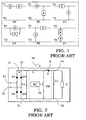
- Figure 1 schematically shows possible configurations of PFC cells using the technique based on the dither effect and inserted between a first T1 and a second network terminal T2.
- dither signal generators have been indicated with D and buffer elements of the first order of the PFC cells (such as a capacitor or an inductor) with Z.
- this figure 1 shows configurations wherein the series of the buffer element Z and of the dither signal generator D is connected to the first network terminal T1 (A) or between the first T1 and the second network terminal T2 (F), wherein the buffer element Z is inserted between the first T1 and the second network terminal T2 and the dither signal generator D is connected to the first network terminal T1 (B), wherein the buffer element Z is connected to the first network terminal T1 and the dither signal generator D is inserted between the first T1 and the second network terminal T2, downstream the buffer element Z (C) or upstream the buffer element Z (E) or wherein the buffer element Z and the dither signal generator D are in parallel to each other and connected to the first network terminal T1 (D).
- circuit topologies being shown realise first-order PFC cells and they allow the conduction time of the rectifier diodes to be increased, linearising the trans-feature of these diodes and increasing therefore the power factor PF of the circuit topology as a whole.
- the dither signal is usually obtained by a power stage being cascade-connected to the PFC cell and by using a stage operating at high frequency, the dither signal will also be at high frequency.
- the input current can take the waveform of a pulse train, whose envelope reproduces the sinusoidal trend of the network voltage.
- boost converter Besides the dither effect principle, there are other circuit topologies among which the most widespread is that based on the principle commonly known as boost converter.
- FIG. 2 A typical diagram of a PFC cell based on this principle is schematically shown in figure 2 .
- the PFC cell 20 essentially comprises a controlled switch SW.
- the PFC cell 20 has a first I1 and a second input terminal I2, as well as a first O1 and a second output terminal O2.
- the first input terminal I1 is connected to the first output terminal O1 by means of the series of an inductor L and a diode D, connected to each other in correspondence with an internal circuit node X.
- the second input terminal 12 is directly connected to the second output terminal O2.
- the controlled switch SW is inserted between the internal circuit node X and the second input terminal I2, i.e. the second output terminal O2 and it has a driving terminal connected to a convenient driving circuit 22.
- the PFC cell 20 is connected to a first T1 and a second network terminal T2 by means of a diode bridge 21.
- the diode bridge 21 comprises a first pair of diodes D1, D2 inserted between the first input terminal I1 and the second input terminal I2 of the PFC cell 20 and interconnected in correspondence with the first network terminal T1, as well as a second pair of diodes D3, D4 inserted, in parallel to the first pair of diodes D1, D2, between the first input terminal I1 and the second input terminal I2 and interconnected in correspondence with the second network terminal T2.
- the diode bridge 21 comprising the pairs of diodes D1-D2 and D3-D4 operates as an input rectifier bridge.
- the PFC cell 20 also has the input terminals I1, I2 and the output terminals O1, O2 connected to a first C1 and a second capacitor C2 respectively.
- the PFC cell 10 is finally connected to a load Z inserted between the output terminals O1 and O2.
- the combination of the capacitor C2 and of the PFC cell 20 substantially realises an active filter driven by the driving circuit 22 and capable of controlling the harmonic content of the power absorbed by the load.
- the switch SW is an electronic switch realised with an active component of the MOSFET type, driven by the integrated IC driving circuit 22 so as to adjust the conduction time thereof.
- the technical problem underlying the present invention is to provide a PFC cell topology of the type comprising a bipolar power transistor, which overcomes the limits and drawbacks still affecting PFC cells according to the prior art.
- the solution idea underlying the present invention is that of using the intrinsic electric features of a simply driven bipolar power transistor to modulate the conduction time thereof.
- this transistor is comprised in the PFC cell, this cell is capable of modifying the waveform envelope of the current absorbed by the line, making the envelope of the same almost sinusoidal, thus obtaining a power factor PF having values close to one.
- a cell for controlling the power factor of a power supply line realised according to the invention is shown hereafter and globally indicated with 30. Elements being structurally and functionally similar to the devices shown with reference to the prior art have been given the same numeral references.
- the PFC cell 30 essentially comprises a conveniently-driven bipolar transistor TB1.
- the PFC cell 30 has a first I1 and a second input terminal I2, as well as a first O1 and a second output terminal O2.
- the first input terminal I1 is connected to the first output terminal O1 by means of the series of an inductor L and a diode D, connected to each other in correspondence with an internal circuit node X.
- the second input terminal I2 is directly connected to the second output terminal O2.
- the bipolar transistor TB1 is inserted between the internal circuit node X and the second input terminal I2, i.e. the second output terminal O2 and it has a control terminal, particularly a base terminal B1, connected, by means of a RC network 31, to a transformer winding T, connected in turn to the second output terminal O2.
- the base terminal B1 of the bipolar transistor TB1 is connected to the winding T by means of the series of a first resistor R1 and a capacitor C of the network 31, as well as to the second output terminal O2 by means of a second resistor R2 of the network 31.
- bipolar transistor TB 1 and of the particular electric features thereof together with the driving mode according to the invention allows a simple and cheap PFC network to be realised.
- the present invention provides a method for modulating the conduction time of the bipolar transistor TB 1 comprised in the PFC cell by exploiting the well known phenomenon according to which the charges injected in the base terminal of a bipolar transistor allow the saturation effect of the bipolar transistor itself and they determine the conduction time thereof.
- the PFC cell 30 according to the invention thus succeeds in modulating the transistor turn-on time without inserting any integrated circuit.
- the method for controlling the power factor of a power supply line uses a cell for controlling the power factor and it performs said power factor control by adjusting the turn-on and turn-off time of a bipolar transistor comprised in the cell.
- control method provides that the adjustment of the bipolar transistor turn-on and turn-off time is performed by means of a control signal derived from a signal having an elementary alternated trend being applied to the base terminal B1 of the bipolar transistor TB1, in particular obtained from a transformer winding and applied to the base terminal by means of the network 31.
- control signal to drive the bipolar transistor base terminal B1, particularly generated by an integrated circuit operating as a modulator, but this control signal is advantageously obtained from an already existing signal.
- this already existing signal is a signal drawn through an additional winding on a transformer being already in the applications which normally use transformers operating at high frequency.
- a voltage signal generated on the transformer thus biases the base terminal B1 of the bipolar transistor TB1 through the network 31, essentially comprising a capacitor and two resistors.
- the capacitor C being in series with the base terminal B1, together with the resistor R1 being always in series with this base terminal B1, determine the conduction time constant of the bipolar transistor TB1 and they allow a duty cycle being less than 50% to be realised.
- the duty cycle adjustment effect is obtained by exploiting the features of the network 31 in combination with the storage time variations of the bipolar transistor itself in correspondence with the several currents on the collector terminal to be switched by the bipolar transistor TB1.
- the transistor For input voltage values ranging around ⁇ 10 ⁇ 15% of a nominal voltage value, the transistor adjusts the power factor PF through a modulation of the conduction time determined by the storage time thereof.
- the PFC cell 30 is substantially an active PFC cell capable of modulating the conduction time of the bipolar transistor TB1.
- FIG. 4 An application of the PFC cell 30 being suggested is schematically shown in figure 4 .
- the bipolar transistor driving voltage of the PFC cell 30 is obtained by means of an auxiliary winding T on a transformer of an electronic ballast 40.
- the PFC cell 30 is inserted at the power supply of this electronic ballast 40 and it is connected to a first and a second network terminals T1, T2 by means of a diode bridge 41.
- the PFC cell 30 is also uncoupled at the input and output by means of convenient capacitors C1, C2.
- the PFC cell 30 has the first and the second input terminals I1, I2 connected to the diode bridge 41 and the first and the second output terminals O1, O2 connected to the electronic ballast 40.
- these first and second input terminals I1, I2 are connected to each other by the first capacitor C1 and these first and second output terminals O1, O2 are connected to each other by the second capacitor C2.
- the alternated voltage trend on the auxiliary winding T in combination with the storage time feature, regulate the turn-on and turn-off time of the bipolar transistor TB1 of the PFC cell 30.
- Figure 5 shows the waveform related to the trend of the voltage and current at the ends of the bipolar transistor of the PFC cell 30 inserted in the electronic ballast 40.
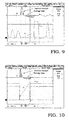
- FIGS 9 and 10 show the details related to the instants is1 and is3.
- the bipolar transistor turn-on lasts since the charges have been injected in the base region until the complete removal thereof. From figures 9 and 10 it can be noticed that, for the same peak of the injected base current Ib, the device turn-on time depends on the storage time thereof. In fact, as shown in figure 10 , it is evident that this latter is lower than in figure 9 just by virtue of the dependence of this parameter on the collector current Ic and thus on the transistor saturation level.
- the inductor L, the diode D and the bipolar transistor TB1 of the PFC cell according to the invention realise a network, interposed between a rectifier bridge and a high frequency section, capable of modifying the waveform envelope of the current absorbed by the line, making the envelope thereof almost sinusoidal, thus obtaining a power factor PF with values close to one.
Landscapes
- Engineering & Computer Science (AREA)
- Power Engineering (AREA)
- Physics & Mathematics (AREA)
- Electromagnetism (AREA)
- General Physics & Mathematics (AREA)
- Radar, Positioning & Navigation (AREA)
- Automation & Control Theory (AREA)
- Rectifiers (AREA)
- Dc-Dc Converters (AREA)
Claims (6)
- Verfahren zum Steuern des Leistungsfaktors einer Stromversorgungsleitung, wobei das Verfahren eine mit der Stromversorgungsleitung verbundene Zelle zum Steuern des Leistungsfaktors verwendet, wobei die Steuerung des Leistungsfaktors durch Anpassung der Einschalt- und AusschaltZeit eines in der Leistungsfaktor-Steuerungszelle enthaltenden Bipolartransistors (TB1) durchgeführt wird,
dadurch gekennzeichnet,
dass es eine Tastverhältnis-Anpassung der Leistungsfaktor-Steuerungszelle vorsieht, die durch ein RC-Netzwerk (31) bewerkstelligt wird, welches mindestens einen Kondensator (C) sowie einen Widerstand (R1), die miteinander in Reihe und zwischen einen Steueranschluss des Bipolartransistors (TB1) und eine Transformatorwicklung (T) geschaltet sind, umfasst, welche wiederum mit dem zweiten Eingangsanschluss (12) verbunden ist, wobei die Tastverhältnis-Anpassung die Merkmale des RC-Netzwerkes (31) in Kombination mit den Speicherzeitschwankungen des Bipolartransistors (TB1) in Übereinstimmung mit den Stromschwankungen auf einem Kollektoranschluss des Bipolartransistors (TB1) ausnutzt. - Steuerungsverfahren nach Anspruch 1, dadurch gekennzeichnet, dass die Anpassung der Einschalt und Ausschaltzeit des Bipolartransistors (TB1) mittels eines von einem im Prinzip alternierenden Signal abgeleiteten, an den Steuerungsanschluss (B1) des Bipolartransistors (TB1) angelegten Steuerungssignals ausgeführt wird.
- Steuerungsverfahren nach Anspruch 2, dadurch gekennzeichnet, dass das im Prinzip alternierende Signal aus der Transformatorwicklung erhalten wird.
- Zelle zum Steuern des Leistungsfaktors einer Stromversorgungsleitung des einen ersten Eingangsanschluss (I1) und einen zweiten Eingangsanschluss (I2), einen ersten Ausgangsanschluss (01) und einen zweiten Ausgangsanschluss (02) enthaltenden Typs, wobei der erste Eingangsanschluss (I1) über eine Reihenschaltung einer Drossel (L) und einer Diode (D), welche an einem internen Schaltungsknotenpunkt (X) miteinander verbunden sind, mit dem ersten Ausgangsanschluss (O1) verbunden ist, und wobei der zweite Eingangsanschluss (12) und der zweite Ausgangsanschluss (02) miteinander verbunden sind, wobei die Zelle einen zwischen den internen Schaltungsknotenpunkt (X) und den zweiten Eingangsanschluss (12) eingefügten Bipolartransistor (TB1) aufweist, der einen Steuerungsanschluss (B1) hat,
dadurch gekennzeichnet,
dass der Steuerungsanschluss (B1) mittels eines RC-Netzwerkes (31) mit einer Transformatorwicklung (T) verbunden ist und ein aus einem im Prinzip alternierenden Signal abgeleitetes Steuerungssignal empfängt, wobei das RC-Netzwerk (31) einen mit einem Kondensator (C) zwischen dem Steuerungsanschluss des Bipolartransistors (TB1) und der Transformatorwick lung (T) in Reihe geschalteten ersten Widerstand (R1) aufweist, wobei die Transformatorwicklung (T) wiederum mit dem zweiten Eingangsanschluss (12) verbunden ist. - Steuerungszelle nach Anspruch 4, dadurch gekennzeichnet, dass das RC-Netzwerk (31) darüber hinaus einen zwischen den Steuerungseingang (B1) des Bipolartransistors (TB1) und den zweiten Eingangsanschluss (I2) der Steuerungszelle eingefügten zweiten Widerstand (R2) aufweist.
- Vorschaltgerät, dadurch gekennzeichnet, dass es mindestens eine Leistungsfaktor-Steuerungszelle gemäß einem der Ansprüche 4 bis 5 umfasst.
Priority Applications (3)
| Application Number | Priority Date | Filing Date | Title |
|---|---|---|---|
| DE602004020177T DE602004020177D1 (de) | 2004-01-22 | 2004-01-22 | Leistungsfaktorkorrekturschaltung und Verfahren dafür |
| EP04425034A EP1557733B1 (de) | 2004-01-22 | 2004-01-22 | Leistungsfaktorkorrekturschaltung und Verfahren dafür |
| US11/041,519 US7391198B2 (en) | 2004-01-22 | 2005-01-21 | Method and cell for controlling the power factor of a power supply line |
Applications Claiming Priority (1)
| Application Number | Priority Date | Filing Date | Title |
|---|---|---|---|
| EP04425034A EP1557733B1 (de) | 2004-01-22 | 2004-01-22 | Leistungsfaktorkorrekturschaltung und Verfahren dafür |
Publications (2)
| Publication Number | Publication Date |
|---|---|
| EP1557733A1 EP1557733A1 (de) | 2005-07-27 |
| EP1557733B1 true EP1557733B1 (de) | 2009-03-25 |
Family
ID=34626569
Family Applications (1)
| Application Number | Title | Priority Date | Filing Date |
|---|---|---|---|
| EP04425034A Expired - Lifetime EP1557733B1 (de) | 2004-01-22 | 2004-01-22 | Leistungsfaktorkorrekturschaltung und Verfahren dafür |
Country Status (3)
| Country | Link |
|---|---|
| US (1) | US7391198B2 (de) |
| EP (1) | EP1557733B1 (de) |
| DE (1) | DE602004020177D1 (de) |
Families Citing this family (1)
| Publication number | Priority date | Publication date | Assignee | Title |
|---|---|---|---|---|
| RU2525837C2 (ru) * | 2012-04-28 | 2014-08-20 | Закрытое акционерное общество "Связь инжиниринг" | Способ и система управления безмостовым корректором коэффициента мощности с помощью цифрового сигнального процессора |
Family Cites Families (6)
| Publication number | Priority date | Publication date | Assignee | Title |
|---|---|---|---|---|
| NL7613894A (nl) * | 1976-12-15 | 1978-06-19 | Philips Nv | Schakelinrichting voorzien van een hoogspannings- vermogenstransistor. |
| US4792746A (en) * | 1987-05-11 | 1988-12-20 | Astec Components, Ltd. | Non-dissipative series voltage switching regulator having improved switching speed |
| US5982113A (en) * | 1997-06-20 | 1999-11-09 | Energy Savings, Inc. | Electronic ballast producing voltage having trapezoidal envelope for instant start lamps |
| US6020688A (en) * | 1997-10-10 | 2000-02-01 | Electro-Mag International, Inc. | Converter/inverter full bridge ballast circuit |
| US6275013B1 (en) * | 2000-07-21 | 2001-08-14 | Funai Electric Co., Ltd. | Switching power supply employing an internal resistance in series with a zener diode to stabilize a DC output |
| JP3939587B2 (ja) * | 2002-05-10 | 2007-07-04 | 東光株式会社 | 昇圧型スイッチング電源装置 |
-
2004
- 2004-01-22 EP EP04425034A patent/EP1557733B1/de not_active Expired - Lifetime
- 2004-01-22 DE DE602004020177T patent/DE602004020177D1/de not_active Expired - Fee Related
-
2005
- 2005-01-21 US US11/041,519 patent/US7391198B2/en not_active Expired - Fee Related
Also Published As
| Publication number | Publication date |
|---|---|
| US7391198B2 (en) | 2008-06-24 |
| DE602004020177D1 (de) | 2009-05-07 |
| US20060087261A1 (en) | 2006-04-27 |
| EP1557733A1 (de) | 2005-07-27 |
Similar Documents
| Publication | Publication Date | Title |
|---|---|---|
| US5510974A (en) | High frequency push-pull converter with input power factor correction | |
| US6049473A (en) | Harmonic-injection control technique for three-phase, discontinuous-conduction-mode, high-power-factor boost rectifiers with improved line-transient response | |
| US8184456B1 (en) | Adaptive power converter and related circuitry | |
| CA1218698A (en) | Compact electrical power supply for signal processing applications | |
| US7164591B2 (en) | Bridge-less boost (BLB) power factor correction topology controlled with one cycle control | |
| CN101282079B (zh) | 用于功率控制器的系统和方法 | |
| JPH09504160A (ja) | パルス幅変調dc/dcブーストコンバータ | |
| US5982639A (en) | Two switch off-line switching converter | |
| US5475580A (en) | Power supply circuit | |
| JP2003510001A (ja) | Llc変換器及びllc変換器を制御する方法 | |
| CN101523711A (zh) | 自振荡直流-直流转换器及其方法 | |
| EP1761832B1 (de) | Verfahren und schaltung zur aktiven leistungsfaktorkorrektur | |
| EP1580639A1 (de) | Übergangsmodus-Leistungsfaktorkorrekturvorrichtung in Schaltnetzteilen | |
| US10581321B1 (en) | Flyback converter with multiplier signal control circuit and method | |
| EP1557733B1 (de) | Leistungsfaktorkorrekturschaltung und Verfahren dafür | |
| EP0057083A1 (de) | Leistungswandler | |
| CN113273312A (zh) | 用于生成dc电压供应的电路以及使用该dc电压供应电路的驱动器电路 | |
| RU2418355C1 (ru) | Стабилизированный квазирезонансный преобразователь | |
| KR20150044333A (ko) | 브리지리스 역률 개선 회로 및 이의 구동 방법 | |
| JP4250892B2 (ja) | スイッチング電源装置 | |
| AU2006232207A1 (en) | Solid state switching circuit | |
| WO2003055052A1 (en) | Resonant converter with phase delay control | |
| US6388900B1 (en) | Constant-frequency active filter controlled by a peak current control mode | |
| CN100546160C (zh) | 低开关频率的功率因子校正电路 | |
| JP4083686B2 (ja) | 力率改善回路 |
Legal Events
| Date | Code | Title | Description |
|---|---|---|---|
| PUAI | Public reference made under article 153(3) epc to a published international application that has entered the european phase |
Free format text: ORIGINAL CODE: 0009012 |
|
| AK | Designated contracting states |
Kind code of ref document: A1 Designated state(s): AT BE BG CH CY CZ DE DK EE ES FI FR GB GR HU IE IT LI LU MC NL PT RO SE SI SK TR |
|
| AX | Request for extension of the european patent |
Extension state: AL LT LV MK |
|
| 17P | Request for examination filed |
Effective date: 20060118 |
|
| AKX | Designation fees paid |
Designated state(s): DE FR GB IT |
|
| 17Q | First examination report despatched |
Effective date: 20061215 |
|
| GRAP | Despatch of communication of intention to grant a patent |
Free format text: ORIGINAL CODE: EPIDOSNIGR1 |
|
| RIC1 | Information provided on ipc code assigned before grant |
Ipc: H02M 1/42 20070101ALI20071107BHEP Ipc: G05F 1/70 20060101AFI20071107BHEP |
|
| GRAS | Grant fee paid |
Free format text: ORIGINAL CODE: EPIDOSNIGR3 |
|
| GRAA | (expected) grant |
Free format text: ORIGINAL CODE: 0009210 |
|
| AK | Designated contracting states |
Kind code of ref document: B1 Designated state(s): DE FR GB IT |
|
| REG | Reference to a national code |
Ref country code: GB Ref legal event code: FG4D |
|
| REF | Corresponds to: |
Ref document number: 602004020177 Country of ref document: DE Date of ref document: 20090507 Kind code of ref document: P |
|
| PLBE | No opposition filed within time limit |
Free format text: ORIGINAL CODE: 0009261 |
|
| STAA | Information on the status of an ep patent application or granted ep patent |
Free format text: STATUS: NO OPPOSITION FILED WITHIN TIME LIMIT |
|
| 26N | No opposition filed |
Effective date: 20091229 |
|
| GBPC | Gb: european patent ceased through non-payment of renewal fee |
Effective date: 20100122 |
|
| REG | Reference to a national code |
Ref country code: FR Ref legal event code: ST Effective date: 20100930 |
|
| PG25 | Lapsed in a contracting state [announced via postgrant information from national office to epo] |
Ref country code: FR Free format text: LAPSE BECAUSE OF NON-PAYMENT OF DUE FEES Effective date: 20100201 |
|
| PG25 | Lapsed in a contracting state [announced via postgrant information from national office to epo] |
Ref country code: DE Free format text: LAPSE BECAUSE OF NON-PAYMENT OF DUE FEES Effective date: 20100803 |
|
| PG25 | Lapsed in a contracting state [announced via postgrant information from national office to epo] |
Ref country code: GB Free format text: LAPSE BECAUSE OF NON-PAYMENT OF DUE FEES Effective date: 20100122 |
|
| PGFP | Annual fee paid to national office [announced via postgrant information from national office to epo] |
Ref country code: IT Payment date: 20101227 Year of fee payment: 8 |
|
| PG25 | Lapsed in a contracting state [announced via postgrant information from national office to epo] |
Ref country code: IT Free format text: LAPSE BECAUSE OF NON-PAYMENT OF DUE FEES Effective date: 20120122 |