EP1558060B1 - Modes de son à effet spatial dans un système audio pour un véhicule - Google Patents
Modes de son à effet spatial dans un système audio pour un véhicule Download PDFInfo
- Publication number
- EP1558060B1 EP1558060B1 EP05250053A EP05250053A EP1558060B1 EP 1558060 B1 EP1558060 B1 EP 1558060B1 EP 05250053 A EP05250053 A EP 05250053A EP 05250053 A EP05250053 A EP 05250053A EP 1558060 B1 EP1558060 B1 EP 1558060B1
- Authority
- EP
- European Patent Office
- Prior art keywords
- seating
- locations
- location
- surround
- audio system
- Prior art date
- Legal status (The legal status is an assumption and is not a legal conclusion. Google has not performed a legal analysis and makes no representation as to the accuracy of the status listed.)
- Ceased
Links
Images





Classifications
-
- H—ELECTRICITY
- H04—ELECTRIC COMMUNICATION TECHNIQUE
- H04S—STEREOPHONIC SYSTEMS
- H04S7/00—Indicating arrangements; Control arrangements, e.g. balance control
- H04S7/30—Control circuits for electronic adaptation of the sound field
- H04S7/307—Frequency adjustment, e.g. tone control
-
- H—ELECTRICITY
- H04—ELECTRIC COMMUNICATION TECHNIQUE
- H04R—LOUDSPEAKERS, MICROPHONES, GRAMOPHONE PICK-UPS OR LIKE ACOUSTIC ELECTROMECHANICAL TRANSDUCERS; ELECTRIC HEARING AIDS; PUBLIC ADDRESS SYSTEMS
- H04R2205/00—Details of stereophonic arrangements covered by H04R5/00 but not provided for in any of its subgroups
- H04R2205/024—Positioning of loudspeaker enclosures for spatial sound reproduction
-
- H—ELECTRICITY
- H04—ELECTRIC COMMUNICATION TECHNIQUE
- H04R—LOUDSPEAKERS, MICROPHONES, GRAMOPHONE PICK-UPS OR LIKE ACOUSTIC ELECTROMECHANICAL TRANSDUCERS; ELECTRIC HEARING AIDS; PUBLIC ADDRESS SYSTEMS
- H04R2499/00—Aspects covered by H04R or H04S not otherwise provided for in their subgroups
- H04R2499/10—General applications
- H04R2499/13—Acoustic transducers and sound field adaptation in vehicles
-
- H—ELECTRICITY
- H04—ELECTRIC COMMUNICATION TECHNIQUE
- H04S—STEREOPHONIC SYSTEMS
- H04S3/00—Systems employing more than two channels, e.g. quadraphonic
- H04S3/002—Non-adaptive circuits, e.g. manually adjustable or static, for enhancing the sound image or the spatial distribution
-
- H—ELECTRICITY
- H04—ELECTRIC COMMUNICATION TECHNIQUE
- H04S—STEREOPHONIC SYSTEMS
- H04S3/00—Systems employing more than two channels, e.g. quadraphonic
- H04S3/008—Systems employing more than two channels, e.g. quadraphonic in which the audio signals are in digital form, i.e. employing more than two discrete digital channels
Definitions
- the invention is directed to surround audio system for vehicles and more specifically to surround audio systems having operating modes.
- EP 1263263 A discloses an audio apparatus which provides for balance adjustment depending upon whether the audio source to be listened to is a two-channel source or a 5.1 channel source.
- a surround sound audio system for a vehicle having a plurality of operating modes, including a first operating mode characterized by a first equalization pattern that when applied to the audio signals in a plurality of channels including surround channels results in a substantially smoother frequency response at a first of a plurality of seating locations than at others of the plurality of seating locations; and a second operating mode characterized by a second equalization pattern that when applied to the audio signals in the plurality of channels including surround channels results in a frequency response that has substantially similar smoothness at each of the plurality of seating locations.
- the first operating mode may be further characterized by greater sound pressure level at a first of the seating locations than at the other seating locations from radiation corresponding to the plurality of channels including the surround channels; and the second operating mode further characterized by substantially equal sound pressure level at each of a plurality of seating locations from radiation corresponding to a plurality of channels including surround channels.
- the first operating mode may also further characterized by a balance pattern wherein the sound pressure level from each of the speakers is substantially equal at the first seating location and unequal at the other seating locations; and the second operating mode characterized by a balance pattern wherein the sound pressure level measurements from each of a plurality of speakers at each of the seating locations is substantially equal.
- a third operating mode may be provided characterized by greater sound pressure level at a second of the seating locations than at the other seating locations, an equalization pattern that when applied to the audio signals results in a frequency response at the second of the seating locations that is substantially smoother than the frequency responses at the other seating locations, and a balance pattern wherein the sound pressure level from each of a plurality of speakers is substantially equal at the second seating location and unequal at others of the seating locations.
- the first seating location may be a driver seating location, the second seating location a front seating location, or the first seating location is one of an intermediate seating location and a rear seating location.
- a third equalization pattern may be provided that when applied to the audio signals results in a substantially smoother frequency response at the other of the rear seating locations and the intermediate seating locations.
- the first operating mode may be further characterized by a substantially different sound pressure level of radiation corresponding to a plurality of channels including a surround channel at a first of a plurality of seating locations than at others of the seating locations, and the second of the plurality of modes characterized by a substantially uniform sound pressure level of radiation corresponding to the plurality of channels including the surround channels at each of the seating locations.
- circuitry unless otherwise indicated, the elements may be implemented as a microprocessor executing software instructions, which may include digital signal processing (DSP) instructions.
- DSP digital signal processing
- signal lines may be implemented as discrete analog signal lines, as a single discrete digital signal line with appropriate signal processing to process separate streams of audio signal, or as elements of a wireless communication system.
- audio signals may be encoded in either digital or analog form, with appropriate analog-to-digital or digital-to-analog converters.
- radio frequency corresponding to the audio signals in channel A (where A is a channel identifier of a multi channel system)" or “radiating acoustic energy corresponding to signals in channel A” will be expressed as “radiating channel A,” and “radiating acoustic energy corresponding to signal B (where B is an identifier of an audio signal)” will be expressed as “radiating signal B”, it being understood that acoustic radiating devices transduce audio signals, expressed in analog or digital form, into acoustic energy.
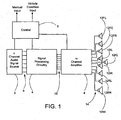
- N-channel audio signal source 2 is communicatingly coupled to signal processing circuitry 4 by signal lines 6.
- Control circuitry 3 may be communicatingly coupled to audio signal source 2, to signal processing circuitry 4, and may be communicatingly coupled directly to m-channel amplifier 8.
- Control circuitry 3 may have input terminals for receiving manual input or for collecting information about operating conditions of the vehicle or both.
- Signal processing circuitry 4 is communicatingly coupled to m channel amplifier 8 by signal lines 10.
- M-channel amplifier 8 (where "m” is a number) is coupled to loudspeakers, designated 12FL (front left); 12FC (front center); 12FR (front right); 12IL (intermediate left); 12IC (intermediate center); 12IR (intermediate right); 12RL (rear left); 12RR (rear right); and 12W (subwoofer) by signal lines 14.
- loudspeakers designated 12FL (front left); 12FC (front center); 12FR (front right); 12IL (intermediate left); 12IC (intermediate center); 12IR (intermediate right); 12RL (rear left); 12RR (rear right); and 12W (subwoofer) by signal lines 14.
- the number and configuration of the loudspeakers may vary from this example.
- N-channel audio signal source 2 may be a conventional source of audio signals, such as a CD or DVD player, a digital storage device, such as a mass storage device or a random access memory, or a radio tuner.
- n channel sources include some channels (typically left (L), right (R), and center (C) channels) that are intended to be perceived as coming from the front; hereinafter, these channels will be referred to as front channels.
- n channel sources include some channels that are intended to be perceived as coming from behind; hereinafter, these channels will be referred to as surround channels.
- the n channels should include rear or surround channels. If the n channels do not include rear or surround channels, signal processing circuitry 4 may contain signal processing circuitry for providing surround channels. Examples of such signal processing circuitry are the Videostage ® decoding circuitry or the CenterpointTM decoding circuitry of Bose Corporation of Framingham, MA, or the Pro Logic ® decoding circuitry or the Pro Logic ® II decoding circuitry available from Dolby Corporation of San Francisco, CA.
- Signal processing circuitry 4 receives as input signals the n channels from the audio signal source, processes the signals, and provides as output streams of processed audio signals to amplifier 8.
- the signal processing may include equalization circuitry, combining circuitry and the like.
- Loudspeakers 12FL - 12W may be conventional loudspeakers, and each loudspeaker may contain one or more acoustic drivers and one or more acoustic elements, such as enclosures, ports, waveguides, horns, or passive radiators. In the event that one or more of loudspeakers 12FL - 12W contain more than one acoustic driver, the loudspeakers may include crossover circuitry. Some elements, such as a volume control, that can affect the gain that is applied to the audio signals by the amplifier 8 are not shown in this view. Signal processing circuitry 4 and amplifier 8 may be incorporated into a single device. There may be additional elements that apply passive signal processing to the amplified audio signals subsequent to the amplifier 8 Control circuitry 3 will be discussed in more detail below.
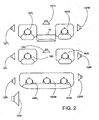
- FIG. 2 shows an example of an acoustic environment appropriate for the invention.
- a vehicle (such as a sport utility vehicle or minivan) interior includes front seating positions 16FL and 16FR, intermediate seating positions 161L and 161R, and rear seating positions 16RL, 16RM, and 16RR.
- Loudspeakers 12FL - 12W are arranged about the vehicle interior as shown.
- a typical loudspeaker type and location for loudspeaker 12FL is a full range, midrange, or bass acoustic driver to the left of and forward of the driver seat location, such as in the driver side door with an additional tweeter unit in the dashboard or the left A-pillar; for loudspeaker 12FC a limited range loudspeaker near the middle of the dashboard; for loudspeaker 121L a full range loudspeaker forward of the intermediate seating position and behind the front seating position, such as in the left rear door; for loudspeaker 12IC a full range or limited range acoustic driver in a central location, such as in a console facing the rear seating area; for loudspeaker 12RL a full range loudspeaker behind the left rear seating position, such as in the left side of the tailgate or near a left rear pillar of the vehicle.
- Loudspeakers 12FR, 12IR, and 12RR are typically of the same type as, positioned symmetrically to, loudspeakers 12FL, 121L, and 12RL, respectively.
- Loudspeaker 12W may be a subwoofer loudspeaker, and may be placed in any convenient location, such as behind, under, or near the rear seat.
- Video monitor 18 is positioned in front of the intermediate seating positions 161L and 161R and facing the rear of the vehicle interior, for example in a console or in a drop down device in the vehicle roof. There may be video monitors in other positions, such as in the seat backs.
- any of the loudspeakers 12FL, 12FC, 12FR, 121L, 121C, 12IR, 12RL, 12RR may have the configuration of loudspeaker 12FC of FIG. 2 , in which the loudspeaker is a limited range loudspeaker to reproduce high or mid and high frequencies, with low frequency signals related to signals reproduced by the limited range loudspeaker re directed to a full range loudspeaker or a woofer or subwoofer loudspeaker, such as loudspeaker 12W.
- any of the loudspeakers 12FL, 12FC, 12FR, 121L, 12IC, 121R, 12RL, 12RR may have the configuration of loudspeaker 12FL, in which there is more than one acoustic driver.
- the two acoustic drivers may be separated, such as one in a passenger door and one in an A-pillar. There may also be additional loudspeakers about the vehicle cabin.
- a feature of the invention is the provision of multiple surround modes.
- a first mode hereinafter “normal surround mode”
- the equalization, fade behavior, and balance takes into account the entire passenger compartment and the perceived loudness does not vary markedly from location to location.
- second mode hereinafter “rear surround mode”
- the equalization, fade behavior, and balance weights the rear seating positions more heavily than the front seating locations, and the perceived loudness is lower in front than in the intermediate and rear seating locations.
- front surround mode hereinafter “front surround mode”
- the equalization, fade behavior, and balance weights the front seating positions more heavily than the rear seating locations and the perceived loudness is greater in the front seating locations than in the intermediate and rear seating locations.
- driver surround mode In a fourth mode (hereinafter “driver surround mode"), the equalization and balance weights the driver's seating position more heavily than the other seating positions, and the perceived loudness is greater at the driver seat than at other seating locations.
- weighting more heavily can include using measurements and listenings from some seating positions to the exclusion of other positions.
- the normal surround mode may be appropriate when the audio program is of interest to both front seat passengers and to rear seating area passengers.
- the rear surround mode may be appropriate when the audio program content is of greater interest to passengers in the rear seating rows of the vehicle passenger compartment, for example, if the audio program content is associated with visual images being displayed on the monitor or if the front seat passengers wish to carry on a conversation, or if the driver wishes to focus attention on some other audio stimulus, such as a navigation system.
- the front surround mode may be appropriate if the audio program is not of interest to the rear seat passengers, if it desirable for reduced sound in the rear seats of the vehicle (for example if there are sleeping children in the rear seat), or if there are no rear seat passengers at all.
- the driver surround mode may be appropriate in circumstances similar to the front surround mode if the front passenger seat is unoccupied.
- one example of a situation in which a rear surround mode is appropriate is when the audio program content is associated with visual images being displayed on a monitor.
- Monitors for the purpose of displaying visual images associated with movies are often placed so that they can be seen by rear seat passengers and not seen by the front seat passengers. Since, in a movie, the audio program is associated with visual images that cannot be seen by the front seat passengers, the audio program may be irrelevant or confusing to the front seat passengers, or may even be annoying, distracting, or dangerous. Additionally, the sound quality may be equalized and balanced for front seat positions (to whom the audio program is irrelevant), at the expense of intermediate and rear seat positions (to whom the audio program is important).
- Normal front/rear fade patterns may also be inappropriate in some circumstances, such as if the audio program is associated with visual images on a monitor.
- a normal front/rear fade pattern in a vehicle at one extreme the perceived loudness of the front speaker radiation is much higher than the perceived loudness of the rear speaker radiation.
- the audio program is associated with visual images on the monitor, it may be more appropriate for the corresponding extreme front/rear fade situation to be such that the amplitude of the intermediate speaker radiation is much higher than the amplitude of the rear speaker radiation and the front speaker radiation.
- FIGS. 3A - 3E illustrate the perceived loudness behavior of the audio system in the various modes.
- FIG. 3A explains some icons used in other views.
- Perceived loudness indicator 30 indicates a reference perceived loudness. The reference perceived loudness is typically the perceived loudness at the position(s) of most interest, or the positions of fade bias (which will be explained below).
- Perceived loudness indicator 32 indicates a perceived loudness that is audibly less than the reference perceived loudness indicator 30.
- Perceived loudness indicator 34 indicates a perceived loudness that is audibly less than perceived loudness indicator 32.
- the icons are intended to indicate general relationships and not precise measurements. The icons are for comparing within a single view only; for example, the perceived loudness indicated by amplitude indicator 30 may differ from figure to figure.
- the perceived loudness of the radiation at all listener locations is approximately the same, as indicated by the amplitude indicators 20FL - 20RR.
- the perceived loudness at the intermediate seating positions and rear seating positions is substantially the same, but the perceived loudness at the front seating positions may be significantly less than the perceived loudness at the intermediate and rear seating positions.
- the perceived loudness at the driver position is higher than the perceived loudness at other seating positions.
- the perceived loudness at the front seating positions is higher than the perceived loudness at the intermediate and rear seating positions.
- the audio signal to the front loudspeakers may be low pass filtered, for example, as indicated in FIG. 3B by low pass filters 28, so that the some speakers are used to radiate bass acoustic energy, but not high frequency acoustic energy.
- Equalization is typically performed to compensate for non-ideal behavior of loudspeakers used to reproduce audio signals and for alterations of the transfer functions from loudspeaker to listener caused by the environment (such as the room or vehicle passenger compartment) in which the loudspeakers operate. Equalization typically includes taking measurements of the frequency response from various loudspeakers at a number of listening locations. The frequency responses at the locations are combined in some manner, such as by averaging or weighting (for example in vehicle, the listening location of the driver's seat or the front seat may be weighted more heavily than rear seat listening locations).
- An equalization pattern that modifies the frequency response is developed so that the frequency response curve has a desirable shape, such as flat or mildly sloped smooth shape, with the amplitudes of peaks and dips minimized.
- Frequency response of EQ therefore varies with changes in surround modes. Improving the frequency response for a loudspeaker at one listening location my result in degrading the response for that loudspeaker at other listening locations. Improving the combined frequency response at one listening location may result in degrading the combined frequency response at other listening locations.
- Uniform balance means that at a listening position, a balanced amount of acoustic energy is perceived as received from each the loudspeakers, so that a listener does not localize predominantly on any one loudspeaker.
- Balance is modified by adjusting the transfer functions applied to the audio signals (which may include the equivalent of amplifying or attenuating the signals, delaying the signals, changing the phase of the signals, and other adjustments) so that the listener perceives an acoustic image that is not skewed to any particular location.
- the adjustments may be frequency dependent.
- uniform balance is desirable.
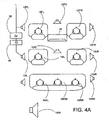
- a desirable balance pattern may include delaying the arrival of radiation from the rear speakers for an enhanced sense of spaciousness. Balance is particularly important if an audio signal is radiated by more than one loudspeaker and if a listening location is near two loudspeakers that radiate the same signal. An example will be shown in FIGS. 4A - 4B .
- t for all the loudspeakers is about the same, the balance at that location is more uniform than if the test tones arrive at varying times. Perception of a balanced amount of radiation from the loudspeakers is a function of both t and sound pressure level. Balance often involves making time/intensity tradeoffs; for example greater sound pressure level from one loudspeaker can be compensated for by applying a delay ⁇ t to the signal to delay arrival time from the speaker. Balance is particularly important if the same signal is radiated from more than one loudspeaker.
- the channel L signal is transmitted to loudspeaker 12FL (relatively near to seating positions 16FL, 16FR, 161L, and 16IR) to radiate channel L.
- the channel L signal may also transmitted to loudspeaker 12IL (relatively near to seating positions 161L, 16IR, 16RL, 16RM, and 16RR) to radiate channel L. It may be desirable to prevent the listener in position 16FL from localizing on the L radiation from loudspeaker 12IL.
- the L signal to loudspeaker 12IL is delayed by time delay 36 so that the arrival time at seating position 16FL of radiation from loudspeaker 12IL is later than the arrival time of radiation from loudspeaker 12FL and so that radiation from loudspeakers 12FL and 12IL arrive at seating location 16IL sufficiently close in time to prevent the impression of an echo .
- the L signal to loudspeaker 12IL may be attenuated by attenuator 38 so that the radiation intensity at seating location 16FL from loudspeaker 12L is less than the radiation intensity from loudspeaker 12FL.
- time delay 36 and attenuator 38 are shown as discrete blocks. In an actual implementation, the functions executed by the time delays and the attenuators could be executed by signal processing circuitry 4.
- FIG. 4B operating in rear surround mode, it is not necessary to radiate the L channel to seating positions 16FL and 16FR or to consider where listeners in seating positions 16FL and 16FR might localize.
- the channel L signal may be transmitted to loudspeaker 12IL to radiate channel L to seating positions 16IL, 16IR, 16RL, 16RM, and 16RR.
- time delay 36 and attenuator 38 of FIG. 4B are not required.
- the R and C channels could be adjusted in a manner similar to the L channel.
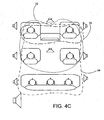
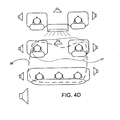
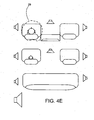
- FIGS. 4C - 4E illustrate different seating locations that may be emphasized or exclusively considered in developing balance and EQ patterns for the various surround modes.
- the normal surround mode EQ pattern may be developed by taking measurements (by a measuring device) and listenings (by a human listener) at locations that include all seating areas, as indicated by line 24
- measurements and listenings from the area indicated by line 25 or line 22 may be weighted somewhat more heavily than measurements and listenings from the rest of the passenger compartment in developing the EQ and balance pattern.
- EQ and balance development for the front surround mode could use the measurements and listenings exclusively from the area indicated by line 25.
- the EQ and balance pattern for the rear surround modes may be developed by taking measurements in the areas that do not include the front seating positions or which weigh measurements and listenings at the front seat positions less heavily than measurements and listenings at other positions in the intermediate and rear seating areas. For example, measurement may be taken at the intermediate and rear seating areas, as indicated by line 26. In some implementations, measurements and listenings from the intermediate seating area, as indicated by line 27, can be weighted somewhat more heavily than measurements and listenings from the rear seating area.
- the EQ pattern in a rear seat mode could be adjusted to result in a different frequency response curve than the normal surround mode.
- An example of a different frequency response curve is the so-called "X-Curve", commonly associated with movie sound tracks and available as SMPTE Standard 202M-1998, from the Society of Motion Picture Television Engineers (SMPTE, internet url smpte.org).
- the EQ and balance pattern for the driver surround mode may be developed by taking measurements and listenings in the driver seating area only, as indicated by line 29.
- One method of achieving good balance in the driver surround mode is to adjust the transfer functions applied to the audio signals so that the radiation from each of the loudspeakers is substantially equal and so that the time of arrival of radiation from each of the loudspeakers is substantially equal and so that the perceived loudness has the pattern of FIG. 3A or 3D .
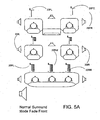
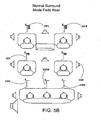
- FIGS. 5A and 5B and FIGS. 6A and 6B illustrate the front/rear fade behavior of the normal surround mode and the rear surround mode.
- a typical front/rear fade control system provides for biasing the relative amplitude of the acoustic radiation toward the front of a listening area or to the rear of a listening area.
- An adjustment device (such as a rotary knob or slide bar) typically allows a range of settings from one extreme, in which the relative amplitude of the acoustic radiation is strongly biased toward the front of the listening area (hereinafter “fade front”) to another extreme, in which the relative amplitude of the acoustic radiation is strongly biased toward the rear of the listening area (hereinafter “fade rear”).
- the perceived loudness at the front seating location is the highest (as indicated by amplitude indicators 20FL - 20RR), the perceived loudness at the rear seating location is lowest, and the perceived loudness at the intermediate seating location is between the perceived loudness at the front seating location and the rear seating location.
- the perceived loudness at the rear seating location is the highest, the perceived loudness at the front seating location is lowest, and the perceived loudness at the intermediate seating location is between the perceived loudness at the front seating location and the rear seating location.
- a fade rear condition listeners tend to localize toward the rear speakers.
- operation of the front/rear fade function changes with the different surround modes.
- the rear surround mode with the front/rear fade set to fade front is + illustrated in FIG. 6A
- the perceived loudness at the intermediate seating location is the higher than the perceived loudness at the rear seating location.
- the perceived loudness at the front seating location may be at a low level decoupled from the front/rear fade control; the front speakers 12FL, 12FC, and 12FR may be low pass filtered, significantly attenuated or muted.
- the perceived loudness at the rear seating location is higher than the perceived loudness at the front seating location.
- the perceived loudness at the front seating location may be at a low level decoupled from the front/rear fade control, and the front speakers 12FL, 12FC, and 12FR may be low pass filtered, significantly attenuated or muted.
- the invention may be implemented with a front/rear fade adjustment control as described in co-pending U.S. Pat. publication US 2004 16 1126, filed February 14, 2003 , assigned to the same assignee as the current application.
- Selection of modes is done by control circuitry 3. Selection may be based on one of, or a combination of, manual selection, in which the user selects a mode, which may include a switch arrangement, in which the mode is selected by the current position of a switch; automatic selection, in which the control circuitry selects a mode based on predetermined rules (typically including a provision for manual override of the automatic selection); or a default system, in which case one mode is selected unless manually overridden.
- Automatic selection methods may include detecting of whether an input media device is a DVD-Audio disk or Super Audio CD (SACD) disk or a DVD-video disk, or reading metadata embedded in the source signal. Additionally, automatic selection methods may include detecting conditions of the vehicle, for example detecting if the vehicle ignition is in the "on" position or if the vehicle transmission is in a drive gear or detecting which seating positions are occupied.
- An example of automatic selection could include: detecting if the audio signal source has associated video content; determining whether the vehicle ignition is on; if there is associated in video content and the ignition is on, selecting rear surround mode, and in other conditions selecting full surround mode.
- the invention has been described using a minivan or a sport utility vehicle having three rows of seats.
- the invention can also be applied to vehicles having two rows of seats or more than three rows of seats such as a large van or small bus.
- a vehicle audio system according to the invention is advantageous over conventional vehicle audio systems because it reduces intrusion of the audio program to areas of the vehicle cabin in which the audio program may be unwanted, annoying, or distracting, while providing for an improve acoustic experience to other areas of the vehicle cabin.
Landscapes
- Physics & Mathematics (AREA)
- Engineering & Computer Science (AREA)
- Acoustics & Sound (AREA)
- Signal Processing (AREA)
- Stereophonic System (AREA)
- Fittings On The Vehicle Exterior For Carrying Loads, And Devices For Holding Or Mounting Articles (AREA)
- Circuit For Audible Band Transducer (AREA)
- Details Of Audible-Bandwidth Transducers (AREA)
Claims (12)
- Système audio à effet spatial pour un véhicule, où le système comprend:une pluralité de modes de travail, comprenant,- un premier mode de travail, comprenant un premier modèle d'égalisation, qui, s'il est appliqué aux signaux audio dans une pluralité de voies, comprenant des voies à effet spatial, résulte, à une première d'une pluralité de places assises, dans une réponse en fréquence essentiellement plus souple qu'à d'autres de la pluralité de places assises, et- un deuxième mode de travail, comprenant un deuxième modèle d'égalisation, qui, s'il est appliqué aux signaux audio dans une pluralité de voies, comprenant des voies à effet spatial, résulte dans une réponse en fréquence, qui crée une souplesse essentiellement similaire à chacune de la pluralité de places assises.
- Système audio à effet spatial selon la revendication 1, où- le premier mode de travail comprend en outre un niveau de pression sonore plus élevé à une première des places assises par rapport aux autres places assises en ce qu'il concerne l'émission correspondant à la pluralité de voies, comprenant lesdites voies à effet spatial, et- le deuxième mode de travail comprend en outre un niveau de pression sonore essentiellement égal à chacune de ladite pluralité de places assises en ce qu'il concerne l'émission correspondant à la pluralité de voies, comprenant les voies à effet spatial.
- Système audio à effet spatial selon la revendication 1, où- le premier mode de travail comprend en outre un modèle de compensation, dans lequel un niveau de pression sonore de chacune de la pluralité de haut-parleurs est essentiellement identique à une première place assise et est non-identique aux autres places assises, et- le deuxième mode de travail comprend en outre un modèle de compensation, dans lequel les mesures du niveau de pression sonore de chacun des haut-parleurs à chacune des places assises sont essentiellement identiques.
- Système audio selon la revendication 1, où la pluralité des modes de travail comprend en outre un troisième mode de travail, qui comprend un niveau de pression sonore plus élevé à une deuxième des places assises, face aux autres places assises, un modèle d'égalisation, qui, s'il est appliqué aux signaux audio, résulte dans une réponse en fréquence à la deuxième des places assises, qui est considérablement plus souple que les réponses en fréquence aux autres places assises, et comprend un modèle de compensation, où le niveau de pression sonore de chacune de la pluralité d'haut-parleurs est essentiellement égal à la deuxième place assise et est différent aux autres places assises.
- Système audio selon l'une quelconque des revendications 1 à 3, où la première place assise comprend une place assise de conducteur (16FL).
- Système audio selon la revendication 4, où la deuxième place assise comprend la position de place assise devant (16FL, 16FR).
- Système audio selon l'une quelconque des revendications 1 à 3, où la première place assise est l'une d'une place assise intermédiaire (16IL, 16IR) et d'une place assise arrière (16RL, 16RM, 16RR).
- Système audio selon la revendication 7, où la pluralité des modèles d'égalisation comprend en outre un troisième modèle d'égalisation, qui, s'il est appliqué aux signaux audio, résulte dans une réponse en fréquence essentiellement plus souple aux autres des places assises arrières et aux places assises intermédiaires.
- Système audio selon la revendication 8, où le troisième modèle d'égalisation comprend une courbe cible, où la courbe cible est une courbe en X.
- Système audio selon la revendication 1, où le premier modèle d'égalisation comprend une courbe cible, où la courbe cible est une courbe en X.
- Système audio selon la revendication 1, où- le premier mode de travail comprend en outre un niveau de pression sonore de radiation essentiellement différent, correspondant à la pluralité de voies, comprenant une voie à effet spatial, à une première d'une pluralité de places assises différent aux autres des places assises, et- le deuxième mode de la pluralité de modes comprend en outre un niveau de pression sonore de radiation essentiellement uniforme correspondant à la pluralité de voies, comprenant les voies à effet spatial, à chacune desdites places assises.
- Système audio selon la revendication 11, où la première des places assises est soit une place assise intermédiaire ou une place assise arrière.
Applications Claiming Priority (2)
| Application Number | Priority Date | Filing Date | Title |
|---|---|---|---|
| US10/756,028 US7653203B2 (en) | 2004-01-13 | 2004-01-13 | Vehicle audio system surround modes |
| US756028 | 2004-01-13 |
Publications (3)
| Publication Number | Publication Date |
|---|---|
| EP1558060A2 EP1558060A2 (fr) | 2005-07-27 |
| EP1558060A3 EP1558060A3 (fr) | 2006-09-20 |
| EP1558060B1 true EP1558060B1 (fr) | 2009-12-23 |
Family
ID=34634545
Family Applications (1)
| Application Number | Title | Priority Date | Filing Date |
|---|---|---|---|
| EP05250053A Ceased EP1558060B1 (fr) | 2004-01-13 | 2005-01-07 | Modes de son à effet spatial dans un système audio pour un véhicule |
Country Status (5)
| Country | Link |
|---|---|
| US (2) | US7653203B2 (fr) |
| EP (1) | EP1558060B1 (fr) |
| JP (1) | JP4737994B2 (fr) |
| CN (1) | CN100569008C (fr) |
| DE (1) | DE602005018402D1 (fr) |
Families Citing this family (61)
| Publication number | Priority date | Publication date | Assignee | Title |
|---|---|---|---|---|
| JPH03139241A (ja) * | 1989-08-02 | 1991-06-13 | Fuji Oil Co Ltd | チョコレート成分含有食品及びその製造法 |
| DE50311478D1 (de) * | 2003-06-20 | 2009-06-10 | Harman Becker Automotive Sys | Tonsignal-Bearbeitungsvorrichtung und Tonsignal-Bearbeitungsverfahren mit automatischer Klangspektrumauswahl |
| EP1591995B1 (fr) * | 2004-04-29 | 2019-06-19 | Harman Becker Automotive Systems GmbH | Système de communication d'intérieur pour une cabine de véhicule |
| US20070242832A1 (en) * | 2004-06-04 | 2007-10-18 | Matsushita Electric Industrial Co., Ltd. | Acoustical Signal Processing Apparatus |
| US20060002571A1 (en) * | 2004-06-30 | 2006-01-05 | International Business Machines Corporation | Self-adjusted car stereo system |
| US7688992B2 (en) * | 2005-09-12 | 2010-03-30 | Richard Aylward | Seat electroacoustical transducing |
| US8090116B2 (en) * | 2005-11-18 | 2012-01-03 | Holmi Douglas J | Vehicle directional electroacoustical transducing |
| DE602006007322D1 (de) * | 2006-04-25 | 2009-07-30 | Harman Becker Automotive Sys | Fahrzeugkommunikationssystem |
| WO2008006376A1 (fr) * | 2006-07-13 | 2008-01-17 | Bang & Olufsen A/S | Procédé, appareil, et système de redistribution spatiale de son direct et ambiant |
| DE102006039162A1 (de) * | 2006-08-21 | 2008-02-28 | Lear Corp., Southfield | Schutzverfahren für Lautsprechersysteme |
| EP1986466B1 (fr) * | 2007-04-25 | 2018-08-08 | Harman Becker Automotive Systems GmbH | Procédé et appareil pour le réglage du son |
| US8325936B2 (en) * | 2007-05-04 | 2012-12-04 | Bose Corporation | Directionally radiating sound in a vehicle |
| US8724827B2 (en) | 2007-05-04 | 2014-05-13 | Bose Corporation | System and method for directionally radiating sound |
| US20080273722A1 (en) * | 2007-05-04 | 2008-11-06 | Aylward J Richard | Directionally radiating sound in a vehicle |
| US9560448B2 (en) * | 2007-05-04 | 2017-01-31 | Bose Corporation | System and method for directionally radiating sound |
| US8483413B2 (en) * | 2007-05-04 | 2013-07-09 | Bose Corporation | System and method for directionally radiating sound |
| US9100748B2 (en) * | 2007-05-04 | 2015-08-04 | Bose Corporation | System and method for directionally radiating sound |
| US20080273724A1 (en) * | 2007-05-04 | 2008-11-06 | Klaus Hartung | System and method for directionally radiating sound |
| US8041438B2 (en) * | 2007-06-28 | 2011-10-18 | Apple Inc. | Data-driven media management within an electronic device |
| US7861008B2 (en) * | 2007-06-28 | 2010-12-28 | Apple Inc. | Media management and routing within an electronic device |
| US8111837B2 (en) * | 2007-06-28 | 2012-02-07 | Apple Inc. | Data-driven media management within an electronic device |
| US8171177B2 (en) | 2007-06-28 | 2012-05-01 | Apple Inc. | Enhancements to data-driven media management within an electronic device |
| EP2051543B1 (fr) | 2007-09-27 | 2011-07-27 | Harman Becker Automotive Systems GmbH | Gestion automatique des sons graves |
| US9100766B2 (en) * | 2009-10-05 | 2015-08-04 | Harman International Industries, Inc. | Multichannel audio system having audio channel compensation |
| US8934645B2 (en) | 2010-01-26 | 2015-01-13 | Apple Inc. | Interaction of sound, silent and mute modes in an electronic device |
| JPWO2011121955A1 (ja) * | 2010-03-30 | 2013-07-04 | パナソニック株式会社 | オーディオ装置 |
| US8654989B2 (en) * | 2010-09-01 | 2014-02-18 | Honda Motor Co., Ltd. | Rear surround sound system and method for vehicle |
| US8989884B2 (en) | 2011-01-11 | 2015-03-24 | Apple Inc. | Automatic audio configuration based on an audio output device |
| US8971546B2 (en) * | 2011-10-14 | 2015-03-03 | Sonos, Inc. | Systems, methods, apparatus, and articles of manufacture to control audio playback devices |
| JP6278966B2 (ja) * | 2012-09-13 | 2018-02-14 | ハーマン インターナショナル インダストリーズ インコーポレイテッド | マルチゾーン聴取環境における漸進的な音響バランスおよびフェード |
| US9251787B1 (en) | 2012-09-26 | 2016-02-02 | Amazon Technologies, Inc. | Altering audio to improve automatic speech recognition |
| US20140095023A1 (en) | 2012-09-28 | 2014-04-03 | Tesla Motors, Inc. | Vehicle Air Suspension Control System |
| US10019066B2 (en) | 2012-09-28 | 2018-07-10 | Tesla, Inc. | Method of launching an application and selecting the application target window |
| US20140093107A1 (en) * | 2012-09-28 | 2014-04-03 | Tesla Motors, Inc. | Automated Audio Optimization System |
| US9591405B2 (en) * | 2012-11-09 | 2017-03-07 | Harman International Industries, Incorporated | Automatic audio enhancement system |
| KR101342149B1 (ko) * | 2012-12-13 | 2013-12-13 | 전자부품연구원 | 차량용 음향 분리 방법, 그리고 이를 수행하는 네트워크 관리장치 |
| US10725726B2 (en) * | 2012-12-20 | 2020-07-28 | Strubwerks, LLC | Systems, methods, and apparatus for assigning three-dimensional spatial data to sounds and audio files |
| US10291983B2 (en) | 2013-03-15 | 2019-05-14 | Elwha Llc | Portable electronic device directed audio system and method |
| JP6388907B2 (ja) * | 2013-03-15 | 2018-09-12 | ティ エイチ エックス リミテッド | 所定聴取空間内の特定位置におけるサウンドフィールドを修正する方法及びシステム |
| US10181314B2 (en) * | 2013-03-15 | 2019-01-15 | Elwha Llc | Portable electronic device directed audio targeted multiple user system and method |
| US10531190B2 (en) | 2013-03-15 | 2020-01-07 | Elwha Llc | Portable electronic device directed audio system and method |
| US10575093B2 (en) | 2013-03-15 | 2020-02-25 | Elwha Llc | Portable electronic device directed audio emitter arrangement system and method |
| US9886941B2 (en) | 2013-03-15 | 2018-02-06 | Elwha Llc | Portable electronic device directed audio targeted user system and method |
| EP2974010B1 (fr) * | 2013-03-15 | 2021-08-18 | DTS, Inc. | Mixage de musique multicanal automatique à partir de multiples pistes audio |
| JP6284331B2 (ja) * | 2013-10-01 | 2018-02-28 | アルパイン株式会社 | 会話支援装置、会話支援方法及び会話支援プログラム |
| EP2930955B1 (fr) * | 2014-04-07 | 2021-02-17 | Harman Becker Automotive Systems GmbH | Filtrage adaptatif |
| US9725047B2 (en) * | 2015-06-22 | 2017-08-08 | Ford Global Technologies, Llc | Loudspeaker arrangement in a vehicle |
| US9628894B2 (en) | 2015-08-12 | 2017-04-18 | GM Global Technology Operations LLC | Audio entertainment system for a vehicle |
| DE112017000382T5 (de) * | 2016-01-14 | 2018-09-27 | Harman International Industries, Incorporated | Schallstrahlungsmustersteuerung |
| JP6465058B2 (ja) * | 2016-03-31 | 2019-02-06 | マツダ株式会社 | 車両用効果音発生装置 |
| EP3232688A1 (fr) | 2016-04-12 | 2017-10-18 | Fraunhofer-Gesellschaft zur Förderung der angewandten Forschung e.V. | Appareil et procédé permettant de fournir des zones de sons individuels |
| CN106231503B (zh) * | 2016-09-19 | 2018-05-29 | 清华大学 | 一种用于车内分区域控制的音频系统及控制方法 |
| EP3484176A1 (fr) * | 2017-11-10 | 2019-05-15 | Nxp B.V. | Contrôleur de présentation audio de véhicule |
| JP7211013B2 (ja) * | 2018-10-31 | 2023-01-24 | トヨタ自動車株式会社 | 車両用音入出力装置 |
| WO2020141020A1 (fr) * | 2019-01-03 | 2020-07-09 | Harman Becker Automotive Systems Gmbh | Système sonore à largeur améliorée du signal sonore perçu |
| US12028692B2 (en) | 2019-10-30 | 2024-07-02 | Harman Becker Automotive Systems Gmbh | Loudspeaker arrangement |
| JP7441660B2 (ja) * | 2020-02-04 | 2024-03-01 | 株式会社デンソーテン | 後席ディスプレイ装置、車載システムおよび制御方法 |
| JP7013514B2 (ja) * | 2020-03-31 | 2022-01-31 | 本田技研工業株式会社 | 車両 |
| KR20240050843A (ko) * | 2022-10-12 | 2024-04-19 | 현대자동차주식회사 | 차량 및 그 제어 방법 |
| CN115884034A (zh) * | 2022-12-14 | 2023-03-31 | 中国第一汽车股份有限公司 | 一种车辆重低音均衡控制方法及装置 |
| CN120186528A (zh) * | 2023-12-19 | 2025-06-20 | 哈曼贝克自动系统股份有限公司 | 自动音频调谐系统 |
Family Cites Families (28)
| Publication number | Priority date | Publication date | Assignee | Title |
|---|---|---|---|---|
| US5043970A (en) * | 1988-01-06 | 1991-08-27 | Lucasarts Entertainment Company | Sound system with source material and surround timbre response correction, specified front and surround loudspeaker directionality, and multi-loudspeaker surround |
| JPH0236698A (ja) * | 1988-07-26 | 1990-02-06 | Mazda Motor Corp | 車両用オーディオ装置 |
| US5146507A (en) * | 1989-02-23 | 1992-09-08 | Yamaha Corporation | Audio reproduction characteristics control device |
| US5428687A (en) * | 1990-06-08 | 1995-06-27 | James W. Fosgate | Control voltage generator multiplier and one-shot for integrated surround sound processor |
| GB9026906D0 (en) * | 1990-12-11 | 1991-01-30 | B & W Loudspeakers | Compensating filters |
| JP2779276B2 (ja) * | 1991-07-11 | 1998-07-23 | 三菱電機株式会社 | 音響再生装置 |
| US5754664A (en) * | 1993-09-09 | 1998-05-19 | Prince Corporation | Vehicle audio system |
| JP3572646B2 (ja) * | 1993-11-29 | 2004-10-06 | ソニー株式会社 | 車載用音響機器システム |
| US5797092A (en) * | 1994-04-28 | 1998-08-18 | Metro One Telecommunications, Inc. | Method for monitoring the connection between the subscriber and the destination telephone and providing directory assistance upon detection of predetermined tone |
| US5661811A (en) * | 1994-08-25 | 1997-08-26 | Delco Electronics Corporation | Rear seat audio control with multiple media |
| US5680468A (en) * | 1995-02-21 | 1997-10-21 | Chrysler Corporation | Methods of and systems for speaker equalization in automotive vehicles having convertible tops |
| US5983087A (en) * | 1997-06-26 | 1999-11-09 | Delco Electronics Corporation | Distributed digital signal processing for vehicle audio systems |
| DE19739425A1 (de) * | 1997-09-09 | 1999-03-11 | Bosch Gmbh Robert | Verfahren und Anordnung zur Wiedergabe eines sterophonen Audiosignals |
| US6195435B1 (en) * | 1998-05-01 | 2001-02-27 | Ati Technologies | Method and system for channel balancing and room tuning for a multichannel audio surround sound speaker system |
| US6993144B1 (en) | 1999-09-30 | 2006-01-31 | Etymotic Research, Inc. | Insert earphone assembly for audiometric testing and method for making same |
| DE60040554D1 (de) * | 2000-08-07 | 2008-11-27 | Mitsubishi Electric Corp | Audiovisuelles system in einem kraftfahrzeug |
| JP2002152900A (ja) * | 2000-11-09 | 2002-05-24 | Pioneer Electronic Corp | 音量制御装置 |
| WO2002065815A2 (fr) | 2001-02-09 | 2002-08-22 | Thx Ltd | Systeme sonore et procede de reproduction sonore |
| JP4215967B2 (ja) * | 2001-05-29 | 2009-01-28 | パイオニア株式会社 | 音響装置 |
| JP2002354600A (ja) * | 2001-05-29 | 2002-12-06 | Pioneer Electronic Corp | 音響装置 |
| EP1280377A1 (fr) | 2001-07-27 | 2003-01-29 | A&D Engineering Co., Ltd. | Configuration de haut-parleurs et processeur de signal pour la reproduction sonore stéréo pour un véhicule et véhicule avec la configuration |
| JP2003089330A (ja) * | 2001-09-18 | 2003-03-25 | Matsushita Electric Ind Co Ltd | 車載用音響映像制御装置 |
| JP4019952B2 (ja) * | 2002-01-31 | 2007-12-12 | 株式会社デンソー | 音響出力装置 |
| US7123737B2 (en) | 2002-02-13 | 2006-10-17 | Plantronics, Inc. | Ear clasp headset |
| US7483540B2 (en) * | 2002-03-25 | 2009-01-27 | Bose Corporation | Automatic audio system equalizing |
| CN1701520B (zh) * | 2003-01-23 | 2011-09-28 | 哈曼贝克自动系统股份有限公司 | 具有平衡设置的多通道音频系统和控制平衡设置的方法 |
| US7305097B2 (en) * | 2003-02-14 | 2007-12-04 | Bose Corporation | Controlling fading and surround signal level |
| US20050074131A1 (en) * | 2003-10-06 | 2005-04-07 | Mc Call Clark E. | Vehicular sound processing system |
-
2004
- 2004-01-13 US US10/756,028 patent/US7653203B2/en active Active
-
2005
- 2005-01-07 EP EP05250053A patent/EP1558060B1/fr not_active Ceased
- 2005-01-07 DE DE602005018402T patent/DE602005018402D1/de not_active Expired - Lifetime
- 2005-01-10 CN CNB2005100036396A patent/CN100569008C/zh not_active Expired - Fee Related
- 2005-01-13 JP JP2005006643A patent/JP4737994B2/ja not_active Expired - Fee Related
-
2009
- 2009-11-17 US US12/620,114 patent/US8031880B2/en not_active Expired - Fee Related
Also Published As
| Publication number | Publication date |
|---|---|
| CN100569008C (zh) | 2009-12-09 |
| HK1079034A1 (zh) | 2006-03-24 |
| US20050152562A1 (en) | 2005-07-14 |
| EP1558060A3 (fr) | 2006-09-20 |
| US8031880B2 (en) | 2011-10-04 |
| CN1642363A (zh) | 2005-07-20 |
| US20100080401A1 (en) | 2010-04-01 |
| JP2005210717A (ja) | 2005-08-04 |
| JP4737994B2 (ja) | 2011-08-03 |
| EP1558060A2 (fr) | 2005-07-27 |
| US7653203B2 (en) | 2010-01-26 |
| DE602005018402D1 (de) | 2010-02-04 |
Similar Documents
| Publication | Publication Date | Title |
|---|---|---|
| EP1558060B1 (fr) | Modes de son à effet spatial dans un système audio pour un véhicule | |
| US6501843B2 (en) | Automotive audio reproducing apparatus | |
| EP1387601B1 (fr) | Système de traitement du son avec mélange adaptatif de décodage matriciel actif et de traitement matriciel passif | |
| JP4408670B2 (ja) | 歪制限技術を使用するサウンド処理システム | |
| US9628894B2 (en) | Audio entertainment system for a vehicle | |
| EP1504549B1 (fr) | Système audio a son enveloppant discrèt destiné a un usage domestique et automobile | |
| US20030021433A1 (en) | Speaker configuration and signal processor for stereo sound reproduction for vehicle and vehicle having the same | |
| US20050213786A1 (en) | Acoustic system for vehicle and corresponding device | |
| US20020181713A1 (en) | Audio apparatus | |
| EP1280377A1 (fr) | Configuration de haut-parleurs et processeur de signal pour la reproduction sonore stéréo pour un véhicule et véhicule avec la configuration | |
| US20240373184A1 (en) | A method of processing audio for playback of immersive audio | |
| JP2001069598A (ja) | 車載用マルチチャネルオーディオ再生装置 | |
| HK1079034B (en) | System and method of vehicle audio surround modes | |
| US20250048051A1 (en) | A method of processing audio for playback of immersive audio | |
| JPH01223895A (ja) | 音響再生装置 | |
| CN117652161A (zh) | 用于回放沉浸式音频的音频处理方法 | |
| CN118633301A (zh) | 用于回放沉浸式音频的音频处理方法 | |
| JP2022006537A (ja) | 再生装置、設定方法、及び車載スピーカシステム | |
| JP2003054326A (ja) | 車両用ステレオ音響再生のためのスピーカー配置と信号処理機及びこれらを備えた車両 | |
| HK1073947B (en) | Discrete surround audio system for home and automotive listening |
Legal Events
| Date | Code | Title | Description |
|---|---|---|---|
| PUAI | Public reference made under article 153(3) epc to a published international application that has entered the european phase |
Free format text: ORIGINAL CODE: 0009012 |
|
| AK | Designated contracting states |
Kind code of ref document: A2 Designated state(s): AT BE BG CH CY CZ DE DK EE ES FI FR GB GR HU IE IS IT LI LT LU MC NL PL PT RO SE SI SK TR |
|
| AX | Request for extension of the european patent |
Extension state: AL BA HR LV MK YU |
|
| PUAL | Search report despatched |
Free format text: ORIGINAL CODE: 0009013 |
|
| AK | Designated contracting states |
Kind code of ref document: A3 Designated state(s): AT BE BG CH CY CZ DE DK EE ES FI FR GB GR HU IE IS IT LI LT LU MC NL PL PT RO SE SI SK TR |
|
| AX | Request for extension of the european patent |
Extension state: AL BA HR LV MK YU |
|
| RIN1 | Information on inventor provided before grant (corrected) |
Inventor name: PRAGER, LEE A. Inventor name: HOLMI, DOUGLAS J. |
|
| RIN1 | Information on inventor provided before grant (corrected) |
Inventor name: TORIO, GUY A. Inventor name: PRAGER, LEE A. Inventor name: HOLMI, DOUGLAS J. |
|
| 17P | Request for examination filed |
Effective date: 20070320 |
|
| AKX | Designation fees paid |
Designated state(s): DE GB |
|
| 17Q | First examination report despatched |
Effective date: 20070425 |
|
| GRAP | Despatch of communication of intention to grant a patent |
Free format text: ORIGINAL CODE: EPIDOSNIGR1 |
|
| GRAS | Grant fee paid |
Free format text: ORIGINAL CODE: EPIDOSNIGR3 |
|
| GRAA | (expected) grant |
Free format text: ORIGINAL CODE: 0009210 |
|
| AK | Designated contracting states |
Kind code of ref document: B1 Designated state(s): DE GB |
|
| REG | Reference to a national code |
Ref country code: GB Ref legal event code: FG4D |
|
| REF | Corresponds to: |
Ref document number: 602005018402 Country of ref document: DE Date of ref document: 20100204 Kind code of ref document: P |
|
| PLBE | No opposition filed within time limit |
Free format text: ORIGINAL CODE: 0009261 |
|
| STAA | Information on the status of an ep patent application or granted ep patent |
Free format text: STATUS: NO OPPOSITION FILED WITHIN TIME LIMIT |
|
| 26N | No opposition filed |
Effective date: 20100924 |
|
| PGFP | Annual fee paid to national office [announced via postgrant information from national office to epo] |
Ref country code: ES Payment date: 20190131 Year of fee payment: 14 |
|
| PGFP | Annual fee paid to national office [announced via postgrant information from national office to epo] |
Ref country code: DE Payment date: 20200129 Year of fee payment: 16 |
|
| GBPC | Gb: european patent ceased through non-payment of renewal fee |
Effective date: 20200107 |
|
| PG25 | Lapsed in a contracting state [announced via postgrant information from national office to epo] |
Ref country code: GB Free format text: LAPSE BECAUSE OF NON-PAYMENT OF DUE FEES Effective date: 20200107 |
|
| REG | Reference to a national code |
Ref country code: DE Ref legal event code: R119 Ref document number: 602005018402 Country of ref document: DE |
|
| PG25 | Lapsed in a contracting state [announced via postgrant information from national office to epo] |
Ref country code: DE Free format text: LAPSE BECAUSE OF NON-PAYMENT OF DUE FEES Effective date: 20210803 |