EP1560235A2 - Composant multicouche électrique - Google Patents
Composant multicouche électrique Download PDFInfo
- Publication number
- EP1560235A2 EP1560235A2 EP05001704A EP05001704A EP1560235A2 EP 1560235 A2 EP1560235 A2 EP 1560235A2 EP 05001704 A EP05001704 A EP 05001704A EP 05001704 A EP05001704 A EP 05001704A EP 1560235 A2 EP1560235 A2 EP 1560235A2
- Authority
- EP
- European Patent Office
- Prior art keywords
- layers
- layer
- electrode
- electrode layers
- shielding
- Prior art date
- Legal status (The legal status is an assumption and is not a legal conclusion. Google has not performed a legal analysis and makes no representation as to the accuracy of the status listed.)
- Granted
Links
- 239000003990 capacitor Substances 0.000 claims abstract description 103
- 239000000463 material Substances 0.000 claims description 18
- KDLHZDBZIXYQEI-UHFFFAOYSA-N Palladium Chemical compound [Pd] KDLHZDBZIXYQEI-UHFFFAOYSA-N 0.000 claims description 6
- BASFCYQUMIYNBI-UHFFFAOYSA-N platinum Chemical compound [Pt] BASFCYQUMIYNBI-UHFFFAOYSA-N 0.000 claims description 6
- PXHVJJICTQNCMI-UHFFFAOYSA-N Nickel Chemical compound [Ni] PXHVJJICTQNCMI-UHFFFAOYSA-N 0.000 claims description 4
- 230000001419 dependent effect Effects 0.000 claims description 4
- BQCADISMDOOEFD-UHFFFAOYSA-N Silver Chemical compound [Ag] BQCADISMDOOEFD-UHFFFAOYSA-N 0.000 claims description 3
- 229910052709 silver Inorganic materials 0.000 claims description 3
- 239000004332 silver Substances 0.000 claims description 3
- RYGMFSIKBFXOCR-UHFFFAOYSA-N Copper Chemical compound [Cu] RYGMFSIKBFXOCR-UHFFFAOYSA-N 0.000 claims description 2
- 229910001252 Pd alloy Inorganic materials 0.000 claims description 2
- 229910001260 Pt alloy Inorganic materials 0.000 claims description 2
- 229910052802 copper Inorganic materials 0.000 claims description 2
- 239000010949 copper Substances 0.000 claims description 2
- 229910052759 nickel Inorganic materials 0.000 claims description 2
- 229910052763 palladium Inorganic materials 0.000 claims description 2
- 229910052697 platinum Inorganic materials 0.000 claims description 2
- 229910001316 Ag alloy Inorganic materials 0.000 claims 2
- 239000000919 ceramic Substances 0.000 description 19
- 238000010586 diagram Methods 0.000 description 12
- 230000008878 coupling Effects 0.000 description 5
- 238000010168 coupling process Methods 0.000 description 5
- 238000005859 coupling reaction Methods 0.000 description 5
- 230000015572 biosynthetic process Effects 0.000 description 3
- 238000006073 displacement reaction Methods 0.000 description 3
- 229910002113 barium titanate Inorganic materials 0.000 description 2
- JRPBQTZRNDNNOP-UHFFFAOYSA-N barium titanate Chemical compound [Ba+2].[Ba+2].[O-][Ti]([O-])([O-])[O-] JRPBQTZRNDNNOP-UHFFFAOYSA-N 0.000 description 2
- 229910010293 ceramic material Inorganic materials 0.000 description 2
- 238000005516 engineering process Methods 0.000 description 2
- 238000004519 manufacturing process Methods 0.000 description 2
- 238000005245 sintering Methods 0.000 description 2
- 230000001629 suppression Effects 0.000 description 2
- 208000032365 Electromagnetic interference Diseases 0.000 description 1
- 229910052772 Samarium Inorganic materials 0.000 description 1
- RTAQQCXQSZGOHL-UHFFFAOYSA-N Titanium Chemical compound [Ti] RTAQQCXQSZGOHL-UHFFFAOYSA-N 0.000 description 1
- IHWJXGQYRBHUIF-UHFFFAOYSA-N [Ag].[Pt] Chemical compound [Ag].[Pt] IHWJXGQYRBHUIF-UHFFFAOYSA-N 0.000 description 1
- 229910052788 barium Inorganic materials 0.000 description 1
- YIMPFANPVKETMG-UHFFFAOYSA-N barium zirconium Chemical compound [Zr].[Ba] YIMPFANPVKETMG-UHFFFAOYSA-N 0.000 description 1
- 230000009286 beneficial effect Effects 0.000 description 1
- 239000000470 constituent Substances 0.000 description 1
- 230000000694 effects Effects 0.000 description 1
- 230000005684 electric field Effects 0.000 description 1
- 230000005686 electrostatic field Effects 0.000 description 1
- 230000010354 integration Effects 0.000 description 1
- 229910052751 metal Inorganic materials 0.000 description 1
- 239000002184 metal Substances 0.000 description 1
- 238000000034 method Methods 0.000 description 1
- 238000012986 modification Methods 0.000 description 1
- 230000004048 modification Effects 0.000 description 1
- 230000007935 neutral effect Effects 0.000 description 1
- SWELZOZIOHGSPA-UHFFFAOYSA-N palladium silver Chemical compound [Pd].[Ag] SWELZOZIOHGSPA-UHFFFAOYSA-N 0.000 description 1
- 238000007639 printing Methods 0.000 description 1
- 230000001681 protective effect Effects 0.000 description 1
- 238000007650 screen-printing Methods 0.000 description 1
- 238000005476 soldering Methods 0.000 description 1
- 230000003068 static effect Effects 0.000 description 1
- 239000006228 supernatant Substances 0.000 description 1
Images




Classifications
-
- H—ELECTRICITY
- H01—ELECTRIC ELEMENTS
- H01G—CAPACITORS; CAPACITORS, RECTIFIERS, DETECTORS, SWITCHING DEVICES, LIGHT-SENSITIVE OR TEMPERATURE-SENSITIVE DEVICES OF THE ELECTROLYTIC TYPE
- H01G4/00—Fixed capacitors; Processes of their manufacture
- H01G4/30—Stacked capacitors
-
- H—ELECTRICITY
- H01—ELECTRIC ELEMENTS
- H01G—CAPACITORS; CAPACITORS, RECTIFIERS, DETECTORS, SWITCHING DEVICES, LIGHT-SENSITIVE OR TEMPERATURE-SENSITIVE DEVICES OF THE ELECTROLYTIC TYPE
- H01G4/00—Fixed capacitors; Processes of their manufacture
- H01G4/002—Details
- H01G4/005—Electrodes
-
- H—ELECTRICITY
- H01—ELECTRIC ELEMENTS
- H01G—CAPACITORS; CAPACITORS, RECTIFIERS, DETECTORS, SWITCHING DEVICES, LIGHT-SENSITIVE OR TEMPERATURE-SENSITIVE DEVICES OF THE ELECTROLYTIC TYPE
- H01G4/00—Fixed capacitors; Processes of their manufacture
- H01G4/002—Details
- H01G4/005—Electrodes
- H01G4/012—Form of non-self-supporting electrodes
Definitions
- the invention relates to an electrical multilayer component with electrode layers and dielectric layers.
- an electrical Multi-layer component known which has a base body and stacked electrode layers of a first one and a second grade through dielectric layers are separated from each other and which at least one Make up capacity.
- the electrode layers are at the Side surfaces of the body contacted to the outside.
- the present invention makes the basic principle exploiting, according to which in an electroceramic Multilayer device several capacitors in a single Basic body can be integrated.
- the individual capacities are formed by opposing electrode layers, between where a dielectric layer is arranged.
- Electrode layers are according to the Present invention prepared by providing a Variety of dielectric layers, for example of Green films, then printing on these green films with a metal-containing paste, wherein the printed area later forms the electrode layer.
- a green sheet coated with several electrode layers are included rectangular shape of the multilayer component the Electrode layers in a plane. It is, however conceivable, the dielectric layers not just above each other stack and then sinter, but the Electrode layers, the dielectric layers any to give other external shape.
- the dielectric layers are, as long as they are still present as a green sheet, very flexible and therefore adaptable to different shapes.
- an electrical multilayer component specified which contains at least two capacitors, which each are formed from opposite Electrode layers and at least one intermediate Dielectric layer. At least two to different Electrode layers belonging to capacitors are included laterally offset from each other.
- a component is advantageous in which between two laterally staggered Electrode layers at least one shielding layer is arranged.
- the different capacitors include a reduced one Have stray capacity.
- each of the two at least offset to each other electrode layers partially or completely overlapped by a shielding layer becomes.
- the lateral displacement of two electrode layers to each other in this context means that the Displacement of one electrode layer relative to the other Electrode layer in the plane of one of the two Electrode layers takes place.
- Laterally staggered Electrode layers are obtained, for example, in which two such layer stack next to each other and in different Arranging heights in the multilayer component.
- a Shielding layer can in particular a turn Electrode layer, that is, that they are part of an im Multi-layer component contained capacitor is.
- the shielding layer as well as the Electrode layer sufficiently good electrical conductive Properties, so that they are used to shield electrostatic Fields is suitable.
- the shielding layer may preferably be in lie on a plane parallel to the staggered one another Electrode layers is.
- each of the two Electrode layers are overlapped by a shielding layer, the decoupling between the two layers even further be improved.
- the two electrode layers can are overlapped by one and the same shielding layer.
- the overlapping of the two electrode layers, the belong to different capacitors, has the advantage that the Component takes up less space at the same capacity.
- the device may be provided that between two electrode layers two Shielding layers are provided, the one another Have overlap.
- This embodiment has the advantage that through the Shielding layers are formed a separate capacity can, on the one hand a defined coupling between the Shielding allows and on the other hand a form additional capacitor present in the component, which can be connected from the outside and used accordingly can be.
- each shielding layer part of or several capacitors. This gives you the advantage that the shielding layers in addition to the decoupling of adjacent electrode layers still another function can take over. By being part of a capacitor, they can add to the capacity of another capacitor in the Component is integrated, contribute.
- a first type of electrode layers is provided contribute substantially only to a first capacitor.
- a second type of electrode layers provided, in turn, essentially only one contribute second capacitor.
- the electrode layers of a Each variety is in the form of each one above the other stacked layers. The so formed piles are laterally offset from each other.
- the concept of lateral displacement of stacks to each other as well interpret as it has already been described above is.
- each electrode layer of the first grade and each Electrode layer of the second kind is at least one Shielding layer arranged. It can be one at a time and act the same shielding layer.
- the shielding layer preferably runs parallel to the Electrode layers.
- This embodiment of the device extends the concept the decoupling of individual electrode layers on all Electrode layers belonging to a capacitance. Thereby can the decoupling between two present in the device Capacitors are further improved.
- each shielding layer to each of the two Contributes capacitors may be provided. This can increase the capacity of both in the component contained capacitors in a simple way and Way, and above all, to save space. Because the Capacity increase happens in this case without that Applying additional electrode layers, but only by using the decoupling of the anyway Capacitors necessary shielding.
- each top electrode layer of the device at its top and their bottom provided with a shielding layer.
- this embodiment may also be advantageous that is, if the other constituents of the Multilayer device are arranged symmetrically, the means that the electrode layers are arranged so that the component with both the bottom and with the Top can be mounted on a circuit board without that there is a difference. In this case, that can Provision of shielding layers at the top and on the lower end of the stacked electrode layers one additional contribution to the security against rotation of the component cause.
- the device In another embodiment of the device have two Capacitors on the same capacity. In this case that is Component designed very homogeneous, that is, it too can be easily trained against rotation, so that Oberund Bottom equal on a circuit board can be mounted.
- those in the component provided capacitors different capacities.
- capacitor ceramic contain are special advantageous properties, for example in terms of Temperature dependence of the dielectric constant.
- capacitor ceramic for example, a ceramic based on barium titanate into consideration. It is particularly possible to use so-called "C0G” ceramics. Such a material would be, for example, (Sm, Ba) NdCiO 3 ceramics.
- the doped barium titanate may contain.
- Z5O or Y5V ceramics formed can be made from a barium zirconium titanate.
- HQM materials come into consideration, which formed are made up of basic masses similar to those of C0G masses.
- Dielectric layers With regard to the material of one or more Dielectric layers, it is also advantageous if a material with voltage-dependent resistance, so one so-called varistor ceramic is included.
- varistor ceramics are particularly considered systems, containing ZnO-Bi or ZnO-Pr.
- Such Dielectric layers have the advantage that they are next to the Capacitor still as another component a varistor in integrate the multilayer component.
- the electrode layers and optionally also for shielding layers For example, silver, palladium, platinum, as well as a Silver-palladium alloy, a silver-platinum alloy or also be used copper or nickel. These materials have the advantage that they have good sintering properties in the Have common sintering with many different ceramics.
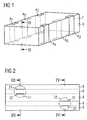
- FIG. 1 shows the main body 6 of a multilayer component in a perspective view.
- the component has a longitudinal axis 7, along which the component extends.
- the main body 6 is cuboid, but may also have any other geometric shape.
- the cuboid shape has the advantage that the component is relatively easy to manufacture and can be used without much additional effort for the SMT (Surface Mount Technology).
- On the side surfaces of the base body 6 outer terminals A 1 , A 2 , A 3 , A 4 are arranged.
- the external connections are applied opposite each other. That is, the outer terminal A 1 is the outer terminal A 4 and the outer terminal A 2 is the outer terminal A 3 opposite.
- the external connections can be made, for example, by burning in a silver stoving paste or other suitable material. They are not only arranged on the side surfaces, but they also surround the base body 6 at its boundary edges and thus cover small parts of the top or the base of the body 6. By this measure, it can be ensured that the device is surface mountable. It can then simply be placed on top or on the bottom of a soldering point and soldered using the Lotddlings the device on a circuit board.
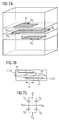
- FIG. 2 shows a longitudinal section through the component Figure 1. It can be seen that the base body 6 is formed is made of superimposed dielectric layers 8.
- This Dielectric layers 8 may, for example, ceramic Green films are in the formable state stacked, pressed, cut and then be sintered so that a monolithic body 6 arises.
- Electrode layers 21, 22, 31, 32 are applied on individual dielectric layers 8 . These Electrode layers are used in the manufacture of the Basic body of the device by imprinting a Screen printing paste or with another suitable Procedure on the still free surface of the concerned Dielectric layer applied. Subsequently, the printed dielectric layers stacked, and as on described above prepared, further processed.
- the electrode layers 21, 22 arranged in the basic body or 31, 32 each form a capacitor 11 or 12.
- the two capacitors are common integrated into the multilayer component. This results the advantage that for the realization of two capacitors consumes less device area on a circuit board is as if the capacitors in individual Multilayer components are present.
- the electrode layers 21, 22 belonging to the capacitor 11 and the electrode layers 31, 32 belonging to the capacitor 12 are laterally offset from one another.
- This lateral offset has been made in the direction of the longitudinal axis 7 of the component and corresponds to the arrangement of the side of the body 6 arranged on the outside terminals A 1 , A 2 , A 3 , A 4th
- the electrode layers 21, 22 are contacted with the external terminals A 1 and A 4 .
- the electrode layers 31, 32 are contacted with the external terminals A 2 and A 3 .
- FIG. 3 shows a section through the component from FIG. 2 along the line III-III.
- the electrode layer 21 is connected to the external terminal A 1 .
- the electrode layer 22 is connected to the external terminal A 4 .
- the electrode layer 21 and the electrode layer 22 overlap one another and thus form a capacitor 11.
- a dielectric layer 8 is arranged between the electrode layers 21, 22.
- the dielectric layers 8 in Figure 2 are all designated by the same reference numeral, this does not mean that these dielectric layers must all be made of the same material. Rather, it is also possible to use 8 different materials for the dielectric layers.
- FIG. 4 shows a section along the line IV-IV from FIG. 2, that is, through the capacitor 12. According to FIG. 3, it can again be seen that the electrode layer 32 is connected to the external terminal A 2 and the electrode layer 31 to the external terminal A 3 .
- FIG. 5 shows the equivalent circuit diagram for the component from FIG. 2. It can be seen here that in the case of the external connection A 1 and A 4, a capacitor with the capacitance C 1 and between the external connection A 2 and A 3 another capacitor with the capacitance C 2 is switched.
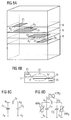
- FIG. 6A shows an exemplary embodiment of a component with a shielding layer 41. Otherwise, an electrode layer 21 and an electrode layer 31 are provided in the component. By appropriate marking with A 1 , A 3 and A 4 is indicated with which external terminal the respective electrode layer is contacted in each case. For better clarity, the external connections are not shown even in the perspective view.
- Figure 6A still contains the dielectric layers 8, which are all designated by the same reference numerals, which may well consist of different materials. This may mean, for example, that the uppermost dielectric layer 8 is made of a different material than the subsequent dielectric layer 8.
- FIG. 6B can be seen in a longitudinal section to FIG. 6A, that the electrode layer 21 with the shielding layer 41, which in turn also represents an electrode layer, forms a first capacitor 11.
- the shielding layer 41 is thus Component of each of a capacitor 11, 12 and serves beyond that also the shield between the Electrode layers 21, 31, since now in geometric Regard no more straightforward connection between the Electrode layers 21, 31 is possible without the Shielding layer 41 to cross. This means that electric fields between the electrode layer 21 and the electrode layer 31 produce a possible coupling would be effective through the electrically conductive shielding layer 41 shielded. This will increase the stray capacity effectively reduced between the capacitors 11 and 12.
- FIG. 6A shows that the shielding layer 41 with regard to their shape on the one hand to the electrode layer 21 and on the other hand to the shape of the electrode layer 31 is largely adapted, so that a maximum overlap area to form the respective capacitor 11, 12 is present.
- FIG. 6B exists advantageously an overlap, so that the shielding 41, the electrode layers 21, 31 protrudes laterally. This is However, the figure 6A not apparent.
- FIG. 6C shows an equivalent circuit diagram of the component on FIG. 6A.
- the capacitors 11 and 12 therefore have capacitances C 1 and C 2 and are interconnected in such a way that the terminal A 1 is connected to both capacitors and the terminals A 4 and A 3 are connected only to one of the two capacitors. Starting from the external connection A 1 thus results in a star connection.
- FIG. 7A shows a further embodiment of the component.
- the shielding layer 41 is connected not only to an external terminal but to two external terminals, namely A 2 and A 4 .
- the electrode layers 21 and 31 have an overlap not only with the opposite shielding layer 41 but also with each other.
- FIG. 7B shows that the electrode layer 21 forms two capacitors 11, 12 with the shielding layer 41. This results in particular in conjunction with FIG. 7A.
- a first capacitor is formed over the electrode layer 21, the shielding layer 41 to the outer terminal A 2 and that a second capacitor 12 is formed, starting from the outer terminal A 3 via the electrode layer 21, the shielding 41 to the external connection A 4 .
- This embodiment of the device has the advantage that with three electrode layers four capacitors available can be made.
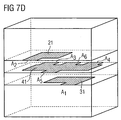
- FIG. 7D shows an extension of the component shown in FIG. 7A.
- the component according to FIG. 7D is designed as a so-called tripod.
- This means that the shielding electrode 41 is connected from one side, from the rear side of the component, to three external terminals.
- the external connections A 4 and A 3 correspond to the external connections shown in FIG.
- an external connection A 6 is shown, which is indicated by dashed lines in Figure 1 and which is arranged between the external terminals A 4 and A 3 . From the opposite side, the shielding layer 41 is made accessible by the external connection A 5 .
- the possibility of contacting the three layers contained in the component is increased.
- FIG. 7D shows the equivalent circuit shown in FIG. 7C.
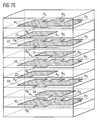
- Figure 7E shows an extension of the embodiment of Figure 7D. Similar to the exemplary embodiment from FIG. 7D, additional external connections A 5 and A 6 are provided in the example according to FIG. 7E. These external connections are shown in FIG. 1 by dashed additional external connections A 5 and A 6 .
- further electrode layers 22, 32 are provided, which can increase the capacitance of the capacitors.
- the electrode layers 21 and 22 are connected to the external terminal A 4 .
- the electrode layers 31 and 32 are connected to the external terminal A 3 .
- shielding layers 41, 42, 43, 44, 45 are provided which are each contacted on the rear side of the component with three external connections A 1 , A 2 and A 5 .
- the shielding layers 41, 42, 43, 44, 45 are contacted with the external terminal A 6 .
- a shielding layer 41, 42, 43, 44, 45 is arranged to form a capacitor, each having an electrode layer.
- a shielding layer 41, 45 is provided at the upper end and at the lower end of the layer stack, which increase the symmetry and improve the shielding of the component towards the outside.
- FIG. 8A shows a further component in a perspective view, wherein two shielding layers are contained.
- the two shielding layers 41 and 51 are different in shape in that they are contacted with different external terminals.
- the shielding layer 41 is contacted with the external terminal A 3 and the shielding layer 51 with the external terminal A 1 . Together with the overlap which the two shielding layers 41, 51 have with each other, this results in the formation of a further capacitor, which can be connected from the outside via the external connections A 1 and A 3 .
- the electrode layer 21 with the shielding layer 41 forms a first capacitor 11.
- the electrode layer 31 forms a further capacitor 13 with the shielding layer 51.
- the two shielding layers 41, 51 also form another one Capacitor 12. As can be seen from the equivalent circuit diagram in FIG. 8C or FIG. 8D, this further capacitor can be connected from the outside.
- the purpose can therefore be achieved, on the one hand, to decouple the two electrode layers 21 and 31 particularly effectively, namely from one another by means of two superimposed shielding layers.
- the two capacitors 11 and 13 receive a defined coupling, which is defined by the capacitance of the capacitor 12.
- a defined coupling is significantly more advantageous in many applications than an undefined stray capacitance between two capacitors arranged in a multilayer component.
- the capacitor 12 representing the defined coupling can be used as noise suppression in an interference suppression circuit.
- FIG. 8B It can still be seen from FIG. 8B that, as in FIGS 6B and 7B, a projection of the shielding layers 41, 51 via the respective electrode layer 21, 31 to be shielded is particularly advantageous.
- FIG. 8C shows a first equivalent circuit diagram for the component from FIG. 8A in the case that only capacitor materials are used for the dielectric layers 8.
- the equivalent circuit consists of three capacitors with capacitances C 1 , C 2 and C 3 .
- the capacitor 12 represented by the capacitance C 2 is accessible from outside through the external connections A 1 and A 2 and can thus be externally connected.
- FIG. 8D Another circuit diagram variant is shown in FIG. 8D. It is assumed here that at least the dielectric layers 8 lying between two electrode layers or between an electrode layer and a shielding layer or between two shielding layers all contain a varistor material. This results in a parallel connection of a voltage-dependent resistor VDR 1 , VDR 2 and VDR 3 to each capacitor C 1 , C 2 , C 3 .
- VDR 1 , VDR 2 and VDR 3 to each capacitor C 1 , C 2 , C 3 .
- two electrode layers with an intervening varistor ceramic form a capacitor on the basis of the electrode layers and the interposed dielectric, and on the other hand a varistor due to the voltage-dependent resistance of the intermediate ceramic layer.
- the two components are connected in parallel, as well as Figure 8D can be seen.
- Such a device equipped with varistor ceramic has the advantage that it can be used as an EMI filter.
- Dielectric layers 8 designed as a varistor material become.
- FIG. 9A shows a further exemplary embodiment of a multilayer component according to the type presented in FIG. 6A, wherein an enlargement can be seen in that yet another capacitor is integrated into the component.
- This is achieved by providing three different types of electrode layers, namely electrode layers 21, 22 and 23. These three electrode layers 21, 22, 23 are contacted with different external connections, A 2 for electrode layer 21, A 4 for electrode layer 22 and A 3 for electrode layer 23.
- the three electrode layers 21, 22, 23 are, as can also be seen in FIG. 9B, each involved in the formation of a capacitor 11, 12, 13. More specifically, the capacitor 13 is formed by the electrode layer 21 and the overlying shielding layer 41. In addition is still involved in the capacitor 13, the underlying shielding layer 42.
- the shielding layers 41, 42, 43 have identical shape and are therefore assigned to the same type of shielding layer. They are all connected to the external connection A 1 .
- the capacitor 12 is formed by the electrode layer 22 and through the shielding layer 41 and through the Shielding layer 43.
- the capacitor 11 is formed by the electrode layer 23 and through the shielding layer 43. Accordingly, the shielding layer 43 and the shielding layer 42 are each involved in two different capacitors.
- the Shielding layer 43 is involved only in the capacitor 13.
- the electrode layer 21st as a counterelectrode for the formation of a capacitor both the shielding layer 42 as well as the uppermost shielding layer 41 is available. So the top one would be Shielding layer 41 for forming a capacitor not absolutely necessary. However, it has the advantage that on the one hand increases the capacitance of the capacitor 13 through it can be, because once again the same capacity comes to as between the electrode layer 21 and the Shielding layer 42 formed capacitance. In addition, has the shielding layer 41 still has the advantage that the Electrode layer 21 is shielded to the outside.
- FIG. 9C shows an equivalent circuit diagram for the component from FIG. 9A, where a star connection of three capacitances C 1 , C 2 , C 3 can be recognized, wherein the external connection A 1 forms the neutral point.
- FIG. 10A shows by way of example how a component formed according to the basic principle of FIG. 8A can be expanded by adding further layers.
- a further electrode layer 32 is now provided.
- this additional electrode layer 32 which is of the same type as the electrode layer 31, that is, that it has the same shape and that it also has the same horizontal position and that it is also connected to the same external terminal, here A 4 .
- the capacitance of one of the capacitors formed in the component can be increased.
- a further shielding layer 52 is accordingly provided in the embodiment according to FIG. 10A in order to ensure good shielding between the electrode layers 31 and 21.
- the shielding layers 41 and 52 again contribute to the capacitor, which contribute between the external terminals A 1 and A 3 , see also FIG. 8C, where the capacitor is designated by the capacitance C 2 .
- the shielding layers 51 and 52 and 53 and 54 in Figure 10A are all of the same type. Likewise, the shielding layers 41 and 42 in Fig. 10A of the same type. For the others Addition of an electrode layer 31 would have the addition the shielding layer 52 is sufficient so that the shielding layers 51 and 54 are not essential for this purpose. They can therefore also be omitted in FIG. 10A.
- a shielding layer as the uppermost layer in the component can have the advantage that the uppermost electrode layer 31 is well shielded not only relative to the electrode layer 21 but also to the outside.
- the shielding layer 51 can also contribute to the capacitance of the capacitor formed with the electrode layer 31, compare the capacitance C 1 in FIG. 8C.
- the capacitor 11 is formed with the participation of Electrode layer 21 and the shielding layers 41 and 42
- the capacitor 12 is formed with the participation of Shielding layers 53 and 42 and the shielding layers 41 and 52
- the capacitor 13 is formed from the Electrode layers 32 and the Abletiken 53 and 54th and the electrode layer 31 and the shield layers 52 and 51.
- the Equivalent circuit diagram according to FIG. 8C is also pointed out.
- FIG. 11A shows by way of example how the basic principle according to FIG. 7A can be extended by adding additional layers.
- the shielding layers 41, 42, 43, 44 and 45 are provided as shielding layers. All of these shielding layers are of the same type, that is to say they are all connected to the outer terminals A 2 and A 4 and otherwise have the same shape and the same horizontal positioning, that is to say that they are identical with respect to the stacking direction.
- the outer shielding layers 41 and 45 serve the Shielding of the device to the outside.
- further electrode and shielding layers here in addition to the electrode layer 21 nor the Electrode layer 22 of the same type comes to it and where with respect to the electrode layer 31 nor the Electrode layer 32 comes of the same type, the Capacity of each capacitor formed here are increased.
- the component shown in FIG. 1 preferably has a base area smaller than 2.5 mm 2 . Particularly advantageous is a footprint of 1.37 mm 2 , which corresponds to the design 0405 and has the advantage that a particularly small component area is required for the two capacitors.
- the Elements described here are also doubled in side by side a single component, which is the number of Increased capacitors and what, for example, in the design 0508 can be realized.
- Figure 8D still shows the advantage in the integration of varistor materials in the dielectric layers, which is evident from the fact that the varistors VDR 1 , VDR 2 and VDR 3 are already integrated in the multilayer component, resulting in separate varistors with a corresponding circuit according to the prior art can be waived.
- the invention is not in terms of number the electrode layers limited. It was shown that here presented concepts arbitrary in the number of Electrode layers can be extended.
Landscapes
- Engineering & Computer Science (AREA)
- Power Engineering (AREA)
- Manufacturing & Machinery (AREA)
- Microelectronics & Electronic Packaging (AREA)
- Fixed Capacitors And Capacitor Manufacturing Machines (AREA)
- Ceramic Capacitors (AREA)
Applications Claiming Priority (2)
| Application Number | Priority Date | Filing Date | Title |
|---|---|---|---|
| DE102004004096 | 2004-01-27 | ||
| DE200410004096 DE102004004096A1 (de) | 2004-01-27 | 2004-01-27 | Elektrisches Vielschichtbauelement |
Publications (3)
| Publication Number | Publication Date |
|---|---|
| EP1560235A2 true EP1560235A2 (fr) | 2005-08-03 |
| EP1560235A3 EP1560235A3 (fr) | 2008-01-02 |
| EP1560235B1 EP1560235B1 (fr) | 2012-06-06 |
Family
ID=34638760
Family Applications (1)
| Application Number | Title | Priority Date | Filing Date |
|---|---|---|---|
| EP20050001704 Expired - Lifetime EP1560235B1 (fr) | 2004-01-27 | 2005-01-27 | Composant multicouche électrique |
Country Status (2)
| Country | Link |
|---|---|
| EP (1) | EP1560235B1 (fr) |
| DE (1) | DE102004004096A1 (fr) |
Cited By (4)
| Publication number | Priority date | Publication date | Assignee | Title |
|---|---|---|---|---|
| EP1659597A3 (fr) * | 2004-11-18 | 2007-01-03 | TDK Corporation | Condensateur multicouche |
| WO2007054082A1 (fr) * | 2005-11-11 | 2007-05-18 | Epcos Ag | Composant électrique multicouche avec une forme d’électrodes spéciale pour la réduction de la dispersion à la fabrication de la capacité |
| CN110890216A (zh) * | 2018-09-11 | 2020-03-17 | 太阳诱电株式会社 | 层叠陶瓷电容器、层叠陶瓷电容器包装体和组件安装电路基板 |
| CN114899009A (zh) * | 2019-01-28 | 2022-08-12 | 京瓷Avx元器件公司 | 具有超宽带性能的多层陶瓷电容器 |
Citations (2)
| Publication number | Priority date | Publication date | Assignee | Title |
|---|---|---|---|---|
| JP2000228329A (ja) | 1999-02-08 | 2000-08-15 | Matsushita Electric Ind Co Ltd | 多連型積層セラミックコンデンサ |
| DE10064447C2 (de) | 2000-12-22 | 2003-01-02 | Epcos Ag | Elektrisches Vielschichtbauelement und Entstörschaltung mit dem Bauelement |
Family Cites Families (7)
| Publication number | Priority date | Publication date | Assignee | Title |
|---|---|---|---|---|
| JPH0653078A (ja) * | 1992-07-27 | 1994-02-25 | Mitsubishi Materials Corp | バリスタ機能付き積層コンデンサアレイ |
| JPH06151245A (ja) * | 1992-11-06 | 1994-05-31 | Mitsubishi Materials Corp | ノイズフィルタ |
| JP3328399B2 (ja) * | 1993-12-08 | 2002-09-24 | ティーディーケイ株式会社 | 積層コンデンサアレイ |
| JPH07169649A (ja) * | 1993-12-16 | 1995-07-04 | Tdk Corp | 積層貫通型コンデンサアレイ |
| JPH1012490A (ja) * | 1996-06-20 | 1998-01-16 | Murata Mfg Co Ltd | 貫通型積層コンデンサアレイ |
| JP3470566B2 (ja) * | 1997-09-19 | 2003-11-25 | 株式会社村田製作所 | 積層型電子部品 |
| JP2003068568A (ja) * | 2001-08-27 | 2003-03-07 | Matsushita Electric Ind Co Ltd | 積層セラミックコンデンサ |
-
2004
- 2004-01-27 DE DE200410004096 patent/DE102004004096A1/de not_active Ceased
-
2005
- 2005-01-27 EP EP20050001704 patent/EP1560235B1/fr not_active Expired - Lifetime
Patent Citations (2)
| Publication number | Priority date | Publication date | Assignee | Title |
|---|---|---|---|---|
| JP2000228329A (ja) | 1999-02-08 | 2000-08-15 | Matsushita Electric Ind Co Ltd | 多連型積層セラミックコンデンサ |
| DE10064447C2 (de) | 2000-12-22 | 2003-01-02 | Epcos Ag | Elektrisches Vielschichtbauelement und Entstörschaltung mit dem Bauelement |
Cited By (5)
| Publication number | Priority date | Publication date | Assignee | Title |
|---|---|---|---|---|
| EP1659597A3 (fr) * | 2004-11-18 | 2007-01-03 | TDK Corporation | Condensateur multicouche |
| KR100770556B1 (ko) | 2004-11-18 | 2007-10-29 | 티디케이가부시기가이샤 | 적층형 콘덴서 |
| WO2007054082A1 (fr) * | 2005-11-11 | 2007-05-18 | Epcos Ag | Composant électrique multicouche avec une forme d’électrodes spéciale pour la réduction de la dispersion à la fabrication de la capacité |
| CN110890216A (zh) * | 2018-09-11 | 2020-03-17 | 太阳诱电株式会社 | 层叠陶瓷电容器、层叠陶瓷电容器包装体和组件安装电路基板 |
| CN114899009A (zh) * | 2019-01-28 | 2022-08-12 | 京瓷Avx元器件公司 | 具有超宽带性能的多层陶瓷电容器 |
Also Published As
| Publication number | Publication date |
|---|---|
| EP1560235A3 (fr) | 2008-01-02 |
| DE102004004096A1 (de) | 2005-08-18 |
| EP1560235B1 (fr) | 2012-06-06 |
Similar Documents
| Publication | Publication Date | Title |
|---|---|---|
| DE4008507C2 (de) | Laminiertes LC-Filter | |
| EP2174328B1 (fr) | Composant multicouche électrique avec une résistance et une couche de découplage | |
| EP2143117B1 (fr) | Composant électrique multicouche comportant une structure de blindage sans contact électrique | |
| EP1606831B1 (fr) | Composant multicouche electrique | |
| DE19628890A1 (de) | Elektronikteile mit eingebauten Induktoren | |
| EP1350257B1 (fr) | Composant multicouche electrique et circuit antiparasites pourvu d'un tel composant | |
| EP1369880B1 (fr) | Composant électrique multicouche et circuit | |
| EP1425762B1 (fr) | Composant multicouche electrique | |
| DE102004010001A1 (de) | Elektrisches Bauelement und schaltungsanordnung mit dem Bauelement | |
| EP1369881B1 (fr) | Composant électrique multicouche | |
| DE102004016146B4 (de) | Elektrisches Vielschichtbauelement | |
| EP1560235B1 (fr) | Composant multicouche électrique | |
| EP1537655B1 (fr) | Filtre de resonance multiple | |
| EP1391898B1 (fr) | Composant électrique multicouche | |
| EP1880399B1 (fr) | Element de traversee electrique | |
| DE112020002057T5 (de) | Komponente mit niedriger Induktivität | |
| DE60036238T2 (de) | Vielschicht-Keramikkondensator für dreidimensionale Montage | |
| EP2246866B1 (fr) | Composant électrique et agencement de circuit | |
| DE102004029411B4 (de) | Keramischer Mehrschichtkondensator | |
| WO2003009311A1 (fr) | Composant electroceramique |
Legal Events
| Date | Code | Title | Description |
|---|---|---|---|
| PUAI | Public reference made under article 153(3) epc to a published international application that has entered the european phase |
Free format text: ORIGINAL CODE: 0009012 |
|
| AK | Designated contracting states |
Kind code of ref document: A2 Designated state(s): AT BE BG CH CY CZ DE DK EE ES FI FR GB GR HU IE IS IT LI LT LU MC NL PL PT RO SE SI SK TR |
|
| AX | Request for extension of the european patent |
Extension state: AL BA HR LV MK YU |
|
| PUAL | Search report despatched |
Free format text: ORIGINAL CODE: 0009013 |
|
| AK | Designated contracting states |
Kind code of ref document: A3 Designated state(s): AT BE BG CH CY CZ DE DK EE ES FI FR GB GR HU IE IS IT LI LT LU MC NL PL PT RO SE SI SK TR |
|
| AX | Request for extension of the european patent |
Extension state: AL BA HR LV MK YU |
|
| 17P | Request for examination filed |
Effective date: 20080610 |
|
| AKX | Designation fees paid |
Designated state(s): DE FR GB |
|
| 17Q | First examination report despatched |
Effective date: 20100301 |
|
| REG | Reference to a national code |
Ref country code: DE Ref legal event code: R079 Ref document number: 502005012770 Country of ref document: DE Free format text: PREVIOUS MAIN CLASS: H01G0004380000 Ipc: H01G0004012000 |
|
| GRAP | Despatch of communication of intention to grant a patent |
Free format text: ORIGINAL CODE: EPIDOSNIGR1 |
|
| RIC1 | Information provided on ipc code assigned before grant |
Ipc: H01G 4/012 20060101AFI20111212BHEP Ipc: H01G 4/005 20060101ALI20111212BHEP Ipc: H01G 4/30 20060101ALI20111212BHEP |
|
| GRAS | Grant fee paid |
Free format text: ORIGINAL CODE: EPIDOSNIGR3 |
|
| GRAA | (expected) grant |
Free format text: ORIGINAL CODE: 0009210 |
|
| RIN1 | Information on inventor provided before grant (corrected) |
Inventor name: FEICHTINGER, THOMAS Inventor name: ORTNER, MARKUS |
|
| AK | Designated contracting states |
Kind code of ref document: B1 Designated state(s): DE FR GB |
|
| REG | Reference to a national code |
Ref country code: GB Ref legal event code: FG4D Free format text: NOT ENGLISH |
|
| REG | Reference to a national code |
Ref country code: DE Ref legal event code: R096 Ref document number: 502005012770 Country of ref document: DE Effective date: 20120802 |
|
| PLBE | No opposition filed within time limit |
Free format text: ORIGINAL CODE: 0009261 |
|
| STAA | Information on the status of an ep patent application or granted ep patent |
Free format text: STATUS: NO OPPOSITION FILED WITHIN TIME LIMIT |
|
| 26N | No opposition filed |
Effective date: 20130307 |
|
| REG | Reference to a national code |
Ref country code: DE Ref legal event code: R097 Ref document number: 502005012770 Country of ref document: DE Effective date: 20130307 |
|
| PGFP | Annual fee paid to national office [announced via postgrant information from national office to epo] |
Ref country code: DE Payment date: 20140124 Year of fee payment: 10 |
|
| PGFP | Annual fee paid to national office [announced via postgrant information from national office to epo] |
Ref country code: FR Payment date: 20140124 Year of fee payment: 10 |
|
| PGFP | Annual fee paid to national office [announced via postgrant information from national office to epo] |
Ref country code: GB Payment date: 20140123 Year of fee payment: 10 |
|
| REG | Reference to a national code |
Ref country code: DE Ref legal event code: R119 Ref document number: 502005012770 Country of ref document: DE |
|
| GBPC | Gb: european patent ceased through non-payment of renewal fee |
Effective date: 20150127 |
|
| PG25 | Lapsed in a contracting state [announced via postgrant information from national office to epo] |
Ref country code: GB Free format text: LAPSE BECAUSE OF NON-PAYMENT OF DUE FEES Effective date: 20150127 Ref country code: DE Free format text: LAPSE BECAUSE OF NON-PAYMENT OF DUE FEES Effective date: 20150801 |
|
| REG | Reference to a national code |
Ref country code: FR Ref legal event code: ST Effective date: 20150930 |
|
| PG25 | Lapsed in a contracting state [announced via postgrant information from national office to epo] |
Ref country code: FR Free format text: LAPSE BECAUSE OF NON-PAYMENT OF DUE FEES Effective date: 20150202 |