EP1560403A1 - Dispositif et procédé de recherche prédictive pour des numéros de téléphone - Google Patents
Dispositif et procédé de recherche prédictive pour des numéros de téléphone Download PDFInfo
- Publication number
- EP1560403A1 EP1560403A1 EP05100625A EP05100625A EP1560403A1 EP 1560403 A1 EP1560403 A1 EP 1560403A1 EP 05100625 A EP05100625 A EP 05100625A EP 05100625 A EP05100625 A EP 05100625A EP 1560403 A1 EP1560403 A1 EP 1560403A1
- Authority
- EP
- European Patent Office
- Prior art keywords
- contacts
- database
- contact
- searching
- input
- Prior art date
- Legal status (The legal status is an assumption and is not a legal conclusion. Google has not performed a legal analysis and makes no representation as to the accuracy of the status listed.)
- Withdrawn
Links
Images





Classifications
-
- H—ELECTRICITY
- H04—ELECTRIC COMMUNICATION TECHNIQUE
- H04M—TELEPHONIC COMMUNICATION
- H04M1/00—Substation equipment, e.g. for use by subscribers
- H04M1/26—Devices for calling a subscriber
- H04M1/27—Devices whereby a plurality of signals may be stored simultaneously
- H04M1/274—Devices whereby a plurality of signals may be stored simultaneously with provision for storing more than one subscriber number at a time, e.g. using toothed disc
- H04M1/2745—Devices whereby a plurality of signals may be stored simultaneously with provision for storing more than one subscriber number at a time, e.g. using toothed disc using static electronic memories, e.g. chips
- H04M1/27467—Methods of retrieving data
- H04M1/2748—Methods of retrieving data by matching character strings
-
- E—FIXED CONSTRUCTIONS
- E04—BUILDING
- E04G—SCAFFOLDING; FORMS; SHUTTERING; BUILDING IMPLEMENTS OR AIDS, OR THEIR USE; HANDLING BUILDING MATERIALS ON THE SITE; REPAIRING, BREAKING-UP OR OTHER WORK ON EXISTING BUILDINGS
- E04G1/00—Scaffolds primarily resting on the ground
- E04G1/18—Scaffolds primarily resting on the ground adjustable in height
- E04G1/22—Scaffolds having a platform on an extensible substructure, e.g. of telescopic type or with lazy-tongs mechanism
-
- E—FIXED CONSTRUCTIONS
- E04—BUILDING
- E04G—SCAFFOLDING; FORMS; SHUTTERING; BUILDING IMPLEMENTS OR AIDS, OR THEIR USE; HANDLING BUILDING MATERIALS ON THE SITE; REPAIRING, BREAKING-UP OR OTHER WORK ON EXISTING BUILDINGS
- E04G1/00—Scaffolds primarily resting on the ground
- E04G1/15—Scaffolds primarily resting on the ground essentially comprising special means for supporting or forming platforms; Platforms
-
- E—FIXED CONSTRUCTIONS
- E04—BUILDING
- E04G—SCAFFOLDING; FORMS; SHUTTERING; BUILDING IMPLEMENTS OR AIDS, OR THEIR USE; HANDLING BUILDING MATERIALS ON THE SITE; REPAIRING, BREAKING-UP OR OTHER WORK ON EXISTING BUILDINGS
- E04G7/00—Connections between parts of the scaffold
- E04G7/02—Connections between parts of the scaffold with separate coupling elements
- E04G7/06—Stiff scaffolding clamps for connecting scaffold members of common shape
-
- E—FIXED CONSTRUCTIONS
- E04—BUILDING
- E04G—SCAFFOLDING; FORMS; SHUTTERING; BUILDING IMPLEMENTS OR AIDS, OR THEIR USE; HANDLING BUILDING MATERIALS ON THE SITE; REPAIRING, BREAKING-UP OR OTHER WORK ON EXISTING BUILDINGS
- E04G1/00—Scaffolds primarily resting on the ground
- E04G1/24—Scaffolds primarily resting on the ground comprising essentially special base constructions; comprising essentially special ground-engaging parts, e.g. inclined struts, wheels
- E04G2001/242—Scaffolds movable on wheels or tracks
-
- H—ELECTRICITY
- H04—ELECTRIC COMMUNICATION TECHNIQUE
- H04M—TELEPHONIC COMMUNICATION
- H04M1/00—Substation equipment, e.g. for use by subscribers
- H04M1/26—Devices for calling a subscriber
- H04M1/27—Devices whereby a plurality of signals may be stored simultaneously
- H04M1/274—Devices whereby a plurality of signals may be stored simultaneously with provision for storing more than one subscriber number at a time, e.g. using toothed disc
- H04M1/2745—Devices whereby a plurality of signals may be stored simultaneously with provision for storing more than one subscriber number at a time, e.g. using toothed disc using static electronic memories, e.g. chips
- H04M1/27463—Predictive input, predictive dialling by comparing the dialled sequence with the content of a telephone directory
-
- H—ELECTRICITY
- H04—ELECTRIC COMMUNICATION TECHNIQUE
- H04M—TELEPHONIC COMMUNICATION
- H04M1/00—Substation equipment, e.g. for use by subscribers
- H04M1/26—Devices for calling a subscriber
- H04M1/27—Devices whereby a plurality of signals may be stored simultaneously
- H04M1/274—Devices whereby a plurality of signals may be stored simultaneously with provision for storing more than one subscriber number at a time, e.g. using toothed disc
- H04M1/2745—Devices whereby a plurality of signals may be stored simultaneously with provision for storing more than one subscriber number at a time, e.g. using toothed disc using static electronic memories, e.g. chips
- H04M1/27467—Methods of retrieving data
- H04M1/2747—Scrolling on a display
Definitions
- Personal information managers such as in PDAs and cell phones typically maintain lists of contacts. These contact lists store information about each contact including items, such as: name, job title, company name, business number, home number, fax number, mobile number, email addresses, web pages, and the like.
- the contact lists can become very long. For example, some contact lists may include everyone in a large company. Finding contacts within these contact lists can be difficult.
- the present invention is directed towards providing a method and system for finding and accessing a contact quickly and easily.
- the search input is entered that is then used to search through contacts stored in the device.
- the filtered contacts may be readily accessed by various applications that use the contact information.
- a user may enter numbers and characters that are used in searching the contacts.
- a list of possible contacts is provided to the user. The input characters are highlighted in the list of possible contacts.
- all of the information contained within a contact may be searched.
- the search input could correspond to an address, a fax number, a last name, a note included within the contact, and the like.
- a number of contact lists are searched so as to allow a user to enter a request to find a contact without requiring that the user to specify where to specifically find the contact. For example, if the user request was in the form of dialing input, the caller need not specify whether the number is from the call log, a contacts list, whether the caller is engaging speed dial, whether the caller is first entering the area-code or whether the caller is just entering the local number.
- contacts are retrieved that include the search input somewhere within the contact.
- the present invention is directed at providing a method and system for finding and accessing a contact quickly and easily by filtering and searching through all of the contacts stored in the device based on user input.
- the filtered contacts may be readily accessed by various applications that use the contact information.
- an input field appears within which a user may enter numbers and characters that is used in searching the contacts.
- a list of possible contacts is provided to the user. The input characters are highlighted in the list of possible contacts.
- FIGURE 1 illustrates a mobile computing device that may be used according to an exemplary embodiment of the present invention.
- Mobile computing device 100 includes processor 160, memory 162, display 128, keypad 132, and navigation controls 134.
- Memory 162 generally includes both volatile memory (e.g., RAM) and non-volatile memory (e.g., ROM, Flash Memory, or the like).
- Mobile computing device 100 includes operating system 164, such as the Windows CE operating system from Microsoft Corporation, or another operating system, which is resident in memory 162 and executes on processor 160.
- Keypad 132 may be a push button numeric dialing pad (such as on a typical telephone), a multi-key keyboard (such as a conventional keyboard).
- Display 128 may be a liquid crystal display, or any other type of display commonly used in mobile computing devices. Display 128 may be touch-sensitive, and would then could also act as an input device.
- a smart dial contact search application resides on mobile computing device 100 and is programmed to provide operations relating to easily accessing contact information.
- the smart contact application may reside in the hardware or software of the device.
- Mobile computing device 100 also includes non-volatile storage 168 within memory 162. Non-volatile storage 168 may be used to store persistent information which should not be lost if mobile computing device 100 is powered down.
- Mobile computing device 100 includes power supply 170, which may be implemented as one or more batteries.
- Power supply 170 might further include an external power source, such as an AC adapter or a powered docking cradle that supplements or recharges the batteries.
- Mobile computing device 100 is shown with two types of optional external notification mechanisms: LED 140 and audio interface 174. These devices may be directly coupled to power supply 170 so that when activated, they remain on for a duration dictated by the notification mechanism even though processor 160 and other components might shut down to conserve battery power. Audio interface 174 is used to provide audible signals to and receive audible signals from the user. For example, audio interface 174 may be coupled to a speaker for providing audible output and to a microphone for receiving audible input, such as to facilitate a telephone conversation.
- Mobile computing device 100 also includes a communications interface, such as wireless interface layer 172, that performs the function of transmitting and receiving wireless communications.
- the wireless interface layer 172 facilitates wireless connectivity between the mobile computing device 100 and the outside world. According to one embodiment, transmissions to and from the wireless interface layer 172 are conducted under control of the operating system 164. In other words, communications received by wireless interface layer 172 may be disseminated to application programs 166 via operating system 164, and vice versa.
- Navigation controls 134 assist the user in navigating through various entries and options that may be illustrated on display 128. For example, users can use navigation control 134 to select a contact method from a selected contact. For example, a user may select a contact from a list of contacts returned from a smart dial contact search. The user could then press a button to contact the corresponding contact using the default communication method, or the user may navigate through the contact and select the desired form of communication to be used with the contact.
- FIGURE 1 represents a suitable operating environment according to an embodiment of the invention
- any device may be used that is capable of receiving a user-entered request (such as dialing input) in accordance with a variety of request methods (such as a variety of contact methods).
- Communication media typically embodies computer readable instructions, data structures, program modules or other data in a modulated data signal such as a carrier wave or other transport mechanism and includes any information delivery media.
- modulated data signal means a signal that has one or more of its characteristics set or changed in such a manner as to encode information in the signal.
- communication media includes wired media such as a wired network or direct-wired connection, and wireless media such as acoustic, RF, infrared and other wireless media.
- the term computer readable media as used herein includes both storage media and communication media.
- FIGURE 6 illustrates a series of displays 600A-D as they might appear, for example, on display 128 of FIGURE 1, during a searching scenario.
- the display 600 includes an input field 601, a filtered output field 602 and a focus frame 603.
- each of the displays illustrate the display in different states. Accordingly, each of the display 600, the input field 601, the filtered output field 602 and the focus frame 603 are identified with a suffix A through D that corresponds to the different state.
- Input field 601 allows the user to enter numbers/characters to search for a contact.
- the user can search for a contact using any identifying information within a contact and then contact the resulting user using any of the available communications methods available for that user. For example, the user could contact an individual using a telephone number, email address, instant messaging identification, SMS message, and the like. The user could also search for a contact based on a note included within the contact.
- the filtered output field 602 represents a unified area in which contacts found in response to the input are presented to the user.
- Focus frame 603 allows the user to identify what item against which the user desires to take action. For example, while focus frame 603 highlights input field 601, the user may enter content into the input field. However, the user may also scroll the focus frame 603 down to one of the items in the filtered output field 602 in order to select that contact.
- Display 600A is an initial state of a display with no search input entered into the input field 601 A, and with no contacts presented in the filtered output field 602A. Focus frame 603A highlights the input field 601 A thus reflecting that display 600A is ready to accept dialing input in the input field 601 A.
- Display 600B illustrates the state after the user has entered an "E" in the input field 601B.
- the focus frame 603B remains over the input field 601B thus allowing this input.
- the filtered output field 602B then presents three contacts corresponding to the single character search input.
- the user could have also entered a number within input field into input field 601B, or any other available character or icon that may be used in identifying a contact.
- Display 600C illustrates the state after the user also enters an "L" with the accumulated search input being "EL". Focus frame 603C remains over the input field 601C thus still allowing this input. At this stage, filtering occurs as described in further detail below with respect to FIGURE 3 through FIGURE 5. In response to the filtering operation, the filtered output field 602C illustrates fewer contacts. The resulting entries are appropriate to the search input as emphasized by the bolded and underlined portions of the resulting entries.
- the resulting entries illustrated in filtered output field 602 may have originated from separate databases in which the entries were represented using incompatible data structures. For example, some of the resulting entries may have originated from a contacts database, some from a speed dial database, and some from a call log. However, notwithstanding that the entries were originally represented at their source using different data structures, the entries are homogenous as they appear in the filtered output field 602.
- Filtering may be stopped when further filtering would not result in a change in the contacts displayed in the filtered output field. For example, suppose that the search input represents a last name. Users often have numerous entries corresponding to family members who share the same last name. Accordingly, as the name is spelled out, the response entries may not change. Accordingly, unnecessary filtering is largely avoided resulting in processor savings that are especially significant in devices that have lower processing capabilities.
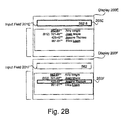
- FIGURES 2A-B illustrates an exemplary searching scenario, in accordance with aspects of the invention.
- Display 200A is an initial state of a display with no search input entered into the input field 201 A, and with no contacts presented in the filtered output field 202A.
- Display 200B illustrates the state after the user has entered an "5" in the input field 201B.
- the focus frame 203B remains over the input field 201B thus allowing this input.
- the filtered output field 202B then the fifth speed dial entry.
- Display 200C illustrates the state after the user also enters an "6" with the accumulated search input being "56". Focus frame 203C remains over the input field 201 C thus still allowing this input. In response to the filtering operation, the filtered output field 202C illustrates more contacts. The resulting entries are appropriate to the search input as emphasized by the bolded and underlined portions of the resulting entries.
- the first two entries presuppose that the dialer is entering the first two digits of the area code first.
- the remaining four entries presuppose that the dialer is entering the first two digits of the local number.
- the local numbers returned may be those entries conform to the dialing input, and that either did not have an area code specified, or those entries that included an area code that corresponds to a default area code. For example, if device 100 is currently in the 610 area code, and/or if the 610 area code is the area code of the telephone number of the telephonic device, the filtering may ignore the area code and just match the dialing input against the local number.
- Display 200D shows after the user also enters a "2" with the accumulated dialing input being "562".
- the focus frame 203D remains over the input field 201D thus allowing this input as well.
- the response entries in the filtered output field 202D are then refreshed to reflect the additional dialing input. As described in further detail below, the response entries in the filtered output field 202 will not always change in response to additional dialing input.
- the response entries of the filtered output field 202D now include five numbers that presuppose that the dialing input represents the first three digits of a local number. These five entries are identified by having underlined portions that match the dialing input.
- the dialing input represents the first name of an individual named "Joan”.
- the digits 0 and 2 through 9 have corresponding alphabetic letters listed on the buttons.
- entered digits may instead represent the corresponding alphabetic letters.
- the digit "5" may also represent the letters “j", “k”, or “I”.
- the digit "6” also represents the letters “m”, “n”, or “o”.
- the digit "2” also represents the letters "a", "b", or "c”.
- the dialing input "562" might represents "Joa”.
- the entry for Joan matches the dialing input as represented by the underlined portions of the entry.
- the user may also directly enter the letter directly if the device includes the capability.
- Display 200E illustrates after the user also enters a "6" with the accumulated dialing input being "5626".
- the focus frame 203E remains over the input field 201E thus allowing this input.
- the dialing input in the input field 201E is now specific enough that all of the potential matches may now appear in the filtered output field 202E.
- the top entry presupposes that the dialing input represents the first four digits of the local number.
- the middle two entries assume that the dialing input represents the first four letters of the first name corresponding to a telephone number.
- the lowest entry assumes that the dialing input represents the first four letters of the last name corresponding to a telephone number.
- Display 200F illustrates the focus frame 203F moved over a particular entry in the filtered output field 202F.
- the movement of the focus frame 203F may be accomplished using, for example, the navigation controls 134 of FIGURE 1.
- FIGURE 3 schematically illustrates an architecture 300, in accordance with aspects of the present invention.
- Each of the elements of the architecture 300 may be hardware, software, or a combination of hardware and software.
- each of the elements of the architecture 300 may be software modules that are emulated when the processor 160 of FIGURE 1 executes one of the application programs 166 of FIGURE 1.
- FIGURE 3 there are solid arrows leading from one module to the next. These solid arrows represent request paths for one or more requests from the module at the tail of the arrow to the module at the head of the arrow.
- Database Architecture 300 includes databases 310 such as database A, database B, and database C.
- the databases are generically labeled to emphasize that the principles of the present invention may operate with many different kinds of databases having a variety of data structures.
- database A, B and C will often be referred to as a contacts (including pinned items and SIM contacts), speed dial, and call log database, respectively.
- contacts including pinned items and SIM contacts
- speed dial including pinned items and SIM contacts
- call log database respectively.
- three databases are shown, the present invention may work with other numbers of databases as well.
- the databases are described as having entries that have incompatible data structures between databases, the databases may also have compatible data structures as well.
- Databases A, B, and C have entries A 1 through A N , B 1 through B M , and C 1 through C P , respectively.
- Each entry may represent any information that relates to a contact.
- the entries may include any information typically found in a contact, a symbol that is used to represent a contact, a user name (such as an Instant Messenger (IM) user name), and the like.
- IM Instant Messenger
- a contact may include a name, title, company, fax number, mobile number, address, email address, IM user, and the like.
- a contact could also be located based on a time associated with the last contact.
- Displayer module 321 assembles all the data structures necessary for device 100 to receive and present the filtered output results. The display module 321 does this even though the filtered output results may be from different databases. In order to accomplish this, the display module 321 directly or indirectly uses all of the other modules and databases illustrated in FIGURE 3.
- displayer 321 asks requestor module 316 for all the rows of information that are needed to fill in the display.
- This initial request begins a chain of requests that flow generally upward as illustrated in FIGURE 3.
- the requestor 316 then asks the second concatenator module 315 for the updated request data that is to appears in the input field 201 concatenated with all of the corresponding filtered entries from all of the databases 310.
- the second concatenator 315 then accesses the request data 314, and requests the updated filtered entries from the filter module 313.
- the filter 313 examines the updated request data 314 to determine whether the updated input warrants re-filtering. For example, the filter 313 may compare the previously filtered entries corresponding to the currently viewed items in the filtered output field 202 to see if the updated input would result in any of such items being filtered out. If the updated request data would not result in a change to the viewed data, the filter 313 notifies the second concatenator 315 of this. The second concatenator 315 would then concatenate the new request data to the old filtered data, which would then be returned to the requestor 316. In this case, if the displayer 321 were to scroll down the list in the output field, the filter would check the newly viewed items to see if they also would be eliminated by the most updated filtering.
- filter 313 asks the first concatenation module 312 for the concatenated list of the databases 310 with duplicates removed.
- the first concatenator 312 then accesses database A and database B.
- the first concatenator 312 also requests a non-duplicated version of database C from the duplicate remover module 311.
- Some of the databases may include entries with substantially duplicated information. For example, there may be numerous entries in the call log database since there may be many incoming calls registered from a particular telephone number. Although it is desirable to have such entries for each event in the context of call log, it is not desirable to have such duplication in the filtered output field 202 where perhaps only a telephone number and an associated contact are ultimately displayed. Accordingly, a duplicate remover module 311 examines each entry and removes duplicates.
- the duplicate remover 311 Upon request for the non-duplicated version of a database, the duplicate remover 311 accesses the selected database in order to generate a non-duplicated version of the database.
- the non-duplicated version of database does not change in response to additional dialing input. Accordingly, access to the database and regeneration of the non-duplicated version may be avoided. Instead, the duplicate remover 311 may simply store the non-duplicated version of the database C, and only regenerate the non-duplicated version periodically.
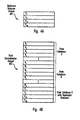
- FIGURE 4A illustrates a data structure that represents the duplicate remover output 401, in accordance with aspects of the invention.
- the duplicate remover output 401 only has entries C 1 , C 3 , C 12 , and C 88 . The rest of the entries were deemed to be duplicates and thus removed by the duplicate remover 311.
- the first concatenator 312 receives and concatenates an instance of the database A, an instance of the database B, and the duplicate remover output 401.
- the resulting output is illustrated in FIGURE 4B as the first concatenator output 402, which is returned to the filter 313.
- the filter 313 then filters the first concatenator output 402 using the request data entered in the input field 201 as the filtering parameter.
- the filter 313 checks for a match against any parameter that the user may intend for the filter to match against. For example, when entering dialing input into input field 201, the user may intend to enter a telephone number with the area code first, enter a telephone number without the area code, enter the first name of a desired callee, enter the last name of a desired callee, or the like.
- the filter 313 filters against all these parameters.
- the output from filter 313 is illustrated in FIGURE 4C as filter output 403. Note that some of the entries have been removed thus emphasizing that the output is filtered.
- the second concatenator 315 receives and concatenates the request data with the filter output 403.
- the resulting output is illustrated in FIGURE 4D as second concatenator output 404.
- the requestor 316 receives the second concatenated output 404 and then processes those entries that need to be displayed by the displayer.
- the entries in the second concatenator output 404 represents entries from different databases. Accordingly, each of the entries in the second concatenator output 404 may have significantly different data structures and thus still be incompatible with display in a unified format. Accordingly, the requestor 316 uses various data interfaces 317, 318, 319 and 320 in order to properly format the entries in a unified manner.
- the requestor 316 passes the request data to the request data interface 317.
- the request data interface 317 then passes back the request data formatted for presentation on display 200.
- the font size of the request data may change depending on how many characters are entered in the input field 201. Specifically, the font size may be reduced as necessary to fit all of the request data in one line in the input field 201.
- the requestor 316 passes in any entries from database A that are to be displayed to the database A data interface 318, any entries from database B that are to be displayed to the database B data interface 319, and any entries from database C that are to be displayed to the database C data interface 320.
- Database A data interface 318, database B data interface 319, and database C data interface 320 then return the entries with equivalent formatting such that the filter output field 202 displays the entries in a unified fashion regardless of the origin of the entry.
- the request 316 then passes the formatted entries to the displayer 321 for presentation on the display 200.
- the filter 313 retrieves data appropriate to multiple request methods by filtering on multiple parameters that depend on the user's ambiguous intent. For example, the filter 313 may use the dialing input to match to a telephone number with area code, a telephone number without area code, an associated first name, an associated last name, of the like. Dialing using any of these filtering parameters may be viewed as being a separate dialing method in accordance with the present invention.
- the filter 313 may query the requestor 316 for the proper data interfaces for the corresponding entries it is filtering to determine whether the entries satisfy the filtering criteria. Also, the duplicate remover 311 may query the requestor 316 for the proper data interfaces for corresponding entries in order to determine whether the corresponding entries are indeed duplicates.
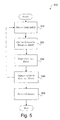
- FIGURE 5 illustrates a process 500 for allowing a user to enter a request to find a contact, in accordance with the present invention. After a start block, the process moves to block 510 where user input is obtained for finding a contact. Clearing the input characters takes the user back to the top of the Contact list.
- the process obtains the contacts that are appropriate based on the user's input.
- the contacts are obtained by searching.
- a contacts application or some other application on the device such as a home screen (e.g. the Today Screen available on many mobile devices that utilize Microsoft mobile software)
- contact databases are searched.
- the contact databases include pinned items, recent calls, regular contacts, and SIM contacts.
- filtering a specific category or data store only that particular database is searched.
- filtering from the Today screen the entire data store of contacts is searched.
- all of the contacts accessible by the device are searched for appropriate contacts.
- database A may include data appropriate for dialing from a contacts list
- database B includes data appropriate for speed dialing
- database C includes data appropriate for dialing through a call log selection.
- the contact data is unified into a single list.
- the matched results appear in the following order (from top to bottom): Speed Dial Contacts (In numbered order); Recent Calls (alphabetically then ascending order); Pinned Contacts (alphabetically); Regular Contacts (alphabetically); and SIM Contacts (alphabetically).
- the user may define the way the results are displayed.
- the process then moves to block 540 where the results are displayed such that the user may review the contacts.
- the input is highlighted in the list view of the matched contacts.
- the process may then return to block 510 to obtain additional user input that focuses the search for the contacts.
- the process may continue until the user selects a contact at block 550.
- the process then ends and returns to processing other actions.
Landscapes
- Engineering & Computer Science (AREA)
- Architecture (AREA)
- Mechanical Engineering (AREA)
- Civil Engineering (AREA)
- Structural Engineering (AREA)
- Signal Processing (AREA)
- Telephone Function (AREA)
- Information Retrieval, Db Structures And Fs Structures Therefor (AREA)
- Telephonic Communication Services (AREA)
Applications Claiming Priority (2)
| Application Number | Priority Date | Filing Date | Title |
|---|---|---|---|
| US768035 | 1991-09-30 | ||
| US10/768,035 US20050171933A1 (en) | 2004-01-29 | 2004-01-29 | Smart dial content search |
Publications (1)
| Publication Number | Publication Date |
|---|---|
| EP1560403A1 true EP1560403A1 (fr) | 2005-08-03 |
Family
ID=34654365
Family Applications (1)
| Application Number | Title | Priority Date | Filing Date |
|---|---|---|---|
| EP05100625A Withdrawn EP1560403A1 (fr) | 2004-01-29 | 2005-01-31 | Dispositif et procédé de recherche prédictive pour des numéros de téléphone |
Country Status (5)
| Country | Link |
|---|---|
| US (1) | US20050171933A1 (fr) |
| EP (1) | EP1560403A1 (fr) |
| JP (1) | JP2005259117A (fr) |
| KR (1) | KR20050077805A (fr) |
| CN (1) | CN1649369A (fr) |
Cited By (4)
| Publication number | Priority date | Publication date | Assignee | Title |
|---|---|---|---|---|
| WO2008031634A1 (fr) | 2006-09-11 | 2008-03-20 | Sony Ericsson Mobile Communications Ab | Procédé permettant d'accéder à des coordonnées |
| EP2192752A1 (fr) * | 2005-09-09 | 2010-06-02 | J-Data Co., Ltd. | Téléphone portable pour extraire des données stockées |
| RU2447604C2 (ru) * | 2007-02-03 | 2012-04-10 | Эл Джи Электроникс Инк. | Мобильное устройство связи, способное предоставлять перечень возможных телефонных номеров, и способ управления мобильным устройством связи |
| WO2012075550A1 (fr) * | 2010-12-08 | 2012-06-14 | Boris Ivanov Tsigov | Procédé et système permettant une numérotation téléphonique abrégée |
Families Citing this family (16)
| Publication number | Priority date | Publication date | Assignee | Title |
|---|---|---|---|---|
| US7599362B2 (en) | 2005-11-28 | 2009-10-06 | Sony Ericsson Mobile Communications Ab | Method and device for communication channel selection |
| US20070143364A1 (en) * | 2005-12-21 | 2007-06-21 | Chen Lang S | Techniques to manage contact information |
| US7711744B1 (en) * | 2006-01-18 | 2010-05-04 | 3Com Corporation | Simple and fast directory search with reduced keystrokes and reduced server calls |
| US20080162971A1 (en) * | 2006-12-29 | 2008-07-03 | Nokia Corporation | User Interface for Searches |
| US9298721B2 (en) * | 2007-02-28 | 2016-03-29 | Qualcomm Incorporated | Prioritized search results based on monitored data |
| US20090055379A1 (en) * | 2007-08-22 | 2009-02-26 | Richard Murtagh | Systems and Methods for Locating Contact Information |
| KR101538636B1 (ko) * | 2008-01-29 | 2015-07-22 | 삼성전자 주식회사 | 주소록 검색 방법 및 이를 이용한 휴대용 통신 장치 |
| CN101299857B (zh) * | 2008-07-02 | 2012-09-05 | 北京搜狗科技发展有限公司 | 一种输出通讯信息的方法及装置 |
| US8395547B2 (en) | 2009-08-27 | 2013-03-12 | Hewlett-Packard Development Company, L.P. | Location tracking for mobile computing device |
| US8755815B2 (en) | 2010-08-31 | 2014-06-17 | Qualcomm Incorporated | Use of wireless access point ID for position determination |
| CN101877738A (zh) * | 2010-04-12 | 2010-11-03 | 上海闻泰电子科技有限公司 | 一种实现手机拨号快速匹配完整号码的方法 |
| US8392411B2 (en) | 2010-05-20 | 2013-03-05 | Google Inc. | Automatic routing of search results |
| CN103222319B (zh) | 2010-09-29 | 2016-08-10 | 高通股份有限公司 | 一种用于移动计算设备的方法及移动计算设备 |
| CN102172003A (zh) * | 2011-04-26 | 2011-08-31 | 华为终端有限公司 | 信息处理方法及终端设备 |
| US20130185275A1 (en) * | 2012-01-13 | 2013-07-18 | Hendricks Investment Holdings, Llc | Methods and systems for searching entries in smart devices |
| CN103685668B (zh) * | 2013-11-21 | 2017-03-29 | 科大讯飞股份有限公司 | 快捷输入本地通讯录中联系人的方法及系统 |
Citations (4)
| Publication number | Priority date | Publication date | Assignee | Title |
|---|---|---|---|---|
| EP0951163A2 (fr) * | 1998-04-14 | 1999-10-20 | Samsung Electronics Co., Ltd. | Méthode de numérotation pour un téléphone mobile |
| GB2351631A (en) * | 1999-03-17 | 2001-01-03 | Nec Corp | Automatically completing dialled telephone numbers |
| EP1193956A2 (fr) * | 2000-10-02 | 2002-04-03 | Microsoft Corporation | Combinaison de différentes méthodes de requête en un interface d'utilisateur unique et unifié |
| US20030174833A1 (en) * | 2002-03-15 | 2003-09-18 | Chien-Fa Wang | Dialing method with phone number retrieval using partial pattern matching |
Family Cites Families (6)
| Publication number | Priority date | Publication date | Assignee | Title |
|---|---|---|---|---|
| US20030069874A1 (en) * | 1999-05-05 | 2003-04-10 | Eyal Hertzog | Method and system to automate the updating of personal information within a personal information management application and to synchronize such updated personal information management applications |
| CA2406084A1 (fr) * | 2000-04-17 | 2001-10-25 | Lonnie S. Clabaugh | Mecanisme sans etat d'extraction de donnees |
| JP2002209009A (ja) * | 2001-01-05 | 2002-07-26 | Sony Corp | 情報処理装置および方法、並びに記録媒体 |
| US20030110068A1 (en) * | 2001-12-10 | 2003-06-12 | Matheson Lesley R. | System for exchanging materials |
| US7313760B2 (en) * | 2002-12-19 | 2007-12-25 | Microsoft Corporation | Contact picker |
| US7360174B2 (en) * | 2002-12-19 | 2008-04-15 | Microsoft Corporation | Contact user interface |
-
2004
- 2004-01-29 US US10/768,035 patent/US20050171933A1/en not_active Abandoned
-
2005
- 2005-01-28 KR KR1020050008237A patent/KR20050077805A/ko not_active Withdrawn
- 2005-01-28 CN CNA2005100078242A patent/CN1649369A/zh active Pending
- 2005-01-31 JP JP2005024157A patent/JP2005259117A/ja active Pending
- 2005-01-31 EP EP05100625A patent/EP1560403A1/fr not_active Withdrawn
Patent Citations (4)
| Publication number | Priority date | Publication date | Assignee | Title |
|---|---|---|---|---|
| EP0951163A2 (fr) * | 1998-04-14 | 1999-10-20 | Samsung Electronics Co., Ltd. | Méthode de numérotation pour un téléphone mobile |
| GB2351631A (en) * | 1999-03-17 | 2001-01-03 | Nec Corp | Automatically completing dialled telephone numbers |
| EP1193956A2 (fr) * | 2000-10-02 | 2002-04-03 | Microsoft Corporation | Combinaison de différentes méthodes de requête en un interface d'utilisateur unique et unifié |
| US20030174833A1 (en) * | 2002-03-15 | 2003-09-18 | Chien-Fa Wang | Dialing method with phone number retrieval using partial pattern matching |
Non-Patent Citations (1)
| Title |
|---|
| UPP S: "AUTOMATIC TELEPHONE NUMBER RETRIEVAL", MOTOROLA TECHNICAL DEVELOPMENTS, MOTOROLA INC. SCHAUMBURG, ILLINOIS, US, vol. 19, 1 June 1993 (1993-06-01), pages 71, XP000361480, ISSN: 0887-5286 * |
Cited By (6)
| Publication number | Priority date | Publication date | Assignee | Title |
|---|---|---|---|---|
| EP2192752A1 (fr) * | 2005-09-09 | 2010-06-02 | J-Data Co., Ltd. | Téléphone portable pour extraire des données stockées |
| US8346296B2 (en) | 2005-09-09 | 2013-01-01 | J-Data Co., Ltd. | Portable telephone |
| WO2008031634A1 (fr) | 2006-09-11 | 2008-03-20 | Sony Ericsson Mobile Communications Ab | Procédé permettant d'accéder à des coordonnées |
| US7710293B2 (en) | 2006-09-11 | 2010-05-04 | Sony Ericsson Mobile Communications Ab | Method for accessing contact information |
| RU2447604C2 (ru) * | 2007-02-03 | 2012-04-10 | Эл Джи Электроникс Инк. | Мобильное устройство связи, способное предоставлять перечень возможных телефонных номеров, и способ управления мобильным устройством связи |
| WO2012075550A1 (fr) * | 2010-12-08 | 2012-06-14 | Boris Ivanov Tsigov | Procédé et système permettant une numérotation téléphonique abrégée |
Also Published As
| Publication number | Publication date |
|---|---|
| JP2005259117A (ja) | 2005-09-22 |
| CN1649369A (zh) | 2005-08-03 |
| US20050171933A1 (en) | 2005-08-04 |
| KR20050077805A (ko) | 2005-08-03 |
Similar Documents
| Publication | Publication Date | Title |
|---|---|---|
| EP1560403A1 (fr) | Dispositif et procédé de recherche prédictive pour des numéros de téléphone | |
| EP1193956B1 (fr) | Combinaison de différentes méthodes de requête en un interface d'utilisateur unique et unifié | |
| US6909910B2 (en) | Method and system for managing changes to a contact database | |
| US8150017B2 (en) | Phone dialer with advanced search feature and associated method of searching a directory | |
| US7551899B1 (en) | Intelligent dialing scheme for telephony application | |
| US8532710B2 (en) | Integrated dialing | |
| US7046994B1 (en) | System and method for associating a contact with a call ID | |
| CN101330687B (zh) | 根据通话频率进行号码匹配的方法及移动电话 | |
| US20040052355A1 (en) | Apparatus, system and method of auto-completing telephone numbers that are being manually dialed | |
| US20080079609A1 (en) | Method for Accessing Contact Information | |
| WO2003073732A1 (fr) | Mise a disposition d'informations pour faciliter des conversations telephoniques | |
| KR20020083216A (ko) | 전자 전화번호부의 즐겨찾기 방법 및 장치 | |
| CN102780802A (zh) | 一种快速拨号的方法及终端 | |
| CN1564569A (zh) | 电话号码搜索方法和搜索引擎 | |
| US9225819B2 (en) | Character analysis engine in mobile computing device for facilitating interactive voice response operations | |
| KR20050099894A (ko) | 이동 통신 단말기의 텍스트에 포함된 전화번호 등록 방법 | |
| KR100639368B1 (ko) | 이동통신 단말기의 단축번호 관리방법 | |
| JPH04239857A (ja) | 通信装置 | |
| JPH11289376A (ja) | 市外局番検索機能付き携帯電話端末 | |
| JPH09294155A (ja) | 携帯情報端末およびデータ検索方法 | |
| KR20030044237A (ko) | 이동통신 단말기에서의 전화번호 검색방법 | |
| KR20050004402A (ko) | 이동통신 단말기의 전화번호 검색방법 | |
| JPH11191798A (ja) | 携帯電話機とそのメモリダイアル検索方法 |
Legal Events
| Date | Code | Title | Description |
|---|---|---|---|
| PUAI | Public reference made under article 153(3) epc to a published international application that has entered the european phase |
Free format text: ORIGINAL CODE: 0009012 |
|
| AK | Designated contracting states |
Kind code of ref document: A1 Designated state(s): AT BE BG CH CY CZ DE DK EE ES FI FR GB GR HU IE IS IT LI LT LU MC NL PL PT RO SE SI SK TR |
|
| AX | Request for extension of the european patent |
Extension state: AL BA HR LV MK YU |
|
| 17P | Request for examination filed |
Effective date: 20060104 |
|
| AKX | Designation fees paid |
Designated state(s): AT BE BG CH CY CZ DE DK EE ES FI FR GB GR HU IE IS IT LI LT LU MC NL PL PT RO SE SI SK TR |
|
| STAA | Information on the status of an ep patent application or granted ep patent |
Free format text: STATUS: THE APPLICATION IS DEEMED TO BE WITHDRAWN |
|
| 18D | Application deemed to be withdrawn |
Effective date: 20100422 |