EP1562171A2 - Dispositif de réglage de la tension des électrodes opposées dans un panneau à cristaux liquides - Google Patents
Dispositif de réglage de la tension des électrodes opposées dans un panneau à cristaux liquides Download PDFInfo
- Publication number
- EP1562171A2 EP1562171A2 EP05002029A EP05002029A EP1562171A2 EP 1562171 A2 EP1562171 A2 EP 1562171A2 EP 05002029 A EP05002029 A EP 05002029A EP 05002029 A EP05002029 A EP 05002029A EP 1562171 A2 EP1562171 A2 EP 1562171A2
- Authority
- EP
- European Patent Office
- Prior art keywords
- opposing electrode
- electrode voltage
- liquid crystal
- luminance
- value
- Prior art date
- Legal status (The legal status is an assumption and is not a legal conclusion. Google has not performed a legal analysis and makes no representation as to the accuracy of the status listed.)
- Withdrawn
Links
- 239000004973 liquid crystal related substance Substances 0.000 title claims abstract description 116
- 230000004044 response Effects 0.000 claims abstract description 10
- 230000003287 optical effect Effects 0.000 claims description 53
- 230000004048 modification Effects 0.000 description 13
- 238000012986 modification Methods 0.000 description 13
- 239000003990 capacitor Substances 0.000 description 10
- 238000005070 sampling Methods 0.000 description 10
- 230000008859 change Effects 0.000 description 9
- 230000006870 function Effects 0.000 description 7
- 238000005286 illumination Methods 0.000 description 6
- 238000000034 method Methods 0.000 description 6
- 238000005516 engineering process Methods 0.000 description 5
- 238000010276 construction Methods 0.000 description 4
- 230000007423 decrease Effects 0.000 description 4
- 230000002123 temporal effect Effects 0.000 description 4
- 230000033228 biological regulation Effects 0.000 description 3
- 230000000694 effects Effects 0.000 description 3
- 230000015556 catabolic process Effects 0.000 description 2
- 238000006731 degradation reaction Methods 0.000 description 2
- 230000005693 optoelectronics Effects 0.000 description 2
- 239000007787 solid Substances 0.000 description 2
- 230000001360 synchronised effect Effects 0.000 description 2
- 230000004075 alteration Effects 0.000 description 1
- 238000006243 chemical reaction Methods 0.000 description 1
- 238000001514 detection method Methods 0.000 description 1
- 230000002349 favourable effect Effects 0.000 description 1
- 239000012535 impurity Substances 0.000 description 1
- 150000002500 ions Chemical class 0.000 description 1
- 239000000463 material Substances 0.000 description 1
- 239000011159 matrix material Substances 0.000 description 1
- 230000007246 mechanism Effects 0.000 description 1
- 230000003071 parasitic effect Effects 0.000 description 1
- 230000000704 physical effect Effects 0.000 description 1
- 230000010287 polarization Effects 0.000 description 1
- 230000008569 process Effects 0.000 description 1
- 230000009467 reduction Effects 0.000 description 1
- 238000000926 separation method Methods 0.000 description 1
- 239000010409 thin film Substances 0.000 description 1
- 230000001960 triggered effect Effects 0.000 description 1
Images



Classifications
-
- G—PHYSICS
- G09—EDUCATION; CRYPTOGRAPHY; DISPLAY; ADVERTISING; SEALS
- G09G—ARRANGEMENTS OR CIRCUITS FOR CONTROL OF INDICATING DEVICES USING STATIC MEANS TO PRESENT VARIABLE INFORMATION
- G09G3/00—Control arrangements or circuits, of interest only in connection with visual indicators other than cathode-ray tubes
- G09G3/20—Control arrangements or circuits, of interest only in connection with visual indicators other than cathode-ray tubes for presentation of an assembly of a number of characters, e.g. a page, by composing the assembly by combination of individual elements arranged in a matrix no fixed position being assigned to or needed to be assigned to the individual characters or partial characters
- G09G3/34—Control arrangements or circuits, of interest only in connection with visual indicators other than cathode-ray tubes for presentation of an assembly of a number of characters, e.g. a page, by composing the assembly by combination of individual elements arranged in a matrix no fixed position being assigned to or needed to be assigned to the individual characters or partial characters by control of light from an independent source
- G09G3/36—Control arrangements or circuits, of interest only in connection with visual indicators other than cathode-ray tubes for presentation of an assembly of a number of characters, e.g. a page, by composing the assembly by combination of individual elements arranged in a matrix no fixed position being assigned to or needed to be assigned to the individual characters or partial characters by control of light from an independent source using liquid crystals
-
- G—PHYSICS
- G09—EDUCATION; CRYPTOGRAPHY; DISPLAY; ADVERTISING; SEALS
- G09G—ARRANGEMENTS OR CIRCUITS FOR CONTROL OF INDICATING DEVICES USING STATIC MEANS TO PRESENT VARIABLE INFORMATION
- G09G3/00—Control arrangements or circuits, of interest only in connection with visual indicators other than cathode-ray tubes
- G09G3/20—Control arrangements or circuits, of interest only in connection with visual indicators other than cathode-ray tubes for presentation of an assembly of a number of characters, e.g. a page, by composing the assembly by combination of individual elements arranged in a matrix no fixed position being assigned to or needed to be assigned to the individual characters or partial characters
- G09G3/34—Control arrangements or circuits, of interest only in connection with visual indicators other than cathode-ray tubes for presentation of an assembly of a number of characters, e.g. a page, by composing the assembly by combination of individual elements arranged in a matrix no fixed position being assigned to or needed to be assigned to the individual characters or partial characters by control of light from an independent source
- G09G3/36—Control arrangements or circuits, of interest only in connection with visual indicators other than cathode-ray tubes for presentation of an assembly of a number of characters, e.g. a page, by composing the assembly by combination of individual elements arranged in a matrix no fixed position being assigned to or needed to be assigned to the individual characters or partial characters by control of light from an independent source using liquid crystals
- G09G3/3611—Control of matrices with row and column drivers
- G09G3/3648—Control of matrices with row and column drivers using an active matrix
-
- G—PHYSICS
- G09—EDUCATION; CRYPTOGRAPHY; DISPLAY; ADVERTISING; SEALS
- G09G—ARRANGEMENTS OR CIRCUITS FOR CONTROL OF INDICATING DEVICES USING STATIC MEANS TO PRESENT VARIABLE INFORMATION
- G09G3/00—Control arrangements or circuits, of interest only in connection with visual indicators other than cathode-ray tubes
- G09G3/02—Control arrangements or circuits, of interest only in connection with visual indicators other than cathode-ray tubes by tracing or scanning a light beam on a screen
-
- G—PHYSICS
- G09—EDUCATION; CRYPTOGRAPHY; DISPLAY; ADVERTISING; SEALS
- G09G—ARRANGEMENTS OR CIRCUITS FOR CONTROL OF INDICATING DEVICES USING STATIC MEANS TO PRESENT VARIABLE INFORMATION
- G09G2320/00—Control of display operating conditions
- G09G2320/02—Improving the quality of display appearance
- G09G2320/0204—Compensation of DC component across the pixels in flat panels
-
- G—PHYSICS
- G09—EDUCATION; CRYPTOGRAPHY; DISPLAY; ADVERTISING; SEALS
- G09G—ARRANGEMENTS OR CIRCUITS FOR CONTROL OF INDICATING DEVICES USING STATIC MEANS TO PRESENT VARIABLE INFORMATION
- G09G2320/00—Control of display operating conditions
- G09G2320/02—Improving the quality of display appearance
- G09G2320/0247—Flicker reduction other than flicker reduction circuits used for single beam cathode-ray tubes
-
- G—PHYSICS
- G09—EDUCATION; CRYPTOGRAPHY; DISPLAY; ADVERTISING; SEALS
- G09G—ARRANGEMENTS OR CIRCUITS FOR CONTROL OF INDICATING DEVICES USING STATIC MEANS TO PRESENT VARIABLE INFORMATION
- G09G2360/00—Aspects of the architecture of display systems
- G09G2360/14—Detecting light within display terminals, e.g. using a single or a plurality of photosensors
- G09G2360/141—Detecting light within display terminals, e.g. using a single or a plurality of photosensors the light conveying information used for selecting or modulating the light emitting or modulating element
-
- G—PHYSICS
- G09—EDUCATION; CRYPTOGRAPHY; DISPLAY; ADVERTISING; SEALS
- G09G—ARRANGEMENTS OR CIRCUITS FOR CONTROL OF INDICATING DEVICES USING STATIC MEANS TO PRESENT VARIABLE INFORMATION
- G09G2360/00—Aspects of the architecture of display systems
- G09G2360/14—Detecting light within display terminals, e.g. using a single or a plurality of photosensors
- G09G2360/145—Detecting light within display terminals, e.g. using a single or a plurality of photosensors the light originating from the display screen
-
- G—PHYSICS
- G09—EDUCATION; CRYPTOGRAPHY; DISPLAY; ADVERTISING; SEALS
- G09G—ARRANGEMENTS OR CIRCUITS FOR CONTROL OF INDICATING DEVICES USING STATIC MEANS TO PRESENT VARIABLE INFORMATION
- G09G3/00—Control arrangements or circuits, of interest only in connection with visual indicators other than cathode-ray tubes
- G09G3/001—Control arrangements or circuits, of interest only in connection with visual indicators other than cathode-ray tubes using specific devices not provided for in groups G09G3/02 - G09G3/36, e.g. using an intermediate record carrier such as a film slide; Projection systems; Display of non-alphanumerical information, solely or in combination with alphanumerical information, e.g. digital display on projected diapositive as background
Definitions
- the present invention relates to technology for handling changes in the optimal voltage value that should be provided to opposing electrodes in a liquid crystal panel used in an image display device such as a projector.
- Liquid crystal panels are often used as optoelectronic devices for forming images.
- the liquid crystal device is an optoelectronic device that is capable of forming images by applying a voltage in response to an image signal corresponding to a pixel to liquid crystal forming the pixel and controlling the transmissivity of light radiated on the pixel.
- FIGS. 4(A) and (B) are explanatory views showing an equivalent circuit of an arbitrary first pixel in a liquid crystal panel, and the waveform of voltage applied to the first pixel.
- the first pixel PE is provided at an orthogonal intersection of a scan line SL and a signal line DL via a TFT (thin film transistor) 142, which is a switching element.
- a gate electrode for the TFT 142 (hereinafter, referred to as a "TFT switch”) is connected to the scan line SL, a drain electrode is connected to the signal line DL, and a source electrode is connected to a pixel electrode 144 of the pixel PE.
- An opposing electrode 146 opposing the pixel electrode 144 is connected to an opposing electrode signal line LCCOM, and an opposing electrode voltage Vcom with nearly the same potential is applied to the opposing electrode 146 of each pixel through the opposing electrode signal line LCCOM.
- the opposing electrode voltage Vcom applied through the opposing electrode signal line LCCOM is called the LCCOM voltage.
- the pixel signal voltage Vop corresponding to this pixel is written to the pixel capacitor Cpe through the TFT switch 142 which is turned “on” and “off” by a switch voltage Vg of a scan line drive signal supplied by the scan line SL.
- the image signal voltage Vop is written to the pixel capacitor Cpe as a pixel electrode voltage Vp during a sampling interval Ts, and the pixel electrode voltage Vp is saved in a hold interval Th as shown in FIG. 4(B).
- the liquid crystal on the pixel electrode 144 operates due to the potential difference between the LCCOM voltage Vcom supplied to the opposing electrode 146 and the pixel electrode voltage Vp supplied to the pixel electrode 144.
- a plurality of other pixels arranged in a matrix form are similar.
- an alternative current drive is conventionally used for the pixels (that is, the liquid crystal).
- the polarity of a pixel electrode voltage Vp applied to the pixel electrode 144 is made opposite to the LCCOM voltage Vcom applied to the opposing electrode 146 for each frame scan cycle, the average voltage applied to the pixel electrode 144 and the opposing electrode 146 is set to 0 V, and driving is carried out such that a DV voltage is not applied to the liquid crystal as shown in FIG. 4(B).
- the 0 level was conventionally made the boundary, and shifts were alternately made between the positive and negative poles, but in the present Specification, the boundary is not limited to the 0 level, but may be made a desired level and includes cases where shifting occurs between a high level and a low level.
- the high level may be called the positive electrode and the low level the negative electrode for convenience sake.
- the actual pixel electrode voltage Vp differs from the pixel signal voltage Vop depending on the leakage current through the liquid crystal resistor, the length of the hold interval Th, the size of the pixel capacitor Cpe, the "off" current of the TFT switch 142, and the feedthrough that occurs when the TFT 142 is turned “on” due to the parasitic capacitor of the TFT switch 142. Because of this, the LCCOM voltage Vcom needs to be the voltage center of the pixel electrode voltage Vp, not the signal voltage center Vop of the pixel signal voltage Vop to set the average voltage applied to the pixel PE to 0 V.
- the actual LCCOM voltage Vcom is ordinarily optimally adjusted before shipping from the factory where the display device utilizing the liquid crystal display is assembled.
- Examples of technology related to this sort of technology are such as that given in Japanese Patent Laid-Open Gazette No. 59-119328 and No. 2002-358056.
- the luminance of the light source lamp used as the source for the illuminating light that illuminates the liquid crystal panel decreases over time, causing the luminance of the stray light radiating on the TFT switch 142 to change over time.
- the present invention is directed to a first projector that includes a liquid crystal panel and a projection optical system for projecting a resulting image corresponding to the modulated light output from the liquid crystal panel.
- the first projector further includes: an opposing electrode voltage adjustment circuit for adjusting a value of an opposing electrode voltage inputted into the liquid crystal panel.
- the opposing electrode voltage adjustment circuit includes: an opposing electrode voltage generator for generating the opposing electrode voltage in response to a set parameter value; an opposing electrode voltage regulator for setting the parameter value to the opposing electrode voltage generator; and a luminance detector for detecting a luminance of the modulated light output from the liquid crystal panel and inputting a luminance signal representing the detected luminance into the opposing electrode voltage regulator.
- the opposing electrode voltage regulator changes the parameter value to a plurality of values and successively sets them to the opposing electrode voltage generator, obtains a difference between a maximum value and a minimum value of luminance signals inputted from the luminance detector as a flicker value for each of the parameter values, and sets the parameter value corresponding to a minimum flicker value out of the flicker values obtained for each of the parameter values to the opposing electrode voltage generator, thereby adjusting the value of the opposing electrode voltage inputted into the liquid crystal panel.
- the first projector it is possible in the first projector to automatically adjust the opposing electrode voltage value such that the flicker value becomes minimal in a case where an instruction is given to adjust the opposing electrode voltage value inputted in the liquid crystal panel at a specified timing.
- the luminance detector includes a luminance sensor for detecting a luminance of the modulated light, and the luminance sensor is disposed on a light path of modulated light that do not enter the projection optical system but is output from the liquid crystal panel.
- the present invention is directed to a second projector that includes a plurality of liquid crystal panels, a combination optical system for combining a plurality of modulated lights output from the plurality of liquid crystal panels, and a projection optical system for projecting a resulting image corresponding to the combined light output from the combination optical system.
- the second projector further includes: an opposing electrode voltage adjustment circuit for adjusting respective values of opposing electrode voltage inputted to the liquid crystal panels.
- the opposing electrode voltage adjustment circuit includes: a plurality of opposing electrode voltage generators for generating the opposing electrode voltage in response to a set parameter value, provided for each of the liquid crystal panels; an opposing electrode voltage regulator for setting the parameter value to each of the opposing electrode voltage generators; and a luminance detector for detecting a luminance of the combined light output from the combination optical system and inputting a luminance signal representing a detected luminance into the opposing electrode voltage regulator.
- the opposing electrode voltage regulator selects only one of the plurality of liquid crystal panels, output the modulated light from the selected liquid crystal panel, changes the parameter value to a plurality of values and successively sets them to the opposing electrode voltage generator corresponding to the selected liquid crystal panel, obtains a difference between a maximum value and a minimum value of luminance signals inputted from the luminance detector as a flicker value for each of the parameter values, and sets the parameter value corresponding to a minimum flicker value out of the flicker values obtained for each of the parameter values to the corresponding opposing electrode voltage generator, thereby adjusting the value of the opposing electrode voltage inputted into the selected liquid crystal panel.
- the luminance detector includes a luminance sensor for detecting a luminance of the combination light, and the luminance sensor is disposed on a light path of combination light that do not enter the projection optical system but is output from the combination optical system.
- the luminance sensor does not shield the combined light entering the projection optical system, it is therefore possible to adjust the opposing electrode voltage in the projector without stopping the projection of ordinary images, for example.
- the present invention is not limited to the projectors as modes, but may be effectuated in a variety of modes such as a mode as an opposing electrode voltage adjustment circuit, a mode as a liquid crystal display device equipped with such an opposing electrode voltage adjustment circuit, and a mode as a method invention such as an opposing electrode voltage adjustment method.
- FIG. 1 is a block view showing the essential construction of a liquid crystal projector as one embodiment of the present invention.
- FIG. 2 is a flowchart showing the procedure for LCCOM voltage adjustment
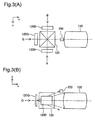
- FIGS. 3(A) and (B) are explanatory views showing the placement of the luminance sensor 250 in a three-panel liquid crystal projector.
- FIGS. 4(A) and (B) are explanatory views showing the waveform of voltage applied to an arbitrary pixel and an equivalent circuit of the pixel in a liquid crystal panel.
- FIG. 1 is a block view showing the essential construction of a liquid crystal projector as one embodiment of the present invention.
- This liquid crystal projector 10 is composed of an optical system 100 for projecting images, and a control system 200 for controlling the photographing of images.
- the optical system 100 is equipped with an illumination optical system 110, a liquid crystal panel (LCD) 120, and a projection optical system 130.
- the control system 200 is equipped with a controller 210, an image processor 220, a liquid crystal panel (LCD) driver 230, a LCCOM voltage generator 240, a luminance sensor 250, and an A/D converter 260.
- the controller 210 is composed of a computer equipped with a memory and CPU, not illustrated.
- the controller 210 reads and executes a program stored in the memory to control an image processor 220, an LCD driver 230, and an LCCOM voltage generator 240. For example, it controls the overall operation of the projector by setting to registers, not illustrated, the various parameter values used by the image processor 220, the LCD driver 230, and the LCCOM voltage generator 240 and controlling their respective operations.
- the image processor 220 effectuates a variety of functions, namely analog digital conversion and decoding functions, a synchronous signal separation function, and an image processing function. That is, the image processor 220 internally converts inputted analog and digital image signals VS to usable digital image data, and synchronizes and writes the converted digital image data to a frame memory, not illustrated, or reads digital image data written to the frame memory.
- the image processor 220 also carries out image processing in the read and write process.
- a variety of image processing is possible such as luminance adjustment, color balance adjustment, contrast adjustment, sharpness adjustment and other image quality adjustments, image size magnification and reduction, and trapezoidal distortion correction.
- the liquid crystal panel driver 230 generates a drive signal for driving the liquid crystal panel 120 based on image data inputted from the image processor 220.
- the generated drive signal is inputted to a terminal for inputting drive signals from the liquid crystal panel 120.
- the LCCOM voltage generator 240 generates a voltage (hereinafter, referred to as the "LCCOM voltage") that is applied to common opposing electrodes of the liquid crystal panel 120 based on the parameter values set to the resister, not illustrated, by the controller 220.
- the generated LCCOM voltage is inputted to the terminal (hereinafter, referred to as the "LCCOM input terminal") for inputting the LCCOM voltage from the liquid crystal 120.
- the liquid crystal panel 120 modulates illumination light output from the illumination optical system 110 based on drive signals from the liquid crystal driver 230 and the LCCOM voltage from the LCCOM voltage generator 240.
- the modulated light is output towards the projection optical system 130. That is, the liquid crystal panel 120 is transparent, and is used as a light valve (light modulator) for modulating illumination light.
- the projection optical system 130 projects the modulation light radiated in the projection optical system 130 that was modulated by the liquid crystal panel 120 on a screen SC.
- the controller 210 functions as the LCCOM voltage regulator 214 when the CPU reads and executes the program stored in the memory.
- the LCCOM voltage regulator 214, the LCCOM voltage generator 240, the A/D converter 260 and the luminance sensor 250 as the luminance detector function as an LCCOM voltage regulation circuit, a characteristic of the present invention.
- the luminance sensor 250 detects the luminance of modulated light output from the liquid crystal panel 120, and detects the luminance of entered light, outputting it as an analog luminance signal.
- the A/D converter 260 converts the luminance signal inputted by the luminance sensor 250 to digital luminance data that can be inputted to the controller 210.
- the LCCOM voltage regulator 214 uses the luminance data inputted from the A/D converter 260 for LCCOM voltage adjustment described below.
- the luminance sensor 250 is disposed as described below in the present embodiment.
- the top side on the paper (+y direction) is the top of the elements 110, 120, and 130 in the optical system 100, and the elements 110, 120, and 130 are disposed along the horizontal direction (x direction) of the paper; the description of the elements 110, 120, and 130 is given from the size (+z direction).
- the luminance sensor 250 is disposed in a position such as to shield the modulated light output from the liquid crystal panel 120 that was radiated on the projection optical system 130, and to obtain a quantity of light such that a change in the luminance generated by flickering contained in the modulated light is detected.
- the luminance sensor 250 is disposed proximate to the projection optical system 130 and proximate to the outer edge on the top (the +y direction) of the projection optical system 130.
- FIG. 2 is a flowchart showing the procedure for LCCOM voltage adjustment.
- LCCOM voltage adjustment is carried out at set timer intervals to correspond with temporal changes in the optimal value of the LCCOM voltage.
- the execution of a timer, not illustrated, of the controller 210 is triggered by an instruction to the LCCOM voltage regulator 214 to execute LCCOM voltage adjustment at fixed intervals.
- the fixed time intervals may be set as appropriate according to temporal changes.
- the LCCOM voltage regulator 214 causes the display of a still image for LCCOM voltage adjustment in step S310.
- image data showing the still image for LCCOM voltage adjustment is read from a memory not illustrated and inputted to the image processor 220 to carry out display of the still image for LCCOM voltage adjustment.
- a halftone solid image with a 50% luminance for example, may be used as the still image for LCCOM voltage adjustment in which flickering can be readily detected.
- the LCCOM voltage regulator 214 finds a parameter value corresponding to the LCCOM voltage Vcom with the minimum flicker in step S320.
- the LCCOM voltage Vcom is sequentially changed in unit step intervals Vstp from the minimum value to the maximum value by changing and setting the parameter value for the LCCOM voltage generator 240 from the lowest possible value to the maximum value sequentially in the minimum unit (for example, 1) of the parameter value.
- the minimum and maximum values in the luminance data for each LCCOM voltage Vcom inputted from the A/D converter 260 is found, and the difference between the minimum and maximum values that were found of the luminance data is made the flicker size. It is thereby possible to find the parameter value corresponding to the LCCOM voltage Vcom set when the minimum flicker is found out of the flicker sizes that were found.
- the frequency of the flicker is ordinarily equivalent to the alternating frequency (1/2 of the alternating drive frequency) when the liquid crystal is alternately driven.
- the flicker frequency becomes half of the frame frequency, or 30 Hz.
- sampling of the luminance signal is required at a high sampling rate at or above the Nyquist frequency in the A/D converter 260.
- sampling is required at a sampling frequency at or about twice (60 Hz) the flicker frequency (30 Hz), and preferably, sampling is required at a sampling frequency 10 times or higher than the flicker frequency, and even more preferably, sampling is required at a sampling rate 100 times or more thereof.
- the luminance signal detected by the luminance sensor 250 is therefore sampled at a sampling frequency of 3 kHz, which is 100 times the flicker frequency (30 Hz) in the A/D converter 260.
- step S330 the parameter value that is found is set as the optimal value, and is set to the LCCOM voltage generator 240.
- the LCCOM voltage generator 240 thereby outputs the optimal value of the LCCOM voltage Vcom, which is inputted to an LCCOM input terminal of the liquid crystal panel 120.
- the optimal value of the parameter that is found is stored in a nonvolatile memory, not illustrated. This optimal value is then used as the parameter value to be set to the LCCOM voltage generator 240 for initial set-up of the projector, such as when starting or resetting the projector.
- the projector 10 of the present embodiment operates an LCCOM voltage adjustment circuit, making it possible to automatically adjust the LCCOM voltage setting value to an optimal value such that the size of the flicker decreases.
- the LCCOM voltage can be automatically adjusted to the optimal value according to temporal changes therein. It is thus possible to automatically control flickering that occurs in response to changes over time of the optimal value of the LCCOM voltage.
- LCCOM voltage adjustment in the embodiment described above is explained with an example where the LCCOM voltage adjustment is carried out at fixed time intervals, though it is not limited thereto.
- the adjustment may be carried out during the interval up until when the power is actually turned off.
- the LCCOM voltage adjustment may be carried out according to user instructions.
- the user operates a remote controller not illustrated or an operation button provided on the projector unit, instructing the LCCOM voltage regulator 214 to carry out LCCOM voltage adjustment processing, so the processing is carried out.
- the LCCOM voltage adjustment may be carried out not at one of the adjustment timings, but at a plurality of adjustment timings.
- the parameter value set to the LCCOM voltage generator 240 was successively changed and set in the LCCOM voltage adjustment processing from the minimum to the maximum value in the minimum settable units, thereby finding the size of the flicker in the LCCOM voltage Vcom, changed in unit step intervals Vstp, and then finding the parameter value corresponding to the LCCOM voltage Vcom whose flicker size is minimal; but the present invention is not limited thereto.
- the change can be made not successively in unit step intervals Vstp but successively in step intervals coarser than the unit step interval Vstp, the step interval found estimated to include the LCCOM voltage Vcom with the minimum flicker, and the step interval changed in unit step intervals Vstp.
- any adjustment method with which the value of the LCCOM voltage Vcom is changed by changing the parameter value of the LCCOM voltage generator 240 so the optimal value of the LCCOM voltage Vcom can be found with the minimum flicker size, and the parameter value corresponding thereto can be found as the optimal value, may be used.
- the luminance sensor 250 may be disposed proximate to the projection optical system 130 and at the outer edge on the projection optical system 130. It may also be disposed proximate to the projection optical system 130 and at the outer edge to the left or the right of the projection optical system 130. It may also be disposed proximate to the liquid crystal panel 120. In further detail, it may be disposed at any position as long as light not entering the projection optical system 130 can be detected such that the modulated light entering the projection optical system 130 is not shielded. Also, a plurality of luminance sensor may be disposed in a plurality of locations.
- the luminance sensor 250 was disposed such that modulated light entering the projection optical system 130 is not shielded was described as an example, but it may be disposed such that the luminance of the modulated light entering the projection optical system 310 is detected. In this case, however, it is favorable to dispose it in the light path between the liquid crystal panel 120 and the projection optical system 130 in a position where the luminance sensor 250 is not formed as the projection image, that is proximate to the projection optical system 130. In a case where it is thus disposed, the image may become dark, but it is possible to detect the flicker of light actually projected, which is advantageous for adjustment.
- the luminance sensor 250 is equipped with a mechanism to move the luminance of the modulated light entering the projection optical system 130 to a detectable position only during LCCOM voltage adjustment, an ordinary image can be prevented from becoming dark if the image is projected when not during an LCCOM voltage adjustment.
- the present invention is applied to a single-panel liquid crystal projector that uses one liquid crystal panel, but the present invention may be applied to liquid crystal projectors that have three or any other number of liquid crystal panels as well.
- FIGS. 3(A) and (B) are explanatory views showing the positional relationship of the luminance sensor 250 in a three-panel liquid crystal projector.
- the three-panel liquid crystal projector is equipped with three liquid crystal panels 120R, 120G, and 120B for respectively modulating the entering red (R), green (G), and blue (B) light; a cross-dichroic prism 125 for combining the variously colored modulated light output from the liquid crystal panels 120R, 120G, and 120B; and the projection optical system 130 for projecting the combined light from the cross-dichroic prism 125.
- FIG. 3(A) is an outline plan view of the optical elements as viewed from above.
- FIG. 3(B) is an outline plan of the optical elements in FIG. 3(A) as viewed from the right.
- the luminance sensor 250 is disposed between the cross-dichroic prism 125 and the projection optical system 130.
- the luminance sensor 250 is disposed proximate to the projection optical system 130 and at the outer edge above the projection optical system 130 similar to in the embodiment such that the modulated light output from the liquid crystal panels 120R, 120G, and 120B and entering the projection optical system 130 is not shielded, and that the luminance can be detected whose change due to flicker can be adequately detected.
- the arrangement described in modification s 3 to 5 may be used.
- an image processor, LCD driver, and LCCOM voltage generator having the same functions as the image processor 220, the LCD driver 230, and the LCCOM voltage generator 240 are provided respectively at the liquid crystal panels 120R, 120G, and 120B.
- LCCOM voltage adjustment is carried out separately at the liquid crystal panels 120R, 120G, and 120B.
- modulated light output from the other liquid crystal panels 120G and 120B may be shielded to carry out the same LCCOM voltage adjustment processing as in the embodiment.
- the gradation value of the color signals entering the liquid crystal panels can be set to a minimum level, so the output modulated light becomes only stray light as a rule.
- a still image for adjustment is displayed during LCCOM voltage adjustment.
- the invention is not limited thereto, and LCCOM voltage adjustment may be carried out when displaying an ordinary projection image.
- whether the displayed image is a moving image or a still image may be determined during LCCOM voltage adjustment, and if it is a moving image, a still image for LCCOM voltage adjustment may be displayed.
- a projector using a liquid crystal panel is described as an example, but the invention is not limited thereto, but may be applied to a direct-view image display device using liquid crystal panels.
- a projection optical system is not provided, so the luminance sensor is disposed proximate to the liquid crystal panels.
Landscapes
- Engineering & Computer Science (AREA)
- Physics & Mathematics (AREA)
- Computer Hardware Design (AREA)
- General Physics & Mathematics (AREA)
- Theoretical Computer Science (AREA)
- Chemical & Material Sciences (AREA)
- Crystallography & Structural Chemistry (AREA)
- Liquid Crystal Display Device Control (AREA)
- Liquid Crystal (AREA)
- Control Of Indicators Other Than Cathode Ray Tubes (AREA)
Applications Claiming Priority (2)
| Application Number | Priority Date | Filing Date | Title |
|---|---|---|---|
| JP2004026913A JP2005221569A (ja) | 2004-02-03 | 2004-02-03 | 液晶パネルに入力する対向電極電圧の調整 |
| JP2004026913 | 2004-02-03 |
Publications (1)
| Publication Number | Publication Date |
|---|---|
| EP1562171A2 true EP1562171A2 (fr) | 2005-08-10 |
Family
ID=34675475
Family Applications (1)
| Application Number | Title | Priority Date | Filing Date |
|---|---|---|---|
| EP05002029A Withdrawn EP1562171A2 (fr) | 2004-02-03 | 2005-02-01 | Dispositif de réglage de la tension des électrodes opposées dans un panneau à cristaux liquides |
Country Status (6)
| Country | Link |
|---|---|
| US (1) | US20050190172A1 (fr) |
| EP (1) | EP1562171A2 (fr) |
| JP (1) | JP2005221569A (fr) |
| KR (1) | KR100620130B1 (fr) |
| CN (1) | CN1652014A (fr) |
| TW (1) | TW200527113A (fr) |
Families Citing this family (25)
| Publication number | Priority date | Publication date | Assignee | Title |
|---|---|---|---|---|
| US9093041B2 (en) * | 2005-11-28 | 2015-07-28 | Honeywell International Inc. | Backlight variation compensated display |
| JP5312729B2 (ja) * | 2005-11-29 | 2013-10-09 | 三星ディスプレイ株式會社 | ディスプレイシステム |
| JP2007206680A (ja) * | 2006-01-06 | 2007-08-16 | Canon Inc | 液晶表示装置及び制御方法 |
| CN100565289C (zh) * | 2006-01-06 | 2009-12-02 | 佳能株式会社 | 液晶显示设备和控制该设备的方法 |
| US8154494B2 (en) * | 2006-01-06 | 2012-04-10 | Canon Kabushiki Kaisha | Image display device with liquid crystal modulation elements |
| CN100565288C (zh) * | 2006-01-06 | 2009-12-02 | 佳能株式会社 | 液晶显示设备 |
| KR100812644B1 (ko) * | 2006-02-22 | 2008-03-13 | 삼성전기주식회사 | 광변조기를 포함하는 디스플레이 장치 및 광변조기 보상방법 |
| JP4966565B2 (ja) * | 2006-03-07 | 2012-07-04 | セイコーエプソン株式会社 | 照明光の調光に応じた液晶パネルの対向電極電圧の動的調整 |
| JP4777134B2 (ja) * | 2006-04-28 | 2011-09-21 | キヤノン株式会社 | 画像投射装置 |
| JP5076647B2 (ja) * | 2007-05-28 | 2012-11-21 | セイコーエプソン株式会社 | 画像表示装置、その駆動方法並びに電子機器 |
| JP5093001B2 (ja) * | 2008-01-16 | 2012-12-05 | 株式会社Jvcケンウッド | 光変調装置、投射型表示装置および画像投影方法 |
| JP2009300530A (ja) * | 2008-06-10 | 2009-12-24 | Seiko Epson Corp | 電気光学装置の駆動装置及び方法、並びに電気光学装置及び電子機器 |
| JP2012203126A (ja) * | 2011-03-24 | 2012-10-22 | Canon Inc | 液晶表示装置、液晶表示装置の制御方法、液晶表示装置の制御プログラム |
| JP2012093770A (ja) * | 2011-12-01 | 2012-05-17 | Necディスプレイソリューションズ株式会社 | 液晶表示装置及びコモン電圧調整方法 |
| US9482935B2 (en) * | 2012-10-16 | 2016-11-01 | Canon Kabushiki Kaisha | Projection apparatus, method for controlling projection apparatus, and program therefor |
| JP2015079208A (ja) * | 2013-10-18 | 2015-04-23 | ソニー株式会社 | 画像表示装置、及び制御方法 |
| JP2015087441A (ja) * | 2013-10-29 | 2015-05-07 | セイコーエプソン株式会社 | 電気光学装置、及び電気光学装置の駆動方法 |
| JP6255973B2 (ja) | 2013-12-18 | 2018-01-10 | セイコーエプソン株式会社 | 電気光学装置、及び電子機器 |
| JP6418768B2 (ja) | 2014-04-04 | 2018-11-07 | キヤノン株式会社 | 画像投射装置およびその制御方法 |
| KR102303685B1 (ko) * | 2014-09-12 | 2021-09-23 | 삼성디스플레이 주식회사 | 표시 장치의 검사 방법 및 이에 의해 검사되는 표시 장치 |
| CN109274946A (zh) * | 2017-07-17 | 2019-01-25 | 深圳光峰科技股份有限公司 | 对极电压调整系统及调整方法以及投影设备 |
| CN109215610B (zh) * | 2018-11-13 | 2020-05-12 | 惠科股份有限公司 | 显示面板的实际最佳公共电压的确定方法、装置及系统 |
| CN112102769B (zh) * | 2020-10-28 | 2022-09-20 | 业成科技(成都)有限公司 | 显示屏公共电压调整方法、装置、计算机设备和存储介质 |
| CN114203125B (zh) * | 2021-12-07 | 2023-02-24 | 昆山龙腾光电股份有限公司 | 一种公共电压的获取方法、装置及计算机存储介质 |
| CN118647845A (zh) * | 2022-02-07 | 2024-09-13 | 柯尼卡美能达株式会社 | 显示器光测量装置及光测量方法、数据处理装置和程序 |
Family Cites Families (6)
| Publication number | Priority date | Publication date | Assignee | Title |
|---|---|---|---|---|
| TW375696B (en) * | 1996-06-06 | 1999-12-01 | Toshiba Corp | Display device |
| JP4240779B2 (ja) * | 2000-07-31 | 2009-03-18 | ソニー株式会社 | 液晶プロジェクタと調整方法 |
| KR100750916B1 (ko) * | 2000-12-18 | 2007-08-22 | 삼성전자주식회사 | 스윙 공통 전극 전압을 이용한 액정 표시 장치 및 이의구동 방법 |
| JP4776785B2 (ja) * | 2001-01-12 | 2011-09-21 | キヤノン株式会社 | 投射型表示装置 |
| JP2004020657A (ja) * | 2002-06-12 | 2004-01-22 | Nec Viewtechnology Ltd | 液晶表示装置、及び該液晶表示装置における液晶パネルの駆動方法 |
| JP2004264677A (ja) * | 2003-03-03 | 2004-09-24 | Hitachi Displays Ltd | 液晶表示装置 |
-
2004
- 2004-02-03 JP JP2004026913A patent/JP2005221569A/ja not_active Withdrawn
- 2004-12-10 TW TW093138426A patent/TW200527113A/zh unknown
- 2004-12-21 KR KR1020040109784A patent/KR100620130B1/ko not_active Expired - Fee Related
-
2005
- 2005-01-31 US US11/046,245 patent/US20050190172A1/en not_active Abandoned
- 2005-02-01 EP EP05002029A patent/EP1562171A2/fr not_active Withdrawn
- 2005-02-02 CN CNA2005100053724A patent/CN1652014A/zh active Pending
Also Published As
| Publication number | Publication date |
|---|---|
| US20050190172A1 (en) | 2005-09-01 |
| KR20050078982A (ko) | 2005-08-08 |
| JP2005221569A (ja) | 2005-08-18 |
| TW200527113A (en) | 2005-08-16 |
| KR100620130B1 (ko) | 2006-09-13 |
| CN1652014A (zh) | 2005-08-10 |
Similar Documents
| Publication | Publication Date | Title |
|---|---|---|
| EP1562171A2 (fr) | Dispositif de réglage de la tension des électrodes opposées dans un panneau à cristaux liquides | |
| US6646628B2 (en) | Liquid crystal projector and adjusting method thereof | |
| US6603452B1 (en) | Color shading correction device and luminance shading correction device | |
| CN101908302B (zh) | 液晶显示装置、控制方法及电子设备 | |
| KR101466119B1 (ko) | 디스플레이장치 및 그 광조절방법 | |
| JP4622425B2 (ja) | 表示制御装置及び方法 | |
| JP5071442B2 (ja) | 液晶表示装置、制御方法および電子機器 | |
| US20060231794A1 (en) | Image display device | |
| JP6331382B2 (ja) | 画像表示装置、および画像表示装置の制御方法 | |
| US20090153457A1 (en) | Display apparatus and method for driving the same | |
| US10121400B2 (en) | Video processing circuit, electro-optical device, electronic apparatus, and video processing method | |
| US20060176260A1 (en) | Burn-in prevention circuit, projector, liquid crystal display apparatus, and burn-in prevention method | |
| US8068076B2 (en) | Liquid crystal display apparatus | |
| CN105940442A (zh) | 视频处理电路、视频处理方法、电光装置及电子设备 | |
| US20180336812A1 (en) | Image display apparatus, liquid crystal display method, and liquid crystal display program | |
| US20170365233A1 (en) | Display device and control method therefor | |
| JP2005195832A (ja) | 画像表示装置および画像表示方法 | |
| JP2015087441A (ja) | 電気光学装置、及び電気光学装置の駆動方法 | |
| JP4736356B2 (ja) | プロジェクタおよびその制御方法 | |
| JP2009139471A (ja) | プロジェクタおよびプロジェクタの制御方法 | |
| JP6398162B2 (ja) | 画像処理回路、電気光学装置及び電子機器 | |
| JP2005275147A (ja) | 液晶表示装置 | |
| JP5246241B2 (ja) | プロジェクタおよびその制御方法 | |
| JPH0548993A (ja) | 液晶デイスプレイ装置 | |
| JP2015114449A (ja) | プロジェクター及びプロジェクターの制御方法 |
Legal Events
| Date | Code | Title | Description |
|---|---|---|---|
| PUAI | Public reference made under article 153(3) epc to a published international application that has entered the european phase |
Free format text: ORIGINAL CODE: 0009012 |
|
| AK | Designated contracting states |
Kind code of ref document: A2 Designated state(s): AT BE BG CH CY CZ DE DK EE ES FI FR GB GR HU IE IS IT LI LT LU MC NL PL PT RO SE SI SK TR |
|
| AX | Request for extension of the european patent |
Extension state: AL BA HR LV MK YU |
|
| STAA | Information on the status of an ep patent application or granted ep patent |
Free format text: STATUS: THE APPLICATION HAS BEEN WITHDRAWN |
|
| 18W | Application withdrawn |
Effective date: 20071010 |