EP1563876A1 - Langlaufski - Google Patents
Langlaufski Download PDFInfo
- Publication number
- EP1563876A1 EP1563876A1 EP05300059A EP05300059A EP1563876A1 EP 1563876 A1 EP1563876 A1 EP 1563876A1 EP 05300059 A EP05300059 A EP 05300059A EP 05300059 A EP05300059 A EP 05300059A EP 1563876 A1 EP1563876 A1 EP 1563876A1
- Authority
- EP
- European Patent Office
- Prior art keywords
- bars
- cross
- ski
- country ski
- bar
- Prior art date
- Legal status (The legal status is an assumption and is not a legal conclusion. Google has not performed a legal analysis and makes no representation as to the accuracy of the status listed.)
- Granted
Links
- 230000006835 compression Effects 0.000 claims abstract description 34
- 238000007906 compression Methods 0.000 claims abstract description 34
- 230000000295 complement effect Effects 0.000 claims abstract description 15
- 125000006850 spacer group Chemical group 0.000 claims 1
- 238000006073 displacement reaction Methods 0.000 description 4
- 230000005540 biological transmission Effects 0.000 description 1
- 239000011248 coating agent Substances 0.000 description 1
- 238000000576 coating method Methods 0.000 description 1
- 238000009434 installation Methods 0.000 description 1
- 238000012423 maintenance Methods 0.000 description 1
- 230000014759 maintenance of location Effects 0.000 description 1
- 239000000463 material Substances 0.000 description 1
- 238000000034 method Methods 0.000 description 1
- 230000002787 reinforcement Effects 0.000 description 1
- 239000007787 solid Substances 0.000 description 1
Images


Classifications
-
- A—HUMAN NECESSITIES
- A63—SPORTS; GAMES; AMUSEMENTS
- A63C—SKATES; SKIS; ROLLER SKATES; DESIGN OR LAYOUT OF COURTS, RINKS OR THE LIKE
- A63C5/00—Skis or snowboards
- A63C5/06—Skis or snowboards with special devices thereon, e.g. steering devices
- A63C5/07—Skis or snowboards with special devices thereon, e.g. steering devices comprising means for adjusting stiffness
-
- A—HUMAN NECESSITIES
- A63—SPORTS; GAMES; AMUSEMENTS
- A63C—SKATES; SKIS; ROLLER SKATES; DESIGN OR LAYOUT OF COURTS, RINKS OR THE LIKE
- A63C7/00—Devices preventing skis from slipping back; Ski-stoppers or ski-brakes
- A63C7/005—Devices preventing skis from slipping back, actuated by the boot
Definitions
- the invention relates to the field of sliding sports, and more specifically that of cross-country skiing. It aims more particularly at a new architecture of boards, intended to allow adjustment of the stiffness of the board according to the user. It therefore makes it possible to adapt a ski to different morphologies, and to different types of practice.
- a cross-country ski is designed on the one hand, to optimize impulses exerted by the skier, and secondly to ensure a smooth glide phase.
- long outside impulse phases That's why the sole of a ski bottom is strongly arched, and has a central part, positioned substantially in the area below the shoe, which is commonly called "fart room".
- the sole In this wax chamber, the sole is covered with a coating or retaining wax that ensures good transmission to restrained when the skier exerts a vertical impulse, and deforms the ski to press the wax of the wax chamber against the snow.
- curvature imparted to the gliding sole is a very important parameter for optimizing performance. It is therefore essential that curvature or curvature is preserved to avoid, for example, that the wax of retention of the wax chamber does not come into contact with the snow during the phases of slips, when the skier has a weight greater than that for which the structure ski mechanics has been designed.
- the impulses exerted by the skier may have a different duration depending on whether the skier is more or less powerful. So, the need makes it felt to be able to adapt the ski's deformability to the type of practical and technical employees, as well as the skier's jig.
- the invention therefore relates to a cross-country ski whose underside is arched to constitute a wax chamber, positioned substantially in the zone located under the user's shoe.
- this ski is characterized in that its upper face comprises at least one recess, this or these recesses receiving a rigid longitudinal bar, extending from the back of the wax chamber to the front from this room.
- One of the ends of each bar abuts on a fixed element relative to the ski, while the complementary means, cooperating with their ends of each bar are provided to ensure the setting of adjustable compression of each of the bars.
- the ski incorporates means that adjust the stiffness and therefore the camber of the ski under a variable load. It is thus possible to protect oneself against the risk of contact of the wax chamber with snow, especially when the skier is in support on the two skis during the practice of the alternative step.
- the means for compressing the bars can act either concomitantly on the two bars, or independently on each of the bars.
- the means for compressing the bars may have an element which projects parallel to the bar, and which cooperates with the end of the bar or bars.
- Compression can also be achieved by means of a mechanism having an articulated compass, the ends of which cooperate with the ends free of the bars, the point of articulation of the compass being him fixed with respect to the ski.
- the compression can be obtained by a mechanism including an eccentric cam cooperating with the ends of bars.
- This mechanism can be replaced by another mechanism sloping faces, the slope of which is not perpendicular to the direction of the bars, and cooperate with complementary surfaces integral bars.
- These faces Complements may be the ends of the bars themselves, or still some elements reported on the ends of bar.
- compression means may include a set of holds of different dimensions, one of which is interposed between a fixed point of the ski at the end of the bars.
- the setting of the compression of each bar is done by setting in place of a wedge of appropriate size.
- this plate has a protruding zone under its face lower, this protruding zone coming into contact with the upper face of the board between the bars.
- the elements located at the ends of the characteristic bars can cooperate with the body or bodies of the binding of the boot on the ski.
- attachment member is meant either the attachment device of the tip of the shoe, or a guide element of the rear part of the shoe, having ribs and / or grooves cooperating with the sole of the shoe.
- the fixed element forming a stop of the characteristic bars can serve as a support for a member of the fastener.
- it is the complementary means, allowing the compression of the bars, which serve as a support for the fastener member.
- the fixed element or the complementary means may have a shape of slide, allowing the longitudinal adjustment of the position of the fastener.
- one of the fastener members may be mounted to ability to slide on the longitudinal bar, in order to adjust its position longitudinal.
- the invention relates to a cross-country ski equipped with means allowing to adjust its stiffness, and thus its hanger.
- a cross-country ski (1) has known manner, in its central part an area (2) called "wax chamber".
- the the sole of this wax chamber (2) is coated with a layer of retaining wax, and must not come into contact with the snow in the glide phases, but only in the pulse phases.
- This wax room extends slightly forward and backward of the zone in which the shoe is implanted.
- the sole (3) has slip zones (4), coated with a wax of different nature, facilitating sliding.
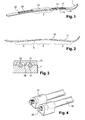
- the ski comprises one or more recesses (10), made on its upper face (11), and forming channels receiving bars longitudinal (12, 13).
- the number of these recesses can be variable, and it is chosen according to the additional stiffness that one wishes to confer on the ski.
- this number of recesses is equal to two, in particular for mechanical stability issues, and also congestion, that is to say for thus allow the installation of the fixing plate.
- the recesses or channels extend over a length of about one meter.
- these channels (10) are a depth corresponding substantially to half the thickness of the bars they welcome (12, 13), but this depth can be adapted in particular to the size of the bars.
- these bars (12, 13) have a sectional shape cylindrical, but other variants can be envisaged without departing from the the invention.
- These bars can be solid or hollow depending on the material that constitutes them, as long as they possess sufficient stiffness.
- the maintenance of these bars inside the characteristic recesses is done at the front at a stop (16) which may advantageously comprise two housings inside which are inserted the front ends (17) of the bars. At the median level, the bars are held inside the channels features (10) through the attachment plate (15).
- the ends (18) of the bars are held by guiding means (20) which, in accordance with the invention, also provide compression of the bars.
- guiding means (20) which, in accordance with the invention, also provide compression of the bars.
- Multiple variants can be considered to obtain this setting in compression, and in particular that illustrated in Figure 4 which comprises tubular clevises (21) receiving the rear ends of the bars.
- These ends (18) are threaded to cooperate with a thread made to inside the clevises (21).
- a thumbprint (23) ensures the relative movement of the end (18) relative to the clevises (21), and therefore by compared to skiing.
- the compression setting of each bar is independently.
- a variant illustrated in FIG. 5 makes it possible to simultaneously adjust the put in compression.
- the ends (18) of the bars and the yoke (25) are smooth.
- the two bars (12, 13) are coupled by a connecting piece (26) having lugs (27) inserted into a housing (28) formed the end of the bars or in the bar itself in the case where it is tubular.
- This connecting piece (26) comprises a screw (30) engaged in the central portion (31) of the yoke (25), so that the screwing ensures simultaneously the compressing the two bars (12, 13).
- the mechanism illustrated in FIG. 6 comprises two branches (40, 41) articulated relative to each other and relative to a fixed point (42) on the ski.
- the angle between these two bars (40, 41) can be adjusted by means of a screw (43) by example.
- the screwing action changes the distance, in the longitudinal direction of the ski, between the point of articulation (42) and the ends (44, 45) of the branches.
- These branches extend by articulated links (46,47), the ends of which are rotated cooperate with the ends of the bars (12, 13).
- FIG. 7 An embodiment variant is illustrated in FIG. 7 in which the branches compasses (50, 51) have inclined surfaces (53) which come into contact with ends of the bars (12, 13). The displacement of the two branches (50, 51) causes the point of contact (54) to move between these sloping surfaces (53) and the bars, and thus the setting in adjustable compression of the bars.
- FIG. 8 Other variants can be made and in particular that illustrated in FIG. 8, in which the rear end (18) of the bar (12) comes into contact with a cam with eccentric (60).
- This eccentric cam (60) is pivotable about a fixed axis relative to the ski so that its rotation pushes the end of the bar towards the front, and thus causes the compression of the bar.
- a similar system can be set up as shown in Figure 9.
- a such mechanism (70) comprises a part (71) into which the rear ends (18) of the bars.
- This intermediate piece (71) is covered by a fixed hood (72) relative to the ski, in which a wheel can be moved (73).
- the upper part (74) of the wheel (73) is circular, while the part lower part (75) of this wheel is eccentric with respect to the axis of rotation (76) of the wheel relative to the hood (72).
- This portion (75) forms an eccentric cam which cooperates with a housing (78) formed in the intermediate piece, so that that the rotation of the wheel (73) causes a displacement in the direction the longitudinal part of the intermediate piece (71), and thus the compression of the bars.
- This shim (83) has a translational capacity transverse to the ski, via a mounting piece (85) integral with the upper face ski.
- the action on the screw (86) allows a transverse displacement of the shim (83), and therefore the exercise of longitudinal forces on the first hold (80).
- FIG. 11 Other variants may be implemented, in particular that illustrated in FIG. 11 in which the rear ends (18) of the bars come to chase each in a housing (91) in a fixed part (90) relative to the ski.
- This piece (90) has a lateral opening (92).
- This opening can receive shims (93) of variable size.
- the front face (94) of these wedges (93) comes to contact of the rear ends of the bars (18), thus putting them in a state of compression which is thus variable according to the width of the shim (93).
- Setting in place of these holds (93) is done manually or mechanized the arching of the ski. means can be provided to prevent the hold does not escape unexpectedly in the event that the ski marries a very important. It is also possible to provide reinforcements that prevent the end (18) bars (12, 13) punch the shims.
- the bars (13) are mounted in two recesses (101), and are placed in compression between firstly a first fixed element (102) and a second fixed element (103) inside which are screwed the ends (18) of the bars.
- the first fixed element (102) forming a stop receives on its upper face the rear member (105) of the attachment, which has ribs (106) for cooperation with the sole of the shoe.
- This rear member (105) can be made in one piece as illustrated schematically, or even consist of several pieces assembled, one cooperating directly with the first fixed element (102), the other having the guide ribs (106).
- the rear member (105) cooperates with the fixed member (102) by a slide mechanism (108), allowing its longitudinal adjustment to take into account the size of the user. Good heard, various forms of slides can be adopted without departing from the invention. Locking of the rear member (105) on the fixed member (102) can obtainable through locking means accessible through the openings (107).
- the front fixed element (103) also has a shape of a slideway for adjusting the position of the base (110) of the body of the fastener comprising the hooking mechanism of the front end of the shoe (not shown).
- the setting position can be indexed by means of means passing through the opening (111).
- the upper part (not shown) with the hooking mechanism is fixed on the base (110) at the level threads (113).
- the rear member (120) of the binding having the ribs (121) is mounted with a portion (122) that rests directly on the upper face (123) of the ski, and a portion (124) which extends inside the recess (125) receiving the characteristic bar (13).
- This bar is represented only over part of its length, between holding struts (126).
- the bar (13) passes through the portion (124) present in the recess (125) so that it retains the rear member (121) on the ski.
- a mechanical indexing mechanism (not shown) can be provided to avoid any longitudinal displacement of the rear member (121) of the binding, and even allow adjustment in the longitudinal position.
- the invention is not limited to the illustrated embodiments only, particularly with regard to the location of the adjustment means at the level back of the ski. These adjustment means can thus of course be found in the front of the board without departing from the scope of the invention. It follows from the above that the invention makes it possible to easily adjust the stiffness of the ski, to maintain a camber optimized for the skier's weight and type of practice. It limits very strongly the risks of seeing the room fart come into contact with the snow during the glide phases.
Landscapes
- Footwear And Its Accessory, Manufacturing Method And Apparatuses (AREA)
- Golf Clubs (AREA)
- Toys (AREA)
- Addition Polymer Or Copolymer, Post-Treatments, Or Chemical Modifications (AREA)
- Fittings On The Vehicle Exterior For Carrying Loads, And Devices For Holding Or Mounting Articles (AREA)
Applications Claiming Priority (2)
| Application Number | Priority Date | Filing Date | Title |
|---|---|---|---|
| FR0450232A FR2865941B1 (fr) | 2004-02-10 | 2004-02-10 | Ski de fond |
| FR0450232 | 2004-02-10 |
Publications (2)
| Publication Number | Publication Date |
|---|---|
| EP1563876A1 true EP1563876A1 (de) | 2005-08-17 |
| EP1563876B1 EP1563876B1 (de) | 2009-06-03 |
Family
ID=34685072
Family Applications (1)
| Application Number | Title | Priority Date | Filing Date |
|---|---|---|---|
| EP05300059A Expired - Lifetime EP1563876B1 (de) | 2004-02-10 | 2005-01-26 | Langlaufski |
Country Status (5)
| Country | Link |
|---|---|
| US (1) | US7360782B2 (de) |
| EP (1) | EP1563876B1 (de) |
| AT (1) | ATE432743T1 (de) |
| DE (1) | DE602005014696D1 (de) |
| FR (1) | FR2865941B1 (de) |
Cited By (3)
| Publication number | Priority date | Publication date | Assignee | Title |
|---|---|---|---|---|
| WO2007022923A3 (de) * | 2005-08-24 | 2007-05-18 | Modell Und Formenbau Blasius G | Ski |
| EP1787691A3 (de) * | 2005-11-16 | 2009-04-08 | Marker Völkl International GmbH | Schneegleitbrett sowie Schalenbauteil für ein Schneegleitbrett |
| WO2010060201A1 (en) * | 2008-11-27 | 2010-06-03 | Michel-Olivier Huard | Camber adjustment system and method for snow-riding devices |
Families Citing this family (21)
| Publication number | Priority date | Publication date | Assignee | Title |
|---|---|---|---|---|
| AUPR838601A0 (en) * | 2001-10-19 | 2001-11-15 | Alexander, Keith | Skateboard wear and impact damage reduction pins/strips |
| DE10204330A1 (de) * | 2002-02-01 | 2003-08-14 | Innotec Ges Zur Entwicklung In | Alpinski |
| US7607679B2 (en) * | 2004-11-23 | 2009-10-27 | Anton F. Wilson | Suspension system for a ski |
| JP2008520379A (ja) * | 2004-11-23 | 2008-06-19 | エフ. ウィルソン,アントン | サスペンション付きスキー板 |
| US20060185585A1 (en) * | 2005-02-09 | 2006-08-24 | Mclean Salahedin B | Ski and snowboard waxing apparatus and method of use |
| WO2006088908A2 (en) * | 2005-02-16 | 2006-08-24 | Wilson Anton F | Snowboards |
| FR2895914B1 (fr) * | 2006-01-09 | 2008-07-04 | Skis Rossignol Sas Soc Par Act | Perfectionnement pour planche de glisse sur neige |
| AT504069B1 (de) * | 2006-07-26 | 2009-08-15 | Atomic Austria Gmbh | Schi oder snowboard mit mitteln zur beeinflussung von dessen querschnittsform |
| US7690674B2 (en) * | 2006-08-10 | 2010-04-06 | Armada Skis, Inc. | Snow riding implement |
| AT504840B1 (de) * | 2007-02-02 | 2009-07-15 | Atomic Austria Gmbh | Schi oder snowboard in der gestalt eines brettartigen gleitgerätes |
| US7581739B2 (en) * | 2007-12-21 | 2009-09-01 | Pluto Technologies, Inc. | Skateboard deck and spring-based truck |
| FR2926735B1 (fr) * | 2008-01-25 | 2010-03-26 | Salomon Sa | Ski alpin avec moyens de reglage |
| AT506545B1 (de) | 2008-04-02 | 2012-05-15 | Atomic Austria Gmbh | Brettartiges gleitgerät mit einer einstellvorrichtung zur veränderung des nutzungsverhaltens |
| DE202008018543U1 (de) | 2008-08-05 | 2015-07-14 | Marker Völkl (International) GmbH | Schneegleitbrett |
| DE102008036390A1 (de) | 2008-08-05 | 2010-02-11 | Marker Völkl (International) GmbH | Schneegleitbrett |
| AT507579B1 (de) * | 2008-12-11 | 2011-01-15 | Atomic Austria Gmbh | Schi oder snowboard mit einem plattenartigen kraftübertragungselement |
| US9305120B2 (en) | 2011-04-29 | 2016-04-05 | Bryan Marc Failing | Sports board configuration |
| US9610492B1 (en) * | 2015-05-06 | 2017-04-04 | John Moran | Adjustable camber snow-gliding board |
| US9950242B2 (en) | 2015-06-19 | 2018-04-24 | Anton F. Wilson | Automatically adaptive ski |
| US10286288B1 (en) * | 2015-12-29 | 2019-05-14 | Alpine Radius Control Technologies, LLC | Torsional stabilizer for skis |
| US20240115896A1 (en) * | 2022-09-27 | 2024-04-11 | Global Pool Products | Diving board and method of making |
Citations (3)
| Publication number | Priority date | Publication date | Assignee | Title |
|---|---|---|---|---|
| FR1470094A (fr) * | 1966-02-25 | 1967-02-17 | Ski à élasticité variable | |
| CH554178A (de) * | 1972-02-21 | 1974-09-30 | Bote Paul | Ski mit vorrichtung zum variieren der flexibilitaet des skis. |
| US20040046362A1 (en) * | 1999-10-14 | 2004-03-11 | Skis Rossignol, S.A. | Board for gliding |
Family Cites Families (7)
| Publication number | Priority date | Publication date | Assignee | Title |
|---|---|---|---|---|
| US3300226A (en) * | 1964-09-28 | 1967-01-24 | Jr Charles L Reed | Ski construction and method for varying the flexibility thereof |
| US4221400A (en) * | 1978-11-08 | 1980-09-09 | Powers John T | Method and apparatus for selectively adjusting the stiffness of a ski |
| ATE196610T1 (de) * | 1990-12-27 | 2000-10-15 | Marker Deutschland Gmbh | Ski mit einem system zur einstellung der steifheit mittels reibung |
| US5326126A (en) * | 1991-06-14 | 1994-07-05 | Ruffinengo Piero G | Modification of the flexibility of skis |
| FR2709072B1 (fr) * | 1993-08-20 | 1995-10-27 | Salomon Sa | Ski perfectionné muni de transmetteurs élastiques de longueur variable de part et d'autre de la zone de fixation. |
| US6530852B2 (en) * | 2000-03-07 | 2003-03-11 | Jaime Rios | Bat structure |
| DE10204330A1 (de) * | 2002-02-01 | 2003-08-14 | Innotec Ges Zur Entwicklung In | Alpinski |
-
2004
- 2004-02-10 FR FR0450232A patent/FR2865941B1/fr not_active Expired - Fee Related
-
2005
- 2005-01-26 EP EP05300059A patent/EP1563876B1/de not_active Expired - Lifetime
- 2005-01-26 AT AT05300059T patent/ATE432743T1/de not_active IP Right Cessation
- 2005-01-26 DE DE602005014696T patent/DE602005014696D1/de not_active Expired - Lifetime
- 2005-01-28 US US11/044,213 patent/US7360782B2/en not_active Expired - Fee Related
Patent Citations (3)
| Publication number | Priority date | Publication date | Assignee | Title |
|---|---|---|---|---|
| FR1470094A (fr) * | 1966-02-25 | 1967-02-17 | Ski à élasticité variable | |
| CH554178A (de) * | 1972-02-21 | 1974-09-30 | Bote Paul | Ski mit vorrichtung zum variieren der flexibilitaet des skis. |
| US20040046362A1 (en) * | 1999-10-14 | 2004-03-11 | Skis Rossignol, S.A. | Board for gliding |
Cited By (4)
| Publication number | Priority date | Publication date | Assignee | Title |
|---|---|---|---|---|
| WO2007022923A3 (de) * | 2005-08-24 | 2007-05-18 | Modell Und Formenbau Blasius G | Ski |
| DE202005021774U1 (de) | 2005-08-24 | 2010-02-04 | Krause, Kaspar | Alpinski |
| EP1787691A3 (de) * | 2005-11-16 | 2009-04-08 | Marker Völkl International GmbH | Schneegleitbrett sowie Schalenbauteil für ein Schneegleitbrett |
| WO2010060201A1 (en) * | 2008-11-27 | 2010-06-03 | Michel-Olivier Huard | Camber adjustment system and method for snow-riding devices |
Also Published As
| Publication number | Publication date |
|---|---|
| FR2865941B1 (fr) | 2006-03-10 |
| US7360782B2 (en) | 2008-04-22 |
| EP1563876B1 (de) | 2009-06-03 |
| FR2865941A1 (fr) | 2005-08-12 |
| DE602005014696D1 (de) | 2009-07-16 |
| US20050206128A1 (en) | 2005-09-22 |
| ATE432743T1 (de) | 2009-06-15 |
Similar Documents
| Publication | Publication Date | Title |
|---|---|---|
| EP1563876B1 (de) | Langlaufski | |
| EP0840640B1 (de) | Vorrichtung zur positionsverstellung einer bindung auf einem gleitbrett | |
| EP1721815A1 (de) | Befestigungsvorrichtung eines Sattels auf einem Kopf des Sattelbolzens | |
| EP1656974A1 (de) | Einrichtung zur Montage von Sicherheitsbindungsteilen auf einen Ski | |
| EP1228787A1 (de) | Unterlagsplatte zur Verbindung an der oberen Oberfläche eines Skis | |
| EP2644234B1 (de) | Befestigungsvorrichtung für Snowboard, und mit einer solchen Vorrichtung ausgestattetes Snowboard | |
| EP1234604B1 (de) | Trägerplatte für ein Snowboard | |
| EP0385945B1 (de) | Skibindung mit einer Sohlenplatte | |
| CH670203A5 (de) | ||
| FR2746023A1 (fr) | Organe de glisse tel que patin a roues en ligne | |
| EP1656973B1 (de) | Vorrichtung zur Montage der Teile einer Sicherheitsbindung auf einem Ski | |
| FR2831455A1 (fr) | Ensemble de retenue d'une chaussure sur une planche de glisse | |
| FR2755025A1 (fr) | Dispositif de liaison entre une planche a usage sportif, notamment une planche a neige, et une fixation de chaussure | |
| EP3894778B1 (de) | Gewehrkolben | |
| EP1025882B1 (de) | Sicherheitsskibindung-Schuh-Kombination | |
| FR2666201A1 (fr) | Chaussure de sport, notamment pour la pratique du ski de fond. | |
| WO2002085473A1 (fr) | Dispositif de montage, demontage rapides d'une fixation de ski sur un ski | |
| EP0801964A1 (de) | Montageplatte für eine Skibindung | |
| EP2465588B1 (de) | Montagevorrichtung auf einem Ski für die Elemente einer Sicherheitsskibindung | |
| FR3110965A1 (fr) | Busc pour crosse de fusil | |
| FR2810253A1 (fr) | Raquette a neige | |
| EP4080154A1 (de) | Gewehrkolben mit verstellbarer positionierung | |
| FR2817162A1 (fr) | Embase de support d'une chaussure sur une planche, l'embase etant munie d'un dispositif de positionnement sur la planche | |
| FR2873590A1 (fr) | Ensemble de retenue d'une chaussure sur une planche de glisse, notamment un ski alpin | |
| EP0785001A1 (de) | Rückhaltevorrichtung für einen Schuh auf einem Ski |
Legal Events
| Date | Code | Title | Description |
|---|---|---|---|
| PUAI | Public reference made under article 153(3) epc to a published international application that has entered the european phase |
Free format text: ORIGINAL CODE: 0009012 |
|
| AK | Designated contracting states |
Kind code of ref document: A1 Designated state(s): AT BE BG CH CY CZ DE DK EE ES FI FR GB GR HU IE IS IT LI LT LU MC NL PL PT RO SE SI SK TR |
|
| AX | Request for extension of the european patent |
Extension state: AL BA HR LV MK YU |
|
| 17P | Request for examination filed |
Effective date: 20051118 |
|
| AKX | Designation fees paid |
Designated state(s): AT DE FR IT |
|
| RAP1 | Party data changed (applicant data changed or rights of an application transferred) |
Owner name: SKIS ROSSIGNOL |
|
| GRAP | Despatch of communication of intention to grant a patent |
Free format text: ORIGINAL CODE: EPIDOSNIGR1 |
|
| GRAS | Grant fee paid |
Free format text: ORIGINAL CODE: EPIDOSNIGR3 |
|
| GRAA | (expected) grant |
Free format text: ORIGINAL CODE: 0009210 |
|
| AK | Designated contracting states |
Kind code of ref document: B1 Designated state(s): AT DE FR IT |
|
| REF | Corresponds to: |
Ref document number: 602005014696 Country of ref document: DE Date of ref document: 20090716 Kind code of ref document: P |
|
| PLBE | No opposition filed within time limit |
Free format text: ORIGINAL CODE: 0009261 |
|
| STAA | Information on the status of an ep patent application or granted ep patent |
Free format text: STATUS: NO OPPOSITION FILED WITHIN TIME LIMIT |
|
| 26N | No opposition filed |
Effective date: 20100304 |
|
| PG25 | Lapsed in a contracting state [announced via postgrant information from national office to epo] |
Ref country code: IT Free format text: LAPSE BECAUSE OF FAILURE TO SUBMIT A TRANSLATION OF THE DESCRIPTION OR TO PAY THE FEE WITHIN THE PRESCRIBED TIME-LIMIT Effective date: 20090603 |
|
| PG25 | Lapsed in a contracting state [announced via postgrant information from national office to epo] |
Ref country code: AT Free format text: LAPSE BECAUSE OF NON-PAYMENT OF DUE FEES Effective date: 20100126 |
|
| PGFP | Annual fee paid to national office [announced via postgrant information from national office to epo] |
Ref country code: FR Payment date: 20110216 Year of fee payment: 7 Ref country code: DE Payment date: 20110111 Year of fee payment: 7 |
|
| REG | Reference to a national code |
Ref country code: FR Ref legal event code: ST Effective date: 20120928 |
|
| PG25 | Lapsed in a contracting state [announced via postgrant information from national office to epo] |
Ref country code: DE Free format text: LAPSE BECAUSE OF NON-PAYMENT OF DUE FEES Effective date: 20120801 |
|
| REG | Reference to a national code |
Ref country code: DE Ref legal event code: R119 Ref document number: 602005014696 Country of ref document: DE Effective date: 20120801 |
|
| PG25 | Lapsed in a contracting state [announced via postgrant information from national office to epo] |
Ref country code: FR Free format text: LAPSE BECAUSE OF NON-PAYMENT OF DUE FEES Effective date: 20120131 |