EP1566076B1 - Audio-gestüzte datenrepräsentationsvorrichtung und verfahren - Google Patents
Audio-gestüzte datenrepräsentationsvorrichtung und verfahren Download PDFInfo
- Publication number
- EP1566076B1 EP1566076B1 EP03769817A EP03769817A EP1566076B1 EP 1566076 B1 EP1566076 B1 EP 1566076B1 EP 03769817 A EP03769817 A EP 03769817A EP 03769817 A EP03769817 A EP 03769817A EP 1566076 B1 EP1566076 B1 EP 1566076B1
- Authority
- EP
- European Patent Office
- Prior art keywords
- data
- value
- audio signal
- data variable
- variable
- Prior art date
- Legal status (The legal status is an assumption and is not a legal conclusion. Google has not performed a legal analysis and makes no representation as to the accuracy of the status listed.)
- Expired - Lifetime
Links
- 238000000034 method Methods 0.000 title claims abstract description 9
- 230000005236 sound signal Effects 0.000 claims abstract description 61
- 238000013507 mapping Methods 0.000 claims abstract description 41
- 238000012545 processing Methods 0.000 claims abstract description 32
- 238000004519 manufacturing process Methods 0.000 claims abstract description 7
- 230000001419 dependent effect Effects 0.000 claims abstract description 4
- 238000005259 measurement Methods 0.000 claims description 23
- 230000006870 function Effects 0.000 claims description 10
- 238000012546 transfer Methods 0.000 claims description 6
- 238000004590 computer program Methods 0.000 claims description 4
- 230000033764 rhythmic process Effects 0.000 description 5
- 238000000053 physical method Methods 0.000 description 4
- 238000012986 modification Methods 0.000 description 3
- 230000004048 modification Effects 0.000 description 3
- 238000004091 panning Methods 0.000 description 3
- 230000004807 localization Effects 0.000 description 2
- 238000012913 prioritisation Methods 0.000 description 2
- 239000000779 smoke Substances 0.000 description 2
- 238000012549 training Methods 0.000 description 2
- ZYXYTGQFPZEUFX-UHFFFAOYSA-N benzpyrimoxan Chemical compound O1C(OCCC1)C=1C(=NC=NC=1)OCC1=CC=C(C=C1)C(F)(F)F ZYXYTGQFPZEUFX-UHFFFAOYSA-N 0.000 description 1
- 230000005540 biological transmission Effects 0.000 description 1
- 230000015572 biosynthetic process Effects 0.000 description 1
- 230000001934 delay Effects 0.000 description 1
- 238000013461 design Methods 0.000 description 1
- 238000009826 distribution Methods 0.000 description 1
- 230000004438 eyesight Effects 0.000 description 1
- 238000011002 quantification Methods 0.000 description 1
- 230000008054 signal transmission Effects 0.000 description 1
- 238000004088 simulation Methods 0.000 description 1
- 230000003595 spectral effect Effects 0.000 description 1
- 238000003786 synthesis reaction Methods 0.000 description 1
- 230000004304 visual acuity Effects 0.000 description 1
- 230000000007 visual effect Effects 0.000 description 1
Images




Classifications
-
- H—ELECTRICITY
- H04—ELECTRIC COMMUNICATION TECHNIQUE
- H04S—STEREOPHONIC SYSTEMS
- H04S1/00—Two-channel systems
Definitions
- the invention relates to a data representation apparatus for representing data by means of an audio signal according to claim 1.
- the invention also relates to a system for representing data by means of an audio signal, comprising:
- the invention also relates to a method of representing data by means of an audio signal according to claim 9.
- the invention also relates to a computer program for execution by a processor, enabling the processor to execute the method.
- the invention also relates to a data carrier storing the computer program.
- An embodiment of such a data representation apparatus is known from US-B-6,230,047 .
- the known apparatus receives as a data variable a heart rate from a pulse monitor. Based on the heart rate, a corresponding rhythm pattern is fetched by an audio processing unit from a rhythm pattern memory, storing prerecorded rhythms of e.g. drums.
- the audio processing unit creates a continuous audio signal from the selected rhythm, having a tempo characteristic in accordance with the particular measured heart rate.
- a disadvantage of this kind of audio feedback of a measurement is, that it is difficult for a user to judge which particular value of the data variable is actually represented, and hence it can only be used in applications where only a reference point of the measurement is required, and only deviations from the reference point have to be judged by the user.
- the known apparatus e.g. is used by joggers, who tend to adjust their training so that their heart rate corresponds to the rhythm.
- US 5 987 142A discloses an example of a system of sound spatialization for positions of specified sound sources or for alarms.
- the data representation apparatus makes it possible to generate a virtual dial of virtual audio source positions around a user's head.
- Corresponding virtual audio sources indicating the value of the data variable on the virtual dial are generated by means of real sound production devices, but a user perceives the sound as coming from a predetermined position or direction.
- any geometrical distribution of virtual sound sources representing data variable values around a user's head can be realized by the audio processing unit.
- the position is determined by the value of the data variable, which does not have a naturally related position in space.
- a temperature measured by a thermometer has no naturally associated position, but it can be measured on a one-dimensional coordinate axis though. It has to be mapped to a point in space. If the data variable has a first value, the virtual sound source is presented in a first position, and if the data variable has a second value, the virtual sound source is presented in a second position.
- a number of values of the data variable are mapped to a locus in space.
- the word locus is used in its meaning "The set or configuration of all points whose coordinates satisfy a single equation or one or more algebraic conditions.”
- the locus can be a one-, two-, or three-dimensional manifold and of any extent.
- temperature values can be mapped to a one-dimensional circle around a user's head, or to a two-dimensional circular strip with a thickness.
- Multichannel sound reproduction already exists.
- headphone virtualizers simulate e.g. 5 loudspeakers required in Dolby 5.1 sound reproduction as virtual loudspeakers.
- the audio information for these sound channels -leading to virtual sound source positions- is already present in the audio signal.
- the virtual sources are supposed to roughly coincide with the real positions of instruments during recording. These physical sound sources naturally have a position.
- the virtual violin should also be perceived as coming from more or less the same spot to the right of the listener.
- Stereo and multichannel sound reproduction is often based on heuristics, so the position of a virtual sound source need not be exactly the same as the original position of the recorded sound source. But, the loudspeakers, or virtual loudspeakers in a headphone virtualizer, are put in a fixed position and stay there. This implies that the position of virtual sound sources is determined by the actual audio signals sent to the loudspeakers. In the data representation apparatus, the positioning of the virtual sound source depends on the data variable, e.g. a measurement such as the time.
- time has no obvious position -it is a positionless or non positional variable-
- a mapping is needed of time values to a locus in three-dimensional space around a user's head, where the corresponding times should be represented by means of virtual sound sources. E.g. at twelve o'clock, a chime sound is produced straight above the user's head.
- the audio processing unit comprises a filter for applying a head related transfer functions (HRTF) to an input audio signal to obtain the output audio signal appearing to originate from the first position respectively the second position.
- HRTF head related transfer functions
- a simple variant of the audio processing unit comprises panning means to simulate the virtual sound source position by means of simple stereo panning. By varying amplitudes and/or delays of a first and a second audio signal component destined for two respective stereo loudspeakers, a locus of virtual sound source positions between the loudspeakers can be traversed.
- the data representation apparatus may comprise a data variable distributor capable of delivering the data variable derived from a measurement from a measurement device to the audio processing unit. It is advantageous if the data variable is directly derived from a measurement from a measurement device, e.g. being the measurement itself.
- the data variable distributor is arranged to transmit measurement data variables to the audio processing unit for positioning the virtual sound source. Additionally or alternatively, the data variable may originate from a data variable delivery device. E.g. the data variable may be stored in a memory means or arrive over Internet.
- the data variable distributor is capable of transmitting either a data variable from a single selected data variable source, or data variables from different sources.
- the data variable distributor may also be configured so as to only transmit data variable values with a predetermined priority.
- the mapping unit is arranged to map a collection of nominal values of the data variable to predetermined regions of three-dimensional space.
- Nominal data variable values are values which fall in a number of classes, e.g. instead of specifying temperatures with a numerical scale such as the Celsius scale, the temperatures can be described as "very hot”, “hot”, “tepid” and “cold”. These nominal values can be mapped e.g. to four quadrants above the user's head. There is no natural ordering relation between nominal data values, so the mapping may contain e.g. a table specifying for each nominal data value a link between the value and a position in space.
- the mapping unit is arranged to map a collection of numerical values of the data variable to positions on a curvilinear locus in three-dimensional space.
- the mapping unit is arranged to specify a curvilinear locus around the user, and to divide it in intervals to which intervals of the numerical data variable should be mapped.
- the locus may be a one-dimensional manifold, but may also be a two-dimensional or three-dimensional manifold in space. Positions along the locus may be equidistant or a more complex relation between the data variable values and the positions along the locus may be used.
- specification means are comprised, arranged to allow a specification of a preferred mapping for the mapping unit.
- the user is driving a car, he might want his speed to be presented by means of a virtual sound source. Accidents happen because a driver has only e.g. two seconds to react, and if he is not wasting that precious time looking at his instruments, he may be able to break in time.
- the allowed speed is 120 km/h. So he might want to specify a dial where 120 km/h corresponds to a virtual sound source straight in front of him, and speeds up to 130 km/h are presented up to 90 degrees on the right. For lower speeds, the 90 degrees on the left may represent speeds down to 80 km/h.
- the speed limit is 50 km/h
- the driver may want to specify an alternative mapping, in which speeds between 25 km/h and 60 km/h are mapped from left to right.
- the mappings map to distinct regions of space, allocated by the user, especially if similar sounding sounds are allocated to the virtual sound sources.
- selection means are present, arranged to allow representation of a first set of data variable values by a first type of the audio signal and a second set of data variable values by a second type of the audio signal.
- nearby values on a virtual dial can be represented with different virtual sounds.
- each set of ten consecutive values is represented by means of sound of increasing pitch. The first value sounds low pitched, the tenth value high pitched, the eleventh value low pitched again, and so on.
- different dial loci or in general data variable mappings are presented simultaneously, their respective data values can be presented by sounds which sound different to the user. In this way he can learn that e.g. the whistle represents the speed measurement, the chime the clock, and so on.
- Fig. 1 shows the data representation apparatus 100 for presenting data by means of an audio signal o. It comprises an audio processing unit 102 which is arranged to deliver the audio signal o with a characteristic C tailored so that the audio signal o appears to originate from a desired position in space to a user 200, dependent on a data variable p.
- the data variable p can be the result of a physical measurement m or another specification, e.g. a mathematical number or a countable attribute of e.g. an email or another data set.
- the audio processing unit 102 is arranged to allocate to the audio signal o a first position 216 in Fig.
- the virtual sound source 222 is simulated by means of a sound production device 112 comprising at least two loudspeakers, e.g. headphones or the loudspeakers of a PC, a television or radio.
- the audio signal o may typically be derived by the audio processing unit 102 based on an input signal i.
- the input signal i can be e.g. music from an external audio source 114, e.g. a portable MP3 player, or can be internally generated audio from an internal audio source 116, e.g. a beep sound or music.
- the input signal i can be mono or multichannel audio.
- the data variable may be received from a measurement device 104 or from a data variable delivering device 124, such as e.g. a disk reader in case the data variables are prestored on a disk, a memory, or a network connection. If all the data variables p are sequentially read from disk and converted to virtual sound source positions, a user 200 can quickly undertake some action in correspondence to the representation of a data variable p, such as pushing a button.
- a data variable distributor 122 is arranged to deliver the data variable p received from the measurement device 104, or the data variable delivering device 124, to the audio processing unit 102.
- the data variable distributor 122 can e.g.
- the data variable distributor 122 may be configured to only pass a value of the data variable p in a predefined interval, or to which a priority value is allocated. E.g. if the data variables are linked to email messages, data variables like "urgent”, “normal”, “infornlation”, etc. may be represented only if the email message has a priority value "professional email”.
- the interval or priority value may be specified to indicate a dangerous situation, e.g. a temperature is only represented if over a predetermined value, and otherwise the user is not bothered with temperature information.
- prioritization means 170 may be present.
- the prioritization means 170 may e.g. be embodied as a processor arranged to evaluate a set of rules on the data variable p, which only when satisfied lead to the transmission of a corresponding position pos to the audio processing unit 102.
- Fig. 1b schematically shows a few example embodiments of the data variable distributor 122. It may comprise as an output connection a first connection 180, on which data variables at different times t0, t1, etc. are interleaved from different measurement devices or data variable delivering devices, according to predefined interleaving scheme. Alternatively or additionally a second connection 182 may be present, which in the example transmits a composed parameter to the audio processing-unit 102, being a function of a first physical measurement m11 and a first delivered data variable pp. A third connection 184 only transmits a second physical measurement m12 as a parameter p13 if its value is greater than 20.
- the mapping unit 132 converts time series of parameters corresponding to e.g.
- the data distributor may be a simple electrical connection between the measurement device and the mapping unit 132.
- the measurement device 104 can e.g. be a pace meter -measuring how many steps per minute the user 200 runs- or a heart rate meter. It is annoying that the user 200 repetitiously has to watch a display for his heart rate. This may interfere with his training and he may even trip over a bulge in the road while looking at the display.
- the audio processing unit 102 may be arranged so that the sound from the virtual source is always present, e.g. if the music from the MP3 player is positioned around the user's 200 head, or it may generate a beep every few seconds. The beep may be added to the sound or music listened to. E.g. an apparatus may alert a user 200 by means of the added beep while he is listening to music from a portable CD player, or in another application to sound of a movie on television.
- the user 200 can specify that his desired running pace is mapped to a position straight in front of him, and slower paces are mapped over his head. Also, for a clock radio virtual sound positioning is very useful. With current clock radios if a user keeps sleeping after the clock radio starts playing in the morning, he only gets a feedback of the time when the radio program presenter announces it, e.g. every half hour during reading of the news. If the virtual sound source position moves, e.g. from the left to the right of the clock radio, the user 200 constantly gets a feedback of the time.
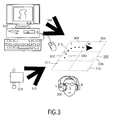
- a mapping unit 132 is present, arranged to map a collection of values of the data variable p to a locus of positions pos in three-dimensional space, such as e.g. a locus 202 in Fig. 2 , or a two-dimensional locus 300 in Fig. 3 .
- specification means 150 are also comprised, which is arranged to allow user 200 to specify a mapping according to his preference. E.g. he can map a number of nominal data variable p values to two-dimensional regions in space -such as a first region 302 and a second region 304- the regions having a size and position according to the user's 200 preference.
- the specification can be input by means of data input means 152.
- data input means 152 E.g.
- the mapping unit may comprise a memory 134 storing map-related data or mapping functions. If the data input means 152 comprise a network connection -e.g. to the internet- it is also possible that e.g. a manufacturer of the data representation apparatus 100 downloads a new mapping.
- Virtual sound sources can be created e.g. by stereo panning.
- the input audio signal i e.g. mono music
- the audio processing unit 102 is converted by the audio processing unit 102 to the output audio signal o, having two components, a first component for a first loudspeaker 160 and a second component for a second loudspeaker 161.
- An amplitude of the two components is determined so that the audio signal o appears to originate from a virtual sound position somewhere in between the two loudspeakers.
- a much more accurate positioning can be achieved by means of head related transfer functions HRTF.
- the audio processing unit 102 may comprise a filter 140 for applying a HRTF to an input audio signal i to obtain the output audio signal o.
- For the first component a first HRTF is used.
- the input signal i is filtered with the first HRTF by the filter 140 to obtain the first component.
- the input signal i is filtered with a second HRTF.
- HRTFs for all virtual sound source positions can be stored in a second memory 142.
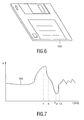
- a HRTF is shown in Fig. 7 .
- the frequency f p of a pinna notch in the HRTF can be used to simulate an elevation of a virtual sound source. More information can be found in " P.J. Bloom: Creating source elevation illusions by spectral Manipulation, Journal of the audio engineering society, v. 25, September 1977, pp. 560-565 .” Information on presenting virtual sound sources by means of headphones can be found in patent WO0149066 . More information on the use of HRTF to simulate virtual sound sources can be found in " F.L. Wightman and D.J.
- Selection means 117 may be present, arranged to allow representation of a first set of data variable p values by a first type b of the audio signal o -e.g. a deep bass sound- and a second set of data variable p values by a second type ch - e.g. a chime- of the audio signal.
- the selection means 117 may e.g. form part of the internal audio source 116, or they may be incorporated in the audio processing unit 102.
- the selection means 117 may also comprise a speech generator 118 arranged to change the type of audio signal by generating a speech signal of the value of the data variable p in the position of the virtual sound source 222. E.g. a sound corresponding to the English word "seven" is generated at the position in space corresponding to a value of the data variable p substantially equal to seven.
- Fig. 2 shows an example of a locus 202 of virtual sound source positions, corresponding to numerical data variable p values, extending around the user's 200 head.
- a first mapping M1 maps the values on a scale 210 of a measurement device 204 -e.g. a speed meter of a car- to the locus 202.
- the mapping may e.g. be so that an angle on the scale 210 is proportional to an angle on the locus 202, or can comprise a nonlinear angle mapping function to a noncircular locus.
- the first position 216 -representing 30km/h in the example- is positioned at 50 degrees from the zenith above the user's 200 head
- the second position 218 -representing 40km/h- is positioned at 40 degrees from the zenith
- a third position 219 -representing 50km/h- is positioned at 30 degrees from the zenith, etc.
- the user 200 decides that the difference between 30km/h and 40km/h is less important than the difference between 40km/h and 50km/h, he can devise a mapping with e.g. 5 degrees between the first position 216 and the second position 218, and 15 degrees between the second position 218 and the third position 219.
- a second mapping M2 can e.g. map temperatures of a thermometer 234.
- the first value 206 may correspond e.g. to a guitarlike sound at the first position 216
- the second value 208 may correspond to a chime sound at the second position 218.
- the mapping unit 132 may be arranged so that only a part of the scale 210 is mapped to the locus 202, e.g. only the low speeds. The speeds below a critical speed, e.g.
- 120 km/h may be mapped over a smaller part of the locus 202, with smaller intervalue angles, and speeds above 120km/h may be mapped with larger intervalue angles. Parts of the scale 210 could even be missing.
- the user 200 can put the locus 202 anywhere he likes in three-dimensional space. E.g. he might prefer the locus to go around him in a horizontal plane, because it is more natural for him, or because in this way he can judge speed differences easier.
- only the azimuth angle is determined by means of a HRTF and the height of the virtual sound source 222 is simulated by means of a pitch modification of the audio signal o.
- Arrow 220 indicates the position or direction in which the virtual sound source 222 is heard, being a kind of virtual pointer. Including in the term a position in space should be included that a virtual sound source appears to be situated not exactly at a well-defined point in space, but within a small region 252 of space, due to e.g. audio processing or the localization capabilities of the user 200.
- Fig. 3 shows how nominal values can be mapped to regions of space.
- measuring device 325 may output one of three nominal values being cold C, tepid T and warm W. They are represented by means of a third mapping M3 with a virtual sound source in respectively the first region 302, the second region 304 and a third region 306.
- Allocating a virtual sound source to a region can be done by allocating it to a position 330 in the region, e.g. the center of the region. If there is an order between the nominal values, as in the case of temperatures, the mapping may follow an order path 315. This can be any path through the available regions 302, 304, etc., e.g. a zigzag path, spiral path, fractal path, etc.
- emails received by a computer 320 may have attributes such as "urgent”, "company email” etc. These attributes can also be mapped to the regions by means of a fourth mapping M4.
- the computer 320 may also present certain commands or warning signals by mapping their nominal values.
- the regions 302, 308... are used as columns, e.g. a first column constituted by the second region 304 and the third region 306, a second column constituted by the first region 302 and a fourth region 308, etc.
- other mappings can be realized.
- the columns may represent types of product to buy, or in a work environment they may represent chores.
- a sound every hour in the third region 306, can indicate that there are two chores left in the first column, representing emails to send.
- a sound the first region 302, can indicate that there is only one person to call today.
- Fig. 4 schematically shows a curvilinear second locus 400 with multiple depths.
- the amplitude of the audio signal o can be used to simulate depth, but also other characteristics can be used such as added reverberation.
- Such a second curvilinear locus 400 is advantageous when the data variable has some importance to the user 200, as e.g. an email changing from plain to urgent.
- Fig. 5a shows how a first and a second instance of data variable p can be presented simultaneously, e.g. a first data variable p1 being the time and a second data variable p2 being a distance traveled.
- a third locus 500 may be presented e.g. at the right of the user 200, and a fourth locus 510 may be presented e.g. at the left. This is especially important if the virtual sound source of the two loci emit a similarly sounding sound. Both sounds can be emitted at the same time instance or temporally interleaved. Both sounds can also traverse the same locus, e.g. the first curvilinear locus 202, as long as they sound different. And preferably they are emitted a different time instances.
- Fig. 5b shows another example of how two loci corresponding to different data variables p can be presented simultaneously.
- the loci may be interweaved intricately, as long as differently sounding sounds are used for their virtual sound sources.
- Values of a first data variable p1 are represented in three-dimensional regions 520, 522, 524, etc. -shown dotted-, and values of a second data variable p2 are represented in three-dimensional regions 540, 542, 544, etc. -shown dashed.
- An audio source 114, 116 arranged to deliver an input audio signal i, a source 104, 124 of the data variable p, the sound production device 112, and the data representation apparatus 100 for presenting data by means of the audio signal o may together form a single system. Its components may be realized in different possible physical combinations, depending on whether the system is portable or installed in a room or a car. Signal connections may be realized wired or wireless by any known technique.
- a head tracker may be present to track the orientation of the user's 200 head, allowing the audio processing unit to reselect a HRTF for a new orientation, so that the virtual sound source 222 seems stationary in space. If headphones are used as a sound production device, they may be arranged to partially pass sounds form the environment for reasons of safety.
- the data representation apparatus may be embodied in different types of apparatus, such as a mobile phone, a portable computer, a portable audio player, a home computer, a car radio, a television set, etc.
- the invention can be implemented by means of hardware or by means of software running on a computer, and previously stored on a data carrier or transmitted over a signal transmission system.
Landscapes
- Physics & Mathematics (AREA)
- Engineering & Computer Science (AREA)
- Acoustics & Sound (AREA)
- Signal Processing (AREA)
- Stereophonic System (AREA)
- Selective Calling Equipment (AREA)
- Electrophonic Musical Instruments (AREA)
Claims (11)
- Datendarstellungsvorrichtung (100) zur Darstellung von Daten mit Hilfe eines Audiosignals, wobei das Gerät dadurch gekennzeichnet ist, dass es umfasst:- eine Audioverarbeitungseinheit (102), die so eingerichtet ist, dass sie das Audiosignal mit einer Charakteristik, die von einer Positionless-Data-Variable mit einem ersten Wert und einem zweiten Wert abhängig ist, zu verschiedenen Zeiten abgibt,
wobei- die Datendarstellungsvorrichtung eine Mapping-(Zuordnungs-)Einheit (132) umfasst, welche so eingerichtet ist, dass sie den ersten Wert der Data-Variable einer ersten Position im dreidimensionalen Raum und den zweiten Wert der Data-Variable einer zweiten Position im dreidimensionalen Raum zuordnet, und- die Audioverarbeitungseinheit (102) so eingerichtet ist, dass sie die Charakteristik verändert, was dazu führt, dass es für einen das Audiosignal hörenden Benutzer den Anschein hat, dass das Audiosignal für die Data-Variable mit dem ersten Wert von der ersten Position und für die Data-Variable mit dem zweiten Wert von der zweiten Position ausgeht. - Datendarstellungsvorrichtung nach Anspruch 1, wobei die Audioverarbeitungseinheit (102) ein Filter (140) umfasst, um eine kopfbezogene Übertragungsfunktion auf ein Eingangsaudiosignal anzuwenden, damit das Ausgangsaudiosignal so vorgesehen wird, dass es von der ersten Position bzw. der zweiten Position auszugehen scheint.
- Datendarstellungsvorrichtung nach Anspruch 1, mit einem Data-Variable-Verteiler (122), der imstande ist, der Audioverarbeitungseinheit (102) die von einer Messeinrichtung (104) ableitbare Data-Variable zuzuführen.
- Datendarstellungsvorrichtung nach Anspruch 1, wobei die Mapping-Einheit (132) so eingerichtet ist, dass sie zuvor festgelegten Bereichen im dreidimensionalen Raum eine Zusammenstellung von Nennwerten der Data-Variable zuordnet.
- Datendarstellungsvorrichtung nach Anspruch 1, wobei die Mapping-Einheit (132) so eingerichtet ist, dass sie Positionen auf einem krummlinigen Locus im dreidimensionalen Bereich eine Zusammenstellung von Zahlenwerten der Data-Variable zuordnet.
- Datendarstellungsvorrichtung nach Anspruch 1, wobei Spezifizierungsmittel (150) enthalten sind, die so eingerichtet sind, dass sie eine Spezifizierung einer bevorzugten Zuordnung für die Mapping-Einheit (132) ermöglichen.
- Datendarstellungsvorrichtung nach Anspruch 1, wobei Auswahlmittel (117) vorhanden sind, die so eingerichtet sind, dass sie eine Darstellung eines ersten Satzes von Data-Variable-Werten durch eine erste Art des Audiosignals sowie eines zweiten Satzes von Data-Variable-Werten durch eine zweite Art des Audiosignals ermöglichen.
- System zur Darstellung von Daten mit Hilfe eines Audiosignals, wobei das System umfasst:- eine Audio-Quelle (114, 116), die so eingerichtet ist, dass sie ein Eingangsaudiosignal abgibt;- eine Quelle (104, 124) einer Positionless-Data-Variable, die imstande ist, einen ersten Wert (206) und einen zweiten Wert (208) aufzuweisen;- eine Tonerzeugungseinrichtung (112) sowie- eine Datendarstellungsvorrichtung nach Anspruch 1.
- Verfahren zur Darstellung von Daten mit Hilfe eines Audiosignals, wobei das Verfahren durch die folgenden Schritte gekennzeichnet ist:- einen Audioverarbeitungsschritt zur Abgabe des Audiosignals mit einer Charakteristik, die von einer Positionless-Data-Variable mit einem ersten Wert und einem zweiten Wert abhängig ist, zu verschiedenen Zeiten,- Zuordnen des ersten Wertes der Data-Variable zu einer ersten Position im dreidimensionalen Raum und des zweiten Wertes der Data-Variable zu einer zweiten Position im dreidimensionalen Raum, und wobei- mit dem Audioverarbeitungsschritt die Charakteristik verändert wird, was dazu führt, dass es für einen das Audiosignal hörenden Benutzer den Anschein hat, dass das Audiosignal für die Data-Variable mit dem ersten Wert von der ersten Position und für die Data-Variable mit dem zweiten Wert von der zweiten Position ausgeht.
- Computerprogramm zur Ausführung durch einen Prozessor, womit der Prozessor befähigt wird, das Verfahren nach Anspruch 9 auszuführen.
- Datenträger zur Speicherung des Computerprogramms von Anspruch 10.
Priority Applications (1)
| Application Number | Priority Date | Filing Date | Title |
|---|---|---|---|
| EP03769817A EP1566076B1 (de) | 2002-11-20 | 2003-11-13 | Audio-gestüzte datenrepräsentationsvorrichtung und verfahren |
Applications Claiming Priority (6)
| Application Number | Priority Date | Filing Date | Title |
|---|---|---|---|
| EP02080357 | 2002-11-20 | ||
| EP02080357 | 2002-11-20 | ||
| EP02080570 | 2002-12-30 | ||
| EP02080570 | 2002-12-30 | ||
| PCT/IB2003/005131 WO2004047489A1 (en) | 2002-11-20 | 2003-11-13 | Audio based data representation apparatus and method |
| EP03769817A EP1566076B1 (de) | 2002-11-20 | 2003-11-13 | Audio-gestüzte datenrepräsentationsvorrichtung und verfahren |
Publications (2)
| Publication Number | Publication Date |
|---|---|
| EP1566076A1 EP1566076A1 (de) | 2005-08-24 |
| EP1566076B1 true EP1566076B1 (de) | 2011-03-23 |
Family
ID=32327855
Family Applications (1)
| Application Number | Title | Priority Date | Filing Date |
|---|---|---|---|
| EP03769817A Expired - Lifetime EP1566076B1 (de) | 2002-11-20 | 2003-11-13 | Audio-gestüzte datenrepräsentationsvorrichtung und verfahren |
Country Status (9)
| Country | Link |
|---|---|
| US (1) | US20060072764A1 (de) |
| EP (1) | EP1566076B1 (de) |
| JP (1) | JP2006506884A (de) |
| KR (1) | KR20050085017A (de) |
| CN (1) | CN1714598B (de) |
| AT (1) | ATE503354T1 (de) |
| AU (1) | AU2003278517A1 (de) |
| DE (1) | DE60336499D1 (de) |
| WO (1) | WO2004047489A1 (de) |
Families Citing this family (18)
| Publication number | Priority date | Publication date | Assignee | Title |
|---|---|---|---|---|
| EP1675432A1 (de) * | 2004-12-27 | 2006-06-28 | Siemens Aktiengesellschaft | Mobiles Kommunikationsendgerät zum Erzeugen einer ortsfesten virtuellen Schallquelle |
| EP1905002B1 (de) * | 2005-05-26 | 2013-05-22 | LG Electronics Inc. | Verfahren und vorrichtung zum decodieren von audiosignalen |
| JP4988716B2 (ja) | 2005-05-26 | 2012-08-01 | エルジー エレクトロニクス インコーポレイティド | オーディオ信号のデコーディング方法及び装置 |
| EP1979898B1 (de) * | 2006-01-19 | 2014-08-06 | Lg Electronics Inc. | Verfahren und vorrichtung zum verarbeiten eines mediensignals |
| KR100878816B1 (ko) * | 2006-02-07 | 2009-01-14 | 엘지전자 주식회사 | 부호화/복호화 장치 및 방법 |
| US8401210B2 (en) * | 2006-12-05 | 2013-03-19 | Apple Inc. | System and method for dynamic control of audio playback based on the position of a listener |
| US9105187B2 (en) * | 2009-05-14 | 2015-08-11 | Woox Innovations Belgium N.V. | Method and apparatus for providing information about the source of a sound via an audio device |
| CA2799738A1 (en) * | 2010-05-17 | 2011-11-24 | Jon Parsons | System and method for multi-dimensional secretion of digital data |
| CH703501A2 (de) * | 2010-08-03 | 2012-02-15 | Stormingswiss Gmbh | Vorrichtung und Verfahren zur Auswertung und Optimierung von Signalen auf der Basis algebraischer Invarianten. |
| US20130208897A1 (en) * | 2010-10-13 | 2013-08-15 | Microsoft Corporation | Skeletal modeling for world space object sounds |
| US9522330B2 (en) | 2010-10-13 | 2016-12-20 | Microsoft Technology Licensing, Llc | Three-dimensional audio sweet spot feedback |
| US9167368B2 (en) | 2011-12-23 | 2015-10-20 | Blackberry Limited | Event notification on a mobile device using binaural sounds |
| US20130339859A1 (en) | 2012-06-15 | 2013-12-19 | Muzik LLC | Interactive networked headphones |
| CN104010265A (zh) * | 2013-02-22 | 2014-08-27 | 杜比实验室特许公司 | 音频空间渲染设备及方法 |
| EP2830335A3 (de) | 2013-07-22 | 2015-02-25 | Fraunhofer-Gesellschaft zur Förderung der angewandten Forschung e.V. | Vorrichtung, Verfahren und Computerprogramm zur Zuordnung eines ersten und eines zweiten Eingabekanals an mindestens einen Ausgabekanal |
| US9473871B1 (en) * | 2014-01-09 | 2016-10-18 | Marvell International Ltd. | Systems and methods for audio management |
| US10489172B2 (en) | 2017-09-08 | 2019-11-26 | Muzik Inc. | True wireless headphones with improved user interface to an experiential eco-system and related devices, methods, and systems |
| US11595775B2 (en) | 2021-04-06 | 2023-02-28 | Meta Platforms Technologies, Llc | Discrete binaural spatialization of sound sources on two audio channels |
Family Cites Families (10)
| Publication number | Priority date | Publication date | Assignee | Title |
|---|---|---|---|---|
| DE861305C (de) * | 1948-10-02 | 1954-05-13 | Atlas Werke Ag | Akustisches, nach dem Echolotverfahren arbeitendes Blindenleitgeraet |
| US5729612A (en) * | 1994-08-05 | 1998-03-17 | Aureal Semiconductor Inc. | Method and apparatus for measuring head-related transfer functions |
| FR2744871B1 (fr) * | 1996-02-13 | 1998-03-06 | Sextant Avionique | Systeme de spatialisation sonore, et procede de personnalisation pour sa mise en oeuvre |
| TW411723B (en) * | 1996-11-15 | 2000-11-11 | Koninkl Philips Electronics Nv | A mono-stereo conversion device, an audio reproduction system using such a device and a mono-stereo conversion method |
| US6173061B1 (en) * | 1997-06-23 | 2001-01-09 | Harman International Industries, Inc. | Steering of monaural sources of sound using head related transfer functions |
| GB9726338D0 (en) * | 1997-12-13 | 1998-02-11 | Central Research Lab Ltd | A method of processing an audio signal |
| US6230047B1 (en) * | 1998-10-15 | 2001-05-08 | Mchugh David | Musical listening apparatus with pulse-triggered rhythm |
| CN2413437Y (zh) * | 1999-08-09 | 2001-01-03 | 陶成果 | 全功能耳包接收立体声发收录放装置 |
| WO2001061456A2 (en) * | 2000-02-14 | 2001-08-23 | Geophoenix, Inc. | Methods and apparatus for viewing information in virtual space |
| US7138575B2 (en) * | 2002-07-29 | 2006-11-21 | Accentus Llc | System and method for musical sonification of data |
-
2003
- 2003-11-13 JP JP2004552997A patent/JP2006506884A/ja not_active Ceased
- 2003-11-13 EP EP03769817A patent/EP1566076B1/de not_active Expired - Lifetime
- 2003-11-13 US US10/535,298 patent/US20060072764A1/en not_active Abandoned
- 2003-11-13 WO PCT/IB2003/005131 patent/WO2004047489A1/en not_active Ceased
- 2003-11-13 KR KR1020057008838A patent/KR20050085017A/ko not_active Ceased
- 2003-11-13 AU AU2003278517A patent/AU2003278517A1/en not_active Abandoned
- 2003-11-13 CN CN2003801036138A patent/CN1714598B/zh not_active Expired - Fee Related
- 2003-11-13 DE DE60336499T patent/DE60336499D1/de not_active Expired - Lifetime
- 2003-11-13 AT AT03769817T patent/ATE503354T1/de not_active IP Right Cessation
Also Published As
| Publication number | Publication date |
|---|---|
| CN1714598B (zh) | 2010-06-09 |
| CN1714598A (zh) | 2005-12-28 |
| JP2006506884A (ja) | 2006-02-23 |
| EP1566076A1 (de) | 2005-08-24 |
| KR20050085017A (ko) | 2005-08-29 |
| DE60336499D1 (de) | 2011-05-05 |
| AU2003278517A1 (en) | 2004-06-15 |
| US20060072764A1 (en) | 2006-04-06 |
| WO2004047489A1 (en) | 2004-06-03 |
| ATE503354T1 (de) | 2011-04-15 |
Similar Documents
| Publication | Publication Date | Title |
|---|---|---|
| US20060072764A1 (en) | Audio based data representation apparatus and method | |
| EP3940690B1 (de) | Verfahren und vorrichtung zur verarbeitung einer musikdatei, endgerät und speichermedium | |
| JP3834848B2 (ja) | 音情報提供装置、及び音情報選択方法 | |
| EP2922313B1 (de) | Audiosignalverarbeitungsvorrichtung und audiosignalverarbeitungssystem | |
| EP2942980A1 (de) | Echtzeitsteuerung einer Schallumgebung | |
| Harma et al. | Techniques and applications of wearable augmented reality audio | |
| US9781538B2 (en) | Multiuser, geofixed acoustic simulations | |
| JP3624805B2 (ja) | 音像定位装置 | |
| CN109246580A (zh) | 3d音效处理方法及相关产品 | |
| Sodnik et al. | Spatial auditory human-computer interfaces | |
| US20040141622A1 (en) | Visualization of spatialized audio | |
| Jenny et al. | Can I trust my ears in VR? Literature review of head-related transfer functions and valuation methods with descriptive attributes in virtual reality | |
| US20250324188A1 (en) | Audio mixed reality and associated systems, methods, devices, and non-transitory computer-readable media | |
| KR100697442B1 (ko) | 음향 재생 장치를 이용한 이동 시뮬레이팅 방법 및 상기방법을 수행하기 위한 사운드 재생 장치 | |
| JP2005051801A (ja) | 音像定位装置 | |
| Miller et al. | Arsad: an augmented-reality spatial auditory display for obstacle avoidance during all phases of flight | |
| US20250237509A1 (en) | System for guiding a user via an audio signal, and corresponding guiding method | |
| Röber et al. | Authoring of 3D virtual auditory Environments | |
| KR20250037456A (ko) | 음향 신호 처리 방법, 정보 생성 방법, 및, 음향 신호 처리 장치 | |
| WO2024014389A1 (ja) | 音響信号処理方法、コンピュータプログラム、及び、音響信号処理装置 | |
| Gröhn | Application of spatial sound reproduction in virtual environments: experiments in localization, navigation, and orientation | |
| TW202424727A (zh) | 音響處理裝置及音響處理方法 | |
| JP2023148359A (ja) | 情報提供システム、情報提供方法、および、情報提供プログラム | |
| WO2024084950A1 (ja) | 音響信号処理方法、コンピュータプログラム、及び、音響信号処理装置 | |
| WO2012124268A1 (ja) | 音声コンテンツ処理装置および音声コンテンツ処理方法 |
Legal Events
| Date | Code | Title | Description |
|---|---|---|---|
| PUAI | Public reference made under article 153(3) epc to a published international application that has entered the european phase |
Free format text: ORIGINAL CODE: 0009012 |
|
| 17P | Request for examination filed |
Effective date: 20050620 |
|
| AK | Designated contracting states |
Kind code of ref document: A1 Designated state(s): AT BE BG CH CY CZ DE DK EE ES FI FR GB GR HU IE IT LI LU MC NL PT RO SE SI SK TR |
|
| AX | Request for extension of the european patent |
Extension state: AL LT LV MK |
|
| DAX | Request for extension of the european patent (deleted) | ||
| 17Q | First examination report despatched |
Effective date: 20060719 |
|
| GRAP | Despatch of communication of intention to grant a patent |
Free format text: ORIGINAL CODE: EPIDOSNIGR1 |
|
| GRAS | Grant fee paid |
Free format text: ORIGINAL CODE: EPIDOSNIGR3 |
|
| GRAA | (expected) grant |
Free format text: ORIGINAL CODE: 0009210 |
|
| AK | Designated contracting states |
Kind code of ref document: B1 Designated state(s): AT BE BG CH CY CZ DE DK EE ES FI FR GB GR HU IE IT LI LU MC NL PT RO SE SI SK TR |
|
| REG | Reference to a national code |
Ref country code: GB Ref legal event code: FG4D |
|
| REG | Reference to a national code |
Ref country code: CH Ref legal event code: EP |
|
| REG | Reference to a national code |
Ref country code: IE Ref legal event code: FG4D |
|
| REF | Corresponds to: |
Ref document number: 60336499 Country of ref document: DE Date of ref document: 20110505 Kind code of ref document: P |
|
| REG | Reference to a national code |
Ref country code: DE Ref legal event code: R096 Ref document number: 60336499 Country of ref document: DE Effective date: 20110505 |
|
| REG | Reference to a national code |
Ref country code: NL Ref legal event code: VDEP Effective date: 20110323 |
|
| PG25 | Lapsed in a contracting state [announced via postgrant information from national office to epo] |
Ref country code: SE Free format text: LAPSE BECAUSE OF FAILURE TO SUBMIT A TRANSLATION OF THE DESCRIPTION OR TO PAY THE FEE WITHIN THE PRESCRIBED TIME-LIMIT Effective date: 20110323 Ref country code: GR Free format text: LAPSE BECAUSE OF FAILURE TO SUBMIT A TRANSLATION OF THE DESCRIPTION OR TO PAY THE FEE WITHIN THE PRESCRIBED TIME-LIMIT Effective date: 20110624 |
|
| PG25 | Lapsed in a contracting state [announced via postgrant information from national office to epo] |
Ref country code: AT Free format text: LAPSE BECAUSE OF FAILURE TO SUBMIT A TRANSLATION OF THE DESCRIPTION OR TO PAY THE FEE WITHIN THE PRESCRIBED TIME-LIMIT Effective date: 20110323 Ref country code: CY Free format text: LAPSE BECAUSE OF FAILURE TO SUBMIT A TRANSLATION OF THE DESCRIPTION OR TO PAY THE FEE WITHIN THE PRESCRIBED TIME-LIMIT Effective date: 20110323 Ref country code: FI Free format text: LAPSE BECAUSE OF FAILURE TO SUBMIT A TRANSLATION OF THE DESCRIPTION OR TO PAY THE FEE WITHIN THE PRESCRIBED TIME-LIMIT Effective date: 20110323 Ref country code: SI Free format text: LAPSE BECAUSE OF FAILURE TO SUBMIT A TRANSLATION OF THE DESCRIPTION OR TO PAY THE FEE WITHIN THE PRESCRIBED TIME-LIMIT Effective date: 20110323 Ref country code: BG Free format text: LAPSE BECAUSE OF FAILURE TO SUBMIT A TRANSLATION OF THE DESCRIPTION OR TO PAY THE FEE WITHIN THE PRESCRIBED TIME-LIMIT Effective date: 20110623 |
|
| PG25 | Lapsed in a contracting state [announced via postgrant information from national office to epo] |
Ref country code: BE Free format text: LAPSE BECAUSE OF FAILURE TO SUBMIT A TRANSLATION OF THE DESCRIPTION OR TO PAY THE FEE WITHIN THE PRESCRIBED TIME-LIMIT Effective date: 20110323 |
|
| PG25 | Lapsed in a contracting state [announced via postgrant information from national office to epo] |
Ref country code: PT Free format text: LAPSE BECAUSE OF FAILURE TO SUBMIT A TRANSLATION OF THE DESCRIPTION OR TO PAY THE FEE WITHIN THE PRESCRIBED TIME-LIMIT Effective date: 20110725 Ref country code: EE Free format text: LAPSE BECAUSE OF FAILURE TO SUBMIT A TRANSLATION OF THE DESCRIPTION OR TO PAY THE FEE WITHIN THE PRESCRIBED TIME-LIMIT Effective date: 20110323 |
|
| PG25 | Lapsed in a contracting state [announced via postgrant information from national office to epo] |
Ref country code: SK Free format text: LAPSE BECAUSE OF FAILURE TO SUBMIT A TRANSLATION OF THE DESCRIPTION OR TO PAY THE FEE WITHIN THE PRESCRIBED TIME-LIMIT Effective date: 20110323 Ref country code: RO Free format text: LAPSE BECAUSE OF FAILURE TO SUBMIT A TRANSLATION OF THE DESCRIPTION OR TO PAY THE FEE WITHIN THE PRESCRIBED TIME-LIMIT Effective date: 20110323 Ref country code: ES Free format text: LAPSE BECAUSE OF FAILURE TO SUBMIT A TRANSLATION OF THE DESCRIPTION OR TO PAY THE FEE WITHIN THE PRESCRIBED TIME-LIMIT Effective date: 20110704 Ref country code: CZ Free format text: LAPSE BECAUSE OF FAILURE TO SUBMIT A TRANSLATION OF THE DESCRIPTION OR TO PAY THE FEE WITHIN THE PRESCRIBED TIME-LIMIT Effective date: 20110323 |
|
| PG25 | Lapsed in a contracting state [announced via postgrant information from national office to epo] |
Ref country code: NL Free format text: LAPSE BECAUSE OF FAILURE TO SUBMIT A TRANSLATION OF THE DESCRIPTION OR TO PAY THE FEE WITHIN THE PRESCRIBED TIME-LIMIT Effective date: 20110323 |
|
| PLBE | No opposition filed within time limit |
Free format text: ORIGINAL CODE: 0009261 |
|
| STAA | Information on the status of an ep patent application or granted ep patent |
Free format text: STATUS: NO OPPOSITION FILED WITHIN TIME LIMIT |
|
| 26N | No opposition filed |
Effective date: 20111227 |
|
| PG25 | Lapsed in a contracting state [announced via postgrant information from national office to epo] |
Ref country code: DK Free format text: LAPSE BECAUSE OF FAILURE TO SUBMIT A TRANSLATION OF THE DESCRIPTION OR TO PAY THE FEE WITHIN THE PRESCRIBED TIME-LIMIT Effective date: 20110323 |
|
| REG | Reference to a national code |
Ref country code: DE Ref legal event code: R097 Ref document number: 60336499 Country of ref document: DE Effective date: 20111227 |
|
| PG25 | Lapsed in a contracting state [announced via postgrant information from national office to epo] |
Ref country code: IT Free format text: LAPSE BECAUSE OF FAILURE TO SUBMIT A TRANSLATION OF THE DESCRIPTION OR TO PAY THE FEE WITHIN THE PRESCRIBED TIME-LIMIT Effective date: 20110323 |
|
| PG25 | Lapsed in a contracting state [announced via postgrant information from national office to epo] |
Ref country code: MC Free format text: LAPSE BECAUSE OF NON-PAYMENT OF DUE FEES Effective date: 20111130 |
|
| REG | Reference to a national code |
Ref country code: CH Ref legal event code: PL |
|
| PG25 | Lapsed in a contracting state [announced via postgrant information from national office to epo] |
Ref country code: LI Free format text: LAPSE BECAUSE OF NON-PAYMENT OF DUE FEES Effective date: 20111130 Ref country code: CH Free format text: LAPSE BECAUSE OF NON-PAYMENT OF DUE FEES Effective date: 20111130 |
|
| REG | Reference to a national code |
Ref country code: IE Ref legal event code: MM4A |
|
| PG25 | Lapsed in a contracting state [announced via postgrant information from national office to epo] |
Ref country code: IE Free format text: LAPSE BECAUSE OF NON-PAYMENT OF DUE FEES Effective date: 20111113 |
|
| PG25 | Lapsed in a contracting state [announced via postgrant information from national office to epo] |
Ref country code: LU Free format text: LAPSE BECAUSE OF NON-PAYMENT OF DUE FEES Effective date: 20111113 |
|
| PG25 | Lapsed in a contracting state [announced via postgrant information from national office to epo] |
Ref country code: TR Free format text: LAPSE BECAUSE OF FAILURE TO SUBMIT A TRANSLATION OF THE DESCRIPTION OR TO PAY THE FEE WITHIN THE PRESCRIBED TIME-LIMIT Effective date: 20110323 |
|
| PG25 | Lapsed in a contracting state [announced via postgrant information from national office to epo] |
Ref country code: HU Free format text: LAPSE BECAUSE OF FAILURE TO SUBMIT A TRANSLATION OF THE DESCRIPTION OR TO PAY THE FEE WITHIN THE PRESCRIBED TIME-LIMIT Effective date: 20110323 |
|
| REG | Reference to a national code |
Ref country code: DE Ref legal event code: R082 Ref document number: 60336499 Country of ref document: DE Representative=s name: VOLMER, GEORG, DIPL.-ING., DE |
|
| REG | Reference to a national code |
Ref country code: DE Ref legal event code: R082 Ref document number: 60336499 Country of ref document: DE Representative=s name: MEISSNER BOLTE PATENTANWAELTE RECHTSANWAELTE P, DE Effective date: 20140328 Ref country code: DE Ref legal event code: R082 Ref document number: 60336499 Country of ref document: DE Representative=s name: MEISSNER, BOLTE & PARTNER GBR, DE Effective date: 20140328 Ref country code: DE Ref legal event code: R082 Ref document number: 60336499 Country of ref document: DE Representative=s name: VOLMER, GEORG, DIPL.-ING., DE Effective date: 20140328 Ref country code: DE Ref legal event code: R081 Ref document number: 60336499 Country of ref document: DE Owner name: KONINKLIJKE PHILIPS N.V., NL Free format text: FORMER OWNER: KONINKLIJKE PHILIPS ELECTRONICS N.V., EINDHOVEN, NL Effective date: 20140328 |
|
| REG | Reference to a national code |
Ref country code: FR Ref legal event code: CD Owner name: KONINKLIJKE PHILIPS ELECTRONICS N.V., NL Effective date: 20141126 Ref country code: FR Ref legal event code: CA Effective date: 20141126 |
|
| REG | Reference to a national code |
Ref country code: FR Ref legal event code: PLFP Year of fee payment: 13 |
|
| REG | Reference to a national code |
Ref country code: DE Ref legal event code: R082 Ref document number: 60336499 Country of ref document: DE Representative=s name: MEISSNER BOLTE PATENTANWAELTE RECHTSANWAELTE P, DE Ref country code: DE Ref legal event code: R082 Ref document number: 60336499 Country of ref document: DE Representative=s name: MEISSNER, BOLTE & PARTNER GBR, DE |
|
| REG | Reference to a national code |
Ref country code: FR Ref legal event code: PLFP Year of fee payment: 14 |
|
| PGFP | Annual fee paid to national office [announced via postgrant information from national office to epo] |
Ref country code: FR Payment date: 20161129 Year of fee payment: 14 Ref country code: GB Payment date: 20161130 Year of fee payment: 14 |
|
| PGFP | Annual fee paid to national office [announced via postgrant information from national office to epo] |
Ref country code: DE Payment date: 20170131 Year of fee payment: 14 |
|
| REG | Reference to a national code |
Ref country code: DE Ref legal event code: R119 Ref document number: 60336499 Country of ref document: DE |
|
| GBPC | Gb: european patent ceased through non-payment of renewal fee |
Effective date: 20171113 |
|
| REG | Reference to a national code |
Ref country code: FR Ref legal event code: ST Effective date: 20180731 |
|
| PG25 | Lapsed in a contracting state [announced via postgrant information from national office to epo] |
Ref country code: DE Free format text: LAPSE BECAUSE OF NON-PAYMENT OF DUE FEES Effective date: 20180602 Ref country code: FR Free format text: LAPSE BECAUSE OF NON-PAYMENT OF DUE FEES Effective date: 20171130 |
|
| PG25 | Lapsed in a contracting state [announced via postgrant information from national office to epo] |
Ref country code: GB Free format text: LAPSE BECAUSE OF NON-PAYMENT OF DUE FEES Effective date: 20171113 |