EP1566415A1 - Wässrige, kolloidale Gasrusssuspension - Google Patents
Wässrige, kolloidale Gasrusssuspension Download PDFInfo
- Publication number
- EP1566415A1 EP1566415A1 EP05000297A EP05000297A EP1566415A1 EP 1566415 A1 EP1566415 A1 EP 1566415A1 EP 05000297 A EP05000297 A EP 05000297A EP 05000297 A EP05000297 A EP 05000297A EP 1566415 A1 EP1566415 A1 EP 1566415A1
- Authority
- EP
- European Patent Office
- Prior art keywords
- aqueous
- gas black
- suspension according
- colloidal
- black suspension
- Prior art date
- Legal status (The legal status is an assumption and is not a legal conclusion. Google has not performed a legal analysis and makes no representation as to the accuracy of the status listed.)
- Granted
Links
- 0 *c(cc1cc2*)ccc1c(N=NC(c1c3cccc1)=CC[C@]3N=Nc(cc1)cc3c1cc(*)cc3*)c2O Chemical compound *c(cc1cc2*)ccc1c(N=NC(c1c3cccc1)=CC[C@]3N=Nc(cc1)cc3c1cc(*)cc3*)c2O 0.000 description 2
- JXOAIPPETXLODB-BFWJDIMNSA-N Nc1cccc(cc2)c1cc2/N=N\c(c1c2cccc1)ccc2/N=N\c(ccc([N+]([O-])=O)c1)c1O Chemical compound Nc1cccc(cc2)c1cc2/N=N\c(c1c2cccc1)ccc2/N=N\c(ccc([N+]([O-])=O)c1)c1O JXOAIPPETXLODB-BFWJDIMNSA-N 0.000 description 1
Images


Classifications
-
- C—CHEMISTRY; METALLURGY
- C09—DYES; PAINTS; POLISHES; NATURAL RESINS; ADHESIVES; COMPOSITIONS NOT OTHERWISE PROVIDED FOR; APPLICATIONS OF MATERIALS NOT OTHERWISE PROVIDED FOR
- C09D—COATING COMPOSITIONS, e.g. PAINTS, VARNISHES OR LACQUERS; FILLING PASTES; CHEMICAL PAINT OR INK REMOVERS; INKS; CORRECTING FLUIDS; WOODSTAINS; PASTES OR SOLIDS FOR COLOURING OR PRINTING; USE OF MATERIALS THEREFOR
- C09D11/00—Inks
- C09D11/30—Inkjet printing inks
- C09D11/32—Inkjet printing inks characterised by colouring agents
- C09D11/324—Inkjet printing inks characterised by colouring agents containing carbon black
- C09D11/326—Inkjet printing inks characterised by colouring agents containing carbon black characterised by the pigment dispersant
-
- E—FIXED CONSTRUCTIONS
- E06—DOORS, WINDOWS, SHUTTERS, OR ROLLER BLINDS IN GENERAL; LADDERS
- E06B—FIXED OR MOVABLE CLOSURES FOR OPENINGS IN BUILDINGS, VEHICLES, FENCES OR LIKE ENCLOSURES IN GENERAL, e.g. DOORS, WINDOWS, BLINDS, GATES
- E06B3/00—Window sashes, door leaves, or like elements for closing wall or like openings; Layout of fixed or moving closures, e.g. windows in wall or like openings; Features of rigidly-mounted outer frames relating to the mounting of wing frames
- E06B3/32—Arrangements of wings characterised by the manner of movement; Arrangements of movable wings in openings; Features of wings or frames relating solely to the manner of movement of the wing
- E06B3/50—Arrangements of wings characterised by the manner of movement; Arrangements of movable wings in openings; Features of wings or frames relating solely to the manner of movement of the wing with more than one kind of movement
- E06B3/5054—Arrangements of wings characterised by the manner of movement; Arrangements of movable wings in openings; Features of wings or frames relating solely to the manner of movement of the wing with more than one kind of movement where the sliding and rotating movements are independent of each other
- E06B3/5063—Arrangements of wings characterised by the manner of movement; Arrangements of movable wings in openings; Features of wings or frames relating solely to the manner of movement of the wing with more than one kind of movement where the sliding and rotating movements are independent of each other the vertical sliding wings having the possibility of an additional rotational movement
-
- C—CHEMISTRY; METALLURGY
- C09—DYES; PAINTS; POLISHES; NATURAL RESINS; ADHESIVES; COMPOSITIONS NOT OTHERWISE PROVIDED FOR; APPLICATIONS OF MATERIALS NOT OTHERWISE PROVIDED FOR
- C09B—ORGANIC DYES OR CLOSELY-RELATED COMPOUNDS FOR PRODUCING DYES, e.g. PIGMENTS; MORDANTS; LAKES
- C09B67/00—Influencing the physical, e.g. the dyeing or printing properties of dyestuffs without chemical reactions, e.g. by treating with solvents grinding or grinding assistants, coating of pigments or dyes; Process features in the making of dyestuff preparations; Dyestuff preparations of a special physical nature, e.g. tablets, films
- C09B67/0033—Blends of pigments; Mixtured crystals; Solid solutions
- C09B67/0041—Blends of pigments; Mixtured crystals; Solid solutions mixtures containing one azo dye
-
- C—CHEMISTRY; METALLURGY
- C09—DYES; PAINTS; POLISHES; NATURAL RESINS; ADHESIVES; COMPOSITIONS NOT OTHERWISE PROVIDED FOR; APPLICATIONS OF MATERIALS NOT OTHERWISE PROVIDED FOR
- C09C—TREATMENT OF INORGANIC MATERIALS, OTHER THAN FIBROUS FILLERS, TO ENHANCE THEIR PIGMENTING OR FILLING PROPERTIES ; PREPARATION OF CARBON BLACK ; PREPARATION OF INORGANIC MATERIALS WHICH ARE NO SINGLE CHEMICAL COMPOUNDS AND WHICH ARE MAINLY USED AS PIGMENTS OR FILLERS
- C09C1/00—Treatment of specific inorganic materials other than fibrous fillers; Preparation of carbon black
- C09C1/44—Carbon
- C09C1/48—Carbon black
- C09C1/56—Treatment of carbon black ; Purification
-
- C—CHEMISTRY; METALLURGY
- C09—DYES; PAINTS; POLISHES; NATURAL RESINS; ADHESIVES; COMPOSITIONS NOT OTHERWISE PROVIDED FOR; APPLICATIONS OF MATERIALS NOT OTHERWISE PROVIDED FOR
- C09D—COATING COMPOSITIONS, e.g. PAINTS, VARNISHES OR LACQUERS; FILLING PASTES; CHEMICAL PAINT OR INK REMOVERS; INKS; CORRECTING FLUIDS; WOODSTAINS; PASTES OR SOLIDS FOR COLOURING OR PRINTING; USE OF MATERIALS THEREFOR
- C09D17/00—Pigment pastes, e.g. for mixing in paints
- C09D17/004—Pigment pastes, e.g. for mixing in paints containing an inorganic pigment
- C09D17/005—Carbon black
-
- E—FIXED CONSTRUCTIONS
- E05—LOCKS; KEYS; WINDOW OR DOOR FITTINGS; SAFES
- E05F—DEVICES FOR MOVING WINGS INTO OPEN OR CLOSED POSITION; CHECKS FOR WINGS; WING FITTINGS NOT OTHERWISE PROVIDED FOR, CONCERNED WITH THE FUNCTIONING OF THE WING
- E05F3/00—Closers or openers with braking devices, e.g. checks; Construction of pneumatic or liquid braking devices
- E05F3/20—Closers or openers with braking devices, e.g. checks; Construction of pneumatic or liquid braking devices in hinges
-
- C—CHEMISTRY; METALLURGY
- C01—INORGANIC CHEMISTRY
- C01P—INDEXING SCHEME RELATING TO STRUCTURAL AND PHYSICAL ASPECTS OF SOLID INORGANIC COMPOUNDS
- C01P2004/00—Particle morphology
- C01P2004/60—Particles characterised by their size
- C01P2004/64—Nanometer sized, i.e. from 1-100 nanometer
-
- C—CHEMISTRY; METALLURGY
- C01—INORGANIC CHEMISTRY
- C01P—INDEXING SCHEME RELATING TO STRUCTURAL AND PHYSICAL ASPECTS OF SOLID INORGANIC COMPOUNDS
- C01P2006/00—Physical properties of inorganic compounds
- C01P2006/12—Surface area
-
- C—CHEMISTRY; METALLURGY
- C01—INORGANIC CHEMISTRY
- C01P—INDEXING SCHEME RELATING TO STRUCTURAL AND PHYSICAL ASPECTS OF SOLID INORGANIC COMPOUNDS
- C01P2006/00—Physical properties of inorganic compounds
- C01P2006/22—Rheological behaviour as dispersion, e.g. viscosity, sedimentation stability
Definitions
- the invention relates to an aqueous, colloidal Gas black suspension, a process for their preparation and their use.
- aqueous carbon black suspensions under Use of water-soluble wetting agents, for example Acrylic resins (US Pat. No. 5,609,671) or ethoxylates (DE 19824947 A1).
- water-soluble wetting agents for example Acrylic resins (US Pat. No. 5,609,671) or ethoxylates (DE 19824947 A1).
- Object of the present invention is an aqueous To provide gas black suspension, the high optical densities on substrates, such as Paper, a low zeta potential, a high Surface tension, low viscosity, good Storage stability and excellent water resistance in the Inkjet printing has.
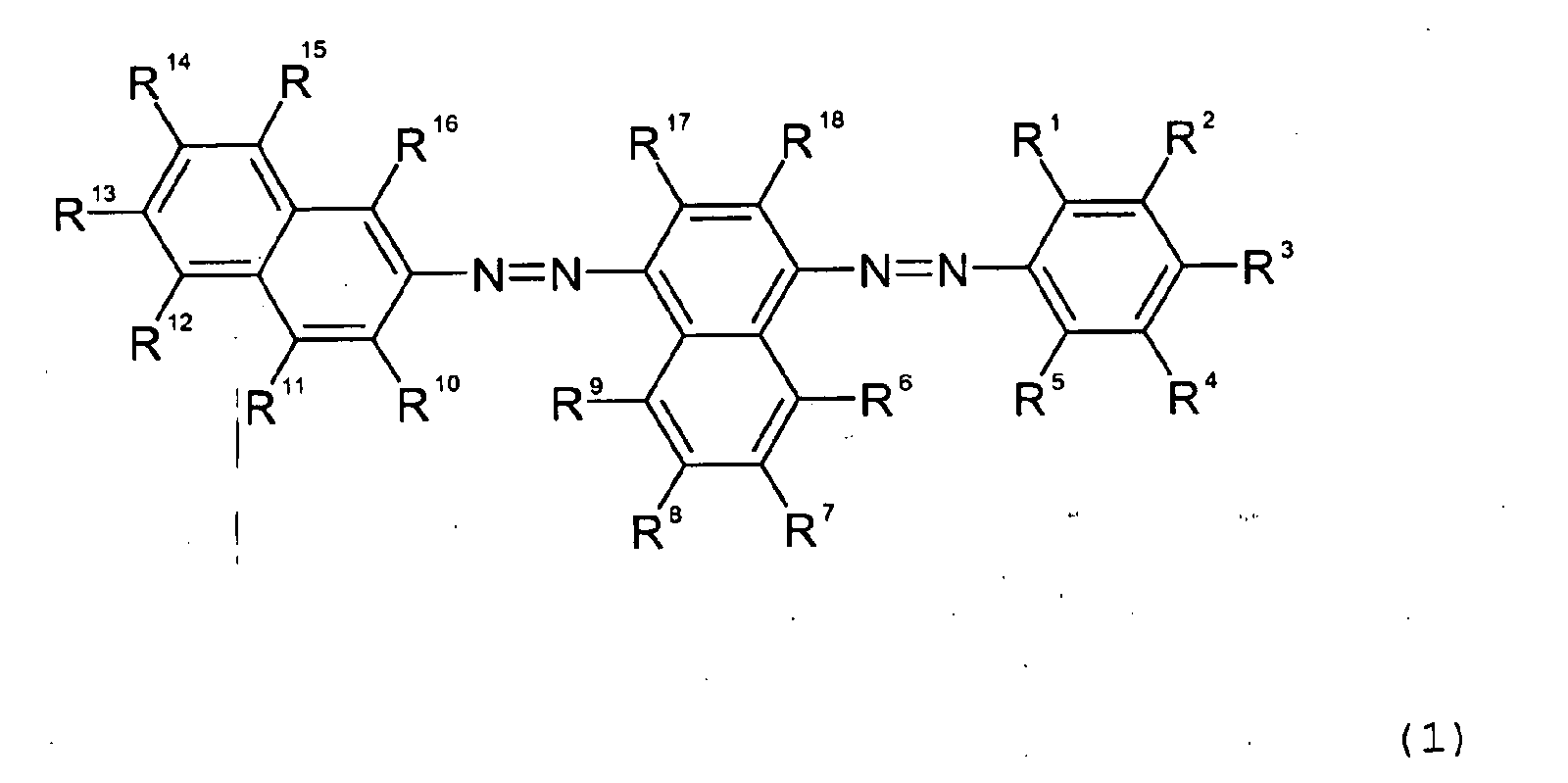
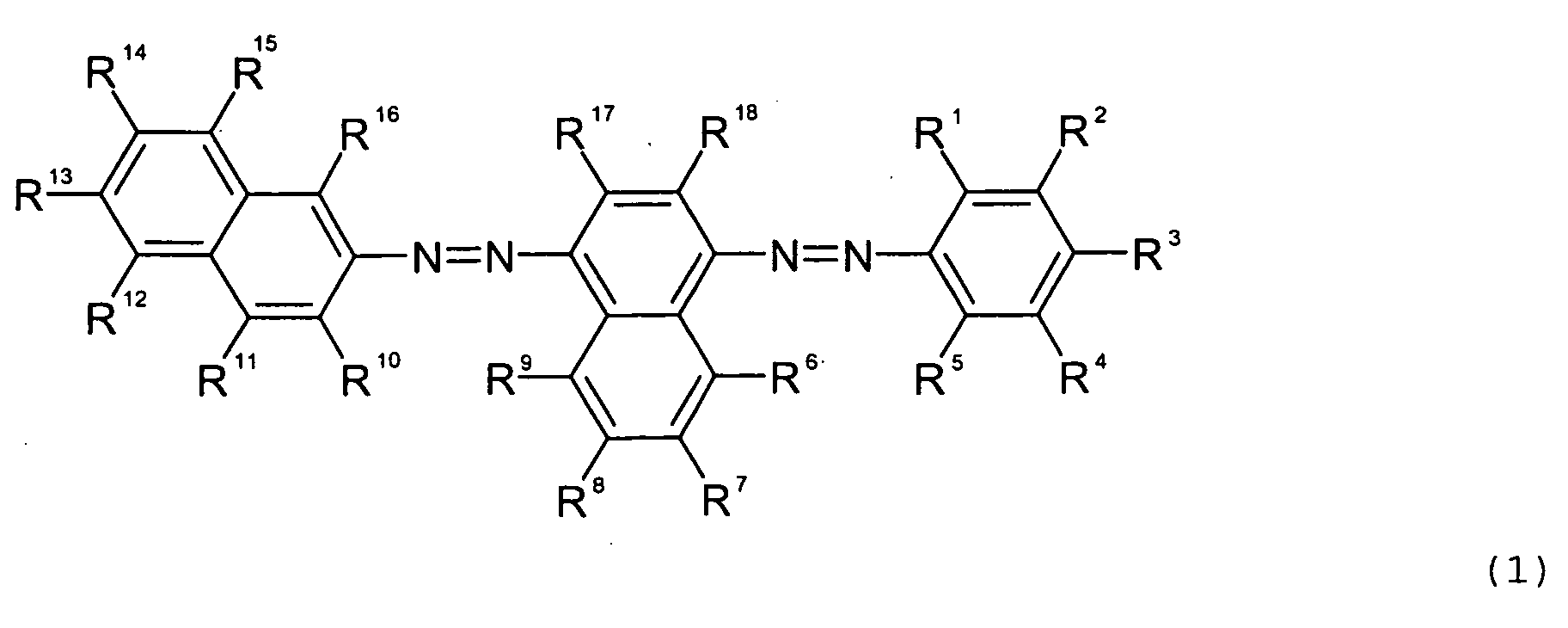
- the invention relates to an aqueous, colloidal Gasrußsuspension, which is characterized in that these a gas black, an azo compound of general formula 1, where R 1 - R 18 may be the same or different and are selected from hydrogen, hydrophilic or hydrophobic groups, acceptor or donor substituents or parts of aliphatic, aromatic or heteroaromatic, acyclic, cyclic or polycyclic systems with acceptor, donor, hydrophilic or hydrophobic Consist of groups and contains water.
- Colloidal means the uniform distribution of particles with a diameter of 10 nm-10 ⁇ m in a suspending agent.
- a low viscosity For use in inks may have a low viscosity Depending on the printing process, be advantageous to the desired Printing properties, such as pressure sharpness, too receive.
- a low zeta potential that the Charge state of the particles in the soot suspension describes is a measure of the good Suspension stability.
- a high surface tension influenced, for example, in the inkjet process positive the droplet formation.
- a high degree of dispersion is of essential for a good storage stability, for good coloristic properties in the application and the Prevention of nozzle clogging especially in the inkjet process.
- especially good water resistance the prints of advantage, because outdoor applications have an increasing importance in inkjet procedures.
- the gas black may have a volatile fraction (950 ° C.) of ⁇ 21% by weight, preferably ⁇ 6% by weight.
- the gas black may have a BET surface area of 80 to 350 m 2 / g.
- the gas black may have a primary particle size of 8 to 40 nm, preferably 13 to 30 nm, particularly preferably 13 to 20 nm.
- the gas black may have a DBP number of 40 to 200 ml / 100 g.
- the gas black can also be a mixture of different ones Be gas soot.
- carbon blacks for example, carbon black FW 200, carbon black FW 2, color black FW 2 V, color black FW 1, color black FW 18, color black S 170, color black S 160, special black 6, special black 5, Special black 4, special black 4A, NIPex 150, NIPex 160 IQ, NIPex 170 IQ, NIPex 180 IQ, Printex U, Printex V, Printex 140 U or Printex 140 V from Degussa AG be used.
- the gas black in the aqueous, Colloidal carbon black suspension may be below 30 wt .-%, preferably less than 20% by weight.
- the azo compound of general formula 1 may be the general formula 1 one or more times in the azo compound contain.
- the unsubstituted or substituted aliphatic or aromatic substituents of the substituents R 1 - R 18 may be phenyl, naphthyl or heteroaromatic substituents such as pyrrolyl, pyridinyl, furyl or puryl.
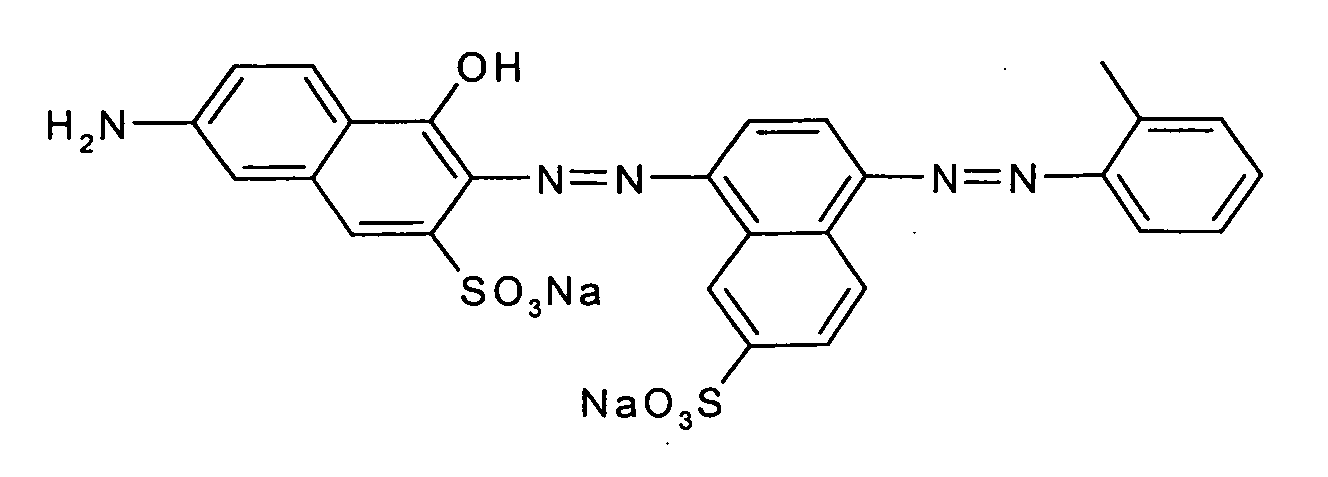
- azo compound of general formula 1 can be used as the azo compound of general formula 1, for example, Tetrasodium-6-amino-4-hydroxy-3 - [[7-sulfonato-4 - [(4-sulfonatophenyl) azo] -1-naphth-1-yl] azo] naphthalene-2,7-disulfonate, 5- [4- (4- (7 - [[2-ethoxy-4- (4-methyl-2-sulfo-phenylazo) -6-sulfo-naphthalen-1-yl] azo] -8-hydroxy-3, 6-disulfonaphthalen-1-ylamino) -6-phenylsulfanyl- [1,3,5] triazin-2-ylamino] -phenylazo] -2-hydroxybenzoic acid or its salts with alkali metal cations or ammonium ions as counterion or 2 - [[4- (4- (7 - [[
- the proportion of the azo compound of general formula 1 in the inventive aqueous, colloidal Gas black suspension can be less than 5 wt .-%, preferably less than 3 Wt .-%, more preferably below 1 wt .-%, very particularly preferably between 0.1 and 1% by weight.
- the azo compound of general formula 1 may be less than 30% by weight, preferably less than 20% by weight, Contain contamination.
- the azo compound of general formula 1 may be less than 10% by weight, preferably less than 5% by weight, especially preferably less than 2500ppm, containing salt.
- the Azo compound of general formula 1 may be at least 100ppm salt included.
- the azo compounds 2 - [[4 - [(1-hydroxy-6-phenylamino-3-sulfonaphthalen-2-yl) azo] -6-sulfonaphthalene-1-yl] azo] -5-methylbenzene 1,4-disulfonic acid, 5- [4- (4- (7 - [[2-ethoxy-4- (4-methyl-2-sulfo-phenylazo) -6-sulfo-naphthalen-1-yl] azo] -8-hydroxy-3, 6-disulfo-naphthalen-1-ylamino) -6-phenylsulfanyl [1,3,5] triazin-2-ylamino] -phenylazo] -2-hydroxy-benzoic acid or tetrasodium 6-amino-4-hydroxy-3 - [[7-sulfonato-4 - [(4-sulfonatophenyl) azo] -1-naphth-1-y
- the aqueous, colloidal gas black suspension according to the invention wetting agent-free, the proportion of azo compound of general formula 1 between 0.1 and 1 wt .-% and the Salinity of the aqueous, colloidal Gas black suspension less than 2500ppm, preferably between 100 and 2500ppm, his.
- the aqueous, colloidal Gasrußsuspension invention may contain biocides, wetting agents and / or additives.
- the aqueous, colloidal Gasrußsuspension invention may contain a biocide.
- the biocide can be used in quantities of 0.01-1.0 wt .-% are added.
- a biocide can Isothiazolinone derivatives, Formaldehydabspalter or Combination products of both product classes used become.
- Parmetol the company Schülke & Mayr, Ebotec of Bode Chemie, Acticide of Thor Chemie or Proxel from Zenecä become.
- the aqueous, colloidal Gasrußsuspension invention can be wetting agent free. Furthermore, wetting agents in Amounts of 0-1% by weight, preferably 0.4-0.6% by weight, based on the total suspension, are added.
- Wetting agents can use compound classes, such as Fatty alcohol ethoxylates, polyacrylic acid and / or their Derivatives, copolymers containing acrylic acid, Acrylic acid derivatives, styrenes, styrene derivatives and / or Polyethers, ligninsulfonates, alkylbenzenesulfonates, Naphthalenesulfonic acid derivatives containing copolymers Maleic anhydride and / or maleic acid derivatives or Combinations of the mentioned wetting agents used become.
- the copolymers can be statistical or alternating block or graft copolymers.
- Joncryl 678, Joncryl 680, Joncryl 682 or Joncryl 690 from Johnson Polymer B.V. used as a dispersion-supporting Wetting agent Joncryl 678, Joncryl 680, Joncryl 682 or Joncryl 690 from Johnson Polymer B.V. used become.
- the dispersing assisting wetting agent it is preferable completely ammonium or alkali hydroxide neutralized Molds, especially NaOH neutralized forms, the Styrene-acrylic acid copolymers can be used.
- wetting agents can also be used for Preparation of the aqueous, colloidal Gas black suspension can be used.
- additives such as alcohols or glycols,
- 1,-pentanediol 1,2-pentanediol
- glycol ethers such as Dipropylene glycol
- heterocycles such as 2-pyrrolidone, or Glycerin
- the aqueous, colloidal according to the invention Gas black suspension can be added.
- the proportion of additives in the aqueous, colloidal gas soot suspension may be below 30% by weight, preferably below 15% by weight.
- Another object of the invention is a method for Preparation of the aqueous, colloidal Gas black suspension, which is characterized in that the gas black and the azo compound of the general formula 1 dispersed in water.
- the dispersion can be carried out with bead mills, ultrasonic devices, High pressure homogenizers, Microfluidizer, Ultra-Turrax or similar aggregates.
- the aqueous, colloidal Gas black suspension by centrifugation and / or filtration getting cleaned.
- Another object of the invention is the use the inventive aqueous, colloidal Gas black suspension in inks, ink jet inks, varnishes, Printing inks, latexes, textiles, leather, adhesives, Silicones, plastics, concrete and building materials.
- the aqueous, colloidal Gasrußsuspensionen invention can be used for coloring, for antistatic Equipment, for reinforcement, and for UV protection of Materials are used.
- Another object of this invention is an ink, which is characterized in that they are the aqueous, colloidal gas black suspension according to the invention contains.
- the ink of the present invention may be azo compounds of general formula 1 between 0.01 and 0.5 wt .-%, preferably between 0.05 and 0.3% by weight.
- the ink according to the invention can be less than 0.05% by weight, preferably less than 0.025% by weight, of salt.
- the Inventive ink can be at least 10ppm salt contain.
- aqueous, colloidal Gas black suspensions are the high optical densities that low zeta potential, the high surface tension, the good storage stability, the high degree of dispersion and the good water resistance of the dried prints.
- the carbon black is added to the solution while stirring slowly (either by hand or with a slow stirrer) gradually incorporated.
- the prepared in point 1 suspension is with the Ultrasound - device dispersed. In the centrifuge can very coarse particles of the suspension thus obtained be separated.
- Table 1 shows the compositions and properties of reference suspensions and of the aqueous colloidal gas black suspension 1 according to the invention.
- Spezialschwarz 550 is an oxidised furnace cast iron from Degussa AG with a primary particle size of 25 nm.
- NIPex 160 IQ is a Degussa gas black with a primary particle size of 20 nm.
- Acticide MBS is a biocide from Thor Chemie.
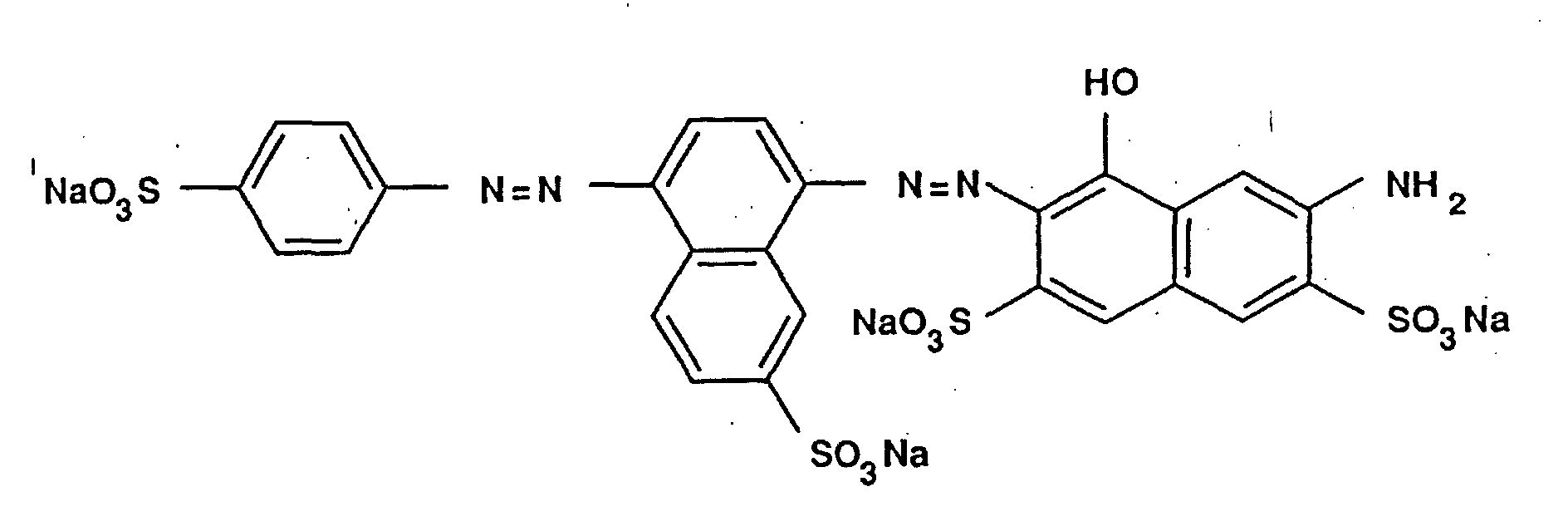
- As the azo compound of formula 1 is tetrasodium 6-amino-4-hydroxy-3 - [[7-sulfonato-4 - [(4-sulfonatophenyl) azo] -1-naphth-1-yl] azo] naphthalene-2,7 disulfonate with the formula used by the company Bayer. This azo compound has a salt content of 312 ppm.
- the salt content of the azo compound is the sum of Sodium sulfate, measured by the sulfate concentration and converted to sodium sulfate, and sodium chloride, measured by the chloride concentration and converted to Sodium chloride.
- an ion exchanger As a separation column, an ion exchanger is lower Capacity used.
- the elution of the ions takes place with electrolytes.
- a conductivity detector is used for the Detection.
- the samples are washed with ultrapure water for 1 h at room temperature Tumbler eluted and sulfate by ion chromatography in the eluate certainly.
- the suspension is then transferred to a volumetric flask and made up to the mark with ultrapure water.
- the volumetric flask should be chosen so that the sample solution contains 0.5 - 40 mg / l SO 4 2- .
- the sample solution is injected through a 0.2 ⁇ m syringe filter into the Ion chromatograph injected.
- the sulfate concentration is calculated using the measured peak area.
- the sample is slurried with ultrapure water.
- the chloride concentration is determined by argentometric titration.
- the suspension After slurrying, the suspension is acidified and titrated with silver nitrate.
- the sample is acidified with nitric acid, the Electrodes and the buret tip into the suspension dipped and titrated potentiometrically.
- the aqueous, colloidal Gasrußsuspension invention 1 is low viscous and shows a high optical density, a good storage stability, a high degree of dispersion and a excellent water resistance of the dried prints.
- FIG. 1 shows light micrographs of the Reference suspension 3 and the aqueous, colloidal gas black suspension 1.
- the reference suspensions 1 - 3 have a high coarse fraction, respectively are partially flocculated and sedimented, and meet thus not the requirements for an ink jet ink.
- the gas black suspension 1 according to the invention shows no Coarse shares and excellent storage stabilities (no Sediment).
- Table 2 shows the dependence of aqueous, colloidal gas black suspensions 1-4 of the salt content according to the invention.
- aqueous, colloidal gas black suspension according to the invention aqueous, colloidal gas black suspension according to the invention aqueous, colloidal gas black suspension according to the invention aqueous, colloidal gas black suspension according to the invention 2 3 4 1 NIPex 160 IQ % 15 15 15 15 Azo compound% of the general formula 1 0.7 0.7 0.7 0.7 Acticide MBS % 0.3 0.3 0.3 0.3 0.3 0.3 0.3 0.3
- aqueous, colloidal Gas black suspensions 1-4 show that already one slight increase in salinity a strong Viscosity increase, this in terms of Dosability, pumpability and long-term stability too have insufficient properties, for example, in inkjet - Procedure to be used.
- aqueous, colloidal gas black suspension 1 is low-viscosity and therefore easy to dose and pump. Due to the excellent storage stability even with heat storage over 28 days, the gas black suspension according to the invention has 1 optimal properties for an application use, such as Example in the inkjet process.
- Table 3 shows the properties of reference suspensions with anionic (reference suspension 4) and nonionic wetting agent additive (reference suspension 5) in comparison to the aqueous, colloidal gas black suspension 1 according to the invention.
- reference suspension reference suspension aqueous, colloidal gas black suspension according to the invention 4 5 1 NIPex 160 IQ % 15 15 15 Disponil FES 32 IS % 6 --- --- Hydropalat 3065 % --- 5 --- Azo compound of the general formula 1 % --- --- 0.7 AMP 90 % 0.2 0.2 --- Acticide MBS % 0.3 0.3 0.3 deion. water % 78.5 79.5 84.0 Zeta - potential mV -15 -4 -56 surface tension nM / m 38 44 72 Optical Density (6 ⁇ m Draw Downs on Data Copy Paper) 1.2 0.9 1.5
- Disponil FES 32 IS is an anionic wetting agent (Fatty alcohol polyglycol ether sulfate) from Cognis.
- Hydropalat 3065 is a nonionic wetting agent (Mixture ethoxylated linear fatty alcohols) from Cognis.
- AMP 90 is 2-amino-2-methyl-1-propanol from Angus Chemistry.
- the azo compound of general formula 1 is Tetrasodium-6-amino-4-hydroxy-3 - [[7-sulfonato-4 - [(4-sulfonatophenyl) azo] -1-naphth-1-yl] azo] naphthalene-2,7-disulfonate, the company Bayer.
- Table 4 shows the properties of a dye-containing reference suspension (6) in comparison to the aqueous, colloidal gas black suspension 5 according to the invention.
- Reference suspension 6 According to the invention, aqueous, colloidal gas black suspension 5 NIPex 160 IQ % 15 15 Azo compound of the general formula 1 % --- 0.7 Acid Black 1 % 1.2 --- Acticide MBS % 0.3 0.3 IDIS @ solv.pd % 8th 8th least. water % 75.5 76.0 light microscope 1 1 freeze Stable Yes Yes pH 7, 6 7.4 Mean particle size nm ⁇ 100 ⁇ 100 Viscosity RT mPas 4.5 4.3 surface tension mN / m 68 68 Zeta potential mV - 51 - 56 Storage stability.
- IDIS @ solv.pd is 1,3-propanediol from Degussa AG.
- acid Black 1 is Naphthol Blue Black with a salt content of 1.5 % By weight of the company Aldrich Chemical Company.
- the azo compound of general formula 1 is tetrasodium 6-amino-4-hydroxy-3 - [[7-sulfonato-4 - [(4-sulfonatophenyl) azo] -1-naphth-1-yl] azo] naphthalene-2,7- disulfonate, the company Bayer.
- the degree of dispersion of the suspension samples becomes 400 graded magnification. Based on the scaling on Light microscope can be coarse particles> 1 micron are well recognized.
- the rheological behavior is measured in a shear rate (CSR) rotation test with a Physica Rheometer UDS 200. At a shear rate of 1000 s -1 , the viscosity value is read off.
- CSR shear rate
- the particle size distribution is with a Photon Correlation Spectrometer (PCS), Type Horiba LB-500, determined and as the mean particle size of the indicated read "median - value”. The measurement takes place at one undiluted suspension sample.
- PCS Photon Correlation Spectrometer
- Type Horiba LB-500 Type Horiba LB-500
- the samples are stored at 50 ° C for 28 days.
- the viscosity and sedimentation tendency are checked.
- Per 300 ml of suspension sample are stored for 28 days at 50 ° C in a drying oven in a closed glass bottle.
- the sedimentation on the ground is checked with a spatula and the viscosity measured with a Brookfield viscometer DV II plus.
- sedimentation on some samples when stored at room temperature is investigated.
- the samples are frozen at -25 ° C and, after thawing, the degree of dispersion is checked by light microscopy.
- a sample is considered to be freeze-stable if the frozen sample has a thinned consistency again after thawing, does not form any sediment and no reagglomeration is visible under the light microscope.
- the pH is absorbed by the undiluted suspension Use of the pH meter CG 837 from Schott determined.
- the glass electrode is dipped into the solution and after read the temperature-corrected pH for five minutes.
- the zeta potential is measured using an MBS-8000 from Matec certainly. The samples are measured undiluted. The Zeta potential is determined by means of electrokinetic Sound amplitude (ESA) determined.
- ESA electrokinetic Sound amplitude
- HP Deskjet 6122 print demos are made on copy paper and for 24 h dried at room temperature.
- the print demos will be in a photo dish with dest. Water submerged and for 5 minute soaked.
- the prints After soaking, the prints are removed from the water bath and dried for 24 h at room temperature.
- the water resistance is assessed by visual Assessment of the discoloration of the copy paper.
- the aqueous, colloidal Gasrußsuspension invention 5 has a better relation to the reference suspension 6 Water resistance.
- the aqueous, Colloidal gas black suspension 5 meets all requirements an optimal suspension.
- the printing trials are done with a Canon Office printer BJC-S750 performed.
- the ink is set in advance Vacuum vented and placed in a cleaned original Cartridge filled.
- the inks according to the invention are distinguished by very good printability, high optical densities and very good storage stability.
- Inventive ink 1 Carbon black concentration [%] 4.5 Ink formulation [%] aqueous, colloidal Gasrußsusp.5 invention 30.0 2-pyrrolidone 12.0 Liponic EG-07 (ethoxylated glycerin) 1.5 IDIS@solv.pd (1,3 propanediol) 1.5 IDIS@solv.hd (1,2 hexanediol) 1.5 deion.
- Table 6 shows the compositions and properties of a reference ink and inks of the invention.
- ink sample Inventive ink Inventive ink reference ink No. 2 3 1 Aqueous Colloidal Gas Black Suspension According to the Invention 1 [%] 13,30 13,30 - Reference suspension 1 [%] - - 13,30 Azo compound of the general formula 1 - 4.91 4.91 Ethanol [%] 5.00 5.00 Ethylene glycol [%] 20.00 20.00 20.00 1,2-hexanediol [%] 5.00 5.00 deionized water [%] 56,70 51.79 51.79 suspension consistency liquid liquid liquid liquid Optical density on copy paper 1.51 1.45 1.26 Microscope (degree of dispersion) ++ - - -
- the same Azo compound used as in the inventive aqueous colloidal gas black suspension 1 (tetrasodium 6-amino-4-hydroxy-3 - [[7-sulfonato-4 - [(4-sulfonatophenyl) azo] -1-naphth-1-yl] azo] naphthalene-2,7 disulfonate).
- gas black suspension according to the invention is with Ethanol, ethylene glycol, 1,2-hexanediol and deion.
- FIG. 2 shows light micrographs of the Inventive inks 2 and 3 and Figure 3 shows Photomicrographs of the reference ink 1.
- the Reference ink 1 has a very high coarse fraction, respectively is almost completely flocculated while the ink 3 of the invention partially flocculates and the Inventive ink 2 is not flocculated at all.
- the ink 2 of the invention shows a high Degree of dispersion and no coarse fractions.
Landscapes
- Chemical & Material Sciences (AREA)
- Organic Chemistry (AREA)
- Engineering & Computer Science (AREA)
- Materials Engineering (AREA)
- Wood Science & Technology (AREA)
- Life Sciences & Earth Sciences (AREA)
- Inorganic Chemistry (AREA)
- Chemical Kinetics & Catalysis (AREA)
- Structural Engineering (AREA)
- Civil Engineering (AREA)
- Inks, Pencil-Leads, Or Crayons (AREA)
- Pigments, Carbon Blacks, Or Wood Stains (AREA)
- Colloid Chemistry (AREA)
- Adhesives Or Adhesive Processes (AREA)
- Paints Or Removers (AREA)
- Compositions Of Macromolecular Compounds (AREA)
Abstract
Description
einen Gasruß, eine Azoverbindung der allgemeinen Formel 1,
Als Azoverbindung der allgemeinen Formel 1 können beispielsweise eingesetzt werden
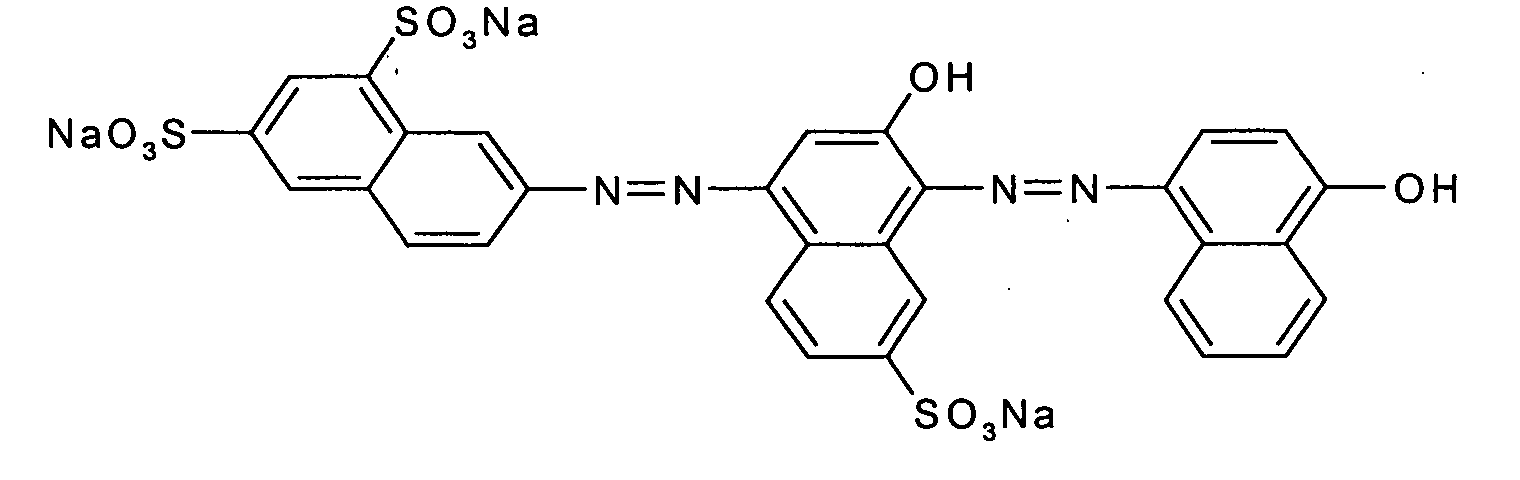



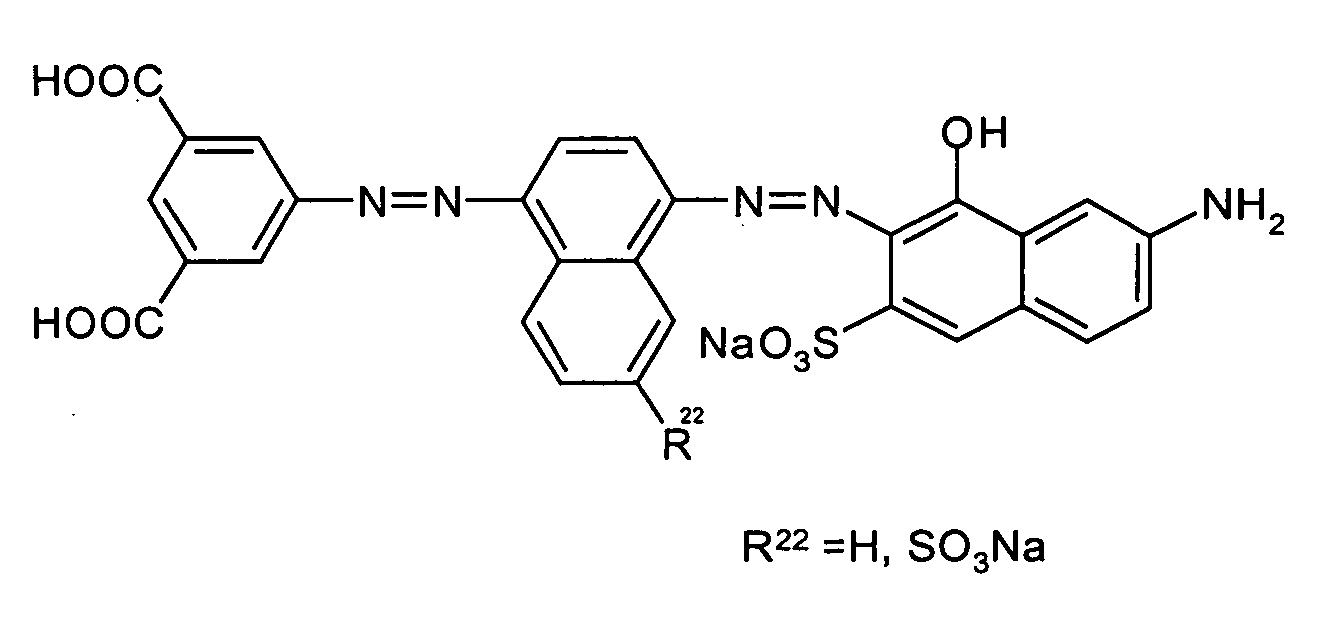
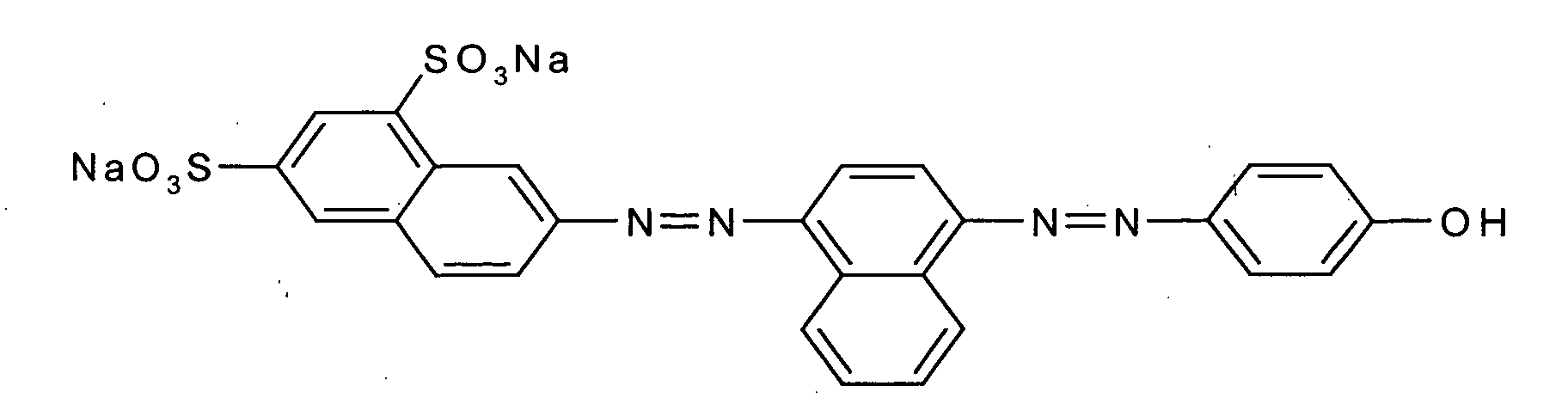
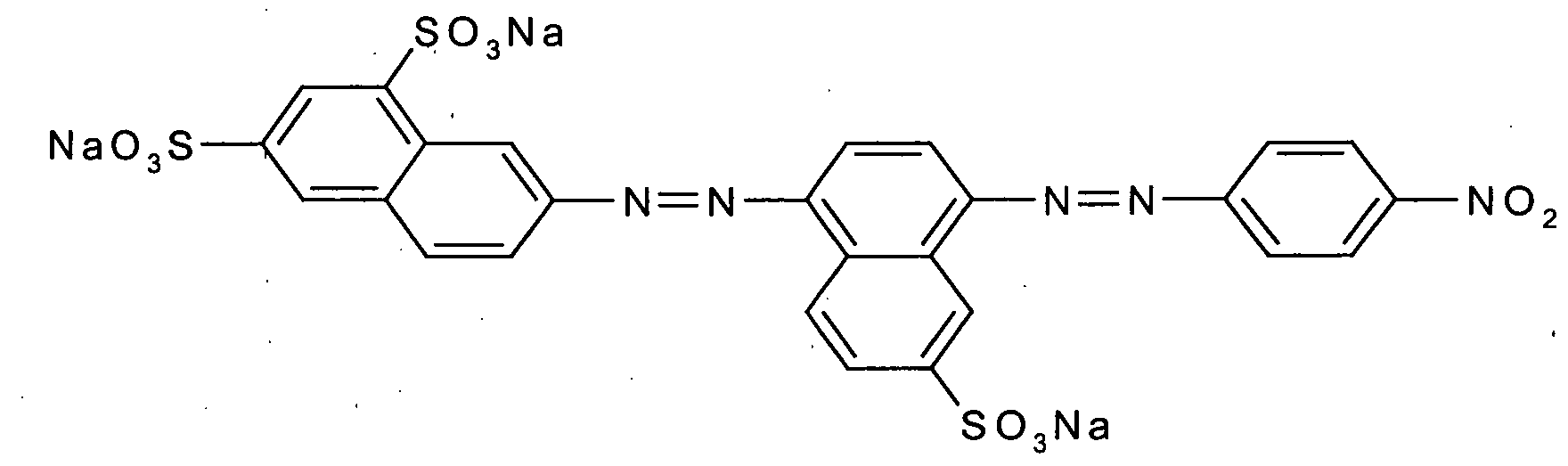


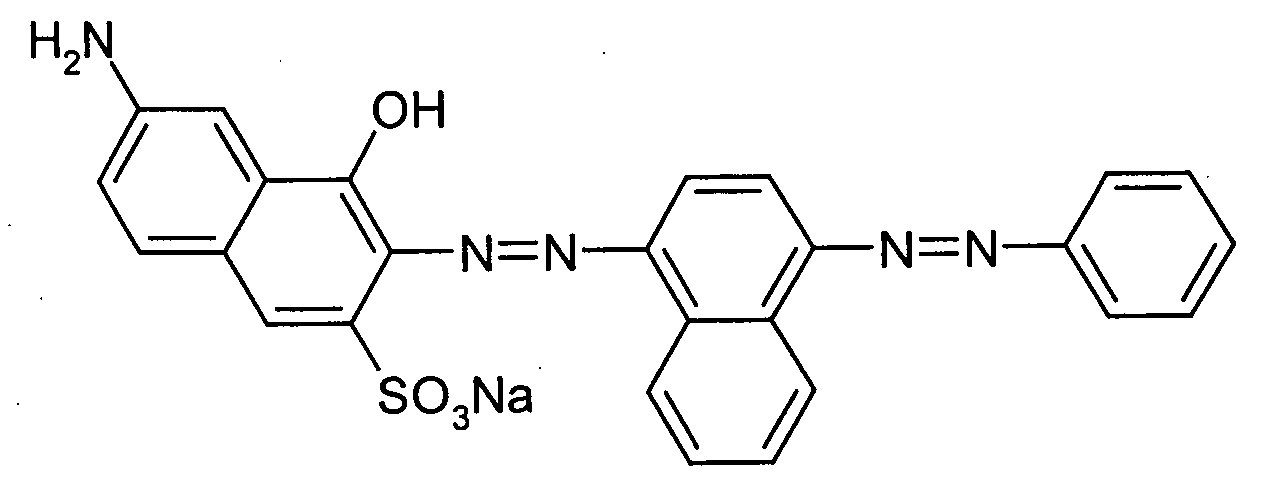

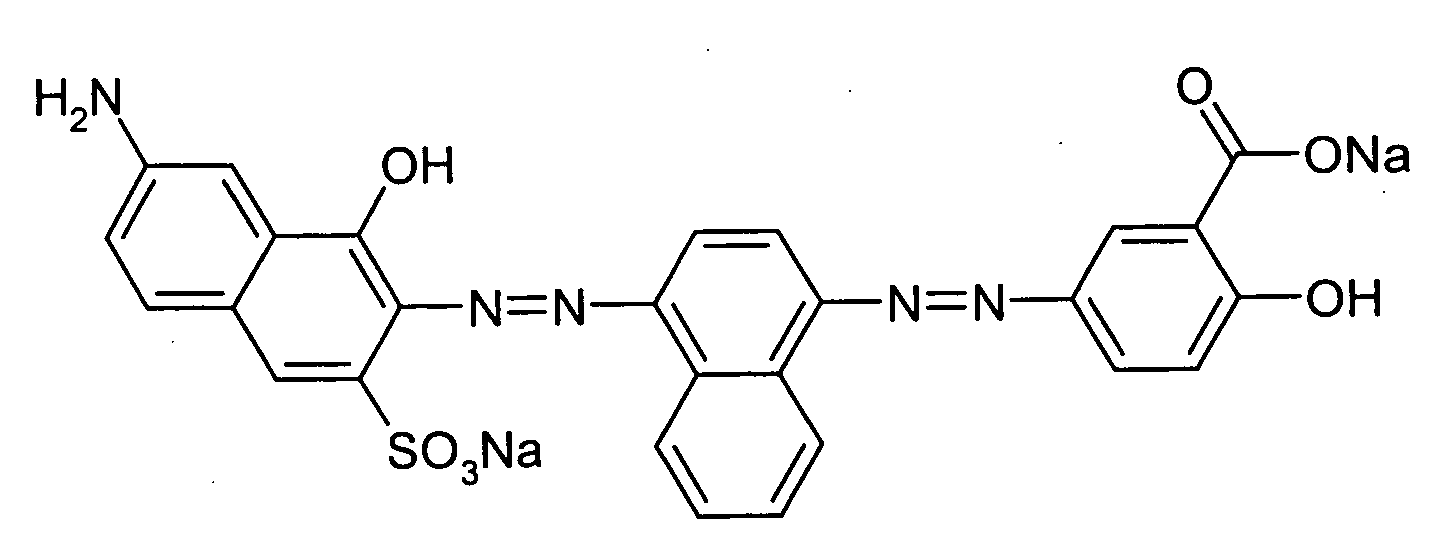

Tetranatrium-6-amino-4-hydroxy-3-[[7-sulfonato-4-[(4-sulfonatophenyl)azo]-1-naphth-1-yl]azo]naphthalen-2,7-disulfonat,


2-[[4-[(1-hydroxy-6-phenylamino-3-sulfo-naphthalen-2-yl)azo]-6-sulfo-naphthalen-1-yl]azo]-5-methyl-benzen-1,4-disulfonsäure oder deren Salze mit Alkalimetallkationen beziehungsweise Ammoniumionen als Gegenion

| Referenzsuspension | Referenzsuspension | Referenzsuspension | erfindungsgemäße wäßrige, kolloidale Gasrußsuspension | ||
| 1 | 2 | 3 | 1 | ||
| NIPex 160 IQ | % | --- | --- | --- | 15 |
| Spezialschwarz 550 | % | 15 | 15 | 15 | --- |
| Azoverbindung der allg. Formel 1 | % | 0,7 | 1,0 | 3,0 | 0,7 |
| Acticide MBS | % | 0,3 | 0,3 | 0,3 | 0,3 |
| Deionisiertes Wasser % | 84,0 | 83,7 | 81,7 | 84,0 | |
| Suspensionskonsistenz | flüssig | flüssig | flüssig | flüssig | |
| Dispergiergrad lichtmikroskopisch | schlecht | schlecht | schlecht | sehr gut | |
| Lagerstabilität 50 °C über 28 Tage | Sediment | Sediment | Sediment | sehr gut | |
| Optische Dichte einer Ink Jet Tinte 6 µm Draw Downs auf Data Copy Papier | n.a. | n.a. | n.a. | 1,5 | |
| n.a. =nicht anwendbar |
Acticide MBS ist ein Biozid der Firma Thor Chemie. Als Azoverbindung der Formel 1 wird Tetranatrium-6-amino-4-hydroxy-3-[[7-sulfonato-4-[(4-sulfonatophenyl)azo]-1-naphth-1-yl]azo]naphthalen-2,7-disulfonat
mit der Formel
- Mol(SO4 2-)
- Molekulargewicht SO4 2-
- Mol(Na2SO4)
- Molekulargewicht Na2SO4
Die Chloridkonzentration wird über eine argentometrische Titration ermittelt.
- VAg
- Volumen der bei der Titration der verbrauchten Silbernitratlösung in ml
- c
- Molarität der Silbernitratlösung [mol/l]
- M
- atomare Masse von Chlor
- t
- Titer der Silbernitratlösung
- Mol(NaCl)
- Molekulargewicht NaCl
| erfindungsgemäße wäßrige, kolloidale Gasrußsuspension | erfindungsgemäße wäßrige, kolloidale Gasrußsuspension | erfindungsgemäße wäßrige, kolloidale Gasrußsuspension | erfindungsgemäße wäßrige, kolloidale Gasrußsuspension | ||
| 2 | 3 | 4 | 1 | ||
| NIPex 160 IQ | % | 15 | 15 | 15 | 15 |
| Azoverbindung % der allg. Formel 1 | 0,7 | 0,7 | 0,7 | 0,7 | |
| Acticide MBS | % | 0,3 | 0,3 | 0,3 | 0,3 |
| Deionisiertes Wasser | % | 84,0 | 84,0 | 84,0 | 84,0 |
| Salzgehalt | ppm | 2500 | 5000 | 10000 | <20 |
| Suspensionskonsistenz nach Herstellung | flüssig | dickflüssig | geliert, pastös | flüssig | |
| Viskosität nach Herstellung [mPas] | < 10 | > 100 | n.a. | < 10 | |
| Lagerstabilität 28 Tage bei 50 °C | dickflüssig | geliert, pastös | n.a. | flüssig |
| Referenzsuspension | Referenzsuspension | erfindungsgemäße wäßrige, kolloidale Gasrußsuspension | ||
| 4 | 5 | 1 | ||
| NIPex 160 IQ | % | 15 | 15 | 15 |
| Disponil FES 32 IS | % | 6 | --- | --- |
| Hydropalat 3065 | % | --- | 5 | --- |
| Azoverbindung der allg. Formel 1 | % | --- | --- | 0,7 |
| AMP 90 | % | 0,2 | 0,2 | --- |
| Acticide MBS | % | 0,3 | 0,3 | 0,3 |
| deion. Wasser | % | 78,5 | 79,5 | 84,0 |
| Zeta - Potential | mV | -15 | -4 | -56 |
| Oberflächenspannung | nM/m | 38 | 44 | 72 |
| Optische Dichte (6 µm Draw Downs auf Data Copy Papier) | 1,2 | 0,9 | 1,5 |
| Referenzsuspension 6 | erfindungsgemäße, wäßrige, kolloidale Gasrußsuspension 5 | ||
| NIPex 160 IQ | % | 15 | 15 |
| Azoverbindung der allg. Formel 1 | % | --- | 0,7 |
| Acid Black 1 | % | 1,2 | --- |
| Acticide MBS | % | 0,3 | 0,3 |
| IDIS @ solv.pd | % | 8 | 8 |
| dest. Wasser | % | 75,5 | 76,0 |
| Lichtmikroskop | 1 | 1 | |
| Gefrierstabil | Ja | Ja | |
| pH | 7, 6 | 7,4 | |
| Mittlere Partikelgröße | Nm | < 100 | < 100 |
| Viskosität RT | mPas | 4,5 | 4,3 |
| Oberflächenspannung | mN/m | 68 | 68 |
| Zeta-Potential | mV | - 51 | - 56 |
| Lagerstabilität. 50 °C/7 Tage | mPas | < 10 | < 10 |
| Lagerstabilität. 50 °C/14 Tage | mPas | < 10 | < 10 |
| Lagerstabilität. 50 °C/28 Tage | mPas | < 10 | < 10 |
| Wasserbeständigkeit | schlecht | Sehr gut |
Je 300 ml Suspensionsprobe werden für 28 Tage bei 50 °C im Trockenschrank in einer geschlossenen Glasflasche gelagert. Die Sedimentbildung am Boden wird mit einem Spatel überprüft und die Viskosität mit einem Brookfield Viskosimeter DV II plus gemessen. Zusätzlich wird die Sedimentbildung an einigen Proben bei Lagerung bei Raumtemperatur untersucht.
Eine Probe wird als gefrierstabil beurteilt, wenn die eingefrorene Probe nach Auftauen wieder eine dünnflüssige Konsistenz hat, kein Sediment bildet und unter dem Lichtmikroskop keine Reagglomerationen sichtbar sind.
| Erfindungsgemäße Tinte | 1 |
| Rußkonzentration [%] | 4,5 |
| Tintenrezeptur [%] | |
| erfindungsgemäße wäßrige, kolloidale Gasrußsusp.5 | 30,0 |
| 2-Pyrrolidon | 12,0 |
| Liponic EG-07 (ethoxyliertes Glyzerin) | 1,5 |
| IDIS@solv.pd (1,3 Propandiol) | 1,5 |
| IDIS@solv.hd (1,2 Hexandiol) | 1,5 |
| deion. Wasser | 53,48 |
| Dimethylaminoethanol | 0,02 |
| Lichtmikroskop | 1 |
| pH-Wert | 8,8 |
| Viskosität [mPas] | 2,7 |
| Oberflächenspannung [mN/m] | 47 |
| Verwendeter Office Drucker | Canon BJC S750 |
| optische Dichte (OD) auf Kompass Copy Office | 1,51 |
| OD auf Inkjet Papier HP 51634 Z | 1,58 |
| OD auf Inkjet Papier CANON HR-101 | 1,60 |
| OD auf Inkjet Papier EPSON 720 dpi | 1,62 |
| visueller Gesamteindruck Druckbild | 1 |
| Düsenverstopfungen | keine |
| Antrocknungen am Druckkopf | keine |
| Andruck nach Druckpause 60 min. | + |
| Andruck nach Druckpause 1 Tag | + |
| Andruck nach Druckpause 3 Tage | + |
| Andruck nach Druckpause 7 Tage | + |
| Tintenprobe | Erfindungsgemäße Tinte | Erfindungsgemäße Tinte | Referenztinte |
| Nr. | 2 | 3 | 1 |
| Erfindungsgemäße wässrige, kolloidale Gasrußsuspension 1 [%] | 13,30 | 13,30 | -- |
| Referenzsuspension 1 [%] | -- | -- | 13,30 |
| Azoverbindung der allg. Formel 1 | -- | 4,91 | 4,91 |
| Ethanol [%] | 5,00 | 5,00 | 5,00 |
| Ethylenglycol [%] | 20,00 | 20,00 | 20,00 |
| 1,2-Hexandiol [%] | 5,00 | 5,00 | 5,00 |
| deionisiertes Wasser [%] | 56,70 | 51,79 | 51,79 |
| Suspensionskonsistenz | flüssig | flüssig | flüssig |
| Optische Dichte auf Kopierpapier | 1,51 | 1,45 | 1,26 |
| Mikroskop (Dispergiergrad) | ++ | -- | -- |
Claims (20)
- Wäßrige, kolloidale Gasrußsuspension, dadurch gekennzeichnet, dass diese wenigstens einen Gasruß, eine Azoverbindung der allgemeinen Formel 1,wobei R1 - R18 gleich oder verschieden sein können und aus Wasserstoff, hydrophilen oder hydrophoben Gruppen, Akzeptor- oder Donatorsubstituenten oder Teilen von aliphatischen, aromatischen oder heteroaromatischen, acyclischen, cyclischen oder mehrfach cyclischen Systemen mit Akzeptor-, Donator-, hydrophilen oder hydrophoben Gruppen bestehen, und Wasser enthält.

- Wässrige, kolloidale Gasrußsuspension nach Anspruch 1, dadurch gekennzeichnet, dass der Gasruß einen Flüchtigenanteil(950°C)von < 21 Gew.-%, eine BET-Oberfläche von 80 - 350 m2/g, eine Primärteilchengröße von 8 -40 nm und eine DBP-Zahl von 40 - 200 ml/100g hat.
- Wäßrige, kolloidale Gasrußsuspension nach Anspruch 1, dadurch gekennzeichnet, daß der Gasrußanteil < 30 Gew.-% ist.
- Wäßrige, kolloidale Gasrußsuspension nach Anspruch 1, dadurch gekennzeichnet, daß der Anteil Azoverbindung der allgemeinen Formel 1 < 5 Gew.-% ist.
- Wäßrige, kolloidale Gasrußsuspension nach Anspruch 1, dadurch gekennzeichnet, daß die Azoverbindung der allgemeinen Formel 1 weniger als 30 Gew.-% Verunreinigung enthält.
- Wäßrige, kolloidale Gasrußsuspension nach Anspruch 1, dadurch gekennzeichnet, daß die Azoverbindung der allgemeinen Formel 1 weniger als 10 Gew.-% Salz enthält.
- Wäßrige, kolloidale Gasrußsuspension nach Anspruch 1, dadurch gekennzeichnet, daß die Azoverbindung 2-[[4-[(1-hydroxy-6-phenylamino-3-sulfo-naphthalen-2-yl)azo]-6-sulfo-naphthalen-1-yl]azo]-5-methyl-benzen-1,4-disulfonsäure, 5-[4-(4-(7-[[2-ethoxy-4-(4-methyl-2-sulfo-phenylazo)-6-sulfo-naphthalen-1-yl]azo]-8-hydroxy-3,6-disulfo-naphthalen-1-ylamino)-6-phenylsulfanyl-[1,3,5]triazin-2-ylamino]-phenylazo]-2-hydroxy-benzoesäure oder Tetranatrium-6-amino-4-hydroxy-3-[[7-sulfonato-4-[(4-sulfonatophenyl)azo]-1-naphth-1-yl]azo]naphthalen-2,7-disulfonat ist.
- Wäßrige, kolloidale Gasrußsuspension nach Anspruch 7, dadurch gekennzeichnet, daß die Azoverbindung weniger als 30 Gew.-% Verunreinigung und weniger als 10 Gew.-% Salz enthält.
- Wäßrige, kolloidale Gasrußsuspension nach Anspruch 7, dadurch gekennzeichnet, daß diese Biozide, Netzmittel und/oder Additive enthält.
- Wäßrige, kolloidale Gasrußsuspension nach Anspruch 9, dadurch gekennzeichnet, daß das Netzmittel ein Fettalkoholethoxylat, Polyacrylsäure oder/und deren Derivate, Copolymer enthaltend Acrylsäure, Acrylsäurederivate, Styrole, Styrolderivate und/oder Polyether, Ligninsulfonat, Alkylbezolsulfonat, Naphthalinsulfonsäurederivat, Copolymer enthaltend Maleinsäureanhydrid und/oder Maleinsäurederivate oder Kombinationen aus den genannten Netzmitteln ist.
- Wäßrige, kolloidale Gasrußsuspension nach Anspruch 9, dadurch gekennzeichnet, daß der Netzmittelanteil zwischen 0 und 1 Gew.-% ist.
- Wäßrige, kolloidale Gasrußsuspension nach Anspruch 9, dadurch gekennzeichnet, daß das Additiv ein Alkohol, Glykol, Glykolether, Heterocyclus oder Glyzerin ist.
- Wäßrige, kolloidale Gasrußsuspension nach Anspruch 9, dadurch gekennzeichnet, daß der Additivanteil < 30 Gew.-% ist.
- Wäßrige, kolloidale Gasrußsuspension nach Anspruch 1, dadurch gekennzeichnet, daß diese netzmittelfrei, der Anteil der Azoverbindung der allgemeinen Formel 1 zwischen 0,1 und 1 Gew.-% und der Salzgehalt der wäßrigen, kolloidalen Gasrußsuspension weniger als 2500ppm ist.
- Verfahren zur Herstellung der wäßrigen, kolloidalen Gasrußsuspension nach Anspruch 1, dadurch gekennzeichnet, daß man den Gasruß und die lösliche Azoverbindung der allgemeinen Formel 1 in Wasser dispergiert.
- Verfahren zur Herstellung der wäßrigen, kolloidalen Pigmentsuspension nach Anspruch 15, dadurch gekennzeichnet, daß man die Dispergierung mit Perlmühlen, Ultraschall-Geräten, Hochdruckhomogenisatoren, Microfluidizer, Ultra-Turrax oder vergleichbaren Aggregaten durchführt.
- Verwendung der wäßrigen, kolloidalen Gasrußsuspension nach Anspruch 1 in Tinten, Ink Jet Tinten, Lacken, Druckfarben, Latizes, Textilien, Leder, Klebstoffen, Silikonen, Kunststoffen, Beton und Baustoffen.
- Tinte, dadurch gekennzeichnet, daß diese die wäßrige, kolloidale Gasrußsuspension nach Anspruch 1 enthält.
- Tinte nach Anspruch 18, dadurch gekennzeichnet, dass der Gehalt an Azoverbindung der allgemeinen Formel 1 zwischen 0,01 und 0,5 Gew.-% ist.
- Tinte nach Anspruch 18, dadurch gekennzeichnet, dass diese netzmittelfrei, der Anteil der Azoverbindung der allgemeinen Formel 1 zwischen 0,01 und 0,5 Gew.-% und der Salzgehalt der Tinte weniger als 250ppm ist.
Priority Applications (2)
| Application Number | Priority Date | Filing Date | Title |
|---|---|---|---|
| PL05000297T PL1566415T3 (pl) | 2004-02-18 | 2005-01-08 | Wodna, koloidalna zawiesina sadzy gazowej |
| SI200530016T SI1566415T1 (sl) | 2004-02-18 | 2005-01-08 | Vodna koloidna suspenzija saj |
Applications Claiming Priority (2)
| Application Number | Priority Date | Filing Date | Title |
|---|---|---|---|
| DE102004007780 | 2004-02-18 | ||
| DE102004007780A DE102004007780A1 (de) | 2004-02-18 | 2004-02-18 | Wäßrige, kolloidale Gasrusssuspension |
Publications (2)
| Publication Number | Publication Date |
|---|---|
| EP1566415A1 true EP1566415A1 (de) | 2005-08-24 |
| EP1566415B1 EP1566415B1 (de) | 2007-02-28 |
Family
ID=34706824
Family Applications (1)
| Application Number | Title | Priority Date | Filing Date |
|---|---|---|---|
| EP05000297A Expired - Lifetime EP1566415B1 (de) | 2004-02-18 | 2005-01-08 | Wässrige, kolloidale Gasrusssuspension |
Country Status (24)
| Country | Link |
|---|---|
| US (1) | US7005004B2 (de) |
| EP (1) | EP1566415B1 (de) |
| JP (1) | JP2005314652A (de) |
| KR (1) | KR101123414B1 (de) |
| CN (1) | CN1657572B (de) |
| AR (1) | AR047804A1 (de) |
| AT (1) | ATE355340T1 (de) |
| AU (1) | AU2005200687B2 (de) |
| BR (1) | BRPI0503049A (de) |
| CA (1) | CA2497319A1 (de) |
| DE (2) | DE102004007780A1 (de) |
| DK (1) | DK1566415T3 (de) |
| EG (1) | EG23648A (de) |
| ES (1) | ES2282930T3 (de) |
| HR (1) | HRP20070195T3 (de) |
| MX (1) | MXPA05001820A (de) |
| MY (1) | MY134428A (de) |
| PL (1) | PL1566415T3 (de) |
| PT (1) | PT1566415E (de) |
| RU (1) | RU2386654C2 (de) |
| SI (1) | SI1566415T1 (de) |
| TW (1) | TW200535199A (de) |
| UA (1) | UA83806C2 (de) |
| ZA (1) | ZA200501425B (de) |
Families Citing this family (13)
| Publication number | Priority date | Publication date | Assignee | Title |
|---|---|---|---|---|
| DE102005009321A1 (de) * | 2005-03-01 | 2006-09-07 | Degussa Ag | Suspension |
| DE102005037336A1 (de) * | 2005-08-04 | 2007-02-08 | Degussa Ag | Kohlenstoffmaterial |
| WO2007053564A2 (en) * | 2005-10-31 | 2007-05-10 | Cabot Corporation | Modified colorants and inkjet ink compositions comprising modified colorants |
| DE102006037079A1 (de) * | 2006-08-07 | 2008-02-14 | Evonik Degussa Gmbh | Ruß, Verfahren zur Herstellung von Ruß und Vorrichtung zur Durchführung des Verfahrens |
| US8133311B2 (en) * | 2007-04-30 | 2012-03-13 | Cabot Corporation | Pigment dipsersions comprising functionalized non-polymeric dispersants |
| DE102007060307A1 (de) * | 2007-12-12 | 2009-06-18 | Evonik Degussa Gmbh | Verfahren zur Nachbehandlung von Ruß |
| US7819962B2 (en) * | 2008-03-17 | 2010-10-26 | Cabot Corporation | Modified pigments having reduced phosphate release, and dispersions and inkjet ink compositions therefrom |
| DE102008026894A1 (de) * | 2008-06-05 | 2009-12-10 | Evonik Degussa Gmbh | Ink Jet Tinte |
| DE102008044116A1 (de) * | 2008-11-27 | 2010-06-02 | Evonik Degussa Gmbh | Pigmentgranulat, Verfahren zu dessen Herstellung und Verwendung |
| EP2196507B1 (de) * | 2008-12-12 | 2011-07-13 | Evonik Carbon Black GmbH | Ink Jet Tinte |
| DE102010002244A1 (de) * | 2010-02-23 | 2011-08-25 | Evonik Carbon Black GmbH, 63457 | Ruß, Verfahren zu seiner Herstellung und seine Verwendung |
| EP3448825B1 (de) * | 2016-04-26 | 2020-05-27 | Dow Global Technologies LLC | Zementäre zusammensetzung umfassend einen tonunempfindlichen betonverflüssiger |
| EP3548558A4 (de) | 2016-12-02 | 2020-07-29 | The Willamette Valley Company Llc | Organische wachsextenderemulsion und verfahren zur herstellung davon |
Citations (4)
| Publication number | Priority date | Publication date | Assignee | Title |
|---|---|---|---|---|
| US3687887A (en) * | 1970-07-20 | 1972-08-29 | Dick Co Ab | Photographic film titling ink |
| US6251174B1 (en) * | 1997-04-01 | 2001-06-26 | Avecia Limited | Ink composition containing at least two azo dyes |
| EP1215250A1 (de) * | 2000-12-13 | 2002-06-19 | Tetenal Photowerk GmbH & Co | Ink-Jet-Tinte und deren Verwendung zum Bedrucken transparenter Druckträger |
| WO2004046256A1 (en) * | 2002-11-16 | 2004-06-03 | Degussa Ag | Aqueous, colloidal gas black suspension |
Family Cites Families (19)
| Publication number | Priority date | Publication date | Assignee | Title |
|---|---|---|---|---|
| US5085698A (en) * | 1990-04-11 | 1992-02-04 | E. I. Du Pont De Nemours And Company | Aqueous pigmented inks for ink jet printers |
| JPH0457865A (ja) * | 1990-06-28 | 1992-02-25 | Canon Inc | インク及びこれを用いたインクジェット記録方法 |
| US5320668A (en) * | 1991-09-23 | 1994-06-14 | Hewlett-Packard Company | Bleed alleviation using pH-sensitive agents |
| JP3440541B2 (ja) * | 1994-03-31 | 2003-08-25 | 三菱化学株式会社 | インクジェット用記録液 |
| JP3440542B2 (ja) * | 1994-03-31 | 2003-08-25 | 三菱化学株式会社 | 記録液 |
| JPH07331141A (ja) * | 1994-06-03 | 1995-12-19 | Brother Ind Ltd | 記録用インク |
| US5609671A (en) * | 1994-06-20 | 1997-03-11 | Orient Chemical Industries, Ltd. | Water-based pigment ink and process for producing the same |
| CN1071605C (zh) * | 1994-06-30 | 2001-09-26 | 维苏威乌斯法国公司 | 薄钢板连铸机的侧壁 |
| IL116378A (en) * | 1994-12-15 | 2003-05-29 | Cabot Corp | Non-aqueous coating or ink composition with improved optical properties containing modified carbon product and method of preparation of the composition |
| IL116379A (en) * | 1994-12-15 | 2003-12-10 | Cabot Corp | Aqueous inks and coatings containing modified carbon products |
| US5835116A (en) * | 1995-01-31 | 1998-11-10 | Canon Kabushiki Kaisha | Image forming method employing ink-jet recording system |
| JP3991289B2 (ja) * | 1995-08-31 | 2007-10-17 | セイコーエプソン株式会社 | にじみの少ない画像を形成可能な顔料系インク組成物 |
| JPH11217529A (ja) * | 1998-02-02 | 1999-08-10 | Canon Inc | インク及びこれを用いるインクジェット記録方法 |
| JP3985337B2 (ja) * | 1998-05-18 | 2007-10-03 | コニカミノルタホールディングス株式会社 | 記録用インク |
| DE19855014A1 (de) * | 1998-11-20 | 2000-05-25 | Rotring Int Gmbh | Antiverschleißadditiv für Tinten und das Additiv enthaltende Tintenzusammensetzung |
| US6277184B1 (en) * | 1998-11-20 | 2001-08-21 | Seiko Epson Corporation | Black ink composition for ink jet recording |
| JP4428758B2 (ja) * | 1999-06-25 | 2010-03-10 | キヤノン株式会社 | インクジェットプリント装置およびその方法 |
| JP2002331739A (ja) * | 2001-05-09 | 2002-11-19 | Fuji Xerox Co Ltd | インクジェット記録方法およびインクジェット記録装置 |
| DE10235027A1 (de) * | 2002-07-31 | 2004-02-12 | Degussa Ag | Wäßrige, kolloidale, gefrier- und lagerstabile Gasrußsuspension |
-
2004
- 2004-02-18 DE DE102004007780A patent/DE102004007780A1/de not_active Ceased
- 2004-03-30 US US10/812,835 patent/US7005004B2/en not_active Expired - Lifetime
-
2005
- 2005-01-08 DE DE502005000403T patent/DE502005000403D1/de not_active Expired - Lifetime
- 2005-01-08 PL PL05000297T patent/PL1566415T3/pl unknown
- 2005-01-08 AT AT05000297T patent/ATE355340T1/de active
- 2005-01-08 EP EP05000297A patent/EP1566415B1/de not_active Expired - Lifetime
- 2005-01-08 PT PT05000297T patent/PT1566415E/pt unknown
- 2005-01-08 SI SI200530016T patent/SI1566415T1/sl unknown
- 2005-01-08 ES ES05000297T patent/ES2282930T3/es not_active Expired - Lifetime
- 2005-01-08 DK DK05000297T patent/DK1566415T3/da active
- 2005-02-14 EG EG2005020069A patent/EG23648A/xx active
- 2005-02-15 TW TW094104351A patent/TW200535199A/zh unknown
- 2005-02-15 MY MYPI20050544A patent/MY134428A/en unknown
- 2005-02-15 MX MXPA05001820A patent/MXPA05001820A/es active IP Right Grant
- 2005-02-16 AU AU2005200687A patent/AU2005200687B2/en not_active Expired - Fee Related
- 2005-02-17 KR KR1020050013197A patent/KR101123414B1/ko not_active Expired - Fee Related
- 2005-02-17 CA CA002497319A patent/CA2497319A1/en not_active Abandoned
- 2005-02-17 ZA ZA200501425A patent/ZA200501425B/xx unknown
- 2005-02-17 UA UAA200501459A patent/UA83806C2/ru unknown
- 2005-02-17 RU RU2005104287/04A patent/RU2386654C2/ru not_active IP Right Cessation
- 2005-02-17 AR ARP050100563A patent/AR047804A1/es unknown
- 2005-02-18 JP JP2005043152A patent/JP2005314652A/ja not_active Ceased
- 2005-02-18 BR BR0503049-8A patent/BRPI0503049A/pt not_active IP Right Cessation
- 2005-02-18 CN CN2005100090973A patent/CN1657572B/zh not_active Expired - Lifetime
-
2007
- 2007-05-07 HR HR20070195T patent/HRP20070195T3/xx unknown
Patent Citations (4)
| Publication number | Priority date | Publication date | Assignee | Title |
|---|---|---|---|---|
| US3687887A (en) * | 1970-07-20 | 1972-08-29 | Dick Co Ab | Photographic film titling ink |
| US6251174B1 (en) * | 1997-04-01 | 2001-06-26 | Avecia Limited | Ink composition containing at least two azo dyes |
| EP1215250A1 (de) * | 2000-12-13 | 2002-06-19 | Tetenal Photowerk GmbH & Co | Ink-Jet-Tinte und deren Verwendung zum Bedrucken transparenter Druckträger |
| WO2004046256A1 (en) * | 2002-11-16 | 2004-06-03 | Degussa Ag | Aqueous, colloidal gas black suspension |
Also Published As
| Publication number | Publication date |
|---|---|
| DE102004007780A1 (de) | 2005-09-08 |
| PT1566415E (pt) | 2007-05-31 |
| US7005004B2 (en) | 2006-02-28 |
| MXPA05001820A (es) | 2005-08-22 |
| RU2386654C2 (ru) | 2010-04-20 |
| MY134428A (en) | 2007-12-31 |
| AU2005200687B2 (en) | 2009-07-16 |
| AR047804A1 (es) | 2006-02-22 |
| KR101123414B1 (ko) | 2012-03-26 |
| RU2005104287A (ru) | 2006-07-27 |
| SI1566415T1 (sl) | 2007-08-31 |
| HRP20070195T3 (en) | 2007-05-31 |
| CN1657572A (zh) | 2005-08-24 |
| BRPI0503049A (pt) | 2005-11-08 |
| EG23648A (en) | 2007-03-19 |
| ATE355340T1 (de) | 2006-03-15 |
| ZA200501425B (en) | 2005-09-05 |
| EP1566415B1 (de) | 2007-02-28 |
| CA2497319A1 (en) | 2005-08-18 |
| ES2282930T3 (es) | 2007-10-16 |
| AU2005200687A1 (en) | 2005-09-01 |
| UA83806C2 (ru) | 2008-08-26 |
| DE502005000403D1 (de) | 2007-04-12 |
| TW200535199A (en) | 2005-11-01 |
| US20050178291A1 (en) | 2005-08-18 |
| DK1566415T3 (da) | 2007-06-04 |
| JP2005314652A (ja) | 2005-11-10 |
| PL1566415T3 (pl) | 2007-07-31 |
| CN1657572B (zh) | 2010-04-28 |
| KR20070070288A (ko) | 2007-07-04 |
Similar Documents
| Publication | Publication Date | Title |
|---|---|---|
| DE10253447A1 (de) | Wäßrige, kolloidale Gasrußsuspension | |
| EP1394226B1 (de) | Wässrige, kolloidale, gefrier- und lagerstabile Gasrusssuspension | |
| EP1072654B1 (de) | Wässrige Russdispersionen | |
| EP2155824B9 (de) | Pigmentpräparation, verfahren zu deren herstellung und verwendung | |
| EP1566415B1 (de) | Wässrige, kolloidale Gasrusssuspension | |
| EP1072655A2 (de) | Wässrige Russdispersionen | |
| EP0825233A2 (de) | Wässrige Farbstoffpräparationen | |
| EP1734083A2 (de) | Suspension enthaltend ein wasserunloesliches Farbmittel und eine heterozyklische Verbindung | |
| HK1084145B (en) | Aqueous, colloidal gas black suspension |
Legal Events
| Date | Code | Title | Description |
|---|---|---|---|
| PUAI | Public reference made under article 153(3) epc to a published international application that has entered the european phase |
Free format text: ORIGINAL CODE: 0009012 |
|
| 17P | Request for examination filed |
Effective date: 20050108 |
|
| AK | Designated contracting states |
Kind code of ref document: A1 Designated state(s): AT BE BG CH CY CZ DE DK EE ES FI FR GB GR HU IE IS IT LI LT LU MC NL PL PT RO SE SI SK TR |
|
| AX | Request for extension of the european patent |
Extension state: AL BA HR LV MK YU |
|
| AKX | Designation fees paid |
Designated state(s): AT BE BG CH CY CZ DE DK EE ES FI FR GB GR HU IE IS IT LI LT LU MC NL PL PT RO SE SI SK TR |
|
| AXX | Extension fees paid |
Extension state: HR Payment date: 20050108 |
|
| GRAP | Despatch of communication of intention to grant a patent |
Free format text: ORIGINAL CODE: EPIDOSNIGR1 |
|
| GRAS | Grant fee paid |
Free format text: ORIGINAL CODE: EPIDOSNIGR3 |
|
| GRAA | (expected) grant |
Free format text: ORIGINAL CODE: 0009210 |
|
| RAP1 | Party data changed (applicant data changed or rights of an application transferred) |
Owner name: DEGUSSA GMBH |
|
| AK | Designated contracting states |
Kind code of ref document: B1 Designated state(s): AT BE BG CH CY CZ DE DK EE ES FI FR GB GR HU IE IS IT LI LT LU MC NL PL PT RO SE SI SK TR |
|
| AX | Request for extension of the european patent |
Extension state: HR |
|
| REG | Reference to a national code |
Ref country code: GB Ref legal event code: FG4D Free format text: NOT ENGLISH |
|
| REG | Reference to a national code |
Ref country code: CH Ref legal event code: EP |
|
| REF | Corresponds to: |
Ref document number: 502005000403 Country of ref document: DE Date of ref document: 20070412 Kind code of ref document: P |
|
| REG | Reference to a national code |
Ref country code: DE Ref legal event code: R096 Ref document number: 502005000403 Country of ref document: DE Effective date: 20070412 |
|
| REG | Reference to a national code |
Ref country code: IE Ref legal event code: FG4D Free format text: LANGUAGE OF EP DOCUMENT: GERMAN |
|
| REG | Reference to a national code |
Ref country code: RO Ref legal event code: EPE |
|
| REG | Reference to a national code |
Ref country code: HR Ref legal event code: TUEP Ref document number: P20070195 Country of ref document: HR |
|
| REG | Reference to a national code |
Ref country code: SE Ref legal event code: TRGR |
|
| GBT | Gb: translation of ep patent filed (gb section 77(6)(a)/1977) |
Effective date: 20070427 |
|
| PG25 | Lapsed in a contracting state [announced via postgrant information from national office to epo] |
Ref country code: BG Free format text: LAPSE BECAUSE OF FAILURE TO SUBMIT A TRANSLATION OF THE DESCRIPTION OR TO PAY THE FEE WITHIN THE PRESCRIBED TIME-LIMIT Effective date: 20070528 |
|
| REG | Reference to a national code |
Ref country code: HR Ref legal event code: T1PR Ref document number: P20070195 Country of ref document: HR Ref country code: PT Ref legal event code: SC4A Free format text: AVAILABILITY OF NATIONAL TRANSLATION Effective date: 20070503 |
|
| REG | Reference to a national code |
Ref country code: GR Ref legal event code: EP Ref document number: 20070401598 Country of ref document: GR |
|
| PG25 | Lapsed in a contracting state [announced via postgrant information from national office to epo] |
Ref country code: IS Free format text: LAPSE BECAUSE OF FAILURE TO SUBMIT A TRANSLATION OF THE DESCRIPTION OR TO PAY THE FEE WITHIN THE PRESCRIBED TIME-LIMIT Effective date: 20070628 |
|
| REG | Reference to a national code |
Ref country code: HU Ref legal event code: AG4A Ref document number: E001581 Country of ref document: HU |
|
| REG | Reference to a national code |
Ref country code: PL Ref legal event code: T3 |
|
| ET | Fr: translation filed | ||
| REG | Reference to a national code |
Ref country code: ES Ref legal event code: FG2A Ref document number: 2282930 Country of ref document: ES Kind code of ref document: T3 |
|
| RAP2 | Party data changed (patent owner data changed or rights of a patent transferred) |
Owner name: EVONIK DEGUSSA GMBH |
|
| REG | Reference to a national code |
Ref country code: DE Ref legal event code: R081 Ref document number: 502005000403 Country of ref document: DE Owner name: EVONIK CARBON BLACK GMBH, DE Free format text: FORMER OWNER: DEGUSSA AG, 40474 DUESSELDORF, DE Effective date: 20070214 Ref country code: DE Ref legal event code: R081 Ref document number: 502005000403 Country of ref document: DE Owner name: EVONIK CARBON BLACK GMBH, DE Free format text: FORMER OWNER: DEGUSSA GMBH, 40474 DUESSELDORF, DE Effective date: 20071022 |
|
| NLT2 | Nl: modifications (of names), taken from the european patent patent bulletin |
Owner name: EVONIK DEGUSSA GMBH Effective date: 20071107 |
|
| PLBE | No opposition filed within time limit |
Free format text: ORIGINAL CODE: 0009261 |
|
| STAA | Information on the status of an ep patent application or granted ep patent |
Free format text: STATUS: NO OPPOSITION FILED WITHIN TIME LIMIT |
|
| 26N | No opposition filed |
Effective date: 20071129 |
|
| REG | Reference to a national code |
Ref country code: DE Ref legal event code: R097 Ref document number: 502005000403 Country of ref document: DE Effective date: 20071129 |
|
| PG25 | Lapsed in a contracting state [announced via postgrant information from national office to epo] |
Ref country code: LT Free format text: LAPSE BECAUSE OF FAILURE TO SUBMIT A TRANSLATION OF THE DESCRIPTION OR TO PAY THE FEE WITHIN THE PRESCRIBED TIME-LIMIT Effective date: 20070228 |
|
| PG25 | Lapsed in a contracting state [announced via postgrant information from national office to epo] |
Ref country code: MC Free format text: LAPSE BECAUSE OF NON-PAYMENT OF DUE FEES Effective date: 20080131 |
|
| REG | Reference to a national code |
Ref country code: HR Ref legal event code: ODRP Ref document number: P20070195 Country of ref document: HR Payment date: 20081230 Year of fee payment: 5 |
|
| PG25 | Lapsed in a contracting state [announced via postgrant information from national office to epo] |
Ref country code: EE Free format text: LAPSE BECAUSE OF FAILURE TO SUBMIT A TRANSLATION OF THE DESCRIPTION OR TO PAY THE FEE WITHIN THE PRESCRIBED TIME-LIMIT Effective date: 20070228 |
|
| PGFP | Annual fee paid to national office [announced via postgrant information from national office to epo] |
Ref country code: PT Payment date: 20081223 Year of fee payment: 5 Ref country code: RO Payment date: 20081230 Year of fee payment: 5 Ref country code: SK Payment date: 20081229 Year of fee payment: 5 |
|
| PGFP | Annual fee paid to national office [announced via postgrant information from national office to epo] |
Ref country code: DK Payment date: 20090113 Year of fee payment: 5 Ref country code: IE Payment date: 20090123 Year of fee payment: 5 |
|
| PGFP | Annual fee paid to national office [announced via postgrant information from national office to epo] |
Ref country code: FI Payment date: 20090115 Year of fee payment: 5 Ref country code: SI Payment date: 20090105 Year of fee payment: 5 |
|
| REG | Reference to a national code |
Ref country code: HR Ref legal event code: PNAN Ref document number: P20070195 Country of ref document: HR Owner name: EVONIK DEGUSSA GMBH, DE |
|
| PGFP | Annual fee paid to national office [announced via postgrant information from national office to epo] |
Ref country code: GR Payment date: 20090123 Year of fee payment: 5 |
|
| REG | Reference to a national code |
Ref country code: SI Ref legal event code: SP73 Owner name: EVONIK DEGUSSA GMBH; DE Effective date: 20090429 |
|
| PG25 | Lapsed in a contracting state [announced via postgrant information from national office to epo] |
Ref country code: CY Free format text: LAPSE BECAUSE OF FAILURE TO SUBMIT A TRANSLATION OF THE DESCRIPTION OR TO PAY THE FEE WITHIN THE PRESCRIBED TIME-LIMIT Effective date: 20070228 |
|
| PGFP | Annual fee paid to national office [announced via postgrant information from national office to epo] |
Ref country code: SE Payment date: 20090114 Year of fee payment: 5 |
|
| REG | Reference to a national code |
Ref country code: CH Ref legal event code: PL |
|
| PG25 | Lapsed in a contracting state [announced via postgrant information from national office to epo] |
Ref country code: CH Free format text: LAPSE BECAUSE OF NON-PAYMENT OF DUE FEES Effective date: 20090131 Ref country code: LI Free format text: LAPSE BECAUSE OF NON-PAYMENT OF DUE FEES Effective date: 20090131 |
|
| NLT1 | Nl: modifications of names registered in virtue of documents presented to the patent office pursuant to art. 16 a, paragraph 1 |
Owner name: EVONIK DEGUSSA GMBH |
|
| REG | Reference to a national code |
Ref country code: FR Ref legal event code: CD Ref country code: FR Ref legal event code: CA |
|
| REG | Reference to a national code |
Ref country code: HR Ref legal event code: PBON Ref document number: P20070195 Country of ref document: HR Effective date: 20100109 |
|
| REG | Reference to a national code |
Ref country code: PT Ref legal event code: MM4A Free format text: LAPSE DUE TO NON-PAYMENT OF FEES Effective date: 20100708 |
|
| PG25 | Lapsed in a contracting state [announced via postgrant information from national office to epo] |
Ref country code: LU Free format text: LAPSE BECAUSE OF NON-PAYMENT OF DUE FEES Effective date: 20080108 |
|
| REG | Reference to a national code |
Ref country code: DK Ref legal event code: EBP |
|
| REG | Reference to a national code |
Ref country code: SI Ref legal event code: KO00 Effective date: 20100812 |
|
| EUG | Se: european patent has lapsed | ||
| REG | Reference to a national code |
Ref country code: SK Ref legal event code: MM4A Ref document number: E 1837 Country of ref document: SK Effective date: 20100108 |
|
| PG25 | Lapsed in a contracting state [announced via postgrant information from national office to epo] |
Ref country code: FI Free format text: LAPSE BECAUSE OF NON-PAYMENT OF DUE FEES Effective date: 20100108 Ref country code: SK Free format text: LAPSE BECAUSE OF NON-PAYMENT OF DUE FEES Effective date: 20100108 Ref country code: SI Free format text: LAPSE BECAUSE OF NON-PAYMENT OF DUE FEES Effective date: 20100109 |
|
| PG25 | Lapsed in a contracting state [announced via postgrant information from national office to epo] |
Ref country code: IE Free format text: LAPSE BECAUSE OF NON-PAYMENT OF DUE FEES Effective date: 20100108 Ref country code: PT Free format text: LAPSE BECAUSE OF NON-PAYMENT OF DUE FEES Effective date: 20100708 Ref country code: DK Free format text: LAPSE BECAUSE OF NON-PAYMENT OF DUE FEES Effective date: 20100131 |
|
| REG | Reference to a national code |
Ref country code: HU Ref legal event code: FH1C Free format text: FORMER REPRESENTATIVE(S): IFJ. SZENTPETERI ADAM, S.B.G. & K. SZABADALMI UEGYVIVOEI IRODA, HU Representative=s name: S.B.G. & K. SZABADALMI UEGYVIVOEI IRODA, HU Ref country code: HU Ref legal event code: GB9C Owner name: EVONIK CARBON BLACK GMBH, DE Free format text: FORMER OWNER(S): EVONIK DEGUSSA GMBH,, DE; EVONIK DEGUSSA GMBH, DE |
|
| REG | Reference to a national code |
Ref country code: NL Ref legal event code: SD Effective date: 20110628 |
|
| REG | Reference to a national code |
Ref country code: DE Ref legal event code: R081 Ref document number: 502005000403 Country of ref document: DE Owner name: EVONIK CARBON BLACK GMBH, DE Free format text: FORMER OWNER: EVONIK DEGUSSA GMBH, 40474 DUESSELDORF, DE Effective date: 20110505 |
|
| REG | Reference to a national code |
Ref country code: GB Ref legal event code: 732E Free format text: REGISTERED BETWEEN 20110623 AND 20110629 |
|
| REG | Reference to a national code |
Ref country code: ES Ref legal event code: PC2A Owner name: EVONIK CARBON BLACK GMBH Effective date: 20110804 |
|
| REG | Reference to a national code |
Ref country code: FR Ref legal event code: TP |
|
| PG25 | Lapsed in a contracting state [announced via postgrant information from national office to epo] |
Ref country code: RO Free format text: LAPSE BECAUSE OF NON-PAYMENT OF DUE FEES Effective date: 20100108 |
|
| PGFP | Annual fee paid to national office [announced via postgrant information from national office to epo] |
Ref country code: TR Payment date: 20120214 Year of fee payment: 8 |
|
| REG | Reference to a national code |
Ref country code: DE Ref legal event code: R082 Ref document number: 502005000403 Country of ref document: DE Representative=s name: FLEISCHER, ENGELS & PARTNER MBB, PATENTANWAELT, DE |
|
| PG25 | Lapsed in a contracting state [announced via postgrant information from national office to epo] |
Ref country code: SE Free format text: LAPSE BECAUSE OF NON-PAYMENT OF DUE FEES Effective date: 20100109 |
|
| PGFP | Annual fee paid to national office [announced via postgrant information from national office to epo] |
Ref country code: HU Payment date: 20130205 Year of fee payment: 9 |
|
| PGFP | Annual fee paid to national office [announced via postgrant information from national office to epo] |
Ref country code: BE Payment date: 20130128 Year of fee payment: 9 |
|
| REG | Reference to a national code |
Ref country code: DE Ref legal event code: R082 Ref document number: 502005000403 Country of ref document: DE Representative=s name: FLEISCHER, ENGELS & PARTNER MBB, PATENTANWAELT, DE |
|
| BERE | Be: lapsed |
Owner name: EVONIK CARBON BLACK G.M.B.H. Effective date: 20140131 |
|
| PG25 | Lapsed in a contracting state [announced via postgrant information from national office to epo] |
Ref country code: HU Free format text: LAPSE BECAUSE OF NON-PAYMENT OF DUE FEES Effective date: 20140109 |
|
| PG25 | Lapsed in a contracting state [announced via postgrant information from national office to epo] |
Ref country code: BE Free format text: LAPSE BECAUSE OF NON-PAYMENT OF DUE FEES Effective date: 20140131 |
|
| REG | Reference to a national code |
Ref country code: FR Ref legal event code: PLFP Year of fee payment: 12 |
|
| REG | Reference to a national code |
Ref country code: FR Ref legal event code: PLFP Year of fee payment: 13 |
|
| PG25 | Lapsed in a contracting state [announced via postgrant information from national office to epo] |
Ref country code: TR Free format text: LAPSE BECAUSE OF NON-PAYMENT OF DUE FEES Effective date: 20140108 |
|
| REG | Reference to a national code |
Ref country code: FR Ref legal event code: PLFP Year of fee payment: 14 |
|
| P01 | Opt-out of the competence of the unified patent court (upc) registered |
Effective date: 20230517 |
|
| PGFP | Annual fee paid to national office [announced via postgrant information from national office to epo] |
Ref country code: PL Payment date: 20231228 Year of fee payment: 20 Ref country code: NL Payment date: 20240119 Year of fee payment: 20 |
|
| PGFP | Annual fee paid to national office [announced via postgrant information from national office to epo] |
Ref country code: ES Payment date: 20240223 Year of fee payment: 20 |
|
| PGFP | Annual fee paid to national office [announced via postgrant information from national office to epo] |
Ref country code: AT Payment date: 20240122 Year of fee payment: 20 |
|
| PGFP | Annual fee paid to national office [announced via postgrant information from national office to epo] |
Ref country code: DE Payment date: 20240104 Year of fee payment: 20 Ref country code: CZ Payment date: 20231229 Year of fee payment: 20 Ref country code: GB Payment date: 20240123 Year of fee payment: 20 |
|
| PGFP | Annual fee paid to national office [announced via postgrant information from national office to epo] |
Ref country code: IT Payment date: 20240129 Year of fee payment: 20 Ref country code: FR Payment date: 20240124 Year of fee payment: 20 |
|
| REG | Reference to a national code |
Ref country code: DE Ref legal event code: R071 Ref document number: 502005000403 Country of ref document: DE Ref country code: NL Ref legal event code: MK Effective date: 20250107 |
|
| PG25 | Lapsed in a contracting state [announced via postgrant information from national office to epo] |
Ref country code: CZ Free format text: LAPSE BECAUSE OF EXPIRATION OF PROTECTION Effective date: 20250108 |
|
| REG | Reference to a national code |
Ref country code: ES Ref legal event code: FD2A Effective date: 20250124 |
|
| REG | Reference to a national code |
Ref country code: GB Ref legal event code: PE20 Expiry date: 20250107 |
|
| PG25 | Lapsed in a contracting state [announced via postgrant information from national office to epo] |
Ref country code: CZ Free format text: LAPSE BECAUSE OF EXPIRATION OF PROTECTION Effective date: 20250108 |
|
| REG | Reference to a national code |
Ref country code: AT Ref legal event code: MK07 Ref document number: 355340 Country of ref document: AT Kind code of ref document: T Effective date: 20250108 |
|
| PG25 | Lapsed in a contracting state [announced via postgrant information from national office to epo] |
Ref country code: ES Free format text: LAPSE BECAUSE OF EXPIRATION OF PROTECTION Effective date: 20250109 |
|
| PG25 | Lapsed in a contracting state [announced via postgrant information from national office to epo] |
Ref country code: GB Free format text: LAPSE BECAUSE OF EXPIRATION OF PROTECTION Effective date: 20250107 |