EP1566448A2 - Differenzialdiagnostik mit Hepcidin - Google Patents
Differenzialdiagnostik mit Hepcidin Download PDFInfo
- Publication number
- EP1566448A2 EP1566448A2 EP04025211A EP04025211A EP1566448A2 EP 1566448 A2 EP1566448 A2 EP 1566448A2 EP 04025211 A EP04025211 A EP 04025211A EP 04025211 A EP04025211 A EP 04025211A EP 1566448 A2 EP1566448 A2 EP 1566448A2
- Authority
- EP
- European Patent Office
- Prior art keywords
- inflammatory
- chronic disease
- inflammatory chronic
- acute
- hepcidin
- Prior art date
- Legal status (The legal status is an assumption and is not a legal conclusion. Google has not performed a legal analysis and makes no representation as to the accuracy of the status listed.)
- Granted
Links
Images

Classifications
-
- G—PHYSICS
- G01—MEASURING; TESTING
- G01N—INVESTIGATING OR ANALYSING MATERIALS BY DETERMINING THEIR CHEMICAL OR PHYSICAL PROPERTIES
- G01N33/00—Investigating or analysing materials by specific methods not covered by groups G01N1/00 - G01N31/00
- G01N33/48—Biological material, e.g. blood, urine; Haemocytometers
- G01N33/50—Chemical analysis of biological material, e.g. blood, urine; Testing involving biospecific ligand binding methods; Immunological testing
- G01N33/68—Chemical analysis of biological material, e.g. blood, urine; Testing involving biospecific ligand binding methods; Immunological testing involving proteins, peptides or amino acids
- G01N33/6893—Chemical analysis of biological material, e.g. blood, urine; Testing involving biospecific ligand binding methods; Immunological testing involving proteins, peptides or amino acids related to diseases not provided for elsewhere
Definitions
- the present invention relates to the use of hepcidin as a marker for the detection of inflammatory chronic diseases, in particular in differential diagnosis for the detection of inflammatory chronic Diseases and / or non-inflammatory chronic diseases. Furthermore, the present invention relates to a method for the detection of inflammatory chronic diseases, non-inflammatory chronic Diseases and / or acute phase reactions, including the determination of hepcidin.
- Chronic diseases are widespread and include a variety of inflammatory and non-inflammatory diseases of various kinds Organs. Chronic diseases often cause a significant limitation the quality of life of the affected patients. That's why it is desirable to provide faster and safer diagnostic options, Thus, the therapy and care of patients with chronic To optimize diseases.
- hepcidin as a marker for Detection of inflammatory chronic diseases can be used may, especially in differential diagnosis for the detection of inflammatory chronic diseases and / or non-inflammatory chronic diseases.
- Hepcidin is a peptide from 20 (SEQ ID NO: 1), 22 (SEQ ID NO: 2) or 25 (SEQ ID NO: 3) amino acids (Park et al., J. Biol. Chem. Vol. 276, No. 11, p. 7806-7810, 2001), which are cleaved from hepcidinogen. Hepcidin is produced in the liver and plays a central role in iron metabolism Role (Nicolas et al., Blood Cells, Molecules and Diseases (2002) 29 (3): 327-335).
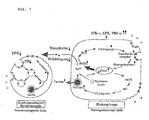
- hepcidin releases the iron from the Macrophages are regulated to the erythropoietic progenitor cells, with a increased hepcidin levels inhibit iron release.
- macrophages causes a high iron concentration an increase in induced nitric oxide synthetase. This induces cytokine production, which in turn causes chronic inflammation can trigger.
- chronic diseases for example characterized by functional iron deficiency, hemochromatosis, Diabetes, rheumatoid arthritis, arteriosclerosis, tumors or to diagnose kidney failure using the marker hepcidin.
- Hepcidin can be determined, for example, from serum, plasma or urine become. Preferably, a determination is made from serum.
- the reference values The measured variable hepcidin are for example in the range of about 0 to 1000 ng / ml, in particular 100 to 500 ng / ml.
- a particularly preferred Reference range is about 200 to 260 ng / ml.
- As limit can be at the Measurement any value used within the reference range be, for example, a value in the range of 0 to 1000 ng / ml.
- Prefers the threshold is a value between 100 and 500 ng / ml.
- hepcidin for example, with the hepcidin prohormone ELISA test performed by DRG, Marburg, Germany become.
- markers are determined which are suitable for the detection of inflammatory chronic diseases and / or non-inflammatory chronic diseases.
- markers are, for example, acute phase proteins, regulators of the synthesis of acute phase proteins, homocysteine, hs-CRP, SAA, C-reactive protein (CRP), serum amyloid A (SAA), ⁇ 1 -antichymotrypsin, acid ⁇ 1 -glycoprotein, ⁇ 1 -antitrypsin, haptoglobin, fibrinogen, complement component C3, complement component C4, ceruloplasmin, interleukin 6 (IL-6), leukemia inhibiting factor (LIF), oncostatin M, interleukin 11 (IL-11), Ciliary neurotropic factor (CNTF), interleukin 1 ⁇ (IL-1 ⁇ ), interleukin 1 ⁇ (IL-1 ⁇ ), tumor necrosis factor- ⁇ (TNF ⁇ ), tumor necrosis
- one or more other markers besides hepcidin can provide a more accurate and safer diagnostic assessment of a disease be guaranteed. This can be the mental and physical strain on affected patients through targeted therapies be reduced or eliminated even faster.
- the usage of several markers is particularly advantageous if at a Patients in addition to a chronic illness one or more others Diseases exist.
- inflammatory and / or non-inflammatory chronic diseases become.
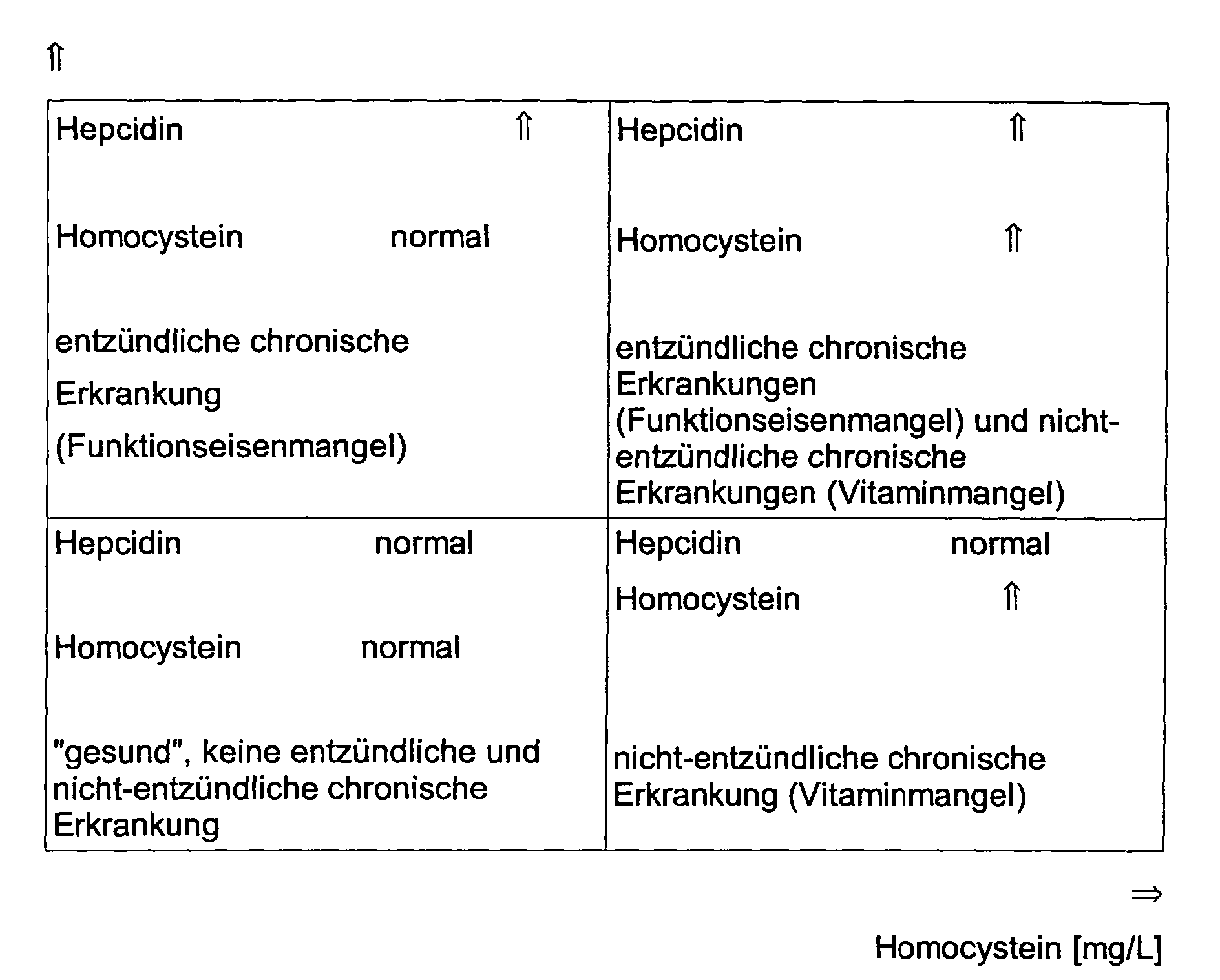
- an elevated hepcidin content shows the presence an inflammatory chronic disease
- an increased homocysteine content indicates a non-inflammatory chronic disease.
- Inflammatory chronic diseases caused by the inventive Can be detected, for example, hematochromatosis, Diabetes, rheumatoid arthritis, and other rheumatic diseases, Atherosclerosis, vasculitis, tumors, renal failure and systemic Lupus erythematosus.
- Non-inflammatory chronic diseases, which detected by the method according to the invention may be, for example, vitamin deficiencies, in particular B6, B12 and folate deficiency states, pellagra, fumicular spinal disease, Pseudoencephalitis, hemodegenerative diseases, e.g. Alzheimer and vascular diseases such as coronary artery disease or peripheral Arterial Disease.
- Homocysteine can be determined, for example, from serum, plasma or urine become. Preferably, a determination is made from serum.
- the reference values The measured variable homocysteine is preferably in the range of about 3 to 18 ⁇ mol / l, preferably about 5 to 15 ⁇ mol / l, in particular about 15 ⁇ mol / l.
- Limit can be any value within the reference range when measuring used, for example 12, 13, 14 or 15 ⁇ mol / l. More preferably, the limit value used is about 15 ⁇ mol / l.
- the following illustration illustrates a classification model based on the determination of hepcidin and homocysteine.
- hepcidin and homocysteine can in addition to hepcidin and homocysteine additionally one or more markers be used. Suitable markers are listed above.
- Examples of acute phase proteins which are used in the method according to the invention are preferably determined, are for example C-reactive protein (CRP), Serum amyloid A (SAA), ⁇ -1-antichymotrypsin, acid ⁇ 1-glycoprotein, ⁇ 1-antitrypsin, Haptoglobin, fibrinogen, the complement component C3, the Complement component C4 or / and coerroloplasmin.
- CRP C-reactive protein
- SAA Serum amyloid A
- ⁇ -1-antichymotrypsin acid ⁇ 1-glycoprotein
- ⁇ 1-antitrypsin Haptoglobin
- fibrinogen the complement component C3, the Complement component C4 or / and coerroloplasmin.
- regulators the synthesis of acute phase proteins are, for example, interleukin-6, the Leukemia Inhibition Factor (LEF), Oncostatin M, Interleukin 11, the ciliary neurotropic factor (CNTF), interleukin 1 ⁇ (IL-1 ⁇ ), interleukin 1 ⁇ (IL-1 ⁇ ), Tumor Necrosis Factor ⁇ (TNF ⁇ ), Tumor Necrosis Factor ⁇ (TNF ⁇ ), insulin, fibroblast growth factor, hepatocyte growth factor, the trans-growth factor ⁇ (TGF ⁇ ) or / and interferon.
- CRP, SAA, IL6, IL1 or / and TNF- ⁇ are determined.
- Particularly preferred in the method according to the invention is the acute phase protein C-reactive protein determined.
- Suitable reference values of the measurand C-reactive protein are, for example in the range of 7 to 13 mg / l, preferably about 8 to 12 mg / l, particularly preferably about 9 to 11 mg / l, in particular about 10 mg / l.
- Limit can be any value within the reference range when measuring used, for example 9, 10 or 11 mg / l. Especially Preferably, the limit value used is about 10 mg / l.
- hepcidin and an acute phase protein or / and a regulator of the synthesis of acute phase proteins advantageously allows between the presence of an inflammatory chronic Disease and / or a temporary acute-phase reaction to distinguish.
- an elevated hepcidin content is an indication of the presence an inflammatory chronic disease
- an elevated level of a Acute phase protein and / or a regulator of the synthesis of acute phase proteins indicates the presence of a temporary acute phase reaction.
- the following illustration illustrates a classification model based on the determination of hepcidin and C-reactive protein (CRP).
- hepcidin and an acute phase protein and / or a regulator the synthesis of acute phase proteins additionally one or more markers be used. Suitable markers are listed above.
- a patient classified in group a) does not have one chronic disease still needs an acute-phase response and is needed no further therapy.
- An inflammatory chronic disease or an acute phase reaction is not available.
- Possible diseases which are, for example, B vitamin deficiency diseases of the Nervous system, e.g. fumicular spinal disease or pseudoencephalitis, Pellagra, neurodegenerative diseases such as Alzheimer's disease, or vascular disorders, e.g. coronary heart disease, or arterial diseases.
- a patient classified in group c) suffers from an inflammatory condition chronic disease and has an acute-phase response on.
- a non-inflammatory chronic disease is in this patient not before.
- Possible diseases which may be considered are e.g. Pancreatitis, hepatitis, rheumatic diseases, systemic lupus erythematosus or vasculitis.
- a patient classified in group d) has an inflammatory chronic illness on.
- An acute phase reaction or a non-inflammatory one chronic disease is not present.
- ACD chronic disease anemia
- a patient classified in group e) has a non-inflammatory chronic illness and an acute-phase reaction to. There is no inflammatory chronic disease.
- a patient classified in group g) has both a non-inflammatory chronic disease as well as an inflammatory chronic illness and an acute-phase reaction to.
- a patient classified in group h) has both non-inflammatory as well as an inflammatory chronic disease, however no acute-phase reaction to.
- the method according to the invention can determines one or more other markers for said parameters become. Preference is given, for example, to holotranscobalamin II, methylmalonic acid, Cystathionine, acute phase proteins, regulators of the synthesis of Acute phase proteins, transferin, soluble transferin receptor (sTfR), Ferritin, creatinine, hemoglobin, blood glucose, triglycerides, cholesterol, zinc, Protoporphyrin, myoglobin, hemosiderin, catalase, peroxidase and cytochrome certainly.
- other, used in the field Markers are used. By a combination of the invention Marker with further markers, it is advantageously possible, a very wide Spectrum of different diseases in one diagnostic step identify.
- the inventive method advantageously also allows a Differential diagnosis.
- a differential diagnosis is aimed at the Differentiation and identification of one or more specific diseases Within a group, symptoms are more similar or even more consistent Diseases.
- the inventive Method a delineation or identification of inflammatory chronic diseases, non-inflammatory chronic diseases and acute-phase reactions, which often have very similar symptoms have carried out.
- the method according to the present invention may be described in Combination with other diagnostic or differential diagnostic procedures be used. Particularly preferred is, for example, the Combination of the method according to the invention with a test for the determination of iron metabolism disorders and / or vitamin disorders. in this connection are preferred disorders of vitamin B6, vitamin B12 and folic acid certainly. Thus, advantageously not only the disease itself, but in many cases also the cause of the disease, for example a vitamin deficiency, are determined in a diagnostic step.
- Hepcidin prohormone a new marker in the diagnosis of iron metabolism disorders group Age [years] n medium Hepcidin [G / L] CRP [mg / L] sTfR [mg / L] Ferritin [ ⁇ g / L] women 50-59 48 141 1.7 3.2 70 60-69 64 125 1.7 3.2 90 70-80 28 121 2.0 3.2 89 Hormone therapy 37 123 1.8 2.8 94 No hormone therapy 105 136 1.9 3.3 77 Men 50-59 56 140 1.4 3.0 166 60-69 60 139 1.5 3.3 188 70-80 28 138 2.2 3.3 198
- hepcidin is a marker of the amount of circulating Iron is.
- the amount of circulating iron is too high (sTfR ⁇ 4 mg / L, ferritin> 100 ⁇ g / L)
- hepcidin is released. (> 300 ⁇ g / l).
- the amount of circulating iron is too low (sTfR> 4 mg / l, Ferritin ⁇ 30 ⁇ g / L), hepcidin expression is stopped.
Landscapes
- Life Sciences & Earth Sciences (AREA)
- Health & Medical Sciences (AREA)
- Engineering & Computer Science (AREA)
- Molecular Biology (AREA)
- Chemical & Material Sciences (AREA)
- Biomedical Technology (AREA)
- Urology & Nephrology (AREA)
- Hematology (AREA)
- Immunology (AREA)
- Cell Biology (AREA)
- Analytical Chemistry (AREA)
- Biotechnology (AREA)
- Proteomics, Peptides & Aminoacids (AREA)
- Food Science & Technology (AREA)
- Medicinal Chemistry (AREA)
- Physics & Mathematics (AREA)
- Microbiology (AREA)
- Biochemistry (AREA)
- General Health & Medical Sciences (AREA)
- General Physics & Mathematics (AREA)
- Pathology (AREA)
- Investigating Or Analysing Biological Materials (AREA)
- Medicines Containing Antibodies Or Antigens For Use As Internal Diagnostic Agents (AREA)
- Polysaccharides And Polysaccharide Derivatives (AREA)
Abstract
Description

| Hepcidin-Prohormon, ein neuer Marker in der Diagnose von Eisenstoffwechselstörungen | ||||||
| Gruppe | Alter [Jahre] | n | Mittel | |||
| Hepcidin [µg/L] | CRP [mg/L] | sTfR [mg/L] | Ferritin [µg/L] | |||
| Frauen | 50-59 | 48 | 141 | 1.7 | 3.2 | 70 |
| 60-69 | 64 | 125 | 1.7 | 3.2 | 90 | |
| 70-80 | 28 | 121 | 2.0 | 3.2 | 89 | |
| Hormontherapie | 37 | 123 | 1.8 | 2.8 | 94 | |
| Keine Hormontherapie | 105 | 136 | 1.9 | 3.3 | 77 | |
| Männer | 50-59 | 56 | 140 | 1.4 | 3.0 | 166 |
| 60-69 | 60 | 139 | 1.5 | 3.3 | 188 | |
| 70-80 | 28 | 138 | 2.2 | 3.3 | 198 |
| Hepcidin, erwarteter Normalbereich | < 100-300 µg/l |
| sTfR/log Ferritin bei Patienten mit Eisenmangel (w,m) | 0,9 |
| sTfR/log Ferritin bei Patienten mit Eisenüberladung (w,m) | 3,7 und 3,4 |
| sTfR bei Patienten mit Eisenmangel (w,m) | 4,4 und 5 mg/l |
| Ferritin bei Patienten mit Eisenmangel (w,m) | 15 und 30 µg/l |
| Ferritin bei Patienten mit Eisenüberladung (w,m) | 150 und 400 µg/l |
| CRP bei Patienten mit anhaltender Akut-Phase-Reaktion | > 5 mg/l |


Claims (14)
- Verwendung von Hepcidin als Marker zum Nachweis von entzündlichen chronischen Erkrankungen.
- Verwendung von Hepcidin als Marker bei der Differenzialdiagnostik zum Nachweis von entzündlichen chronischen Erkrankungen oder/und nicht-entzündlichen chronischen Erkrankungen.
- Verwendung nach Anspruch 1 oder 2, worin ein oder mehrere weitere Marker eingesetzt werden.
- Verfahren zum Nachweis von chronischen Erkrankungen, umfassend die Bestimmung voni) Hepcidin undii) Homocystein.
- Verfahren nach Anspruch 4, worin entzündliche oder/und nicht-entzündliche chronische Erkrankungen nachgewiesen werden.
- Verfahren nach Anspruch 5, dadurch gekennzeichnet, dass eine Klassifizierung in die folgenden Gruppen erfolgt:a) keine chronische Erkrankung,b) entzündliche chronische Erkrankung,c) nicht-entzündliche chronische Erkrankung undd) sowohl entzündliche chronische Erkrankung als auch nicht- entzündliche chronische Erkrankung.
- Verfahren zum Nachweis von entzündlichen chronischen Erkrankungen oder/und Akut-Phase-Reaktionen, umfassend die Bestimmung voni) Hepcidin undiii) einem Akut-Phase-Protein oder/und einem Regulator der Synthese von Akut-Phase-Proteinen.
- Verfahren nach Anspruch 7, worin das Akut-Phase-Protein C-reaktives Protein ist.
- Verfahren nach Anspruch 8, dadurch gekennzeichnet, dass eine Klassifizierung in die folgenden Gruppen erfolgt:a) keine Akut-Phase-Reaktion, keine entzündliche chronische Er krankung,b) entzündliche chronische Erkrankung mit Akut-Phase-Reaktion, undc) Akut-Phase-Reaktion, keine entzündliche chronische Erkrankung undd) entzündliche chronische Erkrankung, keine Akut-Phase-Reaktion.
- Verfahren nach einem der Ansprüche 4 bis 9, umfassend die Bestimmung voni) Hepcidin,ii) Homocystein undiii) einem Akut-Phase-Protein oder/und einem Regulator der Synthese von Akut-Phase-Proteinen.
- Verfahren nach Anspruch 10, worin eine Klassifizierung in die folgenden Gruppen erfolgt:a) weder nicht-entzündliche noch entzündliche chronische Erkrankung, keine Akut-Phase-Reaktion,b) nicht-entzündliche chronische Erkrankung, (keine entzündliche chronische Erkrankung, keine Akut-Phase-Reaktion),c) entzündliche chronische Erkrankung und Akut-Phase-Reaktion, (keine nicht-entzündliche chronische Erkrankung),d) entzündliche chronische Erkrankung (keine Akut-Phase-Reaktion, keine nicht-entzündliche chronische Erkrankung),e) nicht-entzündliche chronische Erkrankung und Akut-Phase-Reaktion, (keine entzündliche chronische Erkrankung),f) Akut-Phase-Reaktion (weder nicht-entzündliche noch entzündliche chronische Erkrankung),g) nicht-entzündliche chronische Erkrankung und entzündliche chronische Erkrankung und Akut-Phase-Reaktion,h) nicht-entzündliche chronische Erkrankung und entzündliche chronische Erkrankung (keine Akut-Phase-Reaktion).
- Verfahren nach einem der Ansprüche 4 bis 11, dadurch gekennzeichnet, dass ein oder mehrere weitere Marker bestimmt werden, ausgewählt aus Holotranscobalamin II, Methylmalonsäure, Cystathionin, Akut-Phase-Proteinen, Regulatoren der Synthese von Akut-Phase-Proteinen, Transferin, löslichem Transferinrezeptor (sTfR), Ferritin, Creatinin, Hämoglobin, Blutglucose, Triglyceride, Cholesterin, Zink, Protoporphyrin, Myoglobin, Hämosiderin, Katalase, Peroxidase und Cytochrom.
- Verfahren nach einem der Ansprüche 4 bis 12, dadurch gekennzeichnet, dass eine Differenzialdiagnostik durchgeführt wird.
- Verwendung eines Verfahrens nach einem der Ansprüche 4 bis 13 in Kombination mit einem Test zur Bestimmung von Eisenstoffwechselstörungen oder/und Vitaminstörungen.
Applications Claiming Priority (2)
| Application Number | Priority Date | Filing Date | Title |
|---|---|---|---|
| DE10349124A DE10349124A1 (de) | 2003-10-22 | 2003-10-22 | Differenzialdiagnostik mit Hepcidin |
| DE10349124 | 2003-10-22 |
Publications (3)
| Publication Number | Publication Date |
|---|---|
| EP1566448A2 true EP1566448A2 (de) | 2005-08-24 |
| EP1566448A3 EP1566448A3 (de) | 2006-02-01 |
| EP1566448B1 EP1566448B1 (de) | 2009-03-25 |
Family
ID=34442197
Family Applications (1)
| Application Number | Title | Priority Date | Filing Date |
|---|---|---|---|
| EP04025211A Expired - Lifetime EP1566448B1 (de) | 2003-10-22 | 2004-10-22 | Differenzialdiagnostik mit Hepcidin |
Country Status (7)
| Country | Link |
|---|---|
| US (1) | US7416857B2 (de) |
| EP (1) | EP1566448B1 (de) |
| JP (1) | JP3939324B2 (de) |
| AT (1) | ATE426675T1 (de) |
| CA (1) | CA2485718A1 (de) |
| DE (2) | DE10349124A1 (de) |
| ES (1) | ES2322149T3 (de) |
Families Citing this family (13)
| Publication number | Priority date | Publication date | Assignee | Title |
|---|---|---|---|---|
| US20060094064A1 (en) * | 2003-11-19 | 2006-05-04 | Sandip Ray | Methods and compositions for diagnosis, stratification, and monitoring of alzheimer's disease and other neurological disorders in body fluids |
| EP2498096A1 (de) * | 2006-07-21 | 2012-09-12 | Amgen Inc. | Verfahren zum Erkennen und/oder Messen von Hepcidin in einer Probe |
| US20110053268A1 (en) * | 2006-10-17 | 2011-03-03 | Naohisa Tomosugi | Method for diagnosis of abnormal iron metabolism using active hepcidin as indicator |
| PE20130588A1 (es) * | 2007-02-02 | 2013-05-21 | Amgen Inc | Hepcidina, antagonistas de la hepcidina y metodos de uso |
| US8313950B2 (en) * | 2007-05-21 | 2012-11-20 | The Ohio State University Research Foundation | Hepcidins as biomarkers for impending lupus nephritis flare |
| US8187827B2 (en) * | 2007-05-31 | 2012-05-29 | Naohisa Tomosugi | Diagnostic methods for acute ischemic disease using activated hepcidin as an indicator |
| US20100292131A1 (en) * | 2007-11-16 | 2010-11-18 | Pronota N.V. | Biomarkers and methods for diagnosing, predicting and/or prognosing sepsis and uses thereof |
| WO2009139822A1 (en) | 2008-05-01 | 2009-11-19 | Amgen Inc. | Anti-hepcidin antibodies and methods of use |
| US20100068737A1 (en) * | 2008-09-16 | 2010-03-18 | University Of Tennessee Research Foundation | Enzyme-linked Immunosorbent Assay (ELISA) for Canine Hepcidin |
| EP2364370B1 (de) * | 2008-11-22 | 2014-09-03 | Astute Medical, Inc. | Verfahren zur prognose von akuter niereninsuffizienz |
| US20110059080A1 (en) * | 2009-09-08 | 2011-03-10 | Mark Cornfeld | Use of an anti-il6 antibody to decrease hepcidin in cancer patients |
| BR112017005730B1 (pt) | 2014-09-26 | 2023-12-12 | Somalogic Operating Co., Inc | Método para triagem de um indivíduo quanto ao risco de um evento cardiovascular ou para predizer a probabilidade que um indivíduo tenha tal evento |
| KR20230035082A (ko) * | 2020-07-02 | 2023-03-10 | 탐페레 유니버시티 파운데이션 에스알 | 헵시딘의 레닌-기반 분석 |
Family Cites Families (4)
| Publication number | Priority date | Publication date | Assignee | Title |
|---|---|---|---|---|
| JP2002514170A (ja) | 1996-07-30 | 2002-05-14 | エナージェティクス,インコーポレイティド | 食品補充物 |
| EP2186524B1 (de) | 2001-05-25 | 2018-02-21 | Institut National De La Sante Et De La Recherche Medicale (Inserm) | Verwendung von Hepcidin als ein Regler der Eisenhomöostase |
| WO2003025583A2 (en) | 2001-09-14 | 2003-03-27 | F. Hoffmann-La Roche Ag | Differential diagnosis of disorders of iron metabolism |
| EP1578254B1 (de) | 2002-11-19 | 2013-03-06 | DRG International, Inc. | Diagnoseverfahren für erkrankungen durchuntersuchung auf hepcidin in menschlichem oder tierischem gewebe, blut oderkörperflüssigkeiten und therapeutische anwendungen dafür |
-
2003
- 2003-10-22 DE DE10349124A patent/DE10349124A1/de not_active Withdrawn
-
2004
- 2004-10-21 CA CA002485718A patent/CA2485718A1/en not_active Abandoned
- 2004-10-22 JP JP2004308059A patent/JP3939324B2/ja not_active Expired - Fee Related
- 2004-10-22 DE DE502004009217T patent/DE502004009217D1/de not_active Expired - Lifetime
- 2004-10-22 EP EP04025211A patent/EP1566448B1/de not_active Expired - Lifetime
- 2004-10-22 ES ES04025211T patent/ES2322149T3/es not_active Expired - Lifetime
- 2004-10-22 AT AT04025211T patent/ATE426675T1/de active
- 2004-10-22 US US10/972,101 patent/US7416857B2/en not_active Expired - Fee Related
Non-Patent Citations (7)
| Title |
|---|
| MORGENSTERN, DIGESTIVE DISEASES AND SCIENCES, vol. 48, no. 10, 2003 |
| NEMETH ET AL., BLOOD, vol. 101, no. 7, 2003 |
| NICOLAS ET AL., BLOOD CELLS, MOLECULES AND DISEASES, vol. 29, no. 3, 2002, pages 327 - 335 |
| NICOLAS, THE JOURNAL OF CLINICAL INVESTIGATION, vol. 110, no. 7, 2002 |
| PARK ET AL., J. BIOL. CHEM., vol. 276, no. 11, 2001, pages 7806 - 7810 |
| ROETTO ANTONELLO, NATURE GENETICS, vol. 33, no. 1, 2003 |
| WEINSTEIN ET AL., BLOOD, vol. 100, no. 10, 2002 |
Also Published As
| Publication number | Publication date |
|---|---|
| CA2485718A1 (en) | 2005-04-22 |
| EP1566448A3 (de) | 2006-02-01 |
| ATE426675T1 (de) | 2009-04-15 |
| JP3939324B2 (ja) | 2007-07-04 |
| DE502004009217D1 (de) | 2009-05-07 |
| EP1566448B1 (de) | 2009-03-25 |
| US20050148025A1 (en) | 2005-07-07 |
| ES2322149T3 (es) | 2009-06-17 |
| US7416857B2 (en) | 2008-08-26 |
| DE10349124A1 (de) | 2005-05-19 |
| JP2005134387A (ja) | 2005-05-26 |
Similar Documents
| Publication | Publication Date | Title |
|---|---|---|
| DE69229737T2 (de) | Gerät zur Ermittlung des Zustands der Lunge | |
| Anita et al. | Inflammatory markers in type 2 diabetes with vs. without cognitive impairment; a systematic review and meta-analysis | |
| EP1566448B1 (de) | Differenzialdiagnostik mit Hepcidin | |
| Groover et al. | Exercise-mediated improvements in painful neuropathy associated with prediabetes in mice | |
| Mitchell et al. | Stability of cerebrospinal fluid pH in chronic acid-base disturbances in blood | |
| DE2905807C2 (de) | ||
| DE69121561T2 (de) | Verwendung von 3-guanidinopropionsäure zur herstellung eines medikaments zur behandlung und prävention von fettsucht | |
| DE60223931T2 (de) | Differentialdiagnose von störungen vom eisenmetabolismus | |
| DE60024240T2 (de) | Vorhersagen ueber von diabetes beeintraechtigte wundheilung | |
| Sylvia et al. | The effect of age and lung pathology on cytochrome a, a3 redox levels in rat cerebral cortex | |
| DE102012109419A1 (de) | Verfahren zur Ermittlung von den 23Na+-Gehalt beschreibenden Natriumwerten und Lokalspule | |
| DE3789310T2 (de) | Verfahren zur feststellung der entwicklungsgeschichte eines körperzustandes aus einer einzigen blutprobe. | |
| DE69427711T2 (de) | Verfahren zur hemmung der stickstoffoxidbildung | |
| EP0329961A2 (de) | Verwendung von 2-Oxo-pyrrolidin-1-acetamid zur Bestimmung der glomerulären Filtrationsrate beim Menschen | |
| DE69017673T2 (de) | Verminderung von post-prandial grossen neutralen aminosäureplasmakonzentrationen. | |
| EP1269213A2 (de) | Verfahren zur esr-spektroskopischen bestimmung von veränderungen der transporteigenschaften des albumins in einer albuminhaltigen probe, esr-spektrometer zur durchführung des verfahrens und einsatz des verfahrens zur diagnose und zur kontrolle albuminhaltiger präparate | |
| Jösch et al. | Urin-Arylamidase | |
| EP0337467B1 (de) | Verfahren zur Bestimmung von Thyroxin und dazu geeignete Standardlösung | |
| EP1601975A1 (de) | Differenzialdiagnostik und monitoring von vitamin b12-, vitamin b6- und fols ure-st rungen | |
| EP0351790B1 (de) | Verfahren zur Bestimmung von Fructosamin | |
| EP0583717B1 (de) | Verfahren und Standardlösung zur Bestimmung von Thyroxin (T4) oder Trijodthyronin (T3) | |
| EP0349987B1 (de) | Fructosamin-Calibrator | |
| Al Samarraı et al. | Evaluation Of Hepcidin And Iron Concentrations With Liver And Kidney Functions In Beta-Thalassemia Patients | |
| DE102025129049A1 (de) | Verfahren zur messung der zerebralen vaskulären reaktivität unter verwendung von hypoxie als vasoaktivem mittel | |
| EP1761777B1 (de) | Sepsisdiagnosetest |
Legal Events
| Date | Code | Title | Description |
|---|---|---|---|
| PUAI | Public reference made under article 153(3) epc to a published international application that has entered the european phase |
Free format text: ORIGINAL CODE: 0009012 |
|
| AK | Designated contracting states |
Kind code of ref document: A2 Designated state(s): AT BE BG CH CY CZ DE DK EE ES FI FR GB GR HU IE IT LI LU MC NL PL PT RO SE SI SK TR |
|
| AX | Request for extension of the european patent |
Extension state: AL HR LT LV MK |
|
| PUAL | Search report despatched |
Free format text: ORIGINAL CODE: 0009013 |
|
| AK | Designated contracting states |
Kind code of ref document: A3 Designated state(s): AT BE BG CH CY CZ DE DK EE ES FI FR GB GR HU IE IT LI LU MC NL PL PT RO SE SI SK TR |
|
| AX | Request for extension of the european patent |
Extension state: AL HR LT LV MK |
|
| 17P | Request for examination filed |
Effective date: 20060310 |
|
| AKX | Designation fees paid |
Designated state(s): AT BE BG CH CY CZ DE DK EE ES FI FR GB GR HU IE IT LI LU MC NL PL PT RO SE SI SK TR |
|
| GRAP | Despatch of communication of intention to grant a patent |
Free format text: ORIGINAL CODE: EPIDOSNIGR1 |
|
| GRAP | Despatch of communication of intention to grant a patent |
Free format text: ORIGINAL CODE: EPIDOSNIGR1 |
|
| GRAS | Grant fee paid |
Free format text: ORIGINAL CODE: EPIDOSNIGR3 |
|
| GRAA | (expected) grant |
Free format text: ORIGINAL CODE: 0009210 |
|
| AK | Designated contracting states |
Kind code of ref document: B1 Designated state(s): AT BE BG CH CY CZ DE DK EE ES FI FR GB GR HU IE IT LI LU MC NL PL PT RO SE SI SK TR |
|
| REG | Reference to a national code |
Ref country code: GB Ref legal event code: FG4D Free format text: NOT ENGLISH |
|
| REG | Reference to a national code |
Ref country code: CH Ref legal event code: EP |
|
| REG | Reference to a national code |
Ref country code: IE Ref legal event code: FG4D Free format text: LANGUAGE OF EP DOCUMENT: GERMAN |
|
| REF | Corresponds to: |
Ref document number: 502004009217 Country of ref document: DE Date of ref document: 20090507 Kind code of ref document: P |
|
| REG | Reference to a national code |
Ref country code: ES Ref legal event code: FG2A Ref document number: 2322149 Country of ref document: ES Kind code of ref document: T3 |
|
| PG25 | Lapsed in a contracting state [announced via postgrant information from national office to epo] |
Ref country code: FI Free format text: LAPSE BECAUSE OF FAILURE TO SUBMIT A TRANSLATION OF THE DESCRIPTION OR TO PAY THE FEE WITHIN THE PRESCRIBED TIME-LIMIT Effective date: 20090325 Ref country code: SI Free format text: LAPSE BECAUSE OF FAILURE TO SUBMIT A TRANSLATION OF THE DESCRIPTION OR TO PAY THE FEE WITHIN THE PRESCRIBED TIME-LIMIT Effective date: 20090325 |
|
| PG25 | Lapsed in a contracting state [announced via postgrant information from national office to epo] |
Ref country code: SE Free format text: LAPSE BECAUSE OF FAILURE TO SUBMIT A TRANSLATION OF THE DESCRIPTION OR TO PAY THE FEE WITHIN THE PRESCRIBED TIME-LIMIT Effective date: 20090625 Ref country code: PL Free format text: LAPSE BECAUSE OF FAILURE TO SUBMIT A TRANSLATION OF THE DESCRIPTION OR TO PAY THE FEE WITHIN THE PRESCRIBED TIME-LIMIT Effective date: 20090325 |
|
| NLV1 | Nl: lapsed or annulled due to failure to fulfill the requirements of art. 29p and 29m of the patents act | ||
| REG | Reference to a national code |
Ref country code: IE Ref legal event code: FD4D |
|
| PG25 | Lapsed in a contracting state [announced via postgrant information from national office to epo] |
Ref country code: PT Free format text: LAPSE BECAUSE OF FAILURE TO SUBMIT A TRANSLATION OF THE DESCRIPTION OR TO PAY THE FEE WITHIN THE PRESCRIBED TIME-LIMIT Effective date: 20090901 Ref country code: EE Free format text: LAPSE BECAUSE OF FAILURE TO SUBMIT A TRANSLATION OF THE DESCRIPTION OR TO PAY THE FEE WITHIN THE PRESCRIBED TIME-LIMIT Effective date: 20090325 Ref country code: CZ Free format text: LAPSE BECAUSE OF FAILURE TO SUBMIT A TRANSLATION OF THE DESCRIPTION OR TO PAY THE FEE WITHIN THE PRESCRIBED TIME-LIMIT Effective date: 20090325 |
|
| PG25 | Lapsed in a contracting state [announced via postgrant information from national office to epo] |
Ref country code: SK Free format text: LAPSE BECAUSE OF FAILURE TO SUBMIT A TRANSLATION OF THE DESCRIPTION OR TO PAY THE FEE WITHIN THE PRESCRIBED TIME-LIMIT Effective date: 20090325 Ref country code: RO Free format text: LAPSE BECAUSE OF FAILURE TO SUBMIT A TRANSLATION OF THE DESCRIPTION OR TO PAY THE FEE WITHIN THE PRESCRIBED TIME-LIMIT Effective date: 20090325 Ref country code: NL Free format text: LAPSE BECAUSE OF FAILURE TO SUBMIT A TRANSLATION OF THE DESCRIPTION OR TO PAY THE FEE WITHIN THE PRESCRIBED TIME-LIMIT Effective date: 20090325 |
|
| PG25 | Lapsed in a contracting state [announced via postgrant information from national office to epo] |
Ref country code: IE Free format text: LAPSE BECAUSE OF FAILURE TO SUBMIT A TRANSLATION OF THE DESCRIPTION OR TO PAY THE FEE WITHIN THE PRESCRIBED TIME-LIMIT Effective date: 20090325 Ref country code: DK Free format text: LAPSE BECAUSE OF FAILURE TO SUBMIT A TRANSLATION OF THE DESCRIPTION OR TO PAY THE FEE WITHIN THE PRESCRIBED TIME-LIMIT Effective date: 20090325 Ref country code: BG Free format text: LAPSE BECAUSE OF FAILURE TO SUBMIT A TRANSLATION OF THE DESCRIPTION OR TO PAY THE FEE WITHIN THE PRESCRIBED TIME-LIMIT Effective date: 20090625 |
|
| PLBE | No opposition filed within time limit |
Free format text: ORIGINAL CODE: 0009261 |
|
| STAA | Information on the status of an ep patent application or granted ep patent |
Free format text: STATUS: NO OPPOSITION FILED WITHIN TIME LIMIT |
|
| 26N | No opposition filed |
Effective date: 20091229 |
|
| BERE | Be: lapsed |
Owner name: F.HOFFMANN-LA ROCHE A.G. Effective date: 20091031 Owner name: ROCHE DIAGNOSTICS G.M.B.H. Effective date: 20091031 |
|
| PG25 | Lapsed in a contracting state [announced via postgrant information from national office to epo] |
Ref country code: MC Free format text: LAPSE BECAUSE OF NON-PAYMENT OF DUE FEES Effective date: 20091031 |
|
| PG25 | Lapsed in a contracting state [announced via postgrant information from national office to epo] |
Ref country code: BE Free format text: LAPSE BECAUSE OF NON-PAYMENT OF DUE FEES Effective date: 20091031 Ref country code: GR Free format text: LAPSE BECAUSE OF FAILURE TO SUBMIT A TRANSLATION OF THE DESCRIPTION OR TO PAY THE FEE WITHIN THE PRESCRIBED TIME-LIMIT Effective date: 20090626 |
|
| PG25 | Lapsed in a contracting state [announced via postgrant information from national office to epo] |
Ref country code: LU Free format text: LAPSE BECAUSE OF NON-PAYMENT OF DUE FEES Effective date: 20091022 |
|
| PG25 | Lapsed in a contracting state [announced via postgrant information from national office to epo] |
Ref country code: HU Free format text: LAPSE BECAUSE OF FAILURE TO SUBMIT A TRANSLATION OF THE DESCRIPTION OR TO PAY THE FEE WITHIN THE PRESCRIBED TIME-LIMIT Effective date: 20090926 |
|
| PG25 | Lapsed in a contracting state [announced via postgrant information from national office to epo] |
Ref country code: TR Free format text: LAPSE BECAUSE OF FAILURE TO SUBMIT A TRANSLATION OF THE DESCRIPTION OR TO PAY THE FEE WITHIN THE PRESCRIBED TIME-LIMIT Effective date: 20090325 |
|
| PG25 | Lapsed in a contracting state [announced via postgrant information from national office to epo] |
Ref country code: CY Free format text: LAPSE BECAUSE OF FAILURE TO SUBMIT A TRANSLATION OF THE DESCRIPTION OR TO PAY THE FEE WITHIN THE PRESCRIBED TIME-LIMIT Effective date: 20090325 |
|
| PGFP | Annual fee paid to national office [announced via postgrant information from national office to epo] |
Ref country code: GB Payment date: 20130925 Year of fee payment: 10 |
|
| PGFP | Annual fee paid to national office [announced via postgrant information from national office to epo] |
Ref country code: FR Payment date: 20130924 Year of fee payment: 10 Ref country code: CH Payment date: 20131029 Year of fee payment: 10 Ref country code: DE Payment date: 20131031 Year of fee payment: 10 Ref country code: AT Payment date: 20130925 Year of fee payment: 10 |
|
| PGFP | Annual fee paid to national office [announced via postgrant information from national office to epo] |
Ref country code: IT Payment date: 20131018 Year of fee payment: 10 Ref country code: ES Payment date: 20131011 Year of fee payment: 10 |
|
| REG | Reference to a national code |
Ref country code: DE Ref legal event code: R119 Ref document number: 502004009217 Country of ref document: DE |
|
| REG | Reference to a national code |
Ref country code: CH Ref legal event code: PL |
|
| REG | Reference to a national code |
Ref country code: AT Ref legal event code: MM01 Ref document number: 426675 Country of ref document: AT Kind code of ref document: T Effective date: 20141022 |
|
| GBPC | Gb: european patent ceased through non-payment of renewal fee |
Effective date: 20141022 |
|
| PG25 | Lapsed in a contracting state [announced via postgrant information from national office to epo] |
Ref country code: DE Free format text: LAPSE BECAUSE OF NON-PAYMENT OF DUE FEES Effective date: 20150501 Ref country code: GB Free format text: LAPSE BECAUSE OF NON-PAYMENT OF DUE FEES Effective date: 20141022 Ref country code: CH Free format text: LAPSE BECAUSE OF NON-PAYMENT OF DUE FEES Effective date: 20141031 Ref country code: LI Free format text: LAPSE BECAUSE OF NON-PAYMENT OF DUE FEES Effective date: 20141031 |
|
| REG | Reference to a national code |
Ref country code: FR Ref legal event code: ST Effective date: 20150630 |
|
| PG25 | Lapsed in a contracting state [announced via postgrant information from national office to epo] |
Ref country code: FR Free format text: LAPSE BECAUSE OF NON-PAYMENT OF DUE FEES Effective date: 20141031 Ref country code: AT Free format text: LAPSE BECAUSE OF NON-PAYMENT OF DUE FEES Effective date: 20141022 Ref country code: IT Free format text: LAPSE BECAUSE OF NON-PAYMENT OF DUE FEES Effective date: 20141022 |
|
| REG | Reference to a national code |
Ref country code: ES Ref legal event code: FD2A Effective date: 20160105 |
|
| PG25 | Lapsed in a contracting state [announced via postgrant information from national office to epo] |
Ref country code: ES Free format text: LAPSE BECAUSE OF NON-PAYMENT OF DUE FEES Effective date: 20141023 |